Andrea del Sarto’s journey to France in 1518 has acquired a special place in accounts of his career. John Shearman treated that year as the beginning of Andrea’s ‘heroic period’, while Jan Sammer’s recent reconstruction of the painter’s movements has given the French episode a much firmer documentary basis than it previously possessed. Andrea’s service to François I can now be followed through financial records, court movements and diplomatic correspondence with a degree of precision that earlier scholars did not have. Sammer has used that reconstruction to argue that Andrea saw major finished works by Leonardo and Raphael at the French court and that these encounters affected his subsequent painting.
It would nevertheless be misleading to make France the beginning of Andrea’s relationship with either artist. Earlier scholarship had placed Leonardo and Raphael firmly within his development before 1518. Iris H. Cheney, reviewing the monographs of Sydney J. Freedberg and Shearman, noted that both scholars regarded Leonardo as an important presence in Andrea’s work after about 1511, even though they differed over the balance of influences involved. Freedberg emphasised Leonardesque psychological animation and sfumato within a broader High Renaissance vocabulary, while Shearman allowed a more mixed field of sources. Cheney herself argued that Shearman had underestimated Raphael’s contribution and that Raphaelesque ideas had been absorbed into Andrea’s artistic personality before the French journey.
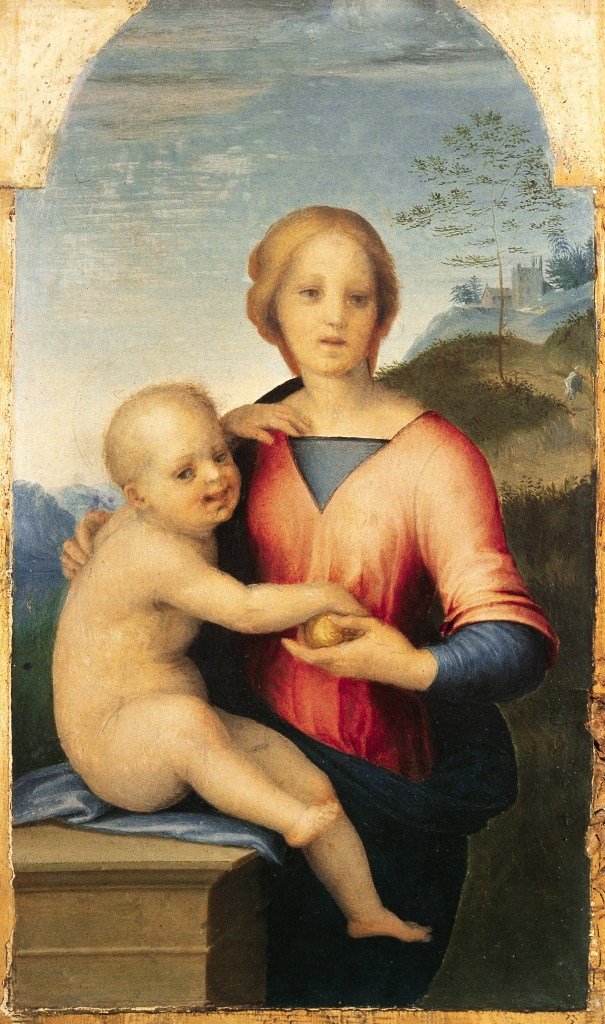
The surviving work supports that qualification. A small Virgin and Child in the Galleria Corsini, part of the Galleria Nazionale d’Arte Antica in Rome, generally dated to about 1507, belongs to Andrea’s earliest independent phase. Roberto Longhi regarded it as one of his most clearly Raphaelesque early paintings, and the Natali/Cecchi catalogue likewise relates its conception to the Madonnas Raphael had painted in Florence. Andrea does not repeat a Raphaelesque formula so much as absorb a way of organising the emotional exchange between mother and child. The relationship between the figures is softened and made more intimate, but the underlying conception is already part of his pictorial language.
Andrea del Sarto, Virgin and Child, c. 1507–10, Galleria Nazionale d’Arte Antica, Palazzo Corsini, Rome. Photograph: Justanarthistorian2015, via Wikimedia Commons, CC BY 4.0.
Other evidence points in the same direction. Andrea had studied prestigious models from an early stage, and Vasari placed him among the young Florentine artists who spent long periods drawing from the works available to them, including the cartoons for Michelangelo’s Battle of Cascina and Leonardo’s Battle of Anghiari. Cordellier has stressed that such study belonged to a wider Florentine culture in which copying and reworking the work of other artists formed part of artistic formation.
Raphael had become one of those models well before the French journey. Cordellier traces his presence through a number of early Madonnas, where Andrea simplified or modified Raphaelesque constructions rather than reproducing them literally. In the Corsini Madonna and the Madonna of Humility, Andrea drew upon Raphael’s Florentine inventions while adjusting their clarity and emotional register. By the middle of the decade, the borrowings had become less overt.
Leonardo’s presence was equally well established before 1518. Sammer does not deny this. He allows that Andrea may have encountered aspects of the standing Leda while Leonardo was still connected with Florence, and he accepts that Leonardesque ideas were already available within Andrea’s artistic world. His argument is more precise: the French journey may have altered the conditions of access. What Andrea had previously known through drawings, earlier inventions, discussion or indirect transmission could now be encountered in the form of specific finished paintings.
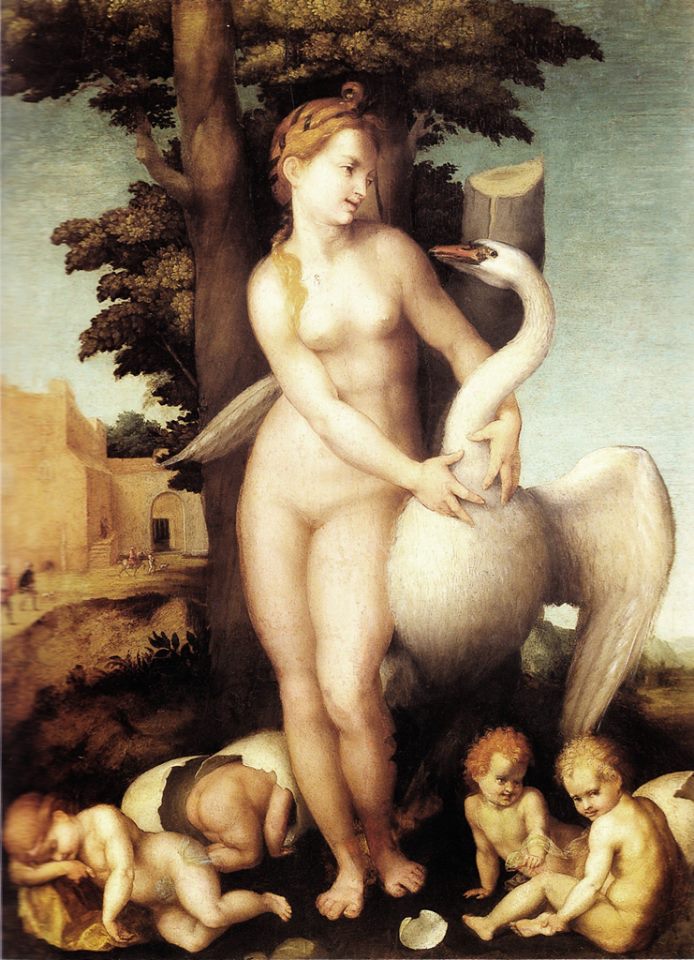
After Leonardo da Vinci, Leda and the Swan, before 1517, tempera on panel, 115 × 86 cm, Galleria Borghese, Rome, after Leonardo’s lost original. Image via Wikimedia Commons, Public Domain.
France enters the story not as a point of discovery, but as a possible change in the character of Andrea’s contact with Leonardo and Raphael. By 1518, both artists had helped to shape his visual language. The question is what happened when that long-standing engagement became attached to particular works that he may have seen directly at François I’s court.
Legacy and Innovation
Andrea’s engagement with the art of others is easiest to understand when copying is separated from the idea of simple replication. Dominique Cordellier makes that distinction repeatedly. Andrea could imitate another artist with extraordinary fidelity when he chose to do so, but much of the time he was looking for something more useful than a duplicate: a pose, a relation between figures, a spatial arrangement, or a compositional solution that could be dismantled and rebuilt within another work.
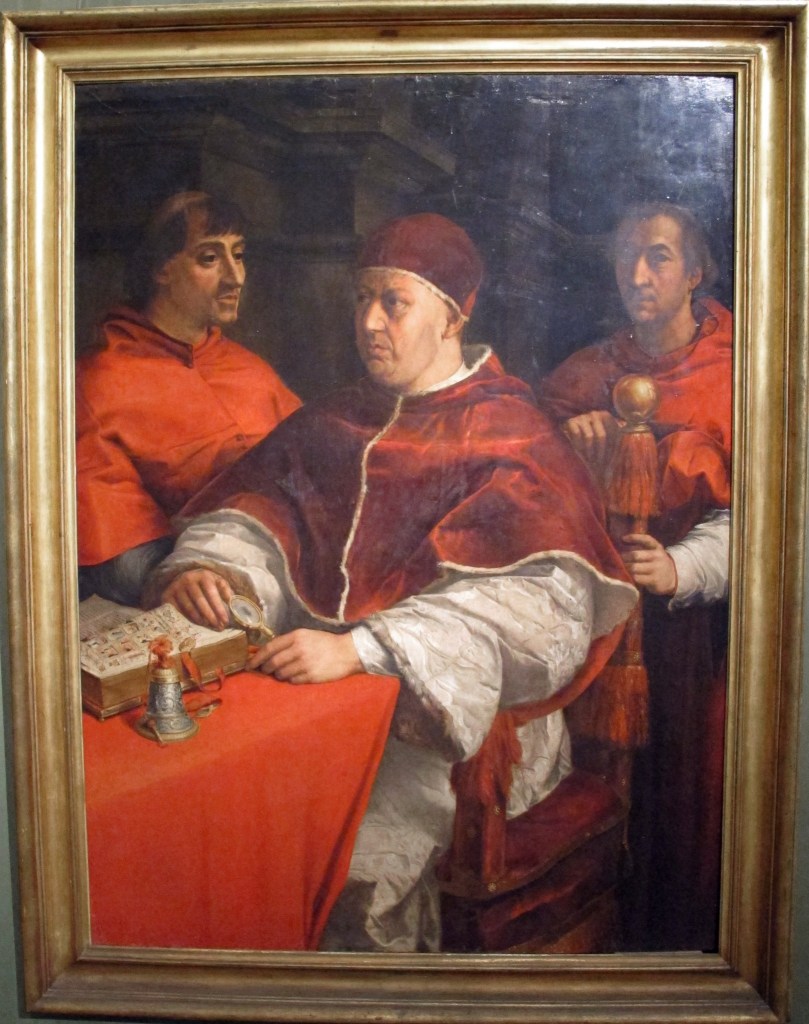
The celebrated copy of Raphael’s Portrait of Pope Leo X with Cardinals Giulio de’ Medici and Luigi de’ Rossi demonstrates Andrea’s capacity for exact imitation. Ottaviano de’ Medici commissioned Andrea to make a substitute when Federico Gonzaga sought possession of Raphael’s original. Vasari claimed that Andrea reproduced the painting so convincingly that Giulio Romano, who had known Raphael and his work intimately, initially failed to recognise the substitution. Whatever allowance is made for Vasari’s anecdotal manner, the episode demonstrates Andrea’s capacity to suppress his own manner and reproduce that of another painter when exact imitation was required.
Andrea del Sarto, after Raphael, Portrait of Pope Leo X with Cardinals Giulio de’ Medici and Luigi de’ Rossi, 1525, oil on panel, 159 × 119 cm, Museo di Capodimonte, Naples. Photograph: Sailko, via Wikimedia Commons, CC BY-SA 3.0.
His normal procedure was different. In this respect, Andrea might take a figure from a larger composition but leave its surroundings behind. He could redraw it more compactly, repeat a head or an arm while testing a position, strengthen one contour and neglect another, or translate an image into the softer language of red or black chalk. The drawing did not need to preserve the source in full. It preserved whatever Andrea had found useful in it. Cordellier accordingly describes his copying as free rather than literal, without methodical attention to measurement or proportion.
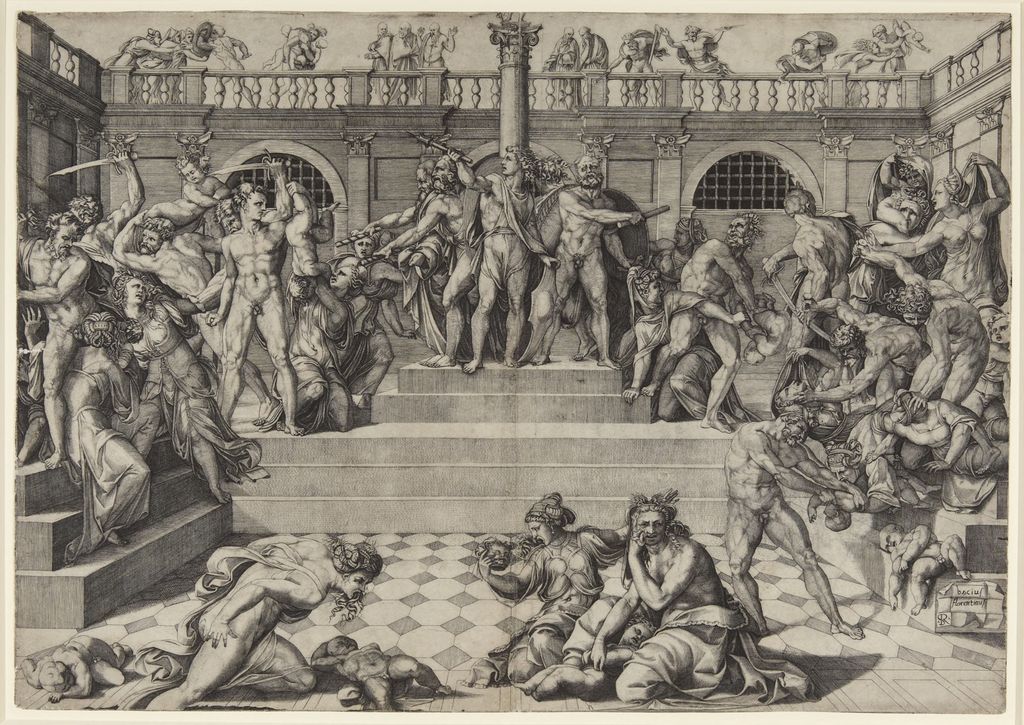
His drawings after Baccio Bandinelli’s Massacre of the Innocents offer a concrete example. Andrea did not attempt to reproduce the crowded composition as a whole. Instead, he extracted individual figures and children from it and studied them separately. Once isolated, the borrowed bodies become more compact and abbreviated; contours overlap and parts remain unresolved. Another artist’s finished invention has become material for Andrea to test, alter and absorb.
Marco Dente, after Baccio Bandinelli, Massacre of the Innocents, c. 1520, engraving, 41 × 58.2 cm, Princeton University Art Museum. Image: Princeton University Art Museum, Public Domain.
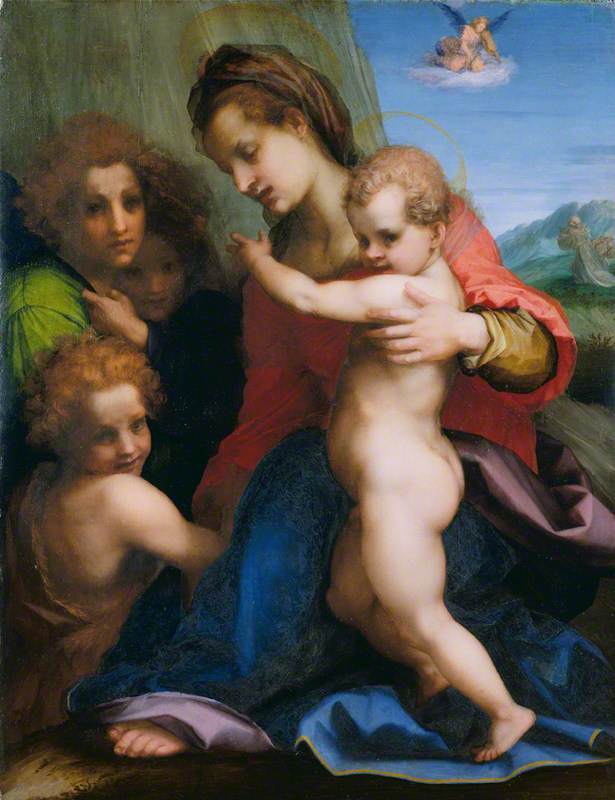
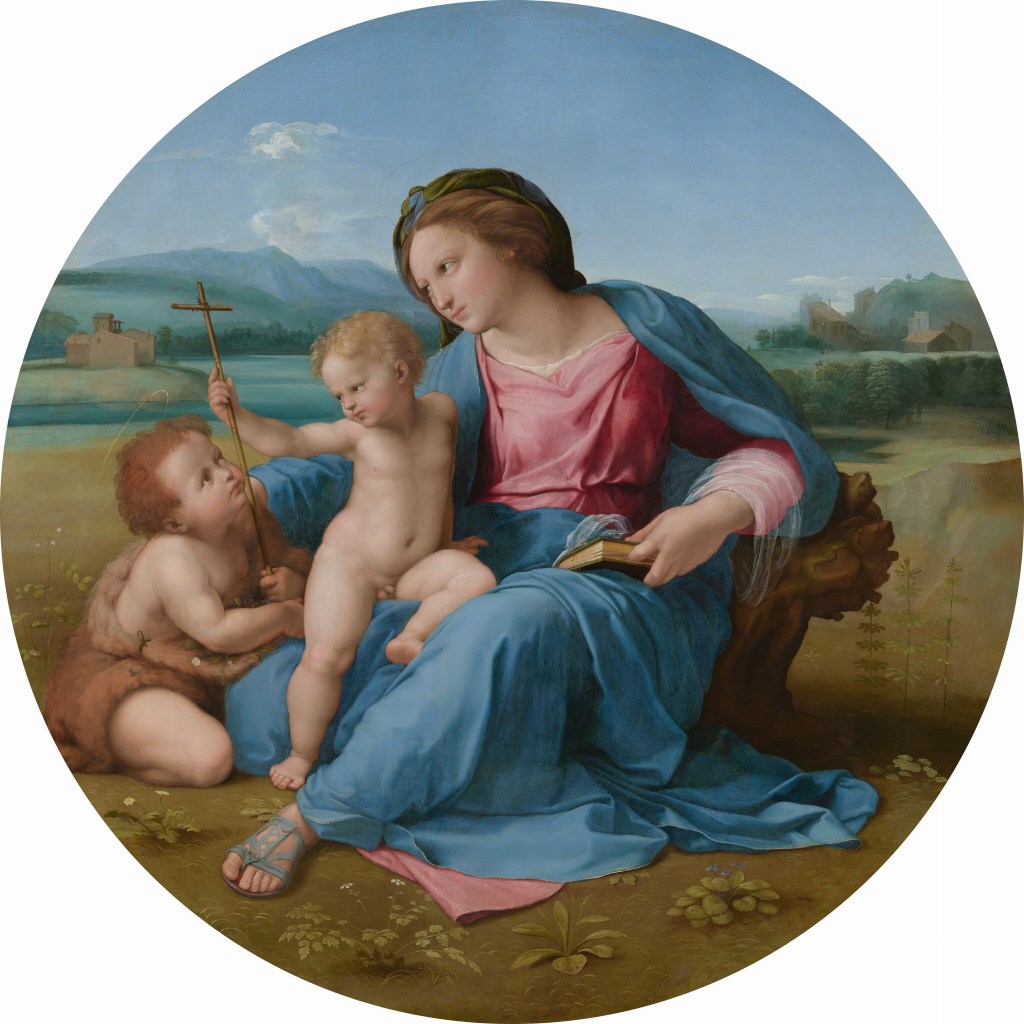
Raphael offered material of a different kind. Andrea had been studying his work for years, but Cordellier shows that the relationship did not depend on straightforward quotation. In the early Madonnas, Andrea sometimes retained the essential relation between Raphael’s figures while changing the construction around them. In the Wallace Collection Virgin and Child with the Infant Baptist, for example, he adapted the design of the Virgin in Raphael’s Alba Madonna, but tightened the group and made its forms more angular. The source remains perceptible, yet the composition has been rebuilt in Andrea’s own terms.
Andrea del Sarto, Virgin and Child with the Infant Baptist, c. 1517–19, oil on panel, 106.5 × 81.3 cm, Wallace Collection, London. Image: The Wallace Collection, via Wikimedia Commons, Public Domain.Raphael, The Alba Madonna, c. 1510, oil on panel transferred to canvas, diameter 94.5 cm, National Gallery of Art, Washington, D.C. Image: National Gallery of Art, Washington, Andrew W. Mellon Collection, Public Domain.
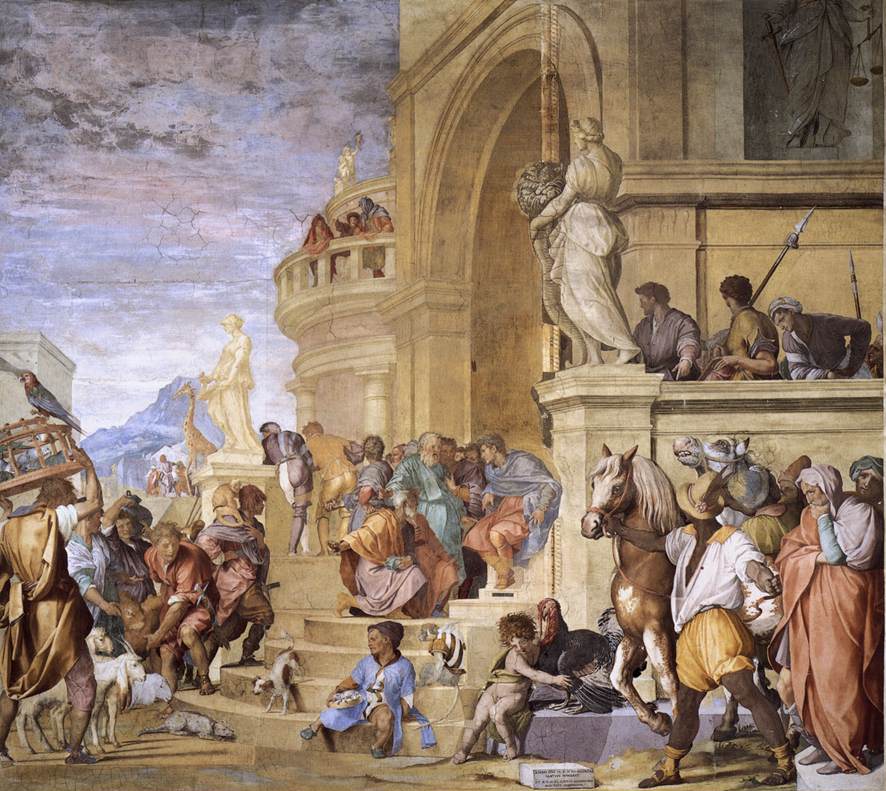
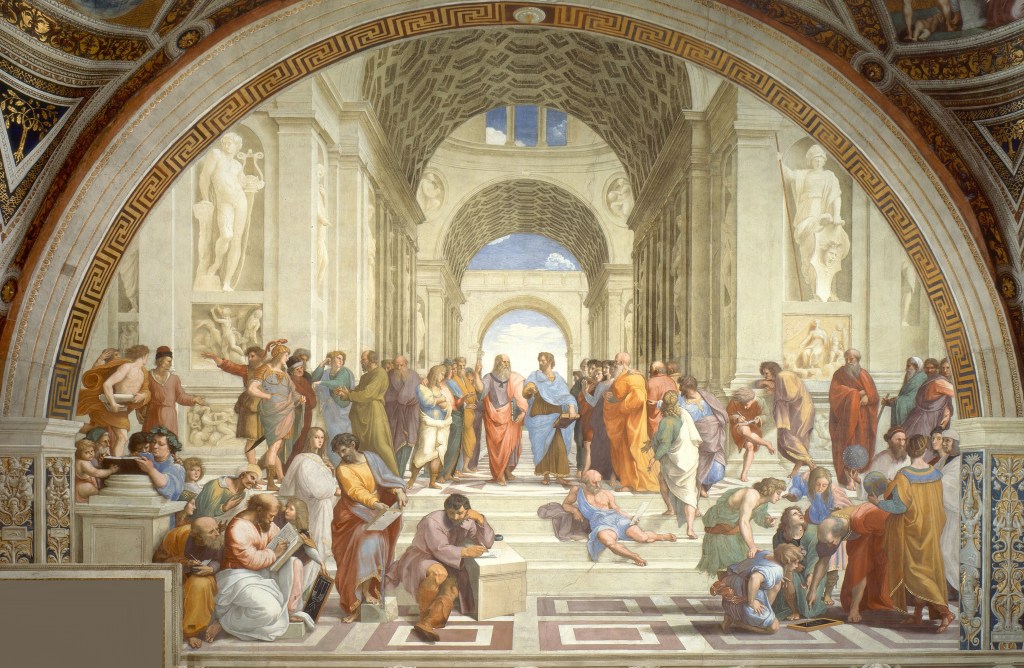
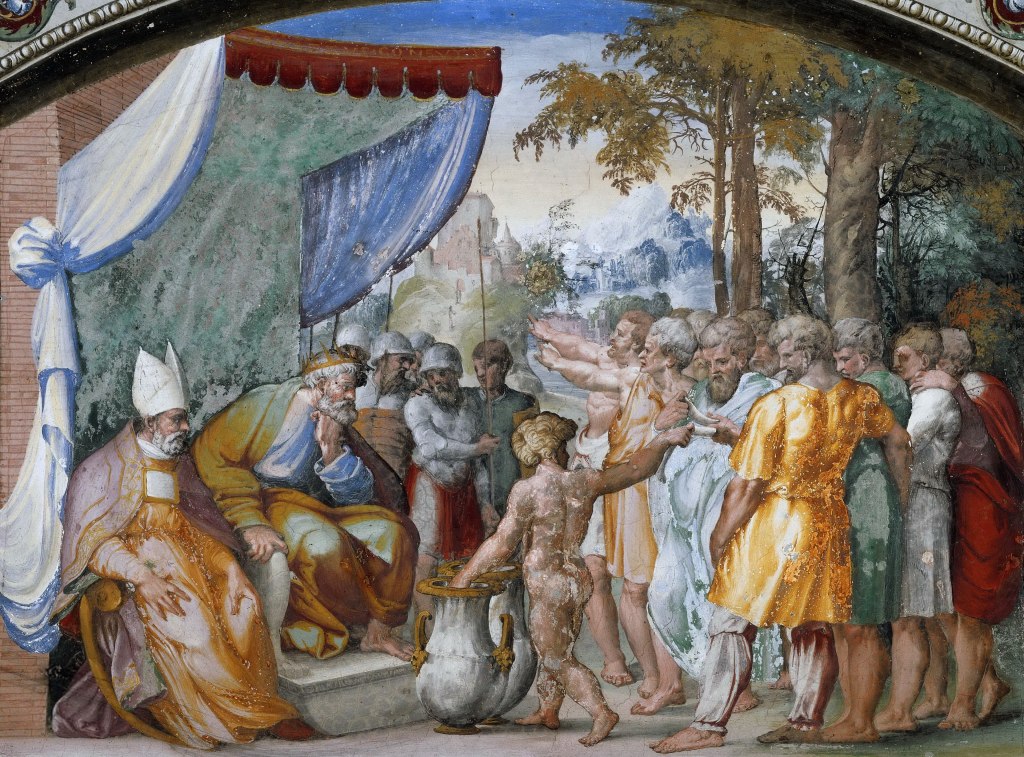
At other times the borrowing lay not in a single figure but in the organisation of space. In Tribute to Caesar, begun around 1520 and left unfinished when work stopped in 1521, Andrea drew on Raphael’s monumental compositions. The group around Caesar has been related specifically to Raphael’s Division of the Land in the Vatican Logge. Cordellier, following Shearman, also points to Andrea’s use in 1521 of spatial constructions derived from the School of Athens and the cartoons for the Acts of the Apostles, but seen from a lateral rather than frontal viewpoint, as though the spectator had moved from the centre of a theatre towards the wings.
Andrea del Sarto and Alessandro Allori, Tribute to Caesar, c. 1520, fresco, Villa Medicea, Poggio a Caiano. Image: Web Gallery of Art, via Wikimedia Commons, Public Domain.Raphael, The School of Athens, 1509–11, fresco, 500 × 770 cm, Stanza della Segnatura, Apostolic Palace, Vatican City. Image via Wikimedia Commons, Public Domain.Workshop of Raphael, The Division of the Land, c. 1517–19, fresco, tenth bay of the Raphael Loggia, Vatican. Image via Wikimedia Commons / Web Gallery of Art, Public Domain.
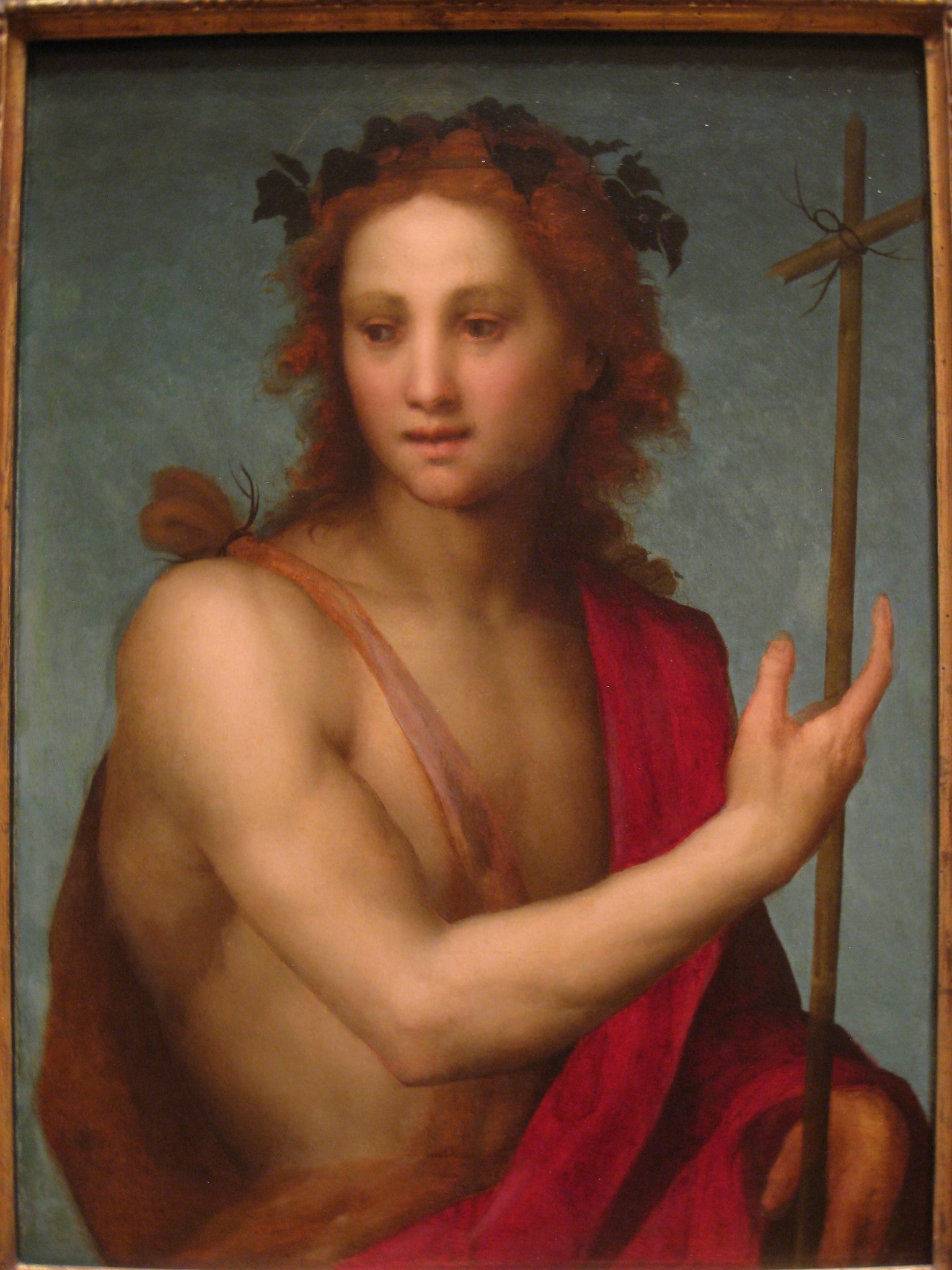
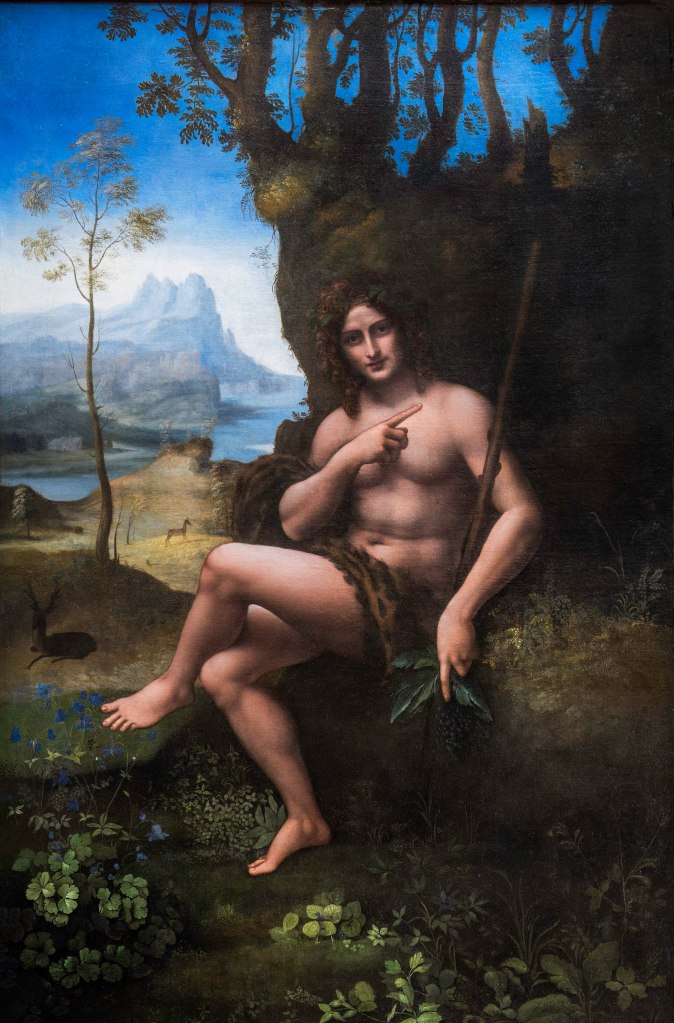
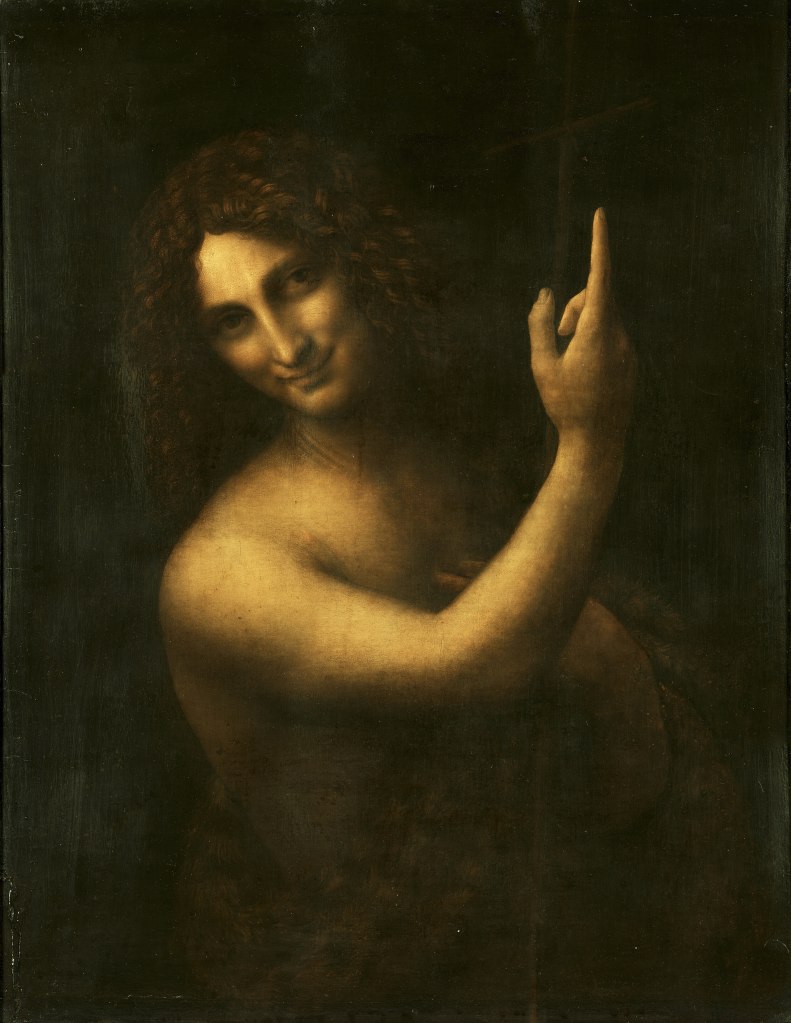
The same scholar also singles out the Worcester Saint John the Baptist as evidence of Andrea’s close knowledge of Leonardo’s treatment of the subject. His comparison is not confined to the familiar half-length Saint John the Baptist in the Louvre. There is also a larger, full-length Baptist in a landscape, now likewise in the Louvre and generally attributed to Francesco Melzi or Leonardo’s workshop.
Workshop of Leonardo da Vinci, attributed to Francesco Melzi, Saint John the Baptist, c. 1517–20, later transformed into a Bacchus, oil on canvas transferred from panel, 177 × 115 cm, Musée du Louvre, Paris. Image via Wikimedia Commons, Public Domain.
In the late seventeenth century the Louvre painting was explicitly transformed into a Bacchus: grapes and an ivy crown were added, and Saint John’s cross-staff was converted into a thyrsus. The spotted animal skin, however, appears to belong to the original conception. Andrea’s Worcester picture seems to depend most directly on the half-length Saint John, but its fusion of Baptist and Bacchic imagery belongs to this broader Leonardesque treatment of the subject. Cordellier leaves open the separate historical question of when Andrea encountered these ideas: Rome is one possibility, France another.
Leonardo: Leda and Saint John
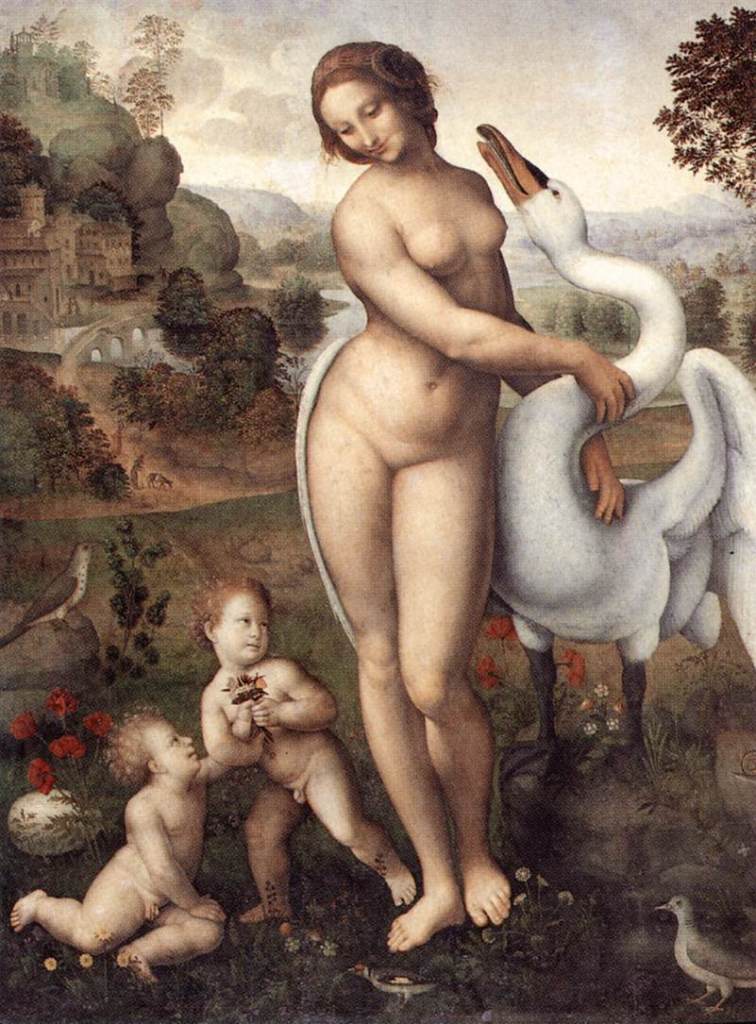
The Brussels Leda poses a problem of chronology before it poses one of influence. Its dependence on Leonardo has long been recognised, but scholars have disagreed over when Andrea made it. John Shearman placed the picture around 1513–14, and the Natali/Cecchi catalogue likewise favoured a date around 1513–15. On that chronology, the painting would belong to Andrea’s pre-French career and could not itself be evidence for what he saw at François I’s court. Jan Sammer, by contrast, has argued for a date after Andrea’s return from France, around 1519.
Andrea del Sarto, Leda and the Swan, c. 1513–19, painting on wood, 102 × 76 cm, Royal Museums of Fine Arts of Belgium, Brussels. Image via Wikimedia Commons, Public Domain.After Leonardo da Vinci, Leda and the Swan, before 1517, tempera on panel, 115 × 86 cm, Galleria Borghese, Rome, after Leonardo’s lost original. Image via Wikimedia Commons, Public Domain.
Chronology matters here because Andrea’s Leda does not merely repeat a generic Leonardesque type. It depends upon Leonardo’s lost composition of Leda and the Swan, known through copies and related works. Andrea retains the essential conception of the standing female figure with the swan, but changes both the emotional and compositional balance. His Leda turns more directly towards the bird, while the accompanying children are differently disposed. Sammer regards these changes not as evidence against dependence on Leonardo, but as examples of Andrea’s characteristic willingness to rework a model rather than reproduce it.
If the earlier dating is accepted, Andrea must have known the composition before leaving Florence. Sammer allows that possibility: aspects of Leonardo’s Leda could have circulated in drawings, copies or other forms while Leonardo’s inventions were still accessible in Italy. His argument is therefore not that France introduced Andrea to the subject, but that it may have allowed him to see Leonardo’s finished composition directly rather than through copies or other forms of transmission.
The Brussels painting therefore cannot by itself prove the French connection. Its dependence on Leonardo is clear, but its date remains disputed. A pre-1518 date would place the work within Andrea’s established engagement with Leonardo, whereas a post-1519 date would make direct access in France a more immediate possibility. The uncertainty cannot be removed simply by stressing the resemblance.
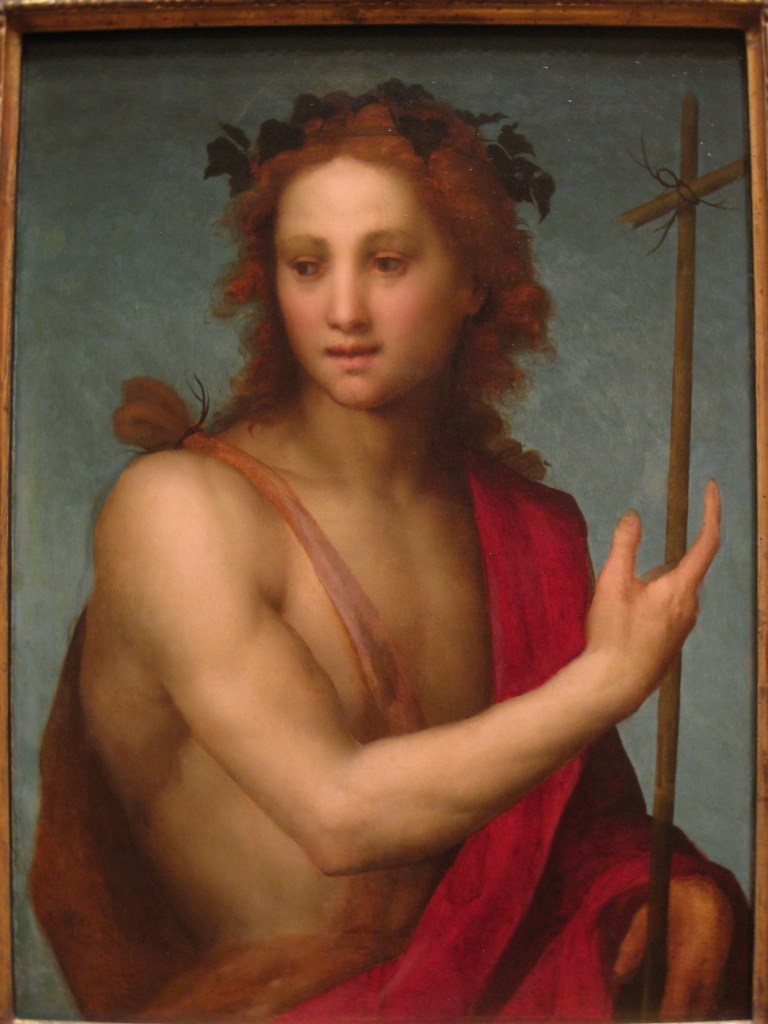
The Worcester Saint John the Baptist presents the problem differently. Here the Leonardesque relationship is both close and specific. Sydney J. Freedberg identified the painting as the work described by Vasari and dated it to about 1517 on stylistic grounds. He connected it directly with Leonardo’s Saint John the Baptist in the Louvre, citing the upward gesture, the contrapposto, the half-length format, the exposed torso, the looping drapery and the luxuriant hair. For Freedberg, the relationship was too exact to be explained satisfactorily through a remote intermediary.
Leonardo da Vinci, Saint John the Baptist, c. 1508–19, oil on walnut panel, 72.9 × 56.3 cm, Musée du Louvre, Paris. Image via Wikimedia Commons, Public Domain.Andrea del Sarto, Saint John the Baptist, c. 1517, oil on panel, Worcester Art Museum, Worcester, Massachusetts. Photograph: Daderot, via Wikimedia Commons, Public Domain.
At the same time, Andrea does not simply reproduce Leonardo’s figure. The Worcester Baptist is made more explicit in his identity and symbolism. Freedberg drew attention to the crown of vine leaves and to the way Andrea develops the ambiguity between Saint John and Bacchus. The transformation is characteristic of the process described by Cordellier: Andrea recognises a powerful invention, isolates its governing features and then makes them serve a more definite purpose of his own.
The chronology has proved more difficult than the formal relationship. Freedberg’s date of about 1517 would place the Worcester picture before Andrea’s French journey. He therefore considered earlier opportunities for Andrea to have encountered Leonardo’s work, including Leonardo’s presence in Italy before his departure for France. Sammer has reopened the question by returning to Vasari’s account. Vasari says that Andrea painted the Baptist for the Grand Master of France after his return home, in an attempt to recover favour following his departure from royal service. Sammer identifies this official as René of Savoy and therefore argues that the painting belongs after the French journey rather than before it.
On Sammer’s reconstruction, France supplies a straightforward opportunity for direct access. Leonardo’s Saint John the Baptist had entered the royal collection, and Andrea was moving within the same courtly environment during 1518–19. Sammer does not need to posit a personal meeting between the two artists: the existence of the painting in the royal collection is sufficient for the argument.
The two paintings bear different weights within the case for France. The Leda remains chronologically unstable: the dependence on Leonardo is clear, but its usefulness as evidence for French access depends upon accepting the later date. The Worcester Saint John offers a tighter convergence of documentary tradition, formal dependence and opportunity, although its dating likewise remains contested. In neither case does France create Andrea’s interest in Leonardo. What it may have supplied was direct access to particular finished works that he was already equipped to study with considerable independence.
Raphael and the Barberini Holy Family
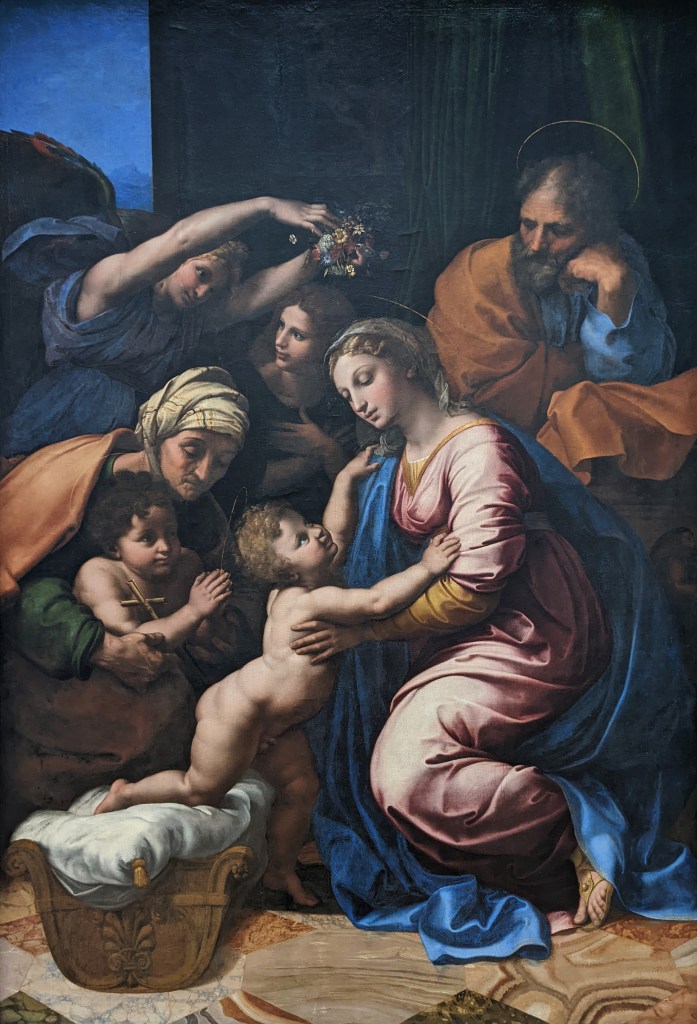
The Holy Family in Palazzo Barberini provides the clearest test of Sammer’s argument in relation to Raphael. The connection is with Raphael’s Holy Family of Francis I, painted for François I and sent to France in 1518. According to Sammer’s reconstruction, the picture was formally presented to Queen Claude at Nantes on 4 August of that year, when Andrea was in royal service. He therefore considers it highly probable that Andrea saw Raphael’s painting at the French court.
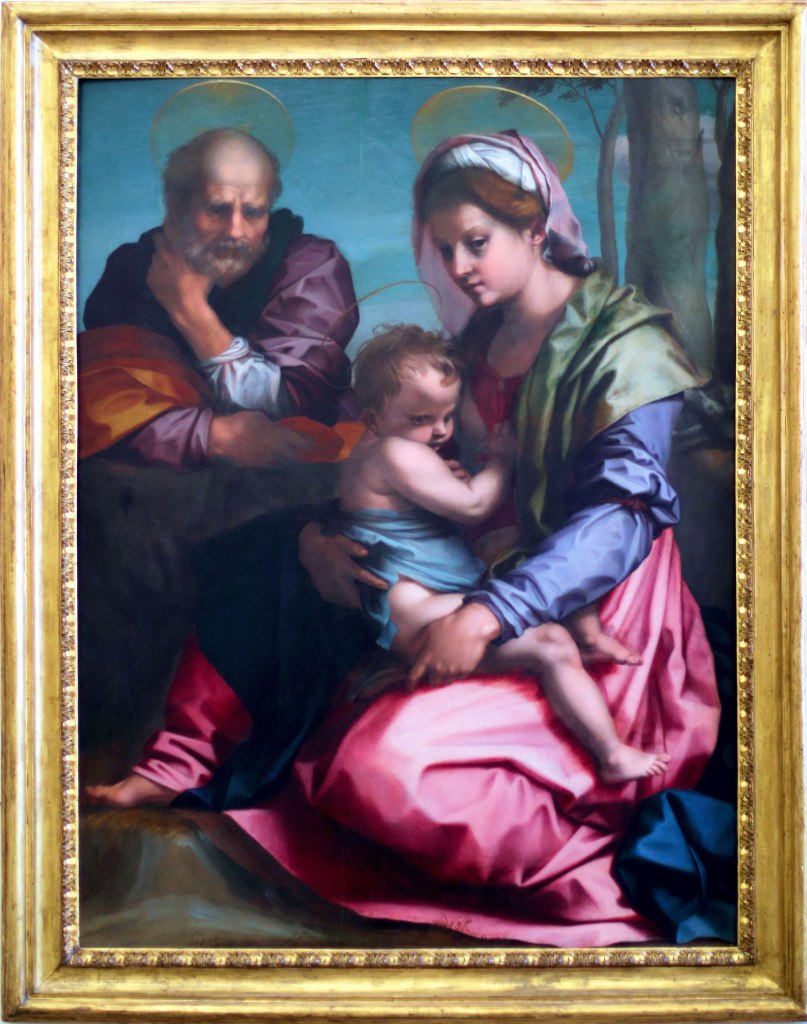
Andrea del Sarto, The Barberini Holy Family, c. 1525–29, oil on panel, Gallerie Nazionali d’Arte Antica, Palazzo Barberini, Rome. Photograph: Vicenç Valcárcel Pérez, via Wikimedia Commons, CC BY-SA 4.0.Raphael, The Holy Family of Francis I, 1518, oil on panel transferred to canvas, 207 × 140 cm, Musée du Louvre, Paris. Image via Wikimedia Commons, Public Domain.
The relationship between the two works is concentrated above all in the figure of Saint Joseph. Andrea does not repeat Raphael’s composition as a whole. Instead, he takes over the older man’s physical type and the way he bends towards the central group, using that figure within a substantially different arrangement. John Shearman had already recognised the connection, so the comparison itself does not depend upon Sammer’s reconstruction. What Sammer adds is a specific historical occasion on which Andrea could have encountered Raphael’s finished painting directly.
Chronology again affects the argument. The Barberini Holy Family is generally placed late in Andrea’s career. Freedberg dated it to about 1528, while Shearman preferred a date no later than about 1525; the Natali/Cecchi catalogue favours approximately 1528–29. Even on the earlier dating, several years separate Andrea’s stay in France from the finished painting.
That interval changes the nature of the argument. With the Brussels Leda, the principal question was whether the painting itself should be moved to a date after France. With the Barberini picture, the later date is not in serious dispute. The issue is whether a figure seen in Raphael’s painting in 1518 could remain available to Andrea and be re-employed years afterwards. Cordellier’s account of Andrea’s practice makes such a process less exceptional than it might initially appear. His studies after other artists were selective, and he repeatedly detached figures or compositional ideas from their original settings before adapting them to new purposes.
Leonardo and the Medici Holy Family
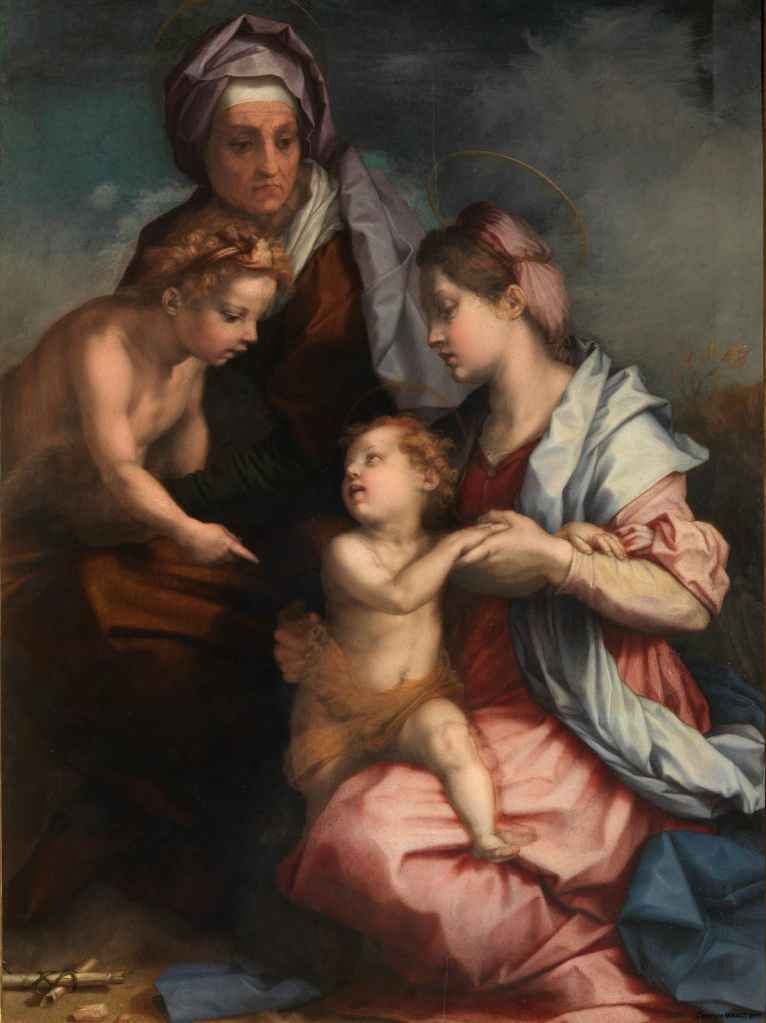
The Holy Family painted for Ottaviano de’ Medici, generally dated to about 1529, offers a different kind of comparison with Leonardo. The point is not a close quotation comparable to Saint Joseph in the Barberini picture. Rather, the affinity lies in the organisation of the group: several figures are bound together through a compact pyramidal structure in which the movement of one body leads directly into the next.
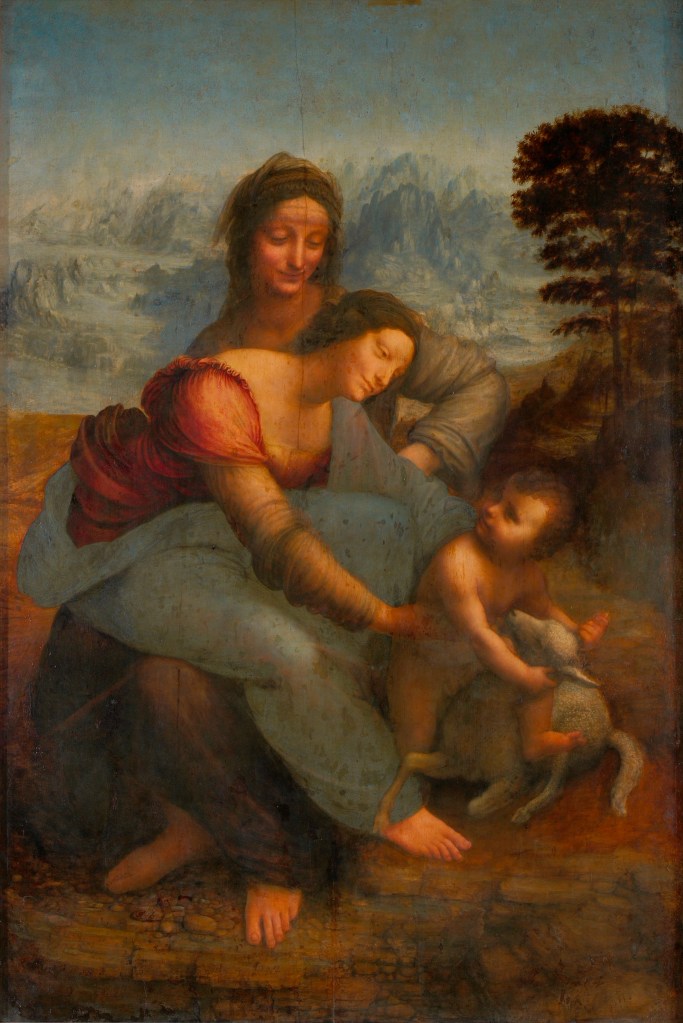
Andrea del Sarto, Virgin and Child with Saint Elizabeth and the Infant Saint John the Baptist (Medici Holy Family), c. 1529, oil on panel, Galleria Palatina, Palazzo Pitti, Florence. Image via Wikimedia Commons, Public Domain.Leonardo da Vinci, The Virgin and Child with Saint Anne, c. 1503–19, oil on poplar panel, 168 × 130 cm, Musée du Louvre, Paris. Image via Wikimedia Commons, Public Domain.
Leonardo’s Virgin and Child with Saint Anne provides the obvious point of comparison. Its composition depends upon the close interlocking of Anne, the Virgin and the Christ Child, whose bodies are linked in a continuous flow of movement rather than arranged as a sequence of isolated figures. Andrea’s Holy Family is differently conceived and includes a different cast of figures, but it shares something of that principle. The group is built through overlapping bodies and linked gestures, so that the composition acquires unity from the way the figures physically depend upon one another.
Sammer has suggested that Andrea may have encountered Leonardo’s Saint Anne in France, where the painting belonged to the royal collection. If so, the Medici Holy Family would represent a later reworking of a compositional idea encountered roughly a decade earlier. The chronological interval is greater than in the Barberini example, but the nature of the borrowing is also less literal. What seems to persist is not an individual figure, but a way of constructing a group.
Conclusion
France need not be treated as the origin of Andrea del Sarto’s engagement with Leonardo and Raphael. Its importance lies rather in the possibility that direct encounters with particular works gave a greater opportunity to exercise skills that were already fundamental to his practice.
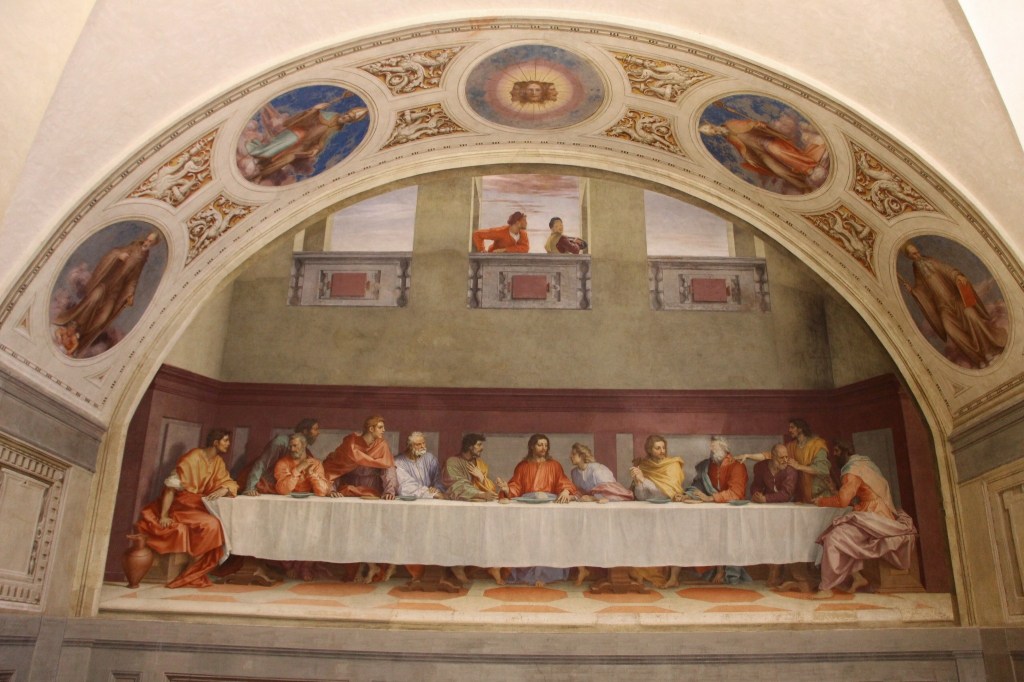
The Last Supper at San Salvi shows how thoroughly Andrea could absorb the work of other artists without allowing the result to become a collection of quotations. Leonardo lies behind the conception, while Raphael and northern prints also contributed to its formation, but the fresco remains completely coherent in its own terms.
Andrea del Sarto, The Last Supper, 1520–25, fresco, Museo del Cenacolo di Andrea del Sarto, San Salvi, Florence. Photograph: DerBilch, via Wikimedia Commons, CC BY 3.0.
The same habit of transformation appears elsewhere, from the Raphaelesque structures reworked in the Wallace Collection Virgin and Child with the Infant Baptist to the less easily defined debts of the Vienna Lamentation. Cordellier’s concluding formulation helps to explain the scale of Andrea’s achievement, in which borrowing became invention:
“But his essential debt to Leonardo’s art does not depend on this. Above all, in his painting, Andrea del Sarto owed to Leonardo the sense of the attenuation of the energy of the drawing. That very particular way of softening, tempering the verve of the form and its rendering, conformed—in Vasari’s opinion—to Andrea del Sarto’s natural tendency toward timidity; but modern criticism, in contrast, has interpreted it as a more deliberate method of the artist, who thus magnificently brings together, through the morbidezza of color, the sfumato of Leonardo, and the solid reliefs of Michelangelo while maintaining a sense of balance worthy of Raphael.”
Producing these essays requires care, time, research, and resources. Contributions to help sustain this exploration would be greatly appreciated.
Cheney, Iris H. Review of S. J. Freedberg, Andrea del Sarto, and John Shearman, Andrea del Sarto. The Art Bulletin 53, no. 4 (December 1971), pp. 532–35.
Cordellier, Dominique. “Drawings by Andrea del Sarto after Ancient and Modern Sources.” In Julian Brooks, with Denise Allen and Xavier F. Salomon, Andrea del Sarto: The Renaissance Workshop in Action. Los Angeles: J. Paul Getty Museum, 2015.
Freedberg, Sydney J. Andrea del Sarto. 2 vols. Cambridge, MA: Belknap Press of Harvard University Press, 1963.
Natali, Antonio. Andrea del Sarto. New York and Milan: Abbeville Press Publishers, 1999.
Natali, Antonio, and Alessandro Cecchi. Andrea del Sarto: Catalogue complet. Paris: Bordas, 1992.
Sammer, Jan. “Andrea del Sarto at the Court of France.” The Burlington Magazine 168 (September 2026), pp. 852–59.
Shearman, John. Andrea del Sarto. 2 vols. Oxford: Clarendon Press, 1965.
Vasari, Giorgio. Lives of the Artists. Translated by George Bull. 2 vols. London: Penguin Classics, 1987.
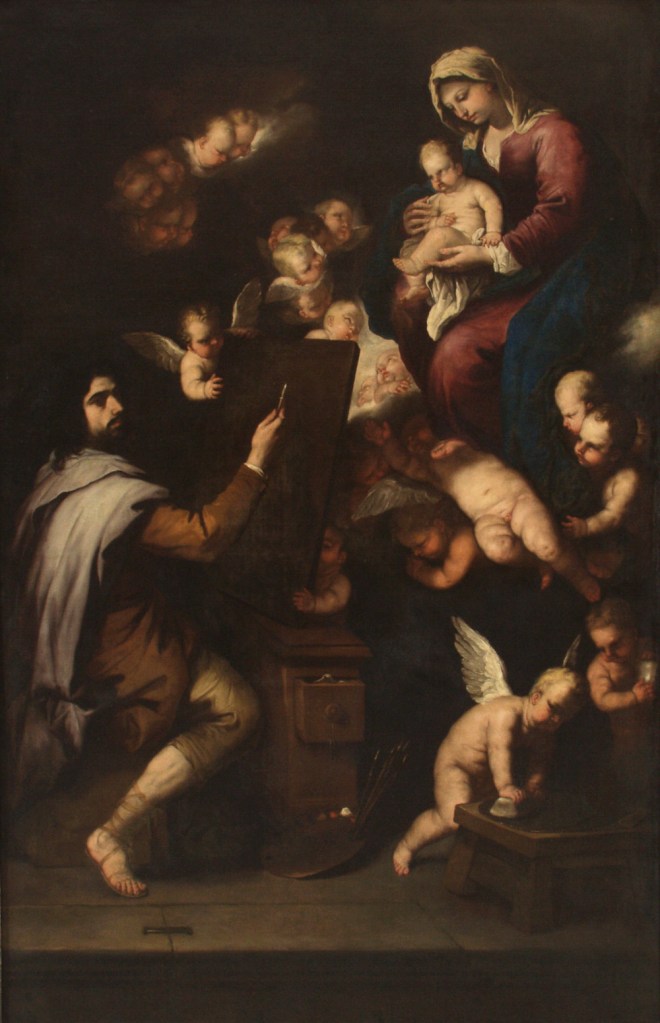
Luca Giordano returned to his own appearance throughout his long career. His earliest experiments in self-representation include Saint Luke Painting the Virgin, now in the Museo de Arte de Ponce, Puerto Rico, in which the young painter gave the Evangelist his own features, as well as a group of portraits in which he assumed the identities of philosophers and an alchemist.
Luca Giordano, Saint Luke Painting the Virgin, c. 1650, oil on canvas, 285.8 × 186.7 cm, Museo de Arte de Ponce, Puerto Rico, inv. 57.0030. Image: Wikimedia Commons, public domain.
Later portraits record the changes in his appearance as his reputation grew and his career extended from Naples and Florence to Madrid. Bernardo De Dominici remembered a long face, chestnut-coloured eyes and hair, and a habitually melancholy expression, characteristics that can be followed, with considerable variation, through Giordano’s painted images of himself.
The four paintings considered here do not constitute a complete survey. They span roughly three decades and show Giordano at different stages of his career, from the intellectual role-playing of his early years to the increasingly direct scrutiny of his ageing face. They were also made under different circumstances. One presents the painter as an alchemist; another entered Cardinal Leopoldo de’ Medici’s collection of artists’ self-portraits; a third makes spectacles, sight and the activity of painting prominent; and the last was probably made shortly before Giordano left Naples for Spain in 1692.
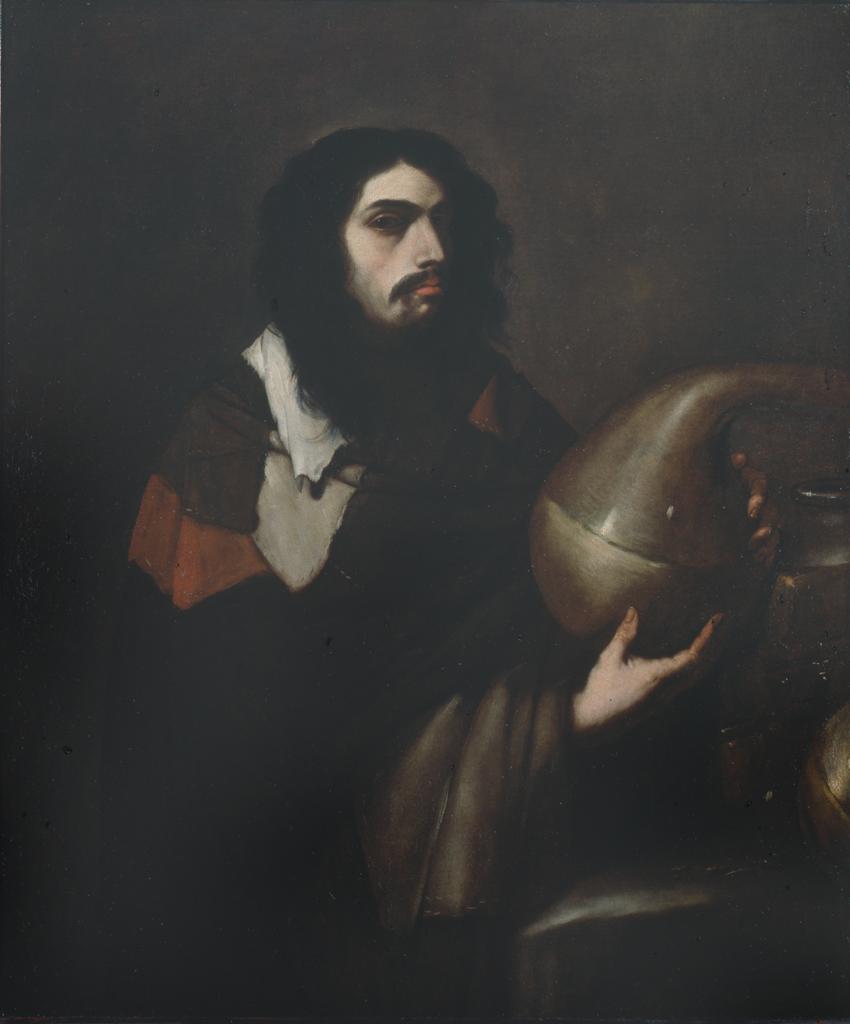
Around 1660, while still in his twenties, Giordano painted himself holding a large glass alembic. The vessel identifies the role he has assumed in the Self-Portrait as an Alchemist, now in the Pinacoteca di Brera. The museum relates the painting to a fashion among Neapolitan intellectuals for having themselves represented in the guise of philosophers, a practice that Giordano adopted in a group of youthful self-portraits.
The role is established with few means. Against a dark background, Giordano turns towards the viewer with the alembic held prominently before him. Light catches the broad glass vessel and the face above it, while much of his clothing remains in shadow. His long features, dark hair and direct gaze correspond with descriptions of his youthful appearance. The glass apparatus gives greater specificity to the identity he has chosen. This is not simply a learned man, but an alchemist, associated with the investigation and transformation of matter.
Such figures already had a strong pictorial tradition in Naples. Jusepe de Ribera’s half-length philosophers and learned men had found a ready audience there, and Ribera remained an important model for Giordano during his early career. Giordano extended this repertory to philosophers, mathematicians, astronomers and astrologers. Biagio de Giovanni has placed these paintings within an intellectual culture in which alchemy and physics, astrology and geometry still occupied neighbouring territory. The Brera portrait belongs to this world of learning and enquiry, but Giordano has made himself one of its inhabitants.
Nor was the alchemist an isolated experiment. In a Self-Portrait as a Philosopher, formerly at Capesthorne Hall, Giordano holds a manuscript containing a horoscope and an inscription declaring that it is better to die with friends than to live among enemies. Another composition shows an astronomer with a telescope and a mirror, in which Giordano’s face appears looking towards the spectator. His own features could therefore move between different learned identities, sometimes occupying the whole portrait and sometimes appearing within a larger composition.
Giuseppe Scavizzi finds a further precedent in Salvator Rosa, who had repeatedly used his own features while presenting himself as painter, soldier, poet and philosopher. Scavizzi argues that Giordano knew Rosa’s work, and the comparison is close to the concerns of these early paintings. In the Brera portrait Giordano’s appearance remains recognisable, but the alembic allows that appearance to carry another identity. A few years later, in the self-portrait acquired by Cardinal Leopoldo de’ Medici, the circumstances were different. There the collector wanted a portrait of the artist painted by his own hand.
The Medici self-portrait
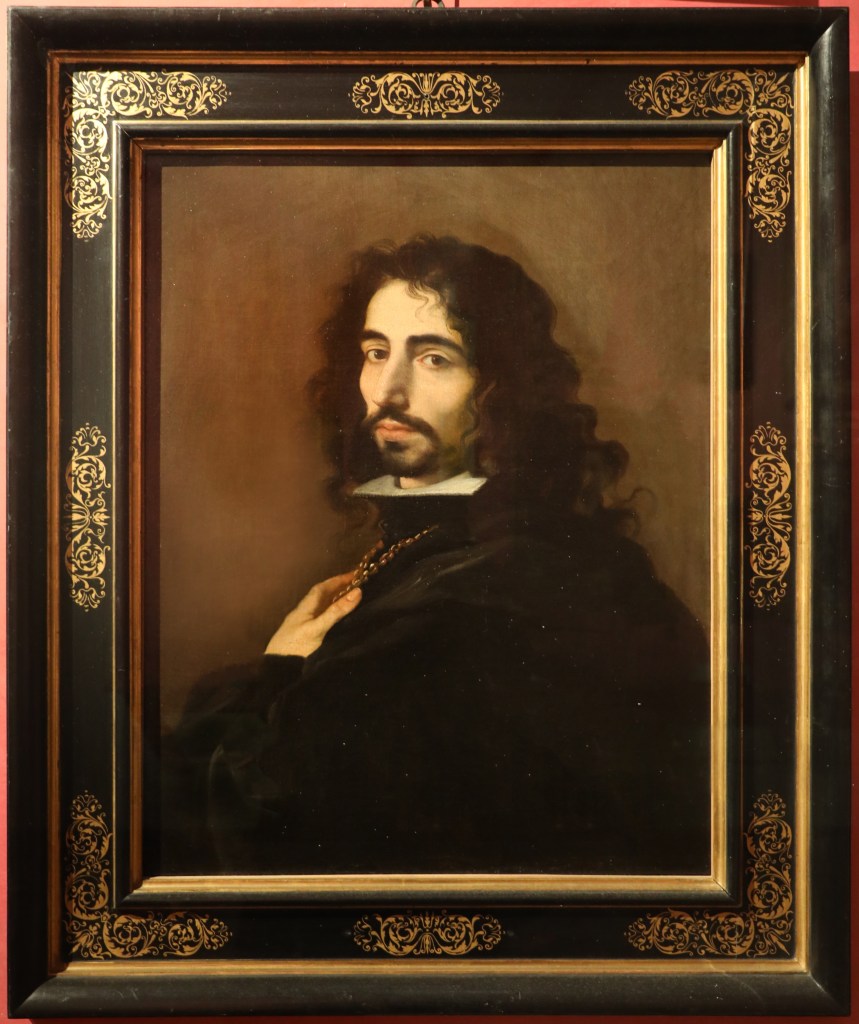
Luca Giordano, Self-Portrait, c. 1665–70, oil on canvas, 72.5 × 57.5 cm, Gallerie degli Uffizi, Florence, Corridoio Vasariano, inv. 1890 no. 1629. Image: Wikimedia Commons, public domain.
Giordano’s Self-Portrait in the Uffizi, generally dated to 1665–70, presents a markedly different conception of self-representation from the Brera alchemist. He appears in black, with a white collar, long dark hair and a gold chain gathered in his left hand. The palette is austere. His pale, drawn face is set against the dark mass of his hair and clothing, while the chain provides the only conspicuous note of ornament. Francesca de Luca stresses the picture’s simplicity and the deliberate character of the gesture towards the chain. She also notes the tension between the controlled handling of the face and dress and the greater freedom of the long, unruly hair.
Andrea Vaccaro provides a useful contemporary comparison. In 1664 he became the first prefetto of the newly established Corporation of Neapolitan Painters, with Giordano serving as second assistant. Vaccaro’s own formal self-portrait, generally dated to about 1664–66, has been connected with the Corporation and presents the older painter in fashionable dress, with an elaborate lace neckcloth and an emphatically public bearing. Formal self-representation was therefore already part of the professional culture immediately surrounding Giordano when the Uffizi portrait was painted.
The Uffizi portrait probably belonged to Cardinal Leopoldo de’ Medici, whose collection gives the work a precise context. Leopoldo was systematically assembling self-portraits by artists, and Anna Maria Procajlo has shown how exacting that process could be. The cardinal did not simply seek portraits of painters. He wanted the ritratto fatto di sua propria mano, a portrait made by the sitter himself. His agents were expected to establish both that the painting was autograph and that the person represented was indeed the artist. Copies and false identifications could be rejected regardless of their quality.
The purpose of such a collection was more than biographical. Filippo Baldinucci described Leopoldo as setting aside rooms for portraits of distinguished painters made by their own hands, so that the spectator could see both the artists themselves and their manner of painting. The self-portrait therefore combined likeness with authorship. It preserved the artist’s appearance while also providing an example of his maniera. Giordano’s picture entered a setting in which the face and the hand that painted it were deliberately brought together.
The documentary history of the Uffizi portrait is secure. It appears in the inventory compiled after Leopoldo’s death in 1675, where Giordano is described with black beard, side-whiskers and hair, a Spanish-style collar, black dress and cloak, and a gold chain held in his left hand. The picture was recorded in the grand-ducal collections in 1682 and mentioned by Baldinucci in 1686. R. Muzi has suggested that it may have been made for Leopoldo after Giordano’s presumed stay in Florence in 1665, a date consistent with the painter’s apparent age. The proposal remains plausible rather than documented.
Procajlo’s research makes the timing suggestive. By the 1660s Leopoldo’s agents were actively seeking autograph self-portraits, particularly by living or recently deceased artists whose identities and authorship could be more readily verified. In July 1665, for example, his agent Paolo del Sera reported being offered a self-portrait by Guercino said to be entirely by the painter’s own hand. This shows that the machinery of acquisition was operating in precisely the period to which the Uffizi portrait has been assigned.
The gold chain introduces an interesting but more uncertain strand of evidence. Marco Chiarini connected the portrait with a story told by Bernardo De Dominici. According to De Dominici, Giordano sent a self-portrait to Grand Duke Cosimo III and later saw it displayed beside portraits of Titian and Veronese. He supposedly remarked that his own dark head had been badly placed between such great men, since he was only a poor painter. The Grand Duke, pleased by this profession of humility, rewarded him with a gold chain bearing a medal with his portrait. If the story refers to the Uffizi picture, Giordano’s hand resting on the chain acquires an obvious significance. Both Muzi and De Luca, however, treat the account cautiously, and the inventory evidence is firmer than De Dominici’s later testimony.
De Luca interprets the portrait as a carefully constructed statement of Giordano’s status as an artist. Its formality lies less in display than in restraint: the controlled paint, severe clothing and limited tonal range suppress overt emotion, while the turning head and loose hair prevent the image from becoming rigid. The melancholy associated with Giordano’s appearance is still present, but here it is contained within an image of professional self-possession.
The Stuttgart self-portrait
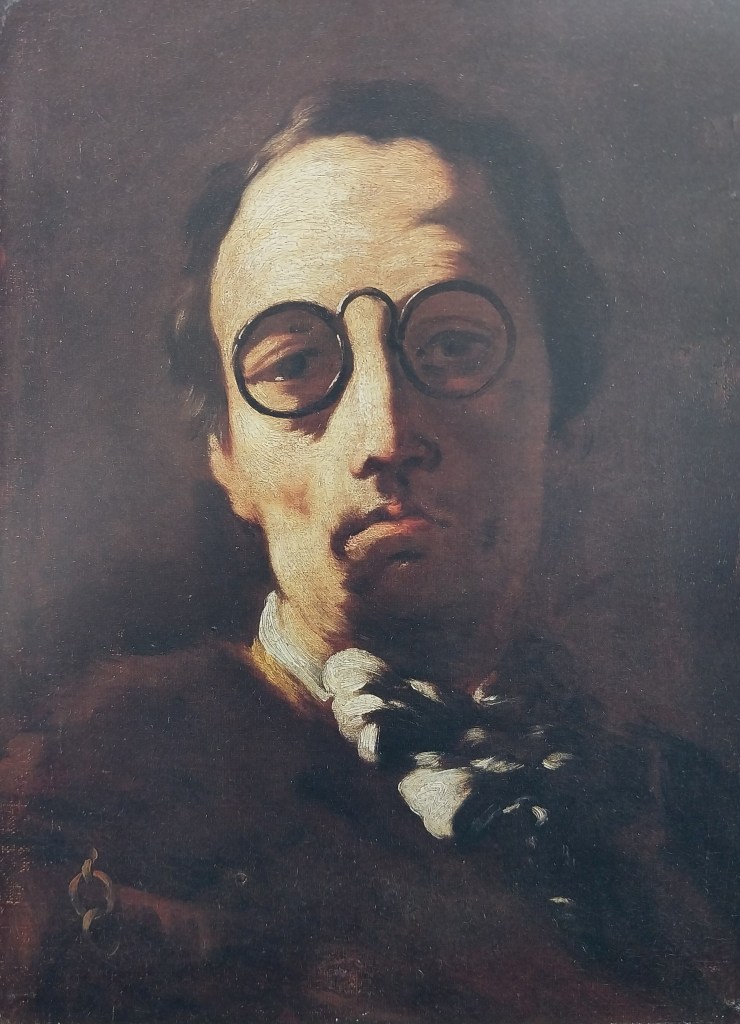
Luca Giordano, Self-Portrait, c. 1688, oil on canvas, 46.8 × 35.3 cm, Staatsgalerie Stuttgart. Image: author’s photograph of a reproduction in Luca Giordano 1634–1705 (2001).
The Self-Portrait in the Staatsgalerie Stuttgart shifts attention from status and collecting to the act of painting itself. Nicola Suthor dates the work to about 1688. Giordano appears wearing spectacles, his head turning towards the viewer above a white cravat and dark outer garment. The format is small and close, and the handling of the paint is conspicuously economical.
Suthor looks closely at the surface. The white cravat is modelled with passages of black, its folds and loops formed with different brushes. A pointed brush picks out the highlights on the spectacles, while broader strokes describe the softer fabric. The ridges left by the bristles remain visible. The flesh is handled just as sparingly. Individual strokes establish wrinkles, expression and facial volume without being absorbed into a uniformly smooth surface. Around the neck, skin, linen and outer clothing are distinguished as much by the handling of the paint as by colour or contour.
Suthor places Giordano against Carlo Dolci, whose diligenza depended upon painstaking finish and the suppression of obvious signs of rapid execution. Giordano follows a different logic. The material operation of painting remains visible, and the spectator can see something of the speed with which the brush has moved. The portrait represents Giordano through his physiognomy, but also through the characteristic action of his hand.
That visible rapidity carried particular force in the case of an artist whose speed had become legendary. Giordano’s prestezza was repeatedly noted by contemporaries and later biographers, and the nickname Luca fa presto condensed a reputation for extraordinary facility. Stories circulated of half-length figures completed in less than an hour, while comparisons with Tintoretto and Veronese reinforced the image of a painter capable of prodigious production. Yet speed did not exclude preparation. As Riccardo Lattuada has put it, Giordano painted quickly only after having thought long and deeply. His speed rested on a long training of eye, memory and hand, reinforced by copying, drawing and the use of preparatory studies and bozzetti for larger projects. I have discussed this tension between preparation and rapid execution more fully in an earlier Inner Surfaces essay on Giordano’s work at the Casón del Buen Retiro. In Suthor’s account, speed becomes a form of bravura, a demonstration of mastery in which the process of execution remains visible.
The spectacles introduce another aspect of the portrait. Marco Liberato relates them first to the practical difficulty of Giordano’s failing eyesight, making them almost an emblem of the ageing painter. Suthor takes their significance further, arguing that they should not be treated merely as a descriptive detail. Their optical function makes sight itself part of the image. Giordano was far-sighted, but the spectacles also lend themselves to a broader interpretation of the painter’s visual intelligence. Suthor associates them with the foresight required to conceive and organise the immense decorative schemes for which he was increasingly famous. They identify him as a pictor doctus, though not primarily in the humanist sense of a painter displaying literary erudition. His knowledge lies in the science and practice of painting.
Giovan Pietro Bellori helps to define what that practical knowledge could mean. He praised Giordano’s ability to construct contours with broad strokes, con grossi trattizzi ne’ contorni, which resolved themselves when seen from the proper distance. Such effects, Bellori wrote, belonged to the practico professore, the experienced practitioner who understood how the eye would complete what the brush had abbreviated. Giordano’s rapid handling depended upon judgement. The painter had to know how much information could be withheld at close range while still producing coherence for a spectator standing further away.
The spectacles and the brushwork belong together. One concerns the conditions of seeing; the other demonstrates how Giordano converted that understanding into paint. The Stuttgart portrait presents his professional intelligence through the means of painting itself.
The Pio Monte self-portrait
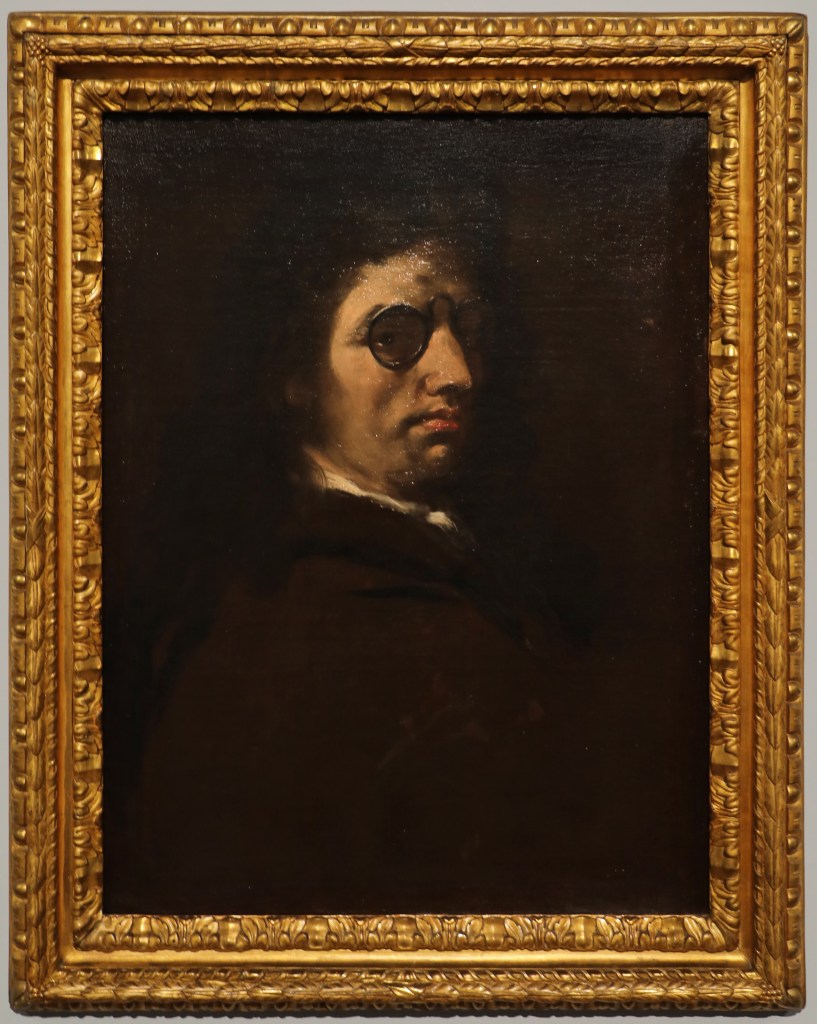
Luca Giordano, Self-Portrait, c. 1692, oil on canvas, 63 × 49 cm, Pio Monte della Misericordia, Naples. Image: Wikimedia Commons, public domain.
The Self-Portrait in the Pio Monte della Misericordia is now generally dated to about 1692, immediately before Giordano left Naples for Spain at the invitation of Charles II. Earlier scholarship placed it around 1678, partly because of its resemblance to the self-image at San Gregorio Armeno, but Giuseppe Scavizzi later revised the chronology and Marco Liberato follows the later dating. Giordano was therefore approaching sixty when the picture was painted, at the height of his reputation and on the threshold of the decade he would spend at the Spanish court.
For Lattuada, the striking feature of the portrait is its extreme reduction of pictorial means. Giordano had made his reputation through large altarpieces, history paintings and enormous decorative cycles, yet here almost all incidental detail has been stripped away. The brown overcoat is scarcely resolved, the body is established by a few dark strokes and the hair by rapid turns of the brush over the preparation. The flesh alone seems to bring light into the image. Lattuada calls the portrait a powerful image made with almost nothing, in which economy of means is matched by the intensity of self-scrutiny.
The face is treated without flattery. The cheeks have loosened, the features have thickened and the spectacles sit prominently across the nose. Liberato similarly emphasises the way the ageing figure seems to emerge from the neutral ground, almost as a non finito. The brush can be precise and measured in one passage, rapid and fragmented in another. Wrinkles and changes in the flesh are suggested rather than laboriously described, while the unfinished clothing keeps attention concentrated on the face. He compares the picture with a portrait of Giordano made in Madrid in 1692, formerly in the Torrecilla collection, where the same physiognomy and marks of age are visible. The comparison lends further support to the later dating.
Lattuada sees the Pio Monte portrait as part of a longer habit of unsparing observation. Giordano returned repeatedly to his own appearance, registering the effects of time upon his features over several decades. This recurrence leads Lattuada to Rembrandt, whose self-portraits he memorably describes as an “existential metronome”, recording successive stages of a life. He presents the comparison cautiously, asking whether Giordano’s repeated self-representation might be understood in a similar way. The analogy concerns method rather than style. Both painters returned to their own faces across time and allowed physical change to become part of the subject.
Lattuada also suggests a possible route through which Giordano could have known Rembrandt’s work. Gaspar Roomer’s celebrated Neapolitan collection contained an extensive body of prints and engravings, and Giordano’s familiarity with Northern European art may have developed partly through such collections. Prints allowed artists to encounter distant traditions without leaving the room in which they studied them, and Lattuada believes that Giordano absorbed something of Rembrandt’s character heads and self-portraits through this medium.
Portraiture itself occupied only a small part of Giordano’s immense production. Lattuada nevertheless points to the portrait of his friend Carlo Celano, canon of Naples Cathedral and now also at the Pio Monte della Misericordia, as an instructive comparison. There too a sparing use of paint is combined with concentrated observation of the sitter. The self-portrait’s economy belongs to a small strand of Giordano’s portraiture in which reduced means could produce a strong sense of presence.
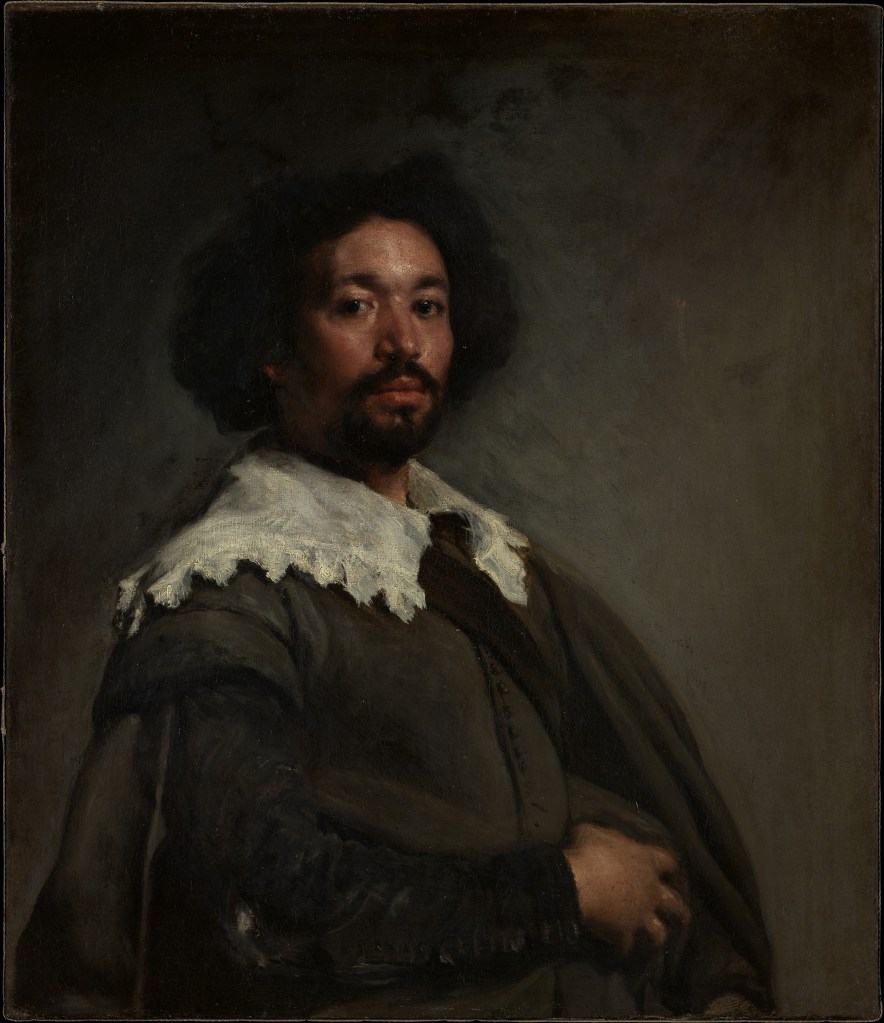
Liberato compares the immediacy of the Pio Monte picture with Velázquez’s Juan de Pareja, while Lattuada extends the comparison to Velázquez’s broader investigation of vision.
Diego Velázquez, Juan de Pareja, 1650, oil on canvas, 81.3 × 69.9 cm, The Metropolitan Museum of Art, New York, inv. 1971.86. Image: The Metropolitan Museum of Art, Open Access, public domain.
For him, works such as Las Meninas and Las Hilanderas depend upon the eye’s ability to make sense of forms that are only partially stated. Giordano’s abbreviated handling works in a related way. Seen close to, individual marks may appear abrupt or incomplete; from further away they resolve into hair, skin, fabric and expression. Lattuada ends his discussion by encouraging the spectator to move towards and away from the picture, allowing the brushstrokes to alternate between material traces and coherent image.
Lattuada argues that the reduced chromatic range and spare handling of the portrait allow the face to communicate with unusual directness. Unlike a religious painting whose meaning may depend upon iconography, narrative or historical knowledge, the self-portrait confronts the viewer first as the image of another person. For him, it can cross the historical distance between painter and spectator. Giordano’s earlier self-portraits had allowed him to assume intellectual roles, to establish his identity within a collection of artists’ self-portraits, or to present the intelligence of the practising painter. Here the emphasis falls on the face itself, altered by time and established through the fewest necessary strokes.
Beyond the four portraits
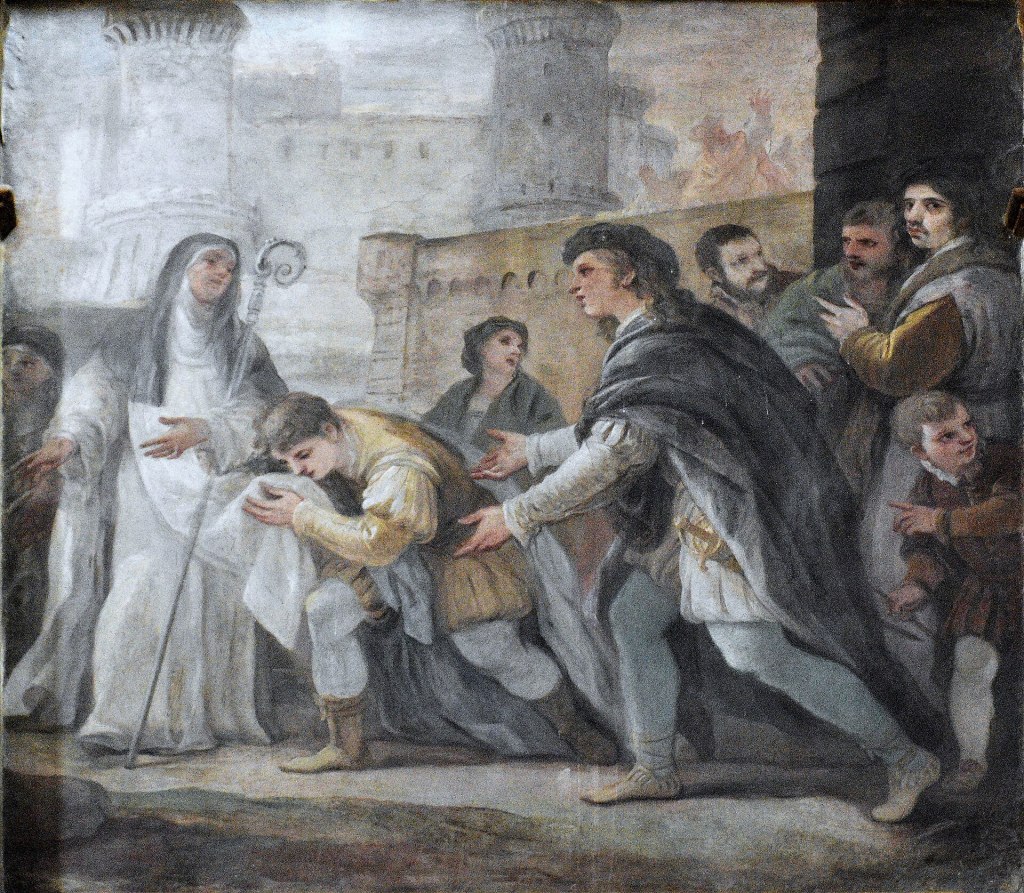
These four paintings form only part of a much larger history of Giordano’s self-representation. Alongside autonomous portraits, he repeatedly inserted his own likeness into larger compositions. In Saint Luke Painting the Virgin at Ponce, the Evangelist bears Giordano’s features. At San Gregorio Armeno he appears among the figures in the fresco of the Basilian nuns welcomed in Naples by Duke Sergio, while another self-image was incorporated into the Marriage of the Virgin at Guadalupe. Towards the end of his Spanish period he included himself again in the decoration of Toledo Cathedral, where his likeness appears in one of the fictive windows of the sacristy.
Luca Giordano, The Basilian Nuns Welcomed in Naples by Duke Sergio (Monache basiliane accolte a Napoli dal duca Sergio), 1684, fresco, San Gregorio Armeno, Naples, detail showing the artist’s self-portrait. Image: Giuseppe Guida/Wikimedia Commons, CC BY-SA 4.0.
Self-portraiture accompanied a career of extraordinary scale. Giordano moved across Naples, Venice, Florence and Spain, absorbed and transformed very different traditions, and left a deep mark on later painting. Lattuada has described artists as capable of “making art history inside the works they paint”. Few painters embodied that idea more fully than Giordano. His self-portraits offer one concentrated record of the man within that prodigious career.
Related articles on Inner Surfaces
Luca Giordano at the Casón del Buen Retiro: the Alegoría del Toisón de Oro and the last Habsburg court
Salvator Rosa: Portraits, Self-Portraits and the Construction of Artistic Identity
Producing these essays requires care, time, research, and resources. Contributions to help sustain this exploration would be greatly appreciated.
I have consulted the following sources. Any errors are mine.
Printed sources
de Giovanni, Biagio. “I ‘filosofi’ di Luca Giordano e la libertà della filosofia.” In Luca Giordano 1634–1705. Naples: Electa Napoli, 2001.
Fumagalli, Elena, ed. “Filosofico umore” e “maravigliosa speditezza”: pittura napoletana del Seicento dalle collezioni medicee. Florence: Giunti, 2007. See Francesca de Luca, cat. 20, p. 182.
Liberato, Marco. Cat. 1, in Sylvain Bellenger, Stefano Causa and Patrizia Piscitello, eds., Luca Giordano. Dalla natura alla pittura. Milan: Electa, 2020, p. 160.
Liberato, Marco. Cats. 1–4, in Stefano Causa and Christophe Leribault, eds., Luca Giordano. Le triomphe de la peinture napolitaine. Paris: Paris Musées, 2019, pp. 159–61.
Pacelli, Vincenzo. La pittura napoletana da Caravaggio a Luca Giordano. Naples: Edizioni Scientifiche Italiane, 1996.
Procajlo, Anna Maria. “Leopoldo de’ Medici e la sua ricerca sistematica del ‘ritratto fatto di sua propria mano’.” Imagines 4 (May 2020): 134–151.
Scavizzi, Giuseppe. Luca Giordano. La vita e le opere. Naples: Artem, 2017.
Spinosa, Nicola, ed. Luca Giordano 1634–1705. Naples: Electa Napoli, 2001. See especially R. Muzi’s catalogue entries on Giordano’s self-portraits.
Suthor, Nicola. Bravura: Virtuosity and Ambition in Early Modern European Painting. Princeton and Oxford: Princeton University Press, 2021.
Tuck-Scala, Anna Kiyomi. Andrea Vaccaro (Naples, 1604–1670): His Documented Life and Art. Pozzuoli: Paparo Edizioni, 2012.
Úbeda de los Cobos, Andrés. Luca Giordano at the Museo Nacional del Prado: Catalogue Raisonné. Madrid: Museo Nacional del Prado, 2017.
Broadcast and online sources
Catedral Primada de Toledo. “La Sacristía y Pinacoteca.”
Christie’s. “Luca Giordano, An Astronomer Holding a Telescope and a Mirror, Reflecting a Portrait of the Artist.”
Lattuada, Riccardo. “Autoritratto.” Museo Nazionale, Rai Tre, 2 January 2016. RaiPlay Sound.
Ministero della Cultura, Catalogo Generale dei Beni Culturali. “Monache basiliane accolte a Napoli dal duca Sergio,” Luca Giordano, 1684.
Museo de Arte de Ponce. “Luca Giordano, Saint Luke Painting the Virgin, c. 1650.”
Pinacoteca di Brera. “Luca Giordano, Autoritratto di Luca Giordano in veste di chimico o alchimista, c. 1660.”
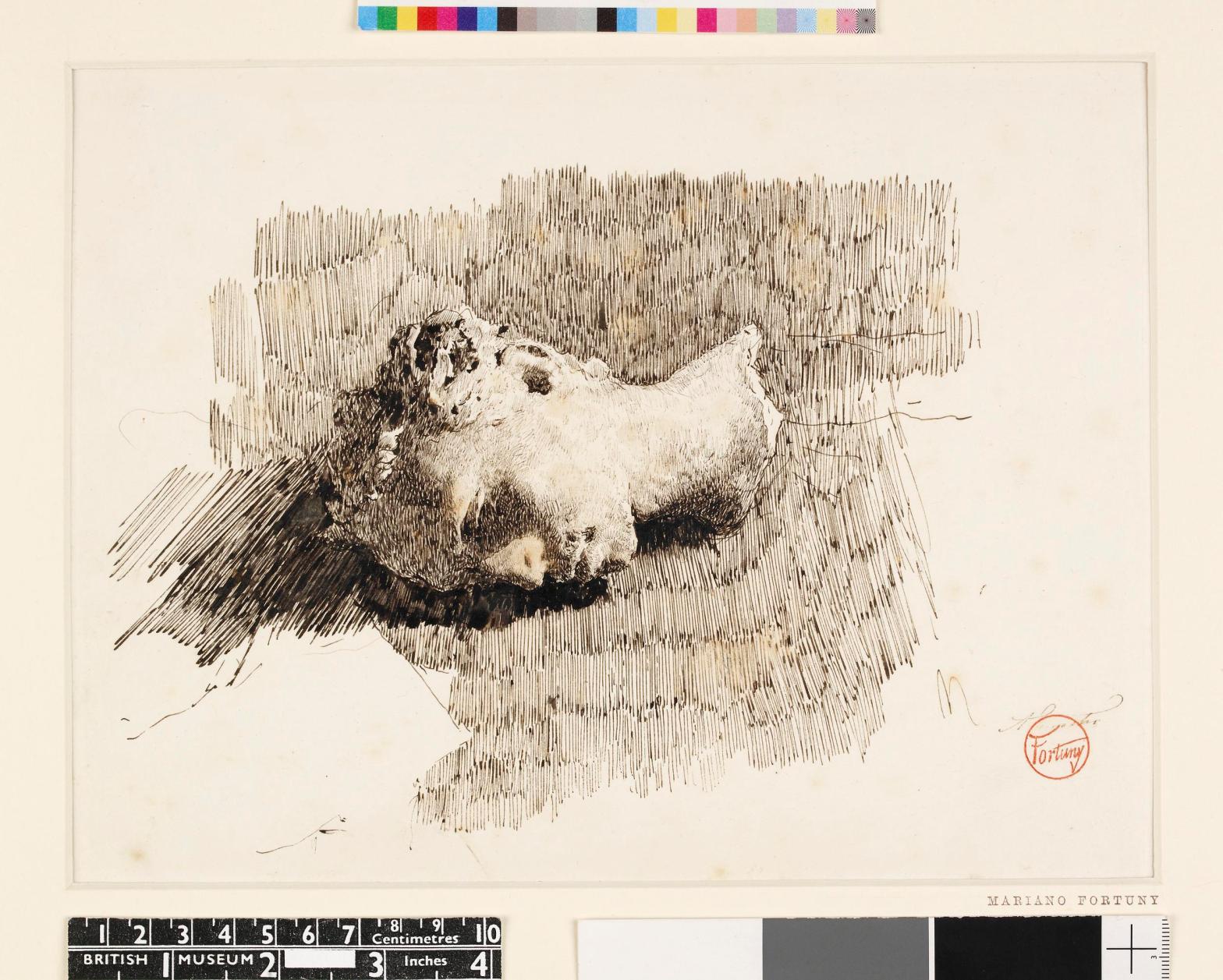
Mariano Fortuny’s drawing of Vincenzo Gemito’s plaster portrait of Francesco Paolo Michetti presents the artist through another artist’s translation of a sculpted likeness. The image is particularly apt for Michetti, whose own practice repeatedly moved between direct observation, photographic record and transformation in other media.
Francesco Paolo Michetti is difficult to contain within the conventional boundaries of a painter’s career. Painting remained central to his activity, but his practice also encompassed photography, drawing, sculpture, decorative design, experiments with architectural space, optical devices, theatre and, eventually, cinema. These interests overlapped across a career in which Michetti repeatedly tested different ways of observing, preserving and transforming what he saw.
This experimentalism appeared early. Michetti first exhibited in Paris in 1872, when he was barely twenty-one, and returned repeatedly over the following decades. By the beginning of the 1880s his work was already conspicuous for its variety of materials and presentation. At the Milan exhibition of 1881 he showed more than thirty works, predominantly in pastel and tempera, while contemporary commentators also noticed his unconventional frames, which extended the visual effect of the picture beyond the painted surface itself. Photography had entered his practice by this period. A photograph of the pinewood near Francavilla, dated to about 1881, already shows the camera being used to isolate the structure and rhythm of natural forms. At the same time, critics were noticing the importance of movement in Michetti’s painting. Reviewing the Turin exhibition of 1880, Louis Gonse singled out the force and accuracy of movement in his compositions, decades before Michetti’s experiments with cinema.
Luigi M. Lombardi Satriani offers a useful way of thinking about this range of activity in his essay “Le realtà e gli sguardi”. He considers the different kinds of attention brought to Abruzzo by Michetti and the circle around him. Michetti, Gabriele D’Annunzio, Costantino Barbella and the folklorist Antonio De Nino could travel through the same towns, attend the same religious festivals and observe the same people, yet what each retained from those encounters depended upon his particular form of practice. One might make photographs or drawings, another sculpture, literary notes or ethnographic description. Lombardi Satriani argues that reality is therefore not simply received intact by the observer, but assumes different contours according to the gaze directed towards it.
The Francavilla circle provides a concrete example of a shared field of experience being apprehended in different ways. Michetti’s own practice raises a related question within the work of a single artist, since he himself moved continually between different forms of representation. Photography could arrest a passing appearance, isolate a detail and preserve it for scrutiny. Painting allowed observed material to be reorganised through colour and composition. Sculpture offered a way of testing volume and physical presence. His manipulation of architectural space brought actual light and framing into the experience of looking, while theatre and cinema later introduced duration, performance and movement.
Photography became particularly important within this range because it allowed appearances to be detached from the circumstances in which they had first been seen. They could then be stored, enlarged, compared, classified and returned to long after the original encounter.
Photography as instrument, archive and form of knowledge
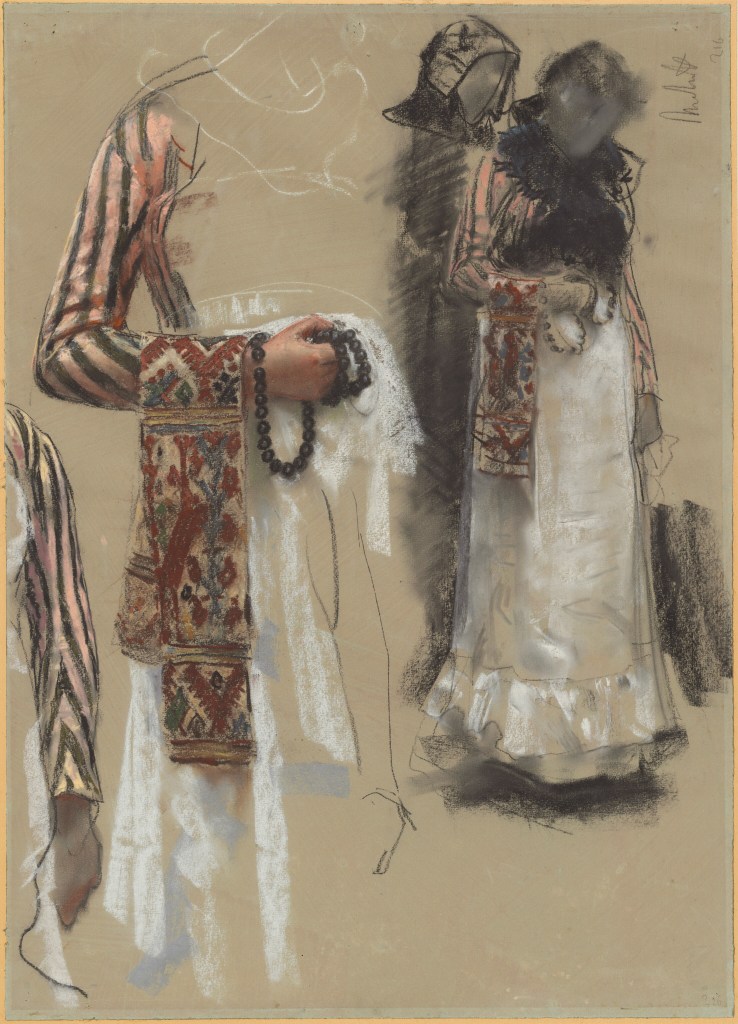
The camera accompanied Michetti into the field. In the early 1880s he travelled through Abruzzo with Gabriele D’Annunzio, Costantino Barbella and Antonio De Nino, seeking out religious festivals and other occasions when large numbers of people gathered. Barbella recalled an expedition to the pilgrimage at Casalbordino in which he, Michetti and D’Annunzio left Pescara at dawn and carried cameras specifically to make studies of costume. Michetti was already thinking about Il voto, while D’Annunzio was making notes for future writing. Similar excursions followed, combining photography with drawing, sculpture, literary observation and the developing ethnographic study of regional customs.
Francesco Paolo Michetti, Southern Italian Woman Dressed for Church, 1885–88, pastel on blue laid paper prepared with beige gouache, 64.5 × 46 cm, National Gallery of Art, Washington. National Gallery of Art, public domain.
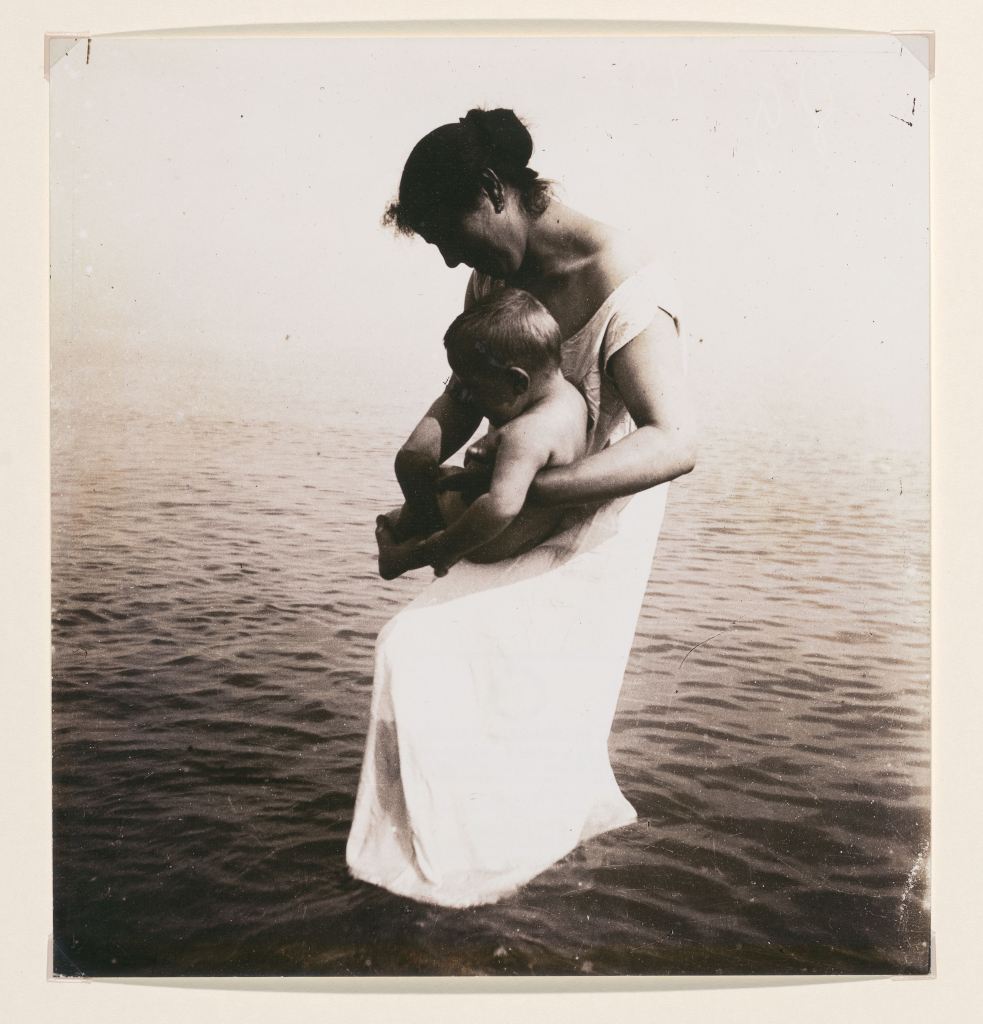
Michetti photographed pilgrims, processions and crowds, as well as shepherds, peasants, street vendors, musicians, mothers and children. The camera could preserve a gesture, a costume or a face encountered within the movement of a festival and make it available for later study. His use of photography also extended beyond these organised expeditions. In September 1888, writing to Simone Sorge, he casually mentioned bringing his camera on a visit in order to make a portrait, evidence of how readily photography had entered his ordinary working and social life.
Francesco Paolo Michetti, Adelina e il piccolo Sandro, 1882, photograph, Rijksmuseum, Amsterdam. Rijksmuseum, CC0 1.0 / Wikimedia Commons.
The scale of the archive that resulted was considerable. Ugo Ojetti later described numbered and alphabetically ordered drawers containing some ten thousand photographs taken by Michetti himself, alongside a separate system for cataloguing thousands of canvases and studies. Photographs could be retrieved and compared with painted sketches, allowing figures and landscapes recorded at different times to remain available long after the moment in which they had first been seen. The archive functioned as a form of visual memory that could be searched, compared and rearranged.
Its subjects extended well beyond the human material of the Abruzzese expeditions. Michetti photographed flowers, leaves, roots, rocks, trees and stones worn smooth by water, often concentrating closely on their structure and surface. Marina Miraglia draws particular attention to photographs of trees made at the Villa d’Este at Tivoli around 1910–11. The only photographic enlargements she found in Michetti’s archive were details from these studies. Enlargement allowed a fragment of bark, branching structure or configuration of foliage to be separated still further from its surroundings and examined as a visual form in its own right.
By this stage photography could also produce images that Michetti regarded as complete without translation into paint. When the Milanese dealer Lino Pesaro visited him at Francavilla in 1919 and asked to see recent paintings, Michetti showed him photographs instead. According to Miraglia’s account, he saw no need to transfer them to canvas when they had already achieved the aesthetic and expressive result he wanted. Photography and painting could therefore coexist within his practice as distinct means of working with appearances, even while photographs continued to contribute to the conception of paintings.
The archive remained an active part of Michetti’s creative process. A photographed figure could be detached from its original setting, a landscape retained for another purpose, and observations made at different times brought together within a new composition. Visible experience, once fixed by the camera, became material that Michetti could select, alter and recombine in paint.
Observation and transformation
The photographic archive gave Michetti a repertoire from which individual elements could be extracted and used in new circumstances. A photographed figure might recur in several paintings, altered in dress, orientation or gesture. Landscape and figures recorded separately could be brought together within a single composition. In one study of two peasant women near Rapino, for example, the photographed figures were subsequently combined in paint with a landscape element probably derived from another photographic source. The photograph supplied material from which Michetti could construct a new image.
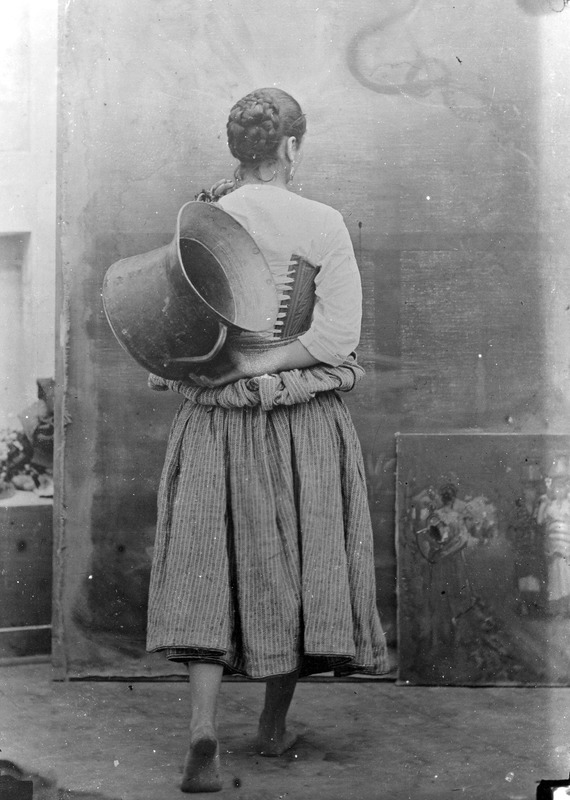
The long development of La figlia di Iorio makes the process particularly clear. Michetti repeatedly photographed women carrying a conca, sometimes posed in the studio and sometimes caught walking, and related figures recur across works from different periods. One photograph made before 1895 records a model in the pose eventually used for the daughter of Iorio. Landscape was investigated separately. A stereoscopic photograph of the Maiella carries on its reverse Michetti’s rapid drawing of a walking woman, while the profile of the photographed mountain is closely related to the simplified ridge in the finished painting.
Photography could also enter the process after a pictorial idea had already begun to take shape. One catalogue entry records Michetti devising a figure in the course of developing La figlia di Iorio, then posing a living model according to that conception and photographing her. The new photograph could in turn be used as the composition continued to develop. Drawing, photography and painting could therefore succeed one another more than once during the making of a work.
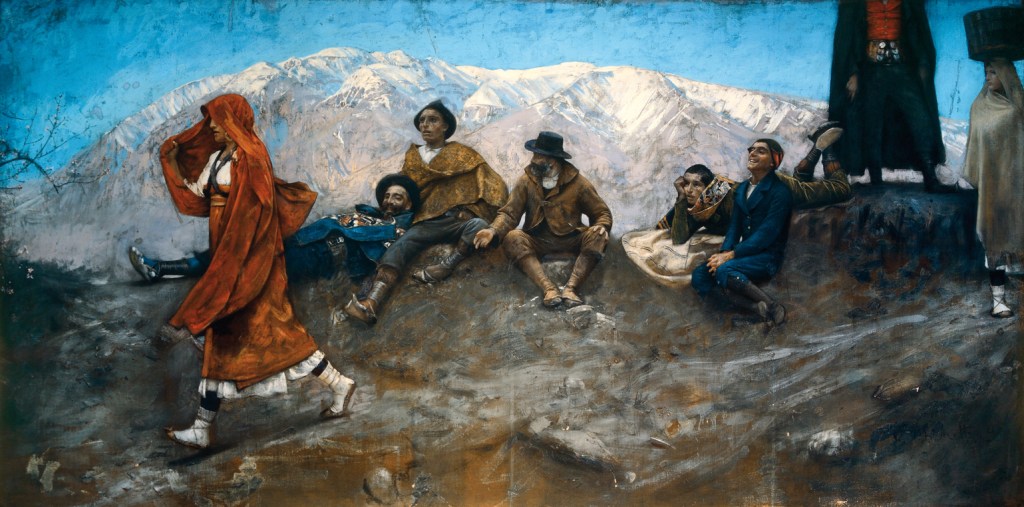
The accumulated studies are brought together in La figlia di Iorio within an emphatically simplified composition. The daughter appears at the left, striding away beneath her red mantle, while the men are distributed across the rocky slope to her right. At the far right another woman, carrying a conca on her head, turns back towards the scene. Behind them the Maiella is reduced to a broad, sharply defined mountain profile. Renato Barilli relates this compression to Michetti’s persistent tendency to suppress perspectival depth and organise forms across the painted surface. Detailed observation has here been distilled into a severe horizontal arrangement of figure, gesture and landscape.
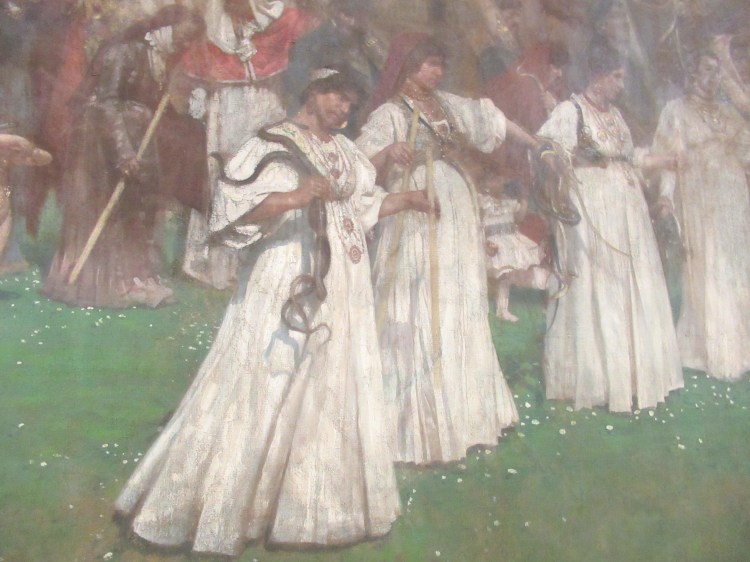
A comparable movement from close observation to stylisation appears in Le serpi. Its long preparation included photographic and graphic studies connected with the Abruzzese religious festival at Cocullo. Teresa Mulone draws attention to the strongly stylised floral forms incorporated into the painting, with sinuous curves related to the colpo di frusta of contemporary Art Nouveau. Michetti’s study of local people, costume and ritual thus entered a composition shaped equally by pattern, rhythm and an international decorative language.
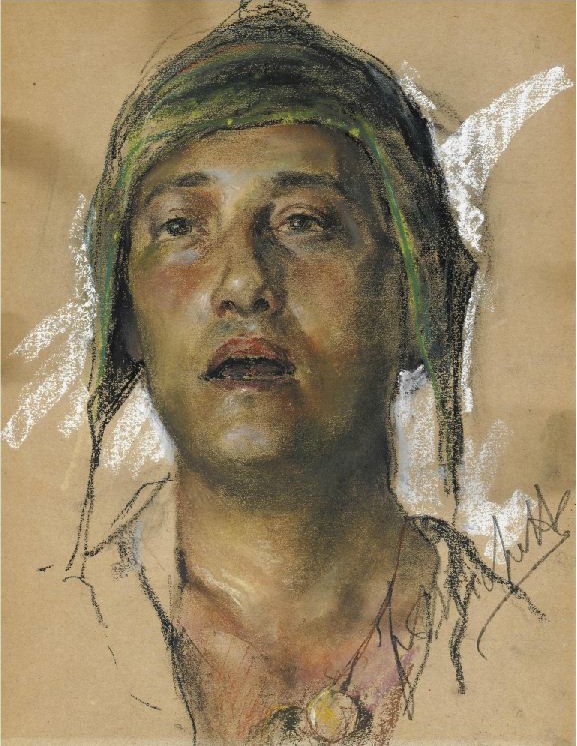
Francesco Paolo Michetti, La figlia di Iorio, 1895, tempera on canvas, 550 × 280 cm, Palazzo del Governo, Pescara. Wikimedia Commons, public domain.Francesco Paolo Michetti, Le serpi, 1900, detail, tempera on canvas, 362 × 957 cm, Museo Michetti, Francavilla al Mare. Wikimedia Commons, CC BY-SA 4.0.Francesco Paolo Michetti, Study traditionally identified as Aligi, c.1890s, pastel on paper, 47 × 36 cm, private collection. A character study later associated with Aligi, the young shepherd in D’Annunzio’s La figlia di Iorio, although the identification is not certain. Wikimedia Commons, public domain.
This tendency to organise observed material through rhythm and simplification was carried much further in the works Michetti called Linee, a body of work subsequently discussed as the Poema delle Linee. Contemporary descriptions suggest that the term was already in use by the 1880s, although many of these works were subsequently associated with his later career. Gabriele D’Annunzio described Michetti as seeking the “hidden lines” within visible appearances and wrote of some two hundred canvases in which an idea had been reduced to its fundamental tones and lines. Some were comparatively developed in colour, while in others a single line and colour could retain the expressive force of the original perception; elsewhere a few rapid indications were enough to suggest movement with remarkable immediacy.
The Linee also belonged to Michetti’s continuing dialogue with photography. Photographic records, painted studies and highly reduced compositions remained connected within the same working archive. Miraglia describes the Poema delle Linee as a “sublimation of photographic language”: the instantaneous selection characteristic of photography had become part of Michetti’s pictorial thinking. The individual image could operate almost like a frame extracted from a longer sequence, reduced to the essential relations of light, line and movement.
Photography could also enter the physical making of an image. Michetti sometimes worked directly over photographic prints, adding tempera by hand. Roberto Lucifero records a more unusual procedure in which Michetti prepared a canvas with a thin layer of gesso and then coated it with photographic emulsion. A photographic trace was produced directly on this prepared surface and subsequently developed further in paint. The photographic image and the painted image therefore occupied the same support, with the former serving as an underlying stage in the construction of the latter.
Light offered another field for this kind of investigation. Photography could preserve particular effects of illumination, while Michetti’s paintings, interiors and optical experiments gave him further means of recreating and manipulating them.
Light and movement
Roberto Lucifero characterises Michetti’s visual activity as a continual “hunt for light”. He describes reflected light on foliage becoming a brushstroke and presents light as a persistent element in Michetti’s investigation of visible form. Movement was another longstanding concern, one that would eventually lead him from painting and photography into cinema.
Francesco Paolo Michetti, Testa femminile (recto), c.1888, tempera and pastel on canvas, Raccolte Frugone, Genoa. Photograph by Sailko / Wikimedia Commons, CC BY-SA 4.0.
At the Convento Michetti, the former Franciscan convent at Francavilla, Michetti carried his interest in seeing into the building itself. He constructed large circular windows deliberately positioned to frame particular views of the surrounding landscape. Marina Miraglia relates these architectural devices to his broader fascination with optical framing, also evident in his habitual use of binoculars. The rooms were painted white to intensify the daylight, while curtains devised for both the Convento and the Casino al mare incorporated coloured textile inserts through which daylight entered the rooms. In this way Michetti could alter the colour of the natural light illuminating an interior.
The Casino al mare also contained an optical laboratory with instruments devised by Michetti and his son Alessandro. Among them was a stereoscope made by Michetti himself, a device that creates an impression of three-dimensional depth by presenting a slightly different image to each eye.
Photography provided Michetti with another means of investigating movement. A particularly revealing example is his series recording the mattanza, or tuna slaughter, at Acireale around 1907. Successive instantaneous exposures record closely spaced moments within the same event. The viewpoint shifts between broader views of the collective action and closer framings of fishermen, gestures and expressions. Miraglia sees in these sequences an emerging cinematic way of looking.
Francesco Paolo Michetti, Model in the Pescasseroli Costume, c.1890, photograph, Istituto Centrale per il Catalogo e la Documentazione, Rome. ICCD / Wikimedia Commons, CC BY-SA 4.0.
His interest in moving images eventually led him to make a feature-length film, Volti d’Abruzzo (Faces of Abruzzo), between 1923 and 1925. The film is now lost. Separate surviving cinematographic material from this period includes fragments shot in Rome and a short documentary. Miraglia notes in the surviving footage changes of scale, movement towards the camera and shifts of focus. Michetti’s papers at Francavilla also preserve drawings dated 1923–25 for cinematographic cameras, projectors and other photographic and film equipment. In the same group of material, a photograph of a strip of film is followed by the isolation of a single frame. Miraglia sees this as another form of Michetti’s longstanding attempt to seize a transient expressive moment from the continuous flow of movement.
Beyond the picture
The unconventional frames already noticed by critics at the Milan exhibition of 1881 developed into increasingly elaborate extensions of the painted image. The frame Michetti devised for Corpus Domini was itself an intricate construction. Ugo Ojetti describes an iron-coloured surround carrying a painted woman wrapped in a long cloth with a child in her arms, a nude man below, a polished brass disc surmounted by a black ball, and an extraordinary accumulation of scarabs, starfish, rosaries, crucifixes, penitential disciplines and scapulars. Ojetti understood this heterogeneous collection as a commentary on the painting and as a gathering of emblems drawn from Abruzzese religious culture. The boundary of the picture had become another field in which Michetti could combine painting, sculpture, objects and symbolic forms.
Michetti’s activity in design extended into fabrics, furniture and architecture. At Francavilla he designed the Casino al mare, his early seaside studio, and drew up its architectural plans himself. His work on such spaces belonged to the same broad range of activity that included the design of furniture, decorative fabrics and mechanisms.
Theatre offered a further opportunity to work with space, figures and movement. In 1904 Michetti collaborated with Gabriele D’Annunzio on the first production of La figlia di Iorio, staged at the Teatro Lirico in Milan on 2 March under the direction of Virgilio Talli. Michetti designed the scenery and costumes for a subject that he had already investigated over many years through painting, drawing and photography. In letters concerning the production, D’Annunzio looked to Michetti’s accumulated experience to establish human types, determine settings and devise the spatial arrangements of the action.
Much of the visual material already existed in Michetti’s photographic archive. The costume worn by Irma Grammatica as Mila di Codro was identical to one Michetti had photographed earlier on the terrace of his Roman studio while preparing Le serpi. Marina Miraglia also notes that the arrangement of the hair closely corresponds to the earlier photographic study. Material gathered through observation and photography could therefore be transferred directly into costume and performance.
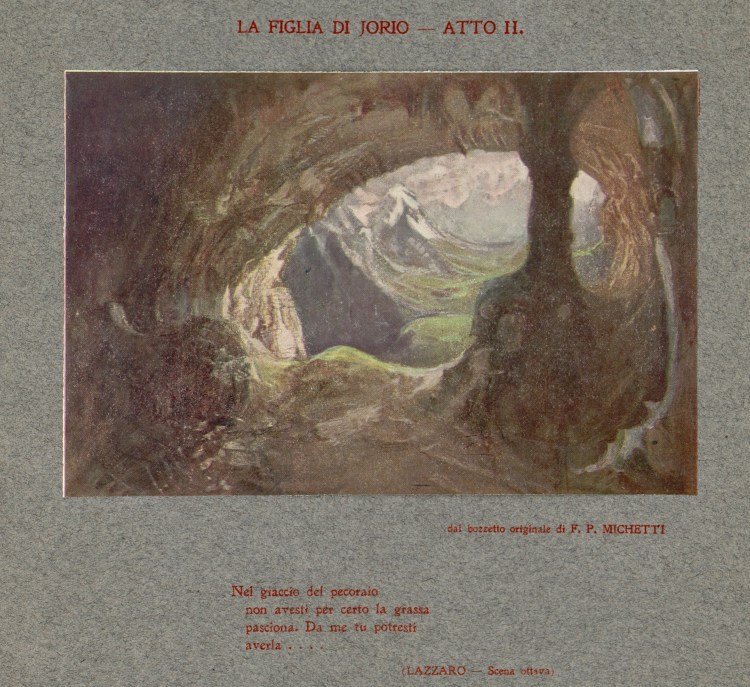
Michetti also used photographs of the Grotta del Cavallone near Lama dei Peligni when designing the setting for the second act, in which the young shepherd Aligi and Mila take refuge together in a mountain cave.
Francesco Paolo Michetti, Caverna d’Aligi, set design for Act II of Gabriele D’Annunzio’s La figlia di Iorio, undated, photoreproduction on paper, Archivio Storico Ricordi, Milan. Archivio Storico Ricordi / Wikimedia Commons, CC BY-SA 4.0.
Close observation of an actual landscape, together with Michetti’s accumulated studies of Abruzzese costume and human types, helped him construct the archaic world D’Annunzio wanted for the drama, described by the poet as “barbaric and remote”. The association with the play subsequently became attached to the real place: the great entrance chamber of the Grotta del Cavallone became known as the Sala di Aligi.
Conclusion
Michetti’s movement between painting, photography, drawing, design, theatre and cinema was sustained by a persistent interest in how visible experience could be observed, preserved and transformed. Different media allowed him to isolate different aspects of the same world.
Luigi M. Lombardi Satriani’s account of different forms of looking offers a useful way of understanding this range. The continuity of Michetti’s work lies in the enquiry itself: from his early photographic studies to his later optical and cinematic experiments, he remained concerned with the appearance of things and with the means by which their forms, movements and changing effects of light might be grasped.
A related essay on Francesco Paolo Michetti can also be found elsewhere on Inner Surfaces: Francesco Paolo Michetti: Light, Colour and the Vitality of Motion.
Producing these essays requires care, time, research, and resources. Contributions to help sustain this exploration would be greatly appreciated.
The sources for this essay are as follows. Any errors are mine.
Barilli, Renato, ed., with Alessandra Borgogelli and Susanna Weber. L’ultimo Michetti: pittura e fotografia. Florence: Fratelli Alinari, 1995.
Barilli, Renato. “Combattimento per un’immagine nell’ultimo Michetti.” In L’ultimo Michetti: pittura e fotografia, edited by Renato Barilli, with Alessandra Borgogelli and Susanna Weber, pp. 7–16. Florence: Fratelli Alinari, 1995.
Benzi, Fabio, and Claudio Strinati, eds. Francesco Paolo Michetti: dipinti, pastelli, disegni. Naples: Electa Napoli, 1999.
Benzi, Fabio, Gianluca Berardi, Teresa Sacchi Lodispoto and Sabrina Spinazzè. Francesco Paolo Michetti. Catalogo generale. Vol. 1. Cinisello Balsamo: Silvana Editoriale, 2018.
Benzi, Fabio, Gianluca Berardi, Teresa Sacchi Lodispoto and Sabrina Spinazzè. Francesco Paolo Michetti. Catalogo generale. Vol. 2. Cinisello Balsamo: Silvana Editoriale, 2024.
Garofalo, Daniela. Francesco Paolo Michetti. Il genio fotografico. Pescara: Ianieri Edizioni, 2015.
Lombardi Satriani, Luigi M. “Le realtà e gli sguardi.” In Francesco Paolo Michetti: il cenacolo delle arti. Tra fotografia e decorazione, pp. 65–71. Naples: Electa Napoli, 1999.
Lucifero, Roberto. “Oltre la pittura: uno stile di vita.” In Francesco Paolo Michetti: il cenacolo delle arti. Tra fotografia e decorazione. Naples: Electa Napoli, 1999.
Miraglia, Marina. Francesco Paolo Michetti fotografo. Turin: Einaudi, 1975.
Miraglia, Marina. “Michetti tra pittura e fotografia.” In Francesco Paolo Michetti: il cenacolo delle arti. Tra fotografia e decorazione. Naples: Electa Napoli, 1999.
Mulone, Teresa. “Michetti e il gusto di fine secolo: qualche precisazione.” In Francesco Paolo Michetti: il cenacolo delle arti. Tra fotografia e decorazione. Naples: Electa Napoli, 1999.
Ojetti, Ugo. “Artisti contemporanei: F. P. Michetti.” Emporium 32, no. 192 (December 1910): 403–428.
Sorge, Paola, ed. Lettere di Michetti a Vinca, a Simone Sorge, agli amici. Pescara: Ianieri Edizioni, 2025.
Strinati, Claudio, scientific director. Francesco Paolo Michetti: il cenacolo delle arti. Tra fotografia e decorazione. Naples: Electa Napoli, 1999.
Weber, Susanna. “L’ultimo Michetti e la fotografia.” In L’ultimo Michetti: pittura e fotografia, edited by Renato Barilli, with Alessandra Borgogelli and Susanna Weber, pp. 29–36. Florence: Fratelli Alinari, 1995.
Online resources
Di Monte, Michele. “Michetti, Francesco Paolo.” Dizionario Biografico degli Italiani, vol. 74. Rome: Istituto della Enciclopedia Italiana, 2010.
Catalogo Generale dei Beni Culturali. Entries relating to Francesco Paolo Michetti and his photographic archive.
Grotte del Cavallone. Historical material relating to La figlia di Iorio, the Grotta del Cavallone and the Sala di Aligi.
Museo Michetti, Francavilla al Mare. Historical and collection information relating to Michetti, the Casino al mare and the Convento Michetti.
Thomas Fearnley travelled to Naples in the spring of 1833 before making an extended journey through Sicily. His Italian itinerary also took in Capri, Sorrento, Amalfi and Castellammare, places already familiar to northern European artists and, in several cases, to his mentor Johan Christian Dahl. David Jackson has stressed, however, that Fearnley was often drawn to less obvious motifs and viewpoints. Direct observation was central to his Italian work. Rather than repeatedly seeking out established prospects, he recorded coastal settlements, roads, buildings, vegetation and fragments of inhabited landscape as he encountered them. Italy enlarged both the geographical and the pictorial range of his work.
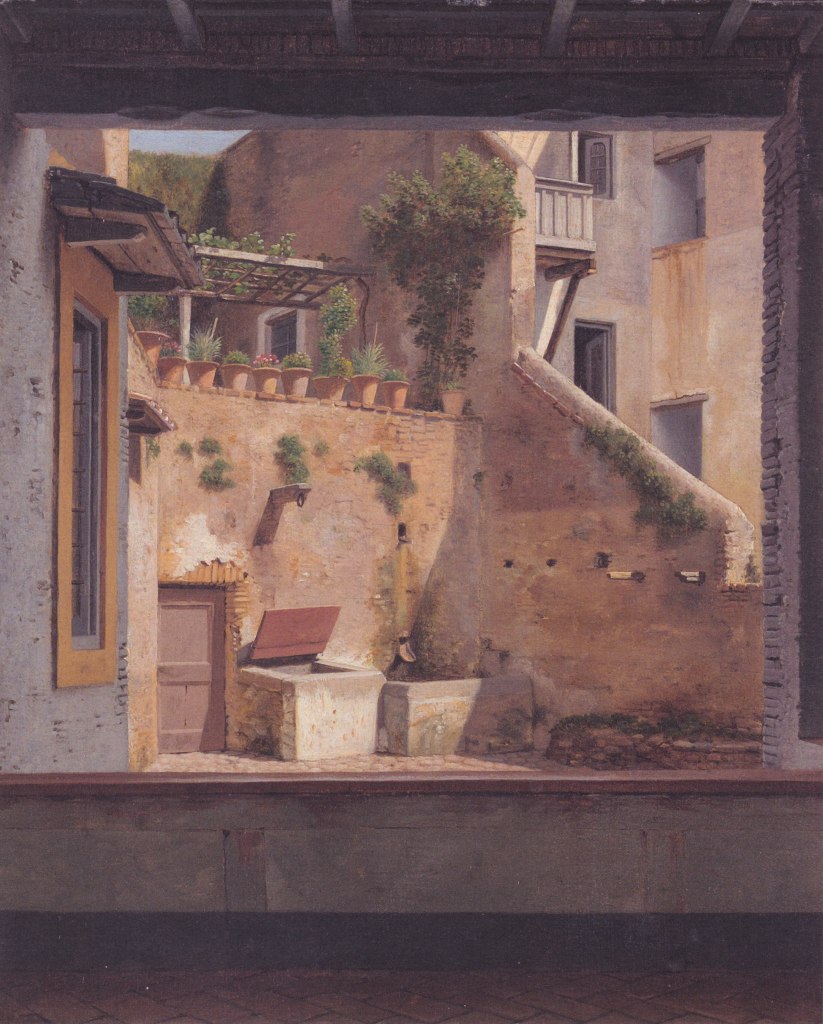
Dahl provided an immediate precedent. During his own Italian journey of 1820–21 he had worked increasingly in the open air, responding to differences of light, colour and atmosphere with greater naturalism. Behind both artists lay a longer tradition of plein-air study in Italy, extending through painters such as Valenciennes, Vernet, Wilson and Thomas Jones. Christoffer Wilhelm Eckersberg was especially important in the Scandinavian context. His Roman studies of 1813 were closely observed and often fragmentary, with architectural forms cropped or approached from positions that could appear almost arbitrary. Fearnley had studied at the Royal Danish Academy, and although there is no evidence that he studied directly under Eckersberg, Jackson argues that he could scarcely have avoided the influence of his example.
Christoffer Wilhelm Eckersberg, View through a Window to a Courtyard in Rome, 1813–16, oil on canvas, 33.5 × 27.5 cm, Ribe Kunstmuseum. Wikimedia Commons, public domain.
Fearnley himself moved readily between broad landscape and motifs brought close to the picture plane, using asymmetry, oblique viewpoints and abrupt cropping. Jackson relates this freedom to what he describes as an essentially democratic principle in Eckersberg’s practice: the painter could give serious attention to whatever happened to be present. In Fearnley’s case, a wall, a plant, a harbour structure or a fragment of architecture could therefore become sufficient material for a study. His terrace pictures belong naturally within this wider practice.
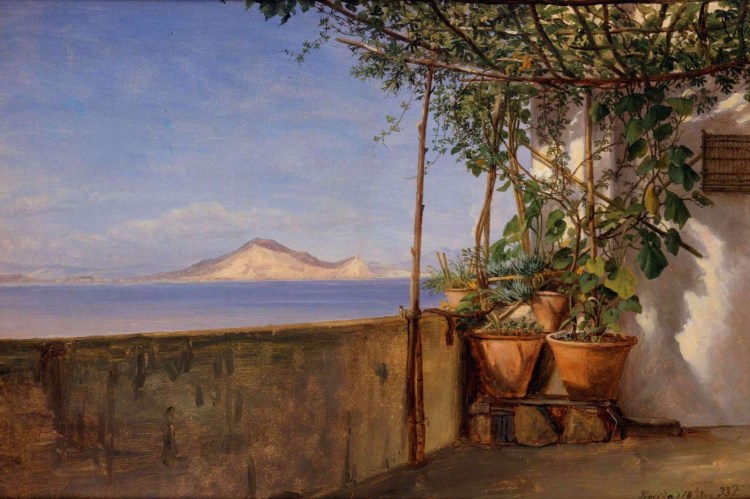
Terrace in Procida was painted on 18 August 1833, during Fearnley’s first year in southern Italy. The dated inscription fixes the encounter precisely. Painted in oil on paper, the small work concentrates upon a loggia overlooking the sea. Pale masonry, trellis and plants occupy much of the immediate field, so that the distant landscape is encountered from within the architecture rather than set apart from it. Its modest scale was consistent with Fearnley’s portable practice in Italy, where many of his studies were made on paper and could readily be carried while travelling.
Thomas Fearnley, Terrace in Procida, 1833, oil on paper laid down on panel, 30 × 44.5 cm, private collection. Wikimedia Commons, public domain.
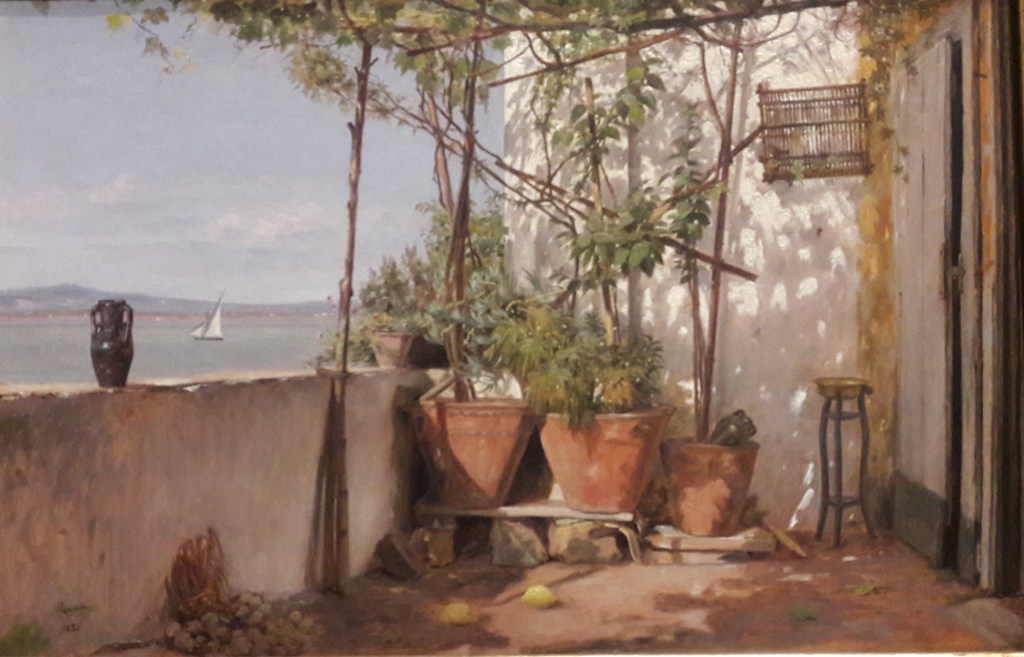
The choice of this particular corner was not without consequence. Two years later the Danish painter Martinus Rørbye painted Loggia, Procida from almost the same place. Nationalmuseum in Stockholm, which owns Rørbye’s picture, considers it highly probable that he had seen Fearnley’s treatment of the motif before visiting Procida himself. Rørbye again gives substantial space to the loggia, with its wall, trellis and pots, while the sea appears beyond. The comparison provides a rare instance in which the circulation of an apparently incidental Italian motif among Scandinavian artists can be traced with some confidence.
Martinus Rørbye, Loggia, Procida, 1835, oil on paper mounted on canvas, 32 × 47.5 cm, Nationalmuseum, Stockholm, NM 7402. Wikimedia Commons, public domain.
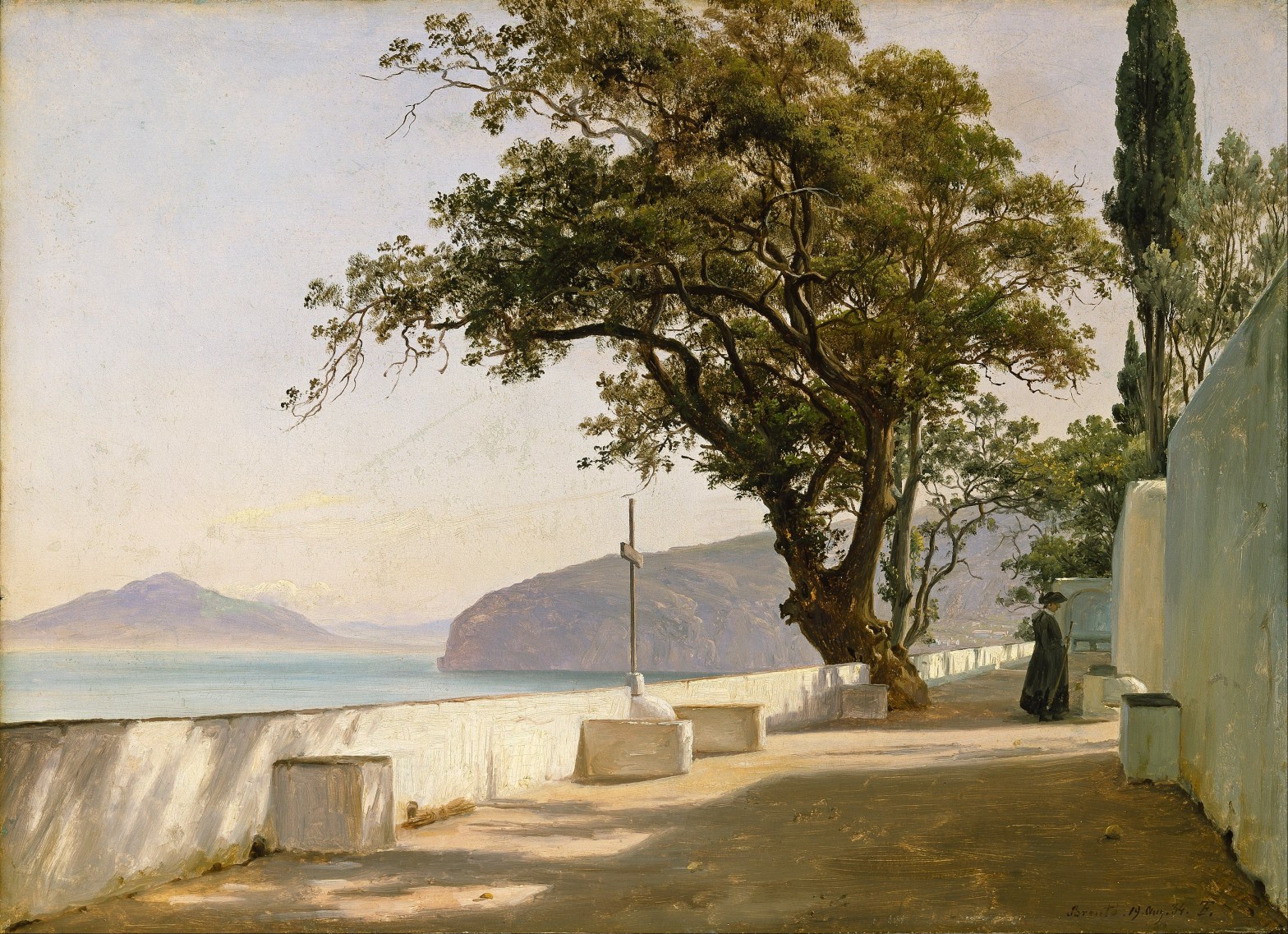
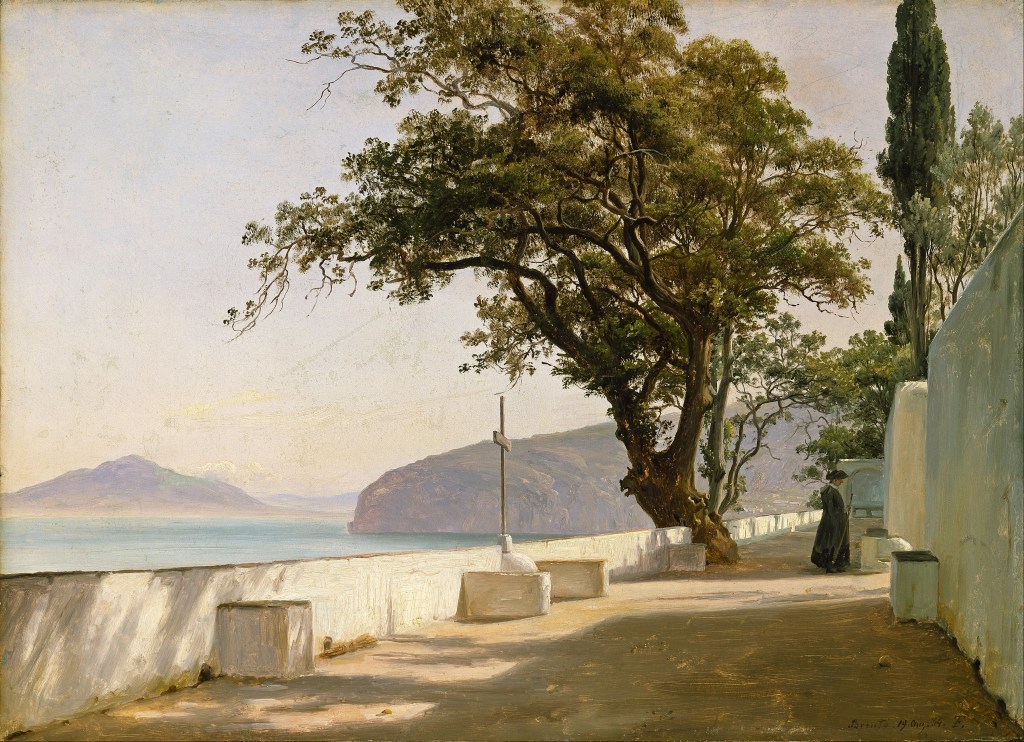
Fearnley returned to the terrace subject at Sorrento in 1834. The Terrace of the Capuchin Convent at Sorrento was painted from the convent of San Francesco on the promontory between Sorrento and Meta. Here the terrace takes possession of much of the composition. A long pale wall, benches, a cross, an oak and the path establish the immediate setting, while the sea and distant headlands recede behind them. Strong sunlight catches the rendered wall and contrasts with the deep shade at the right. Farther away, the coast loses definition in the pale atmosphere. A small dark-clad figure remains subordinate to these larger relationships of light, vegetation and architecture.
The Sorrento painting is also informative about Fearnley’s working methods. Torsten Gunnarsson has pointed out that it resists a straightforward division between plein-air study and completed painting. Technical examination showed that Fearnley worked on it in at least two phases. The sky and the dark cross were added after other passages had dried, while preparatory drawing remains visible beneath the oak. Fearnley himself appears to have regarded the picture as a study, yet its careful organisation and close attention to vegetation show that direct observation need not imply rapid or entirely spontaneous execution.
Thomas Fearnley, The Terrace of the Capuchin Convent at Sorrento, 1834, oil on paper mounted on canvas, 39.5 × 54 cm, Nasjonalmuseet, Oslo, NG.M.03369. Wikimedia Commons, public domain.
During his Italian travels Fearnley produced a large body of oil sketches alongside more finished studio compositions. Jackson describes these studies as part of a visual archive accumulated through travel, material that could remain available for later use after the journey itself had ended. The terrace paintings belong to that larger body of observation rather than to a planned series. Their importance here lies in the seriousness with which Fearnley treated motifs that might once have seemed incidental, and in the freedom that plein-air practice gave him to record them without first turning them into conventional landscape compositions.
The Neapolitan Terrace
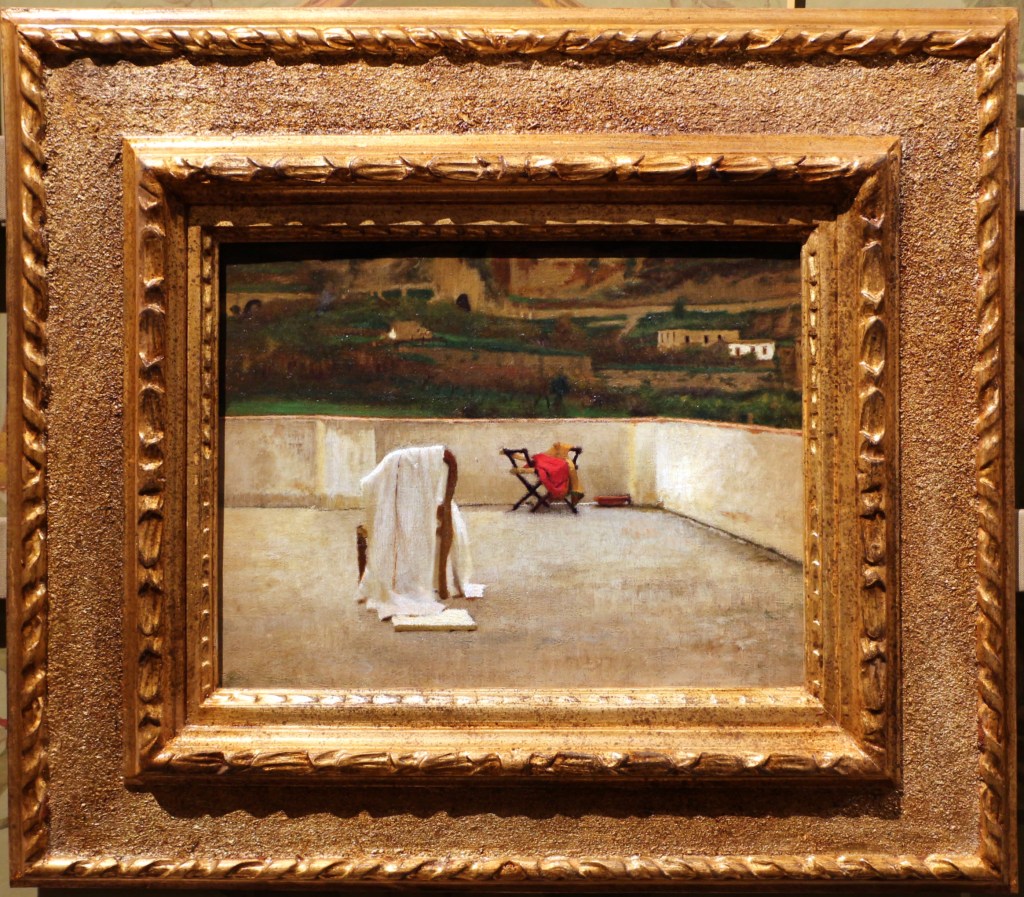
A visitor to the Gallerie d’Italia in Naples might come across Domenico Morelli’s La terrazza and take it, at first glance, for something close to the small dal vero studies that became familiar in later nineteenth-century landscape painting. A plain terrace is caught in strong light, with two chairs in the foreground and the landscape opening beyond. There is little in the picture itself to suggest historical narrative.
The resemblance is largely accidental. Morelli painted La terrazza towards the end of the 1860s as a study for Storia di un paggio innamorato (The Story of a Page in Love), one of the literary and historical subjects characteristic of his work. The story, inspired by Elizabethan theatre, concerned a young page and the lady of a castle. Morelli developed it in several versions. In the first, the two figures occupied a broad terrace against a landscape painted from life; another, unfinished version moved the action indoors and showed the page stealing a kiss from the sleeping woman. La terrazza studies the setting of the first composition before its protagonists have been introduced.
Domenico Morelli, La terrazza, c. 1868, oil on canvas, 26.3 × 34.5 cm, Gallerie d’Italia, Naples. Photograph by Sailko, Wikimedia Commons, CC BY 3.0.
That circumstance accounts for much of its apparent modernity. The terrace is still rustic and comparatively bare, and the two chairs have become the principal objects in a space intended for narrative action. In the finished painting Morelli retained only the folding chair and elaborated the architecture to give the scene a more historical character. The study therefore resembles an autonomous landscape not because Morelli intended it as one, but because the provisional stage of his work temporarily left the setting to itself.
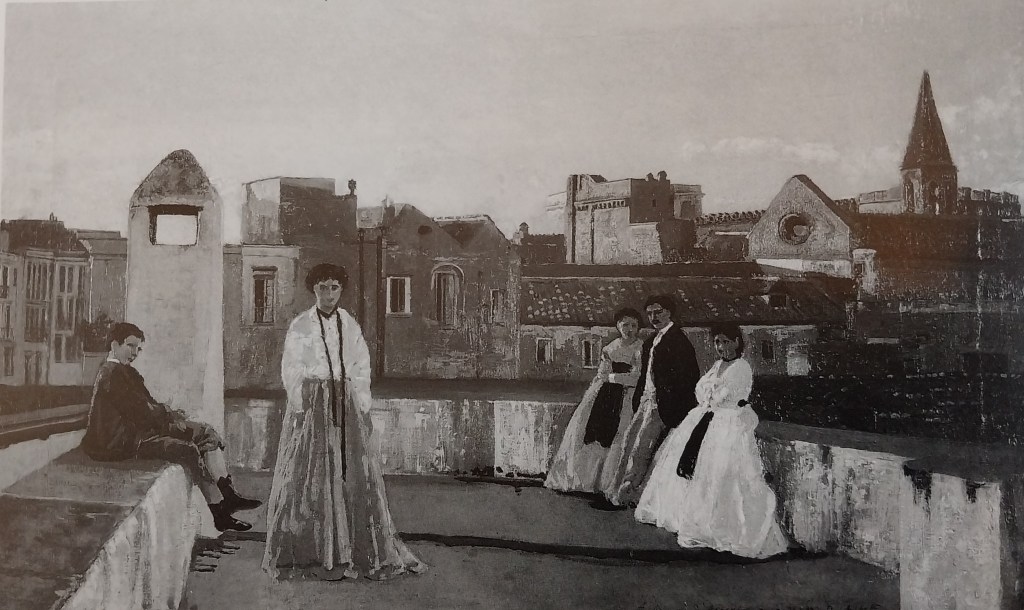
Eduardo Dalbono’s La terrazza, painted at about the same moment, occupies a rather different position. The figures retain a degree of social and pictorial formality, but their setting is emphatically contemporary: a roof terrace enclosed by a plain parapet, with the irregular rooftops of Naples rising immediately behind it. The city is not arranged as a distant panorama. Roofs, walls, gables and towers press close to the terrace, so that the inhabited foreground and the urban landscape appear almost continuous. Dalbono was associated at this period with the Scuola di Resina, whose painters gave renewed attention to direct observation, contemporary life and effects of light. Here the terrace is already more than a setting for figures. It has become part of the observed modern city.
Eduardo Dalbono, La terrazza (La famiglia in terrazza), c. 1865–67, oil on canvas, Galleria Nazionale d’Arte Moderna e Contemporanea, Rome. Photograph by the author from a published reproduction.
Antonio Mancini’s Terrazza napoletana of 1877 belongs to a different category. Here the terrace was not devised as the setting for a narrative painting but formed part of the artist’s own immediate surroundings. Cinzia Virno identifies it as the terrace of the house in Vico Orticelli, Naples, where Mancini lived between 1876 and 1877, before his second journey to Paris. The picture records a place closely connected with his daily life.
The terrace itself is almost empty. A pale parapet cuts across the composition, withholding much of the space immediately beyond it, while the roofs of Naples spread across the upper part of the picture. Alfredo Schettini, writing in 1942, described the painting as an “armonia di grigi delicati e densi” and as a vision at once broad and intimate. The phrase catches one of its central paradoxes. The foreground is closed and tightly bounded, yet the accumulation of rooftops gives the small canvas a surprising spatial breadth.
There is a second tension in the handling of the surface. The range of colour is restrained, but the paint does not feel thin or neutral. Wall, roof and foreground retain a palpable material presence, so that the eye moves between the physical surface of the picture and the distance represented beyond it. That economy of colour is part of the work’s boldness. For a painting of 1877, its refusal of anecdote, its compressed structure and its reliance on a few tonal relationships give it a distinctly modern character.
Antonino Leto’s Centodieci anni a Ischia, painted around 1882, begins from an emphatically human subject. The title fixes attention on the extraordinary age of the woman seated on the terrace, and there is something almost archetypal in the image of old age at rest in the warmth of a southern setting. Yet Leto does not isolate her from her surroundings. She belongs completely to them, seated among pots, plants and simple furniture, her small figure held within the ordinary life of the terrace.
Antonino Leto, Centodieci anni a Ischia, 1881, oil on canvas, 26 × 46 cm, Galleria d’Arte Moderna “Empedocle Restivo”, Palermo.
The terrace does not quite contain the scene. Above its decorated parapet, treetops, distant buildings and low headlands interrupt the view, while the sea remains open to the left and the cloud-filled sky brings a stronger sense of movement. The setting is carefully observed, but it keeps opening beyond the woman rather than enclosing her. The painting belongs to the period in which Leto, after settling on Capri in 1882, increasingly turned towards marine landscape. At this stage the human figure still retains importance, though the sea and sky are already beginning to assert themselves more strongly.
That balance gives the painting much of its character. The woman is neither anecdotal decoration nor the sole centre of attention. She is fully integrated into a world of light, vegetation, weather and distance. The title insists on her presence, but the painting steadily enlarges itself beyond her.
Vincenzo Migliaro’s Taverna a Posillipo, exhibited in 1886, takes a familiar Neapolitan subject and makes light itself one of the chief agents of the scene. Tavern pictures were common enough to risk becoming picturesque formulae, but Francesco Netti praised Migliaro’s painting for its immediacy and luminosity, finding in it the very atmosphere of a Neapolitan day.
Vincenzo Migliaro, Taverna a Posillipo, 1886, oil on canvas, 44 × 77 cm, Gallerie d’Italia, Naples. Photograph by Sailko, Wikimedia Commons, CC BY 3.0.
Much of the foreground is left open, so that the terrace has a breadth absent from the more compressed spaces of Mancini and Leto. Across it the light continually changes. Deep shadow gathers beneath parts of the cane pergola and within the doorway, but a strip of sunlight cuts through farther back, while the weathered wall catches patches of bright light across its pinkish render. The braces of the pergola divide the upper part of the scene into angular shapes, vegetation clings around the building, and pots line the parapet before the view opens towards the sea. Netti himself noticed the large foreground and the passing shadow of a cloud across it.
The figures are dispersed through the space rather than arranged around a single action. Some sit at tables, others stand or converse in small groups, while the nearest figure carries a stronger suggestion of local dress. At the back, a figure turned into the doorway hints at activity continuing inside the building. These details are enough to suggest the ordinary social life of the tavern without allowing anecdote to take over. The empty tables contribute to the sense of a pause in the day, a place being used at an unhurried moment rather than at the height of activity.
The old masonry, pale walls, plants and rough textures give the terrace a strongly physical presence, but Migliaro does not allow these details to harden into description for its own sake. Shade, reflected light and full sun keep changing their appearance. This is what lifts the picture beyond the familiar repertory of Neapolitan tavern life.
Attilio Pratella’s Balcony with Snow turns the terrace motif in an unexpected direction. The balcony itself is close, domestic and refined, its iron railing and flowerpots occupying much of the foreground. We might expect such a setting to open onto a dense urban scene, yet beyond the railings the view falls away instead into a broad pale distance. The contrast between the near domestic detail and the openness beyond is one of the painting’s strongest effects.
Rosario Caputo uses the phrase veduta barometrica in discussing the landscape practice of Pratella and Giuseppe Casciaro, drawing attention to a way of seeing in which weather, atmosphere and changing light become integral to the view itself. In Pratella’s case, Alfredo Schettini particularly admired his command of grey, including the greys present even in clear southern light, and contrasted this with more conventional versions of Naples built from brilliant blue, turquoise and orange-yellow. Pratella also spoke of seeking l’unità nella varietà, unity within variety. The phrase suits a picture in which ornamental ironwork, flowerpots, snow, distant landscape and sky retain their separate character but are held together by a common atmosphere.
Pratella’s connection with Giuseppe Casciaro was close. The two artists had shared lodgings in Via Foria in the 1880s, often painted together and sometimes worked from the same motifs. Casciaro would return repeatedly to elevated gardens, terraces and open views, developing them through a different medium and practice.
In 1871, more than twenty years before Casciaro’s terrace study of 1893, Édouard Manet had made the balcony of the house occupied by his family at Oloron-Sainte-Marie into a subject in its own right. A broad pale wall cuts diagonally across the foreground, red uprights divide the composition, and the figure and small cat occupy the remaining spaces with little concession to conventional balance. Charles S. Moffett related the abrupt framing, flattened architectural planes and asymmetry to Manet’s interest in Japanese prints. Beyond this emphatic geometry, however, the roofs and surrounding landscape are handled more softly. The balcony has become a substantial pictorial presence rather than merely a vantage point from which the town is seen.
Édouard Manet, Oloron-Sainte-Marie, 1871, oil on canvas, 42.5 × 62.5 cm, Emil Bührle Collection, on long-term loan to Kunsthaus Zürich. Wikimedia Commons, public domain.
Casciaro’s terrace of 1893 takes that freedom in another direction. The foreground is dominated by the weight and solidity of the terrace itself: irregular masonry, a large terracotta jar, smaller pots and a balcony rail press close to the picture plane. Above this dense material foreground, only a narrow band of landscape remains. Treetops, a palm and an umbrella pine are compressed between the stone below and the open sky above, with pale blue hills appearing beyond them. The muted yellow-orange sky gives the distance a softness quite unlike the physical immediacy of the terrace. Precisely because so little landscape is visible, it becomes more suggestive, implying a much wider world withheld from view.
Giuseppe Casciaro, terrace study, 1893. Photograph by the author from a published reproduction.
The choice of such a motif accords closely with Casciaro’s way of working. Vito Carbonara describes an artist who returned repeatedly to a relatively concentrated group of places, examining Naples and its surroundings over many years. Carlo Siviero gives a more immediate account of the process. Painting with Casciaro on Capri in 1907, he remembered him completing one study, moving a short distance, cutting another sheet of paper, repositioning his umbrella and easel and beginning again. Siviero called this facility the felicità del suo occhio. A terrace, pergola, path or garden corner could therefore emerge from the continuous act of looking rather than from the search for a predetermined subject.
Carbonara also resists the familiar criticism that Casciaro simply repeated himself. He proposes instead that works made around the same places and periods can be understood as “pictorial seasons”, in which repeated motifs acquire different emphases from one encounter to the next. Tra il verde shows one such variation at a more intimate scale. A woman stands in a corner of the terrace between two large flowering plants. Fallen petals are scattered across the paving below, an incidental detail that adds to the sense of an observed, lived-in space.
Giuseppe Casciaro, Tra il verde, 1890, pastel on paper, 44 × 67 cm, MUST – Museo Storico della Città di Lecce. Wikimedia Commons, public domain.
In Una terrazza a Seiano, dated 8 October 1915, another possibility comes to the fore. Casciaro spent an intensive period at Seiano that summer, staying at Villa Ruggiero and producing between one and two hundred works. The pergola, paving, pale walls, vegetation, distant hills and sky are brought into a restricted range of pearl grey, muted green and off-white. The French term enveloppe is useful here: colour and tone bind the separate forms together through a common atmospheric light.
Giuseppe Casciaro, Una terrazza a Seiano, 8 October 1915, oil on panel, formerly Segretariato Generale della Presidenza della Repubblica. Photograph by the author from a published reproduction.
Rosario Caputo’s term veduta barometrica identifies a different aspect of the same picture. Weather has become part of the subject itself. The grey day is registered across the terrace and the country beyond, while the solitary figure rests at the parapet beneath the pergola. In Carbonara’s terms, this is a paesaggio-stato d’animo rather than simply a paesaggio-veduta. The observed place has become the vehicle for a poetic mood.
These terrace paintings belong to very different circumstances, but each gives pictorial weight to spaces that might once have remained incidental to a larger composition. In Fearnley, the terrace emerges from plein-air study and close observation of encountered places. In Naples later in the century, it becomes something more varied: a domestic setting, an urban platform, a place of sociability, a structure shaped by weather, or simply a fragment of the visible world sufficient in itself.
What joins them is not a continuous tradition so much as an enlarged sense of what a landscape painting might contain. Walls, railings, pots, paving and pergolas no longer need to disappear before the view beyond them. They can become part of the subject.
Producing these essays requires care, time, research, and resources. Contributions to help sustain this exploration would be greatly appreciated.
Caputo, Rosario. La pittura napoletana dell’Ottocento. 2 vols. Naples: Franco Di Mauro, 2022.
Carbonara, Vito. Giuseppe Casciaro: l’artista e le stagioni pittoriche a Nusco. Atripalda: Mephite, 2022.
Carbonara, Vito. Il re del pastello: la pittura di Giuseppe Casciaro ai vertici dell’arte italiana di inizio Novecento. Atripalda: Mephite, 2026.
Cassani, Silvia, ed. Civiltà dell’Ottocento. Le arti figurative. Naples: Electa Napoli, 1997.
Molajoli, Bruno, and Nicola Spinosa. Art Treasures of the Banco di Napoli: Catalogue of the Collection. Naples: Banco di Napoli, 1984.
Moffett, Charles S., ed. The Passionate Eye: Impressionist and Other Master Paintings from the E. G. Bührle Collection. Zurich: Artemis Verlag, 1990.
Ottani Cavina, Anna, ed. Un paese incantato: Italia dipinta da Thomas Jones a Corot. Milan: Electa, 2001.
Picone Petrusa, Maria Antonietta, ed. Dal vero: il paesaggismo napoletano da Gigante a De Nittis. Turin: Umberto Allemandi & C., 2002.
Sumner, Ann, and Greg Smith, eds. In Front of Nature: The European Landscapes of Thomas Fearnley. London: D Giles Limited, in association with the Barber Institute of Fine Arts, University of Birmingham, 2012.
Virno, Cinzia. Antonio Mancini: catalogo ragionato dell’opera. Vol. I. Rome: De Luca Editori d’Arte, 2019.
Two women inhabit two expanses of grass and flowers. In Nikolai Kuznetsov’s Holiday of 1879, a young woman lies almost full length in the vegetation, her body settling into the broad horizontal spread of the field. Thirteen years later, in Ilya Repin’s Autumn Bouquet. Portrait of Vera Repin, the artist’s daughter stands upright in an open landscape, holding an abundant bundle of the plants and flowers that surround her. The pictures are different in character and intention, yet each makes the relation between a human figure and the natural world part of its subject. One woman seems almost absorbed by the field; the other has gathered a portion of it into her hands.
Kuznetsov and Repin came from the same broad world of late nineteenth-century Russian art. Both had been born in territories that are now part of Ukraine but then lay within the Russian Empire: Repin at Chuhuiv in 1844, Kuznetsov six years later at his family’s estate of Stepanovka in Kherson Province. Their careers were very different in scale and reputation. Repin became one of the commanding figures of Russian painting; Kuznetsov, less familiar outside Russia and Ukraine, established himself as a painter of genre subjects and portraits. What brought them into a common institutional orbit was the Society for Travelling Art Exhibitions, whose members became known as the Peredvizhniki, or Wanderers.
The society was founded in 1870, although its origins are usually traced back to the celebrated revolt of fourteen students at the Imperial Academy of Arts in St Petersburg seven years earlier. Its travelling exhibitions offered an alternative to the Academy and brought contemporary painting before audiences in Moscow, St Petersburg and other cities. The Peredvizhniki are closely associated with Realism and with a renewed attention to contemporary life, landscape and national culture, but they were never stylistically uniform. Repin joined the society in 1878. Kuznetsov belonged to a younger generation and began showing with it at the beginning of the following decade.
In 1881, Holiday entered one of the most important public arenas of Russian art through the exhibitions of the Peredvizhniki. By the time Repin painted Vera at Zdravnevo in 1892, that artistic world had altered considerably. Those years encompass changes in the uses of landscape, in portraiture and genre painting, and in the ways Russian artists responded to artistic developments elsewhere in Europe. Yet both pictures begin with the same simple elements, a figure, a field and the physical presence of flowers.
By the time Kuznetsov painted Holiday, landscape had acquired a new prominence in Russian art. Earlier in the century, painters such as Alexei Venetsianov had already joined scenes of rural life to broad skies and open countryside, but from the 1860s and 1870s the land itself became a subject of sustained attention. This development had close parallels in literature. Critics had praised Alexander Pushkin for finding poetry in native scenery that earlier writers might have dismissed as ordinary, while Ivan Turgenev brought close observation of nature into association with the lives of the people who inhabited it. Painting and literature did not simply borrow from one another. They shared a growing conviction that familiar places, seasons and stretches of countryside could sustain serious artistic meaning.
The landscapes that resulted were often striking for the modesty of their material. A road, a field, a low horizon or a group of trees could be enough. Alexei Savrasov found emotional resonance in such motifs, while Ivan Shishkin gave them greater scale and permanence. In Rye of 1878, a track runs through a ripening field towards a distant horizon, with tall pines rising above the grain. The picture is based on a particular landscape near Shishkin’s native Yelabuga, yet the breadth of the field and sky allows the scene to assume a wider significance. Close observation of a place has become an image of the land.
Ivan Shishkin, Rye, 1878, oil on canvas, 107 × 187 cm, State Tretyakov Gallery, Moscow. Wikimedia Commons / Google Art Project, public domain.
Other possibilities were developing at the same time. In Arkhip Kuindzhi’s Moonlit Night on the Dnieper of 1880, now in the State Russian Museum, St Petersburg, the landscape is simplified and transformed by the concentration of moonlight on water and sky. Its Romantic conception of nature moves away from Shishkin’s close description towards something more atmospheric and visionary. Set beside one another, the two paintings suggest the range landscape had acquired by this period, from sustained observation of the visible world to a more concentrated exploration of light, mood and perception.
Arkhip Kuindzhi, Moonlit Night on the Dnieper, 1880, oil on canvas, 105 × 146 cm, State Russian Museum, St Petersburg. Wikimedia Commons, public domain.
This attention to native scenery formed part of a larger search for cultural identity. During the second half of the nineteenth century, artists, writers and critics turned towards history, folklore, popular traditions and the life of the countryside as possible sources for an art grounded in local experience. Yet the idea of a national school should not suggest an enclosed artistic culture. The Russian Empire encompassed different peoples, languages and landscapes, and the Peredvizhniki themselves were not insulated from developments elsewhere in Europe. Realism and Naturalism had become international pictorial languages, carried through travel, exhibitions, reproduction and personal contact.
Repin offers a clear example. During his stay in Paris in the 1870s he encountered contemporary French painting and gradually became receptive to aspects of it, even though his experiments with Parisian subjects brought criticism from Ivan Kramskoi and Vladimir Stasov. What was at issue was partly subject matter. For critics committed to the development of a national art, the modern life of Paris could seem remote from the social and cultural questions that Russian painters ought to address. Yet the techniques and perceptions encountered abroad could be separated from the subjects to which they were first attached. Interest in plein-air painting, changing light and atmospheric colour could return with an artist and be applied to places much closer to home.
National subject matter and an international pictorial language were therefore not incompatible. This becomes increasingly apparent towards the end of the century, when landscape painting across Russia and northern Europe placed new emphasis on atmosphere, colour and immediate visual experience while retaining strong attachments to particular regions. The subject might still be a field, a village or a stretch of native countryside, but the terms in which it was painted were no longer exclusively local.
That distinction is useful for the two paintings considered here. Kuznetsov’s Holiday belongs to a specific Ukrainian landscape and culture, while Repin’s Autumn Bouquet was painted at Zdravnevo, in present-day Belarus. Neither field needs to be treated as a generic emblem of a single national landscape. What they share is a period in which familiar countryside had ceased to be merely the setting for human action. Landscape could carry associations of place, memory and cultural identity, while also offering painters a field for experiments in light, colour and the relation between a figure and the space around it.
Nikolai Kuznetsov, Holiday, 1879, oil on canvas, 55 × 98 cm, State Tretyakov Gallery, Moscow. Wikimedia Commons, public domain.
Kuznetsov painted Holiday in 1879, shortly after leaving the Imperial Academy of Arts and returning to Stepanovka, his family estate in Kherson Province. The Ukrainian countryside was part of the world in which he had grown up and now became a principal subject of his painting. In the same year he produced Touring the Property, where the meeting of landowner and peasant gives rural life a sharper social edge. Holiday turns instead towards leisure and the experience of being out in the landscape.
Nikolai Kuznetsov, Touring the Property, 1879, oil on canvas, 49.5 × 79.3 cm, State Tretyakov Gallery, Moscow. Wikimedia Commons, public domain.
In Holiday, the young woman wears Ukrainian festive dress, realised with the same attention that Kuznetsov gives to the vegetation around her. The embroidery of the white blouse, the patterned skirt and dark boots remain clearly legible among grasses, weeds and wildflowers that have been individually observed. She lies almost parallel with the lower edge of the canvas, one arm bent behind her and the other laid across her forehead, at once a gesture of relaxation and an instinctive shelter from the sun. Behind her, the steppe rises and falls in a succession of shallow, interlocking slopes. Their contours seem to answer the reclining body, while the overlapping bands of land create a subdued recession towards the blue sky. The landscape is spacious without being empty.
Galina S. Tchourak has used the famous episode from War and Peace in which the wounded Prince Andrei lies at Austerlitz and looks upwards at the immense sky to describe a broader affinity between Russian writing and landscape painting. Simple elements of nature could open onto a more expansive state of feeling. In Holiday the comparison acquires a particular visual resonance. The woman is also lying beneath an open blue sky, but Kuznetsov keeps the experience rooted in the physical pleasures of a summer day. The detailed foreground, the warmth of the sunlight and the easy gesture of the raised arm make tranquillity something felt through the body as well as through the landscape.
Tatiana Karpova has described the painting as joining the breadth of the Ukrainian steppe with the languor of a holiday. The Musée d’Orsay catalogue adds a small anthropological footnote by reproducing a later photograph of a young woman rolling in the grass after the harvest. Here such ease with the landscape requires little explanation. When Holiday was shown at the ninth Peredvizhniki exhibition in 1881, it attracted the notice of Ivan Kramskoi and subsequently entered Pavel Tretyakov’s collection.
Repin arrived at the relation between figure and landscape from a different direction, through portraiture. Autumn Bouquet belongs to a longer sequence in which members of his family became both intimate subjects and opportunities for experiment. In Taking a Rest of 1882, the sitter is his wife, Vera Alekseyevna Repina, asleep in a deep red chair. The format has something of the scale of formal portraiture, but the moment itself is private and unguarded. Repin turned the folds of her dress, the upholstery and the difficult foreshortening of the body into a study of closely related tones.
Ilya Repin, Taking a Rest. Portrait of Vera Alekseyevna Repina, the Artist’s Wife, 1882, oil on canvas, 143 × 94 cm, State Tretyakov Gallery, Moscow. Wikimedia Commons, public domain.
His eldest daughter, Vera Ilyinichna, became a recurring subject. In Dragonfly of 1884, painted when she was twelve, she sits on a wooden rail against a broad summer sky, her figure caught in strong outdoor light. The hat casts a shadow across her face while sunlight breaks across the patterned dress. Repin altered the composition as he worked, extending the canvas and changing the setting before arriving at the open arrangement we see now. The apparent ease of the picture was therefore the result of considerable adjustment.
Ilya Repin, Dragonfly. Portrait of Vera Ilyinichna Repina, the Artist’s Daughter, 1884, oil on canvas, 111 × 84.4 cm, State Tretyakov Gallery, Moscow. Wikimedia Commons / Google Art Project, public domain.
Repin painted Autumn Bouquet at Zdravnevo in 1892, when Vera was twenty. In September he wrote from the estate to Tatiana Tolstaya that he had begun a portrait of her in the garden, with a large bouquet of autumn flowers and a smaller, more delicate boutonnière, seeking an expression of life, youth and languor. The finished painting preserves that ease while remaining closely observed. Vera’s dark patterned blouse and white lace collar are set against the softer greens of the landscape, while the red beret and the flowers provide concentrated notes of colour. Compared with Dragonfly, the tonality is quieter and the handling more finished.
Ilya Repin, Autumn Bouquet. Portrait of Vera Ilyinichna Repina, the Artist’s Daughter, 1892, oil on canvas, 114 × 67 cm, State Tretyakov Gallery, Moscow. Wikimedia Commons, public domain.
The bouquet is central to the relationship between figure and setting. Its mixture of flowers and grasses brings the colours and textures of the garden forward into Vera’s hands. She remains distinctly present as an individual rather than becoming an emblem of autumn or youth, yet the portrait depends upon the landscape around her. David Jackson has stressed that Repin’s family portraits allowed likeness and aesthetic experiment to coexist. Here portraiture, landscape and still life are drawn together through colour, light and the familiarity of the sitter.
The thirteen years between Holiday and Autumn Bouquet do not describe a simple movement from one kind of painting to another. Kuznetsov’s picture already resists a neat distinction between genre painting and landscape, while Repin’s portrait depends upon the garden, its light and its flowers for much of its character. By the 1890s such distinctions had become increasingly porous. Landscape could enter portraiture and scenes of everyday life as an active part of their meaning. Repin’s Leo Tolstoy Ploughing of 1887 offers a telling midpoint, presenting the writer through his physical activity in the cultivated landscape.
Ilya Repin, Leo Tolstoy Ploughing, 1887, oil on cardboard, 27.8 × 40.3 cm, State Tretyakov Gallery, Moscow. Wikimedia Commons, public domain.
Taken together, Holiday and Autumn Bouquet show how much could be made from familiar countryside. Kuznetsov’s young woman rests among grasses and wildflowers; Vera holds a gathered bouquet in her arms. In each painting, flowers and vegetation belong to the figure’s experience. More generally, the landscape remains observed, particular and close at hand, a place in which human presence can find harmony.
Producing these essays requires care, time, research, and resources. Contributions to help sustain this exploration would be greatly appreciated.
These are the sources consulted. Any errors are mine.
Blakesley, Rosalind P., “The Quest for Russian Distinction,” in Russia and the Arts: The Age of Tolstoy and Tchaikovsky, London: National Portrait Gallery, 2016, pp. 63–76.
Hedström, Per, “The Peredvizhniki and Europe,” in David Jackson and Per Hedström, eds, The Peredvizhniki: Pioneers of Russian Painting, Stockholm: Nationalmuseum, 2011, pp. 40–53.
Jackson, David, The Russian Vision: The Art of Ilya Repin, Schoten: BAI, 2006.
Karpova, Tatiana, catalogue entry for Nikolai Dmitrievich Kuznetsov, Jour de fête, in Marie-Pierre Salé and Édouard Papet, eds, L’Art russe dans la seconde moitié du XIXe siècle: en quête d’identité, Paris: Musée d’Orsay / Réunion des musées nationaux, 2005, cat. 284, p. 401.
Salé, Marie-Pierre and Édouard Papet, “Avant-propos,” in Marie-Pierre Salé and Édouard Papet, eds, L’Art russe dans la seconde moitié du XIXe siècle: en quête d’identité, Paris: Musée d’Orsay / Réunion des musées nationaux, 2005, pp. 17–34.
Tchourak, Galina S., “Terre russe: le paysage en peinture et en littérature,” in Marie-Pierre Salé and Édouard Papet, eds, L’Art russe dans la seconde moitié du XIXe siècle: en quête d’identité, Paris: Musée d’Orsay / Réunion des musées nationaux, 2005, pp. 51–65.
Museum collection records
Online collection records from the State Tretyakov Gallery, Moscow, were consulted for works by Nikolai Kuznetsov, Ivan Shishkin and Ilya Repin discussed in this essay; the State Russian Museum, St Petersburg, was consulted for Arkhip Kuindzhi’s Moonlit Night on the Dnieper.
Two painted versions of Isabella d’Este have come to define her association with Titian, although neither records a simple encounter between painter and sitter. One, generally called Isabella in Red, is known principally through a copy made by Peter Paul Rubens after a lost Titian and shows Isabella as a mature woman. The other, Isabella in Black, now in the Kunsthistorisches Museum in Vienna, presents her with richly ornamented sleeves, fur and an elaborate headdress, but with the face of a woman far younger than Isabella was when the portrait was painted in the mid-1530s. She was then about sixty. At first the two images seem to offer a choice between age and youth, observation and flattery. Their histories resist so simple a division.
Isabella had been concerned with the making and circulation of her image for much of her adult life, but the surviving correspondence makes it difficult to separate that concern from the political circumstances in which she lived. Married to Francesco II Gonzaga in 1490, she assumed delegated authority while her husband was campaigning during the Italian Wars and governed Mantua during his imprisonment by the Venetians in 1509–10. After Francesco’s death in 1519 she acted as regent for their son Federico until he established his own authority. Carolyn James has argued that Isabella’s portraits should therefore be considered alongside the other means by which a Renaissance ruler might establish magnificence, lineage, prudence and political competence. Her close direction of artists has often been judged more harshly than comparable image-making by male princes.
Dress formed part of the same visual language. Around 1509 Isabella began wearing the distinctive turban-like headdress variously described as the zazara, scuffioto or capigliara, made from interwoven hair and silk ribbons. Its association with her became sufficiently close that Susanna Gonzaga and Laura Bentivoglio sought permission to adopt the fashion and were refused. In 1515 a less resistible request arrived through Isabella’s son Federico. François I wanted a doll dressed in examples of the clothes Isabella wore, together with miniature versions of her headdresses, so that women at the French court could copy them. In 1523 Bona Sforza, queen of Poland, thanked Isabella for six gold-and-silk scuffioti and asked to receive examples of future inventions. Her fashions had acquired a political as well as a fashionable currency beyond Mantua.
For generations, such vigilance was readily explained as vanity. That interpretation owed much to Pietro Aretino, who in 1534 ridiculed the ageing marchioness for attempting to disguise the effects of time. James has shown how readily later scholars accepted his caricature, sometimes treating Isabella’s direction of artists as interference rather than as princely image-making. Aretino’s attack also lies behind the familiar assumption that Isabella commissioned Titian’s later youthful portrait because she disliked an earlier image in which he had shown her as an older woman. Nothing is known of her reaction to that first portrait.
Her attitude towards likeness was more complicated than the charge of vanity implies. Isabella could reject a portrait because she thought it failed to resemble her, while portraits were also used within her family to compare features across generations. Yet she could approve an image that departed conspicuously from physical fact. The two portraits associated with Titian preserve both possibilities.
The earlier portrait has not survived. It is generally dated to about 1529–30, when Titian was working for the Gonzaga court, and the 2004 Ferrara catalogue Gli Este a Ferrara: una corte nel Rinascimento treated it as a portrait painted from life. Isabella, born in 1474, was then in her mid-fifties, and Titian apparently represented her at something approaching her contemporary age.
Its composition is preserved most importantly in Rubens’s Isabella in Red, made around the beginning of the seventeenth century while he was in the service of Vincenzo Gonzaga at Mantua. Rubens copied two Titian portraits of Isabella there, the youthful portrait now in Vienna and the lost image of the older woman. In the surviving copy Isabella appears at three-quarter length in a sumptuous red dress, with pearls and gold ornaments worked into the elaborate headdress.
Peter Paul Rubens, Isabella d’Este (Isabella in Red), c. 1600–01, oil on canvas, 101.8 × 81 cm, Kunsthistorisches Museum, Vienna. Image: Wikimedia Commons / Kunsthistorisches Museum Wien, public domain.
A seventeenth-century inventory of Titian’s original supplies details that should not be transferred automatically to Rubens’s painting. It described Isabella in an old-fashioned red satin dress, with a fan in her right hand and her left resting in her lap. The fan is not visible in Rubens’s version. The difference is a useful reminder that the copy preserves Titian’s conception without reproducing every feature literally. Titian’s original subsequently entered the collection of Charles I of England and was dispersed after the king’s execution.
Rubens’s painting should therefore be treated as a translation rather than a facsimile. The Kunsthistorisches Museum has emphasised the greater splendour and bodily amplitude he gave Titian’s Isabella in accordance with his own pictorial language. The Vienna exhibition catalogue Isabella d’Este: La prima donna del mondo. Fürstin und Mäzenatin der Renaissance, edited by Sylvia Ferino-Pagden, develops the point further. The richness of the red costume, the glittering pearls and gold, the rosy complexion and the soft modelling of the face belong in part to Rubens’s early seventeenth-century conception of princely femininity. Isabella has become fuller and more opulent without becoming a caricature.
Rubens has consequently preserved the lost composition without providing transparent access to Titian’s canvas, still less to Isabella herself. Even the portrait that apparently stood closest to her appearance in middle age has reached us through another painter, working roughly seventy years later.
The youthful portrait had a different and more elaborate genealogy. In 1534 Isabella arranged for Titian to work not from a new sitting but from a portrait Francesco Francia had painted in 1511, when she was about thirty-seven. Francia had likewise worked without Isabella before him. She had refused to sit, and he instead relied on an earlier portrait by Lorenzo Costa while Isabella’s half-sister Lucrezia d’Este Bentivoglio acted as intermediary and supplied verbal guidance about her appearance.
When Francia’s portrait reached Mantua, Isabella acknowledged that it bore little resemblance to her but praised the painter for making her much more beautiful than nature had. She nevertheless considered asking for the colour of her eyes to be altered, before accepting Lucrezia’s advice that further work might disturb the painting. Isabella later gave the portrait to the Ferrarese courtier Gian Francesco Zaninello. More than twenty years afterwards it was recovered from his heirs and sent to Venice for Titian to use. Titian’s model was therefore a portrait whose idealisation Isabella had recognised and approved, itself dependent upon an earlier likeness and the recollections of someone who knew her.
Francis Ames-Lewis has emphasised that such mediation was not unusual in Renaissance portraiture. Painted likenesses could be constructed from drawings or earlier portraits, supplemented by verbal description and remembered appearance. Exact physiognomic correspondence was only one of the things a portrait might provide. Beauty, nobility, rank and social identity could also belong to its claim to truth.
The resulting Isabella in Black does not advertise this complicated ancestry. Isabella appears composed and youthful, seated in a three-quarter-length pose against a dark background. Her black bodice is set against richly patterned blue sleeves worked with gold and silver, while white fur falls across one shoulder. Pearls and jewels ornament the headdress. James describes Isabella as firmly grasping a rosary and reads it as a sign of piety within a display otherwise marked by magnificence. She also draws attention to the fine balance between the exposed skin at the neckline and the stiff posture and indirect gaze that maintain decorum and wifely chastity. The elaborate zazara, meanwhile, recalls the coiffures of Roman imperial women and renews classical associations already present in earlier images of Isabella.
Titian, Isabella d’Este (Isabella in Black), c. 1534–36, oil on canvas, 102.4 × 64.7 cm, Kunsthistorisches Museum, Vienna. Image: Wikimedia Commons / Kunsthistorisches Museum Wien, public domain.
The portrait was finished by the spring of 1536. On 29 May Isabella wrote to the Mantuan ambassador in Venice that it pleased her greatly, adding, with some humour, that she doubted she had ever possessed at the age represented the beauty Titian had given her. Her response acknowledged the idealisation rather than mistaking it for recovered physical fact.
That response belongs within a broader Renaissance understanding of portraiture. Beverly Louise Brown has argued that sixteenth-century discussions of female portraiture did not bind truthfulness to exact physiognomic reproduction. Petrarchan ideas of beauty allowed art to improve upon nature, while writers such as Paolo Pino and Giovanni Paolo Lomazzo accepted the correction of physical imperfections in pursuit of a more perfect image. Idealisation did not in itself disqualify a portrait from being considered true.
The point has a particular bearing on Titian. Paul Joannides has emphasised his ability to construct the identity of a sitter through costume, pose and expression as well as resemblance. Titian was also sufficiently confident in this process to portray people he had never seen. Joannides cites the profile portrait of François I, devised from verbal information and a medal, and compares that reconstruction with Isabella, whom Titian knew only in middle age but represented as a much younger woman.
Brown has seen the Vienna portrait as a more durable conception of Isabella, in which beauty accompanies intelligence and inward resolution. James makes that interpretation more historically specific. The rejuvenated figure may recall the years in which Isabella exercised some of her most conspicuous political responsibilities, maintaining the Gonzaga regime through the disruptions of the Italian Wars and displaying the prudence and fortitude expected of a ruler. Youth, on this reading, evokes an earlier history of political competence as well as physical beauty.
The portrait may also have participated in the dynastic transition taking place around Isabella during the 1530s. James notes affinities with Giulio Romano’s Portrait of a Woman, probably Margherita Paleologo, whose sitter, if the identification is correct, married Isabella’s son Federico Gonzaga in 1531. There is no evidence that Titian had seen Giulio’s painting, and James allows that the relationship may instead have arisen through Isabella’s instructions.
Giulio Romano, Portrait of a Woman, probably Margherita Paleologo, c. 1531, oil on panel, 115.5 × 90 cm, Royal Collection. Image: Wikimedia Commons / Google Art Project, public domain.
The similarities are nevertheless specific. Both women have centrally parted hair and corkscrew curls, wear related zazare with prominent jewels, pearl earrings and embroidered chemises, and are presented seated at three-quarter length with their elbows resting on a partly visible chair. Both hold a rosary in the right hand. Some of Margherita’s clothing may itself preserve the character of sartorial gifts received from Isabella. James reads these shared visual codes as communicating magnificence, intelligence, prudence and piety, perhaps presenting the younger woman as a political and dynastic successor to her mother-in-law.
One uncertainty remains over the Vienna painting itself. Francesco Valcanover, comparing it with Titian’s slightly later Portrait of Eleonora Gonzaga della Rovere in the Uffizi, questioned whether the surviving canvas was entirely autograph. He thought Isabella awkwardly placed within the chair and found the drawing of the balzo, coiffure, costume and especially the hands less assured than he would expect from Titian. The colour also appeared to him comparatively coarse and hurried. Since Titian’s other portraits made from pre-existing models do not generally show such weaknesses, Valcanover raised the possibility that the Vienna painting might be a workshop repetition of a lost original. The Kunsthistorisches Museum and subsequent cataloguing have continued to attribute it to Titian, so his proposal remains a dissenting one.
Titian, Portrait of Eleonora Gonzaga della Rovere, c. 1537, oil on canvas, 114 × 103 cm, Uffizi Galleries, Florence. Image: Wikimedia Commons / Yorck Project, public domain.
Whether or not Valcanover’s suspicion is accepted, Isabella’s letter of 1536 remains the most direct contemporary response to the youthful conception. She recognised the extent of Titian’s transformation and welcomed it. Seen beside Rubens’s later version of the older Isabella, the portrait makes it difficult to separate likeness neatly from invention. One image reaches us through a painter working decades after Titian’s lost original. The other was itself constructed from earlier portraits, remembered appearance, clothing and instruction, and may even survive through a workshop repetition. What endures is not a single recoverable face, but the image Isabella helped to fashion of herself as magnificent, cultivated and capable of rule.
Producing these essays requires care, time, research, and resources. Contributions to help sustain this exploration would be greatly appreciated.
The following sources were consulted. Any errors are mine.
Ames-Lewis, Francis. Isabella and Leonardo: The Artistic Relationship between Isabella d’Este and Leonardo da Vinci, 1500–1506. New Haven and London: Yale University Press, 2012.
Bentini, Jadranka, ed. Gli Este a Ferrara: Una corte nel Rinascimento. Exhibition catalogue, Castello Estense, Ferrara, 14 March–13 June 2004. Cinisello Balsamo: Silvana Editoriale, 2004.
Biadene, Susanna, ed. Tiziano. Exhibition catalogue, Palazzo Ducale, Venice, and National Gallery of Art, Washington. Venice: Marsilio Editori, 1990.
Brown, Beverly Louise. “No Less True than Truth: Female Portraiture between the Real and the Ideal.” In Titian’s Vision of Women: Beauty, Love, Poetry, edited by Sylvia Ferino-Pagden, Francesca Del Torre Scheuch and Wencke Deiters, 189–208. Milan: Skira, 2021.
Ferino-Pagden, Sylvia. Isabella d’Este, “La Prima donna del mondo”: Fürstin und Mäzenatin der Renaissance. Edited by Wilfried Seipel. Exhibition catalogue, Kunsthistorisches Museum, Vienna. Vienna: Kunsthistorisches Museum, 1994.
James, Carolyn. “Political Image Making in Portraits of Isabella d’Este, Marchioness of Mantua.” Gender & History 35, no. 1 (2023): 20–41. doi: 10.1111/1468-0424.12582.
Joannides, Paul. Titian to 1518: The Assumption of Genius. New Haven and London: Yale University Press, 2001.
Kunsthistorisches Museum Wien. “Isabella d’Este, Marchioness of Mantua.” Tiziano Vecellio, c. 1534–36. Gemäldegalerie, inv. 83. Online collection entry. Accessed 11 September 2026.
Kunsthistorisches Museum Wien. “Isabella d’Este.” Peter Paul Rubens, c. 1600–01. Gemäldegalerie, inv. 1534. Online collection entry. Accessed 11 September 2026.
Valcanover, Francesco. “Tiziano in Palazzo Ducale a Venezia: Un primo bilancio.” In Titian 500, edited by Joseph Manca, 16–27. Studies in the History of Art 45, Symposium Papers XXV. Washington, DC: National Gallery of Art, 1993.
Edgar Degas, Woman Ironing (La Repasseuse), c. 1869, oil on canvas, 92.5 × 73.5 cm, Bayerische Staatsgemäldesammlungen – Neue Pinakothek, Munich, inv. 14310. Image credit: Bayerische Staatsgemäldesammlungen – Neue Pinakothek München, CC BY-SA 4.0.
Laundry was an inescapable part of life in nineteenth-century Paris. Clothes and household linen were generally sent out to be cleaned, supporting a large industry whose workers could be encountered in laundries and washhouses, at the bateaux-lavoirs moored on the Seine, or carrying bundles between their places of work and their customers. By the end of the century, nearly 70,000 women were employed in the trade. The work was poorly paid and physically demanding, involving prolonged standing, lifting and repetitive movement, as well as regular exposure to dirty linen, bleach and lye.
The laundress had consequently become a familiar presence in the city and had long been available to artists as a recognisable working type. There was an older tradition behind such imagery. As Jillian Taylor Lerner has shown, eighteenth- and early nineteenth-century representations of the petits métiers had commonly distinguished urban workers by their dress, tools and other occupational attributes. During the July Monarchy (1830–48), an expanding illustrated culture reflected a growing appetite for describing and classifying contemporary society. Occupation was increasingly considered alongside behaviour, neighbourhood, social aspiration and ways of life. Such images did more than record an existing social order: they also helped to shape contemporary ideas about the different people who inhabited the modern city.
For women, employment carried additional implications. The laundress worked in a trade which made her conspicuous beyond the domestic sphere. She moved through the streets on business and worked in communal or commercial premises, sometimes removing or loosening clothing in the heat. Her occupation came to be associated not only with poverty and hard physical work but with assumptions about working-class sexuality. Britany Salsbury has traced the persistent stereotype of the laundress as flirtatious or sexually available, a stereotype that bore an uneasy relationship to the economic insecurity of the women themselves. Low wages and irregular employment led some laundresses to supplement their income through occasional prostitution, but popular imagery could turn those circumstances into an attribute of the type itself.
The three works considered here approached this familiar figure at different moments between the between the mid-1850s and 1880. In a drawing by Honoré Daumier, an early painting by Edgar Degas and Fernand Pelez’s Au Lavoir, the occupation remained unmistakable, but it did not wholly determine the representation of the woman herself. Each work, in a different way, moved between the laundress as a recognised social type and the presence of a particular individual.
Honoré Daumier: Laundress and Her Child Crossing a Bridge
Honoré Daumier, Laundress and Her Child Crossinga Bridge (Blanchisseuse et son enfant), c. 1855–57, black chalk, pen and ink with wash on paper, 29 × 22 cm, Collection André Bromberg. Image credit: Photograph by the author from a published reproduction.
In Laundress and Her Child Crossing a Bridge, of about 1855–57, Honoré Daumier catches two figures in transit. The chosen medium here contributes decisively to the sense of movement. Daumier worked in black chalk, pen and ink with wash, and the figure is constructed with remarkable economy.
The line does not close every form; washes spread across the paper without giving the body the density it would acquire in oil. The great skirt is at once a garment and a broad, mobile shape. The result is not weightlessness, because the burden of the laundry remains evident, but there is a reduced sense of mass. The woman seems to be drawn forward across the sheet even as the child pulls against her progress.
That contrary movement gives the drawing much of its vitality. The bundle presses into one side of the body, the child draws upon the other arm, while wind catches the hair, scarf and skirt of the laundress. Daumier has chosen a publicly visible conjunction of motherhood and work: the laundry must be carried, the child must be taken along, and both demands are negotiated simultaneously. Salsbury notes that children sometimes accompanied their mothers into laundry workplaces, a practical circumstance that gives Daumier’s conjunction of work and childcare a specific social context.
Laundresses recur among Daumier’s representations of contemporary Paris. Merlin James has placed them alongside railway passengers, migrants, street figures and circus performers, while distinguishing such drawings and paintings from the more pointed satire of Daumier’s lithographs. The laundresses are not presenting themselves to an audience. Their postures arise from the circumstances of a life of labour.
A later painting, The Laundress of about 1863, returns to the same conjunction of laundry, motherhood and movement, but with a markedly different physical character. There the woman climbs steps from the Seine carrying a substantial bundle while helping a child upwards. The body has acquired greater density and gravity; the upward movement is slower and more effortful. Here too the painting concentrates on the simultaneous demands of paid labour and motherhood.
Honoré Daumier, The Laundress (La Blanchisseuse), c. 1863, oil on wood, 49 × 33.4 cm, Musée d’Orsay, Paris, inv. RF 2630. Image credit: The Yorck Project / Wikimedia Commons, public domain.
Edgar Degas: La Repasseuse
Edgar Degas, Woman Ironing (La Repasseuse), c. 1869, oil on canvas, 92.5 × 73.5 cm, Bayerische Staatsgemäldesammlungen – Neue Pinakothek, Munich, inv. 14310. Image credit: Bayerische Staatsgemäldesammlungen – Neue Pinakothek München, CC BY-SA 4.0.
In La Repasseuse, painted about 1869, Edgar Degas represents a woman who has momentarily stopped ironing. The iron remains beneath her hand, but her body has straightened and she looks out towards the spectator. Around her arms, Degas has left repeated contours, traces of slightly different positions which disturb the apparent stillness of the figure. Britany Salsbury has suggested that these may evoke the repetitive movement of ironing. The effect is less one of arrested action than of a pause within movement.
The colour is muted overall, although far from uniform. Blue-grey, green, dusty pink and warmer brownish passages emerge intermittently among the whites of the blouse and linen. In places the paint appears almost to stain the surface; elsewhere it is dragged or brushed more opaquely across it, producing an effect at times closer to pastel than to densely worked oil paint. Forms are established without becoming completely fixed. The hanging linen in particular seems to emerge from a fluid, patchy atmosphere, an effect that can almost suggest the dampness and steam of the laundry itself.
Against this comparatively loose handling, the woman’s face is strikingly resolved. Its modelling is firmer, the features more compactly stated, and the warmer colour of the flesh stands out against the broken whites and greys around it. This difference helps to explain why the Neue Pinakothek has described the picture as possessing something of the character of a portrait. The impression does not depend upon biography. It arises from the sustained attention given to a single face within an otherwise provisional-looking environment.
The model was probably Emma Dobigny, a young professional model whom Degas repeatedly employed at this period. Salsbury suggests that these sittings involved the white blouse associated with women working in the Parisian laundry trade. The information is useful chiefly because it tells us something about how the image was made. Degas was not recording an identifiable laundress encountered at work. A professional model assumed the clothing and activity through which the occupation could be recognised.
Yet Degas’s knowledge of the trade was not confined to the studio. Contemporary recollections describe him stopping at laundresses’ shops to watch women at work, and Salsbury notes that he also took an interest in the terminology and techniques of washing and ironing.
Yet the setting does not develop into a strongly narrative scene. The iron, worktable, blouse and hanging linen establish the laundry, but Degas gives us no customer, no exchange between figures and no incident from which a story might be constructed. Earlier popular representations of laundresses had often depended upon such encounters, particularly comic or suggestive exchanges between working women and male visitors. Richard Thomson has noted the difference between this kind of pictorial narrative and Degas’s treatment of the subject. Here the woman is socially and occupationally situated, but the moment itself remains open. The picture therefore feels less like an episode arranged for interpretation than a fragment cut from the continuing rhythm of work.
La Repasseuse belongs to a period in which Degas’s choice of subject was changing substantially. His formation had been rooted in older painting: study with Louis Lamothe, copying in the Louvre, prolonged work in Italy, and early ambitions in history painting and portraiture. During the later 1860s and early 1870s, however, contemporary Paris increasingly entered his work. The laundress became one of the subjects through which that transition took place, eventually recurring in approximately forty paintings, drawings and prints.
Contemporary critics recognised the significance of this choice of subject. Salsbury notes that Zola praised the truthfulness of Degas’s laundresses, while Huysmans welcomed his introduction of washerwomen and their workplaces into serious modern painting.
In later treatments, Degas would make the bodily effort of laundry work far more explicit, showing women bending over tables, bearing down on irons, stretching, yawning or carrying heavy baskets. In the Munich painting, the work is registered more indirectly, through the iron, the linen and the repeated contours around the arms, while the face receives the greatest degree of definition.
Fernand Pelez: Au Lavoir
Fernand Pelez, Au Lavoir, 1880, oil on canvas, 251 × 190 cm, Musée d’Art moderne André Malraux (MuMa), Le Havre. Image credit: Photograph by the author.Fernand Pelez, Au Lavoir, 1880, detail, oil on canvas, Musée d’Art moderne André Malraux (MuMa), Le Havre. Image credit: Photograph by the author.
Fernand Pelez’s Au Lavoir, exhibited at the Salon of 1880, places the physical business of washing at the centre of a large, ambitious painting. Two women are at work. To the left, one leans forward over a washing board, pressing and scrubbing the linen with outstretched arms. The other stands behind a deep wooden tub, wringing a length of wet cloth between both hands. Around them are further tubs, buckets, boards and piles of washing. The interior is spare and workmanlike, defined largely by the equipment and materials of their occupation.
Much of the painting’s force lies in the women’s bodies. Pelez repeatedly draws attention to shoulders, forearms and hands: the extended arms of the woman at the rear, the powerful shoulders and bare arms of the figure in front, and the two hands closing around the twisted linen. The actions are different, but both require strength. On a canvas more than two and a half metres high, this physicality acquires an imposing scale. The foreground woman in particular has a monumental presence, although nothing in her clothing or surroundings removes her from the ordinary conditions of work.
Colour reinforces the concentration on labour. The blue water in the central tub is unexpectedly vivid against the browns, greys and soiled whites around it. Contrasting blues also appear in the wet linen above the water and in the cloth knotted on the side of the tub. Wood, skin, water and fabric are given distinct material qualities, while the composition continually returns to the point at which body and material meet: hands pressing cloth, arms stretched over a board, linen being twisted above the tub.
The foreground woman also looks directly at the viewer. Pelez gives no narrative reason for this and does not turn the moment into an anecdote. Her hands remain occupied with the cloth as she looks out. The face is notably individualised, as are her build and stance, but nothing identifies her beyond her occupation. There is a certain self-possession in the combination of physical strength and directness, although the expression itself remains difficult to define. Pelez gives her a particularity within a broader anonymity.
His academic formation is relevant to that effect. Pelez had studied at the École des Beaux-Arts and had been a pupil of Alexandre Cabanel. Richard Thomson has noted that Au Lavoir retains the finished treatment of surfaces associated with that training, especially in the flesh, while placing unidealised figures within the shabby environment of the washhouse. He also stresses the change of scale: compared with earlier images of the laundress as an isolated occupational type, Pelez made the subject larger and more emphatic, showing distinct processes of scrubbing and wringing. Zola recognised the change when he reviewed the Salon of 1880, welcoming Pelez as one of the academically trained artists who had been induced “to come over to naturalism”. The painting won a first-class medal, was purchased by the French State and was sent to the museum at Le Havre the following year.
In discussing Pelez’s representations of poverty, Linda Nochlin drew attention to the range of social conditions he depicted. She described him as an “extraordinary painter” whose work encompassed different degrees of poverty and disaffection, and distinguished the “respectable working poor” from the more extreme condition of misère, in which destitution could involve abjection, alienation and the treatment of the poor as a social Other. That distinction is useful for Au Lavoir. These women belong to the world of hard and poorly rewarded physical labour, but Pelez does not present them as destitute. The emphasis falls upon work, strength and material circumstance rather than upon abjection.
Nochlin’s broader argument about nineteenth-century modernity also provides a useful context for Pelez. She argued for a plurality of modernities: artists could respond to contemporary experience without adopting the formal innovations that would later become synonymous with modernism. Au Lavoir fits comfortably within that broader account. Its academic finish does not distance it from modern life. Pelez has used those resources to give contemporary labour a large scale and physical authority.
The laundress entered nineteenth-century art as an immediately recognisable social figure, identified by her clothing, implements, surroundings and actions. In the three works considered here, that recognition remains intact, but it does not make the women interchangeable. Daumier, Degas and Pelez each find a particular presence within an anonymous occupation. The social type remains, while the individual continues to elude complete definition.
Producing these essays requires care, time, research, and resources. Contributions to help sustain this exploration would be greatly appreciated.
James, Merlin, ‘Daumier: London’, The Burlington Magazine, vol. 156, no. 1331, February 2014, pp. 125–26.
Lampert, Catherine, Michael Pantazzi, Judith Wechsler et al., Daumier (1808–1879): Visions of Paris, London: Royal Academy of Arts, 2013.
Lerner, Jillian Taylor, ‘The French Profiled by Themselves: Social Typologies, Advertising Posters, and the Illustration of Consumer Lifestyles’, Grey Room, no. 27, Spring 2007, pp. 6–35.
Nochlin, Linda, and Dan Karlholm, ‘Misery, Beauty, and Other Issues: Linda Nochlin in Conversation with Dan Karlholm’, The Art Bulletin, vol. 94, no. 2, June 2012, pp. 187–98.
Salsbury, Britany, ‘Degas and the Laundress’, in Britany Salsbury (ed.), Degas and the Laundress: Women, Work, and Impressionism, Cleveland: Cleveland Museum of Art; New Haven and London: Yale University Press, 2023, pp. 1–20.
Thomson, Richard, ‘The Skillful, the Social, and the Scurrilous: The Imagery of the Laundress in Naturalist Painting’, in Britany Salsbury (ed.), Degas and the Laundress: Women, Work, and Impressionism, Cleveland: Cleveland Museum of Art; New Haven and London: Yale University Press, 2023, pp. 35–43.
Bayerische Staatsgemäldesammlungen, Neue Pinakothek, ‘Edgar Degas, Die Büglerin (La Repasseuse), c. 1869’, online collection record.
Giuseppe Maria Crespi, La pulce (The Flea), c. 1709, oil on copper, 28 × 24 cm, Uffizi Galleries, Florence. Credit: Wikimedia Commons, public domain.
A young woman sits in a cramped interior, pulling her clothing aside as she examines her body. Her head is lowered, one shoulder exposed, and the composition is organised around the awkward concentration of the act. The small oil on copper in the Uffizi is generally known as The Flea (La pulce), although no contemporary source appears to have described Crespi’s pictures under that title. Usually dated to about 1709, it belonged to the Medici collections and is the earliest of a group of surviving compositions in which Crespi and his workshop returned to the same theme.
The identification of the action as flea hunting has nevertheless had a long history, and the subject itself belonged readily enough to the comic and mildly erotic repertory of genre painting. A partially dressed woman searching her body could offer the spectator both bodily intimacy and amusement. Crespi has concentrated the Uffizi version closely around the woman, however. She dominates the small composition, although bedding, vessels and other domestic objects gather around her and give the interior a distinctly inhabited character. Her bent body, bare foot and loosened clothing have none of the polished ease of an erotic figure. The physical inconvenience of what she is doing remains conspicuous.
Crespi returned repeatedly to the motif, but he did not simply repeat the Uffizi composition. Seven surviving variants or related versions have been identified, and their chronology has been much debated. In the later paintings the setting expands and acquires a much more active role. The larger version in the Louvre, probably painted in the later 1720s, places the woman on a bed within a substantially furnished room; related paintings in Pisa and Naples develop the same conception. Furniture, musical instruments, a lapdog, pots and other household possessions now provide information about the woman and her circumstances. The interior has become part of the subject.
Giuseppe Maria Crespi, La Femme à la puce (The Woman with the Flea), c. 1727–29, oil on canvas, 55 × 41 cm, Musée du Louvre, Paris. Credit: JackyM59/Wikimedia Commons, public domain.
This difference is particularly revealing. In the early Uffizi copper, the woman still dominates the confined space. In the later compositions, where she lives begins to tell us more about her circumstances, almost as much as the action itself. The change also brings into view a recurrent feature of Crespi’s painting: his interest in the material evidence of a life. Cloth, furniture, vessels and worn surfaces can operate almost as small still-life passages within the larger scene. They are not simply descriptive additions. They help establish the character and social register of the room.
There has also been an attempt to connect the flea-hunting pictures with a lost series described by the painter and writer Giampietro Zanotti (1674–1765). According to Zanotti, an English patron commissioned Crespi to paint, on small copper panels, the rise and decline of a female singer: from poverty, through fame and prosperity, to a final state of solitude and misery. Roberto Longhi suggested that a flea-hunting woman might have formed the opening episode of such a story, and Mira Pajes Merriman later explored the possibility in greater detail. The chronology, however, creates difficulties. The Uffizi picture appears to precede the likely date of the lost series, and there is no documentary evidence establishing that Crespi actually used the flea-hunting motif within it. The connection remains an intriguing hypothesis rather than an identification.
Genre painting still occupied an uncertain position in Italian art when Crespi began his career in Bologna during the 1680s. Scenes of trades, domestic activity, fairs and taverns could be avidly collected while remaining associated by academic critics with the lower registers of painting. The Bamboccianti had made such subjects commercially successful, particularly through pictures of contemporary popular life in which figures were distributed through streets, courtyards and landscapes. Francesco Porzio has stressed that attraction to this world could coexist with considerable social distance. Humble subjects might be comic, picturesque, moralising or merely curious, and these different responses did not necessarily exclude one another.
Crespi’s own interest in working life had begun before his closer association with Florence. In about 1687–88 he publicly exhibited two now-lost paintings, one showing labourers at a winepress and another showing butchers at work. His encounter with Grand Prince Ferdinando de’ Medici in 1708 nevertheless provided a particularly receptive setting for such subjects. John T. Spike has noted Ferdinando’s admiration for Crespi’s humour, rapid execution and unconventional imagination, while Florentine collections offered extensive opportunities to study Bamboccianti painting. Contemporary accounts remembered the prince wanting from Crespi subjects that were “pleasant and common”.
The Uffizi Flea belongs comfortably within that culture of curiosity and amusement, but its effect is not reducible to either. The picture offers intimate access while leaving the figure absorbed in an activity of her own. That combination of proximity and self-containment gives a slight, potentially comic subject a more persistent interest than its premise might suggest.
Scena di fattoria
Giuseppe Maria Crespi, Scena di fattoria (Farm Scene), also known as Scena di cortile (Courtyard Scene), date uncertain (traditionally c. 1710–15), oil on canvas, 76 × 90 cm, Pinacoteca Nazionale di Bologna. Credit: Sailko/Wikimedia Commons, CC BY-SA 4.0.
Scena di fattoria (Farm Scene), also known as Scena di cortile (Courtyard Scene), is now in the Pinacoteca Nazionale in Bologna. Its date is less certain than has sometimes been assumed. The picture has often been placed soon after Crespi’s Florentine encounter with Bamboccianti painting in 1709, but its thin handling and threadlike highlights have also prompted comparisons with works from much later in his career.
The scene itself is built around a piece of coarse humour. To the left, a woman bends over the washing and raises a stone towards a barefoot man who is urinating against the wall, apparently ready to throw it at him. Another woman looks on from beneath the loggia, while a cat above seems to join the rebuke from its opening in the wall. The joke is broad, and closely related to the low-life humour associated with the Bamboccianti, but it occupies only part of the picture.
Much of its effect comes instead from the farmyard itself. Crespi has given close attention to the crumbling plaster, exposed brickwork, uneven masonry and worn surfaces of the buildings. Washing hangs from the upper level; pots, tubs and other domestic objects have been dispersed through the darker recesses below. The honey-coloured walls catch the light unevenly, so that sections of rough surface emerge from shadow while other parts of the courtyard remain subdued. These material details do more than establish the setting. They give the scene a physical particularity that is as important as the figures who inhabit it.
The eye therefore moves between different kinds of observation. The woman’s raised arm and the man against the wall provide the most obvious exchange, but elsewhere the picture is quieter. Figures sit or watch beneath the loggia, laundry has been left to dry, and utensils occupy the spaces where work is taking place. Human activity and the fabric of the building have been treated with comparable attention. The courtyard appears used and weathered, its surfaces marked by long habitation and daily work.
The immediacy of the scene has led to speculation about Crespi’s use of a camera obscura. Luigi Crespi later recalled that his father installed a lens in his house and observed images projected from the street onto the wall of his studio, and Mira Pajes Merriman connected this practice with the close rendering of masonry in the present picture. The evidence remains uncertain, however. Luigi’s account appears to refer to experiments made late in Crespi’s life, while Zanotti, who was much closer to him in age, makes no mention of a lens. The suggestion is therefore best treated as a possibility rather than an explanation.
What is clearer is that Scena di fattoria depends upon a balance between comic incident and sustained observation of place. The coarse exchange across the courtyard could easily have supplied the whole subject, but Crespi has allowed the buildings, laundry, vessels and patches of light to claim attention alongside it. The result is not simply a joke set against a neutral background. The life of the yard resides in its surfaces and objects as much as in the people within it.
La sguattera
Giuseppe Maria Crespi, La sguattera (The Scullery Maid), c. 1720–25, oil on canvas, 56 × 44 cm, Contini Bonacossi Collection, Uffizi Galleries, Florence. Credit: Wikimedia Commons, public domain.
In La sguattera (The Scullery Maid or Woman Washing Dishes), painted around 1720–25 and now in the Contini Bonacossi Collection at the Uffizi, Crespi returns to an intimate domestic interior. A woman stands with her back to us at a sink in a dark kitchen, surrounded by shelves, pots, pans and other utensils. A cat sleeps on a rush-seated chair nearby. Nothing interrupts her work, and there is little here that develops into anecdote. Washing dishes is repetitive labour, and Crespi has made that repetition itself the basis of the scene.
Light is essential to the way the room is understood. It enters from above and settles selectively across the woman’s white cap and shoulders, the folds of her clothing and the objects around her, leaving much of the interior in shadow. The pots and vessels are not merely accessories required to establish a kitchen. They form small still-life passages within the larger composition, each briefly caught by the same searching illumination. The effect is quite different from the open, honey-coloured masonry of Scena di fattoria, but both pictures reveal Crespi’s close attention to surfaces, cloth and the objects handled in everyday work.
Eugenio Riccòmini has placed La sguattera, which he dates to about 1725, within Crespi’s sustained “observation of nature”. He contrasts its humble domestic setting with the Arcadian elegance fashionable elsewhere in eighteenth-century painting and suggests comparisons, at some distance, with Velázquez, Manet and perhaps Vermeer. The last comparison is particularly suggestive as an analogy rather than a claim of direct influence. Like a Dutch domestic interior, Crespi’s kitchen allows an absorbed household task and the material environment in which it is performed to command attention together.
There is a longer history behind this concentration upon observed experience. In the Seven Sacraments, painted around 1712 for Cardinal Pietro Ottoboni, Crespi had brought Catholic ritual into contemporary churches, rooms and hospital interiors. Riccòmini recalls Zanotti’s account of the genesis of Confession: Crespi had supposedly noticed a shaft of sunlight falling through a broken window onto a confessional and later reconstructed the effect in his studio. Whether every detail of the anecdote can be verified is less important than what it tells us about the way Crespi was remembered: as a painter alert to transient effects of light and to the circumstances in which people actually lived and acted.
That attentiveness extends beyond the human figure. Crespi’s Scaffali con libri di musica in Bologna, with its shelves of books, papers and miscellaneous objects, shows how compelling the material world could become when isolated as a subject in its own right.
Giuseppe Maria Crespi, Scaffali con libri di musica (Bookshelves with Music Books), c. 1725–30, oil on canvas, 165.5 × 153.5 cm, Museo Internazionale e Biblioteca della Musica, Bologna. Credit: Wikimedia Commons, public domain.
In La sguattera, figure, utensils, cloth and light remain bound together. The woman neither poses nor turns from her task, while the objects around her remain part of the same concentrated domestic world. Crespi has found enough in a commonplace act of work, and in the things surrounding it, to sustain the painting.
Common life
The three paintings considered here do not describe a simple progression in Crespi’s genre painting. He continued to move between crowded public scenes, comic narratives, pastorals, intimate interiors and images of work. What they show instead is the range of distances from which he approached comparable material. The Flea presses close to an awkward bodily act; Scena di fattoria distributes attention across a shared and disorderly environment; La sguattera narrows the scene to one woman, one room and the duration of a repetitive task.
Across those differences, certain painterly habits recur. Crespi has been attentive to worn cloth, peeling plaster, brick, pots, books, laundry and other objects marked by handling and use. Light repeatedly enters his pictures unevenly, discovering a face, a piece of fabric or a vessel before allowing the surrounding space to fall back into darkness. These details do not amount to documentary evidence in themselves. As Francesco Porzio has emphasised, genre painting selected and rearranged fragments of observed reality within conventions shaped by comedy, social hierarchy and the expectations of collectors. But Crespi’s observation gives those conventions a remarkable physical density.
This helps to explain his position within the longer history of Italian genre painting. The Bamboccianti had established a market for contemporary popular life, often presenting its inhabitants within picturesque and comic settings. Later in the eighteenth century, Giacomo Ceruti would give poor and working figures a monumentality and psychological gravity that Porzio regards as having had few Italian precedents since Caravaggio. Crespi occupies a less settled position between them. Humour has remained available to him, sometimes very broadly, as Scena di fattoria makes clear; so have cultivated curiosity and the pleasures of pictorial anecdote. Yet at other moments these elements recede, leaving a flea hunt, a kitchen task or the worn fabric of a room to hold attention for themselves.
Riccòmini’s account of Crespi as an artist whose novelty arose from a renewed attention to what could actually be seen is helpful here. His naturalism did not require him to abandon the traditions in which he had been trained. The Carracci, Guercino, Venetian painting, northern genre and the Bamboccianti all remained available to him, as did sacred painting and the comic tradition. What distinguishes Crespi is less a rejection of these inheritances than the freedom with which he could redirect them towards the miscellaneous substance of contemporary experience. In his genre paintings, common life could still amuse, surprise or invite curiosity, but it could also occupy the picture with remarkably little need for justification.
Producing these essays requires care, time, research, and resources. Contributions to help sustain this exploration would be greatly appreciated.
Porzio, Francesco, ‘Aspetti e problemi della scena di genere in Italia’, in Da Caravaggio a Ceruti: la scena di genere e l’immagine dei pitocchi nella pittura italiana, Milan, 1998, pp. 17–39.
Riccòmini, Eugenio, L’arte a Bologna dalle origini ai giorni nostri, Bologna: Pendragon, 2011.
Spike, John T., Giuseppe Maria Crespi and the Emergence of Genre Painting in Italy, with essays by Mira Pajes Merriman and Giovanna Perini, exhibition catalogue, Kimbell Art Museum, Fort Worth, 20 September–7 December 1986, Fort Worth: Kimbell Art Museum, 1986.
Online museum and catalogue resources
Fondazione Federico Zeri, Cataloghi online, entry for Giuseppe Maria Crespi, Donna che lava i piatti (La sguattera).
Pinacoteca Nazionale di Bologna, online collection entry for Giuseppe Maria Crespi, Scena di cortile.
Pinacoteca Nazionale di Bologna, ‘Il Settecento: da Giuseppe Maria Crespi ai Gandolfi’, online gallery guide, including Scena di cortile.
When Gustave Courbet painted Les Cribleuses de blé (The Grain Sifters) in 1854–55, he was in his mid-thirties and had already become one of the most contentious figures in French painting. Born in 1819 at Ornans, a small town in the Doubs close to the Swiss border, Courbet came from a prosperous family of landowners. He left for Paris in 1839, initially intending to study law, but soon abandoned that course for painting. His artistic education was comparatively independent. Rather than following a conventional academic training, he worked with several teachers, copied paintings in the Louvre and looked closely at the art of the past. A journey through Belgium and the Netherlands in 1846 brought a further encounter with Flemish and Dutch painting. Yet Paris, for all its importance to his career, never displaced his native Franche-Comté. Courbet returned to Ornans and the nearby family property at Flagey almost every summer, and its landscape, inhabitants and social life entered his work with unusual persistence.
By the end of the 1840s, this attachment to the immediate and familiar had become inseparable from Courbet’s increasingly radical conception of what modern painting might represent. In The Stone Breakers (1849, lost) and the enormous A Burial at Ornans (1849–50), he gave contemporary provincial subjects a scale and seriousness traditionally associated with history painting. The latter, exhibited at the Salon of 1850–51, brought together the recognisable inhabitants of Ornans around an ordinary provincial funeral. Nothing has been done to convert them into ideal types. Painted life-size across a canvas more than six metres wide, they occupy a pictorial territory that convention had largely reserved for biblical, mythological or historical events. Courbet’s realism consequently involved more than the choice of everyday subjects: it unsettled the hierarchy through which subjects, bodies and forms of pictorial treatment had previously been assigned their relative importance.
Gustave Courbet, Un enterrement à Ornans (A Burial at Ornans), 1849–50, oil on canvas, 315 × 668 cm, Musée d’Orsay, Paris. Image: Google Art Project / Wikimedia Commons.Gustave Courbet, Les Casseurs de pierres (The Stone Breakers), 1849, oil on canvas, approximately 165 × 257 cm, formerly Gemäldegalerie, Dresden; lost in 1945. Image: Wikimedia Commons.
Les Cribleuses de blé belongs to the next phase of this development and, once again, to the world of Ornans. Courbet appears to have begun the picture there during the winter of 1853–54, and the finished canvas is signed and dated 1855. The central woman has been identified as his sister Zoé; the seated figure at the left as another sister, Juliette; while the boy investigating the agricultural machine at the right may be Désiré Binet, Courbet’s unacknowledged son. The family identifications are significant. They do not, however, make the painting a straightforward record of rural life. The Courbets were substantial landowners, and the artist’s sisters would not ordinarily have undertaken the arduous work represented here. From the beginning, observation and invention have been more closely intertwined than the apparent directness of the scene might suggest.
Courbet himself connected the painting with another work involving his sisters, Young Ladies of the Village (1851–52). Writing to his friend and supporter Champfleury late in 1854, he described the new work as a picture of rural customs belonging to the same series. He added a more intriguing qualification: it was, he said, another tableau étrange, another “strange picture”. For all the apparent familiarity of its ingredients, The Grain Sifters seems already to have struck its maker as something more difficult to place.
Gustave Courbet, Les Demoiselles de village (Young Ladies of the Village), 1851–52, oil on canvas, 194.9 × 261 cm, Metropolitan Museum of Art, New York. Image: Metropolitan Museum of Art / Wikimedia Commons, CC0.
It was being completed at an unusually charged moment in Courbet’s career. During 1854–55 he was working on the immense Painter’s Studio, whose full title described it as a “real allegory” summing up seven years of his artistic and moral life. Almost six metres wide, the painting places Courbet himself at its centre, working at an easel, while around him are assembled figures drawn from different parts of his social and intellectual world. Friends and supporters, including Baudelaire, Champfleury and Proudhon, occupy one side; on the other Courbet gathered figures associated with poverty, commerce, exploitation and ordinary life. The result is at once a representation of the artist’s studio and an extraordinarily ambitious attempt to make that space contain the society around him.
Gustave Courbet, L’Atelier du peintre (The Painter’s Studio), 1854–55, oil on canvas, 361 × 598 cm, Musée d’Orsay, Paris. Image: Wikimedia Commons.
Courbet intended The Painter’s Studio for the Exposition Universelle held in Paris in 1855. Although a number of his paintings were accepted, the vast Studio was rejected. His response was characteristic. At his own expense he erected a temporary exhibition building close to the official exposition, the Pavillon du Réalisme, and there presented a large selection of his work on his own terms. The accompanying catalogue included a statement of his artistic position. Rather than accepting inherited formulas or belonging to a school, Courbet insisted upon the need to make an art of his own time from the world available to him.
It is tempting to make The Grain Sifters carry the full weight of that declaration, but the painting does not behave like a manifesto. There is no explicit political drama and no simple heroic elevation of the worker. Its realism is at once more intimate and more elusive. Courbet has returned to the people and physical world of his native region, yet what he has made from them is anything but straightforward. The room is recognisable, the implements specific, the labour apparently observable; but the bodies, space and actions have already begun to disturb that familiarity. Courbet’s own tableau étrange is grounded in the real world while refusing to conform entirely to it.
The Body of Labour
The room Courbet has constructed is shallow, enclosed and crowded with things. Grain spreads across the floor; sacks bulge against the wall; bowls, baskets and agricultural implements occupy the spaces between the three figures. At the right stands the dark wooden tarare, a hand-operated winnowing machine used to separate grain from chaff. The floor seems to tip upwards towards the back wall, bringing objects that ought to recede into unusually close relation with the surface of the canvas. There is little empty space and almost no distance into which the eye can escape. Yet the effect is not simply claustrophobic. The scattered objects, repeated curves and strongly differentiated areas of colour establish their own, somewhat unconventional order.
It was partly this peculiar spatial construction that led Hélène Toussaint, writing in the catalogue of the major Courbet exhibition of 1977, to suggest an early encounter with Japanese art. The elevated viewpoint, flattened recession, repeated circular forms and emphatically projected gestures seemed to her comparable with features of Japanese prints beginning to circulate in France. Linda Nochlin later preferred to explain the effect through Courbet’s own pictorial procedures, but Toussaint’s comparison registers the unusual flatness and surface organisation of the picture.
Gustave Courbet, Les Cribleuses de blé (The Grain Sifters), 1854–55, oil on canvas, 131 × 167 cm, Musée d’arts de Nantes, Nantes. Image: Eagertourist / Wikimedia Commons, CC0 1.0.
Nochlin describes that organisation as an “additive unity”. Rather than subordinating everything to a single dominant perspective or compositional rhythm, Courbet allows forms, objects and textures to accumulate across the canvas. She detects an affinity with Chardin, particularly in the apparently casual arrangement of vessels and other objects linked through shape and surface. Yet Chardin normally binds such things into a clearly receding spatial structure. Courbet scatters them more widely and less predictably, producing a harsher and sometimes almost dissonant coherence. Bowls, sacks and containers answer one another through shape, while the large circular sieve held by the central woman belongs to a sequence of rounded forms dispersed throughout the room.
Jean-Baptiste-Siméon Chardin, Still Life of Kitchen Utensils, c. 1733–34, oil on canvas, 32.5 × 40.3 cm, Ashmolean Museum, Oxford. Image: Wikimedia Commons.
The figures themselves remain remarkably distinct. Juliette, seated on the floor at the left, bends over the grain she is sorting; Zoé kneels with her back towards us, raising the sieve in front of her; the boy at the right peers into the tarare. Despite the painting’s title, only Zoé is actually sifting. Courbet has brought together three different activities rather than showing a group engaged in a single collective task.
Colour gives this dispersed structure a more immediate focus. Wheat and ochre tones extend across much of the painting, while the cooler clothing of the figures at either side contains the central blaze of Zoé’s orange-red dress. Her scale, too, is difficult to ignore. She seems almost too large for the room, her skirt spreading broadly across the floor while the narrowing waist, straining neck and extended arms carry the eye upwards towards the sieve. Nochlin describes the resulting construction as an oval set above the broad pyramid of the skirt. The heavy, roughly worn slippers that emerge beneath the skirt prevent this highly organised shape from becoming wholly abstract. The figure is at once emphatically composed and insistently bodily.
That tension between formal construction and physical presence continues across the rest of the painting. Courbet differentiates the whitewashed wall, dark wood, coarse sacks and scattered grain with a sustained attention to their physical character. Above Zoé, a pale reflection is crossed by the granular pattern of shadow, so that illumination seems deposited upon the wall rather than dissolving it into atmosphere. Nochlin contrasts this hardness with the softer penumbra of Millet’s interiors.
Jean-François Millet, Femme cousant à la lumière de la lampe (Woman Sewing by Lamplight), 1870–72, oil on canvas, 100.6 × 81.9 cm, The Frick Collection, New York. Image: Google Arts & Culture / Wikimedia Commons, Public Domain.
Courbet allows very little pictorial haze to reconcile one thing with another. Wood remains wood, plaster plaster, grain grain. The realism of the picture resides as much in the physical insistence of its surfaces as in the recognisability of the activity represented.
Zoé’s action, however, complicates precisely that impression of physical truth. The pose looks immediately persuasive as an image of strenuous work: the body leans forward, the neck is taut and the arms stretch out to support the large sieve. On closer inspection, it is difficult to imagine the action being performed quite like this. Dominique de Font-Réaulx has pointed out that a sieve laden with grain would normally require the worker to stand, using the weight of the body to counterbalance it. Courbet instead has Zoé kneel, extending the sieve at arm’s length in a position that heightens the apparent effort while making the practical action less plausible. The gesture becomes almost ceremonial. What first appears to have been directly observed is already an exaggeration, a transformation of work into something closer to a pose of labour.
The bodily rhetoric is fundamental to the composition. In the surviving oil esquisse, the subsidiary figures are less fully characterised than they would become in the Nantes canvas: the woman at the left has not yet acquired quite the same lassitude, while the boy’s curiosity about the machine is less developed. Zoé, by contrast, is clearly there in essentials. She kneels with her face completely withheld, her arms projected towards the sieve and her back forming the same powerful ascending line towards the lowered head. Whether the small painting preceded the large canvas or was produced after the composition had been established, perhaps specifically for the sale of esquisses held at the Hôtel Drouot in June 1855, remains uncertain. Whatever their sequence, the consistency between the two versions shows how central Zoé’s bodily construction was to the composition.
Gustave Courbet, Les Cribleuses de blé, esquisse (The Grain Sifters, Sketch), c. 1855, oil on board laid on canvas, 37.2 × 52.7 cm, private collection. Image: Christie’s / Wikimedia Commons.
The pose carries the painting beyond the immediate world of Ornans. The woman working with her back to us in Velázquez’s Las Hilanderas (The Spinners) offers a close point of comparison, and Nochlin has suggested that the painting may have provided Courbet with a precedent. Courbet’s figure, however, possesses a different physical authority. Her broad back, lowered head and extraordinary extension of the arms belong to a much older pictorial language in which the body is made expressive through weight, torsion and effort. Michelangelo’s Libyan Sibyl on the Sistine ceiling comes irresistibly into the field of comparison, not because Courbet need have been consciously quoting it, but because its turning, reaching body had helped to establish that language of monumental physical action. Nochlin, from another direction, points to the muscular back-turned ironworker in Tintoretto’s Forge of Vulcan, whose confident expansiveness approaches the bodily authority Courbet has given his female worker.
Diego Velázquez, Las Hilanderas (The Spinners / The Fable of Arachne), c. 1655–60, oil on canvas, 220 × 289 cm, Museo Nacional del Prado, Madrid, detail. Image: Wikimedia Commons, Public Domain.Michelangelo, Libyan Sibyl, c. 1511, fresco, 395 × 380 cm, Sistine Chapel, Vatican City, detail. Image: Wikimedia Commons, Public Domain.Jacopo Tintoretto, La fucina di Vulcano (The Forge of Vulcan), 1578, oil on canvas, Palazzo Ducale, Venice, detail. Image: Sailko / Wikimedia Commons, CC BY 3.0, cropped.
The inherited monumentality has been transferred to an unexpected setting. Zoé is neither prophetess nor mythological figure, nor even the male labourer to whom such muscular extension had more readily been granted. She is a young woman kneeling on the floor of a grain room in the Doubs. Courbet has not idealised away the rough slippers, heavy skirt, grain and dust that bind her to that setting. Instead, a routine agricultural action has acquired the bodily amplitude of something much larger while its immediate circumstances remain emphatically present. The tension between the specificity of work and the monumental form given to it leads directly to a larger question: what did it mean, in the middle of the nineteenth century, to represent a woman working in this way?
Women and Work
Set beside other images of female labour from the middle decades of the nineteenth century, Courbet’s central figure looks still more unusual. Women at work were by no means absent from contemporary painting, but they were often represented through familiar forms of reassurance. Rural labour could be absorbed into ideas of endurance, maternity, piety or natural order; alternatively, it could be softened into something graceful, picturesque or decorous. Courbet allows none of these conventions to sit comfortably around his grain sifter.
Millet provides a close comparison. In The Gleaners of 1857, three women bend repeatedly towards the earth, their bodies drawn into the broad horizontal rhythm of the field. Gleaning was not simply an innocuous rural custom. In many parts of France, after the harvest, the rural poor had traditionally been permitted to enter the fields and gather the fallen ears of grain, a valuable supplement to household subsistence. Such customary claims had repeatedly brought gleaners into conflict with landowners and farmers seeking greater control over the produce of their fields. Yet Millet’s women seem to belong to a world older and more enduring than those immediate conflicts. Their stooping forms are bound closely to the land, and the hardship of their work becomes part of an almost timeless rural order.
Jean-François Millet, Des glaneuses (The Gleaners), 1857, oil on canvas, 83.5 × 110 cm, Musée d’Orsay, Paris. Image: Google Art Project / Wikimedia Commons, Public Domain.
Zoé inhabits labour differently. Where Millet’s three bodies submit to the recurring stoop of gleaning, hers rises and reaches within the confined room. Millet’s gleaners possess their own severity and monumentality, but Courbet concentrates bodily effort into a single expansive gesture.
Breton’s field workers offer another possibility: labour made graceful and picturesque. Courbet’s sifter is no less carefully constructed, but the heavy skirt and awkward kneeling position refuse that ease. Her pose has grandeur, but little of the decorous grace expected of Salon painting.
The room itself places this labour in time. Juliette sorts grain manually at the left; Zoé works with the large sieve at the centre; at the right the boy examines the tarare. Nochlin has suggested that the sequence may register different stages of agricultural technology, moving from manual separation towards mechanisation. Such a reading must remain tentative. What is clear is that Courbet has juxtaposed three distinct procedures rather than three workers engaged in the same activity.
They belonged, moreover, to a rural economy already changing. During the second half of the nineteenth century, increasing mechanisation would alter agricultural practices and the kinds of work undertaken by women. The tarare brings that changing world into Courbet’s room. It prevents the scene from becoming an image of immemorial peasant life, even if it would be too neat to turn the painting into a simple allegory of progress.
Zoé thus belongs to a particular place, practice and moment of change, while the scale and force Courbet has given her seem to exceed them. She is neither a timeless emblem of peasant endurance nor a picturesque type. The conditions of work remain sharply defined, but they have been joined to a bodily grandeur that is much harder to classify.
A Strange Picture
Courbet’s description of Les Cribleuses de blé as a tableau étrange seems apt. Almost everything in the painting can be named: the room, the grain, the sieve, the tarare, even the people who posed for its figures. Yet this accumulation of particulars does not make the picture easier to explain. The more closely Courbet attends to the visible and tangible world, the less securely the painting belongs to simple observed actuality.
Zoé’s body is both familiar and improbable, an agricultural worker and a monumental pictorial invention. Nothing has ceased to be specific, but nothing quite seems ordinary either. More than a century and a half later, the strangeness Courbet recognised in the picture remains.
Producing these essays requires care, time, research, and resources. Contributions to help sustain this exploration would be greatly appreciated.
Des Cars, Laurence and Dominique de Font-Réaulx, eds, Gustave Courbet, exhibition catalogue, Galeries nationales du Grand Palais, Paris; Metropolitan Museum of Art, New York; Musée Fabre, Montpellier, 2007–08.
Font-Réaulx, Dominique de, ‘Realism and Ambiguity in the Paintings of Gustave Courbet’, in Laurence des Cars and Dominique de Font-Réaulx, eds, Gustave Courbet, exhibition catalogue, 2007–08.
Nochlin, Linda, Courbet, London: Thames & Hudson, 2007, especially ‘The Cribleuses de blé: Courbet, Millet, Breton, Kollwitz, and the Image of the Working Woman’, pp. 95–106.
Toussaint, Hélène, Gustave Courbet: 1819–1877, exhibition catalogue, Galeries nationales du Grand Palais, Paris, 1977–78; Royal Academy of Arts, London, 1978. Paris: Éditions des Musées nationaux, 1977.
Online resources
Christie’s, catalogue entry for Gustave Courbet, Les Cribleuses de blé, esquisse, c. 1855.
Gaillard, Emmanuelle, ‘Les cribleuses de blé’, L’Histoire par l’image, September 2005.
Metropolitan Museum of Art, material accompanying Gustave Courbet, exhibition and artist resources.
Musée Courbet, Ornans, biographical and contextual material on Gustave Courbet.
Musée d’arts de Nantes, collection and educational material on Gustave Courbet, Les Cribleuses de blé.
Musée d’Orsay, collection entries for Gustave Courbet, Un enterrement à Ornans and L’Atelier du peintre.
POP: la plateforme ouverte du patrimoine, Joconde database, entry for Gustave Courbet, Les Cribleuses de blé, Musée d’arts de Nantes, inv. 874.
Florence, the Macchiaioli and the problem of belonging
Silvestro Lega belongs securely to the history of the Macchiaioli, but not quite comfortably to any shorthand definition of them. That is partly because the Macchiaioli themselves were never a school in the strict sense. They were a loose and sometimes fractious constellation of painters, critics and friends who gathered in Florence during the 1850s, most famously at the Caffè Michelangiolo, and who shared an impatience with the conventions of academic painting. Their name, initially derisive, came from the macchia, the patch or stain of colour through which forms could be apprehended as relationships of light and dark rather than laboriously assembled from descriptive detail. Yet even this apparently technical term can mislead. The macchia was less a recipe than a way of insisting upon the coherence of the first visual impression, upon the picture conceived as a totality.
The movement emerged at a charged historical moment. The Italy into which Lega had been born in 1826 was not a unified state but a collection of kingdoms, duchies and territories, several subject directly or indirectly to Austrian power. The revolutions of 1848, the wars of independence that followed and the creation of the Kingdom of Italy in 1861 transformed the political world in which his generation came of age. Unification itself did not settle every question. Giuseppe Mazzini and his followers had envisaged a democratic republic; the state that actually emerged was a constitutional monarchy under the House of Savoy. For artists who had identified national independence with republican or democratic aspirations, achievement could therefore coexist with disappointment.
Lega was not politically detached from these events. A committed admirer of Mazzini, he wrote anti-Austrian proclamations and volunteered in the fighting of 1848. Nor was he unusual among the Macchiaioli in having been drawn personally into the Risorgimento. Several members of the group participated directly in the struggles for independence, while political questions were integral to the milieu in which they formed. Artistic and political rebellion could seem contiguous, although it would be misleading to make one the simple expression of the other. The macchia was not a republican code, and a sunlit Tuscan field did not become political merely by being painted from life. Rather, inherited authority was being questioned simultaneously in several spheres. Contemporary soldiers, ordinary labour, domestic life and the landscape immediately before the artist could now claim a seriousness previously reserved for history, mythology and religion.
There was, moreover, no single Macchiaiolo landscape. One of the movement’s best-known centres was Castiglioncello, a small settlement on the Tuscan coast south of Livorno, where the critic and patron Diego Martelli inherited an estate in 1861. Fattori, Signorini, Giuseppe Abbati, Raffaello Sernesi and others worked there amid a coastal landscape of pinewoods, cliffs, open country and sea. Friendship, hospitality and artistic experiment became inseparable. Lega, however, was never identified with the Castiglioncello group as closely as several of his companions. His characteristic territory during the 1860s lay elsewhere.
Giovanni Fattori, Diego Martelli at Castiglioncello, 1867, oil on panel, 13 × 20 cm, Jucker Collection, Milan. Image credit: Wikimedia Commons, public domain.Telemaco Signorini, Pastures at Castiglioncello (Pascoli a Castiglioncello), 1861, oil on canvas, 31 × 76 cm, private collection. Image credit: Wikimedia Commons, public domain.Raffaello Sernesi, Seascape at Castiglioncello, 1864, oil on canvas, private collection. Image credit: Wikimedia Commons, public domain.
That territory was Piagentina, then a semi-rural district immediately beyond the eastern edge of Florence, outside Porta alla Croce and between the Arno and the Affrico. It was neither urban Florence nor an Arcadian retreat. Villas, gardens, cultivated plots, lanes and fields occupied a porous borderland in which the city remained close at hand. Other Macchiaioli worked there, but for Lega it became something more enduring: a lived environment bound to the Batelli, Cecchini and Sacchetti families, to friendship and affection, and eventually to some of his most sustained painting. Later, another stretch of the Arno at Bellariva would provide a different domestic and artistic community through the Tommasi family. Still later came Gabbro, inland from Livorno in the Tuscan hills, where the Bandini household and the surrounding countryside furnished him with a markedly different repertory of people and places.
Silvestro Lega, La visita, 1868, oil on canvas, Galleria Nazionale d’Arte Moderna e Contemporanea, Rome. Image credit: Wikimedia Commons, public domain.
Seen in this way, geography is not incidental to Lega’s career. The places in which he worked repeatedly altered the terms on which observation, social life and painting met. Yet he also brought something persistent to each of them. His formation had been more academic than that of several of his future companions. Under Luigi Mussini he absorbed the Purist admiration for the Trecento and Quattrocento and an exacting discipline of drawing; under Antonio Ciseri he encountered another highly controlled pictorial tradition. Purism itself did not necessarily oppose direct observation. Mussini urged an indefatigable study of the vero, the visible truth before the artist, while looking to the early Italian masters for intellectual and formal discipline.
Luigi Mussini, Il trionfo della verità (The Triumph of Truth), 1848, oil on canvas, 143.5 × 213 cm, Accademia di Belle Arti di Brera, Milan. Image credit: Wikimedia Commons, public domain.Antonio Ciseri, Ecce Homo (Behold the Man!), 1871, oil on canvas, 380 × 292 cm, Galleria d’Arte Moderna, Florence. Image credit: Wikimedia Commons, public domain.
Lega’s eventual allegiance to the Macchiaioli was therefore not a clean repudiation of everything he had learnt. That older schooling remained latent within his mature work, sometimes conspicuously so. The interest of his development lies less in watching discipline give way to spontaneity than in following the changing accommodation between the two. Piagentina, Bellariva and Gabbro would each test that accommodation differently. Before reaching them, however, Lega had first to discover how to paint, as he later put it, da me: for himself.
From Modigliana to Piagentina: learning to work da sé
If Lega later remembered his training with gratitude, he also remembered the difficulty of escaping from it. Luigi Mussini had awakened in him, as he put it, “the true passion for art”, and the young painter progressed rapidly in drawing. Yet by the 1850s he had become increasingly conscious of inhabiting artistic systems that no longer seemed sufficient. Mussini and his associate Adolf von Stürler appeared to him as devotees of Albrecht Dürer; under Antonio Ciseri he found himself in what he called another “labyrinth”, this time dominated by the example of Giuseppe Bezzuoli. The problem was not want of instruction but an excess of inherited directions. At one point Lega described himself as imbrogliatissimo: thoroughly entangled.
His response was gradual rather than iconoclastic. Returning to his native Modigliana, in Romagna, he began, in his own memorable phrase, “to forget Ciseri and to work for myself”: cominciai a scordarmi del Ciseri e a fare da me. Giuseppe Mesirca rightly treats this independence as something more complicated than the abandonment of academic discipline. The clear draughtsmanlike structure acquired through Ciseri remained, as did a propensity for measured composition and controlled colour. What altered was the authority under which these means were employed. Lega was trying to work, as he subsequently expressed it, come l’animo mio sentiva, as his own spirit felt.
Portraiture helped him towards that independence. The living sitter demanded an encounter with something less tractable than an inherited composition, and Lega’s early portraits already reveal how restraint could become psychologically expressive. A mouth, an attentive gaze, a slight disturbance in an otherwise ordered surface might carry more weight than overt gesture. This capacity to make feeling emerge through formal reticence would survive every subsequent transformation of his manner.
Landscape brought a more abrupt revelation. Lega recalled that in 1859, having scarcely painted landscape before, he went into the countryside with other artists to make studies from nature. The experience seemed to transport him “into a new life in art”. The wording is worth attending to. He does not describe nature as something passively copied; an external encounter produces an impressione within him. Observation and inward response are already intertwined.
The immediate context was itself changing. Giovanni Costa, newly arrived in Florence from Rome and conversant with developments in French landscape painting, encouraged artists to study directly from the vero. For Lega, however, this new attentiveness to landscape coincided with another form of engagement with contemporary reality. The wars of independence supplied subjects that belonged neither to the academy nor to retrospective history painting. In works such as Bersaglieri che conducono prigionieri austriaci, contemporary soldiers occupy an observed world without being inflated into theatrical heroes. The restraint is characteristic: the modernity of the picture lies as much in its refusal of patriotic bombast as in its subject.
Silvestro Lega, Bersaglieri che conducono prigionieri austriaci, 1861, oil on canvas, Galleria d’Arte Moderna, Palazzo Pitti, Florence. Image credit: Wikimedia Commons, public domain.
Looking back, Lega regarded these military paintings of 1859–61 as the point at which his emancipation became complete. “In these pictures,” he wrote, “I believe I began to show my complete separation from the different schools in which I had been trained. There I was myself”: Lì ero io. It is a remarkably succinct definition of artistic independence. He had not ceased to be the draughtsman formed by Mussini and Ciseri; rather, the discipline they had given him was becoming available for purposes of his own.
That distinction is essential before turning to Piagentina. Lega did not arrive there by exchanging order for spontaneity, or academic convention for an unmediated transcription of nature. He arrived with a highly trained eye, a newly discovered responsiveness to landscape and a growing conviction that the vero had to be encountered personally. The question now was what kind of painting those apparently disparate inheritances might make together.
Piagentina: a landscape made habitable
Piagentina gave Lega something more than a convenient place to paint. The district lay just beyond Florence’s eastern edge, outside Porta alla Croce and between the Arno and the Affrico: close enough to the city for its towers and cupolas still to register in the landscape, yet sufficiently open for villas, gardens, fields and cultivated plots to form a semi-rural world of their own. Telemaco Signorini later remembered the roads dividing beyond the last houses, one leading towards the Arno beneath plane trees, another crossing fields towards the Affrico. Near the little bridge stood the villa of Spirito Batelli, where Lega became closely attached to the family and where much of his art in the 1860s found its natural habitat.
The distinction from Castiglioncello is instructive. There, the Macchiaioli encountered the more expansive coastal landscape associated with Diego Martelli and his circle. Piagentina offered something less spectacular and, for Lega, perhaps more congenial: a cultivated margin where landscape, architecture and domestic existence continually overlapped. Francesca Dini has stressed the unusual coherence of the works produced there. The surrounding countryside was not scenery appended to human activity. Gardens, interiors, villas, women working or reading, paths and fields belonged to a single lived environment, increasingly assimilated into the painter’s emotional life.
Silvestro Lega, Il villino Batelli a Piagentina, 1863, oil on canvas, 43.4 × 79.3 cm, private collection. Image credit: Wikimedia Commons, public domain.
Il villino Batelli a Piagentina of 1863 makes an apt point of entry. The composition is remarkably unostentatious. A long white villa and its enclosed garden occupy one part of the picture; countryside opens beyond, while vegetation presses into the foreground and a small figure gathers flowers nearby. Florence remains perceptible in the distance. Yet the apparent simplicity is the result of careful organisation. Large areas of architecture, foliage, sky and open ground are made to balance and qualify one another, while the tree canopy partly interrupts the villa and prevents its geometry from becoming inert. The handling is arguably subtler and more vibrant than in Le lavandaie presso Firenze of the previous year, but nothing has dissolved. Observation is being made to coexist with a strong sense of pictorial totality.
Silvestro Lega, Le lavandaie presso Firenze (Lavandaie nei pressi di Firenze), c. 1862, oil on canvas, 70 × 59 cm, private collection. Image credit: Wikimedia Commons, public domain.
That equilibrium helps explain why Lega should never be understood as having exchanged his earlier discipline for the macchia. Telemaco Signorini later characterised his aim as a sincere interpretation of the vero joined to a renewed engagement with the Quattrocento and the feeling of modern life. Mario Tinti would call the result a realismo spiritualizzato, a spiritualised realism. The phrase risks sounding more nebulous than the pictures themselves, yet it identifies something genuine. In Lega’s hands, everyday reality is neither embellished into anecdote nor reduced to neutral description. Formal order gives ordinary experience a peculiar gravity.
This is evident in works such as L’educazione al lavoro and L’elemosina. Their subjects are modest and contemporary, but the figures possess a measured stillness which can recall early Renaissance painting without lapsing into imitation. Carlo Sisi has gone further, reading the domestic paintings of Piagentina as expressions of the values of the educated liberal bourgeoisie that had emerged from the Risorgimento: family, work, continuity, instruction and confidence in a comprehensible social order. L’educazione al lavoro, with its quiet transmission of practical knowledge between generations, lends itself very well to such a reading.
Silvestro Lega, L’educazione al lavoro, 1863, oil on canvas, 91.5 × 67 cm, private collection. Image credit: Wikimedia Commons, public domain.Silvestro Lega, L’elemosina, 1864, oil on canvas, 71.8 × 124 cm, private collection. Image credit: Wikimedia Commons, public domain.
There is a danger, however, in making Piagentina too coherent. The ordered life these paintings represent was not without tension, and Lega’s restraint can accommodate unease as readily as serenity. Passa il Viatico, painted towards the end of the decade, is exemplary in this regard. Three figures kneel at the threshold of a poor building as the sacramental procession passes somewhere beyond our view. The event itself is withheld. Giuseppe Mesirca was alert to the severity of the setting and to the subdued orchestration of greys, violets, greens and browns. Nothing theatrical occurs, yet mortality has entered the picture. The scene depends upon implication, upon the pressure exerted by what remains unseen.
Silvestro Lega, L’ora dell’Ave Maria – Il passaggio del viatico, c. 1870. Image credit: Wikimedia Commons, public domain.
Even at its most tranquil, then, Piagentina is not quite an idyll sealed against history or anxiety. Laura Lombardi has interpreted the Batelli villa itself as the embodiment of a world of affections and ideas already vulnerable to change. Florence was expanding; the countryside beyond its walls would not remain untouched; the political hopes of the Risorgimento had settled into a more ambiguous national reality. None of this requires us to convert Lega’s paintings into political allegories. It does, however, prevent their stillness from becoming timeless.
What Piagentina offered was a temporary consonance between place, social life and artistic language. Lega could paint directly from the visible world without surrendering the habits of order acquired in his youth; he could invest ordinary motifs with feeling without forcing them into narrative rhetoric. Diego Martelli’s phrase sentimento della cosa, the feeling of the thing, is useful here. A wall, a patch of cultivated ground, a seated woman or the fall of evening light acquires significance through the attention brought to it.
By the end of the decade that consonance was becoming harder to sustain. Deaths within the Batelli household, culminating in that of Virginia Batelli in 1870, altered the emotional fabric of Lega’s life, while the collective Macchiaiolo moment itself was beginning to loosen. Yet it would be misleading to treat what followed as the simple collapse of a golden age. Piagentina had already shown that immediacy and structure, observation and feeling, could be combined in more than one way. The 1870s would test how far those combinations could be remade.
After Piagentina: several ways forward
The end of the Piagentina years did not leave Lega with another coherent manner ready to take their place. During the 1870s his painting becomes more various, as the close correspondence between place, domestic life and pictorial language begins to loosen. Landscape, portraiture, contemporary history and scenes of everyday life now develop along somewhat different lines. It is this plurality, rather than the emergence of a single new style, that gives the decade its character.
The changing artistic climate formed part of the process. Telemaco Signorini, writing anonymously in L’Italia artistica, criticised Il canto di uno stornello for what he considered too timid an approach to the vero, praising instead a fattura spezzata, a more broken and fragmented execution. Lega did not simply follow the path Signorini advocated, but the criticism shows that the severe clarity of the Piagentina manner was itself being questioned.
Silvestro Lega, Il canto di uno stornello, 1867, oil on canvas, 158 × 98 cm, Galleria d’Arte Moderna, Palazzo Pitti, Florence. Image credit: Wikimedia Commons, public domain.
In landscape, the response can be seen in a group of works that Francesca Dini associates with a more direct and materially emphatic kind of painting. In Paesaggio romagnolo, Case a San Gervasio and Campagna con contadino fra il grano, the broad horizontal organisation familiar from Piagentina increasingly gives way to vertical formats. The paint grows denser and the colour warmer; Dini describes the new chromatic register as “Giorgionesque”, in contrast to the more diaphanous colour of the previous decade. What changes, then, is not simply the degree of finish. The format itself becomes less expansive and equable, while colour and impasto assume a more conspicuous part in the construction of the image.
Silvestro Lega, Campagna con contadino fra il grano, c. 1872–75, oil on panel, 37 × 28.5 cm, private collection. Image credit: Farsettiarte.
Elsewhere, however, Lega was pursuing a very different kind of concentration. His response to the death of Giuseppe Mazzini in March 1872 produced one of the most singular paintings of his career. Having gone to Pisa, Lega developed Gli ultimi momenti di Giuseppe Mazzini through drawings and studies before completing the painting in 1873. The subject could readily have encouraged patriotic rhetoric. Instead, Mazzini lies in a sparsely described room, represented as still living and stripped of the conventional apparatus of heroic commemoration. The great republican remains recognisably a man at the end of his life. Contemporary critics noticed this refusal of apotheosis, and Diego Martelli regarded the painting as one of Lega’s outstanding achievements. Here, the political convictions of his youth re-enter his art, but through close engagement with a contemporary event rather than through the conventions of history painting.
Silvestro Lega, Gli ultimi momenti di Giuseppe Mazzini (Mazzini morente), 1873, oil on canvas, 76.5 × 100.3 cm, Museum of Art, Rhode Island School of Design, Providence. Image credit: Wikimedia Commons, public domain.
Nor did the domestic repertory disappear with Piagentina. Carlo Sisi sees Le bambine che fanno le signore and La visita alla balia as belonging to a more analytical phase of Lega’s realism. The familiar bourgeois milieu survives, but its former poise is less complete, and greater attention falls upon individual behaviour and psychological distinction. These paintings bring Lega into contact with the developing Naturalist culture of the period without turning him into a programmatic Naturalist painter. His own description of Le bambine che fanno le signore as “a little low in tonality” is characteristically practical: even while the character of his subjects was changing, he continued to think of the picture as an organised chromatic whole.
Silvestro Lega, Le bambine che fanno le signore, 1872, oil on canvas, 60 × 110 cm, Istituto Matteucci, Viareggio. Image credit: Wikimedia Commons, public domain.Silvestro Lega, La visita alla balia, c. 1872–73, oil on canvas, Galleria d’Arte Moderna, Palazzo Pitti, Florence. Image credit: Wikimedia Commons, public domain.
The decade was difficult personally and uneven in productivity, but it was not a withdrawal from contemporary artistic life. In 1875 Lega and Odoardo Borrani opened a short-lived gallery in Piazza Santa Trinita. Writing that year, Lega referred to the “progress of modern art”, a phrase that places his own concerns firmly in the present. His painting might no longer possess the stylistic assurance of Piagentina, but he had no interest in merely preserving what he had already achieved.
By the later 1870s, that engagement was widening. In 1878 Lega saw paintings by Camille Pissarro which Martelli had sent from Paris, and the following year he was again exhibiting in Florence, reviving older friendships and forming new ones. Among these was his relationship with the sculptor Rinaldo Carnielo, whose portrait belongs to this period of widening exchange. In the painting, Lega places the sitter against a dark, restricted background and gives unusual weight to the modelling of the head and face. The handling is broader and more material than in his earlier portraiture, while the concentrated setting draws attention towards Carnielo’s psychological presence. The portrait offers evidence that Lega had begun to absorb aspects of recent French painting into his own practice, without adopting them wholesale.
Silvestro Lega, Ritratto dello scultore Rinaldo Carnielo, 1878, oil on canvas, 61.3 × 46.7 cm, Galleria Rinaldo Carnielo, Florence. Image credit: Wikimedia Commons, public domain.
The 1870s thus have a shape, though not the unity of the previous decade. Lega explores warmer and denser landscape painting, a starkly restrained form of contemporary history, altered kinds of domestic realism and a changing approach to portraiture. No single one of these becomes the new formula. Instead, the decade opens his painting out after the concentrated achievement of Piagentina. By its close, renewed contact with French painting and with a wider Florentine artistic circle had given that process further impetus. Bellariva would provide the next important setting in which it could develop.
Bellariva: renewal and another community
Bellariva gave Lega something the 1870s had lacked: not a new doctrine, but a setting in which artistic work, domestic life and exchange with younger painters again became continuous. Around 1880 he became increasingly closely involved with the Tommasi family at Villa La Casaccia, on the eastern outskirts of Florence along the Arno. The circumstances recall Piagentina without repeating it. Once again he found himself working within an inhabited landscape rather than in an abstract countryside, but the social setting was different and so was the artistic climate.
The Tommasi connection placed Lega among a younger generation. He taught Angiolo and Lodovico Tommasi and took a close interest in Adolfo Tommasi’s development. Signorini later recalled that Lega encouraged Adolfo to distrust conventional teaching and to look at nature “with his own eyes and with his own personality”. The advice has a particular resonance in Lega’s case. More than twenty years earlier he had described his own emancipation as learning to work da me; he was now urging the same independence upon painters young enough to have known the Macchiaioli chiefly as an established generation.
Silvestro Lega, Il pittore Tommasi che dipinge in giardino, 1885, oil on canvas, 37.3 × 27.5 cm, private collection. Image credit: Wikimedia Commons, public domain.Silvestro Lega, Ritratto di Eleonora Tommasi,1884–85, oil on canvas. Image credit: Wikimedia Commons, public domain.
At Bellariva, however, this interchange was not simply pedagogical. The Tommasi household gave Lega access to a new network of domestic relationships, while his younger brother Ettore, Ettore’s wife Adele and their son Antonio also became part of the domestic circle surrounding him. Diego Martelli later described the period as one in which Lega recovered “the warmth of childhood and of womanhood”. The phrase is characteristically nineteenth-century, but the underlying point is clear enough: sustained work returned together with a sense of belonging.
The paintings of these years register the change without reverting to the formal poise of Piagentina. In In villa of 1880, the familiar ingredients of Lega’s earlier domestic art remain present: figures, garden, architecture, summer light. Yet the handling is markedly more abbreviated. Forms are established with broader strokes, edges are less insistently secured, and the surface retains something of the immediacy of a study. The subject is intimate, but the painting no longer depends upon the crystalline order that had given the Piagentina pictures their peculiar stillness.
Silvestro Lega, In villa, 1880, oil on paper, 47.8 × 68 cm, Galleria d’Arte Moderna, Palazzo Pitti, Florence. Image credit: WikiArt, public domain.
Other Bellariva works explore the same revival through figure painting. In Una madre, Lega represented his sister-in-law Adele with the young Antonio. Francesca Dini draws attention to the rich blue of the woman’s dress, which gives the sober interior much of its chromatic life. The emotional relation between mother and child is carried through posture, gaze and the organisation of the figures rather than through anecdotal incident. In Ritratto di signora in giardino, the so-called Bruttona of 1883, physical individuality is allowed to remain uncompromised by conventional prettification. Both paintings suggest an artist newly attentive to colour and immediacy while retaining the concentration that had always marked his portraiture.
Silvestro Lega, Una madre, 1884, oil on canvas, 191 x 124 cm, Fondazione Cassa dei Risparmi di Forlì, Forlì. Image credit: Wikimedia Commons, public domain.
The Uffizi’s entry for Lega’s Ritratto di signora in giardino (1883), familiarly known as La Bruttona, includes a reproduction of the painting and a discussion of its place within the Bellariva period.
French painting formed part of this changed atmosphere. Lega had already seen Pissarro’s work in 1878, and in 1880–81 paintings by Manet and other French artists were shown in Florence at exhibitions organised by the Società Donatello. Martelli, who had been one of the earliest Italian critics to explain Impressionism seriously, believed that some of Lega’s studies now approached the “serene gaiety” of the French Impressionists. His comment is valuable because it identifies an affinity in luminosity and handling without requiring Lega to become an Impressionist in any strict sense.
Silvestro Lega, four studies from the Cofanetto Tommasi, 1882: Giardino a Bellariva, oil on panel, 7 × 23.5 cm; L’Arno alla Casaccia, oil on panel, 7 × 23.5 cm; La culla, oil on panel, 7 × 14.5 cm; Luigi Tommasi in giardino, oil on panel, 7 × 14.5 cm. Private collection. Image credit: Farsettiarte.
Indeed, the Bellariva paintings are more interesting for the way new experience is absorbed into an already complicated practice. Their brighter tonal effects and freer surfaces coexist with habits of concentration acquired much earlier. Lega’s eye disease was already troubling him, but Martelli insisted in 1885 that it had not prevented him from perceiving masses or the splendour of colour. “Now Silvestro Lega works intensely,” he wrote. The remark catches the essential character of Bellariva: not a late survival, and not yet the harsher concentration of Gabbro, but a period in which Lega again found sustained work, artistic companionship and a means of responding afresh to the visible world.
Gabbro: people, place and the late vero
Gabbro brought Lega into another kind of inhabited landscape. The village lies inland from Livorno, among the low Tuscan hills, and from about 1886 he began to spend increasingly long periods there. Through Angiolo Tommasi and Angiolo Torchi he came into contact with Count Odoardo Rosselmini and, more importantly, with the Bandini family at Poggio Piano. Before long he was a regular presence in the household, teaching Clementina Bandini’s daughters Giulia and Paolina, painting members of the family and working in the surrounding countryside. As at Piagentina and Bellariva, place and social life became inseparable from artistic practice; yet Gabbro produced neither a return to the 1860s nor a simple continuation of Bellariva.
The scale of this final phase is easy to underestimate. Works associated with Gabbro account for an exceptionally large proportion of Lega’s known production, encompassing portraits, domestic scenes, landscapes and studies of local rural people. The Bandini household itself offered a varied social environment. Clementina managed the estate and oversaw the education of her children; artists and friends came and went; newspapers, reading, painting and conversation belonged to everyday life. In La signora Clementina Bandini con le figlie a Poggio Piano of 1887, Lega represents that life without converting it into a society portrait. Clementina appears as the active centre of a working household, surrounded by daughters whose differing positions and gestures give the group a quiet internal animation.
Silvestro Lega, La signora Clementina Fiorini Bandini e le figlie a Poggio Piano, 1887, oil on panel, 33.5 × 21 cm. Image credit: Wikimedia Commons, public domain.
The painting also makes clear how far Lega’s late freedom could coexist with organisation. Hats, dresses, pieces of wall, openings of sky and areas of vegetation are disposed with considerable calculation, even where individual forms are handled broadly. Francesca Dini has emphasised the intensity of colour in these works, especially the recurring importance of reds and other concentrated chromatic accents. Earlier critics sometimes described the late paint itself in almost physical terms. Mario Tinti compared its richness to ripe fruit splitting open with warm juices: an extravagant image, but one that catches the increasing materiality of Lega’s colour.
That material richness was only one possibility within the Gabbro work. Some pictures become darker, drier or more compressed; others retain considerable luminosity. Emilio Cecchi detected in the late compositions something increasingly “convulsive and breathless”, while Raffaele Monti spoke instead of a purified and meditated painting. The difference between those descriptions is instructive. There is no single Gabbro manner. What unites the best of the work is not a uniform surface but a heightened concentration upon the relationship between figure, place and paint.
Carlo Sisi approaches the local women, the gabbrigiane, from this direction. Contemporary descriptions could easily have turned them into picturesque rural types: women accustomed to hard labour, travelling between the countryside and Livorno with heavy baskets of produce. Lega’s interest, however, was not primarily ethnographic. Sisi stresses the concentration upon faces and individual character, and the way physiognomy becomes a means of attending to temperament and state of mind. The women belong unmistakably to a particular environment, but they do not merely illustrate it. Signorini expressed the principle neatly: the women should be recognisable as belonging to that place, and the place as belonging to those women.
This distinguishes Lega from much contemporary Naturalist painting devoted to the heroics or hardship of agricultural labour. He rarely turns work in the fields into an epic subject. Instead, rural identity is carried through bodies, clothing, complexion, posture and the particular spaces in which people live. In some of the late heads, descriptive information is pared down still further. Faces emerge from abbreviated strokes and concentrated colour, with little interest in idealisation. The vero has become more searching, but not more documentary.
Lega’s own letters give this relationship to the visible world an unusual immediacy. Writing from Villa Bandini in May 1887, he told Telemaco Signorini that he was making “more studies than pictures” and that “the splendid countryside does nothing but suggest things to me”. He described the previous evening’s sunset almost as a miracle, then added that he was “someone who is trying not to grow old”. The remark gives direct expression to his determination to remain artistically responsive.
As these years went on, however, Lega’s worsening eyesight increasingly complicated that direct engagement with the visible world. It would be tempting to connect the freer or more abbreviated character of some late works directly with the condition, but the evidence does not support so simple an explanation. In another letter he admitted that when he stood before the vero he felt his misfortune most acutely. Yet the same letter shows him scraping down a canvas for the third time, dismissing a model and preparing to try again. He was also working in pastel and referred, with characteristic economy, to “a landscape all sunlight”. Difficulty before nature did not make him abandon it.
Landscape, indeed, remained integral to these years. In Alla villa di Poggio Piano the figures, architecture and surrounding vegetation belong to a single field of broken colour, more loosely held than in the Piagentina works but still carefully distributed across the surface. Elsewhere in his late landscape painting, as in La salita del Pellegrino of about 1890, narrative almost disappears altogether. A road, a wall, a slope or a stand of vegetation is sufficient. By reducing the subject, Lega makes the act of selection more conspicuous: what matters is how a particular interval of countryside has been seen, divided and weighted.
Silvestro Lega, Alla villa di Poggio Piano, c. 1888–89, oil on panel, 34 × 60.5 cm, private collection. Image credit: Wikimedia Commons, public domain.Silvestro Lega, La salita del Pellegrino a Firenze, 1890. Image credit: MeisterDrucke.
Gabbro therefore resists the idea of a late “liberation” in which the old discipline is finally discarded. Some works are freer, some darker, some chromatically richer; others remain strongly constructed. What has changed is the range within which Lega can now move. Family life, rural physiognomy and landscape are no longer reconciled through the lucid equilibrium of Piagentina. They are examined more closely, sometimes more harshly, and with a surface increasingly responsive to the pressure of the particular thing seen. In that sense the late vero is both narrower and deeper: less concerned with an exemplary world, more absorbed in the stubborn individuality of places and people.
Coda: persistence rather than culmination
It is tempting to make Lega’s late work the culmination of his career, as though the greater freedom of Gabbro finally released something that had been constrained by the discipline of his youth. The paintings do not support so simple an ascent. Abbreviated handling had appeared much earlier, while habits of drawing, structure and chromatic organisation never disappeared. What changed repeatedly was the balance among them.
Piagentina had brought those elements into a complete accord. At Bellariva the balance shifted within a different social setting and through fresh contact with contemporary painting; at Gabbro the same elements were tested against another landscape, another group of people and the increasingly difficult circumstances of Lega’s later life. None of these places contains the definitive Lega. Each allowed him to remake the relation between the vero, pictorial order and personal response.
His letters perhaps express that continuity most clearly. As a younger man he had described artistic independence as learning to work da me, and later insisted that he wanted to paint as his own spirit felt. In 1887 he could still call himself someone “trying not to grow old”. Even when failing eyesight made direct work before the vero painful, he continued to make studies, restart paintings and pursue new effects of light.
There is something fitting, then, in a letter of April 1895, written only months before his death. Lega was physically weak enough for a short walk to exhaust him, but at Villa San Giorgio he could still “breathe” and make studietti as a diversion from his sufferings. The scale of the work had diminished, but the activity itself had not ceased. Across a career repeatedly unsettled by changing artistic allegiances, political disappointment, bereavement, illness and financial difficulty, what persisted was not a manner but the need to continue looking, testing and painting.
Producing these essays requires care, time, research, and resources. Contributions to help sustain this exploration would be greatly appreciated.
Bartolena, Simona, ed. I Macchiaioli e l’invenzione del plein air tra Francia e Italia. Cinisello Balsamo: Silvana Editoriale, 2023.
Bietoletti, Silvestra, and Laura Lombardi. L’opera critica di Diego Martelli: dai Macchiaioli agli Impressionisti. Exhibition catalogue, Livorno, Museo Civico Giovanni Fattori, Villa Mimbelli, 3 October 1996–12 January 1997. Florence: Artificio, 1996.
Dini, Francesca, ed. Silvestro Lega da Bellariva al Gabbro. Exhibition catalogue, Castiglioncello, Centro per l’arte “Diego Martelli”, Castello Pasquini, 19 July–19 October 2003. Florence: Polistampa, 2003.
Dini, Francesca. “L’ultimo Lega.” In Silvestro Lega da Bellariva al Gabbro, edited by Francesca Dini, 15–36. Florence: Polistampa, 2003.
Mesirca, Giuseppe. Silvestro Lega. Florence: Edizioni d’Arte Il Fiorino, 1985.
Mazzocca, Fernando, and Carlo Sisi, eds. I Macchiaioli: prima dell’impressionismo. Exhibition catalogue, Padua, Palazzo Zabarella, 27 September 2003–8 February 2004. Venice: Marsilio, 2003.
Rylands, Philip. “I Macchiaioli: Turin and Forlì.” The Burlington Magazine 149, no. 1251, June 2007, 432–34.
Sisi, Carlo. “Terra promessa.” In Silvestro Lega da Bellariva al Gabbro, edited by Francesca Dini, 37–42. Florence: Polistampa, 2003.
Brera / Palazzo Citterio. “Testa di donna o ‘Gabbrigiana’.” Online collection entry.
Catalogo generale dei Beni Culturali. “Silvestro Lega, Una madre.” Online catalogue entry.
Silvestro Lega Catalogo Generale. “Autobiografia.” Online resource.
Treccani. “Lega, Silvestro.” Dizionario Biografico degli Italiani, vol. 64, 2005.
Uffizi Galleries. “Silvestro Lega, Il canto di uno stornello.” Online collection entry.
Uffizi Galleries. “Le Gallerie degli Uffizi ricevono in dono il Ritratto di signora in giardino.” Online article / collection notice.