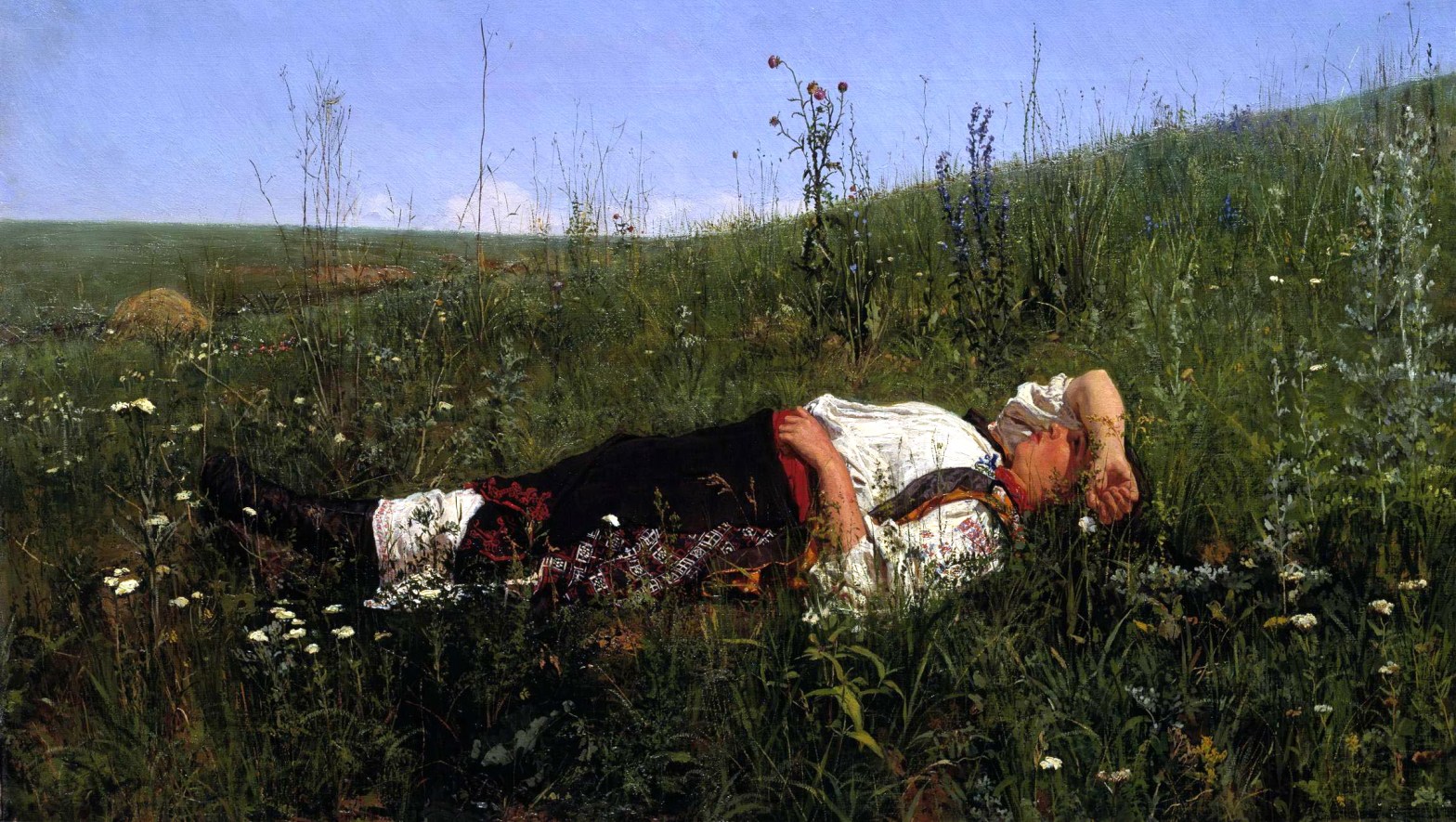
Two women inhabit two expanses of grass and flowers. In Nikolai Kuznetsov’s Holiday of 1879, a young woman lies almost full length in the vegetation, her body settling into the broad horizontal spread of the field. Thirteen years later, in Ilya Repin’s Autumn Bouquet. Portrait of Vera Repin, the artist’s daughter stands upright in an open landscape, holding an abundant bundle of the plants and flowers that surround her. The pictures are different in character and intention, yet each makes the relation between a human figure and the natural world part of its subject. One woman seems almost absorbed by the field; the other has gathered a portion of it into her hands.
Kuznetsov and Repin came from the same broad world of late nineteenth-century Russian art. Both had been born in territories that are now part of Ukraine but then lay within the Russian Empire: Repin at Chuhuiv in 1844, Kuznetsov six years later at his family’s estate of Stepanovka in Kherson Province. Their careers were very different in scale and reputation. Repin became one of the commanding figures of Russian painting; Kuznetsov, less familiar outside Russia and Ukraine, established himself as a painter of genre subjects and portraits. What brought them into a common institutional orbit was the Society for Travelling Art Exhibitions, whose members became known as the Peredvizhniki, or Wanderers.
The society was founded in 1870, although its origins are usually traced back to the celebrated revolt of fourteen students at the Imperial Academy of Arts in St Petersburg seven years earlier. Its travelling exhibitions offered an alternative to the Academy and brought contemporary painting before audiences in Moscow, St Petersburg and other cities. The Peredvizhniki are closely associated with Realism and with a renewed attention to contemporary life, landscape and national culture, but they were never stylistically uniform. Repin joined the society in 1878. Kuznetsov belonged to a younger generation and began showing with it at the beginning of the following decade.
In 1881, Holiday entered one of the most important public arenas of Russian art through the exhibitions of the Peredvizhniki. By the time Repin painted Vera at Zdravnevo in 1892, that artistic world had altered considerably. Those years encompass changes in the uses of landscape, in portraiture and genre painting, and in the ways Russian artists responded to artistic developments elsewhere in Europe. Yet both pictures begin with the same simple elements, a figure, a field and the physical presence of flowers.
By the time Kuznetsov painted Holiday, landscape had acquired a new prominence in Russian art. Earlier in the century, painters such as Alexei Venetsianov had already joined scenes of rural life to broad skies and open countryside, but from the 1860s and 1870s the land itself became a subject of sustained attention. This development had close parallels in literature. Critics had praised Alexander Pushkin for finding poetry in native scenery that earlier writers might have dismissed as ordinary, while Ivan Turgenev brought close observation of nature into association with the lives of the people who inhabited it. Painting and literature did not simply borrow from one another. They shared a growing conviction that familiar places, seasons and stretches of countryside could sustain serious artistic meaning.
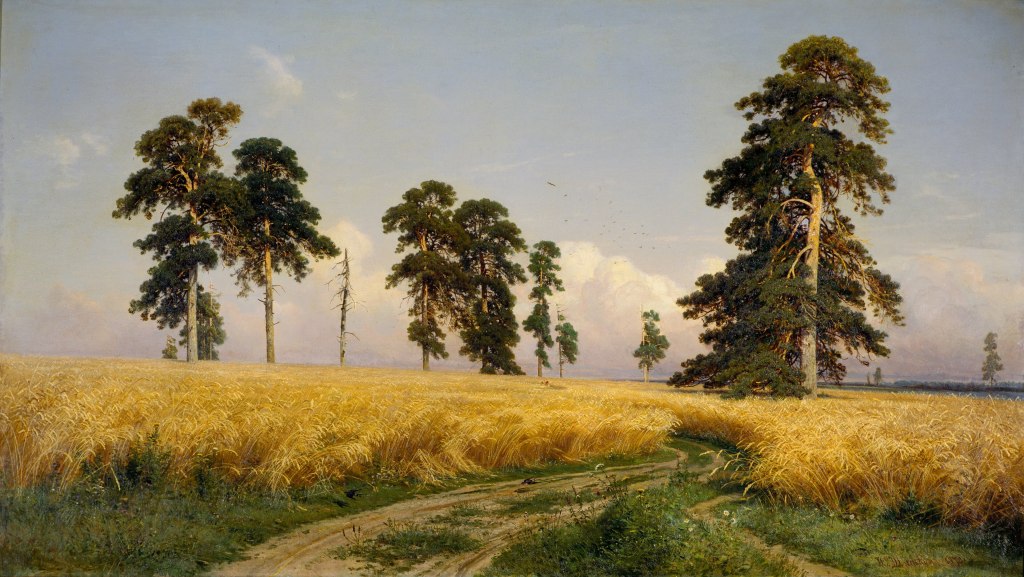
The landscapes that resulted were often striking for the modesty of their material. A road, a field, a low horizon or a group of trees could be enough. Alexei Savrasov found emotional resonance in such motifs, while Ivan Shishkin gave them greater scale and permanence. In Rye of 1878, a track runs through a ripening field towards a distant horizon, with tall pines rising above the grain. The picture is based on a particular landscape near Shishkin’s native Yelabuga, yet the breadth of the field and sky allows the scene to assume a wider significance. Close observation of a place has become an image of the land.
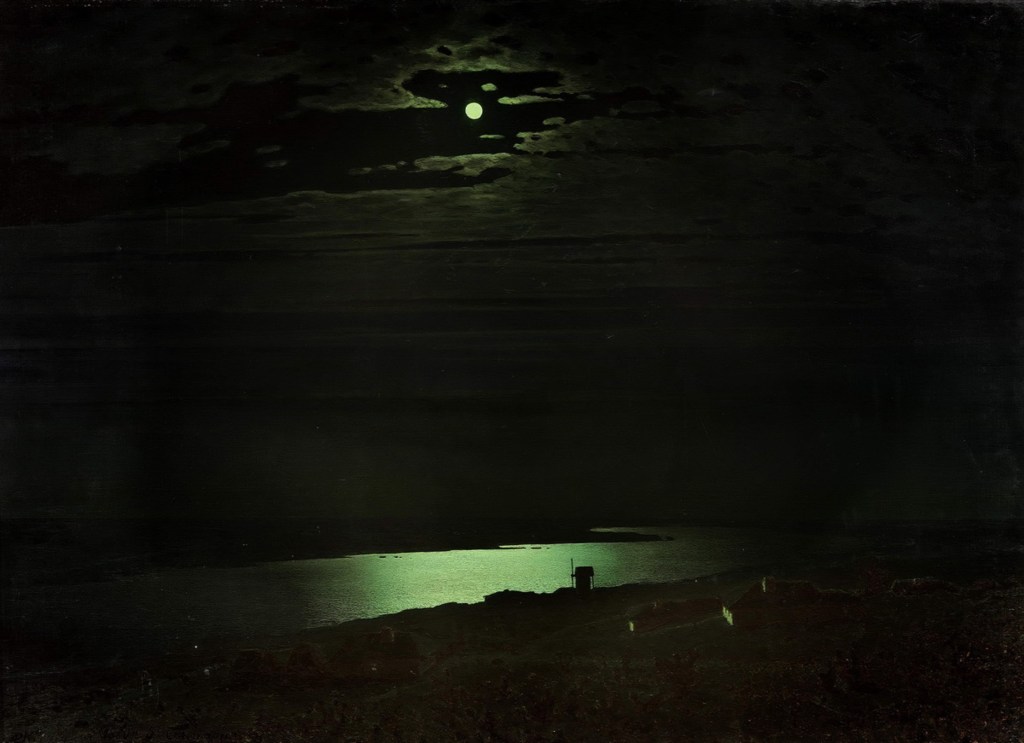
Other possibilities were developing at the same time. In Arkhip Kuindzhi’s Moonlit Night on the Dnieper of 1880, now in the State Russian Museum, St Petersburg, the landscape is simplified and transformed by the concentration of moonlight on water and sky. Its Romantic conception of nature moves away from Shishkin’s close description towards something more atmospheric and visionary. Set beside one another, the two paintings suggest the range landscape had acquired by this period, from sustained observation of the visible world to a more concentrated exploration of light, mood and perception.
This attention to native scenery formed part of a larger search for cultural identity. During the second half of the nineteenth century, artists, writers and critics turned towards history, folklore, popular traditions and the life of the countryside as possible sources for an art grounded in local experience. Yet the idea of a national school should not suggest an enclosed artistic culture. The Russian Empire encompassed different peoples, languages and landscapes, and the Peredvizhniki themselves were not insulated from developments elsewhere in Europe. Realism and Naturalism had become international pictorial languages, carried through travel, exhibitions, reproduction and personal contact.
Repin offers a clear example. During his stay in Paris in the 1870s he encountered contemporary French painting and gradually became receptive to aspects of it, even though his experiments with Parisian subjects brought criticism from Ivan Kramskoi and Vladimir Stasov. What was at issue was partly subject matter. For critics committed to the development of a national art, the modern life of Paris could seem remote from the social and cultural questions that Russian painters ought to address. Yet the techniques and perceptions encountered abroad could be separated from the subjects to which they were first attached. Interest in plein-air painting, changing light and atmospheric colour could return with an artist and be applied to places much closer to home.
National subject matter and an international pictorial language were therefore not incompatible. This becomes increasingly apparent towards the end of the century, when landscape painting across Russia and northern Europe placed new emphasis on atmosphere, colour and immediate visual experience while retaining strong attachments to particular regions. The subject might still be a field, a village or a stretch of native countryside, but the terms in which it was painted were no longer exclusively local.
That distinction is useful for the two paintings considered here. Kuznetsov’s Holiday belongs to a specific Ukrainian landscape and culture, while Repin’s Autumn Bouquet was painted at Zdravnevo, in present-day Belarus. Neither field needs to be treated as a generic emblem of a single national landscape. What they share is a period in which familiar countryside had ceased to be merely the setting for human action. Landscape could carry associations of place, memory and cultural identity, while also offering painters a field for experiments in light, colour and the relation between a figure and the space around it.
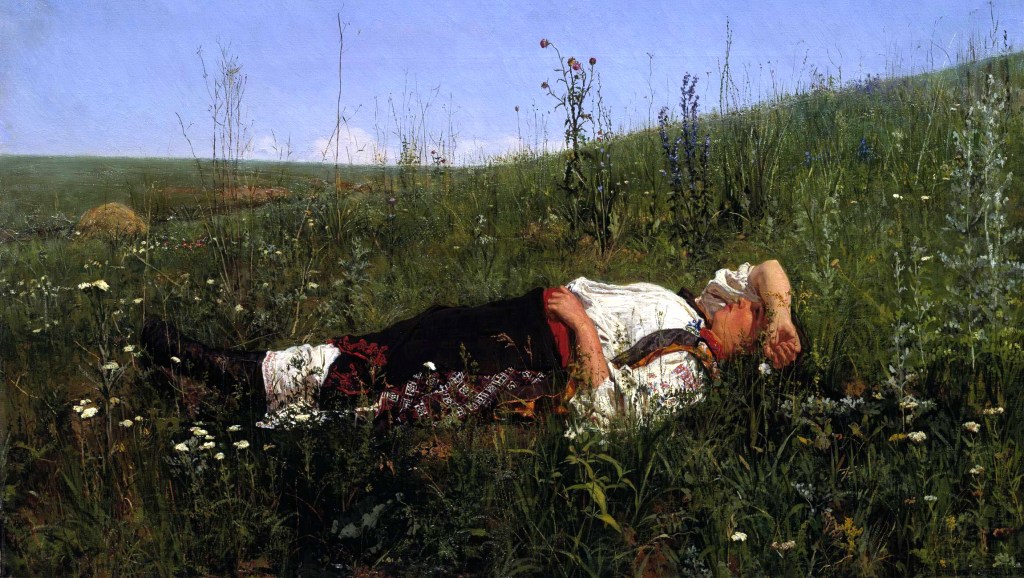
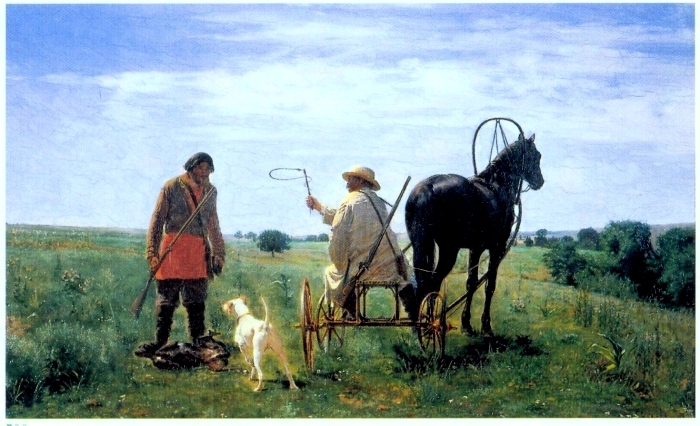
Kuznetsov painted Holiday in 1879, shortly after leaving the Imperial Academy of Arts and returning to Stepanovka, his family estate in Kherson Province. The Ukrainian countryside was part of the world in which he had grown up and now became a principal subject of his painting. In the same year he produced Touring the Property, where the meeting of landowner and peasant gives rural life a sharper social edge. Holiday turns instead towards leisure and the experience of being out in the landscape.
In Holiday, the young woman wears Ukrainian festive dress, realised with the same attention that Kuznetsov gives to the vegetation around her. The embroidery of the white blouse, the patterned skirt and dark boots remain clearly legible among grasses, weeds and wildflowers that have been individually observed. She lies almost parallel with the lower edge of the canvas, one arm bent behind her and the other laid across her forehead, at once a gesture of relaxation and an instinctive shelter from the sun. Behind her, the steppe rises and falls in a succession of shallow, interlocking slopes. Their contours seem to answer the reclining body, while the overlapping bands of land create a subdued recession towards the blue sky. The landscape is spacious without being empty.
Galina S. Tchourak has used the famous episode from War and Peace in which the wounded Prince Andrei lies at Austerlitz and looks upwards at the immense sky to describe a broader affinity between Russian writing and landscape painting. Simple elements of nature could open onto a more expansive state of feeling. In Holiday the comparison acquires a particular visual resonance. The woman is also lying beneath an open blue sky, but Kuznetsov keeps the experience rooted in the physical pleasures of a summer day. The detailed foreground, the warmth of the sunlight and the easy gesture of the raised arm make tranquillity something felt through the body as well as through the landscape.
Tatiana Karpova has described the painting as joining the breadth of the Ukrainian steppe with the languor of a holiday. The Musée d’Orsay catalogue adds a small anthropological footnote by reproducing a later photograph of a young woman rolling in the grass after the harvest. Here such ease with the landscape requires little explanation. When Holiday was shown at the ninth Peredvizhniki exhibition in 1881, it attracted the notice of Ivan Kramskoi and subsequently entered Pavel Tretyakov’s collection.
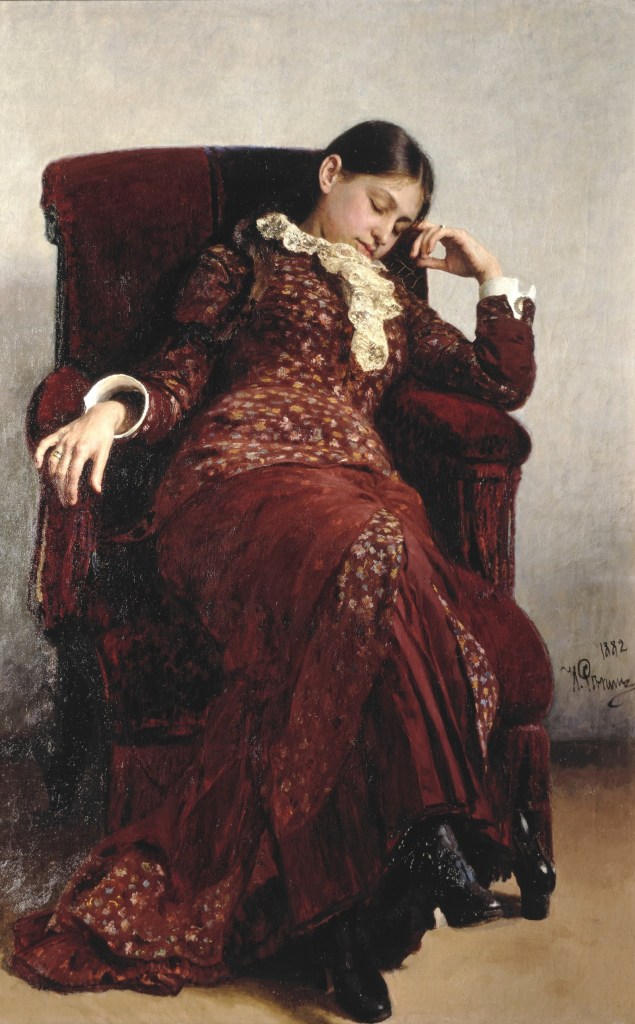
Repin arrived at the relation between figure and landscape from a different direction, through portraiture. Autumn Bouquet belongs to a longer sequence in which members of his family became both intimate subjects and opportunities for experiment. In Taking a Rest of 1882, the sitter is his wife, Vera Alekseyevna Repina, asleep in a deep red chair. The format has something of the scale of formal portraiture, but the moment itself is private and unguarded. Repin turned the folds of her dress, the upholstery and the difficult foreshortening of the body into a study of closely related tones.
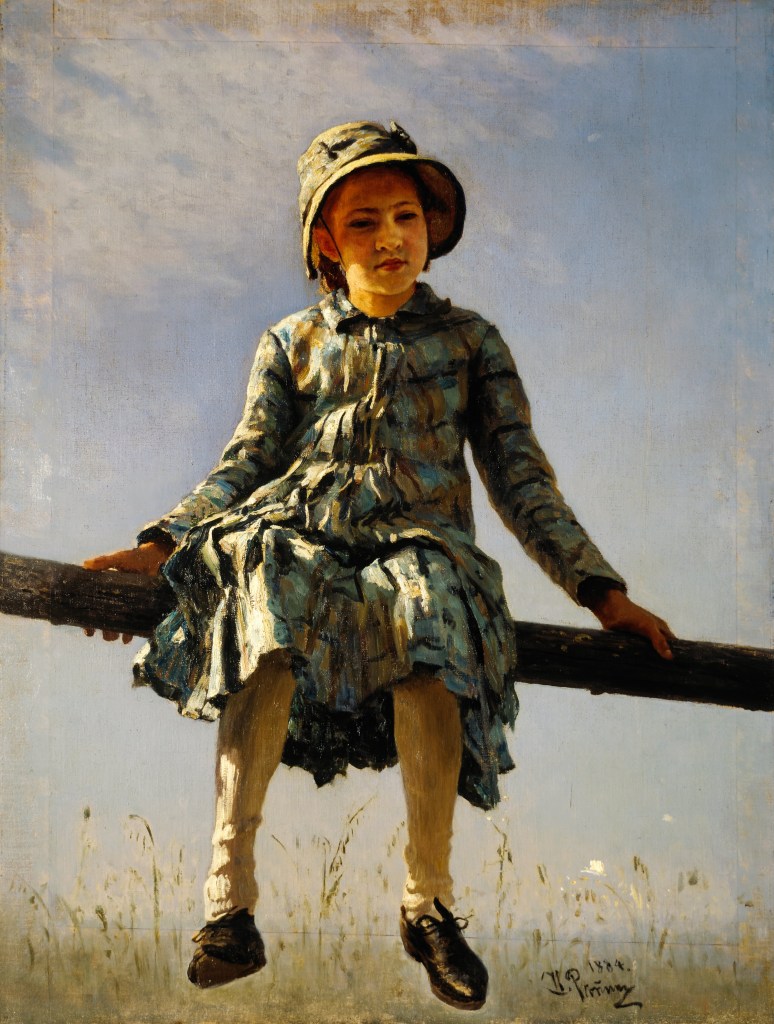
His eldest daughter, Vera Ilyinichna, became a recurring subject. In Dragonfly of 1884, painted when she was twelve, she sits on a wooden rail against a broad summer sky, her figure caught in strong outdoor light. The hat casts a shadow across her face while sunlight breaks across the patterned dress. Repin altered the composition as he worked, extending the canvas and changing the setting before arriving at the open arrangement we see now. The apparent ease of the picture was therefore the result of considerable adjustment.
Repin painted Autumn Bouquet at Zdravnevo in 1892, when Vera was twenty. In September he wrote from the estate to Tatiana Tolstaya that he had begun a portrait of her in the garden, with a large bouquet of autumn flowers and a smaller, more delicate boutonnière, seeking an expression of life, youth and languor. The finished painting preserves that ease while remaining closely observed. Vera’s dark patterned blouse and white lace collar are set against the softer greens of the landscape, while the red beret and the flowers provide concentrated notes of colour. Compared with Dragonfly, the tonality is quieter and the handling more finished.
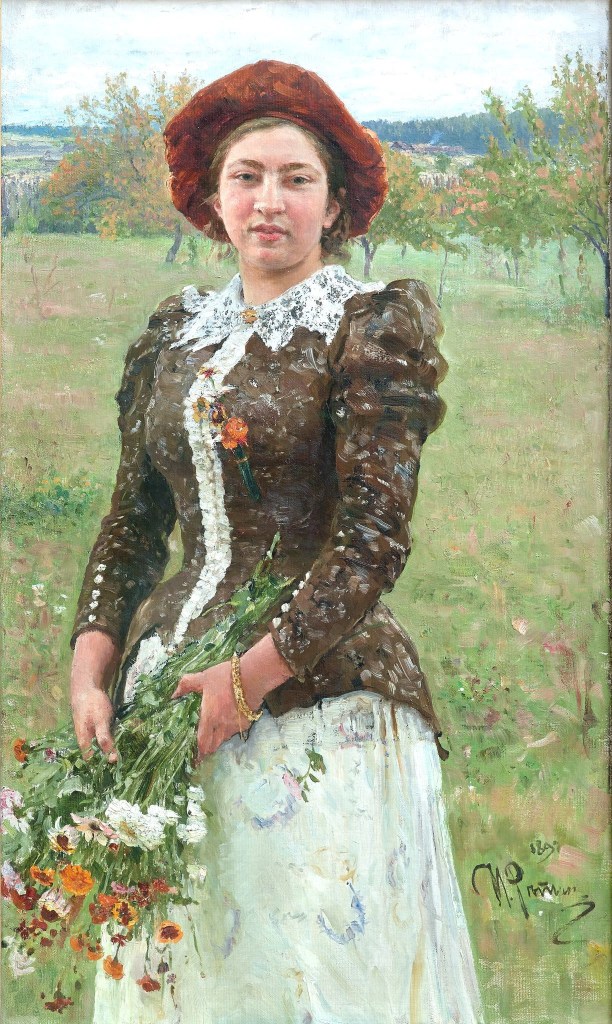
The bouquet is central to the relationship between figure and setting. Its mixture of flowers and grasses brings the colours and textures of the garden forward into Vera’s hands. She remains distinctly present as an individual rather than becoming an emblem of autumn or youth, yet the portrait depends upon the landscape around her. David Jackson has stressed that Repin’s family portraits allowed likeness and aesthetic experiment to coexist. Here portraiture, landscape and still life are drawn together through colour, light and the familiarity of the sitter.
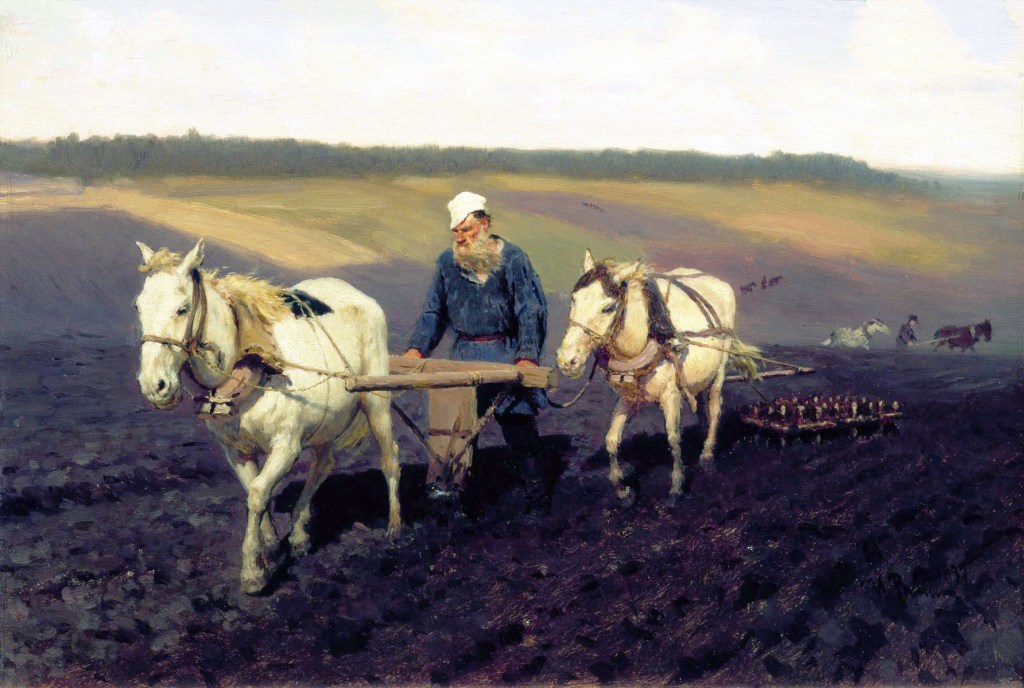
The thirteen years between Holiday and Autumn Bouquet do not describe a simple movement from one kind of painting to another. Kuznetsov’s picture already resists a neat distinction between genre painting and landscape, while Repin’s portrait depends upon the garden, its light and its flowers for much of its character. By the 1890s such distinctions had become increasingly porous. Landscape could enter portraiture and scenes of everyday life as an active part of their meaning. Repin’s Leo Tolstoy Ploughing of 1887 offers a telling midpoint, presenting the writer through his physical activity in the cultivated landscape.
Taken together, Holiday and Autumn Bouquet show how much could be made from familiar countryside. Kuznetsov’s young woman rests among grasses and wildflowers; Vera holds a gathered bouquet in her arms. In each painting, flowers and vegetation belong to the figure’s experience. More generally, the landscape remains observed, particular and close at hand, a place in which human presence can find harmony.
Producing these essays requires care, time, research, and resources. Contributions to help sustain this exploration would be greatly appreciated.
https://donorbox.org/inner-surfaces-resonances-in-art-and-literature-837503
Bibliography
These are the sources consulted. Any errors are mine.
Blakesley, Rosalind P., “The Quest for Russian Distinction,” in Russia and the Arts: The Age of Tolstoy and Tchaikovsky, London: National Portrait Gallery, 2016, pp. 63–76.
Hedström, Per, “The Peredvizhniki and Europe,” in David Jackson and Per Hedström, eds, The Peredvizhniki: Pioneers of Russian Painting, Stockholm: Nationalmuseum, 2011, pp. 40–53.
Jackson, David, The Russian Vision: The Art of Ilya Repin, Schoten: BAI, 2006.
Karpova, Tatiana, catalogue entry for Nikolai Dmitrievich Kuznetsov, Jour de fête, in Marie-Pierre Salé and Édouard Papet, eds, L’Art russe dans la seconde moitié du XIXe siècle: en quête d’identité, Paris: Musée d’Orsay / Réunion des musées nationaux, 2005, cat. 284, p. 401.
Salé, Marie-Pierre and Édouard Papet, “Avant-propos,” in Marie-Pierre Salé and Édouard Papet, eds, L’Art russe dans la seconde moitié du XIXe siècle: en quête d’identité, Paris: Musée d’Orsay / Réunion des musées nationaux, 2005, pp. 17–34.
Tchourak, Galina S., “Terre russe: le paysage en peinture et en littérature,” in Marie-Pierre Salé and Édouard Papet, eds, L’Art russe dans la seconde moitié du XIXe siècle: en quête d’identité, Paris: Musée d’Orsay / Réunion des musées nationaux, 2005, pp. 51–65.
Museum collection records
Online collection records from the State Tretyakov Gallery, Moscow, were consulted for works by Nikolai Kuznetsov, Ivan Shishkin and Ilya Repin discussed in this essay; the State Russian Museum, St Petersburg, was consulted for Arkhip Kuindzhi’s Moonlit Night on the Dnieper.
 Inner Surfaces