Giuseppe De Nittis: Light, Air and Modern Life.

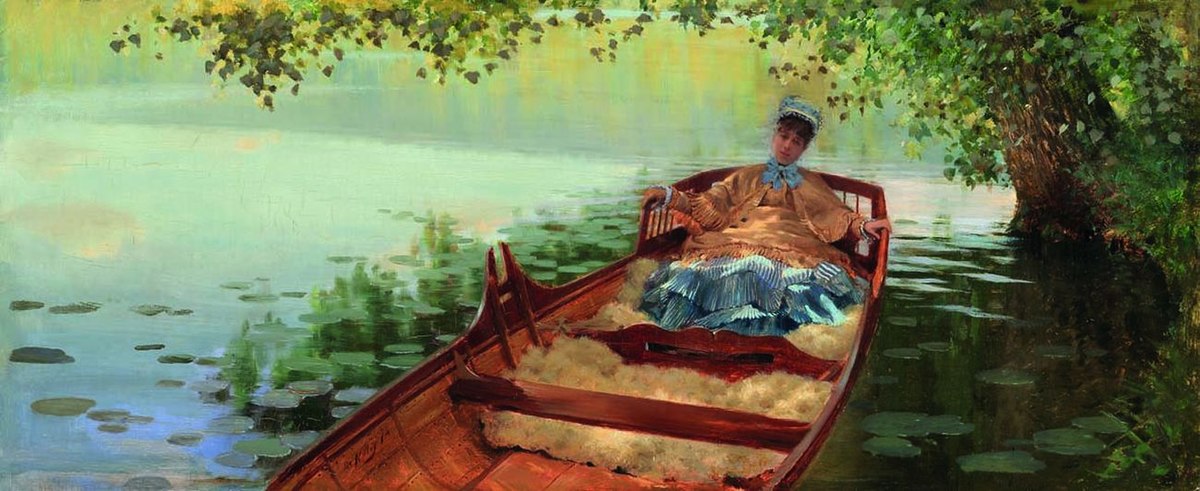
Léontine in canotto/ Léontine in a rowing boat (1874), oil on panel, 24×54 cm, Private collection.
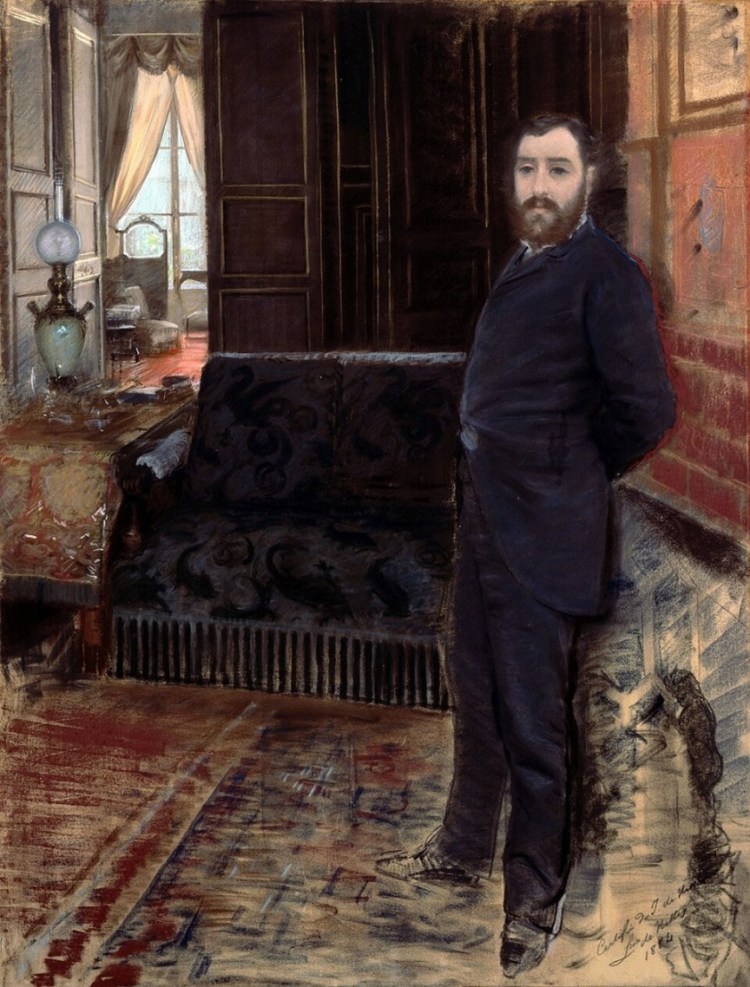
Self-Portrait (ca.1883) Pastel on canvas, 114×88 cm, Palazzo della Marra, Barletta.

(Credit: Wikimedia Commons).

Giuseppe De Nittis: “A happy man who would have wished everyone around him to be equally happy.” Jeanne Mairet, Souvenirs, 1907.

De Nittis was a cosmopolitan artist, at ease in different social circles, open to new perspectives, and adaptable to life in foreign countries. He was socially generous and determined to succeed, qualities that made him appear warm-hearted, as Jeanne Mairet observed. And yet, like many artists of his generation, his life was far from easy.

Giuseppe Gaetano De Nittis was born on 25 February 1846 in Barletta, Italy, at Via della Cordoneria 23, now Corso Vittorio Emanuele 23. He died at the age of 38 on 21 August 1884 in Saint-Germain-en-Laye, a suburb of Paris, from what was then officially termed a “cerebral and pulmonary congestion”. The precise modern diagnosis cannot be established with certainty, but he had been suffering from serious bronchitis, and his sudden death is most plausibly understood as the result of a catastrophic stroke.

His father, Raffaele, was a liberal who supported constitutional government and national unification in opposition to the monarchy. He was arrested and imprisoned under Ferdinand II for his political views and released only after the 1848 revolution. During his imprisonment, Raffaele’s mental health declined, and in 1856 he took his own life.

The year before his death, Giuseppe also lost his brother Vincenzo to suicide, most likely prompted by financial and emotional difficulties. On 30 April of the same year, he lost his dear friend Édouard Manet, someone with whom he had just been renewing his friendship. He and his wife, Léontine Lucile Gruvelle, suffered the deaths of two children in infancy, Thérèse Lucile Joséphine and Raffaele Gaetano, who both died within months of their births in 1870 and 1872. Their third child, Jacques De Nittis, was born in Herculaneum, near Naples, in 1872 and lived until 1907.

Despite the absence and early loss of their father, the orphaned brothers were lovingly raised by their paternal grandparents, as Giuseppe De Nittis recalls in his notebook, the Taccuino. He remembers the generous-hearted nature of both his grandfather and grandmother. Their grandfather had been a kind and forbearing state administrator, serving as the Architect of the Saltworks of Barletta and opening his home to workers whose thatched cottages had caught fire.
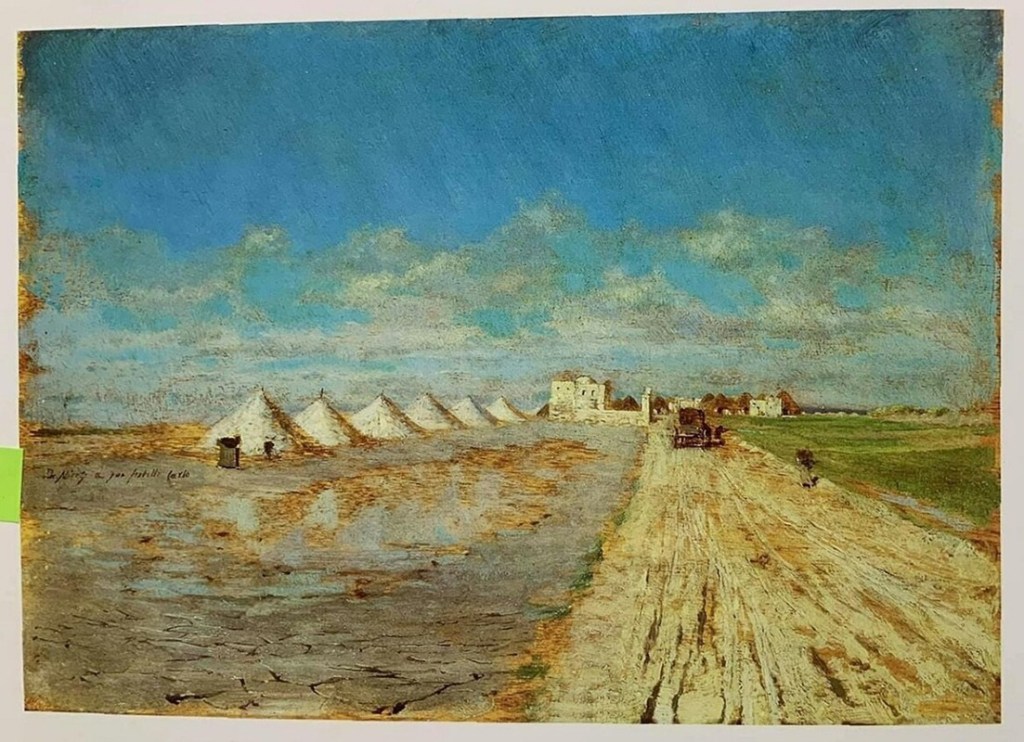
Le saline di Salina di Barletta/The Saltworks of Barletta (1864), oil on canvas 18 × 24 cm, Private collection.

(Credit: Wikimedia Commons).

After Raffaele’s death in 1856, the eldest brother took responsibility for the family’s affairs. In 1860, Vincenzo moved with the family to Naples to improve their prospects. Although he initially opposed Giuseppe’s desire to become a painter, he eventually consented to his brother’s wishes.

Despite the fragile emotional circumstances of his youth, De Nittis’s art rarely addresses themes of social injustice or the suffering of the poor and marginalised. This is not to suggest that he was socially aloof or insensitive, or that he never included working men or women in his art. In 1879, he painted a scene in Posillipo featuring three working women, titled Au Revoir!, and in the same year he exhibited La venditrice di fiammiferi a Londra/ The Match-girl in London in Paris, although it is difficult to locate an image of the latter.
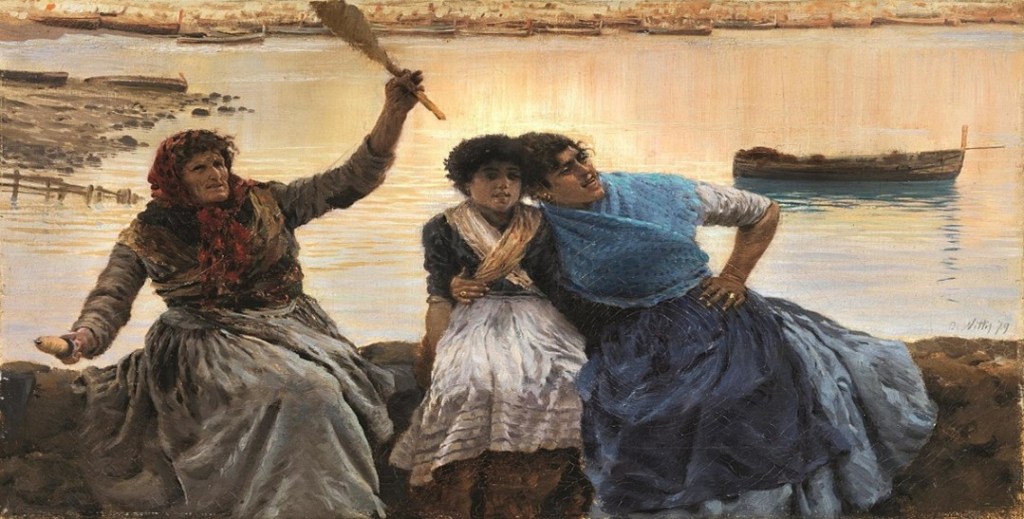
Au revoir (1879), oil on canvas, 36×54.5 cm, Private collection.

(Credit: Wikimedia Commons).

Earlier, his Sur la route de Castellamare/ On the Road to Castellamare (1875) depicts a similarly popular scene, composed around a road, as in the more famous works The Road to Brindisi and Crossing the Apennines. The painting captures an intensely hot day, showing sunburned workers pausing from their labour: one eats grapes while another has removed his workboots. The baskets carried by the man on the left will soon be loaded onto the nearby donkey and filled with stones. While these figures are clearly labourers exposed to some hardship, De Nittis does not present them as exhausted, vulnerable, or exploited.
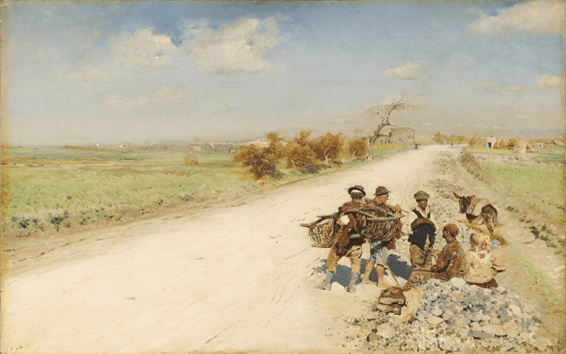
Sur la route de Castellammare/On the road to Castellammare (1875), oil on canvas,

54.5×74.5 cm, Private collection.

(Credit: Wikimedia Commons).

This neutral tone is particularly evident when compared with Bestie da Soma/ Beasts of Burden, painted by Teofilo Patini in 1886. Patini, born in Castel del Sangro in the province of L’Aquila and also trained in Naples at the Accademia, sought to convey a clear socialist message. His workers are shown in states of poverty and hardship, expressed through their posture, facial expressions, and the composition of the work. By contrast, De Nittis occasionally drew on popular figures to introduce a moderate sense of realism into his landscapes and cityscapes, but he was not a campaigner for social justice.
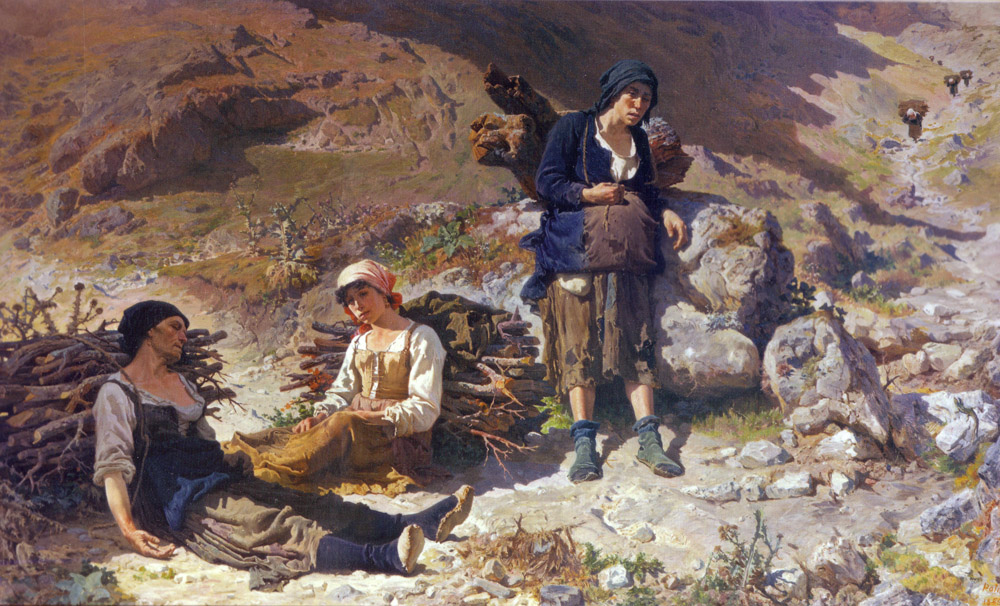
Teofilo Patini: Bestie da soma/ Beasts of Burden (1886), oil on canvas, 244 × 416 cm, Palazzo del Governo, L’Aquila.

(Credit: Wikipedia).

For the most part, his subjects were rooted in bourgeois urban life, or were painted landscapes. Such choices were likely both practical (commercial), and aesthetic, yet we also know that his visits to London exposed him to scenes of poverty that left a mark. An account by Jules Claretie recalls how he passed through the poor areas of London, such as Whitechapel, in the company of De Nittis, encountering a world of neglect, poor lodgings, workhouses, and shoeless paupers. Moreover, in the Taccuino, De Nittis recalls Rotten Row, where people not favoured by fortune, wealth, or privilege seemed to be “nothing but a fleeting moment, a nonentity crushed under the wheels of the carriages.”

The biographical and autobiographical accounts of De Nittis’s life present a story of hard work, social success, and public recognition. But the reputation he won as a painter required diligence, flexibility, and self-determined assertion. He achieved the fame and recognition he deserved, yet, as Degas noted in a letter to Léontine, “He was happy and understood by the world, but not for long.” It was the determination and foresight of Léontine that ensured that a large part of his artistic legacy was collated and preserved in Barletta.

Léontine left her collection of her husband’s works to Barletta in her 1912 will, and after her death in 1913 the collection arrived in the city in March 1914. It was first housed in the former Dominican convent and then moved through a series of provisional municipal spaces before being gathered into a more formal museum setting by 1929. During the Second World War it was evacuated to Castel del Monte for safety, and afterwards returned to the city, where conditions again proved insufficient. In 1992 the works were transferred to the Castello Svevo, which offered improved but still limited accommodation. The collection finally found a stable and appropriate home in Palazzo della Marra, where it was inaugurated in March 2007.
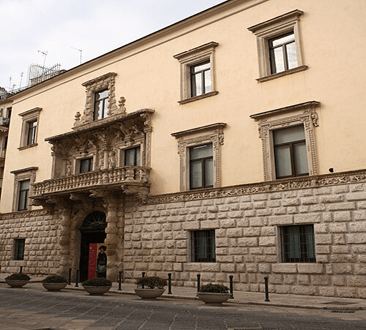
Palazzo della Marra, Barletta. (Credit: Wikipedia).

 In 1993, Federico Zeri was in an interview about De Nittis, conducted by Enzo del Vecchio, for the RAI. Zeri (1921–1998) was an Italian art historian renowned for his exceptional eye, his sharp connoisseurship, and his ability to combine meticulous archival work with intuitive stylistic insight. At this point, the collection was still in the Castello Svevo, and Zeri’s praise was placed in the context of the necessity for De Nittis’s recognition, both intellectually and through his work being granted a worthy location.

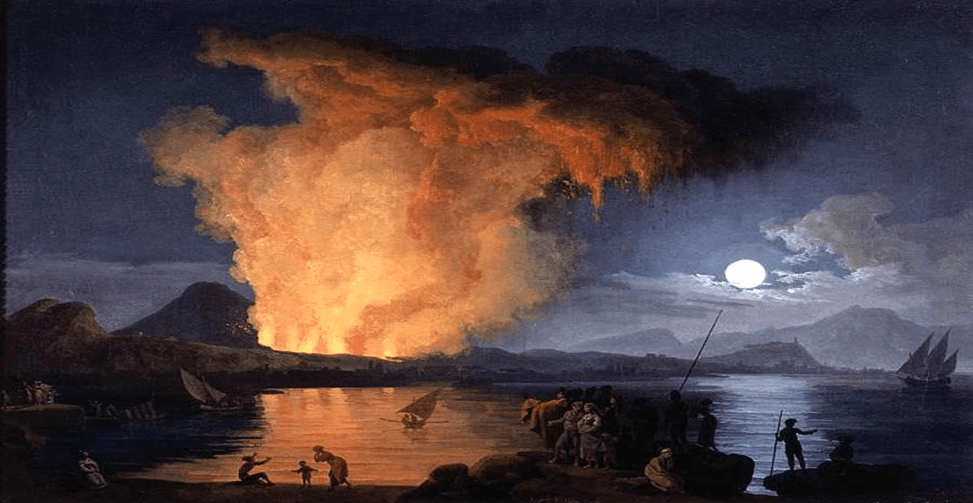
In a brief interview, he captures the sense of De Nittis as a painter with an acute vision and the skill to express that vision. He is seen as not just a great Impressionist (or member of any particular group) but as a great painter in absolute terms. He is recognised for his capacity to learn from the artistic circles around him and to adapt and capture what he sees. Zeri points out his skill in rendering the pristine, muffled sensation of a fresh snowfall. He also states that in La discesa dal Vesuvio/ The Descent from Vesuvius, De Nittis demonstrates his mastery by showing figures backlit by an atmospheric Neapolitan sunset.
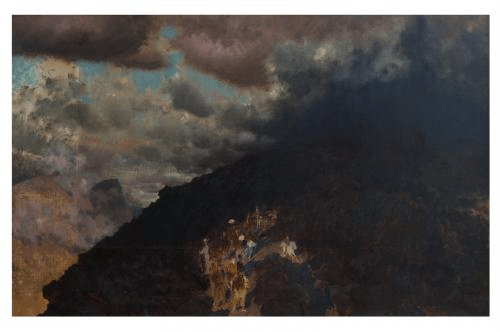
Eruzione del Vesuvio (figure che discendono il Vesuvio in eruzione)/ The Eruption of Vesuvius (1872), oil on canvas, 71×130 cm, Palazzo della Marra, Barletta.

(Credit: Catalogo generale dei Beni Culturali).

Zeri justly describes him as a painter capable of capturing both the bright beams of Neapolitan light and the foggy, misty atmospheres of Paris or London. According to Zeri, he also possesses an extraordinary talent for framing his scenes with the eye of a photographer. He is capable of daring choices, such as filling much of a canvas with a preponderance of sky, or, I would add, of road.

In looking at De Nittis’s work Nei campi intorno a Londra/ In the Fields Around London (ca.1875) a very French-looking scene, Zeri suggests that at this moment De Nittis appears to be a kind of home-grown Sisley or Pissarro.
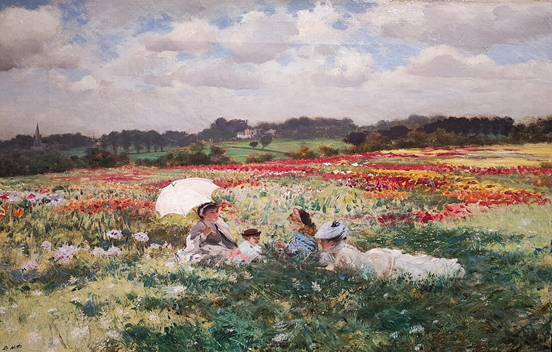
Nei campi intorno a Londra/ In the fields around London (1875), oil on canvas, 45×55 cm, Private collection.

(Credit: Wikimedia Commons).

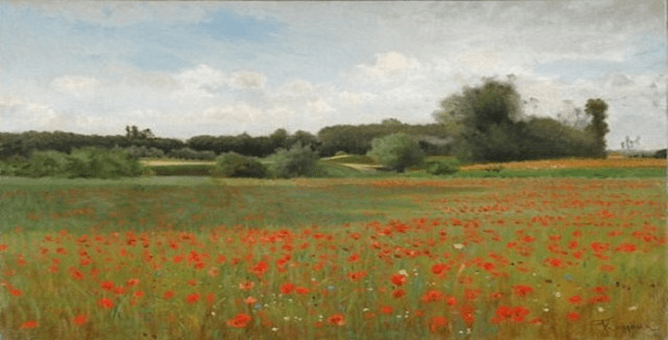
This observation again draws out his versatility as a painter, as well as his willingness to learn from what he saw around him. We could add one more citation to Zeri’s anecdotal list, Monet’s Poppy Field near Argenteuil/ Les Coquelicots (1873).
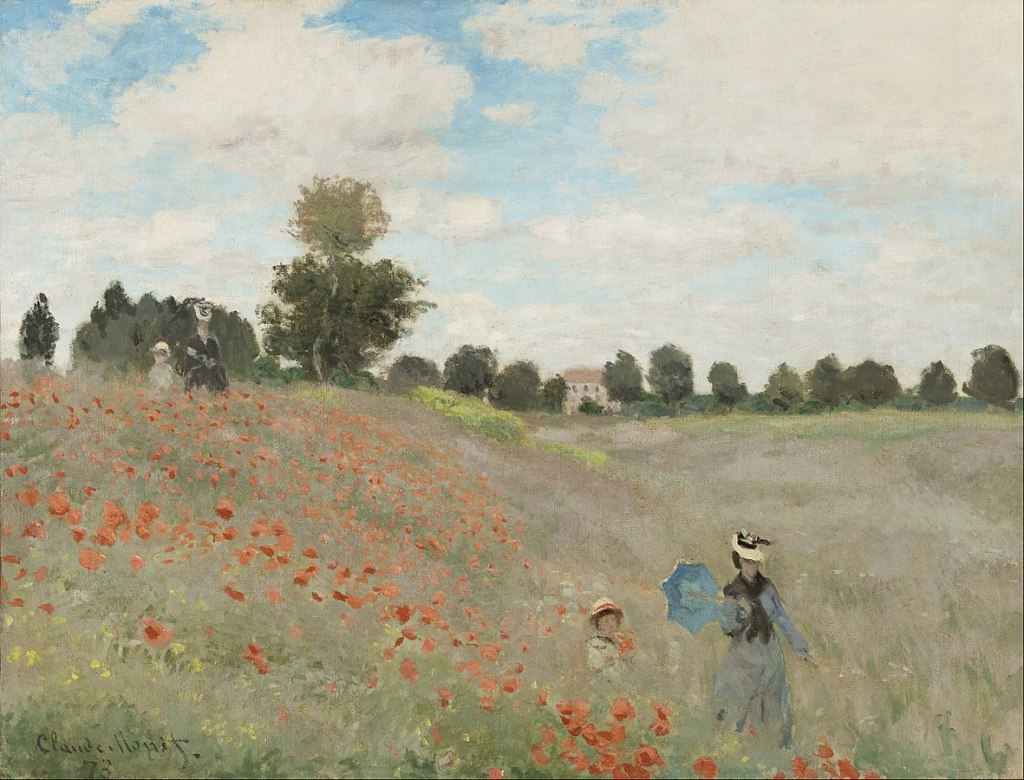
Claude Monet: Les Coquelicots/ Poppy Field near Argenteuil (1873), oil on canvas, 50×65.3cm, Musée d’Orsay, Paris.

(Credit: Wikimedia Commons).

De Nittis was highly respected in Paris during his lifetime, where he was seen as both an endearing outsider and an honorary Parisian. He was a painter in demand, and while he said that his fortune was made in Paris, he also acknowledged the support he received in London from the wealthy British banker Kaye Knowles. Praise for the artist was widespread during his lifetime. In one of his letters, edited by Victor Merlhès, Gauguin asserted that ‘Everyone copies either De Nittis or the great Bastien-Lepage. De Nittis and Lepage achieved perfection in what the Impressionists started.’

A number of Italian landscape painters had established reputations in France before De Nittis. Gabriele Smargiassi, for example, resided in Paris from 1828 to 1837, working on commission for Queen Maria Amalia, a Bourbon princess of the Two Sicilies who had been raised in the cosmopolitan Neapolitan court. Smargiassi produced landscapes of Naples, Rome, and France for the queen, and also exhibited at the Salon.

During De Nittis’s early years in the City of Light, Giuseppe Palizzi (1812–1888) had already established himself as a well-connected intermediary between Paris and Italy. He had met members of the Barbizon School and exhibited regularly at the Salon.
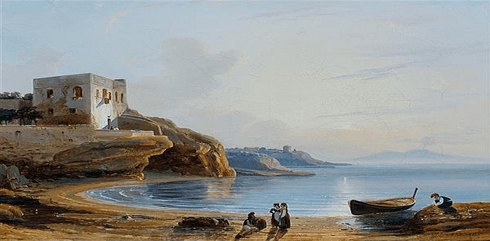
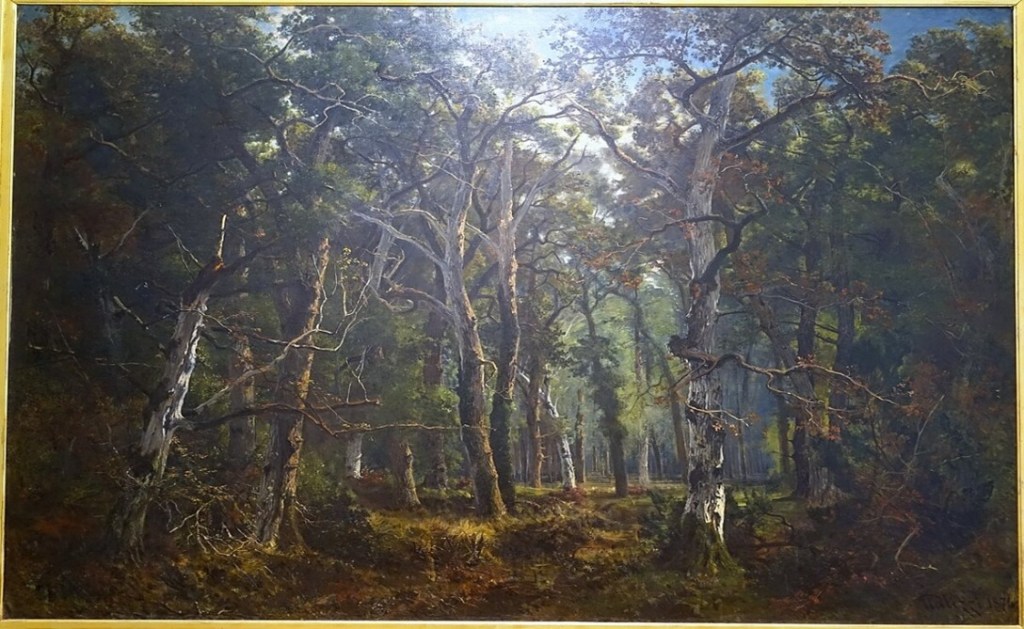
Gabriele Smargiassi: Paesaggio napoletano/ Neapolitan Landscape (1830), 30 x 40 cm, Private collection and Giuseppe Palizzi: Bosco di Fontainebleau/Forest of Fontainebleau (1874),oil on canvas, 232×320 cm, GNAM, Roma.

(Credit: Wikimedia Commons).

It was Palizzi who introduced the Florentine Macchiaioli to Barbizon works and the plein air painting tradition. As well as being part of the Neapolitan School of Resina, De Nittis met Giovanni Fattori in Florence. The latter also had a mutual friend in Degas – as suggested by the fact that the two artists exchanged portraits in 1860.
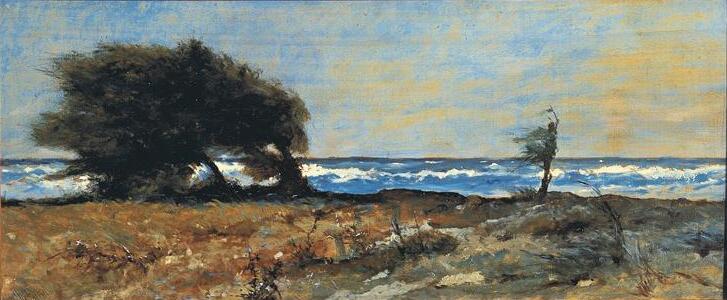
Giovanni Fattori: La libacciata/ The Southwesterly Wind (1880-1885), oil on panel, 28.4x68cm, palazzo Pitti, Galleria d’arte moderna, Firenze.

(Credit: Wikipedia).

By 1868, the art dealer Goupil was asking De Nittis to recommend Italian artists, suggesting that he had assumed a mediating role in Paris previously occupied by Palizzi. It was at the Universal Exposition of 1867 that French critics began to recognise the quality and potential of Italian art as a contributor to contemporary culture. At the Salon of that year, Domenico Morelli won a silver medal for painting and was exploring a looser manner of handling, characterised by fluid brushwork and an increasing emphasis on immediate visual impressions. At the same time, artists associated with the School of Resina were engaged in a sustained investigation of light.

Considered collectively, many Italian painters formed an important component of a broader movement towards a modern, perceptually grounded style, one concerned with macchia, chiaroscuro, light, sensation, and the desire to capture the immediacy of lived experience.

Further evidence of cultural exchange is found in the fact that Florence held some significant collections of French art: the collections of Marie-Caroline, Duchess of Berry and Prince Anatoly Demidov offered insight into French taste. The collections held works of neoclassical restraint and Romantic sensibility. The Marquis Marcellin Desboutin, a printmaker who was a friend of both Degas and De Nittis had a Florentine villa which brought together French and Italian cultural figures who were passing through. His villa L’Ombrellino on the hill of Bellosguardo was referred to as the ‘Parisian circle on the Arno.’
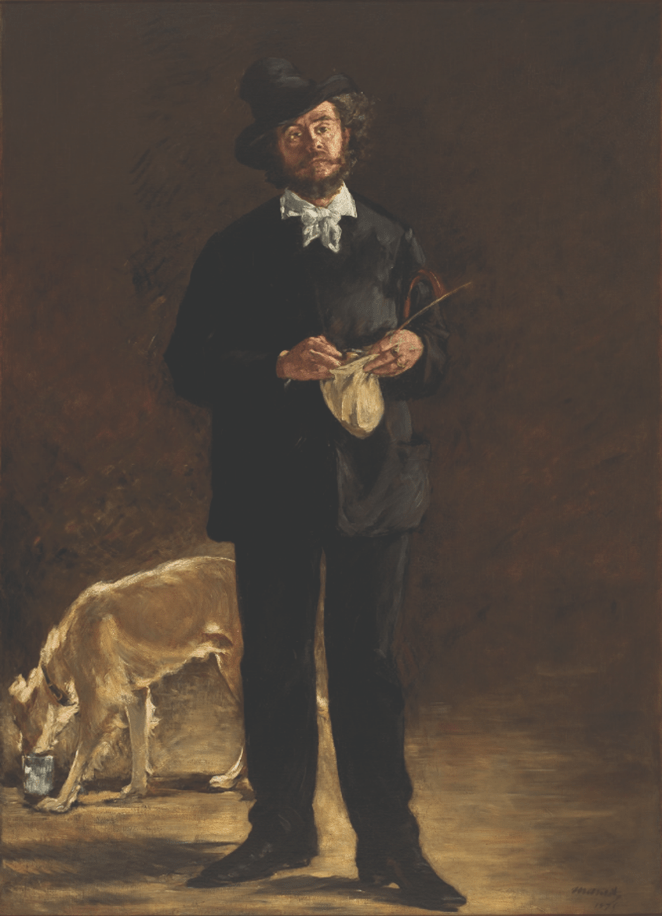
Edouard Manet: L’Artiste, Portrait de Marcellin Desboutin/ The Artist, Portrait of Marcellin Desboutin (1875), oil on canvas, 195.5×131.5 cm, Museu de Arte de São Paulo.

(Cedit: Wikimedia Commons).

So, De Nittis was part of the French artistic scene, the cosmopolitan gatherings in Florence and he also had a brief spell in the Accademia di Belle Arti in Naples, followed by a deeper and sustained connection with the artists of The School of Resina.

He was open to the innovations of his time; he exhibited at the first impressionist exhibition of 1874, encouraged by Degas to lend weight to the new movement. He also had a significant collection of impressionist paintings, which were purchased with the discerning help of Caillebotte. Nonetheless, he did not exhibit his works with the Impressionists again and he negotiated his own path between modern innovation and the demands of the market.

 In contrast to his rebellious and independent attitude towards the teaching offered at the Accademia in Naples, De Nittis seemed to make the most of, and take the best from, the opportunities that came his way. He was even attentive to the style of Meissonier when he first came to Paris though, as he later admitted, this did not really suit him. We could also set him beside James Tissot and Alfred Stevens, if we make our criteria for comparison broad enough.

He was, for the most part, incorporating the innovations of Manet and the Impressionists into a style that remained accessible to a broader public. Like his friend Manet, he continued to exhibit at the Salon and did not alienate himself from the establishment. To label his work as belonging to the juste milieu is therefore not entirely unfair: he occupied a position between a carefully finished realism suited to the Salon public and a painterly style aligned with experimental modernism.

In several of his most acclaimed works he attends closely to Parisian fashion, though never in the explicit, fashion-plate idiom familiar from Alfred Stevens or James Tissot. His elegantly dressed figures are typically shown in motion, crossing urban spaces that are equally studies in atmosphere and modern architecture. The result is a subtly balanced image in which clothing, light, and the city’s fabric coexist without hierarchy. These scenes remain indebted to the Neapolitan landscape tradition, whose clarity of light and sense of spatial breadth continue to inform his Parisian views. Even the city’s distinctive architecture, while clearly referenced, is never allowed to dominate in a self-conscious or jingoistic way. La Place de la Concorde provides a telling example: the recognisable setting is held within a veil of atmospheric effects, and its passing figures animate the square without turning it into a piece of obvious civic rhetoric.

Two of De Nittis’s early landscapes, painted in 1866, when he was engaged with the School of Resina, Casale nei dintorni di Napoli and L’Ofantino share stylistic characteristics. They are both charged with scrupulously realised details and both have blue skies that evoke the effect of enamel.
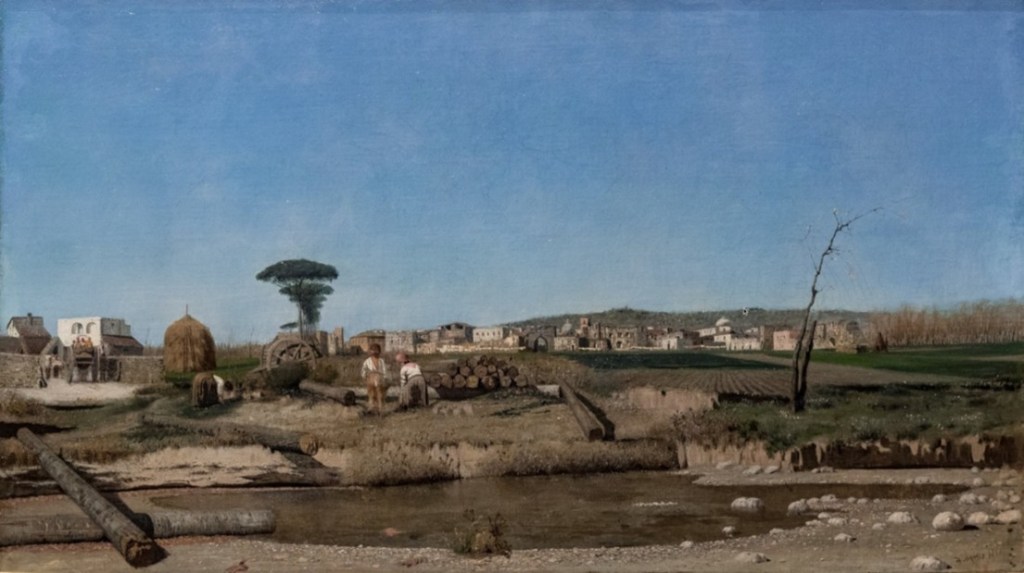
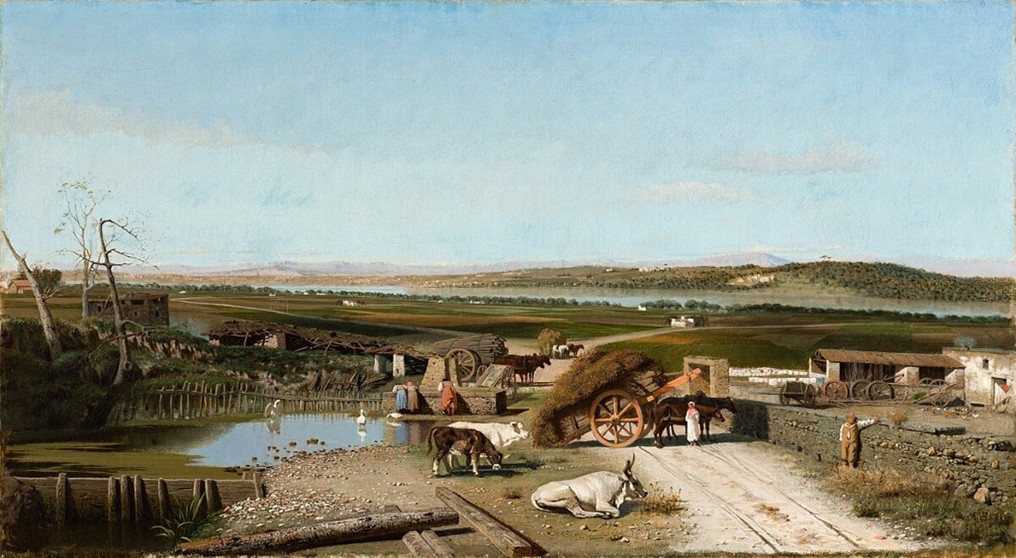
Casale nei dintorni di Napoli/ Farmhouse near Naples (1866), oil on canvas, 43×75 cm, Museo di Capodimonte, Napoli. L’Ofantino/ On the Ofantino channel (1866), oil on canvas, 60×100 cm, Private collection.

(Credit: Wikimedia Commons).

When he later returned to Naples and Barletta he demonstrated a different style of landscape painting. Most notably, his plein air studies of Vesuvius Sulle falde del Vesuvius/ On the Slopes of Vesuvius revealed a dramatically modern style of landscape with a radically simplified form and chromatic range. In the rare moments when figures occupy these landscapes they are barely visible and seem to threaten to dissolve into the geological background. Goupil informed him that dal vero studies of such radical character were unlikely to be well received by the public and, on that basis, declined to accept them. De Nittis went on to sell some of these works privately in London.
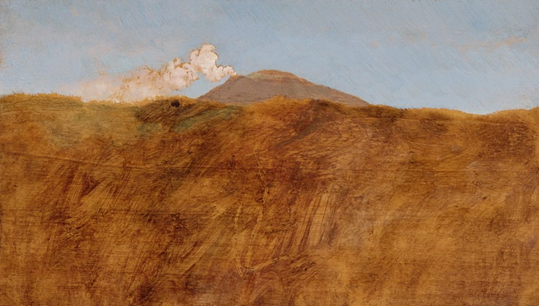
De Nittis, Vesuvius.

Paesaggio Vesuviano/ Vesuvian Landscape (1871-2), Oil on panel, 18.5 x 31.7 cm, Private collection.

(Credit: Daxer and Marschall).
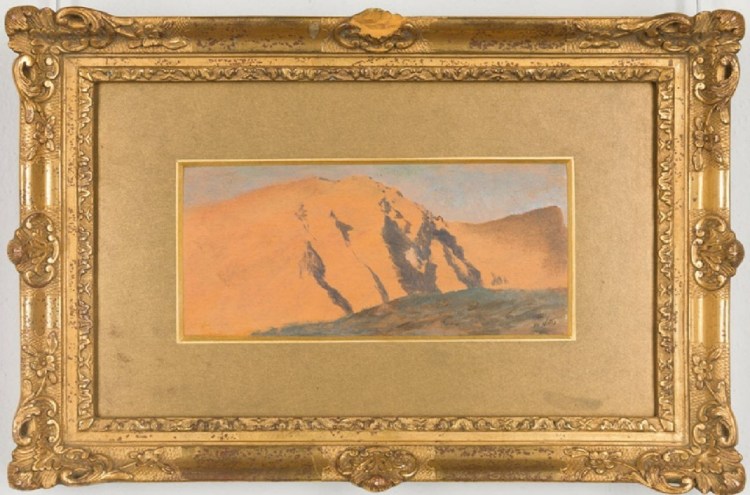
De Nittis, Vesuvius

Sulle falde del Vesuvio/ On the Slopes of Vesuvius (1872), oil on panel, Galleria d’Arte Moderna di Milano.

(Credit: Catalogo generale dei Beni Culturali).
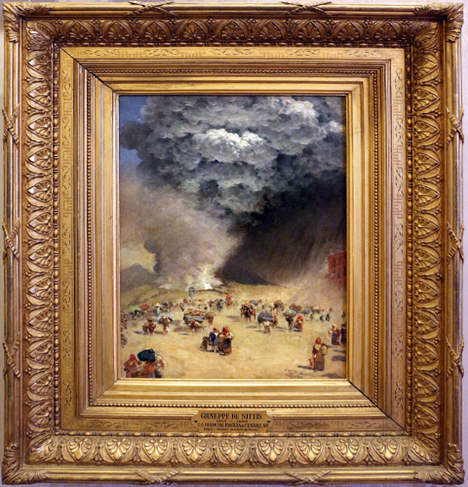
De Nittis, Vesuvius

Pioggia di cenere/ The Rain of Ashes (1872), oil on canvas, 40.5x28cm, Galleria d’Arte Moderna Florence.

(Credit: Wikimedia Commons).

With the eruption of 26 April 1872, De Nittis was able to produce works which combined natural study with human drama. La pioggia di cenere depicts the people of Resina fleeing the eruption in a reportage-like canvas. The figures are dwarfed by overwhelming natural forces. There are also two studies of the eruption (one already illustrated above) that have smaller groups of people, horses and a carriage descending from Vesuvius in bright pools of light permitted by gaps in the clouds of ash. Here too the people are dynamic but small compared to the might of the volcano and its effects.
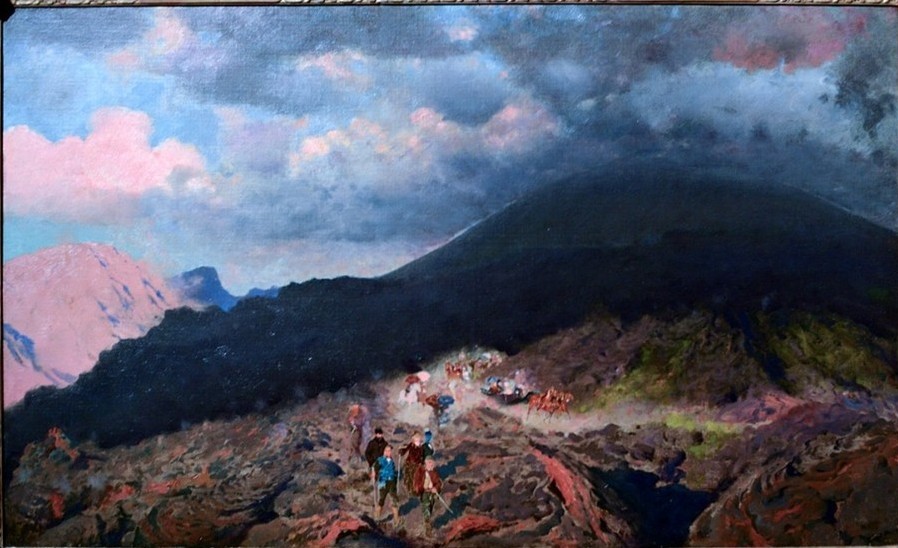
L’eruzione del Vesuvio/ The eruption of Mount Vesuvius – II (1872), oil on canvas, Private collection.

(Credit: Wikimedia Commons).

Together with Degas and Zandomeneghi, he created a freer and more direct pastel style. The favoured medium of Rosalba and Liotard was reaffirmed as serving the desire to capture the moment. Pastel drawing creates a rich, lustrous, and realistic effect by depositing pure, highly pigmented particles onto the surface, allowing colour to sit on the paper as a velvety, light-catching layer rather than sinking in. With no drying time and no preparatory medium, it has the advantage of immediacy and it can be used to create either finely finished works, or works that excitingly hover between the status of a sketch and a complete picture. From 1876, De Nittis wanted to produce large pastel works, of a natural size and scale. His Portrait d’Edmond de Goncourt, Le corse al Bois de Boulogne and La femme aux pompons offer examples from 1879-1881.

Portrait d’Edmond de Goncourt (1881), pastel on paper, 87 × 115 cm, Nancy Municipal Archives (Académie Goncourt deposit).

(Credit: ‘De Nittis – At the Salon’).

The Portrait of Edmond de Goncourt 1881 depicts the famous diarist, novelist, and critic who played a significant role in shaping late nineteenth-century literary taste. Goncourt cultivated a distinctly aesthetic, hyper-observant, and socially attuned prose style. In his diaries and fiction, he often turned his attention toward figures on the social margins, such as prostitutes, servants, minor artists, and other lives overlooked by bourgeois convention, recording them with a mixture of curiosity, acuity, and froideur. Here De Nittis works the pigment into a dense surface, creating an intensely real and tactile finish. The delight in using white and cream for fabrics, paper, and a snowy exterior is also evident. The level of detail is masterful, with a fine realisation of book spines, table objects, furnishings, as well as the rendering of Goncourt’s hair, jacket, and the curtains.
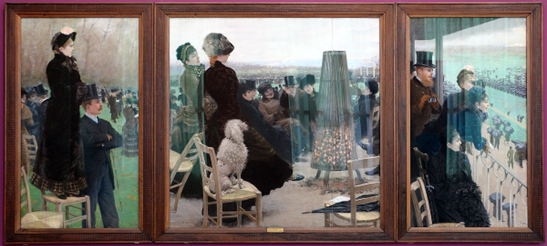
Le corse al Bois de Boulogne/ Le corse a Auteuil (1881), pastel on canvas, 200 × 395 cm, GNAM, Roma.

(Credit: Wikimedia Commons).

Alle Course de Auteil (At the Races of Auteil) 1881, our second large pastel work, is a secular triptych of modern life in Paris. This combination of three segments of racecourse life simultaneously offers three studies in intensely photographic framing, as well as some radical viewpoints from different levels and locations. It is not the sport that is depicted here but the see-and-be-seen culture of the haute bourgeoisie engaging in a leisure activity. Their elegant attire, with fine coats, hats, and dresses, reinforces the sense of display and social distinction. The composition suggests a bright autumn day, with the light and atmosphere conveying a crisp, seasonal quality.
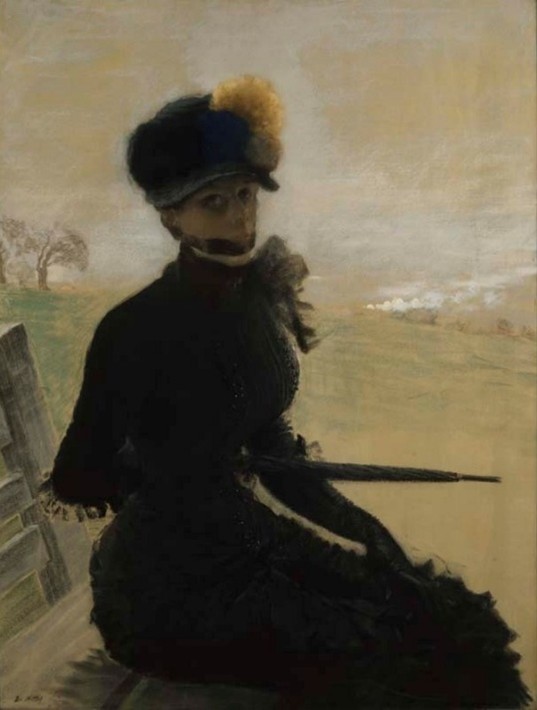
La femme aux pompons (ca. 1879), pastel on canvas, 116.5 × 90 cm, Galleria d’Arte Moderna di Milano.

(Credit: Wikimedia Commons).

La femme aux pompons (c. 1879) shows a young woman seated outdoors on a wooden bench, turning towards the viewer. This rich pastel work achieves a remarkable sense of texture in her clothing and skin, while also capturing fleeting atmospheric effects. There is a contrast between the careful realisation of the sitter and her attire and the more gently defined landscape around her. This study of character, costume, light and atmosphere contributes to the evolving vocabulary of modern femininity in nineteenth‑century Parisian painting.

In De Nittis’s brief but highly productive life, the year of his social affirmation, 1878, came only six years before he died. He pursued the success that would reward him and offer the acclaim that he merited. In the course of doing so he moved from the management of Reitlinger to Goupil and subsequently freed himself, contractually at least, from Goupil, although at considerable financial cost. As mentioned earlier, he also travelled to London to paint ten London scenes for Kaye Knowles. Thus, on top of the labour art and creativity, we must add the demands of travel, financial worry, and social networking. In 1878 De Nittis was at a peak. He won a first-class medal at the Salon and, at the Universal Exhibition, displayed twelve paintings to great public and critical acclaim. He was awarded the Medal of Honour and appointed to the Legion of Honour.

With his change in social standing, he decided to move to a more prestigious location; he bought a house in rue Viète at the beginning of 1880. Here he held Saturday evening soirées that were attended by many famous guests of high social standing, comprising aristocratic, literary and artistic personalities. In this new residence, De Nittis was able to display his collection of Japanese art and his Impressionist paintings, as well as offering guests an interior decoration which was at the height of fashion. Almost in the manner of literary social satire, after his passing, the widowed Léontine found that she could count on the loyalty and support of only a handful of true friends.
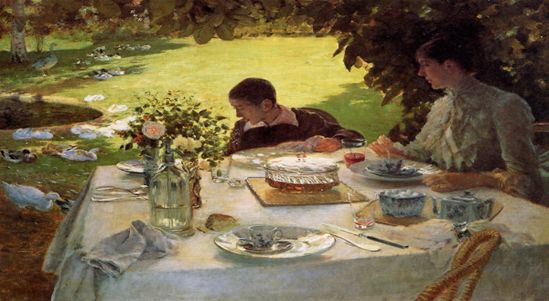
Petit déjeuner dans le jardin/ Breakfast in the Garden (ca.1883–1884), oil or pastel on canvas, 81 × 117 cm, Palazzo della Marra, Barletta.

(Credit: Wikimedia Commons).

Among the artist’s last works, there are scenes of close family moments, portrayed in a garden in Saint-Germain-en-Laye. Breakfast in the Garden and three studies entitled In the Hammock reveal two fundamental characteristics: they mark both a ‘prolonged observation of reality’ and ‘an emotional testament to his beloved family,’ as Renato Miracco has observed. The empty chair in the breakfast scene (a scene realised in scrupulous detail with wonderful still-life studies within it) adds a note of self-referential realism, as it documents the absence of the artist from the table, while he works on the painting. At the same time, the absence now holds a sense of poignancy, as we know that he was to die not long after the work’s completion. In the Hammock III also conveys another visual emotion in this tranquil garden setting; the closeness of Léontine and Jacques.
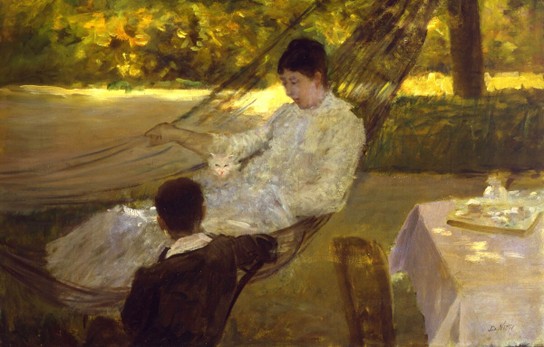
In the Hammock – III / Dans le hamac III (1884), oil on canvas, 65 × 42 cm, Museo Frugone, Genova.

(Credit: Wikimedia Commons).

Pranzo a Posillipo (c. 1879) takes us back in time a little, yet it unites a number of elements and offers an exquisite image for consideration. The picture conveys visual emotions of warmth and conviviality in an iconic Neapolitan setting. This unfinished work shows a debt to the work of Manet, and, as Martelli observed, it is as if a café-chantant scene had been transposed to Naples. The painting connects with a fond memory recorded in the Taccuino, in which De Nittis describes gatherings on a terrace beneath a full moon. We are drawn to the figure of Léontine, her head inclined in a gesture of recognition. Beyond her lie Capo Posillipo and Palazzo Donn’Anna, with the soft, glassy light of the sea and the beautifully realised colours of an evening sky in the distance. There is tremendous warmth in this image, coupled with a slightly wistful and valedictory mood, capturing a passing moment at sunset.
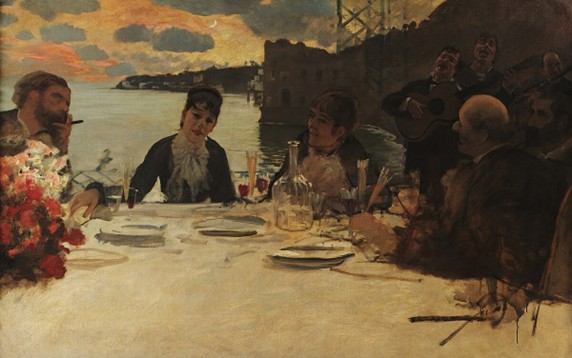
Lunch at Posillipo/ Pranzo a Posillipo (1879), oil on canvas, 111×173.3 cm, Galleria d’Arte Moderna, Milano.

(Credit: Wikimedia Commons).

There is something inherently mesmerising about the prospect of a dining scene at the water’s edge. A similar contrast between close company and open water is captured in Whistler’s Wapping (1860–1864), which features the artist’s model and partner Joanna Hiffernan reclining on the balcony rail of a Thames-side pub, the Angel, in Cherry Gardens, Bermondsey. The scene here is more urban and socially realistic: we are in the working-class docklands of the Thames rather than the gulf of Naples. Yet both works seem to function as existential tableaux, placing human interaction at the edge of an open expanse of water.
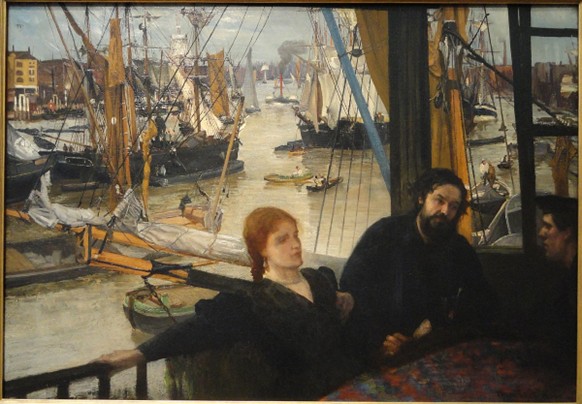
James McNeill Whistler: Wapping on the Thames (1860–1864),oil on canvas, 72×108 cm, National Gallery of Art, Washington D.C..

(Credit: Wikimedia Commons).

The sense of suspended, heightened emotional significance that such a setting creates is also exploited by Bergman in the lakeside scene from Wild Strawberries (Smultronstället), as if Nature herself is timelessly observing the gathering. Lake Vättern seems to pose a silent question as the professor, the young travellers, and Marianne sit together in tenuous harmony. Arguably, it complements an existential yearning expressed by the actors in the Swedish hymn-poem by Johan Olof Wallin (1779–1839): ‘Where is the friend I seek wherever I go?’ (‘Var är den vän som överallt jag söker?’)

A scene from Ingmar Bergman’s Wild Strawberries (Smultronstället) of 1957.

(Credit: Musings on Films).

Pranzo a Posillipo can therefore be seen as a miniature dramatic form which combines warmth with a soft undertone of transience. As such, it works well as a conclusion to our synoptic and biographical reflection on the work of De Nittis. From here we can gain some sense of his artistic range, by giving individual consideration to a number of his paintings.

De Nittis – a selection of works.

La traversata degli Appennini / The Crossing of the Appennines (1867).
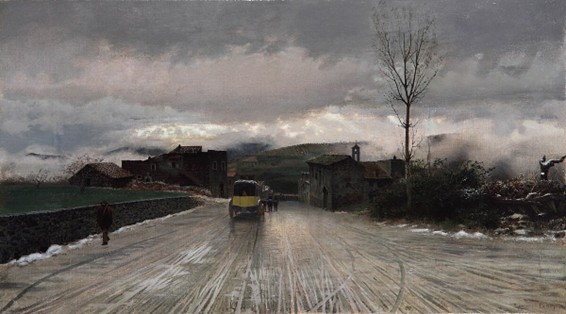
La traversata degli Appennini (Crossing the Apennines), oil on canvas, 45×76.5 cm, Museo di Capodimonte, Naples.

In this work, the road is the clear protagonist. The scene is overcast and veiled in mist or haze, and the sober tones and muted colours evoke a mood of melancholy, nostalgia, or introspection. The dampness of the setting is emphasised by the multiple cart tracks marking the road. There is a strong sense of departure: leaving one world behind, perhaps moving toward the unknown. Compositions featuring roads were a recurring motif in De Nittis’s repertoire, and this painting was followed by his famous, brighter work, La strada da Napoli a Brindisi / The Road from Naples to Brindisi (1872).
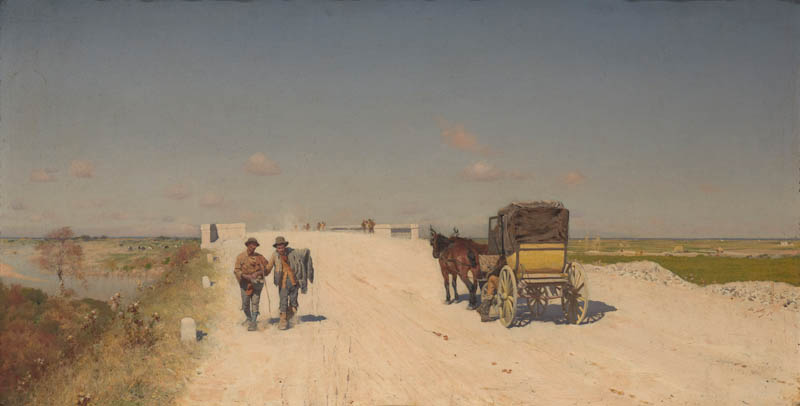
La strada da Napoli a Brindisi / The Road from Naples to Brindisi (1872), oil on canvas, 27×52 cm, Indianapolis Museum of Art.

(Credit: Wikimedia Commons).

The Return from the Ball/ Il Ritorno dal Ballo (1870).
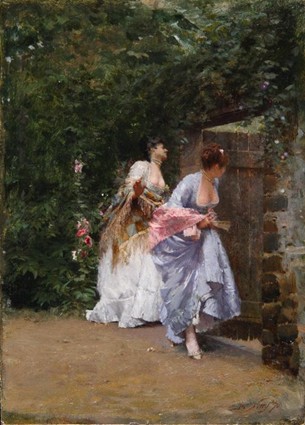
Il ritorno dal ballo/ Returning from the Ball (1870), oil on panel, 24 × 30.5 cm, Private collection.

This work reflects the concerns of the art merchant Goupil, who encouraged De Nittis towards producing Salon-friendly and commercially astute paintings. Among the subjects promoted were scenes such as this, featuring figures sensually attired in costumes suggestive of the ancien régime. This relatively small oil painting (24 × 16.5 cm) carries vaguely aristocratic overtones and evokes a sense of refined sociability, perhaps offering a sanitised or fantasy vision of pre-revolutionary France.

However, the narrative ambiguity of the scene feels distinctly modern. Set in a threshold space, the painting shows elegant but undefined women looking back through a garden gateway, suggesting the moment after a social event. While they appear cognisant of some shared activity, its nature remains unclear; and although they represent the height of elegance, their faces are withheld from view.

From the Top of the Diligence (Stagecoach) / Dall’alto della diligenza (1872).
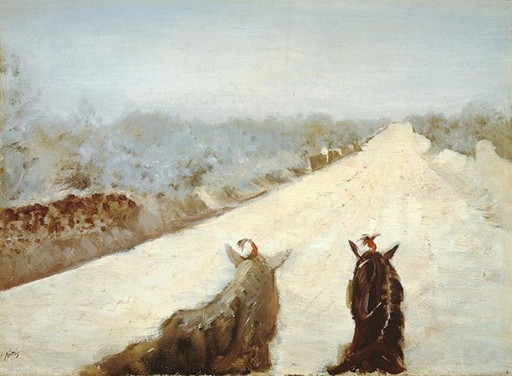
De Nittis stagecoach

Dall’alto della diligenza/ From the Top of the Stagecoach (ca.1872-1875), oil on panel, 26.5×36.5, Private collection.

(Credit: WikiArt).

The viewer shares the painter’s viewpoint from the top of the coach, which invites participation in the scene while also creating a sense of detachment and observation. This elevated perspective suggests movement, with the bright road ahead of the coach dominating the foreground, at the cost of human detail. The composition is sparsely inhabited, creating an overall feeling of distance and openness. There is an atmospheric restraint, with attention focused on light and the dirt road rather than narrative incident. Seen from a position of transit rather than rootedness, the landscape can be read as a realistic document, or a visual metaphor for the journeys and transitions of life.

Sulle falde di Vesuvius / On the Slopes of Vesuvius (1872).

This title refers to a series of plein air studies of Vesuvius from 1872, of which an indicative example is provided here. These works were executed from direct observation, dal vero, and are not in the manner of Grand Tour souvenirs. Rather, they are careful studies that record Vesuvius under varying light conditions. They are almost geological in character, depicting crevasses, ridges, and the rocky slopes, with only sparse vegetation.

De Nittis employs Naples yellow for the first time in these works. They are presented in close-up, without a panoramic view, and appear to be exercises in formal simplification and concentrated focus. As noted above, in the rare instances where human figures appear, they are almost entirely absorbed into the landscape, so pronounced is the degree of abstraction.
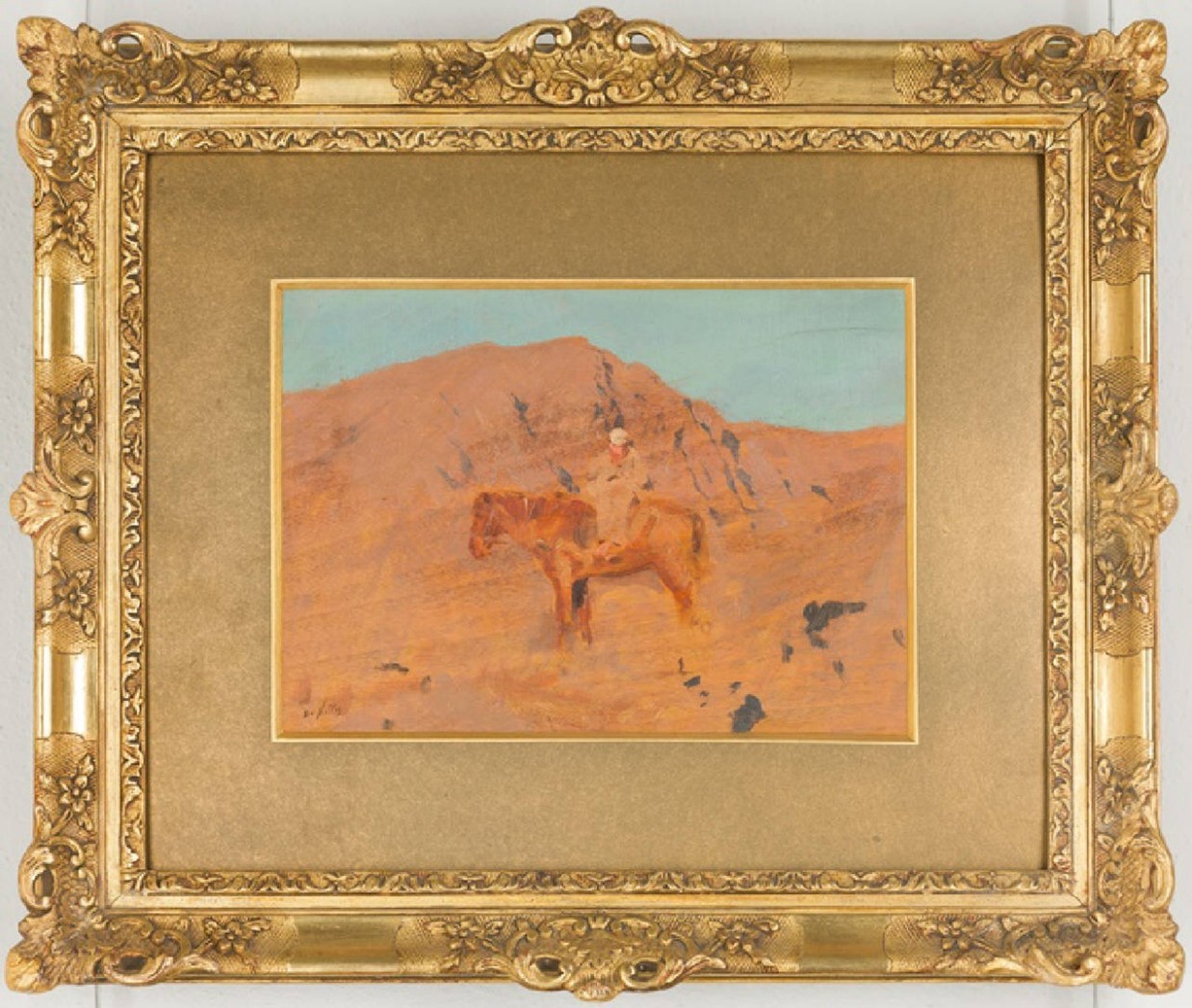
Sulle falde del Vesuvio/ On the Slopes of Vesuvius (1872), oil on panel, 13×18 cm, Galleria d’Arte Moderna di Milano.

(Credit: Catalogo generale dei Beni Culturali).

Che Freddo!/ Fait il Froid! (1874) and Sulla neve/ On the Snowy Path (1875).
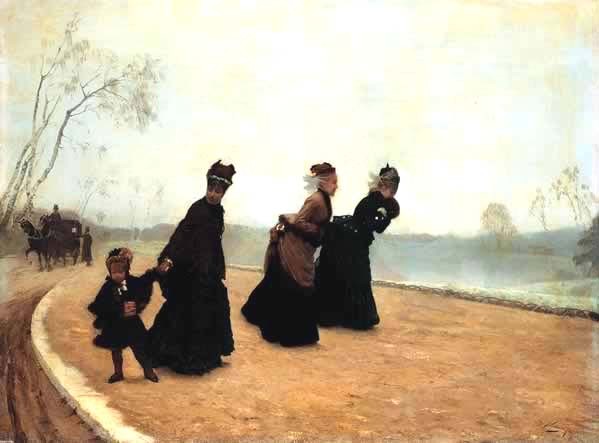
Fait il froid/ Che freddo! (1874), oil on canvas, 43 × 32.5 cm, Private collection.

(Credit: Wikimedia Commons).
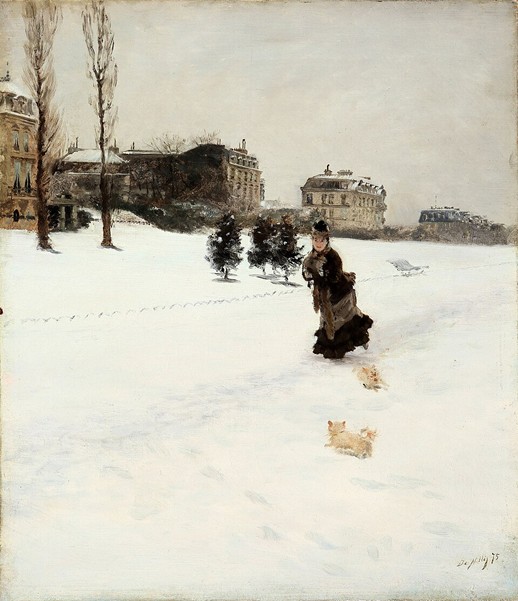
Sulla neve/ On the snowy path (1875), oil on canvas, 43 × 32.5 cm, Private collection.

(Credit: Wikimedia Commons).

The heavy snowfall in the winter of 1874–1875 offered De Nittis the opportunity to make numerous studies of winter skies and snowy scenes. The profound silence of the snow, the pale winter light, and the outstretched, empty expanses of white delighted him, as he reflected in a passage in his Taccuino. He was so captivated by the beautifully “Japanese” vision it created that he declared it brought him fully into his own element and confirmed the vocation for which he was born: “to paint, to admire, to dream.”

These works constituted a significant and innovative departure for De Nittis in his study of atmospheric light, his use of contrast, and his employment of cool tones such as white, grey, beige, and violet. Che Freddo! was presented at the 1874 Salon, where it was well received by the public; it was subsequently sold by Goupil to an American collector for the considerable sum of 10,000 francs. In compositional terms, the framing is radical and engages the imagination in reconstructing a realistic image with a subtle narrative component. The women featured crossing a wide pathway, beside an arcing cart track, are fashionably dressed in dark costumes, and also convey a sense of rapid movement in the cold. This dynamism is counterbalanced as one of the women is being pulled back in a different direction by a child, who appears momentarily distracted. The cart track creates a depth of field that draws the eye toward a dark carriage, which contrasts with the snowy weather. In the background, an atmospheric setting stretches upward into a beautifully realised winter sky.

Sulla Neve takes the Impressionist theme of social leisure and modern life and places it in an informal, quiet setting. A woman is walking her two dogs, offering a study of movement and exuberance on a winter’s day against an architectural backdrop. Once more, we see De Nittis’s mastery of the crisp, reflective quality of winter light on snow and its interactions with different surfaces, shadows, and figures. Particularly striking is the contrast between the trodden snow and the untouched, soft, powdery expanses, which suggest a profound sense of silence.

Parisians of the Place de la Concorde (c.1875)/ Parisiens de la Place de la Concorde, A Corner of the Place de la Concorde (1880)/ Un coin de la Place de la Concorde.
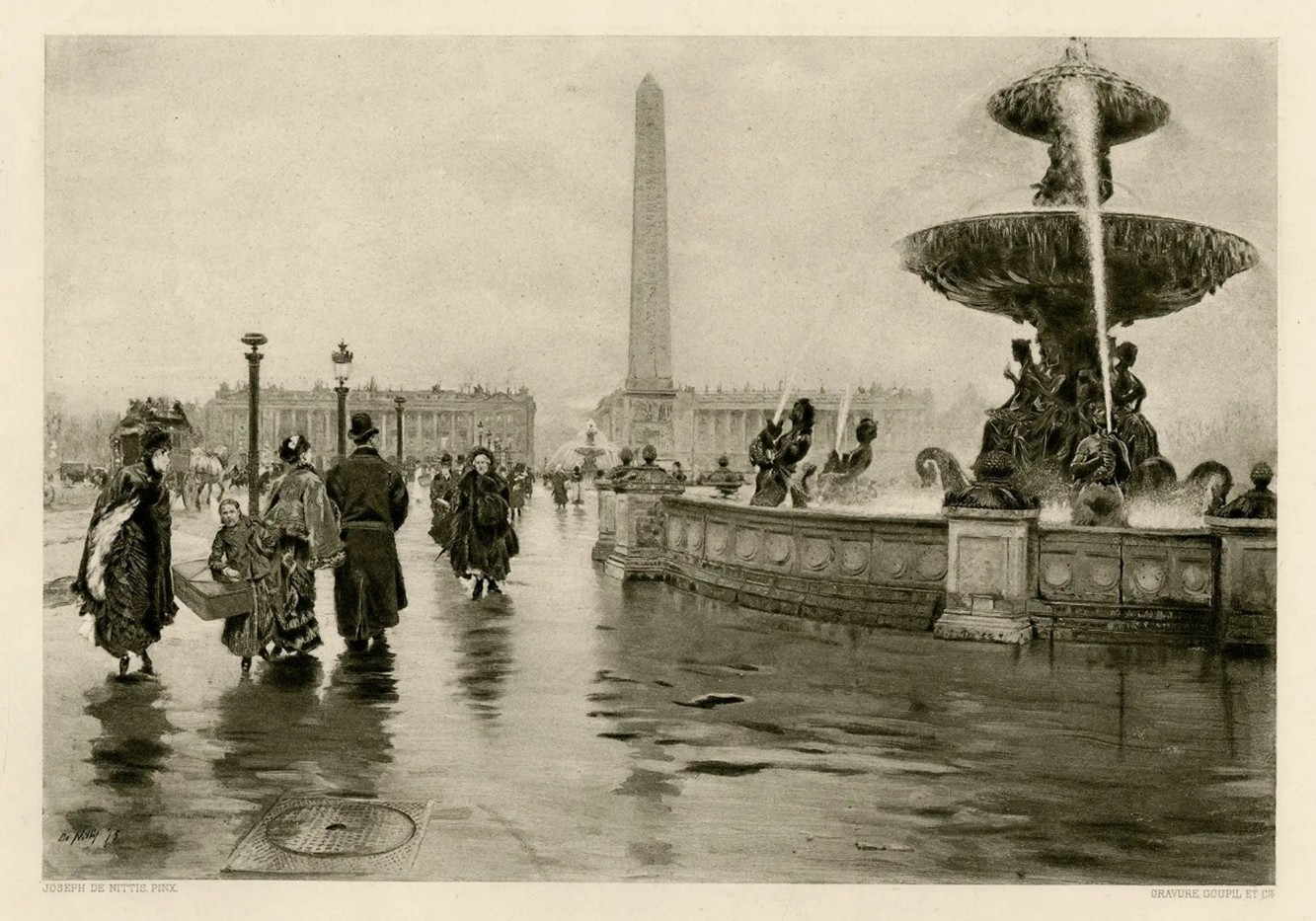
La Place de la Concorde (1875), a photogravure; the original is part of the collection at the Presidential Atatürk Museum Mansion in Ankara, Turkey.

(Credit: Rob Zanger, Rare Books).
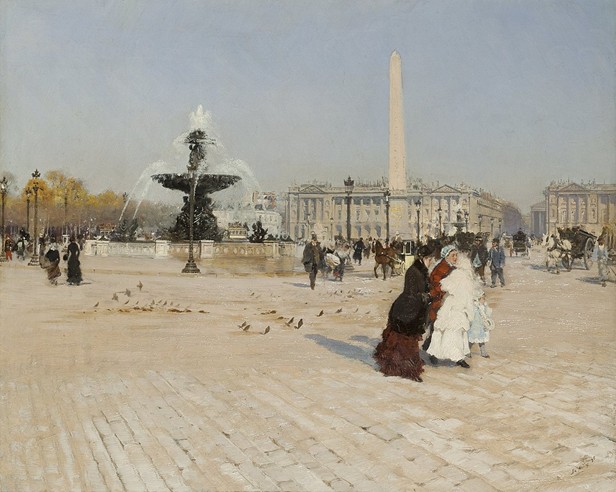
A Corner of the Place de la Concorde in Paris/ Un Coin de la Place de la Concorde (1880), oil on canvas, 65 × 81 cm, private collection.

(Credit: Wikimedia Commons).

The first of these two works, for which I can only find a photogravure reproduction, depicts a rainy day in dark tones, with a reflective pavement. In contrast, A Corner of the Place de la Concorde presents the setting in a brighter, clearer and more sharply defined moment. The 1875 work was widely disseminated in reproductions, such as the illustration used here, and may well have been a source of inspiration for a number of subsequent painters of boulevard scenes, including Jean Béraud (1849–1935).

While remaining in the realm of probability, Boldini’s Place de Clichy (1874) is often credited with encouraging De Nittis away from narrative vignettes such as Fait-il froid! towards a broader urban vision. What is certain is that La Place de la Concorde attracted considerable attention after its exhibition at the Salon of 1875, and it was sold in October of that year to the Sultan of Turkey for 25,000 francs.

As mentioned in passing earlier, Parisians of the Place de la Concorde (1875) chooses a location dense with buildings and monuments that speak of Parisian history, French colonial ambition, administrative authority and social prestige. These include the Luxor Obelisk, the Hôtel de Crillon, the Hôtel de la Marine, the Église de la Madeleine and the Fontaines de la Concorde. Yet all of these are embedded within a self-consciously modern vision of life as mutable and provisional. The protean nature of modern experience and perception is further emphasised in A Corner of the Place de la Concorde (1880), which alters the distance, angle and atmosphere of the same location. It is as if the easel (or metaphorical viewfinder) has been repositioned on a different day. This later work adopts a wider angle and does not include a principal figural group shown from behind. It also features that familiar expanse of empty ground typical of De Nittis, here reflecting a brighter light. The figures, the atmosphere and the composition are all tuned to a lighter register.

Westminster (c.1875).
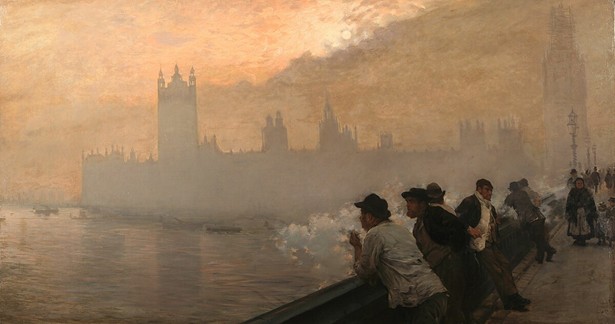
Westminster (ca. 1875), oil on canvas, 110 × 192 cm, private collection.

(Credit: Wikimedia Commons).

Kaye Knowles, the British banker and member of the country’s economic and social elite, gave De Nittis the opportunity to explore London’s distinctive visual and social character. In this work, fog or smog dissolves the mass of the Palace of Westminster in a manner that aligns with the atmospheric studies of London produced by Whistler in some of his Nocturnes, and by Monet in his studies of the city of 1870–1871. De Nittis, however, restrains his level of abstraction, and the Parliament building remains clearly recognisable.

The beauty of the image contains an inherent irony and ambivalence. The grand architecture is veiled by a haze intensified by coal consumption and industrialisation. There is a further irony in the fact that Knowles’s family wealth had its origins in the Lancashire coal-mining industry. This is not to suggest that De Nittis was making a deliberate social statement, but it is something that cannot be overlooked when viewing the work today. Despite its atmospheric origins in industrial pollution, the image is delicate, beautiful and bound to a particular moment.

Once more, De Nittis uses a bridge as the staging point for his view, enabling him to animate the cityscape with recognisable urban types. The unheroic Londoner, casually smoking on the bridge, balances the grandeur of the Houses of Parliament and adds an air of realism, while stopping short of overt social comment or critique.

There is something dignified and muted about the painting. It is not merely northern greyness; rather, it possesses a compelling sense of mystery. When we recall De Nittis’s remarks on the shocking poverty of London, we see that he nevertheless remained open to finding beauty and authenticity in diverse landscapes and atmospheric conditions. His paintings narrate the streets of London in a manner that is both modern and ‘reliable’, a quality that may have appealed to British critics.

Returning from the Races/ Retour des courses (1875).
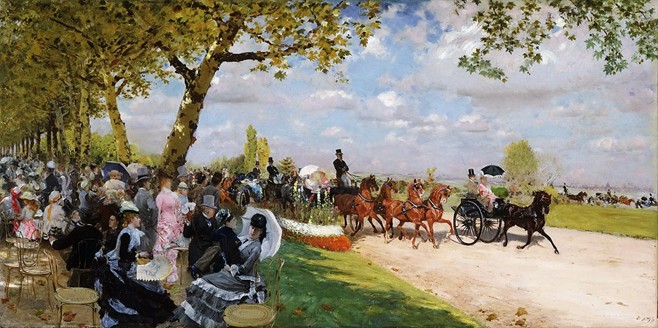
Return from the Races/ Ritorno dalle corse (1875), oil on canvas, 32.5 × 43 cm, Philadelphia Museum of Art.

(Credit: Wikimedia Commons).

The fascination of this composition lies in its organisation around the spectator’s gaze, giving the impression that we are walking into the scene and momentarily glimpsing frozen time. I find it interesting to compare the work with another famous preceding outdoor social tableau, albeit in a different context, Manet’s Le Concert aux Tuileries (1862). The contrasts somehow add weight to De Nittis’s chosen style.
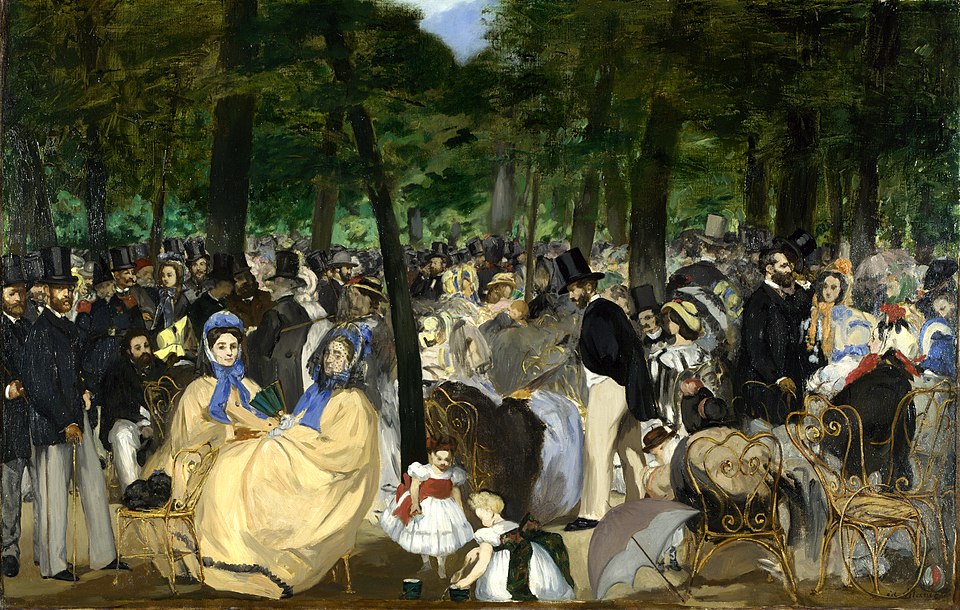
Édouard Manet: Le Concert aux Tuileries/ Music in the Tuileries (1862), Oil on Canvas, 76×118 cm, The National Gallery, London.

(Credit: Wikipedia).

Both works share a fascination with modern social life, capturing fleeting moments of public leisure and observation. In both works, the spectator is drawn into the scene, positioned as a participant in the unfolding event, at the racecourse or amidst a fashionable concert. Manet flattens the pictorial plane, creating a tapestry-like surface in which figures and space coexist with minimal depth, while De Nittis employs an angled composition that guides the eye through the scene, producing a more immersive, almost cinematic effect. Both artists focus on the rhythm of the crowd and the subtleties of posture, gesture and attire, yet they achieve different atmospheric outcomes. Manet’s even lighting emphasizes pattern and surface, whereas De Nittis modulates natural light to animate space and movement. Together, the works resonate as parallel experiments in portraying modernity, one emphasizing the flat, social mosaic of the urban crowd, the other the dynamic, perspectival interplay of leisure, observation and the spectator’s gaze.

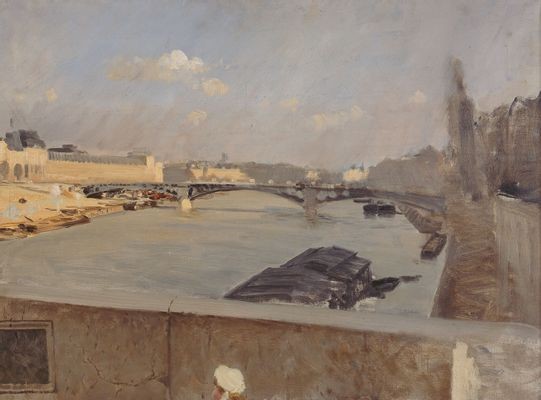
The Bridge / Ponte (1876).
De Nittis Ponte

Il Ponte/ The Bridge (ca. 1876), oil on canvas, 54×74 cm, Palazzo della Marra, Barletta.

(Credit: Artsupp).

When the viewer registers the head of a small girl at the base of the composition, they become aware of the audacious nature of the framing. It seems highly likely that De Nittis used the boundaries of the window of his mobile atelier-cab to shape this view. The painting balances realism with an Impressionist sensibility. The river is presented as an urban experience, in which infrastructure, bridges, and modes of transit convey the energy of the modern city. At the same time, De Nittis’s landscape skills come into play, lending the work an atmospheric rendering that tempers this modernity with tonal restraint.

Boulevard Haussmann (I and II) (1877).
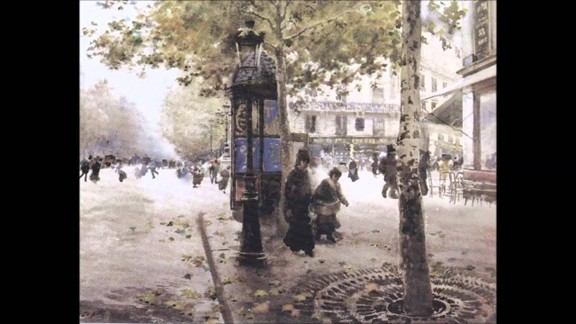
Boulevard Haussman I (1877), watercolour on card, 31×41 cm, Private collection.

(Credit: Artnet).

These watercolours (only the first illustrated here), exhibited by De Nittis at the Paris Salon of 1877, were deemed unparalleled masterpieces by Degas. The medium lends the works a sense of lightness and immediacy, and the brief glimpse of Parisian life offers a cosmopolitan view: a cultural stage marked by mobility, anonymity, and mixture. There is delight in the study of light effects and contrasts, in the use of realistic depth-of-field, and in figures suggested with a delicate, blurred, fleeting touch that conveys motion.

The Japanese Screen / Paravento giapponese (1878).
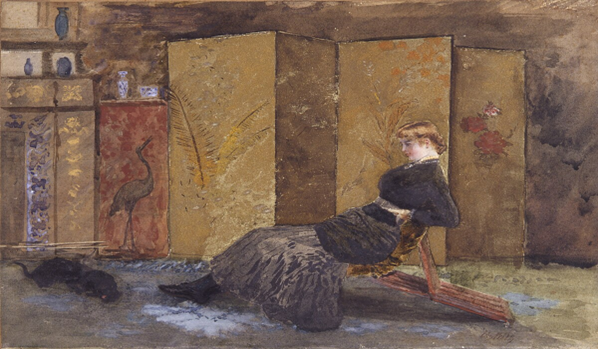
Il paravento giapponese/ The Japanese folding screen (ca.1878), watercolor on paper, 22.5 × 31.5 cm, Pinacoteca Metropolitana di Bari.

(Credit: Wikimedia Commons).

This work from the gallery of Bari illustrates the importance of Japanese culture for De Nittis, reflected in his interest in prints as well as decorative and material objects. The screen in the painting serves both a decorative and a compositional purpose. Its decoration, along with that of the room as a whole, is executed with restraint and subtly marked by Japanese motifs. Compositionally, the screen provides a linear and angular contrast that draws attention to the woman’s relaxed, sinuous pose.

This is an intimate work set within a private domestic interior, adopting a muted and harmonious palette. Works such as this underscore De Nittis’s status as a modern, cosmopolitan figure, fully attuned to the vogue for Japonisme and the forms of inspiration it could offer.

La parfumerie Violet, à l’angle du Boulevard des Capucines et de la rue Scribe (The Violet Perfumery) c. 1880
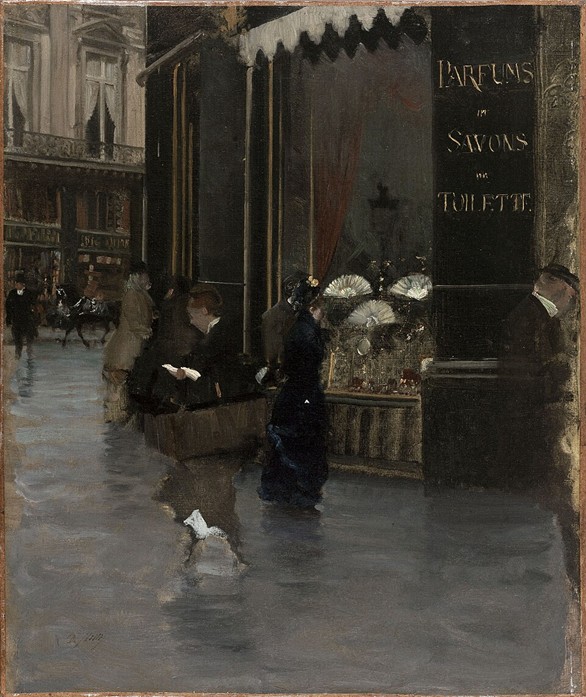
La parfumerie Violet/ Profumeria Violet (1882), oil on canvas, 74 × 62 cm, Musée Carnavalet, Paris.

(Credit: Wikimedia Commons).

This painting offers a testimony to the emerging dialogue between photography and painting that unfolded in the second half of the nineteenth century. A number of tropes later associated with early twentieth-century street photography are visible here: reflections layered over interior space, and the shared transience and anonymity of passing figures. The Perfumery is emblematic of Parisian elegance, luxury goods, female consumption, and the theatricality of shopping. The purchasers are both spectators and performers.

The brisk painting techniques used to render the strolling women and men make them types rather than caricatures. De Nittis places us in the role of witnesses without offering a critique, giving the scene a lucid ephemerality.

This is the Paris of pavements, tailored coats, and polished surfaces: a world rendered in a sober steel-blue palette that recalls the works of Caillebotte. The darker tonality highlights the contrasts of white and silver in the shop windows, as well as the splashes of white fabrics and objects, which punctuate the composition like pin-pricks of light.

What might at first seem to be a simple boulevard vignette reveals layers of visual complexity. We see flat plane divisions alongside depth of field, the contrast between static architecture and the mobility of the street, and the double play of realistic depiction and social display.

Cantiere (1880–1883).
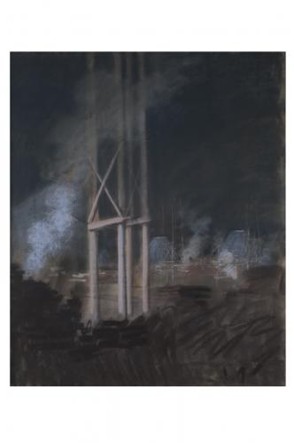
Cantiere/ Worksite (1883), oil/pastel on canvas, 73×59 cm, Palazzo della Marra, Barletta.

(Credit: Catalogo generale dei Beni Culturali).

There is a striking modernity in this picture, which presents industry within an empty and abstract setting. Rather than depicting a site of collective labour and production, it is pared down to a glyph. To the contemporary eye, it anticipates a barren and enigmatic locus, recalling the cinematic visions of Antonioni in Il deserto rosso or Francesco Rosi’s documentary-style approach to labour and industry in Il caso Mattei. It also seems to prefigure notable photographic works of the twentieth century, such as Charles Sheeler’s Criss-Crossed Conveyors of the River Rouge Plant (1927).

https://www.metmuseum.org/art/collection/search/265132

The softness of the pastel destabilises the hard industrial structures, as does the evening register, which renders the austerity of the image mysterious rather than merely severe. Devoid of any element of the picturesque, this is a work of stillness, mystery and modernity.

Il salotto della principessa Mathilde / The Salon of Princess Mathilde (1883).
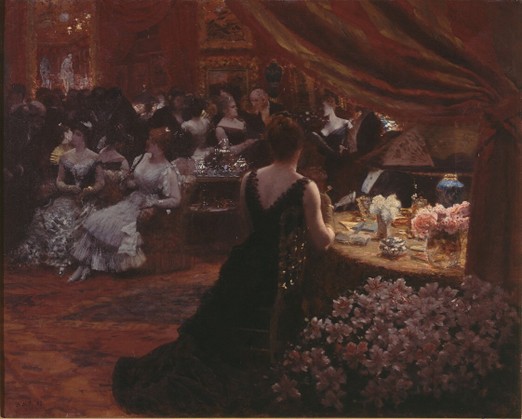
Il salotto della Principessa Mathilde/ The Parlor of Princess Mathilde (1883), oil on canvas, 74 × 92.5 cm, Palazzo della Marra, Barletta.

(Credit: Wikimedia Commons).

This work depicts a social gathering in the salon of Princess Mathilde Bonaparte, the first cousin of Napoléon III. Here De Nittis turns to the mastery of interior light and colour, within a densely populated space. Interestingly, the patron of the work, the princess herself, is embedded at the centre of the crowd rather than being foregrounded. One of the nearer figures is a woman with her back to the viewer, a device which anchors the perspective and guides the eye into the room. These two traits alone give the picture a distinctly modern quality, suggesting the event as observed rather than contrived.

The artificial light is shown rebounding off mirrors and objects, fabrics and furniture. In broad terms this is a social tableau, but one with the emphasis on optical realism, a sense of movement and social dynamism.

In a Cab / In Fiacre (1883).
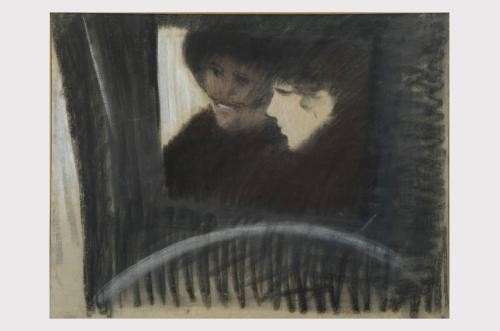
In fiacre/ In a Cab (1883), pastel on canvas, 56.5 × 73.0 cm, Palazzo della Marra, Barletta.

(Credit: Catalogo generale dei Beni Culturali).

In this work, De Nittis attends to the most fleeting of gestures. We catch a glimpse of two women through the window of their cab. The half-smile of the more distant figure might suggest a momentary response to something just said; in any case, we are looking into a private space, as if by accident.

Fiacres in Paris were considered spaces somewhere between the private and the public. They could be secret, transitional places where couples met, people gossiped, or deals were made. De Nittis offers an ambiguous, speculative invitation to a narrative. It is ironic that here the painter looks into a cab and that the window frames the scene from the outside inwards; as we know, he often painted from inside a cab, and here the roles are reversed.

The pastel medium adds softness and a dreamlike quality. What we see is not judgmentally invasive or socially satirical. If anything, this is one of those charming, intriguing moments one might encounter in the life of the city.

Coda

Sometimes, happily, I would remain under sudden downpours. Because, believe me, I know the atmosphere well; and I have painted it many times. I know all the colours, all the secrets of air and sky, in their intimate nature. Oh, the sky! I have painted so many pictures of it. Skies, skies alone, and beautiful clouds.

Nature, I am so close to her. I love her; how much joy she has given me. She has taught me everything: love and generosity. She has revealed the truth, the one hidden in myth… Antaeus, who regained his strength every time he touched the Earth, great Earth!

And with their sky, I picture the countries where I have lived: Naples, Paris, London.

I have loved them all. I love life, I love nature.

I love everything I have painted.

Giuseppe De Nittis, Taccuino, parte prima: ‘A Napoli.’

If you wish to support Inner Surfaces, here is the link for contributions:

https://donorbox.org/inner-surfaces-resonances-in-art-and-literature-837503

Acknowledgements and Sources.

Renato Miracco’s An Italian Impressionist in Paris (2022) offers an excellent introduction (in English), and Maria Luisa Pacelli’s De Nittis e la rivoluzione dello sguardo (2019) is a fascinating exhibition catalogue. Christine Farese Sperken’s introduction to De Nittis (2007) is also a very good starting point; it is a succinct account from a leading authority and offers far more than one might expect from such a slender text.

I am also indebted to the essays within these texts by the following authors: Stefano Bosi, Omar Cuccinello, Marina Ferretti Bocquillon, Barbara Guidi, Vasilij Gusella, Robert Jensen, Hélène Pinet, Adolfo Tura, and Isabella Valente (her catalogue entry for Sur la route de Castellamare (1875) in Chiodini (2025)).

Readers are encouraged to consult these publications, and those cited below, for greater depth; any errors in this essay are mine alone.

Bibliography.

Angiuli, E. and Spurell, K., De Nittis e Tissot: pittori della vita moderna (Milano, 2006).

Chazal, G., Morel, D. et al., Giuseppe De Nittis – La modernité élégante (Paris, 2010).

Chiodini, E. (ed.) L’Italia dei Primi Italiani (Crocetta del Montello (Treviso) 2025).

De Nittis, G., Taccuino (Bari, 1964).

Farese Sperken, C. (ed.) Giuseppe De Nittis: Barletta, Palazzo Della Marra Catalogo Generale (Bari, 2016).

Farese Sperken, C., Giuseppe De Nittis: da Barletta a Parigi (Fasano di Brindisi, 2007).

Martorelli, L., Mazzoca, F. et al. Da De Nittis a Gemito (Genoa, 2017).

Mazzoca, F., Zatti, P. et al., De Nittis: pittore della vita moderna (Milano, 2024).

Miracco, R. (ed.) Giuseppe De Nittis: la donazione di Léontine Gruvelle De Nittis, catalogo generale (Roma, 2022).

Miracco, R. et al., An Italian Impressionist in Paris: Giuseppe De Nittis (Washington, 2022).

Pacelli, M. et al., De Nittis e la rivoluzione dello sguardo (Ferrara, 2019).

Picone Petrusa, M., Dal Vero: Il paesaggismo Napoletano da Gigante a De Nittis (Torino, 2002).
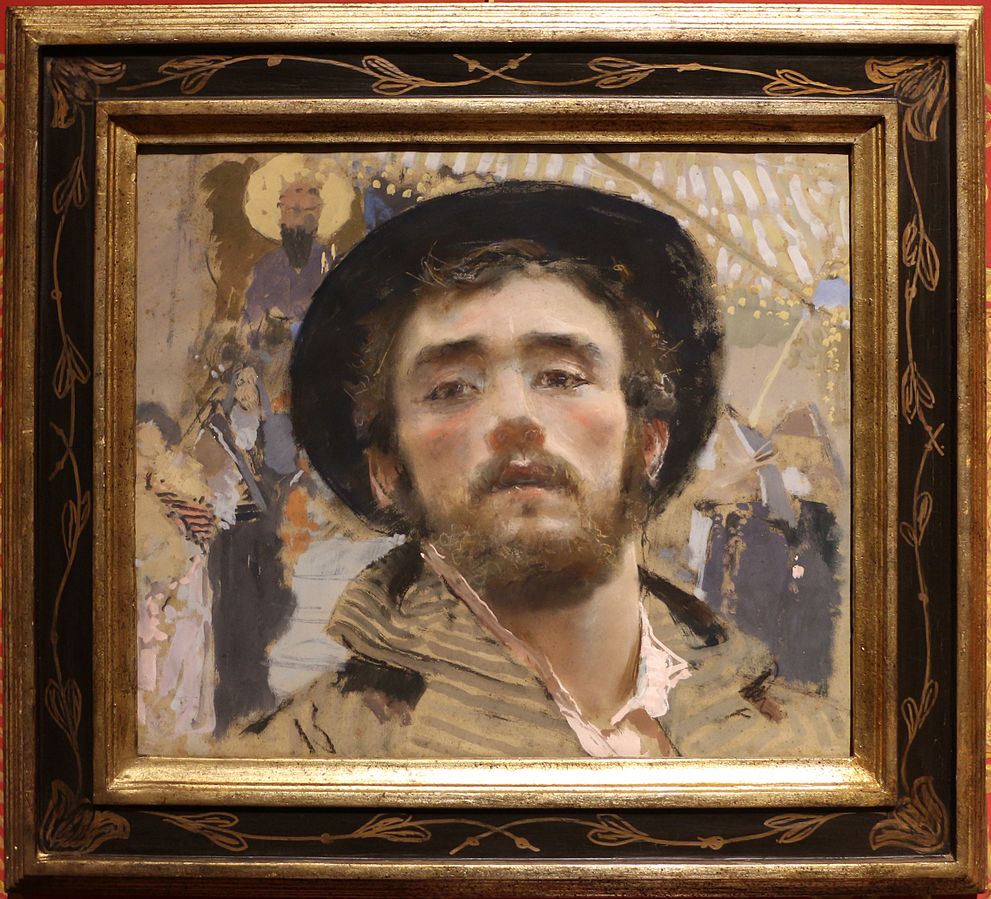
Light, colour and the vitality of motion: Introducing the world of Francesco Paolo Michetti (1851-1929).

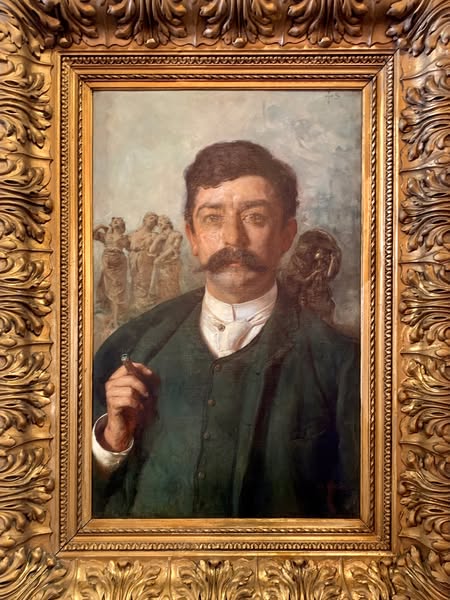
The featured image of this article, Francesco Paolo Michetti’s 1877 self-portrait, (Palazzo Zevallos Stigliano, Naples) offers an introduction to the artist while also immediately conveying the light and colour characteristic of his work. In the words of Marina Miraglia:

The half-open mouth and the intense, passionate gaze express that healthy fullness of life and that trusting, joyful surrender to the natural course of things which are the most authentic themes—beyond the subjects portrayed—of Michetti’s painting. Through these elements, Michetti achieves a profound psychological insight, matched by a formal execution that aligns perfectly with the content, in harmonies of extremely light tones that are remarkably controlled and elegant.

Miraglia also coined, almost in passing, the phrase “the vitality of motion” (or, more literally, “the freshness of movement”) during an interview with Clemente Mariscola at the ICCD (Istituto Centrale per il Catalogo e la Documentazione) in Rome on 17 April 2012. The term arose in relation to Michetti’s use of photography as a tool for studying movement, but it resonates more broadly: as a spontaneous utterance, it suggests the raw fact of an event unfolding in time—its inherent wonder, its Istigkeit, as Huxley might have put it.

To light and movement, one could equally add sound, so exuberant is some of Michetti’s work. Ultimately, in engaging with the work of Francesco Paolo Michetti, we are invited to encounter the ineffable energy and fascination embedded within each apparently ordinary moment.

Michetti chose the agro-pastoral community of his native Abruzzo as his open-air studio and laboratory. This setting offered him starkly contrasting possibilities. On the one hand, it was an escape from the urban and the industrial, providing the inspiration of Nature in its broadest sense — that realm which resists closed systems and rational codification. In this way, it was a locus for the primordial, the mythical, and the unexpected, qualities found in both its landscape and its people. At the same time, this escape was also an encounter with a rural underclass mired in poverty and superstition. Michetti’s pastoral inspiration drew more from the Georgics than from the Eclogues. His vision, though often soaring with beauty and charm, remained rooted in the poverty of his youth.

While Michetti’s art was never intended to be political, his work gained added significance from its timing and context, despite his being neither a fervent nationalist nor a militant social reformer. Throughout his lifespan (1851–1929), the South of Italy was burdened by the persistence of the latifundia system, with huge estates in the hands of absentee landlords and the majority of peasants surviving as day labourers under conditions of chronic poverty. The liberal state after unification failed to resolve this imbalance: the Trasformismo politics of the late 1870s prioritised parliamentary stability rather than structural agrarian reform, leaving rural discontent to fester. Popular agitation, most dramatically the Fasci Siciliani of the early 1890s, revealed the depth of frustration, while reformers such as Gaetano Salvemini began to investigate the realities of peasant life “from below,” exposing the gulf between official rhetoric and lived conditions. Various commissions and debates addressed the so-called questione meridionale, but genuine redistribution of land was continually postponed. Instead, limited initiatives—such as public works, taxation reform, or small-scale tenancy schemes—were implemented unevenly. Against this backdrop of stasis punctuated by the search for remedies, Michetti’s depictions of peasant rituals and rural life take on a double aspect: timeless in appearance, yet bound to a society where the pressure for change was never far from the surface.

Far from any romantic notions of effortless genius, Michetti’s oeuvre was the result of intense labour, and his wide-ranging creativity was disciplined through scrupulous cataloguing and research. While he immersed himself in the humble rural world of his childhood, he returned to it equipped with a rich education — one that brought modern, intellectual, and practical methods to bear on a community still shaped by paganism and superstition. He was also a photographer, conducting experiments that were almost Leonardesque, both in that medium and in painting. He developed his own alternative to tempera: a guazzo (gouache) in which pigments were dissolved in glycerine instead of egg, producing a fluid paint with a luminous finish. He also experimented with techniques for fixing pastel drawings and there is a clear sense that experimentation offered him personal inspiration, as well as forming a vital component of his artistic practice.

There is a restless side to Michetti, one that seems absorbed in the process of creation, often with little regard for the final product. Georges Hérelle, in his Nottolette dannunziane, recalls:

With the pretext that it must be unbearable to own a painting, that is, to have the same artwork constantly before one’s eyes, and that people should be spared such a torment, he got it into his head that, once a painting is completed, it would be best to make a magnificent engraving of it and then destroy the original. In this way, the engraving, kept in a folder, would only be seen by the owner whenever he felt like it. Starting from this idea, he began to search for new and extraordinary engraving techniques, and he wasted a great deal of money in the process.

A more radical testimony comes from Edoardo Scarfoglio, who recalls that Michetti once imagined creating a picture that would destroy itself over time and even fantasised that, once a work had been extensively exhibited, it ought to be torn apart. Scarfoglio glosses:

Thus, his ambition would be to leave behind nothing but a shifting, fluid, and ever-changing legend—like the one that surrounds the names of certain Greek painters, which has come down to us without any documents.

In this, Sabrina Spinazzé perceptively recognises a modern impulse: the privileging of the ‘intellectual elaboration of the image’ over its ‘material execution.’ At the same time, we should not overlook Ojetti’s mocking remark about Michetti’s desire, at the age of 70 or 71, to visit Japan. It seems likely that the artist’s admiration for Japanese culture included its philosophical embrace of transience (mujō) as central to existence. Many traditional Japanese art forms are explicitly structured around impermanence. Michetti’s radical statements may thus be read as both a philosophical affirmation of the transient, ever-changing vitality of the present moment and a practical pursuit of an art form that appears light, unburdened, and perpetually open to renewal.

It is somehow apt that the horizontal compositional style used in Michetti’s large-scale paintings both anticipated the cinematography he experimented with and drew inspiration from classical antiquity. A letter written by Sartorio recalls an evening with Michetti spent pastel drawing from illustrations of herms and Greek vases. In a 1930 letter to Tommaso Sillani, Sartorio wrote:

In the evening, under the lamps, even d’Annunzio would draw; we copied reproductions of the Greek primitives, the herms then unearthed in the Parthenon, and sometimes the Maestro would show us, commenting as he went, countless pastel studies made on Corinthian and Attic vases from the Naples Museum. That was the true Michetti.

As Sabrina Spinazzè has observed, the ‘paratactic organisation’ of some of Michetti’s works appears to draw not only on ancient vases, but also on the structural principles of friezes and sarcophagi­forms that, like film, seem to unfold as movement in time and space.

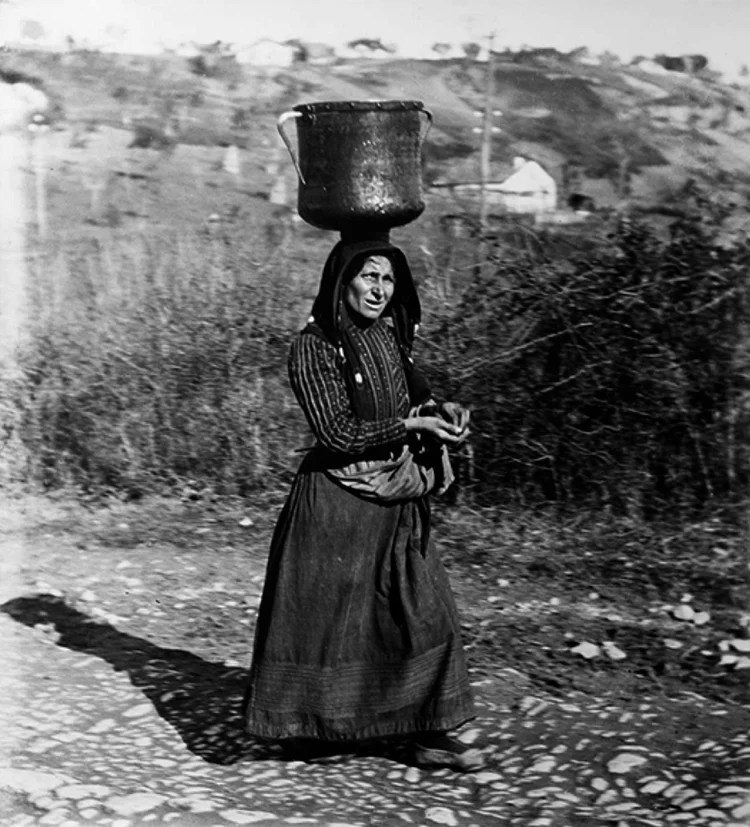
While Abruzzo served as his unbounded en plein air studio, much was also adjusted and worked out in his actual studio, in the convento and even elsewhere. For example, a photograph of a model holding an armful of roots, posing on a terrace in Rome, was part of his studio assemblage for the realisation of Gli serpi (The Serpents). Some of the artist’s rooms in the convento were reported to resemble workshops or laboratories more than traditional studios.

So far, we have set limits on the romantic or mystical interpretations of Michetti’s work, but that is not to suggest such qualities were entirely absent. The ornate and flamboyant prose of Gabriele d’Annunzio, a close friend and artistic companion, often celebrated Michetti’s life and work in elevated terms, accentuating its mysticism, aestheticism, and symbolism. That these descriptions were not only expressed but seemingly welcomed suggests they resonated with some aspects of Michetti’s artistic self-conception. Still, I chose not to foreground such affinities at the outset, precisely because doing so might too easily obscure the important distinctions which also existed.

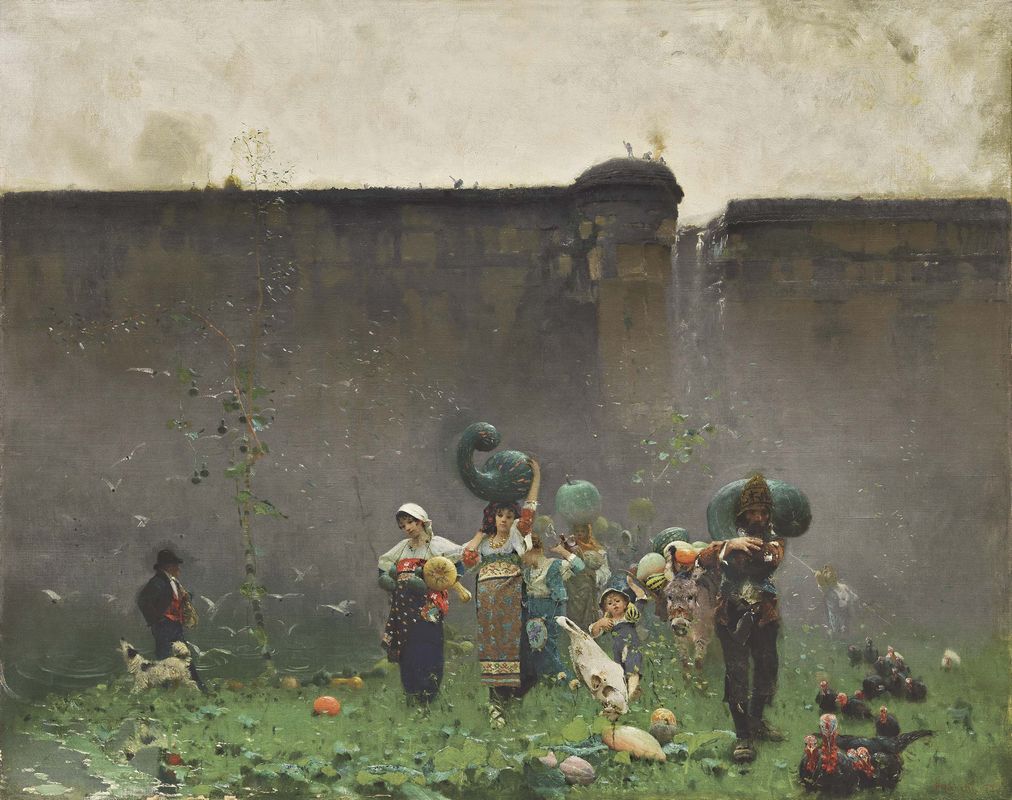
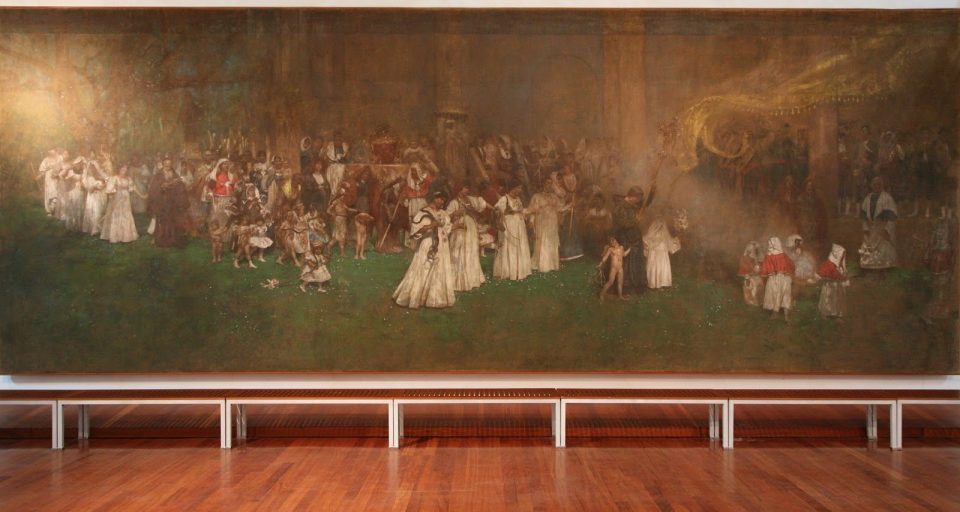
Now that we have considered some of the grounded, experimental, and systematic aspects of Michetti’s practice, it is worth turning to some of the more compellingly fantastic elements of his work. La raccolta delle zucche (The Pumpkin Harvest), painted in 1872–1873 when Michetti was just 21 years old, is a stunningly beautiful canvas marked by an irresistible strangeness and singularity. Adding to its richness, we also have what amounts to an ekphrasis of the painting in d’Annunzio’s Ricordi Francavillesi (1883), where the work is reimagined in prose.

(Credit: Wikimedia Commons).

In La raccolta, the artist displays, to borrow another expression from Marina Miraglia, a capacity for a heightened realism based on mimesis (un realismo spinto sul mimesis), such as we might expect from a pupil of Filippo Palizzi.

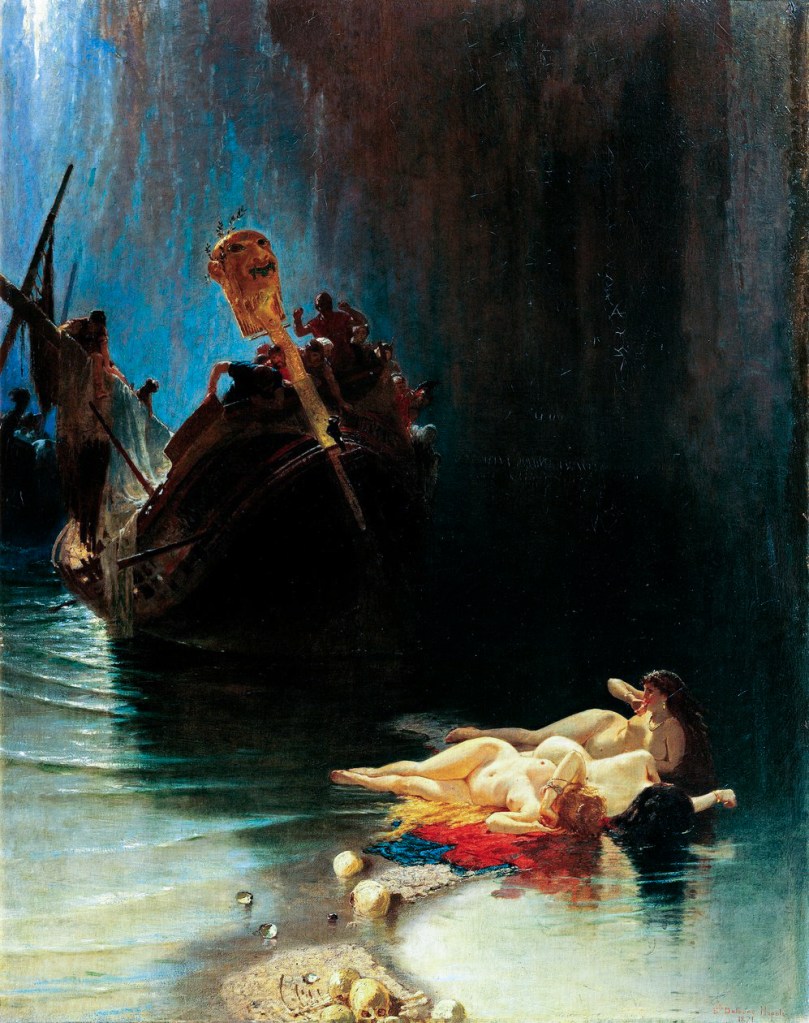
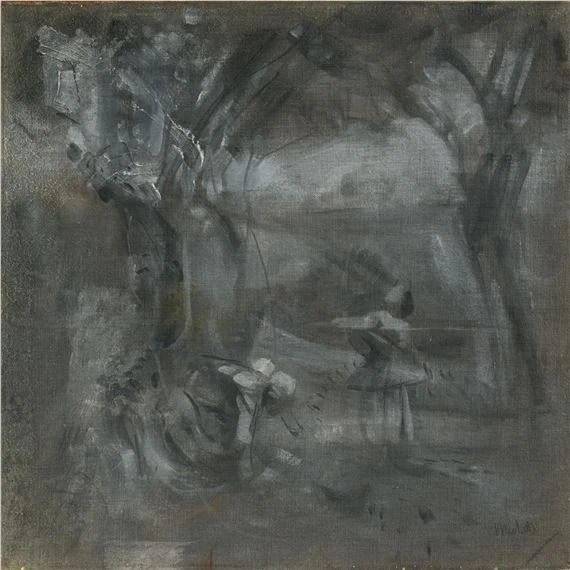
At the same time, this is an oneiric and enchanted scene, bordering on Symbolist work. Fabio Benzi has noted that this element cannot be disregarded, highlighting Michetti’s friendship with Edoardo Dalbono who, in his painting La leggenda delle sirene (The Legend of the Sirens), had recently blended observational fidelity with a dreamlike quality. Dalbono’s painting was at the crossroads between the Romantic concept of the sublime and Symbolist suggestion.

(Credit: Meisterdrucke).

Certain features of Michetti’s style are rhetorical rather than representational, employing composition and figuration to move us beyond realism. This visual rhetoric, I would argue, opens the way to d’Annunzio’s writing, where it finds an even more heightened expression.

In La raccolta d’Annunzio sees the location as Bolognano, in the province of Pescara. However, in this Bolognano scene the background, ‘brings to mind a vast ruin of a pagoda, fragments of Buddhist colossi.’ He continues:

A milky vapour floats in the morning air, rising from the greenish marshes; and the plants with large rough leaves snake along, intertwine on the ground, and rise in clusters upwards. Through this vaporous freshness, men and women come carrying enormous gourds on their heads – yellow, green, mottled gourds, of strange shapes, of strange twists, resembling monstrous skulls, like vessels ruined by swelling, barbaric trumpets, or trunks of large desiccated reptiles.

The clinching moment, however, is when d’Annunzio forces a dramatic paradox: ‘The effect is fantastical, almost dreamlike; yet the scene is real.’ We are in the territory of d’Annunzio’s Symbolism here, a type of aesthetic epistemology which seems to declare that through a heightened and accentuated vision we can reach reality. While this is part of a new artistic vision, it also, arguably, revisits older arguments on imagination (fantastica) and the representational (icastica).

While it is clear that the younger d’Annunzio was inspired by Michetti’s painting and photography, the degree to which there might have been a dialectical relationship between the artists is less easy to establish, and it is not within the scope of this introduction. What is clear is that Michetti was already, in this early work, experimenting with elements of Symbolism and fantasy which can be traced to Dalbono and Morelli. Moreover, the ethereal and vibrant style of Mariano Fortuny – a realm of luminosity, vapour and smoke – played its part.

As we can see from the illustration, a procession of rural workers, together with a rafter of turkeys, walks towards the viewer. A notional depth of field is suggested, as they appear to fan out as they get closer to us, while those most distant blur into what could be an infinite regression. Nonetheless, the colour and focus of the scene fill the front of the picture plane and the overall compositional effect is vivid and shallow, brought forward by a wall.

The procession seems to emerge from what looks like a breach in the enormous wall, described by d’Annunzio above as resembling the “vast ruin of a pagoda.” Vast is the operative term here, as people appear to be encamped on what looks like a higher plain of ground at the top of the structure. The wall therefore also resembles a cliff, especially considering the cataracts that seem to flow down from it, filling the pool on the left of the painting.

In addition to the movement of the processional figures and those high up in the background, we also see a man on the left who looks as though he might be about to step forward. His dog is facing the opposite direction and is barking at some birds — a large flock of which is gliding down from the high wall behind. There are plenty of dynamic poses among the workers: arms akimbo, arms raised or folded to carry the burden of the harvest. The approaching child at the centre of the picture rocks with the rhythm of his gait, and the donkey beside him is lifting its left leg as it advances. The faint image of a shepherd in the background, to the right of the picture, is in a pose that expresses torsion; he grips a staff slung diagonally across his back.

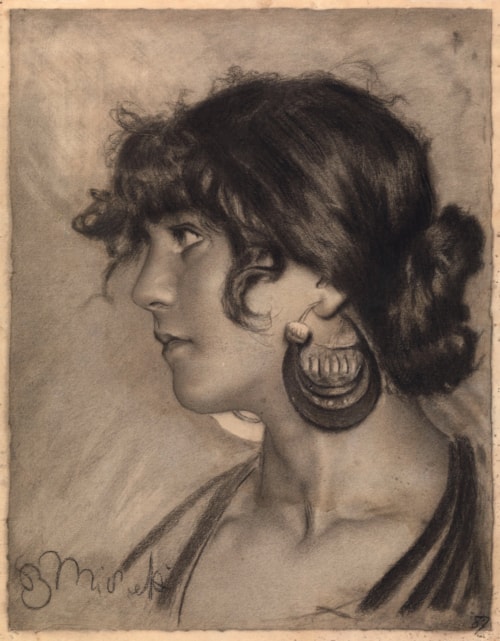
As d’Annunzio observes, there is something aqueous and vaporous about the scene. This holds true for the composition as a whole. While there is a pool on the left, the rich greenery to the right also appears saturated, marshy. The colour of the stonework at the back seems to run and dissolve into a rising mist. Smoke rises from a fire at the top of the wall, mingling with smears of cloud above. The colour palette is beautiful: white, black, brown, red, orange, gold, green, and a sort of electric blue or cerulean. The finest detail is reserved for the costumes and their fabric in the foreground. We should digress for a moment to underscore Michetti’s keen knowledge of Abruzzo fabric, costumes and folk jewellery, which often had an apotropaic role. Most distinctive perhaps are the sciacquajje di Orsogna, the semilunar earrings which add such a distinctive touch to many of his portraits of women.

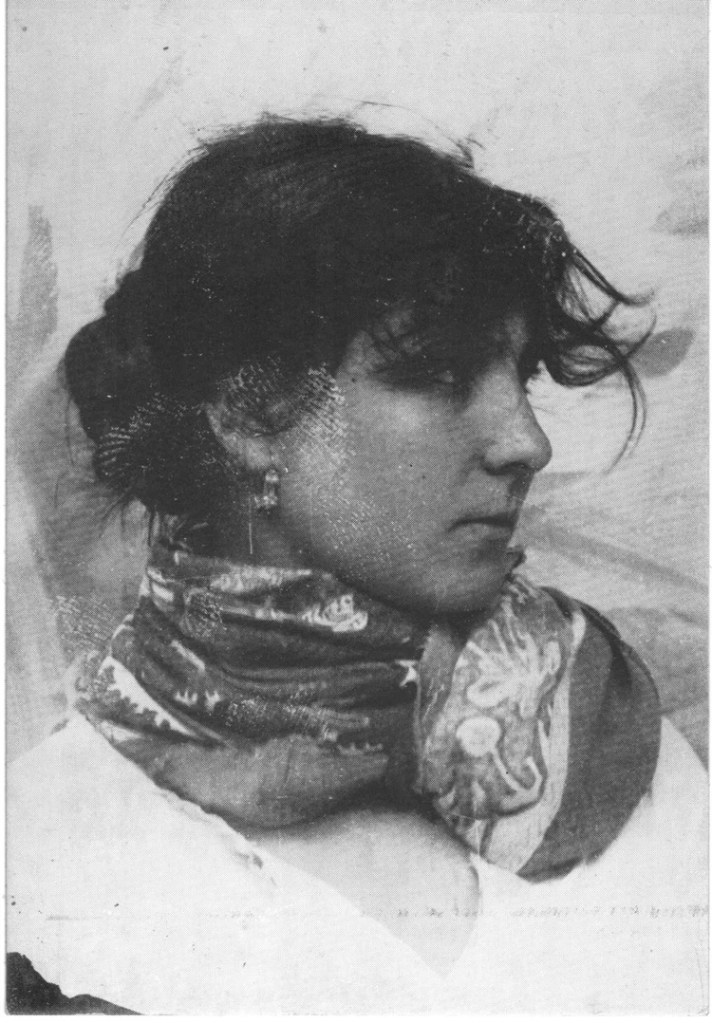
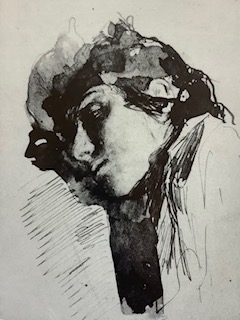
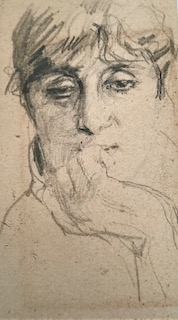
A charcoal and black chalk profile of Annunziata Cirmignani (Michetti’s future wife). (Credit: Stephen Ongpin Fine Art).

To return to La raccolta, the apparent error made by d’Annunzio, who says that the pumpkins resemble “monstrous skulls,” probably stems from misremembering. In the middle of the painting there is a floating anamorphic skull which, incidentally and possibly coincidentally, resembles the human skull in Holbein’s The Ambassadors. Whether Michetti’s skull — probably that of an ox — is intended as a memento mori is not certain. For this viewer, it seems to allude to the primordial, to the deep history of nature, reinforcing, perhaps, the sense that the procession resembles a line of ancestry regressing into the earliest times.

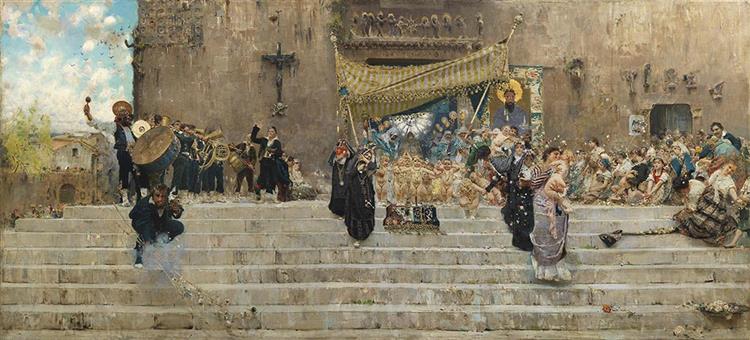
Where the scene in La raccolta is brought forwards by a wall, the Duomo of Chieti fulfils a similar function in La processione del Corpus Domini a Chieti. This work was exhibited in the National Exhibition in Naples in 1877 and it generated a lot of attention, dividing the critics. The painting depicts a procession leaving the cathedral and shows how Michetti responded to the influence of Mariano Fortuny. The great appeal of this work lies in its colour, expansiveness and exuberance. Corpus Domini is a luminous work which bursts with colour and a chorus of processional figures who are leaving the church.

It is not veristic but rather a phantasmagoria of colours, textures and movement. There is a kind of synaesthesia in the painting which complements the sensorial prose of d’Annunzio. The gold of the children’s jewellery, of an icon’s halo and of the band’s brass instruments conveys sound, as does the smoke and sparks of the fireworks that are being set off. A flock of birds in the sky to the left of the composition may have just erupted into flight at the noise of it all. Light brown, light blue, gold and ultramarine punctuate the scene while the costumes, the processional canopy and a decorative ceremonial carpet once more offer close studies of intricate fabrics.

(Credit: WikiArt).

D’Annunzio described Corpus Domini as a ‘sacred bacchanal’ and the nude children, the fireworks, the beautiful women and the exultant light of the painting give it a distinctly pagan vitality. The critics who could not accept the work were perplexed by what they saw deciding that, whatever it was, it could not be considered serious art. Giovanni Costa (1826–1903) saw it as an internally inconsistent and was clearly disturbed that it didn’t offer a true representation of a religious procession. He saw that some areas were carefully drawn while others appeared to have been forgotten. Some colours were in harmony, while others clashed; some figures were rounded, while others were flat. The very brightness and colour of Corpus Domini seemed to provoke in him a feeling of moral disapprobation.

However, while Costa’s response left some room to acknowledge Michetti’s skill, the condemnation of Adriano Cecioni (1836–1886) was unequivocal. He thought that the work was ‘false, mendacious and charlatan’ and that it was little more than ‘a fan in a frame.’ It was Francesco Netti (1832–1894) who ‘got it’, realising that Michetti’s chromatic and sonorous explosion was intentional and offered the public a breakthrough into a new artistic vision influenced by Fortuny and Japanese art. Corpus Domini was to be enjoyed and celebrated for what it was, principally a celebration of the ‘beautiful things’ in life containing as it did ‘women, children and flowers.’

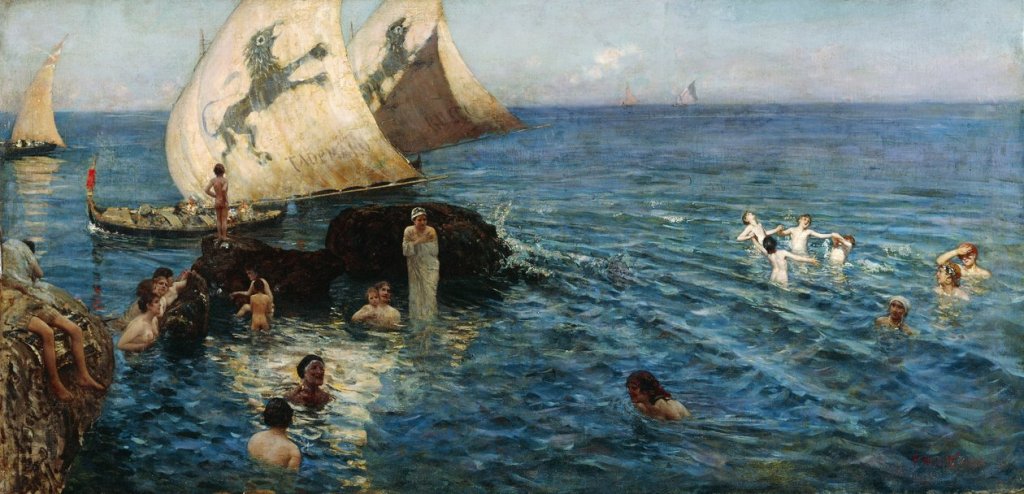
Impressione sull’Adriatico (Impression of the Adriatic), painted in 1880, is a striking example of Michetti’s mastery in depicting maritime scenes. The work was praised by Boito as ‘an Adriatic of lapis lazuli, with bursts of blinding light,’ and it presents a bathing scene set in strong light, just before sunset. As in many of Michetti’s works, the image seems to hover between a mythical study and a portrayal of an unspoilt contemporary rural moment, showing locals bathing by the rocks of Ortona. The brilliance of the canvas—its rich contrasting colours, the subtle tones of the sunset and the surface of the water, together with the serenity and innocence of the bathers—makes it a luminous and radiant work. The interplay of nudity, partial nudity, and gestures of modesty situates the scene in an interstice between ethnographic idealism and aestheticised reverie, between purity and pagan sensuality. Its dreamlike atmosphere recalls Morelli and Dalbono, while the treatment of colour and light reveals the influence of Fortuny. This warm painting reflects Michetti’s deep sympathy with the communal rhythms of life in Abruzzo during his time.

(Credit: Meisterdrucke).

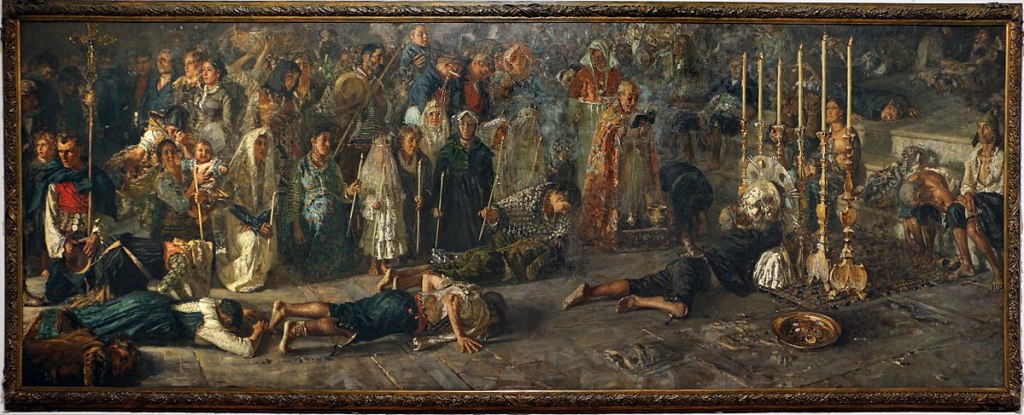
Il voto (The Vow), painted in 1883 and also exhibited in the Esposizione di Roma of that year, is an exceptionally large canvas (250 x 700 cm) housed in the Galleria Nazionale d’Arte Moderna in Rome. Begun in 1881, it depicts a scene from the feast of San Pantaleone (Saint Pantaleon) in Miglianico: panteleimon in Greek means “all-compassionate,” and the saint was the patron of midwives and physicians, also invoked for protection against illness and headaches. His feast falls on 27 July, and we may therefore assume that the oppressive throng of pilgrims is assembled in the heat of a summer’s day. The painting presents the dark interior of a crowded church where figures press together: some stand, some sit, while others advance by prostration towards the effigy of the saint. It is an anthropological and expressive work, raw in its intensity, and reminiscent of the popular scenes painted by Courbet and Jules Breton, as well as managing to capture archaic ritual in the manner of Giovanni Verga.

(Credit: Wikimedia Commons).

One memorable detail of this work was that it was provocatively labelled ‘non-finito.’ More accurately, it was of course a ‘finito, non-finito’, that is to say Michetti intended the work to expound the lessons of Fortuny, combining close study with more impressionistic brushwork. It also blended well with the anti-modern, anti-rationalist focus of Angelo Sommaruga’s Cronica Bizantina and the sensual decadence of the writing of Gabriele D’Anunzio.

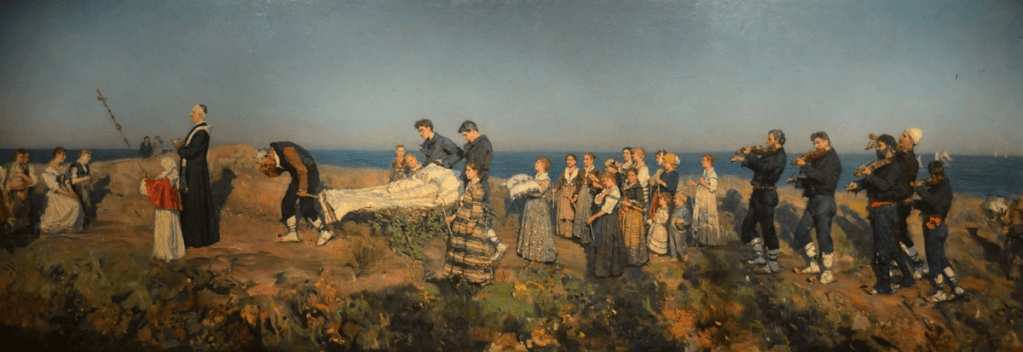
I morticelli is a study of the funeral of two children, painted in 1880; this work is held in the Museo Nazionale d’ Abruzzo. The horizontal format emphasizes movement, while the close attention to facial expressions captures the individual responses to the tragedy in the moment depicted. The bleakness of the scene is softened by its natural setting, with flowers and sunlight. There is also a choral dimension: the participants represent members of the local community, including the priest, the musicians, and the children and adults of the village. The funeral unfolds in a liminal space, as beyond the idyllic rural setting stretches the unbounded horizon of the Adriatic Sea. This is a moving study of nineteenth century misère which is alleviated by nature and the sympathetic gathering of a community. I morticelli also shows awareness of Courbet’s Un enterrement à Ornans (A Burial at Ornans) and suggests that Michetti was aware of the French artist’s realism and respect for rural life.

(Credit: Wikimedia Commons).

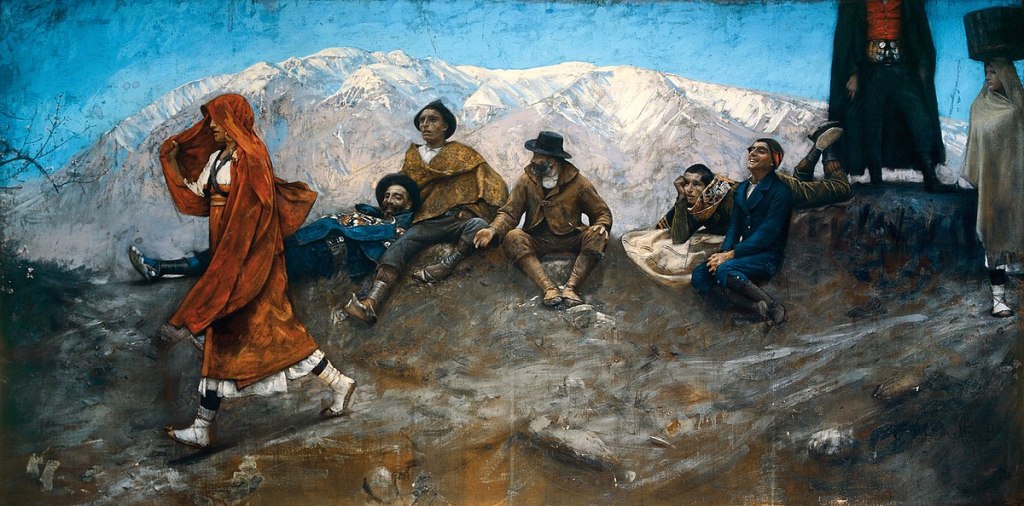
La figlia di Jorio (Jorio’s Daughter), the 1895 version, won first prize at the Venice Biennale that same year. This huge canvas (280 × 530 cm) has a horizontal format and reads like a cinematic frieze: a fleeing woman strides from right to left before a chorus of men whose faces display a range of reactive expressions. La figlia evokes a spectrum of emotions in the crowd that is watching her pass—curiosity, lust, admonition, mockery, and contempt seem particularly central. Here, too, Michetti demonstrates a keen study of movement: the fleeing woman’s feet propel her forward, with the left heel about to touch the ground while she rises onto the ball of her right foot. Her face is not visible, as she is in the act of covering it with her bold red mantle. She moves with energy and confidence, conveying a stately, sober, and austere presence.

The Maiella mountains form a dramatic backdrop; the ridge line is sharply defined and bathed in high, bright light. There is a radical photographic crop of a standing male figure at the right of the composition, and another realistic detail is the woman carrying a load on her head, who is still but turning back momentarily, with a shawl wrapped around her. This work illustrates well Michetti’s refinement of disegno, a process aided by his photography. The same skill is also documented by d’Annunzio, who refers to Michetti having a ‘high operation of the intellect’ which was able to choose the right line, out from ‘a mystery of countless outlines.’ This new leanness and precision might also have been encouraged by Michetti’s interest in Japanese culture, as here the aesthetic concept 間 (ma) encourages respect for the space, or rather the living interval between things.

(Credit: Wikimedia Commons).

A succinct and fitting narrative for Jorio was furnished by Ettore Janni. He relates the daughter’s story as follows:

She gives herself to the man who opened her arms to her in a gesture of tenderness… and the daughter of Jorio becomes the talk of all. The rigid and cruel virtue of the village turns savagely against her with shame and mockery… and a storm seizes and shatters the soul of the daughter of Jorio… she rises again, looks around her… now she will carry out her revenge.

The daughter of Jorio becomes the scourge. She is the demonic seductress, the sorceress who enchants men and drives them mad… and around her swirls an aura of terror, of desire, of sacrilege. Then the scourge falls and she atones more for her revenge than for her first sin.

She lives on in her solitude… Is she dead? Who knows?… but her spirit still wanders the land, passing through the veils of a legend that is one of sin, but more of suffering and sorrow.

The rigid mores of rural life, patriarchal double standards and a kind of misogynistic myth-making close in on the daughter, who is only named as the property of her father.  Nonetheless, Michetti succeeds in turning the myth and solitude of the daughter into something powerful and worthy of respect. Her upright posture, modesty and purposeful stride contrasts with the wave of recumbent men whose faces are distorted by ignorance.

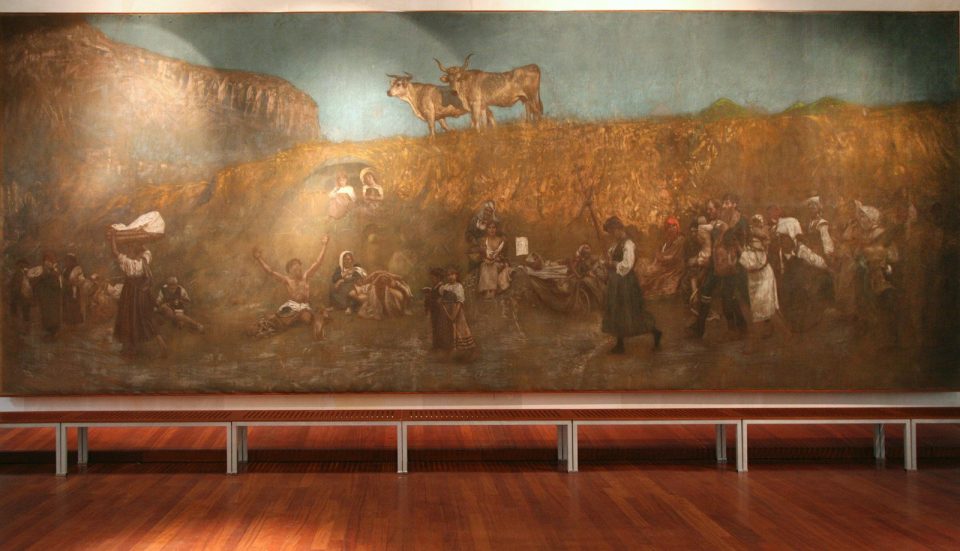
Gli storpi is a work of 1900, painted on a large canvas (380 × 970 cm), and is housed in the Museo Michetti in Francavilla al Mare. It can be paired with Gli serpi of the same year, which is also held in Francavilla. Both works were executed in a short period, following a long process of preparation and planning, in order to be ready for the 1900 Universal Exposition in Paris.

Gli storpi illustrates an account by the anthropologist Antonio de Nino, who described the procession of the sick and infirm of Casalbordino. This pilgrimage took place on the first Sunday of August, to commemorate the appearance of the Madonna dei Miracoli, which had occurred in 1527. When we compare Michetti’s painting with his photographic and documentary sources, we are left with the impression that he aimed for a relatively contained realisation of the scene. As well as colour, expression and movement, there is a cool positivist detachment that tempers his work. The extant photographs taken by Michetti which informed the painting had a biting realism which showed physical deformation and the atrophy of limbs, the stooped and the hunched, and beggars with ulcerous skin lesions.

Gli storpi captures all the surprise of a single moment: for example, on a hill at the centre of the canvas, two oxen dominate the composition with all the force of chance. They seem to suggest a robust and vital aspect of nature, rising above the smaller, more shadowy vale of human suffering beneath them. The upper slope of the hill and the oxen are bathed in golden sunlight, which forms a luminous band across the centre of the composition.

(Credit: Rubricando).

We know that Gli Serpi was the result of a field trip made in 1884 with Antonio De Nino, together with Costantino Barbella and Gabriele D’Annunzio, to San Domenico di Cocullo for the Feast of the Snakes. Michetti returned from the visit with extensive photographic documentation. This religious celebration took place every year on the first Sunday of May. According to local folklore, the harmless snakes used in the ceremony, when wrapped around the breasts of mothers who were not lactating, could restore their milk. San Domenico of Cocullo was considered a thaumaturgical saint, believed also to protect against snake bites. Unsurprisingly, the feast has pre-Christian roots, possibly tracing back to the worship of Angitia, the ancient Roman goddess of snakes.

(Credit: Rubricando).

There is a magical quality to Gli serpi with its vivid colours of gold, green, splashes of red and bright touches of white. The mixture of closely defined elements and impressionistic suggestions, also notably found in Il voto, makes this another dreamlike study. The clouds of incense and a flowing, almost dissolving, canopy of gold in the right half of the composition also contribute to this atmosphere.

Turning to Michetti’s workplace contexts, in the summer of 1880 his project for a studio on the beach at Francavilla al Mare was completed; in the same year, he established a creative collective called the Cenacolo delle Arti. In 1885 he purchased a disused fifteenth-century Franciscan convent in Francavilla al Mare, Santa Maria del Gesù, which he converted into his studio and a meeting place for the cenacolo, later known simply as il Convento. Within its walls, a circle of artists and intellectuals gathered, including Gabriele D’Annunzio, Costantino Barbella, Paolo De Cecco, Francesco Paolo Tosti, Edoardo Scarfoglio, and Antonio De Nino. Il Convento thus functioned as a site where painting, literature, music, material culture, and ethnographical scholarship intersected, grounded both in local traditions and in broader cultural developments.

There is a passage by Italo De Sanctis that describes the context of the cenacolo with warmth, as a kind of utopia:

[Michetti] had grown fond of that quiet countryside, all fresh with vegetable gardens and orchards. One could get by with little money, in a solitude that felt somewhat wild. The people were kind, and the wine was like the people. The women—beautiful, upright, and graceful—wore white blouses and short skirts, showing their full breasts and shapely arms without the slightest malice. The men were solemn, like monuments.

He invited friends and colleagues, who came eagerly and formed the cenacolo—the circle that gave Italy its loftiest poetry, its most forceful painting, its most heartfelt song. Francavilla was the ideal place for their capricious way of life; and there they lived in the full grace of the Lord, in the joy of creation, the fever of work, the intoxication of song, the raptures of love. Days of good humour, of complete joy!

Rosy dawns followed one another in the forgetting of the seasons, and a musical enchantment filled the ecstasy of light, a fragrance of spikenard hung in the air. Young, free, and carefree, they never felt fatigue. Days of intense and fruitful work were followed by nights of delirious joy, under the moonlight. Even the most enchanting Amazons would come down from Chieti to the shore, to make their lives more like a fairy tale, in that little corner of paradise.

Both the sources and concerns of Michetti’s art were multiple. The cenacolo provided interdisciplinary input into his creative process, while his own work undoubtedly inspired his companions, most notably d’Annunzio. Equally important, perhaps, was the conviviality and mutual encouragement that such a circle must have fostered. It is possible to work back from Michetti’s paintings, tracing the influence of those around him: musical, documentary, ethnographic, dramatic and symbolist elements can all be found in his art. Yet the greatest reward comes from contemplating the final unified whole and, with it, the particularity of Michetti’s project.

Photography was an extremely important medium for Michetti. He used it to deepen and develop his drawing and painting, but also recognised it as an artistic medium in itself. In this context Miraglia observes how ‘the strength of photography lies precisely in its language, whose prerogative is exactly to remain constantly balanced between denotation and connotation, between documentation of reality and figurative reshaping.’ Photography could capture a moment and freeze it with a level of detail previously unachievable but it would also remain a representation, an act shaped by the decision of a photographer which also imposed sharp limits through its cropping of an image.

Michetti used photography in varied ways and for different projects. At first, he employed it for portraits and for studies of posed models that would inform his compositions. He also photographed the rural life of the Abruzzo, including its choral gatherings. Through experiments with photography and cinematography he was able to capture a realistic sense of movement, developing his own film camera and, later in 1922, he even invented a cinema projector. His legacy further includes experiments with stereoscopic photography: this, together with his use of life models and terracotta models, helped him attain a sense of volume and plasticity in his painting.

Examples of Michetti’s photography. (Credit: Studio Trisorio.)

This was a period of rapid technical innovation which saw improvements in the compactness and portability of cameras; something tied, in turn, to pre-coated plates of film that used the gelatine silver bromide process. Such developments in film also significantly reduced the time required for a figure to hold a pose.  It is not hard to imagine how photography enhanced Michetti’s pictorial representation, particularly in his treatment of light, line, and movement. Its influence is evident in his portraits in charcoal and chalk, executed on paper prepared with dried clay, where he applied colours in broad patches corresponding to areas of light and shadow. Photographs helped him to capture expression and detail, as well as informing him about light and shade. Michetti’s charcoal portraits seem to suggest a clear debt to photography.

Michetti developed a dialectical relationship with his medium, which allowed him to engage more deeply with his subjects. He moved fluidly between drawing, painting, and his photographic sources. It seems highly likely that photography played a crucial role in enabling Michetti to realise a pared-down style of disegno. For example, Jorio demonstrates a notable austerity of line, and Michetti’s general catalogue contains a number of monochrome studies—both of figures and of landscapes—that may have been inspired by his experience as a photographer. At the same time, we should also cite the likely influence Japanese ink painting as an influence on his monochrome works.

Michetti – monochrome studies. Credit: Mutual Art and WikiArt.

The binomial nature of black and white photography (as well as other very significant contextual factors) may also have influenced the proliferation of rapid pencil sketches made by him post-1910.

Pencil sketch, post 1910 ca. Credit: Gliubich, casa d’aste.

Another area of restraint, in which the effusive manner of Fortuny cedes to a fifteenth century sobriety, is in Michetti’s Illustrations for The Amsterdam Bible from the period 1893-1897 (for illustrations, see Strinati 1999 (b) p. 151.)

The breadth of Michetti’s work would make any introduction fall short in some way, however there are more aspects of it which deserve to at least be mentioned. Michetti was a landscape artist and he excelled in the creation of landscapes which were often, although not exclusively, executed in pastel and tempera (or other mixed media). Such was Michetti’s mastery of pastels it is often stated that they were the inspiration behind Giuseppe Casciaro’s adoption of them. Casciaro is said to have been struck by the pastels exhibited by Michetti in the Promotrice in Naples of 1885. Michetti’s studies bridge the Neapolitan and French en plein air artistic tradition, offering stunning works that convey brightness and immediacy.

A hillside path with blooming cherry trees. Michetti, 1905 (Credit: National Gallery Washington).

While on the subject of the study on nature, it is worth tracking back again to his work as a photographer. From the 1890s onwards the Michetti archives have pictures of trees, leaves, flowers, rock formations, seaside rocks and rocky rivers. Some of the close-up photographs reveal an interest in natural textures that anticipate the work of the American photographer Edmund Weston whose ‘straight photography’, developed from the 1920s onwards, included close-up images of shells, cabbages, peppers, rocks and dunes.

Michetti’s skill at rendering idyllic charm and grace has perhaps received little attention here and we should at least make passing reference to it. La pastorella (The Shepherdess) in the Galleria Nazionale d’Arte Moderna in Rome can stand to represent his poetic grace in the depiction of rural scenes. This work of 1887 offers an example of the many exuberant, intensely colourful and technically skilful pastoral scenes that Michetti completed.   

(Credit: AcquistoArte).

At the later date of 1896 we have a return to such grace in L’offerta (The Offering) in which Miraglia sees ‘Pre-Raphaelite reminiscences.’ This work, which is in the Royal Collection in the Villa Savoia, was completed for Queen Elena; in it the queen is represented as a kind of secular Madonna. She is depicted sitting down, with her son Giorgio in her arms, receiving an offering from a kneeling shepherd. Clearly, this apparent return to an earlier style of painting was considered fitting for the commission.

(L’Offerta (studies). Credit: ANCA, Case d’Asta).

Michetti was a great portrait artist. His skill in this genre is represented in his self-portraits, his studies for large-scale paintings, in formal commissions and in work for friends. We began with one of his self-portraits, so here we can look at a study of a friend and fellow artist of the cenacolo. The Portrait of Costantino Barbella (ca. 1888) depicts the sculptor from Chieti with two of his most famous sculptural works on either side of him. On the left is the figural group Canto d’Amore (Song of Love) while on the right we have Canesto d’Amore (Basket of Love). This warm portrait captures what d’Annunzio referred to as the handsome Barbella’s ‘nostalgic eyes of a shepherd and [his] thick pirate’s moustache.’

(Credit: Archivio di Stato di Chieti).

Michetti’s productivity did not end there: he produced etchings; designed decorative fabric motifs; carried out anthropological research on textiles; studied flowers and vegetation; created designs for stamps, postcards, and book illustrations (including the Amsterdam Bible, as mentioned earlier); and designed a classically decorated label and amphora for the Abruzzo liqueur Corfinio. He also worked on fabrics and theatre sets, together with actors’ costumes; drew up architectural plans for his Casino al mare and designed furniture; and even created unique curtains and decorative frames for his paintings.

With this in mind, it is little wonder that Ojetti recorded the artist saying, “I believe, you know, that no one has ever worked as much as I have in their life.” What is more perplexing perhaps is how his fame has slipped from international recognition and how little is in print about him in English. I hope that this short and incomplete summary of his achievements might stimulate some wider interest in this great artist from the Abruzzo, who was educated in Naples.

[This article relies on the Italian scholarship listed in the bibliography below. My intention is to introduce Michetti to an English-speaking audience and to encourage readers to consult these secondary sources. Any errors or infelicities are my own .]

Producing these articles requires care, time, research, and resources. Contributions to help sustain this exploration would be greatly appreciated.

https://donorbox.org/inner-surfaces-resonances-in-art-and-literature-837503

Bibliography

(The two volume general catalogue for Michetti, listed below, features articles by Fabio Benzi, Gianluca Berardi, Teresa Sacchi Lodispoto and Sabrina Spinazzè. These are names worth searching for on the internet and the Galleria Berardi of Rome has a website and a Facebook page which is well worth consulting.)

Benzi, F. (et al.) Francesco Paolo Michetti: catalogo generale volume 1. Milan, 2018.

Benzi, F. (et al.) Francesco Paolo Michetti: catalogo generale volume 2. Milan, 2024.

Caputo, R., La pittura Napoletana dell’Ottocento (2 vols.) Napoli, 2017.

Del Cimmuto, P., Il vero e il sentimento. Ascoli Piceno, 2016.

Di Tizio, F., D’Annunzio e Michetti: la verità sui loro rapporti. Casoli (Chieti) 2002.

Garofolo, D., Francesco Paolo Michetti: il genio fotografo. Silvi Marina (TE) 2015.

Janni, E., F. P. Michetti in ‘La Lettura’, VX, 1914, 62, pp. 967-969.

Miraglia, M., Francesco Paolo Michetti Fotografo. Torino, 1975.

Strinati, C. (Ed. (a)) Francesco Paolo Michetti: dipinti, pastelli, disegni. Napoli, 1999.

Strinati, C. (Ed. (b)) Francesco Paolo Michetti: Il cenacolo delle arti, tra fotografia e decorazione. Napoli, 1999.

Appendix: Some of the lesser known figures cited in this article.

The following are brief biographical notes on artists, writers, and cultural figures who were part of Francesco Paolo Michetti’s circle or who influenced and collaborated with him. They are included to provide context for the references made in the text and to highlight the broader cultural network surrounding Michetti. I have not included details of the more widely known artists and literary figures.

Costantino Barbella (1853–1925) – Abruzzese sculptor, known for terracotta depictions of rural life. A close friend and collaborator of Michetti, they shared an interest in elevating peasant culture through art.

Camillo Boito (1836–1914) – Italian architect, art critic, and novelist. A leading theoretician of architectural restoration in Italy, he also wrote extensively on art and aesthetics. Boito’s critical writings engaged with contemporary painters, including Michetti, influencing public and scholarly reception of their work.

Adriano Cecioni (1836–1886) – Painter, sculptor, and critic of the Macchiaioli movement. His realist ideals resonated with Michetti’s own pursuit of naturalistic truth in art.

Giovanni Costa (1826–1903) – Italian painter and landscape artist, associated with the Macchiaioli and later the “Etruscan School.” Costa was influential in promoting naturalistic painting and mentoring younger artists, including Michetti, shaping his approach to light, landscape, and realism.

Paolo De Cecco (1864–1928) – Polymath from Chieti, Abruzzo: painter, writer, inventor, and accomplished mandolinist. A cultural figure tied to Michetti’s circle, his paintings of rural Abruzzo paralleled Michetti’s own subjects, while his versatility made him a hub of local artistic life.

Italo De Sanctis (1869–1925) – Painter from Abruzzo whose portraits and genre scenes show Michetti’s influence. A younger colleague, he carried forward Michetti’s artistic legacy in the region.

Antonio De Nino (1837–1907) – Archaeologist and folklorist from Abruzzo. His studies of regional traditions complemented Michetti’s use of Abruzzese rituals, folklore, and peasant life as artistic subjects.

Georges Hérelle (1848–1935) – French philosopher, translator, and ethnographer. He introduced Italian Decadent literature to French audiences, translating works by D’Annunzio, Deledda, and Serao. His scholarly interests also encompassed Basque folklore and regional history, and he maintained close intellectual ties to Michetti and other figures in Italian artistic circles.

Ettore Janni (1865–1937) – Writer, journalist, and critic. Part of the intellectual exchange around Michetti, engaged in literary and artistic debates that intersected with Michetti’s milieu.

Francesco Netti (1832–1894) – Painter from Apulia, known for historical and genre scenes. His detailed realism and interest in local life resonated with Michetti, and he participated in exhibitions that brought him into Michetti’s artistic network.

Ugo Ojetti (1871–1946) – Journalist, critic, and writer. A younger figure in Italian cultural life, he critically engaged with Michetti and helped frame his place in Italian art history through journalism.

Giulio Aristide Sartorio (1860–1932) – Symbolist painter and later Secessionist. His large allegorical works echoed Michetti’s own monumental style; they shared exhibition spaces and artistic ideals in Rome’s cultural life.

Angelo Sommaruga (1857–1941) – Publisher and journalist. Founder of Cronaca Bizantina, he provided a platform for many writers and artists in Michetti’s orbit, including Gabriele d’Annunzio, one of Michetti’s closest collaborators.

Tommaso Sillani (1888–1944) – Journalist, writer, and diplomat. Though of a younger generation, he connected with Michetti’s extended intellectual network, particularly in literary and political discourse.

Edoardo Scarfoglio (1860–1917) – Journalist and writer, co-founder of Il Mattino. His sharp journalism and literary ties linked him to Michetti’s cultural circle, especially through shared Abruzzese roots and connections with other intellectuals like d’Annunzio.

Gaetano Salvemini (1873–1957) – Historian, politician, and anti-fascist activist from Italy. Though not an artist, he moved in intellectual circles connected with Michetti and others from Abruzzo, contributing to the cultural and political discourse of the period.

Francesco Paolo Tosti (1846–1916) – Abruzzese composer, famed for his songs. Shared regional background and friendship with Michetti; both carried Abruzzo’s cultural voice beyond Italy (Tosti in London, Michetti in Paris and Rome).

Links and videos:

Accessed on 30 September, 2025.

Michetti and photography – interview with Marina Miraglia.

https://youtu.be/5l5exWgDfJ0?si=LTEooEyijo6Zcb6g

Fabio Benzi speaking about work on Michetti’s general catalogue, back in 2018.


Gemito and Mathilde Duffaud – ‘Not Made for Financial Gain.’

Introduction – Vincenzo Gemito and Mathilde Duffaud

Mathilde Duffaud, la parigina, was Gemito’s first love—the first profound adult attachment of a foundling child. He met her in 1873 while living with his adoptive parents in the Palazzo del Mojariello in Capodimonte. Mathilde lived on the floor above with the French antiquarian Duhamel. Already known as a model for Antonio Mancini, she was initially approached by Gemito for the same purpose. In time, however, their relationship evolved into a deep mutual affection.

Mathilde was a serene beauty, nine years his senior, with brown hair, large black eyes, and a sweet smile. He, by contrast, was a mercurial young artist in his early twenties, already displaying the emotional intensity that would later overwhelm him—un artista folle of great talent.

According to the scholar and biographer Ottavio Morisani, Mathilde exerted a benevolent influence on both Gemito’s character and his career, encouraging him to pursue further artistic development in Paris. He moved there in March 1877, and she joined him in August. Their time in Paris, however, was marked by hardship—financial difficulties and the worsening of Mathilde’s health. She suffered from a serious illness—possibly a tumour or tuberculosis, as reported in different secondary sources—and eventually required emergency surgery.

In 1880, the couple returned to Naples for good. The following year they relocated to the Villa Galante in Herculaneum, hoping that the healthier environment might aid her recovery. Despite these efforts, Mathilde died there in 1881.

Gemito’s drawings and sculptures of Mathilde offer a rare opportunity to explore the intersection of profound personal feeling and artistic creation. They also serve as an introduction to the early phase of one of the most important Italian artists of the late nineteenth and early twentieth centuries. Referring to a group of drawings from the Minozzi collection, two scholars—writing independently—observe that the studies were “not made for financial gain.” This same sincerity and personal investment runs through all the works that will be considered here.

Two profiles to begin with…

(Credit: see below.)

In the introduction to the exhibition catalogue Temi di Vincenzo Gemito, there is a small reproduction of a drawing by the artist that shows his profile alongside that of Mathilde. The profiles are arranged so that they are very slightly staggered—like the edges of two playing cards shifted between thumb and fingers. The faces of the two lovers remain visible as distinct entities, separated by only the slightest difference. A reverse movement might momentarily align them in perfect tessellation, before one image dissolves into the other.

The exhibition’s curator, Bruno Mantura, offers another metaphor for this delicate boundary between individuality and mutual absorption: the lineaments of the couple, he suggests, seem to “emerge, as if out of a process of distillation.”

Love Lost.

(Image credit: Gallerie d’Italia, Napoli.)

Gemito’s powerful and haunting Self-portrait with Mathilde Duffaud commands attention like no other representation of her. The biographer Ottavio Morisani (1936) interpreted the mood of the drawing as one in which Gemito appears “inert,” while Duffaud is “no longer woman nor flesh,” having become something inspirational—an “ideal.” Once we are aware of the biographical context, the drawing conveys an unmistakable sense of loss.

Though Gemito signed and dated the front of the drawing in 1909, this is almost certainly a later addition made for the art market. Supporting this, the reverse of the sheet bears the inscription: In Ercolano / 1881 Villa Galanti / Palazzo Sforzi. Gemito. Catalogue entries by Isabella Valente (2023) and Rosanna Naclerio (2009) both suggest 1880–1881 as the most likely period of execution, with Valente favouring 1880 as closer to Mathilde’s death.

There is some variation in the literature regarding the materials used. Some catalogue entries describe it as pen and watercolour, while others specify red chalk and watercolour (sanguigna acquerellata). In either case, Gemito achieves striking emotional and atmospheric impact through the combination of a red or sepia warmth with tenebrous chiaroscuro and delicate sfumato effects.

Even a viewer unfamiliar with the drawing’s context would likely be struck by the energy of the scene. Gemito appears as an intense figure, marked by a guarded detachment that discourages intrusion. There is a sense that his calm holds something taut and volatile—an inner unrest. Behind him, Mathilde appears elevated and serene. Only her head and high collar are rendered, which enhances her sense of aloofness and self-possession, as our gaze is drawn upward. The absence of her torso is compensated by dark shading to the right of her head; the right side of her face merges into this shadow. The blank space flanking the figures compresses the scene, magnifying the emotional intensity of their portraits.

Though Mathilde is placed behind Gemito in the composition, her presence is not diminished. On the contrary, she seems to possess a graceful air of authority. Her look encompasses more, enveloping both her partner and any viewer who might be watching. Gemito almost certainly used a mirror to make this drawing, and with that in mind, we realise that the couple are not only looking out—they are also looking at each other. Even if Mathilde’s likeness was rendered after her death, her gaze can still be read as looking back at him.

The couple appear intertwined and self-contained, facing the world as one. While Mathilde is the more composed of the two, she shares something of Gemito’s dark charisma: she is part of it—and, by extension, they are part of each other.

Gemito’s right shoulder is angled forward dynamically, as if his drawing hand is about to re-engage with the paper while he watches himself in the mirror. If the drawing was created after Mathilde’s death, it nonetheless radiates a powerful magnetism. Its realisation may have been sustained by heartfelt memory, supported by earlier drawings and terracotta sculptures.

There is a strange, oneiric vitality to this work, and the intimacy of their bond is palpable.

Drawings from the Minozzi Collection

What kind of observer was Gemito?

Most of the drawings of Mathilde from the Minozzi collection are in pen and ink, or pen and ink and watercolour. Some were realised with very rapid strokes and many seem to have been completed quickly, as if Gemito was trying to capture the essence of a moment. Morisani describes the obsessive way in which he watched and documented Mathilde, suggesting that he had the ‘cruel curiosity of a surgeon’ and portrayed her in ‘continuous’ and ‘insistent’ studies. He suggested that all this was in the search for a ‘definitive form’ of her.

After reading these words of Morisani, it is hard to look at the vigorous drawings in the Minozzi collection without recalling Gemito’s notorious temper. Pen and ink lines can be severe and sharp, especially when the use of watercolour is minimal. They can seem more wire than flesh and appear like some electrical storm of creativity.

(Detail of Gemito’s energetic hatching, credit: see below.)

This sense of sharpness is increased when we remember Gemito’s ruthless capacity to document realistic detail. His pencil drawing of Anna Cutolo (whom he married after Mathilde’s death), named in catalogues as Anna Morente, is a case in point. The picture shows Anna looking like a weak and wounded animal. She has an abdomen swollen with liquid, the consequence of a sarcoma, and yet she is being asked to sit as a model. Bruno Mantura felt that Gemito, in this context, may have followed Anna’s decline with the ‘attention of a cold and angry observer.’ In this situation, it is not so much the fact that Anna is ill, but the uncomfortable position she is in—a pose that strips her of dignity and exposes the full extent of her condition.

(Credit: see below.)

Looking back to the seventeenth century, a pen and ink drawing attributed to Rembrandt, A Sick Woman Lying in Bed, Possibly Saskia (Petit Palais, c. 1635–40), offers another intensely personal and realistic study of the illness of a loved one. The work directly conveys the dejected and weary nature of the subject, though in a more compassionate way. While there is an inevitable sense of detachment—as the artist observes rather than shares in the experience—the woman’s distress is primarily expressed through her facial features and the position of her hands. At the very least, she is shown lying down, covered, and as comfortable as possible.

Coincidentally, in a drawing of 1886, Gemito portrayed Anna in a reclining pose and also added white—though to her face. However, current scholarship suggests that Anna was not ill in this work, and that her pallor in the portrait may have been due to Gemito’s mental state at the time, as well as his own personal artistic taste. (See Cat. 24 in Carrera et al. (2023).)

(Credits: Wikimedia Commons.)

Gemito was a man of extremes and his numerous drawings of Mathilde might testify to his intense and obsessive nature. Although it was Anna who cared for him during the darkest periods of his mental illness, his volatility must also have been evident during his relationship with Mathilde. His difficult temperament extended to his friendships as well. In an 1878 letter, the painter Antonio Mancini accused him of taking the best from their relationship while giving back only an “impossible character.” One account from Schettini, cited by Hiesinger (2007), even claims that Gemito physically assaulted Mancini, attempting to strangle him, after which Mancini feared being left alone with him. The altercation reportedly stemmed from Mancini breaking a mutual agreement: they had pledged not to sell works without each other’s approval, nor at low prices. Mancini, however, had sold some paintings to buy food—for himself and his companions.

While it seems reasonable to intuit (or at least project) traces of agitation and irascibility in some of the leaner, and more tempestuous of the Minozzi drawings, this should not be taken too far. Gemito brings a softness and sensitivity into some of the pictures of Mathilde through the use of shading, as well as through the inclusion of finely rendered detail and psychological and emotional elements. Beyond this, we have one or two works in pencil which bring us closer to the realisation of a rounder and more tactile quality which can be found in his terracotta busts of Mathilde.

(Credits: see below.)

The drawings selected above are among the most atmospheric in the collection; they are acutely sensitive and seem to capture Gemito’s fascination and love for Mathilde very well. The work on the far right is in pencil.

The inspiration for the use of pen, ink and wash must have come from the influence of Morelli and Mariano Fortuny. Looking at the works below, we can see similarities of approach in all three artists, in the style of the hatching and the massing out of darker areas with blots, brushes or smears of ink.

[Image credits: Left Mariano Fortuny, Cecilia de Madrazo Playing the Piano (Wikimedia commons)/ Centre: Vicenzo Gemito, Mathilde Seated (see below)/ Right: Domenico Morelli, The Artist’s Daughter Eleonora Reclining on a Chaise Longue (Wikimedia Commons).]

However, Fortuny’s work is more finely wrought and complete, both in composition and in the realization of detail. In contrast, Gemito and Morelli appear to have worked more quickly, aiming for a rapid overall impression and focusing closely only on selected areas of particular interest. In their drawings more generally, some parts tend to taper off or are left entirely void. While this is, of course, a limited comparison, it does suggest that Morelli was more attuned to immediacy than to Fortuny’s control and finesse—and that Gemito adopted a similar approach to drawing.

While Gemito’s drawings confirm Morisani’s assertion that he studied Mathilde frequently and relentlessly as she went about her life, many seem to sketch out her overall presence, rather than pursuing specific detail. For example, if she is drawn engaged in an activity, then the dynamics or detail of that activity may not be clearly defined, but rather lost in a tangle of suggestive lines and shading: we can see this in the work below, Mathilde al lavoro (GDS 2826).

(Credit: see below.)

Gemito’s overall artistic legacy contains many drawings which study energy and anatomy, especially those made in his classicising phase. As such, they also resemble the investigations of master draftsmen from the Renaissance and Baroque periods. However, these drawings of Mathilde are profoundly personal and seem to be concerned with recording her presence and its fascination, rather than trying to capture a specific physical dynamic, or perfect aspects of anatomical detail. The overall feeling is intimate and domestic.

It is possible, if not likely, that these drawings contributed to an overall awareness of Mathilde that served his sculptures of her. Notwithstanding this, they are not serial preparatory drawings which investigate details of physiognomic representation, or even study arrangements in composition, for a final project. To a large extent she is both the subject and the goal. He wants to capture her presence in time, for himself.

As suggested by an earlier comparison, we find ourselves in emotional territory reminiscent of Rembrandt’s pen and ink drawings of Saskia—such as Saskia Asleep in Bed, housed in the Ashmolean Museum, Oxford. Rembrandt’s drawings of Saskia, like Gemito’s drawings of Mathilde, document a private world, and a relationship within that world, which is passing ineluctably.

(Credit: Wikimedia Commons.)

In an essay by John Berger, Go Ask the Time, there is an analogy that parallels the nature of these domestic studies. Although it concerns storytelling, it also speaks to the character of the drawings:

Everyone knows that stories are simplifications. To tell a story is to select. Only in this way can a story be given a form and so be preserved. If you tell a story about somebody you love, a curious thing happens. The storyteller is like a dressmaker cutting a pattern out of cloth. You cut from the cloth as fully and intelligently as possible. Inevitably there are narrow strips and awkward triangles which cannot be used – which have no place in the form of the story. Suddenly you realize it is those strips, those useless remnants, which you love most. Because the heart wants to retain all.

These drawings are not honed projects—they are fragments which are valuable in themselves. Like the remnants in Berger’s analogy, they are the carefully chosen pieces cut from a larger, ungraspable whole. What they preserve is partial, shaped by affection and attention, and by the limits of what can be held onto. In their quiet specificity, they offer not the full story, but something more intimate: a sense of what it means to try to hold on to a life as it constantly moves beyond reach.

Another interesting aspect of the Minozzi drawings is the paper upon which they are drawn and some light on this subject has been shed by Simonetta Funel, see (Capobianco and Mamone, 2014). Among the published reproductions of his drawings listed below are drawings on squared (account book) paper, lined paper and a page from the Bible, The Epistles to the Hebrews, XI. The Minozzi collection has a number of drawings of Mathilde on pages from the Bible and the possible connotation of devotion derived from associating the paper with its subject cannot be easily dismissed.

(Credits: see below.)

The incorporation of such a variety of types of paper opens up some obvious questions. We wonder whether he was economising, or laying his hands upon whatever was available when he felt the need to draw. While this might have been the case in some instances, it certainly could not have been the rule. The reason we know this is that some of the sheets he used were rare and selected for the quality associated with their age. For example, his famous drawing Scorfano, in the Gallerie d’Italia of Naples, was on manuscript paper from the 18th century.

(Credit: Wikimedia Commons.)

Once we see one element of choice at work, we are entitled to speculate whether he even liked the way that more everyday types of paper responded to ink. The safest approach is probably to assume that a mixture of accident and design played a part in the process of selection. In terms of intentional connection, Simonetta Funel found a photograph of a drawing of Anna, portrayed as Trinacria, on a geographical map of Sicily from 1770.

There is an accidental consequence to seeing that Gemito exercised his talents on everyday paper: when an artist creates something extraordinary on the most ordinary surface, it serves as a reminder that true talent comes from within. Such skill can be summoned wherever and whenever it is needed, as long as the artist’s energy and skill endure. Clare Robertson has noted how Annibale Carracci often offered small studies as payment in kind, even to people of humble origins. One example is his Head of an Old Woman (early 1590s) in the Fitzwilliam Museum, Cambridge, which was painted on a sheet of old accounts—visible beneath the thin layer of paint. Similarly, Carlo Siviero recounts how Gemito, finding himself in the Villa Farnesina without paper, spontaneously made sketches after Raphael on lottery slips, demonstrating the same kind of improvisation and resourcefulness.

(Credit: The Fitzwilliam Museum.)

Gemito ‘in pieces’ over Mathilde?

There are two small bronze heads of Mathilde by Gemito which, while tenderly rendered, are disturbing in their suggestion of decapitation. One of the two bronze sculptures is set on a bronze cushion which has simulations of creases and bumps to create an air of realism. The other is perched on a marble plinth.

(Image credits: see below.)

We can attempt to explain away the sense of brutal severance evident in such shoulder-less, and practically neckless, representations through an appeal to cultural allusions and precedents. As the catalogue entry for Gemito (2009) has suggested, artists traditionally focused on anatomical fragments, or made plaster casts, in preparation for sculptures and paintings, as well as working on them as studies in their own right.

One example might be Géricault’s Study of Feet and Hands (Musée Fabre), cited below. Similarly, Rodin used plaster casts in preparation for his sculptures and also created finished studies of paired hands to explore their expressive potential. A bronze cast of Rodin’s The Cathedral is also included below.

(Credits: Gericault – Web Gallery of Art/ Rodin – Wikipedia.)

Italian religious art has a tradition of depicting headless saints. In a different but thematically related context, 19th century drama and opera also explored scenes of decapitation—for example, Schiller and Donizetti, both of whom visited Naples, dramatised the fates of Mary Stuart and Anne Boleyn.

Appealing to cultural tradition does not, however, diminish the possibility that intense emotion influenced this choice. In her study The Body in Pieces, Linda Nochlin explores how bodily fragmentation preoccupies Western art from the 18th to the 20th centuries. When discussing Gericault’s Severed Heads of 1818, she observes that they “foreground…the absolute abjectness of these subjects.”

(Credit: Benjamin Blake Evemy.)

This insight can be applied, with some modification, to Gemito’s small bronze heads of Mathilde. Unlike Gericault’s heads, which convey abject poverty, suffering, and execution, Mathilde’s expression is tender rather than tormented. This contrast underscores the tragic and premature nature of her death, expressing the abjectness of losing someone beautiful and beloved too soon.

Another work that shares this macabre subject is Paul Gauguin’s 1892 painting Arii Matamoe (The Royal End). Although this work post-dates Gemito’s sculpture and therefore could not have influenced him, it may have been inspired by Gauguin witnessing an execution in Paris as a youth. The use of the guillotine in France was frequent in the 1850s and 1860s and had a widespread impact on the European psyche; moreover, this gruesome method of administering justice endured for decades. The last public execution by guillotine in France occurred in 1939, the last execution in France took place in 1977, and the death penalty was only abolished in 1981. In any case, the dramatic impact of Gauguin’s work is captured well by Elizabeth Childs: “The visage is as horrific as it is legible, for it is a severed head placed on a white pillow that sets it off with shuddering clarity” (see Homburg and Riopelle eds. Ottawa, 2019, p.146).

(Credit: Wikimedia Commons).

Returning to the particular nuances of our subject, the tender repose of Mathilde’s half-closed eyes and the human warmth captured in her face and hairstyle are cruelly contrasted by her bodiless state, which transforms her into an image of lifelessness and irrevocable loss. As Nochlin observes, the vertical form represents the “axis of beauty,” and to lose this verticality is, symbolically, to lose dignity. Reducing the human form to a horizontal fragment is de-sublimatory. In these small sculptures, love, beauty, bitter loss, and haunting memory coexist simultaneously, creating a poignant tension that lingers with the viewer.

Another work by Gemito seems to reinforce this interpretation. After Anna Cutolo’s death, he sculpted a Neapolitan water jug, a mummara, with a disembodied hand reaching around its handle. This domestic object, likely symbolizing everyday life and nurture, bears two inscriptions: on the front, “Nannina,” and on the back, “so’ lacreme d’ammore e nun e acqua” (“these are tears of love, not water”). Arguably, all three sculptures are powerful expressions of lacerating grief and loss—they are sculture strazianti.

(Image credit: see below)

The extreme isolation of Mathilde’s head may also serve an idealising function, akin to Rodin’s sculpture Thought (c. 1895), which portrays the head of his student and fellow sculptor Camille Claudel. Originally titled Thought Emerging from Matter, Rodin’s work emphasised the idea that carving reveals an intuitive form latent within the material—and, by extension, within the artist. Similarly, Gemito’s focus on Mathilde’s head perhaps highlights it as the most expressive site of her inner life. This emphasis on the ‘seat of thought’ aligns with the purpose of a memorial: to capture not just physical likeness, but a more enduring, abstract presence.

Claudel later suffered from mental illness, and it is possible that the sculptures of both Rodin and Gemito emerged from a shared atmosphere of psychological intensity—marked by turmoil, loss, and perhaps even remorse. In Rodin’s case, the sense of loss stemmed not from bereavement, as with Gemito and Mathilde, but from the breakdown of his romantic relationship with Claudel.

(Image credit: Web Gallery of Art.)

Gemito often plays with the tension between completeness and incompleteness in his sculpture. His Mask of the Emperor Alexander loses the upper part of Alexander the Great’s head, including the characteristic hairstyle (l’anastolé) associated with his representation. This fragmentary treatment gives the statue a feeling of authenticity, although, ironically, his likely sources—the Rondanini sculpture and the Alexander as Helios from the Musei Capitolini—both have complete heads.

Conversely, in a study of Psyche, Gemito adds the upper part of the cranium, which was missing from his antique model, and masterfully includes flowing hair tied at the back of the head. Similarly, in a terracotta bust of his wife Anna, a Hellenistic vein is accentuated by leaving a broken finish on the left side of the base. As Cinzia Virno has observed, this detail lends the piece an air of antiquity.

The nature and degree of finish were, therefore, deliberate elements of Gemito’s artistic repertoire. Even a cursory glance at his portrait sculptures reveals variations in the length of his subjects’ necks, the style, angle, and definition of their shoulders, and the extent of broken-edged finishes. However, none of the works I have encountered are as severely cropped as the small sculptures of Mathilde’s head. These fragmented portraits, at the very least, arrest the viewer’s attention, disrupt the expectation of a complete form, and compel us to pause.

Feeling whole…

As a counterbalance to the proto-modernist rhetoric of fragmentation, we can look at some of the very human and tactile terracotta works that Gemito made of Mathilde. One terracotta portrait from 1879 depicts her in what appears to be a peignoir, with an elaborate appliqué dress underneath. The graceful vertical line of her robe is accentuated by the lace trim lining the gown’s closure. This work showcases Gemito’s skill in rendering surface texture, fine detail, and flow in sculpture. Mathilde’s face here is extremely gentle and slightly wistful.

(Credit: Artnet.)

A terracotta bust of Mathilde from 1872 conveys a similar wistfulness, enhanced by the hollowing of the eyes and the slightly open mouth. Here, her face emerges in smooth clarity from the undulating surfaces of her hair and dress, which blend defined elements with areas that seem to recede into an undefined organic texture.

(Credit: see below.)

Another bust, dated 1877, shows Mathilde with a smile that seems to mask physical strain. The curve of the smile echoes other traversing lines—such as that of her shawl—and coordinates with the slight tilt of her head. Once again, skilful hollowing and shaping create chiaroscuro effects and recreate textures, notably the lace detail in her high collar. The swirl of her shawl adds a note of realism, giving the impression of a very personal, intimate moment.

A pastel by Degas, Portrait of a Woman Wearing a Green Blouse (c.1884), while completed seven years later, makes for interesting comparison; it captures a gentle melancholy, which is similar to Gemito’s sculptures of Mathilde.

(Credits: Gemito, see below/ Degas, Artchive.)

To conclude, I would like to share a quotation from Conversation with My Sculpture (Colloquio con la mia scultura), a poem by the Sicilian artist Emilio Greco (1913–2013). Its delicate evocation of captured beauty and timelessness aligns with Gemito’s tender and intimate portrayals of Mathilde:

I have stopped this moment of your beauty
To have you alone with me, companion of my thoughts
It seems you have flown out from the depths of the earth,
Like a spring,
And the path of the centuries has barely brushed
Your cheeks…

Emilio Greco in his studio.

(Credit: Edarcom Europa.)

Producing these articles requires care, time, research, and resources. Contributions to help sustain this exploration would be greatly appreciated.

https://donorbox.org/inner-surfaces-resonances-in-art-and-literature-837503

(General note on image credits – where there were no online reproductions available, I made photographs from books. The published images of Mathilde that I have consulted in research, and in some instances have photographed, are listed beneath the bibliography. I hope that these citations and the educational/not-for-profit status of the article suffice, otherwise I can make amendments as necessary.)

Bibliography

Bellenger, S. (ed.) Napoli Ottocento. Milano, 2024.

Berger, J., Go Ask the Time: https://granta.com/go-ask-the-time/ (accessed, Wed 4 June, 2025.)

Carrera, M. (et al.) Antonio Mancini/ Vicenzo Gemito. Milano, 2023.

Capobianco, F. and Mormone, M. (eds.) Vincenzo Gemito – dal salotto minozzi al museo capodimonte. Napoli, 2014.

Di Giacomo, S., Gemito: la vita, l’opera. Napoli, 2023.

Esposito, D. and Panzetta, A. (eds.) Gemito e la scultura a Napoli tra Otto e Novecento. Naples, 2012.

Farge, C. (et al.) Rodin and the Art of Ancient Greece. London, 2018.

Hiesinger, U., Antonio Mancini, 19th Century Master. Philadelphia, 2007.

Homburg, C. and Riopelle, C (eds.) Gaugin Portraits. Ottowa, 2019.

Mantura, B., Temi di Vincenzo Gemito. Roma, 1989.

Marasco, W., Il Genio dell’Abbandono. Vicenza, 2015.

Martorelli, L. and Mazzoca, F. (eds.) Da De Nittis a Gemito. Genova, 2017.

Morisani, O., Vita di Gemito. Napoli, 1936.

Nocentini, G., Vincenzo Gemito – sculture e disegni. Pesaro, 2001.

Pagano, M., Gemito. Milano, 2009.

Robertson, C., The Invention of Annibale Carracci. Milano, 2008.

Virno, C. (ed.) Vincenzo Gemito: la collezione. Roma, 2014.

(NB. The text of poem by Greco, Colloquio con la mia scultura, was photographed by me, at Greco’s permanent exhibition in Catania.)

Illustrations of Gemito’s pictures of Mathilde available in books:

Minozzi drawings – Capobianco and Mormone (2014).

Mathilde in giardino: inchiostro e acquerello, GDS 2836, p.46.

L’ombra di Mathilde: inchiostro a penna e aquerellato, GDS 2617, p.48.

Mathilde che legge: inchiostro a penna e acquerellato, GDS 2618, p.48.

Mathilde sofferente, firmato ‘V.Gemito’: inchiostro a penna e acquerellato, GDS 2778, p.49.

Mathilde allo specchio: inchiostro a penna e acquerellato, 2811, p.101.

Mathilde al Lavoro: inchiostro a penna e acquerellato, GDS 2826, p.109.

Mathilde, firmato ‘Gemito’: inchiostro a penna e acquerellato su carta quadrettata, GDS 2825, p.110.

Mathilde: matita, GDS 2822, p.112.

Mathilde di profilo: inchiostro a penna e acquerellato, GDS 2671, 117.

Mathilde di profilo: inchiostro a penna e acquerellato su carta stampata, GDS 2852, p.120.

Mathilde di profilo, firmato ‘Gemito’: inchiostro a penna e acquerellato, GDS 2637, p.128.

Mathilde in campagna: inchiostro a penna, GDS 2876, p.136.

Mathilde seduta: inchiostro a penna e acquerellato, GDS 2818, p.137.

Mathilde: inchiostro a penna e acquerellato, GDS 2909, p.141.

Mathilde: bronzo, OA 8972, p.144.

Mantura (1989).

Gemito e Mathilde, profili, p.15.

Testina di Mathilde sul cuscino (cat.54).

Testina di Mathilde (cat.53).

Mathilde al tavolo (cat.56).

Testa di Mathilde (cat.60).

Ritratto di Mathilde ammalata (cat.62).
Mathilde che ricama (cat. 57).
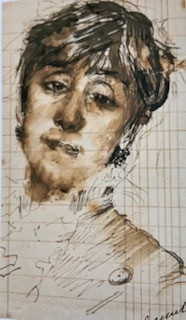
Pagano (2009).
Autoritratto con Mathilde, sanguigna e acquerellata, firmato ‘V. Gemito 1909,’ p.255.

Testina di Mathilde sul cuscino, bronzo, p. 232.

Busto di Mathilde, terracotta (Milano) pp.124-125.

Mathilde che legge/Mathilde in poltrona/ Mathilde sofferente/ Mathilde in giardino/ L’ombra di Mathilde, pp. 229-231.

Martorelli and Mazocca (2017).

Busto di Mathilde, terracotta (Monaco) p.170.

Ritratto di Mathilde, terracotta (Collezione privata) p.61.

Carrera (2023)

Autoritratto con Mathilde, sanguigna e acquerellata, firmato ‘V. Gemito 1909,’ pp. 122-123.

Antonio Mancini – Hunger and Fame (la fame e la fama.)

‘…a dodici anni mi recai a Napoli, dove rimasi fino ad adulto. Io giunsi a Napoli in pessimo arnese. La fame era allora molta, ma scarsa la fama…’

‘…at twelve years old, I went to Naples, where I stayed until adulthood. I arrived in Naples in terrible shape. At the time, there was a lot of hunger, but little fame…’

(Quoted Virno (2019) vol. 2. 503.)

Lo scugnizzo, 1868 (Private collection) offers us an excellent introduction to Antonio Mancini (1852-1930); it is a noteworthy work of his early Neapolitan phase, prior to his first visit to Paris in 1875.

This was Mancini’s first large-scale painting and it was significant enough to draw his teachers, Filippo Palizzi and Stanislao Lista, to his improvised loft studio, part of the family home in Vico Majorana in Naples. Domenico Morelli must also have seen Lo scugnizzo and it is to this work that Dario Cecchi connects Morelli’s Neapolitan dialectal exclamation, ‘A’ stu schugnizzu dico bene, nun saccio pròpete che l’aggiu ‘cchiù a ‘mparà’, indicating that he no longer knew what to teach his talented pupil.

The painting, realised in Mancini’s sixteenth year, is certainly a testament to his precocious talent. It seems to capture the formative emotional experiences of his youth and to mark a definitive point of departure for a significant body of works which were to follow. Dario Cecchi (1918-1992) wrote an excellent biography of Mancini which allows us to see how the artist’s impoverished early years can give sense and depth to this distinctive masterpiece.

There can be no doubt about the importance of autobiographical understanding here when we know that, in later life, Mancini himself said, ‘Lo Scugnizzo ero io’, ‘I was the urchin.’ In this powerful affirmation he was also indirectly revealing his lifelong feeling of inferiority in the presence of the wealthy. The antiquarian Augusto Jandolo recalled Mancini saying, ‘Vulgarity is often the daughter of poverty, and poverty has always been my closest relative.’

The overall importance of this work is underscored by the fact that the Mancini family made a number of attempts to buy it back; Antonio’s nephew finally managed to purchase it in 1920. When the artist saw it again, he declared how he painted it in a loft at the age of 16 when he was famished. (…Avevo sedici anni: l’ho fatto dentro una soffita, con una fame!…)

Mancini and Morelli; capturing emotion on canvas.

In outline, the painting depicts the life-size image of an out-of-place street urchin (scugnizzo), dressed in rags, standing in a fashionable bar, beside the discarded remains of a party. The essential polarity created is therefore between poverty and wealth: a poor boy contrasts with objects from a world of careless indulgence.

Among the various achievements in Mancini’s painting that would have appealed to Morelli must have been the way in which it realises an intense emotionality. At the end of his Roman residency, Morelli was required to produce a showcase work. Among the requirements that led to Gli Iconoclasti (The Iconoclasts) (1855), was that it should convey an intense emotion, a ‘martyrdom of the soul.’

In order to convey such truthful feeling, Morelli entered the emotions of his historical subjects through imagining characters in his own time. Thus, the Byzantine monk and painter St. Lazarus (who was persecuted during the iconoclastic period of the 8th and the 9th centuries) was imagined as a ‘young liberal,’ while the role of a brutal executor was realised through contemplation of ‘the character type of a policeman.’ This anecdote illustrates Morelli’s defining combination of fantasy and realism.

The emotional drama of Morelli’s ‘Gli iconoclasti.’

(Credit: Wikipedia)

But Mancini did not need to find such means for imaginative empathy. He was a poor and hungry youth and he had been a poor and hungry child. When very young, he witnessed infant mortality in the orphanage run by his aunt Chiara in Narni. Moreover, in the Naples of the Ottocento, he would have been surrounded by the poverty, neglect and exploitation of children.

On the subject of hope and a precarious childhood.

Mancini was an earnest student, but one dependent on education where and when he could find it. He found it with the religious orders of the Scolopi (Piarists) in Narni and the Gerolomini in Naples. He must have hoped to find progress and stability through these opportunities and, in relation to this, there are further traces of his childhood experience in another work, completed a year before Lo scugnizzo.

Fanciullo napoletano (Neapolitan Boy) was finished in 1867 [See, Virno 2019, cat.13]. This is a representation of an innocent boy ready to leave for school with a bundle of books, and a flower stem in bloom, under his arm. There were to be other, later works, of young students with books; the theme was obviously close to his heart. When he painted Lo scugnizzo Mancini had both talent and the motivation for success but nevertheless, this might not have been enough.

Dutiful towards his teachers (and mindful of the expectations that his parents were investing in his talent) he was also in an extremely uncertain situation. Anyone who has read works by Charles Dickens, and knows anything about the author’s childhood, could quickly imagine Mancini’s circumstances at the age of sixteen. The relics of a party in Mancini’s painting are like the brightly lit and food-laden windows of A Christmas Carol to London’s poor: the abundance is alluring, within apparent reach, but ultimately inaccessible. In 1865, Mancini used to loiter outside the Caffé d’Europa in Naples, in the hope that one of the painters would invite him to eat with them. ‘Sometimes [he] was invited’ he said, only to add, ‘but more often not.’

The precariousness of the young painter is the precariousness of Lo scugnizzo. There is no grand Morellian heroism here but rather the everyday pathos of a vulnerable street urchin. This mood matches the fragile uncertainty of our aspiring young artist and, in emotional terms, we are not that far from the dignity in suffering portrayed in religious works of the Neapolitan Seicento.

Talent transforming scarcity.

We can see this painting as demonstrating just how far scarcity can be elevated and transformed by talent. Tomaso Montanari’s 2016 television monograph La vera natura di Caravaggio shows us how the rich visual and emotional variations found in Caravaggio’s art in Rome were probably born in a basement studio, with a small range of props and a limited repertoire of low-cost models. In a similar act of creative magic, in his loft studio, with a model taken from the streets, Mancini elevates the dramatic status of his scugnizzo. His skill as a painter and the simple compositional choice of juxtaposing the boy with objects and décor associated with an extravagant lifestyle produces a compelling masterpiece.

Material detail and realism.

While the fabrics and the decoration of the bar are sumptuous, some of the beautifully rendered lustre and texture derives from more mundane objects, such as the discarded paper, the foil on the bottles (with their commercial labels) and the reflections in the empty glasses. In all events, beside the boy and at his feet, we have a wonderful set of effects of light and texture, as well as bravura still-life studies.

We can add to the list of skilfully depicted objects, surfaces and textures: we have padded-fabric wainscoting, studded at the top, with a frill trim at the bottom; masks and costumes; richly patterned damask wallpaper; glass seen through glass; decorated China cups, in different positions; an abandoned photograph, photographs in a magazine or newspaper, and strewn cut flowers. This is a declaration of what the young painter is capable of and we can only guess that the attention to such a range of fine realistic detail must have been a particular delight to the eyes of Filippo Palizzi.

The difficult face of child poverty.

Mancini employs a strong light, which rakes in from left to right. One consequence of this is that the most telling planes of the boy’s face are partially hidden, by being in a right profile which is retreating into shadow. What is still noticeable is that there is something delicate and detached about his expression and line of sight. The simplicity of the face allows it to catch a range of projections from the viewer, who is set an emotional challenge.

Should the admirer of this painting affirm the ephebic beauty and fragility of the boy, or should they shake themselves out of such effete aestheticism and be mobilised by the sight of social injustice? Perhaps the apparent dilemma is merely the fruit of language as, in vision, everything can reach us at once and one thing need not be separated from another.

Moreover, if we compare the scugnizzo’s expression to what Linda Nochlin calls a proto-documentary photograph from 1910, by Lewis Hine, then we might simply decide that Mancini achieved a strikingly faithful portrayal of reality. This is because Hine’s frontal portrait ‘Addie Card, 12 years old, anemic spinner in North Pownal Cotton Mill, Vermont,’ silences us in a similar way to Mancini’s painting; through its subtle and haunting representation of youthful suffering. As suggested in Auden’s poem, Musée des Beaux Arts, great tragedy is often muted by its existence within a context of indifference and daily routine.

(The photograph is in The Metropolitan Museum of Art (see link below) and is also reproduced in Nochlin, 2018, p. 106.)

https://www.metmuseum.org/art/collection/search/285844

Mancini and artistic tradition; observations on light, colour and mood.

The Seicento artistic heritage of Naples lays some claim to the colour and mood of this work of art, along with its chiaroscuro lighting discussed above.

The tonalities of the Neapolitan Baroque share the stage in this emotionally charged but finely modulated scene. There are earthy hues of red in the painting which combine with gold, yellow and white. These colours, and the boy’s sallow skin, are redolent of the seventeenth century: we can also feel the influence of Naples in Mancini’s use of Pompeian red and Pozzuoli Earth. The palette has a richness and luxury which is nonetheless tuned to a register of quiet sorrow.

There is an emotional kinship and affinity between Lo scugnizzo and the pictorial world of Bernardo Cavallino (1616-1656). I am referring to the Cavallino perceived by Raffaello Causa as an ‘evocative and anxious personality, tender, mournful and sentimental.’ A painter who confronted subjects in an ‘intimist key.’  (See Introduction in Lurie, A and Percy, A (eds.) Bloomington, 1984.) Without falling into an excess of sentimentality, we are presented with both warmth and want.

Bernardo Cavallino, La pittura: An Allegory of Painting. Collection Novelli, Naples.

(Credit: Mutual Art)

Bernardo Cavallino, Santa Cecilia (1645 ca.), Museum of Fine Arts Boston.

(Credit: Wikipedia)

Lo scugnizzo – comparative meditations on expressive posture and the statuesque.

Mancini’s street-child has an overtly statuesque quality, almost as if he is a wax figure placed in a maquette. His right profile creates a sensation of movement against the alignment of the feet, which face to the left at about 45 degrees. This is suggestive of a division in the boy’s attention; he is reticent or hesitant. It is as if the remnants of the party belong to another world that is forbidden.

There is life too in his flexed right leg, but the potential for contrapposto is not realised, as this is not a conventionally heroic, or even an especially graceful stance. In a classical, or classicizing, context one could reasonably expect a hand gesture to accompany a youth in such a flexed, asymmetrical posture. This is certainly the case with the Idolino of Pesaro and with Vincenzo Gemito’s Narciso (Narcissus) of 1886.

Idolino di Pesaro (Museo archeologico nazionale di Firenze.)

(Credit: Wikipedia.)

Gemito Vincenzo, Narciso (1886), Villa Pignatelli, Naples.

(Credit: Catalogo generale dei Beni Culturali.)

But in Lo scugnizzo all mobility and swagger has been cut short: there is no pointing or outstretched hand, no tilting hip and no eloquent void between the arm and body. Instead, the contrapposto dynamism somehow gets trapped as it travels towards his torso. Rather than energy moving out to the extremities, the fingers are interlocked and his arms hang down before him. This is not youthful cocksureness, it is rather the diffidence of an endearing but downtrodden child who looks as though he might step away in shyness at any moment. In mood we are closer to Murillo’s street-children, or the adults in Millet’s L’ Angelus.

Looking forward in time, less than a decade after Mancini’s Lo scugnizzo, Rodin offered a sculptural vision of pathos that breaks the stasis of hopelessness and rises into the torso. In his statue L’Age d’airan (first exhibited as Le Vaincu; modelled in 1876 and cast in 1906) the emotions of a vanquished adult break through into movement and gesture in the upper body. Realism here takes us into another dimension of emotional complexity and ambivalence, as we have an indeterminate awakening into what could be release, or simply mounting suffering. What feelings are innocently assimilated, and perhaps only partially comprehended, in Mancini’s child seem to have graduated into a fully embodied reaction in Rodin’s adult.

L’Age d’airan (The Age of Bronze) 1877, by Auguste Rodin. Nationalmuseum, Stockholm, Sweden. 

(Credit: Wikimedia Commons.)

True feeling in an uncertain setting.

A game of perception is played out in Mancini’s inclusion of the edges of picture frames on the red wall in his background. Including evidence of paintings is part of the lavishness of the scene but we can also see it as a device that renders the picture more real. If the world of paintings is behind the boy, then what we are seeing must be reality. However, in terms of overall composition, we are not transported into a plausible space. To make the situation feel credible, we would have to invent some form of justifying narrative. We could decide that it is about a boy who has wandered into a bar which had a party the night before; alternatively, we could call it a religious allegory about restraint, or temptation. But there is something reductive in any such invention and it is better to leave the image as puzzling and unsettling, as that is part of its power.

Nothing lasts; how Lo scugnizzo can change the way we look at Alla Dogana (The Customs).

Lo scugnizzo is painfully ephemeral. The party it alludes to has already finished, objects lie abandoned, and the revellers have gone. The artifice of the pictorial arrangement also reinforces a sense of transience: we know that it will only last for as long as the artist requires, then the real-world scugnizzo will go back to the street and any props will be packed away.

 With this in mind, it is interesting to see how the work can shift our viewing of Mancini’s Alla Dogana (The Customs) (1877). On its own, the latter work might seem to be a testimony to an age of travel, wealth, and cosmopolitan living. The Customs is certainly a picture which aims to appeal to the Parisian marketplace. The woman who sits in the painting is well-dressed, apparently self-possessed and is perched on a trunk which bears testament to her wealth and the ability to afford to travel. She is, we might think, just waiting to head off to new lands and new experiences. The room she is in has the appeal of domestic sophistication and does not resemble a customs office; it has fine, lined wallpaper, an oil painting, and a delicately crafted writing desk.

However, there is an uneasy disorder and incompleteness in the left of the canvas which might invoke an underlying sense of the precarious nature of human life; something arguably intrinsic to Mancini’s personal experience and, by extension, to his art.

https://www.nationalgallery.org.uk/paintings/antonio-mancini-adieu-paris-the-customs

Here a crate has either been opened, presumably for a customs inspection, or it has not been packed to completion. Piled together in a box and padded with old newspaper, we see a jumble of objects which, at one level, are visually more intriguing than looking at the lid of a closed crate or suitcase. There is also something dynamic and transitional about this detail which catches our attention.

However, at the same time, the objects have lost the kind of appeal that once led to their acquisition. Like the remains of the party in the Lo scugnizzo, these are objects which are out of use; they are no longer animated or given meaning through social usage. There is something sad, unrewarding and superfluous about them. The woman in the picture might be in a less enviable situation than we first thought. After all, she is quite literally spaesata (lost/ out of her familiar surroundings). She is neither at home, nor at her final destination and, in emphasis of this fact, one of the words that is visible in the newspaper packaging is déménagements.

In the setting of the painting she is in some kind of holding place. The ambiguous room, somewhere between a customs office and a living room, is ultimately a studio construct. This study could be a return to, and a reworking of, the feelings of the displaced, socially excluded, and vulnerable child in Lo scugnizzo.

Moreover, if we accept Hiesinger’s conjecture that the model in this painting is Mathilde Duffaud, Vincenzo Gemito’s first love, then we are in unsettled circumstances. (The idea is plausible, as the model strongly resembles Gemito’s two bronze heads of Mathilde, one on a cast cushion and the other on a plinth.) Mathilde would have just arrived in Paris by the end of 1877, the year of the painting, to be reunited with Gemito. She had an illness that was to necessitate the couple’s return to Naples in 1880 and by 1881 she had passed away in Herculaneum. An awareness of both the alienation in Lo scugnizzo and the biographical reality of Mathilde’s ill health, and her impending return to Naples, destabilises and complicates our understanding of what we are seeing.

Conclusion: a studio misère and the inspiration and heroism of childhood.

Linda Nochlin’s study of the visual representation of misère in the nineteenth century opens with a definition of the term by a young French sociologist, Eugène Buret. He argues that misère is distinct from poverty as it is a ‘pain felt morally’, and its ‘pain penetrates to the moral sense.’ Buret’s qualification is highly relevant to Lo scugnizzo which probes a viewer’s moral and emotional core.

While parts of Nochlin’s study of nineteenth-century art offer some possibility of parallels with Mancini, most notably the chapter on the artist Fernand Pelez (1848-1913), most of the images considered deal with small groups of the urban poor and the rural poor; people in the streets and in the fields. There is also an examination of representations of the Great Irish Famine (also known as the Great Hunger) which occurred between 1845 and 1852. The images of this extensive tragedy are considered to be the paradigmatic example of nineteenth-century misery.

Within this great social sweep of urbanisation, industrialisation and poverty there were also more intimate representations of struggle and social difference; more intimate domains, such as brothels, cafés, music halls and dance studios. Mancini’s Lo scugnizzo offers his own microcosm for the age; a studio misère, a solitary study of psychological and dramatic intensity realised with a poetic refinement. It is a work of great originality and sensibility, innovative and apt for its time, while still influenced by tradition.

Wordsworth’s short poem of 1802 My Heart Leaps Up declares that ‘The child is father of the man.’ The same poem also connects a sensibility for beauty with the state of childhood. There is a similar idea in Baudelaire’s The Painter of Modern Life where he declares that ‘genius is no more than childhood recaptured at will.’ He also refers to ‘that stare animal-like in its ecstasy, which all children have when confronted with something new.’ Mancini’s precocious talent enabled him to articulate his genius while still close to the youth which was its source. His own childhood and an empathy for the scugnizzi that modelled for him are of seminal importance in his art, as are the sentiments that both he and they embodied. Mancini’s Lo scugnizzo is part of that understated nineteenth-century heroism in art; one which stood apart from the accoutrements of status and glory and chose instead to be rooted in contemporary social reality. It is a heroism that might simply be the maintenance of a dignity of being. Here, the boy’s quiet forbearance is innocent, devoid of reaction and reproach: such qualities will need to come from the concern of the viewer.

Producing these articles requires care, time, research, and resources. Contributions to help sustain this exploration would be greatly appreciated.

https://donorbox.org/inner-surfaces-resonances-in-art-and-literature-837503

Bibliography

(I have been reliant on the following texts but any errors and infelicities are my own.)

Baudelaire, C., The Painter of Modern Life, trans. P. E. Charvet. London, 1972.

Bellenger, S. (ed.) Napoli Ottocento. Milano, 2024.

Carrera, M. (et al.) Antonio Mancini/ Vicenzo Gemito. Milano, 2023.

Cecchi, D., Antonio Mancini. Torino, 1966.

Hiesinger, U., Antonio Mancini, 19th Century Master. Philadelphia, 2007.

Lurie, A and Percy, A (eds.) Bernardo Cavallino of Naples (1616-1656). Bloomington, 1984.

Martorelli, L. (ed.) Domenico Morelli e il suo tempo. Napoli, 2005.

Nochlin, L. Misère: The Visual Representation of Misery in the 19th Century. London, 2018.

Nochlin, L., Realism. London, 1971.

Valente, I. ‘Verità, spiritualità e mito. L’opera di Domenico Morelli’ in Napoli Ottocento (ed.) Bellenger, S., Milano, 2024.

Virno, C., Antonio Mancini, catalogo ragionato dell’opera 2 voll. Roma, 2019.

(Feature image credit (Mancini’s self-portrait) – Antonacci Lappicirella Fine Art: https://www.alfineart.com/about-us/ )

(The Scugnizzo has also been alternatively named as follows: Ama il prossimo tuo come te stesso/ Miiseria e stravizio/ Lendemain de fête/ Il terzo comandamento/ Fremito di desiderio/ Desideri.)

Giuseppe Casciaro (1861-1941) –an introduction with context.


Giuseppe Casciaro’s first lessons were with Paolo Emilio Stasi from Spongano in Puglia. As Stasi’s artistic importance, and hence his influence on Casciaro, seems a little understated in the literature, it is worth emphasising that he was a versatile painter who captured various aspects of the people and landscapes of Salento. Vito Carbonara justly refers to Stasi as ‘eclectic’ and ‘brilliant.’ Images from works exhibited in the Museo Castromediano of Lecce, help us to discern something of the culture passed on to Casciaro.


The following link offers three images of Stasi’s work, the image below included:

https://www.valerioterragno.it/artisti-salentini/183-stasi-paolo-emilio


Stasi’s commitment to his locale also extended to archaeological work, such as the Grotta Romanelli, a palaeolithic site near Castro. This comprised a single room about seven metres above sea level with an adjoining tunnel, which yielded hundreds of artefacts. Castro, more relevantly to our focus here, was a favourite landscape of Casciaro’s, where he carried out a number of studies.


Giuseppe Casciaro, Marina di Castro (1918) Museo del Novecento Napoletano.

(Credit: Wikimedia Commons).


Casciaro grew up in difficult circumstances, as he was orphaned at 12 years old. He was, at least, supported by a rather strict uncle who was a priest; in his youth he was educated in a liceo (il liceo-ginnasio di Maglie) and was destined for further study in Naples. While his uncle expected him to study medicine there, Casciaro enrolled in the Accademia di Belle Arti, convinced that he was to become an artist. When his deception was discovered, by someone from his region who was also resident in Naples, his uncle immediately cut his allowance. It was only through the kindness of his aunts Carolina and Carmela that he received 5 lira a month. This very modest sum was smuggled to him in his monthly laundry bundle – according to the account of Alfredo Schettini.


In all events, in the face of severe poverty, he went to study under Gioacchino Toma and Stanislao Lista at the Accademia in Naples. However subdued his circumstances, Casciaro was, from the outset, a spirited and determined individual. As documented by Vito Carbonara, accounts of his time at the Accademia record how he was reproached for his absences from classes in perspective and, in July of 1881, he was reproached for ‘boorish behaviour (maniere villane)’ used against a classmate.


Returning to Casciaro’s teachers, Toma was committed to verismo and was famous for his studies of historic and genre subjects, as well as landscapes. We can note some similarities in the artists’ depiction of mood through a comparison of Casciaro’s portrayal of his wife Giovina, and Toma’s representation of women.

Gioacchino Toma, Luisa Sanfelice in carcere, 1874, Capodimonte.

(Credit: Wikipedia).


Giuseppe Casciaro, Portrait of Giovina.

(Credit: Artnet).


Equally, if we look at Toma’s work La pioggia it is not too far from Casciaro’s emotional and visual repertoire.

Gioacchino Toma, La pioggia (1882-85 ca.) Gallerie d’Italia, Napoli.

(Credit: Wikipedia).

Giuseppe Casciaro, Pioggia al Vomero.

(Credit: Galleria Pananti Casa d’Aste.)


While Toma’s overall artistic project was very different from that of Casciaro, in some aspects of their landscape work we can see affinities. In some instances, there is a shared spirit of introspection and perhaps sadness. Toma’s approach to art was intimate, essentialist and melancholic. His studies were often situated in sparsely decorated rooms and the tonality of his paintings tended towards the dark and melancholic. Casciaro’s landscapes could similarly evoke a sense of silence, solitude and introspection.


Giuseppe Casciaro, Ischia.

(Credit: Capitolium Art – Casa d’Aste.)

Stanislao Lista is remembered primarily for his sculpture: he was an artist also committed to realism, mediated through his own style, which was arguably a blend of Neoclassicism and Romanticism. A dedication to verismo is evident from Lista’s portrait bust of his father.


Stanislao Lista, Portrait of Giuseppe Lista (1867) Napoli, Accademia di Belle Arti.

(Credit: Fondazione Zeri.)


This work is the fruit of Lista’s commitment to studying sculpture from life, dal vero. The portrait is frank and far from flattering. Beyond this, the edges of this work were deliberately left rough, perhaps to indicate the new direction that Lista was taking and mark a departure from the polished finish expected in an academy: Lista eschewed the vision of a style of sculpture based on an idealised classical model. He saw copying from life, through rapid modelling in clay and through disegno as a means to capture the essence of a live model. For Lista, drawing and modelling from life could capture the true spirit of a subject that otherwise might become lost in the lengthy process of carving marble, particularly in a manner which was overly reliant on classical precedents and a fixed academic pedagogy. Responding to life models with the primacy of drawing, one could create a work which was ‘a natural and necessary consequence of the subject one wants to address.’


The new energy and realism that came from Lista’s teaching was carried forward by some of his former pupils into Paris: Gemito’s ‘Little Fisherman’ and Achille D’Orsi’s ‘Parasites’, for example, managed to divide opinion at the ‘Exposition Universelle de 1878’ in Paris.

Vincenzo Gemito, Il Pescatorello (ca.1876) Museo di Capodimonte.

(Credit: author’s photograph).

Achille d’Orsi, I Parassiti (1877) Museo di Capodimonte.

(Credit: author’s photograph).

Traditionalists saw these works as ugly and ignoble, while Camillo Boito wrote of ‘beauty renewed in the ugliness of the real.’ These Italians were drawing interest in Paris for their studies from life and for choosing an unflinching realism. (See Valente, 2014.) This digression into sculpture is valid for a number of reasons. While Lista was primarily a sculptor, he was also an artist: he was skilled in disegno and he worked as a teacher of painting. Lista had a number of talented pupils under his tutelage, beyond our Casciaro. Along with Domenico Morelli, he taught Vincenzo Migliaro, Vincenzo Irolli and Gaetano Esposito, to name but a few.

With this in mind, Lista would certainly have extolled the value of the direct channelling of a truthful, and fleeting, moment in painting. In Casciaro’s work, like that of Lista, we can see the spirit of innovation anchored in tradition. The notion of not dissipating inspiration with intermediary stages would have appealed to Casciaro, who became a superlative en plein air pastel artist who, according to contemporary accounts, worked with pastels with fearsome speed and instinct. Casciaro was industrious, ‘un accanito operaio della pittura’; he was always outdoors and he worked on Sundays (occasionally being subjected to colourful insults for such sacrilege by the passing faithful on their way to church).


The journalist and arts’ critic Ugo Ojetti (1845-1924) expressed a reservation (which contained a simultaneous element of flattery) that Casciaro’s work could suffer as a result of his facility with a brush: ‘Casciaro aveva un solo nemico: l’abilità della mano.’ In a similar vein, Rosario Caputo has suggested that Casciaro’s dexterity and his creative capacity meant that his work often fell into two broad categories: one was more commercial, more immediately attractive, and repeatable, while the other was more intimate, more refined and more sought after by the discerning (Caputo (2017)). While this is surely so, we should be careful not to go as far as representing Casciaro to be a sort of blindly energetic craftsman, a bundle of astute reflexes that could imitate natural effects.

There are a number of reasons for rejecting this characterisation. The extraordinary breadth of Casciaro’s art collection (he had his own personal museum in his house) and his education at the Accademia do not offer us the background of a mere painter-craftsman. However self-possessed he might have been, it is impossible that he did not explore what he was doing reflectively and vigorously within the artistic traditions of his time and the past. Casciaro held numerous academic roles, belonged to a series of artistic circles and became leader of one himself, Il Gruppo Flegreo (1927-1929), which met in his Villa in the Vomero in Naples. Even if, in the act of painting, he was open to the immediate impressions of nature and subject to the quickness of his technique (he could, at times complete from ten to fifteen landscapes in one day) working beneath this facility would have been a sophisticated intellectual and intuitive understanding.


Casciaro’s debut of 1887 at the ‘Promotrice Salvator Rosa’ brought him the praise and support of two more very important figures associated both with the Accademia and with the development of Italian art in the nineteenth century as a whole – Domenico Morelli and Filippo Palizzi. We know that he found this praise to be heartening and inspirational – we also know that he subsequently attended their studios, constantly exhibiting at the Promotrici until 1911. A less happy consequence of Casciaro’s emergence as a talent stemmed from the jealousy of some of his peers. Vito Carbonara has documented how Casciaro was subject to defamatory invectives from some fellow painters, who even accused the artist of passing off the work of others as his own. Casciaro seemed undaunted by this and, once established, continued to work hard regardless of his detractors.

Morelli, ‘radiant (solare)’ by character, worked from invention and not dal vero: ‘rappresentar cose non viste ma vere e l’immaginate all’un tempo’ (‘To represent things not seen but true, and imagined at the same time’) was one of his famous sayings. His orientalism exemplifies this, as it was the creation of his imagination and of work in his studio. There was a tremendous variety in his work, as well as an exuberant chromatic range. Notwithstanding his Romantic approach to art, Morelli was also open to all new innovations and encouraged an atmosphere of more friendly and sincere relations with the students. Palizzi, on the other hand, was an altogether more reserved figure, ‘schivo’ by temperament. Accounts suggest that he was completely different to Morelli and had different ideas about art. Palizzi was committed to the study of reality in assiduous detail. In spite of their differences, the two artists maintained good relations, although later Morelli was to portray himself as a man of wide experience and culture, which he compared to Palizzi’s simplicity. This was a condescension which possibly betrayed his own nervousness about Palizzi’s formidable talents.

Domenico Morelli, La Terazza (1868) Gallerie d’Italia, Napoli.

(Credit: Wikipedia).


Filippo Palizzi – Effetto di luce in una strada di paese in salita, 1861 ca. (painting originally from Casciaro’s own collection).

(Credit: Farsettiarte Casa d’Aste.)

There is something interesting here too in the combination of these talented figures: Morelli a champion of sensuality, imagination and exuberance and Palizzi, a reserved individual with a serious dedication to his vision of truthfulness over imitation. Casciaro, as we will see, has a field of expression which navigates between these poles; his landscapes occupy places in a spectrum which ranges between naturalistic detail and poetic reverie.


Whether or not students had a progressive view of how they wanted to approach painting, overall, theirs was a traditional training. Training in the academy attended to the close study of form, of anatomy and disegno, and (notwithstanding what we have said about Lista’s progressive side) it still included studying from Roman and Renaissance casts to develop the ability to represent plastic movement and to work on the depiction of light and shade. (See Brizia Minerva in Lanzilotta (ed.) (2019)).


In spite of the innovative and exciting en plein air work of artists of the Scuola di Posillipo, like Pitloo and Gigante, and a long landscape tradition in Naples, some artists and connoisseurs of the nineteenth century still considered landscapes to be a secondary art form. For some, prestigious art was necessarily figural, historic, romantic and ‘realistic.’ Part of the reason that landscape art was considered inferior to historical and mythological scenes went back as far as the discourse of the Renaissance, which in turn was informed by the humanist interpretation of the classics. In this tradition, invention was considered intellectually superior to mere imitation.


In his choice to paint outdoors, Casciaro was working close to the spirit of The School of Resina (or The Republic of Portici, as Morelli ironically named it.) This was an anti-academic gathering of artists which, at one point, counted De Nittis in its number. Christine Farese Sperkin has argued that the school reached its fullest expression in its middle years when it demonstrated the following characteristics (and here I paraphrase her view). [In these years it comprised] the steady, extremely clear vision of the image and the precise rendering of every detail, all the way to the horizon line (which gives the same value, both in terms of design and colour, to all the elements) and the wide and articulated spatiality. The clear, crystalline light creates an atmosphere of timelessness and suspension. See (Picone Petrusa, ed. (2002)).


Federico Rossano, Campo di papaveri (1875).

(Credit: Wikimedia Commons).

Casciaro was also surrounded by talented contemporaries with whom he shared ideas and even residences; great artists such as Gaetano Esposito and Attilio Pratella. It is also important to note that he retained an interest in younger painters and included their works in his own art collection.


A pivotal moment for Casciaro came when he saw an exhibition of pastels by the artist Francesco Paolo Michetti, at the Promotrice Salvator Rosa of 1885. Michetti had been working with pastels since 1877, although his pastel works were often combined with tempera painting and he also used pastels for both preparatory purposes and completed works.

Francesco Paolo Michetti, A Hillside Path with Blooming Cherry Trees under an Overcast Sky, 1905.

(Credit: Wikimedia Commons).

For Casciaro pastels became the dominant medium for his work, for numerous exhibitions and for an art market which responded enthusiastically to his production. Casciaro exhibited his pastels every year from 1891-1915 then, from 1915-1926 there was a pause, after which he picked up exhibitions with a high level of frequency until 1939.


In a wider cultural sphere, De Nittis had started to use pastels in Paris, often for portraits and figure groups. These studies were sometimes outdoors, sometimes in, but in all cases they gathered reflections, shades of light and lively surfaces. One example of De Nittis depicting a landscape in pastels is Lungo la Senna davanti alle Tuileries (1876 circa).

This is a meditation on a pale northern light, an autumnal or winter scene. Here, while the light is inevitably more northern than we would generally find in Casciaro, and the setting more urban, there is a similarly poetic mood and a similar predilection for the use of whites and greys to unify the composition.


Degas—whose father was born in Naples and who visited family there on several occasions—worked with pastels for landscape subjects in both the 1860s and the 1890s. One example is Houses by the Sea (1869), a pastel painted on the northern coast of France, in Normandy.

(Credit: Musée d’Orsay.)


Also, we can consider this work: Edgar Degas, Beside the Sea (ca.1869).

(Credit: Wikimedia Commons).

These works present smoother, more distant scenes, characterised by lighter textural and compositional detail than we typically see in Casciaro’s oeuvre. That said, it’s important to acknowledge the breadth and diversity of Casciaro’s output—which, moreover, has yet to be fully catalogued.

Degas’ landscapes of 1890 were even more different.

Degas, monotypes ca.1890, oil and pastel/pastel.

https://www.metmuseum.org/art/collection/search/359362

(Credit: Metropolitan Museum.)

These were monotypes finished off with pastel. They were ‘pleasantly chimerical’ and border on the abstract. They were inspired by the synthesis of landscape impressions gathered by the artist as he travelled by carriage to the Burgundian estate of his friend Pierre-Georges Jeanniot. We know from correspondence that these were undertaken playfully and were seen to be a sure and simple way to earn some money. They were exhibited in the Durand-Ruel gallery in 1892. (For more on these monotypes, see Katie Hanson’s lecture from 2018: https://youtu.be/lUepMHPS2b8?si=25ozz2RnlIlUhxTD ).

The importance of pastels as a medium in the nineteenth century is also illustrated by the fact that, on the 13th March 1885, The French Society of Pastelists was formed – they had an ornate little pavilion at the Exposition Universelle in Paris in 1889.


Exposition Universelle de 1889, Société des Pastellistes.

(Credit: Wikimedia Commons).


As we know, while Casciaro exhibited widely, he painted closer to home. The demand for scenes of Naples was, of course, well established well before the second half of the nineteenth century when Casciaro began to exhibit his work: Naples and its coastline had long been a seductive location for landscape artists and their buyers (see Valente, 2009). The Bay of Naples, enchanted by the siren Parthenope, and cradled in the shadow of Vesuvius had long held a fascination for artists well beyond the confines of Italy. As an essential stop-off point in the Grand Tour and a place of fascination for famous northern literary figures such as Goethe and Nietzsche, its pull was well established. Grand Tourists and tourists wanted to take home mementos of the sun-drenched south. Prior to Casciaro’s studies of more intimate, less grand and overtly iconic, scenes – a shift towards more spontaneous landscapes had already taken place. The aforementioned talents of Pitloo and Gigante had moved away from large scale ‘horizontal’ landscapes, and the sublime and scientific depiction of volcanic activity, towards something altogether more personal and gently atmospheric.

Jacob Philipp Hackert, Landscape with the Palace at Caserta and Vesuvius (1793). Museo Nacional Thyssen-Bornemisza, Madrid. Note the predominantly idealised and broadly symmetrical landscape with repoussoir trees that almost act like stage curtains.

(Credit: Wikimedia Commons).

Pierre-Jacques Volaire, An Eruption of Vesuvius by Moonlight (1770s): a sublime and spectacular scene of Vesuvius erupting, at night.

(Credit: Wikimedia Commons).

Anton Sminck van Pitloo, Vines at Báia (ca.1820-30) NG London.


https://www.nationalgallery.org.uk/paintings/anton-sminck-van-pitloo-vines-at-baia


Giacinto Gigante, Casa delle Ancelle a Donnaregina (Vecchia Napoli), 1865. Gallerie d’Italia, Napoli.

https://gallerieditalia.com/it/musei-online/opere/casa_delle_ancelle_a_donnaregina_vecchia_napoli-14583/


In these two works, of Pitloo and Gigante respectively, note the shift from grand scenes to the unscripted and the fleeting. All this to the extent that, especially with landscape studies, it sometimes becomes difficult to name the location with any precision. We are a step closer here to Casciaro’s visual world.

Giacinto Gigante: Case a Gaeta.

(Credit: Wikimedia Commons).

(There is of course is a substantial body of literature on the subject of Neapolitan landscape art as a seemingly endless list of artists were inspired by Naples. One could start with Causa Picone and Causa, 2004 and Valente, 2009 and readers in the UK could take a trip to the collection of Neapolitan paintings at Compton Verney in Warwickshire.)


The market that Casciaro was working for was different from those of earlier decades or centuries: he was making small-scale works for a labile market and not working to commission for select aristocratic patrons. Casciaro worked hard to produce scenes for exhibitions and he also attracted the patronage of the merchant Adolphe Goupil in Paris; this was subsequent to his success at the Paris Salon of 1892. (The Maison Goupil’s influence is often credited with helping bridge the gap between high art and popular culture, while also laying foundations for modern art marketing practices. It ceased operations in the early twentieth century.)


Details of a contract made with Goupil by Giuseppe De Nittis in 1872, illustrate clearly the pressures of the interface between art and commerce: De Nittis was required to respect the following standard, namely that the monthly payments in actual money must be matched by the entry of works of a minimum value of at least double the amount advanced by the merchant. In fact, De Nittis broke his contract in 1874 due to Goupil’s increasing demands to cater for the fashionable tastes of a rising bourgeois market. I have found no evidence of Casciaro facing similar pressures but it is possible, if not likely. (On De Nittis and Goupil, see Stefano Bosi’s contribution in Martorelli (et al.) (Genova, 2017)).


So, Casciaro was committed, to a large extent, to what lay between the iconic images. Even when he does depict the Faraglioni of Capri, or Vesuvius, the scene is far from being a grand historical sweep, a picture postcard, or a schematic topographical study.


Casciaro was working in an artistic climate suffused with a, slightly paradoxical, spirit of realism which had its literary correlative in the work of the philosopher and historian Francesco de Sanctis (1817-1883). De Sanctis thought that art should not just be the product of individual genius, but the expression of a historical and cultural moment: ‘La forma non e un’idea, ma una cosa.’ He also asserted that it was ‘reality that generated the ideal’, that is to say, without an attention based on reality there could be no ideal or sense of transcendence. Moreover, if we take two of the main aesthetic principles of this era, verismo and realismo we can also see potential for tension, or contradiction. Realism requires a naturalistic representation of events, while verism requires a truthfulness to the spirit or the emotion within a scene and the latter might require a distortion of the former. In Casciaro’s landscapes we see both elements at play – they are recognisable as true to life (to varying degrees) but, simultaneously, they are often gently untethered from time and edging towards a state of reverie.


Giuseppe Casciaro, La Lavandaie (1895). This socially realistic scene which nonetheless retains a poetic lightness.

(Credit: Mark Murray.)

https://www.markmurray.com/giuseppe-casciaro-paintings-for-sale


In all events, Casciaro’s moment and place was found in his local landscapes and, towards the end of his career especially, his chosen places and moments contrasted with the fast march of urbanisation and industrialisation. Nusco, in Irpinia, was one such place.


Giuseppe Casciaro, Sorge la luna a Nusco, oil on canvas (ca.1924).

(Credit: Mutual Art.)


His home region of Salento, especially Castro and Ortelle, were also the subject of his study. In all events, these works were never merely iconic painterly citations of famous landmarks. Each en plein air study conveyed something very specific – these were fleeting moments, in quiet rural spaces, with their own air of truthfulness and spirit of spontaneity.

As landscapes, they could not be tagged to noteworthy figures of his time, as portraits could. Nor did they have a traditional historical or mythological story to tell, through which they could be compared to famous precedents, or form material for intellectual debates. While this observation might seem facile, one of the perennial guarantees for an artist’s status and memorial was through an alliance with intellectual culture.

As mentioned earlier, part of the reason that greater prestige had been given to historical or mythological subjects was that they could be related to literature. Moreover, with such subjects, educated admirers could puzzle over, and debate, possible enigmas or new interpretations of a long-established scene. While no one can deny the elevating experience of contemplating a pure representation of landscape, it can be hard to develop a varied and compelling mode of discourse for the experience. One can quickly fall into cliches which, however apt, seem to fall short through their recurrence. We will later see that the praise that Casciaro received from critics and journalists, while abounding in just enthusiasm, seems limited to a relatively small range of metaphors.


Whatever the confines of the written commentaries, Casciaro’s works were charged with his own sensibility, with his influences, and they varied according to light, location and mood. Casciaro had many influences to draw upon, but he did not belong to a specific school and did not have a narrow manifesto. His works were hard to pin down and entering, as they often did, a dynamic private art market in which they passed hands frequently, they are difficult to catalogue. What is more, they inspired a prolific output of forgeries.


Casciaro was industrious and much praised in his time but, perhaps one of the reasons he is cited as a moral painter, is that (especially with hindsight) we can see that he was not working in a way that guaranteed a legacy or courted attention for anything but the works themselves. Casciaro’s truthfulness to his own vision, his decision to remain in southern Italy (rather than relocating to France) together with his adherence to a certain continuity within innovation, may have contributed to his subsequent neglect.


Added to this we can add the more general fact that the Italian Ottocento as a whole has been marginalised – not least as Longhi’s ‘stupido secolo.’ Infamously, Longhi condemned nineteenth century art in the following summary: ‘The century that spans from the 1800s to the 1900s is the stupid century, the century of intellectual dishonesty, of a lack of passion, and of that scarcity of critical spirit which characterised our art.’


While Casciaro stands apart for many reasons, he is one of a number of highly talented artists who worked in Naples at the end of the nineteenth century and into the early twentieth, all of whom have risked, or still risk, a sort of unintentional damnatio memoriae. Casciaro lived to be eighty and his output was extensive in all respects; in relation to the quantity of works he completed, the number of exhibitions he took part in, and the span of time that his career covered. While past and ongoing studies by Vito Carbonara are connecting Casciaro’s styles and subjects to specific periods, I shall attempt a very general overview here of the variations we are likely to discover in viewing a range of Casciaro’s pictures for the first time.

In terms of colour, he could introduce a range that is intense, emotional and vibrant. (Some commentators have referred to him using a kind of heightened realism, a sort of realism that while ‘transposed to another level’, doesn’t enter into the territory of the symbolist movement.)


Giuseppe Casciaro, Landscape in Capri (1925).


(Credit: Stephen Ongpin, Fine Art.)


In another instance, Casciaro’s range might be more muted, with contrasts reduced by a pervasive use of, for example, a pearl grey. He would use the technique of ‘enveloppement’ in which the image is wrapped by a continuity in colour, through the blending of tones and through gradual transitions between light and dark. Conversely, in other works, contour or outline might be far more clearly defined.


Giuseppe Casciaro, Sotto il Portico (1926).

(Credit: Mutual Art.)
Note the white/grey blending of colour transitions.


Casciaro’s use of white was highlighted by Bice Viallet in around 1917-1918 – Viallet considered them Casciaro’s ‘joy’ and noted various ways in which they were used. Faint, light and soft whites were used to capture snow and clouds, while a chalky and arid white would be used to capture the surfaces of walls and buildings as they reflected strong sunlight. Viallet cited the depiction of a church in Capri as an example of the latter. (See Carbonara, 2022).
Giuseppe Casciaro, Path through the Thickets, Spring (1897).
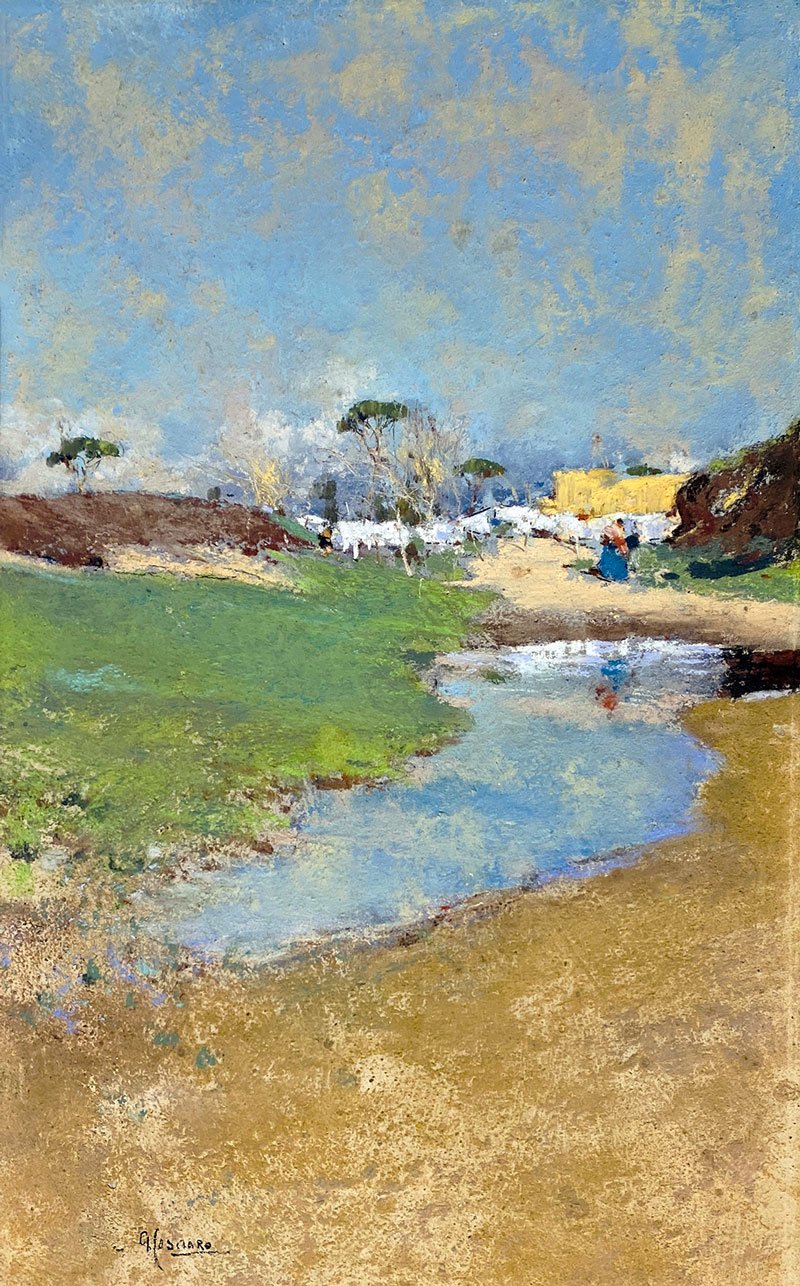
(Credit: Artnet.)


An important line of approach in coming closer to Casciaro’s work is to consider the medium that he used. From Vito Carbonara’s research we know that Casciaro used a rich and oily pastel which comprised a thick stick of highly concentrated colour, held together with a minimum concentrate of binder. We also know that he loved to make these himself and it is evident that, with them, he could achieve brilliant tones, realise smooth strokes (he also used his fingers in the application) and create a type of sfumato effect, as well as being able to create energetic lines and define clear boundaries when he wished to. As well as preparing his own pastels, Carbonara has discovered that Casciaro did not like to use manufactured card but rather took a very strong grey card which he then prepared with a thin layer of whiting or clay, dissolved in water with 0.2% of sublimate (mercuric oxide, a toxic compound used in art and preservation.)
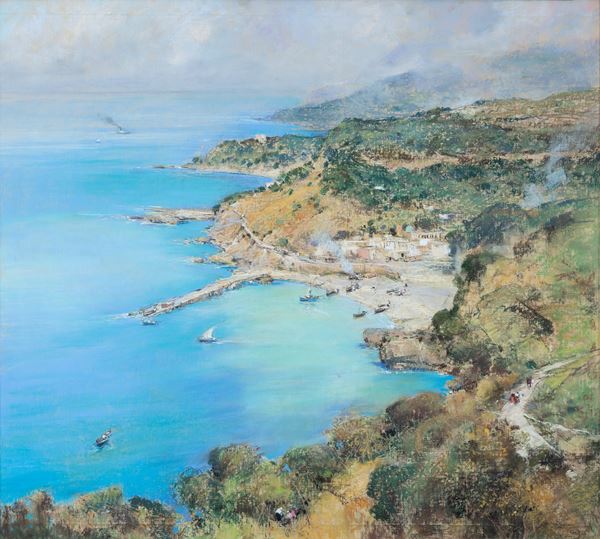

One frequently cited shift in the style of the French impressionists was a move away from chiaroscuro. This observation could reasonably apply to Casciaro’s pastel, but it is important to say that while pastels may have reduced the capacity for tonal modelling, they allowed for great subtleties in chromatic modelling and the exploration of colour as structure. That is to say, in pastel composition, where one might lose a capacity for subtle gradations of light and dark (something possible with great nuance and subtlety in oil) one could still achieve light changes through the use of different densities and properties of colour, through changes in hue and saturation.


Giuseppe Casciaro, Il laghetto di via Forìa (1900). Private collection.

Chromatic modelling in pastel: note the muted shades of the reflections in the lake.


Further to this, a consideration of even three core pastel techniques, helps us to see how a pastel artist like Casciaro could employ layered colours, to different effect. The blending, or rubbing together of two pastel colours could produce subtle nuances of colour. The application of a pastel layer in a loose, uneven or scribbled manner – scumbling, could be used to create a rough, opaque, textured effect, which would allow underlayers to show through. In a similar manner, the overlay of a thin transparent layer of pastel, a glaze, could allow light to pass through layers, in a more smooth and unified way, creating a sense of luminosity and depth. The repertoire of the medium therefore invites its own possibility for the mastery of colour and texture. We should also note that Casciaro was adept at using a quite thin and ‘nervous’ line to depict, for example, the movement of waves.


The juxtaposition of these two works by Casciaro, of A Summer Day and Castro Marina, offers a visible measure of the different finishes that are possible when working in pastel.

(Image credits: Mark Murray/ Blindarte.)

We have a lively recollection of Casciaro’s mastery of pastel technique in a testimony made by the Neapolitan artist Carlo Siviero:


‘Casciaro’s box of pastels is impossible to describe: a pinch of grey stones, uniform, small pieces no bigger than a bean; in that uniformity of ash, the tone of coral red or the intense blue of turquoise stood out. Casciaro, without looking for the colour, could feel it by touch, recognizing it by the shape of the pastel piece: he would sink his fingers into the box and, from all that grey, pull out, with certainty, the colour he needed. With the pads of his fingers, he kneaded, fused, and barely touched the surface of the painting, and not infrequently, he would strike it with the palm of his hand… Then, Siviero continues… once a work had been finished, he would move a few steps away from the place he was and, through a little rectangle of card, size up a new subject. With the dull and powdery material he handled, he was able to fully capture the crystalline transparency of the sky, the oily sheen of the sea, the glazed green of the pines, the solid compactness of the rock.’

The composition in Casciaro’s works might focus on purely natural scenes, or it might incorporate rustic architectural features, creating a contrast between the suggestive impressions of nature and straight architectural lines. Rustic buildings would also allow for a close study of the surface texture of stone, a common focus in the work of Filippo Palizzi.


Filippo Palizzi, Over the Wall (1865) Private collection.

(Credit: Wikipedia).

Casciaro, Porta con grata (1932) from the Signum collection, Lecce.

The linear alignments in buildings, colonnades, or pergolas could work to create depth of field, as well as suggesting a steady time-worn reality in which activity seems to have been suspended.

Giuseppe Casciaro: Rustico con pergolato.

(Credit: Farsettiarte.)


In other compositions, a transverse ‘terracing’ of colours or pictorial planes could create different type of effect – one that invites the eye to track up through the consecutive levels in the image.

(Credit: Mutual Art.)


This pastel study, made by Casciaro in Castro (1931) has a receding line of rocks which creates a depth of field. In addition, the viewer is invited to track upwards through stratifications in the slope. Simultaneously, the composition has depth, in the foreground, as well as a kind of flatness in the upper half, which recalls Japanese prints.


Casciaro’s composition is sometimes close while, at other times, there are expanses of lightness, a feeling of space and an airiness. At times, we are invited to contemplate wide visions of the sea, scenes open to the elements which offer us a sense of freedom.


Scene of Capri, 1906 and Terrazza a Capodimonte 1887.

(Credit: Mark Murray/ askART.)

The images above illustrate Casciaro’s compositional range—from a seascape capturing light effects on a vast expanse of water to a detailed textural study of a terrace, marked by modern, cropped lines of sight.


How do we fare with other labels? Casciaro’s work can tend towards post-impressionist abstraction, with his use of a bold and dense realisation of outline, particularly in the representation of large rocks and cliffs. However, if we set his scenes beside a work of Cezanne’s, we can see where Casciaro adheres to his own limits, where he chooses to hold true to his own style.

(Credits: Finarte / Wikimedia Commons.)

Casciaro’s oil study of Capri (1920) can be compared to Cezanne’s Rocks at L’Estaque (1879-1882). The rocks in Casciaro’s work verge on a two-dimensional plasticity; although they retain some naturalistic depth cues, they are rendered in thick impasto that contrasts sharply with the finer treatment of the trees and clouds in the centre and left of the composition. In Cézanne’s work, by contrast, the flatness of the picture plane is more pervasive and pronounced. His use of colour and faceted brushwork further distances his approach from Casciaro’s.


Equally, while there are impressionistic elements to Casciaro’s work, he does not push them towards presenting a picture surface that is destabilised by the effects of light.
The first work below is Cascario’s pastel of the Faraglioni at Capri, from the Galleria d’Arte Moderna Ricci Oddi in Piacenza. Beneath that we have one of Monet’s studies of Les Pyramides de Port-Coton. While both works capture an ephemeral moment with mastery, the sharper and more planar naturalism of Casciaro’s pastel contrasts with the stippled and painterly brushwork in oil by Monet.

Faraglioni at Capri, Galleria d’Arte Moderna Ricci Oddi.


Les Pyramides à Port-Coton, Claude Monet (1886).

(Credit: Wikimedia)


Compositionally, Casciaro’s works can err towards simplification, without ever tipping towards abstraction or departing entirely from naturalistic representation.

(Credit: artnet.)


This study of Casoli (1895) offers us a pared down composition using a simple zig-zag of diagonal vectors. It is a study of nature that has just the suggestion of a solitary human presence, beneath a tree on the left. There is bright light coming from the left and creating strong shadows from the trees. The overall scene is peaceful with just a suggestion of human presence making a mark on the landscape – there is a quarry and what could be houses on the distant horizon. There are no intrusive ruptures from the landscape tradition and nature takes pride of place.


Throughout his career, Casciaro conveyed a sense of freedom and vitality, continually striving to capture the ever-changing natural scenes unfolding before him. Within the broader scope of his study of nature, a variety of distinctions can be made—for instance, while he depicted wild, untamed landscapes, he also turned to more intimate subjects, such as the following work from 1925.

(Credit: Farsettiarte.)


After viewing a series of his works in quick succession, we might be left with the impression of scenes of pure nature. However, figural elements play their part in his oeuvre, such as his pictures of women washing laundry in a river or portraits of his wife, self-absorbed in quiet activity. Vito Carbonara has noted that people play an increasingly important role in Casciaro’s paintings made in Nusco in 1924. Here figures offer us an emotional engagement with living processes and moments, such as in La Fiera di Sant’Amato, o Fiera a Nusco (see Carbonara 2022, p. 139).


Another notable element of variety in his legacy comes from his still life studies, most of which were made in his later years. Some of this still life arguably suggests his age and, in practical terms, the works must have offered Casciaro an opportunity to continue painting without the physical demands of working en plein air. Whatever the case, they bear testament to his depth of culture, as classic still life works by artists such as Ruoppolo were in his collection. The example below shows us a still-life with vases of flowers, including what looks like a small maiolica pharmacy jar, presumably from his collection.

(Credit: Capitolium Art.)

It is arguable that Casciaro’s landscapes echo the influences of Japanese art, if only indirectly and perhaps through an intuitive assimilation of the trends of his time. In some of his landscapes, there are traces of Japonisme in the way in which trees and plants stand out against the sky and in the use of flattened space and bold colour. The following works offer us an interesting comparison.


Giuseppe Casciaro: Stradina nei pressi della costa (1904).

(Credit: Finarte.)

Utagawa Hiroshige (1797 – 1858): Yamato Province: Yoshino, a Thousand Cherry Trees at One Glance.

https://harvardartmuseums.org/collections/object/210229


Moreover, whenever we look at his seascapes, we should recall that he owned a number of marine studies by Turner. The illustrations below show both artists engaged in a similarly visionary exploration of how colour can dissolve the boundaries between a subject and its emotional resonance.

Casciaro, Marina con pescatori.

(Credit: Arcadia, Casa d’Aste.)


JMW Turner, Sea and Sky, English Coast (c.1830–45).

https://www.tate.org.uk/art/artworks/turner-sea-and-sky-english-coast-d36228


While the focus of this introductory piece is to raise awareness of Casciaro’s now neglected talent, it is equally important to re-state what an important figure he was in his own time. To the indications of this mentioned above, we should also mention the fact that he was appointed a teacher to Italian royalty: in 1906 he became the painting teacher of Queen Elena of Montenegro, the queen consort of King Vittorio Emanuele III; a woman who was beautifully depicted by Vincenzo Caprile in this portrait of 1899.

Vincenzo Caprile, Elena del Montenegro, principessa di Napoli (1899) Gallerie d’Italia, Napoli.

(Credit: author’s photograph).

Prior to 1906 (the same year as an important exhibition in Milan which they attended) the royal family were conversant with Casciaro’s work and already had works by him in their collection. They were in fact part of a wave of demand for his landscapes. Vito Carbonara’s book ‘Giuseppe Casciaro: L’artista e le stagioni pittoriche a Nusco’ has established a formidable documentary and interpretative foundation which, among many other considerations, collates reviews and articles written in response to Casciaro’s many exhibitions. These reviews are highly informative as they reflect the artist’s wide-ranging appeal and his enthusiastic reception.

There are themes that constantly reappear in the praise of his art. There are, for example, frequent comments on the luminosity of his works. They are seen as both real and true, as well as poetic and evocative. The variety of moods conveyed through his landscapes is seen to be wide ranging; from idyllic, bright and expansive, to introspective, melancholic and crepuscular. The elusive effect of his pastels on a viewer’s emotions is also suggested though comparison to music and poetry. (Casciaro had eight chalk medal portraits of major composers in his collection, which at least suggests that music may have, in fact, been important to him.) Beyond this, each study is often seen as a deeply personal work and Casciaro is often portrayed as a moral figure who is true to himself and who is industriously charting his own course. One of my favourite, and less formal, assessments of his talent comes from Antonio Mancini, who reportedly stated:


“My dear Peppino, you are a Vesuvius! But instead of erupting fire and ash, you spew pearls and turquoise, emeralds and rubies, along with a shower of roses.”


We might choose to read an accidental insight in Mancini’s effusive and complimentary metaphors, as Casciaro’s house-museum-atelier, for such it was, contained a significant collection of material culture – art objects of various kinds. He had objects in maiolica, in glass, in silver, as well as fabrics. These also must have informed his sensibility for representing colour, light and texture.


Casciaro’s legacy can also be seen through the work of his students. His academic roles were significant and he was sought after as a private teacher, especially after being chosen as the teacher of Queen Elena in 1906. What is more, two of Casciaro’s four children developed as painters, as illustrated by an exhibition held in Rome in 2004, curated by Cinzia Virno. His daughter Carolina (1895-1978) and his son Guido (1900-1963) both began their artistic studies with their father and, to varying degrees, his influence can be seen in their works. Carolina’s style was closer to that of her father and it demonstrated close fidelity to the direct study from nature and many (but not all) of her works were on a small scale.


Carolina also demonstrated the same decisive strokes as her father. Both Carolina and Guido showed a preference for oil as a medium but Guido became freer in adopting his own style. He sometimes did works on a large scale, he applied himself to figure painting, as well as landscapes, and he tended to transform the scenes that he portrayed. At the same time, Guido resisted the pressure to join contemporary movements, such as Futurism. On one of his works, Marina con Cabine (Il porto di Castro) above his signature, in the bottom right-hand corner of the work, he wrote VIVA IL NOVECENTO/ ABBASSO IL FUTURISMO. Quite clearly, this epigraph affirmed a progressive attitude to art, while repudiating the constraints of a trend. The family entered their works together in Avellino in 1932, as part of the first Irpinian art exhibition: together they took up most of Sala 1, presenting 23 works in total. (See, Virno, C., I Casciaro: Giuseppe, Carolina e Guido. Roma, 2004).


While Casciaro undoubtedly guided countless students in the course of his long career, we can here look at a sample of four: two from Italy and another two, from England and America respectively. Guido di Renzo (Chieti 1886, – Napoli, 1956) produced landscapes, portraits and still-life studies.

https://artsupp.com/it/artisti/guido-di-renzo


Another talented artist, from Salento, Rita Franco (Lecce 1886 – Napoli 1985) produced pastel works of great sensibility which demonstrated that she was continuing the tradition of her teacher.

Credit: https://www.valerioterragno.it/artisti-salentini/106-franco-rita


Francis Edouard Chardon (Calcutta 1865 – Llandudno 1925) was an English painter of landscapes, portraits and still-life paintings who bequeathed his home in Llandudno for the enjoyment and education of the people: Rapallo House is now the site of Llandudno Museum.

Credit: https://artuk.org/discover/artworks/francis-edouard-chardon-18651925-181163


Albert Sheldon Pennoyer (Oakland 1888 – Madrid 1957) was an artist who worked in pastel, gouache, watercolour and oils. He worked on principally on portraits and landscapes of various scenes. While serving in the American army he was also one of the Monuments Men in WWII, documenting their activity in Italy with a Leica camera.

Credit: https://americanart.si.edu/artist/sheldon-pennoyer-3756


I hope that this brief article is sufficient to provoke readers into their own research into the work of Giuseppe Casciaro and the others artists cited above. At the time of writing, there is guidance about where to view Casciaro’s works listed at the end of the Italian Wikipedia entry for him. Moreover, for further detail on where to find works, the reader can refer to pages 175-176 of Vito Carbonara’s book (Avellino, 2022), this is an excellent resource and we can expect to see more from him on Casciaro in the course of time. (Please note, it is always worth checking with museums before taking a trip, as displays can change.)


Producing these articles requires care, time, research, and resources. Contributions to help sustain this exploration would be greatly appreciated.

https://donorbox.org/inner-surfaces-resonances-in-art-and-literature-837503

This study owes a significant debt to the work of others, and I have included a bibliography to acknowledge that debt. My primary aim in assembling this material is to raise awareness of this gifted artist—particularly among English-speaking readers, who are unlikely to have encountered Casciaro before. I sincerely hope that those with some knowledge of Italian will be encouraged to explore the original sources and the work of the authors cited. My special thanks go to Vito Carbonara and Cinzia Virno for their generous help and support. All errors and infelicities in the text are entirely my own.


You Tube has an enjoyable video of works by (and presumably attributed to) Casciaro. (It is always worth recalling that Casciaro’s popularity led to people forging his works.)


Bibliography

Bellenger, S. (ed.) Napoli Ottocento. Roma, 2024.
Benzi, F. (et al.) Francesco Paolo Michetti, catalogo generale. Milano, 2018.
Brown, M., Francesco de Sanctis: The Journal of Aesthetics and Art Criticism, Vol.32, No4 (Summer 1974) pp.477-492.
Causa Picone, M. and Causa, S., Pitloo: Luci e colori del paesaggio napoletano. Napoli, 2004.
Campopiano, P., Giuseppe Casciaro. Treviso, 1999.
Caputo, R., Giuseppe Casciaro. Napoli, 2007.
Caputo, R., La Pittura Napoletana del II Ottocento. Sorrento, 2017.
Carbonara, V., Giuseppe Casciaro: l’artista e le stagioni pittoriche a Nusco. Avellino, 2022.
Carrera, M. (et al.) Antonio Mancini/ Vicenzo Gemito. Milano, 2023.
Cassese, G., Giuseppe Casciaro: un profilo europeo nella storia dell’arte e del collezionismo tra Ottocento e Novecento, in Depositi di Capodimonte, ed. Romano, C. and Tamajo Contarini, M. (Napoli, 2018).
Denvir, B., The Impressionists at First Hand. London 1987 and 2023.
Di Giacomo, P. C., Giuseppe Casciaro (1861-1941). Bologna, 1994.
Fiore, A and Russo, M. (eds.) Giuseppe Casciaro 1861-1941, Privato. Lecce, 2023.
Lanzilotta, G. (ed.) Incanto partenopeo. Guido Di Renzo, Giuseppe Casciaro e la comunità artistica del Vomero nella prima metà del Novecento. Bari, 2019.
Martorelli, L. and Mazzocca, F. (eds.) Da De Nittis a Gemito: i napoletani a Parigi negli anni dell’impressionismo. Genova, 2017.
Picone Petrusa, M. (ed.) Dal Vero. Il paesaggismo Napoletano da Gigante a De Nittis. Torino, 2002.
Valente, I. (ed.) Il Bello o il Vero. Napoli, 2014.
Valente, I., I luoghi incantati della sirena nella pittura Napoletana dell’ottocento. Sorrento, 2009.
Virno, C., I Casciaro: Giuseppe, Carolina e Guido. Roma, 2004.
Virno, C., La storia di una grande amicizia in un nuovo inedito ‘Ritratto di Giuseppe Casciaro’ di mano di Antonio Mancini, in About Art Online, ed. P. Di Loreto (Roma, 2025).
Virno, C. (ed.) Vincenzo Gemito: la collezione. Roma, 2014.
Virno, C., Antonio Mancini, catalogo ragionato dell’opera 2 voll. Roma, 2019.
Schettini, A., Giuseppe Casciaro. Napoli, 1952.

Introduce Yourself (Example Post)

This is an example post, originally published as part of Blogging University. Enroll in one of our ten programs, and start your blog right.

You’re going to publish a post today. Don’t worry about how your blog looks. Don’t worry if you haven’t given it a name yet, or you’re feeling overwhelmed. Just click the “New Post” button, and tell us why you’re here.

Why do this?

  • Because it gives new readers context. What are you about? Why should they read your blog?
  • Because it will help you focus your own ideas about your blog and what you’d like to do with it.

The post can be short or long, a personal intro to your life or a bloggy mission statement, a manifesto for the future or a simple outline of your the types of things you hope to publish.

To help you get started, here are a few questions:

  • Why are you blogging publicly, rather than keeping a personal journal?
  • What topics do you think you’ll write about?
  • Who would you love to connect with via your blog?
  • If you blog successfully throughout the next year, what would you hope to have accomplished?

You’re not locked into any of this; one of the wonderful things about blogs is how they constantly evolve as we learn, grow, and interact with one another — but it’s good to know where and why you started, and articulating your goals may just give you a few other post ideas.

Can’t think how to get started? Just write the first thing that pops into your head. Anne Lamott, author of a book on writing we love, says that you need to give yourself permission to write a “crappy first draft”. Anne makes a great point — just start writing, and worry about editing it later.

When you’re ready to publish, give your post three to five tags that describe your blog’s focus — writing, photography, fiction, parenting, food, cars, movies, sports, whatever. These tags will help others who care about your topics find you in the Reader. Make sure one of the tags is “zerotohero,” so other new bloggers can find you, too.

Introduce Yourself (Example Post)

This is an example post, originally published as part of Blogging University. Enroll in one of our ten programs, and start your blog right.

You’re going to publish a post today. Don’t worry about how your blog looks. Don’t worry if you haven’t given it a name yet, or you’re feeling overwhelmed. Just click the “New Post” button, and tell us why you’re here.

Why do this?

  • Because it gives new readers context. What are you about? Why should they read your blog?
  • Because it will help you focus your own ideas about your blog and what you’d like to do with it.

The post can be short or long, a personal intro to your life or a bloggy mission statement, a manifesto for the future or a simple outline of your the types of things you hope to publish.

To help you get started, here are a few questions:

  • Why are you blogging publicly, rather than keeping a personal journal?
  • What topics do you think you’ll write about?
  • Who would you love to connect with via your blog?
  • If you blog successfully throughout the next year, what would you hope to have accomplished?

You’re not locked into any of this; one of the wonderful things about blogs is how they constantly evolve as we learn, grow, and interact with one another — but it’s good to know where and why you started, and articulating your goals may just give you a few other post ideas.

Can’t think how to get started? Just write the first thing that pops into your head. Anne Lamott, author of a book on writing we love, says that you need to give yourself permission to write a “crappy first draft”. Anne makes a great point — just start writing, and worry about editing it later.

When you’re ready to publish, give your post three to five tags that describe your blog’s focus — writing, photography, fiction, parenting, food, cars, movies, sports, whatever. These tags will help others who care about your topics find you in the Reader. Make sure one of the tags is “zerotohero,” so other new bloggers can find you, too.