Diana Di Rosa occupies an unusual position in the history of seventeenth-century Neapolitan painting. Celebrated in later tradition as “Annella di Massimo”, she acquired a reputation that rested as much on the dramatic story of her life as on the paintings associated with her. Yet while Artemisia Gentileschi has generated an extensive modern literature, Diana’s career has only recently begun to emerge from a much thinner and more uncertain historiography; Giuseppe Porzio’s 2023 study was the first monograph devoted to her.
Recent research has made it possible to approach her rather differently. A more critical consideration of the documentary record has substantially revised the biography inherited from Bernardo De Dominici, while the reassessment of early references to her paintings and, most importantly, the emergence of a signed Saint Cecilia with an Angel have provided a firmer basis from which to reconsider her work. Even so, the picture remains incomplete. Diana belonged to a closely interconnected artistic world in which family relationships, workshop practice and collaboration frequently overlapped, and some of the works now associated with her still resist easy separation from those of the painters around her.
Biography
Several basic points about Diana Di Rosa’s life can now be established with some confidence. A baptismal record gives the date of 20 May 1602 and names her parents as the painter Tommaso Di Rosa and Caterina De Mauro; Diana was the elder sister of Giovanni Francesco Di Rosa, better known as Pacecco. Tommaso died in 1610, and Caterina’s marriage two years later to Filippo Vitale placed Diana within another important branch of Neapolitan painting.
In 1626 Diana married the painter Agostino Beltrano. The marriage agreement was drawn up by Gaspare Del Popolo, who also contributed 200 ducats to her dowry, a detail that points to the close overlap between family, professional and financial ties within the circle in which she worked. A notarial act of January 1644, made when Beltrano was already a widower, refers to her as “Annella” and records provision for their six surviving children. The familiar name, then, belongs to the documentary record as well as to the later literary tradition.
Diana died in December 1643 and was buried, according to her wishes, in the Gesù Nuovo. Her death record does not establish a cause of death, but the presence of confessors suggests an attended death rather than the sudden violence later described by De Dominici. More decisively, Beltrano is documented as a widower the following month. The surviving evidence does not sustain De Dominici’s account of Diana being murdered by her husband in 1649, though it would be going too far to claim that the precise circumstances of her death are known.
What can now be recovered is a much plainer biography, but also a more substantial one: a woman born into an artistic family, married into another professional partnership, active within a densely connected circle of painters, and dead by the end of 1643.
Training and professional status
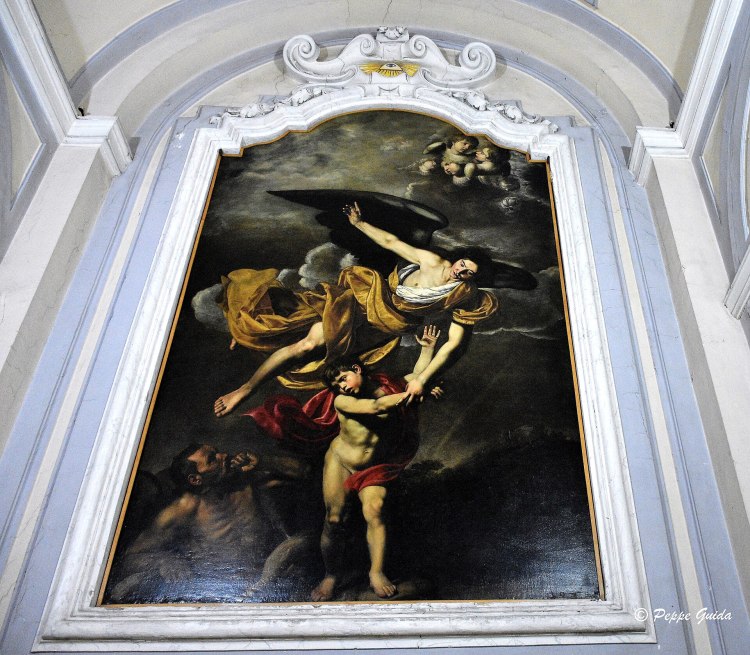
Diana’s earliest artistic education is not documented in detail, but the circumstances of her upbringing provide a strong context for it. Her father, Tommaso Di Rosa, died in 1610. Two years later her mother, Caterina De Mauro, married Filippo Vitale, who thereby became Diana’s stepfather. She consequently spent much of her formative period in the household of one of the leading painters of the new Neapolitan naturalism. The inference that Vitale contributed to her training is not documented directly, but it is entirely consistent with both the family structure and the level at which Diana was already working by 1621.
Filippo Vitale, Angelo custode (Guardian Angel), 1641, oil on canvas, Santa Maria Incoronatella della Pietà dei Turchini, Naples. Image credit: Giuseppe Guida / Wikimedia Commons.
Her subsequent arrangement with Gaspare Del Popolo, a Roman-born painter active in Naples, makes that point more tangible. Del Popolo was himself bound into the same family network: he had trained with Tommaso Di Rosa and married Isabella De Mauro, Caterina’s sister, making him Diana’s uncle by marriage. In 1621 he took both Diana and Agostino Beltrano into his service, but on markedly different terms. Beltrano, then fourteen, entered what Marshall regards as a conventional six-year apprenticeship. Diana, aged eighteen, was contracted for three years and was to receive fifty ducats annually. The distinction suggests that she was already functioning at a more advanced level, closer to a paid junior assistant than to a beginner acquiring the rudiments of painting.
The relationship with Del Popolo remained unusually close. A will drawn up in 1623 provided Diana with an annual pension of ten ducats and a further payment of fifty ducats in the event of his death. In 1626 he prepared the marriage agreement between Diana and Beltrano and contributed substantially to her dowry; the following year the couple renewed their service with him for another five years, with provision for expenses connected with Diana’s possible pregnancies.
Taken together, the evidence suggests not a simple sequence of master and pupil, but a professional formation embedded within family life. Tommaso Di Rosa, Filippo Vitale and Gaspare Del Popolo were linked to Diana not only as painters but as father, stepfather and uncle by marriage. Her early career emerged within a network in which artistic instruction, paid labour, household structure and marriage were unusually difficult to separate.
Family, workshop and collaboration
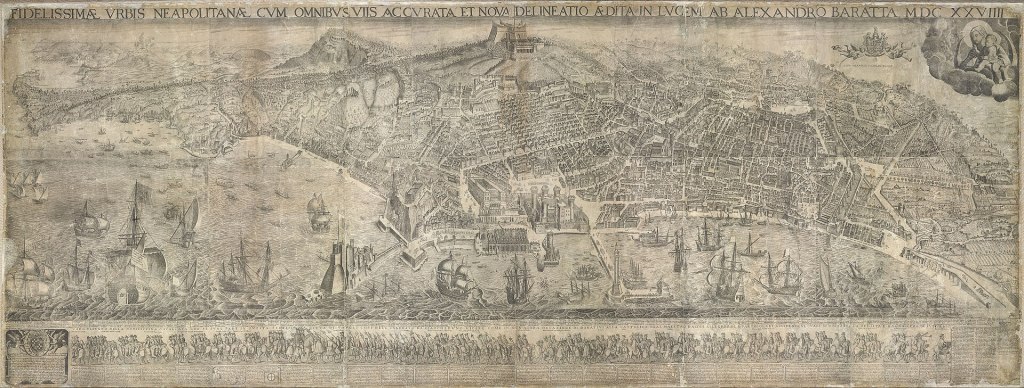
The interweaving of kinship and artistic practice extended well beyond Diana’s immediate household. Christopher Marshall places the Di Rosa family within a dense community of painters and craftsmen clustered around the Piazza della Carità and nearby streets, where marriage, godparenthood, apprenticeship and business partnerships repeatedly overlapped. Diana’s sister Grazia married the Valencian painter Juan Dò in 1626, with Battistello Caracciolo and Jusepe de Ribera as witnesses; Caterina and Filippo Vitale’s daughter Orsola later married Aniello Falcone. Across successive generations, the family became connected to an unusually broad section of the Neapolitan artistic world.
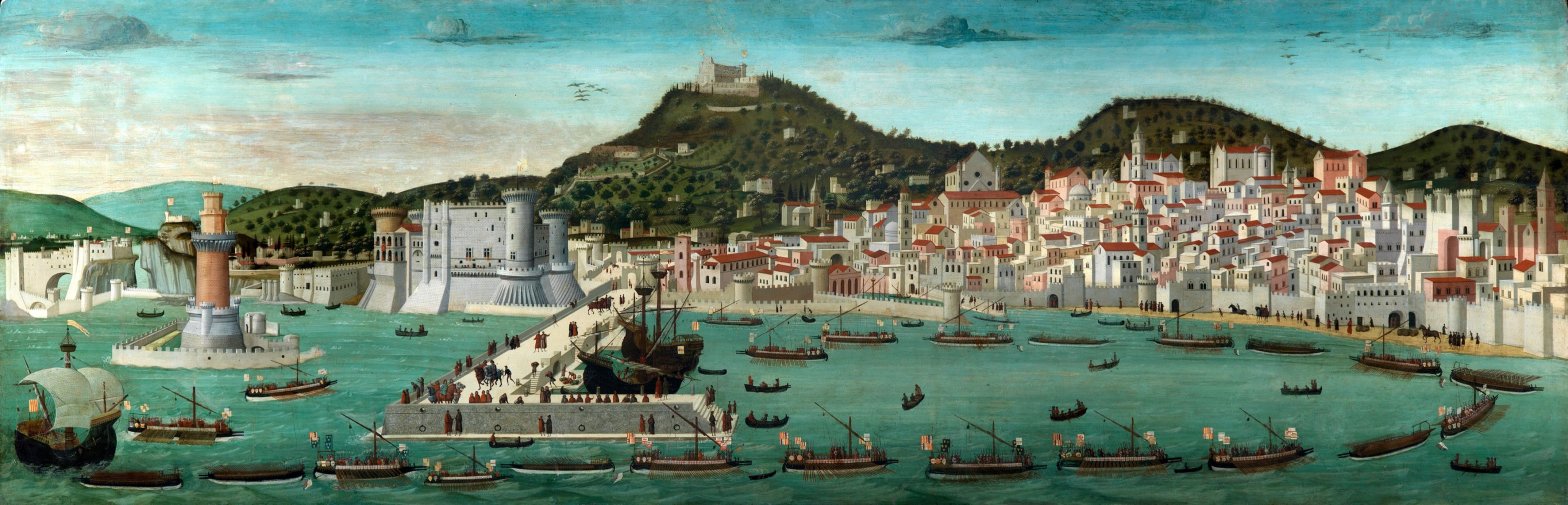
Alessandro Baratta, Fidelissimae urbis neapolitanae cum omnibus viis accurata et nova delineatio, 1629. Image credit: Wikimedia Commons, public domain.
This was more than a social network. Marshall argues that such alliances helped to consolidate workshops, circulate commissions and blur the boundary between household and business. Painters could at once be independent practitioners, relatives, assistants and occasional collaborators. In that environment, the modern expectation that every painting should resolve neatly into a single artistic hand can itself become misleading, especially in larger or more complex commissions.
Diana’s marriage to Agostino Beltrano in 1626 formalised a connection already established through their shared service with Gaspare Del Popolo. Recent studies increasingly support the possibility of direct collaboration between them, particularly in ambitious works. This need not imply that their individual styles were indistinguishable. Rather, it suggests a working relationship in which designs, figure types and even parts of a painting might be shared between closely associated hands. The attributional difficulties surrounding Diana may therefore reflect, at least in part, the conditions under which some of the paintings were originally made.
Massimo Stanzione: what kind of relationship?
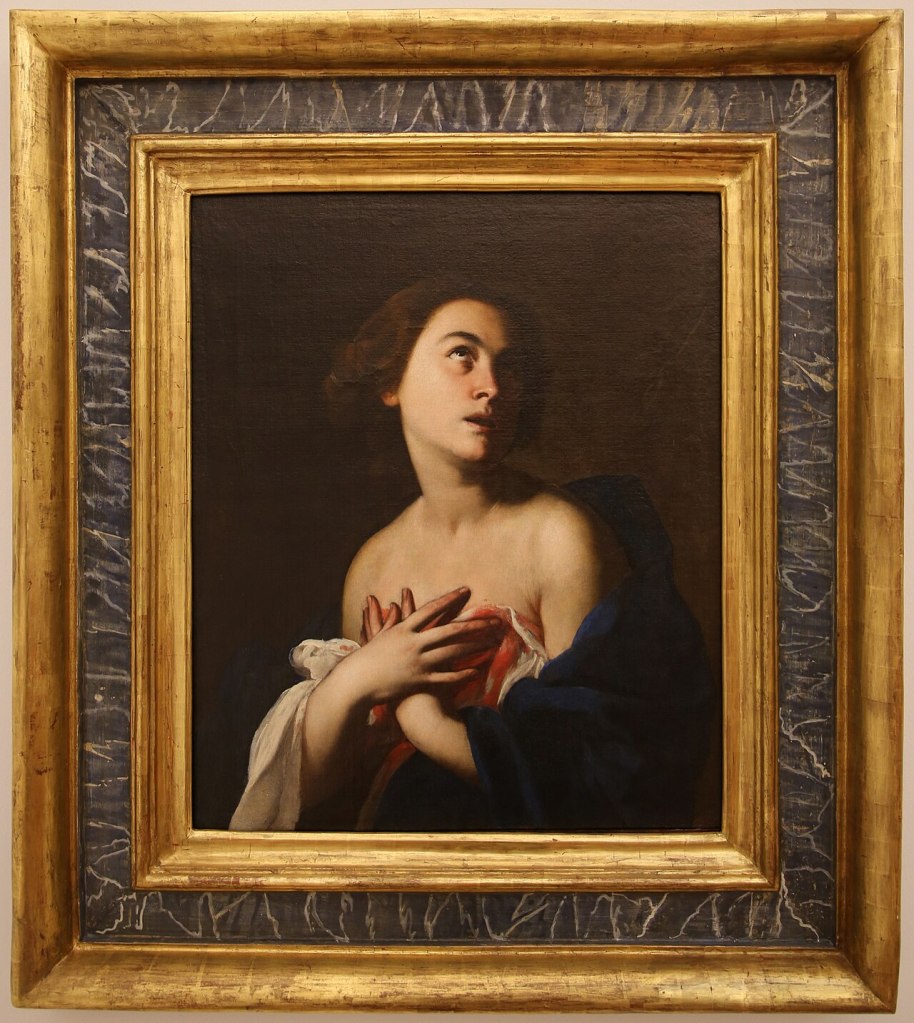
No aspect of Diana’s career has been more strongly coloured by later tradition than her association with Massimo Stanzione. De Dominici made her his favoured pupil and transformed their relationship into the centre of the story that culminated in her supposed murder. The documentary evidence does not support that account of her training, but neither does it allow Stanzione simply to be removed from her career. The designation “Annella di Massimo” already occurs in seventeenth-century inventories, and an inventory drawn up in 1648 for Giuseppe Carafa, Duke of Maddaloni, records a Saint Agatha by Diana that had been “retouched by the hand of Massimo”. The painting itself has not been securely identified, but the entry provides unusually strong evidence that Stanzione intervened directly upon a work regarded as hers.
There were other points of contact. Stanzione had longstanding connections with Diana’s maternal family, acting as godfather to children within the De Mauro circle, while Beltrano’s involvement in Stanzione’s professional activity is documented much more firmly. In 1644 Stanzione transferred to him part of the payment for the frescoes of San Paolo Maggiore, and a later inventory records seventeen bozzetti made by Beltrano from Stanzione’s designs for the same cycle. These documents do not establish Diana’s own position in Stanzione’s workshop, but they place her husband and family in close proximity to him.
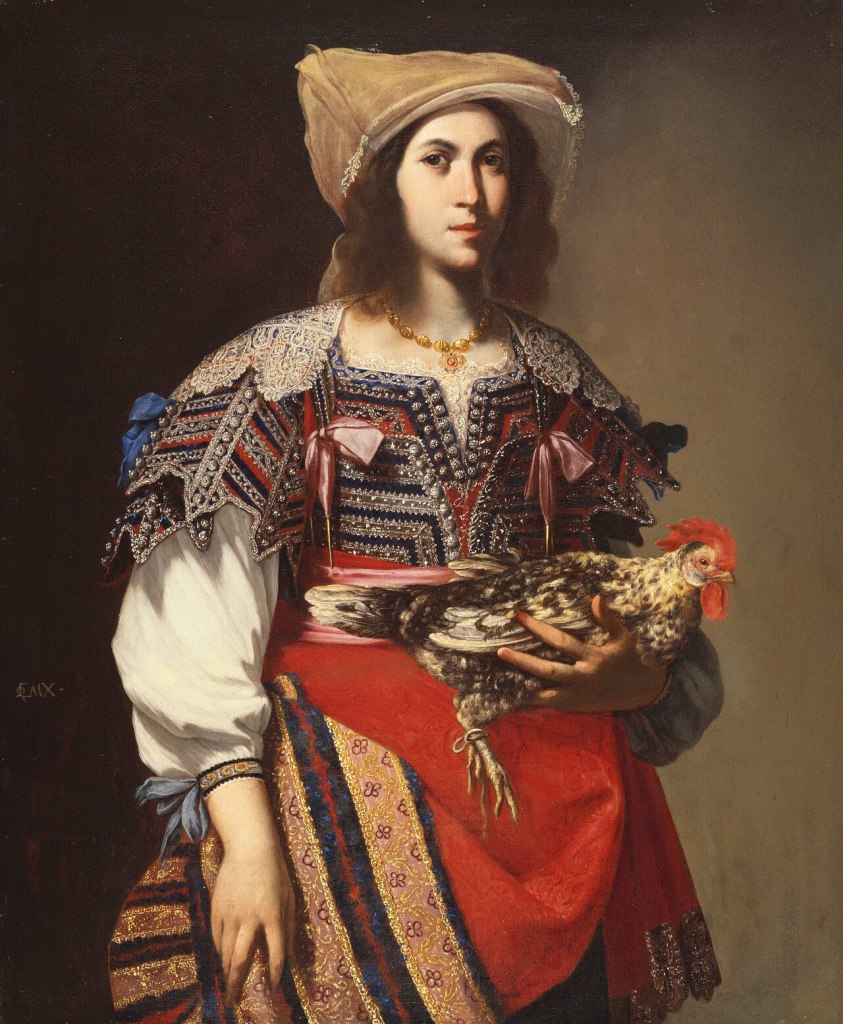
Massimo Stanzione, Sant’Agata (Saint Agatha), c. 1635–40, oil on canvas, Museu de Belles Arts de València, Valencia. Image credit: Wikimedia Commons.Massimo Stanzione, Woman in Neapolitan Costume, c. 1635, oil on canvas, 118.7 × 97.2 cm, Fine Arts Museums of San Francisco, Legion of Honor, San Francisco. Image credit: Wikimedia Commons.
Marshall has proposed that Diana eventually worked as a junior assistant within Stanzione’s establishment, perhaps in the later 1630s or early 1640s. The proposal is plausible but undocumented. It is important not to make stylistic resemblance carry more weight than it can bear: Stanzione’s manner was widely absorbed by painters in Naples who need not have belonged to his workshop at all. What can be said with greater confidence is that the connection was real and professionally significant, even if its precise form remains uncertain.
Why the catalogue is difficult
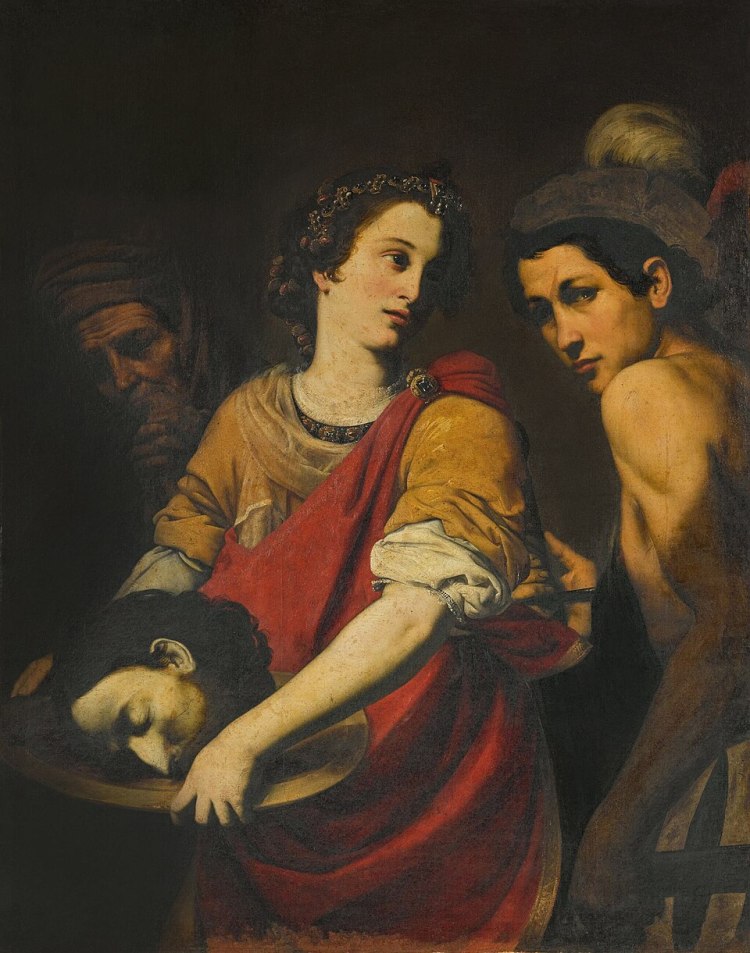
Establishing a reliable catalogue of Diana’s works presents an awkward problem. Seventeenth-century inventories demonstrate that paintings by “Diana”, “Annella” and “Annella di Massimo” circulated in important Neapolitan collections, but descriptions in inventories cannot always be connected securely with surviving works. A striking example is the 1649 inventory of Eleonora Carafa, which records a substantial painting of Herod, Herodias and the head of Saint John the Baptist “de mano di Annella”. The reference confirms that Diana painted such a subject, but it does not establish that the picture was the Salome with the Head of Saint John the Baptist now at Braunfels, recently attributed to her by Giuseppe Porzio.
The surviving paintings present a different challenge. Works now associated with Diana have at various times been assigned to Pacecco Di Rosa, Filippo Vitale, Agostino Beltrano, Massimo Stanzione and other painters working within the same Neapolitan milieu. Stylistic comparison is indispensable, but it can easily become circular: an uncertain painting cannot safely be used to authenticate another uncertain painting. The problem is particularly acute where collaboration may have been involved, or where an old attribution rests upon testimony that is itself difficult to verify.
For much of the modern literature there was, in effect, no uncontested surviving work from which Diana’s individual manner could be defined. That situation has changed decisively with the recognition of the signed Saint Cecilia with an Angel now in Boston. It does not settle the attribution of the surrounding works, but it supplies something previously missing: a secure point against which proposals based on physiognomy, handling, composition and decorative detail can actually be tested. The catalogue that results is still necessarily graded, with a signed centre surrounded by works of differing degrees of probability.
The secure centre: Saint Cecilia with an Angel
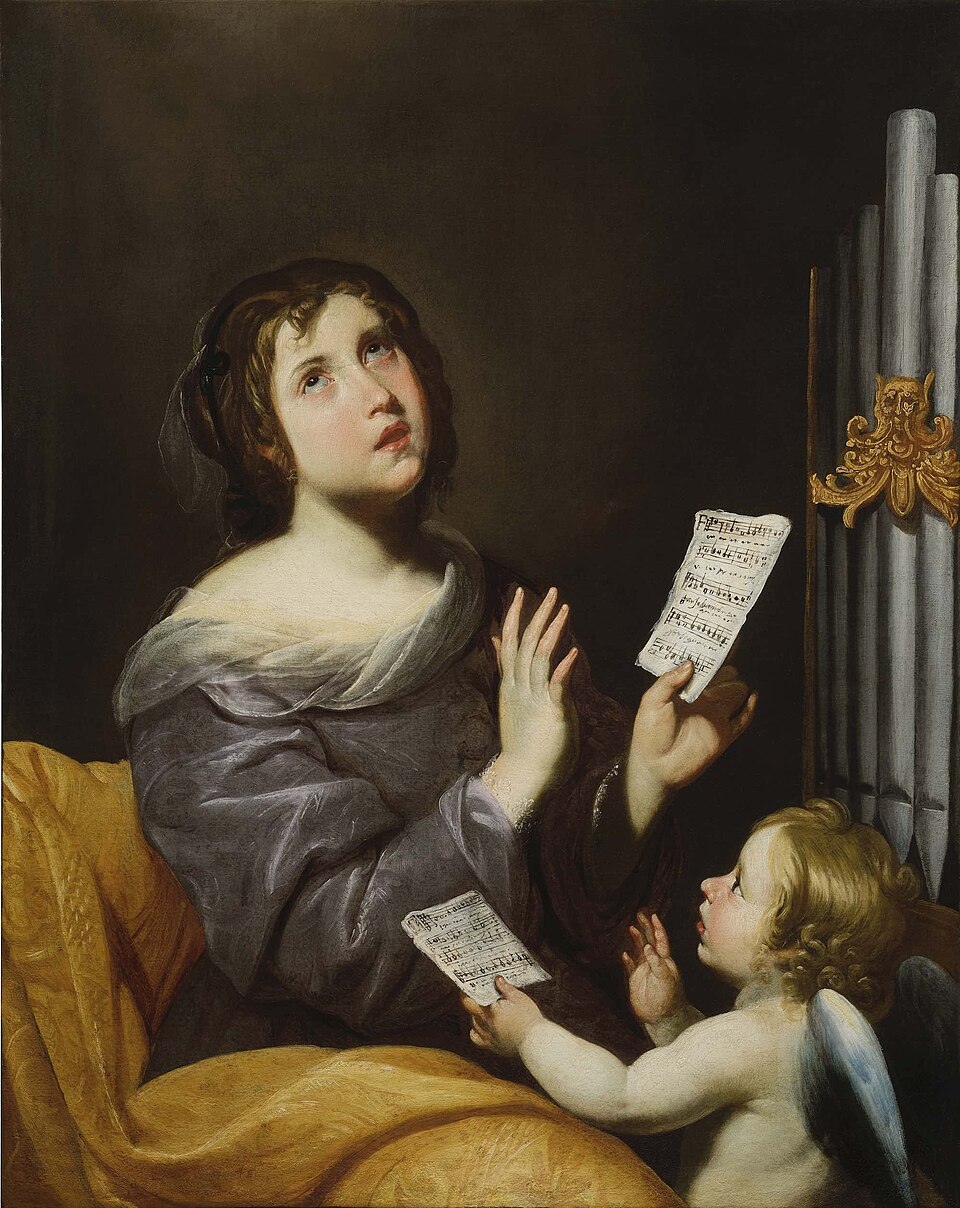
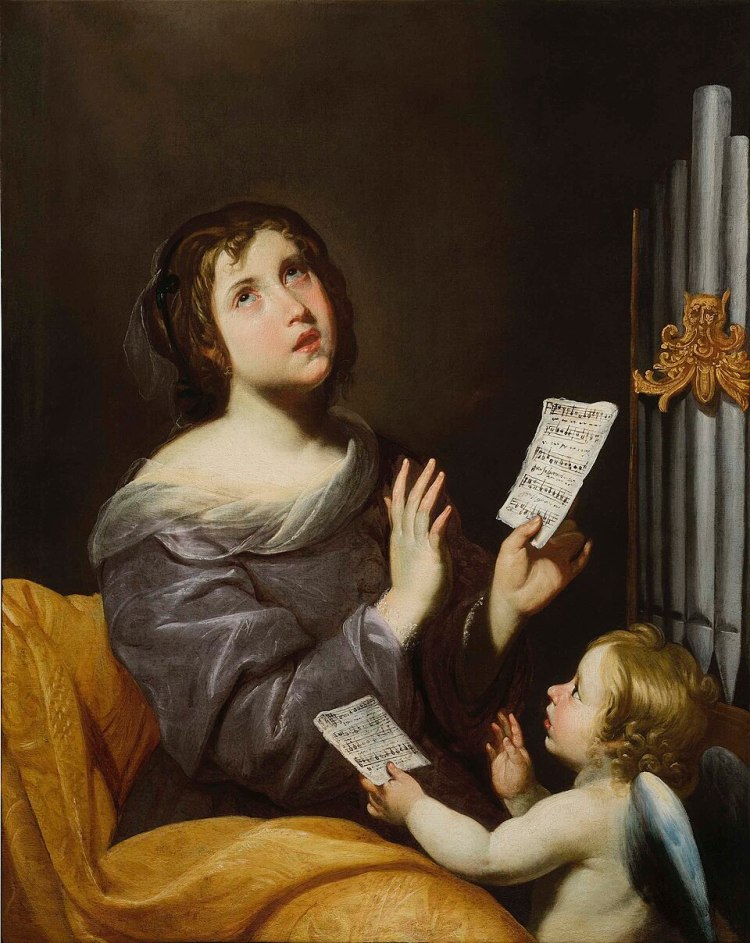
The work that has transformed the study of Diana’s oeuvre is the Saint Cecilia with an Angel, now in the Museum of Fine Arts, Boston. Painted around 1635–40, it is a relatively intimate canvas, measuring 97.5 × 76.5 cm. On the sheet of music held by the saint appears the inscription “Io Diana di Rosa / Sor di Giovane”, understood as a reference to her brother Giovanni Francesco, Pacecco. It is the only autograph inscription by Diana presently known and provides the firmest surviving basis for defining her artistic personality.
Diana Di Rosa, Saint Cecilia with an Angel, c. 1635–40, oil on canvas, 97.5 × 76.5 cm, Museum of Fine Arts, Boston. Image credit: Wikimedia Commons, public domain.
The painting is strikingly refined. Cecilia is arranged on a strong vertical axis beside an organ, her head tilted upwards and her lips parted in song. The angel at the lower right echoes her pose on a smaller scale, looking up towards her while holding his own sheet of music. The effect is devotional without becoming theatrical: the saint’s upward gaze suggests ecstasy, but the angel introduces a gentler, more intimate exchange.
Several details are useful when testing the surrounding attributions. The saint has softly modelled flesh, delicate pink accents around the eyes, cheeks and chin, ringlets falling across the forehead, and finely drawn brows and eyelashes. Her features are contained within an elegant oval, while the contours remain unusually precise without becoming hard. These characteristics recur, to varying degrees, in a number of female half-length figures now attributed to Diana, including Saint Agatha, Saint Barbara, Lucretia and Samson and Delilah.
The picture also helps to explain why Diana’s work has proved so difficult to isolate. Its refinement places it within a classicising current that could readily invite comparison with Guido Reni, while its more immediate naturalistic presence belongs more closely to the Neapolitan world of Stanzione. The delicate female type also stands near enough to Pacecco and to other painters of the same milieu for individual authorship to become difficult to distinguish on style alone. The signature changes the direction of the argument: instead of trying to construct Diana from a cluster of uncertain pictures, those pictures can now be tested against a painting whose authorship is secure.
Extending the corpus: Eliezer and Rebecca at the Well
Among the paintings now attributed to Diana, Eliezer and Rebecca at the Well, dated around 1630–35 and now with Galleria Porcini in Naples, is one of the most persuasive attributions beyond the signed Saint Cecilia. The large canvas, measuring 129.5 × 180.5 cm, has also been identified as Moses and Zipporah at the Well, though Porzio prefers the more conventional interpretation of the episode as the meeting of Abraham’s servant Eliezer with Rebecca.
Its attributional history is revealing. When the painting appeared at Sotheby’s in New York in 2007, it was presented as a work by Pacecco Di Rosa, following an attribution by Riccardo Lattuada. Vincenzo Pacelli, however, had already noted a degree of stylistic incongruity within Pacecco’s works. Porzio now assigns the picture to Diana, and the comparison with Pacecco is central to his argument.
The difference is not based simply on recurring facial types. Porzio describes Diana’s handling as more fluid and transparent, against Pacecco’s denser, smoother and more enamelled surface. In Eliezer and Rebecca, the figures are disposed with a relaxed elegance, and particular attention is given to jewellery, lace and other ornamental details. The pastoral setting is also noticeably less rustic than that of Pacecco’s Jacob and Rachel at the Well, in which a more strongly Riberesque note survives among the subsidiary figures.
The comparison is valuable because Diana and Pacecco shared so much: family, training environment and many of the same stylistic points of departure. Their distinction therefore lies less in opposing artistic languages than in differences of handling and temperament. Pacecco tends towards a more polished and compact surface; Diana, if Porzio’s attribution is accepted, towards greater translucency, spaciousness and ease. Eliezer and Rebecca thus provides an important intermediate case: not an autograph work, but a substantial attribution that can now be measured against the securely signed Boston painting rather than against an entirely hypothetical Diana.
Collaboration as evidence: Marriage of the Virgin
The Marriage of the Virgin, dated to around 1640, provides a different kind of evidence from either the signed Saint Cecilia or the attributed Eliezer and Rebecca. A large canvas measuring 135.5 × 250 cm, it formed part of a Marian cycle for San Giovanni Maggiore and is now attributed jointly to Diana and Agostino Beltrano. Its importance lies precisely in the possibility that more than one hand can be distinguished within a substantial public commission.
The composition itself is conventional, with Mary and Joseph joining hands before the priest, but recent analysis separates the figures stylistically. The youthful Virgin, dressed in blue, is assigned to Diana: her delicate oval face and pale, almost ivory flesh correspond to characteristics now associated with her elsewhere. The two witnesses beside her have likewise been compared with figures in the Death of the Virgin at the Pietà dei Turchini. Joseph and the prominent male figure in the foreground, by contrast, are related more closely to Beltrano’s established types.
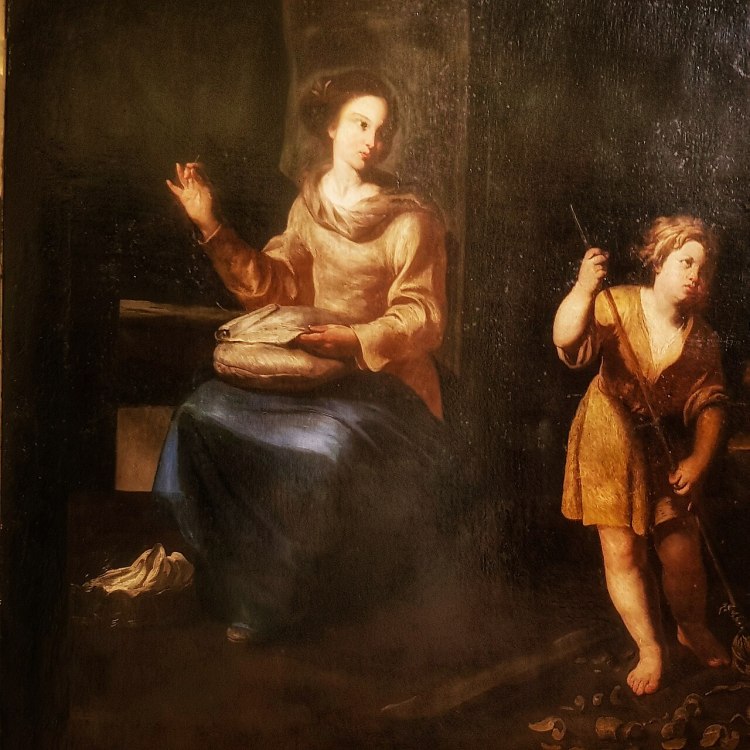
The attribution is necessarily more interpretative than that of the Boston Saint Cecilia, but it matters for another reason. The Marriage of the Virgin suggests that the attributional entanglement surrounding Diana need not always be understood as a failure of connoisseurship. In at least some ambitious works, stylistic difference within a single canvas may reflect the way the painting was actually produced. The broader reconstruction of the San Giovanni Maggiore cycle similarly allows for Beltrano’s participation alongside Diana. Another painting from the same Marian cycle, Christ Child in Saint Joseph’s Carpentry Workshop, has likewise been included by Porzio among Diana’s attributed works.
Attributed to Diana Di Rosa, Christ Child in Saint Joseph’s Carpentry Workshop, c. 1640, oil on canvas, 135 × 247 cm, Naples, Complesso Monumentale Donnaregina–Museo Diocesano; formerly San Giovanni Maggiore. Image credit: Wikimedia Commons.
Seen in this way, collaboration becomes part of the evidence for Diana’s career rather than simply an obstacle to recovering it. The difficulty is not always to decide which of two painters made the whole work, but to recognise that Diana and Beltrano may sometimes have worked together while retaining sufficiently distinct habits for their contributions to remain partially visible.
Further works and attributional boundaries
Among the works Porzio has attributed to Diana are a Triumph of David, whose present location is unknown, and a Rape of Europa, shown in the 2022–23 exhibition Artemisia Gentileschi a Napoli. The latter had previously oscillated between Pacecco Di Rosa and Francesco Guarino. Porzio’s attribution to Diana rests on the female type, the refined treatment of jewellery and coiffure, and a softer handling that he relates to the broader Stanzionesque current in her work.
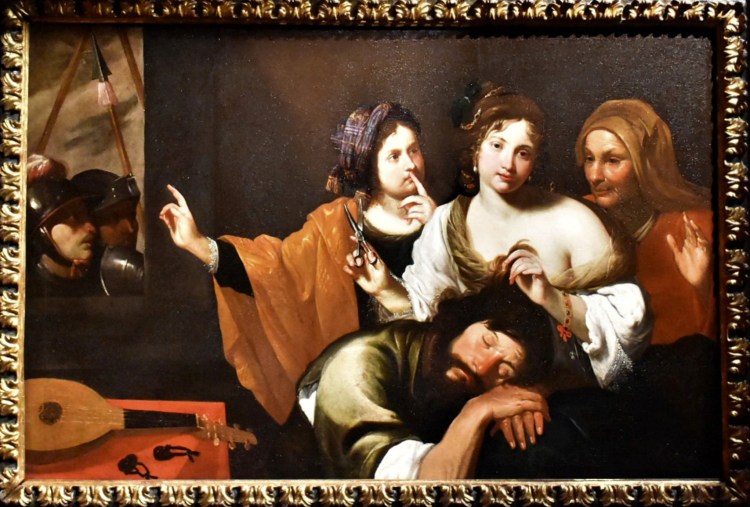
A compelling work is Samson and Delilah, now in a private collection. Porzio presented it in the 2022–23 exhibition Artemisia Gentileschi a Napoli at the Gallerie d’Italia in Naples as an important addition to Diana’s still restricted corpus, relating Delilah’s physiognomy and the softer handling of the paint to the emerging profile of the artist. The painting also has an exceptionally close relationship with Artemisia Gentileschi’s treatment of the same subject, although Porzio considers it impossible to establish securely the direction of dependence between them.
Attributed to Diana Di Rosa, Samson and Delilah, c. 1635–40, oil on canvas, 101 × 155.5 cm, private collection. This is the work exhibited in Naples in 2022 and catalogued by Porzio in 2023 as no. 12; a second, badly damaged version appears separately as no. 19. Image credit: Giuseppe Guida / Wikimedia Commons.
The Birth and Death of the Virgin at the Pietà dei Turchini occupy an important place in Porzio’s reconstruction. He regards their identification with the paintings historically associated with Diana as almost certain and treats them as significant evidence for her artistic personality. At the same time, their very close affinities with Beltrano, together with the documented involvement of Giuseppe Marullo in the Turchini decoration, make the precise division of authorship difficult to determine. Probably executed after an explosion damaged the church in 1638 and before Diana’s death in 1643, they appear at the end of Porzio’s provisional chronology.
More problematic, but especially intriguing, is the Salome with the Head of Saint John the Baptist at Schloss Braunfels. Porzio includes it in Diana’s catalogue after an earlier, cautious attribution to Stanzione by Rebecca Krämer, while also identifying a particularly clear intervention by Beltrano in the figure of the executioner. The 1649 Carafa inventory records a painting of closely related Baptist subject matter “de mano di Annella”, though, as already noted, the document does not prove that the surviving Braunfels canvas is the picture described there.
Attributed to Diana Di Rosa, with intervention by Agostino Beltrano, Salome Receiving the Head of Saint John the Baptist from the Executioner, c. 1635–40, oil on canvas, Schloss Braunfels. Image credit: Wikimedia Commons.
A still more uncertain case is the unpublished Sacrifice of Noah in the Limentani collection, Rome. Porzio singles it out as the highest-quality work he was able to examine at first hand within an early group in which Diana’s developing manner overlaps with Beltrano and Stanzione. He nevertheless considers the individual authorship of works in this group impossible to define with precision, and the Sacrifice of Noah is consequently not included among the twenty-nine paintings in his catalogue of Diana’s works.
The selection points less towards a fixed canon than towards different levels of certainty within the proposed corpus. The Boston Saint Cecilia remains unique in its security; Eliezer and Rebecca and several of the works discussed here can be attributed with increasing confidence, while others reveal how closely Diana’s artistic identity remained bound to collaboration and to the painters around her.
Towards a definition of Diana’s style
The recent scholarship assembled in Donne nella Napoli spagnola, above all Giuseppe Porzio’s work on Diana’s oeuvre, provides the basis for a cautious stylistic profile.
With the signed Saint Cecilia as a point of departure, and the surrounding attributions treated with appropriate caution, a more coherent artistic personality begins to emerge. Diana appears to favour relatively controlled compositions in which the principal figures are clearly separated and emotional attention is concentrated rather than dispersed. Even in narrative subjects there is often a sense of poise: gestures are restrained, exchanges are carried through glances and small movements, and dramatic incident is rarely allowed to overwhelm the figures themselves.
Her female figures provide the most immediately recognisable element. The elongated or delicately oval face, small mouth, clearly articulated eyes, soft pink accents and carefully arranged curls recur often enough to be useful, particularly when combined with pale, softly modelled flesh. Yet physiognomy alone is not sufficient. Porzio’s distinction from Pacecco also depends upon handling: Diana’s paint tends towards greater fluidity and transparency, whereas Pacecco more often produces a denser, smoother and almost enamelled finish.
Refinement of ornament is another recurrent feature. Jewellery, lace and patterned fabrics receive close attention, although this should not be detached from the example of Filippo Vitale and the wider family tradition. What seems more individual is the way Diana combines such detail with lightness and emotional restraint. Her naturalism remains recognisably Neapolitan, but the harsher Riberesque inheritance is softened through classicising elegance and a quieter treatment of expression.
Comparison with Beltrano helps sharpen the distinction further. His narratives tend to open outwards into landscape, subsidiary incident and anecdote; Diana’s, on the present evidence, are more selective and concentrated upon the central encounter. This does not amount to a rigid stylistic formula, particularly where the two may have collaborated, but it suggests a painter whose language was more intimate, fluid and measured than those of the closest artists around her.
None of these characteristics should yet be treated as diagnostic in isolation. The reconstructed corpus remains too provisional and too uneven for that. Their value lies in recurrence: where handling, physiognomy, ornament, compositional restraint and documentary context begin to reinforce one another, the case for Diana becomes correspondingly stronger.
Conclusion
Diana Di Rosa emerges less as a painter recovered through a single decisive discovery than through the gradual convergence of documents, early references and a more discriminating use of connoisseurship. The signed Saint Cecilia with an Angel has altered the balance of the discussion by providing a firm autograph point of reference, but the surrounding corpus is necessarily uneven. Some works can be argued with increasing confidence; others are best understood within the collaborative field shared with Beltrano and the wider Di Rosa–Vitale–Stanzione circle.
That unevenness is itself historically revealing. Diana’s career was embedded in a working environment in which artistic training, marriage, family organisation and workshop production continually overlapped. The difficulty of extracting an entirely autonomous oeuvre from that setting may therefore tell us something about the way paintings were actually produced rather than simply about the limitations of later scholarship.
The resulting picture is more convincing precisely because it remains provisional. The legendary “Annella di Massimo” has given way to a documented professional painter whose relationship with Stanzione was real but more complex than De Dominici allowed, and whose artistic identity can now be approached through a small but increasingly coherent group of paintings. There is still much that cannot be settled, but Diana no longer needs the dramatic story of her life to secure her place within seventeenth-century Neapolitan painting.
Producing these essays requires care, time, research, and resources. Contributions to help sustain this exploration would be greatly appreciated.
I have consulted the following works. Any errors are mine.
Barnes, Margaret M., “Maestra mia”: Artemisia Gentileschi, Diana di Rosa and Women Artists within Seventeenth-Century Neapolitan Workshops, MA thesis, University of Washington, 2025.
De Dominici, Bernardo, Vite de’ pittori, scultori ed architetti napoletani, Naples, 1742–45.
Ilchman, Frederick, and Cara Wolahan, “Saint Cecilia with an Angel,” in Donne nella Napoli spagnola. Un altro Seicento, Turin: Allemandi, 2025, cat. V.6, pp. 140–41.
Marshall, Christopher R., Baroque Naples and the Industry of Painting: The World in the Workbench, New Haven and London: Yale University Press, 2016.
Porzio, Giuseppe, “Artemisia a Napoli. Novità, problemi, prospettive,” in Antonio Ernesto Denunzio and Giuseppe Porzio, eds., Artemisia Gentileschi a Napoli, Milan: Skira, 2022.
Porzio, Giuseppe, Diana Di Rosa. “Bellissima, onestissima, virtuosa dipintrice” nella Napoli del Seicento, Naples: Porcini, 2023.
Porzio, Giuseppe, “Diana Di Rosa e un complesso familiare di artisti nella Napoli del Seicento,” in Donne nella Napoli spagnola. Un altro Seicento, Turin: Allemandi, 2025, pp. 115–22.
Porzio, Giuseppe, “Eliezer and Rebecca at the Well,” in Donne nella Napoli spagnola. Un altro Seicento, Turin: Allemandi, 2025, cat. V.3, pp. 128–29.
Prota-Giurleo, Ulisse, Un complesso familiare di artisti napoletani del secolo XVII, Naples: Rivista Municipale, 1952.
Scorzoni, Anna, “Sposalizio di Maria Vergine / Marriage of the Virgin,” in Donne nella Napoli spagnola. Un altro Seicento, Turin: Allemandi, 2025, cat. V.8, pp. 148–49.
Willette, Thomas, “La scuola stanzionesca,” in Massimo Stanzione: L’opera completa, Naples: Electa, 1992, pp. 121–51.
Reproductions of works discussed but not illustrated
All references are to Giuseppe Porzio, Diana Di Rosa. “Bellissima, onestissima, virtuosa dipintrice” nella Napoli del Seicento (2023).
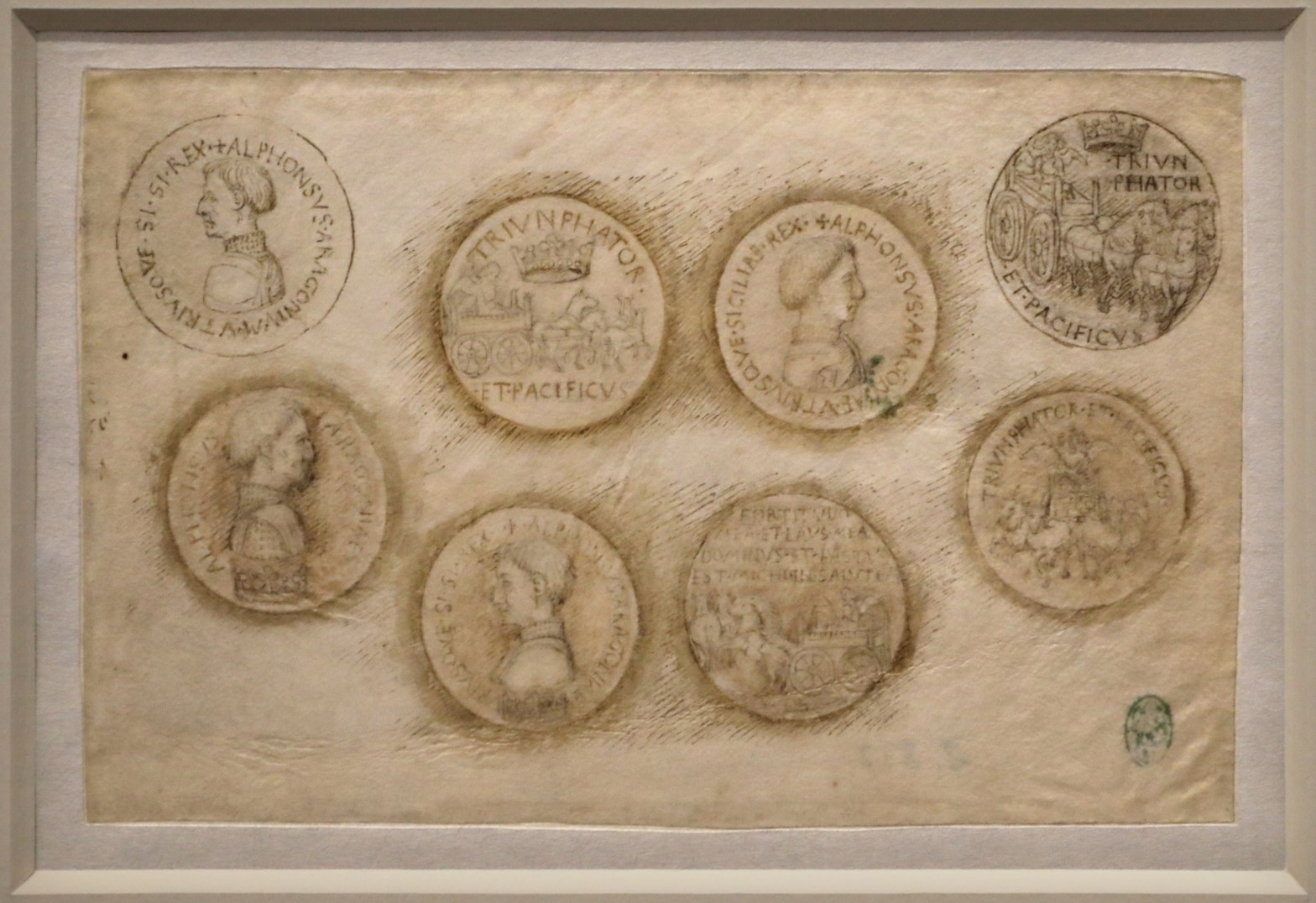
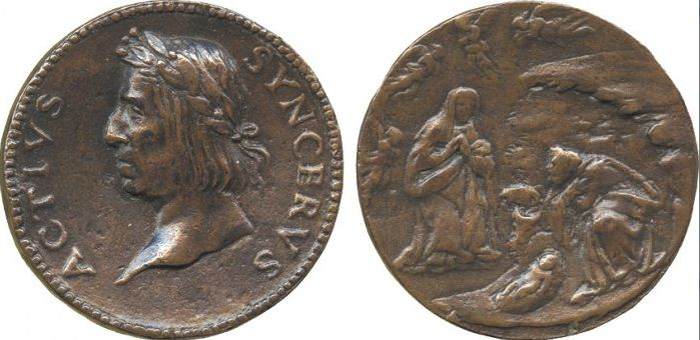
Pisanello, studies for the obverse and reverse of four medals of Alfonso V of Aragon, 1449. Pen and brown ink with ochre wash over metalpoint. Musée du Louvre, Paris, inv. 2317. Image: Wikimedia Commons / Musée du Louvre, Département des Arts Graphiques.
The interior as a different kind of text
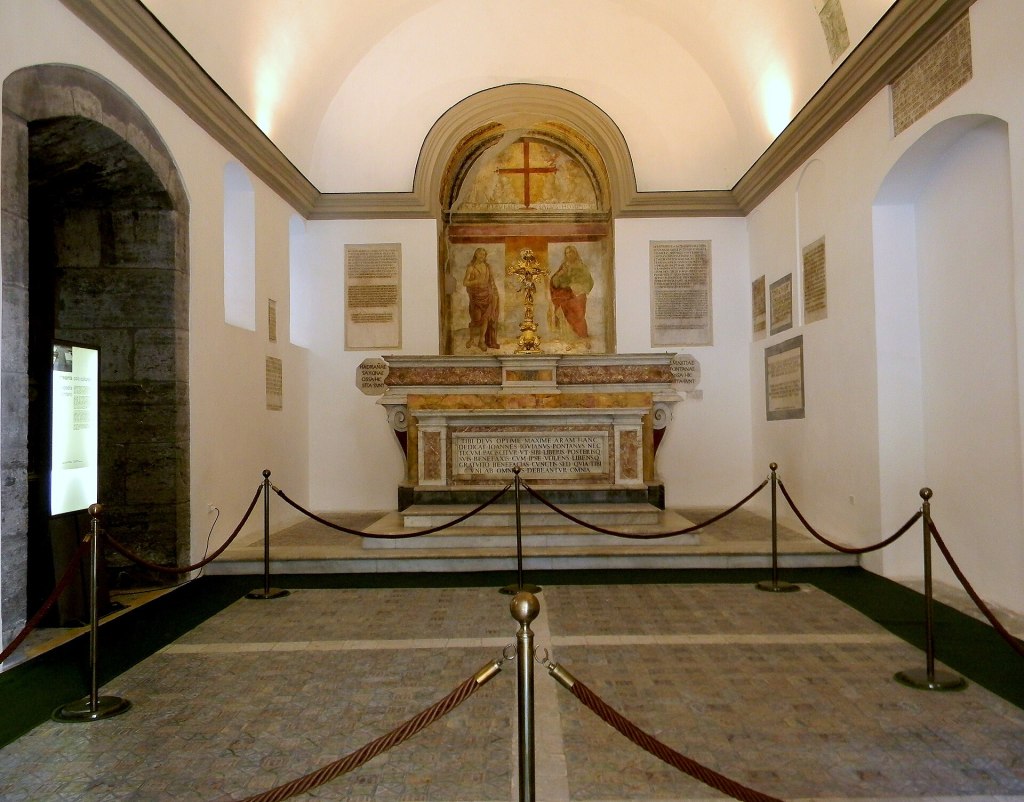
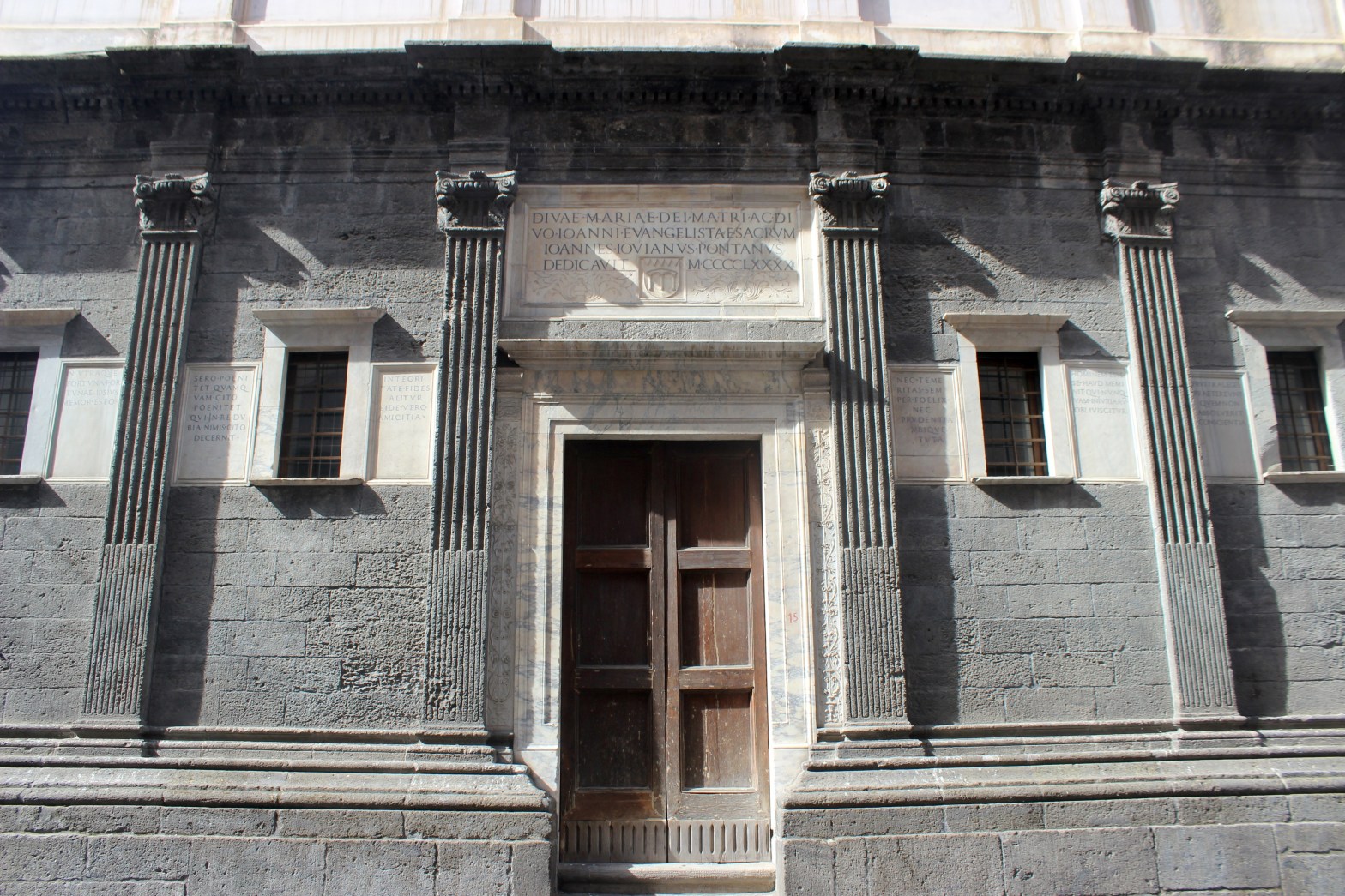
The inscriptions on the exterior of the Pontano Chapel address the street. Their moral and political precepts are directed towards an audience beyond the building, to readers who encounter them as they pass. Inside, inscription assumes a different character. The texts become more personal and commemorative, recording the deaths of Pontano’s wife, his daughter Lucia Marzia, his sons Lucio Francesco and Lucilio, and his friend Pietro Golino, while ancient inscriptions, heraldic devices and the decorated maiolica pavement introduce other forms of memorial and self-representation. The distinction is not absolute, but the movement into the chapel is also a movement from public counsel towards family, friendship and the dead.
What we see today accumulated over time, as successive deaths gave Pontano new reasons to write and commemorate. The funerary writing of the chapel also overlaps with the much larger body of verse gathered in De tumulis, so that the monument and the printed collection belong to the same commemorative culture.
This essay will not document all the inscriptions in full, but will instead examine the different strands of meaning that emerge from the interior: family and friendship, funerary commemoration, the appropriation of antiquity, and Pontano’s wider literary and intellectual world. Individual texts will be quoted where their wording is important to the discussion.
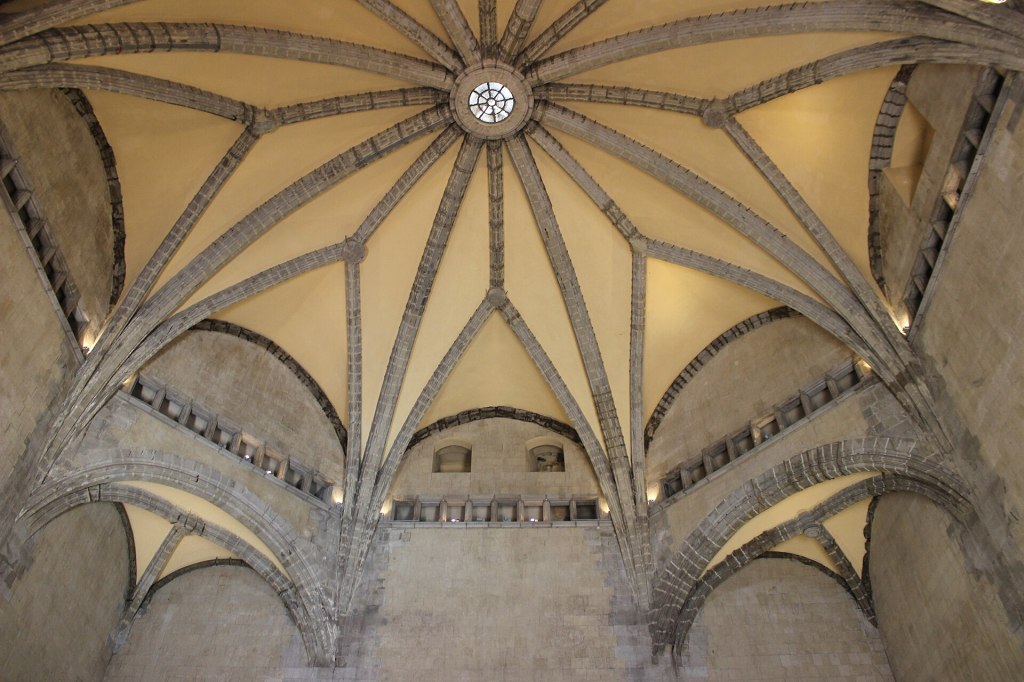
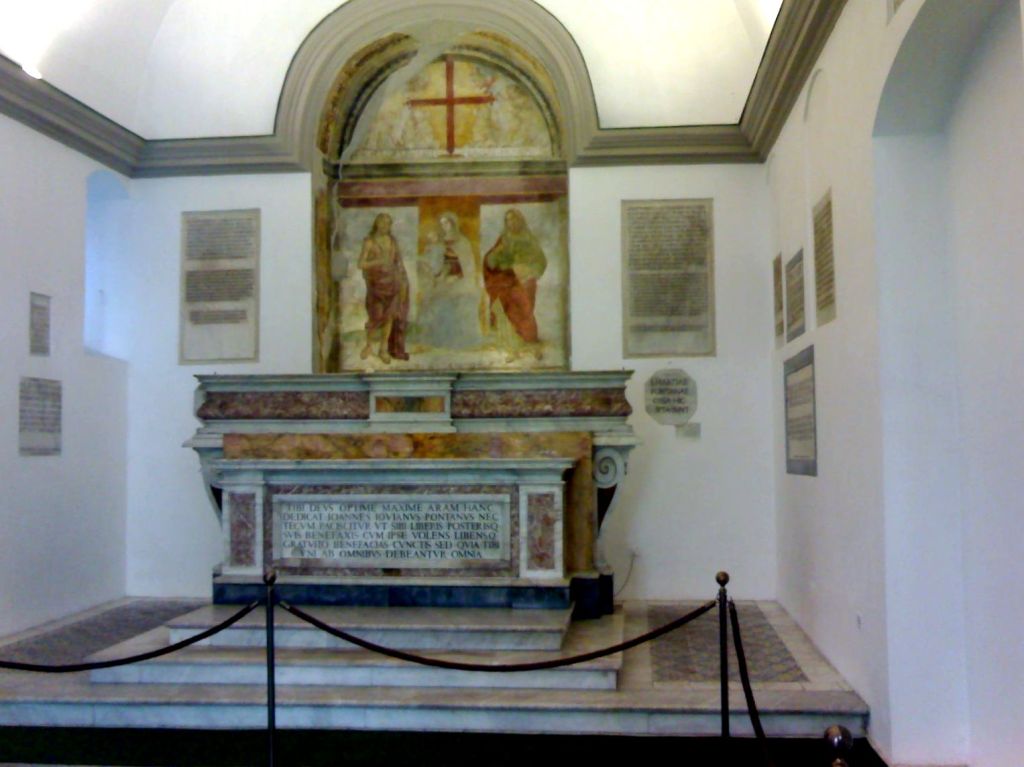
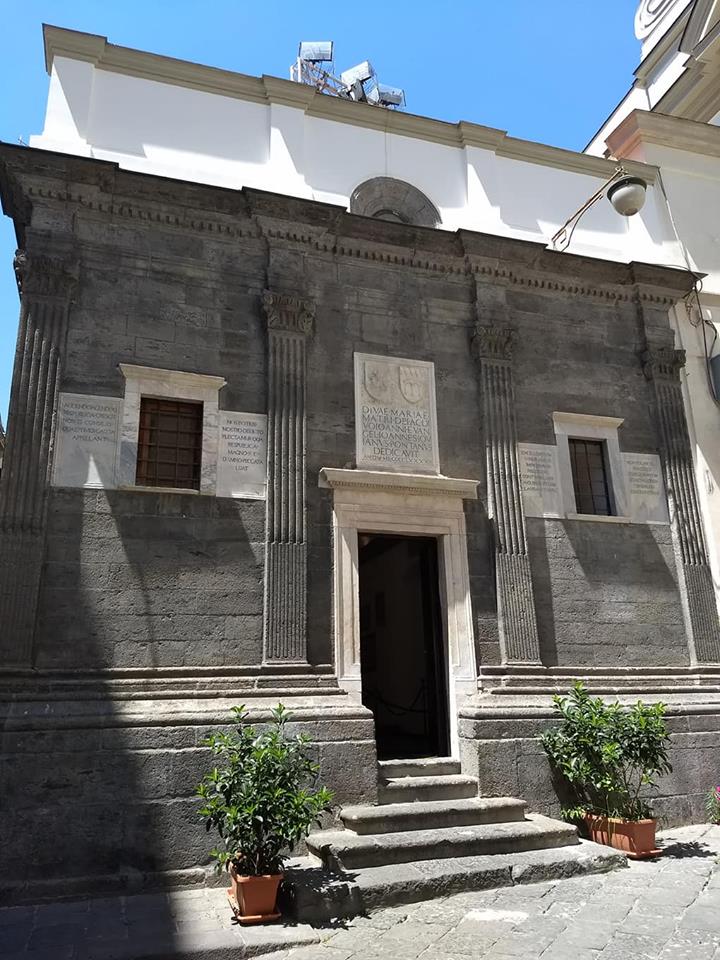
Interior of the Cappella Pontano, Naples. Photo: Giuseppe Guida / Wikimedia Commons, CC BY-SA 4.0.
Adriana Sassone
Adriana Sassone died on 1 March 1490, aged forty-six. Permission for Pontano’s new chapel followed later that year, on 13 September, and the building was consecrated in 1492. Her death was therefore closely bound up with its foundation, even though the chapel would soon acquire a much wider commemorative purpose. Pontano had married Adriana in 1461, when she was seventeen. As Ariadna, she had already become an important presence in his poetry, above all in the three books of De amore coniugali; after her death she appeared again in Meliseus and in De tumulis. The chapel gave permanent material form to a relationship that Pontano had been representing in different literary forms for almost thirty years.
The simplest of her surviving memorials is an octagonal tablet:
HADRIANAE SAXONAE OSSA HIC SITA SVNT
“Here lie the bones of Adriana Sassone.” Italo Sarcone associates it with her burial in the hypogeum, the subterranean burial chamber beneath the chapel, although he also suggests that its octagonal shape may once have related to the geometrical pattern of the maiolica pavement. Its original position cannot now be established with certainty. Alongside this terse identification, Pontano provided a much more elaborate epitaph consisting of three distinct parts: a passage in verse, a prose commemoration, and a concluding dedicatory inscription. Adriana is therefore remembered through several kinds of language within the same monument, ranging from the bare identification of her remains to literary praise and direct address.
The longer epitaph begins with verse. This inscribed poem is closely related to an elegy that Pontano also included in De tumulis, although the monumental and literary versions are not identical. Sarcone records variants between them, so the poem on the wall should not simply be treated as a transcription from the book. What matters here is that both versions commemorate Adriana through a recognisably Roman language of marital and domestic virtue.
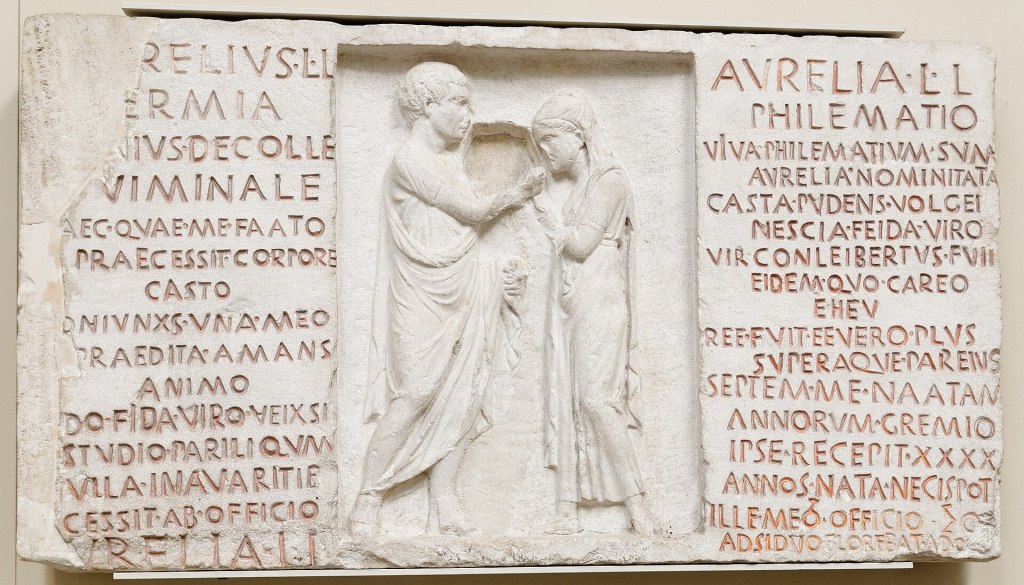
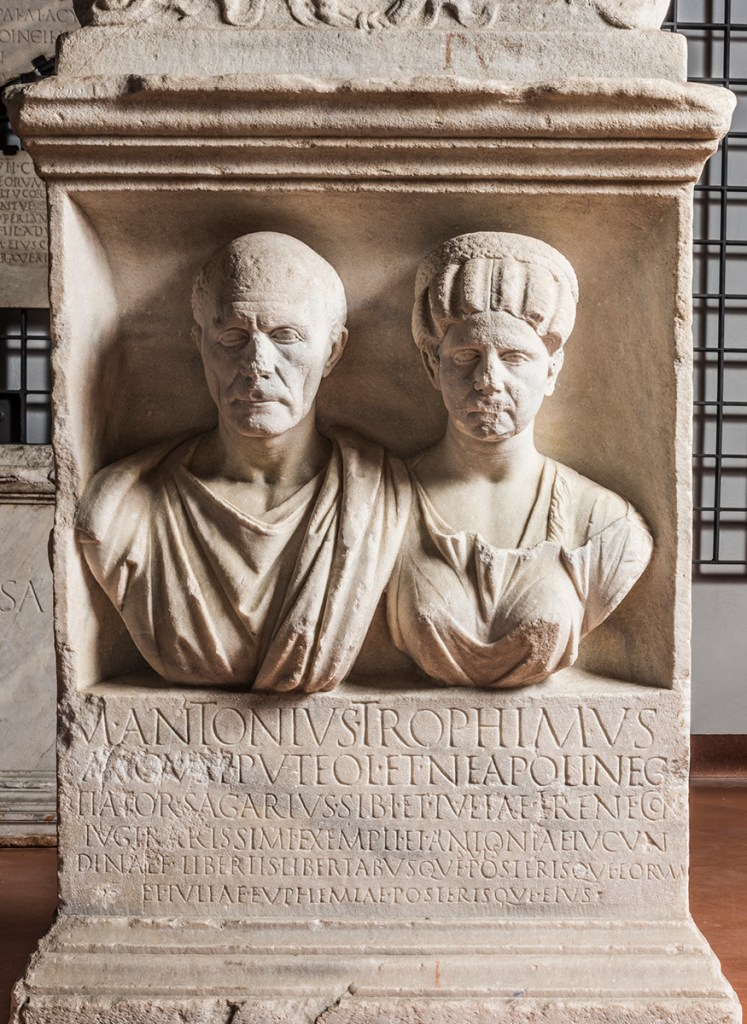
Funerary relief of Lucius Aurelius Hermia and Aurelia Philematium, c. 80 BC. Stone. British Museum, London. A comparative example of Roman conjugal funerary commemoration. Photo: Marie-Lan Nguyen / Wikimedia Commons, CC BY 2.5.
She is presented as the faithful companion and guardian of a chaste marriage, a woman devoted to one husband, an affectionate mother, and the custodian of the household and its Lares. The needle and distaff also appear among the attributes through which her domestic life is characterised. Sarcone connects this vocabulary with Roman funerary commemoration, in which wives were repeatedly praised through fidelity, motherhood, chastity and care of the household. Pontano is not merely writing in a vaguely classical manner. He selects precisely the kinds of qualities through which Roman epitaphs had long constructed the exemplary married woman.
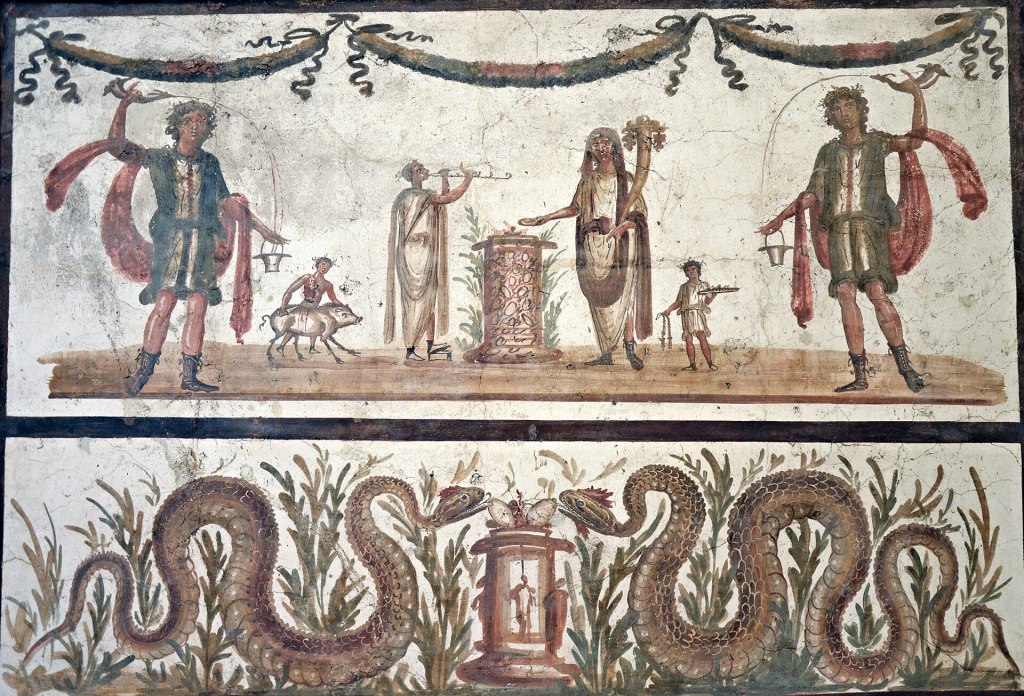
Lararium fresco from Pompeii, showing two Lares pouring wine from rhyta into situlae on either side of a household sacrifice, 1st century AD. Museo Archeologico Nazionale, Naples, inv. 8905. The scene provides a comparative example of the Roman domestic cult in which offerings, household deities and family observance were closely connected, helping to evoke the ritual world behind Pontano’s references to the Lares and continuing commemorative care. Photo: Carole Raddato / Wikimedia Commons, CC BY-SA 2.0.
An unusually revealing comparison is the ancient funerary inscription conventionally known as the epitaph of Claudia. It is not a passage preserved by a Roman literary author but an actual funerary inscription, now lost, known through the epigraphic tradition. It is catalogued in the Corpus Inscriptionum Latinarum, the standard scholarly collection of Roman Latin inscriptions, as CIL I² 1211. Claudia herself is otherwise unknown. The inscription praises her love for her husband, records that she bore two sons, and describes her as agreeable in speech and dignified in manner before ending with the compressed domestic formula domum servavit, lanam fecit: “she kept house; she worked wool.” Pontano does not copy the inscription, but the constellation of virtues is strikingly similar. Adriana too is commemorated as wife, mother and guardian of the household. The comparison shows how readily a highly personal loss could be articulated through an inherited epigraphic language of exemplary womanhood.
That funerary image should not be mistaken for a complete portrait of Adriana or of the marriage. De amore coniugali had already fashioned her through a different literary convention. Its opening poem is an elaborate Ovidian address to the prospective bride, populated by Elegy, Cupid, Venus and the Graces, and rich in myrtle, flowers and perfume. Ariadna is advised to value song above wealth, to avoid ostentation and foreign fashions, to speak modestly and to reserve herself for the poet who promises companionship and fidelity into old age. The poem is highly stylised and prescriptive. Carol Kidwell rightly raises the question of how directly such a literary exercise should be taken as evidence for the woman to whom it was addressed.
Elsewhere Pontano presents a rather different Adriana. In the Antonius she appears not as a passive embodiment of domestic virtue but as a wife capable of asserting herself forcefully and humiliating her husband when he was unfaithful. The difference is useful precisely because it warns against trying to extract a single stable personality from texts belonging to different genres. The prospective bride of De amore coniugali, the formidable wife of the Antonius, and the exemplary uxor of the funerary inscription are not necessarily competing claims about which Adriana was “real.” They are different literary constructions shaped by different occasions and inherited forms. In the chapel, the Roman language of the virtuous wife is the one appropriate to commemoration.
The poem then turns from Adriana’s virtues in life to the honours paid at her grave. Roses and violets are to flourish where she lies; Syrian perfume fills the place; crocus, amomum and other aromatic substances are imagined around her ashes. These are recognisably antique funerary gestures, but in Pontano they are not confined to a reconstructed pagan past. They enter a Christian commemorative practice that included repeated visits to Adriana’s grave and the celebration of a funeral mass for her on the first day of each month. Ancient and Christian forms of remembrance therefore coexist without any obvious sense of incompatibility. The flowers and fragrances of classical funerary poetry could belong to the same commemorative world as prayer and the mass.
The literary form itself participates in that process. Pontano is not simply reporting objects that might be placed at the tomb. By naming roses, violets, incense and aromatic spices, the poem recreates in language something of the sensory character of funerary offering. It would be too strong to say that the poem simply becomes an offering in place of material ritual, but it performs an analogous commemorative work: it summons the substances, gestures and atmosphere through which the dead might be honoured.
The same vocabulary also extends beyond death. In De amore coniugali, when Pontano celebrates the birth of his long-awaited son Lucio Francesco, multicoloured roses are scattered through the house, perfumed fires fill the dwelling, and myrtle and laurel decorate the household shrine. After Lucio’s death, offerings and annual prayers return in the commemorative verse. Flowers, fragrance and ritual gesture therefore belong to a wider language of family observance, accompanying marriage, birth and death. In Pontano’s writing, antique forms of celebration and mourning could be absorbed into the life of a Christian household rather than standing apart from it.
Five years after Adriana’s death, Pontano added a prose commemoration that is much more direct in tone. He explains that, after the chapel had been dedicated, he set up the monument so that he might speak with his wife every day. Although Adriana cannot answer him, his desiderium tui, his longing for her, will answer, and the memoria through which he now speaks with her will not fall silent. The language is worth attending to because Pontano does more than claim that memory preserves the dead. Longing itself is made to respond in Adriana’s absence, while remembrance becomes the medium through which the conversation continues.
He then looks forward to their physical reunion. When his bones have been mingled with hers, he says, they will be together again. The close measures the life they shared with extraordinary precision: he had lived with Adriana for twenty-nine years and nineteen days. Against that finite and countable span he sets the eternity he expects after death. The effect depends upon the contrast between measured earthly time and an afterlife without measure. The chapel does not erase Adriana’s absence, but it establishes a place in which Pontano can continue to address her while anticipating the eventual reunion of their remains.
The final dedicatory inscription returns to a much more conventional epigraphic register. Pontano names himself as the dedicator and describes Adriana as his “excellent and most deserving wife.” Here the Roman precedent lies not only in the virtues assigned to her but in the very structure of the inscription: deceased, relationship, dedicator, age and date of death are compressed into a formal public record. Within the same memorial, Pontano therefore moves between poetic praise, intimate second-person address and the terse documentary conventions of the funerary inscription.
The wider antiquarian context may have offered further precedents for such conjugal commemoration. Maia Wellington Gahtan has drawn attention to Herodes Atticus, the wealthy second-century Greek sophist and Roman senator, and the elaborate memorial culture surrounding his wife Annia Regilla, who died around AD 160. Herodes commemorated her extensively, particularly at the Triopion, an estate and funerary precinct on the Via Appia associated with her memory. Greek inscriptions there protected the precinct and its objects from disturbance. These inscriptions were known to Renaissance antiquarians, including Fra Giocondo, and Gahtan suggests that Pontano’s circle may also have known the association between them, Herodes and the commemoration of Regilla.
The comparison remains hypothetical, but it is more specific than a general appeal to Roman funerary custom. Herodes’ memorialisation of Regilla joined the remembrance of a wife to architecture, inscription and the appropriation of antiquity. Gahtan also notes a possible architectural resemblance between Pontano’s chapel and the funerary building traditionally associated with Regilla, as well as the unusual inscription protecting Pontano’s own family burial place. None of this establishes direct imitation, but it indicates the kind of ancient conjugal monument that could have been available to a humanist antiquarian imagination.
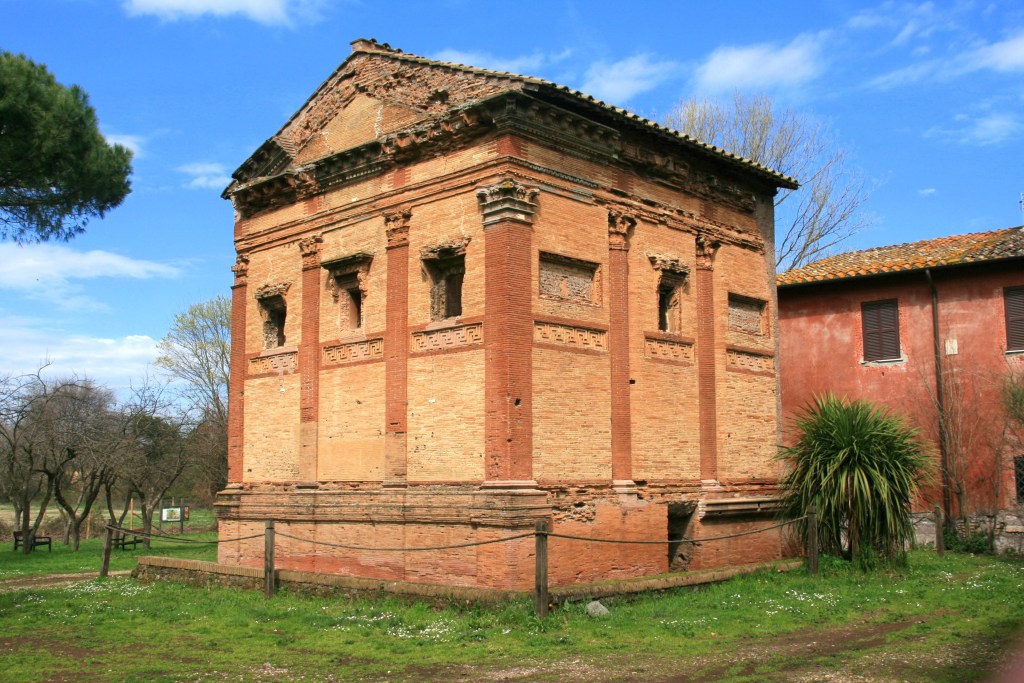
So-called Tomb of Annia Regilla (formerly the Temple of the Deus Rediculus), Via Appia Antica, Rome, second century AD.
A contemporary Neapolitan example brings us closer to Pontano’s own circle. In 1497 Antonio Rota, a high-ranking Aragonese official associated with the Accademia Pontaniana, commissioned for the family chapel in San Pietro a Maiella a cenotaph for himself and his still-living wife Lucrezia Brancia. The monument was later transferred to the Rota chapel in San Domenico Maggiore. Its inscription anticipates their eventual shared burial and praises the concord of their married life. Scipione Ammirato later attributed the epitaph itself to Pontano. If that attribution is accepted, Pontano was composing conjugal funerary language not only for his own chapel but for another prominent Neapolitan household. The Rota monument therefore suggests that the commemoration of marriage through classical funerary forms formed part of a wider humanist culture in which Pontano himself may have acted as both author and exemplar.
The children: Lucia Marzia, Lucio Francesco and Lucilio
The deaths of Pontano’s children altered the commemorative character of the chapel still further. If Adriana’s inscriptions centre on marriage and the continuation of an intimate relationship after death, those for Lucia Marzia, Lucio Francesco and Lucilio repeatedly confront another form of loss: children dying before their father. Pontano makes the reversal of generations itself one of the subjects of commemoration. The inscriptions record not simply premature death but the disruption of an expected sequence in which children should survive their parents, inherit from them and continue the family.
Lucia Marzia, the youngest of Pontano and Adriana’s three daughters, died while still in her teens, probably in 1479, although the precise date remains uncertain. Like Adriana, she was commemorated by an octagonal tablet and by a larger inscription combining verse, prose and a final dedicatory statement. The latter identifies her as Pontano’s “dearest daughter” and records her age with characteristic precision: fourteen years, seven months and twelve days. Her octagonal tablet states simply that her bones lie there. Sarcone suggests that it may originally have been associated with the hypogeum, the subterranean burial chamber beneath the chapel, although its precise original position is uncertain.
The verse inscription is organised around light and darkness. Lucia’s name itself invites association with lux, light. Pontano initially presents himself as the one left in darkness because his daughter has been taken from daylight, but the image is then reversed: Lucia has not simply been carried from light into darkness. She has escaped the darkness of earthly existence and now shines in celestial light. Pontano looks towards heaven and asks whether she in turn looks back at her father, before wondering whether the consolation he seeks may itself be something produced by paternal grief.
Sarcone places this uncertainty within a much older classical tradition of mourning. He compares Pontano’s attempt to address Lucia with Catullus’ lament for the unresponsive ashes of his brother, and sees another ancient resonance in the suggestion that Lucia might count herself fortunate to have died young. The thought has a specific Greek pedigree. In verses associated with Theognis, the best fate is said to be never to have been born and seen the light of the sun; for those who have been born, the next best is to reach death as quickly as possible. Sophocles gives the idea one of its most famous formulations in Oedipus at Colonus, where the chorus similarly declares that not to be born is best and that, once born, a swift return from life is next best. Sarcone’s comparison places Pontano’s effort to find meaning in Lucia’s early death within a tradition in which the brevity of life could paradoxically be imagined as an escape from its sufferings.
The prose inscription turns to the circumstances of Lucia’s death. Pontano dwells on the fact that she died without her immediate family beside her. He himself was absent and could not ease her suffering; her sisters were not there to mingle their tears with her groans; her brother could not give her even a little water in her thirst; and Adriana was unable to take her daughter into her arms, embrace her and kiss her departing soul. Sarcone draws attention to Pontano’s use of diminutives, including aquulam, “a little water”, and animula, the “little soul” or “dear little soul” leaving the body. The inscription preserves not only grief at Lucia’s death but Pontano’s distress that neither he nor the rest of the family had been present to comfort her as she died.
The ending draws Lucia back into the family burial place. Pontano says that he expects soon to sleep with both his daughter and Adriana, and asks Lucia in the meantime to warm her mother’s cooling ashes until he himself comes to join them. The image carries a Christian expectation of reunion after death, but its concentration on shared burial and the physical proximity of family remains also has strong Roman precedents. Roman family tombs commonly gathered successive generations together, while continuing rites maintained relations between the living household and those already buried. Christianity did not simply displace those familial habits of commemoration. In Pontano the two traditions could coexist: Lucia, Adriana and eventually Pontano himself are imagined not simply as separate dead individuals but as members of a family whose relationships continue within the tomb.
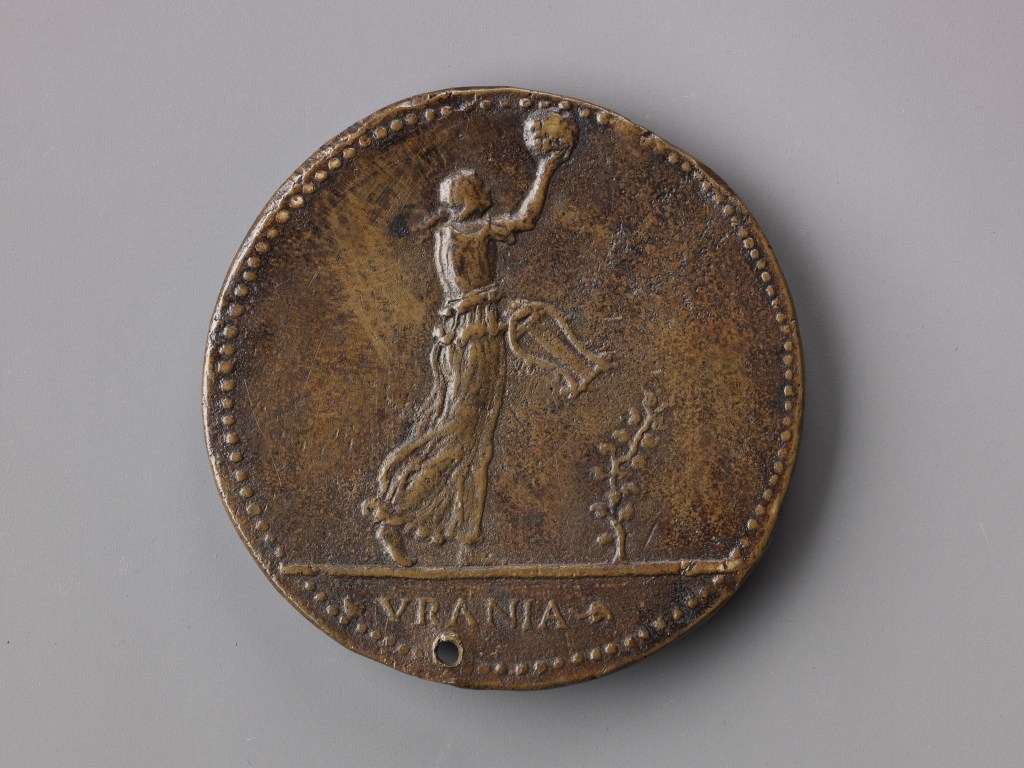
The imagery of light in Lucia’s inscription can be understood at the level of familiar poetic convention, but it also belonged to a much larger intellectual vocabulary for Pontano. In De rebus coelestibus, his extensive work on the heavens and their effects upon the terrestrial world, the sun is a principal agent in generation, and its heat is connected with sensation and intellectual activity. In the dialogue Aegidius, Pontano reasons from the extraordinary reach of physical sunlight to the still greater power of divine action. Elsewhere, in Book V of Urania, his major astronomical poem, Lucia herself appears as a source of heavenly illumination: Pontano imagines his own ashes lying in the obscurity of the tomb while the light she sends from heaven dispels that darkness and preserves his reputation among later generations.
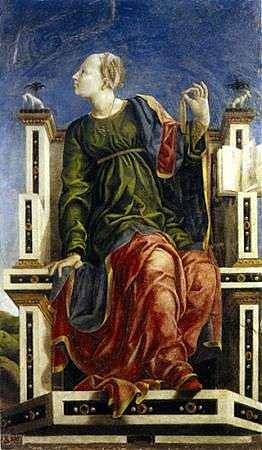
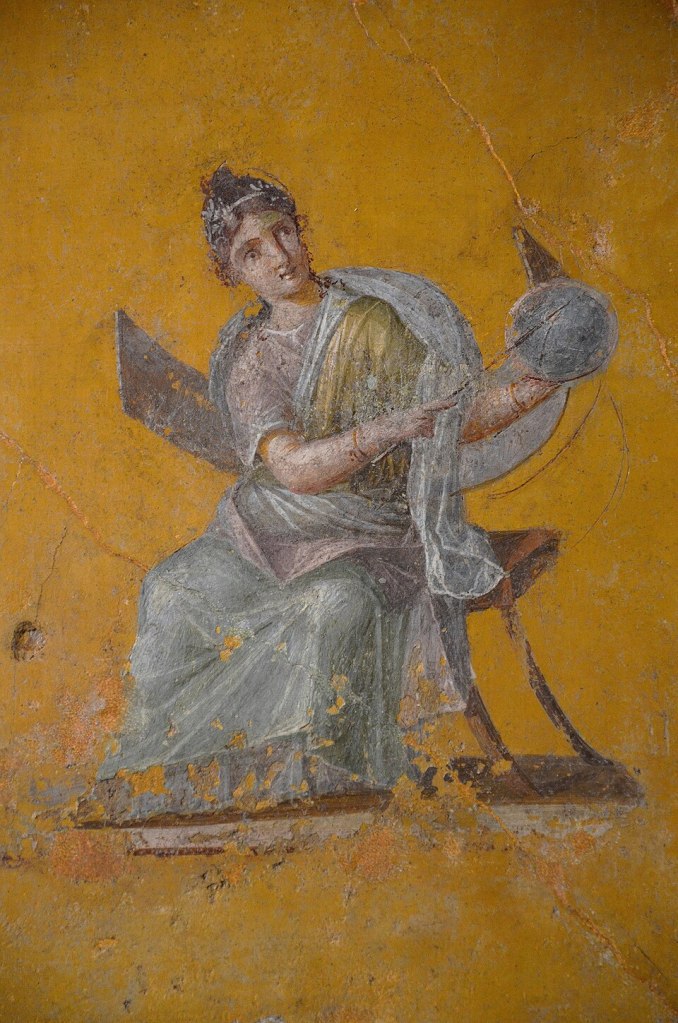
Anonymous Ferrarese artist, traditionally associated with Angelo Maccagnino and collaborators of Cosmè Tura, Urania, c. 1450–60, from the Studiolo di Belfiore. Pinacoteca Nazionale, Ferrara. A courtly Renaissance image of the Muse of astronomy, closely related in subject to the celestial and poetic world of Pontano’s Urania. Image: Wikimedia Commons / Gallerie Estensi, public domain.Urania, Muse of astronomy, fresco fragment from the House of Julia Felix, Pompeii, AD 62–79. The ancient image offers a direct classical precedent for the personification of astronomy that Pontano would later make central to his own poetic world. Photo: Carole Raddato / Wikimedia Commons, CC BY-SA 2.0.
This does not require us to turn Lucia’s epitaph into a coded cosmological statement. Light and darkness were fundamental images of life and death in many traditions. But Pontano’s wider writings give them an additional range of associations. Light could signify generation, sensation, intellectual activity, divine action and continuing fame. Charles Trinkaus has shown how Pontano attempted to understand the celestial order through analogies with human life, society and volition. The stars and planets exerted real influences upon terrestrial existence, including bodily constitution and human temperament, but Pontano did not regard those influences as absolute: his cosmology continued to leave room for divine providence and human freedom. Lucia’s movement from earthly darkness into celestial light therefore belongs to an intellectual world in which the sun and stars were understood to exercise real effects on life below.
The death of Lucio Francesco in 1498 brought another kind of rupture. Born in 1469 after Pontano’s three daughters, he was the long-awaited male heir. Pontano’s hopes for him are visible throughout his writing. The twelve Naeniae in De amore coniugali are lullabies addressed to the young child, while Urania, one of Pontano’s largest and most ambitious poems, was dedicated to him. Lucio later married and had a daughter, Tranquilla, but died at only twenty-nine.
His chapel inscription concentrates less on light and darkness than on the reversal of generations. Pontano recalls that he had prepared the altar and chapel to God in the expectation that his son would one day cover his father’s ashes there. Instead, the father finds himself constructing the son’s tomb. The language repeatedly sets the generations against one another: father and son, old man and boy, parent and child. Sarcone draws attention to these pairings, through which the inversion of the expected order becomes embedded in the language of the poem itself.
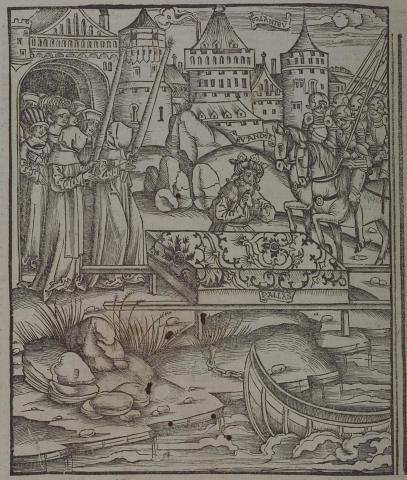
That sense of generational disorder belongs to a long classical tradition. Herodotus gives it memorable form when Croesus observes that in peace sons bury their fathers, whereas war reverses the proper order and fathers bury their sons. Roman literature repeatedly returns to the same horror. In Book XI of Virgil’s Aeneid, the death of the young Pallas is made especially painful by the knowledge that his ageing father Evander must receive his body and perform the rites that the son might normally have been expected to perform for him. Pontano gives this inherited theme a private and dynastic form: the father who had expected his son eventually to bury him finds himself building the son’s tomb.
Evander mourning over the body of Pallas, woodcut from Sebastian Brant’s 1502 Strasbourg edition of Virgil’s Aeneid, fol. 373v. The scene visualises the reversal of generations central to Pontano’s lament for Lucio Francesco: the father confronted with the death of the son who should have survived him. Image: Universitätsbibliothek Heidelberg, via Dickinson College Commentaries, CC BY-NC-SA.
The bitterest conceit comes at the end. Lucio had been the heir, yet what he receives from his father is a tomb as his patrimonium, his inheritance. Pontano in turn describes himself as the heir to grief. The inscription therefore differs markedly from those for Lucia and Lucilio. Its subject is not only premature death, but the collapse of an expected succession: the father who had anticipated leaving property, name and responsibility to his son instead leaves him a monument.
The pathos is intensified by Pontano’s insistence on his own role as maker. He says that he himself raised the altar and temple and now himself constructs the son’s tomb. The chapel, elsewhere marked by the assertion PONTANUS FECIT, becomes implicated in the reversal it records. Pontano can make a monument durable, but he cannot restore the succession the monument had been intended to outlast.
Lucio’s death continued to occupy him outside the chapel. In the Iambici addressed to Tranquilla, Pontano repeatedly returns to her father’s absence. In one poem he remembers Lucio as a child caring for plants and flowers. After his death the plants themselves seem to mourn: their leaves wither because no one remains to tend them, and Pontano promises to water them with his tears. The image is painfully domestic, intimate and personal. It returns the dead heir from the level of succession and dynastic expectation to the remembered habits of an individual child.
Lucilio belongs to a different branch of Pontano’s family life. He was not Adriana’s son, but the child of Stella, Pontano’s Ferrarese mistress, with whom he began an extramarital relationship in 1483 while Adriana was still alive. Pontano celebrated Stella extensively in the Eridanus. Its title uses the classical poetic name of the Po, evoking the river and landscape of the Ferrarese region from which Stella came. Stella bore Pontano Lucilio, who survived for scarcely fifty days. She herself died shortly before the infant, and both mother and child received poems in De tumulis. Lucilio was also commemorated in the chapel.
Here the language of light becomes more elaborate and more painful. Stella’s name means “star”, while Lucilio is associated with lux, light. Pontano asks whether he and Stella gave the child a name that seemed to promise light, only for “black Night” and “black Gloom” to take both mother and son away. The initial letter of Lucilio’s name supplies a second and harsher conceit: L is also the Roman numeral for fifty, and the infant lived scarcely as many days as that letter signifies.
Sarcone interprets this convergence of name, number, light and death as more than verbal ingenuity. He sees in it an attempt to discover signs of fate in what has happened to the child. The interpretation has particular resonance in the context of Pontano’s sustained interest in astrology and the celestial influences already encountered in the discussion of Lucia. Lucilio’s inscription does not formulate a theory of fate, but its anguished attempt to read destiny in a name and a number belongs naturally within that intellectual world.
At its close, however, the poem returns from names, stars and possible signs of destiny to the material language of funerary care. Flowers are to grow over the tomb, perfume is to rise from the urn, and fragrance is to surround the ashes. The prose statement records that Lucilio did not complete fifty days of life and describes him as an enduring source of parental grief and longing. The vocabulary recalls that used for Adriana: whatever intellectual meanings Pontano draws from the child’s name and fate, commemoration eventually returns to the familiar gestures of flowers, fragrance, ashes and continuing care.
Taken together, the three children’s memorials do not repeat a single language of grief. Lucia’s moves uncertainly between darkness and celestial light while dwelling on a death made more painful by the absence of her family. Lucio Francesco’s turns on inheritance and the reversal of generations: the son who should have buried his father instead receives a tomb from him. Lucilio’s transforms names associated with light and stars into signs of mortality and possible fate. Each inscription therefore finds a different structure through which to make an early death intelligible.
What joins them is Pontano’s continuing effort to preserve relationships after their expected future has disappeared. Lucia is imagined with her mother in the family burial place; Lucio receives the monument that has replaced his inheritance; Lucilio is surrounded in verse by the flowers and perfume denied to his brief life. The chapel becomes increasingly crowded not simply with the dead but with interrupted futures: children who did not survive their father, an expected male succession overturned, and relationships repeatedly reconstructed through inscription. The precision with which their ages are recorded, down to months and days, gives these losses a documentary exactness, while the poems refuse to leave them as bare facts.
De tumulis: a wider community of the dead
The family inscriptions in the chapel belong to a much larger body of funerary writing. Several have counterparts in De tumulis, Pontano’s collection of epitaphic poems, although the versions preserved in the book and those carved in stone are not always identical. The relationship is therefore not simply one of transcription. The chapel monumentalises a small and intensely personal group of texts, while De tumulis extends the same practice of commemoration into a far wider human world.
The physical setting strengthens the connection. Poems whose imagery repeatedly moves between light and darkness were placed within a chapel whose austere interior strongly recalls an ancient Roman house tomb. Pontano’s family inscriptions stood in the company of ancient Greek and Roman epigraphs, even if the precise history and arrangement of some of those stones remains uncertain. Beyond the walls of the chapel, De tumulis creates what might be called a literary Via Appia: a succession of the dead encountered through their epitaphs rather than their tombs.
The range is remarkable. Mario Santoro described the collection as embracing illustrious figures and members of Pontano’s family alongside humble or unknown people of very different origins, collectively producing the image of a large and varied society. A person may be caught in a characteristic gesture, an occupation, a vice, a misfortune or the particular event that brought about death. Social distinction does not disappear, but commemoration is not confined to the distinguished. Nobles, poets and learned men share the collection with servants, peasants, merchants and people whose lives would rarely have secured monumental remembrance.
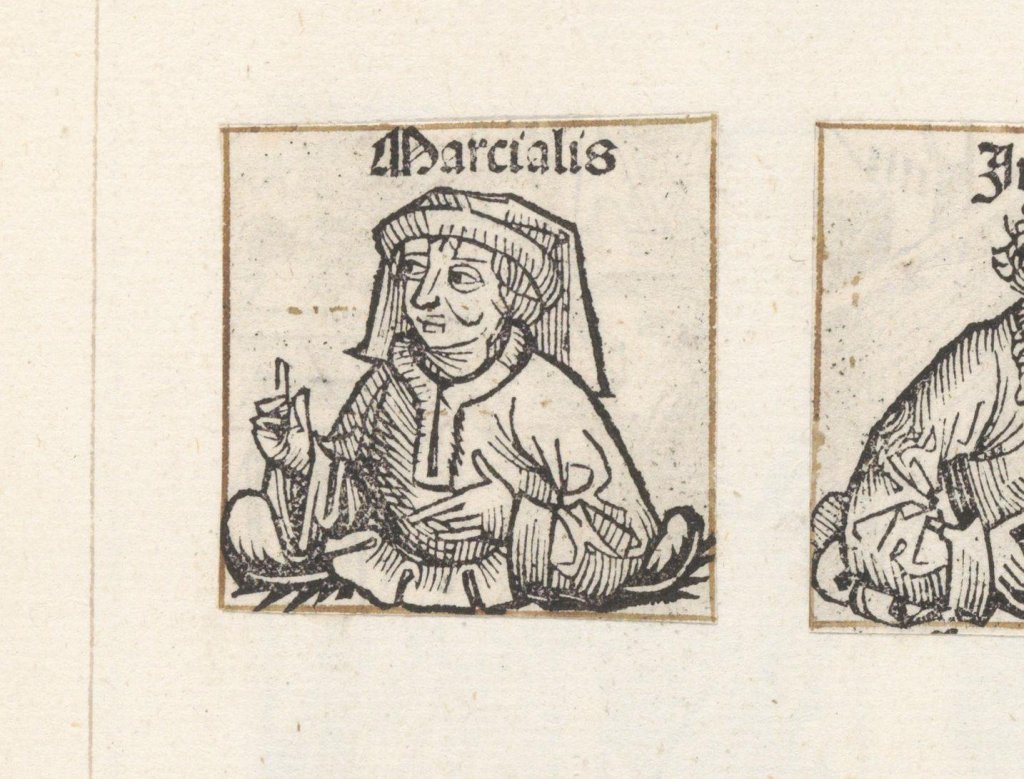
This breadth also reflects the literary tradition in which Pontano was working. The short, pointed epitaph belongs to the world of the classical epigram, particularly Catullus and Martial. That tradition allowed an unusual degree of social observation. Martial could move rapidly between admiration, mockery, obscenity, affection and cruelty, turning the inhabitants of Rome into the subjects of an intensely observant social poetry. Pontano’s earlier verse had exploited the erotic and comic possibilities of the same tradition. In De tumulis the subject has changed, but something of its freedom remains. Tragedy and tenderness coexist with irony, satire and occasionally very dark humour. Death does not oblige every dead person to become exemplary.
Marcus Valerius Martialis, woodcut from Hartmann Schedel’s Liber Chronicarum (Nuremberg Chronicle), 1493. Workshop of Michael Wolgemut and Wilhelm Pleydenwurff. Rijksmuseum, Amsterdam. A Renaissance visualisation of the Roman epigrammatist whose poetry provided an important model for the social range, wit and compression of Pontano’s De tumulis. Image: Rijksmuseum / Wikimedia Commons, public domain.
This makes the inclusion of Pontano’s own family poems particularly striking. The anguish surrounding Adriana, Lucia, Lucio Francesco and Lucilio forms part of the same collection that records much less elevated lives and deaths. Private bereavement is therefore placed within a larger social field. Pontano the husband and father cannot be entirely separated from Pontano the administrator and citizen, a man whose career had made him unusually attentive to the complicated human fabric of Naples. The collection moves across social boundaries because his literary imagination does too.
There is also a more fundamental equality imposed by the subject itself. Whatever distinctions remained between the people commemorated, every poem begins from the fact that a life has ended. Santoro saw in this a dimension extending beyond a simple picture of contemporary society: the individual is caught at a point where the accidents of profession, status and circumstance meet the universal condition of mortality. De tumulis does not abolish social hierarchy, but death repeatedly exposes its limits.
The opening of the collection gives this commemorative project a ritual dimension. Pontano announces a change from the poetry of love and marriage towards songs for the dead, encompassing young and old, men and women. The funerary landscape is animated by figures from his poetic world. Urania gathers flowers and myrtle; the Graces participate in the act of mourning; and places around Naples themselves seem to join the rite. Classical poetry and the actual geography of Pontano’s life are brought together around the graves.
At the centre of this passage is the insistence that tombs possess their own honour and graves require their own care: Est suus et tumulis honor, est sua cura sepulcris. The Manes are invoked, the spirits of the dead understood in Roman religion as recipients of continuing funerary honour. Familiar from inscriptions dedicated Dis Manibus, “to the divine spirits of the dead”, they belonged to a culture in which burial did not bring the obligations of the living towards the deceased to an end.
That language belongs more broadly to the Roman mos maiorum, the “custom of the ancestors”: the inherited practices and obligations through which Roman society understood proper conduct. In the sphere of death this included duties towards burial, family tombs and the continuing commemoration of the dead. Pontano brings this Roman language of obligation into a Christian funerary setting, allowing the two traditions to coexist rather than treating them as separate systems.
The prologue to De tumulis goes further by presenting poetry itself as part of that commemorative duty. Even mute ashes are owed words and prayers, and the dead are imagined as receptive to mournful song. A funerary poem therefore becomes not merely a description of grief but an act of address and remembrance. The same impulse that made Pontano set words into marble also generated a literary collection in which commemoration could continue beyond the physical limits of the chapel.
In Aegidius, Pontano treats burial and commemoration as obligations with consequences beyond private grief. He praises the victor who allows a defeated enemy time to bury the dead and maintains that families should observe funeral rites even while acknowledging the danger of superstition. Funerary observance therefore appears in his thought as part of the proper ordering of family and community.
That wider perspective prevents the chapel from becoming entirely enclosed within Pontano’s immediate family. De tumulis places Adriana and the children among a much larger population of the dead, while the ancient inscriptions within the chapel similarly introduce spouses, children, freedmen, officials, patrons and other inhabitants of the ancient city. The parallel should not be pressed into a claim about a deliberately constructed programme, but the resonance is suggestive. Both the literary collection and the epigraphic environment preserve human lives through short, concentrated acts of naming and description.
The movement beyond blood relationship is completed within the chapel itself by Pietro Golino. He belonged not to Pontano’s family but to the circle of friends and intellectual companions who had shared much of his adult life. De tumulis is dedicated to Golino, and after his death he too became one of its subjects. His burial beside Pontano’s wife and children therefore introduces another kind of relationship into the monument: friendship freely maintained across more than half a century. With Golino, the social world of Pontano’s academy and his sodales, his companions and associates, enters the family tomb. His epitaph will also introduce a very different voice, one in which grief gives way to scepticism, complaint and affectionate mockery.
Pietro Golino: friendship and the academy
The burial of Pietro Golino extends the chapel beyond family commemoration. Golino, sometimes called Pietro Compatre, had been one of Pontano’s closest friends for more than half a century. Like Pontano, he belonged to the administrative world of the Aragonese kingdom as well as to its literary culture. He worked in financial administration, served at times as president of the Sommaria and became vice-chancellor of the Kingdom in 1483. His presence in the chapel therefore introduces a relationship different from those represented by Adriana and Pontano’s children: not kinship, but a friendship sustained through intellectual, social and public life.
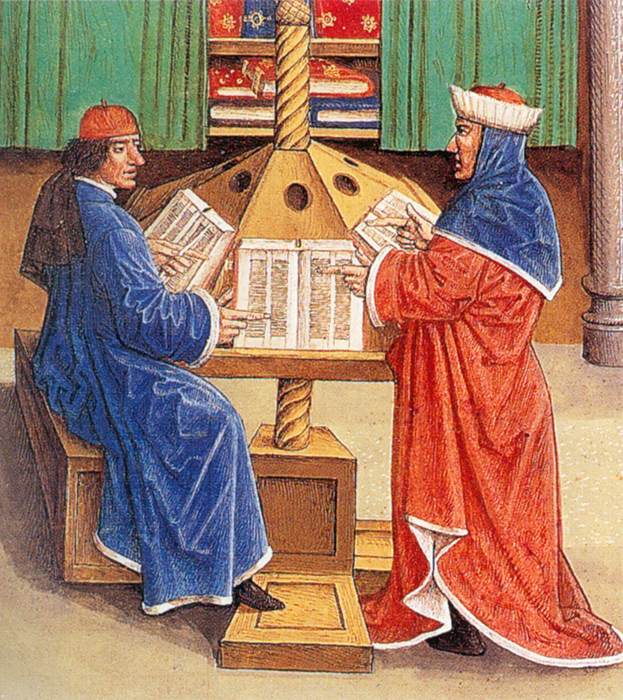
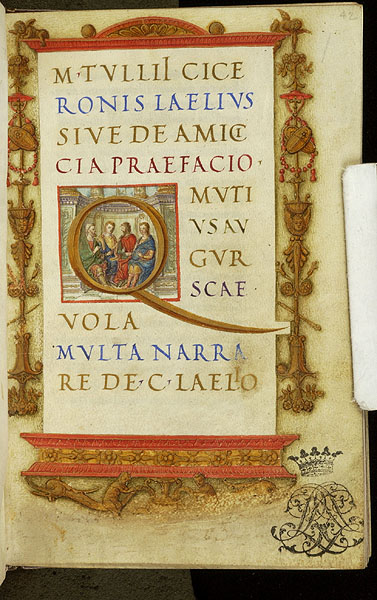
Such friendship had a strong classical pedigree. Cicero’s De amicitia had treated friendship as an ethical bond grounded in affection, constancy and shared values, capable of extending beyond private companionship into civic life. The culture of Pontano’s sodales belonged to this wider humanist recovery of classical forms of association. Reading, conversation, argument, poetry and shared leisure helped define the intellectual community that gathered around Pontano. Golino’s burial within the chapel gives physical permanence to one of those chosen relationships.
Petrarch and Boccaccio in a study, miniature from a Flemish manuscript of Boccaccio’s De casibus virorum illustrium (Des cas des nobles hommes et femmes), c. 1470–83. British Library, Royal MS 14 E V. The image offers a useful Renaissance evocation of learned companionship and intellectual exchange, comparable in spirit to the world of Pontano’s sodales. Image: British Library / Web Gallery of Art.
The tone of Golino’s epitaph is nevertheless strikingly different from that of the family inscriptions. The dead man speaks for himself in an abrupt exchange with an imagined interlocutor. Asked what he is doing, he answers that he is mouldering, tabesco. Asked who he is, he replies with the brutally compressed fui: “I was.” Golino had occupied important offices and shared the intellectual life of one of the most distinguished humanists in Naples, yet the epitaph initially reduces identity to physical decay and a verb in the past tense.
The dialogue then expands into an inventory of life’s experiences. Golino recalls labour, pain, illness and mourning, service beneath powerful masters, the burden of superstition, the burial of beloved friends and the spectacle of his country ruined and its people driven into exile. The catalogue moves between bodily suffering, personal bereavement and public disillusionment. It is difficult to read it without sensing the historical world in which both Golino and Pontano had grown old: long service to the Aragonese monarchy followed by political upheaval, foreign invasion and the collapse of institutions to which they had devoted much of their lives.
The epitaph does not, however, remain solemn. After enumerating the miseries he endured, Golino observes that there was one affliction from which he escaped: the troubles caused by a wife. The joke depends upon his lifelong bachelorhood and recalls the social world in which the friendship had been lived. Golino appears repeatedly in Pontano’s Baiae, poems set at the celebrated thermal resort of Baia. Since Roman antiquity the place had carried a notorious reputation for luxury and sexual licence: Seneca condemned its drinking, boating parties and lovers’ assignations, while Martial and Propertius made its capacity to compromise respectable sexual behaviour a subject of epigram. Pontano deliberately revives something of that ancient Baiae in his own poems, populating the resort with friends and members of the Aragonese court engaged in bathing, flirtation, erotic pursuit and comic social encounters. The ageing Golino belongs to this world. In one poem women initially avoid him, only to become markedly more attentive when they discover that he is wealthy.
The corresponding poem in De tumulis continues the joke after death. A passer-by asks Golino about marriage, the dead bachelor advises against it, and when the traveller admits that he is already married, Golino offers little consolation beyond urging him to escape its burdens. The literary version thus expands a joke compressed in the monumental epitaph. As elsewhere, book and stone preserve related material without simply duplicating one another.
The humour does not erase the bleakness of fui. Work, office, friendship, suffering and political experience are all gathered retrospectively beneath the knowledge that the speaker now belongs to the dead. Yet Pontano places that declaration where it can continue to be read. Golino’s voice, once part of the conversation and banter of the academy, is given one final form of continuance through inscription.
Antiquity made personal
Some of the ancient inscriptions in the chapel may have been chosen because they carried a direct relevance to Pontano’s own experience. That possibility is especially suggestive in a funerary setting where his wife, children and closest friend were also commemorated. Ancient epigraphy need not have remained a detached survival from the past: once collected and placed within a new setting, an inscription could acquire meanings generated by the lives of those who now read it.
One particularly suggestive case is the funerary dedication associated with Pomponius Rhenus, who commemorated younger members of his family who had died before him. Such a text would have had obvious resonance for Pontano, who himself survived several of his children. Another inscription commemorates Maecenatia Erusa, who died at fifteen, close in age to Lucia Marzia. Neither parallel proves why an individual stone was selected, but both show how readily the ancient dead could enter into dialogue with the losses recorded elsewhere in the chapel.
The collection was also socially and religiously varied. Husbands and wives, children and descendants, freedmen and freedwomen, civic figures and professionals all appear. The Christian physician Cyriacus, for example, is said to rest in the “sleep of peace”, bringing late antique Christian funerary language into the same epigraphic environment as pagan material.
Sarcone draws particular attention to the Greek inscriptions and places them within the unusually long survival of Greek culture in Naples. The point is more than a general reminder of the city’s origins. Ancient Naples continued to preserve Greek language and institutions under Roman rule, something already remarked upon by Strabo. Among the inscriptions in the chapel are Greek texts commemorating figures such as Philip, praised for learning and public office, and Alcibiades, whose epitaph adapts a celebrated Greek epigram by substituting the dead man’s name for that of Homer. Such stones connected Pontano’s antiquarian interests not simply with an abstract classical world but with the specifically Greek history of Naples.
The clearest instance in which antiquity appears to have been drawn directly into Pontano’s family world is the now-lost inscription involving the forms Saxono and Saxanus. An ancient-looking text was apparently altered or fabricated so that it incorporated a Latinised version of Adriana Sassone’s surname. It may have been intended less as a deception than as a learned joke, making an apparently ancient monument unexpectedly acknowledge Pontano’s own wife. The example suggests how playfully the boundary between recovery and recreation could sometimes be treated.
The physical survival of the stones also has a wider significance. Renaissance antiquarian culture repeatedly involved the movement, reuse and recontextualisation of older fragments. Such acts of translatio could make continuity materially present: an object survived the people and circumstances for which it had first been made and entered another historical setting. Within a funerary chapel that quality of endurance was particularly resonant. Human lives ended, families altered and political worlds disappeared, while inscribed stone could be carried forward and made legible again.
The ancient inscriptions therefore need not constitute a tightly coordinated programme for their presence to matter. They place Pontano’s own commemorations among earlier records of spouses, children, citizens and the dead of another age. In doing so, they make antiquity less a remote object of study than a continuing material presence within the chapel.
The maiolica pavement
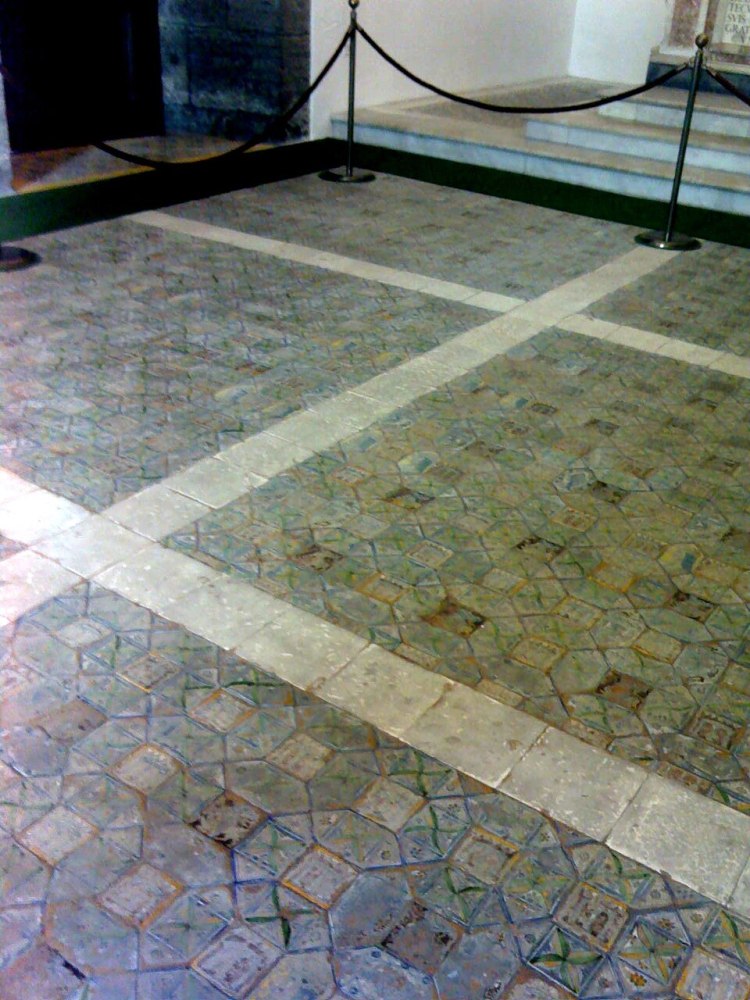
The pavement introduces a strikingly different visual register into the chapel. Against the restraint of the architecture and the density of its marble inscriptions, the floor is animated by colour, foliage, animals, heraldry, profile figures and short texts. Square tiles are combined with elongated hexagonal tiles, or alfardons, to form repeating geometrical units. Within them appear the arms of Pontano and Adriana Sassone and inscriptions including AVE MARIA, PONTANUS FECIT, ADRIANA SAXONA and LAURA BELLA. Writing is therefore unusually prominent within the decorative scheme, interwoven with heraldic, figurative, floral and animal motifs.
Maiolica pavement, Cappella Pontano, Naples, late fifteenth century. Photo: IlSistemone / Wikimedia Commons, CC BY-SA 3.0.
The floor belongs to a much wider culture of maiolica paving in Aragonese Naples. The taste had been established at the highest level under Alfonso the Magnanimous. Valencia formed part of the Crown of Aragon, and nearby Manises was one of the principal centres of ceramic production in the western Mediterranean. Muslim mudéjar craftsmen there continued highly developed traditions of painted and lustred ceramics under Christian rule. Large quantities of Valencian tiles were ordered for Alfonso’s residences in the Kingdom of Naples during the 1440s and 1450s. Their arrival in Naples therefore represented the movement of an established element of Aragonese-Valencian court culture within Alfonso’s Mediterranean dominions rather than simply the importation of a foreign luxury.
The fashion was soon adopted by patrons closely connected with the dynasty and its government. Marino Caracciolo, admitted to Alfonso’s council in 1449, was probably responsible for the azulejos pavement in San Giovanni a Carbonara. The descendants of Cardinal Rinaldo Brancaccio probably commissioned the tiles of the Cappella Brancaccio in the later 1440s. At Gaeta, a pavement commissioned after 1440, probably by Onorato II Gaetani and Giordano Gaetani, included the arms of the Aragonese kings, apparently making dynastic allegiance part of the decoration. Around 1470 Antonio and Turco Cicinello, both of whom served Ferrante as ambassadors in Milan, were associated with the tiled pavement of the Cappella del Crocifisso in San Pietro a Maiella. Some tiles bearing the Carafa stadera, or scales, probably from the palace of Diomede Carafa, are now preserved in the Museo Civico Gaetano Filangieri. Maiolica paving had consequently become associated with patrons of considerable social and political standing.
The fashion remained vigorous in the later 1480s. A document of 1488 records an order for 20,000 tiles from Giuliano da Maiano, sent from Florence to Naples. Their destination is uncertain, although the now-lost royal palace of Poggioreale has been suggested. The period saw several ambitious Aragonese building campaigns, and whatever the destination of this particular shipment, its scale confirms the continuing prestige of tiled decoration in the years when Pontano’s chapel was taking shape.
The origin of Pontano’s own pavement has itself been disputed. Earlier scholars proposed a Tuscan origin, while more recent studies have argued for production in Naples. Angela Dressen supports the latter view, identifying strongly Neapolitan characteristics not found in Tuscan pavements. The floor is now only partly preserved in its original state, and additional tiles were introduced between the fifteenth and seventeenth centuries, but the parts bearing the emblems, inscriptions and profile images connected with Pontano and Adriana belong to the original decoration.
That decoration is intensely personal. Pontano’s bridge emblem appears alongside that of Adriana, represented by Hercules struggling with the lion, while her identity is stated explicitly in ADRIANA SAXONA. Several tiles also carry the same profile head, generally identified as Pontano, although it does not closely correspond to his known medal or bust. Among the zoomorphic motifs are a fish, a hare and another animal which Dressen cautiously identifies as possibly a leopard. Such motifs belonged to an established Neapolitan repertory.
The repeated PONTANUS FECIT makes an unusually strong claim about Pontano’s relationship to the chapel. Bianca de Divitiis has shown that the formula could operate in more than one register. In ancient and Renaissance dedicatory inscriptions, a patron could use fecit to declare that he had caused a monument to be made. The celebrated M. AGRIPPA … FECIT on the Pantheon provided an obvious ancient example, while comparable formulas had been revived in contemporary all’antica architecture. But fecit could also be the language of an artist’s signature. Pontano, deeply familiar with ancient inscriptions, would have known both uses.
The choice of tense sharpened the point. In the preface to his Natural History, Pliny distinguished the comparatively modest faciebat, “was making”, from the much rarer fecit, “made”. Faciebat could leave a work notionally unfinished and open to correction; fecit announced it as complete, with what Pliny understood as an exceptional degree of artistic confidence. Angelo Poliziano revived precisely this distinction in his Miscellanea of 1489, while Pontano’s chapel was taking shape. In writing PONTANUS FECIT repeatedly across the pavement, Pontano could therefore identify himself as the man responsible for the monument while adopting the confident language associated with the maker of a finished work.
Pontano’s own De magnificentia helps explain how such a claim could belong to a patron. Magnificent building was not simply a matter of expense. The excellence of a building reflected upon the judgement of the person responsible for bringing it into existence: an admired work made its maker admired, drew visitors from distant places and provided poets and historians with something worthy of praise. Patronage could therefore encompass conception, judgement and direction as well as expenditure. PONTANUS FECIT does not claim that Pontano physically made the chapel. It makes a more ambitious claim that the completed monument was, in an important sense, his work.
The meaning of LAURA BELLA is much less certain. Stefano Borsi drew attention to an architectural image in a manuscript of Petrarch’s Rime, formerly in the collection of Major J. R. Abbey, which he compared with the Pontano Chapel. The comparison, together with the commemorative importance of a woman in both contexts, raises the possibility of a Petrarchan resonance in the name Laura, although the connection with the particular inscription on the pavement remains conjectural.
Riccardo Filangieri di Candida offered a very different possibility, suggesting that the words might have been introduced by an unknown ceramicist or could simply have entered the batch by mistake. Angela Dressen, approaching the phrase through the history of ceramics, relates LAURA BELLA to the tradition of vasellame amoroso, ceramics associated with courtship and marriage, and compares it with inscribed decoration in other late-fifteenth-century pavements. No single explanation is conclusive.
The foliage and animals introduce a further range of associations. A suggestive contemporary comparison comes from Lorenzo Valla’s Gesta Ferdinandi regis Aragonum, written in 1445–46. Describing the marriage of Alfonso the Magnanimous to Maria of Castile in Valencia, Valla praises an interior pavement laterculo quadrato vitreatoque ac picto constratum, laid with glazed and painted square tiles, and compares its beauty with the groves of Elysium and with an earthly paradise. His description shows that richly coloured tiled decoration could carry explicitly paradisal associations.
Upper Rhenish Master, The Little Garden of Paradise, c. 1410–20. Mixed technique on oak. Städel Museum, Frankfurt am Main, on permanent loan from the Historisches Museum Frankfurt. The enclosed garden combines paradisal imagery with cultivated nature and courtly leisure: figures read, make music and gather among flowers, fruit trees and birds, offering a useful visual parallel for the associations of paradise, garden and otium evoked by Pontano’s pavement. Image: Wikimedia Commons / Google Arts & Culture, public domain.
Nature also occupied an important place in Pontano’s own experience and writing. In De hortis Hesperidum, his poem on citrus cultivation, he turns explicitly to ocia nunc hortique, “now leisure and gardens”, linking cultivated nature with otium. Gardens, rural settings and withdrawal from public business recur through his literary world, associated with repose, poetry, learned conversation and release from the demands of office.
In that context, the animals and foliage of the pavement could bring into the chapel associations with paradise, cultivated nature and repose. They also change its emotional register. Colour, flowers and animals introduce something vivid and life-giving into an interior dominated by commemoration and death.
The pavement thus belongs both to an established Aragonese culture of prestigious maiolica and to the particular world Pontano created inside the chapel. It joins him repeatedly with Adriana through image and inscription, gives unusual prominence to writing as part of the decoration, and allows him, in PONTANUS FECIT, to make an exceptionally self-conscious claim upon the monument he had brought into being.
Outliving an age
By the end of Pontano’s life, the personal losses recorded inside the chapel had been accompanied by the destruction of the political order in which he had spent more than forty years. The French invasion of 1494 was followed by the final collapse of the Aragonese dynasty in 1501. That collapse was not simply an external catastrophe imposed upon a previously stable kingdom. Raffaele Colapietra has traced the longer crisis of the monarchy through fiscal pressure, political isolation, tensions between crown and baronage, and incomplete attempts at reform and centralisation.
Attributed to Francesco Laurana, bust of Ferdinand II of Aragon (Ferrandino), c. 1468. Bode-Museum, Berlin. Ferrandino’s brief reign in 1495–96 belonged to the final crisis of the Aragonese monarchy that Pontano lived to witness. Image: Wikimedia Commons.
Pontano himself had been involved in those attempts to strengthen the state. In November 1484, writing on behalf of Alfonso, Duke of Calabria, to Lorenzo de’ Medici, he described the duke’s intention to put the affairs of the kingdom in order while acknowledging the difficulty of the task. He therefore lived not merely to see the dynasty he had served overthrown, but to see the failure of a political order he had helped to administer and, at moments, to reform.
A contemporary judgement gives this accumulation of loss an unusually sharp form. Antonio de Ferrariis, known as Galateo, was a physician and humanist of Pontano’s circle. Shortly after Pontano’s death in 1503 he wrote to another member of that circle, the Neapolitan humanist Girolamo Carbone. Galateo argues that Pontano’s death itself should scarcely be mourned. What was lamentable was that he had lived long enough to witness the devastation of Italy and the dismemberment of the kingdom, including the French sack of Capua and the Spanish occupation of Calabria. His conclusion is brutal in its simplicity: Pontano had lived too long.
Seen from that perspective, the chapel had acquired a significance that could hardly have been foreseen when it was dedicated in 1492. It now contained the commemoration of wife, children and friend within a political and intellectual world that had itself largely disappeared.
Conclusion
The Pontano Chapel is at once a family memorial, a humanist monument and a public statement of intellectual identity. Its exterior inscriptions address the city through moral and political counsel; inside, the emphasis shifts towards family, friendship, antiquity, grief and self-commemoration. The ancient inscriptions, funerary poems, maiolica pavement and repeated acts of naming all contribute to a monument in which writing is inseparable from architecture.
Across the chapel, Pontano brought together the different worlds he had inhabited: public service, classical learning, poetry, friendship, marriage, bereavement and the hope of enduring reputation. By the end of his life, many of the people and institutions commemorated or implied by the monument had disappeared. The chapel remained.
Producing these essays requires care, time, research, and resources. Contributions to help sustain this exploration would be greatly appreciated.
For a compact but detailed guide to the chapel and its inscriptional programme, including Italian translations of the inscriptions, see I. Sarcone, Il libro di pietra. Le iscrizioni della Cappella Pontano in Napoli (2014).
I have consulted the following texts. Any errors are mine.
Arbace, L., ed., Il pavimento maiolicato di San Giovanni a Carbonara, Naples, 1998.
Arbace, L., et al., eds, Valenza-Napoli. Rotte mediterranee della ceramica, Valencia, 1997.
Ascher, Y., ‘Renaissance Commemoration in Naples: The Rota Chapel in San Pietro a Maiella’, Renaissance Studies, 14.2 (2000), pp. 190–209.
Ascher, Y., ‘Architecture in Sixteenth-Century Campania: The Carafa Chapel in Montecalvo Irpino’, Journal of the Society of Architectural Historians, 61.3 (2002), pp. 296–309.
Ascher, Y., ‘“Renovatio” and “Translatio” in Renaissance Naples: An Addendum to the Story of the Rota Chapels’, Notes in the History of Art, 25.1 (2005), pp. 33–42.
Balsdon, J. P. V. D., Roman Women: Their History and Habits, London: Bodley Head, 1962.
Brooke, J., Giovanni Pontano (1429–1503) and Social Mores, Memorial and Material Culture in Renaissance Naples, c. 1450–1490, unpublished PhD thesis, Department of History of Art and Screen Media, Birkbeck College, University of London, 2010.
Colapietra, R., ‘Gli aspetti interni della crisi della monarchia aragonese’, Archivio Storico Italiano, 119.2 (430) (1961), pp. 163–199.
Como, M. T., ‘Nuove acquisizioni sulla Cappella Pontano. Il contesto originario e l’architettura’, Rinascimento Meridionale, 7 (2016), pp. 35–48.
Coppini, D., ‘Memoria e ricordo. Tumuli di carta e tumuli di pietra nella poesia di Giovanni Pontano’, in A. Raffarin and G. Marcellino, eds, La mémoire en pièces, Paris: Classiques Garnier, 2020, pp. 389–416.
de Divitiis, B., ‘Pontano and his Idea of Patronage’, in M. Beltramini and C. Elam, eds, Some Degree of Happiness: Studi di storia dell’architettura in onore di Howard Burns, Pisa: Edizioni della Normale, 2010, pp. 107–131, 684–692.
de Divitiis, B., ‘PONTANVS FECIT: Inscriptions and Artistic Authorship in the Pontano Chapel’, California Italian Studies, 3.1 (2012), pp. 1–36.
de Divitiis, B., ‘Castel Nuovo and Castel Capuano in Naples: The Transformation of Two Medieval Castles into “all’antica” Residences for the Aragonese Royals’, Zeitschrift für Kunstgeschichte, 76.4 (2013), pp. 441–474.
De Ferrariis, A., Epistole, ed. A. Altamura, Lecce: Centro di Studi Salentini, 1959.
Donatone, G., La maiolica napoletana del Rinascimento, Naples: Gemini Arte, 1993.
Dressen, A., Pavimenti decorati del Quattrocento in Italia, Venice: Marsilio, 2008.
Filangieri di Candida, R., Il tempietto di Gioviano Pontano in Napoli, Naples: Accademia Pontaniana, 1926.
Frothingham, A. W., Lustreware of Spain, New York, 1951.
Gowing, A. M., Empire and Memory: The Representation of the Roman Republic in Imperial Culture, Cambridge: Cambridge University Press, 2005.
Griffin, J., Latin Poets and Roman Life, London: Duckworth, 1985.
Kidwell, C., Pontano: Poet and Prime Minister, London: Duckworth, 1991.
Lyne, R. O. A. M., The Latin Love Poets: From Catullus to Horace, Oxford: Clarendon Press, 1980.
Marsh, D., The Quattrocento Dialogue: Classical Tradition and Humanist Innovation, Cambridge, MA: Harvard University Press, 1980.
Middione, R., ‘Importazione di azulejos valenzani a Napoli negli anni di Alfonso il Magnanimo’, Faenza (1979), pp. 71–77.
Parenti, G., Poëta Proteus alter. Forma e storia di tre libri di Pontano, Florence: Leo S. Olschki, 1985.
Parenti, G., ‘L’invenzione di un genere, il “tumulus” pontaniano’, Interpres, 7 (1987), pp. 125–158.
Percopo, E., Nuovi documenti sugli scrittori e gli artisti dei tempi aragonesi, ed. M. Del Treppo, Naples, 1997.
Pontano, G. G., Baiae, ed. and trans. R. G. Dennis, Cambridge, MA: Harvard University Press, 2006.
Pontano, G. G., De immanitate liber, ed. L. Monti Sabia, Naples: Loffredo, 1970.
Pontano, G. G., De magnanimitate, ed. F. Tateo, Florence: Istituto Nazionale di Studi sul Rinascimento, 1969.
Pontano, G. G., De principe, ed. G. M. Cappelli, Rome: Salerno Editrice, 2003.
Pontano, G. G., De sermone libri sex, ed. S. Lupi and A. Risicato, Lugano: Thesaurus Mundi, 1954.
Pontano, G. G., Dialogues, Volume 3: Aegidius and Asinus, ed. and trans. J. H. Gaisser, Cambridge, MA: Harvard University Press, 2020.
Pontano, G. G., Eclogues. Garden of the Hesperides, ed. and trans. L. Roman, Cambridge, MA: Harvard University Press, 2022.
Pontano, G. G., I dialoghi, ed. C. Previtera, Florence: Sansoni, 1943.
Pontano, G. G., I libri delle virtù sociali, ed. F. Tateo, Rome: Bulzoni, 1999.
Pontano, G. G., Poesie latine, 2 vols, ed. L. Monti Sabia, introduction by F. Arnaldi, Turin: Einaudi, 1977.
Santoro, M., ‘La cultura umanistica’, in Storia di Napoli, vol. IV, part II, Naples, 1973, pp. 317–498.
Sarcone, I., Il libro di pietra. Le iscrizioni della Cappella Pontano in Napoli, Editrice Domenicana Italiana, 2014.
Spisak, A. L., Martial: A Social Guide, London: Duckworth, 2007.
Thornton, D. and Wilson, T., Italian Renaissance Ceramics: A Catalogue of the British Museum, 2 vols, London: British Museum Press, 2009.
Trinkaus, C., ‘The Astrological Cosmos and Rhetorical Culture of Giovanni Gioviano Pontano’, Renaissance Quarterly, 38.3 (1985), pp. 446–472.
Valla, L., Gesta Ferdinandi regis Aragonum, ed. O. Besomi, Padua: Antenore, 1973.
Vitale, G., Modelli culturali nobiliari nella Napoli aragonese, Salerno, 2002.
Warrior, V. M., Roman Religion, Cambridge: Cambridge University Press, 2006.
Wellington Gahtan, M., ‘Reading Pontano’s “libretto co’ fogli di marmo”’, Opus Incertum, 8.1 (2022), pp. 48–59.
For convenience, the discussion follows the tablets from the façade along Via dei Tribunali and then around onto the side facing Piazzetta Pietrasanta, beside the campanile of Santa Maria Maggiore alla Pietrasanta. This corresponds to one natural route of approach through the streets, but should not be taken to imply that the inscriptions were necessarily intended to be read in a fixed linear sequence.
Twelve marble tablets carrying short Latin maxims are set into the exterior walls of the Pontano Chapel. Their subjects are strikingly secular: power and self-restraint, fortune, prudence, trust, clemency, conscience, self-knowledge, political action and responsibility. Carol Kidwell described them as “political and moral maxims” and, more pointedly, as “worldly maxims”, intended for the passer-by rather than primarily for the Christian worshipper. Their position reinforces that public character. They occupy the exposed faces of a building erected in Pontano’s own neighbourhood, across the road from the house in which he lived and around which members of his intellectual circle gathered.
The inscriptions are classical in language and appearance, but it would be misleading to regard them simply as a collection of ancient commonplaces. Their themes recur throughout Pontano’s political and ethical writings, while several have close or suggestive parallels in classical authors. They also speak with particular resonance when set against Pontano’s long experience of Aragonese government: his service to Ferrante and Alfonso II, his diplomatic activity, the crises of the 1490s and the eventual collapse of the dynasty he had served. The degree to which particular tablets refer to particular events cannot always be established. Their brevity gives them precisely the capacity to move between the immediate and the general, between political counsel rooted in experience and propositions capable of addressing an unknown reader in the street.
Previous scholars have recognised something of this political character. Kidwell suggested that some of the inscriptions, particularly those she regarded as the last four, might reflect the crisis surrounding the French invasion and Pontano’s own loss of political authority. More recently, Italo Sarcone has treated the exterior tablets as a connected body of civil and moral admonition, observing that individual maxims can reinforce, qualify or even appear to contradict one another. That observation is important. Read together, the inscriptions do not offer a straightforward catalogue of virtues. They repeatedly confront the reader with distinctions: between prudence and timidity, daring and rashness, law and conscience, punishment and clemency, individual action and responsibility towards the state.
Such tensions have a particular significance in the intellectual world of Pontano. Victoria Kahn has shown that his understanding of prudentia belongs to the contingent realm of practical action, where decisions cannot normally be secured by demonstrative certainty. Pontano associates prudence with deliberation and repeatedly employs the rhetorical practice of arguing in utramque partem, considering a question from opposing positions. Correct judgement consequently depends upon circumstances, place and time rather than the mechanical application of universal rules.
The reading that follows therefore does not attempt to reconstruct a lost political code or to assign a single historical occasion to every tablet. It takes the inscriptions individually and in relation to one another, considering their classical precedents, parallels in Pontano’s writings and possible connections with the political circumstances in which he lived. Some of those connections are considerably firmer than others. Taken cumulatively, however, they suggest that the exterior of the chapel offered its readers something more demanding than a series of precepts. Its maxims repeatedly require the passer-by to compare competing claims, distinguish between neighbouring virtues and vices, and exercise judgement about what particular circumstances require.
Power and self-command
IN MAGNIS OPIBVS VT ADMODVM DIFFICILE SIC MAXIME PVLCHRVM EST SE IPSVM CONTINERE
“When one has great powers, as it is very difficult, so it is particularly admirable to practise self-restraint.”
The first maxim addresses the moral danger created by prosperity and power. Maia Wellington Gahtan identifies it as a paraphrase of a longer speech attributed by Polybius to the Roman general Lucius Aemilius Paullus after the defeat of Perseus of Macedon. Confronted with the fallen king, Aemilius warns his companions against becoming overbearing in success. It is precisely when private individuals or states are most fortunate that they should remain conscious of the possibility of reversal, although moderation is then particularly difficult to maintain. Pontano removes the historical setting and condenses the lesson into an aphorism. Opes can encompass wealth, resources, prosperity and power, while se ipsum continere turns attention from outward possession to inward command. The greater a man’s freedom to act, the more difficult, and therefore the more admirable, his mastery of himself.
Pontano develops essentially the same argument in De principe. Success, he writes, acts as a mirror in which character becomes visible, and self-control is most necessary when someone possesses the freedom to do exactly as he wishes. He immediately connects that freedom with the instability of worldly position. The ruler should discipline his mind by remembering that freedom may become slavery, wealth poverty, and high position disgrace. The affinity with Polybius is close in thought even without assuming direct dependence between the passages. Prosperity is dangerous because it both enlarges the capacity for action and encourages confidence in circumstances that Fortune may abruptly reverse. Restraint is therefore required not despite the possession of power but because of it.
A second passage in De principe gives the principle an exemplary form. Pontano asks whether Scipio Africanus deserves greater praise for his courage in war or for the continentia maintained throughout his life. Through courage he defeated his enemies two or three times; through continence he continually conquered himself. The lexical relationship between continentia and the inscription’s continere strengthens the comparison. External victory and self-command belong to the same language of conquest, but the latter is represented as the more continuous achievement. Panormita had made a comparable distinction in a letter of 1443. Citing Cato, he argues that it is absurd for a man capable of conquering many others to be unable to conquer himself. Alexander remained undefeated in arms but was defeated by anger, while Hannibal’s cruelty diminished the glory of his victories.
Italian, Scipio Africanus, early sixteenth century, after the Antique, bronze relief. National Gallery of Art, Washington, Samuel H. Kress Collection, 1957.14.166. Credit: National Gallery of Art, Washington.
The same conception of rulership had acquired monumental form in Aragonese Naples. As Peter Stacey has observed, Alfonso I’s proclamation as INVICTUS on the triumphal arch at Castel Nuovo is qualified by the epithets CLEMENS and PIUS. Invincibility therefore extends beyond military success. The ruler who remains unconquered by his enemies must also remain unconquered by his own passions in peace. Pontano supplies the negative counterpart in De immanitate. There tyrannical rule is associated with torture, robbery, killing and exile, while reason itself is degraded by anger, appetite and violent instinct. The distinction between victory and self-victory thus becomes political as well as ethical. Without restraint, the strength that enables a ruler to command others may itself become the source of tyranny.
Triumphal arch of Alfonso I, Castel Nuovo, Naples, 1450s–1470s. Detail of the triumphal entrance of Alfonso. Credit: Wikimedia Commons.
That argument acquired a more uncomfortable resonance under Ferrante. The more sensational traditions surrounding his ruthlessness need to be treated cautiously, but Pontano’s own writings could be sharply critical. In De sermone Ferrante appears as a practised dissembler and as a ruler deeply suspicious of his subjects, angered by the sight of two or three people walking and talking together. The detail suggests a form of government shaped by anxiety and mistrust, in marked contrast to the self-possession expected of the good ruler. Panormita’s Alfonso I provides the opposite model. He could move among his subjects without armed protection, relying on his innocence and their goodwill, and was praised for maintaining the same expression, dress, speech, mildness, benevolence and humanity through changing circumstances and unexpected victories. In this idealised image, authority is accompanied by inward steadiness rather than suspicion and fear.
The contrast becomes still sharper in Pontano’s letter to Ferrandino of 9 February 1494. With the French threat intensifying, he attributed the kingdom’s predicament in part to what he called the “mean and violent bearing” of Ferrandino’s grandfather Ferrante and father Alfonso II. The connection with De principe is especially pertinent because that work had itself been addressed to Alfonso as Duke of Calabria. None of this requires the inscription to be read as a covert denunciation of either ruler. Its aphoristic form allows the principle to exceed any single political occasion, addressing monarchs, administrators, barons and other holders of authority. Yet Pontano’s long experience of Aragonese government gave the maxim an immediate political weight. At the beginning of the sequence, it establishes a demanding premise: before the exercise of power can be judged prudent, courageous or just, the person who possesses it must first be capable of governing himself.
Fortune and constancy
IN VTRAQVE FORTVNA FORTVNAE IPSIVS MEMOR ESTO
“In good or bad fortune, remember that fortune changes.”
The second inscription develops a theme already implicit in the first: the instability of worldly success. If power demands self-command because prosperity can encourage arrogance, it also requires an awareness that prosperity itself is insecure. Maia Wellington Gahtan draws attention to the close relationship between the two maxims, noting that the warning against confidence in good fortune follows naturally from the Polybian lesson associated with Aemilius Paullus. The ruler who knows that Fortune may reverse itself has an additional reason to remain moderate in success.
Pontano returns to the same principle in De principe. In one passage he insists that it is particularly important for a ruler to preserve clarity of mind in adversity and not succumb when Fortune deteriorates. He then offers Ferrante himself as an example. At the beginning of his reign, when nobles, common people and entire provinces defected to Jean d’Anjou, Ferrante, according to Pontano, showed no visible agitation. He did not insult those who deserted him, and even when the rebellion of a prominent noble was announced, he responded not with rage but with regret that a man of such a family should have acted dishonourably.
Ferrante’s conduct provides one possible historical parallel for the maxim. In De principe, Pontano presents the king’s composure at the beginning of his reign as an example of how adversity should be met. The comparison is suggestive because the inscription can be read against conduct that Pontano himself had once praised, although there is no reason to assume that Ferrante was its specific or exclusive subject.
The broader point lies in the maxim’s refusal to privilege either prosperity or adversity. In utraque fortuna embraces both conditions. Good fortune should not produce arrogance, and bad fortune should not produce despair. Constancy depends upon recognising that neither condition can safely be treated as permanent. The inscription therefore turns mutability itself into a reason for steadiness of conduct.
Prudence and premature decision
SERO POENITET QUAMQUAM CITO POENITET QUI IN RE DUBIA NIMIS CITO DECERNIT
“He repents too late though he repents quickly, who decides too quickly in a dubious affair.”
The third inscription turns from constancy to judgement. Its subject is not hesitation as such, but the danger of committing oneself before the grounds of a doubtful matter have been sufficiently examined. The paradox of the wording is deliberate: even immediate regret comes too late once an ill-considered decision has already been made.
Pontano gives the principle a specifically political form in De principe. In his discussion of maiestas, he argues that all planning and action require counsel. A ruler should listen to many points of view, examine carefully the grounds upon which individual cases rest, and avoid both immediate assent and automatic rejection. Prudence therefore consists neither in endless delay nor in instinctive decisiveness. It requires the capacity to suspend judgement long enough for the circumstances of a case to become clear.
This belongs to a broader rhetorical conception of prudence in Pontano’s thought. Victoria Kahn has shown that practical judgement operates precisely where certainty is unavailable. Prudence concerns contingent matters and therefore requires deliberation, comparison and the weighing of alternatives. Pontano’s repeated use of in utramque partem, arguing a question from opposing positions, makes rhetoric itself part of the exercise of judgement. Read in that context, the inscription does more than recommend caution. It presents the res dubia as a situation in which judgement must remain open until competing considerations have been weighed.
This emphasis fits closely with Pontano’s own experience of government. Between November 1491 and February 1492 he conducted lengthy negotiations with Innocent VIII in Rome, working to secure papal recognition of Ferrante’s legitimacy and to repair relations between Naples and the papacy. An agreement was eventually reached, but Ferrante soon failed to honour his obligations. Pontano recognised the danger of damaging relations with Rome in an already unstable political climate. The episode therefore offers one possible historical context in which the maxim’s warning against premature decision would have had particular force.
The tablet need not be reduced to that episode. Its formulation remains general, but Pontano’s experience as a counsellor makes the political application especially suggestive. His work depended upon negotiation, comparison of alternatives and attention to changing circumstances, while decisions taken elsewhere could undo that process. The maxim can therefore be read as articulating a principle central both to his political writing and to his practical experience of government.
“Trust feeds on integrity, but friendship on trust.”
The fourth inscription moves from judgement to the conditions upon which relationships between people depend. Its structure is unusually compressed. Integrity gives rise to trust, and trust in turn makes friendship possible. The sequence is cumulative: friendship cannot simply be demanded from another person, since the confidence upon which it rests must first be made possible by conduct worthy of trust. The maxim therefore places responsibility first upon the character and behaviour of the person who seeks the confidence of others.
A passage in De principe provides a suggestive political parallel. Pontano advises the ruler to secure the regard of servants and courtiers by treating them with affability, courtesy, kindness and generosity, by overlooking some faults, praising worthy actions and recognising the value of those who serve him. Such behaviour encourages continued loyalty and goodwill. The circumstances are specifically courtly, whereas the inscription is much broader, but both depend upon a reciprocal conception of human relations. Loyalty is not secured by authority alone: the conduct of the ruler helps to create the conditions in which it becomes possible.
This corresponds with the importance Pontano elsewhere attaches to mutua caritas, the reciprocal goodwill through which social relationships are sustained. The inscription is particularly striking because it reduces that process to three linked terms: integritas, fides and amicitia. Lodi Nauta has shown that Pontano attached philosophical importance to the precision of moral language. In his account, words do more than describe conduct: by naming and marking out actions and qualities, they enable distinctions within the complexity of human experience to be recognised. An insufficiently discriminating vocabulary risks allowing different moral qualities to blur into one another. Here the distinctions are carefully staged. Integrity, trust and friendship are related, but they are not interchangeable: integrity makes trust possible, and trust in turn sustains friendship.
Cicero, Laelius sive de amicitia, Rome, c. 1495. New York, The Morgan Library & Museum, MS M.882. Written by Bartolomeo Sanvito and illuminated by Lauro Padovano; made for Cardinal Raffaele Riario. Credit: The Morgan Library & Museum.
The maxim also had an obvious relevance to political life at court. The Congiura dei Baroni of 1485–87 provides one possible context in which the fragility of trust had become especially visible. Two of the figures implicated in the conspiracy, Antonello Petrucci and Francesco Coppola, Count of Sarno, were not simply hostile barons but men who had occupied positions of exceptional confidence close to Ferrante. Petrucci was the king’s secretary and counsellor, while Coppola was a prominent courtier whom Ferrante, together with Petrucci, had entrusted with negotiations with the rebellious barons. Their eventual implication in the conspiracy therefore represented a breakdown of fides within the ruler’s own political circle. The episode gives particular resonance to a maxim that makes trust dependent upon integrity, although there is no reason to identify the conspiracy as the inscription’s specific subject.
Sala dei Baroni, Castel Nuovo, Naples, vaulted ceiling, fifteenth century. Credit: Wikimedia Commons.
The point also recalls a comparison made earlier in this essay. In discussing the inscription on power and self-command, Pontano’s De sermone provided the striking image of Ferrante suspicious of his subjects and angered by the sight of small groups walking and talking together. The present maxim allows that evidence to be seen from another direction. Fides is not presented as something that can simply be demanded from those around one: it depends upon conduct capable of sustaining it. Without making Ferrante the necessary subject of the inscription, the contrast suggests how far a political culture governed by suspicion could stand from the reciprocal relationships Pontano describes here.
Rashness, prudence and fortune
NEC TEME / RITAS SEM / PER FOELIX / NEC / PRVDENTIA / VBIQVE / TVTA
“Rashness does not always prosper, nor is prudence everywhere safe.”
The fifth inscription is more difficult than the preceding maxims because it refuses to turn prudence itself into an absolute rule. Its two clauses qualify one another. Rash action cannot be relied upon to succeed, but prudent action cannot be relied upon to provide safety either. The point is not that prudence and rashness are equivalent. Rather, conduct takes place in circumstances in which no virtue can guarantee its outcome. The maxim therefore returns to a problem already encountered in the inscriptions on deliberation and Fortune: judgement remains necessary precisely because events cannot be reduced to a dependable formula.
Gahtan has identified a particularly revealing classical source. The first half, nec temeritas semper foelix, comes from Livy’s account of the debate between Quintus Fabius Maximus and Scipio Africanus over Scipio’s proposed invasion of Africa. Fabius opposes the expedition and warns the senate against confusing previous success with proof that hazardous decisions will always prosper. The second half of Pontano’s maxim is not a direct quotation but, as Gahtan observes, effectively condenses Scipio’s reply. Pontano has therefore compressed the opposed positions of two Roman statesmen into a single double sententia: the caution of Fabius is immediately answered by the recognition that prudence itself offers no universal security. Plutarch, discussing the same episode, makes the related observation that it is difficult for the same man always to enjoy good fortune.
Livy, Ab urbe condita, third decade, opening of Book XXI, c. 1455, illuminated by the Master of Fiesole. Besançon, Bibliothèque municipale, MS 838, fol. 1. Arms of Alfonso V of Aragon below.
The form of the inscription is consequently as significant as its subject. Victoria Kahn has shown that Pontano repeatedly treats prudence and Fortune by arguing in utramque partem, bringing competing arguments to bear upon questions that do not admit demonstrative certainty. Prudence belongs to the contingent realm of action, where different courses may remain defensible and where the consequences of a decision cannot be known in advance. The opposing clauses of the inscription enact precisely that kind of reasoning. They do not cancel one another; they require the reader to discriminate between circumstances in which caution is necessary and those in which caution itself may become dangerous. Sarcone similarly reads the apparent contradictions among the tablets as a demand for judgement rather than as inconsistency: there is a time for deliberation and a time for rapid decision.
Pontano’s De fortuna gives the problem a more disconcerting political dimension. In an anecdote concerning Theodore Gaza, men criticise Ferrante during the early years of his reign for governing with insufficient thought or prudence. Gaza answers that the king’s apparently imprudent methods have nevertheless prospered, and that altering a successful manner of acting merely to conform to rational expectations might itself change his Fortune. Pontano’s discussion goes further still, allowing for a form of instinct or divinely inspired spontaneity that may exceed ordinary prudential calculation. The anecdote does not make rashness a virtue. It instead exposes the difficulty of judging action solely by the rationality of the decision or solely by its eventual success.
Bonifacio Bembo, Wheel of Fortune, from the Visconti-Sforza Tarot, Milan, c. 1450–80. New York, The Morgan Library & Museum, MS M.630, no. 9. Credit: The Morgan Library & Museum.
It would therefore be hazardous to assign the inscription a single political target. One possible contemporary resonance lies in Ferrante’s long record of political success, which might have encouraged confidence in methods that were not always conventionally prudent. Pontano later warned him against trusting too confidently in Fortune. But the maxim is more interesting if its uncertainty is allowed to remain intact. Placed within the developing programme, it qualifies the earlier warning against deciding too quickly without reversing it. Deliberation is necessary, but prudence cannot abolish contingency; daring may sometimes succeed, but success does not retrospectively turn rashness into wisdom. The problem confronting the reader is therefore not to choose once and for all between caution and boldness, but to judge when each is appropriate.
Clemency and the memory of injury
HOMINEM ESSE SE HAVD MEMI / NIT QVI NVNQ / VAM INIVRIARVM / OBLIVISCITVR
“He does not remember that he is a man, who never forgets injuries.”
The sixth inscription concerns the moral use of power after an injury has been received. Its formulation is striking because it makes the capacity to forget an offence part of what it means to remember one’s own humanity. The opposite condition, the permanent preservation of injury in the mind, is presented as a failure of self-understanding. The maxim does not say that every offence should go unpunished. Rather, it rejects the idea that resentment should itself become permanent, and therefore raises the question of when the power to retaliate ought deliberately to be restrained.
Pontano gives the principle a specifically political application in De principe. Some things, he writes, are better forgiven than punished, while others should be passed over as though unnoticed or postponed until another occasion. The important point is the discrimination involved. Clemency is not equivalent to passivity, nor does it require the ruler to surrender judgement. It demands that he distinguish between offences that require punishment and those for which punishment would be unnecessary, excessive or politically unwise.
The intellectual background is strongly Senecan. In De clementia, mercy acquires its fullest moral significance precisely where the ruler possesses the ability to punish. Forbearance imposed by weakness is not the same as the restraint of someone who has the means to avenge an injury and chooses not to do so. The great-minded ruler is therefore capable of enduring offences even at the height of his power; the refusal to exact vengeance can itself become evidence of greatness.
Peter Stacey has emphasised the particular importance of clemency to Alfonsine ideas of monarchy. The ruler’s exceptional power required a corresponding capacity for self-restraint: by mastering resentment and foregoing vengeance, he demonstrated that his authority was governed by reason rather than anger. Clemency could therefore help distinguish legitimate kingship from tyranny. Seneca gives the idea an almost divine dimension by presenting the ruler’s power to spare and preserve his subjects as a particularly exalted expression of princely virtue.
The maxim also had an evident relevance to the political circumstances of late Aragonese Naples. By the time the chapel was being constructed, the problem of punishment, resentment and reconciliation had become acute in the aftermath of the Congiura dei Baroni. Ferrante had experienced genuine betrayal, but the inscription places the moral burden upon the person who possesses the power to respond. Remembering an injury indefinitely is not presented as strength. The stronger act may be the deliberate decision not to allow vengeance to become permanent policy. There is no need to identify Ferrante as the inscription’s exclusive subject, but in such a political setting the maxim’s insistence upon clemency could hardly have been without resonance.
Law and conscience
FRVSTRA LEGES PRAETEREVNT QVEM NON ABSOLVERIT CONSCIENTIA
“The laws pass over him in vain whom his conscience does not absolve.”
The seventh inscription shifts attention from external judgement to an authority within the individual. A person may escape legal condemnation and yet remain condemned by his own conscience. Legality and moral innocence are therefore not identical, and formal acquittal cannot supply the latter. Sarcone connects the maxim with the opening of Juvenal’s thirteenth satire, where consciousness of guilt itself becomes a punishment. In monumentalising the idea, Pontano turns that inward judgement into a public admonition: the person passing beneath the inscription is asked to measure conduct by something more exacting than the possibility of legal sanction.
A related argument appears in De principe, although the point there is approached from the opposite direction. Pontano observes that “the greatest justice sometimes constitutes the greatest injustice” and that it may be better to act from fairness and goodness than according to the letter of the law. The inscription concerns someone whom the law fails to condemn, whereas De principe concerns the possibility that strict legality may itself produce injustice. In both cases, however, law is denied complete moral authority. Neither obedience to its letter nor escape from its penalties can substitute for ethical judgement.
The distinction belongs to a wider problem in humanist political thought. Discussion of law among Quattrocento humanists repeatedly brought positive law into relation with justice, reason and individual judgement. Some writers treated law and ethics as distinct, while others questioned whether institutional rules could by themselves secure just conduct. Pontano’s maxim belongs naturally within that environment: conscience supplies an internal standard by which the adequacy of external law can itself be measured.
The inscription also has a possible contemporary political application. Ferrante increasingly used the legal machinery of the Studio in his efforts to curtail baronial autonomy. Against such a background, the maxim could acquire a sharper resonance: government conducted through legal institutions was not thereby guaranteed to be just, any more than an individual who escaped legal condemnation was necessarily innocent. The comparison should remain cautious, since the inscription states a general moral principle rather than identifying a particular abuse. But Pontano’s insistence upon conscience and personal judgement places limits on any assumption that legality alone can legitimate political action.
The inscription therefore continues a recurrent movement in the programme from external power towards self-government. Law can judge conduct from outside, but it cannot absolve the individual who knows himself to have acted wrongly. That emphasis upon inward judgement also relates closely to the injunction to know oneself on the neighbouring tablet.
Self-knowledge
IN OMNI VITAE / GENERE PRIMVM / EST / SE IPSVM / NOSCERE
“In every station in life the first thing is to know one’s self.”
The eighth inscription takes the Delphic injunction to “know thyself” and makes it the foundation of conduct in every condition of life. Coming immediately after the warning that legal acquittal is worthless without the approval of conscience, it deepens the emphasis upon internal judgement. Right conduct depends not simply upon conformity to external rules, but upon an individual’s capacity to understand himself and judge his own actions. The words in omni vitae genere are important because they extend this requirement beyond rulers or political office-holders to people in every station of life.
It is likely that self-knowledge here has a strongly practical and social meaning. To know oneself is also to understand one’s place, the traditions within which one acts and the demands of decorum. The maxim can consequently be read in relation to the civitas as a whole. A coherent political community depends upon individuals possessing sufficient wisdom and integrity to understand both themselves and what their particular circumstances require of them. In this sense self-knowledge underlies many of the distinctions made by the preceding tablets: between prudence and timidity, daring and rashness, integrity and mistrust, legitimate punishment and vengeance.
The classical pedigree of the maxim gives this apparently simple proposition considerable weight. Gahtan notes that, unlike the other eleven sententiae, “know yourself” can be associated with the façade of an actual ancient building, the Temple of Apollo at Delphi, and traces its long Socratic, Platonic and Neoplatonic association with temperance and self-examination. The maxim also appears in Pontano’s own De magnanimitate, where the magnanimous man is especially required to reflect upon himself and practise moderation. By placing it publicly on the chapel façade, Pontano gives the injunction a wider application, and Gahtan goes so far as to suggest that self-knowledge may provide a foundation for the reflection invited by the other inscriptions.
Its importance within the chapel is reinforced by its recurrence in Pontano’s own epitaph, where the passing traveller is ultimately directed away from attempting to know the dead Pontano and towards knowing himself. The same injunction therefore addresses the living from both the public moral programme of the exterior and Pontano’s personal commemoration within the chapel. The present tablet also concludes the sequence of exterior tablets on the side of the chapel running parallel to the Via dei Tribunali.
“The state grows through daring and action, not through those counsels which the timid call cautious.”
The ninth inscription marks a change of emphasis. Earlier tablets have warned against deciding too quickly and against confusing rashness with courage. Here the danger lies at the opposite extreme: hesitation may disguise itself as prudence, and caution may become an excuse for failing to act. The distinction is again one of judgement rather than rule. Pontano does not reject deliberation. He insists that deliberation must eventually issue in action, and that apparent prudence should be judged by whether it serves the needs of the res publica.
The political circumstances of the early 1490s give this maxim a particularly close contemporary resonance. During the negotiations with Innocent VIII in 1491–92, Pontano became increasingly frustrated by Ferrante’s irresolution at a moment when relations with the papacy were precarious and the possibility of French intervention remained in view. On 1 January 1492 he wrote to Alfonso, Duke of Calabria, and Federico d’Aragona, and separately to the queen, pressing the need for an agreement with the pope. In the first letter he acknowledged the unusual boldness with which he had already addressed Ferrante; in the second he complained directly of the king’s irresolution and feared that delay might jeopardise the peace. The maxim need not have been composed as a comment upon this particular episode, but the correspondence shows that its distinction between timely action and timid counsel belonged very directly to Pontano’s experience as a political adviser.
Sarcone adds a classical and political dimension by connecting the maxim with Livy. He sees Pontano’s use of Livy as part of a broader political realism, in which historical example teaches responsiveness to changing circumstances rather than adherence to a fixed formula. He also places beside the inscription a letter of 12 October 1493 in which Pontano again urges the king to act, warns against excessive reliance upon Fortune and stresses the need for timely human intervention. The comparison strengthens the sense that audendo agendoque concerns not simple boldness but the responsibility to act when circumstances demand it.
Its significance becomes clearer when it is read against the earlier inscriptions. The warning against premature decision remains valid, as does the observation that rashness does not always prosper. Yet neither proposition can be turned into an argument for permanent caution. Sarcone explicitly recognises this tension, arguing that the tablets require the reader to distinguish between moments when audacity becomes recklessness and those when caution becomes damaging timidity. The apparent contradiction is therefore central to the political ethic of the programme. The good counsellor or statesman must know not only how to deliberate, but when deliberation has reached its limit and action has become necessary.
Individual guilt and public loss
NOS POTIVS / NOSTRO DELICTO / PLECTAMVR QVA / RESPVBLICA / MAGNO SVO / DAMNO PECCATA / LVAT
“It is right that we ourselves should be punished for our offence, rather than that the state should pay for our faults at great cost to itself.”
The tenth inscription is drawn directly from Livy, Ab urbe condita VIII.7.17. Its original setting is the episode of Titus Manlius Torquatus, whose son disobeys a consular order forbidding individual combat, defeats his opponent and returns victorious, only to be condemned to death by his father. Manlius insists that the offence must be punished rather than allow a breach of military discipline to impose its consequences upon the res publica. The sentence therefore establishes a sharp distinction between individual guilt and collective loss: those responsible for an offence should bear its punishment rather than allowing the state to suffer for it. Gahtan identifies this tablet, together with the preceding maxim on daring and action, as one of the direct Livian quotations on this façade.
Once removed from Livy’s narrative and placed upon the chapel, the maxim acquires a wider political application. The opposition between nos and res publica is fundamental. Responsibility belongs to those who have committed the delictum, while the damnum threatens the political community. Political misconduct is therefore not presented as a private matter. If those responsible for it fail to bear its consequences, the cost may be transferred to the state itself.
The severity of the Livian exemplum also gives the maxim an uncomfortable force. Manlius places the claims of the res publica above even the bond between father and son. Sarcone draws attention to the tension between this uncompromising Roman example and the intensely paternal language of Pontano’s commemorative inscriptions within the chapel. The exterior maxim demands that private attachment yield to public responsibility, while the interior preserves the grief of a father for members of his own family. The contrast does not cancel either position, but it gives particular weight to Pontano’s decision to monumentalise this episode of Roman civic discipline.
The inscription also had an evident contemporary resonance in late Aragonese Naples. Pontano had spent decades advising rulers whose individual decisions could impose consequences upon the kingdom as a whole, and the political tensions of the early 1490s made the relationship between failures of judgement and damage to the wider community increasingly pressing. There is no need to identify Ferrante or any particular episode as the subject of the maxim. Its Livian formulation already provides a general political principle: responsibility should remain with those whose actions have produced the fault rather than being displaced onto the res publica.
A contrasting comparison can be made with Matteo Palmieri’s Vita civile. In that work, Palmieri considers the political community as a living body which may tolerate disorder for a time, but which, if that disorder becomes excessive, falls ill and must purge itself; if badly reformed, it may relapse and ultimately perish. Palmieri’s argument moves in a different direction from Livy’s. Livy seeks to prevent individual wrongdoing from becoming a burden upon the state, while Palmieri imagines disorder becoming so deeply embedded that the civic body itself must undergo purgation. The comparison is suggestive because both formulations consider the point at which failures within political life cease to concern individuals alone and become a danger to the community as a whole.
A small textual complication is worth noting. The tablet itself clearly reads NOS POTIUS. Sarcone observes that Filangieri probably printed non in error, a transcriptional slip which may have contributed to some later uncertainty over the wording. The visible inscription, however, leaves the reading nos in no doubt.
Reputation and the judgement of the wicked
EXCELLENTIVM / VIRORVM EST / IMPROBORVM / NEGLIGERE CONTVMELIAM / A QVIBVS / ETIAM LAVDARI TVRPE
“It is the mark of excellent men to disregard the insults of the wicked, by whom even to be praised is shameful.”
The eleventh inscription turns from public responsibility to reputation and judgement. Its argument depends upon the character of the person who praises or condemns. The abuse of the improbi should carry no weight for the vir excellens, since approval from the same people would itself be dishonourable. Moral worth therefore cannot be measured simply by praise or blame. What matters is the standing of the judge and the values from which the judgement proceeds.
Sarcone connects the maxim with the Spartan moral tradition in Plutarch and draws particular attention to the opposition between probi and improborum. He compares the latter with Pontano’s repeated use of probi in his own commemorative inscriptions, where the approval of honourable men becomes a measure of reputation. Gahtan also traces the maxim to the Spartan tradition, linking it with anonymous sayings transmitted in Plutarch’s Apophthegmata and noting that the same Latin formulation appears in Erasmus’s later translation and elaboration.
The distinction between worthwhile and worthless reputation has particular force in relation to Pontano’s own concern with public standing. The contrast between probi and improbi implies a hierarchy among audiences. Praise from the morally corrupt may compromise rather than enhance reputation, while their hostility need not diminish it. The inscription therefore turns an apparently defensive maxim about insult into a more demanding proposition about whose judgement one should value.
The maxim was also to acquire a striking personal resonance for Pontano after the French invasion. In a letter to Francesco Caracciolo written around July 1495, he defended his conduct after the collapse of the Aragonese cause and complained of the attacks of “stupid and malevolent men”, while insisting upon his lifelong loyalty to the Aragonese kings. If, as seems likely, the exterior inscriptions were already in place before these events, the letter cannot explain the origin of the maxim. It does, however, show how closely its distinction between the judgement of honourable and dishonourable men came to correspond with Pontano’s own later experience of accusation and damaged reputation.
Ferraiolo, Cronaca figurata, French troops and artillery entering Naples during the French invasion of 1495. New York, The Morgan Library & Museum, MS M.801. Credit: Wikimedia Commons.
Within the sequence, the maxim also complements the preceding insistence upon accepting responsibility for one’s own wrongdoing. The two propositions are not contradictory. One should accept deserved punishment, but one need not accept the judgement of those unqualified to give it. The distinction again depends upon discrimination rather than upon a fixed rule: neither public blame nor public praise has moral authority merely because it is public.
Excellence, education and the patria
NON SOLVM TE / PRAESTES EGREGIVM VIRVM SED ET ALIQVEM TIBI SIMILEM / EDVCES PATRIAE
“You should not only show yourself to be an exceptional man, but also educate another like yourself for your country.”
The inscription shifts the emphasis from individual excellence to its transmission. Personal virtue is not sufficient in itself. The vir egregius also has an obligation to form another person capable of serving the patria. Gahtan identifies the maxim as a paraphrase of Cicero’s De officiis II.46. She places it with the preceding maxim among the two inscriptions on the right of the doorway which address the conduct and responsibilities of public men, rather than the fortunes of the res publica itself. Read together, their relationship becomes clearer. The first asks the statesman to distinguish between worthy and unworthy judgement; the second insists that his own excellence should not end with himself, but should be reproduced through the education of another.
Cicero, De officiis, opening page, Naples, c. 1455–60. Rodez, Société des lettres, sciences et arts de l’Aveyron, MS 2. Illuminated by Matteo Felice; from the library of Ferrante I of Naples.
The principle is particularly appropriate to Pontano’s own intellectual activity. Beyond his poetry, much of his writing was devoted to moral and political education, and during the 1490s works that had often developed over long periods were being prepared for printing. While there is no certain evidence that Pontano was cultivating a single successor, the later Aegidius shows him looking explicitly towards intellectual continuity. He presents Giovanni Pardo as a worthy successor within the academy and places hopes in Giles of Viterbo as a figure capable of carrying humanist eloquence into religious discourse. More broadly, Pontano’s writings offered a means of transmitting experience and counsel beyond his own lifetime.
The word patria gives that transmission a specifically civic purpose. The successor is not merely to preserve the reputation or teachings of an individual master, but to put the qualities he has acquired at the service of the wider political community. In this sense education becomes a form of public action. The exceptional individual has an obligation to reproduce the moral and intellectual capacities on which good government depends, passing them to a later generation of men engaged in public life.
The same principle could apply to the chapel inscriptions themselves. Permanently displayed and addressed to those passing through the city, they preserve Pontano’s political and moral counsel beyond the immediate circumstances in which it was formed. The monument therefore does more than commemorate its patron. It also makes his accumulated experience available to later readers, turning the exterior of the chapel into an enduring instrument of ethical and political education.
The inscription was also to acquire a personal resonance after the collapse of the Aragonese regime. In his letter to Francesco Caracciolo of around July 1495, Pontano declares that he has withdrawn from public life and returned to his books. If, as seems likely, the tablet already existed by then, the letter cannot explain its composition. It nevertheless gives retrospective force to the maxim. As Pontano’s direct participation in government diminished, writing, teaching and the transmission of political experience assumed greater importance.
Conclusion
One reading of the programme of inscriptions would suggest that their coherence lies in a repeated demand for discrimination and considered judgement. Power requires self-command, but prudence does not always guarantee safety; a doubtful question should not be decided prematurely, yet caution can become timidity when circumstances demand action. Law cannot replace conscience, punishment must be distinguished from vengeance, and neither praise nor blame possesses moral authority independently of the character of those who bestow it. The apparent tensions between individual tablets are therefore part of the intellectual character of the programme. They ask the reader to distinguish between neighbouring virtues and vices according to circumstance.
This accords closely with Victoria Kahn’s account of Pontano’s prudentia. Practical action belongs to a contingent world in which certainty is seldom available, and rhetorical argument does not simply deliver conclusions but requires the reader or counsellor to compare alternatives and exercise discrimination. Argument in utramque partem, the capacity to entertain competing positions, is consequently related to practical judgement rather than indecision. The inscriptions do not reproduce a formal humanist disputation, and their arrangement cannot be demonstrated to constitute one. Yet the pattern repeatedly encountered across them, in which one maxim qualifies or appears to counter another, belongs comfortably within a rhetorical culture in which prudent action depends upon weighing circumstances rather than obeying a fixed rule.
Virginia Cox’s discussion of consilium in Quattrocento political rhetoric provides a useful wider context. Consilium concerns matters that remain doubtful, concealed or disputed and therefore requires the weighing and comparison of circumstances rather than the application of a fixed rule. Cox also shows how rhetorical understanding could be sharpened through the experience of political life itself, not merely through formal instruction. Although her principal examples are Venetian, the broader conjunction of rhetoric, practical judgement and political experience is closely relevant to the world in which Pontano worked.
In Naples, that humanist culture developed within the setting of Aragonese monarchy. Pontano’s own writings move beyond the traditional concerns of the speculum principis towards questions of social conduct, domestic life, civic relations and the responsibilities of a wider urban elite. His position therefore seems to bridge the world of royal government and that of a wider urban and administrative elite increasingly addressed by his moral and political writings. The chapel itself occupies something of the same position. Its inscriptions emerge from the language and problems of princely government, but they are placed openly before the city rather than reserved for the ruler and his counsellors.
Marta Celati’s study of Giuniano Maio’s De maiestate, composed in Naples in 1492, provides an especially close contemporary parallel for the adaptation of classical political language to Aragonese circumstances. Maio’s work draws repeatedly upon Cicero, Quintilian, Aristotle and Seneca, while reshaping their arguments in relation to the problems of monarchical government. One revealing instance is his treatment of Cicero’s Pro Sestio. Cicero’s passage describes the defence of religion, magistracies, the Senate, laws, ancestral custom, justice, provinces and other foundations of the Roman political order. Maio translates much of this material closely but introduces the language of maiestas where Cicero had spoken of dignitas, adapting a Ciceronian account of public political responsibility to the conceptual framework of Aragonese monarchy. Celati presents this not as an isolated operation but as characteristic of a treatise in which classical authorities are repeatedly reworked in relation to contemporary political experience.
Giuniano Maio, De maiestate, details from the illuminated manuscript made in Naples for Ferrante I, 1492–93. Paris, Bibliothèque nationale de France, MS Italien 1711. Illuminations by Nardo Rapicano.Giuniano Maio, De maiestate, details from the illuminated manuscript made in Naples for Ferrante I, 1492–93. Paris, Bibliothèque nationale de France, MS Italien 1711. Illuminations by Nardo Rapicano.Giuniano Maio, De maiestate, details from the illuminated manuscript made in Naples for Ferrante I, 1492–93. Paris, Bibliothèque nationale de France, MS Italien 1711. Illuminations by Nardo Rapicano.
The comparison is particularly pertinent because Pontano’s De principe and De obedientia were important foundations for Maio’s political thought, while maiestas already occupied an important place in Pontano’s understanding of princely government. Yet the chapel inscriptions also show how political and ethical ideas formed in the orbit of royal government could address a constituency extending beyond the immediate court. Questions concerning restraint, counsel, reputation, responsibility and political action are presented publicly to the city, even if their most engaged contemporary readers are likely to have belonged principally to its educated and administrative elite.
That widening of audience accords with Pontano’s own understanding of language. As Lodi Nauta has shown, De sermone treats speech as part of the social bond itself. Human life consists in actions, public meetings and assemblies, and Pontano states that deliberations, counsels and reasonings themselves consist in discourse and words. Language is therefore not merely the vehicle in which a completed political thought is subsequently expressed. It participates in the processes by which people deliberate, communicate judgement and act together. Nauta also emphasises the importance Pontano gives to precise moral vocabulary, through which neighbouring forms of conduct may be distinguished rather than blurred together. Both aspects are suggestive for the chapel: the tablets publicly name distinctions whose proper application can only be determined through judgement.
Sarcone’s comparison with the Porticus Antoniana gives this public dimension a particularly vivid form. In the Antonius, people passing the humanist portico could be addressed, questioned and drawn into conversation through remarks, jokes and discussion. Sarcone sees something of that dialogic habit continuing in the exterior inscriptions. The analogy need not imply that the stone tablets simply reproduce the exchanges of the portico, but it suggests a productive way of understanding their position in the street. Something of the spirit of humanist conversation has been made monumental and extended beyond Pontano’s immediate circle. The spoken exchange becomes a fixed public text, available not only to associates, officials and members of the contemporary urban elite, but to successive generations of Neapolitan readers.
The permanence of the inscriptions does not, however, make their counsel rigid. Their words are fixed in stone, while the circumstances in which they are to be understood remain variable. That tension may be one of the most characteristic features of the programme. Pontano monumentalises ethical and political counsel without eliminating the need for interpretation. The passer-by is not simply told what prudence, courage or responsibility require in every case, but repeatedly confronted with the possibility that a virtue pushed too far may become its neighbouring vice, or that circumstances may call for a response apparently opposed to one that was appropriate elsewhere. The monument preserves counsel for posterity while leaving judgement active.
The inscription concerning the education of another for the patria gives this concern with transmission a specifically civic form. In the chapel, political and moral judgement itself becomes part of the inheritance Pontano offers to later readers and to the patria.
Yet this public ethical voice represents only one side of the chapel’s epigraphic programme. On the exterior, the inscriptions address an open and changing audience through maxims concerned with conduct, judgement and political life. Within the chapel, the language changes register and enters a more restricted world shaped by family, death, grief, memory and Pontano’s own commemoration. The relationship between these public and private voices, and between the civic discourse of the exterior and the funerary and commemorative language within, forms the subject of the next article.
Producing these essays requires care, time, research, and resources. Contributions to help sustain this exploration would be greatly appreciated.
I have consulted the following texts. Any errors are mine.
Beccadelli, A., Dels fets e dits del gran rey Alfonso: versió catalana del segle XV de Jordi de Centelles, ed. E. Duran, Barcelona: Editorial Barcino, 1990.
Bentley, J. H., Politics and Culture in Renaissance Naples, Princeton, NJ: Princeton University Press, 1987.
Brenzoni, R., Fra Giovanni Giocondo Veronese, Verona 1435–Roma 1515, Florence: L. S. Olschki, 1960.
Brown, A., ed., Language and Images of Renaissance Italy, Oxford: Clarendon Press, 1995.
Brooke, John, Giovanni Pontano (1429–1503) and Social Mores, Memorial and Material Culture in Renaissance Naples, c. 1450–1490, unpublished PhD thesis, Department of History of Art and Screen Media, Birkbeck College, University of London, 2010.
Celati, M., ‘Classical Sources and a New Theory of the State in the Renaissance: A Neapolitan Mirror for Princes’, Annali d’Italianistica, 38 (2020), pp. 19–46.
Cicero, On Duties, trans. W. Miller, Loeb Classical Library 30, Cambridge, MA: Harvard University Press, 1913.
Cicero, Pro Sestio. In Vatinium, trans. R. Gardner, Loeb Classical Library 309, Cambridge, MA: Harvard University Press, 1958.
Cox, V., ‘Rhetoric and Humanism in Quattrocento Venice’, Renaissance Quarterly, 56.3 (2003), pp. 652–694.
de Divitiis, B., ‘Giovanni Pontano and His Idea of Patronage’, in M. Beltramini and C. Elam, eds, Some Degree of Happiness: Studi di storia dell’architettura in onore di Howard Burns, Pisa: Edizioni della Normale, 2010, pp. 107–131.
de Divitiis, B., ‘PONTANVS FECIT: Inscriptions and Artistic Authorship in the Pontano Chapel’, California Italian Studies, 3.1 (2012), pp. 1-36.
Erasmus, D., Apophthegmatum libri I–IV, ed. T. L. ter Meer, Opera Omnia Desiderii Erasmi, IV.4, Leiden: Brill, 2010.
Filangieri di Candida, R., ‘Il tempietto di Gioviano Pontano in Napoli’, Atti dell’Accademia Pontaniana, 56 (1926), pp. 5-41.
Holmes, G., The Florentine Enlightenment, 1400–1450, London: Weidenfeld and Nicolson, 1969.
Juvenal and Persius, Juvenal and Persius, trans. S. M. Braund, Loeb Classical Library 91, Cambridge, MA: Harvard University Press, 2004.
Kahn, V., ‘Giovanni Pontano’s Rhetoric of Prudence’, Philosophy & Rhetoric, 16.1 (1983), pp. 16–34.
Kidwell, C., Pontano: Poet and Prime Minister, London: Duckworth, 1991.
Livy, History of Rome, vol. IV: Books 8–10, trans. B. O. Foster, Loeb Classical Library 191, Cambridge, MA: Harvard University Press, 1926.
Livy, History of Rome, vol. V: Books 21–22, trans. B. O. Foster, Loeb Classical Library 233, Cambridge, MA: Harvard University Press, 1929.
Maffei, D., Alessandro d’Alessandro: giureconsulto umanista (1461–1523), Milan: Giuffrè, 1956.
Nauta, L., ‘Philology as Philosophy: Giovanni Pontano on Language, Meaning, and Grammar’, Journal of the History of Ideas, 72.4 (2011), pp. 481–502.
Palmieri, M., Vita civile, ed. G. Belloni, Florence: Sansoni, 1982.
Percopo, E., ‘La vita di Giovanni Pontano’, Archivio Storico per le Province Napoletane, n.s. 22 (1936), pp. 116–250.
Plutarch, Moralia, vol. III: Sayings of Kings and Commanders; Sayings of Romans; Sayings of Spartans; The Ancient Customs of the Spartans; Sayings of Spartan Women; Bravery of Women, trans. F. C. Babbitt, Loeb Classical Library 245, Cambridge, MA: Harvard University Press, 1931.
Polybius, The Histories, vol. VI: Books 28–39, trans. W. R. Paton, Loeb Classical Library 161, Cambridge, MA: Harvard University Press, 1927.
Pontano, G. G., De immanitate liber, ed. L. Monti Sabia, Naples: Loffredo, 1970.
Pontano, G. G., De magnanimitate, ed. F. Tateo, Florence: Istituto Nazionale di Studi sul Rinascimento, 1969.
Pontano, G. G., De principe, ed. G. M. Cappelli, Rome: Salerno Editrice, 2003.
Pontano, G. G., De sermone libri sex, ed. S. Lupi and A. Risicato, Lugano: Thesaurus Mundi, 1954.
Pontano, G. G., I dialoghi, ed. C. Previtera, Florence: Sansoni, 1943.
Pontano, G. G., I libri delle virtù sociali, ed. F. Tateo, Rome: Bulzoni, 1999.
Pontano, G. G., ‘On the Prince’, trans. N. Webb, in J. Kraye, ed., Cambridge Translations of Renaissance Philosophical Texts, vol. 2: Political Philosophy, Cambridge: Cambridge University Press, 1997, pp. 69–87.
Sarcone, I., Il libro di pietra: le iscrizioni della Cappella Pontano in Napoli, Naples: Editrice Domenicana Italiana, 2014.
Seneca, Moral Essays, vol. I, trans. J. W. Basore, Loeb Classical Library 214, Cambridge, MA: Harvard University Press, 1928.
Soria, A., Los humanistas de la corte de Alfonso el Magnánimo (según los epistolarios), Granada: Universidad de Granada, 1956.
Stacey, P. J. F., Imperial Rome and the Legitimation of Political Authority in Renaissance Naples, unpublished PhD thesis, University of Cambridge, 2000.
Wellington Gahtan, M., ‘Reading Pontano’s “libretto co’ fogli di marmo”’, Opus Incertum, 8.1 (2022), pp. 48–59.
Theodor de Bry, Portrait of Giovanni Gioviano Pontano, c. 1597–99, engraving from Jean-Jacques Boissard, Icones virorum illustrium. Image credit: Rijksmuseum.
The inscriptions of the Pontano Chapel cannot be understood fully from their words alone. To a Renaissance humanist, epigraphy carried associations with the recovery of antiquity, philological scholarship, education, social and intellectual distinction, and the preservation of memory. These associations are particularly important in approaching a monument whose visual austerity can disguise the sophistication of its programme. The twelve exterior tablets belong to a culture in which ancient inscriptions were sought out, copied, collected, discussed and imitated, and in which the durability of the written word offered a powerful means of transmitting knowledge and reputation across time. To recover something of that culture is therefore to recover part of the meaning that Pontano’s inscriptions would have possessed for their first educated readers.
A particularly useful starting point is Leon Battista Alberti’s discussion of inscriptions in Book VII of De re aedificatoria. There is no firm evidence that Pontano drew directly upon this passage, but Alberti’s writings belonged to a humanist culture that was well represented in Naples, and Alberti himself visited the city in 1465. On those grounds alone, Alberti’s discussion warrants inclusion.
Alberti argues that the surfaces of a temple should contribute to the moral and intellectual formation of those who encounter them. Among his examples are the bronze tablets kept on the Capitol which preserved senatorial decrees, popular enactments, treaties and other records of the Roman state. Many were destroyed in AD 69, when fighting between supporters of Vitellius and Vespasian engulfed the Capitoline Hill and the Temple of Jupiter Optimus Maximus was consumed by fire. After securing the empire, Vespasian ordered the lost records to be reconstructed from surviving copies. Suetonius records that some three thousand bronze tablets had perished.
Outside Alberti’s discussion, another ancient precedent familiar to Renaissance humanists was provided by the Twelve Tables, the earliest celebrated codification of Roman law, traditionally compiled in 451–450 BC and publicly displayed in Rome. Livy recounted how the Twelve Tables were compiled and publicly displayed, making them part of the standard humanist understanding of Roman civic life. The fact that Pontano arranged twelve inscribed tablets on the exterior of his chapel invites comparison with this ancient precedent, particularly since several of his maxims concern government and public conduct.
Within Naples itself, Bianca de Divitiis has identified the Palazzo Carafa in Via San Biagio dei Librai as an important precedent for the architectural display of moral counsel. Diomede Carafa was a Neapolitan noble closely connected with the Aragonese court, and his Memoriali offered practical advice on conduct, service and government. During the remodelling of his palace in the later fifteenth century, moralising inscriptions were carved in the friezes of the six first-floor windows. Their maxims advocate reasoned conduct, sincere service and disciplined preparation, closely reflecting the practical outlook of the Memoriali. Concise moral counsel was therefore already being incorporated prominently into the architecture of an elite Neapolitan residence before the construction of Pontano’s chapel. De Divitiis explicitly identifies Carafa’s façade as a precedent for Pontano’s own use of moralising epigraphy.
Carafa’s use of inscription also served a more public form of self-representation. Above the palace portal, an all’antica inscription named him as Count of Maddaloni and presented the building as an honour to Ferrante and to the city. This combination of name, political allegiance and monumental display belonged to a wider practice among the Neapolitan administrative elite, in which inscriptions, coats of arms and emblems asserted the patron’s identity on the urban façade. A comparable example was provided by Orso Orsini, whose palace at Nola carried an all’antica inscription naming him and declaring that he had built the residence in 1470.
A further inscription, on the pedestal of a column in the courtyard, placed the palace within a more explicitly dynastic framework. It presented the building as an honour to the king and to Carafa’s native city, while also explaining his attachment to the site through his ancestors. Here inscription connected political service with family reputation and continuity of place. That combination is important for Pontano, because it shows how written language could give architectural permanence not only to moral counsel but also to a patron’s public and familial identity.
Giuliana Vitale has placed such concerns within the wider conduct of the Neapolitan nobility. Through the Angevin and Aragonese periods, noble families sought to establish themselves in the city through possession of an imposing domus and, where possible, a chapel, while retaining both property and family name in prestigious central locations. Carafa’s will provides separate evidence of the importance he attached to continuity: it stipulated that the palace should pass through the Carafa family and, if his direct male line failed, to the nearest first-born male of another branch bearing the same surname. The inscription and the testament thus approach the same concern from different directions, associating the palace both with ancestral memory and with the continuation of the family.
Pontano’s circumstances were different. His position was grounded in royal administration and humanist culture rather than aristocratic lineage, and the death of his son Lucio left him without a male heir to continue the family line. His chapel nevertheless attached his name and his family memorials to a prominent urban locus. The inscriptions worked alongside the references to Pontaniana in his dialogues, directing commemoration towards an intellectual community as well as a family line. The comparison with Carafa therefore helps define two different ways in which inscription, writing and place could be used to establish continuity beyond an individual lifetime.
The epigraphic culture surrounding Pontano was not confined to newly commissioned buildings. Ancient monumental inscriptions remained visible both within Naples and across the surrounding region. Close to the chapel itself, the remains of the ancient Temple of Castor and Pollux, incorporated into the later structure of San Paolo Maggiore, preserved a monumental Greek inscription naming its patrons and dedicating the building to the Dioscuri and to the city. At Pozzuoli, the Temple of Augustus preserved another prominent foundation inscription, recording the Calpurnii as patrons of the building. These were not merely archaeological survivals but conspicuous examples of the ancient practice of attaching patronage and civic identity to architecture through inscription.
The wider landscape offered many further encounters with written antiquity. Roman remains at Pozzuoli, Cumae and Baiae preserved texts on funerary monuments, architectural fragments and objects of everyday use. Some sense of their range can still be gained from the De Criscio Collection in the Kelsey Museum of Archaeology, assembled from antiquities found around Pozzuoli and including inscriptions from Pozzuoli and Cumae as well as inscribed utilitarian objects. A much larger body of epigraphic material from Naples and Campania is preserved in the Museo Archeologico Nazionale di Napoli, including inscriptions that passed through early modern antiquarian collections before entering the museum. Pontano himself was alert to this less monumental evidence. In De magnificentia he records unusually broad lead water pipes discovered among the ruins between Baiae and Pozzuoli, inscribed with the name of the emperor Claudius. The example is revealing because it shows writing surviving not only on tombs and public monuments, but within the infrastructure of Roman daily life. Such finds made the written presence of antiquity part of the material landscape around Naples.
Marble memorial stone with portraits of the deceased, from Pozzuoli, first half of the 2nd century AD, inv. 3459. Museo Archeologico Nazionale di Napoli. Image credit: MANN.Roman inscribed lead water pipe (fistula aquaria). Image credit: Bertolami Fine Art.Menologium rusticum Colotianum, 1st century AD, provenance unknown, inv. 2632. Museo Archeologico Nazionale di Napoli. Image credit: MANN.Milestone of Trajan, from Naples, early 2nd century AD, inv. 250176. Museo Archeologico Nazionale di Napoli. Image credit: MANN.Funerary marker of Istacidia Rufilla, from Pompeii, 1st century AD, inv. 3818. Museo Archeologico Nazionale di Napoli. Image credit: MANN.Marble base with Greek dedication to the fratria of the Cumaeans, from Naples, early 2nd century AD, inv. 2448. Museo Archeologico Nazionale di Napoli. Image credit: MANN.
We also have evidence of a systematic engagement with inscriptions through the work of Fra Giocondo. An entry in the Aragonese royal treasury accounts from October 1489 records Giocondo and Jacopo Sannazaro travelling together to inspect quelle anticaglie, placing antiquarian fieldwork directly within the Neapolitan humanist circle.
Giocondo’s presence in Naples is especially significant because it places this epigraphic activity close to Pontano’s own intellectual world. He has also been associated with the design of the chapel, although the attribution remains uncertain. More securely, his companion in the antiquarian excursion was Jacopo Sannazaro, a prominent member of Pontano’s circle and one of the humanists most closely associated with the academy that gathered around him. Giocondo’s study of inscriptions was therefore taking place within a network to which Pontano himself belonged.
During the winter of 1487–88, Lorenzo de’ Medici asked Alessandro Cortese in Rome to arrange the compilation of a collection of ancient inscriptions. The celebrated humanist scribe Bartolomeo Sanvito was responsible for copying the manuscript, which was subsequently sent to Fra Giocondo in Naples for checking and correction. Cortese entrusted this critical stage to the man he described as the “prince of antiquarians”, reflecting Giocondo’s exceptional reputation for epigraphic scholarship. The project thus brought together Medici patronage in Florence, scholarly organisation in Rome and antiquarian expertise in Naples, illustrating the wider humanist network through which the study of inscriptions was developing.
Tomb of Jacopo Sannazaro, attributed to Giovanni Angelo Montorsoli and Francesco da Sangallo, c. 1536–45, marble, Santa Maria del Parto, Naples. Image credit: Wikimedia Commons.Girolamo Santacroce, Portrait medal of Jacopo Sannazaro, c. 1520, bronze, Museo Nazionale del Bargello, Florence. Image credit: Wikimedia Commons.Portrait traditionally identified as Fra Giovanni Giocondo, Loggia del Consiglio, Verona, late 15th century. Image credit: Wikimedia Commons.
Giocondo’s particular contribution lay in the care with which he established the accuracy of inscriptions. He distinguished texts that he had examined directly on surviving monuments and artefacts from those known only through manuscript copies, treating the original object as the more reliable source. This concern with first-hand verification brought epigraphy close to the methods of humanist philology, in which different forms of evidence were compared in the attempt to recover authentic ancient texts and language. The study of inscriptions could therefore contribute to a broader humanist pursuit of historical and textual accuracy.
In the preface to the collection prepared for Lorenzo de’ Medici, Giocondo gives this concern with survival a broader cultural meaning. He laments the destruction of ancient buildings, many of which had been dismantled for reuse or reduced to lime, and presents inscriptions and sculpture as among the most durable remains of a civilisation otherwise disappearing from view. Inscriptions preserved not only names and historical information but qualities of language that he particularly admired: brevity, precision and elegance. Their value therefore lay both in what they recorded and in the fact that they carried the forms of ancient culture across time.
Pontano’s interest in inscriptions was likewise closely connected with the study of language. As Giuseppe Germano has shown in his study of De aspiratione (1481), Pontano drew upon epigraphic evidence when considering questions of Latin usage, spelling, names and unusual forms, treating inscriptions as material capable of preserving ancient linguistic evidence with particular authority. Their value lay partly in having escaped the repeated copying through which manuscript texts could acquire errors and alterations. Epigraphy therefore offered Pontano a means of testing received textual forms against evidence that had survived directly from antiquity.
The same material also had an educational use. Germano connects Pontano’s epigraphic interests with the teaching activity attested by Facio and, later, by Tristano Caracciolo, who records that Pontano gave private lessons on Latin poets and historians to members of the Neapolitan patriciate. Inscriptions could therefore serve as practical material for the study of language, historical usage and classical culture. Their value was not confined to private scholarship: they could also form part of the transmission of humanist learning to a younger generation.
The culture of epigraphy also intersected with the collecting of antiquities. Diomede Carafa’s palace housed inscriptions, cippi, urns, busts, reliefs and other ancient objects, creating an environment in which classical remains could be displayed and studied together. Pontano appears to have known the collection at first hand: in De aspiratione he refers to an inscribed urn decorated with the Rape of Proserpine that belonged to Carafa. The episode shows how aristocratic collecting and humanist scholarship could reinforce one another, with objects acquired for display also serving as evidence for philological and antiquarian enquiry.
Independent of the manuscript tradition, ancient objects also carried considerable cultural prestige. In the Carafa palace, their possession and display contributed to the magnificence of an aristocratic residence, while their accessibility to scholars such as Pontano gave them an intellectual function. The collection thus brought aristocratic patronage and humanist scholarship into close contact. This antiquarian culture continued to develop in Naples during the following century. Matteo Geronimo Mazza, a Salernitan jurist and scholar who lived for much of his life in Naples, compiled several epigraphic sylloges and assembled a substantial collection of inscribed marbles at his villa at Marechiaro. De Divitiis places Mazza within a Neapolitan tradition of antiquarian collecting that reached back to Pontano. Much of Mazza’s collection was later dispersed, and in the early nineteenth century a substantial group of inscriptions passed into the Real Museo Borbonico, now the Museo Archeologico Nazionale di Napoli.
Pontano’s engagement with epigraphy also extended beyond Naples through his repeated contact with Rome. His diplomatic missions brought him into another city where ancient inscriptions remained unusually visible, while the movement of scholars between Rome and Naples further strengthened these connections. Figures such as Fra Giocondo and Alessandro d’Alessandro carried with them methods of reading, collecting and discussing antiquities that linked the two centres of humanist culture. Rome therefore provided not only a reservoir of ancient material, but also a wider intellectual environment in which inscriptions were actively interpreted and debated.
One especially revealing example comes from Alessandro d’Alessandro, who describes walking among the ruins of Rome with Pomponio Leto and discussing an inscription concerning the ancient curiae. The episode shows epigraphy functioning as a conversational form of scholarship: an inscribed fragment could prompt questions about Roman institutions, topography and language, with the ruined city itself becoming a setting for historical enquiry. D’Alessandro’s links with both Leto and Pontano make this type of enquiry particularly relevant to the intellectual networks surrounding the Neapolitan academy.
Pomponio Leto provides an especially close Roman parallel. His antiquarian interests extended from archaeological investigation and the collection of inscriptions to his own plans for commemoration: in 1498 he expressed the wish to be buried in an ancient sepulchre on the Via Appia. His house also formed part of this epigraphic culture. Inscriptions were displayed in its atrium, some apparently on the walls, while further marble fragments stood outside. Among these were texts associated with presumed ancestors; some were genuinely ancient, including an epitaph of Sextus Pomponius kept in Leto’s vigna, while others were of doubtful authenticity. Giocondo’s sylloge also included inscriptions transcribed from Leto. The house, which functioned as a meeting place, therefore brought antiquarian display, scholarly exchange and personal commemoration into the same environment.
The parallel with Pontano lies not in any exact replication of Leto’s practices, but in the way both men used antiquity to shape a personal memorial. Leto sought burial in an ancient tomb and surrounded his residence with inscribed remains; Pontano placed family memorials and newly composed inscriptions within a chapel whose language and forms repeatedly invoked the classical past. In both cases, epigraphy offered a means of bringing commemoration into contact with antiquity, while also locating that memorial project within a community of scholars capable of reading and sustaining it. For Pontano, however, the emphasis fell less upon claims of ancestry than upon the preservation of family memory and of a public reputation founded upon learning, authorship, integrity, judgement and service.
Pontano’s connection with Leto was more than indirect. In De sermone he refers to him as an example of modesty, and after Leto’s death in 1498 he composed an epitaph for him. Alessandro d’Alessandro provides a further link between their circles, while Pontano’s praise in Aegidius of Pietro Tamira, one of Leto’s pupils, points to his continuing awareness of Roman humanist scholarship. These connections place the comparison between Leto and Pontano within a real network of contact between Roman and Neapolitan humanism.
Seen against this background, the prominence of inscription in the Pontano Chapel becomes less anomalous. For a humanist of Pontano’s generation, inscribed stone carried associations with antiquity, textual authority, scholarship, education, social distinction and commemoration. It could preserve language with unusual durability, attach names and reputations to place, and invite continued reading and interpretation. Pontano drew these possibilities together in a monument that commemorated his family and gave lasting form to his public identity and intellectual values.
The twelve exterior tablets can now be approached not simply as a series of moral sayings, but as part of a much broader culture of inscription. Their form, placement and durability carried associations that would have been legible to Pontano’s educated contemporaries: with antiquity, learned authority, public counsel, commemoration and the transmission of ideas across time. The next stage is therefore to turn from the culture that made such inscriptions meaningful to the individual tablets themselves, their language, sources and arrangement.
Producing these essays requires care, time, research, and resources. Contributions to help sustain this exploration would be greatly appreciated.
I consulted the following sources. Any errors are mine.
Primary sources
Alberti, Leon Battista. On the Art of Building in Ten Books, trans. Joseph Rykwert, Neil Leach and Robert Tavernor. Cambridge, Massachusetts, 1988.
Carafa, Diomede. Memoriali, ed. F. Petrucci Nardelli. Rome, 1988.
Facio, B., De viris illustribus, ed. L. Mehus, Florence, 1745.
Pontano, Giovanni. I dialoghi, ed. Carmelo Previtera. Florence: Sansoni, 1943.
Pontano, Giovanni Gioviano. De sermone libri sex, ed. Sergio Lupi and Antonino Risicato. 1954.
Pontano, Giovanni. I libri delle virtù sociali, ed. Francesco Tateo. Rome: Bulzoni, 1999.
Secondary sources
Borsi, Stefano. Leon Battista Alberti e Napoli. Florence, 2006.
Brenzoni, Raffaello. Fra Giovanni Giocondo veronese: Verona 1435–Roma 1515: figura genialissima e tipica della versatilità rinascimentale italiana alla luce delle fonti coeve e dei documenti esposti cronologicamente. Florence: L. S. Olschki, 1960.
Brooke, John. Giovanni Pontano (1429–1503) and Social Mores, Memorial and Material Culture in Renaissance Naples, c. 1450–1490. Unpublished PhD thesis, Department of History of Art and Screen Media, Birkbeck College, University of London, 2010.
Clarke, Georgia. Roman House–Renaissance Palaces: Inventing Antiquity in Fifteenth-Century Italy. Cambridge: Cambridge University Press, 2003.
De Divitiis, Bianca. Architettura e committenza nella Napoli del Quattrocento: Diomede Carafa e Giovanni Pontano. Venice, 2007.
De Divitiis, Bianca. “PONTANVS FECIT: Inscriptions and Artistic Authorship in the Pontano Chapel.” California Italian Studies 3, no. 1 (2012).
De Divitiis, Bianca. “Matteo Geronimo Mazza: A Recovered Sylloge by a Renaissance Antiquarian and Collector.” Journal of the Warburg and Courtauld Institutes 83 (2020), pp. 161–256.
De Divitiis, Bianca, and Fulvio Lenzo. “Parole di pietra. Epigrafia, studio dell’antico e nuove architetture nel Rinascimento meridionale.” Opus Incertum 8 (2022), pp. 32–51.
Gahtan, Maia Wellington. “Reading Pontano’s ‘libretto co’ fogli di marmo’.” Opus Incertum 8 (2022), pp. 48–59.
Germano, Giuseppe. Il De aspiratione di Giovanni Pontano e la cultura del suo tempo. Naples, 2005.
Kidwell, Carol. Pontano: Poet and Prime Minister. London: Duckworth, 1991.
Koortbojian, Michael. “A Collection of Inscriptions for Lorenzo de’ Medici: Two Dedicatory Letters from Fra Giovanni Giocondo.” Papers of the British School at Rome 70 (2002), pp. 297–317.
Magister, Sara. “Pomponio Leto collezionista di antichità. Note sulla tradizione manoscritta di una raccolta epigrafica nella Roma del tardo Quattrocento.” Xenia Antiqua 7 (1998), pp. 167–196.
Santoro, Mario. “Humanism in Naples.” In Renaissance Humanism: Foundations, Forms, and Legacy, vol. 1, ed. Albert Rabil Jr., Philadelphia, 1988, pp. 297–329.
Vitale, Giuliana. Modelli culturali nobiliari nella Napoli aragonese. Salerno, 2002.
The exterior of the Pontano Chapel carries twelve sententiae concerned with government, public conduct and the formation of character. Before examining the tablets individually, this series will first consider the political circumstances in which they were created and then the Renaissance culture of epigraphy within which they were conceived.
The present essay approaches the chapel through Pontano’s work as administrator, diplomat and counsellor during the difficult final years of Ferrante’s reign.
By the time of the dedication of the chapel in 1492, Pontano had served the Aragonese dynasty for more than four decades, first as a humanist attached to the court and later as secretary, administrator, diplomat and counsellor. His authority rested upon long experience of government, diplomatic judgement, rhetorical skill and sustained access to the court. He could formulate policy, conduct negotiations and advise the royal family, but executive power remained with the king and the ruling elite.
The political tensions of 1491–92 brought that distinction into particular focus. Relations between Ferrante and Pope Innocent VIII had deteriorated, and renewed papal recourse to France threatened the security of the Aragonese throne. Pontano favoured reconciliation and criticised the king’s irresolution, warning that delay endangered the prospect of a favourable peace. He urged the Duke of Calabria and Federico d’Aragona towards concession and travelled to Rome to help conclude the agreement with the papacy in early 1492. These years have been described as a period of marked friction between Pontano and the ruler he nevertheless continued to serve.
The exterior inscriptions belong to this setting. They give permanent public form to principles of prudence, decision, trust and civic responsibility that Pontano had spent much of his career applying in government. They preserve the judgement of the counsellor independently of the policies eventually pursued by those who exercised executive power. The chapel could therefore serve not only as a memorial to public service, but as a statement of the standards by which Pontano wished that service to be understood.
The programme is not uniformly political. The four maxims facing the square of Santa Maria Maggiore concentrate particularly upon the state and the conduct of statesmen, while the eight inscriptions along Via dei Tribunali address broader questions of fortune, character and personal behaviour. Politics therefore forms part of a wider humanist ethic in which the government of the state and the government of the self remain closely connected.
The detailed language, sources and arrangement of the individual inscriptions will be considered later. Here the central point is that the chapel entered the civic life of Naples as a written monument, carrying Pontano’s understanding of conduct, counsel and government into public space.
Why a written monument?
In 1685, the Neapolitan antiquarian and guidebook writer Pompeo Sarnelli described the Pontano Chapel as “a little book with pages of marble, written inside and out, in verse and prose”. The phrase, taken from his Guida de’ forestieri, captures something essential about the building. Architecture provides its structure, but words occupy an unusually large part of its visible surface. The chapel asks to be encountered not only as a funerary monument, but as a text written across its exterior and interior surfaces.
Bianca de Divitiis has examined the inscriptions as statements about Pontano’s relationship to the building itself. Above the entrances, the dedicatory texts present him publicly as the chapel’s patron. Inside, the repeated formula Pontanus fecit on the pavement advances a more ambitious claim. De Divitiis interprets it as an authorial signature, informed by ancient literary and epigraphic models: Pontano presents himself not merely as the man who commissioned the chapel, but as its auctor, responsible for its conception and entitled to attach his name to the completed work. The inscriptions therefore preserve more than information. They establish the terms in which Pontano wished posterity to understand his part in the monument.
Maia Wellington Gahtan has approached the chapel from a different but complementary direction. She argues that its inscriptions perform many of the commemorative and exemplary functions more commonly entrusted to sepulchral painting and sculpture. Rather than presenting Pontano’s virtues principally through portraiture, allegory or narrative imagery, the chapel names the dead, records patronage, articulates grief and addresses the visitor through written language.
For Gahtan, however, these texts do more than preserve names and reputations. She relates the programme to the conversational culture of humanist academies and to Pontano’s own interest in discourse. The exterior maxims ask readers to recall other texts, supply interpretations and test general principles against their own experience. Reading therefore becomes a form of exchange between ancient authors and a Renaissance compiler, and between the monument and those who encounter it. The chapel commemorates the dead while continuing to provoke reflection among the living.
The altar fresco provides the chapel’s principal devotional image, while its wider commemorative and public programme is articulated through inscriptions. Dedications, epitaphs, moral maxims and claims of patronage and authorship identify the dead, define Pontano’s relationship to the building and invite the visitor to engage with the monument through reading.
De Divitiis and Gahtan therefore reveal two closely related dimensions of the written monument. Its inscriptions construct Pontano’s identity as patron and author, while also creating an active relationship with readers in public space. Sarnelli’s image of a marble book is more than a picturesque description: the chapel was organised as something whose pages could be encountered successively, interpreted and discussed.
These studies explain the prominence and operation of writing within the monument. They also prepare the political question pursued here. Pontano’s public authority depended in large part upon his command of language: he drafted, negotiated, advised, corresponded and persuaded. By transferring moral and political thought into durable inscriptions, the chapel preserved the medium through which much of that authority had been exercised, while directing it beyond the court and beyond his lifetime. The next question is therefore not simply why Pontano covered the building with writing, but what kind of public counsel he intended that writing to preserve.
Public counsel and the limits of office
Pontano’s political authority was grounded in long service rather than birth, military command or formal legal qualification. By the early 1490s he was deeply involved in the practical machinery of the Aragonese state. He directed chancery business, supervised official correspondence and documents, conducted embassies and took part in negotiations affecting the security of the dynasty. His work ranged from the daily administration of government to the interpretation of events across Italy.
The burdens of office were considerable. On 7 May 1490, Pontano attempted to relinquish responsibility for the chancery, complaining that its income no longer covered its expenses and that he was contributing from his own resources to support its personnel. He also criticised Ferrante’s financial priorities, accusing him of spending lavishly on matters that were “not so important, but false and showy”, while hesitating over comparatively modest expenditure in affairs of major political consequence. Pontano nevertheless offered to continue handling letters of state until a successor could be found. The episode shows a loyal servant frustrated by the material conditions and financial judgement under which government was conducted, rather than a humanist withdrawing from public affairs.
Anonymous Neapolitan sculptor, Ferrante I of Aragon on Horseback, c. 1490, marble relief, Museo Nazionale di San Martino, Naples. Originally from the Porta del Carmine. Image credit: Sailko, Wikimedia Commons.
The wider circumstances were increasingly dangerous. Ferrante had emerged from two baronial revolts with his authority intact but with the kingdom marked by fear and resentment. In old age he had become more suspicious and hesitant. Relations with Pope Innocent VIII remained unstable, while papal recognition of the Aragonese succession was essential to the dynasty’s security. French intervention was no longer a remote possibility, and Ludovico il Moro’s ambitions in Milan threatened to draw Charles VIII into Italy. Naples depended upon a shifting network of relations with Rome, Florence, Venice, Milan and the Spanish monarchy, none of which could be taken for granted.
Pontano regarded reconciliation with the papacy as a principal defence against political isolation. During the negotiations of 1491–92, he urged Ferrante to act decisively, to accept limited concessions and to preserve the good faith upon which diplomacy depended. He also addressed Alfonso, Duke of Calabria, and Federico d’Aragona, asking the younger princes to recognise the larger advantages at stake. Carol Kidwell repeatedly draws attention to his concern at seeing substantial political gains endangered by reluctance to make comparatively small financial sacrifices. His letters return to procrastination, excessive caution and dependence upon Fortune where preparation and judgement were required.
Giovanni Ambrogio de Predis, Portrait traditionally identified as Ludovico Sforza (Ludovico il Moro), c. 1490–95, oil on panel, Biblioteca Trivulziana, Castello Sforzesco, Milan. Image credit: Wikimedia Commons.Anonymous sculptor, Ludovico Sforza (Ludovico il Moro), late fifteenth century, marble relief, Museo d’Arte Antica, Castello Sforzesco, Milan. Image credit: Wikimedia Commons.Antonio del Pollaiuolo, Tomb Monument of Pope Innocent VIII, c. 1492–98, gilt bronze, St Peter’s Basilica, Vatican City. Image credit: Torvindus, Wikimedia Commons.Guido Mazzoni, Portrait Bust of Alfonso, Duke of Calabria (later Alfonso II of Aragon), c. 1489–92, bronze, Museo e Real Bosco di Capodimonte, Naples. Image credit: Wikimedia Commons.Anonymous illuminator, Federico I of Aragon Entering Naples, from the Cronaca della Napoli Aragonese, c. 1498, illuminated manuscript, The Morgan Library & Museum, New York. Image credit: The Morgan Library & Museum.
Pontano’s letters are notable for the force with which he addressed members of the royal family. His frankness towards Ferrante rested upon decades of service and a confidence that his diplomatic judgement had repeatedly proved its value. His relationship with Alfonso had an additional dimension: Pontano had served as the prince’s tutor before becoming his secretary and counsellor. Political advice could therefore retain something of the authority of instruction. Whether addressing the ageing king or the generation expected to succeed him, Pontano wrote as a servant who believed that loyalty required candour rather than acquiescence.
His frustration became acute when agreements negotiated in his name were reconsidered or imperfectly observed. Diplomatic authority depended upon personal credit. A counsellor who could not rely upon his ruler to honour commitments risked losing the confidence of princes, cardinals and ambassadors elsewhere in Italy. Pontano therefore treated reputation not merely as a private possession, but as an instrument of statecraft. His writing, integrity and good faith enabled him to negotiate effectively on behalf of the kingdom.
Pontano’s authority was also challenged in a dispute with doctors of law connected with the Studio, the University of Naples re-established by Ferrante in 1465. The institution trained lawyers for service in the kingdom, and several of its leading figures also held senior judicial and administrative offices. Their complaint that they had not been sufficiently consulted during the papal negotiations therefore asserted the claims of formal legal expertise within government. They also questioned Pontano’s legal competence. He replied that, although he was not a doctor of law, decades spent examining books, documents and affairs had given him an expertise that formal qualification alone could not supply. With characteristic asperity, he described himself as an old man who had worn out his teeth over documents and books. He did not dismiss law or trained jurists, naming Colantonio di Capua and Antonio d’Alessandro with respect. His objection was to the suggestion that jurisprudence possessed an exclusive claim over political understanding.
Pontano’s authority rested upon a wider combination of experience, historical knowledge, rhetorical command and moral judgement. His letters show him weighing alliances, anticipating military movements, assessing the motives of rulers and recommending practical remedies. He repeatedly urged action over delay, good faith over opportunism and prudent preparation over reliance upon favourable circumstances. Speaking well to ambassadors was good, he observed on one occasion, and writing was better, but deeds were what counted. His humanism was therefore directed towards action rather than literary accomplishment alone.
Probity formed part of the same conception of counsel. Pontano described himself as a faithful and uncorrupted servant and contrasted his conduct with officials who had enriched themselves while impoverishing the king. He could complain bitterly about inadequate reward, but he also insisted that his reputation did not depend entirely upon royal favour. It had been earned through service and recognised beyond the kingdom. This allowed him to defend the independence of his judgement while continuing to affirm his loyalty to the dynasty.
The chapel was dedicated while these tensions were especially acute. Its commemorative purpose looked towards death, family loss and posterity, but Pontano’s public identity could not be separated from the work of counsel. The political voice associated with the monument is therefore not simply valedictory. It is concise, firm and directed towards future conduct. The chapel preserved the memory of a man approaching the end of life, while also giving durable form to the authority, judgement and probity through which he had sought to serve the state.
Producing these essays requires care, time, research, and resources. Contributions to help sustain this exploration would be greatly appreciated.
I have consulted the following texts. Any errors are mine.
Alberti, Leon Battista, On the Art of Building in Ten Books, trans. Joseph Rykwert, Neil Leach and Robert Tavernor, Cambridge, Massachusetts, 1988.
Bentley, Jerry H., Politics and Culture in Renaissance Naples, Princeton, New Jersey, 1987.
Brooke, John, Giovanni Pontano (1429–1503) and Social Mores, Memorial and Material Culture in Renaissance Naples, c. 1450–1490, unpublished PhD thesis, Department of History of Art and Screen Media, Birkbeck College, University of London, 2010.
de Divitiis, Bianca, ‘PONTANVS FECIT: Inscriptions and Artistic Authorship in the Pontano Chapel’, California Italian Studies, 3.1, 2012, pp. 1–36.
Filangieri di Candida, Riccardo, ‘Il tempietto del Pontano in Napoli’, in In onore di Giovanni Gioviano Pontano nel quinto centenario della sua nascita, Naples, 1926, pp. 15–49.
Kidwell, Carol, Pontano: Poet and Prime Minister, London, 1991.
Monti Sabia, Liliana, Un profilo moderno e due Vitae antiche di Giovanni Pontano, Quaderni dell’Accademia Pontaniana, 25, Naples, 1998.
Percopo, Erasmo, ‘La vita di Giovanni Pontano’, Archivio storico per le province napoletane, n.s., 22, 1936, pp. 116–250.
Sarnelli, Pompeo, Guida de’ forestieri, curiosi di vedere e d’intendere le cose più notabili della regal città di Napoli e del suo amenissimo distretto, Naples, Giuseppe Roselli, 1685.
Senatore, Francesco, ‘La cancelleria del regno aragonese di Napoli attraverso i registri del grande sigillo di Antonello Petrucci’, Studi di storia medioevale e di diplomatica, 9, 2025, pp. 247–291.
Wellington Gahtan, Maia, ‘Reading Pontano’s “libretto co’ fogli di marmo”’, Opus Incertum, 8.1, 2022, pp. 48–59.
Written around 1501–3, during the last years of Giovanni Pontano’s life, the humanist dialogue Aegidius belongs to a period marked by an accumulating sense of loss. That process had begun more than a decade earlier with the death of his wife, Adriana Sassone, on 1 March 1490. Permission to construct the Pontano Chapel was granted that September, and the building was dedicated in 1492. What began in the immediate aftermath of bereavement developed into a wider monument to family, friendship, learning and Pontano’s own memorial.
The years that followed brought losses of another kind. The French descent into Italy in 1494 began the destruction of the Aragonese political order in which Pontano had spent his public life. The dynasty finally collapsed in 1501. In October of that year Sannazaro followed King Federico into exile; towards the end of the year, Pontano’s lifelong companion Pietro Golino died, adding a further personal loss to the political catastrophe that had already overtaken the kingdom.
Aegidius gathers this diminishing world into conversation. Friends are remembered or mourned, Pontano appears as an old man whose achievements are already being recounted by others, and the future of the Academy becomes an urgent concern. Yet the dialogue is not simply elegiac. It also looks towards intellectual succession and towards a possible accommodation between Christian belief and humanist learning.
Read retrospectively, Aegidius offers a suggestive context for the chapel completed nearly a decade earlier. It cannot explain the building’s conception directly, but its valedictory temper helps us recognise the chapel as an earlier stage in the same work of preservation: an attempt to gather those people, values and forms of identity that age, death and political upheaval were beginning to carry away.
The architecture and inscriptions of the chapel have already demonstrated how emphatically the building belongs to the culture of Renaissance humanism. The present essay approaches it from another direction. It considers a small group of themes from Pontano’s later writings that help to explain how a Christian funerary chapel could assume so markedly classical a form. It offers a sketch of the place occupied by religion within his humanism, particularly in relation to old age, public life, commemoration and the responsibilities of the living.
The reported preservation of a relic of Livy’s arm within the chapel provides an arresting emblem of this intellectual world. Pontano had received the relic through his early mentor Panormita, and a now-lost inscription recorded its presence in the building. Later guidebooks described the relic as being on or near the altar, although the original arrangement can no longer be reconstructed. The association is nevertheless striking: the relic of a pagan historian were preserved within a consecrated Christian chapel.
Opening of Livy’s Ab urbe condita, Books XXI–XXX on the Second Punic War, copied by Piero Strozzi and illuminated by Gherardo di Giovanni del Fora for Alfonso, Duke of Calabria, c. 1479, Biblioteca Històrica, Universitat de València. Image credit: Dorieo, Wikimedia Commons, CC BY-SA 4.0.
The chapel’s Christian observance
The chapel’s Christian identity was explicit. The dedicatory inscription over the principal entrance records that Giovanni Gioviano Pontano dedicated the building in 1492 to the Virgin, Mother of God, and Saint John the Evangelist. A shortened version of the same dedication appears over the lateral entrance. Its sacred purpose was therefore publicly declared on both approaches.
Inside, the altar is surmounted by a fresco generally attributed to Francesco Cicino da Caiazzo and probably executed soon after the chapel’s completion. It represents the Virgin and Child between Saint John the Baptist and Saint John the Evangelist, while the lunette above contains the Cross between angels. The inclusion of the Virgin and Saint John the Evangelist corresponds closely with the dedication announced outside.
Attributed to Francesco Cicino da Caiazzo, Virgin and Child between Saint John the Baptist and Saint John the Evangelist, with the Cross between angels above, shortly after 1492, fresco, Pontano Chapel, Naples. Image credit: Il Sistemone, Wikimedia Commons.
These elements should not be treated as marginal qualifications to an otherwise classical monument. The chapel was a consecrated funerary space centred upon a Christian altar. The question is not whether its religious purpose was genuine, but how that purpose related to the forms of classical architecture, moral instruction and commemoration through which Pontano chose to express it.
Religion in Aegidius
In Aegidius, Pontano is introduced as an old man walking and speaking to himself. The words overheard by his visitors are characteristic of the dialogue’s religious temper: “Stop bothering God and badgering him with prayers. His is the private and public care of men.”
Pontano immediately explains that he is not rejecting prayer. God already knows what is useful or harmful to each person, while repeated petitions may ask for things that would bring no benefit. The passage combines confidence in divine providence with a certain impatience towards excessive or importunate devotion.
Opening page of Giovanni Gioviano Pontano’s Aegidius, from Actius, Aegidius, Asinus, Naples, Sigismondo Mayr, 1507. Image credit: PAN Library, Gdańsk (Pomorska Biblioteka Cyfrowa).
Elsewhere in the dialogue Pontano affirms the immortality of the soul. His arguments, however, draw upon natural belief and the consensus of peoples as much as upon formal theology. Religious truth is approached through the habits of humanist enquiry as well as through Christian doctrine.
This characteristic has led to different emphases in modern scholarship. Claudio Finzi sees Aegidius as evidence of a stronger religious concern in Pontano’s final years, whereas David Marsh stresses the dialogue’s attempt to bring sacred learning and humanist culture into closer relationship. The two interpretations are not incompatible. If Aegidius reflects a deepening engagement with religious questions, it does so without abandoning the intellectual methods or literary culture that had shaped Pontano’s career.
The figure of Giles of Viterbo is important in this respect. Pontano presents him as both learned and holy, a religious man who could recognise the moral value of humanist learning. The Augustinian theologian offered the possibility that humanist eloquence might become a vehicle for sacred thought rather than its adversary.
This did not mean that Pontano accepted every form of religious teaching or authority without question. Aegidius criticises corrupt teachers, contentious doctrines, popular superstition and practices encouraged by self-interested clergy. His concern is with the effects of such teaching upon conduct and communal life.
Pontano’s hope for a new Latin philosophy belongs to the same context. He imagined a philosophical language that would be more elegant, more properly Roman and less dominated by aggressive disputation. Intellectual reform was also a reform of manners. Language, belief and social interaction were connected by the demand that learning should improve the lives of those who practised it.
Religion and public life
Pontano’s writings also show that religion was not simply a matter of private belief. Like many Renaissance humanists, he understood it as having an important role in the ordering of public life.
In De principe, he remarks that Alexander the Great recognised the political value of appearing religious. A reputation for piety increased goodwill and helped rulers establish authority over their subjects. Pontano even reports the usefulness of superstition as a means by which leaders might enter the minds of the people.
Giovanni Gioviano Pontano, De obedientia and De principe, fifteenth-century manuscript, Biblioteca Apostolica Vaticana, Vatican City. Image credit: Wikimedia Commons.
This should not be read straightforwardly as a confession of Pontano’s private beliefs. De principe belongs to the literature of advice to rulers and is concerned with the practical operation of government. It nevertheless shows that Pontano regarded religion as a public and political force. Religious reputation could encourage obedience, confirm authority and reinforce the bonds between ruler and subject.
This practical understanding had powerful classical precedents. Cicero repeatedly presents religion as one of the foundations of civil society. Oaths confirm agreements, treaties acquire sanctity, fear of divine punishment restrains wrongdoing, and the gods become witnesses to the obligations citizens undertake towards one another. Religion therefore helps to sustain the trust upon which political communities depend.
Pontano’s writings on the studia humanitatis point in a similar direction. In De immanitate, humanist learning is associated with the cultivation of virtue. It moderates destructive passions, encourages gentleness in social relations and makes communal life possible. The contrast between humanitas and immanitas is not merely educational. It concerns the difference between civilised conduct and the violence that threatens social order.
Religion and humanist education are therefore not presented as interchangeable, but they can perform related tasks. Both may restrain disorder, guide conduct and strengthen the relationships upon which civic life depends. The moral language displayed on the exterior of the chapel belongs within this practical world of advice, judgement and social responsibility.
Commemoration and the living
Pontano did not understand commemoration simply as a service performed for the dead. In De magnificentia, echoing an argument found in Lorenzo Valla’s De voluptate, he remarks with characteristic directness that praise is of no use to corpses, since the dead are no longer concerned with human affairs. Its benefits fall instead upon their children and descendants. Funeral honour preserves the reputation of a family, but it also presents the living with examples worthy of emulation.
This practical view sits well with the chapel’s inscriptions. The epitaphs preserve the names of Pontano’s wife, children, friends and finally Pontano himself, but they do more than identify those buried or commemorated there. They address visitors, recall virtues and invite reflection upon lives that have ended. The dead remain present through words, while the living are made responsible for interpreting what those words preserve.
Cicero provides a broader classical context for this concern with posterity. In the Tusculan Disputations, he places monuments, epitaphs, children, laws and public institutions among the signs that human beings act with future generations in mind. Like those who plant trees whose fruit they will never see, they undertake works that extend beyond their own lives.
Cicero also connects the desire for posthumous fame with public service. Without some expectation of being remembered, few people would willingly endure toil and danger for the commonwealth. The desire for reputation after death need not therefore amount only to vanity. It may encourage conduct whose benefits will be enjoyed by others.
The Pontano Chapel belongs to this forward-looking culture of remembrance. It preserves a family and an individual reputation, but it also places a memorial of civic virtue within the life of the city. Its commemorative purpose depends upon later visitors continuing to read, recognise and respond.
“Know thyself”
Pontano’s own epitaph makes that relationship with the visitor explicit:
“While alive I prepared this house in which I would rest when dead. I beg you not to injure the dead, since while living I injured no one. I am Giovanni Gioviano Pontano, whom the good Muses loved, honourable men respected and kings and lords honoured. You now know who I am, or rather who I was. But I cannot know you, visitor, from the darkness. I ask you instead to know yourself. Farewell.”
The inscription begins by naming the dead man and recording the esteem in which he believed himself to have been held. It then changes direction. Pontano acknowledges that the visitor can now know who he was, while he, confined to darkness, cannot know the person standing before him. The final injunction, “know yourself”, turns attention away from the identity of the deceased and towards the moral life of the reader.
The phrase derives from the Delphic tradition rather than explicitly Christian teaching, but its meaning need not be confined to philosophical introspection. In Neapolitan humanist writing, self-knowledge could include recognition of one’s character, circumstances, duties and proper sphere of action. Mario Santoro connected this practical understanding of the maxim with Pontano’s own commitment to public life. Knowledge of the self could therefore lead outwards into conduct rather than away from society.
The epitaph gives the chapel’s commemoration a reciprocal form. The visitor is invited to remember Pontano, but that encounter is incomplete unless it also produces self-examination. The monument preserves the dead by making demands upon the living.
Conclusion
The chapel began in the aftermath of Adriana Sassone’s death, but its commemorative purpose gradually widened as Pontano’s own world contracted. It came to preserve not only the memory of his wife and family, but also the friendships, public service and intellectual values that had shaped his life. Read beside Aegidius, it appears less as a static family monument than as an early attempt to preserve a world that bereavement, political collapse and old age were beginning to dismantle.
Aegidius was written almost a decade after the chapel’s completion, at a time when age, death and political upheaval had taken away much of the world Pontano had known. The dialogue cannot be used as a direct explanation of the building, but it helps recover the intellectual atmosphere in which the chapel continued to acquire meaning. Christian belief, classical philosophy, humanist learning, public responsibility and the desire for remembrance remain closely connected throughout the dialogue.
The chapel should not therefore be understood as a classical monument whose Christian purpose is merely incidental, nor as a conventional religious foundation decorated with antiquarian references. Its forms belong to the particular religious and commemorative culture of a humanist who continued to approach death, belief and moral conduct through the intellectual traditions of classical antiquity.
Producing these essays requires care, time, research, and resources. Contributions to help sustain this exploration would be greatly appreciated.
Brooke, John, Giovanni Pontano (1429–1503) and Social Mores, Memorial and Material Culture in Renaissance Naples, c. 1450–1490, unpublished PhD thesis, Department of History of Art and Screen Media, Birkbeck College, University of London, 2010.
Cicero, De re publica; De legibus, ed. and trans. Clinton Walker Keyes, Cambridge, Massachusetts, 1961.
Cicero, Tusculan Disputations, ed. and trans. J. E. King, Cambridge, Massachusetts, 1960.
de Divitiis, Bianca, ‘PONTANVS FECIT: Inscriptions and Artistic Authorship in the Pontano Chapel’, California Italian Studies, 3.1, 2012, pp. 1–36.
Finzi, Claudio, Re, baroni, popolo: la politica di Giovanni Pontano, Rimini, 2004.
Kidwell, Carol, Pontano: Poet and Prime Minister, London, 1991.
Marsh, David, The Quattrocento Dialogue: Classical Tradition and Humanist Innovation, Cambridge, Massachusetts, 1980.
Miletti, Lorenzo, ‘Studying Local Antiquities in the Kingdom of Naples: Giovanni Pontano, Francesco Soderini, and the Varronianum of Fondi’, Mitteilungen des Kunsthistorischen Institutes in Florenz, 60.1, 2018, pp. 54–65.
Percopo, Erasmo, ‘La biblioteca di Giovanni Pontano’, in In onore di Giovanni Gioviano Pontano nel quinto centenario della sua nascita, Naples, 1926, pp. 53–65.
Pontano, Giovanni Gioviano, Aegidius and Asinus, ed. and trans. Julia Haig Gaisser, Dialogues, vol. III, Cambridge, Massachusetts, 2020.
Pontano, Giovanni Gioviano, De immanitate liber, ed. and trans. Liliana Monti Sabia, Naples, 1970.
Pontano, Giovanni Gioviano, De principe, ed. Guido M. Cappelli, Rome, 2003.
Pontano, Giovanni Gioviano, I dialoghi, ed. Carmelo Previtera, Florence, 1943.
Pontano, Giovanni Gioviano, I libri delle virtù sociali, ed. Francesco Tateo, Rome, 1999.
Pontano, Giovanni Gioviano, ‘On the Prince’, trans. Nicholas Webb, in Cambridge Translations of Renaissance Philosophical Texts, vol. II: Political Philosophy, ed. Jill Kraye, Cambridge, 1997, pp. 69–87.
Santoro, Mario, Tristano Caracciolo e la cultura napoletana della Rinascenza, Naples, 1957.
Valla, Lorenzo, On Pleasure: De voluptate, trans. A. Kent Hieatt and Maristella de Panizza Lorch, New York, 1977.
Wellington Gahtan, Maia, ‘Reading Pontano’s “libretto co’ fogli di marmo”’, Opus Incertum, 8.1, 2022, pp. 48–59.
Wood, Neal, Cicero’s Social and Political Thought, Berkeley, 1988.
The Pontano Chapel stands on the Via dei Tribunali, one of the busiest and most historically dense streets in Naples. It is not hidden, yet it is remarkably easy to pass without understanding what it is. Its grey piperno exterior is austere, its Latin inscriptions are inaccessible to many viewers, and the intellectual culture that produced it now feels remote. Even its deliberately classical architectural language can appear strangely mute amid the visual abundance of the city.
The chapel remains physically present, and Pontano’s name is still attached to it, but much of what gave the building meaning has receded from view. It was conceived not simply as a family tomb or private place of worship, but as a monument to memory, learning and public life. Its interpretation begins with Giovanni Pontano himself.
Adriano Fiorentino, Giovanni Gioviano Pontano, c. 1490. Marble. The Metropolitan Museum of Art, New York.Adriano Fiorentino, Giovanni Gioviano Pontano, c. 1490. Bronze. The Metropolitan Museum of Art, New York.Adriano Fiorentino, Portrait Medal of Giovanni Gioviano Pontano, c. 1490. Bronze. Obverse: portrait of Pontano. The Metropolitan Museum of Art, New York.Adriano Fiorentino, Portrait Medal of Giovanni Gioviano Pontano, c. 1490. Bronze. Reverse: Urania. The Metropolitan Museum of Art, New York.
Pontano was born at Cerreto di Spoleto in Umbria, but his identity and career were formed in Naples. He entered the service of Alfonso I in the middle of the fifteenth century and rose steadily through the Aragonese administration. He worked in the royal chancery, drafted diplomatic and political correspondence, accompanied military campaigns, and participated in negotiations with other Italian states and the papacy. He eventually became one of the most trusted officials in Ferrante’s government. His responsibilities placed him not only within the royal household but at the centre of the machinery through which the kingdom was administered.
His public career was inseparable from his humanism. The studia humanitatis, centred upon grammar, rhetoric, poetry, history and moral philosophy, trained men for precisely the kinds of work Pontano undertook. Skill in rhetoric was essential to the composition of letters, speeches and diplomatic documents. History supplied examples through which rulers and political conduct might be judged, while moral philosophy provided the language of virtue, prudence, clemency and civic responsibility.
Humanists also helped rulers fashion and defend their public authority. Through histories, speeches, diplomatic letters and works in the speculum principis, or mirror-for-princes, tradition, they presented monarchy as the rule of a virtuous and cultivated prince. Drawing particularly upon Senecan ideals of self-command and clemency, and adapting classical ethics to Christian kingship, such writing could impose moral limits upon power in theory while simultaneously lending prestige and legitimacy to the dynasty that employed its author.
Pontano’s writings therefore did more than reflect the experience he gained in government. They participated in the representation of Aragonese rule, furnishing its princes with a language of virtue, magnificence and public responsibility. At the same time, his thought gradually extended beyond the prince and the court. His later works increasingly addressed urban elites, citizens, households and the conduct of social life.
Contemporaries were struck by the scale of his achievement. Antonio Galateo praised him for sustaining an extraordinary literary production while immersed in affairs of state, observing that even a man wholly devoted to learned leisure might scarcely have accomplished more. Bartolomeo Facio, writing as early as 1456, presented the still relatively young Pontano as an outstanding Latinist, a lyric poet working in the tradition of Catullus, an author of epigrams and astrological poetry, and a respected teacher of the humanities. His reputation was therefore established long before he reached the highest levels of government.
The range of his writing was exceptional. He composed Neo-Latin love poetry, elegies and epitaphs, dialogues, historical works, treatises on astrology and the natural world, and a substantial body of moral and social writing. Some of these works belonged to the traditional literature of counsel addressed to rulers. Others widened their attention to friendship, conversation, household management, the display and use of wealth, magnificence and the conduct appropriate to civic life. His career joined public office and private writing so closely that each helps explain the other.
Pontano also occupied a position between the court and the wider intellectual life of Naples. His offices brought him into contact with rulers, ambassadors, administrators and military commanders, while his teaching, scholarship and participation in the academy connected him with an urban elite of lawyers, clerics, officials and learned citizens. He was not confined either to the royal household or to the study. His career moved continually between government, literary culture and the social life of the city.
The chapel belongs to this same breadth of experience. It commemorated Pontano’s wife, children and friends, but it also gave durable form to the identity he had constructed through public service and writing. Ideas about reputation, civic virtue, magnificence, memory and political conduct were not external additions to a family monument. They belonged to the intellectual world from which the building emerged.
The chapel should therefore be understood as the monument of a humanist statesman. Its severity is not simply an absence of ornament. Architecture, inscription, classical allusion and the organisation of memory work together across its surfaces. Much of its meaning depends upon ideas that are no longer immediately available to the passer-by.
Yet one fundamental question remains unresolved: we still do not know with certainty who designed it. Several architects active in or connected with Aragonese Naples have been proposed, but none can be securely identified. Pontano succeeded in preserving his own name in stone at the centre of Naples, while the identity of the person who translated his project into architecture has largely disappeared.
The problem of the architect
The identity of the architect responsible for the Pontano Chapel has never been securely established. Giuliano da Maiano, Fra’ Giocondo, Francesco di Giorgio Martini and Baccio Pontelli have all been proposed, and each can be connected plausibly with the architectural culture of Aragonese Naples. Unless new documentary evidence appears, the question is unlikely to be resolved beyond dispute, although stylistic analysis has produced several serious proposals.
Giuliano da Maiano remains a plausible candidate because he was active in Naples during the later 1480s and was known to Pontano. His Porta Capuana offers several suggestive points of comparison with the chapel, including the contrast between dark piperno and pale marble, the use of classical capitals and certain ornamental details. The principal difficulty is chronological: Giuliano died in 1490, before the chapel was probably executed. His involvement would therefore require the assumption that he had supplied a design, drawing or model before his death which was realised later. The similarities are not sufficient to prove authorship, but they make that possibility difficult to dismiss entirely.
Fra’ Giocondo and Francesco di Giorgio are more difficult to separate. Both combined architectural practice with antiquarian study, and both investigated the ancient remains of the Campi Flegrei. A document of 1492 records payment to Fra’ Giocondo for 126 drawings associated with two works by Francesco di Giorgio, the Libro de architectura and the Libro de artigliaria. Whether these were original drawings or copies remains uncertain, but the document shows how closely their work could intersect.
Roberto Pane made the most sustained case for Francesco di Giorgio’s authorship. He acknowledged that the attribution was initially reached partly by excluding other candidates, but then developed a detailed stylistic argument from the chapel’s architectural vocabulary. He compared the unusual capitals, fluted pilasters and strongly articulated bases with forms used at Santa Maria al Calcinaio in Cortona, the Palazzo Comunale at Jesi and in Francesco’s drawings and treatises. More important for Pane than individual motifs was what he regarded as a recurring compositional sensibility: the interruption of the raised base by the doorway, the treatment of the small rectangular windows, the round oculus and the relationship between wall, opening and classical order all found parallels in Francesco’s studies and reconstructions of Roman architecture, particularly funerary monuments. Pane also noted Francesco’s familiarity with Neapolitan piperno. Although he began cautiously, he ultimately regarded the accumulation of these affinities as sufficient to place the chapel among Francesco di Giorgio’s architectural inventions.
Fra’ Giocondo nevertheless remains an important possibility because of his humanist and antiquarian interests. He belonged to a wider culture in which ancient inscriptions were copied, collected and studied as historical and literary evidence. That antiquarian interest would become central to the identity of the chapel itself, although its full significance belongs to a later discussion.
In more recent scholarship, Baccio Pontelli has been proposed as the architect of the chapel. Christoph Frommel first drew attention to the comparison with Santa Aurea at Ostia, while Francesco Benelli placed the church within a broader analysis of the architectural languages of Pontelli and Francesco di Giorgio. Santa Aurea’s compact, temple-like form, its walls articulated by pilasters, its emphatic horizontal entablature and its restrained use of classical ornament offer suggestive points of comparison with the Pontano Chapel. Pontelli is also documented in the Kingdom of Naples in 1494, when he supervised work at Reggio Calabria and was summoned by Alfonso II to Sessa Aurunca. Although this evidence postdates the chapel, it demonstrates that he was known to and employed by the Aragonese court. The comparison therefore gives Pontelli a credible place among the candidates without resolving the question of authorship.
Church of Santa Aurea, Ostia Antica, 1483–86. Traditionally attributed to Baccio Pontelli. Credit: Wikimedia Commons.Church of Santa Aurea, Ostia Antica, 1483–86. Traditionally attributed to Baccio Pontelli. Credit: Wikimedia Commons.
The range of plausible candidates is revealing. Several architects and antiquarians connected with Aragonese Naples possessed the experience and interests required by such a commission, and their work sometimes intersected closely. This helps to explain why stylistic comparison has produced possibilities rather than a secure attribution.
The identity of the architect may be uncertain, but the unusual nature of the commission is immediately apparent. Indeed, the building scarcely presents itself as a chapel at all. Seen from the street, it resembles an antique mausoleum or small temple more readily than a Christian place of worship. Its religious function is present, but it is not proclaimed through the familiar external signs of a church. The classical order, funerary form and inscribed surfaces dominate the viewer’s first impression.
There can be no comparable uncertainty about Pontano’s determining role in the conception of the monument. The exterior dedicatory inscriptions name him as founder, while the interior contains epitaphs and poems composed by him for his wife, his children, his friend Pietro Golino and eventually himself. The maiolica pavement also repeatedly carries the words Pontanus fecit. Bianca de Divitiis has shown how suggestive this formula is: it recalls an artist’s signature and allows Pontano to present himself not merely as patron, but as the author of the chapel in a broader humanist sense.
Yet the evidence for his direction does not depend on that inscription alone. The choice of an antique funerary type, the family commemorative function, the conspicuous urban setting and the integration of architecture with texts all point towards Pontano’s sustained involvement. Whoever prepared the drawings, calculated the vault or supervised the masons was giving built form to a conception that was unmistakably his.
The professional architect remains elusive, but the larger conception does not. The building may be architecturally anonymous, but intellectually it is unmistakably Pontano’s.
A Roman monument remade
The closest surviving parallel for the Pontano Chapel is the second-century funerary monument traditionally associated with Annia Regilla beside the Via Appia. Both are compact rectangular structures raised above ground level, with their walls divided into regular bays by pilasters and small openings set within an ordered classical framework. Continuous horizontal mouldings bind the elevations together.
So-called Tomb of Annia Regilla (formerly the Temple of the Deus Rediculus), Via Appia Antica, Rome, second century AD. Credit: Wikimedia Commons.Giovanni Pontano Chapel (Cappella Pontano), Via dei Tribunali, Naples, 1490–92. Credit: Wikimedia Commons.Giovanni Pontano Chapel (Cappella Pontano), Via dei Tribunali, Naples, 1490–1492. Side view. Credit: Wikimedia Commons.Giovanni Pontano Chapel (Cappella Pontano), Via dei Tribunali, Naples, 1490–92. Side view. Credit: Wikimedia Commons.Giovanni Pontano Chapel (Cappella Pontano), Via dei Tribunali, Naples, 1490–92. Side view. Credit: Wikimedia Commons.
Pontano may well have seen the so-called tomb of Annia Regilla during one of his diplomatic journeys to Rome. Its scale and proportions might well have offered a suitable model for the chapel he wished to build in Naples, while its antique funerary form could be adapted through the humanist practice of imitatio.
Imitatio did not imply mechanical reproduction. It involved recognising an authoritative ancient model and remaking it for new circumstances. The Pontano Chapel preserves the essential form of the Roman house tomb while transforming it into a Christian family memorial in the centre of Renaissance Naples. The process might also be understood as aemulatio: not merely following the ancient precedent, but adapting and enriching it. The Roman form was translated into local piperno and combined with marble inscriptions, heraldry and a programme of Neo-Latin writing. A funerary monument beside an ancient road became a chapel on one of the principal streets of Naples, facing Pontano’s own residence.
Humanist imitation was governed by restraint and appropriateness. Horace’s Ars poetica famously warned against the arbitrary combination of incompatible forms. The chapel’s originality lies not in the accumulation of unrelated antique motifs, but in the controlled adaptation of a recognisable funerary type. Its classical model remains legible even as it is made to serve new religious, familial and civic purposes.
The chapel’s present appearance is not identical with its fifteenth-century form. Maria Teresa Como has drawn attention to the earliest known views of the monument, commissioned around 1727 by the Dutch antiquary Jacques Philippe d’Orville and made by the royal architect Carmine Perretti. Because they predate the restoration of 1759, they preserve evidence for the chapel’s earlier state.
On the basis of these views, Como argues that the original attic was taller and plainer than the present one. If the recorded proportions are accurate, its composition may have recalled Roman triumphal arches, particularly those of Septimius Severus in Rome and Trajan at Benevento.
The raised base contributes to the chapel’s dignitas. Alberti’s statement that a temple should be elevated above the level of the city offers a suggestive parallel, though there is no need to assume that Pontano followed De re aedificatoria directly. The resemblance may instead reflect a shared classical culture in which elevation, ordered proportion and durable materials expressed honour and authority. The podium lifts the chapel above the ordinary surface of the street and gives a relatively small building the presence of a monument.
The principle of decorum offers a particularly rewarding way of reading the building. In rhetorical and architectural thought, decorum required an appropriate relationship between form, purpose and social identity. The chapel’s severe classical order, durable piperno and predominance of inscriptions are suited to the memorial of an orator, statesman and scholar. Its appearance does not merely display antiquarian learning; it embodies the identity Pontano wished to preserve.
The Vitruvian terms firmitas, utilitas and venustas provide a related framework. The piperno construction promises durability. The chapel’s uses were multiple: a place of worship, a family mausoleum, a setting for poetry and commemoration, and at times a meeting place for Pontano’s academy. Its beauty arises from the ordering of these functions within a coherent architectural form.
Architecture, rhetoric and memory
The chapel’s inscribed surfaces can be approached through the classical art of memory. In the Rhetorica ad Herennium, then accepted as a work of Cicero, artificial memory is created by assigning vivid images to a sequence of clearly defined places. A house, an arch, a recess or the space between columns might all serve as mnemonic loci. Ideas could then be recovered by mentally revisiting the places in which they had been deposited.
This provides a rewarding context for the exterior of the Pontano Chapel. Its pilasters divide the walls into distinct architectural compartments, and the marble inscriptions occupy the spaces between them. The texts are assigned to a measured sequence of places. The visitor encounters the monument by moving from one inscribed field to another, following an order created by the architecture.
Cicero’s De oratore similarly connects memory with orderly location and with writing upon tablets. Facts are preserved by placing them within distinct mental settings, just as letters are fixed upon a writing surface. The analogy acquires unusual physical immediacy in a chapel whose texts are actually engraved upon marble tablets and set within clearly bounded architectural spaces.
Quintilian extends the mnemonic method beyond the imagined house. In the Institutio oratoria, public buildings, city walls, journeys and pictures can all provide an ordered sequence of places through which memory moves. His account suggests that the art of memory need not remain enclosed within a private or imaginary interior, but may also be attached to places encountered within the city itself. This wider association between memory and urban locus will become relevant later, when the chapel’s place within Pontaniana and its relationship with the surrounding streets and buildings are considered.
Quintilian’s separate comparison between the arrangement of a speech and the construction of a building is equally suggestive. The gathering of materials achieves little unless each part is assigned its proper position within a firm and coherent structure. The chapel brings this rhetorical principle unusually close to architectural form. Its pilasters establish a measured succession of bays, while the inscriptions are assigned to the spaces between them. The Roman house-tomb supplies the basic architectural inventio, but the placing and ordering of its textual elements may be understood as an act of dispositio.
Cola Rapicano, frontispiece to Quintilian, Institutio oratoria, fifteenth century. Biblioteca Històrica de la Universitat de València, BH Ms. 692.
The distinction between exterior and interior may also reflect different kinds of address. On the street-facing walls, Pontano placed texts concerned with conduct, authority and public life. Inside, the inscriptions and poems speak more intimately of his wife, children and friends. The separation is not absolute, but the movement from public counsel outside to familial commemoration within accords with the wider distinction in Pontano’s writing between civic and domestic spheres.
The exterior maxims are brief, aphoristic and sometimes difficult. Their meaning is not exhausted at a glance. Like material gathered in a humanist commonplace book, they invite recollection, comparison and reflection. Their subjects include government, public service, ambition, reputation and personal conduct. The building therefore does more than preserve examples of Pontano’s writing. It continues to address those who pass it, turning the street into a setting for moral and political thought.
These parallels are perhaps best understood as evidence of a shared rhetorical culture rather than a direct architectural application of mnemonic theory. The same habits of thought that placed ideas in ordered loci, arranged the parts of a discourse through dispositio, and fixed words upon tablets find a striking architectural counterpart in the chapel. Its walls become at once a structure, a writing surface and an ordered field of memory.
A monument to memory
The chapel’s position was part of its commemorative meaning. It stood on the Decumanus Maior, the modern Via dei Tribunali, opposite Pontano’s city residence and beside the ancient complex of Santa Maria Maggiore alla Pietrasanta.
Pontano’s late dialogue Aegidius, written around 1501, gives the locality a more personal identity. Suardo Suardino and a companion arrive in Naples seeking Pontano’s city house. They recognise the noble and much-frequented district generally known as Pontaniana by the square tower of Santa Maria Maggiore. The episode suggests that Pontano’s residence and chapel had become closely associated with a recognisable part of the city already bearing his name. Together, the house and chapel marked out this area as distinctly Pontano’s; the campanile, the inscriptions and the name Pontaniana reinforced that association.
Classical writing offered a powerful account of the way memory adheres to place. In De finibus, Cicero describes the particular force of locations associated with eminent men. Places where philosophers, poets and orators had lived, spoken or been buried could make the absent seem present, stimulating recollection more vividly than a verbal account alone. Such places also encouraged emulation: the memory of distinguished predecessors could influence the conduct of those who came after them.
The Pontano Chapel can be understood within this tradition. Its antique form, its elevation above the street and its inscribed surfaces established a fixed point of memory within the movement of the city. The passer-by encountered not only a family tomb, but a monument that attached Pontano’s literary and political identity to a particular urban locus. Memory belonged to the chapel, but also to the house, the street and the surrounding district.
The chapel’s commemorative reach was not confined either to its walls or to those buried within it. Just as the monument formed part of the wider urban fabric of Pontaniana, its literary programme extended beyond the building through Pontano’s De tumulis. Some of these poems were inscribed upon tablets inside the chapel, including those written for his wife Adriana Sassone, his children and his close friend Pietro Golino. Others remained within the poetic collection, extending commemoration to figures beyond the immediate family and into the wider Neapolitan civitas. The stone inscriptions and the poems on the page therefore belonged to a related project: together they created a community of the dead whose memory was sustained through both architecture and literature.
Pontano’s De magnificentia gives this commemorative architecture a civic dimension. Tombs might be private works, raised by individuals or families, yet they could also contribute to the beauty and dignity of a city. When they preserved the memory of deserving citizens, they encouraged virtue and glory among the living. A sepulchral monument could therefore justify private expenditure through public benefit, becoming a form of civic benefaction as well as an expression of personal or familial grief.
The chapel appears to enact precisely this argument. It commemorated Pontano’s wife, children and friends, but it also presented his own learning, public service and moral authority as worthy of preservation. His desire for posthumous reputation need not be understood simply as vanity. Within the Ciceronian tradition, fama was connected with public usefulness: poets, statesmen and other persons of distinction continued to benefit the community through the examples and words they left behind.
Cicero’s quotation from Ennius, volito vivus per ora virum — “I fly living through the mouths of men” — is especially suggestive here. Roman funerary inscriptions often addressed the passer-by, who might stop before a tomb, read its words and speak the name of the dead aloud. A comparable encounter may well have taken place before the Pontano Chapel. Those passing along the street could pause to read its inscriptions, and may have read them aloud. In doing so, they gave Pontano a voice again. Through the breath and speech of the living passer-by, the illustrious humanist became momentarily present, almost recalled to life.
This understanding of memorial fame was not inevitable even within the intellectual culture of the Aragonese court. Lorenzo Valla, who had served Alfonso of Aragon in Naples, offered a sharply different view. In De voluptate, his Epicurean spokesman ridicules the pursuit of posthumous glory and questions the value of tombs and statues to those who can no longer benefit from them. Pontano’s chapel embodies another choice: the more affirmative Ciceronian belief that the remembrance of worthy individuals can enrich civic life and provide examples for posterity.
The inscription on Pontano’s city house made his claim upon the future unusually explicit. Addressed to whoever might later possess the property, it praised Pontano as one who loved literature, the liberal arts, kings and honourable men, and urged his successor not to be ashamed of him. It also called down divine anger upon anyone who damaged the stone. The inscription attempted to ensure that a change of ownership would not efface Pontano’s presence: the house might pass to another family, but the prestige and character of its former inhabitant were to remain attached to it.
After the house was demolished in 1564, the text nonetheless reappeared inside the chapel. Whether the original stone was transferred or the inscription was reproduced is not entirely clear, but the effect was the same: part of the lost residence’s commemorative identity was absorbed into the monument that survived.
The chapel was therefore only one element within a larger memorial landscape. House, chapel, campanile, inscriptions, poetry and place-name reinforced one another, creating a small urban territory in which Pontano’s identity could survive his death. The success of the project is visible even now. The architect’s name remains uncertain, the intellectual culture of the monument has become remote, and many passers-by may scarcely notice the building. Yet Pontano’s name still inhabits this part of Naples. Hidden in plain sight, the chapel continues to perform the work for which it was made.
Producing these essays requires care, time, research, and resources. Contributions to help sustain this exploration would be greatly appreciated.
I have consulted the following texts. Any errors are mine.
Alberti, Leon Battista, On the Art of Building in Ten Books, trans. J. Rykwert, N. Leach and R. Tavernor, Cambridge, Massachusetts, and London, 1988.
Alisio, Gian Carlo, ‘La cappella Pontano’, Napoli Nobilissima, 3, 1963–64, pp. 29–35.
Benelli, Francesco, ‘Baccio Pontelli e Francesco di Giorgio: alcuni confronti stilistici fra rocche, chiese, cappelle e palazzi’, in Francesco di Giorgio alla corte di Federico da Montefeltro, ed. Francesco Paolo Fiore, Florence, 2004, pp. 551–555.
Borsi, Stefano, Leon Battista Alberti a Napoli, Florence, 2006.
Brooke, John, ‘Giovanni Pontano (1429–1503) and Social Mores, Memorial and Material Culture in Renaissance Naples, c. 1450–1490’, unpublished PhD thesis, Department of History of Art and Screen Media, Birkbeck College, University of London, 2010.
Cicero, Brutus; Orator, ed. and trans. G. L. Hendrickson and H. M. Hubbell, Cambridge, Massachusetts, 1962.
Cicero, De Finibus Bonorum et Malorum, ed. and trans. H. Rackham, Cambridge, Massachusetts, 1961.
Cicero, De Oratore, ed. and trans. E. W. Sutton and H. Rackham, Cambridge, Massachusetts, 1959.
Cicero, Tusculan Disputations, ed. and trans. J. E. King, Cambridge, Massachusetts, 1960.
Como, Maria Teresa, ‘Nuove acquisizioni sulla Cappella Pontano. Il contesto originario e l’architettura’, Rinascimento Meridionale, 7, 2016, pp. 35–48.
de Divitiis, Bianca, Architettura e committenza nella Napoli del Quattrocento, Venice, 2007.
de Divitiis, Bianca, ‘Pontano and his Idea of Patronage’, in Some Degree of Happiness: Studi di storia dell’architettura in onore di Howard Burns, eds Maria Beltramini and Caroline Elam, Pisa, 2010, pp. 107–131, 684–692.
de Divitiis, Bianca, ‘PONTANVS FECIT: Inscriptions and Artistic Authorship in the Pontano Chapel’, California Italian Studies, 3.1, 2012, pp. 1–36.
Filangieri di Candida, Riccardo, ‘Il tempietto di Gioviano Pontano in Napoli’, Atti dell’Accademia Pontaniana, 56, 1926, pp. 103–139.
Frommel, Christoph L., ‘Il tempio e la chiesa: Baccio Pontelli e Giuliano della Rovere nella chiesa di S. Aurea a Ostia’, in Architettura e committenza da Alberti a Bramante, Florence, 2006, pp. 390–393.
Gahtan, Maia Wellington, ‘Reading Pontano’s “Libretto co’ fogli di marmo”’, Opus Incertum, 8, 2022, pp. 48–59.
Horace, Satires, Epistles and Ars Poetica, ed. and trans. H. R. Fairclough, Cambridge, Massachusetts, 1966.
Kidwell, Carol, Pontano: Poet and Prime Minister, London, 1991.
Koortbojian, Michael, ‘In commemorationem mortuorum: Text and Image along the “Streets of Tombs”’, in Art and Text in Roman Culture, ed. Jas Elsner, Cambridge, 1996, pp. 210–234.
Pane, Andrea, ‘Architettura e urbanistica del Rinascimento’, in Storia di Napoli, vol. IV, pt. 1, Naples, 1977, pp. 315–417.
Pane, Roberto, Il Rinascimento nell’Italia meridionale, 2 vols, Milan, 1975.
Pane, Roberto, ‘L’attività napoletana di Francesco di Giorgio’, in Storia di Napoli, vol. IV, pt. 1, Naples, 1977, pp. 389–395.
Payne, Alina, The Architectural Treatise in the Italian Renaissance, Cambridge, 1999.
Pontano, Giovanni Gioviano, I dialoghi, ed. Carmelo Previtera, Florence, 1943.
Pontano, Giovanni Gioviano, I libri delle virtù sociali, ed. Francesco Tateo, Rome, 1999.
Quintilian, The Institutio Oratoria, 4 vols, ed. and trans. H. E. Butler, Cambridge, Massachusetts, 1920–22.
Rhetorica ad Herennium, ed. and trans. Harry Caplan, Cambridge, Massachusetts, 1954.
Valla, Lorenzo, On Pleasure (De voluptate), trans. A. Kent Hieatt and Maristella de Panizza Lorch, New York, 1977.
Van Eck, Caroline, ‘Architecture, Language and Rhetoric in Alberti’s De re aedificatoria’, in Architecture and Language, eds G. Clarke and P. Crossley, Cambridge, 2000, pp. 72–81.
Varro, De Lingua Latina, vol. II, ed. and trans. R. G. Kent, Cambridge, Massachusetts, 1958.
Portraiture occupies an unusual place within the work of Salvator Rosa (1615–1673). Although celebrated by his contemporaries for landscapes, battle scenes and increasingly ambitious history paintings, he repeatedly returned to images of the individual figure, producing portraits of remarkable variety and psychological intensity. Some are straightforward likenesses, others adopt theatrical or philosophical roles, while still others stand on the uncertain boundary between portrait, allegory and fantasy figure. Even those works generally accepted as self-portraits resist the expectation that they should present a stable or consistent image of the artist.
The variety of these paintings reflects the circumstances of Rosa’s career. During the 1640s, particularly in Florence, he moved within a circle of writers, actors and scholars centred upon the Accademia dei Percossi, developing friendships with individuals such as Giulio Maffei and Giovanni Battista Ricciardi that proved as important to his intellectual life as his more formal relationships with patrons. His portraits belong to this environment of conversation, theatrical performance, literary exchange and philosophical enquiry no less than to the conventions of seventeenth-century portrait painting.
The paintings considered here range from secure self-portraits to works whose identification remains disputed. Rather than attempting to resolve every uncertainty, this essay examines the different purposes these images served. Rosa appears in turn as actor, painter, philosopher, friend and observer, while certain later works draw upon his own features without necessarily functioning as self-portraits in the conventional sense. Together they reveal an artist who repeatedly explored the possibilities of portraiture as a means of presenting character, learning, friendship and memory.
The painted self
One of Rosa’s earliest appearances within his own paintings occurs in the large Battle made for the Medici during his Florentine years. He included himself among the combatants, turning towards the spectator from within the confusion of the scene. Filippo Baldinucci, the seventeenth-century Florentine artist-biographer, believed that the commission came from Prince Gian Carlo de’ Medici, whereas Jonathan Scott argues that the picture was more probably executed in 1642 for Grand Duke Ferdinando II during Gian Carlo’s absence on a naval expedition. Scott further suggests that it may have responded to poems celebrating the birth of the future Cosimo III, in which Rosa was encouraged to imagine the infant prince’s eventual victories over the Turks.
Salvator Rosa,Battle, c. 1642, oil on canvas, 234 × 350 cm, Palazzo Pitti, Florence. Image: Wikimedia Commons.Salvator Rosa,Battle (detail), c. 1642, oil on canvas, 234 × 350 cm, Palazzo Pitti, Florence. Image: MeisterDrucke.
Unlike Rosa’s earlier battle scenes, the composition unfolds across an expansive landscape before the walls of a classical city. Christian cavalry charge against turbaned opponents in a conflict that avoids any precise historical setting. Amid the confusion of horses, weapons and fallen soldiers, Rosa introduced his own likeness in the lower left corner of the canvas. Half concealed behind a fallen horse, he peers over a shield bearing the word SARÒ, “I shall be”, which also forms an anagram of ROSA. The inscription links the painter’s name with an assertion of future presence or endurance, without defining precisely what that promise entails. Rosa enters the picture, yet remains detached from its action, observing rather than fighting and defining his place through the act of representation itself.
Self-Portrait as Pascariello
The identification of this painting as a self-portrait rests upon documentary evidence rather than resemblance alone. Filippo Baldinucci records that Rosa gave his friend and publisher Girolamo Signoretti a portrait of himself dressed as Pascariello and wearing torn gloves. The unusual conjunction of character and costume corresponds so closely to the surviving painting that its identification with the work described by Baldinucci is highly persuasive. The picture is also thought to have belonged subsequently to Leopoldo de’ Medici, whose collection included a substantial group of artists’ self-portraits.
Salvator Rosa, Self-Portrait as Pascariello, c. 1645–49, oil on canvas, 115.5 × 94 cm, The Ramsbury Manor Foundation, on loan to the National Gallery, London. View the image on the NG website:
Rosa stands against a plain brown background, wearing a dark coat, a cloak thrown over one shoulder and a soft black berrettocascante pulled low over his hair. The hilt and upper part of a sword appear beneath the cloak. His right hand rests on his hip, bringing the bent arm forward and enlarging the figure’s presence within the canvas. The face is exposed to a concentrated light that defines the long nose, prominent eyebrows, pointed beard and curled moustache. His dark eyes meet the viewer directly. The narrow range of blacks and browns concentrates attention upon the face and hands, while the shallow, undefined setting gives the figure an unusual immediacy.
The torn glove is among the painting’s most distinctive passages and also connects it with Baldinucci’s account. The worn leather is described with loose strokes, and the fingers emerge through rents in the material. It is a small but conspicuous display of painterly freedom: the glove is conveyed through broken touches and variations of brown rather than through a smooth and meticulous finish. The compact darkness of the coat and cloak is similarly relieved by the illuminated flesh and the roughened surface of the damaged leather.
The physical authority of the figure is striking. Rosa gives Pascariello the scale and directness of a substantial portrait rather than treating him as a comic type observed in performance. The hand placed on the hip, the steady gaze and the closeness of the figure establish a commanding presence. At the same time, the berretto, worn glove and partly concealed sword retain the character’s informality. The portrait is imposing without becoming ceremonious. Rosa’s likeness remains sharply individualised, but it is inseparable from the costume and bearing of the role he has assumed.
Pascariello was a comic character associated with Naples, Rosa’s native city. Baldinucci describes Rosa performing the role at gatherings in Florence and using its licence for bold humour to express opinions that might have been more dangerous if delivered directly. Pascariello therefore provided more than a theatrical disguise. The character allowed Rosa to combine satire, social observation and criticism within a form of speech whose audacity could be attributed partly to performance.
These performances belonged to the activities of the Accademia dei Percossi, the informal society founded by Rosa after his arrival in Florence in 1640. Its members included painters, poets, musicians, dramatists and men interested in philosophy and science. Jonathan Scott describes gatherings in which meals, poetry, improvisation and theatrical entertainment accompanied intellectual discussion. The academy’s name, which may be translated as the “struck” or “battered”, was deliberately comic, but its members’ interests extended from performance and satire to ancient philosophy, literature and the study of nature.
The Percossi gave social form to the unusually wide range of Rosa’s ambitions. During these Florentine years he wrote poetry, performed comic roles, developed friendships with men of letters and sought subjects that would demonstrate the intellectual reach of painting. His association with Giulio Maffei and Giovanni Battista Ricciardi joined artistic production to a culture of friendship in which poems, portraits, letters and performances circulated among people who knew one another closely. The portrait of Pascariello belongs to this setting rather than to the theatre alone.
The academy also gave Rosa a degree of independence within the patronal world of Medicean Florence. He had arrived under the protection of Prince Gian Carlo de’ Medici, but the Percossi placed him at the centre of a society of his own making. Rosa was not merely one performer among others. He organised the gatherings and brought together the literary, theatrical and artistic interests that shaped them. The portrait preserves one of the public identities through which he exercised that role.
For members of Rosa’s circle, the painting would have depended upon a double recognition. They knew the features of the painter and had also seen him perform as Pascariello. The costume does not efface Rosa’s appearance, nor does his individual likeness neutralise the theatrical character. Both remain present. Pascariello’s wit, licence and Neapolitan origins become part of the image through which Rosa presents himself to friends who understood the associations of the role.
Baldinucci’s reference to the portrait as a gift to Signoretti adds another dimension to the work. It was not necessarily conceived for an anonymous public or primarily as an assertion of professional status. Like several portraits connected with Rosa’s Florentine friendships, it appears to have passed between people joined by literary and artistic interests. The specificity of the costume would have carried a personal meaning for its recipient, who knew both Rosa and the social world in which Pascariello had been performed.
As Helen Langdon has argued, the portrait parodies the conventions of aristocratic male portraiture. The sword, jutting elbow and commanding gaze suggest the swagger of a gentleman or soldier, while the torn glove turns elegance into comic pretence. Through Pascariello, a recognisably Neapolitan character performed before a Florentine audience, Rosa could present pride, independence and social ambition without abandoning irony. The result is not simply a record of theatrical disguise, but a self-portrait constructed through the unstable boundary between assertion and parody.
The painter and poet
A second Florentine self-portrait presents Rosa through activities that had become inseparable during the 1640s. He turns towards the spectator with a brush and another slender implement held together in his raised hand. The latter has been interpreted differently. Helen Langdon identifies it as a pen, joining painting and poetry, while Jonathan Scott describes it as a dart and connects it with the satirical edge of Rosa’s verse. Both readings place the image within a period when Rosa was seeking recognition not only as a painter but also as a poet and intellectual.
Rosa is shown at half length, turning sharply over his shoulder as though his attention has been drawn away from work. His body remains angled from the viewer, while the head reverses that movement and brings the face into direct contact with us. Thick dark hair falls around his neck, corresponding to the description given by Giovanni Battista Passeri, the seventeenth-century painter and biographer of artists who knew Rosa personally. The lower face is framed by a narrow moustache and beard. A fur-lined garment surrounds the figure with a broad area of brown, its weight and softness set against the more precise articulation of the face and hand. The dark ground removes any identifiable setting, but the turn of the body suggests the momentary action of a painter looking from a mirror or canvas towards an observer. Daprà connects this turning pose with Rosa’s earlier self-insertion in the Incredulità di san Tommaso at Viterbo, where the painter appears behind Saint Thomas and directs his gaze towards the spectator. The comparison suggests that Rosa transferred an expressive device developed within narrative painting into his presentation of himself.
Salvator Rosa, Incredulità di san Tommaso, 1638–40, oil on canvas, 258 × 164 cm, Museo Civico Luigi Rossi Danielli, Viterbo. Wikimedia Commons, Public Domain.Salvator Rosa, Incredulità di san Tommaso (detail), 1638–40, oil on canvas, 258 × 164 cm, Museo Civico Luigi Rossi Danielli, Viterbo. Wikimedia Commons, Public Domain.
The portrait is more relaxed than Pascariello. The earlier image confronts the viewer through an upright stance, a hand planted on the hip and the firm geometry of dark costume. Here the body is wrapped rather than fitted, and the turning movement gives the figure greater ease. Rosa turns from his easel towards the spectator with an alert but difficult-to-define expression. Langdon connects the gesture with the convivial life of the Maffei circle, interpreting it as an invitation to share in the pleasures of that company. The turning pose establishes contact with the spectator, while the close grouping of his face, hand and implements keeps the image focused upon his identity as an artist.
The objects held in Rosa’s hand condense two forms of work that occupied him in Florence. The brush identifies painting, while the second object is more difficult to identify. A later engraving after the portrait describes it as a quill and gives the artist the designation “Pittore, Poeta”. Langdon’s interpretation therefore has an early visual and textual precedent. Scott’s reading of the object as a dart, however, gives it a sharper significance: the instrument would allude to the satires through which Rosa directed attacks against artistic incompetence, corruption and the compromises of court life. The object is narrow enough to sustain the uncertainty, and the two interpretations need not lead to entirely opposed accounts. Whether pen or dart, it associates literary expression with the hand that holds the painter’s brush.
The portrait belonged to the Maffei family of Volterra. Scott records that Rosa presented it to them and that they gave it to Grand Duke Cosimo III in 1681. Its history therefore connects the image with a particular group of friendships rather than with an impersonal claim to artistic distinction. The Maffei preserved works made during the years when Rosa stayed at their villas at Barbiano and Monterufoli, including paintings of philosophical subjects, small theatrical scenes and decorations executed directly within the house. The self-portrait formed part of this body of work before entering the Medici collection.
Rosa travelled to the Maffei estates with Giovanni Battista Ricciardi and other members of the Florentine circle. Removed from court life, they read, wrote, drew, dined and discussed philosophy in a landscape of wooded hills and strange rock formations near Volterra. Langdon describes these visits as a rural continuation of the society formed around the Percossi. They offered companionship without the formality of a court and solitude without complete withdrawal from friendship. Rosa drew constantly, while the surrounding country contributed to the development of the rugged landscape forms that Langdon calls his aesthetic of orrida bellezza.
A letter from Ricciardi to Ascanio della Penna records the mixture of sociability and retreat cultivated there. The friends read philosophy among water, rocks and woodland, satirising the world from the apparent distance of the mountains. The letter accompanied a drawing in which Rosa represented himself as a hermit beside another young man writing upon a rock. Above them appeared the words Hic aevi mihi prima dies, “Here begins the first day of my life”. The phrase casts their departure from the city as a form of renewal, although the solitude remained shared and consciously literary. Langdon compares the drawing with Nicolas Poussin’s Et in Arcadia Ego, since both combine an inscribed stone, human figures and a landscape of philosophical reflection. Rosa’s image is nevertheless very different in mood: its inscription announces renewal, while the rugged setting replaces Poussin’s ordered Arcadia with wilderness and creative retreat.
The Maffei provided Rosa with a setting in which his different activities could be exercised together. Scott calls this the happiest period of his life. At Barbiano the family preserved chalk sketches made on the walls, paintings and the decorated lid of a harpsichord. When told that the instrument was out of tune, Rosa reportedly replied that, although useless, he would make it worth at least one hundred scudi. Inside the lid he painted a singing skull with its jaws open beside a music book and loose sheets. The anecdote places painting, music, wit and friendship within the same domestic setting as the self-portrait.
The portrait was therefore both a statement about Rosa’s abilities and a record of the society in which they flourished. Painting and poetry are joined in the raised hand, but the fur-lined garment, turning pose and responsive expression prevent the image from becoming a diagram of artistic accomplishments. Its manner is closer to conversation than proclamation. Langdon interprets it as a gift to the Maffei and as a recollection of creative companionship at Monterufoli. The recipient would have understood the brush and pen, or brush and dart, through direct knowledge of Rosa’s paintings, poems, performances and conversation.
Rosa later attempted to persuade Giulio Maffei to preserve “the memory of our triumvirate”, meaning the friendship shared by Rosa, Maffei and Ricciardi. The phrase gives particular weight to portraits made within this circle. They did not merely record isolated individuals; they belonged to relationships maintained through visits, letters, poems, drawings, food and gifts. In Self-Portrait as an Artist, Rosa presents the union of painting and literature not as an abstract theory of the arts, but as a life practised among friends.
Philosophy
The painting now titled Philosophy has long been associated with Rosa’s appearance, but it is better understood first as an allegorical figure and only secondarily as a possible self-image. The inscription on the reverse identifies it as Rosa’s own portrait, painted for the Niccolini household in Florence, yet the wording is later than the canvas and cannot establish its original conception. Wendy Wassyng Roworth also notes that a seventeenth-century description of the Niccolini collection referred more generally to pictures of philosophers, while the first explicit identification of the man as Rosa dates from the Florentine exhibition of 1767. Rosa may have used his own features, but the image was not devised simply to preserve his appearance.
The figure appears at half length against a muted background, wearing a scholar’s cap and a heavy brown gown wrapped closely around his body. The folds form a broad, compact mass whose smooth solidity has been compared by the National Gallery to a sculpted Roman bust. His head turns slightly, while his eyes meet the spectator with severe and distrustful intensity. Cold light falls across one side of the face, leaving the other in shadow and accentuating the long nose, irregular hair, unshaven cheek and deeply furrowed brow. The firmly closed mouth gives visual form to the subject announced by the tablet he holds before him.
The inscription reads AUT TACE / AUT LOQUERE MELIORA / SILENTIO: “Keep silent, or say something better than silence.” Eckhard Leuschner has shown that the phrase is not merely a general proverb. It is Rosa’s Latin adaptation of two closely related sayings preserved in the Anthologia of Stobaeus, one attributed explicitly to Pythagoras and the other expressed in the imperative form adopted by the painting. Rosa does not appear to have copied a single published translation. He combined and reshaped the material into a concise motto suited to the tablet and to the figure who presents it.
The inscription therefore works at several levels. Any spectator could understand it as an injunction against idle or worthless speech. A more learned viewer might associate silence with the discipline imposed upon the followers of Pythagoras, and perhaps also recall the ancient tradition that credited Pythagoras with introducing the word philosophy. A still smaller circle could have recognised the source in Stobaeus and appreciated Rosa’s manipulation of an unusually recondite classical text. The maxim may even have functioned as a private signal to one of the learned friends among whom Rosa’s philosophical interests developed.
Silence is not presented as passivity. Rosa himself described it paradoxically as a virtue capable of proclaiming its own glory more eloquently than speech. The painting embodies that idea. The tightly closed lips and contracted brow enact restraint, while the tablet makes restraint conspicuously articulate. The figure says nothing, yet the work speaks in words and displays the learning required to formulate them. Philosophical modesty and intellectual self-assertion are held together rather than separated.
This paradox also clarifies the painting’s relation to Rosa’s identity. Ubaldo Meroni argued that the sitter must be Giovan Battista Ricciardi, partly because Ricciardi was learned and habitually taciturn whereas Rosa was famously talkative. The psychological argument is too literal to be decisive. A talkative painter could present silence as an ideal precisely because it was a discipline rather than a natural condition. More importantly, Leuschner’s evidence shows that Rosa was deeply engaged with Pythagorean subjects and wished to be associated with Greek learning, whether he encountered the texts directly or with the assistance of friends. The motto therefore suits the intellectual identity Rosa cultivated even if the face is not accepted as a straightforward likeness.
The painting is restrained almost to austerity. The scholar’s tightly wrapped mantle reinforces the ideal of philosophical reserve. Together with the inscription advocating silence, it presents philosophy not simply as a field of learning but as a disciplined moral practice. The containment of the figure, the absence of distracting attributes and the economy of gesture all contribute to this impression of self-command.
The restricted palette of browns and greys is enlivened chiefly by the pallor of the face and hands and by the lighter surface of the tablet. As Brigitte Daprà observes, the contrasts of light and shadow are softer than those of the half-length philosophers painted by Jusepe de Ribera in Naples, while the more refined colour reflects Rosa’s immersion in Florentine painting, particularly the circles of Lorenzo Lippi and Cesare Dandini. Rosa retains Ribera’s conception of the philosopher as a physically immediate presence, but removes the ragged costume and emphatic naturalism found in many of the older painter’s figures.
The result is neither an idealised ancient sage nor an ordinary contemporary sitter. The disordered hair and unshaven face resist courtly refinement, but the tightly organised silhouette gives the figure monumental authority. Where Pascariello occupies the canvas through stance, costume and direct social encounter, Philosophy withdraws behind a judgement upon speech. The tablet stands between figure and spectator, converting the encounter into a test: communication is justified only when it surpasses silence.
The picture belonged to Filippo Niccolini, tutor and later chamberlain to Prince Gian Carlo de’ Medici, and was paired with the painting now called Poetry in the Wadsworth Atheneum. The two canvases share their early Niccolini history, dimensions and half-length format, although their colour and settings differ markedly. Roworth stresses that the later inscriptions identifying the figures as Rosa and his mistress are confused and probably added to increase the interest of the pair. The male and female models may have drawn upon Rosa and Lucrezia Paolini; however, their personal identities, if present, remain subordinate to the allegories they embody.
Daprà relates the pendants to the ancient comparison of painting and poetry: painting as poesia muta, mute poetry, and poetry as pittura parlante, speaking painting. Philosophy praises silence through a written sentence and thus becomes a mute image that speaks. The companion Poetry holds the instruments through which language might be produced but contains no written verse. The pair does not divide neatly into silence and utterance, but explores the different ways in which word, image and restraint can become expressive.
The conception belongs closely to Rosa’s Florentine years. The Accademia dei Percossi joined poetry, dramatic performance, learned conversation and the visual arts, while Rosa’s friendships with Ricciardi, Giulio Maffei and Niccolini encouraged his engagement with ancient philosophy. The comic licence of Pascariello allowed difficult opinions to be voiced through performance; the tablet in Philosophy proposes an apparently opposite standard in which speech must prove itself superior to silence. These identities are not contradictory. Together they reveal the range of positions Rosa could test through self-presentation and allegorical figure painting.
Rosa’s interest in philosophical subjects extended well beyond this allegory. During the same Florentine period he painted assemblies of ancient thinkers in wooded landscapes, including the Selva dei filosofi in the Palazzo Pitti. Daprà has noted a resemblance between Rosa and a bearded figure in that painting, suggesting that he may have imagined himself as a follower of Diogenes. In later works, he returned more explicitly to individual philosophers, representing Diogenes discarding his bowl after seeing a boy drink with his hands and Democritus meditating among tombs and fragments of human and animal remains. Philosophy therefore belongs to a sustained enlargement of the painter’s identity rather than to an isolated experiment in costume.
The classification of the work as a self-portrait is therefore understandable but should remain qualified. Roworth observes that the face differs noticeably from Rosa’s secure Florentine self-images: it is longer, narrower and more ascetic, with little facial hair. It may be another sitter, or an invented philosopher whose features incorporate something of the artist. In either case, likeness serves an intellectual construction. The painting presents Philosophy not as an abstract emblem but as a difficult human presence, simultaneously silent, admonitory and conspicuously learned.
Daprà suggests that the painting may have influenced the young Luca Giordano, whose Self-Portrait as a Philosopher of the early 1650s similarly presents a brown-robed figure displaying an inscribed tablet. The comparison indicates how quickly Rosa’s conception could become a model for a new kind of artistic image: not merely the likeness of a painter, but the painter, or a figure based upon him, represented as a participant in philosophical life.
Poetry
The companion to Philosophy is securely documented as an allegory of Poetry, although the identity of the woman who served as its model remains uncertain. On 19 September 1641 Filippo Niccolini paid Rosa for two large landscapes and two half-length figures, which Helen Langdon identifies with the present pair, and a Niccolini inventory of 1658 lists the paintings together as Philosophy and Poetry. Their allegorical subjects therefore belong to their early history and do not depend upon the later inscriptions on the reverse.
A young woman appears at half length, turning towards the spectator while holding a book in one hand and a pen poised for writing in the other. Laurel is woven into her dark, freely falling hair. Pen, book and wreath correspond to the conventional attributes of Poetry described by Cesare Ripa, but Rosa avoids an elaborate emblematic apparatus. The figure is established through a few immediately legible objects and through the concentration of face, hands and interrupted action.
Salvator Rosa, Lucrezia as Poetry, c. 1641, oil on canvas, 116.2 × 94.6 cm, Wadsworth Atheneum Museum of Art, Hartford. Image: Wikimedia Commons.
Her presence is direct but not welcoming. The dark eyes meet the spectator with an expression Langdon describes as both challenging and withdrawn. The head turns towards us, while the pen remains suspended above the book, as though composition has been interrupted but not abandoned. There is little suggestion of graceful inspiration or decorative reverie. Langdon remarks that this Poetry appears more likely to be composing satire than pleasing verse, a perception that connects her severity with Rosa’s own developing literary ambitions.
The painting is much richer in colour than its companion. Cool greys, blues and lilacs move through the garments, and Langdon praises the luminous harmonies and brilliance of Rosa’s handling. The folds open around the figure in broader and more varied passages than the compact brown mass of Philosophy, while the loose curls, laurel wreath and slightly disordered clothing give the figure a less contained silhouette. Daprà describes this combination as distinctly picturesque. Colour does not make the image light-hearted, however. Its brilliance intensifies a presence that remains sombre and psychologically guarded.
Daprà draws particular attention to the contrast between the pendants. The brown robe of Philosophy is associated with silence, while the clothing of Poetry appears almost to speak through colour. Yet the opposition is not simply one of silence against expression. Philosophy contains actual language and pushes its verbal injunction towards the viewer. Poetry possesses the pen and book from which language might emerge, but no words are visible. The philosopher speaks through a painted text; Poetry remains silent at the instant before writing.
The Pythagorean source of the London inscription sharpens the relationship. Philosophy advocates control over speech and presents silence as a learned discipline. Poetry represents the activity that must justify breaking that silence. The poised pen makes composition appear not as effortless inspiration but as the production of words that must earn the right to exist. The sternness of the figure is therefore central to the allegory. Poetry is an exacting intellectual and moral practice rather than an ornamental accomplishment.
The differences in background and colour have sometimes raised doubts about whether the two canvases were conceived as pendants. Philosophy appears enclosed within a dark and indeterminate space, whereas Poetry is set against a lighter, more open background. Their documentary history nevertheless establishes their relationship, and Langdon argues that they are also united by mood. Both are isolated half-length figures, both confront the spectator directly, and both resist easy communication. The pair depends upon tension rather than visual symmetry.
The painterly language of Poetry brings together Rosa’s Neapolitan formation and his recent experience of Florentine art. Langdon traces its naturalism ultimately to Caravaggio’s Fortune Teller: like Caravaggio’s young woman, Poetry appears as an observed contemporary presence caught in the midst of an action rather than as a remote classical ideal. The direct gaze, individualised features and suspended hand give the allegory an immediacy that exceeds its attributes. At the same time, the clearer contours and refined colour reflect Rosa’s response to half-length female allegories by Lorenzo Lippi, Giovanni Martinelli and Cesare Dandini. Daprà similarly relates the pair to Ribera’s philosopher paintings while noting the softened chiaroscuro and increased refinement of Rosa’s Florentine manner.
Michelangelo Merisi da Caravaggio, The Fortune Teller (La buona ventura), c. 1595–98, oil on canvas, 99 × 131 cm, Musée du Louvre, Paris. Image: Wikimedia Commons, public domain.Jusepe de Ribera, Heraclitus (Eraclito), c. 1615, oil on canvas, 107 × 79.5 cm, Museo Nacional del Prado, Madrid. Image: Wikimedia Commons, public domain.Lorenzo Lippi, Portrait of a Young Woman, Probably Margherita Galli, in the Guise of Saint Margaret, c. 1656, oil on canvas, 88 × 75 cm, private collection. Image: Wikimedia Commons.Giovanni Martinelli, Allegory of Painting, c. 1630–35, oil on canvas, Gallerie degli Uffizi, Florence. Photograph: Sailko, Wikimedia Commons, CC BY 3.0.Cesare Dandini, Calliope, Muse of Eloquence and Epic Poetry, seventeenth century, oil on canvas, 78.7 × 59.7 cm, private collection. Image: Wikimedia Commons.
The painting has often been called Lucrezia as Poetry. Rosa met Lucrezia Paolini soon after arriving in Florence, and Giovanni Battista Passeri records that she sometimes served as his model. Their first child was born in 1641, and she remained Rosa’s companion until his death. The association is therefore plausible, but it is not documented by the painting’s early records. The later inscription calls the woman “La Ricciardi”, confuses her with Rosa’s male friend Ricciardi and describes the subject incorrectly as a Sibyl. Roworth sees such confusion as part of the later transformation of the pendants into a Romantic story of artist and mistress.
Passeri’s testimony prevents Lucrezia’s possible involvement from being dismissed, but the question is one of modelling rather than secure portraiture. Rosa may have drawn upon her features while altering them to meet the demands of the allegory. Even if Rosa and Lucrezia are present in the pendants, they appear as the human material of Philosophy and Poetry rather than simply as themselves.
The association of painting and poetry was especially important to Rosa. During the Florentine years he began to define himself publicly as more than a painter, writing satire, reciting verse and organising performances in which literary and pictorial identities overlapped. The Hartford allegory does not present poetry as a courtly pastime. Its stern gaze and arrested gesture give composition the character of work. The book is a working surface, and the pen is held with purpose. Poetry appears capable of moral criticism and satirical attack as readily as praise.
The relationship between the pendants also clarifies the range of Rosa’s Florentine self-presentation. Pascariello uses comic performance and licence; the Uffizi self-portrait joins the brush to a pen or dart; Philosophy demands disciplined speech; Poetry holds language in suspension before it is committed to the page. Whether or not the Hartford figure preserves Lucrezia’s appearance, it belongs to a society in which poetry, painting, philosophy and friendship were understood as related forms of intellectual action.
The portrait made for Ricciardi
The painting in the Metropolitan Museum of Art has traditionally been regarded as one of Rosa’s most elaborate self-portraits. Federico Zeri, Ubaldo Meroni and Jonathan Scott instead identified the sitter as Giovan Battista Ricciardi, Rosa’s closest Florentine friend. Neither position can now be treated as secure. The uncertainty is unusually significant because the painting is concerned with friendship, mortality and philosophical reflection. Whether Rosa represented himself for Ricciardi or represented Ricciardi himself changes the biographical emphasis, but not the intellectual and emotional world to which the image belongs.
Salvator Rosa, Portrait, traditionally identified as a self-portrait, c. 1647, oil on canvas, 99.1 × 79.4 cm, Metropolitan Museum of Art, New York. The Metropolitan Museum of Art, Open Access, Public Domain.
The sitter is shown at half length, seated behind a table and turning his face towards the spectator. His long dark hair falls around his shoulders, and a thin moustache and beard frame the lower part of the face. A wreath of cypress branches rests upon his head. One hand supports a human skull placed on a large book, while the other writes Greek words across the skull’s forehead. A single tear is visible on the sitter’s right cheek. The objects are arranged close to the picture plane, so that the skull, book, hand and inscriptions form a compact field of signs beneath the face.
The restricted colouring contributes to the painting’s gravity. Browns and blacks dominate the clothing and background, relieved by the pale surfaces of the face, hands, paper and bone. The cypress wreath is dark and dry rather than luxuriant, and its narrow leaves break irregularly against the sitter’s hair. The skull receives a stronger light than the surrounding objects, making its smooth, exposed surface the visual centre of the lower half of the painting. Rosa distinguishes the texture of bone, paper, hair and cloth without allowing the still-life elements to detach themselves from the sitter’s meditation.
The figure’s expression is difficult to define. The lowered eyebrows and concentrated gaze suggest intellectual absorption, but the tear prevents the image from becoming an impersonal demonstration of Stoic composure. Sorrow has not overwhelmed the sitter, yet neither has philosophical reflection removed it. The hand continues to write while the face acknowledges grief. Emotional vulnerability and intellectual discipline are held together rather than presented as simple alternatives.
On the skull Rosa writes three Greek words, translated variously as “Look. Whither? When?” and “Behold, whither, when.” Their compressed grammar resists a single fluent English rendering. The phrase directs attention towards the skull, the destination towards which human life moves and the unknown moment of death. Rather than explaining the symbolism, it confronts the spectator with mortality as both a universal end and an event whose time remains concealed.
The volume beneath the skull once bore the name of Seneca. Cleaning revealed that the word survives as a pentimento beneath Rosa’s own overpainting. Seneca’s writings provided an important model for early modern reflection upon fortune, the brevity of life and preparation for death, but the alteration warns against reading the picture as a straightforward illustration of Senecan doctrine. The tear and funeral wreath introduce lived grief into the philosophical meditation, while the suppression of the name may indicate some reservation about the adequacy of Stoic consolation.
Cypress had long been associated with death and mourning. Here it functions as a funeral crown, replacing the laurel that appears in Rosa’s allegories of poetry and artistic achievement. The sitter is not crowned as a victorious poet but marked as one who confronts the proximity of death. The contrast with Rosa’s laurel-wreathed figures is especially telling. Both crowns identify an intellectual condition, but cypress turns authorship and reputation towards the question of what, if anything, survives the individual life.
A sheet of paper beside the skull records that Rosa painted the work “at the hermitage” and gave it to Giovan Battista Ricciardi. The phrase “nell’Eremo” has been interpreted in sharply different ways. Meroni and Scott connect it with the Tuscan retreats shared by Rosa, Ricciardi and Giulio Maffei, perhaps at Monterufoli, Barbiano or Strozzavolpe, and Scott favours a date around 1648. In this reading, the painting belongs to a culture of philosophical retirement in which withdrawal from court and city was combined with reading, conversation, drawing and companionship.
Wendy Wassyng Roworth proposed a substantially later origin. She dated the work to the end of 1656 or early 1657, after the deaths of Rosa’s son Rosalvo, his brother Giuseppe and his friend Giulio Maffei. For Roworth, “the hermitage” describes Rosa’s isolation in Rome rather than a literal country residence. She interprets the painting as a response to a consolatory poem addressed to Rosa by Ricciardi and as a work closely related in conception to Human Frailty. Roworth identifies this poem with an ode that Rosa praised in August 1656, although it had previously been associated with a letter of 1652. Her chronology is therefore plausible but not demonstrable: it depends upon that redating of the poem and upon a metaphorical reading of eremo. It nevertheless gives particular force to the tear, the overpainted name of Seneca and the act of writing upon the skull.
The case for Ricciardi as sitter rests upon unusually specific evidence. Ricciardi’s posthumous inventory records a large painting of a philosopher writing upon a skull. More importantly, Giovanni Cinelli Calvoli, who knew both men, described a painting in which Ricciardi appeared in philosophical dress contemplating a human skull and transcribed the dedication found on the Metropolitan canvas. Meroni regarded this as conclusive, and Scott developed the same identification.
Roworth nevertheless showed that the documents do not settle the question. The inventory calls the sitter only a philosopher and records a separate portrait of Ricciardi. Cinelli does not mention the distinctive action of writing upon the skull, and it is uncertain whether he had seen the painting himself or repeated information received from others. Most strikingly, Ricciardi’s descendants exhibited a work identifiable as the Metropolitan painting as Rosa’s self-portrait in 1706, 1729 and 1767. These descriptions belong to the family that owned the picture and create a serious counterweight to Cinelli’s testimony.
The physiognomic evidence is similarly divided. The sitter’s prominent nose, full lips, deep-set eyes and long curling hair have been compared with Rosa’s recognised self-images in the Pitti Battle, the Uffizi portrait, the Incredulity of Saint Thomas and Giovanni Battista Bonacina’s engraved portrait of him.
Roworth regarded the Metropolitan figure as an older and more emaciated version of the same man. Meroni and Scott instead understood the features as Ricciardi’s and emphasised the suitability of the Greek inscription and philosophical attributes to a scholar who regularly assisted Rosa with classical sources.
The argument that Rosa could not have presented himself writing Greek is less persuasive than it once seemed. His exact competence in the language remains uncertain, but his letters, poems and paintings show a sustained desire to engage with Greek literature and to be recognised as a learned artist. He could also draw upon Ricciardi and other humanist friends, as well as Greek-Latin editions and translations. The presence of Greek therefore suits the intellectual culture shared by the two men and cannot by itself determine the sitter’s identity.
Roworth interprets the painting as a friendship portrait made for an absent Ricciardi. On this reading, Rosa offers his own image as a substitute for physical presence. The composition is unusual because the sitter does not pose directly for the recipient but remains absorbed in writing, as though seen through Ricciardi’s eyes. The tear belongs not only to conventional melancholy but to an exchange between friends conscious of separation and loss.
Roworth’s proposed connection with Human Frailty also gives new importance to writing. In the portrait, the sitter writes upon the skull while books, the dedication and other forms of script surround his hands. In Human Frailty, the infant writes a statement about birth, labour and death while the skeleton personifying Death controls his arm. In the portrait, the adult writer attempts to give mortality intellectual form; in Human Frailty, Death physically directs the production of the words. Even without accepting that the paintings were conceived together, the contrast clarifies Rosa’s interest in writing as an activity through which grief could be confronted but not overcome.
The painting may have encouraged conflicting identifications because Rosa’s artistic and intellectual identity had developed so closely through his friendship with Ricciardi. Ricciardi recommended books, supplied subjects, explained classical sources and commented upon Rosa’s poetry. Rosa, in turn, gave visual form to the philosophical and literary interests they shared. A portrait of Ricciardi devised by Rosa could consequently resemble a self-image in conception, while a self-portrait intended for Ricciardi could embody qualities cultivated through their friendship.
The friendship was unusually intense. Rosa’s letters to Ricciardi are more emotionally open than much of his other correspondence. He described writing without carefully choosing his words, following instead the first impulses of imagination and affection. The relationship could also become strained and possessive, particularly when Ricciardi felt displaced by Rosa’s friendship with the Maffei. Yet Rosa continued to value his intellectual companionship and eventually reserved for Ricciardi the privilege of proposing subjects for paintings.
Rosa’s conception draws upon two closely related strands of Neapolitan painting: the naturalistic representation of philosophers and the imagery of hermits contemplating skulls, both strongly associated with Jusepe de Ribera. The half-length format, concentrated illumination and physical immediacy of the skull recall that inheritance. Yet Rosa replaces Ribera’s often anonymous ancient sages with a figure embedded in a documented contemporary relationship. Philosophy becomes not only a subject inherited from earlier painting but an activity practised between friends.
Jusepe de Ribera, Saint Paul the Hermit, 1635–40, oil on canvas, Museo Nacional del Prado, Madrid. Image: Wikimedia Commons, Public Domain.
The evidence therefore remains balanced rather than merely deficient. Cinelli Calvoli’s description strongly favours Ricciardi, while the early exhibition history within the Ricciardi family and the resemblance to recognised likenesses of Rosa sustain the traditional identification. The painting’s meaning does not depend upon forcing a final decision. Its objects are too carefully chosen for it to function as a simple likeness, but the emotional specificity of the face prevents it from becoming an abstract personification. Whether the sitter is Rosa or Ricciardi, the work gives visible form to a friendship in which philosophical study, literary collaboration and personal attachment had become inseparable. Mortality is contemplated not in isolation, but through the memory and imagined presence of another person.
Head of a Man in a Turban
After the elaborate philosophical imagery of the Metropolitan Museum portrait, the Head of a Man in a Turban presents a more ambiguous kind of likeness. The sitter has sometimes been identified as Rosa himself, but there is no documentary evidence that the picture was intended as a self-portrait. Helen Langdon instead places it among Rosa’s teste di fantasia: expressive heads that might draw upon observed faces, including his own reflection, without representing a particular person. Brigitte Daprà similarly regards the identity of the model as less important than Rosa’s transformation of him into an idealised philosopher or cultivated man.
Salvator Rosa, Head of a Man with a Turban, c. 1651, oil on canvas, 59.5 × 49.5 cm, Birmingham Museum and Art Gallery, Birmingham.
The man is shown close to the picture plane, his head turned slightly while his eyes look outward towards the spectator. A loosely wound turban rises above his forehead, its folds catching the light and creating a broad, irregular silhouette. Dark hair and a short beard frame the face. The figure wears a garment whose folds gather around his shoulders, but little of the body is visible. Rosa concentrates attention upon the head, the changing fall of light across the cloth and the sitter’s searching expression.
The composition is simple, but the paint handling gives it considerable variety. Light moves unevenly across the turban, picking out ridges and hollows before dissolving into the darker background. The cloth is not described through hard contours. Its structure emerges from broad strokes, broken highlights and passages in which one fold appears to merge into another. The face is more closely modelled, although here too Rosa avoids a polished finish. The cheek, brow and beard are built from small shifts of light and colour that preserve a sense of movement within the surface.
Langdon suggests that the picture may have begun as a study of illumination falling upon a turban and richly folded cloth. Rosa might have transformed such an exercise into something more suggestive. The half-shadowed face and loosely described costume give the man an air of distance, as though he has been interrupted in thought. No book, inscription or philosophical attribute explains his identity. His character is conveyed through expression, bearing and costume rather than through a developed allegorical programme.
The turban does not necessarily identify the sitter as a member of a particular ethnic or religious group. In seventeenth-century painting it could suggest the ancient world, the eastern Mediterranean or a more general remoteness from contemporary European society. Rosa used similar head coverings for philosophers, soldiers and unidentified figures. The costume removes the man from ordinary social portraiture and allows him to appear as an imagined type whose place and time remain uncertain.
Such ambiguity distinguishes the painting from a commissioned likeness. A conventional portrait would normally establish the sitter’s social identity through dress, setting, gesture or accompanying objects. Here those signs have been reduced almost to nothing. The turban is visually striking but biographically uninformative, while the plain background offers no clue to occupation or status. Rosa seems less interested in preserving an individual identity than in creating the presence of a man whose appearance encourages speculation.
Pier Francesco Mola painted similarly isolated figures in eastern dress, while Giovanni Benedetto Castiglione produced numerous etched and drawn studies of bearded men in turbans. These images allowed artists to explore expression, costume and character without the obligations of formal portraiture. Rosa’s examples are generally more sombre. His figures often appear to possess an inward life that remains inaccessible to the spectator.
Pier Francesco Mola, Oriental Warrior, also known as The Barbary Pirate, c. 1650, oil on canvas, 172 × 123 cm, Musée du Louvre, Paris. Image: Wikimedia Commons, Public Domain.Giovanni Benedetto Castiglione, Bearded Man Wearing a Turban, c. 1647–51, etching, 17.9 × 14.8 cm, Los Angeles County Museum of Art. Image: LACMA/Wikimedia Commons, Public Domain.
His Neapolitan formation remained important. Jusepe de Ribera’s imaginary philosophers had established a model in which wisdom could be represented through the worn face and humble clothing of an ordinary man. Ribera often identified his figures through books, inscriptions or attributes, but their authority depended equally upon their physical presence. Rosa adopts that naturalistic foundation while making the identity of his sitter still less determinate. The man may evoke a Stoic philosopher, but he cannot be identified as a particular thinker.
Rosa frequently studied his own face in a large mirror. Filippo Baldinucci records that he experimented with different expressions, using his reflection to develop heads that could later be adapted for paintings. This practice helps to explain why some of the teste di fantasia resemble the artist without necessarily being self-portraits. His features could provide starting material for an imagined character, just as another model’s face could be altered until individual likeness gave way to a more general type.
Baldinucci also states that Rosa painted numerous small heads for friends, alongside the landscapes and other works that circulated within his social circle. In 1651 Rosa painted a head for Pietro Pandolfini, secretary to Cardinal Giovanni Giacomo Panciroli, and his correspondence records comparable gifts to friends in Pisa. Daprà has suggested that the Birmingham painting may be one of the testacce sent to Ricciardi in 1650 or 1651. The identification cannot be demonstrated, but it places the work plausibly within this practice of exchange.
A relatively small painting made for a knowledgeable friend did not need to explain whether its figure was a particular philosopher, an eastern traveller or an imagined solitary. The uncertainty may have been part of its attraction, inviting discussion of expression, costume and character. In the Head of a Man in a Turban, observed physiognomy and invention remain deliberately intertwined. The result is not an incomplete portrait but a concentrated study of a human presence whose identity is withheld.
Portrait of a Man
The Portrait of a Man in the State Hermitage Museum has passed through a particularly unstable history of identification. During the eighteenth and nineteenth centuries the figure was variously described as an Italian brigand, a captain of bandits or a portrait of a bandit. In the early twentieth century Leandro Ozzola and Hermann Voss identified it as a self-portrait, possibly showing Rosa in the theatrical role of Pascariello or Formica. Later scholars rejected that interpretation, and the sitter is now generally treated as unidentified. The painting may represent an actual individual, but it has also been proposed as one of Rosa’s teste di fantasia, an expressive head constructed from observation and invention.
Salvator Rosa, Portrait of a Man, 1640s, oil on canvas, 78 × 64.5 cm, State Hermitage Museum, St Petersburg, inv. no. 1483. Image: Wikimedia Commons.
The man is shown at bust length against a dark background, facing almost directly towards the spectator. He wears a dark cap and a white shirt beneath a heavy dark cloak, which is drawn across the body and gripped at the left by his gloved right hand. The close cropping brings the head, hand and gathered fabric near the picture plane. His gaze is direct but difficult to interpret. The eyebrows draw slightly together, and the mouth is firmly closed. The expression is ambiguous; Rosa avoids the dramatic grimace sometimes found in his more overt studies of expression. Instead, the face holds itself in a state of contained alertness. The man appears ready to respond, but the circumstances of that response remain unknown.
The painting is organised through a narrow range of browns, blacks and flesh tones. Light strikes the forehead, the bridge of the nose and one side of the face before falling away across the cheek and beard. The shirt supplies the strongest pale accent, but even this is subdued. The cloak is built from broad passages of paint rather than closely described folds: its weight grounds the figure, while the dark surrounding of the head, by the beard and hat, sharpens the focus on the face.
Particular attention is given to the differing surfaces of the costume. The soft cloth of the cap, the heavier folds of the brown cloak and the leather glove are distinguished through variations in handling and texture. This tactile treatment gives the figure a strong physical presence while retaining an overall air of mystery.
The earliest known descriptions did not identify the figure as a brigand. In Aedes Walpolianae, published in 1752, the picture was called simply A Man’s Head. The Walpole catalogue of 1773 used the equally cautious title Portrait of a Man. The more romantic interpretation was attached to the image later in the eighteenth century. Jean-Baptiste Michel’s engraving after the painting described the figure as “A Captain of Banditti”, and this title helped establish a narrative that continued long after the picture entered the Hermitage.
The painting had belonged to Sir Robert Walpole and hung at Houghton Hall before its transfer to Russia in 1779. In 1777 it was reproduced in an engraving by Jean-Baptiste Michel, after George Farington, under the title A Captain of Banditti. The print therefore records the brigand identity before the painting left England. That identity belongs securely to the history of the picture’s reception, but there is no evidence that Rosa himself conceived the man as a bandit.
The brigand interpretation is nevertheless understandable. The uncombed hair, coarse cloak, unadorned costume and guarded expression contrast sharply with the conventions of aristocratic portraiture. Nothing in the painting connects the sitter with civic office, wealth or learned occupation. Later viewers therefore supplied a social role that appeared to suit his rough appearance. Rosa’s own reputation as the supposed painter of bandits and wild landscapes made the identification still more persuasive.
That reputation was itself greatly enlarged after his death. Eighteenth- and nineteenth-century writers transformed Rosa into a rebellious wanderer closely acquainted with soldiers, outlaws and the inhabitants of remote landscapes. Paintings of unidentified men could consequently be absorbed into the developing mythology of the artist. The Hermitage figure became a brigand not because of an inscription or early document, but because later viewers believed that such a figure belonged naturally within Rosa’s world.
Ozzola attempted to replace the brigand with the artist himself. Drawing upon Filippo Baldinucci’s account of a self-portrait in the costume of Pascariello, he proposed that the Hermitage painting represented Rosa in theatrical dress. Baldinucci describes a portrait given to Girolamo Signoretti in which Rosa wore the coarse costume of the comic character, including a large rough cloak. Ozzola associated that description with the Hermitage canvas.
The identification cannot be sustained. Baldinucci’s account refers to a painting that later passed into the collection of Cardinal Leopoldo de’ Medici, while the early history of the Hermitage work leads instead to the Walpole collection. More importantly, the rediscovery of the portrait now generally accepted as Self-Portrait as Pascariello provides a much closer correspondence with Baldinucci’s description, including the worn glove and recognisably theatrical costume. The Hermitage painting lacks those specific signs.
Voss nevertheless supported the self-portrait interpretation in 1924. The frontal pose, slightly fixed position of the head and gaze towards the spectator suggested to him the activity of an artist studying himself in a mirror. Luigi Salerno rejected the proposal in 1963, and later scholarship has generally followed him. The figure bears some resemblance to Rosa, but resemblance alone is insufficient in an artist who repeatedly used his own physiognomy as material for invented heads.
Comparison with the secure self-portraits also raises difficulties. The Hermitage man possesses Rosa’s dark colouring, prominent nose and abundant hair, but the shape of the face, the beard and the overall proportions are not exact. These differences might be explained by changes of age, angle or expression, yet there is no accompanying attribute or documentary record to support a self-portrait identification. The work therefore remains outside the group of reliable likenesses.
Daprà connects the Hermitage painting with the Head of a Man with a Turban discussed above, formerly in the Mahon Collection and now in Birmingham Museum and Art Gallery. She also compares the Hermitage painting with a bearded testaccia then in the K. Davies Collection and known to her through Luigi Salerno’s catalogue, apparently the Portrait of a Bearded Man later sold at Sotheby’s in 2019.
Salvator Rosa, Head of a Man with a Turban, c. 1651, oil on canvas, 59.5 × 49.5 cm, Birmingham Museum and Art Gallery, Birmingham.Salvator Rosa, Portrait of a Bearded Man, Bust-Length, Traditionally Identified as Masaniello, oil on canvas, 58.7 × 49 cm, private collection. Image: Sotheby’s.
The men share unruly hair, strongly modelled features and an ambiguous status between individual portrait and imagined character. Daprà even raises the possibility that the Hermitage and Davies pictures represent the same model at different ages. Such comparisons are suggestive, but they do not restore a name to the sitter.
The proposed classification as a testa di fantasia may provide the most productive way of understanding the painting. Such works resemble portraits in their concentration upon a single face, but they need not preserve the identity of a particular person. Rosa might begin with a living model or his own reflection and then modify the physiognomy, costume and expression until the image became a character rather than a likeness.
The category overlaps with what northern European painting termed the tronie: a study of an expressive human type rather than a conventional commissioned portrait. Turbans, rough cloaks, beards and unusual hairstyles could remove a model from ordinary society, allowing the figure to evoke a philosopher, soldier, foreigner, rebel or bandit without being firmly identified as any one of them. The Hermitage man belongs within this field. He looks as though he has emerged from a narrative, although the narrative itself has disappeared.
The Hermitage catalogue cautiously associates him with brigands or fugitive rebels from the period of Masaniello’s revolt. That suggestion should not be treated as established historical fact. Rosa’s relationship with the revolt became entangled with later legend, and the painting contains no specific reference to Naples in 1647. Its power lies instead in the encounter between a strongly individualised face and the absence of information that would turn observation into biography.
This distinguishes it from the Metropolitan portrait. In New York, the cypress wreath, skull, Seneca volume, Greek inscription and dedicatory sheet locate the sitter within a particular network of friendship and philosophical thought. The Hermitage man possesses no comparable framework.
The successive titles attached to the work reveal how difficult later viewers found that anonymity to accept. A man without an identity became a brigand; the brigand was transformed into Rosa himself; the supposed self-portrait was eventually returned to anonymity. The history of the painting therefore belongs not only to a catalogue problem but to its imaginative suggestiveness.
The warrior self-image
Two paintings traditionally connected with Rosa’s self-image extend the problem of identity into the territory of martial costume and dramatic role. The first, in the Detroit Institute of Arts, is still catalogued by the museum as a Self-Portrait of the 1650s. The second, in the Chigi Saracini collection in Siena, has generally been called a Warrior or Self-Portrait as a Warrior. Their attribution, dating and relationship have all been questioned, and neither possesses the documentary security of Pascariello or the Uffizi self-portrait. They remain compelling, however, because they show how readily Rosa’s appearance could be transformed into an image of proud and potentially aggressive independence.
Salvator Rosa, Self-Portrait (traditional identification), c. 1650s, oil on canvas, Detroit Institute of Arts. Image: Wikimedia Commons.Salvator Rosa, Warrior (traditional identification as a self-portrait), c. 1650s, oil on canvas, Chigi Saracini Collection, Siena. Image: Wikimedia Commons.
The Detroit figure is shown close to the picture plane, turning his head sharply towards the spectator. Long dark hair falls around a lean face framed by a narrow moustache and beard. The body remains partly in profile, while the head reverses the movement and establishes a direct, wary encounter. Dark clothing absorbs much of the figure into the surrounding shadow, leaving the face as the principal focus. There are no books, inscriptions or implements to define an intellectual or professional identity. Instead, character is conveyed through the turn of the head, the tightened expression and the concentration of the gaze; the painting therefore differs from Rosa’s more programmatic self-images.
The Detroit Institute dates the picture to the 1650s and identifies it as Rosa, but the early history of the work is poorly documented. Its recorded provenance begins only with a French private collection and later ownership in New York before its purchase by the museum in 1966. The absence of an early provenance does not disprove Rosa’s authorship or the identification of the sitter, but it deprives both claims of the support available for his more secure self-portraits. Wendy Wassyng Roworth consequently treated the attribution with caution, placing the work among the disputed images whose resemblance to Rosa may depend partly upon an already established facial type.
The Siena painting converts a related physiognomy into a much more explicit role. The figure is shown in profile, wearing a helmet and holding a drawn sword whose diagonal dominates the composition. Costume, weapon and pose define a martial identity that is absent from the more ambiguous Hermitage painting. The drawn sword also helped later viewers associate the painting with the legend of Rosa as a rebellious outsider. Roworth notes that its martial character accorded readily with the nineteenth-century image of the artist as brigand, insurgent or proto-Romantic hero. The traditional self-portrait title may therefore owe something to Rosa’s later reputation as well as to any perceived resemblance.
Ubaldo Meroni rejected the self-portrait identification and proposed that the Siena sitter was Prince Agostino Chigi, governor of Castel Sant’Angelo from 1656 to 1667. The military gesture would suit such a sitter, but Meroni offered no contemporary document comparable to the evidence he produced for the Metropolitan portrait of Ricciardi. The identification therefore remains conjectural. It replaces one uncertain name with another rather than securely resolving the painting’s status.
The relationship between the Detroit and Siena pictures raises a further difficulty. Richard Wallace suggested that the Siena painting may depend upon the Detroit composition and may even be by another hand. Roworth was also cautious. She noted that each resembles the Metropolitan portrait and considered whether one or both might be later constructions based upon an accepted image of Rosa. Of the two, Detroit presents the more coherent and inwardly concentrated likeness. Siena converts comparable features into a more overtly martial image, defined by helmet, drawn sword and emphatic profile.
Together the two paintings occupy an unstable place between portrait, self-portrait and character study. They lack the objects and inscriptions through which Rosa usually defines an intellectual persona, yet they are not neutral likenesses. Detroit constructs vigilance and self-containment; Siena turns similar qualities towards martial display. Whether both were painted by Rosa, and whether either represents him directly, they testify to the continuing attraction of a facial and psychological type associated with the artist: solitary, severe, resistant to easy access and capable of being recast as the image of a warrior.
Self-Portrait as a Poet
The presumed self-portrait in Strasbourg returns from the uncertain territory of Rosa’s teste di fantasia to an image that is more plausibly connected with the artist himself. The identification is not supported by an inscription or an early record of ownership, and should therefore retain some qualification. The facial resemblance to Rosa’s recognised self-images is nevertheless strong, while the wreath worn by the figure gives the painting a specific relation to poetry. Brigitte Daprà interprets it as an image in which Rosa presents himself as a poet, one of the identities that he had cultivated particularly intensively during his Florentine years.
Salvator Rosa, Self-Portrait as a Poet, c. 1645–50, oil on canvas, 61 × 45 cm, Musée des Beaux-Arts, Strasbourg, inv. no. 44.987.3.7.
The figure is shown at bust length, turned slightly away while looking back towards the spectator. Thick black hair rises untidily beneath a wreath, while a full beard covers much of the lower face. The dark clothing contrasts with a warm golden background, while the right side of the face has a similarly golden light. No hand, book or writing instrument appears within the narrow composition. The poetic identity therefore depends almost entirely upon the wreath and upon the expression and character that Rosa gives to the head itself.
The wreath is difficult to read at first because its leaves are absorbed into the dark hair. It does not form a clear ornamental crown of the kind worn by the woman in Poetry. Instead, its irregular leaves only just break out from the outline of the head. Laurel traditionally signified poetic fame and artistic achievement, but Rosa suppresses its ceremonial splendour. The poet is crowned, yet the crown seems subtle and even subdued. The gaze is directed outwards from the frame, but it lacks the confrontational steadiness of Pascariello or the commanding severity of Philosophy. The eyes appear tired, perhaps reddened, and the raised brows contribute to an expression of melancholy absorption.
Daprà describes the expression as dreamlike and presents the figure as saturnine and deeply reflective. Saturn had long been associated with melancholy, solitude and intellectual or artistic contemplation. The term does not necessarily imply a temporary sadness. It describes a temperament inclined towards inwardness, imaginative intensity and withdrawal from ordinary sociability. Rosa had already developed aspects of this identity through his philosophical portraits, but the Strasbourg painting gives it a more personal and less declarative form.
Nothing here resembles the elaborate allegorical apparatus of some of Rosa’s other portraits. The narrow format strengthens the sense of inward concentration. The spectator is brought close to the face, but this proximity does not produce intimacy in the ordinary sense. The figure remains psychologically distant. He looks outward without appearing fully present to what he sees, as though his attention remains divided between the spectator and an internal train of thought.
Rosa’s poetry had become central to his identity during his years in Florence. Within the Accademia dei Percossi he recited satirical verse, organised performances and developed a public role that combined painter, actor, musician and poet. His satires attacked artistic ignorance, corruption, social pretension and the dependence of artists upon patrons. Poetry therefore offered him more than an additional accomplishment. It allowed him to claim intellectual independence and to address subjects that painting could express only indirectly.
The Strasbourg painting also differs from Rosa’s Poetry in Hartford. There, the allegorical figure holds the instruments of composition and confronts the spectator with alertness and energy. Her brilliant garments contribute to the sense of poetry as an active art. The Strasbourg figure, by contrast, is enclosed within a golden tonality and lacks both movement and overt attributes of authorship. If the Hartford painting personifies poetry in action, the Strasbourg image presents the poet as withdrawn into introspection and melancholy.
The laurel wreath in the Strasbourg painting introduces a further comparison, this time with the cypress-crowned sitter in the Metropolitan portrait. Conventionally, the two plants carry opposing meanings: cypress belongs to mourning and preparation for death, while laurel promises poetic fame and survival through art. Rosa nevertheless brings them visually close. Both wreaths are dark, irregular and partly absorbed into the sitter’s hair, rather than standing out as festive or ceremonial crowns. That visual association may suggest that, in the Strasbourg painting, the promise of poetic immortality is shadowed by mortality and melancholy rather than set securely against them.
Rosa’s Neapolitan formation remains visible in the concentrated lighting and vigorous naturalism of the face. Ribera’s philosophers and saints provided precedents for half-length figures whose intellectual or spiritual lives were expressed through weathered features and dramatic illumination. Rosa adapts that language to a self-image of artistic melancholy. The rough beard and dark complexion resist the polished elegance of official portraiture, while the laurel elevates the figure without disguising his physical particularity.
The resemblance to Rosa is persuasive when compared with his more secure self-portraits. The elongated face, prominent nose, abundant dark hair and strongly marked eyes recur elsewhere, although the fuller beard and wreath make exact comparison difficult. Rosa may have used his own features while intensifying them into an expressive type. As we have seen, such a procedure would be consistent with his other self-images, in which likeness is combined with costume, allegory or assumed character.
The Strasbourg painting adds a more subtle emotional register to the group. It lacks the social confidence of the Uffizi portrait, the theatrical wit of Pascariello and the heroic gesture of the warrior. Here the laurel proclaims poetry, but the shadowed eyes and darkened surface suppress any sense of triumph. Rosa presents authorship not simply as a public accomplishment but as an inward condition marked by melancholy, ambition and uncertain recognition.
Portrait of Lucrezia
The Portrait of Lucrezia in Palazzo Barberini differs fundamentally from Rosa’s allegorical figures and ambiguous teste di fantasia. Helen Langdon regards it as the only surviving portrait by Rosa that can be understood securely as a direct likeness of a particular individual. No emblem, theatrical role or philosophical attribute intervenes between the woman and the spectator. Lucrezia Paolini appears simply as herself, although the simplicity of the image carries the weight of a long relationship and, very probably, of recent bereavement.
Salvator Rosa, Portrait of Lucrezia Paolini, c. 1656, oil on canvas, 66 × 50 cm, Galleria Nazionale d’Arte Antica, Palazzo Barberini, Rome. Image: Wikimedia Commons.
Lucrezia is represented at bust length against a plain brown background. Her body turns slightly away, while her head returns towards the spectator. Rosa frequently used this movement in his portraits, allowing the face to meet the viewer without making the sitter appear rigidly frontal. Here the turn is restrained and almost imperceptible. It gives the impression that Lucrezia has looked up quietly rather than consciously adopted a pose.
She is dressed in black, with her hair drawn back beneath a dark head covering. The clothing forms a broad dark mass that merges with the surrounding shadow, interrupted only by a rapid streak of white paint where the outer garment parts at the front. No jewellery, ornament or domestic object indicates her social position. The black clothing has usually been understood as a sign of mourning, but it also removes nearly every distraction from the face. The head covering gives the head a compact, almost sculptural outline. Unlike the abundant loose hair of the youthful allegories associated with her, nothing breaks the sober containment of the figure. The face is fully exposed, with its broad forehead, long nose, softly modelled cheeks and firmly closed mouth.
The expression combines reserve with unusual emotional immediacy. Lucrezia does not display grief through tears, lowered eyes or dramatic gesture. She looks outward steadily. Her gaze has been described as intense, proud and saddened, although none of those qualities operates alone. Pride prevents sorrow from becoming helplessness, while sadness modifies the apparent firmness of her bearing. The face appears composed because feeling is being contained, not because it is absent.
The distinction from the earlier Poetry is striking. In the youthful allegory, the woman turns energetically towards the viewer, surrounded by brilliant colour and the attributes of literary creation. Her loose curls, laurel wreath and informal clothing create a picturesque liveliness. In the Barberini portrait, produced perhaps fifteen years later, colour has almost disappeared. The youthful model transformed into a personification has been replaced by a woman shown in the fullness of adult experience.
The comparison should nevertheless be made cautiously. The identification of the Hartford model as Lucrezia remains probable rather than certain. The Barberini portrait, by contrast, is documented in the inventory drawn up after Rosa’s death in 1673. It hung in the salone, the principal room of his house in the via Gregoriana, and remained with his descendants until it was purchased from his heirs by the Italian State in 1914. Caterina Volpi concludes from its place in the household and its intimate character that it was painted for personal or family use rather than for sale. Whatever Lucrezia’s relationship to the earlier allegory, the Roman canvas provides the secure likeness against which proposed images of her must be judged.
Rosa met Lucrezia in Tuscany soon after his arrival in Florence in 1640. She was the daughter of Silvestro Paolini and was still legally married to another man. Unmarried or irregular cohabitation was not uncommon in seventeenth-century Italy, but their relationship remained legally vulnerable. Lucrezia became Rosa’s companion, model and the mother of his children, and the circumstances of her existing marriage prevented them from marrying for most of their life together. They lived as husband and wife for more than thirty years before marrying in March 1673, shortly before Rosa’s death.
Rosa and Lucrezia’s domestic situation became increasingly precarious during the 1650s, when the Church was seeking to regulate extramarital relationships more actively. Rosa had influential connections who offered some protection, but his enemies within Roman literary and artistic society recognised that Lucrezia’s continued marriage to another man gave them a means of attacking his moral character.
A quarrel that had begun with ridicule of his poetry and social ambitions could therefore be redirected towards the Holy Office. The danger became more immediate after the election of Fabio Chigi as Pope Alexander VII, when the balance of influence at the papal court changed and Rosa could no longer rely upon his existing connections to shield the household. He feared that denunciation might bring investigation, imprisonment or enforced separation.
Rosa’s alarm emerges vividly in a letter to Giovan Battista Ricciardi of February 1656. He feared imprisonment through some “becco fottuto di spia di Santo Offizio” and cursed the institution and its inventor. Yet the same outburst becomes an emphatic declaration of his attachment to Lucrezia. He insisted that he was not driven by lust, but wished to enjoy the comfort and cordial companionship of women like her, immediately adding that he did not believe another Lucrezia existed anywhere in the world.
Fearing denunciation, Rosa sent Lucrezia and their son Rosalvo temporarily to Naples, where they stayed with members of his family. The separation was intended as a protective measure, but it placed them in the city shortly before the devastating outbreak of plague in the summer of 1656. The plague killed the fifteen-year-old Rosalvo and Rosa’s brother Giuseppe. Rosa also received news that his sister and her family had died, although Helen Langdon (2022) reports that this later proved false. He believed the report at the time and wrote under the impression that much of his family had been destroyed, describing himself as the unhappiest man alive.
Lucrezia survived and returned to Rome, and it is possible that the portrait belongs to this moment. Jonathan Scott connects its solemn character with her return after Rosalvo’s death. Rosa wrote of the bitterness of finding himself alone with her after the loss of their son, and the painting has therefore been interpreted as a record of their reunion and shared mourning. The dating is not secure, however. Although the portrait is generally placed around 1656, Caterina Volpi allows that it may have been painted earlier in the decade, before Lucrezia left for Naples.
Daprà suggests that, in painting Lucrezia, Rosa may have intended to oppose oblivion by preserving her likeness. On this reading, the portrait might have been a response to the losses he had already suffered and to the consequent fear that she might also be taken from him. For that reason, Daprà writes that the image acquires the dignity of a lasting memorial, even though Lucrezia was still alive.
The absence of idealisation is one of the painting’s most affecting features. Rosa does not restore the beauty that Passeri attributed to the young Lucrezia or disguise the marks of maturity. Her cheeks have softened, and the pallor of her face is emphasised by the brown background and black dress. Yet the treatment is neither harsh nor clinical. The face is painted with close attention and considerable tenderness, allowing physical specificity to carry emotional meaning.
Rosa’s Neapolitan formation remains evident. The concentrated format, sober colouring and strong physical presence recall once again the naturalism of Ribera. Yet the dramatic illumination and rough surfaces associated with Ribera’s saints and philosophers have been quietened. Light spreads gently across Lucrezia’s face rather than cutting it into opposing areas. The result retains naturalistic directness while becoming more private and restrained.
Tomaso Montanari has also detected a profound reflection upon the portraiture of Velázquez. The comparison is plausible in the suppression of ornament, the muted colouring and the sitter’s unforced psychological presence. As in Velázquez’s portraits, outward simplicity intensifies rather than diminishes the encounter. The sitter does not perform an emotion for the viewer; she exists before us with a reserve that cannot be completely entered.
The painting has often been described as modern. That impression arises partly from its suppression of elaborate seventeenth-century portrait conventions. Lucrezia is not presented through rank, possessions or allegorical disguise, and Rosa imposes no courtly elegance upon her. The plain setting, close cropping and attention to an inwardly complicated expression can seem surprisingly immediate to a later viewer.
Its apparent modernity should not obscure its historical circumstances. Lucrezia was Rosa’s companion but not yet his wife, a central figure in his household whose legal and social position remained insecure. Her lack of public status might explain why she could not be represented through the language of aristocratic portraiture. The privacy of the image may therefore reflect both intimacy and exclusion from more formal modes of representation.
Lucrezia does not appear defeated, nor is the portrait merely an image of sorrow. Her steady gaze and reserve give her a presence that cannot be reduced to Rosa’s feelings about her. The painting may be the most intimate work in the group, but intimacy does not amount to complete access. Rosa preserves the appearance of a woman he knew closely while allowing her inward experience to remain her own.
Human Frailty
In this study, the sequence of portraits and self-images now culminates in a work that is not itself a portrait in any straightforward sense, but which gathers together many of the essay’s central concerns. In L’Umana Fragilità, Human Frailty, Rosa turns from the identities that people fashion for themselves towards the mortal condition those identities cannot overcome. The actor’s costume, the philosopher’s learning, the poet’s laurel and the cultivated sitter’s emblems all belong to a world of social and intellectual distinction. Here such distinctions are overwhelmed by birth, suffering, time and death.
A woman sits near the centre of the tall canvas, holding a naked child on her lap. She wears a wreath of pale pink roses, while a heavy mantle falls around her body. Her face is tired and strangely passive. She does not attempt to defend the child or turn away from what approaches them. Mother and infant are enclosed within a nocturnal space in which figures and objects emerge gradually from the darkness. They appear less to occupy a coherent setting than to have been trapped within an accumulation of emblems.
A gigantic winged skeleton bends over them. Its skull and ribcage catch the light, while the remainder of its body merges with the surrounding gloom. The wings spread over the mother and child like a dominating canopy: their function seems to be to oppress the figures, rather than to carry Death away. Jonathan Scott compares the skeleton to a malignant spider, an apt description of the way it hangs above the two human figures and extends its limbs towards them.
Death has seized the child’s wrist and guides his hand across a sheet of paper. The infant writes:
Conceptio culpa, nasci poena, labor vita, necesse mori.
“Conception is sin, birth is pain, life is toil, death a necessity.”
The phrase, derived from a medieval poem attributed to Adam of Saint Victor, compresses the course of human existence into four severe propositions. The child is made to write the sentence before he can properly have learned to write or even to understand it. The gesture eliminates the comforting idea that knowledge of mortality belongs only to adulthood. Death instructs the infant from the moment of birth, as though the conclusion of life were already contained in its beginning.
The child’s dependence makes the action particularly disturbing. His hand does not resist, but neither does he write independently. Death controls the movement. The image resembles an inverted lesson in which the teacher does not prepare the pupil for life but reveals that life itself is governed by extinction. The mother watches, yet her downcast stillness suggests that she is powerless to interrupt the lesson.
Around them Rosa assembles a profusion of objects associated with mortality and the instability of earthly existence. At the lower left, a putto blows bubbles, recalling the familiar formula homo bulla: man is a bubble. The transparent spheres rise briefly before bursting, turning play into an image of life’s brevity. Nearby, another putto applies a flame to a loose bundle of tow suspended above a cradle. Such coarse flax fibre, historically used as tinder, catches fire almost immediately and burns away within moments, making it a striking emblem of life’s brevity. Infancy, play and destruction are brought into uncomfortable proximity.
Butterflies, whose short lives made them natural symbols of transience, flutter within the darkness. A spent firework has fallen after its momentary ascent and illumination. A thistle sheds its seed. An owl, traditionally associated with darkness and ill omen, watches from beneath the woman’s robe. None of these details merely repeats the message of the inscription. Together they establish a world in which existence is defined by brief emergence, dispersal and disappearance.
At the right stands a herm crowned with cypress. It represents Terminus, the Roman divinity of boundaries and endings. His stony face is impassive, indifferent to the scene unfolding beside him. In ordinary life a boundary might distinguish one territory or possession from another. Here the ultimate boundary is death, the point beyond which all human claims and distinctions cease to operate.
The stone obelisk at the left carries a sequence of carved images referring to the stages and conditions of human life. The faces of a child and an old man mark the span between beginning and end. A falcon signifies vitality, but is partly obscured by the skeleton’s wing. Other creatures allude to hatred, violence and death. The monument that might conventionally preserve memory or fame is itself absorbed into Rosa’s darker meditation upon extinction.
A knife lies near the woman’s feet. Its blade bears Rosa’s initials. It can be understood as the instrument that cuts the thread of life, but the position of the signature also draws the artist himself into the allegory. Rosa does not place his name upon a book, a painter’s palette or an object signifying intellectual accomplishment. He signs the weapon of severance. Authorship is brought under the same law as everything else in the painting.
The woman’s wreath introduces a more personal note. Its pale roses may allude to the name Rosa, connecting the seated figure with the artist’s family. This detail contributes to Jonathan Scott’s interpretation of the painting as an intensely private response to the losses that struck Rosa’s household in 1656.
Rosa believed that much of his family had been destroyed. In his letters to Giovan Battista Ricciardi he described himself as the most unhappy man alive, unable to work, wandering through Rome and weeping as he wrote. He rejected the philosophical consolations offered by his friend, insisting that Stoic principles were powerless before actual bereavement. Philosophers, he suggested, might have written differently had they endured comparable suffering.
Scott identifies the seated woman as Lucrezia and the child as an image of the dead Rosalvo. He consequently reads Human Frailty as a pictorial epitaph for Rosa’s son and the relatives whom the artist believed he had lost. In this interpretation, the rose wreath refers not simply to Rosa’s name but to a particular family, while the skeleton directs Rosalvo’s hand to acknowledge the necessity of his own death. The painting becomes both an allegory of universal mortality and a record of personal catastrophe.
The identification cannot be demonstrated conclusively. Neither the woman nor the child is named, and the imagery belongs to a long tradition of moralising representations of mortality. The child is far younger than Rosalvo was when he died, while the female figure may function principally as an allegorical mother rather than as a recognisable likeness. The painting’s precise date is also uncertain, and its subsequent acquisition by Cardinal Flavio Chigi complicates the idea that it remained a purely private memorial.
Scott’s reading nevertheless remains compelling because it accounts for the painting’s peculiar intensity. Rosa did not invent its individual symbols, and much of its imagery can be traced to emblem books, philosophical traditions and earlier meditations upon death. Yet their accumulation does not feel merely scholarly. The work presses its emblems upon the human figures with an almost oppressive insistence. Mother and child are not placed at a safe distance from the symbols of mortality. They are surrounded, hemmed in and physically handled by them.
The possible identification of the woman as Lucrezia becomes particularly powerful when the painting is considered after her portrait. In the Barberini canvas, she appears alone, dressed in black and meeting the spectator with an expression that Scott associates with the events of 1656. In Human Frailty, it feels as though the same grief is transformed into allegory. The solitary woman becomes a mother holding a child, while the sorrow contained within the portrait expands into a universe governed by death.
The two works offer different approaches to bereavement. The portrait concentrates grief within a living face through dress, pose and lighting; the allegory enlarges it through personification, inscription and emblem. One preserves the presence of a survivor. The other makes grief into an environment from which there is no escape.
The passivity of the mother is essential. She does not enact the dramatic gestures conventionally associated with lamentation. Her arms continue to support the child, but she has no power over what happens to him. She is neither an allegorical victor over Death nor a Christian mourner visibly sustained by the promise of resurrection. Rosa offers no consoling angel, heavenly light or indication that the child’s death forms part of a providential design.
The absence of consolation distinguishes the painting from many religious treatments of mortality. Its message is not that death will be overcome, but that it is unavoidable. The Latin inscription identifies conception itself with guilt and birth with suffering. Life is labour, and death is necessity. Even the mother-child grouping, one of the most familiar visual forms of tenderness and hope in Christian art, is invaded and controlled by the skeleton.
The philosophical identities explored elsewhere in the essay draw upon several ancient traditions, but they share an ideal of learning as a means of self-command and consolation. After the deaths of his son and brother in 1656, Ricciardi addressed Rosa in a poem that offered a specifically Stoic response to suffering, praising the moral strength with which adversity might be endured. Rosa’s letters, however, insist that such principles could provide no true relief from bereavement.
Roworth connects both the Metropolitan portrait and Human Frailty with Ricciardi’s poem and identifies writing as their strongest link. In the New York painting, the adult sitter inscribes a skull and retains control of the pen; in Human Frailty, Death possesses the infant’s wrist and dictates the sentence. On this basis, the two works can be seen to assign very different meanings to writing. In the portrait, it remains an act of philosophical reflection, an attempt to make sense of mortality. In Human Frailty, it records the conditions imposed upon a life that has scarcely begun.
The painting also places a limit upon the forms of self-presentation explored throughout the essay. In Pascariello, Rosa transforms social inferiority into theatrical assurance; elsewhere he assumes the roles of painter, poet, philosopher and warrior. The uncertain male heads similarly turn observed features into brigands, thinkers or poetic characters. In Human Frailty, neither invention nor social identity offers protection. The child has no opportunity to fashion a self before Death writes its conclusion, while the mother’s role and the artist’s signature remain powerless to prevent loss.
This severity does not entail a rejection of artistic ambition. The scale, complexity and intellectual density of the painting demonstrate Rosa’s determination to compete as a painter of learned invention, and the work subsequently entered the collection of Cardinal Flavio Chigi. Rosa drew upon emblem books, ancient philosophy, Christian poetry and his own earlier imagery to give personal grief a form capable of public circulation. Emotional urgency and professional ambition are not mutually exclusive here.
Scott’s biographical interpretation must nevertheless remain a proposal rather than a recovered fact. The woman cannot securely be identified as Lucrezia, nor can the infant be assumed to represent Rosalvo. Yet the probable date, the rose wreath, Rosa’s letters and the extraordinary concentration of imagery concerned with birth and death make the association more than arbitrary. The painting’s private and universal meanings cannot readily be separated: a particular experience of bereavement is given the form of a general statement about human life.
Conclusion
Rosa’s portraits and self-images do not form a conventional record of appearances. Instead, they explore the roles through which identity could be fashioned and recognised: actor, painter, poet, philosopher, warrior, friend or lover. Costume, attributes, inscriptions and resemblance allowed faces to move between portrait, allegory and imagined character. Several of these works also belonged to relationships of friendship and exchange rather than to formal patronage, so that identity was constructed not in isolation but through conversation, gifts and shared intellectual life.
The portrait of Lucrezia and Human Frailty bring these experiments into contact with grief and mortality. Rosa’s assumed roles and philosophical emblems may give experience intellectual or artistic form, but they cannot remove the body from time and death.
Rosa’s portraiture therefore moves continually between invention and vulnerability. Art can preserve an appearance, create a role and extend the presence of the absent. It cannot make those identities permanent. That tension gives these varied works their coherence.
Producing these essays requires care, time, research, and resources. Contributions to help sustain this exploration would be greatly appreciated.
I have consulted the following sources. Any errors are mine.
Daprà, Brigitte, ‘I ritratti di Salvator Rosa’, in Salvator Rosa: tra mito e magia, exhibition catalogue, Museo di Capodimonte, Naples, Naples: Electa, 2008, pp. 58–65.
Langdon, Helen, Xavier F. Salomon and Caterina Volpi, Salvator Rosa: Bandits, Wilderness and Magic, London: Paul Holberton Publishing, 2010.
Leuschner, Eckhard, ‘The Pythagorean Inscription on Rosa’s London “Self-Portrait”’, Journal of the Warburg and Courtauld Institutes, 57, 1994, pp. 278–83.
Meroni, Ubaldo, Fonti per la storia della pittura e della scultura antica, VIII: Serie documentaria. Lettere ed altri documenti intorno alla storia della pittura. Giovanni Benedetto Castiglione detto il Grechetto, Salvator Rosa, Gian Lorenzo Bernini, Monzambano, 1978.
Meroni, Ubaldo, ‘Salvator Rosa: autoritratti e ritratti di amici’, Prospettiva, 25, April 1981, pp. 65–70.
Montanari, Tomaso, ‘Rosa, Salvatore’, Dizionario Biografico degli Italiani, vol. 88, Rome: Istituto della Enciclopedia Italiana, 2017.
Roworth, Wendy Wassyng, ‘The Consolations of Friendship: Salvator Rosa’s Self-Portrait for Giovanni Battista Ricciardi’, Metropolitan Museum Journal, 23, 1988, pp. 103–24.
Roworth, Wendy Wassyng, ‘Salvator Rosa’s Self-Portraits: Some Problems of Identity and Meaning’, The Seventeenth Century, 4, 1989, pp. 117–48.
Salerno, Luigi, L’opera completa di Salvator Rosa, Milan: Rizzoli, 1975.
Scott, Jonathan, Salvator Rosa: His Life and Times, New Haven and London: Yale University Press, 1995.
Vsevolozhskaya, Svetlana, Museo Statale Ermitage: La pittura italiana del Seicento. Catalogo della collezione, Milan: Skira, 2010.
Wallace, Richard W., ‘Salvator Rosa’s Democritus and L’Umana Fragilità’, The Art Bulletin, 50, 1968, pp. 21–32.
Wallace, Richard W., The Etchings of Salvator Rosa, Princeton: Princeton University Press, 1979.
A young woman appears in strict profile against a landscape darkening beneath storm clouds. Her pale face is calm and remote, her elaborately plaited hair threaded with pearls and precious stones. Her breasts are uncovered, and around her neck a living serpent winds itself through a gold chain. Along the lower edge of the panel, an inscription identifies her as Simonetta Vespucci of Genoa.
Its painter, Piero di Cosimo, was among the most original artists active in Florence around the turn of the sixteenth century. Born Piero di Lorenzo in Florence in 1462, he acquired the name by which he is known from his master, Cosimo Rosselli. Piero accompanied Rosselli to Rome when the older painter was summoned to work on the walls of the Sistine Chapel in 1481–82, probably assisting with the extensive landscape passages in Rosselli’s frescoes. Back in Florence, he developed a remarkably varied career, producing altarpieces and devotional works alongside portraits and secular paintings drawn from mythology and the imagined beginnings of human civilisation.
What distinguishes Piero is less any single category of subject than the independence of his pictorial imagination. He was an attentive observer of animals, plants, rocks, weather and changing light, but he employed this naturalism in scenes that are frequently strange, elusive or without close precedent. Familiar stories seem to become unfamiliar in his hands. Figures and landscape often carry equal weight, while meanings remain understated rather than being declared through conventional gestures or attributes. His paintings can consequently appear at once meticulously concrete and curiously dreamlike.
Piero di Cosimo, Perseus Freeing Andromeda, 1510–15, tempera grassa on panel, 70 × 120 cm, Gallerie degli Uffizi, Florence. Image: Google Art Project/Wikimedia Commons.Piero di Cosimo, The Fight between the Lapiths and the Centaurs, probably 1500–15, oil on wood, 71 × 260 cm, National Gallery, London. Image: Wikimedia Commons.Piero di Cosimo, The Forest Fire, c. 1505, oil on panel, 71.2 × 202 cm, Ashmolean Museum, Oxford. Image: Wikimedia Commons.
Our view of Piero has long been coloured by Giorgio Vasari, who presented him as an eccentric recluse, living on boiled eggs, delighting in storms and discovering fantastic landscapes and battles in clouds and stains on walls. Some of these anecdotes may preserve memories of the artist’s habits, but taken together they construct an almost literary character, in which unusual paintings are explained through an equally unusual way of life. Modern scholarship has treated this account more cautiously. Piero was not an isolated outsider but a painter who worked for cultivated and prosperous Florentine patrons and responded with considerable sophistication to poetry, classical mythology, religious tradition and contemporary visual culture. His strangeness belongs primarily to the imaginative forms he gave these materials rather than to the picturesque eccentricity of Vasari’s biography.
Simonetta Vespucci was born Simonetta Cattaneo in Genoa in 1453. Her father, Gaspare Cattaneo, and her mother, Cattocchia di Marco Spinola, belonged to prominent Genoese families. In 1468, while still very young, she married Marco Vespucci and came to Florence soon afterwards. The marriage was not merely private. The Vespucci were firmly associated with the Medici regime, while Simonetta’s relatives were connected through the Appiani with the rulers of Piombino and the mineral resources of Elba. The union therefore joined families linked by commerce, diplomacy and Medicean political interests.
Her position in Florence was greatly enlarged by her association with Giuliano de’ Medici, Lorenzo’s younger brother, who publicly celebrated her as the object of an idealised devotion. Contemporary culture presented their relationship through the conventions of courtly and Petrarchan love. Through the ceremonial and literary culture surrounding the Medici, the beauty of a young married noblewoman acquired a significance that extended far beyond her immediate social circle.
The decisive public occasion was Giuliano’s joust in Piazza Santa Croce in January 1475. A standard reportedly designed by Botticelli showed a white-robed figure of Pallas Athena, while Angelo Poliziano’s unfinished Stanze per la giostra transformed Simonetta into a radiant and mythological presence. The poem preserves details of her biography, including her Ligurian origins and Florentine marriage, but translates them into poetic fiction. Simonetta appears simultaneously as a historical woman and as a nymph associated with Venus, Minerva and Diana.
Her name also became attached to Botticelli’s images of ideal female beauty. No surviving painting by him can be securely identified as a portrait of Simonetta from life, but several elaborate female profiles have traditionally been associated with her. One of the best known is the Portrait of a Young Woman in Mythological Guise in Frankfurt, in which the woman’s braided hair is threaded with pearls and crowned with feathers. Its remote profile and fanciful coiffure have often encouraged comparison with Piero’s painting. Such works are perhaps better understood as ideal or commemorative “Simonetta” types than as reliable records of her individual appearance.
Sandro Botticelli, Idealised Portrait of a Lady (Portrait of Simonetta Vespucci as a Nymph), c. 1480–85, mixed technique on poplar, 81.3 × 54 cm, Städel Museum, Frankfurt am Main. Image: Städel Museum, Frankfurt am Main.
Simonetta died on 26 April 1476, probably of tuberculosis, at the age of twenty-three. Her death was followed by an unusually public expression of grief. Her body was carried through Florence in an open coffin, allowing spectators to see her face, and poets described death as having preserved or even intensified her beauty. Lorenzo de’ Medici had followed the progress of her illness closely and sent his physician to the Vespucci household, while reports of her condition were conveyed to him during his absence from Florence.
A substantial body of poetry grew up around her. Bernardo Pulci imagined her ascending to heaven as a new phoenix and joining Laura and Beatrice; elsewhere she became Daphne, a nymph or a beneficent star. Poliziano gave lasting form to the idealised love of Giuliano for Simonetta in the figures of Iulio and Simonetta in the Stanze. Other poets and humanists contributed elegies, sonnets and Latin epigrams, transforming her premature death into a shared literary event.
The cult that followed therefore arose from a conjunction of beauty, youth, Medici association, public spectacle, poetry and early death. Giuliano’s murder exactly two years later, on the same calendar date, made it still easier to bind their stories together symbolically. Simonetta ceased to belong only to biography and became an emblem of youthful beauty, unattainable love and continuing fame.
That transformation is essential to understanding Piero’s painting. Even before the panel was made, the historical Simonetta had already been converted into a poetic figure whose identity lay somewhere between memory and myth. A portrait of her did not therefore need to function simply as a record of physical appearance. It could present the woman Florence remembered, celebrated and reinvented after her death.
It is only in comparatively recent scholarship that the identification of the woman as Simonetta Vespucci has acquired a substantial degree of confidence. The inscription along the lower edge of the panel, SIMONETTA IANUENSIS VESPUCCIA, would seem to provide an obvious answer, but for many years it was suspected of having been added long after the painting was completed, perhaps after the work entered the possession of the Vespucci family in the late sixteenth century.
Technical examination has considerably weakened that possibility. Earlier investigation found that the craquelure, the fine network of cracks that develops as an old painted surface ages, remains consistent across the inscription and the surrounding paint. A name added centuries later might be expected to possess a different pattern of cracking or to sit visibly above an already aged surface. The continuity of the craquelure therefore suggested that the inscription and the rest of the painting had aged together.
The picture was examined and restored by the Centre for Research and Restoration of the Museums of France before the 2014–15 exhibition Fra Angelico, Botticelli… Chefs-d’œuvre retrouvés at Chantilly. The conservators concluded that the position of the inscription had been planned from the outset and was not a later sixteenth-century addition.
Technical examination and restoration of the Portrait of Simonetta Vespucci, with radiographs and infrared images, Centre for Research and Restoration of the Museums of France:
Documentary evidence may support this conclusion. In 2001 Gabriele Donati drew attention to an undated note, probably written around 1550–52, in which Paolo Giovio asked the sculptor Francesco da Sangallo to send him “la Simonetta”. Since the object could be handed to a messenger, Donati identified it as a painting, probably Piero di Cosimo’s panel, which was then in Sangallo’s collection. If this identification is correct, the picture was already known as the Simonetta several decades before it passed into the possession of the Vespucci family in 1586.
The serpent has also been reconsidered. It was long treated as the asp associated with Cleopatra’s suicide, but more recent study has identified it as a harmless Mediterranean whipsnake. It winds through the gold chain without biting or alarming the woman, and its almost circular movement is unlike the active, threatening snakes found in unequivocal representations of Cleopatra’s death. This does not by itself prove that the sitter is Simonetta, but it removes one of the strongest arguments for identifying her as the Egyptian queen.
Before these findings were brought together, the picture occupied a much less stable position. Vasari had described what was almost certainly the same work as “a very beautiful head of Cleopatra, with an asp wound around her neck,” and his account shaped its interpretation for centuries. Since he did not mention the inscription, scholars who accepted his testimony were inclined either to regard the lettering as a later addition or to treat it as unreliable. Once the inscription was doubted, the unusual imagery encouraged a succession of alternative identifications, among them Proserpina, Pallas Athena and Boccaccio’s Lady Fiammetta. The recent evidence has made Simonetta the most persuasive identification, but it has not made the painting straightforward. It has instead shifted the problem from the identity of the woman to the manner in which Piero chose to represent her.
Dennis Geronimus has offered one of the most sustained attempts to understand the painting’s unusual details in relation to Simonetta. His reading is valuable because it does not treat the inscription as sufficient in itself. Instead, he asks whether the hair, jewellery, serpent, exposed body and landscape can be understood as parts of a posthumous image in which Simonetta’s historical identity has been transformed by poetry, ceremony and commemoration.
The pearls and other jewels woven into the woman’s hair form an important part of this argument. Pearls were costly objects and conspicuous signs of wealth, but they also belonged to the visual language of marriage. They appeared in bridal jewellery and could suggest purity, value and social status. Geronimus identifies the elaborate pearl-covered acconciatura as a vespaio, a type of hairstyle whose name literally means “wasp’s nest”, and suggests that it may pun on the Vespucci name through vespa, the Italian word for wasp. The allusion is possible rather than demonstrable, but it shows how family identity might have been embedded in ornament rather than stated only through the inscription.
Other aspects of the hairstyle are no less difficult to interpret. Its braids, knots and rubies seem far removed from the restrained presentation expected in an ordinary Florentine marriage portrait. Yet Geronimus argues that such extravagance need not indicate vanity or lasciviousness. He compares it with the artificial coiffures found in images of Venus, ideal female heads and festival costume. In this context the woman’s appearance may belong less to everyday dress than to the ceremonial world of jousts, pageants and mythological disguise through which Simonetta had already been presented during her lifetime. The coiffure could therefore recall her public reinvention at Giuliano de’ Medici’s joust, when poetry and spectacle placed her between historical woman, nymph and goddess.
Geronimus develops this nuptial aspect further by proposing a possible connection with the marriage in 1482 of Simonetta’s niece, Semiramide d’Appiano, to Lorenzo di Pierfrancesco de’ Medici. The union renewed links among families already connected through Simonetta and the Medici, and Geronimus suggests that the painting may have been commissioned in relation to it. On this reading, Simonetta’s image would have served not simply as a memorial to a woman who had died six years earlier, but as a youthful presence imaginatively restored at the moment of a new dynastic alliance. The bridal pearls would then belong simultaneously to remembrance, marriage and renewal.
The proposal is ingenious, but it remains a hypothesis. No document connects the painting securely with the wedding, and the argument depends upon bringing several circumstantial details into alignment: the identities of the families, the possible date of the panel, the nuptial associations of the pearls and the regenerative meanings assigned to the serpent. It may explain why the image seems to combine commemoration with bridal display, but it also risks making the painting conform too neatly to a reconstructed occasion. The ambiguity of the objects may not require a single historical event to account for it.
The serpent introduces a still wider and less stable field of meaning. It winds through and around the links of a gold chain necklace, so that living creature and manufactured ornament become part of the same circle. The woman shows neither fear nor pain, and the snake does not behave like an instrument of attack. Its body curves back towards itself, although it neither bites its tail nor completes a full circle.
Geronimus relates this form to the ouroboros, the tail-devouring serpent associated with time, eternity and regeneration. The snake’s ability to shed its skin supplied a further image of renewal. Applied to Simonetta, such meanings would allow the serpent to acknowledge mortality while also resisting it: her life has ended, but her beauty, memory and fame are imagined as continuing beyond death.
This interpretation has a more particular Medicean context. A circular serpent device also appears on medals bearing the name of Lorenzo di Pierfrancesco de’ Medici, although the resemblance to Piero’s image is suggestive rather than exact. Joost Keizer draws a further comparison with the frieze made by Bertoldo and his workshop for the Medici villa at Poggio a Caiano, where a serpent biting its tail encircles a mountainous form associated with the regenerative powers of the earth. Together, these examples show that the circular serpent, with its associations of time, renewal and regeneration, belonged to a visual environment connected with the Medici. They therefore lend some support to the proposed association between the painting and Lorenzo di Pierfrancesco.
Bertoldo di Giovanni and workshop, detail of the frieze for the Villa Medicea at Poggio a Caiano, c. 1490, glazed terracotta. Image: Wikimedia Commons.Villa Medicea at Poggio a Caiano, designed by Giuliano da Sangallo, begun c. 1485. Image: Wikimedia Commons.
The comparison remains suggestive rather than conclusive. Piero’s snake does not reproduce the completed circle of the Medicean device, and Sharon Fermor has reasonably objected that an ouroboros conventionally bites its own tail. The serpent may evoke that emblem without quoting it precisely, but it may also retain meanings that resist so specific an identification. Its sinuous form and its proximity to the woman’s body make it at once decorative, sensual and potentially threatening.
Geronimus also proposes a more verbal form of family allusion. Since the Italian word for chain is catena, he suggests that the necklace may contain a pun on Simonetta’s birth family, the Cattaneo. As with the supposed reference to Lorenzo di Pierfrancesco’s emblem, the possibility belongs to a cultivated culture of names, devices and poetic wordplay, but it cannot be demonstrated. Such associations help to show how the image might have been read, but they should not be mistaken for a securely recoverable programme.
The serpent can therefore be placed within a commemorative interpretation of Simonetta without being reduced to a single meaning. It may suggest death, continuity, regeneration and visual desire at once. Its incompleteness is important. It approaches the form of an emblem but does not settle into one, leaving the viewer to move between creature and symbol.
The landscape extends the painting’s uncertainty beyond Simonetta’s body and ornaments. Its open sea, distant fortified architecture, changing light, dead and living vegetation, and gathering clouds have all encouraged interpretation, but not in a way that produces a single stable account.
The maritime setting may first carry a loose geographical association. It does not amount to an identifiable view, yet in a portrait that names Simonetta as Genoese, the sea and fortified coast could have suggested Liguria and the maritime world from which she came. Such a connection should remain tentative. The landscape is too generalised to be treated as a topographical record, but it may still participate in the construction of her identity.
Sarah Blake McHam gives the setting a more explicitly temporal and commemorative structure. Simonetta faces a setting sun, dead trees and darkening clouds, while behind her the vegetation remains greener and the sky brighter. On this reading, the landscape describes a movement from remembered vitality towards extinction. The woman turns towards the signs of her fate, while the serpent, with its near-circular movement, offers a counter-image of continuity and enduring fame.
Piero di Cosimo, Portrait of Simonetta Vespucci, c. 1480–90, tempera on panel, 57 × 42 cm, Musée Condé, Chantilly. Image: Google Art Project/Wikimedia Commons.
The force of this interpretation lies in the way it connects different parts of the painting. Landscape and serpent become complementary: one points towards death, the other towards survival in memory. Yet the argument remains dependent upon accepting the dead tree, declining light and storm cloud as signs of Simonetta’s premature death. Fermor objects that no secure contemporary convention requires the stormy landscape to be read in this way, and warns against imposing a modern emotional conception of landscape upon a fifteenth-century image.
Fermor places particular emphasis on the woman’s exposure within an open, untamed landscape. Female sitters were more commonly shown within interiors or framed by windows, balconies and doorways, pictorial structures that echoed the social enclosure expected of respectable women. Piero removes those boundaries. Simonetta appears directly before an extensive landscape with nothing to contain or regulate her. Fermor interprets this freedom from enclosure as part of the painting’s erotic licence and its departure from conventions of female decorum.
The setting also serves more immediate pictorial purposes. Its relative bareness intensifies the richness of the woman’s hair, pearls and pale flesh. The rolling contours of the terrain echo the curves of her body, while the dark cloud throws her profile into relief and repeats aspects of its outline. The storm may therefore be understood less as an emblem of death than as an instance of Piero’s interest in changing weather and his ability to use atmosphere to heighten the physical presence of the figure.
Joost Keizer draws attention to a still more intimate relationship between Simonetta and the clouds. He observes that their forms appear to repeat her profile, almost as though the contour of her head were passing into vapour. The effect makes her seem at once bodily present and immaterial. The landscape no longer merely surrounds the figure or foretells Simonetta’s fate; it participates in her transformation from a historical person into memory, apparition and myth.
John Onians, writing in an essay on the biological basis of Renaissance aesthetics, has perceived another, more speculative profile within the same clouds. He suggests that the dark mass immediately behind Simonetta contains the indistinct face of an ugly old man. The supposed face is difficult to discern, although a rounded projection in the cloud may be read as a prominent nose and the profile as facing in the same direction as Simonetta. Onians relates the effect to Piero’s reported habit of discovering figures in clouds and stained walls, and interprets the contrast as one between an object of desire and one of aversion.
Whether or not the old man can be securely seen, the observation reinforces Keizer’s broader point that the clouds do not operate merely as background. Their unstable forms interact with Simonetta’s profile and invite the viewer to move between atmosphere and figure. As with the serpent, the landscape approaches symbolic meaning without settling into a fixed emblem. It may evoke origin, death, freedom, desire, memory and dissolution, but no single reading exhausts its role.
Portrait, ideal image and painted presence
The identification of Simonetta does not make the picture a conventional portrait. Piero’s woman is named, but she is not presented as an ordinary Florentine sitter. Her exposed breast, elaborate coiffure, costly ornaments, serpent and open landscape place her at a distance from the social world in which female portraits usually affirmed marriage, lineage and decorum. The image preserves historical identity while transforming it into something less stable.
Geronimus describes the painting as poised between ritrarre, the recording of a particular likeness, and imitare, the more selective and inventive reconstruction of nature. The distinction is useful because the face does not appear to have been taken directly from Simonetta in life. Piero’s other paintings contain women with related features, suggesting that he drew upon an ideal type of his own. Geronimus compares the Chantilly figure with female heads in several of Piero’s religious paintings and with one of the nymphs in The Finding of Vulcan on Lemnos. Although the latter faces in the opposite direction, her high forehead, long straight nose, small chin and elongated neck closely resemble the Chantilly figure’s profile. Yet the inscription, the specificity of the profile and the accumulated associations with Simonetta prevent the figure from becoming wholly generic. The painting remains suspended between remembered individuality and ideal beauty.
Piero di Cosimo, The Finding of Vulcan on Lemnos (detail), c. 1490, oil and tempera on panel, Wadsworth Atheneum Museum of Art, Hartford. Image: Wikimedia Commons.
Geronimus therefore calls it an “evocation of the mind.” The phrase acknowledges both the absence of the historical woman and the imaginative work required to restore her. Simonetta is neither marked by the unequivocal pallor of death nor reconstructed simply as she might once have appeared. She is reconstituted as a youthful presence in which bodily beauty, social identity, memory and poetic invention coexist: not a direct likeness or a free fantasy, but a posthumous image shaped by what she had come to mean.
Commemoration and sensuality are therefore not easily separable. The exposed body and elaborate ornaments do not simply threaten the dignity of a memorial image; they intensify its promise of renewed presence. Piero asks the viewer not only to remember Simonetta’s beauty but to experience it as vividly available to sight. Her pale flesh, intricate hair and jewels invite prolonged looking, even as the strict profile denies any reciprocal encounter.
Joost Keizer places particular emphasis on this capacity of painting. Poetry could preserve Simonetta in language, praise her and transform her into an ideal, but painting could offer the semblance of a body. Renaissance writers sometimes imagined the painted likeness as a substitute for an absent beloved, capable of attracting desire in its own right. Piero’s panel gives Simonetta’s poetic afterlife a sensuous material form: she appears present, yet neither addresses the viewer nor returns the gaze. The image restores her to sight without pretending that access to her has been recovered.
This tension may also help to explain the persistence of the Cleopatra identification. Vasari’s description was not arbitrary. The exposed breast, jewels and serpent readily evoke an ancient heroine associated with beauty, luxury, erotic power and death. Even if the inscription and technical evidence make Simonetta the most persuasive identification, Piero may have allowed the historical woman to assume something of the visual character of Cleopatra or another antique beauty. The image gains part of its power from the uncertainty between portrait and mythological invention.
Fermor’s interpretation of the woman as Cleopatra gives full weight to the picture’s eroticism, but it is difficult to reconcile with the apparent originality of the inscription and the early association of the panel with Simonetta. Geronimus and Keizer offer a more inclusive account. Simonetta’s chastity, fame and posthumous idealisation need not exclude sensual attraction. The erotic charge may be integral to the commemorative process, since the painting preserves not only her name but the desire attached to her beauty.
The inscription and technical evidence make Simonetta Vespucci the most persuasive identification, but they do not turn the painting into a straightforward portrait. Piero combines a named historical woman with the visual languages of ceremony, sensuality, antiquity and commemoration. Marriage, public display, mortality and renewal remain present as associations rather than resolving into a single programme. The painting’s ambiguity is not an obstacle to its meaning, but the means by which a woman who died young is transformed into an enduring image of beauty, memory and desire.
[Producing these essays requires care, time, research, and resources. Contributions to help sustain this exploration would be greatly appreciated.]
I have relied on the following sources. Any errors are mine.
Cropper, Elizabeth. ‘On Beautiful Women, Parmigianino, Petrarchismo, and the Vernacular Style’. The Art Bulletin, vol. 58, no. 3, September 1976, pp. 374–94.
Donati, Gabriele. ‘Francesco da Sangallo, Paolo Giovio e la “Simonetta” di Piero di Cosimo’. Prospettiva, no. 101, January 2001, pp. 81–85.
Ettle, Ross Brooke. ‘The Venus Dilemma: Notes on Botticelli and Simonetta Cattaneo Vespucci’. Source: Notes in the History of Art, vol. 27, no. 4, Summer 2008, pp. 3–10.
Fermor, Sharon. Piero di Cosimo: Fiction, Invention and Fantasia. London: Reaktion Books, 1993.
Geronimus, Dennis. Piero di Cosimo: Visions Beautiful and Strange. New Haven and London: Yale University Press, 2006.
Keizer, Joost. ‘A High Renaissance Oddity’. Zeitschrift für Kunstgeschichte, vol. 71, no. 1, 2008, pp. 136–43.
Laclotte, Michel, and Nathalie Volle, eds. Fra Angelico, Botticelli… Chefs-d’œuvre retrouvés. Chantilly and Paris: Domaine de Chantilly, Musée Condé and Cercle d’Art, 2014.
McHam, Sarah Blake. Piero di Cosimo: Eccentricity and Delight. London: Reaktion Books, 2024.
Mineo, Nicolò. ‘Cattaneo, Simonetta’. Dizionario Biografico degli Italiani, vol. 22. Rome: Istituto della Enciclopedia Italiana, 1979.
Onians, John. ‘The Biological Basis of Renaissance Aesthetics’. In Concepts of Beauty in Renaissance Art, edited by Francis Ames-Lewis and Mary Rogers, pp. 12–27. Aldershot: Ashgate, 1998.
Woods-Marsden, Joanna. ‘“Ritratto al Naturale”: Questions of Realism and Idealism in Early Renaissance Portraits’. Art Journal, vol. 46, no. 3, Autumn 1987, pp. 209–16.
Tullio Lombardo, born around the middle of the fifteenth century and active until his death in Venice in 1532, belonged to one of the leading family workshops of sculptors and architects in Renaissance Venice. He trained and worked alongside his father, Pietro Lombardo, and his younger brother Antonio, contributing to major architectural and funerary commissions before developing an increasingly distinctive sculptural language of his own. His work combines close engagement with ancient sculpture with the refined classicism associated with Venetian humanist culture. The paired reliefs considered here belong among his most original explorations of ideal beauty, portraiture and the imaginative recovery of antiquity.
In the 1490s, Tullio Lombardo developed a distinctive Venetian form of marble relief in which two bust-length figures appear closely joined within a framed rectangular field. The format seems to have drawn upon several different traditions. Roman funerary monuments offered a sculptural precedent for the presentation of paired figures, while ancient carved gems may have suggested both their idealised classical appearance and the pronounced projection of the busts from the surrounding field. Northern paintings and engravings provided further compositional precedents. Paired images of Christ and the Virgin, and corresponding portraits of husbands and wives, had established the visual association of closely related bust-length figures, whether within a single field or on adjoining panels. Tullio did not simply reproduce any one of these models, but combined and transformed them into a new kind of sculptural object, uniting the immediacy of portraiture with the imaginative distance of antiquity.
The format was well adapted to an emerging audience of cultivated private collectors. As autonomous reliefs rather than parts of a tomb or architectural ensemble, such works could be examined closely and appreciated for their references to antiquity, portraiture and contemporary painting. This orientation becomes still more pronounced in Bacchus and Ariadne. Its broader rectangular field, incised border and strongly frontal composition give the relief the character of a marble picture and seem more specifically to address the visual habits of collectors of paintings. The kind of domestic collecting culture to which such a work was suited is vividly evoked in the following generation by Lorenzo Lotto’s Portrait of Andrea Odoni of 1527, in which the Venetian collector appears surrounded by antique sculpture.
Lorenzo Lotto, Portrait of Andrea Odoni, 1527, oil on canvas, 104.3 × 116.8 cm, Royal Collection. Image: Wikimedia Commons.
The resemblance to Roman funerary reliefs anchors Tullio’s format in the sphere of lived human experience. Such monuments preserve the presence of actual men and women and the relationships between them, rather than belonging wholly to the distant world of myth or literature. That association lends Tullio’s figures a human familiarity, while the possibility that he drew upon contemporary sitters, or that the reliefs retain something of contemporary portraiture, gives them an additional immediacy. Yet their classical appearance, idealised beauty and possible literary associations simultaneously remove them from ordinary portraiture. As Sara Blake McHam and Alison Luchs suggest, they may be understood either as idealised contemporary portraits or as ancient protagonists of an “archaeological fantasy”: figures poised between recognisable life and an imagined antiquity.
Although both reliefs arise from the same sculptural conception, the Vienna relief represents a distinct development of the earlier format. The earlier Double Portrait possesses an energy and vigour that invites thoughts of a dramatic narrative. Bacchus and Ariadne, by contrast, moves into a smoother, more lyrical aesthetic.
The change becomes immediately apparent in the relation between the figures and the marble field. In the Ca’ d’Oro relief, the couple presses against the limits of an almost square slab. Their bodies project so strongly that deep channels cut between their necks and the background allow the heads to appear almost free of the marble plane. The figures resemble two nearly freestanding busts superimposed upon the slab rather than forms fully contained within it. In Bacchus and Ariadne, the broader horizontal format gives the couple more space and binds them more closely into a unified, picture-like composition.
Tullio Lombardo, Double Portrait, c. 1490–95, Carrara marble, 47.5 × 50.5 × 23 cm, Galleria Giorgio Franchetti alla Ca’ d’Oro, Venice. Image: Wikimedia Commons.
The treatment of the bodies reinforces this difference. The Ca’ d’Oro man is cut off abruptly across the upper chest, in a herm-like termination that intensifies the impression of a bust attached to the slab. The woman descends further and appears to rest upon the narrow projecting ledge beneath the figures. In Bacchus and Ariadne, both figures retain their shoulders and upper arms, and their outer contours are cut diagonally downwards towards the centre. Rather than seeming to settle upon the ledge, the two bodies appear suspended at an equal height above it. Their fragmentary condition is therefore less abrupt and more carefully absorbed into the composition.
The internal hierarchy of the pair has also changed. In the Ca’ d’Oro relief, the woman occupies the more prominent forward position, while the man appears behind her and is more abruptly truncated. In Bacchus and Ariadne, this arrangement is reversed. Bacchus stands clearly in the foreground, overlapping Ariadne’s right shoulder, while she inclines her head towards him from behind. The effect is not simply one of altered depth. The Vienna couple forms a more unified and tender grouping, with the man appearing to shelter the woman rather than merely sharing the field with her. Visual and expressive priority has passed from the female figure to the male.
Tullio Lombardo, Double Portrait, c. 1490–95, Carrara marble, 47.5 × 50.5 × 23 cm, Galleria Giorgio Franchetti alla Ca’ d’Oro, Venice. Image: Wikimedia Commons.Tullio Lombardo, Bacchus and Ariadne (now titled Young Couple), c. 1505–10, marble with traces of paint, 56 × 71 × 20 cm, Kunsthistorisches Museum, Kunstkammer, Vienna. Image: Wikimedia Commons.
The new intimacy is realised through a series of subtle adjustments to contour and surface. The sharply defined hair and more abrupt transitions of the Ca’ d’Oro relief give way to long, undulating locks that soften the passage from head to neck and shoulder. Bacchus’s hair grazes Ariadne’s brow, while a leaf from his wreath lightly touches her forehead. Ariadne’s own hair swells against her brocaded snood, introducing a restrained inner tension within an otherwise tranquil design. The drapery is simplified in the same spirit. Instead of the taut, overflowing neckline of the earlier relief, broad, generalised folds descend over Ariadne’s shoulders, reinforcing the slower rhythm of the composition.
The movement of the heads and eyes deepens the contrast between the two couples. In the Ca’ d’Oro relief, both heads remain almost upright and physically separate, while their glances cross with an alertness that suggests an active, perhaps dramatic exchange. In Bacchus and Ariadne, the heads incline towards one another, but the eyes move away. The raised brows give the figures an attentive, almost listening expression, as though both were responding to something beyond the relief. Ariadne’s inclined position leaves half her face in shadow, withdrawing her further from the beholder and helping to turn the emotional intensity inward.
This sensitive distinction between the orientation of the head and the direction of the eyes has an affinity with Antonello da Messina’s portraiture, where slight divergences of movement and gaze create an unusually vivid sense of alertness and psychological presence.
Antonello da Messina, Portrait of a Young Man, c. 1475–79, tempera and oil on poplar panel, 33 × 24.8 cm, National Gallery of Art, Washington, D.C. Image: Wikimedia Commons.
Tullio uses the device differently in the two reliefs. The earlier pair appears caught within an unfolding encounter, whereas the physical closeness of the Vienna figures is accompanied by psychological absorption rather than direct communication. They seem less concerned with action than with a shared inward state, what Alison Luchs describes as being “lost in like but separate dreams.”
The handling of the marble changes just as decisively. In the Ca’ d’Oro relief, Tullio excavates deeply around the necks and opens the man’s curls so that light penetrates the carving. Flesh, hair and fabrics are sharply differentiated, while the highly polished surfaces intensify the contrast between soft skin and more intricately worked details. In Bacchus and Ariadne, undercutting is much more restricted. The eyes are less deeply drilled, the features project less strongly, and the transitions between forms are more gradual. Light and shadow therefore move across a more even and homogeneous surface rather than breaking into the flickering contrasts of the earlier relief. The figures remain sensuous, but their animation no longer depends upon the forceful projection and deep excavation of the Ca’ d’Oro pair.
McHam and Luchs propose the doomed newlyweds of a Greek epigram as a possible subject for the Ca’ d’Oro relief. Published in the Anthologia Graeca at Florence in 1494, the poem laments Eupolis and Lycaenion, who were killed when the roof of their chamber collapsed on their wedding night. Francesco Colonna appears implicitly to have associated this story with Tullio’s sculptural conception: the woodcut monument to Sertulius and Rancilla in his Hypnerotomachia Poliphili of 1499 seems to combine a composition based upon Tullio’s relief with an inscription derived from the Greek epigram. The direction and closeness of the relationship have nevertheless been disputed. Jennifer Fletcher argued that Tullio’s sculpture postdated the woodcut, while Anne Markham Schulz, dating the relief to about 1491–93, placed it earlier but suggested that both works may ultimately have drawn upon comparable antique funerary models rather than one directly copying the other.
The Vienna pair is no easier to identify securely. The wreath in the young man’s hair, whether composed of ivy or grapes, supports his traditional identification as Bacchus, whose lover was Ariadne. Yet the woman lacks Ariadne’s customary attributes, while the elaborately carved brocaded snood enclosing her wavy hair belongs to contemporary sixteenth-century Venetian fashion. McHam and Luchs therefore ask whether the figures might be well-born Venetians assuming the guise of Bacchus and Ariadne. Their ultimate formal sources lie in the paired likenesses of Roman funerary monuments, once widespread in north-eastern Italy and familiar through works such as Mantegna’s Martyrdom of Saint Christopher. Yet couples represented as lovers joined by visible emotion are rare both in antiquity and in Renaissance portraiture, which more commonly presents restrained individuals or married partners. It is the unusual animation of Tullio’s pair, combined with their evocation of Roman grave sculpture, that has encouraged comparison with the lovers of the Hypnerotomachia Poliphili, whose stories express the Renaissance longing to recover the lost culture of antiquity.
Andrea Mantegna, Martirio e trasporto del corpo decapitato di san Cristoforo (The Martyrdom and Transport of the Decapitated Body of Saint Christopher), c. 1454–57, fresco, Cappella Ovetari, Chiesa degli Eremitani, Padua. Image: Wikimedia Commons.
McHam and Luchs also suggest that the young man might be understood as a poet or musician and the woman as his lover or muse, both familiar themes in Venetian culture and painting. His ivy wreath need not identify Bacchus alone. Although laurel became the more familiar emblem of poetry, ivy also carried poetic associations and could signify victory in ancient poetic competitions. The relief also resembles the close-up presentation of musical ensembles, as seen in Cariani’s A Concert of about 1518–20, where three closely grouped half-length figures are brought together through music, a book and glances directed in different ways.
Cariani, A Concert, c. 1518–20, oil on canvas, 116.2 × 144.8 cm, National Gallery of Art, Washington, D.C. Image: National Gallery of Art, Washington.
Such scenes usually make music visible through performers and stringed instruments. Tullio’s figure may instead be a singer who relies upon the voice, a physically invisible instrument, to praise his lover or muse. The sculpture would then embody an oxymoron: ephemeral sound made permanent in tangible stone. Its operation is also akin to poetry, in which brevity and allusiveness multiply possible meanings. Rather than demanding a single solution, its deliberate ambiguities permit several interpretations to remain active at once.
The chronology of Bacchus and Ariadne nevertheless remains disputed, and this affects its relationship with contemporary painting. Alison Luchs dates the relief to about 1505–10, seeing it as Tullio’s reconsideration of his earlier invention in the light of the new poetic language associated with Giorgione. Anne Markham Schulz instead proposes a later date of about 1520, relating the relief’s restrained undercutting, broader format, quieter modelling and more homogeneous surface to the Tomb of Doge Giovanni Mocenigo. She does not reject the comparison with Giorgione, describing the relief as a close sculptural counterpart to his melancholy figures, but her later dating places greater emphasis upon Tullio’s own later development within a pictorial culture that Giorgione had already helped to transform.
Tullio Lombardo and workshop, Monument to Doge Giovanni Mocenigo, c. 1500–22, marble, Basilica dei Santi Giovanni e Paolo, Venice. Image: Wikimedia Commons.
Alison Luchs places these developments within a broader dialogue between sculpture and painting in early sixteenth-century Venice. Rather than treating Bacchus and Ariadne simply as evidence that Tullio adopted pictorial effects, she proposes a more reciprocal process. The expressive possibilities first explored in the Ca’ d’Oro relief may themselves have helped prepare the ground for Giorgione’s poetic half-length figures. On Luchs’s dating of the Vienna relief to about 1505–10, Bacchus and Ariadne would have entered this dialogue while Giorgionesque painting was still developing and might itself have provided a stimulus to contemporary painters.
Sebastiano del Piombo, Young Woman as a Wise Virgin, c. 1510–11, oil on panel, 73.7 × 59.1 cm, National Gallery of Art, Washington, D.C. Image: National Gallery of Art, Washington.Palma il Vecchio, Portrait of a Young Man, c. 1510, oil on panel, 38.7 × 29 cm, Museum of Fine Arts, Budapest. Image: Wikimedia Commons.Palma il Vecchio, Portrait of a Young Woman (or Portrait of a Girl), c. 1510, oil on panel, 38.8 × 28.5 cm, Museum of Fine Arts, Budapest. Image: Wikimedia Commons.Giovanni Bellini, Nude with a Mirror, c. 1515, oil on panel, 62.3 × 79 cm, Kunsthistorisches Museum, Vienna. Image: Wikimedia Commons.
Possible echoes of Tullio’s Bacchus and Ariadne may be discerned in Sebastiano del Piombo’s Young Woman as a Wise Virgin, Bellini’s Nude with a Mirror and paired half-length figures associated with Palma Vecchio, suggesting that comparable pictorial and psychological effects were being explored across Venetian painting and sculpture. If, however, Schulz’s date of about 1520 is accepted, the relief would be better understood as a later response to an already established pictorial language than as part of the wider artistic dialogue through which that pictorial language developed.
Several features of Bacchus and Ariadne support this connection with contemporary painting. Tullio designs the relief for a privileged frontal viewpoint. Where Bacchus overlaps Ariadne’s right shoulder, his own left shoulder is compressed into an exceptionally thin layer of relief, a distortion that becomes apparent only when the sculpture is viewed obliquely. From the front, however, the figures form a coherent, closely joined ensemble. The bodily construction is therefore subordinated to the forward-facing image presented to the beholder, much as it would be in a painting. The thin incised border, resembling a frame, strengthens this pictorial effect.
This visual orientation is reinforced by the more restricted undercutting and gradual transitions of the carving. Light and shadow pass gently across the relatively homogeneous surface, contributing to the figures’ softened contours and inward mood. Ariadne’s inclined head leaves part of her face in shadow, not as a dramatic consequence of deep excavation but as an expressive veil that withdraws her from the beholder. Tullio thus makes shadow an active vehicle of mood rather than merely an effect of carving.
This painterly use of light and shadow brings the relief close to Giorgione’s idealised half-length figures, particularly the Boy with an Arrow, while the veiled identity and suggestive gesture of Laura offer a related comparison. In these works, youthful beauty is joined to an identity and emotional state that remain deliberately uncertain. Pose, gaze and expression, together with the suggestive adjustment of the garment in Laura, imply an inward life without resolving it into a clear narrative. These affinities help to explain why Luchs understands the relationship between Tullio and Giorgionesque painting as reciprocal rather than as a simple passage of influence from painting to sculpture.
Giorgione, Ragazzo con la freccia (Boy with an Arrow), c. 1505, oil on poplar panel, 48 × 41.8 cm, Kunsthistorisches Museum, Gemäldegalerie, Vienna. Image: Wikimedia Commons.Giorgione, Laura, c. 1506, oil on panel transferred to canvas, 41 × 33.6 cm, Kunsthistorisches Museum, Vienna. Image: Wikimedia Commons.
This exchange between sculpture and painting also belongs to the wider paragone debate, the rivalry through which the two arts asserted their different capacities. Tullio’s relief demonstrates that marble could suggest inward feeling, ambiguity and the fleeting effects of light rather than merely bodily solidity and permanence. Venetian painters could respond by emphasising what painting appeared uniquely able to achieve: colour, atmospheric continuity, variation of pose and the presentation of several kinds of image within a single work.
Titian’s La Schiavona offers a particularly pointed example. The sitter appears in contemporary dress with the immediacy of a living presence, while beside her a fictive marble relief presents the same woman in profile and in classical drapery. Titian’s colour and handling of flesh heighten the contrast between the animated figure and her sculpted counterpart. The painting therefore sets the living sitter against a sculptural image within its own field, while claiming the painter’s ability to represent both. Luchs notes that the marble parapet and relief have been interpreted as a challenge directed specifically towards Tullio’s high-relief portraits. Whether or not the allusion was so precise, the work belongs to the same Venetian culture of comparison in which painters and sculptors tested their powers against one another.
Titian, La Schiavona, c. 1510–12, oil on canvas transferred from panel, 119 × 93 cm, The National Gallery, London. Image: Wikimedia Commons.
To conclude, the two reliefs reveal more than a refinement of Tullio’s carving or a movement towards a more pictorial style. In the Ca’ d’Oro work, the compressed setting, sharply differentiated surfaces and urgent relation between the figures encourage the search for an underlying narrative. In Bacchus and Ariadne, the broader field, softened modelling and separation of the gazes transform the paired image into something more elusive. Mythological, poetic and musical meanings remain possible, but none wholly governs the work. The relief instead makes ambiguity itself expressive, while demonstrating that marble could rival painting in its command of light, inward feeling and imaginative suggestion.
[Producing these essays requires care, time, research, and resources. Contributions to help sustain this exploration would be greatly appreciated.]
I have relied on the following sources. Any errors are mine.
Fletcher, Jennifer. Review of Alison Luchs, Tullio Lombardo and Ideal Portrait Sculpture in Renaissance Venice, 1490–1530. The Burlington Magazine, 138 (December 1996), pp. 831–32.
Luchs, Alison. Tullio Lombardo and Ideal Portrait Sculpture in Renaissance Venice, 1490–1530. Cambridge: Cambridge University Press, 1995.
Luchs, Alison, ed. Tullio Lombardo and Venetian High Renaissance Sculpture. Washington, DC: National Gallery of Art; New Haven and London: Yale University Press, 2009.
Markham Schulz, Anne. The Sculpture of Tullio Lombardo. London and Turnhout: Harvey Miller Publishers, 2014.
McHam, Sarah Blake, and Alison Luchs. ‘Venetian Expressive Busts: Portraiture, Narrative, or Fantasy?’ In Tullio Lombardo and Venetian High Renaissance Sculpture, edited by Alison Luchs, pp. 60–85. Washington, DC: National Gallery of Art; New Haven and London: Yale University Press, 2009.