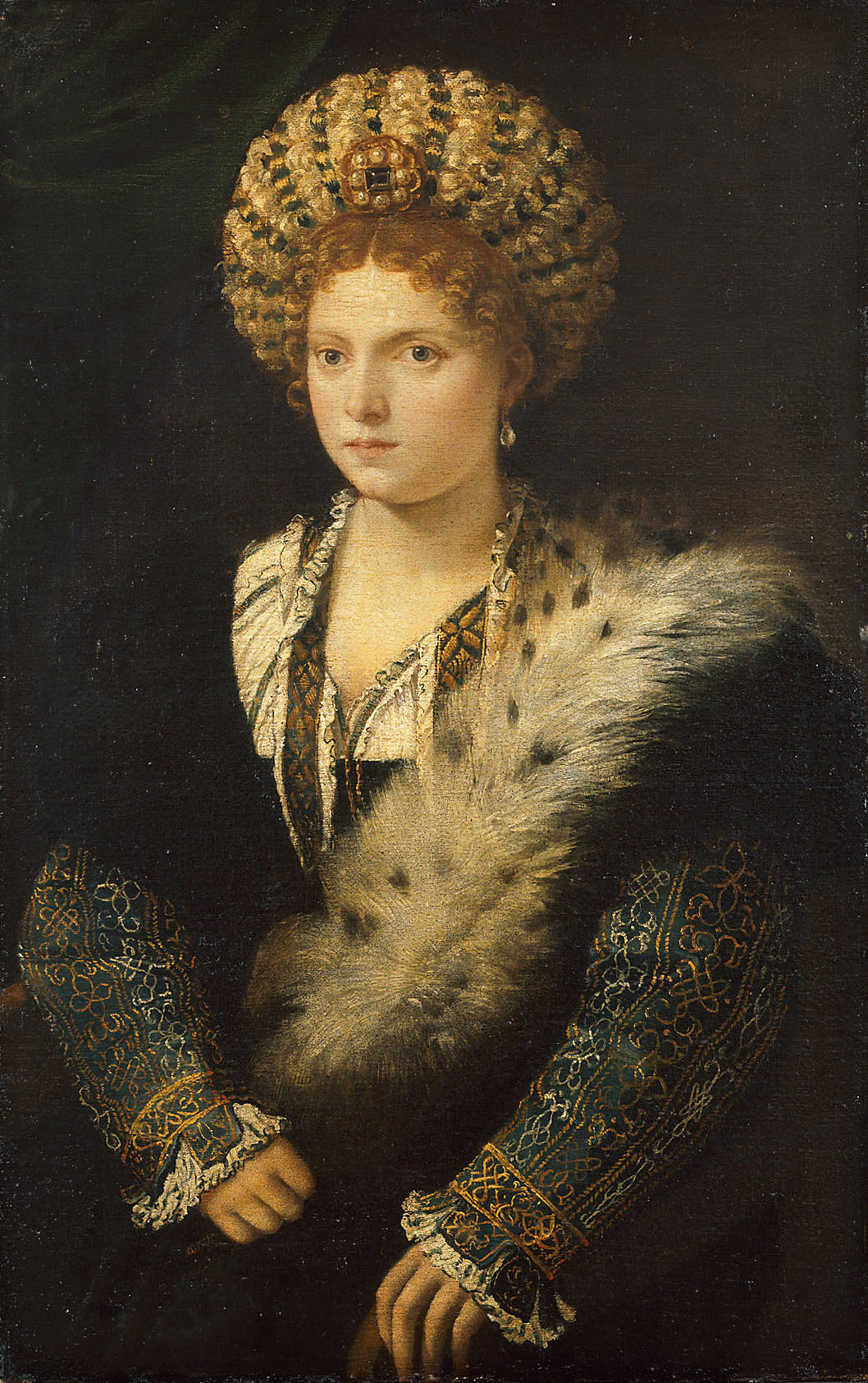
Two painted versions of Isabella d’Este have come to define her association with Titian, although neither records a simple encounter between painter and sitter. One, generally called Isabella in Red, is known principally through a copy made by Peter Paul Rubens after a lost Titian and shows Isabella as a mature woman. The other, Isabella in Black, now in the Kunsthistorisches Museum in Vienna, presents her with richly ornamented sleeves and an elaborate headdress, but with the face of a woman far younger than Isabella was when the portrait was painted in the mid-1530s. She was then about sixty. At first the two images seem to offer a choice between age and youth, observation and flattery. Their histories resist so simple a division.
Isabella had been concerned with the making and circulation of her image for much of her adult life, but the surviving correspondence makes it difficult to separate that concern from the political circumstances in which she lived. Married to Francesco II Gonzaga in 1490, she assumed delegated authority while her husband was campaigning during the Italian Wars and governed Mantua during his imprisonment by the Venetians in 1509–10. After Francesco’s death in 1519, his will appointed Isabella, together with Cardinal Sigismondo Gonzaga, to the regency until Federico reached the age of twenty-two. Carolyn James has argued that Isabella’s portrait commissions should therefore be considered alongside the other means by which a Renaissance ruler might establish magnificence, lineage, prudence and political competence. Her close direction of artists has often been judged more harshly than comparable image-making by male princes.
Dress formed part of the same visual language. By about 1509 Isabella had begun wearing elaborate turban-like headdresses variously described as the zazara, scuffioto or capigliara. Their association with her became sufficiently close that Susanna Gonzaga and Laura Bentivoglio sought permission to adopt the fashion and were refused. In 1515 a less resistible request arrived through Isabella’s son Federico: François I wanted a doll dressed in examples of the clothes Isabella wore, together with miniature versions of her headdresses, so that women at the French court could copy them. In 1523 Bona Sforza, queen of Poland, thanked Isabella for six gold-and-silk scuffioti and asked to receive examples of future inventions. Isabella’s fashions had acquired a reach, and a political currency, beyond Mantua.
For generations, such vigilance was readily explained as vanity. That interpretation has owed much to Pietro Aretino, who in 1534 ridiculed the ageing Marchioness for attempting to disguise the effects of time. James has shown how readily later scholars accepted his caricature, sometimes treating Isabella’s direction of artists as interference rather than as princely image-making. The familiar supposition that she commissioned Titian’s later, youthful portrait because she disliked his earlier image of her as an older woman is unsupported by surviving evidence: nothing is known of her response to the earlier portrait.
Her attitude towards likeness was less consistent than the charge of vanity implies. Isabella could object when a portrait failed to resemble her, and portraits were used within her family to compare features across generations. Yet she could also approve of an image that departed conspicuously from physical fact. The two portraits associated with Titian preserve both possibilities.
The earlier portrait has not survived. It is generally dated to about 1529–30, when Titian was working for the Gonzaga court, and the 2004 Ferrara catalogue Gli Este a Ferrara: una corte nel Rinascimento has treated it as a portrait painted from life. Isabella, born in 1474, was then in her mid-fifties, and Titian apparently showed her at something approaching her contemporary age.
Its composition is preserved in Rubens’s Isabella in Red, made around the beginning of the seventeenth century when he was in the service of Vincenzo Gonzaga at Mantua. Rubens copied two Titian portraits of Isabella there: the youthful portrait now in Vienna and the lost image of the older woman. In his version of the latter, also in the Kunsthistorisches Museum, Isabella sits at three-quarter length in red, holding a fan in her right hand while her left rests in her lap. Pearls and gold ornaments decorate the elaborate headdress, and the breadth of the dress gives the figure considerable physical presence. Titian’s original subsequently entered the collection of Charles I of England and was dispersed after the king’s execution. A seventeenth-century inventory described Isabella in an old-fashioned red dress, confirming the broad outlines of the composition preserved by Rubens.
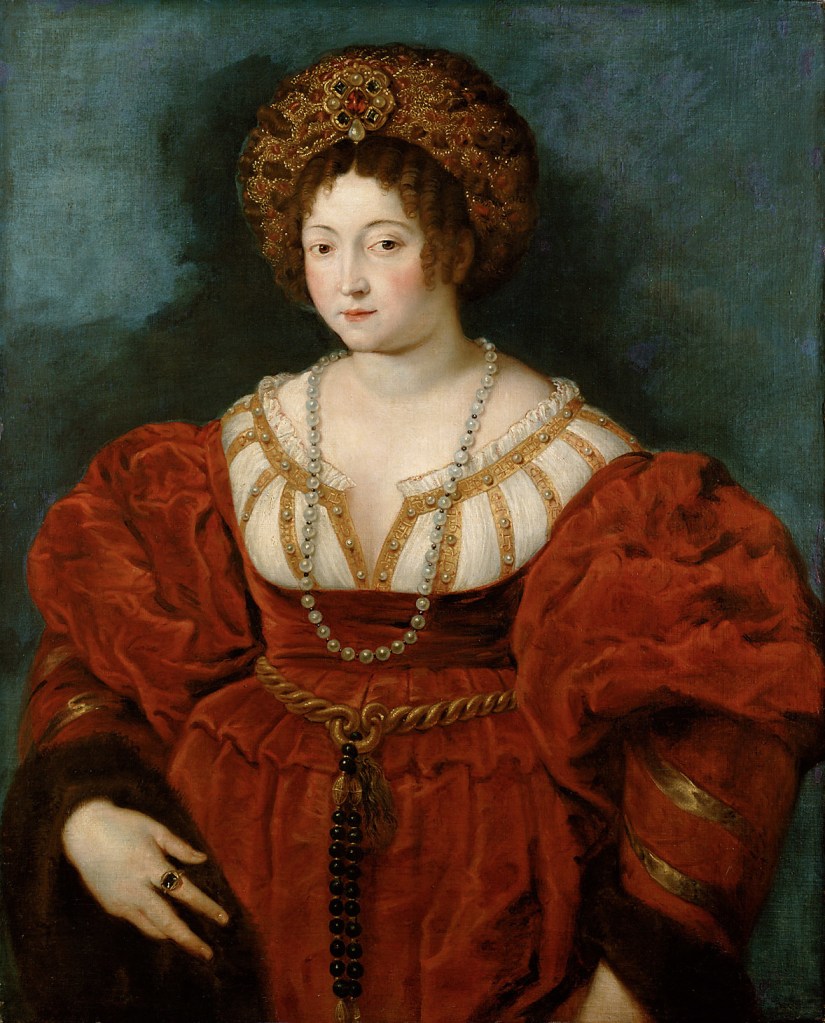
Rubens’s painting should nevertheless be treated as a translation rather than a facsimile. The Kunsthistorisches Museum has emphasised that he increased the splendour and bodily amplitude of Titian’s Isabella in accordance with his own pictorial language. The Vienna exhibition catalogue Isabella d’Este: La prima donna del mondo. Fürstin und Mäzenatin der Renaissance, by Sylvia Ferino-Pagden, develops the point further. The richness of the red costume, the glittering pearls and gold, the rosy complexion and the soft modelling of the face belong in part to Rubens’s early seventeenth-century conception of princely femininity. Isabella has become fuller and more opulent, without becoming a caricature.
Rubens has therefore preserved the lost composition without providing transparent access to Titian’s canvas, still less to Isabella herself. Even the portrait that apparently stood closest to her appearance in middle age has reached us through another painter, working roughly seventy years later.
The youthful portrait had a different and more elaborate genealogy. In 1534 Isabella arranged for Titian to work not from a new sitting but from a portrait that Francesco Francia had painted in 1511, when she was about thirty-seven. Francia, too, had worked without Isabella before him. She had refused to sit and instead supplied an earlier likeness, probably connected with Lorenzo Costa, while her half-sister Lucrezia d’Este Bentivoglio supplemented it with her recollections. Lucrezia thought Francia had made Isabella too thin and melancholy and urged her sister to sit for him in person, but Isabella remained unwilling to do so.
When Francia’s portrait reached Mantua, Isabella responded enthusiastically, remarking that he had made her considerably more beautiful than nature had done. She later gave the painting to the Ferrarese nobleman Gian Francesco Zaninello. More than twenty years afterwards it was recovered from Zaninello’s heirs and sent to Venice for Titian to use. His model was therefore a portrait whose flattering character Isabella had already recognised and approved, itself dependent upon an earlier likeness and another woman’s memory of her.
Francis Ames-Lewis has emphasised that such mediation was not unusual in Renaissance portraiture. Painted likenesses could be constructed from drawings or earlier portraits, supplemented by verbal description and remembered appearance; their purpose might be to present beauty, rank or social identity rather than to reproduce a sitter’s features with exact fidelity.
The resulting Isabella in Black does not advertise that ancestry. Isabella appears composed and youthful, seated upright against a dark background. Her black bodice is set against richly patterned blue sleeves worked with gold and silver, while white fur falls across one shoulder. Pearls and jewels ornament the headdress, and the rosary in her hands introduces piety into a display otherwise marked by magnificence and fashionable distinction. James has drawn attention to the balance between the exposed skin at the neckline and the restraint of the pose and indirect gaze. She also connects the headdress with the elaborate coiffures of Roman imperial women, extending classical associations already present in earlier images of Isabella.
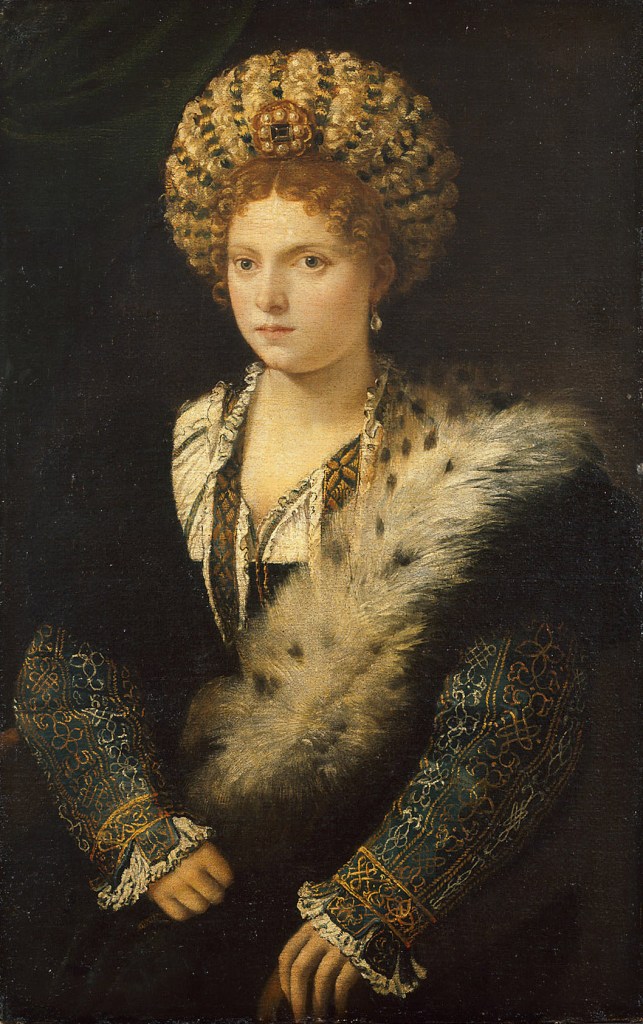
The portrait was finished by the spring of 1536. On 29 May Isabella wrote to her agent Agnello that it pleased her greatly, adding, with some humour, that she doubted she had ever possessed at the age represented the beauty Titian had given her.
That response belongs within a broader Renaissance understanding of portraiture. Beverly Louise Brown has argued that sixteenth-century discussions of female portraiture did not bind truthfulness to exact physiognomic reproduction. Petrarchan ideas of beauty allowed art to improve upon nature, while writers such as Paolo Pino and Giovanni Paolo Lomazzo accepted the correction of physical imperfections in pursuit of a more perfect image. Idealisation did not, in itself, disqualify a portrait from being considered true.
The point has a particular bearing on Titian. Paul Joannides has emphasised that his reputation as a portraitist rested on more than resemblance: costume, pose and expression could establish dignity, temperament and social identity. Titian was also confident in reconstructing sitters whom he had never seen. His profile portrait of François I, for example, was devised from verbal information and a medal. Joannides has compared that process directly with Isabella, whom Titian knew only in middle age but represented as a much younger woman.
Brown has seen the Vienna portrait as a more durable conception of Isabella, in which beauty accompanies intelligence and inward resolution. James has made that interpretation more historically specific. The rejuvenated figure may recall the years in which Isabella exercised some of her most conspicuous political responsibilities, maintaining the Gonzaga regime through the disruptions of the Italian Wars and demonstrating the prudence and fortitude expected of a ruler. Youth, on this reading, evokes a period of political competence as well as physical beauty.
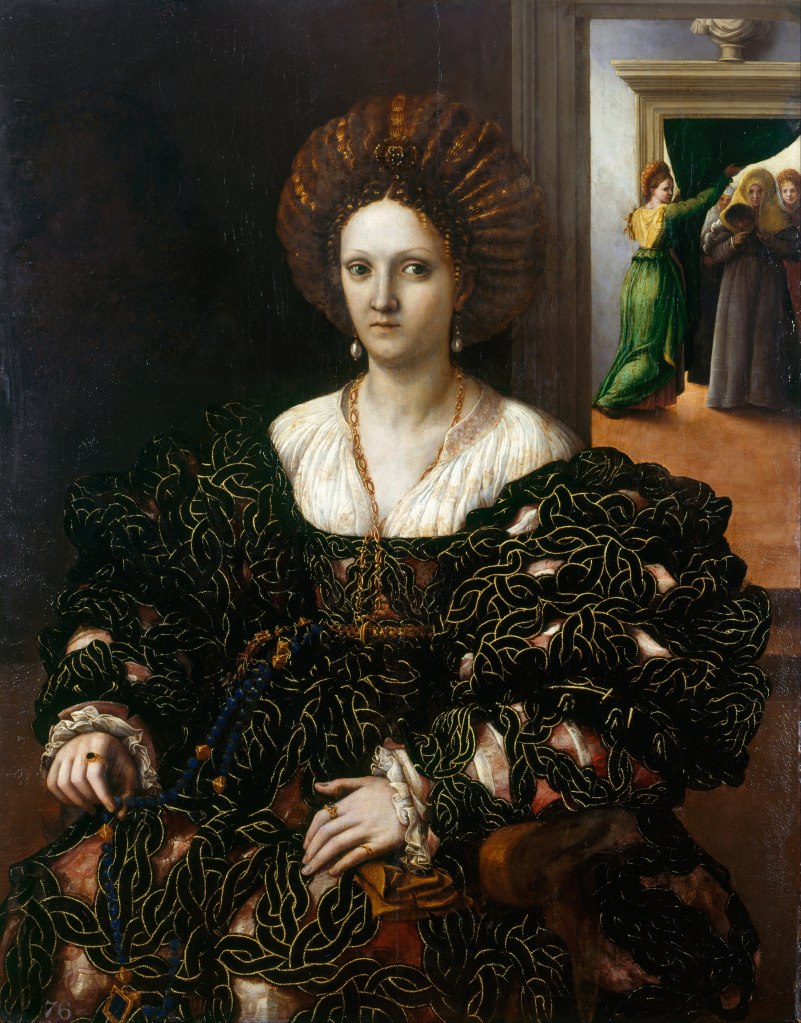
The portrait may also have participated in a dynastic transition during the 1530s. James has noted its affinities with Giulio Romano’s Portrait of a Woman, probably Margherita Paleologo, whose sitter, if the identification is correct, married Isabella’s son Federico Gonzaga in 1531. The two women share centrally parted hair, corkscrew curls, jewelled headdresses, pearl earrings, embroidered chemises and rosaries, as well as a comparable three-quarter-length format. Some of Margherita’s clothing may itself reflect sartorial gifts from Isabella. James has suggested that this shared visual language presented the younger woman as a successor within the Gonzaga dynasty, inheriting qualities of magnificence, prudence and piety associated with her mother-in-law.
One uncertainty remains over the Vienna painting itself. Francesco Valcanover, comparing it with Titian’s slightly later Portrait of Eleonora Gonzaga della Rovere in the Uffizi, questioned whether the surviving canvas was entirely autograph.
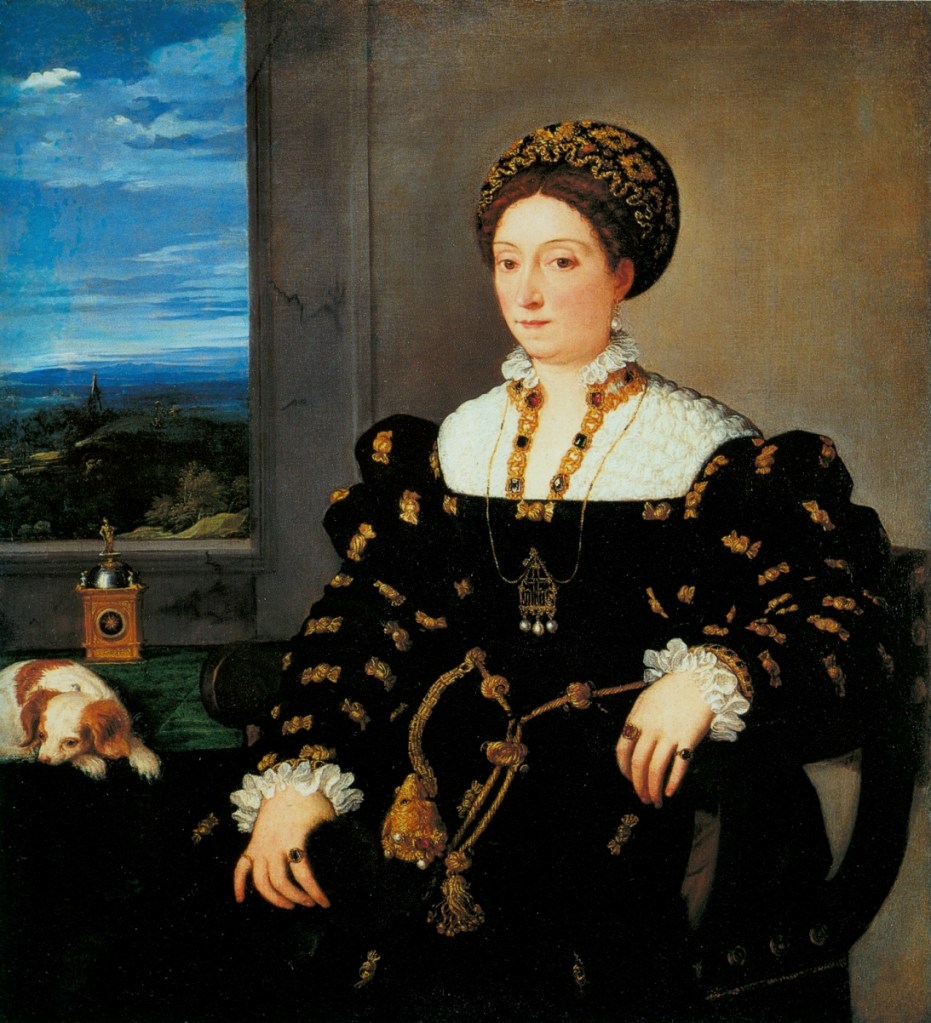
He found Isabella awkwardly placed in the chair and judged the drawing of the balzo, hair, costume and hands less assured than he would expect from Titian; the colour also seemed to him comparatively coarse and hurried. Since Titian’s other portraits made from pre-existing models do not generally show such weaknesses, Valcanover raised the possibility that the Vienna painting might be a workshop repetition of a lost original. The Kunsthistorisches Museum and subsequent cataloguing have continued to attribute it to Titian, so the proposal remains a dissenting one.
Whether or not Valcanover’s suspicion is accepted, Isabella’s letter of 1536 provides the most direct contemporary response to the youthful image. She recognised the extent of Titian’s transformation and welcomed it.
Producing these essays requires care, time, research, and resources. Contributions to help sustain this exploration would be greatly appreciated.
https://donorbox.org/inner-surfaces-resonances-in-art-and-literature-837503
Bibliography
The following sources were consulted. Any errors are mine.
Ames-Lewis, Francis. Isabella and Leonardo: The Artistic Relationship between Isabella d’Este and Leonardo da Vinci, 1500–1506. New Haven and London: Yale University Press, 2012.
Bentini, Jadranka, ed. Gli Este a Ferrara: Una corte nel Rinascimento. Exhibition catalogue, Castello Estense, Ferrara, 14 March–13 June 2004. Cinisello Balsamo: Silvana Editoriale, 2004.
Biadene, Susanna, ed. Tiziano. Exhibition catalogue, Palazzo Ducale, Venice, and National Gallery of Art, Washington. Venice: Marsilio Editori, 1990.
Brown, Beverly Louise. “No Less True than Truth: Female Portraiture between the Real and the Ideal.” In Titian’s Vision of Women: Beauty, Love, Poetry, edited by Sylvia Ferino-Pagden, Francesca Del Torre Scheuch and Wencke Deiters, 189–208. Milan: Skira, 2021.
Ferino-Pagden, Sylvia. Isabella d’Este, “La Prima donna del mondo”: Fürstin und Mäzenatin der Renaissance. Edited by Wilfried Seipel. Exhibition catalogue, Kunsthistorisches Museum, Vienna. Vienna: Kunsthistorisches Museum, 1994.
James, Carolyn. “Political Image Making in Portraits of Isabella d’Este, Marchioness of Mantua.” Gender & History 35, no. 1 (2023): 20–41. doi: 10.1111/1468-0424.12582.
Joannides, Paul. Titian to 1518: The Assumption of Genius. New Haven and London: Yale University Press, 2001.
Kunsthistorisches Museum Wien. “Isabella d’Este, Marchioness of Mantua.” Tiziano Vecellio, c. 1534–36. Gemäldegalerie, inv. 83. Online collection entry. Accessed 11 September 2026.
Kunsthistorisches Museum Wien. “Isabella d’Este.” Peter Paul Rubens, c. 1600–01. Gemäldegalerie, inv. 1534. Online collection entry. Accessed 11 September 2026.
Valcanover, Francesco. “Tiziano in Palazzo Ducale a Venezia: Un primo bilancio.” In Titian 500, edited by Joseph Manca, 16–27. Studies in the History of Art 45, Symposium Papers XXV. Washington, DC: National Gallery of Art, 1993.
 Inner Surfaces