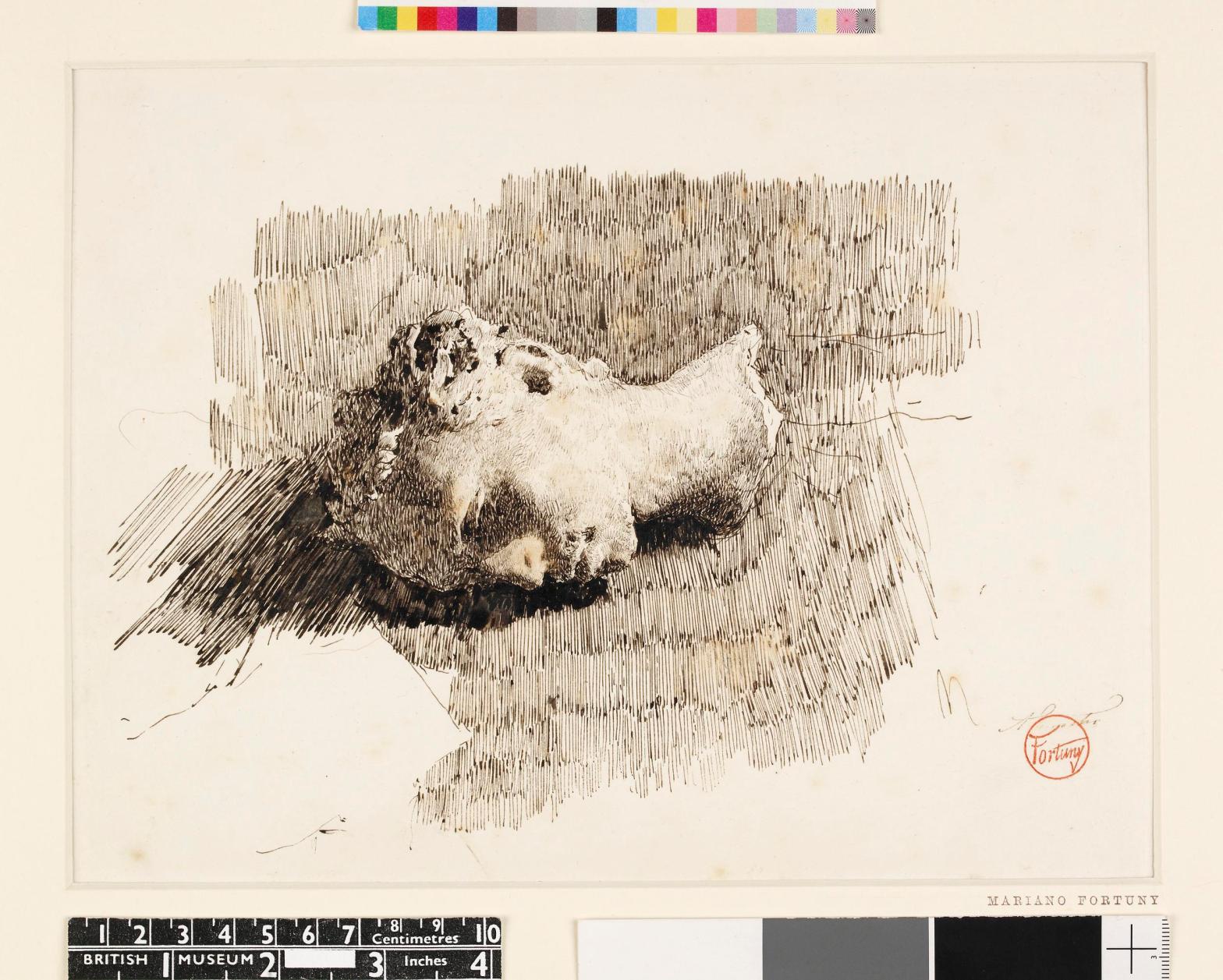
Mariano Fortuny, Plaster head of Francesco Paolo Michetti by Vincenzo Gemito, undated, before 1874, pen and brown ink on paper, 21.1 × 30 cm, British Museum, London. © The Trustees of the British Museum. CC BY-NC-SA 4.0.
One reality, several ways of seeing
Mariano Fortuny’s drawing of Vincenzo Gemito’s plaster portrait of Francesco Paolo Michetti presents the artist through another artist’s translation of a sculpted likeness. The image is particularly apt for Michetti, whose own practice repeatedly moved between direct observation, photographic record and transformation in other media.
Francesco Paolo Michetti is difficult to contain within the conventional boundaries of a painter’s career. Painting remained central to his activity, but his practice also encompassed photography, drawing, sculpture, decorative design, experiments with architectural space, optical devices, theatre and, eventually, cinema. These interests overlapped across a career in which Michetti repeatedly tested different ways of observing, preserving and transforming what he saw.
This experimentalism appeared early. Michetti first exhibited in Paris in 1872, when he was barely twenty-one, and returned repeatedly over the following decades. By the beginning of the 1880s his work was already conspicuous for its variety of materials and presentation. At the Milan exhibition of 1881 he showed more than thirty works, predominantly in pastel and tempera, while contemporary commentators also noticed his unconventional frames, which extended the visual effect of the picture beyond the painted surface itself. Photography had entered his practice by this period. A photograph of the pinewood near Francavilla, dated to about 1881, already shows the camera being used to isolate the structure and rhythm of natural forms. At the same time, critics were noticing the importance of movement in Michetti’s painting. Reviewing the Turin exhibition of 1880, Louis Gonse singled out the force and accuracy of movement in his compositions, decades before Michetti’s experiments with cinema.
Luigi M. Lombardi Satriani offers a useful way of thinking about this range of activity in his essay “Le realtà e gli sguardi”. He considers the different kinds of attention brought to Abruzzo by Michetti and the circle around him. Michetti, Gabriele D’Annunzio, Costantino Barbella and the folklorist Antonio De Nino could travel through the same towns, attend the same religious festivals and observe the same people, yet what each retained from those encounters depended upon his particular form of practice. One might make photographs or drawings, another sculpture, literary notes or ethnographic description. Lombardi Satriani argues that reality is therefore not simply received intact by the observer, but assumes different contours according to the gaze directed towards it.
The Francavilla circle provides a concrete example of a shared field of experience being apprehended in different ways. Michetti’s own practice raises a related question within the work of a single artist, since he himself moved continually between different forms of representation. Photography could arrest a passing appearance, isolate a detail and preserve it for scrutiny. Painting allowed observed material to be reorganised through colour and composition. Sculpture offered a way of testing volume and physical presence. His manipulation of architectural space brought actual light and framing into the experience of looking, while theatre and cinema later introduced duration, performance and movement.
Photography became particularly important within this range because it allowed appearances to be detached from the circumstances in which they had first been seen. They could then be stored, enlarged, compared, classified and returned to long after the original encounter.
Photography as instrument, archive and form of knowledge
The camera accompanied Michetti into the field. In the early 1880s he travelled through Abruzzo with Gabriele D’Annunzio, Costantino Barbella and Antonio De Nino, seeking out religious festivals and other occasions when large numbers of people gathered. Barbella recalled an expedition to the pilgrimage at Casalbordino in which he, Michetti and D’Annunzio left Pescara at dawn and carried cameras specifically to make studies of costume. Michetti was already thinking about Il voto, while D’Annunzio was making notes for future writing. Similar excursions followed, combining photography with drawing, sculpture, literary observation and the developing ethnographic study of regional customs.
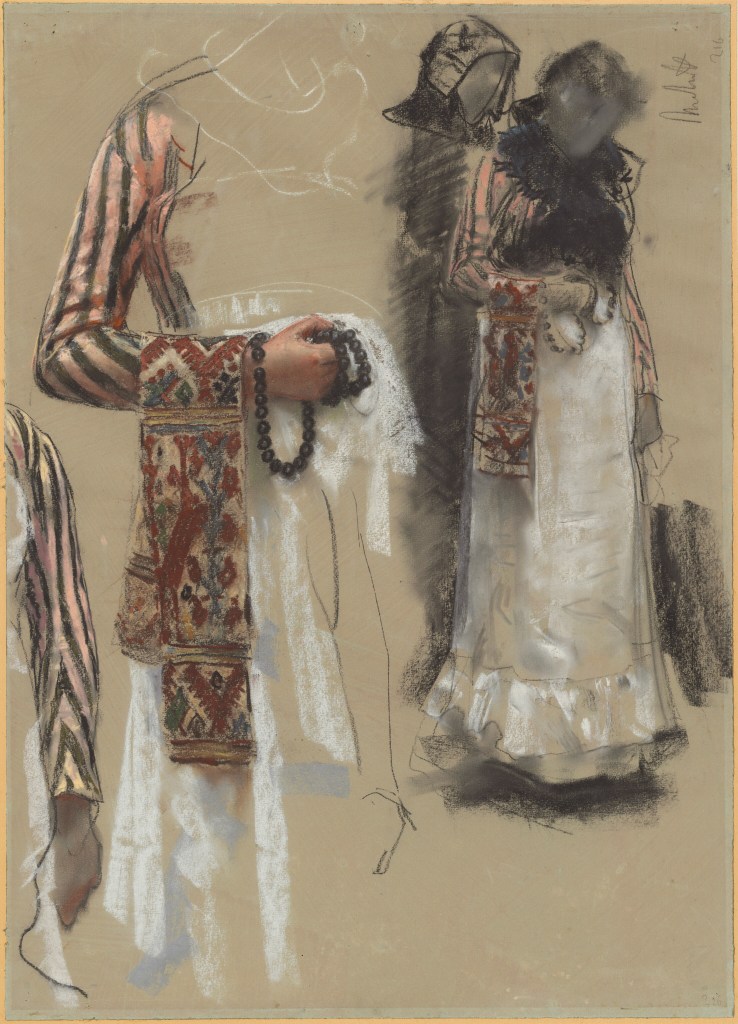
Michetti photographed pilgrims, processions and crowds, as well as shepherds, peasants, street vendors, musicians, mothers and children. The camera could preserve a gesture, a costume or a face encountered within the movement of a festival and make it available for later study. His use of photography also extended beyond these organised expeditions. In September 1888, writing to Simone Sorge, he casually mentioned bringing his camera on a visit in order to make a portrait, evidence of how readily photography had entered his ordinary working and social life.
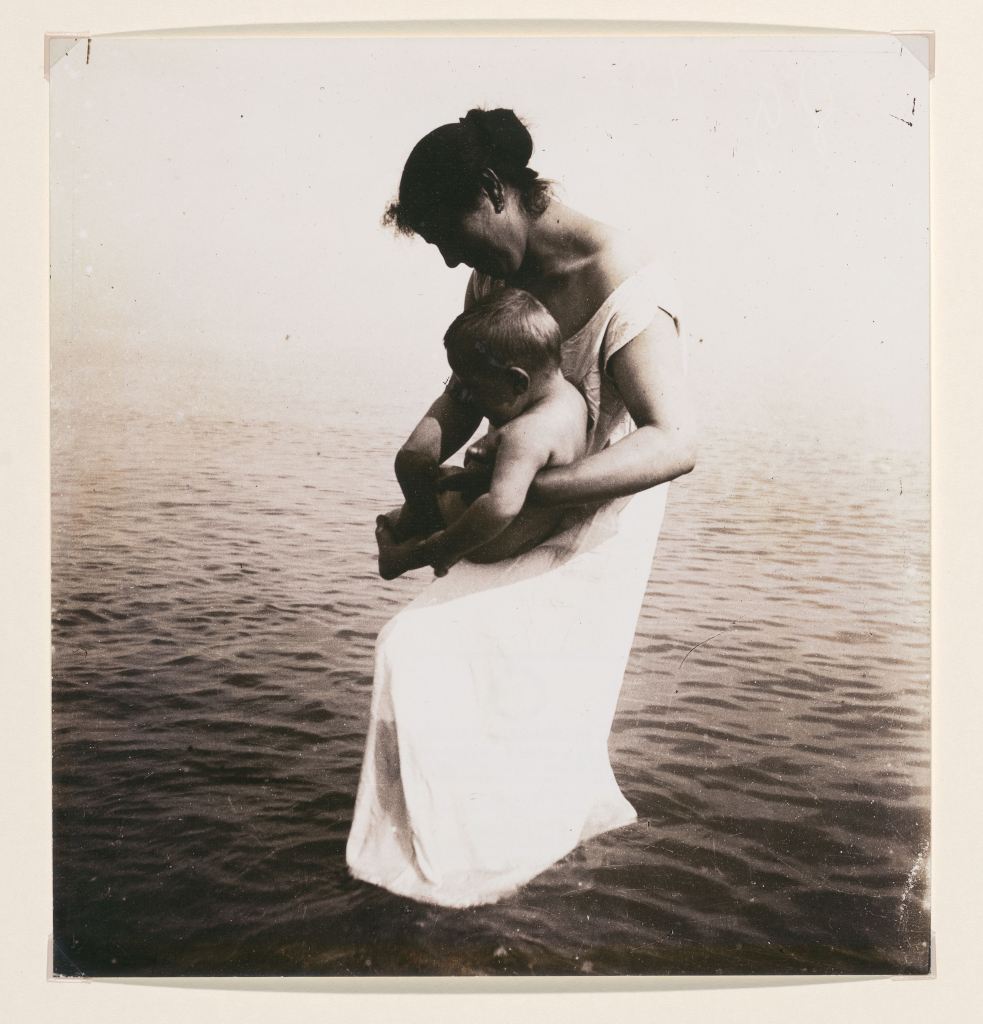
The scale of the archive that resulted was considerable. Ugo Ojetti later described numbered and alphabetically ordered drawers containing some ten thousand photographs taken by Michetti himself, alongside a separate system for cataloguing thousands of canvases and studies. Photographs could be retrieved and compared with painted sketches, allowing figures and landscapes recorded at different times to remain available long after the moment in which they had first been seen. The archive functioned as a form of visual memory that could be searched, compared and rearranged.
Its subjects extended well beyond the human material of the Abruzzese expeditions. Michetti photographed flowers, leaves, roots, rocks, trees and stones worn smooth by water, often concentrating closely on their structure and surface. Marina Miraglia draws particular attention to photographs of trees made at the Villa d’Este at Tivoli around 1910–11. The only photographic enlargements she found in Michetti’s archive were details from these studies. Enlargement allowed a fragment of bark, branching structure or configuration of foliage to be separated still further from its surroundings and examined as a visual form in its own right.
By this stage photography could also produce images that Michetti regarded as complete without translation into paint. When the Milanese dealer Lino Pesaro visited him at Francavilla in 1919 and asked to see recent paintings, Michetti showed him photographs instead. According to Miraglia’s account, he saw no need to transfer them to canvas when they had already achieved the aesthetic and expressive result he wanted. Photography and painting could therefore coexist within his practice as distinct means of working with appearances, even while photographs continued to contribute to the conception of paintings.
The archive remained an active part of Michetti’s creative process. A photographed figure could be detached from its original setting, a landscape retained for another purpose, and observations made at different times brought together within a new composition. Visible experience, once fixed by the camera, became material that Michetti could select, alter and recombine in paint.
Observation and transformation
The photographic archive gave Michetti a repertoire from which individual elements could be extracted and used in new circumstances. A photographed figure might recur in several paintings, altered in dress, orientation or gesture. Landscape and figures recorded separately could be brought together within a single composition. In one study of two peasant women near Rapino, for example, the photographed figures were subsequently combined in paint with a landscape element probably derived from another photographic source. The photograph supplied material from which Michetti could construct a new image.
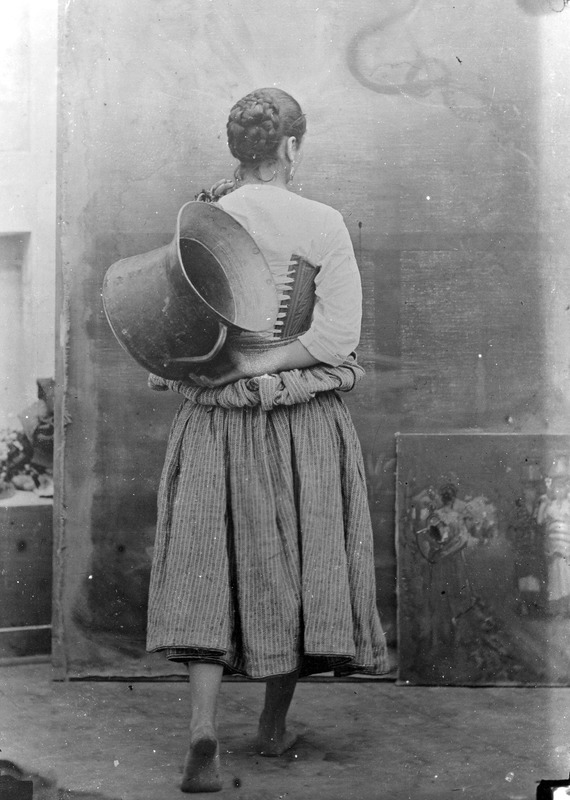
The long development of La figlia di Iorio makes the process particularly clear. Michetti repeatedly photographed women carrying a conca, sometimes posed in the studio and sometimes caught walking, and related figures recur across works from different periods. One photograph made before 1895 records a model in the pose eventually used for the daughter of Iorio. Landscape was investigated separately. A stereoscopic photograph of the Maiella carries on its reverse Michetti’s rapid drawing of a walking woman, while the profile of the photographed mountain is closely related to the simplified ridge in the finished painting.
Photography could also enter the process after a pictorial idea had already begun to take shape. One catalogue entry records Michetti devising a figure in the course of developing La figlia di Iorio, then posing a living model according to that conception and photographing her. The new photograph could in turn be used as the composition continued to develop. Drawing, photography and painting could therefore succeed one another more than once during the making of a work.
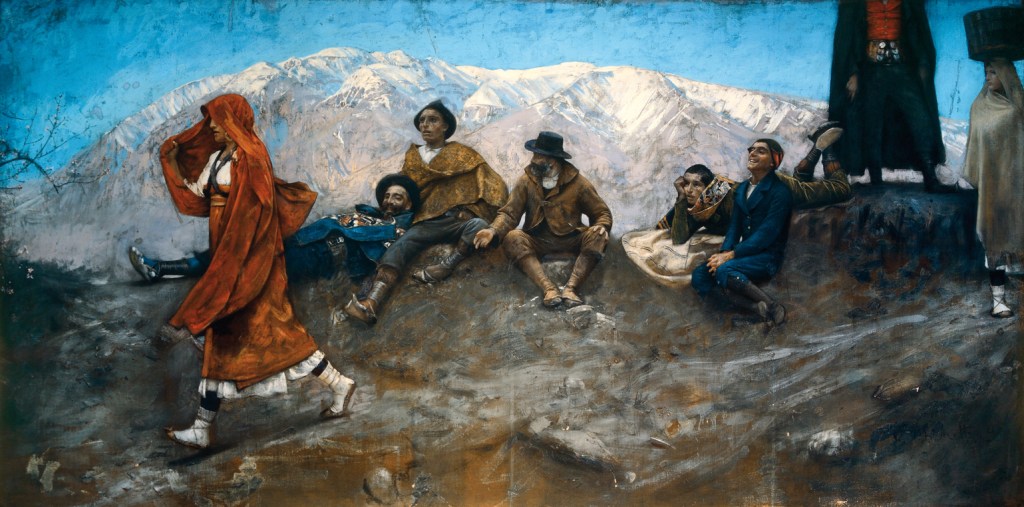
The accumulated studies are brought together in La figlia di Iorio within an emphatically simplified composition. The daughter appears at the left, striding away beneath her red mantle, while the men are distributed across the rocky slope to her right. At the far right another woman, carrying a conca on her head, turns back towards the scene. Behind them the Maiella is reduced to a broad, sharply defined mountain profile. Renato Barilli relates this compression to Michetti’s persistent tendency to suppress perspectival depth and organise forms across the painted surface. Detailed observation has here been distilled into a severe horizontal arrangement of figure, gesture and landscape.
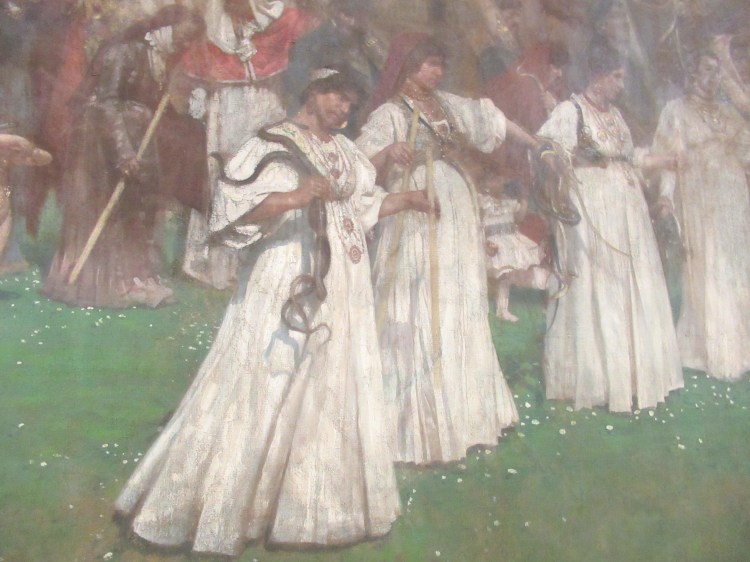
A comparable movement from close observation to stylisation appears in Le serpi. Its long preparation included photographic and graphic studies connected with the Abruzzese religious festival at Cocullo. Teresa Mulone draws attention to the strongly stylised floral forms incorporated into the painting, with sinuous curves related to the colpo di frusta of contemporary Art Nouveau. Michetti’s study of local people, costume and ritual thus entered a composition shaped equally by pattern, rhythm and an international decorative language.
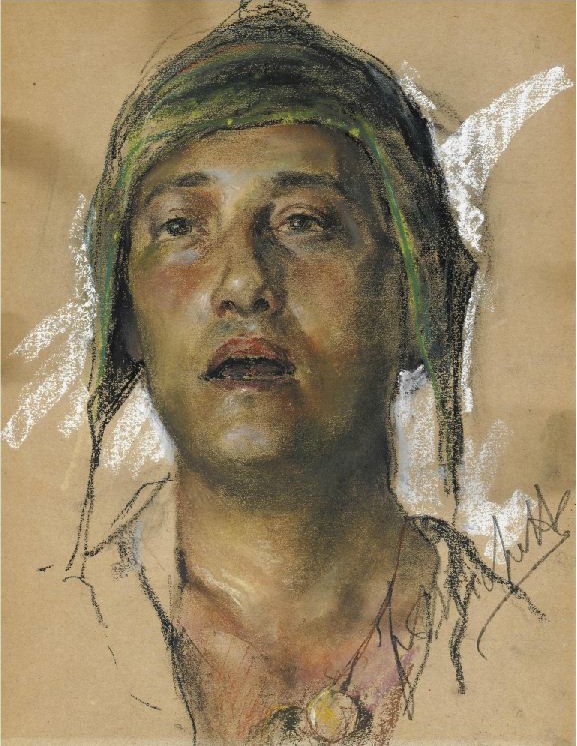
This tendency to organise observed material through rhythm and simplification was carried much further in the works Michetti called Linee, a body of work subsequently discussed as the Poema delle Linee. Contemporary descriptions suggest that the term was already in use by the 1880s, although many of these works were subsequently associated with his later career. Gabriele D’Annunzio described Michetti as seeking the “hidden lines” within visible appearances and wrote of some two hundred canvases in which an idea had been reduced to its fundamental tones and lines. Some were comparatively developed in colour, while in others a single line and colour could retain the expressive force of the original perception; elsewhere a few rapid indications were enough to suggest movement with remarkable immediacy.
The Linee also belonged to Michetti’s continuing dialogue with photography. Photographic records, painted studies and highly reduced compositions remained connected within the same working archive. Miraglia describes the Poema delle Linee as a “sublimation of photographic language”: the instantaneous selection characteristic of photography had become part of Michetti’s pictorial thinking. The individual image could operate almost like a frame extracted from a longer sequence, reduced to the essential relations of light, line and movement.
Photography could also enter the physical making of an image. Michetti sometimes worked directly over photographic prints, adding tempera by hand. Roberto Lucifero records a more unusual procedure in which Michetti prepared a canvas with a thin layer of gesso and then coated it with photographic emulsion. A photographic trace was produced directly on this prepared surface and subsequently developed further in paint. The photographic image and the painted image therefore occupied the same support, with the former serving as an underlying stage in the construction of the latter.
Light offered another field for this kind of investigation. Photography could preserve particular effects of illumination, while Michetti’s paintings, interiors and optical experiments gave him further means of recreating and manipulating them.
Light and movement
Roberto Lucifero characterises Michetti’s visual activity as a continual “hunt for light”. He describes reflected light on foliage becoming a brushstroke and presents light as a persistent element in Michetti’s investigation of visible form. Movement was another longstanding concern, one that would eventually lead him from painting and photography into cinema.
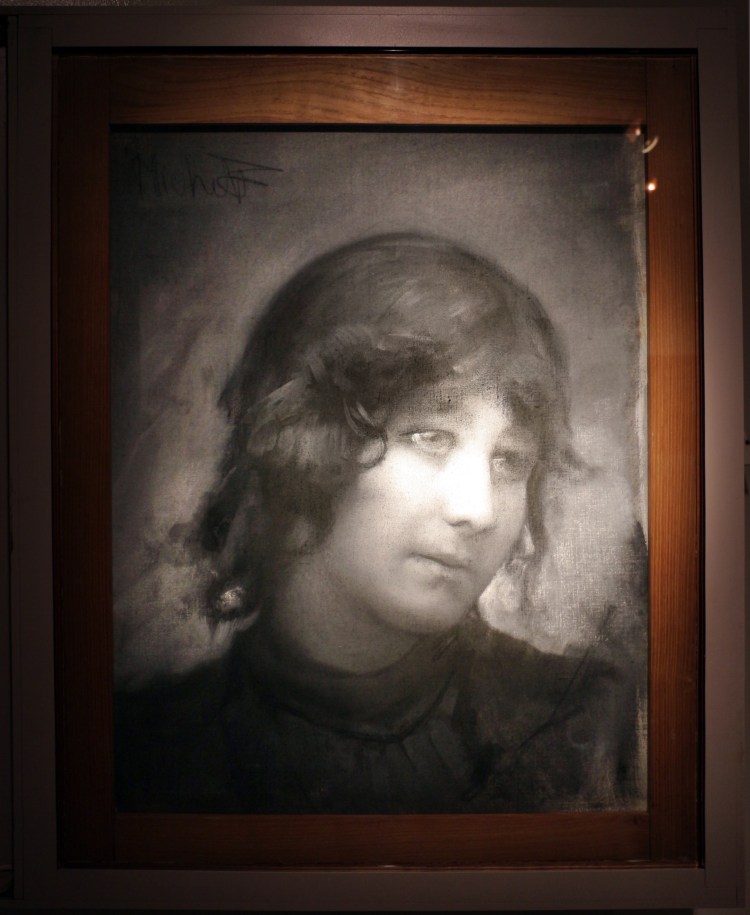
At the Convento Michetti, the former Franciscan convent at Francavilla, Michetti carried his interest in seeing into the building itself. He constructed large circular windows deliberately positioned to frame particular views of the surrounding landscape. Marina Miraglia relates these architectural devices to his broader fascination with optical framing, also evident in his habitual use of binoculars. The rooms were painted white to intensify the daylight, while curtains devised for both the Convento and the Casino al mare incorporated coloured textile inserts through which daylight entered the rooms. In this way Michetti could alter the colour of the natural light illuminating an interior.
The Casino al mare also contained an optical laboratory with instruments devised by Michetti and his son Alessandro. Among them was a stereoscope made by Michetti himself, a device that creates an impression of three-dimensional depth by presenting a slightly different image to each eye.
Photography provided Michetti with another means of investigating movement. A particularly revealing example is his series recording the mattanza, or tuna slaughter, at Acireale around 1907. Successive instantaneous exposures record closely spaced moments within the same event. The viewpoint shifts between broader views of the collective action and closer framings of fishermen, gestures and expressions. Miraglia sees in these sequences an emerging cinematic way of looking.
His interest in moving images eventually led him to make a feature-length film, Volti d’Abruzzo (Faces of Abruzzo), between 1923 and 1925. The film is now lost. Separate surviving cinematographic material from this period includes fragments shot in Rome and a short documentary. Miraglia notes in the surviving footage changes of scale, movement towards the camera and shifts of focus. Michetti’s papers at Francavilla also preserve drawings dated 1923–25 for cinematographic cameras, projectors and other photographic and film equipment. In the same group of material, a photograph of a strip of film is followed by the isolation of a single frame. Miraglia sees this as another form of Michetti’s longstanding attempt to seize a transient expressive moment from the continuous flow of movement.
Beyond the picture
The unconventional frames already noticed by critics at the Milan exhibition of 1881 developed into increasingly elaborate extensions of the painted image. The frame Michetti devised for Corpus Domini was itself an intricate construction. Ugo Ojetti describes an iron-coloured surround carrying a painted woman wrapped in a long cloth with a child in her arms, a nude man below, a polished brass disc surmounted by a black ball, and an extraordinary accumulation of scarabs, starfish, rosaries, crucifixes, penitential disciplines and scapulars. Ojetti understood this heterogeneous collection as a commentary on the painting and as a gathering of emblems drawn from Abruzzese religious culture. The boundary of the picture had become another field in which Michetti could combine painting, sculpture, objects and symbolic forms.
Michetti’s activity in design extended into fabrics, furniture and architecture. At Francavilla he designed the Casino al mare, his early seaside studio, and drew up its architectural plans himself. His work on such spaces belonged to the same broad range of activity that included the design of furniture, decorative fabrics and mechanisms.
Theatre offered a further opportunity to work with space, figures and movement. In 1904 Michetti collaborated with Gabriele D’Annunzio on the first production of La figlia di Iorio, staged at the Teatro Lirico in Milan on 2 March under the direction of Virgilio Talli. Michetti designed the scenery and costumes for a subject that he had already investigated over many years through painting, drawing and photography. In letters concerning the production, D’Annunzio looked to Michetti’s accumulated experience to establish human types, determine settings and devise the spatial arrangements of the action.
Much of the visual material already existed in Michetti’s photographic archive. The costume worn by Irma Grammatica as Mila di Codro was identical to one Michetti had photographed earlier on the terrace of his Roman studio while preparing Le serpi. Marina Miraglia also notes that the arrangement of the hair closely corresponds to the earlier photographic study. Material gathered through observation and photography could therefore be transferred directly into costume and performance.
Michetti also used photographs of the Grotta del Cavallone near Lama dei Peligni when designing the setting for the second act, in which the young shepherd Aligi and Mila take refuge together in a mountain cave.
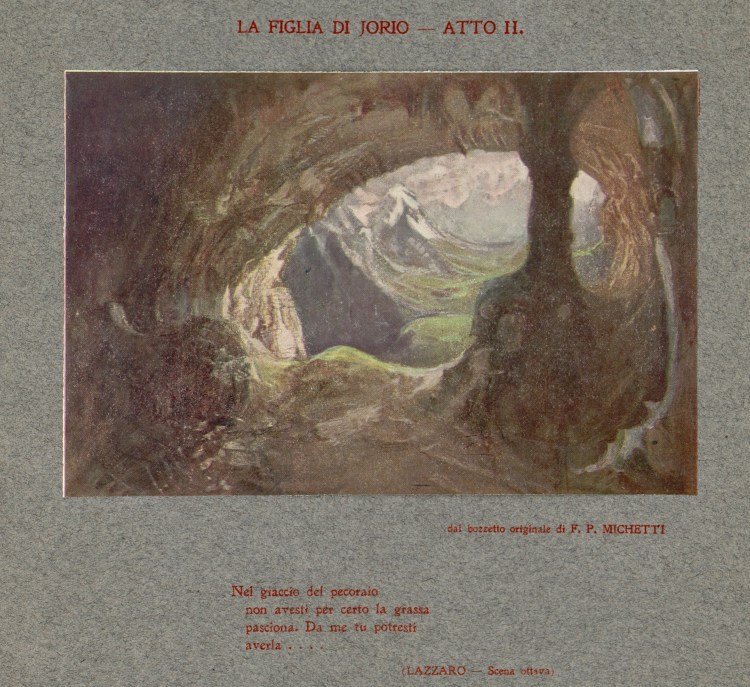
Close observation of an actual landscape, together with Michetti’s accumulated studies of Abruzzese costume and human types, helped him construct the archaic world D’Annunzio wanted for the drama, described by the poet as “barbaric and remote”. The association with the play subsequently became attached to the real place: the great entrance chamber of the Grotta del Cavallone became known as the Sala di Aligi.
Conclusion
Michetti’s movement between painting, photography, drawing, design, theatre and cinema was sustained by a persistent interest in how visible experience could be observed, preserved and transformed. Different media allowed him to isolate different aspects of the same world.
Luigi M. Lombardi Satriani’s account of different forms of looking offers a useful way of understanding this range. The continuity of Michetti’s work lies in the enquiry itself: from his early photographic studies to his later optical and cinematic experiments, he remained concerned with the appearance of things and with the means by which their forms, movements and changing effects of light might be grasped.
A related essay on Francesco Paolo Michetti can also be found elsewhere on Inner Surfaces: Francesco Paolo Michetti: Light, Colour and the Vitality of Motion.
Producing these essays requires care, time, research, and resources. Contributions to help sustain this exploration would be greatly appreciated.
https://donorbox.org/inner-surfaces-resonances-in-art-and-literature-837503
Bibliography
The sources for this essay are as follows. Any errors are mine.
Barilli, Renato, ed., with Alessandra Borgogelli and Susanna Weber. L’ultimo Michetti: pittura e fotografia. Florence: Fratelli Alinari, 1995.
Barilli, Renato. “Combattimento per un’immagine nell’ultimo Michetti.” In L’ultimo Michetti: pittura e fotografia, edited by Renato Barilli, with Alessandra Borgogelli and Susanna Weber, pp. 7–16. Florence: Fratelli Alinari, 1995.
Benzi, Fabio, and Claudio Strinati, eds. Francesco Paolo Michetti: dipinti, pastelli, disegni. Naples: Electa Napoli, 1999.
Benzi, Fabio, Gianluca Berardi, Teresa Sacchi Lodispoto and Sabrina Spinazzè. Francesco Paolo Michetti. Catalogo generale. Vol. 1. Cinisello Balsamo: Silvana Editoriale, 2018.
Benzi, Fabio, Gianluca Berardi, Teresa Sacchi Lodispoto and Sabrina Spinazzè. Francesco Paolo Michetti. Catalogo generale. Vol. 2. Cinisello Balsamo: Silvana Editoriale, 2024.
Garofalo, Daniela. Francesco Paolo Michetti. Il genio fotografico. Pescara: Ianieri Edizioni, 2015.
Lombardi Satriani, Luigi M. “Le realtà e gli sguardi.” In Francesco Paolo Michetti: il cenacolo delle arti. Tra fotografia e decorazione, pp. 65–71. Naples: Electa Napoli, 1999.
Lucifero, Roberto. “Oltre la pittura: uno stile di vita.” In Francesco Paolo Michetti: il cenacolo delle arti. Tra fotografia e decorazione. Naples: Electa Napoli, 1999.
Miraglia, Marina. Francesco Paolo Michetti fotografo. Turin: Einaudi, 1975.
Miraglia, Marina. “Michetti tra pittura e fotografia.” In Francesco Paolo Michetti: il cenacolo delle arti. Tra fotografia e decorazione. Naples: Electa Napoli, 1999.
Mulone, Teresa. “Michetti e il gusto di fine secolo: qualche precisazione.” In Francesco Paolo Michetti: il cenacolo delle arti. Tra fotografia e decorazione. Naples: Electa Napoli, 1999.
Ojetti, Ugo. “Artisti contemporanei: F. P. Michetti.” Emporium 32, no. 192 (December 1910): 403–428.
Sorge, Paola, ed. Lettere di Michetti a Vinca, a Simone Sorge, agli amici. Pescara: Ianieri Edizioni, 2025.
Strinati, Claudio, scientific director. Francesco Paolo Michetti: il cenacolo delle arti. Tra fotografia e decorazione. Naples: Electa Napoli, 1999.
Weber, Susanna. “L’ultimo Michetti e la fotografia.” In L’ultimo Michetti: pittura e fotografia, edited by Renato Barilli, with Alessandra Borgogelli and Susanna Weber, pp. 29–36. Florence: Fratelli Alinari, 1995.
Online resources
Di Monte, Michele. “Michetti, Francesco Paolo.” Dizionario Biografico degli Italiani, vol. 74. Rome: Istituto della Enciclopedia Italiana, 2010.
Catalogo Generale dei Beni Culturali. Entries relating to Francesco Paolo Michetti and his photographic archive.
Grotte del Cavallone. Historical material relating to La figlia di Iorio, the Grotta del Cavallone and the Sala di Aligi.
Museo Michetti, Francavilla al Mare. Historical and collection information relating to Michetti, the Casino al mare and the Convento Michetti.
 Inner Surfaces