Luca Giordano, Self-Portrait as an Alchemist, c. 1660, oil on canvas, 116 × 96 cm, Pinacoteca di Brera, Milan, inv. 689. Image: © Pinacoteca di Brera, Milan – MiC.
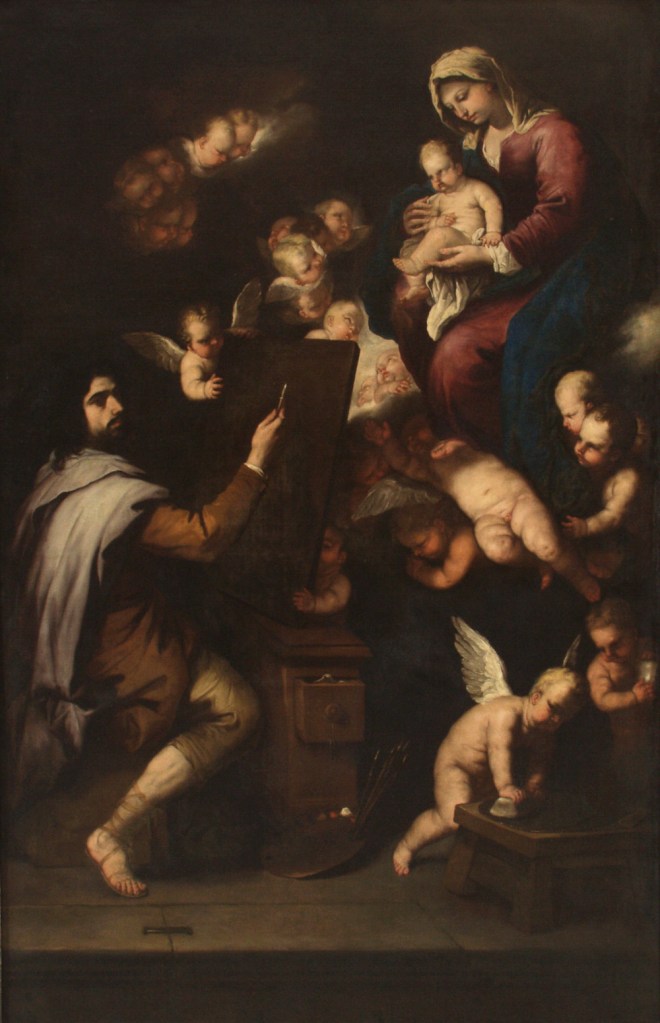
Luca Giordano returned to his own appearance throughout his long career. His earliest experiments in self-representation include Saint Luke Painting the Virgin, now in the Museo de Arte de Ponce, Puerto Rico, in which the young painter gave the Evangelist his own features, as well as a group of portraits in which he assumed the identities of philosophers and an alchemist.
Later portraits record the changes in his appearance as his reputation grew and his career extended from Naples and Florence to Madrid. Bernardo De Dominici remembered a long face, chestnut-coloured eyes and hair, and a habitually melancholy expression, characteristics that can be followed, with considerable variation, through Giordano’s painted images of himself.
The four paintings considered here do not constitute a complete survey. They span roughly three decades and show Giordano at different stages of his career, from the intellectual role-playing of his early years to the increasingly direct scrutiny of his ageing face. They were also made under different circumstances. One presents the painter as an alchemist; another entered Cardinal Leopoldo de’ Medici’s collection of artists’ self-portraits; a third makes spectacles, sight and the activity of painting prominent; and the last was probably made shortly before Giordano left Naples for Spain in 1692.
The alchemist
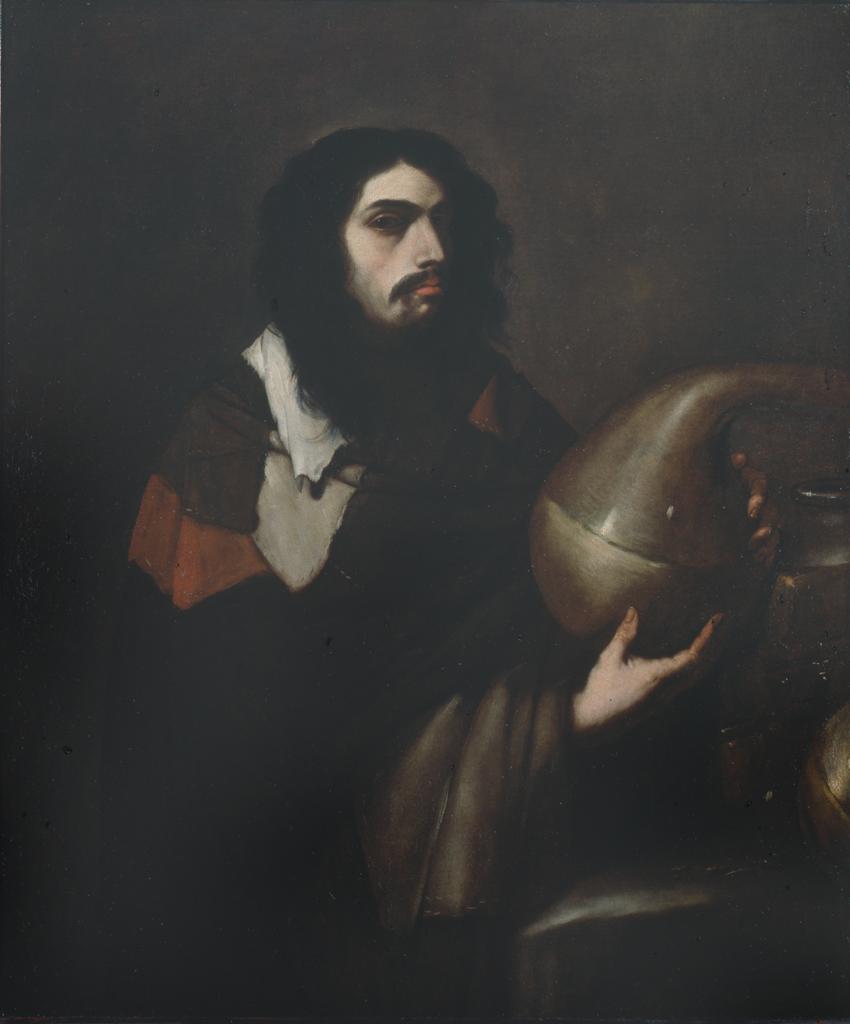
Around 1660, while still in his twenties, Giordano painted himself holding a large glass alembic. The vessel identifies the role he has assumed in the Self-Portrait as an Alchemist, now in the Pinacoteca di Brera. The museum relates the painting to a fashion among Neapolitan intellectuals for having themselves represented in the guise of philosophers, a practice that Giordano adopted in a group of youthful self-portraits.
The role is established with few means. Against a dark background, Giordano turns towards the viewer with the alembic held prominently before him. Light catches the broad glass vessel and the face above it, while much of his clothing remains in shadow. His long features, dark hair and direct gaze correspond with descriptions of his youthful appearance. The glass apparatus gives greater specificity to the identity he has chosen. This is not simply a learned man, but an alchemist, associated with the investigation and transformation of matter.
Such figures already had a strong pictorial tradition in Naples. Jusepe de Ribera’s half-length philosophers and learned men had found a ready audience there, and Ribera remained an important model for Giordano during his early career. Giordano extended this repertory to philosophers, mathematicians, astronomers and astrologers. Biagio de Giovanni has placed these paintings within an intellectual culture in which alchemy and physics, astrology and geometry still occupied neighbouring territory. The Brera portrait belongs to this world of learning and enquiry, but Giordano has made himself one of its inhabitants.
Nor was the alchemist an isolated experiment. In a Self-Portrait as a Philosopher, formerly at Capesthorne Hall, Giordano holds a manuscript containing a horoscope and an inscription declaring that it is better to die with friends than to live among enemies. Another composition shows an astronomer with a telescope and a mirror, in which Giordano’s face appears looking towards the spectator. His own features could therefore move between different learned identities, sometimes occupying the whole portrait and sometimes appearing within a larger composition.
Giuseppe Scavizzi finds a further precedent in Salvator Rosa, who had repeatedly used his own features while presenting himself as painter, soldier, poet and philosopher. Scavizzi argues that Giordano knew Rosa’s work, and the comparison is close to the concerns of these early paintings. In the Brera portrait Giordano’s appearance remains recognisable, but the alembic allows that appearance to carry another identity. A few years later, in the self-portrait acquired by Cardinal Leopoldo de’ Medici, the circumstances were different. There the collector wanted a portrait of the artist painted by his own hand.
The Medici self-portrait
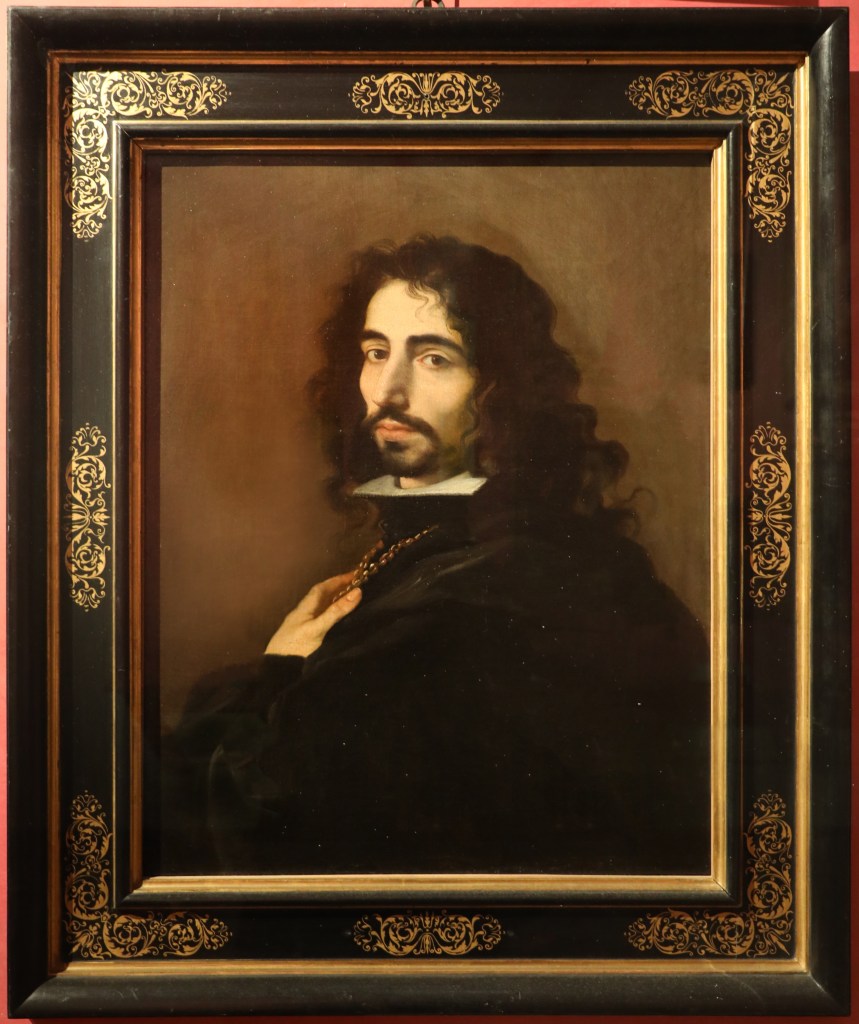
Giordano’s Self-Portrait in the Uffizi, generally dated to 1665–70, presents a markedly different conception of self-representation from the Brera alchemist. He appears in black, with a white collar, long dark hair and a gold chain gathered in his left hand. The palette is austere. His pale, drawn face is set against the dark mass of his hair and clothing, while the chain provides the only conspicuous note of ornament. Francesca de Luca stresses the picture’s simplicity and the deliberate character of the gesture towards the chain. She also notes the tension between the controlled handling of the face and dress and the greater freedom of the long, unruly hair.
Andrea Vaccaro provides a useful contemporary comparison. In 1664 he became the first prefetto of the newly established Corporation of Neapolitan Painters, with Giordano serving as second assistant. Vaccaro’s own formal self-portrait, generally dated to about 1664–66, has been connected with the Corporation and presents the older painter in fashionable dress, with an elaborate lace neckcloth and an emphatically public bearing. Formal self-representation was therefore already part of the professional culture immediately surrounding Giordano when the Uffizi portrait was painted.
The Uffizi portrait probably belonged to Cardinal Leopoldo de’ Medici, whose collection gives the work a precise context. Leopoldo was systematically assembling self-portraits by artists, and Anna Maria Procajlo has shown how exacting that process could be. The cardinal did not simply seek portraits of painters. He wanted the ritratto fatto di sua propria mano, a portrait made by the sitter himself. His agents were expected to establish both that the painting was autograph and that the person represented was indeed the artist. Copies and false identifications could be rejected regardless of their quality.
The purpose of such a collection was more than biographical. Filippo Baldinucci described Leopoldo as setting aside rooms for portraits of distinguished painters made by their own hands, so that the spectator could see both the artists themselves and their manner of painting. The self-portrait therefore combined likeness with authorship. It preserved the artist’s appearance while also providing an example of his maniera. Giordano’s picture entered a setting in which the face and the hand that painted it were deliberately brought together.
The documentary history of the Uffizi portrait is secure. It appears in the inventory compiled after Leopoldo’s death in 1675, where Giordano is described with black beard, side-whiskers and hair, a Spanish-style collar, black dress and cloak, and a gold chain held in his left hand. The picture was recorded in the grand-ducal collections in 1682 and mentioned by Baldinucci in 1686. R. Muzi has suggested that it may have been made for Leopoldo after Giordano’s presumed stay in Florence in 1665, a date consistent with the painter’s apparent age. The proposal remains plausible rather than documented.
Procajlo’s research makes the timing suggestive. By the 1660s Leopoldo’s agents were actively seeking autograph self-portraits, particularly by living or recently deceased artists whose identities and authorship could be more readily verified. In July 1665, for example, his agent Paolo del Sera reported being offered a self-portrait by Guercino said to be entirely by the painter’s own hand. This shows that the machinery of acquisition was operating in precisely the period to which the Uffizi portrait has been assigned.
The gold chain introduces an interesting but more uncertain strand of evidence. Marco Chiarini connected the portrait with a story told by Bernardo De Dominici. According to De Dominici, Giordano sent a self-portrait to Grand Duke Cosimo III and later saw it displayed beside portraits of Titian and Veronese. He supposedly remarked that his own dark head had been badly placed between such great men, since he was only a poor painter. The Grand Duke, pleased by this profession of humility, rewarded him with a gold chain bearing a medal with his portrait. If the story refers to the Uffizi picture, Giordano’s hand resting on the chain acquires an obvious significance. Both Muzi and De Luca, however, treat the account cautiously, and the inventory evidence is firmer than De Dominici’s later testimony.
De Luca interprets the portrait as a carefully constructed statement of Giordano’s status as an artist. Its formality lies less in display than in restraint: the controlled paint, severe clothing and limited tonal range suppress overt emotion, while the turning head and loose hair prevent the image from becoming rigid. The melancholy associated with Giordano’s appearance is still present, but here it is contained within an image of professional self-possession.
The Stuttgart self-portrait
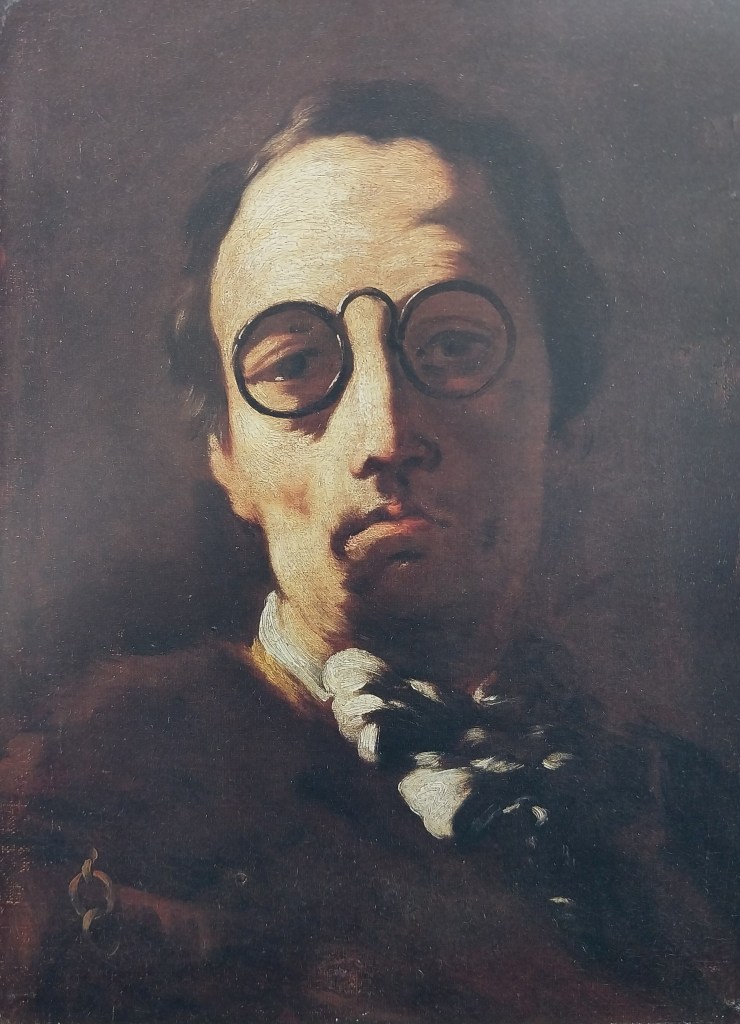
The Self-Portrait in the Staatsgalerie Stuttgart shifts attention from status and collecting to the act of painting itself. Nicola Suthor dates the work to about 1688. Giordano appears wearing spectacles, his head turning towards the viewer above a white cravat and dark outer garment. The format is small and close, and the handling of the paint is conspicuously economical.
Suthor looks closely at the surface. The white cravat is modelled with passages of black, its folds and loops formed with different brushes. A pointed brush picks out the highlights on the spectacles, while broader strokes describe the softer fabric. The ridges left by the bristles remain visible. The flesh is handled just as sparingly. Individual strokes establish wrinkles, expression and facial volume without being absorbed into a uniformly smooth surface. Around the neck, skin, linen and outer clothing are distinguished as much by the handling of the paint as by colour or contour.
Suthor places Giordano against Carlo Dolci, whose diligenza depended upon painstaking finish and the suppression of obvious signs of rapid execution. Giordano follows a different logic. The material operation of painting remains visible, and the spectator can see something of the speed with which the brush has moved. The portrait represents Giordano through his physiognomy, but also through the characteristic action of his hand.
That visible rapidity carried particular force in the case of an artist whose speed had become legendary. Giordano’s prestezza was repeatedly noted by contemporaries and later biographers, and the nickname Luca fa presto condensed a reputation for extraordinary facility. Stories circulated of half-length figures completed in less than an hour, while comparisons with Tintoretto and Veronese reinforced the image of a painter capable of prodigious production. Yet speed did not exclude preparation. As Riccardo Lattuada has put it, Giordano painted quickly only after having thought long and deeply. His speed rested on a long training of eye, memory and hand, reinforced by copying, drawing and the use of preparatory studies and bozzetti for larger projects. I have discussed this tension between preparation and rapid execution more fully in an earlier Inner Surfaces essay on Giordano’s work at the Casón del Buen Retiro. In Suthor’s account, speed becomes a form of bravura, a demonstration of mastery in which the process of execution remains visible.
The spectacles introduce another aspect of the portrait. Suthor argues that they should not be treated merely as a descriptive detail. Their optical function makes sight itself part of the image. Giordano was far-sighted, but the spectacles also lend themselves to a broader interpretation of the painter’s visual intelligence. Suthor associates them with the foresight required to conceive and organise the immense decorative schemes for which he was increasingly famous. They identify him as a pictor doctus, though not primarily in the humanist sense of a painter displaying literary erudition. His knowledge lies in the science and practice of painting.
Giovan Pietro Bellori helps to define what that practical knowledge could mean. He praised Giordano’s ability to construct contours with broad strokes, con grossi trattizzi ne’ contorni, which resolved themselves when seen from the proper distance. Such effects, Bellori wrote, belonged to the practico professore, the experienced practitioner who understood how the eye would complete what the brush had abbreviated. Giordano’s rapid handling depended upon judgement. The painter had to know how much information could be withheld at close range while still producing coherence for a spectator standing further away.
The spectacles and the brushwork belong together. One concerns the conditions of seeing; the other demonstrates how Giordano converted that understanding into paint. The Stuttgart portrait presents his professional intelligence through the means of painting itself.
The Pio Monte self-portrait
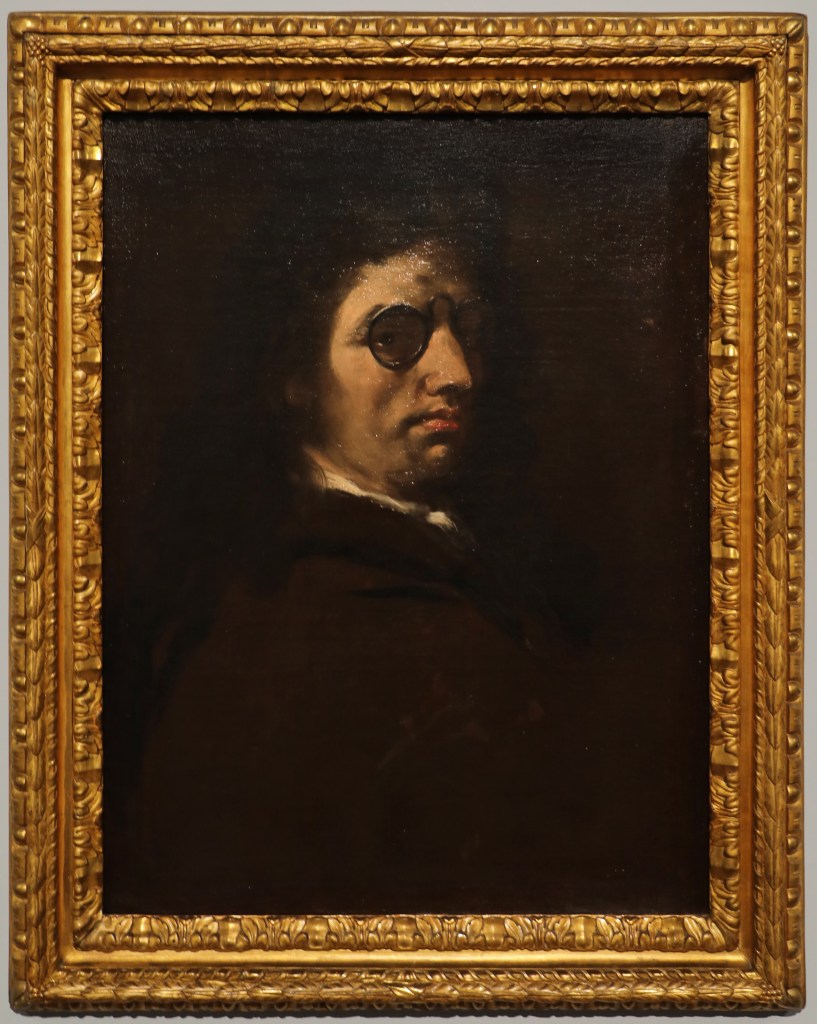
The Self-Portrait in the Pio Monte della Misericordia is now generally dated to about 1692, immediately before Giordano left Naples for Spain at the invitation of Charles II. Earlier scholarship placed it around 1678, partly because of its resemblance to the self-image at San Gregorio Armeno, but Giuseppe Scavizzi later revised the chronology and Marco Liberato follows the later dating. Giordano was therefore approaching sixty when the picture was painted, at the height of his reputation and on the threshold of the decade he would spend at the Spanish court.
For Lattuada, the striking feature of the portrait is its extreme reduction of pictorial means. Giordano had made his reputation through large altarpieces, history paintings and enormous decorative cycles, yet here almost all incidental detail has been stripped away. The brown overcoat is scarcely resolved, the body is established by a few dark strokes and the hair by rapid turns of the brush over the preparation. The flesh alone seems to bring light into the image. Lattuada calls the portrait a powerful image made with almost nothing, in which economy of means is matched by the intensity of self-scrutiny.
The face is treated without flattery. The cheeks have loosened, the features have thickened and the spectacles sit prominently across the nose. Liberato similarly emphasises the way the ageing figure seems to emerge from the neutral ground, almost as a non finito. The brush can be precise and measured in one passage, rapid and fragmented in another. Wrinkles and changes in the flesh are suggested rather than laboriously described, while the unfinished clothing keeps attention concentrated on the face. He compares the picture with a portrait of Giordano made in Madrid in 1692, formerly in the Torrecilla collection, where the same physiognomy and marks of age are visible. The comparison lends further support to the later dating.
Lattuada sees the Pio Monte portrait as part of a longer habit of unsparing observation. Giordano returned repeatedly to his own appearance, registering the effects of time upon his features over several decades. This recurrence leads Lattuada to Rembrandt, whose self-portraits he memorably describes as an “existential metronome”, recording successive stages of a life. He presents the comparison cautiously, asking whether Giordano’s repeated self-representation might be understood in a similar way. The analogy concerns method rather than style. Both painters returned to their own faces across time and allowed physical change to become part of the subject.
Lattuada also suggests a possible route through which Giordano could have known Rembrandt’s work. Gaspar Roomer’s celebrated Neapolitan collection contained an extensive body of prints and engravings, and Giordano’s familiarity with Northern European art may have developed partly through such collections. Prints allowed artists to encounter distant traditions without leaving the room in which they studied them, and Lattuada believes that Giordano absorbed something of Rembrandt’s character heads and self-portraits through this medium.
Portraiture itself occupied only a small part of Giordano’s immense production. Lattuada nevertheless points to the portrait of his friend Carlo Celano, canon of Naples Cathedral and now also at the Pio Monte della Misericordia, as an instructive comparison. There too a sparing use of paint is combined with concentrated observation of the sitter. The self-portrait’s economy belongs to a small strand of Giordano’s portraiture in which reduced means could produce a strong sense of presence.
Liberato compares the immediacy of the Pio Monte picture with Velázquez’s Juan de Pareja, while Lattuada extends the comparison to Velázquez’s broader investigation of vision.
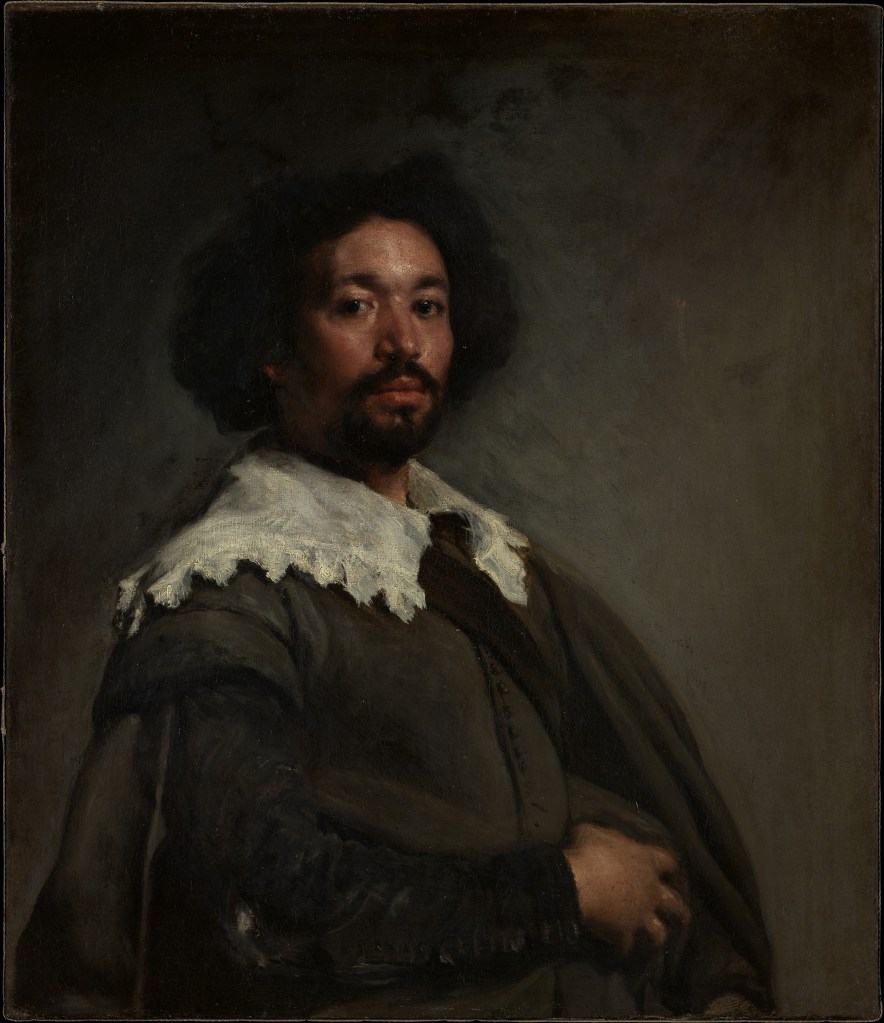
For him, works such as Las Meninas and Las Hilanderas depend upon the eye’s ability to make sense of forms that are only partially stated. Giordano’s abbreviated handling works in a related way. Seen close to, individual marks may appear abrupt or incomplete; from further away they resolve into hair, skin, fabric and expression. Lattuada ends his discussion by encouraging the spectator to move towards and away from the picture, allowing the brushstrokes to alternate between material traces and coherent image.
Lattuada argues that the reduced chromatic range and spare handling of the portrait allow the face to communicate with unusual directness. Unlike a religious painting whose meaning may depend upon iconography, narrative or historical knowledge, the self-portrait confronts the viewer first as the image of another person. For him, it can cross the historical distance between painter and spectator. Giordano’s earlier self-portraits had allowed him to assume intellectual roles, to establish his identity within a collection of artists’ self-portraits, or to present the intelligence of the practising painter. Here the emphasis falls on the face itself, altered by time and established through the fewest necessary strokes.
Beyond the four portraits
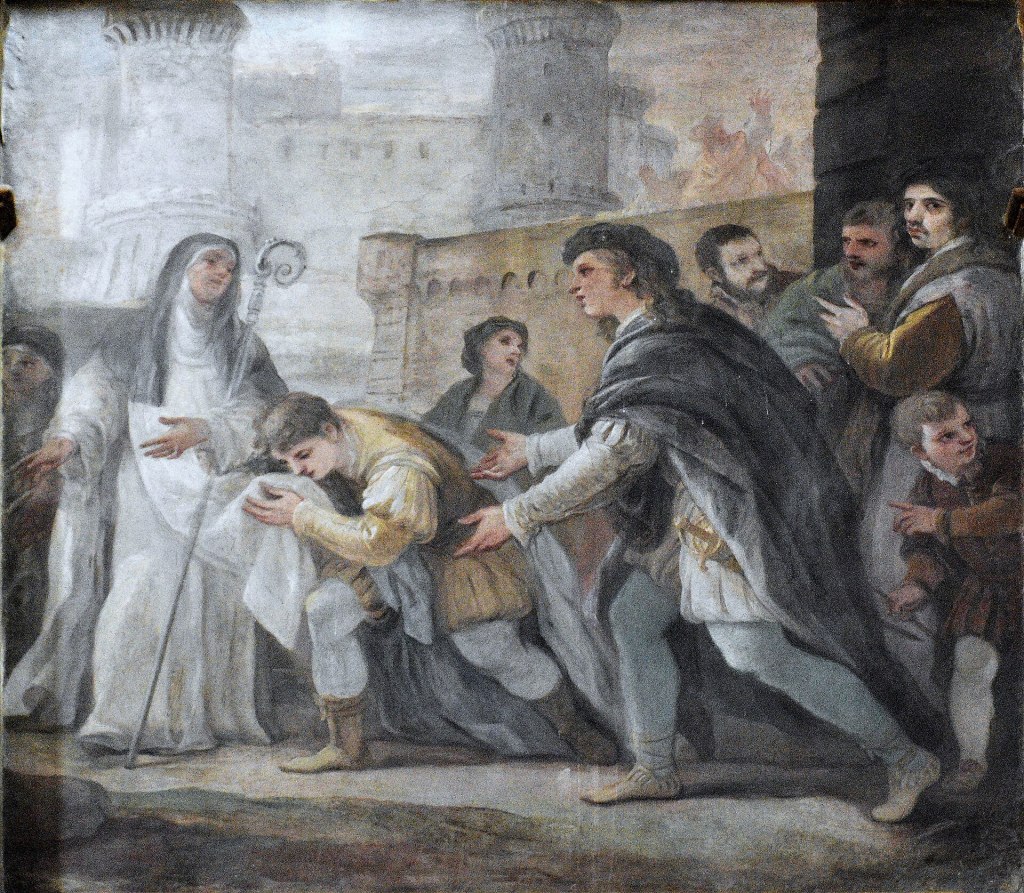
These four paintings form only part of a much larger history of Giordano’s self-representation. Alongside autonomous portraits, he repeatedly inserted his own likeness into larger compositions. In Saint Luke Painting the Virgin at Ponce, the Evangelist bears Giordano’s features. At San Gregorio Armeno he appears among the figures in the fresco of the Basilian nuns welcomed in Naples by Duke Sergio, while another self-image was incorporated into the Marriage of the Virgin at Guadalupe. Towards the end of his Spanish period he included himself again in the decoration of Toledo Cathedral, where his likeness appears in one of the fictive windows of the sacristy.
Self-portraiture accompanied a career of extraordinary scale. Giordano moved across Naples, Venice, Florence and Spain, absorbed and transformed very different traditions, and left a deep mark on later painting. Lattuada has described artists as capable of “making art history inside the works they paint”. Few painters embodied that idea more fully than Giordano. His self-portraits offer one concentrated record of the man within that prodigious career.
Related articles on Inner Surfaces
Luca Giordano at the Casón del Buen Retiro: the Alegoría del Toisón de Oro and the last Habsburg court
Salvator Rosa: Portraits, Self-Portraits and the Construction of Artistic Identity
Producing these essays requires care, time, research, and resources. Contributions to help sustain this exploration would be greatly appreciated.
https://donorbox.org/inner-surfaces-resonances-in-art-and-literature-837503
Bibliography
I have consulted the following sources. Any errors are mine.
Printed sources
de Giovanni, Biagio. “I ‘filosofi’ di Luca Giordano e la libertà della filosofia.” In Luca Giordano 1634–1705. Naples: Electa Napoli, 2001.
Fumagalli, Elena, ed. “Filosofico umore” e “maravigliosa speditezza”: pittura napoletana del Seicento dalle collezioni medicee. Florence: Giunti, 2007. See Francesca de Luca, cat. 20, p. 182.
Liberato, Marco. Cat. 1, in Sylvain Bellenger, Stefano Causa and Patrizia Piscitello, eds., Luca Giordano. Dalla natura alla pittura. Milan: Electa, 2020, p. 160.
Pacelli, Vincenzo. La pittura napoletana da Caravaggio a Luca Giordano. Naples: Edizioni Scientifiche Italiane, 1996.
Procajlo, Anna Maria. “Leopoldo de’ Medici e la sua ricerca sistematica del ‘ritratto fatto di sua propria mano’.” Imagines 4 (May 2020): 134–151.
Scavizzi, Giuseppe. Luca Giordano. La vita e le opere. Naples: Artem, 2017.
Spinosa, Nicola, ed. Luca Giordano 1634–1705. Naples: Electa Napoli, 2001. See especially R. Muzi’s catalogue entries on Giordano’s self-portraits.
Suthor, Nicola. Bravura: Virtuosity and Ambition in Early Modern European Painting. Princeton and Oxford: Princeton University Press, 2021.
Tuck-Scala, Anna Kiyomi. Andrea Vaccaro (Naples, 1604–1670): His Documented Life and Art. Pozzuoli: Paparo Edizioni, 2012.
Úbeda de los Cobos, Andrés. Luca Giordano at the Museo Nacional del Prado: Catalogue Raisonné. Madrid: Museo Nacional del Prado, 2017.
Broadcast and online sources
Catedral Primada de Toledo. “La Sacristía y Pinacoteca.”
Christie’s. “Luca Giordano, An Astronomer Holding a Telescope and a Mirror, Reflecting a Portrait of the Artist.”
Lattuada, Riccardo. “Autoritratto.” Museo Nazionale, Rai Tre, 2 January 2016. RaiPlay Sound.
Ministero della Cultura, Catalogo Generale dei Beni Culturali. “Monache basiliane accolte a Napoli dal duca Sergio,” Luca Giordano, 1684.
Museo de Arte de Ponce. “Luca Giordano, Saint Luke Painting the Virgin, c. 1650.”
Pinacoteca di Brera. “Luca Giordano, Autoritratto di Luca Giordano in veste di chimico o alchimista, c. 1660.”
 Inner Surfaces