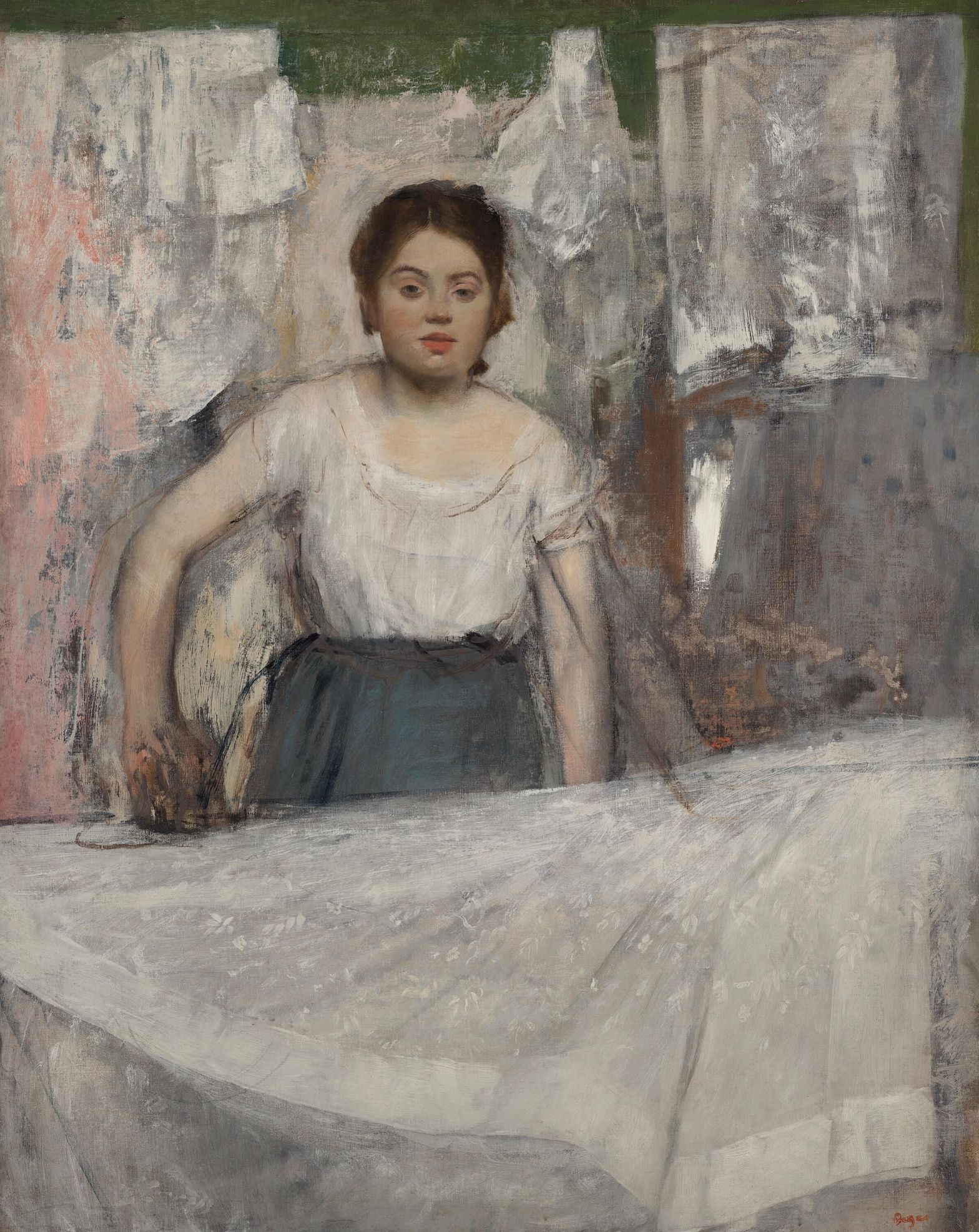
Edgar Degas, Woman Ironing (La Repasseuse), c. 1869, oil on canvas, 92.5 × 73.5 cm, Bayerische Staatsgemäldesammlungen – Neue Pinakothek, Munich, inv. 14310. Image credit: Bayerische Staatsgemäldesammlungen – Neue Pinakothek München, CC BY-SA 4.0.
Laundry was an inescapable part of life in nineteenth-century Paris. Clothes and household linen were generally sent out to be cleaned, supporting a large industry whose workers could be encountered in laundries and washhouses, at the bateaux-lavoirs moored on the Seine, or carrying bundles between their places of work and their customers. By the end of the century, nearly 70,000 women were employed in the trade. The work was poorly paid and physically demanding, involving prolonged standing, lifting and repetitive movement, as well as regular exposure to dirty linen, bleach and lye.
The laundress had consequently become a familiar presence in the city and had long been available to artists as a recognisable working type. There was an older tradition behind such imagery. As Jillian Taylor Lerner has shown, eighteenth- and early nineteenth-century representations of the petits métiers had commonly distinguished urban workers by their dress, tools and other occupational attributes. During the July Monarchy (1830–48), an expanding illustrated culture reflected a growing appetite for describing and classifying contemporary society. Occupation was increasingly considered alongside behaviour, neighbourhood, social aspiration and ways of life. Such images did more than record an existing social order: they also helped to shape contemporary ideas about the different people who inhabited the modern city.
For women, employment carried additional implications. The laundress worked in a trade which made her conspicuous beyond the domestic sphere. She moved through the streets on business and worked in communal or commercial premises, sometimes removing or loosening clothing in the heat. Her occupation came to be associated not only with poverty and hard physical work but with assumptions about working-class sexuality. Britany Salsbury has traced the persistent stereotype of the laundress as flirtatious or sexually available, a stereotype that bore an uneasy relationship to the economic insecurity of the women themselves. Low wages and irregular employment led some laundresses to supplement their income through occasional prostitution, but popular imagery could turn those circumstances into an attribute of the type itself.
The three works considered here approached this familiar figure at different moments between the between the mid-1850s and 1880. In a drawing by Honoré Daumier, an early painting by Edgar Degas and Fernand Pelez’s Au Lavoir, the occupation remained unmistakable, but it did not wholly determine the representation of the woman herself. Each work, in a different way, moved between the laundress as a recognised social type and the presence of a particular individual.
Honoré Daumier: Laundress and Her Child Crossing a Bridge
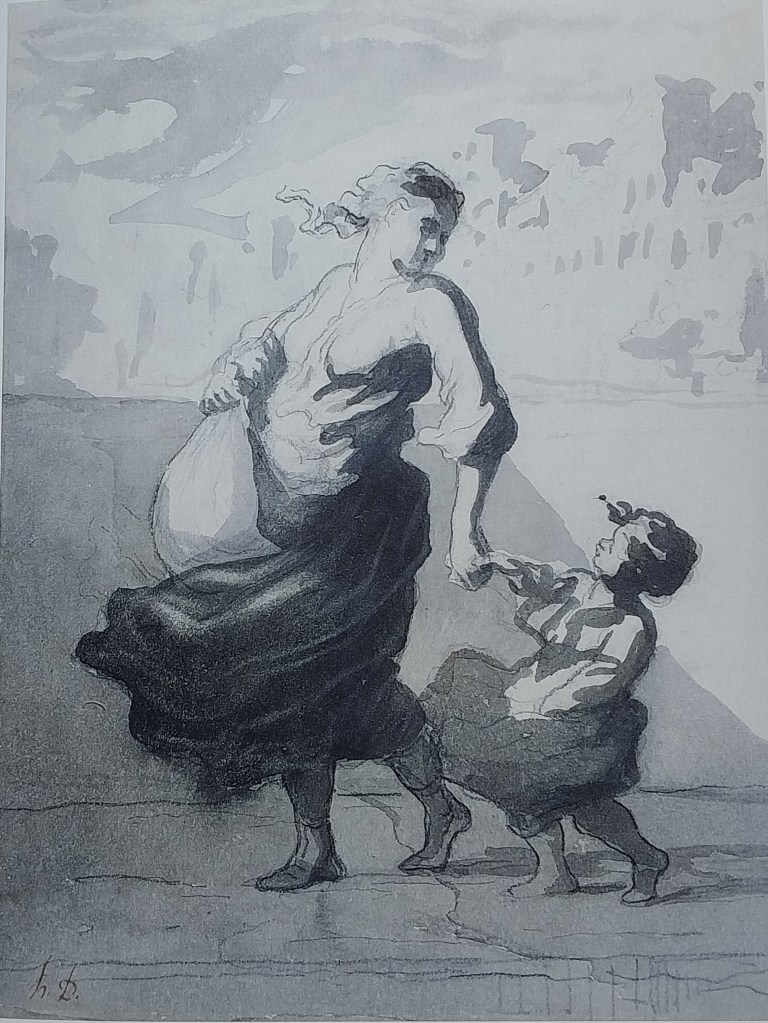
In Laundress and Her Child Crossing a Bridge, of about 1855–57, Honoré Daumier catches two figures in transit. The chosen medium here contributes decisively to the sense of movement. Daumier worked in black chalk, pen and ink with wash, and the figure is constructed with remarkable economy.
The line does not close every form; washes spread across the paper without giving the body the density it would acquire in oil. The great skirt is at once a garment and a broad, mobile shape. The result is not weightlessness, because the burden of the laundry remains evident, but there is a reduced sense of mass. The woman seems to be drawn forward across the sheet even as the child pulls against her progress.
That contrary movement gives the drawing much of its vitality. The bundle presses into one side of the body, the child draws upon the other arm, while wind catches the hair, scarf and skirt of the laundress. Daumier has chosen a publicly visible conjunction of motherhood and work: the laundry must be carried, the child must be taken along, and both demands are negotiated simultaneously. Salsbury notes that children sometimes accompanied their mothers into laundry workplaces, a practical circumstance that gives Daumier’s conjunction of work and childcare a specific social context.
Laundresses recur among Daumier’s representations of contemporary Paris. Merlin James has placed them alongside railway passengers, migrants, street figures and circus performers, while distinguishing such drawings and paintings from the more pointed satire of Daumier’s lithographs. The laundresses are not presenting themselves to an audience. Their postures arise from the circumstances of a life of labour.
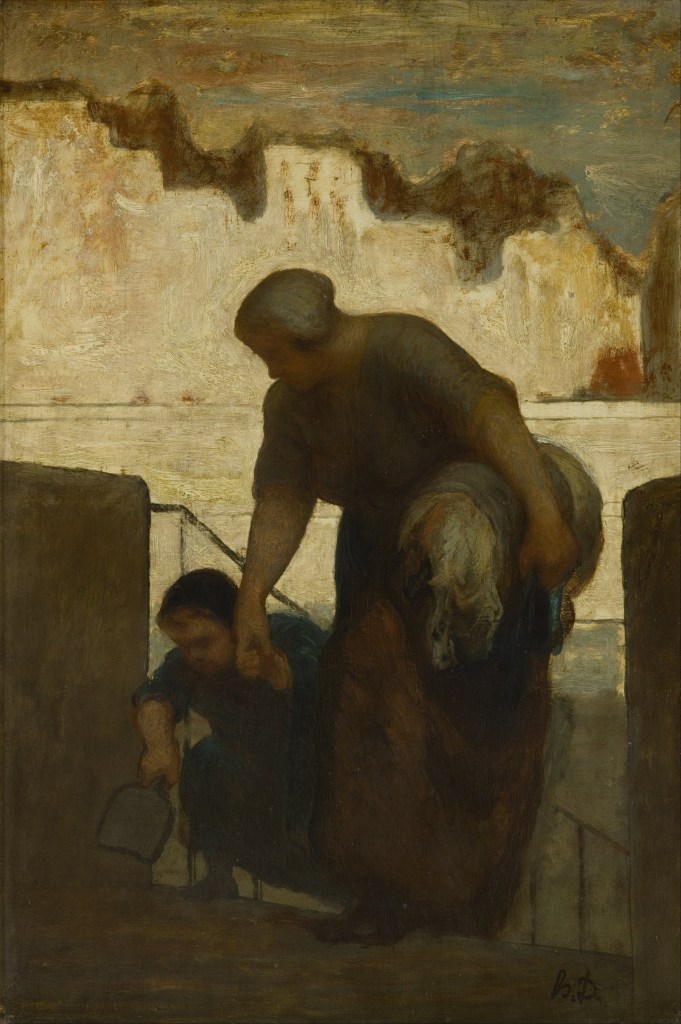
A later painting, The Laundress of about 1863, returns to the same conjunction of laundry, motherhood and movement, but with a markedly different physical character. There the woman climbs steps from the Seine carrying a substantial bundle while helping a child upwards. The body has acquired greater density and gravity; the upward movement is slower and more effortful. Here too the painting concentrates on the simultaneous demands of paid labour and motherhood.
Edgar Degas: La Repasseuse
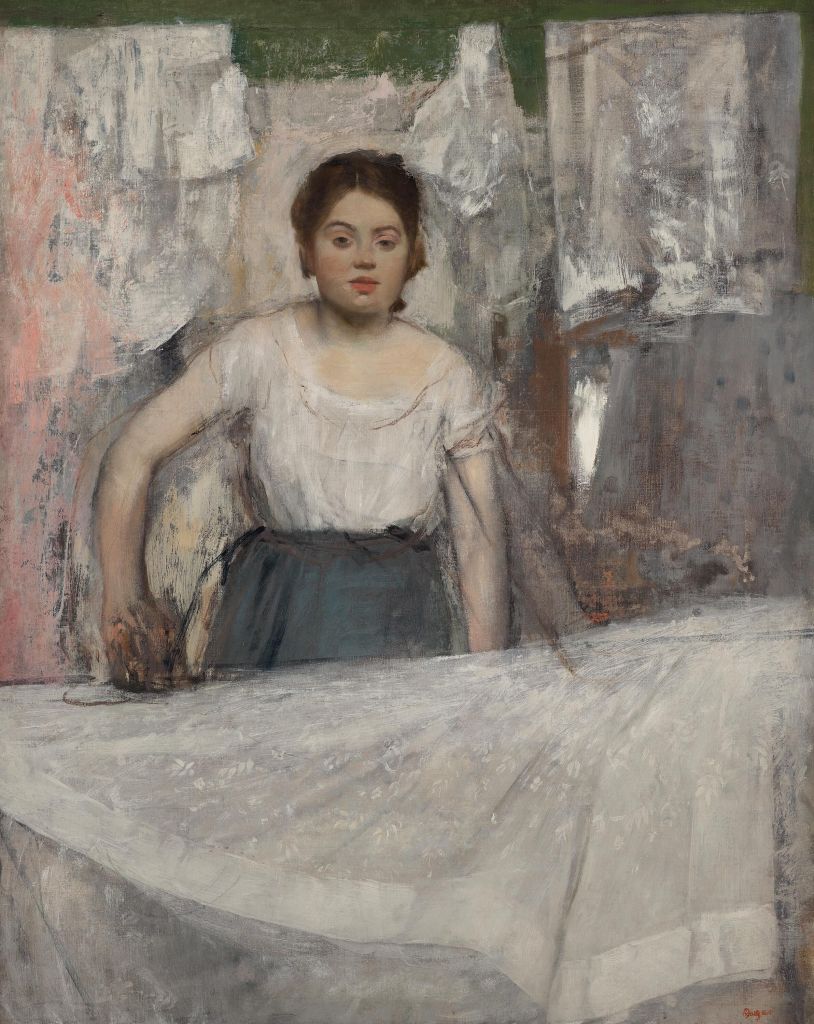
In La Repasseuse, painted about 1869, Edgar Degas represents a woman who has momentarily stopped ironing. The iron remains beneath her hand, but her body has straightened and she looks out towards the spectator. Around her arms, Degas has left repeated contours, traces of slightly different positions which disturb the apparent stillness of the figure. Britany Salsbury has suggested that these may evoke the repetitive movement of ironing. The effect is less one of arrested action than of a pause within movement.
The colour is muted overall, although far from uniform. Blue-grey, green, dusty pink and warmer brownish passages emerge intermittently among the whites of the blouse and linen. In places the paint appears almost to stain the surface; elsewhere it is dragged or brushed more opaquely across it, producing an effect at times closer to pastel than to densely worked oil paint. Forms are established without becoming completely fixed. The hanging linen in particular seems to emerge from a fluid, patchy atmosphere, an effect that can almost suggest the dampness and steam of the laundry itself.
Against this comparatively loose handling, the woman’s face is strikingly resolved. Its modelling is firmer, the features more compactly stated, and the warmer colour of the flesh stands out against the broken whites and greys around it. This difference helps to explain why the Neue Pinakothek has described the picture as possessing something of the character of a portrait. The impression does not depend upon biography. It arises from the sustained attention given to a single face within an otherwise provisional-looking environment.
The model was probably Emma Dobigny, a young professional model whom Degas repeatedly employed at this period. Salsbury suggests that these sittings involved the white blouse associated with women working in the Parisian laundry trade. The information is useful chiefly because it tells us something about how the image was made. Degas was not recording an identifiable laundress encountered at work. A professional model assumed the clothing and activity through which the occupation could be recognised.
Yet Degas’s knowledge of the trade was not confined to the studio. Contemporary recollections describe him stopping at laundresses’ shops to watch women at work, and Salsbury notes that he also took an interest in the terminology and techniques of washing and ironing.
Yet the setting does not develop into a strongly narrative scene. The iron, worktable, blouse and hanging linen establish the laundry, but Degas gives us no customer, no exchange between figures and no incident from which a story might be constructed. Earlier popular representations of laundresses had often depended upon such encounters, particularly comic or suggestive exchanges between working women and male visitors. Richard Thomson has noted the difference between this kind of pictorial narrative and Degas’s treatment of the subject. Here the woman is socially and occupationally situated, but the moment itself remains open. The picture therefore feels less like an episode arranged for interpretation than a fragment cut from the continuing rhythm of work.
La Repasseuse belongs to a period in which Degas’s choice of subject was changing substantially. His formation had been rooted in older painting: study with Louis Lamothe, copying in the Louvre, prolonged work in Italy, and early ambitions in history painting and portraiture. During the later 1860s and early 1870s, however, contemporary Paris increasingly entered his work. The laundress became one of the subjects through which that transition took place, eventually recurring in approximately forty paintings, drawings and prints.
Contemporary critics recognised the significance of this choice of subject. Salsbury notes that Zola praised the truthfulness of Degas’s laundresses, while Huysmans welcomed his introduction of washerwomen and their workplaces into serious modern painting.
In later treatments, Degas would make the bodily effort of laundry work far more explicit, showing women bending over tables, bearing down on irons, stretching, yawning or carrying heavy baskets. In the Munich painting, the work is registered more indirectly, through the iron, the linen and the repeated contours around the arms, while the face receives the greatest degree of definition.
Fernand Pelez: Au Lavoir
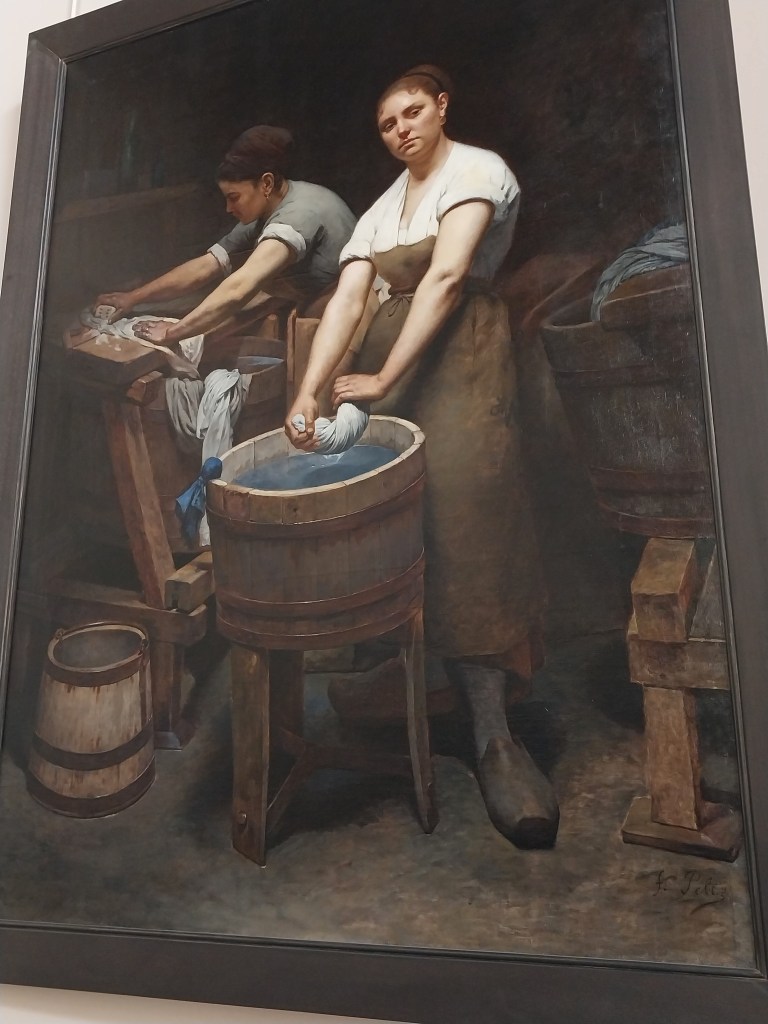
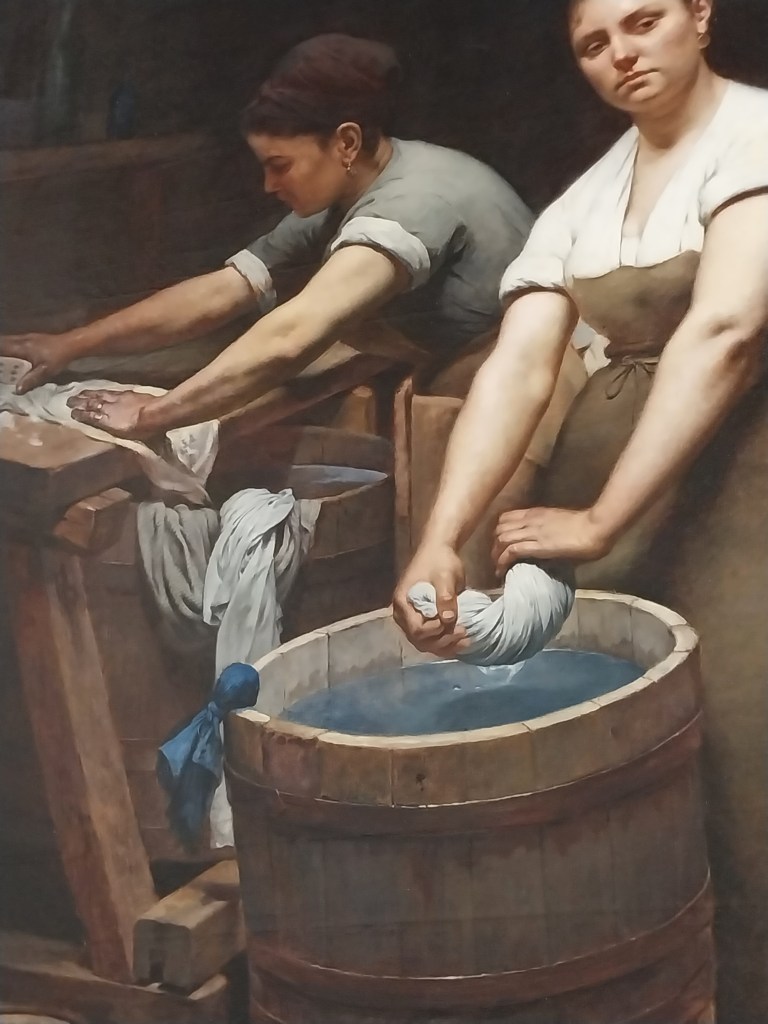
Fernand Pelez’s Au Lavoir, exhibited at the Salon of 1880, places the physical business of washing at the centre of a large, ambitious painting. Two women are at work. To the left, one leans forward over a washing board, pressing and scrubbing the linen with outstretched arms. The other stands behind a deep wooden tub, wringing a length of wet cloth between both hands. Around them are further tubs, buckets, boards and piles of washing. The interior is spare and workmanlike, defined largely by the equipment and materials of their occupation.
Much of the painting’s force lies in the women’s bodies. Pelez repeatedly draws attention to shoulders, forearms and hands: the extended arms of the woman at the rear, the powerful shoulders and bare arms of the figure in front, and the two hands closing around the twisted linen. The actions are different, but both require strength. On a canvas more than two and a half metres high, this physicality acquires an imposing scale. The foreground woman in particular has a monumental presence, although nothing in her clothing or surroundings removes her from the ordinary conditions of work.
Colour reinforces the concentration on labour. The blue water in the central tub is unexpectedly vivid against the browns, greys and soiled whites around it. Contrasting blues also appear in the wet linen above the water and in the cloth knotted on the side of the tub. Wood, skin, water and fabric are given distinct material qualities, while the composition continually returns to the point at which body and material meet: hands pressing cloth, arms stretched over a board, linen being twisted above the tub.
The foreground woman also looks directly at the viewer. Pelez gives no narrative reason for this and does not turn the moment into an anecdote. Her hands remain occupied with the cloth as she looks out. The face is notably individualised, as are her build and stance, but nothing identifies her beyond her occupation. There is a certain self-possession in the combination of physical strength and directness, although the expression itself remains difficult to define. Pelez gives her a particularity within a broader anonymity.
His academic formation is relevant to that effect. Pelez had studied at the École des Beaux-Arts and had been a pupil of Alexandre Cabanel. Richard Thomson has noted that Au Lavoir retains the finished treatment of surfaces associated with that training, especially in the flesh, while placing unidealised figures within the shabby environment of the washhouse. He also stresses the change of scale: compared with earlier images of the laundress as an isolated occupational type, Pelez made the subject larger and more emphatic, showing distinct processes of scrubbing and wringing. Zola recognised the change when he reviewed the Salon of 1880, welcoming Pelez as one of the academically trained artists who had been induced “to come over to naturalism”. The painting won a first-class medal, was purchased by the French State and was sent to the museum at Le Havre the following year.
In discussing Pelez’s representations of poverty, Linda Nochlin drew attention to the range of social conditions he depicted. She described him as an “extraordinary painter” whose work encompassed different degrees of poverty and disaffection, and distinguished the “respectable working poor” from the more extreme condition of misère, in which destitution could involve abjection, alienation and the treatment of the poor as a social Other. That distinction is useful for Au Lavoir. These women belong to the world of hard and poorly rewarded physical labour, but Pelez does not present them as destitute. The emphasis falls upon work, strength and material circumstance rather than upon abjection.
Nochlin’s broader argument about nineteenth-century modernity also provides a useful context for Pelez. She argued for a plurality of modernities: artists could respond to contemporary experience without adopting the formal innovations that would later become synonymous with modernism. Au Lavoir fits comfortably within that broader account. Its academic finish does not distance it from modern life. Pelez has used those resources to give contemporary labour a large scale and physical authority.
The laundress entered nineteenth-century art as an immediately recognisable social figure, identified by her clothing, implements, surroundings and actions. In the three works considered here, that recognition remains intact, but it does not make the women interchangeable. Daumier, Degas and Pelez each find a particular presence within an anonymous occupation. The social type remains, while the individual continues to elude complete definition.
Producing these essays requires care, time, research, and resources. Contributions to help sustain this exploration would be greatly appreciated.
https://donorbox.org/inner-surfaces-resonances-in-art-and-literature-837503
Bibliography
James, Merlin, ‘Daumier: London’, The Burlington Magazine, vol. 156, no. 1331, February 2014, pp. 125–26.
Lampert, Catherine, Michael Pantazzi, Judith Wechsler et al., Daumier (1808–1879): Visions of Paris, London: Royal Academy of Arts, 2013.
Lerner, Jillian Taylor, ‘The French Profiled by Themselves: Social Typologies, Advertising Posters, and the Illustration of Consumer Lifestyles’, Grey Room, no. 27, Spring 2007, pp. 6–35.
Nochlin, Linda, and Dan Karlholm, ‘Misery, Beauty, and Other Issues: Linda Nochlin in Conversation with Dan Karlholm’, The Art Bulletin, vol. 94, no. 2, June 2012, pp. 187–98.
Salsbury, Britany, ‘Degas and the Laundress’, in Britany Salsbury (ed.), Degas and the Laundress: Women, Work, and Impressionism, Cleveland: Cleveland Museum of Art; New Haven and London: Yale University Press, 2023, pp. 1–20.
Thomson, Richard, ‘The Skillful, the Social, and the Scurrilous: The Imagery of the Laundress in Naturalist Painting’, in Britany Salsbury (ed.), Degas and the Laundress: Women, Work, and Impressionism, Cleveland: Cleveland Museum of Art; New Haven and London: Yale University Press, 2023, pp. 35–43.
Bayerische Staatsgemäldesammlungen, Neue Pinakothek, ‘Edgar Degas, Die Büglerin (La Repasseuse), c. 1869’, online collection record.
 Inner Surfaces