Courbet, Ornans and 1854–55
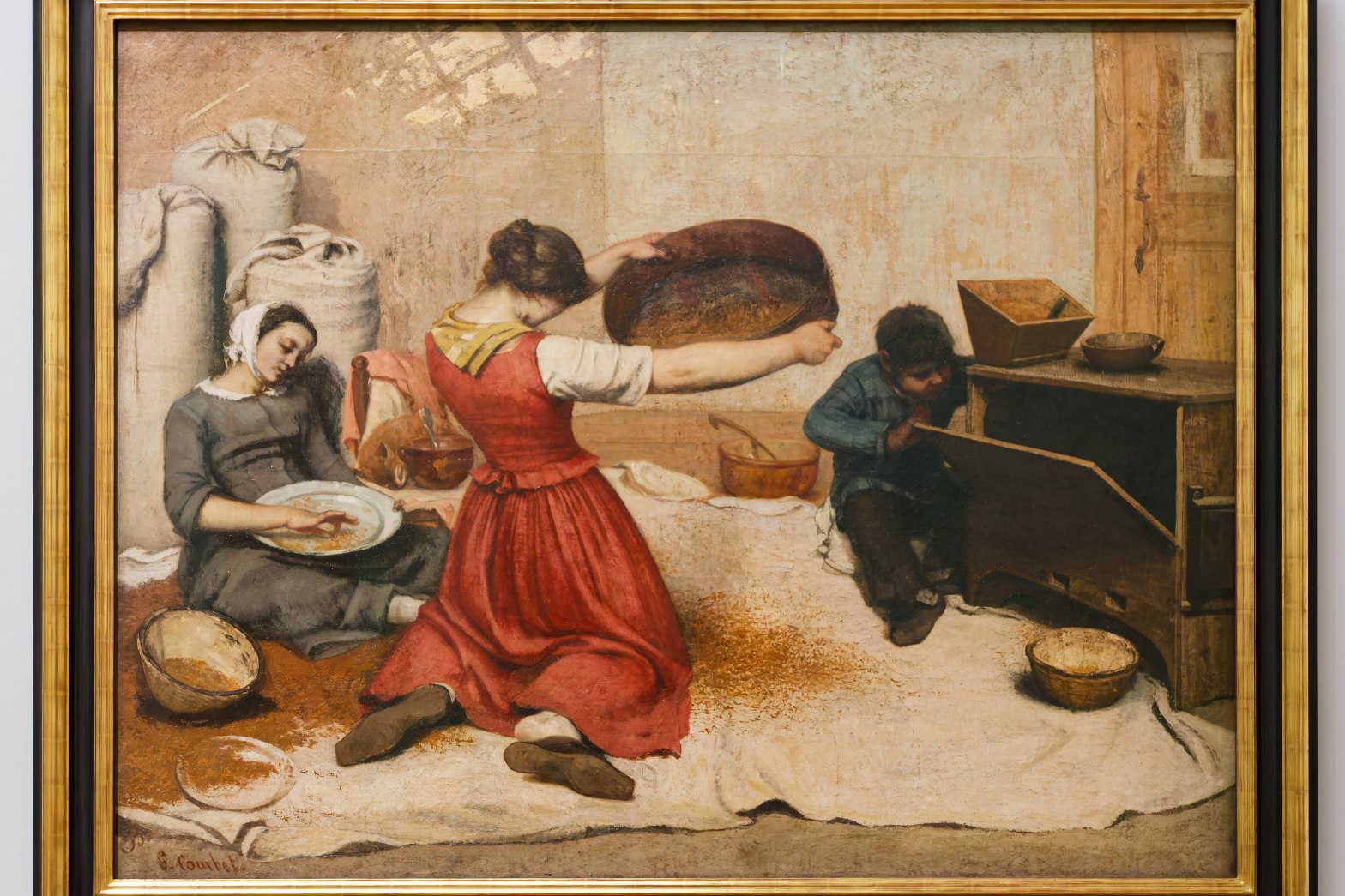
When Gustave Courbet painted Les Cribleuses de blé (The Grain Sifters) in 1854–55, he was in his mid-thirties and had already become one of the most contentious figures in French painting. Born in 1819 at Ornans, a small town in the Doubs close to the Swiss border, Courbet came from a prosperous family of landowners. He left for Paris in 1839, initially intending to study law, but soon abandoned that course for painting. His artistic education was comparatively independent. Rather than following a conventional academic training, he worked with several teachers, copied paintings in the Louvre and looked closely at the art of the past. A journey through Belgium and the Netherlands in 1846 brought a further encounter with Flemish and Dutch painting. Yet Paris, for all its importance to his career, never displaced his native Franche-Comté. Courbet returned to Ornans and the nearby family property at Flagey almost every summer, and its landscape, inhabitants and social life entered his work with unusual persistence.
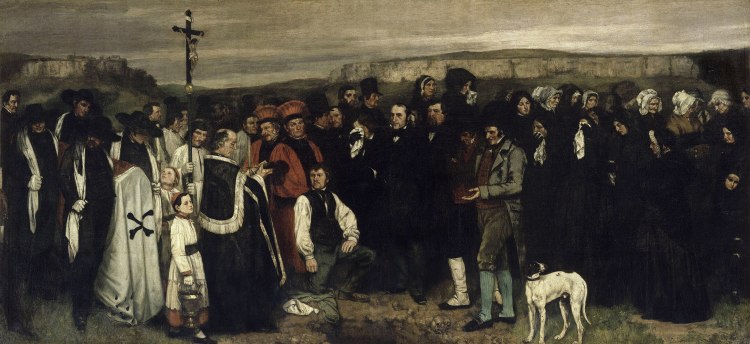
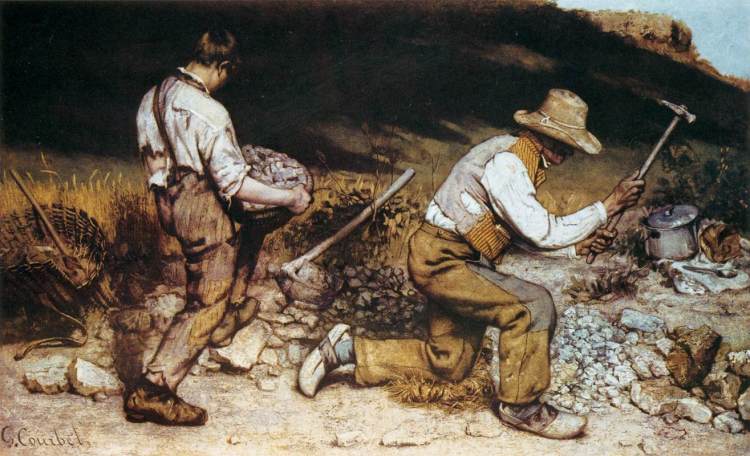
By the end of the 1840s, this attachment to the immediate and familiar had become inseparable from Courbet’s increasingly radical conception of what modern painting might represent. In The Stone Breakers (1849, lost) and the enormous A Burial at Ornans (1849–50), he gave contemporary provincial subjects a scale and seriousness traditionally associated with history painting. The latter, exhibited at the Salon of 1850–51, brought together the recognisable inhabitants of Ornans around an ordinary provincial funeral. Nothing has been done to convert them into ideal types. Painted life-size across a canvas more than six metres wide, they occupy a pictorial territory that convention had largely reserved for biblical, mythological or historical events. Courbet’s realism consequently involved more than the choice of everyday subjects: it unsettled the hierarchy through which subjects, bodies and forms of pictorial treatment had previously been assigned their relative importance.
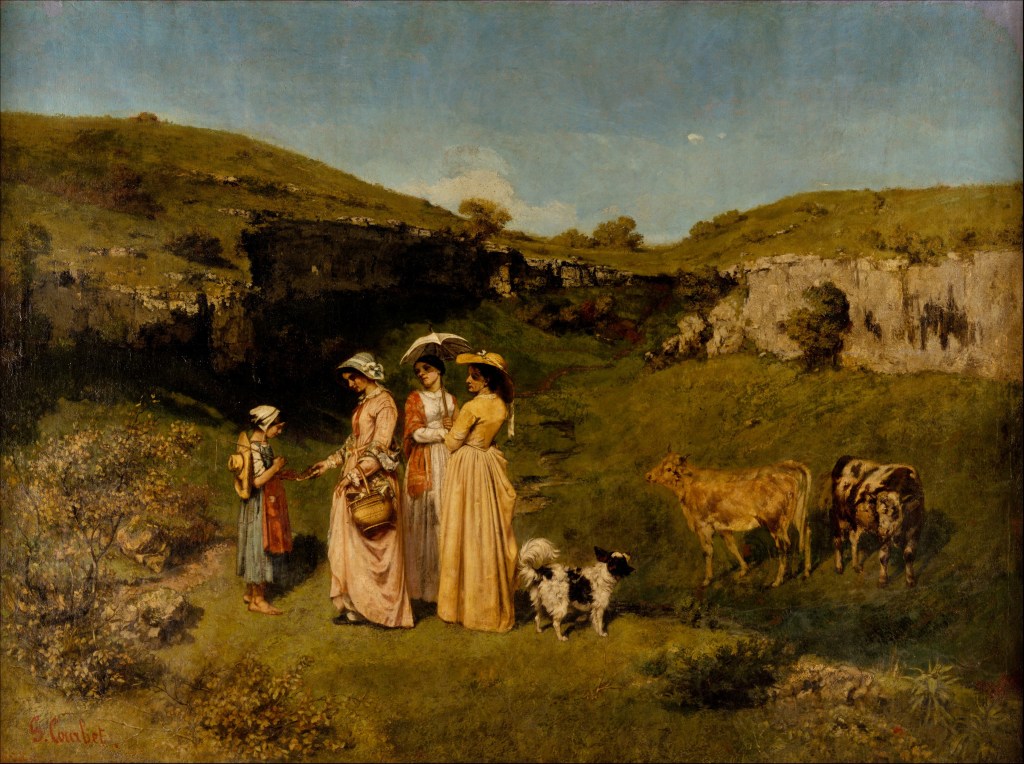
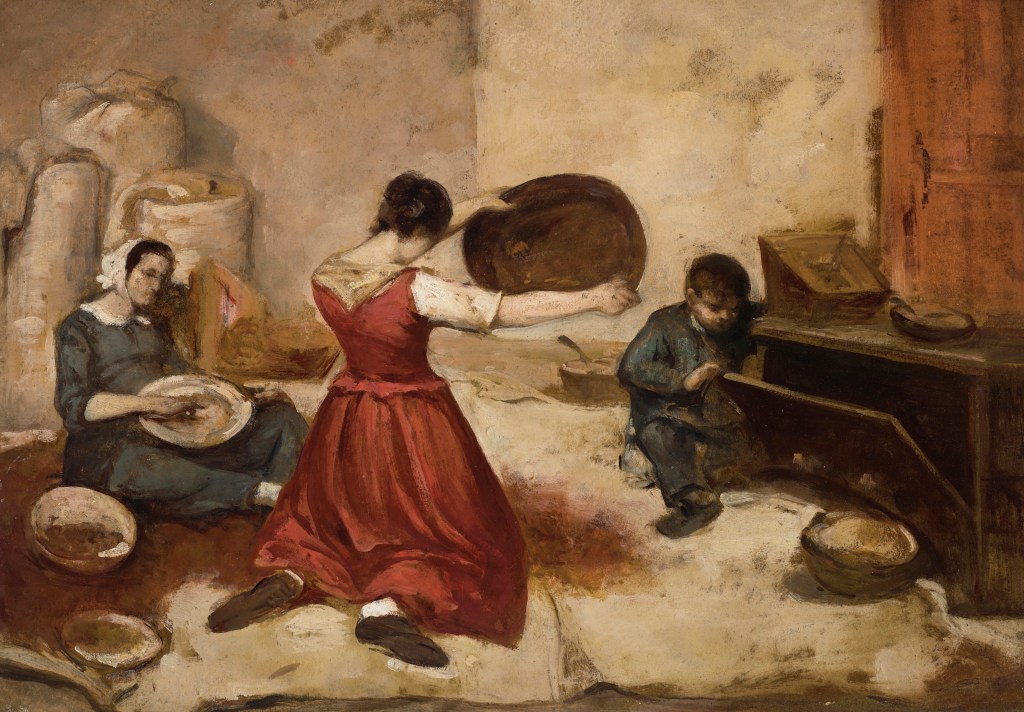
Les Cribleuses de blé belongs to the next phase of this development and, once again, to the world of Ornans. Courbet appears to have begun the picture there during the winter of 1853–54, and the finished canvas is signed and dated 1855. The central woman has been identified as his sister Zoé; the seated figure at the left as another sister, Juliette; while the boy investigating the agricultural machine at the right may be Désiré Binet, Courbet’s unacknowledged son. The family identifications are significant. They do not, however, make the painting a straightforward record of rural life. The Courbets were substantial landowners, and the artist’s sisters would not ordinarily have undertaken the arduous work represented here. From the beginning, observation and invention have been more closely intertwined than the apparent directness of the scene might suggest.
Courbet himself connected the painting with another work involving his sisters, Young Ladies of the Village (1851–52). Writing to his friend and supporter Champfleury late in 1854, he described the new work as a picture of rural customs belonging to the same series. He added a more intriguing qualification: it was, he said, another tableau étrange, another “strange picture”. For all the apparent familiarity of its ingredients, The Grain Sifters seems already to have struck its maker as something more difficult to place.
It was being completed at an unusually charged moment in Courbet’s career. During 1854–55 he was working on the immense Painter’s Studio, whose full title described it as a “real allegory” summing up seven years of his artistic and moral life. Almost six metres wide, the painting places Courbet himself at its centre, working at an easel, while around him are assembled figures drawn from different parts of his social and intellectual world. Friends and supporters, including Baudelaire, Champfleury and Proudhon, occupy one side; on the other Courbet gathered figures associated with poverty, commerce, exploitation and ordinary life. The result is at once a representation of the artist’s studio and an extraordinarily ambitious attempt to make that space contain the society around him.
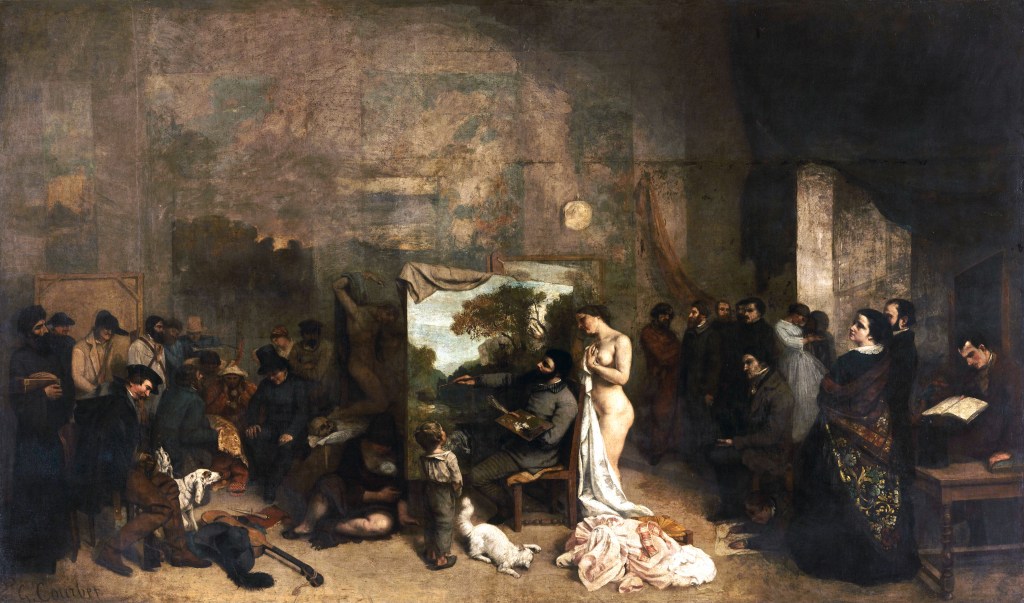
Courbet intended The Painter’s Studio for the Exposition Universelle held in Paris in 1855. Although a number of his paintings were accepted, the vast Studio was rejected. His response was characteristic. At his own expense he erected a temporary exhibition building close to the official exposition, the Pavillon du Réalisme, and there presented a large selection of his work on his own terms. The accompanying catalogue included a statement of his artistic position. Rather than accepting inherited formulas or belonging to a school, Courbet insisted upon the need to make an art of his own time from the world available to him.
It is tempting to make The Grain Sifters carry the full weight of that declaration, but the painting does not behave like a manifesto. There is no explicit political drama and no simple heroic elevation of the worker. Its realism is at once more intimate and more elusive. Courbet has returned to the people and physical world of his native region, yet what he has made from them is anything but straightforward. The room is recognisable, the implements specific, the labour apparently observable; but the bodies, space and actions have already begun to disturb that familiarity. Courbet’s own tableau étrange is grounded in the real world while refusing to conform entirely to it.
The Body of Labour
The room Courbet has constructed is shallow, enclosed and crowded with things. Grain spreads across the floor; sacks bulge against the wall; bowls, baskets and agricultural implements occupy the spaces between the three figures. At the right stands the dark wooden tarare, a hand-operated winnowing machine used to separate grain from chaff. The floor seems to tip upwards towards the back wall, bringing objects that ought to recede into unusually close relation with the surface of the canvas. There is little empty space and almost no distance into which the eye can escape. Yet the effect is not simply claustrophobic. The scattered objects, repeated curves and strongly differentiated areas of colour establish their own, somewhat unconventional order.
It was partly this peculiar spatial construction that led Hélène Toussaint, writing in the catalogue of the major Courbet exhibition of 1977, to suggest an early encounter with Japanese art. The elevated viewpoint, flattened recession, repeated circular forms and emphatically projected gestures seemed to her comparable with features of Japanese prints beginning to circulate in France. Linda Nochlin later preferred to explain the effect through Courbet’s own pictorial procedures, but Toussaint’s comparison registers the unusual flatness and surface organisation of the picture.
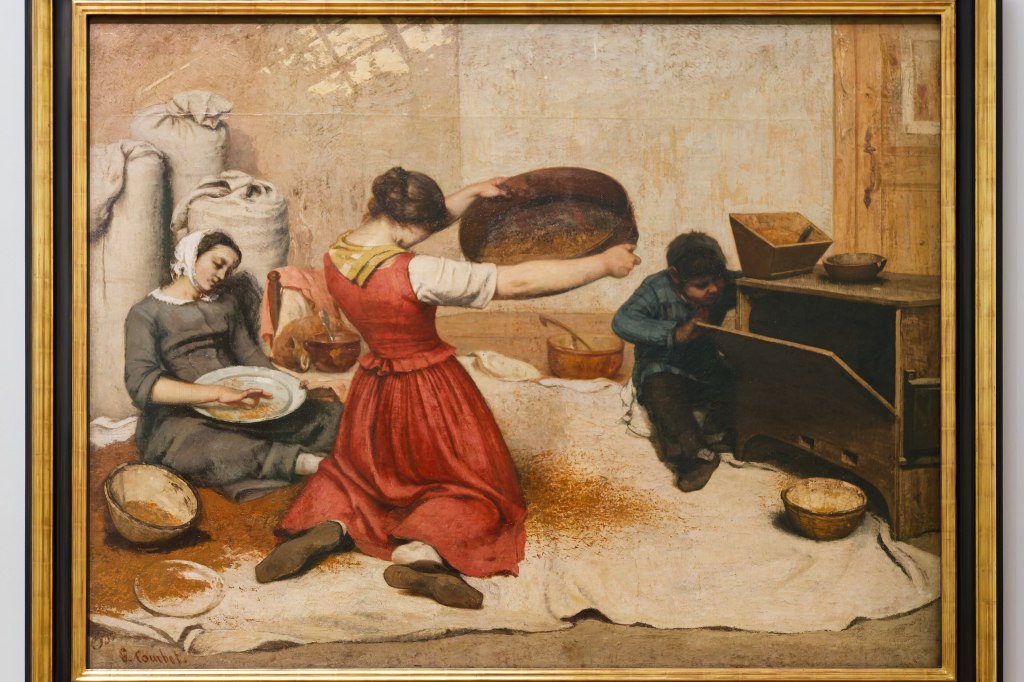
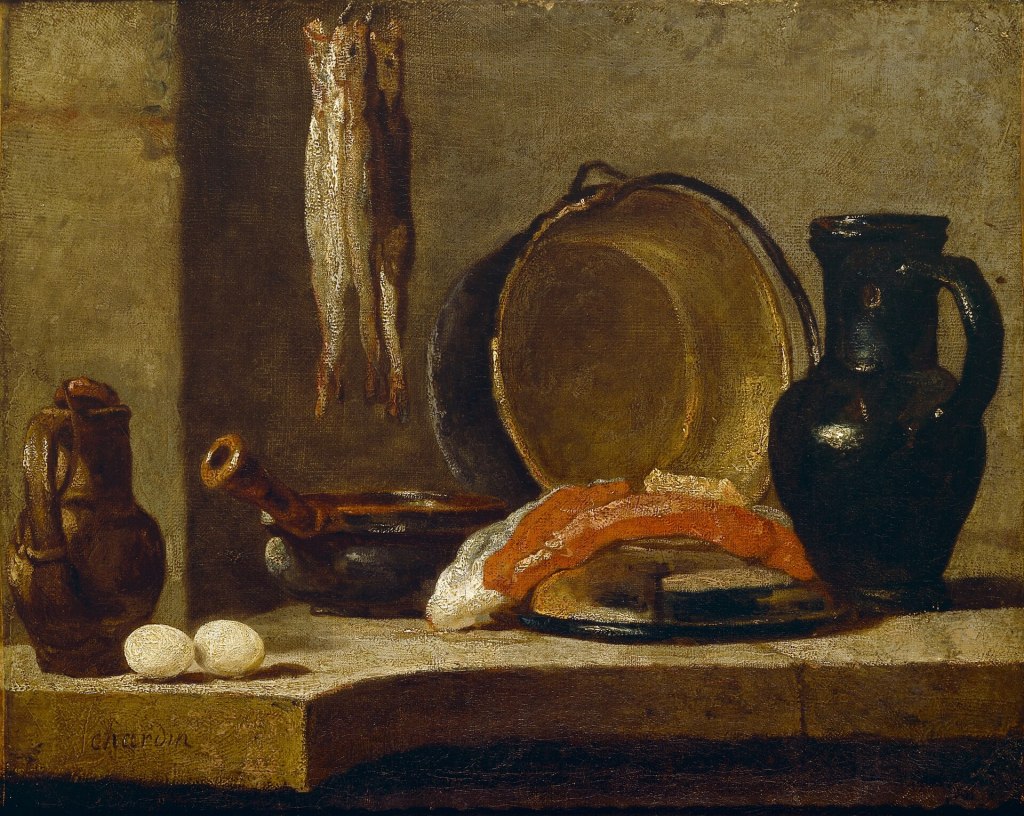
Nochlin describes that organisation as an “additive unity”. Rather than subordinating everything to a single dominant perspective or compositional rhythm, Courbet allows forms, objects and textures to accumulate across the canvas. She detects an affinity with Chardin, particularly in the apparently casual arrangement of vessels and other objects linked through shape and surface. Yet Chardin normally binds such things into a clearly receding spatial structure. Courbet scatters them more widely and less predictably, producing a harsher and sometimes almost dissonant coherence. Bowls, sacks and containers answer one another through shape, while the large circular sieve held by the central woman belongs to a sequence of rounded forms dispersed throughout the room.
The figures themselves remain remarkably distinct. Juliette, seated on the floor at the left, bends over the grain she is sorting; Zoé kneels with her back towards us, raising the sieve in front of her; the boy at the right peers into the tarare. Despite the painting’s title, only Zoé is actually sifting. Courbet has brought together three different activities rather than showing a group engaged in a single collective task.
Colour gives this dispersed structure a more immediate focus. Wheat and ochre tones extend across much of the painting, while the cooler clothing of the figures at either side contains the central blaze of Zoé’s orange-red dress. Her scale, too, is difficult to ignore. She seems almost too large for the room, her skirt spreading broadly across the floor while the narrowing waist, straining neck and extended arms carry the eye upwards towards the sieve. Nochlin describes the resulting construction as an oval set above the broad pyramid of the skirt. The heavy, roughly worn slippers that emerge beneath the skirt prevent this highly organised shape from becoming wholly abstract. The figure is at once emphatically composed and insistently bodily.
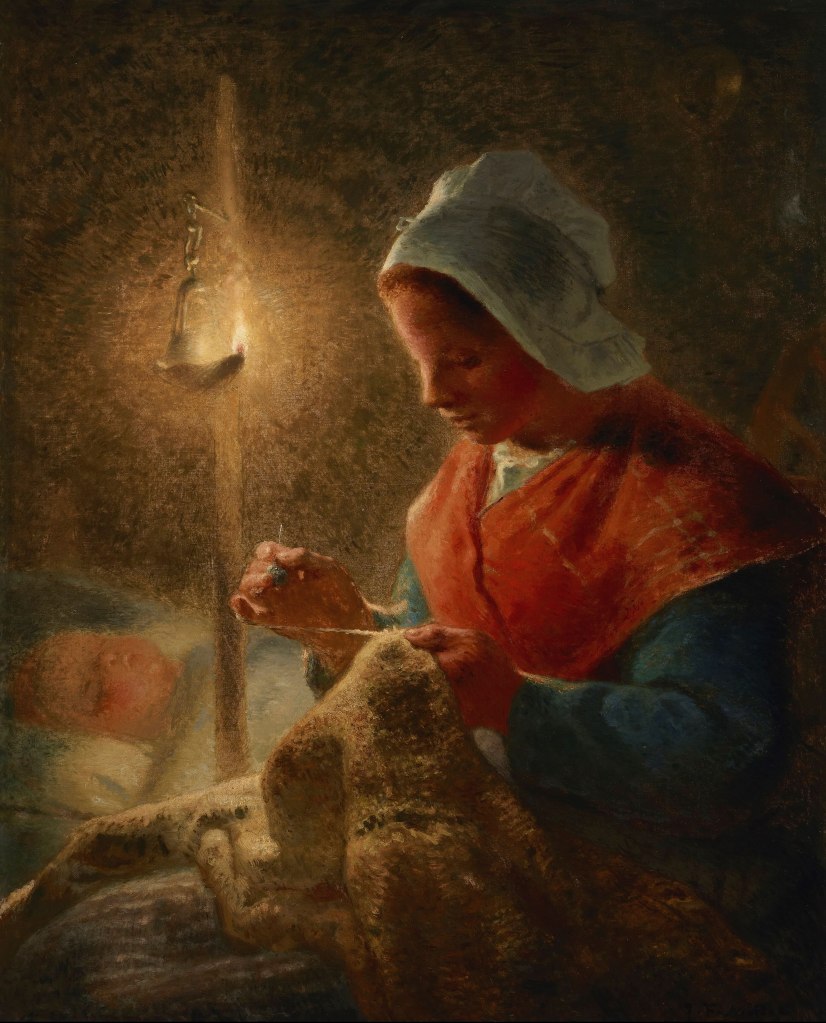
That tension between formal construction and physical presence continues across the rest of the painting. Courbet differentiates the whitewashed wall, dark wood, coarse sacks and scattered grain with a sustained attention to their physical character. Above Zoé, a pale reflection is crossed by the granular pattern of shadow, so that illumination seems deposited upon the wall rather than dissolving it into atmosphere. Nochlin contrasts this hardness with the softer penumbra of Millet’s interiors.
Courbet allows very little pictorial haze to reconcile one thing with another. Wood remains wood, plaster plaster, grain grain. The realism of the picture resides as much in the physical insistence of its surfaces as in the recognisability of the activity represented.
Zoé’s action, however, complicates precisely that impression of physical truth. The pose looks immediately persuasive as an image of strenuous work: the body leans forward, the neck is taut and the arms stretch out to support the large sieve. On closer inspection, it is difficult to imagine the action being performed quite like this. Dominique de Font-Réaulx has pointed out that a sieve laden with grain would normally require the worker to stand, using the weight of the body to counterbalance it. Courbet instead has Zoé kneel, extending the sieve at arm’s length in a position that heightens the apparent effort while making the practical action less plausible. The gesture becomes almost ceremonial. What first appears to have been directly observed is already an exaggeration, a transformation of work into something closer to a pose of labour.
The bodily rhetoric is fundamental to the composition. In the surviving oil esquisse, the subsidiary figures are less fully characterised than they would become in the Nantes canvas: the woman at the left has not yet acquired quite the same lassitude, while the boy’s curiosity about the machine is less developed. Zoé, by contrast, is clearly there in essentials. She kneels with her face completely withheld, her arms projected towards the sieve and her back forming the same powerful ascending line towards the lowered head. Whether the small painting preceded the large canvas or was produced after the composition had been established, perhaps specifically for the sale of esquisses held at the Hôtel Drouot in June 1855, remains uncertain. Whatever their sequence, the consistency between the two versions shows how central Zoé’s bodily construction was to the composition.
The pose carries the painting beyond the immediate world of Ornans. The woman working with her back to us in Velázquez’s Las Hilanderas (The Spinners) offers a close point of comparison, and Nochlin has suggested that the painting may have provided Courbet with a precedent. Courbet’s figure, however, possesses a different physical authority. Her broad back, lowered head and extraordinary extension of the arms belong to a much older pictorial language in which the body is made expressive through weight, torsion and effort. Michelangelo’s Libyan Sibyl on the Sistine ceiling comes irresistibly into the field of comparison, not because Courbet need have been consciously quoting it, but because its turning, reaching body had helped to establish that language of monumental physical action. Nochlin, from another direction, points to the muscular back-turned ironworker in Tintoretto’s Forge of Vulcan, whose confident expansiveness approaches the bodily authority Courbet has given his female worker.
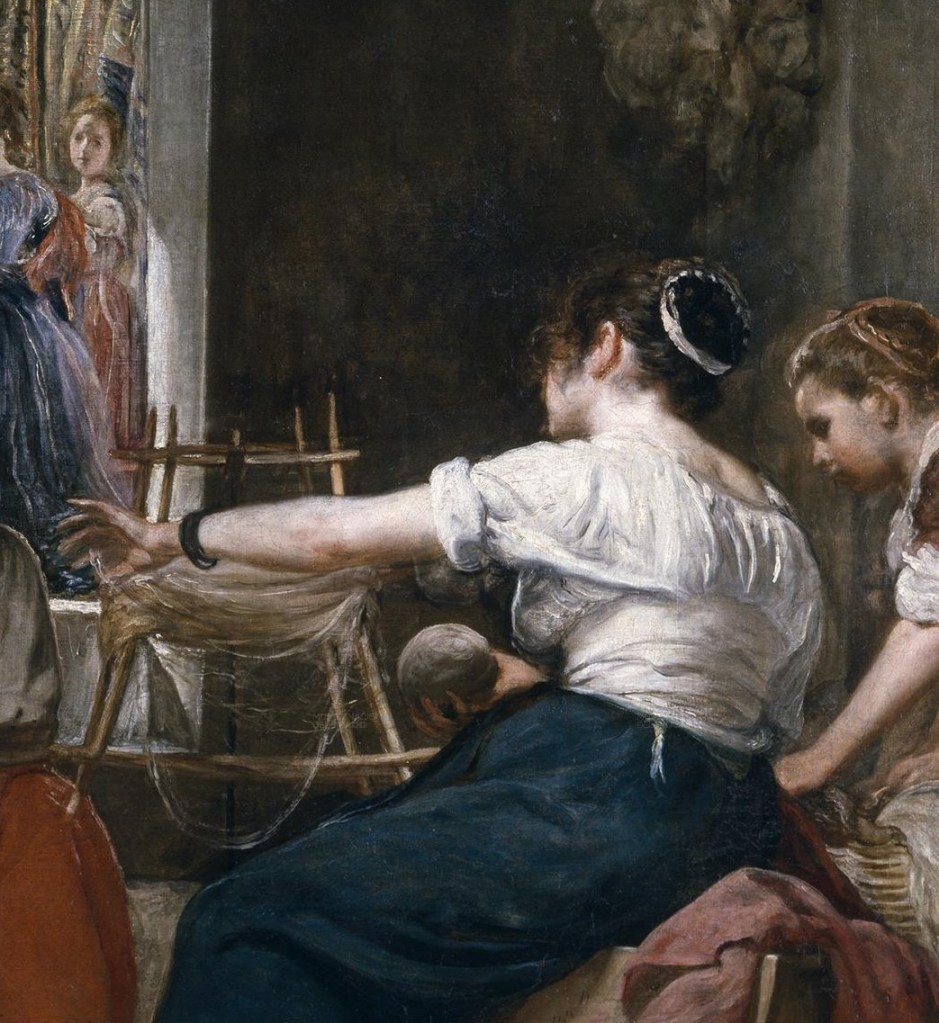
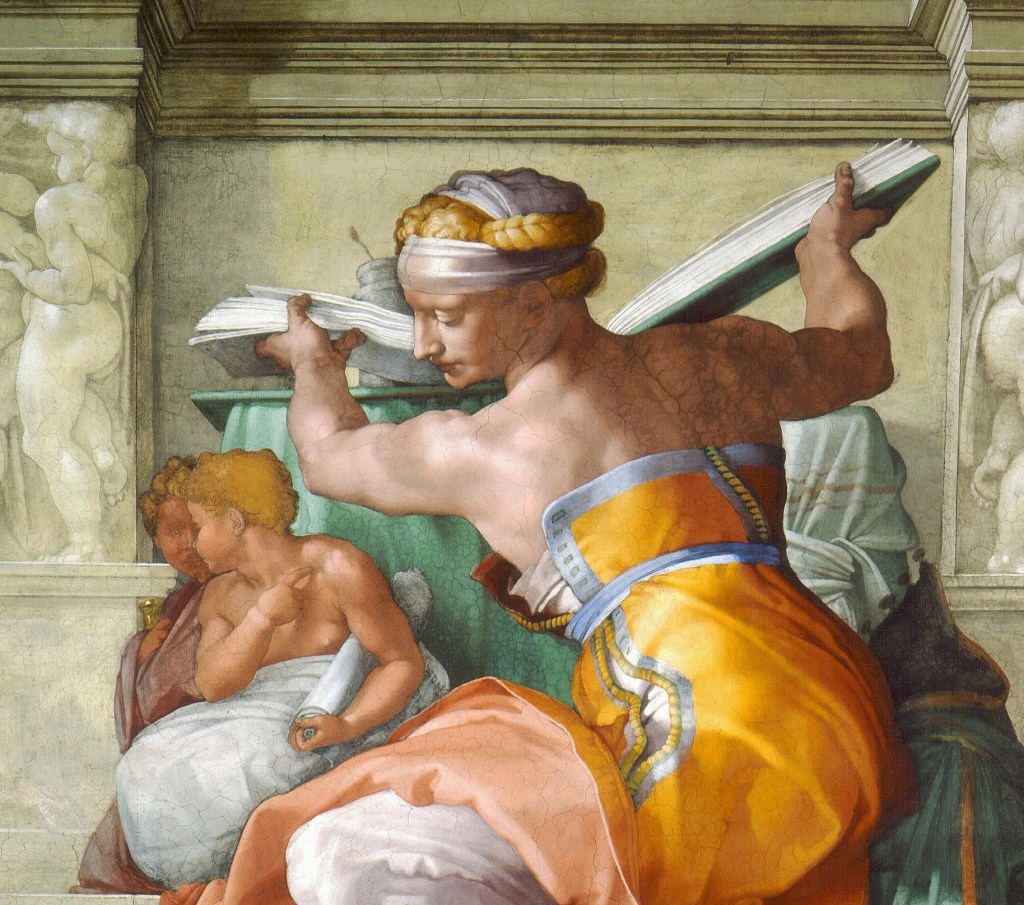
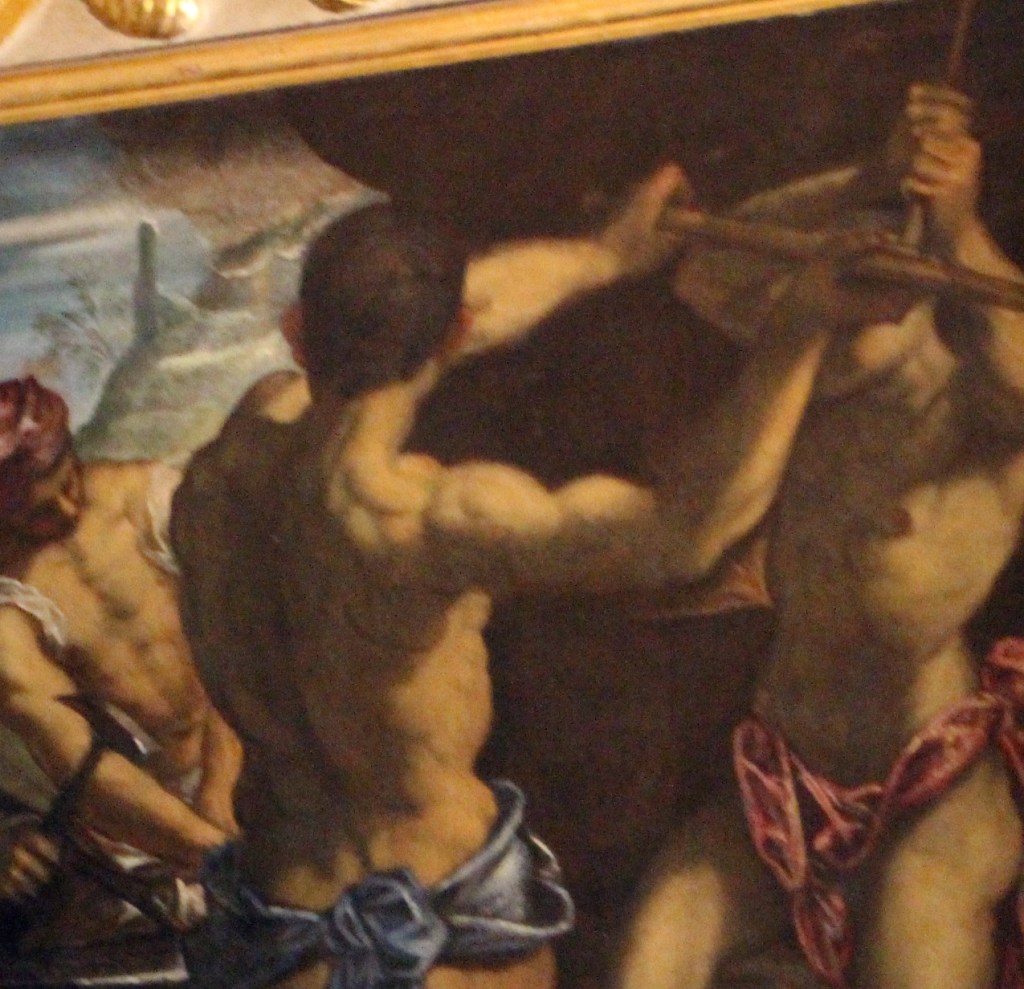
The inherited monumentality has been transferred to an unexpected setting. Zoé is neither prophetess nor mythological figure, nor even the male labourer to whom such muscular extension had more readily been granted. She is a young woman kneeling on the floor of a grain room in the Doubs. Courbet has not idealised away the rough slippers, heavy skirt, grain and dust that bind her to that setting. Instead, a routine agricultural action has acquired the bodily amplitude of something much larger while its immediate circumstances remain emphatically present. The tension between the specificity of work and the monumental form given to it leads directly to a larger question: what did it mean, in the middle of the nineteenth century, to represent a woman working in this way?
Women and Work
Set beside other images of female labour from the middle decades of the nineteenth century, Courbet’s central figure looks still more unusual. Women at work were by no means absent from contemporary painting, but they were often represented through familiar forms of reassurance. Rural labour could be absorbed into ideas of endurance, maternity, piety or natural order; alternatively, it could be softened into something graceful, picturesque or decorous. Courbet allows none of these conventions to sit comfortably around his grain sifter.
Millet provides a close comparison. In The Gleaners of 1857, three women bend repeatedly towards the earth, their bodies drawn into the broad horizontal rhythm of the field. Gleaning was not simply an innocuous rural custom. In many parts of France, after the harvest, the rural poor had traditionally been permitted to enter the fields and gather the fallen ears of grain, a valuable supplement to household subsistence. Such customary claims had repeatedly brought gleaners into conflict with landowners and farmers seeking greater control over the produce of their fields. Yet Millet’s women seem to belong to a world older and more enduring than those immediate conflicts. Their stooping forms are bound closely to the land, and the hardship of their work becomes part of an almost timeless rural order.
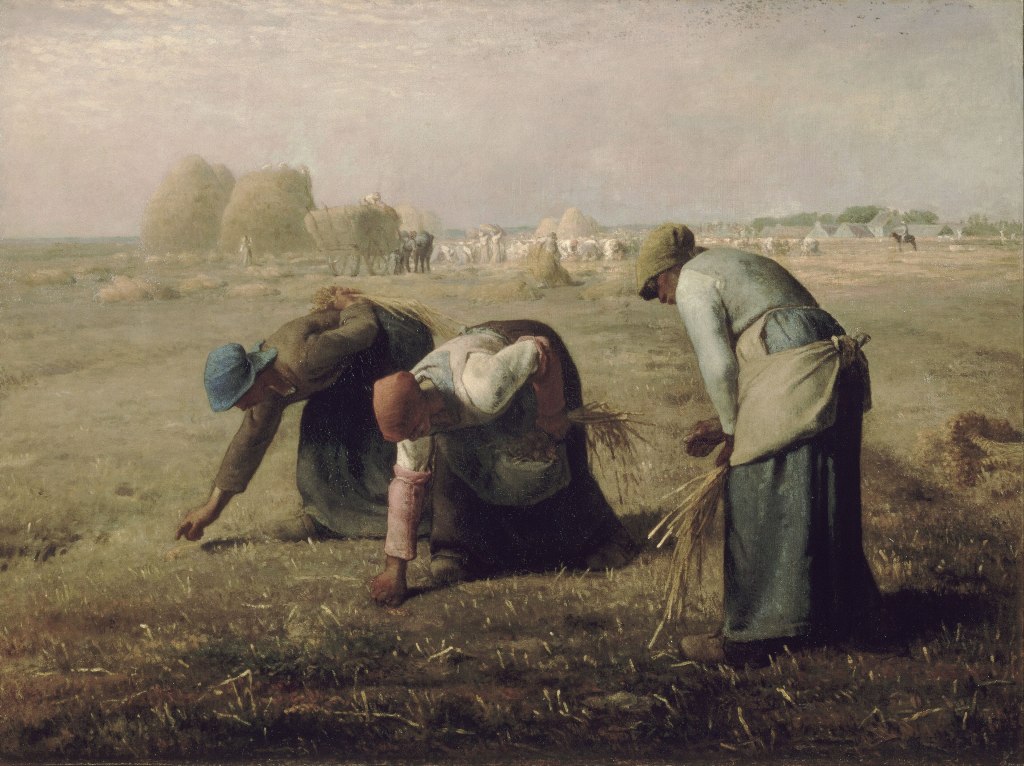
Zoé inhabits labour differently. Where Millet’s three bodies submit to the recurring stoop of gleaning, hers rises and reaches within the confined room. Millet’s gleaners possess their own severity and monumentality, but Courbet concentrates bodily effort into a single expansive gesture.
Breton’s field workers offer another possibility: labour made graceful and picturesque. Courbet’s sifter is no less carefully constructed, but the heavy skirt and awkward kneeling position refuse that ease. Her pose has grandeur, but little of the decorous grace expected of Salon painting.
The room itself places this labour in time. Juliette sorts grain manually at the left; Zoé works with the large sieve at the centre; at the right the boy examines the tarare. Nochlin has suggested that the sequence may register different stages of agricultural technology, moving from manual separation towards mechanisation. Such a reading must remain tentative. What is clear is that Courbet has juxtaposed three distinct procedures rather than three workers engaged in the same activity.
They belonged, moreover, to a rural economy already changing. During the second half of the nineteenth century, increasing mechanisation would alter agricultural practices and the kinds of work undertaken by women. The tarare brings that changing world into Courbet’s room. It prevents the scene from becoming an image of immemorial peasant life, even if it would be too neat to turn the painting into a simple allegory of progress.
Zoé thus belongs to a particular place, practice and moment of change, while the scale and force Courbet has given her seem to exceed them. She is neither a timeless emblem of peasant endurance nor a picturesque type. The conditions of work remain sharply defined, but they have been joined to a bodily grandeur that is much harder to classify.
A Strange Picture
Courbet’s description of Les Cribleuses de blé as a tableau étrange seems apt. Almost everything in the painting can be named: the room, the grain, the sieve, the tarare, even the people who posed for its figures. Yet this accumulation of particulars does not make the picture easier to explain. The more closely Courbet attends to the visible and tangible world, the less securely the painting belongs to simple observed actuality.
Zoé’s body is both familiar and improbable, an agricultural worker and a monumental pictorial invention. Nothing has ceased to be specific, but nothing quite seems ordinary either. More than a century and a half later, the strangeness Courbet recognised in the picture remains.
Producing these essays requires care, time, research, and resources. Contributions to help sustain this exploration would be greatly appreciated.
Donate to Inner Surfaces here.
Bibliography
These are the sources for this essay. Any errors are mine.
Callen, Anthea, Courbet, London: Jupiter Books, 1980.
Des Cars, Laurence and Dominique de Font-Réaulx, eds, Gustave Courbet, exhibition catalogue, Galeries nationales du Grand Palais, Paris; Metropolitan Museum of Art, New York; Musée Fabre, Montpellier, 2007–08.
Font-Réaulx, Dominique de, ‘Realism and Ambiguity in the Paintings of Gustave Courbet’, in Laurence des Cars and Dominique de Font-Réaulx, eds, Gustave Courbet, exhibition catalogue, 2007–08.
Nochlin, Linda, Courbet, London: Thames & Hudson, 2007, especially ‘The Cribleuses de blé: Courbet, Millet, Breton, Kollwitz, and the Image of the Working Woman’, pp. 95–106.
Toussaint, Hélène, Gustave Courbet: 1819–1877, exhibition catalogue, Galeries nationales du Grand Palais, Paris, 1977–78; Royal Academy of Arts, London, 1978. Paris: Éditions des Musées nationaux, 1977.
Online resources
Christie’s, catalogue entry for Gustave Courbet, Les Cribleuses de blé, esquisse, c. 1855.
Gaillard, Emmanuelle, ‘Les cribleuses de blé’, L’Histoire par l’image, September 2005.
Metropolitan Museum of Art, material accompanying Gustave Courbet, exhibition and artist resources.
Musée Courbet, Ornans, biographical and contextual material on Gustave Courbet.
Musée d’arts de Nantes, collection and educational material on Gustave Courbet, Les Cribleuses de blé.
Musée d’Orsay, collection entries for Gustave Courbet, Un enterrement à Ornans and L’Atelier du peintre.
POP: la plateforme ouverte du patrimoine, Joconde database, entry for Gustave Courbet, Les Cribleuses de blé, Musée d’arts de Nantes, inv. 874.

