La pulce
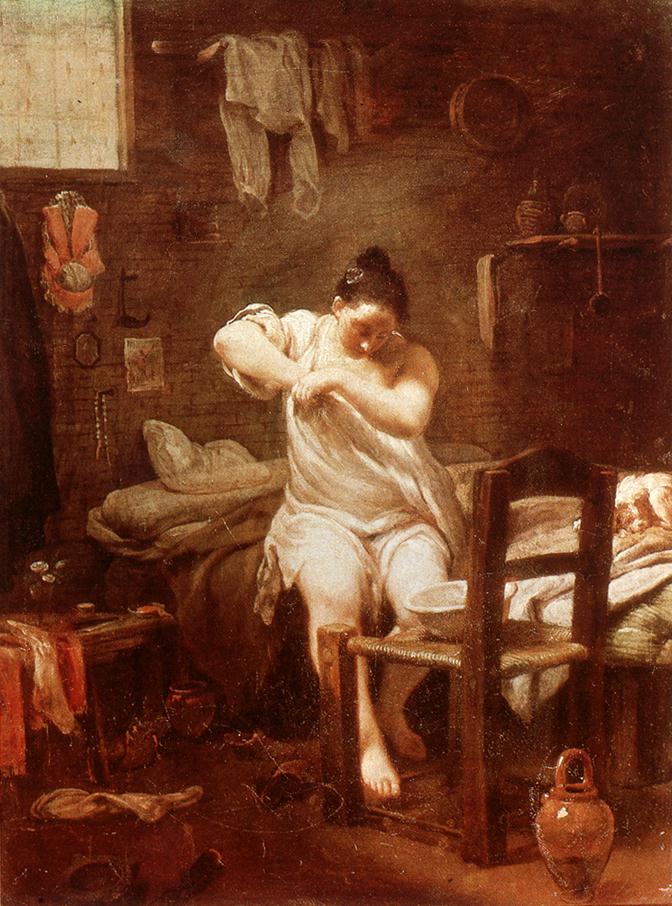
A young woman sits in a cramped interior, pulling her clothing aside as she examines her body. Her head is lowered, one shoulder exposed, and the composition is organised around the awkward concentration of the act. The small oil on copper in the Uffizi is generally known as The Flea (La pulce), although no contemporary source appears to have described Crespi’s pictures under that title. Usually dated to about 1709, it belonged to the Medici collections and is the earliest of a group of surviving compositions in which Crespi and his workshop returned to the same theme.
The identification of the action as flea hunting has nevertheless had a long history, and the subject itself belonged readily enough to the comic and mildly erotic repertory of genre painting. A partially dressed woman searching her body could offer the spectator both bodily intimacy and amusement. Crespi has concentrated the Uffizi version closely around the woman, however. She dominates the small composition, although bedding, vessels and other domestic objects gather around her and give the interior a distinctly inhabited character. Her bent body, bare foot and loosened clothing have none of the polished ease of an erotic figure. The physical inconvenience of what she is doing remains conspicuous.
Crespi returned repeatedly to the motif, but he did not simply repeat the Uffizi composition. Seven surviving variants or related versions have been identified, and their chronology has been much debated. In the later paintings the setting expands and acquires a much more active role. The larger version in the Louvre, probably painted in the later 1720s, places the woman on a bed within a substantially furnished room; related paintings in Pisa and Naples develop the same conception. Furniture, musical instruments, a lapdog, pots and other household possessions now provide information about the woman and her circumstances. The interior has become part of the subject.
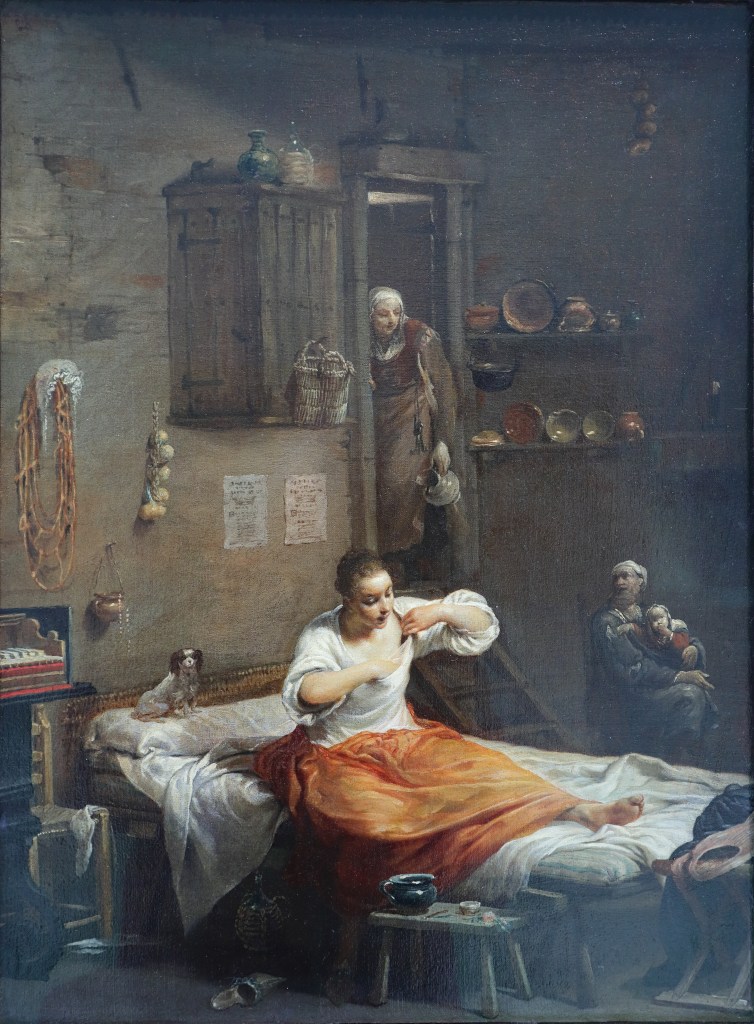
This difference is particularly revealing. In the early Uffizi copper, the woman still dominates the confined space. In the later compositions, where she lives begins to tell us more about her circumstances, almost as much as the action itself. The change also brings into view a recurrent feature of Crespi’s painting: his interest in the material evidence of a life. Cloth, furniture, vessels and worn surfaces can operate almost as small still-life passages within the larger scene. They are not simply descriptive additions. They help establish the character and social register of the room.
There has also been an attempt to connect the flea-hunting pictures with a lost series described by the painter and writer Giampietro Zanotti (1674–1765). According to Zanotti, an English patron commissioned Crespi to paint, on small copper panels, the rise and decline of a female singer: from poverty, through fame and prosperity, to a final state of solitude and misery. Roberto Longhi suggested that a flea-hunting woman might have formed the opening episode of such a story, and Mira Pajes Merriman later explored the possibility in greater detail. The chronology, however, creates difficulties. The Uffizi picture appears to precede the likely date of the lost series, and there is no documentary evidence establishing that Crespi actually used the flea-hunting motif within it. The connection remains an intriguing hypothesis rather than an identification.
Genre painting still occupied an uncertain position in Italian art when Crespi began his career in Bologna during the 1680s. Scenes of trades, domestic activity, fairs and taverns could be avidly collected while remaining associated by academic critics with the lower registers of painting. The Bamboccianti had made such subjects commercially successful, particularly through pictures of contemporary popular life in which figures were distributed through streets, courtyards and landscapes. Francesco Porzio has stressed that attraction to this world could coexist with considerable social distance. Humble subjects might be comic, picturesque, moralising or merely curious, and these different responses did not necessarily exclude one another.
Crespi’s own interest in working life had begun before his closer association with Florence. In about 1687–88 he publicly exhibited two now-lost paintings, one showing labourers at a winepress and another showing butchers at work. His encounter with Grand Prince Ferdinando de’ Medici in 1708 nevertheless provided a particularly receptive setting for such subjects. John T. Spike has noted Ferdinando’s admiration for Crespi’s humour, rapid execution and unconventional imagination, while Florentine collections offered extensive opportunities to study Bamboccianti painting. Contemporary accounts remembered the prince wanting from Crespi subjects that were “pleasant and common”.
The Uffizi Flea belongs comfortably within that culture of curiosity and amusement, but its effect is not reducible to either. The picture offers intimate access while leaving the figure absorbed in an activity of her own. That combination of proximity and self-containment gives a slight, potentially comic subject a more persistent interest than its premise might suggest.
Scena di fattoria
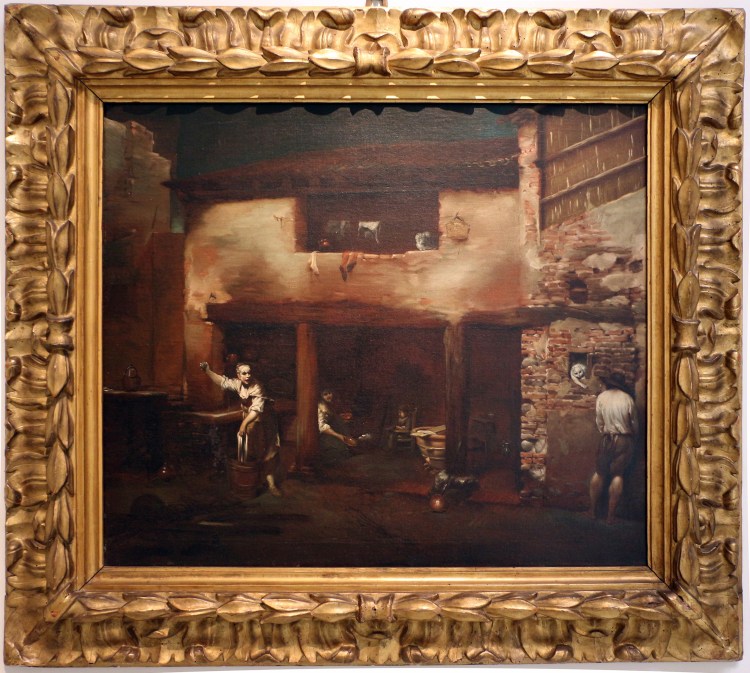
Scena di fattoria (Farm Scene), also known as Scena di cortile (Courtyard Scene), is now in the Pinacoteca Nazionale in Bologna. Its date is less certain than has sometimes been assumed. The picture has often been placed soon after Crespi’s Florentine encounter with Bamboccianti painting in 1709, but its thin handling and threadlike highlights have also prompted comparisons with works from much later in his career.
The scene itself is built around a piece of coarse humour. To the left, a woman bends over the washing and raises a stone towards a barefoot man who is urinating against the wall, apparently ready to throw it at him. Another woman looks on from beneath the loggia, while a cat above seems to join the rebuke from its opening in the wall. The joke is broad, and closely related to the low-life humour associated with the Bamboccianti, but it occupies only part of the picture.
Much of its effect comes instead from the farmyard itself. Crespi has given close attention to the crumbling plaster, exposed brickwork, uneven masonry and worn surfaces of the buildings. Washing hangs from the upper level; pots, tubs and other domestic objects have been dispersed through the darker recesses below. The honey-coloured walls catch the light unevenly, so that sections of rough surface emerge from shadow while other parts of the courtyard remain subdued. These material details do more than establish the setting. They give the scene a physical particularity that is as important as the figures who inhabit it.
The eye therefore moves between different kinds of observation. The woman’s raised arm and the man against the wall provide the most obvious exchange, but elsewhere the picture is quieter. Figures sit or watch beneath the loggia, laundry has been left to dry, and utensils occupy the spaces where work is taking place. Human activity and the fabric of the building have been treated with comparable attention. The courtyard appears used and weathered, its surfaces marked by long habitation and daily work.
The immediacy of the scene has led to speculation about Crespi’s use of a camera obscura. Luigi Crespi later recalled that his father installed a lens in his house and observed images projected from the street onto the wall of his studio, and Mira Pajes Merriman connected this practice with the close rendering of masonry in the present picture. The evidence remains uncertain, however. Luigi’s account appears to refer to experiments made late in Crespi’s life, while Zanotti, who was much closer to him in age, makes no mention of a lens. The suggestion is therefore best treated as a possibility rather than an explanation.
What is clearer is that Scena di fattoria depends upon a balance between comic incident and sustained observation of place. The coarse exchange across the courtyard could easily have supplied the whole subject, but Crespi has allowed the buildings, laundry, vessels and patches of light to claim attention alongside it. The result is not simply a joke set against a neutral background. The life of the yard resides in its surfaces and objects as much as in the people within it.
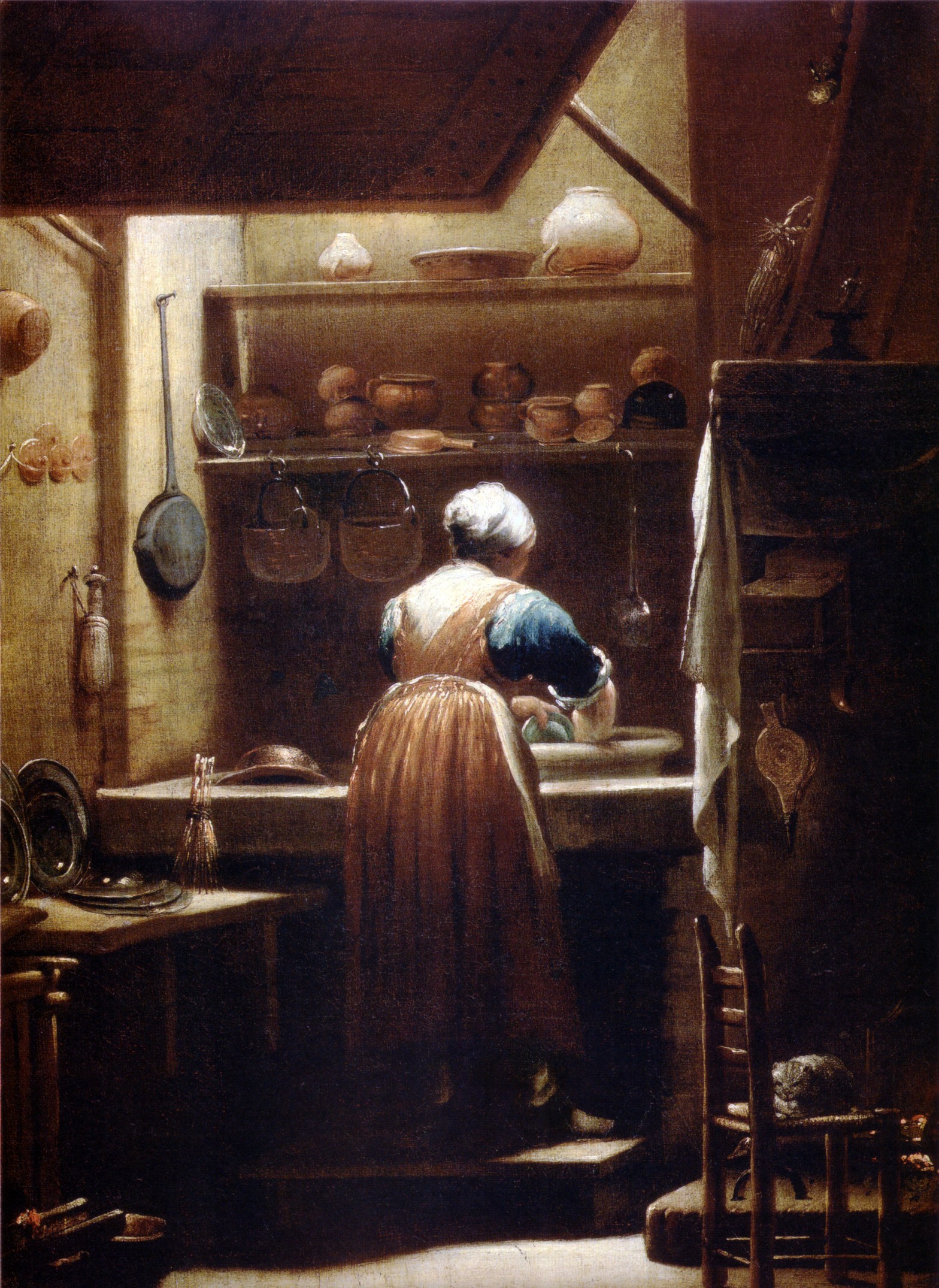
La sguattera
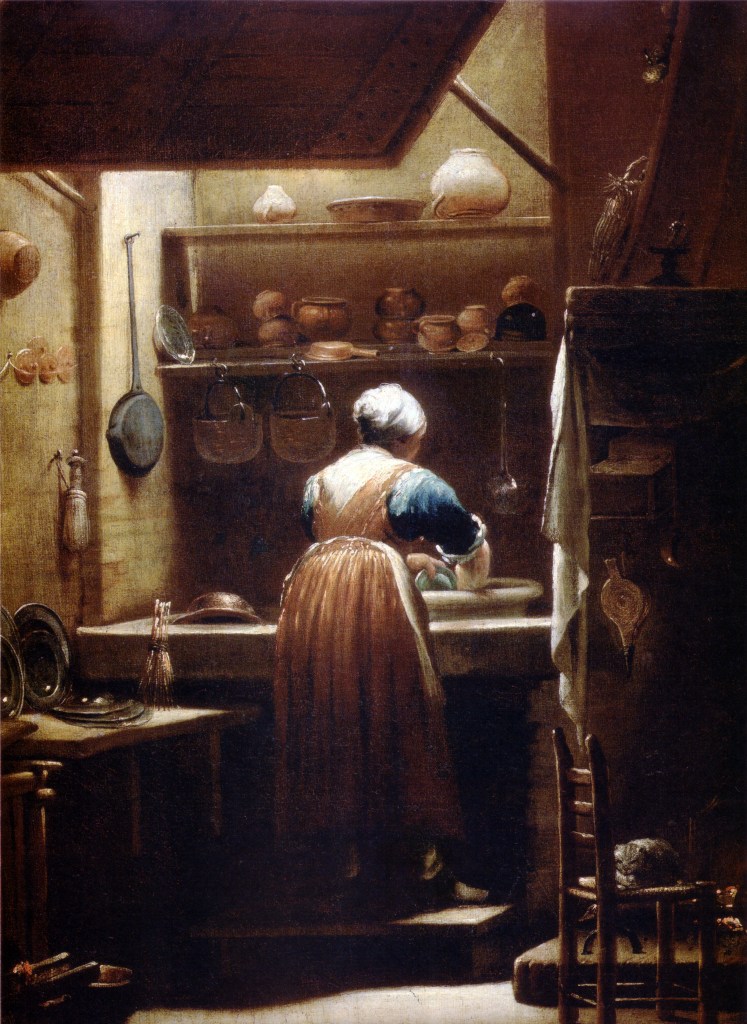
In La sguattera (The Scullery Maid or Woman Washing Dishes), painted around 1720–25 and now in the Contini Bonacossi Collection at the Uffizi, Crespi returns to an intimate domestic interior. A woman stands with her back to us at a sink in a dark kitchen, surrounded by shelves, pots, pans and other utensils. A cat sleeps on a rush-seated chair nearby. Nothing interrupts her work, and there is little here that develops into anecdote. Washing dishes is repetitive labour, and Crespi has made that repetition itself the basis of the scene.
Light is essential to the way the room is understood. It enters from above and settles selectively across the woman’s white cap and shoulders, the folds of her clothing and the objects around her, leaving much of the interior in shadow. The pots and vessels are not merely accessories required to establish a kitchen. They form small still-life passages within the larger composition, each briefly caught by the same searching illumination. The effect is quite different from the open, honey-coloured masonry of Scena di fattoria, but both pictures reveal Crespi’s close attention to surfaces, cloth and the objects handled in everyday work.
Eugenio Riccòmini has placed La sguattera, which he dates to about 1725, within Crespi’s sustained “observation of nature”. He contrasts its humble domestic setting with the Arcadian elegance fashionable elsewhere in eighteenth-century painting and suggests comparisons, at some distance, with Velázquez, Manet and perhaps Vermeer. The last comparison is particularly suggestive as an analogy rather than a claim of direct influence. Like a Dutch domestic interior, Crespi’s kitchen allows an absorbed household task and the material environment in which it is performed to command attention together.
There is a longer history behind this concentration upon observed experience. In the Seven Sacraments, painted around 1712 for Cardinal Pietro Ottoboni, Crespi had brought Catholic ritual into contemporary churches, rooms and hospital interiors. Riccòmini recalls Zanotti’s account of the genesis of Confession: Crespi had supposedly noticed a shaft of sunlight falling through a broken window onto a confessional and later reconstructed the effect in his studio. Whether every detail of the anecdote can be verified is less important than what it tells us about the way Crespi was remembered: as a painter alert to transient effects of light and to the circumstances in which people actually lived and acted.
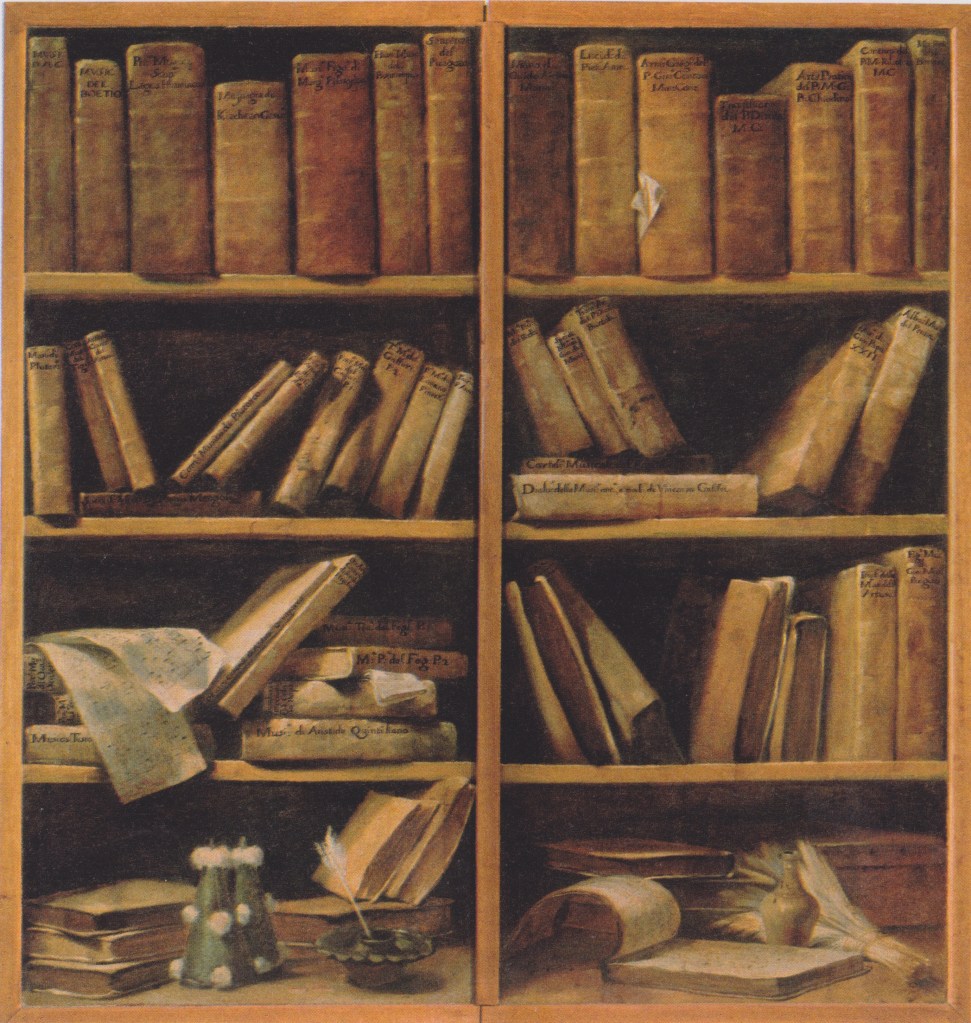
That attentiveness extends beyond the human figure. Crespi’s Scaffali con libri di musica in Bologna, with its shelves of books, papers and miscellaneous objects, shows how compelling the material world could become when isolated as a subject in its own right.
In La sguattera, figure, utensils, cloth and light remain bound together. The woman neither poses nor turns from her task, while the objects around her remain part of the same concentrated domestic world. Crespi has found enough in a commonplace act of work, and in the things surrounding it, to sustain the painting.
Common life
The three paintings considered here do not describe a simple progression in Crespi’s genre painting. He continued to move between crowded public scenes, comic narratives, pastorals, intimate interiors and images of work. What they show instead is the range of distances from which he approached comparable material. The Flea presses close to an awkward bodily act; Scena di fattoria distributes attention across a shared and disorderly environment; La sguattera narrows the scene to one woman, one room and the duration of a repetitive task.
Across those differences, certain painterly habits recur. Crespi has been attentive to worn cloth, peeling plaster, brick, pots, books, laundry and other objects marked by handling and use. Light repeatedly enters his pictures unevenly, discovering a face, a piece of fabric or a vessel before allowing the surrounding space to fall back into darkness. These details do not amount to documentary evidence in themselves. As Francesco Porzio has emphasised, genre painting selected and rearranged fragments of observed reality within conventions shaped by comedy, social hierarchy and the expectations of collectors. But Crespi’s observation gives those conventions a remarkable physical density.
This helps to explain his position within the longer history of Italian genre painting. The Bamboccianti had established a market for contemporary popular life, often presenting its inhabitants within picturesque and comic settings. Later in the eighteenth century, Giacomo Ceruti would give poor and working figures a monumentality and psychological gravity that Porzio regards as having had few Italian precedents since Caravaggio. Crespi occupies a less settled position between them. Humour has remained available to him, sometimes very broadly, as Scena di fattoria makes clear; so have cultivated curiosity and the pleasures of pictorial anecdote. Yet at other moments these elements recede, leaving a flea hunt, a kitchen task or the worn fabric of a room to hold attention for themselves.
Riccòmini’s account of Crespi as an artist whose novelty arose from a renewed attention to what could actually be seen is helpful here. His naturalism did not require him to abandon the traditions in which he had been trained. The Carracci, Guercino, Venetian painting, northern genre and the Bamboccianti all remained available to him, as did sacred painting and the comic tradition. What distinguishes Crespi is less a rejection of these inheritances than the freedom with which he could redirect them towards the miscellaneous substance of contemporary experience. In his genre paintings, common life could still amuse, surprise or invite curiosity, but it could also occupy the picture with remarkably little need for justification.
Producing these essays requires care, time, research, and resources. Contributions to help sustain this exploration would be greatly appreciated.
https://donorbox.org/inner-surfaces-resonances-in-art-and-literature-837503
Bibliography
Porzio, Francesco, ‘Aspetti e problemi della scena di genere in Italia’, in Da Caravaggio a Ceruti: la scena di genere e l’immagine dei pitocchi nella pittura italiana, Milan, 1998, pp. 17–39.
Riccòmini, Eugenio, L’arte a Bologna dalle origini ai giorni nostri, Bologna: Pendragon, 2011.
Spike, John T., Giuseppe Maria Crespi and the Emergence of Genre Painting in Italy, with essays by Mira Pajes Merriman and Giovanna Perini, exhibition catalogue, Kimbell Art Museum, Fort Worth, 20 September–7 December 1986, Fort Worth: Kimbell Art Museum, 1986.
Online museum and catalogue resources
Fondazione Federico Zeri, Cataloghi online, entry for Giuseppe Maria Crespi, Donna che lava i piatti (La sguattera).
Pinacoteca Nazionale di Bologna, online collection entry for Giuseppe Maria Crespi, Scena di cortile.
Pinacoteca Nazionale di Bologna, ‘Il Settecento: da Giuseppe Maria Crespi ai Gandolfi’, online gallery guide, including Scena di cortile.
 Inner Surfaces