Before France
Andrea del Sarto’s journey to France in 1518 has acquired a special place in accounts of his career. John Shearman treated that year as the beginning of Andrea’s ‘heroic period’, while Jan Sammer’s recent reconstruction of the painter’s movements has given the French episode a much firmer documentary basis than it previously possessed. Andrea’s service to François I can now be followed through financial records, court movements and diplomatic correspondence with a degree of precision that earlier scholars did not have. Sammer has used that reconstruction to argue that Andrea saw major finished works by Leonardo and Raphael at the French court and that these encounters affected his subsequent painting.
It would nevertheless be misleading to make France the beginning of Andrea’s relationship with either artist. Earlier scholarship had placed Leonardo and Raphael firmly within his development before 1518. Iris H. Cheney, reviewing the monographs of Sydney J. Freedberg and Shearman, noted that both scholars regarded Leonardo as an important presence in Andrea’s work after about 1511, even though they differed over the balance of influences involved. Freedberg emphasised Leonardesque psychological animation and sfumato within a broader High Renaissance vocabulary, while Shearman allowed a more mixed field of sources. Cheney herself argued that Shearman had underestimated Raphael’s contribution and that Raphaelesque ideas had been absorbed into Andrea’s artistic personality before the French journey.
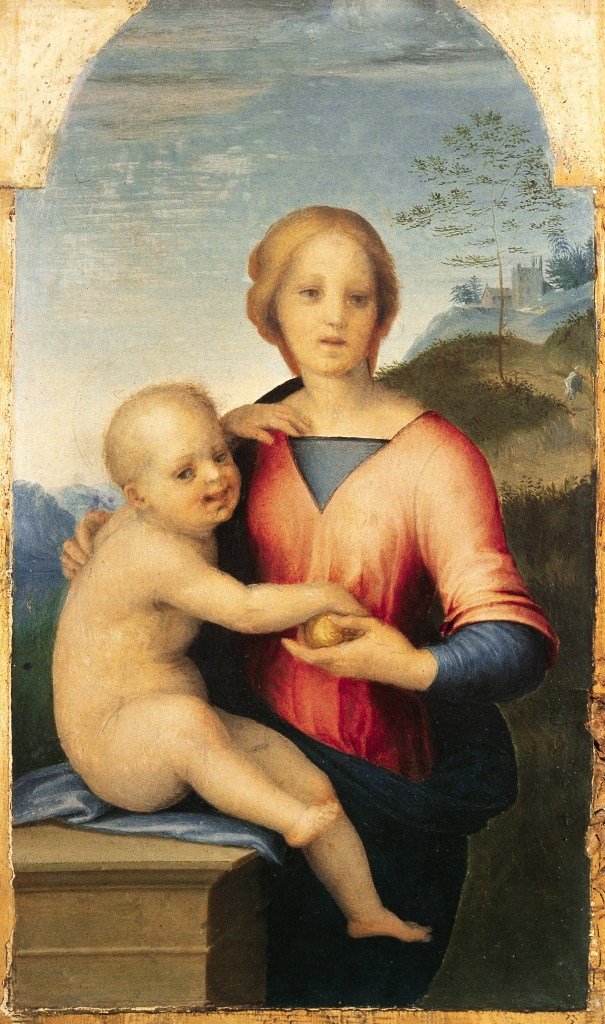
The surviving work supports that qualification. A small Virgin and Child in the Galleria Corsini, part of the Galleria Nazionale d’Arte Antica in Rome, generally dated to about 1507, belongs to Andrea’s earliest independent phase. Roberto Longhi regarded it as one of his most clearly Raphaelesque early paintings, and the Natali/Cecchi catalogue likewise relates its conception to the Madonnas Raphael had painted in Florence. Andrea does not repeat a Raphaelesque formula so much as absorb a way of organising the emotional exchange between mother and child. The relationship between the figures is softened and made more intimate, but the underlying conception is already part of his pictorial language.
Other evidence points in the same direction. Andrea had studied prestigious models from an early stage, and Vasari placed him among the young Florentine artists who spent long periods drawing from the works available to them, including the cartoons for Michelangelo’s Battle of Cascina and Leonardo’s Battle of Anghiari. Cordellier has stressed that such study belonged to a wider Florentine culture in which copying and reworking the work of other artists formed part of artistic formation.
Raphael had become one of those models well before the French journey. Cordellier traces his presence through a number of early Madonnas, where Andrea simplified or modified Raphaelesque constructions rather than reproducing them literally. In the Corsini Madonna and the Madonna of Humility, Andrea drew upon Raphael’s Florentine inventions while adjusting their clarity and emotional register. By the middle of the decade, the borrowings had become less overt.
Madonna of Humility on Wikimedia Commons
Leonardo’s presence was equally well established before 1518. Sammer does not deny this. He allows that Andrea may have encountered aspects of the standing Leda while Leonardo was still connected with Florence, and he accepts that Leonardesque ideas were already available within Andrea’s artistic world. His argument is more precise: the French journey may have altered the conditions of access. What Andrea had previously known through drawings, earlier inventions, discussion or indirect transmission could now be encountered in the form of specific finished paintings.
France enters the story not as a point of discovery, but as a possible change in the character of Andrea’s contact with Leonardo and Raphael. By 1518, both artists had helped to shape his visual language. The question is what happened when that long-standing engagement became attached to particular works that he may have seen directly at François I’s court.
Legacy and Innovation
Andrea’s engagement with the art of others is easiest to understand when copying is separated from the idea of simple replication. Dominique Cordellier makes that distinction repeatedly. Andrea could imitate another artist with extraordinary fidelity when he chose to do so, but much of the time he was looking for something more useful than a duplicate: a pose, a relation between figures, a spatial arrangement, or a compositional solution that could be dismantled and rebuilt within another work.
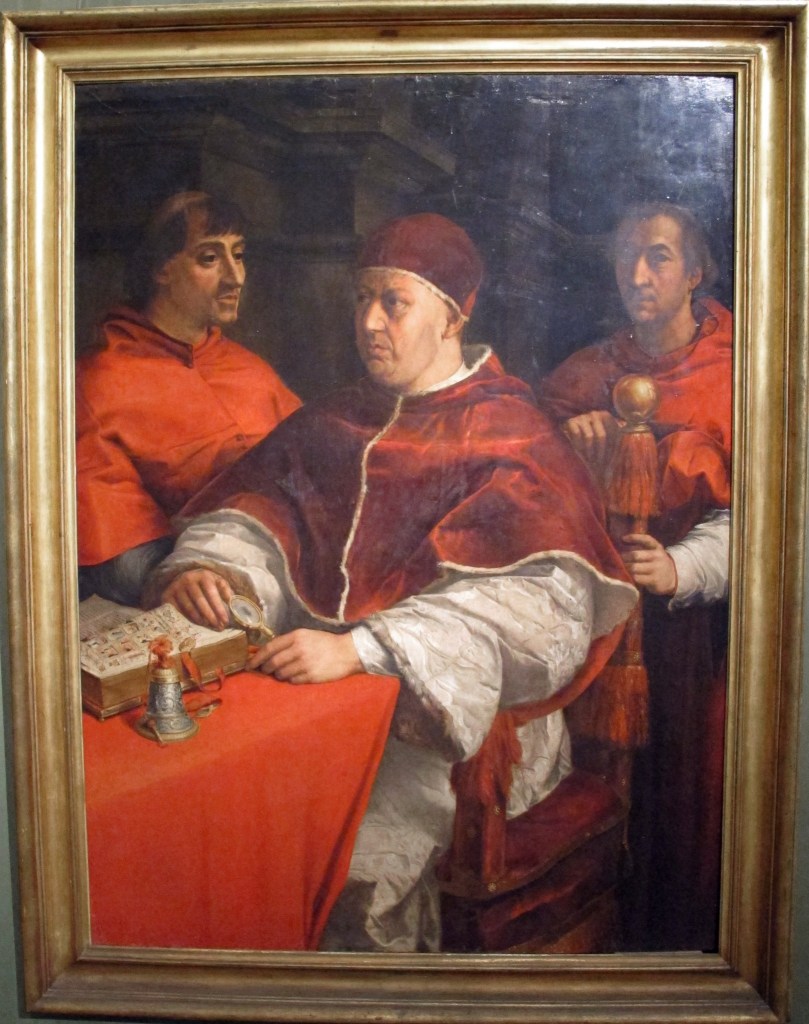
The celebrated copy of Raphael’s Portrait of Pope Leo X with Cardinals Giulio de’ Medici and Luigi de’ Rossi demonstrates Andrea’s capacity for exact imitation. Ottaviano de’ Medici commissioned Andrea to make a substitute when Federico Gonzaga sought possession of Raphael’s original. Vasari claimed that Andrea reproduced the painting so convincingly that Giulio Romano, who had known Raphael and his work intimately, initially failed to recognise the substitution. Whatever allowance is made for Vasari’s anecdotal manner, the episode demonstrates Andrea’s capacity to suppress his own manner and reproduce that of another painter when exact imitation was required.
His normal procedure was different. In this respect, Andrea might take a figure from a larger composition but leave its surroundings behind. He could redraw it more compactly, repeat a head or an arm while testing a position, strengthen one contour and neglect another, or translate an image into the softer language of red or black chalk. The drawing did not need to preserve the source in full. It preserved whatever Andrea had found useful in it. Cordellier accordingly describes his copying as free rather than literal, without methodical attention to measurement or proportion.
His drawings after Baccio Bandinelli’s Massacre of the Innocents offer a concrete example. Andrea did not attempt to reproduce the crowded composition as a whole. Instead, he extracted individual figures and children from it and studied them separately. Once isolated, the borrowed bodies become more compact and abbreviated; contours overlap and parts remain unresolved. Another artist’s finished invention has become material for Andrea to test, alter and absorb.
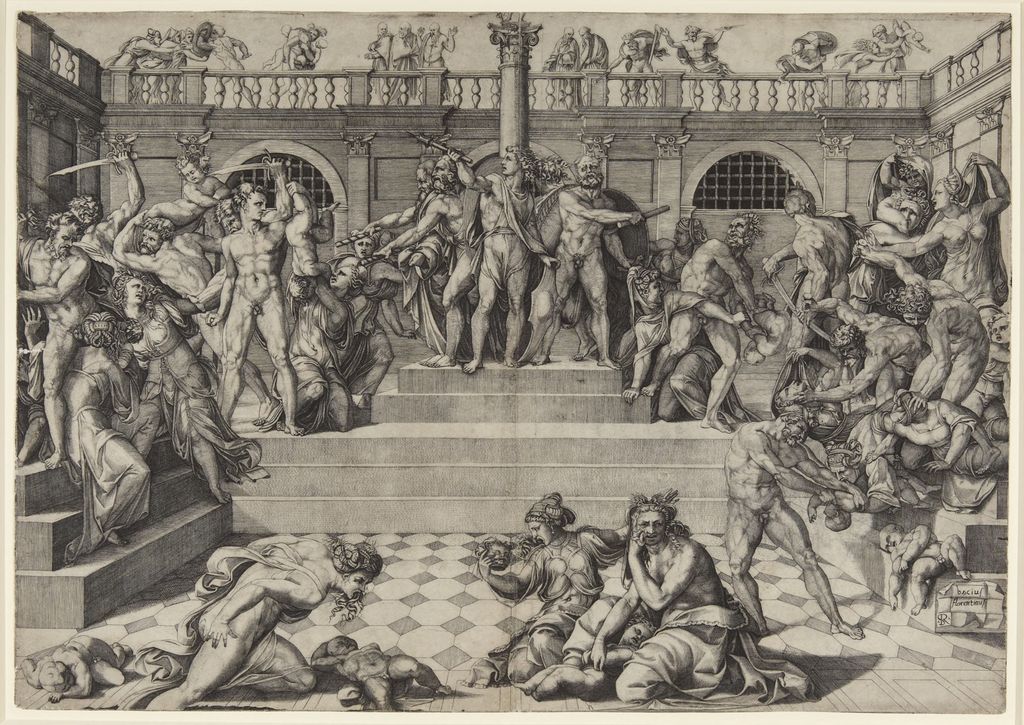
Study after Bandinelli’s Massacre of the Innocents on the Louvre website
Raphael offered material of a different kind. Andrea had been studying his work for years, but Cordellier shows that the relationship did not depend on straightforward quotation. In the early Madonnas, Andrea sometimes retained the essential relation between Raphael’s figures while changing the construction around them. In the Wallace Collection Virgin and Child with the Infant Baptist, for example, he adapted the design of the Virgin in Raphael’s Alba Madonna, but tightened the group and made its forms more angular. The source remains perceptible, yet the composition has been rebuilt in Andrea’s own terms.
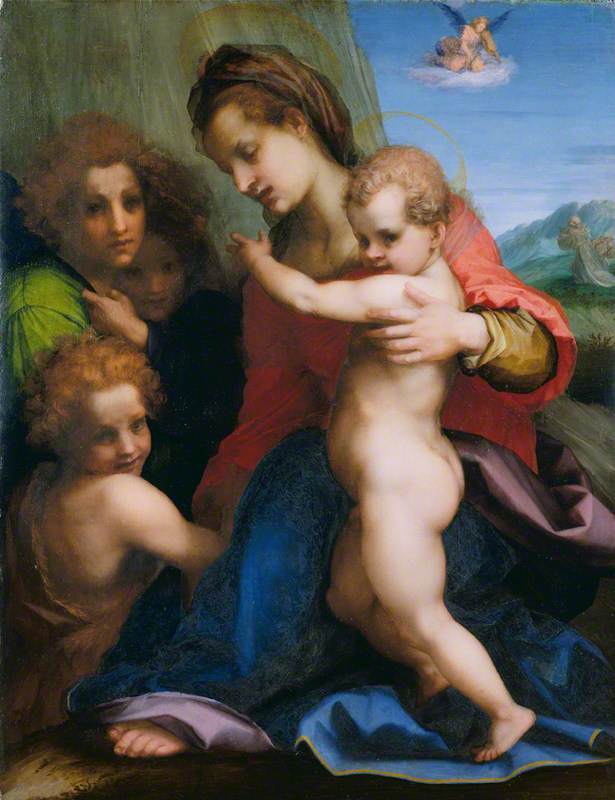
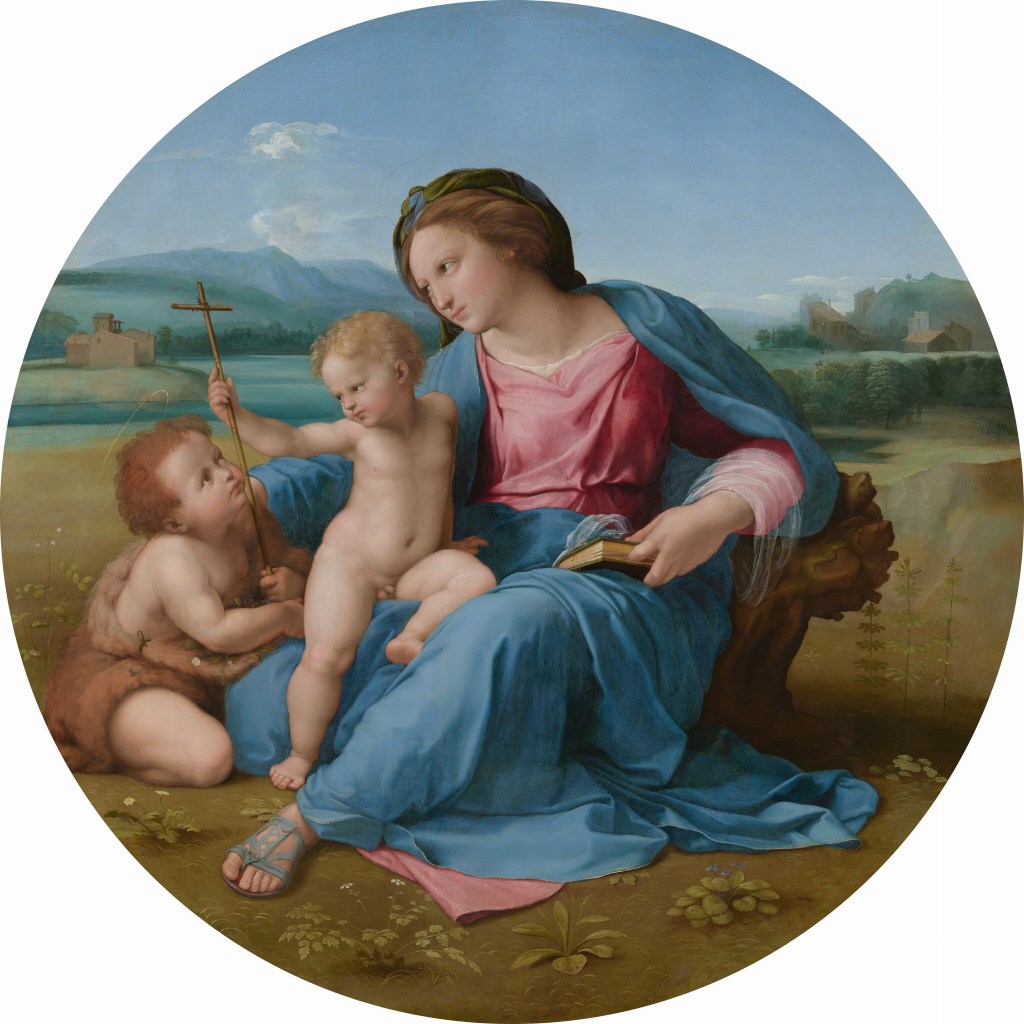
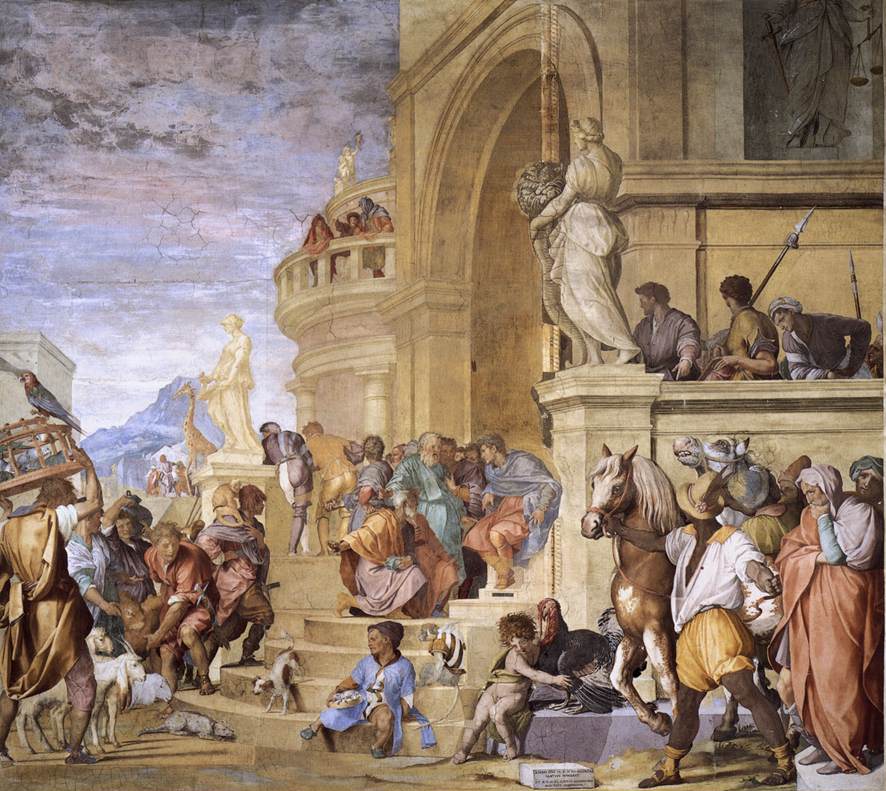
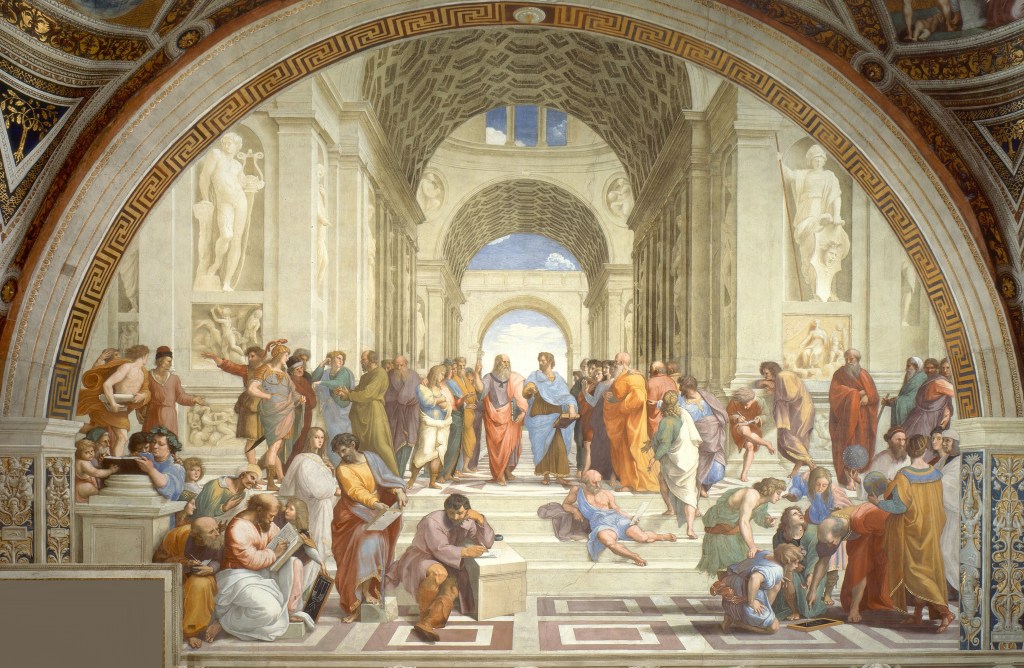
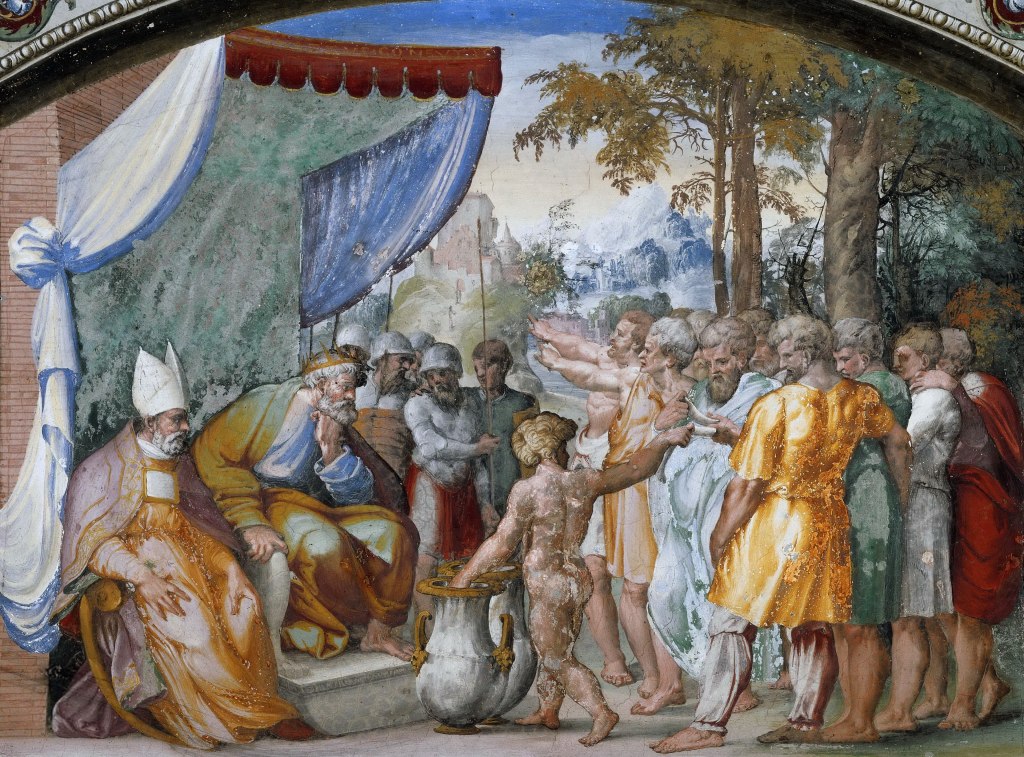
At other times the borrowing lay not in a single figure but in the organisation of space. In Tribute to Caesar, begun around 1520 and left unfinished when work stopped in 1521, Andrea drew on Raphael’s monumental compositions. The group around Caesar has been related specifically to Raphael’s Division of the Land in the Vatican Logge. Cordellier, following Shearman, also points to Andrea’s use in 1521 of spatial constructions derived from the School of Athens and the cartoons for the Acts of the Apostles, but seen from a lateral rather than frontal viewpoint, as though the spectator had moved from the centre of a theatre towards the wings.
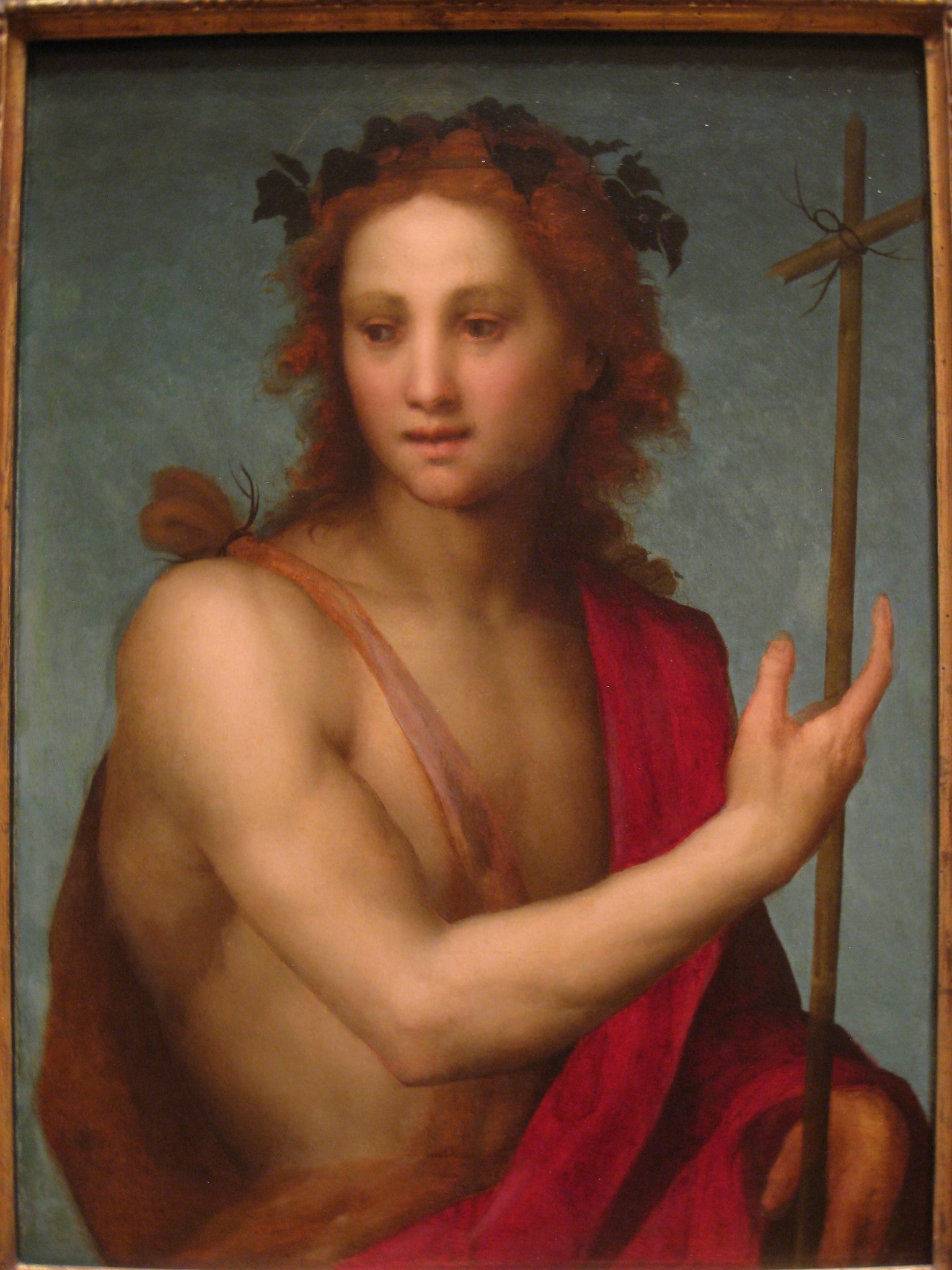
The same scholar also singles out the Worcester Saint John the Baptist as evidence of Andrea’s close knowledge of Leonardo’s treatment of the subject. His comparison is not confined to the familiar half-length Saint John the Baptist in the Louvre. There is also a larger, full-length Baptist in a landscape, now likewise in the Louvre and generally attributed to Francesco Melzi or Leonardo’s workshop.
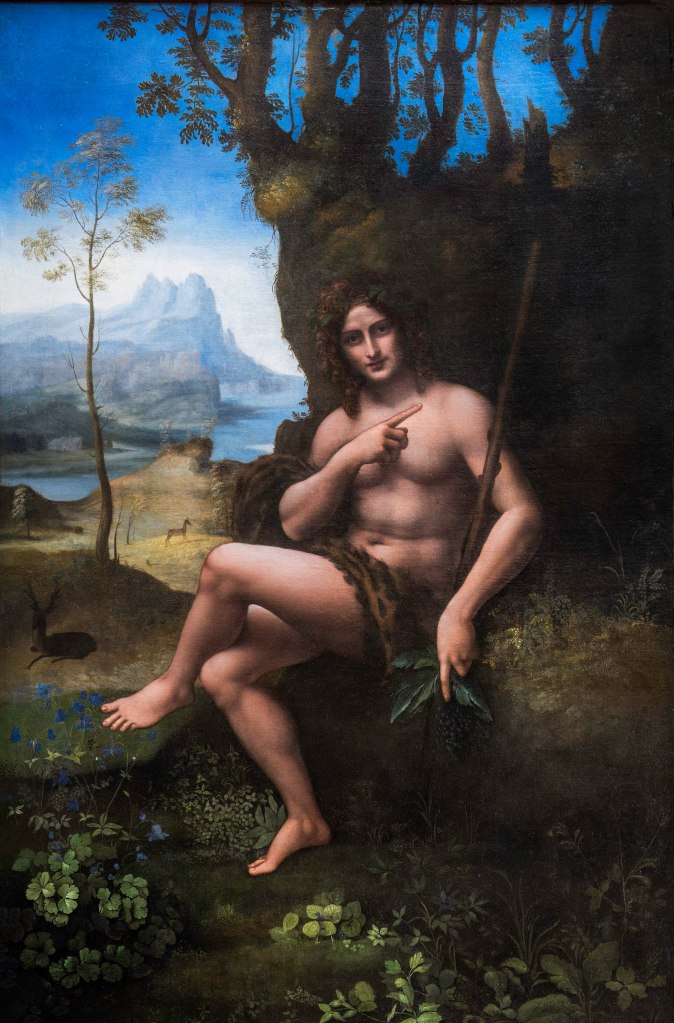
In the late seventeenth century the Louvre painting was explicitly transformed into a Bacchus: grapes and an ivy crown were added, and Saint John’s cross-staff was converted into a thyrsus. The spotted animal skin, however, appears to belong to the original conception. Andrea’s Worcester picture seems to depend most directly on the half-length Saint John, but its fusion of Baptist and Bacchic imagery belongs to this broader Leonardesque treatment of the subject. Cordellier leaves open the separate historical question of when Andrea encountered these ideas: Rome is one possibility, France another.
Leonardo: Leda and Saint John
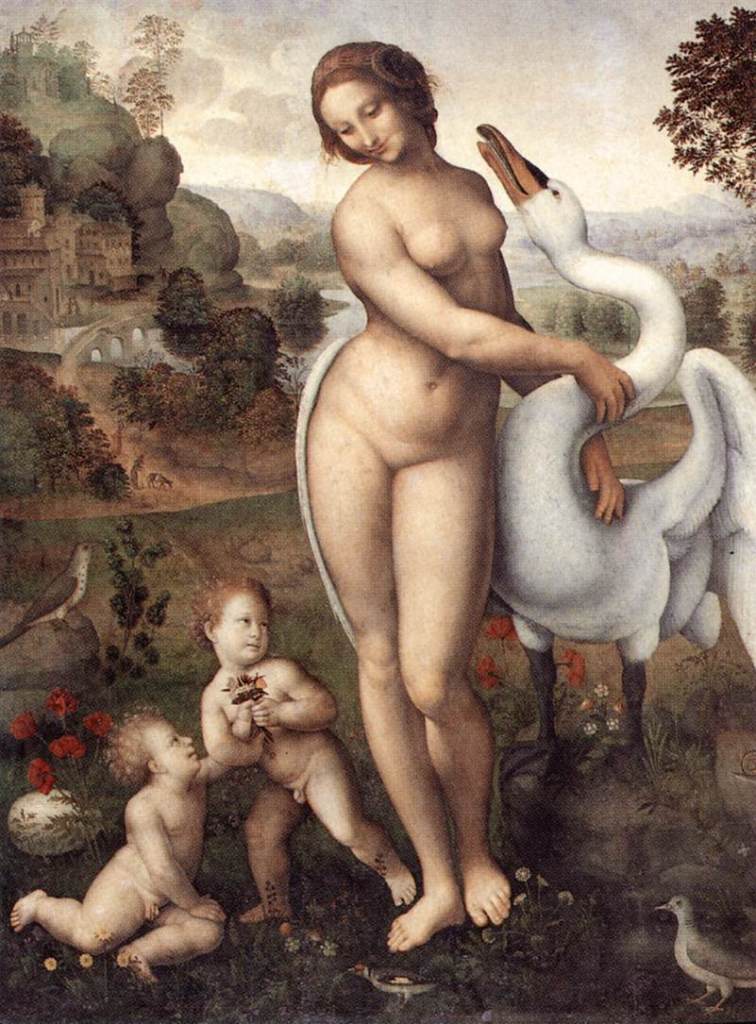
The Brussels Leda poses a problem of chronology before it poses one of influence. Its dependence on Leonardo has long been recognised, but scholars have disagreed over when Andrea made it. John Shearman placed the picture around 1513–14, and the Natali/Cecchi catalogue likewise favoured a date around 1513–15. On that chronology, the painting would belong to Andrea’s pre-French career and could not itself be evidence for what he saw at François I’s court. Jan Sammer, by contrast, has argued for a date after Andrea’s return from France, around 1519.
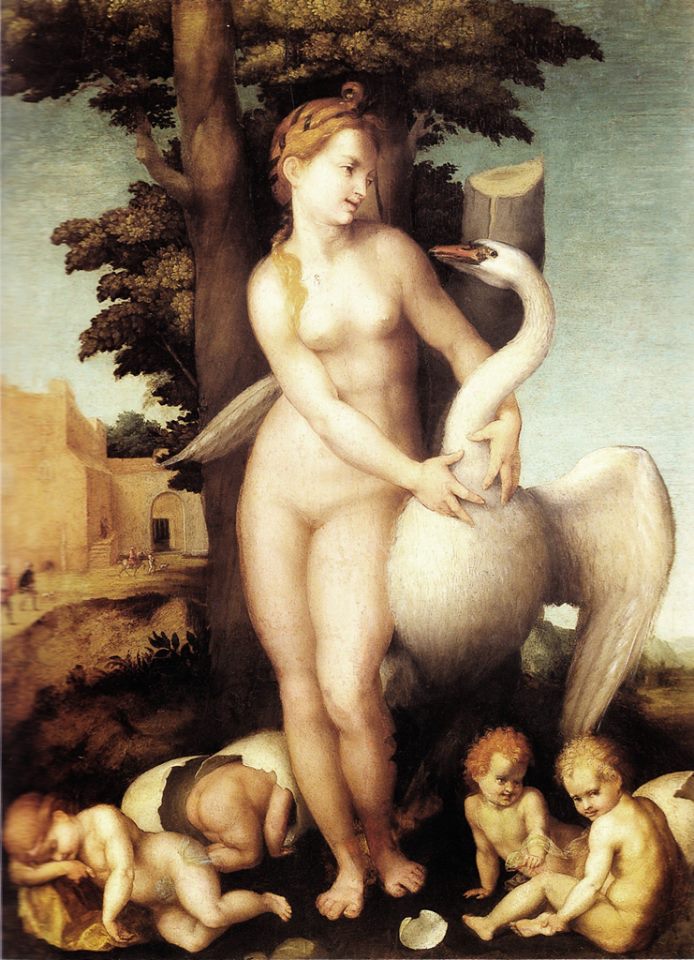
Chronology matters here because Andrea’s Leda does not merely repeat a generic Leonardesque type. It depends upon Leonardo’s lost composition of Leda and the Swan, known through copies and related works. Andrea retains the essential conception of the standing female figure with the swan, but changes both the emotional and compositional balance. His Leda turns more directly towards the bird, while the accompanying children are differently disposed. Sammer regards these changes not as evidence against dependence on Leonardo, but as examples of Andrea’s characteristic willingness to rework a model rather than reproduce it.
If the earlier dating is accepted, Andrea must have known the composition before leaving Florence. Sammer allows that possibility: aspects of Leonardo’s Leda could have circulated in drawings, copies or other forms while Leonardo’s inventions were still accessible in Italy. His argument is therefore not that France introduced Andrea to the subject, but that it may have allowed him to see Leonardo’s finished composition directly rather than through copies or other forms of transmission.
The Brussels painting therefore cannot by itself prove the French connection. Its dependence on Leonardo is clear, but its date remains disputed. A pre-1518 date would place the work within Andrea’s established engagement with Leonardo, whereas a post-1519 date would make direct access in France a more immediate possibility. The uncertainty cannot be removed simply by stressing the resemblance.
The Worcester Saint John the Baptist presents the problem differently. Here the Leonardesque relationship is both close and specific. Sydney J. Freedberg identified the painting as the work described by Vasari and dated it to about 1517 on stylistic grounds. He connected it directly with Leonardo’s Saint John the Baptist in the Louvre, citing the upward gesture, the contrapposto, the half-length format, the exposed torso, the looping drapery and the luxuriant hair. For Freedberg, the relationship was too exact to be explained satisfactorily through a remote intermediary.
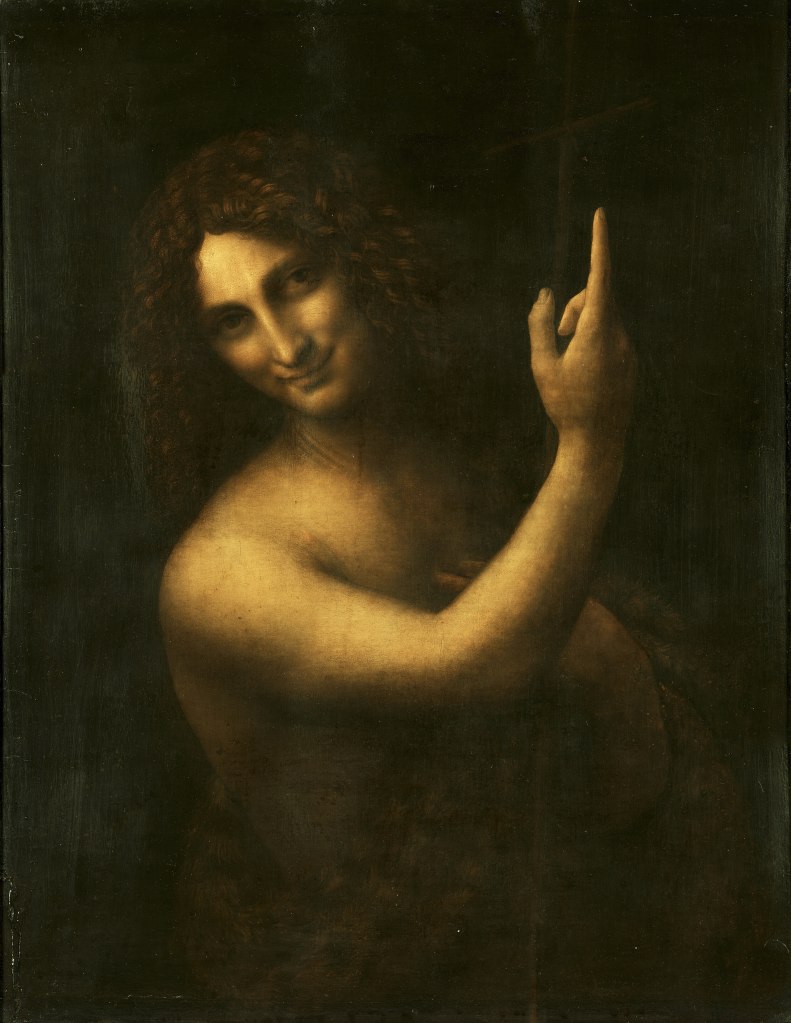
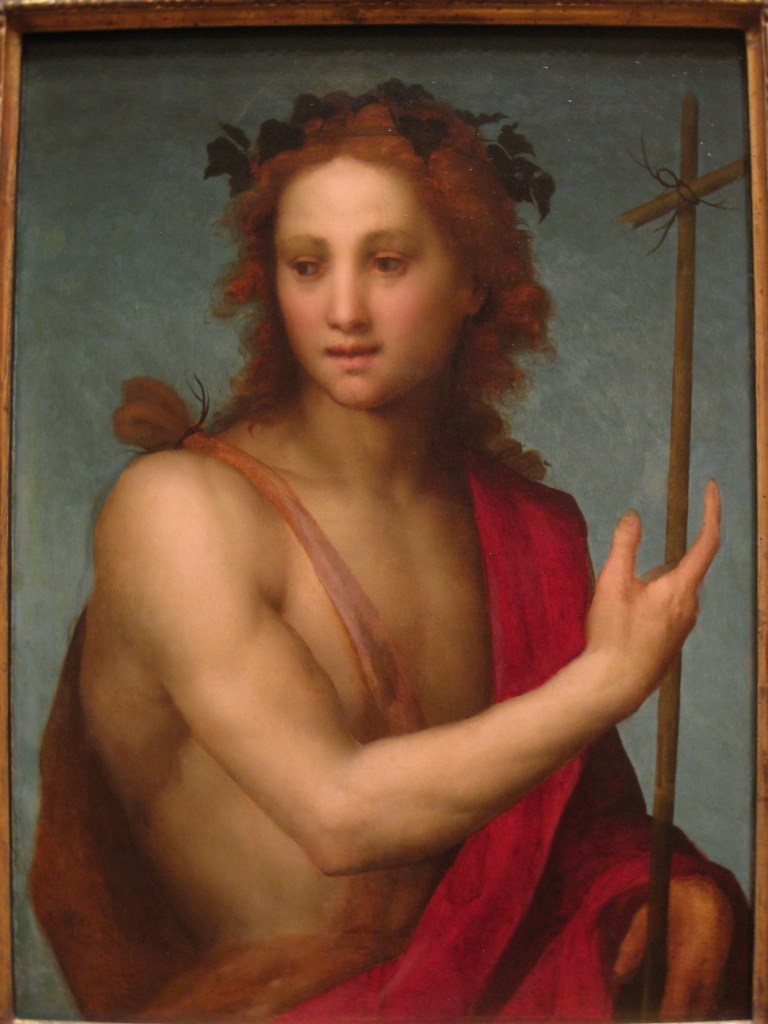
At the same time, Andrea does not simply reproduce Leonardo’s figure. The Worcester Baptist is made more explicit in his identity and symbolism. Freedberg drew attention to the crown of vine leaves and to the way Andrea develops the ambiguity between Saint John and Bacchus. The transformation is characteristic of the process described by Cordellier: Andrea recognises a powerful invention, isolates its governing features and then makes them serve a more definite purpose of his own.
The chronology has proved more difficult than the formal relationship. Freedberg’s date of about 1517 would place the Worcester picture before Andrea’s French journey. He therefore considered earlier opportunities for Andrea to have encountered Leonardo’s work, including Leonardo’s presence in Italy before his departure for France. Sammer has reopened the question by returning to Vasari’s account. Vasari says that Andrea painted the Baptist for the Grand Master of France after his return home, in an attempt to recover favour following his departure from royal service. Sammer identifies this official as René of Savoy and therefore argues that the painting belongs after the French journey rather than before it.
On Sammer’s reconstruction, France supplies a straightforward opportunity for direct access. Leonardo’s Saint John the Baptist had entered the royal collection, and Andrea was moving within the same courtly environment during 1518–19. Sammer does not need to posit a personal meeting between the two artists: the existence of the painting in the royal collection is sufficient for the argument.
The two paintings bear different weights within the case for France. The Leda remains chronologically unstable: the dependence on Leonardo is clear, but its usefulness as evidence for French access depends upon accepting the later date. The Worcester Saint John offers a tighter convergence of documentary tradition, formal dependence and opportunity, although its dating likewise remains contested. In neither case does France create Andrea’s interest in Leonardo. What it may have supplied was direct access to particular finished works that he was already equipped to study with considerable independence.
Raphael and the Barberini Holy Family
The Holy Family in Palazzo Barberini provides the clearest test of Sammer’s argument in relation to Raphael. The connection is with Raphael’s Holy Family of Francis I, painted for François I and sent to France in 1518. According to Sammer’s reconstruction, the picture was formally presented to Queen Claude at Nantes on 4 August of that year, when Andrea was in royal service. He therefore considers it highly probable that Andrea saw Raphael’s painting at the French court.
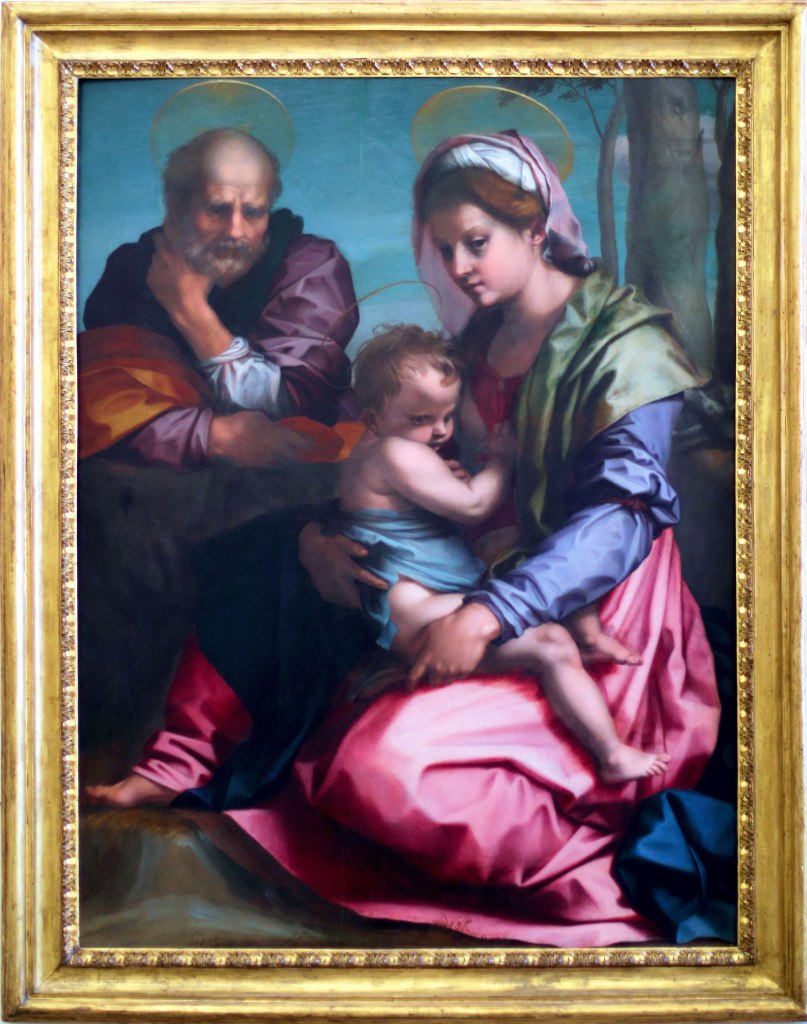
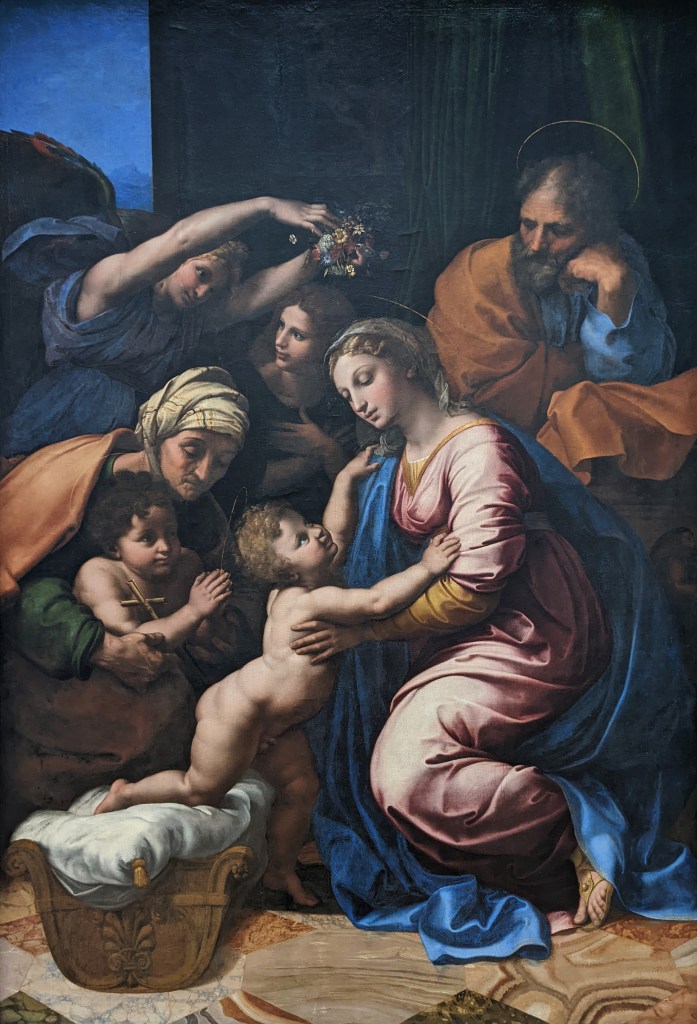
The relationship between the two works is concentrated above all in the figure of Saint Joseph. Andrea does not repeat Raphael’s composition as a whole. Instead, he takes over the older man’s physical type and the way he bends towards the central group, using that figure within a substantially different arrangement. John Shearman had already recognised the connection, so the comparison itself does not depend upon Sammer’s reconstruction. What Sammer adds is a specific historical occasion on which Andrea could have encountered Raphael’s finished painting directly.
Chronology again affects the argument. The Barberini Holy Family is generally placed late in Andrea’s career. Freedberg dated it to about 1528, while Shearman preferred a date no later than about 1525; the Natali/Cecchi catalogue favours approximately 1528–29. Even on the earlier dating, several years separate Andrea’s stay in France from the finished painting.
That interval changes the nature of the argument. With the Brussels Leda, the principal question was whether the painting itself should be moved to a date after France. With the Barberini picture, the later date is not in serious dispute. The issue is whether a figure seen in Raphael’s painting in 1518 could remain available to Andrea and be re-employed years afterwards. Cordellier’s account of Andrea’s practice makes such a process less exceptional than it might initially appear. His studies after other artists were selective, and he repeatedly detached figures or compositional ideas from their original settings before adapting them to new purposes.
Leonardo and the Medici Holy Family
The Holy Family painted for Ottaviano de’ Medici, generally dated to about 1529, offers a different kind of comparison with Leonardo. The point is not a close quotation comparable to Saint Joseph in the Barberini picture. Rather, the affinity lies in the organisation of the group: several figures are bound together through a compact pyramidal structure in which the movement of one body leads directly into the next.
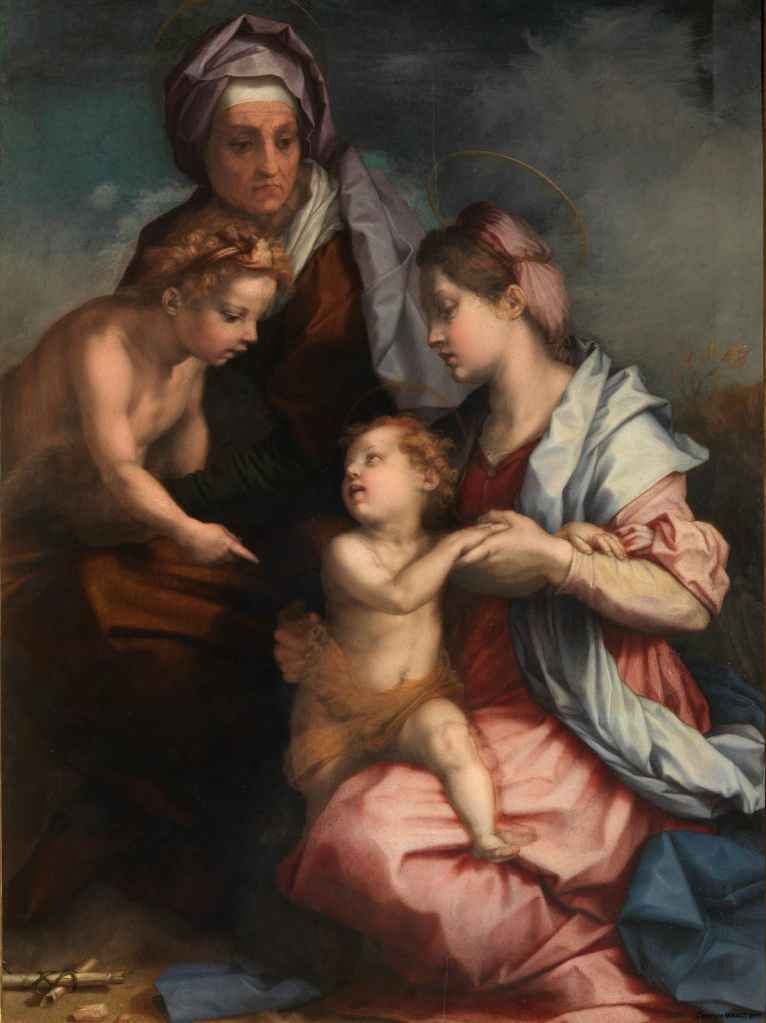
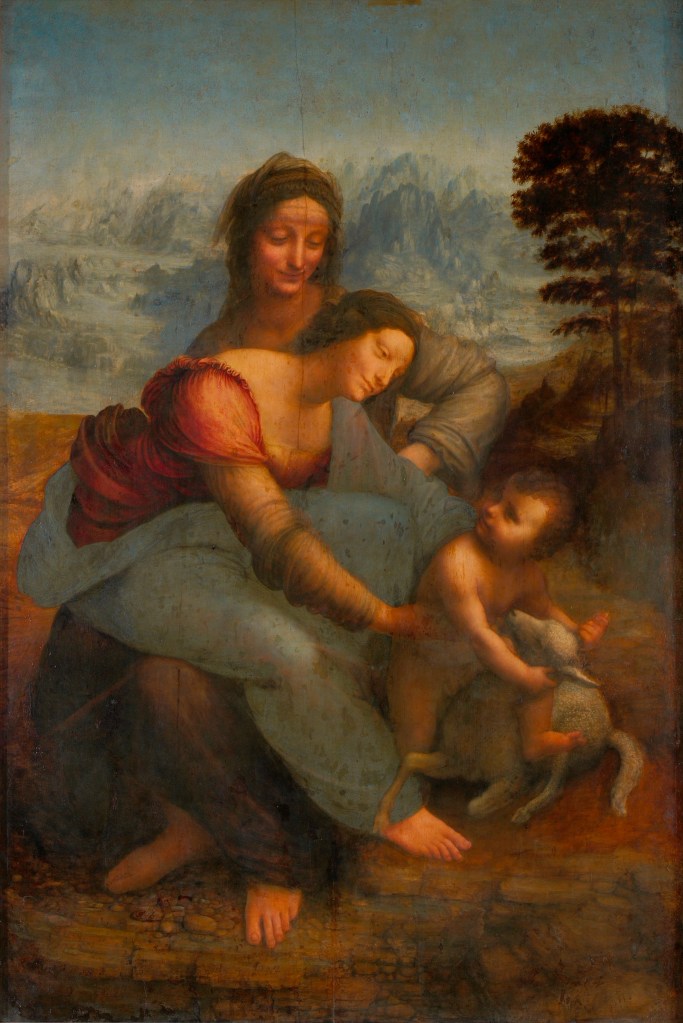
Leonardo’s Virgin and Child with Saint Anne provides the obvious point of comparison. Its composition depends upon the close interlocking of Anne, the Virgin and the Christ Child, whose bodies are linked in a continuous flow of movement rather than arranged as a sequence of isolated figures. Andrea’s Holy Family is differently conceived and includes a different cast of figures, but it shares something of that principle. The group is built through overlapping bodies and linked gestures, so that the composition acquires unity from the way the figures physically depend upon one another.
Sammer has suggested that Andrea may have encountered Leonardo’s Saint Anne in France, where the painting belonged to the royal collection. If so, the Medici Holy Family would represent a later reworking of a compositional idea encountered roughly a decade earlier. The chronological interval is greater than in the Barberini example, but the nature of the borrowing is also less literal. What seems to persist is not an individual figure, but a way of constructing a group.
Conclusion
France need not be treated as the origin of Andrea del Sarto’s engagement with Leonardo and Raphael. Its importance lies rather in the possibility that direct encounters with particular works gave a greater opportunity to exercise skills that were already fundamental to his practice.
The Last Supper at San Salvi shows how thoroughly Andrea could absorb the work of other artists without allowing the result to become a collection of quotations. Leonardo lies behind the conception, while Raphael and northern prints also contributed to its formation, but the fresco remains completely coherent in its own terms.
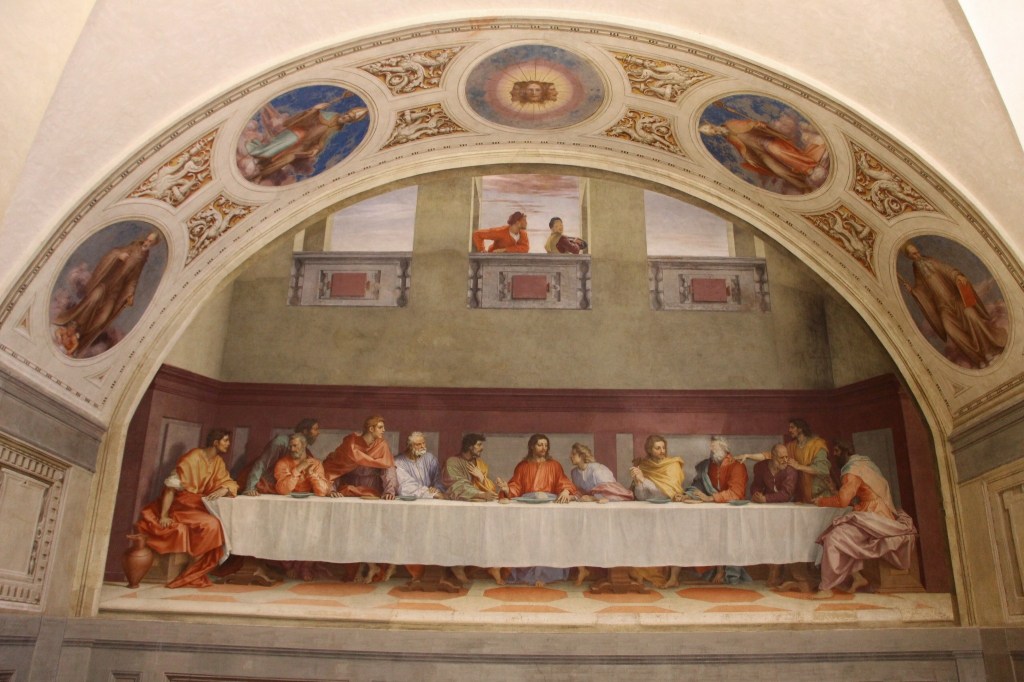
The same habit of transformation appears elsewhere, from the Raphaelesque structures reworked in the Wallace Collection Virgin and Child with the Infant Baptist to the less easily defined debts of the Vienna Lamentation. Cordellier’s concluding formulation helps to explain the scale of Andrea’s achievement, in which borrowing became invention:
“But his essential debt to Leonardo’s art does not depend on this. Above all, in his painting, Andrea del Sarto owed to Leonardo the sense of the attenuation of the energy of the drawing. That very particular way of softening, tempering the verve of the form and its rendering, conformed—in Vasari’s opinion—to Andrea del Sarto’s natural tendency toward timidity; but modern criticism, in contrast, has interpreted it as a more deliberate method of the artist, who thus magnificently brings together, through the morbidezza of color, the sfumato of Leonardo, and the solid reliefs of Michelangelo while maintaining a sense of balance worthy of Raphael.”
Producing these essays requires care, time, research, and resources. Contributions to help sustain this exploration would be greatly appreciated.
Donate to Inner Surfaces here.
Bibliography
Cheney, Iris H. Review of S. J. Freedberg, Andrea del Sarto, and John Shearman, Andrea del Sarto. The Art Bulletin 53, no. 4 (December 1971), pp. 532–35.
Cordellier, Dominique. “Drawings by Andrea del Sarto after Ancient and Modern Sources.” In Julian Brooks, with Denise Allen and Xavier F. Salomon, Andrea del Sarto: The Renaissance Workshop in Action. Los Angeles: J. Paul Getty Museum, 2015.
Freedberg, Sydney J. Andrea del Sarto. 2 vols. Cambridge, MA: Belknap Press of Harvard University Press, 1963.
Natali, Antonio. Andrea del Sarto. New York and Milan: Abbeville Press Publishers, 1999.
Natali, Antonio, and Alessandro Cecchi. Andrea del Sarto: Catalogue complet. Paris: Bordas, 1992.
Sammer, Jan. “Andrea del Sarto at the Court of France.” The Burlington Magazine 168 (September 2026), pp. 852–59.
Shearman, John. Andrea del Sarto. 2 vols. Oxford: Clarendon Press, 1965.
Vasari, Giorgio. Lives of the Artists. Translated by George Bull. 2 vols. London: Penguin Classics, 1987.

