Thomas Fearnley and the Terrace
Thomas Fearnley travelled to Naples in the spring of 1833 before making an extended journey through Sicily. His Italian itinerary also took in Capri, Sorrento, Amalfi and Castellammare, places already familiar to northern European artists and, in several cases, to his mentor Johan Christian Dahl. David Jackson has stressed, however, that Fearnley was often drawn to less obvious motifs and viewpoints. Direct observation was central to his Italian work. Rather than repeatedly seeking out established prospects, he recorded coastal settlements, roads, buildings, vegetation and fragments of inhabited landscape as he encountered them. Italy enlarged both the geographical and the pictorial range of his work.
Dahl provided an immediate precedent. During his own Italian journey of 1820–21 he had worked increasingly in the open air, responding to differences of light, colour and atmosphere with greater naturalism. Behind both artists lay a longer tradition of plein-air study in Italy, extending through painters such as Valenciennes, Vernet, Wilson and Thomas Jones. Christoffer Wilhelm Eckersberg was especially important in the Scandinavian context. His Roman studies of 1813 were closely observed and often fragmentary, with architectural forms cropped or approached from positions that could appear almost arbitrary. Fearnley had studied at the Royal Danish Academy, and although there is no evidence that he studied directly under Eckersberg, Jackson argues that he could scarcely have avoided the influence of his example.
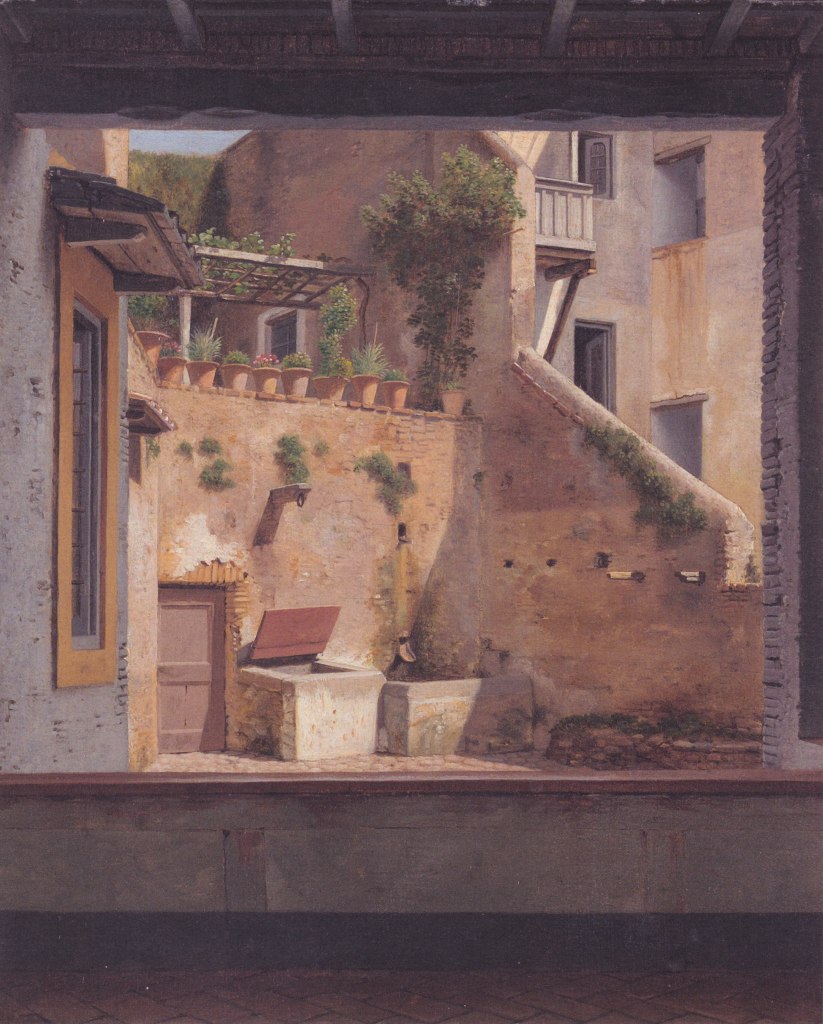
Fearnley himself moved readily between broad landscape and motifs brought close to the picture plane, using asymmetry, oblique viewpoints and abrupt cropping. Jackson relates this freedom to what he describes as an essentially democratic principle in Eckersberg’s practice: the painter could give serious attention to whatever happened to be present. In Fearnley’s case, a wall, a plant, a harbour structure or a fragment of architecture could therefore become sufficient material for a study. His terrace pictures belong naturally within this wider practice.
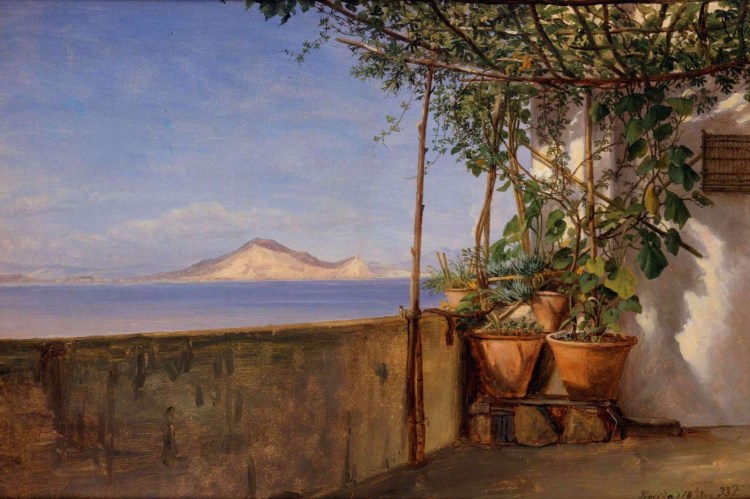
Terrace in Procida was painted on 18 August 1833, during Fearnley’s first year in southern Italy. The dated inscription fixes the encounter precisely. Painted in oil on paper, the small work concentrates upon a loggia overlooking the sea. Pale masonry, trellis and plants occupy much of the immediate field, so that the distant landscape is encountered from within the architecture rather than set apart from it. Its modest scale was consistent with Fearnley’s portable practice in Italy, where many of his studies were made on paper and could readily be carried while travelling.
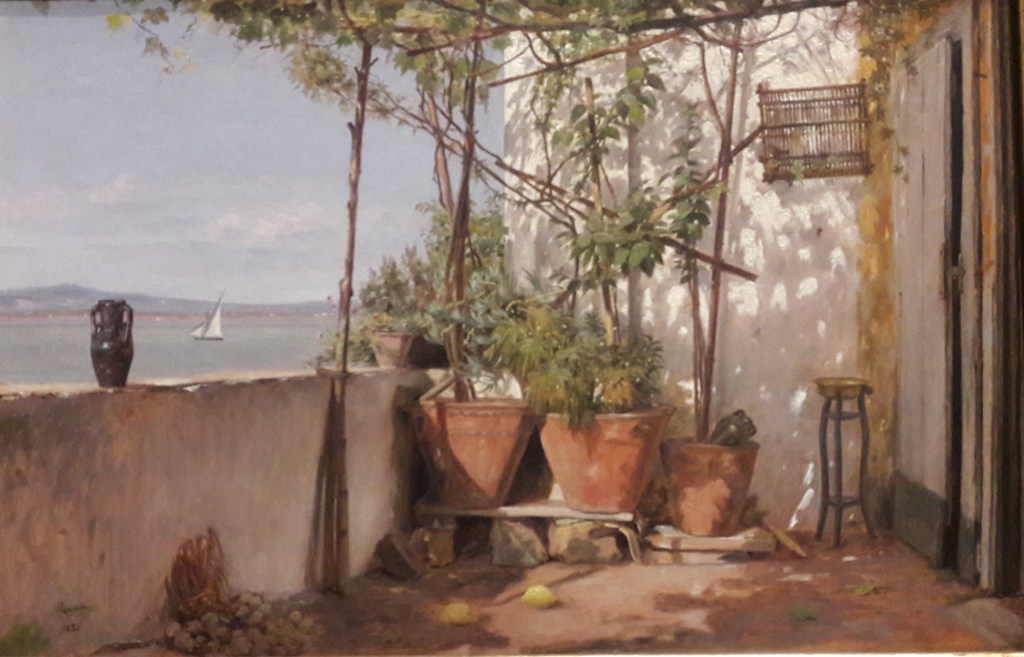
The choice of this particular corner was not without consequence. Two years later the Danish painter Martinus Rørbye painted Loggia, Procida from almost the same place. Nationalmuseum in Stockholm, which owns Rørbye’s picture, considers it highly probable that he had seen Fearnley’s treatment of the motif before visiting Procida himself. Rørbye again gives substantial space to the loggia, with its wall, trellis and pots, while the sea appears beyond. The comparison provides a rare instance in which the circulation of an apparently incidental Italian motif among Scandinavian artists can be traced with some confidence.
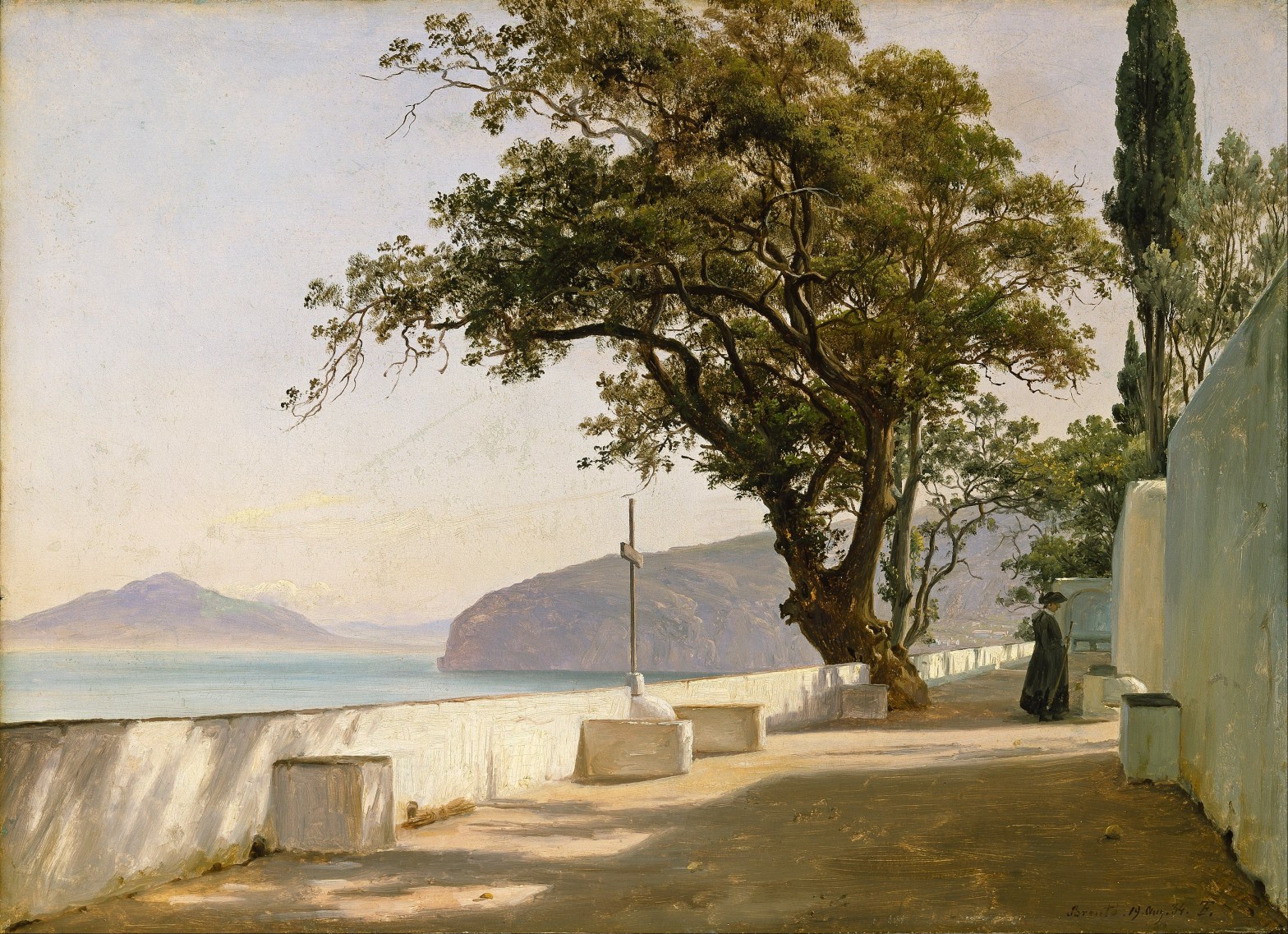
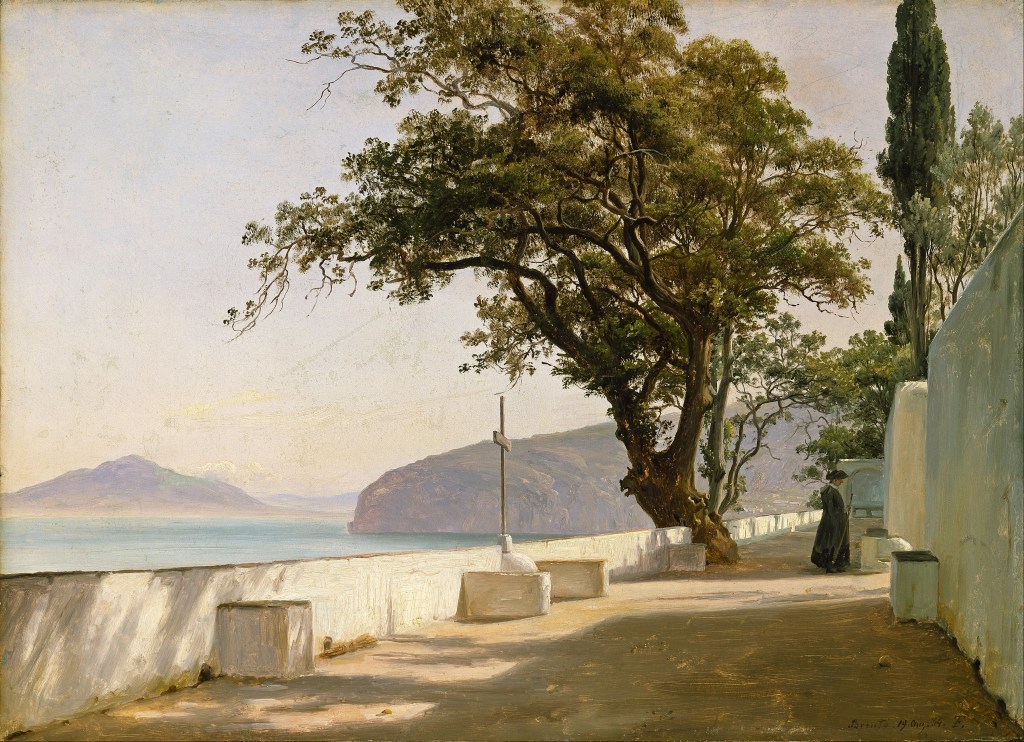
Fearnley returned to the terrace subject at Sorrento in 1834. The Terrace of the Capuchin Convent at Sorrento was painted from the convent of San Francesco on the promontory between Sorrento and Meta. Here the terrace takes possession of much of the composition. A long pale wall, benches, a cross, an oak and the path establish the immediate setting, while the sea and distant headlands recede behind them. Strong sunlight catches the rendered wall and contrasts with the deep shade at the right. Farther away, the coast loses definition in the pale atmosphere. A small dark-clad figure remains subordinate to these larger relationships of light, vegetation and architecture.
The Sorrento painting is also informative about Fearnley’s working methods. Torsten Gunnarsson has pointed out that it resists a straightforward division between plein-air study and completed painting. Technical examination showed that Fearnley worked on it in at least two phases. The sky and the dark cross were added after other passages had dried, while preparatory drawing remains visible beneath the oak. Fearnley himself appears to have regarded the picture as a study, yet its careful organisation and close attention to vegetation show that direct observation need not imply rapid or entirely spontaneous execution.
During his Italian travels Fearnley produced a large body of oil sketches alongside more finished studio compositions. Jackson describes these studies as part of a visual archive accumulated through travel, material that could remain available for later use after the journey itself had ended. The terrace paintings belong to that larger body of observation rather than to a planned series. Their importance here lies in the seriousness with which Fearnley treated motifs that might once have seemed incidental, and in the freedom that plein-air practice gave him to record them without first turning them into conventional landscape compositions.
The Neapolitan Terrace
A visitor to the Gallerie d’Italia in Naples might come across Domenico Morelli’s La terrazza and take it, at first glance, for something close to the small dal vero studies that became familiar in later nineteenth-century landscape painting. A plain terrace is caught in strong light, with two chairs in the foreground and the landscape opening beyond. There is little in the picture itself to suggest historical narrative.
The resemblance is largely accidental. Morelli painted La terrazza towards the end of the 1860s as a study for Storia di un paggio innamorato (The Story of a Page in Love), one of the literary and historical subjects characteristic of his work. The story, inspired by Elizabethan theatre, concerned a young page and the lady of a castle. Morelli developed it in several versions. In the first, the two figures occupied a broad terrace against a landscape painted from life; another, unfinished version moved the action indoors and showed the page stealing a kiss from the sleeping woman. La terrazza studies the setting of the first composition before its protagonists have been introduced.
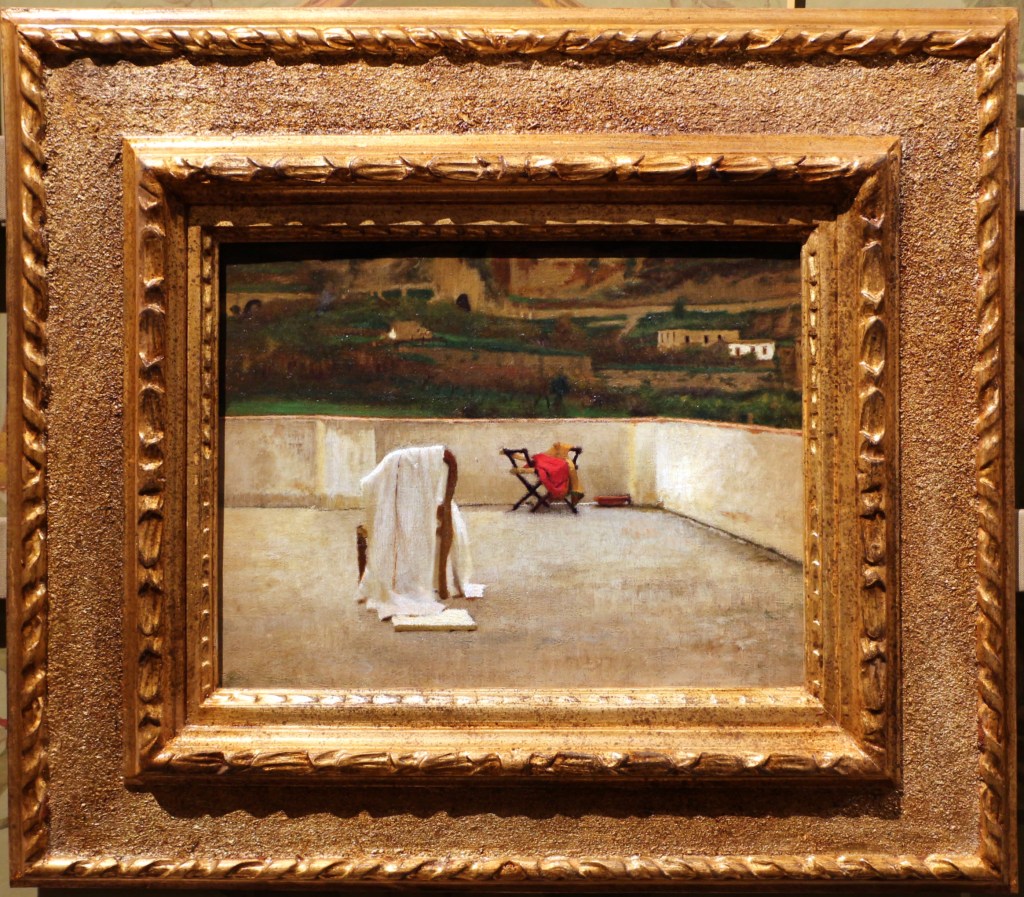
That circumstance accounts for much of its apparent modernity. The terrace is still rustic and comparatively bare, and the two chairs have become the principal objects in a space intended for narrative action. In the finished painting Morelli retained only the folding chair and elaborated the architecture to give the scene a more historical character. The study therefore resembles an autonomous landscape not because Morelli intended it as one, but because the provisional stage of his work temporarily left the setting to itself.
Eduardo Dalbono’s La terrazza, painted at about the same moment, occupies a rather different position. The figures retain a degree of social and pictorial formality, but their setting is emphatically contemporary: a roof terrace enclosed by a plain parapet, with the irregular rooftops of Naples rising immediately behind it. The city is not arranged as a distant panorama. Roofs, walls, gables and towers press close to the terrace, so that the inhabited foreground and the urban landscape appear almost continuous. Dalbono was associated at this period with the Scuola di Resina, whose painters gave renewed attention to direct observation, contemporary life and effects of light. Here the terrace is already more than a setting for figures. It has become part of the observed modern city.
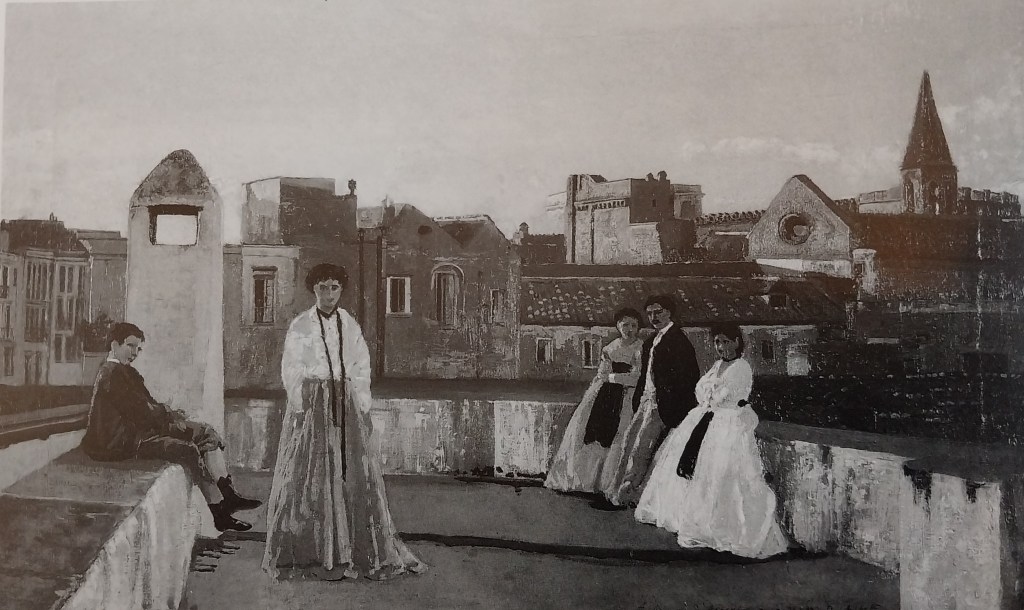
Antonio Mancini’s Terrazza napoletana of 1877 belongs to a different category. Here the terrace was not devised as the setting for a narrative painting but formed part of the artist’s own immediate surroundings. Cinzia Virno identifies it as the terrace of the house in Vico Orticelli, Naples, where Mancini lived between 1876 and 1877, before his second journey to Paris. The picture records a place closely connected with his daily life.
Image: Finarte, Antonio Mancini, Terrazza napoletana, 1877
The terrace itself is almost empty. A pale parapet cuts across the composition, withholding much of the space immediately beyond it, while the roofs of Naples spread across the upper part of the picture. Alfredo Schettini, writing in 1942, described the painting as an “armonia di grigi delicati e densi” and as a vision at once broad and intimate. The phrase catches one of its central paradoxes. The foreground is closed and tightly bounded, yet the accumulation of rooftops gives the small canvas a surprising spatial breadth.
There is a second tension in the handling of the surface. The range of colour is restrained, but the paint does not feel thin or neutral. Wall, roof and foreground retain a palpable material presence, so that the eye moves between the physical surface of the picture and the distance represented beyond it. That economy of colour is part of the work’s boldness. For a painting of 1877, its refusal of anecdote, its compressed structure and its reliance on a few tonal relationships give it a distinctly modern character.
Antonino Leto’s Centodieci anni a Ischia, painted around 1882, begins from an emphatically human subject. The title fixes attention on the extraordinary age of the woman seated on the terrace, and there is something almost archetypal in the image of old age at rest in the warmth of a southern setting. Yet Leto does not isolate her from her surroundings. She belongs completely to them, seated among pots, plants and simple furniture, her small figure held within the ordinary life of the terrace.
GAM Palermo, first-floor collection, Antonino Leto, Centodieci anni a Ischia (sixth image)
Antonino Leto, Centodieci anni a Ischia, 1881, oil on canvas, 26 × 46 cm, Galleria d’Arte Moderna “Empedocle Restivo”, Palermo.
The terrace does not quite contain the scene. Above its decorated parapet, treetops, distant buildings and low headlands interrupt the view, while the sea remains open to the left and the cloud-filled sky brings a stronger sense of movement. The setting is carefully observed, but it keeps opening beyond the woman rather than enclosing her. The painting belongs to the period in which Leto, after settling on Capri in 1882, increasingly turned towards marine landscape. At this stage the human figure still retains importance, though the sea and sky are already beginning to assert themselves more strongly.
That balance gives the painting much of its character. The woman is neither anecdotal decoration nor the sole centre of attention. She is fully integrated into a world of light, vegetation, weather and distance. The title insists on her presence, but the painting steadily enlarges itself beyond her.
Vincenzo Migliaro’s Taverna a Posillipo, exhibited in 1886, takes a familiar Neapolitan subject and makes light itself one of the chief agents of the scene. Tavern pictures were common enough to risk becoming picturesque formulae, but Francesco Netti praised Migliaro’s painting for its immediacy and luminosity, finding in it the very atmosphere of a Neapolitan day.
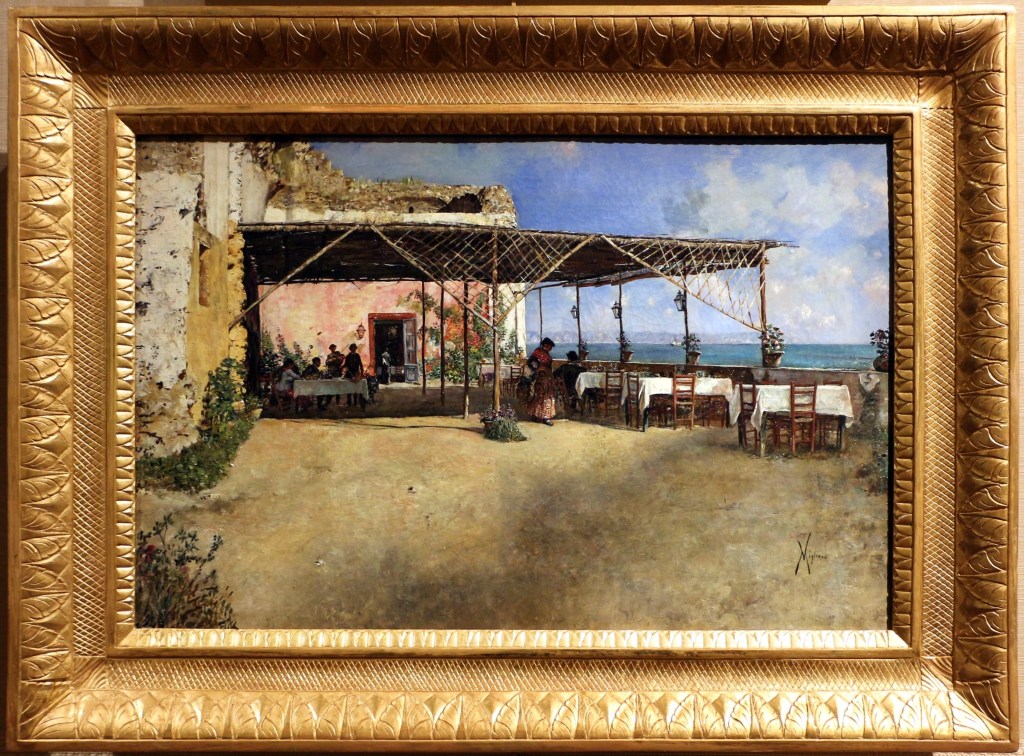
Much of the foreground is left open, so that the terrace has a breadth absent from the more compressed spaces of Mancini and Leto. Across it the light continually changes. Deep shadow gathers beneath parts of the cane pergola and within the doorway, but a strip of sunlight cuts through farther back, while the weathered wall catches patches of bright light across its pinkish render. The braces of the pergola divide the upper part of the scene into angular shapes, vegetation clings around the building, and pots line the parapet before the view opens towards the sea. Netti himself noticed the large foreground and the passing shadow of a cloud across it.
The figures are dispersed through the space rather than arranged around a single action. Some sit at tables, others stand or converse in small groups, while the nearest figure carries a stronger suggestion of local dress. At the back, a figure turned into the doorway hints at activity continuing inside the building. These details are enough to suggest the ordinary social life of the tavern without allowing anecdote to take over. The empty tables contribute to the sense of a pause in the day, a place being used at an unhurried moment rather than at the height of activity.
The old masonry, pale walls, plants and rough textures give the terrace a strongly physical presence, but Migliaro does not allow these details to harden into description for its own sake. Shade, reflected light and full sun keep changing their appearance. This is what lifts the picture beyond the familiar repertory of Neapolitan tavern life.
Attilio Pratella’s Balcony with Snow turns the terrace motif in an unexpected direction. The balcony itself is close, domestic and refined, its iron railing and flowerpots occupying much of the foreground. We might expect such a setting to open onto a dense urban scene, yet beyond the railings the view falls away instead into a broad pale distance. The contrast between the near domestic detail and the openness beyond is one of the painting’s strongest effects.
Attilio Pratella, Balcone con neve, oil on canvas, 31 × 26 cm. Napoli Post
Rosario Caputo uses the phrase veduta barometrica in discussing the landscape practice of Pratella and Giuseppe Casciaro, drawing attention to a way of seeing in which weather, atmosphere and changing light become integral to the view itself. In Pratella’s case, Alfredo Schettini particularly admired his command of grey, including the greys present even in clear southern light, and contrasted this with more conventional versions of Naples built from brilliant blue, turquoise and orange-yellow. Pratella also spoke of seeking l’unità nella varietà, unity within variety. The phrase suits a picture in which ornamental ironwork, flowerpots, snow, distant landscape and sky retain their separate character but are held together by a common atmosphere.
Pratella’s connection with Giuseppe Casciaro was close. The two artists had shared lodgings in Via Foria in the 1880s, often painted together and sometimes worked from the same motifs. Casciaro would return repeatedly to elevated gardens, terraces and open views, developing them through a different medium and practice.
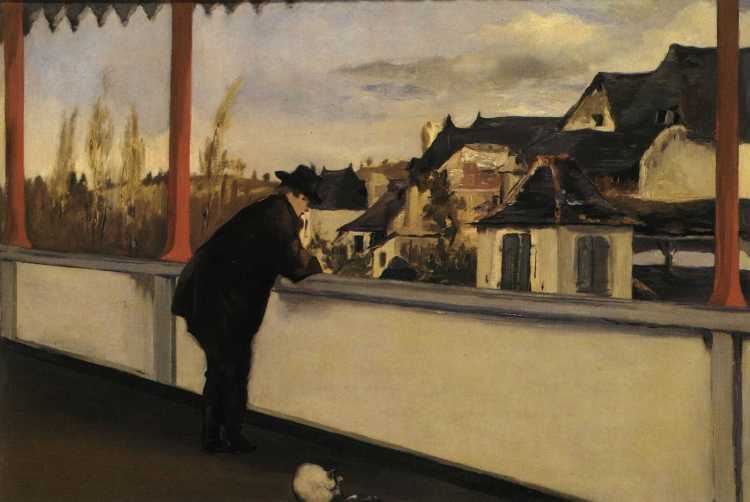
In 1871, more than twenty years before Casciaro’s terrace study of 1893, Édouard Manet had made the balcony of the house occupied by his family at Oloron-Sainte-Marie into a subject in its own right. A broad pale wall cuts diagonally across the foreground, red uprights divide the composition, and the figure and small cat occupy the remaining spaces with little concession to conventional balance. Charles S. Moffett related the abrupt framing, flattened architectural planes and asymmetry to Manet’s interest in Japanese prints. Beyond this emphatic geometry, however, the roofs and surrounding landscape are handled more softly. The balcony has become a substantial pictorial presence rather than merely a vantage point from which the town is seen.
Casciaro’s terrace of 1893 takes that freedom in another direction. The foreground is dominated by the weight and solidity of the terrace itself: irregular masonry, a large terracotta jar, smaller pots and a balcony rail press close to the picture plane. Above this dense material foreground, only a narrow band of landscape remains. Treetops, a palm and an umbrella pine are compressed between the stone below and the open sky above, with pale blue hills appearing beyond them. The muted yellow-orange sky gives the distance a softness quite unlike the physical immediacy of the terrace. Precisely because so little landscape is visible, it becomes more suggestive, implying a much wider world withheld from view.
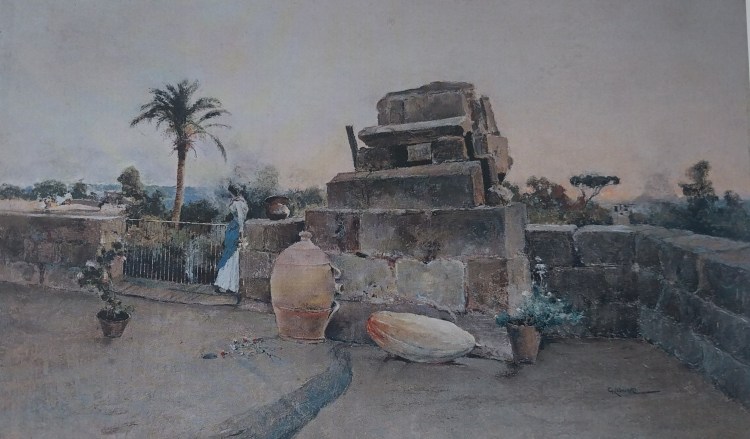
The choice of such a motif accords closely with Casciaro’s way of working. Vito Carbonara describes an artist who returned repeatedly to a relatively concentrated group of places, examining Naples and its surroundings over many years. Carlo Siviero gives a more immediate account of the process. Painting with Casciaro on Capri in 1907, he remembered him completing one study, moving a short distance, cutting another sheet of paper, repositioning his umbrella and easel and beginning again. Siviero called this facility the felicità del suo occhio. A terrace, pergola, path or garden corner could therefore emerge from the continuous act of looking rather than from the search for a predetermined subject.
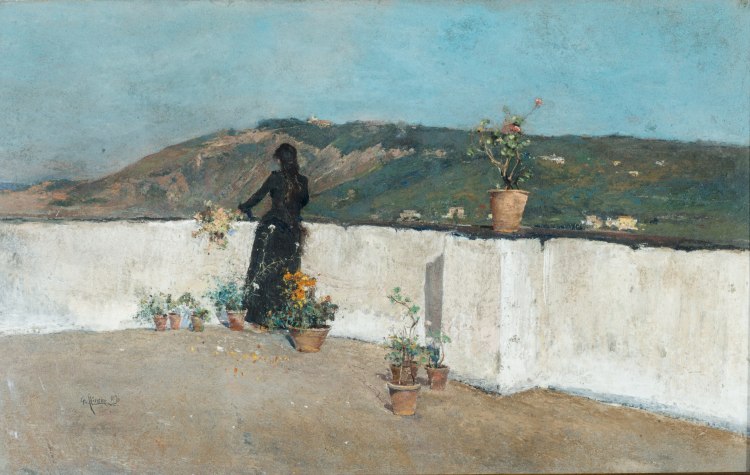
Carbonara also resists the familiar criticism that Casciaro simply repeated himself. He proposes instead that works made around the same places and periods can be understood as “pictorial seasons”, in which repeated motifs acquire different emphases from one encounter to the next. Tra il verde shows one such variation at a more intimate scale. A woman stands in a corner of the terrace between two large flowering plants. Fallen petals are scattered across the paving below, an incidental detail that adds to the sense of an observed, lived-in space.
In Una terrazza a Seiano, dated 8 October 1915, another possibility comes to the fore. Casciaro spent an intensive period at Seiano that summer, staying at Villa Ruggiero and producing between one and two hundred works. The pergola, paving, pale walls, vegetation, distant hills and sky are brought into a restricted range of pearl grey, muted green and off-white. The French term enveloppe is useful here: colour and tone bind the separate forms together through a common atmospheric light.
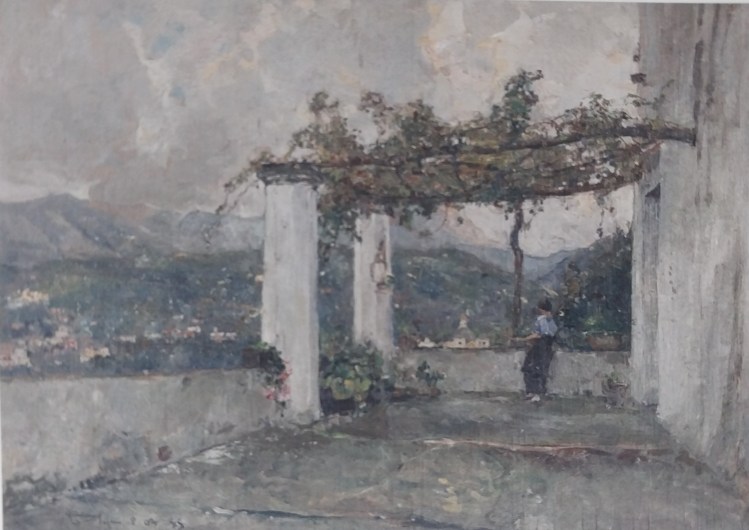
Rosario Caputo’s term veduta barometrica identifies a different aspect of the same picture. Weather has become part of the subject itself. The grey day is registered across the terrace and the country beyond, while the solitary figure rests at the parapet beneath the pergola. In Carbonara’s terms, this is a paesaggio-stato d’animo rather than simply a paesaggio-veduta. The observed place has become the vehicle for a poetic mood.
These terrace paintings belong to very different circumstances, but each gives pictorial weight to spaces that might once have remained incidental to a larger composition. In Fearnley, the terrace emerges from plein-air study and close observation of encountered places. In Naples later in the century, it becomes something more varied: a domestic setting, an urban platform, a place of sociability, a structure shaped by weather, or simply a fragment of the visible world sufficient in itself.
What joins them is not a continuous tradition so much as an enlarged sense of what a landscape painting might contain. Walls, railings, pots, paving and pergolas no longer need to disappear before the view beyond them. They can become part of the subject.
Producing these essays requires care, time, research, and resources. Contributions to help sustain this exploration would be greatly appreciated.
https://donorbox.org/inner-surfaces-resonances-in-art-and-literature-837503
Bibliography
I consulted these texts. Any errors are mine.
Caputo, Rosario. La pittura napoletana dell’Ottocento. 2 vols. Naples: Franco Di Mauro, 2022.
Carbonara, Vito. Giuseppe Casciaro: l’artista e le stagioni pittoriche a Nusco. Atripalda: Mephite, 2022.
Carbonara, Vito. Il re del pastello: la pittura di Giuseppe Casciaro ai vertici dell’arte italiana di inizio Novecento. Atripalda: Mephite, 2026.
Cassani, Silvia, ed. Civiltà dell’Ottocento. Le arti figurative. Naples: Electa Napoli, 1997.
Molajoli, Bruno, and Nicola Spinosa. Art Treasures of the Banco di Napoli: Catalogue of the Collection. Naples: Banco di Napoli, 1984.
Moffett, Charles S., ed. The Passionate Eye: Impressionist and Other Master Paintings from the E. G. Bührle Collection. Zurich: Artemis Verlag, 1990.
Ottani Cavina, Anna, ed. Un paese incantato: Italia dipinta da Thomas Jones a Corot. Milan: Electa, 2001.
Picone Petrusa, Maria Antonietta, ed. Dal vero: il paesaggismo napoletano da Gigante a De Nittis. Turin: Umberto Allemandi & C., 2002.
Sumner, Ann, and Greg Smith, eds. In Front of Nature: The European Landscapes of Thomas Fearnley. London: D Giles Limited, in association with the Barber Institute of Fine Arts, University of Birmingham, 2012.
Virno, Cinzia. Antonio Mancini: catalogo ragionato dell’opera. Vol. I. Rome: De Luca Editori d’Arte, 2019.
 Inner Surfaces