Formation and the vero
Vittorio Corcos enrolled at the Accademia di Belle Arti in Florence in November 1875 and progressed with conspicuous ease. Admitted directly to Enrico Pollastrini’s drawing course, he passed his examinations and, in 1876–77, received a silver medal for a figure study copied dal vero. Despite this success, he soon became dissatisfied with his training. As Ilaria Taddei notes, his unease arose less from the Purist rigour of the Academy or the pedantry of its teachers than from an inner need to express the vero with greater immediacy and more vivid colour.
A recollection preserved by Corcos’s Livornese contemporary Giovanni Targioni-Tozzetti gives some substance to that description. While the young Corcos was copying a marble torso, Pollastrini reproved him for working without an eraser. Corcos replied “con fierezza” that he had no need of one, since he never erased. Taddei links the episode to the “naturale facilità della sua mano” and his “istintiva disposizione al disegno”. The episode is best read as evidence of unusual fluency and assurance in drawing. What chafed against academic method was less discipline itself than the distance between a regulated procedure and his instinctive response to the motif.
Corcos’s early formation suggests neither straightforward academic conservatism nor a simple revolt against it. He was already technically secure, but looking for a more rapid and chromatically vivid means of giving form to what he saw.
Naples and Morelli
Corcos went to Naples in 1878 with a scholarship from the Comune di Livorno, chiefly because of his admiration for Domenico Morelli. Reproductions of Morelli’s work had impressed him not only by their freer handling but by what Taddei describes as extraordinary powers of invention and audacious effects of light and colour. In Naples, Corcos entered the recently reformed Accademia di Belle Arti, advanced rapidly through its classes and won a silver medal for drawing from the nude and draped figure.
The teaching he encountered there joined close study from life to imaginative reconstruction. Stanislao Lista, with whom Corcos formed a close relationship, advocated drawing from the model and then repeating the exercise from memory. Its purpose was to make the artist “più libero e originale” and capable of a broader, more assured manner. In Lista’s theoretical writing, invention arose from the mind’s synthesis of perceptions accumulated through the study of nature. The artist was not merely to copy what stood before him, but to absorb and reconstitute it.
Giuseppe De Sanctis, who studied in Morelli’s studio and later became close to Corcos, recalled the particular attention Morelli gave to drapery. Students were expected to understand the direction and construction of a fold so thoroughly that they could recreate it from memory. The exercise was not an end in itself. Through the close study of individual folds, they learned how a fabric behaved and acquired the knowledge needed to suggest its material character without reproducing every crease and highlight.
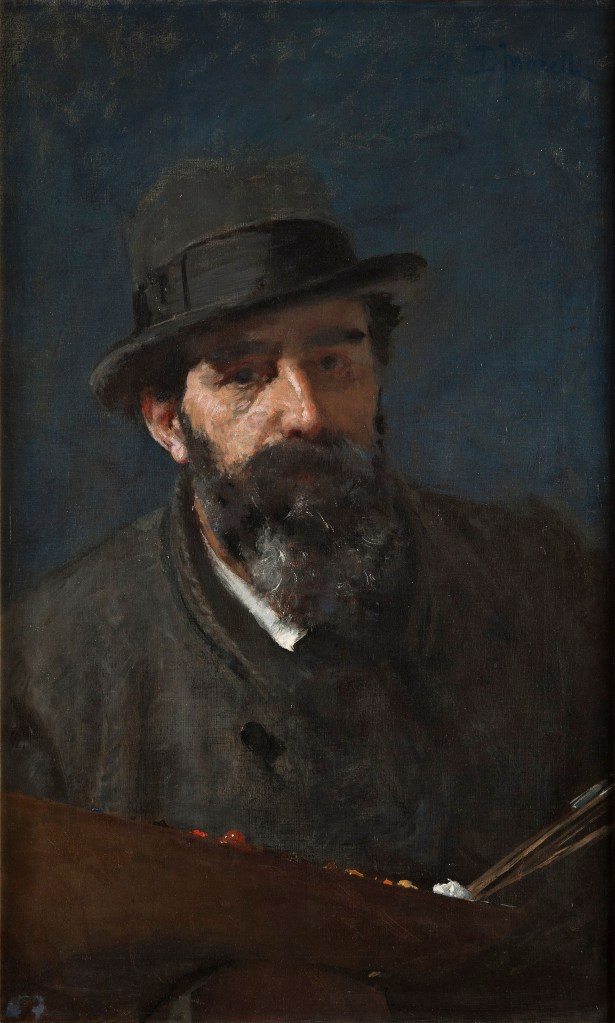
Morelli also insisted that technical understanding had to be joined to feeling. Corcos remembered him repeatedly telling his pupils, “una cosa sentita è per metà fatta”: something truly felt was already half made. The maxim points to a broader principle in his teaching. Observation and knowledge provided the basis of painting, but what had been seen and understood also had to be inwardly absorbed before it could be given expressive form.
Corcos’s Neapolitan work reflects this shift. In L’Arabo in preghiera, Taddei finds a Morellian element of fantasy carried by transformations of line and strong juxtapositions of colour. Il boia, known largely through contemporary description, was painted with broad dark strokes, forceful colour and an intensity that won Morelli’s approval. Corcos’s drawings from the period also became freer, absorbing something of the fragmented line, emphatic chiaroscuro and expressive ink work of Morelli’s own graphic practice.
Paris, Naturalism and the modern-life picture
Corcos arrived in Paris in 1880 with little money but with a very deliberate appetite for opportunity. Ilaria Taddei describes him as seeking the “amicizie giuste”, looking about with “occhi spalancati e orecchi ben aperti”, ready to absorb the spirit of the age. Giuseppe De Nittis gave that search direction. Through him Corcos entered both the commercial orbit of Goupil and the salon in rue Viète, where painters and writers including Degas, Manet, Caillebotte, Émile Zola, Edmond de Goncourt and Alphonse Daudet circulated. Corcos later named Goncourt, closely associated with literary Naturalism and acutely attentive to modern society and its manners, as his favourite prose writer. The milieu mattered artistically as well as socially. It placed him in contact with a literary culture that had made contemporary life, in its respectable and disreputable forms alike, a legitimate field of serious artistic inquiry.
Taddei draws the connection explicitly through the Goncourts and Zola. The preface to Germinie Lacerteux had claimed that subjects drawn from degraded or socially marginal existence could nevertheless become the material of an art that was “sévère et pure”; Zola, in turn, proposed to examine “la beauté” and “la laideur” with the same determination. Huysmans made a parallel argument for painting, insisting that modern art need not restrict itself to elevated themes when salons, markets, cafés, domestic interiors, boulevards and poor streets offered subjects in their own right. In Paris Corcos encountered a broader conception of what counted as representable, extending well beyond a new repertoire of motifs.
À la brasserie, exhibited at the Salon of 1881, belongs directly to this climate. Four men occupy a crowded interior, three absorbed in a card game while another figure is cut by the edge of the composition. Taddei invokes Huysmans’s phrase “un coin de l’existence contemporaine, fixé tel quel” and describes the picture as a tranche de vie. The oblique, almost photographic cropping, the noisy and heated atmosphere of the room, and the broadness of the handling give the impression of an episode caught in progress. Taddei connects this to a renewal founded on more exact attention to nature and greater respect for the milieu in which life unfolds.
(An engraving after Corcos’s À la brasserie, published in 1881, is held in the collection of the Musée d’art et d’histoire, Geneva.)
The brasserie is more than a backdrop. Taddei calls the painting a “documento umano”, a record of contemporary habits and social behaviour. Corcos pursued related possibilities in Figure in un omnibus, where the compressed interior of public transport becomes a subject in itself, and in I mendicanti, where the danger of sentimentality is resisted through fidelity to the observed dato. The range is significant. Modernity could be found in sociability, anonymity, discomfort or poverty as readily as in spectacle.
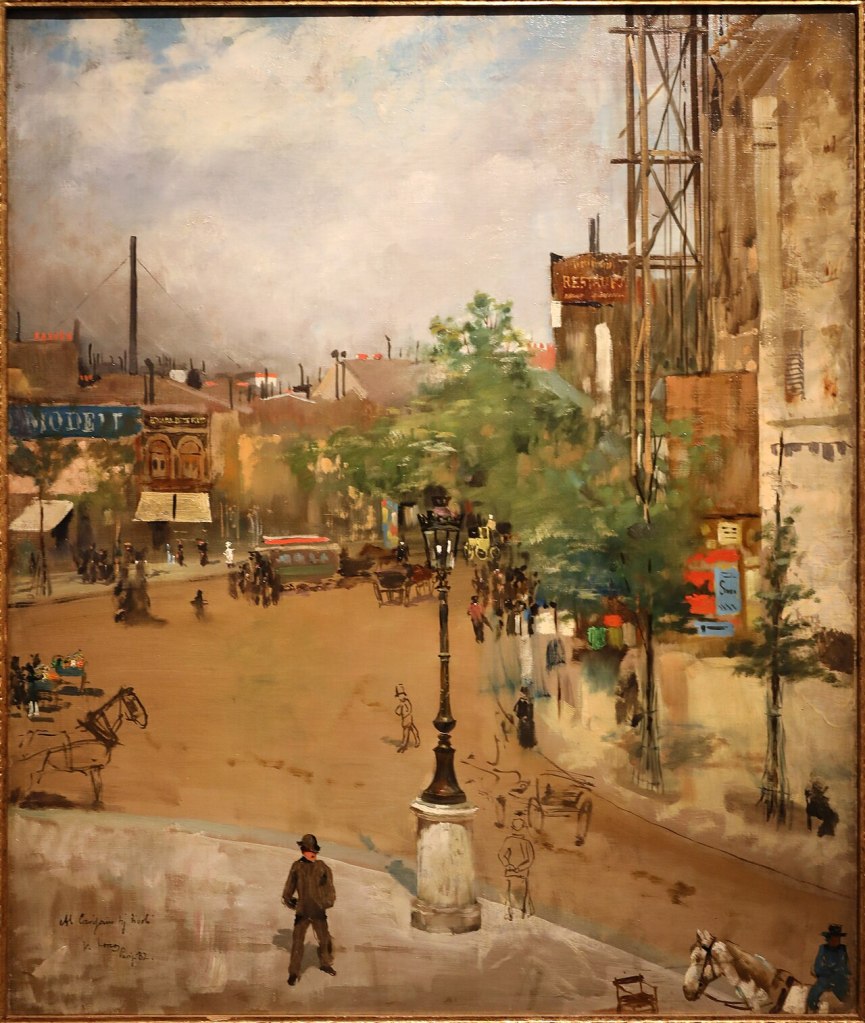
Paris itself became part of this enlarged field. Taddei writes of the city’s frenetic daily movement, advertising posters and rapidly changing built environment, pointing to Strada di Parigi of 1882 as evidence of Corcos’s fascination with the metropolis. The city offered him not just new subjects but a new structure of experience: crowds, interiors, passing encounters, social types and fragments of activity. In this sense the Parisian phase did not displace the vero established in his Italian formation. It relocated it within the conditions of modern urban life.
De Nittis, Goupil and the visual language of fashionable modernity
The Parisian vero had another, more marketable face. Through De Nittis, Corcos found a model for representing contemporary society with a combination of modernity, elegance and social clarity. De Nittis had made the boulevards, racecourses, gardens and resorts of fashionable life into subjects whose topicality did not exclude refinement. Corcos followed him into the same territory, painting figures at the Bois de Boulogne, Longchamp, theatre foyers and seaside resorts. The attraction lay partly in subject matter, but also in a way of turning social observation into pictorial pleasure.
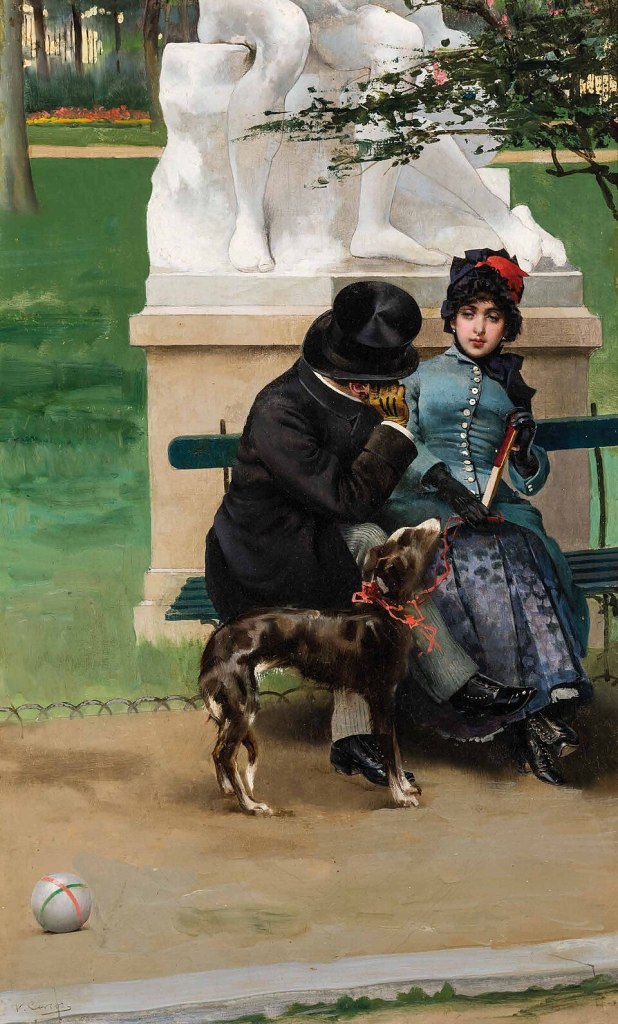
Goupil transformed that aptitude into a career. After buying Les pensionnaires à l’église in 1881, the firm entered into a relationship with Corcos that would last for fifteen years. Paintings could be sold internationally and, through photogravure and other reproductive processes, circulated far beyond the original purchaser. A successful motif was not exhausted by a single canvas. It could be repeated, varied and disseminated through prints and illustrated publications. Corcos’s images entered a visual economy in which recognisability mattered: fashionable dress, leisure, courtship, domestic affection and the rituals of the prosperous classes had to communicate readily to viewers in Paris, London, Brussels or New York.
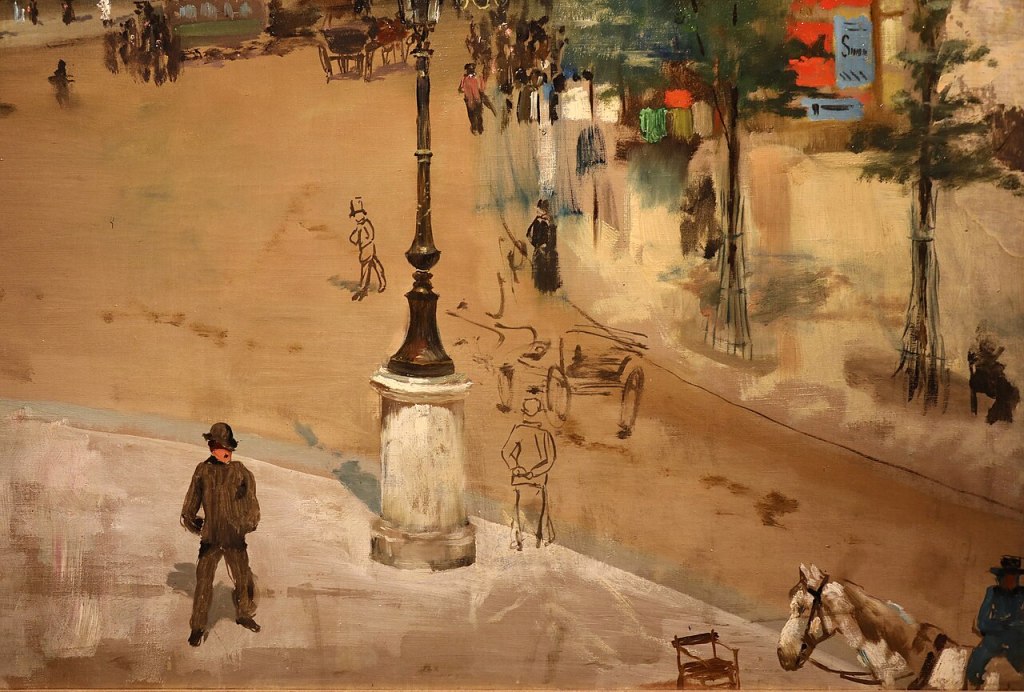
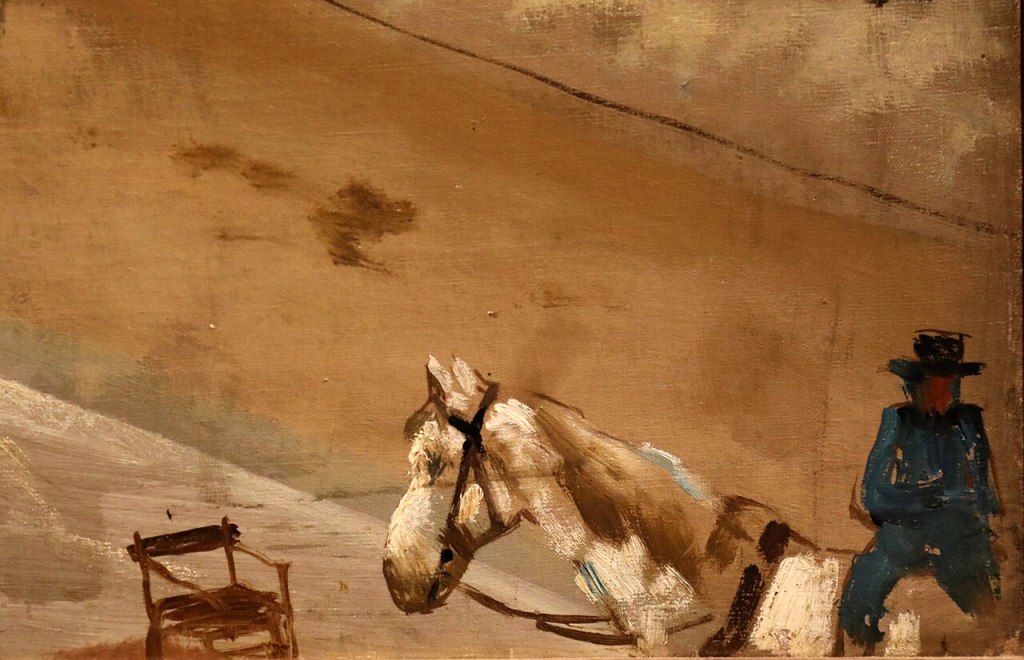
The polished finish associated with Corcos’s commercial production did not exhaust his range. Alongside it he continued to work in a much more abbreviated and immediate manner. In Strada di Parigi of 1882, passing figures and carriages are rapidly indicated, while small landscapes made at Biarritz, Brighton, along the Thames and in Hyde Park in 1884 were treated almost as visual notes. The same capacity for direct, atmospheric observation reappears in his Edinburgh views of 1887. Such works are a useful reminder that the highly finished surface on which Corcos’s international reputation increasingly depended was one mode of painting among several available to him.
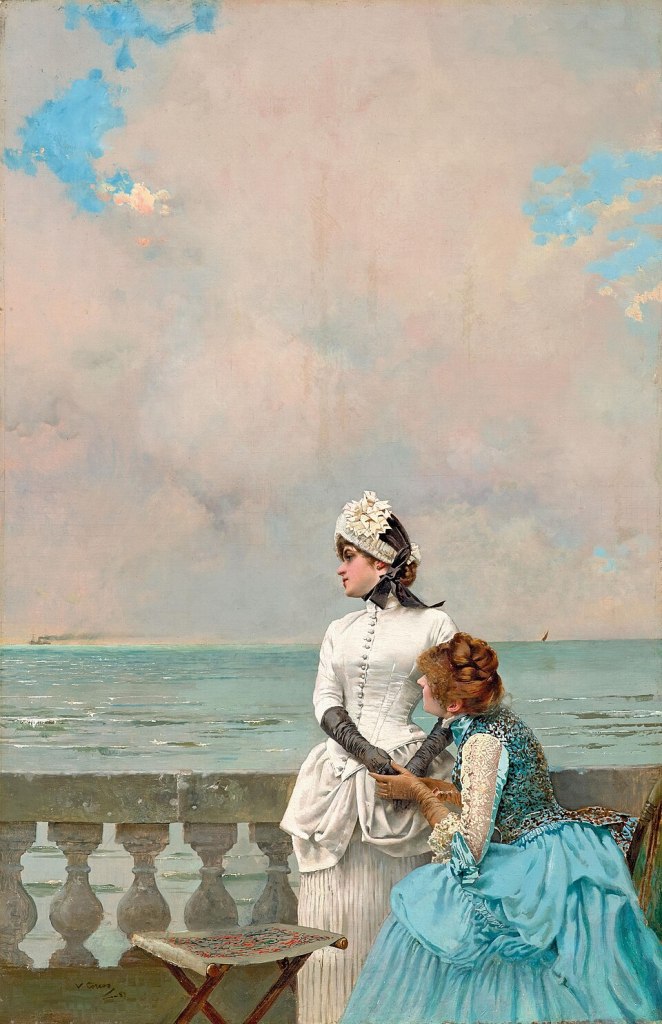
Works such as Nous verrons, Dis-moi tout, Idillio al mare and Mezzogiorno al mare occupy the commercial territory. Their young women and elegant companions converse, flirt or idle beside the sea in situations whose emotional meaning is deliberately easy to apprehend. Taddei describes the serenity of these pictures as carefully calculated. They retain the contemporaneity of Corcos’s Parisian experience while removing much of the social friction encountered in À la brasserie or I mendicanti. Modern life here has become pleasurable, polished and available for consumption.
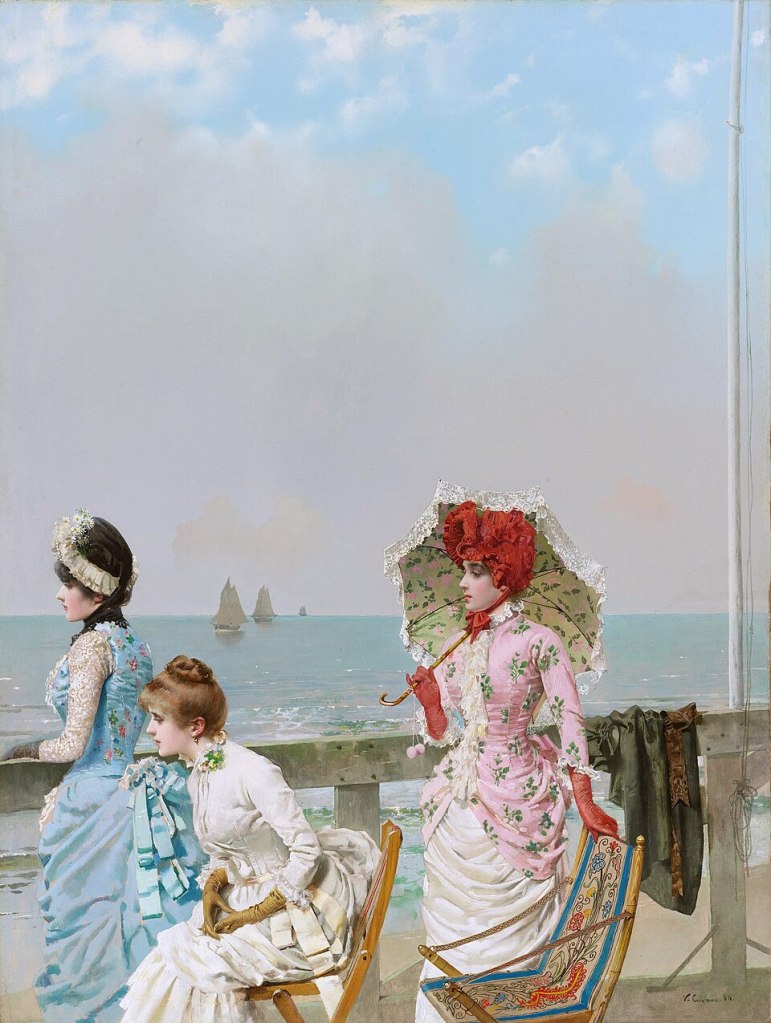
The relationship with De Nittis was more than an entry into this market. Corcos continued to regard the older painter as a model in both art and life, and the De Nittis household remained one of the centres of his Parisian world. In works such as Le nouveau-né, Taddei finds his example in the open-air setting, delicate chiaroscuro and refinement of sentiment. What Corcos absorbed was a means of giving contemporary social life pictorial distinction without removing its recognisable manners, settings and pleasures.
Goupil’s system rewarded precisely this combination, and Corcos became extraordinarily successful within it. The designation peintre des jolies femmes attached itself to a growing repertoire of attractive female types, while images of fashionable society were multiplied and exported through the international art trade. Yet commercial fluency brought its own constraint. By 1884 Corcos was already complaining that this production could not satisfy “un artista vero di cuore”. Recalling these pressures in a letter to Theo van Gogh in 1890, he described himself as a “pauvre piocheur, condamné” to produce “un art fardé et poudré que je n’aime pas”. The polished modernity for which he was becoming known had become a highly successful professional language, and its demands did not always coincide with his own artistic preferences.
Portraiture as interpretation: likeness, social identity and constructed appearance
Portraiture had interested Corcos before Paris. In Florence he had admired Michele Gordigiani for the facility with which he could observe a sitter and translate facial features, expression and character into a rapid image. Paris enlarged that conception. Léon Bonnat offered both a firmer pictorial architecture and a model of what the successful modern portraitist could become. Carlo Sisi stresses the social significance of Bonnat’s example, presenting him as an artist of formidable reputation, surrounded by an elite clientele eager to be represented and, in Sisi’s phrase, almost “divinised”. His teaching began with proportion, balance and the disposition of the body, before attention turned to the face, hands and feet; dark grounds, controlled shadows and concentrated accents of light then gave the sitter solidity and authority. Corcos absorbed this structural gravity without adopting Bonnat’s weightier manner wholesale, tempering it with lighter colour, greater attention to dress and surface, and a more seductive responsiveness to social persona.
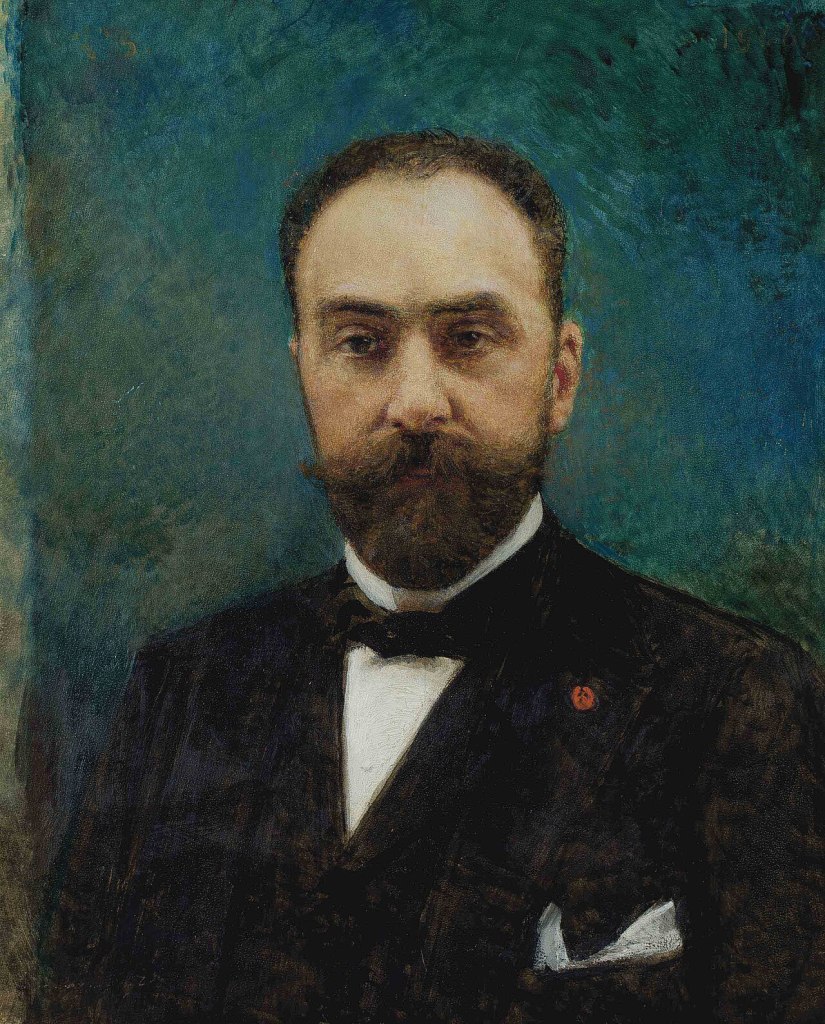
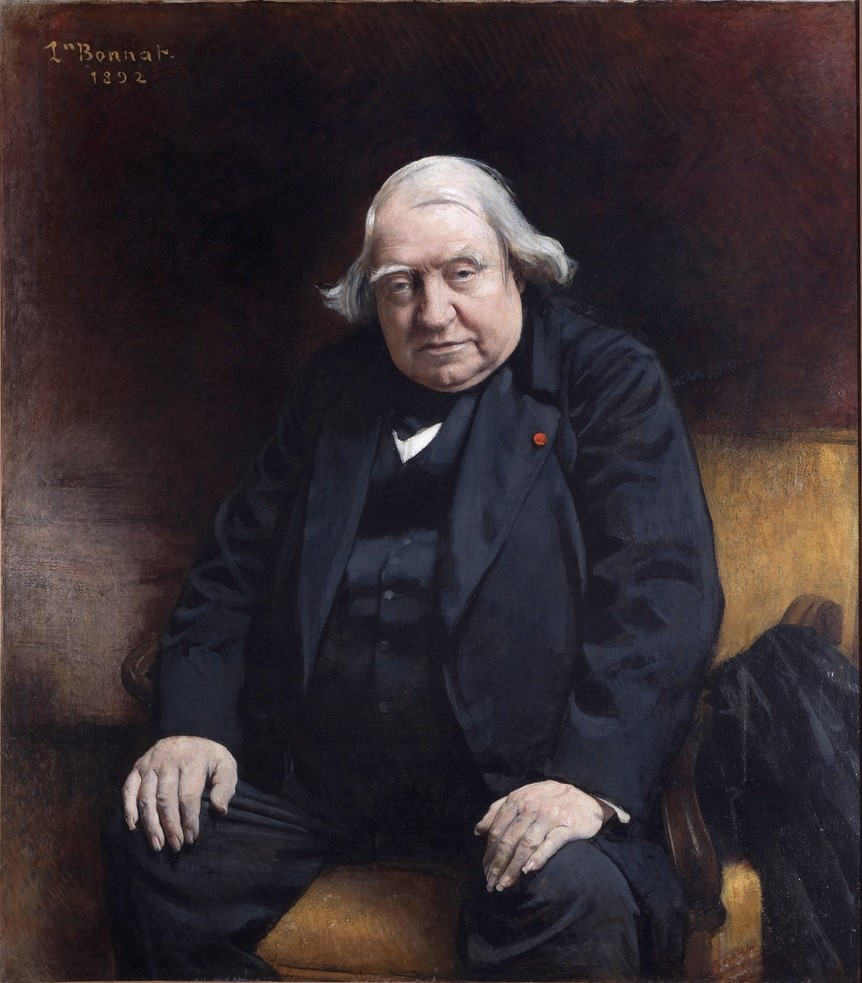
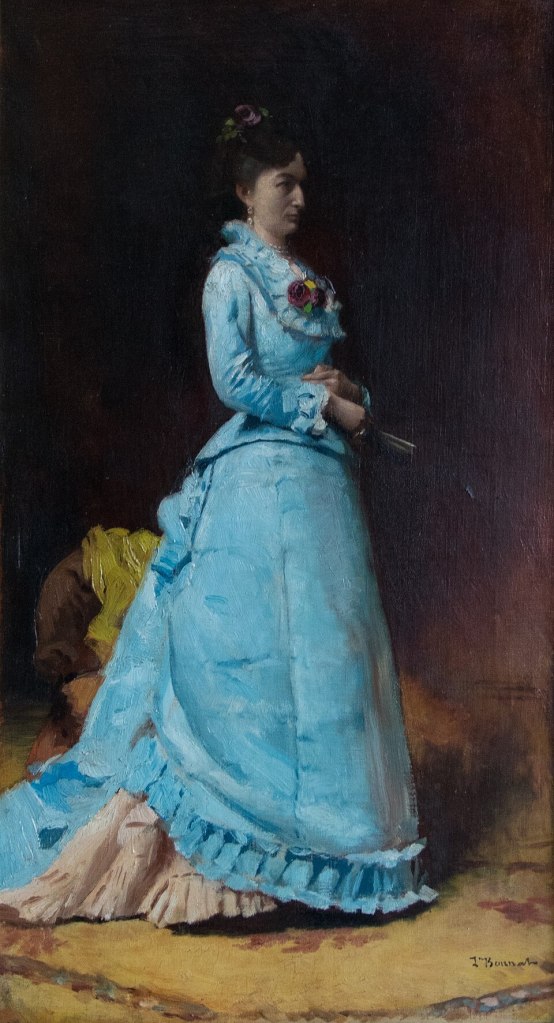
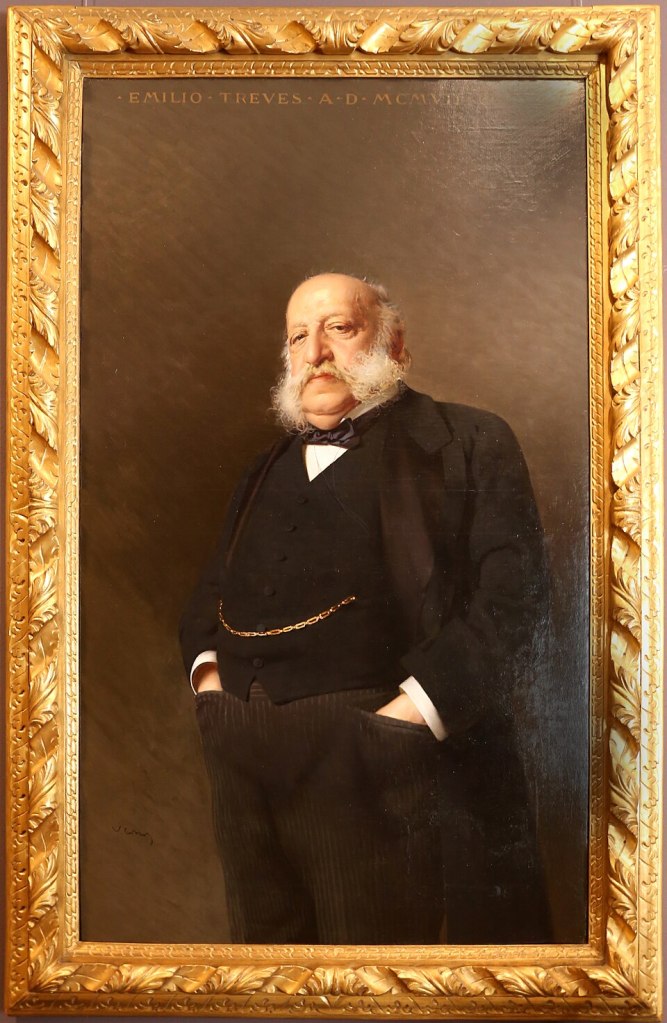
Corcos became unusually explicit about this function. A man’s portrait, he maintained, should make his social position immediately apparent; a woman should be made provocative even at eighty. Ugo Ojetti put the matter more caustically, observing that Corcos painted men and women not as they were but as they wished to be. Flattery was certainly involved, and Corcos readily admitted that he preferred to emphasise a sitter’s better features. But the operation went beyond cosmetic correction. Rank, cultivation, desirability and temperament were selected and organised into an image in which the sitter could recognise an intended version of the self.
Photography did not displace this interpretative role; it sharpened it. Corcos used photographs in his practice, and Sisi calls photography portraiture’s “sorella d’avventura”. A photograph might preserve a transient expression or an accidental configuration of features, but a painted portrait could draw on many such appearances. Within contemporary discussions of physiognomy and psychology, this capacity allowed painting to claim a paradoxical superiority: the finished portrait might be “more resembling than the truth” because it synthesised what no single instant could contain. Likeness became an accumulation and selection rather than the duplication of one appearance.
Corcos himself believed that every representation of nature was conditioned by the artist who made it. Even students copying the same unchanging vero, he later observed, produced different results. Portraiture made that principle especially visible. The sitter supplied features, gesture and behaviour, but their pictorial relationship had to be decided. The casual Yorick, cigarette in hand, required a different construction from the austere public presence of a scholar or statesman. Silvestro Lega, whom Corcos knew during his impoverished final years, was shown wrapped against the cold and wearing the only glove he owned, a detail that gave the portrait an intimacy grounded in personal knowledge. Moreover, the portrait of Pietro Mascagni of 1891 is similarly adjusted to character: Corcos placed the composer astride a chair and varied the degree of finish across the canvas, leaving some passages barely indicated while working the right eye almost like a miniature.
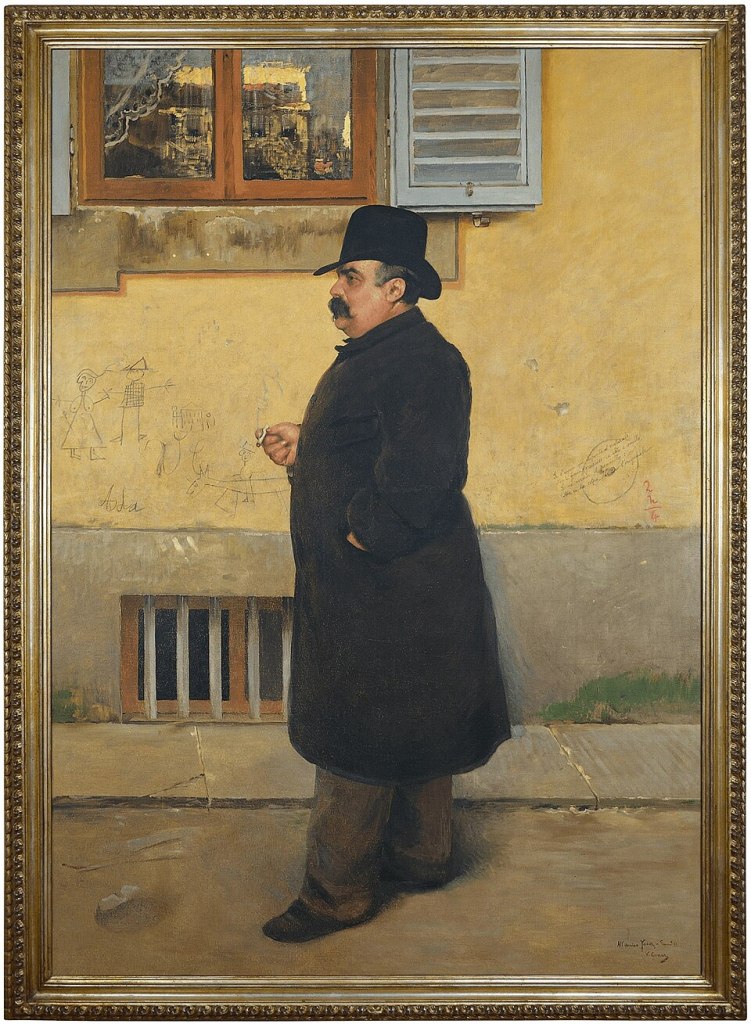
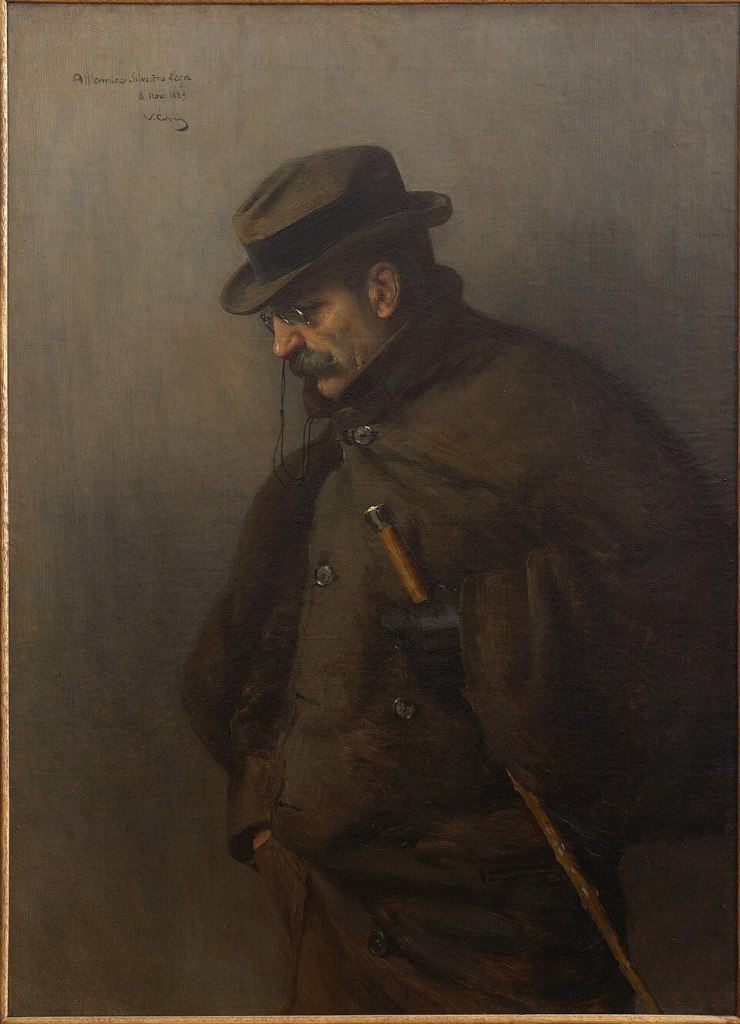
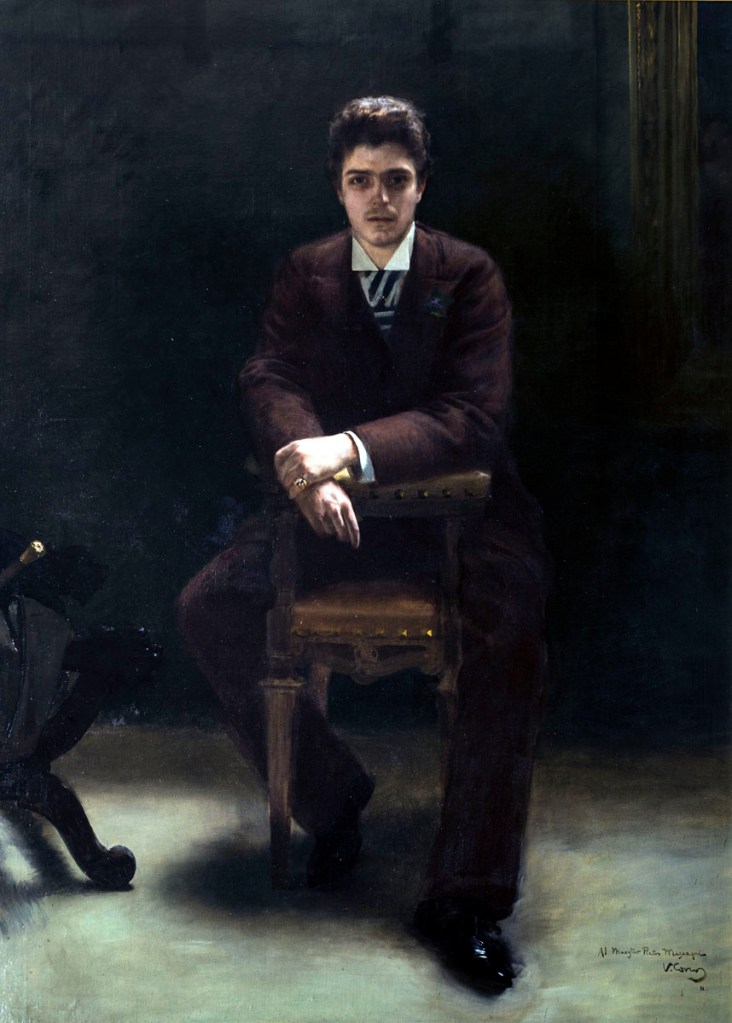
Official portraiture made the process still more deliberate. Before painting Queen Margherita, Corcos spent time observing her preferences, habits, gestures and attitudes. He avoided the conventional apparatus of court portraiture and chose elements of the setting that would present her as cultivated, charitable and intellectually engaged. The resulting likeness was not less constructed because it arose from close acquaintance. Observation furnished the evidence; portraiture determined what that evidence would mean.
Surface, dress, objects and the social meaning of things
Corcos’s reputation for finish can easily make his attention to material things seem merely virtuoso. Carlo Sisi argues for something more consequential. In the visual culture to which Corcos belonged, clothes, fabrics, jewellery, fans and furnishings participated in the description of a person as fully as facial features or gesture. Painters and photographers alike scrutinised dress with almost documentary exactitude, while the expanding market for images encouraged a close correspondence between painted society and the world that recognised itself in those paintings.
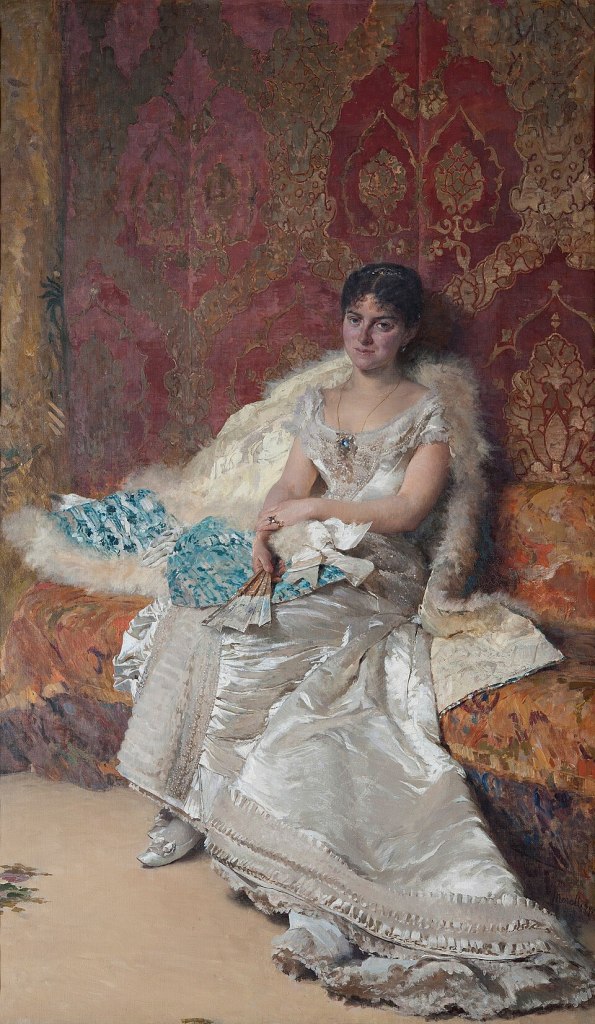
Sisi places Corcos alongside De Nittis, Boldini and other painters who made the material forms of cultivated life unusually conspicuous. Hair catches the light, pearls acquire their milky sheen, and cloth is given density, transparency or lustre according to its nature. Yet this descriptive precision had roots reaching back to Naples. As we noted earlier, Morelli had insisted that a painter could not make white silk convincing simply by copying every fold. The movement and construction of the fabric had first to be understood, so that its material character could be suggested even with relatively few strokes. Corcos’s later brilliance with silk, velvet and lace depended on knowledge rather than enumeration.
By the later nineteenth century such materials carried an increasingly elaborate social charge. Reviewing the Naples exhibition of 1877, the painter and critic Francesco Netti remarked that fashionable visitors could recognise their own world in the paintings around them: the same fabrics, carpets, satin shoes, bare arms and accessories that belonged to their daily lives. Sisi uses the passage to evoke a culture in which representation and self-presentation had become closely entwined. Corcos’s fabrics and ornaments locate his sitters within that culture. They register wealth and taste, but also habits of display and the codes through which bourgeois and aristocratic identity was displayed and recognised.
The fan is a particularly suggestive example. Japonisme had transformed such objects from incidental accessories into conspicuous signs of cultivated taste, while Japanese art itself encouraged European painters to attend more closely to pattern, decorative surface and flattened design. In Madreperla, Sisi sees the large open fan entering into a quiet relation with the surrounding flowers. Its transparency and delicacy belong to a world in which an ordinary possession could acquire associations of refinement, fantasy and emotional escape. The object retains its material specificity while exceeding its practical use.
That capacity becomes still more pointed when dress registers a social position that is not straightforwardly privileged. Sisi singles out Le istitutrici ai Campi Elisi, whose governesses wear refined black clothes and possess the appearance of cultivated women, yet remain socially subordinate within the affluent world they inhabit. Their elegance is edged by exclusion. The clothes do not merely embellish the figures; they make visible the uneasy proximity between participation in a social world and dependence upon it.
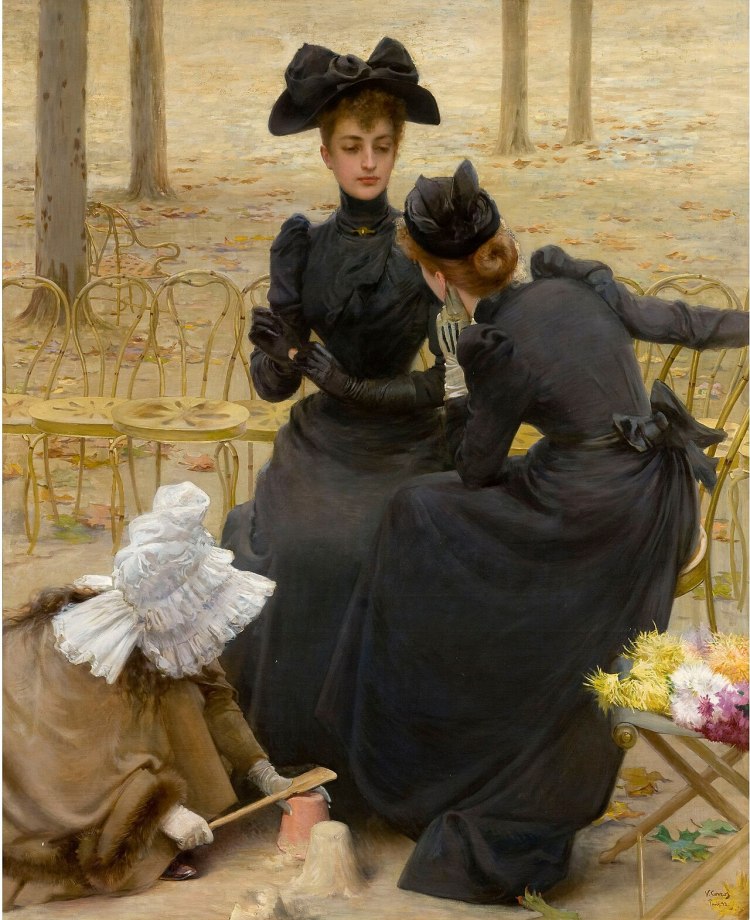
Corcos’s material exactitude is inseparable from his portraiture of an age. Interiors, clothes, gestures and minor objects could preserve information about social rank and taste, but they could also carry more private suggestions of temperament, desire or constraint. Sisi’s comparison with Baudelaire is apt: modern citizens were to be represented in the forms proper to their own time, down to their neckties and polished boots. In Corcos, the surface of things is rarely empty. It is one of the places where social identity becomes visible.
The eyes and inwardness
For Corcos, the eyes gradually became the most concentrated site of portraiture. He repeatedly maintained that if he found them with the right expression, “il resto viene da sé”. Ilaria Taddei connects this conviction with his admiration for Boldini, whose portraits could communicate something affectionate or unspoken through the eyes even when other aspects of the drawing were deliberately irregular. Corcos’s own method similarly privileged the face as the point at which likeness might become character.
The emphasis did not necessarily make character easier to read. Carlo Sisi treats the eyes as a central element of Corcos’s portraiture, but describes a considerable range of expressions and ways of looking in his women: dark eyes emerging assertively from shadow, candid adolescent expressions, and direct looks that confront the spectator rather than submit to inspection. In Ombrello rosso, the fixed eyes and firmly closed mouth give the woman an almost peremptory presence. La parigina, by contrast, was praised for a dreamy expression compared by a contemporary critic to “un soffio d’aprile”. The difference lies less in the accuracy with which the eyes are described than in the kinds of access they appear to offer, or withhold.
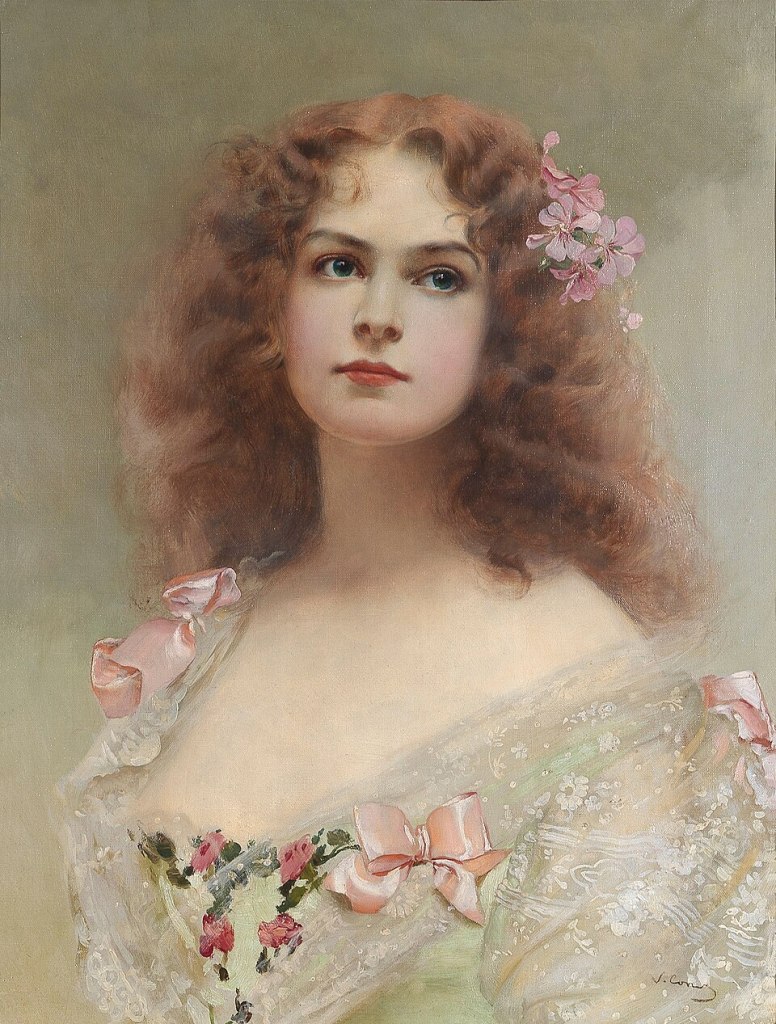
This is where Corcos’s psychological ambition extends beyond what can be read from facial expression alone. His portraits can supply abundant evidence about a sitter’s social identity while leaving the thoughts behind the face unresolved. A direct look may seem to promise disclosure, yet it can equally establish distance. A woman looking directly out of the picture is not necessarily made more available to the spectator; the returned look can reverse the relationship, making the viewer conscious of being regarded in turn.
Other works shift the emphasis from confrontation to absorption. In Lettura interessante of 1888, the book introduces the possibility of a mental space extending beyond the visible scene. Eugenia Querci reads such images through the fin-de-siècle association of reading with fantasy, reflection and escape from social convention. Small narrative elements may suggest what has prompted a mood, but they do not explain it. Corcos can describe the circumstances surrounding a state of mind while leaving it partly inaccessible.
That reserve becomes increasingly important in the years before Sogni. In Contemplazione, for example, the melancholy directness of the woman’s look coexists with an abandoned pose and a religious setting whose significance remains uncertain. The painting provides signs from which an interpretation might be constructed without fixing a single explanation.
The 1890s: Sogni, Rupture and Morfinomane
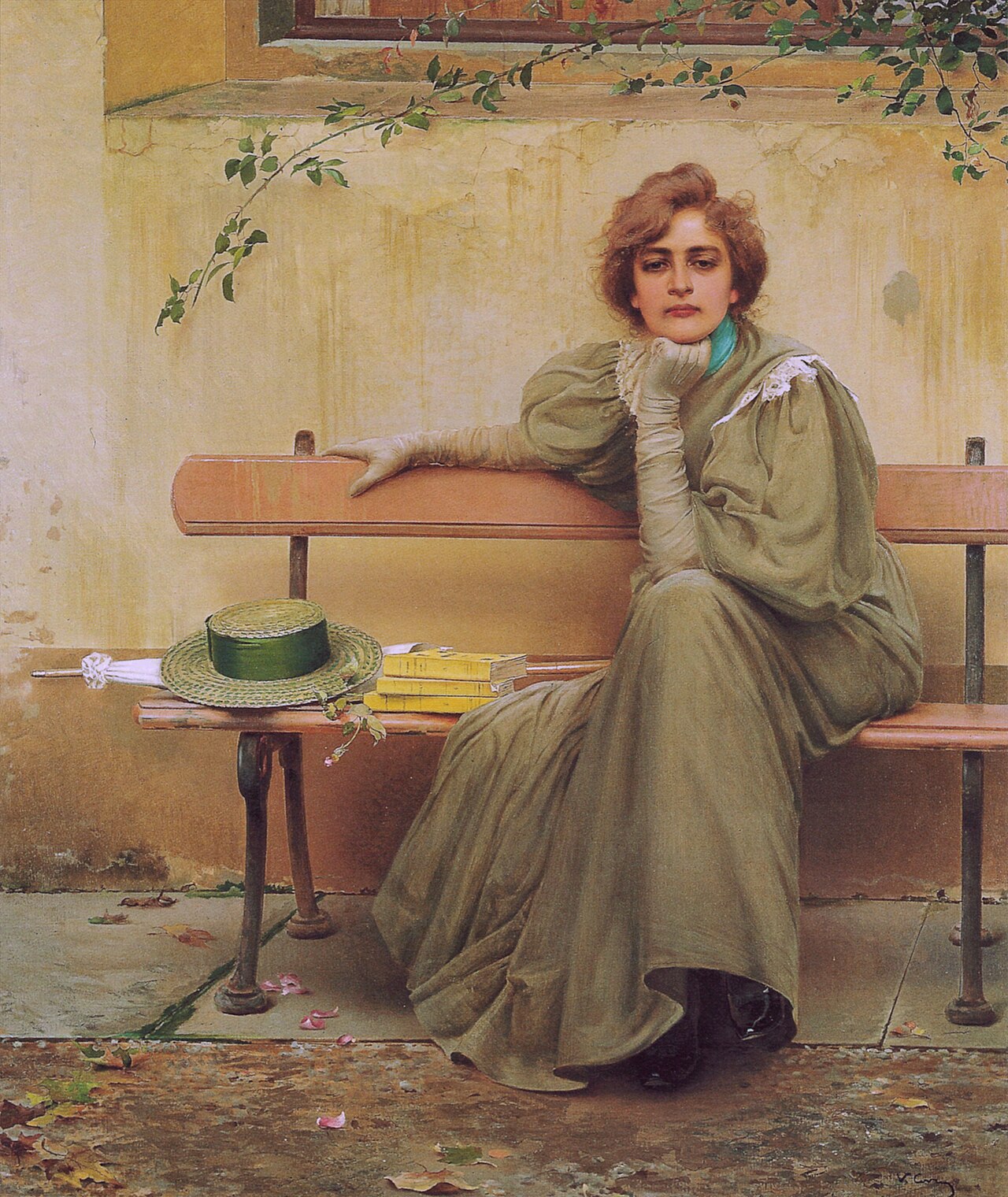
When Sogni was exhibited at the Festa dell’Arte e dei Fiori in Florence in 1896, it caused what one commentator called a “chiasso indiavolato”. The commotion centred on the young woman herself. Her crossed legs, loose posture and slightly parted lips seemed unusually free of the conventions expected of feminine decorum, while her calm self-possession frustrated attempts to decide exactly what she was thinking. Critics wondered whether she remembered a finished love affair or anticipated another; one suggested that she dreamed of things “di cui non dovrebbero sognare le ragazze”. Sisi regards the resulting “seducente perversità” as inseparable from the picture’s contemporaneity. Sogni presented not an overtly scandalous woman but one whose imaginative life appeared to belong to herself.
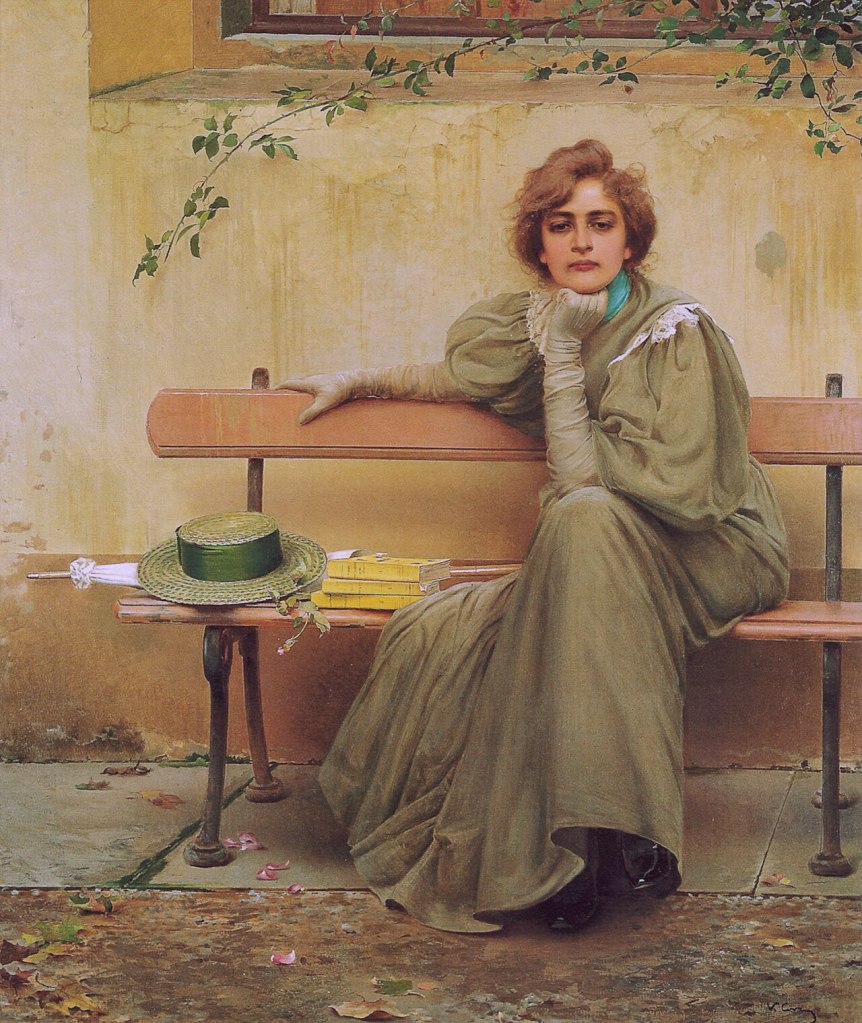
The objects around her sharpen rather than resolve this uncertainty. The yellow-covered books, faded rose, parasol and hat make the bench a repository of reading, memory and suspended activity. Taddei associates the books with Paul Bourget and Marcel Prévost, writers whose fiction explored the emotional complications of cultivated society. A critic remarked that Bourget or Prévost, had they been painters, might have produced something like Sogni. Literature enters the picture less as illustration than as a means of suggesting a consciousness formed by reading, expectation and experience.
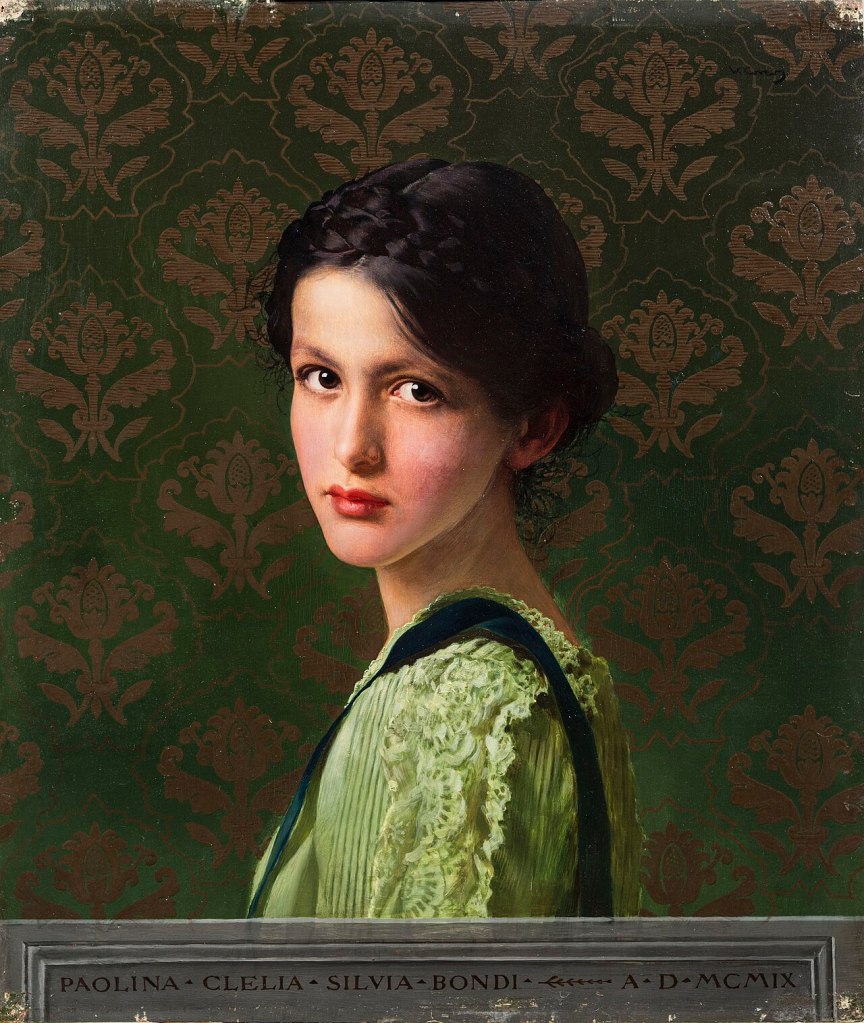
The same year, Rupture approached emotional disturbance more explicitly. A woman dressed in dark clothes collapses into an armchair with her head in her hands, amid bright upholstery, flowers, a kneeling stool, a Renaissance-style bust and carefully chosen ornaments. Taddei connects this décor with D’Annunzian taste and perhaps with the Manifattura di Signa, a workshop near Florence producing artistic terracottas inspired by antique and Renaissance models and owned by the family of Paolina Clelia Silvia Bondi, whom Corcos would later portray. These furnishings place the episode within the object-rich environment of D’Annunzian fin-de-siècle Aestheticism, where interiors could declare taste, status and cultural allegiance.
Morfinomane of 1899 occupies a more disturbing register. The painting, whose present location is unknown, showed an elegantly dressed woman in black abandoned to the effects of morphine. Emanuele Bardazzi places it within the late-century fascination with narcotics, illness and disturbed consciousness, and recalls Taddei’s comparison with Hippolyte in Baudelaire’s Femmes damnées: Delphine et Hippolyte. Baudelaire evokes dulled eyes and languid tears, a broken bearing, stupor and sombre sensual languor: “De ses yeux amortis les paresseuses larmes, / L’air brisé, la stupeur, la morne volupté”. The affinity lies in this conjunction of fragile beauty, lassitude and stupefaction rather than in any direct illustration of the poem. Eugenia Querci, in turn, relates Corcos’s picture to Santiago Rusiñol’s La morfina and Ernest Chambard’s Les morphinomanes. The elegant female type familiar from his society painting remains recognisable, but elegance can now coexist with dependency, exhaustion and unease.
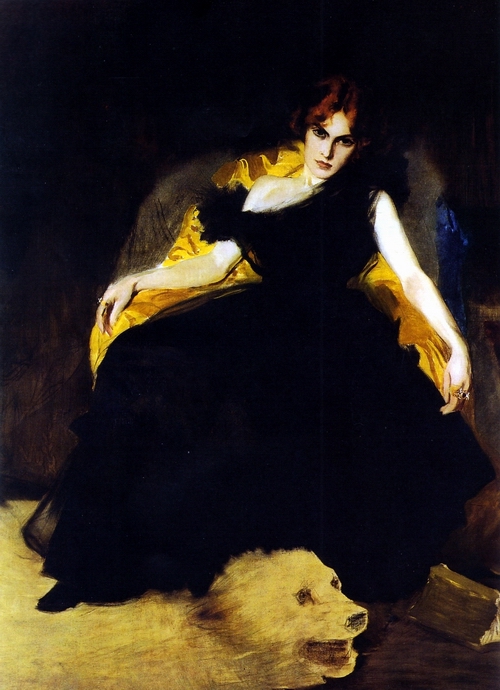
Alongside courtship, leisure and fashionable self-presentation, Corcos was thus admitting subjects of private speculation, emotional collapse and altered consciousness. Sisi treats Sogni, Rupture and Morfinomane among the works in which subject begins to carry greater weight than questions of stylistic allegiance. Their force comes from situations and associations familiar to a society saturated in novels, periodicals and discussion of emotional and nervous life. Corcos retained the accomplished finish of his established painting while making room for states of mind that were far less settled.
Naturalism, Decadentism and Symbolist suggestion
Corcos’s work in the 1890s does not resolve into a succession of neatly separated styles. His commitment to the vero remained active while literary and psychological suggestion acquired greater importance. Taddei’s discussion of Sogni captures this overlap especially well: she places the almost photographic presence of the woman beside a Symbolist concentration of sentiment. Contemporary critics themselves spoke of a “fusione di varie scuole” and disagreed over whether Corcos should be considered a realist or a “spiritualist”, using the latter term for an art concerned with inner life and poetic or ideal suggestion. The painting remains firmly attached to visible appearances while asking them to carry meanings that cannot be read from appearance alone.
Naturalism had not become an abandoned phase. After leaving Paris and settling in Florence at the end of 1886, Corcos continued to paint subjects that Taddei places within a Tuscan and French Naturalist tradition. Much later, writing about Boldini in 1931, he still employed the language of anatomy and expert diagnosis. The terminology is revealing without requiring us to make Corcos a doctrinaire Naturalist: close observation and an analytical confidence in visible reality remained part of his understanding of painting.
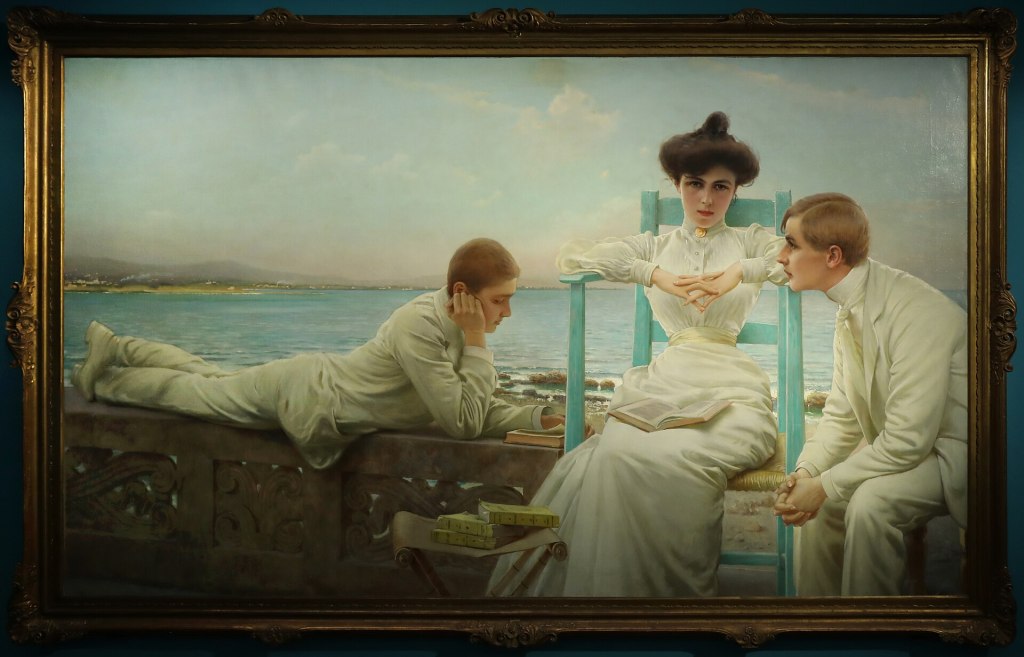
Decadentism entered at a different level. In Corcos it is most useful for describing a late-century field of subjects and moods: cultivated leisure, withdrawal into reading or reverie, erotic uncertainty, melancholy, nervous disturbance and, at its darker edge, illness and narcotics. In his discussion of the Corcos household and its Florentine literary milieu, Silvio Balloni argues that, in this particular cultural setting, Naturalist and Decadent tendencies need not be treated as opposites. They could operate as “i due lati d’un medesimo fatto”, two sides of the same experience. In lettura sul mare belongs to the quieter end of this Decadent sensibility, bringing two young men and a young woman together in an atmosphere of reading, conversation and contemplation. Sogni gives it a more ambiguous female presence; Morfinomane brings elegance into contact with dependency and physical exhaustion. None of these subjects required Corcos to abandon the representational language he already possessed.
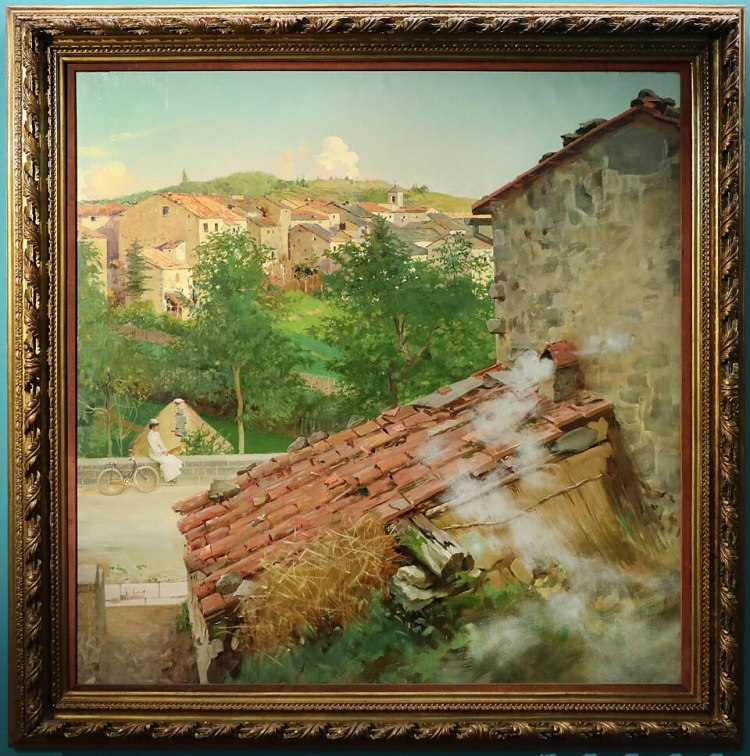
Symbolism describes something different again: the increased suggestive capacity of what Corcos paints. In Pracchia, Sisi sees a familiar Tuscan landscape assuming a Symbolist character; elsewhere a book, flower or expression can point beyond its literal presence towards memory, desire or an unresolved state of mind. Corcos did not exchange Naturalism for Decadentism and then Symbolism. Naturalism remained in his reliance on observed appearances; Decadentism entered through subject and emotional atmosphere; Symbolism through the capacity of concrete things to suggest meanings beyond that which they visibly describe. Corcos thus found his own position within the overlapping artistic and literary cultures of the late nineteenth century.
Corcos as writer: Mademoiselle Leprince
Corcos’s literary activity formed a substantial second strand of his career. He wrote fiction, reminiscences and articles, gave lectures and worked as an illustrator. His collection Mademoiselle Leprince, published in Livorno in 1901, gathered stories that had in some cases appeared earlier in periodicals. Taddei describes these pieces as bozzetti, short sketches ranging from autobiographical and Parisian material to more explicitly veristic subjects, written with a painter’s attentiveness to light, colour and the appearance of places and people.
The title story is especially revealing. First published in the literary weekly Fanfulla della Domenica in 1894, it concerns a professional model who continues to pose because she must earn her living, while her thoughts move towards another existence. She dreams of quiet, the countryside, children and perhaps marriage. Her occupation determines what others see and what is required of her body, but it does not encompass the life she imagines for herself. Corcos repeatedly returns to her reverie, establishing a distinction between the role she performs and the thoughts that remain her own.
That distinction has an obvious bearing on his paintings of women, although Sogni, painted two years later, should not be treated as a direct illustration of the story. Mademoiselle Leprince is valuable precisely because prose allows Corcos to state directly something that painting can only suggest. A painter can record dress, posture, expression and surroundings, but none of these necessarily discloses what a person is thinking. In the story, the model is literally an object of sustained visual scrutiny, yet the narrative gives her a private consciousness that cannot be inferred from her professional appearance.
The same doubleness recurs elsewhere in Corcos’s fiction. Taddei notes his ability to establish a room, an encounter or a figure through a few closely observed details, while fantasy, anxiety, inhibition or desire remain less easily disclosed. His prose and painting thus share a persistent discrepancy between what can be described from the outside and what remains private to the figure.
Emma Corcos, Il Marzocco and the Florentine literary milieu
By the 1890s the Corcos household in via Marsilio Ficino had become an established meeting place for artists, writers and scholars, closely connected with the Florentine literary weekly Il Marzocco. Emma Corcos was central to this activity. Contemporary testimony presents her not simply as the wife of a successful painter or the hostess of a fashionable salon, but as a woman of considerable intellectual energy who read widely, wrote herself and sustained literary friendships of her own. The house belonged to a cultivated Florentine society in which literature, painting, scholarship and contemporary debate met with unusual regularity.
Her closest literary relationship was with Giovanni Pascoli, one of the leading Italian poets of the period. Their extensive correspondence began in 1897 and continued until his death. He admired her refinement and culture and transformed her in his letters and poetry into the elusive “gentile ignota”. Emma herself was an active participant in literary discussion. She later recalled hearing Giosuè Carducci, the dominant poet of the preceding generation, dismiss several contemporary writers and asking him directly what he thought of Pascoli. His reply was emphatic: Pascoli was great and would endure, “Il Pascoli è grande. Quello resterà!”
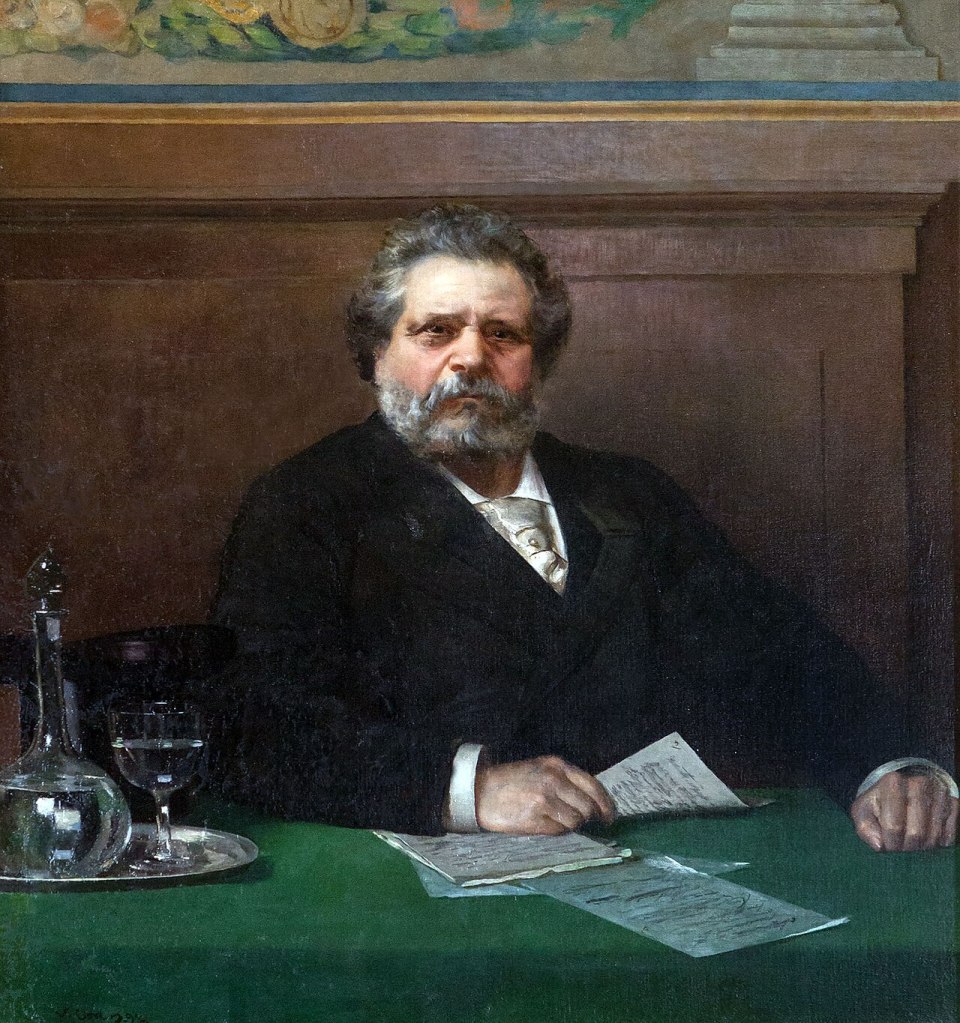
Vittorio’s involvement with this literary world was equally concrete. He contributed writing and images to Il Marzocco, while his friendship with Pascoli led to attempts to coordinate poetry and book illustration. Corcos proposed designs for the poet’s publications and later sent him a drawing inspired by Il mendico for Canti di Castelvecchio. Pascoli explained that he could not use it because the image reproduced poorly on the paper chosen for the volume. There is some suggestion in the correspondence, however, that this practical objection may not have been the only consideration, and that he was also anxious not to offend Vittorio and Emma by rejecting the drawing outright. The exchange shows how closely questions of literary meaning, visual form and personal relations could intersect within this circle.
Silvio Balloni’s reconstruction of the Corcos salon gives the milieu a more precise intellectual character. Within this particular Florentine setting, Aestheticism existed alongside the scientific and philological culture associated with the city’s institutions of higher learning. Interest in beauty, poetry and literary suggestion did not exclude historical scholarship or intellectual discipline. Nor did the circle simply follow the more flamboyant Aestheticism associated with D’Annunzio. Balloni stresses its comparative sobriety and intellectual seriousness, while an 1898 letter from Emma records discussion of the Dreyfus affair and Zola in the Corcos drawing room. The salon was socially privileged, but its interests were neither narrowly artistic nor provincial.
Pasquale Vannucci’s account of Pascoli’s early reception offers a suggestive parallel with Corcos. He records the argument that the novelty of Myricae was initially obscured by a “decoro” and “squisitezza d’espressione” that still allowed the poetry to be read in traditional terms. We can recognise a comparable difficulty in Corcos’s reception. The finish, elegance and formal refinement of his painting could encourage a conventional reading even when its subjects and emotional tensions belonged to the changing culture of the fin de siècle.
Corcos and Umbertine Italy
Sisi places Corcos securely within the artistic and literary culture of Umbertine Italy because he gave persuasive form to the society around him. Radical formal innovation was not central to that achievement. The designation is useful for a culture in which inherited forms remained powerful while social habits, ideas of femininity, psychological interests and literary tastes were changing rapidly. Works such as Sogni, Rupture and Morfinomane belong to this world precisely because their modernity lies substantially in what they represent and imply. They do not depend on a rejection of established pictorial practice.
Corcos’s career had always depended on selective assimilation. Morelli, Parisian Naturalism, fashionable modern-life painting, portrait photography and the example of Impressionism all entered his work without demanding exclusive allegiance. He could take luminosity or compositional freedom from newer painting without surrendering controlled drawing and recognisable form. The result was neither simple conservatism nor avant-garde experiment. What he absorbed was repeatedly adjusted to the purposes of portraiture, to his international clientele and to his own standards of finish.
The limits of that adaptability became clearer as the artistic climate changed. In 1907, with more disruptive artistic practices already emerging, Corcos continued to defend accurate drawing, mastery of the brush and carefully judged colour. Taddei notes that he remained intellectually curious, visited exhibitions and followed new developments, but did not fundamentally alter the manner established during his maturity. His distance from the avant-garde cannot be explained simply by ignorance of what was happening around him.
The change was visible in Florence itself. Balloni describes the years around 1903–04 as the beginning of a different cultural phase, when the salon world associated with Il Marzocco increasingly gave way to younger and more combative intellectual movements. Corcos belonged to the earlier culture of coexistence: academic inheritance, the vero, international painting, literary Aestheticism, psychological suggestion and bourgeois sociability could all occupy the same field without requiring a decisive rupture with the past. His position within modern Italian art is best understood through that capacity for accommodation. He registered the tensions of his period while continuing to work within established forms whose continuity was itself part of the culture he represented.
Conclusion
Corcos’s reputation as a painter of elegant women and accomplished society portraits has often encouraged a reading of his work through finish, charm and social polish. Yet those qualities are only part of what the paintings do. As we have seen, dress, furnishings, books and gesture establish rank, taste and circumstance with great precision, while expression and pose can leave something of the person unresolved.
That balance grew from a formation in which the vero was continually enlarged rather than abandoned. Florence gave Corcos technical assurance; Naples joined observation to imaginative reconstruction, structure and feeling; Paris opened his work to modern urban life, literature, fashionable society and the international art market. Portraiture brought these strands together in a practice where likeness could be exact but selective, and social identity clear without fully explaining the sitter.
In Corcos’s female subjects of the 1890s, that tension became increasingly pronounced. Sogni, Rupture and Morfinomane introduce reverie, emotional crisis, erotic uncertainty and altered consciousness into Corcos’s established practice. His fiction, and the literary culture surrounding Emma Corcos and Il Marzocco, show that this interest in the discrepancy between outward appearance and private thought belonged to the wider intellectual world in which he worked.
Corcos never became an avant-garde painter. Naturalist observation, Decadent subjects and Symbolist suggestion could coexist with his attachment to drawing, formal control and beauty. His modernity lies in that coexistence: in allowing contemporary experience to press against forms he chose to retain.
Producing these essays requires care, time, research, and resources. Contributions to help sustain this exploration would be greatly appreciated.
Donate to Inner Surfaces here.
Bibliography
Balloni, Silvio, ‘Il salotto della gentile ignota’, in Carlo Sisi (ed.), Vittorio Corcos. L’avventura dello sguardo, Milan: Silvana Editoriale, 2019, pp. 36–45.
Bardazzi, Emanuele, ‘Le vergini funeste. Fenomenologie dell’eterno femminino, decadente e fin de siècle’, in Carlo Sisi (ed.), Vittorio Corcos. L’avventura dello sguardo, Milan: Silvana Editoriale, 2019, pp. 46–61.
Corcos, Vittorio Matteo, Mademoiselle Leprince, Livorno: S. Belforte & C., 1901.
Querci, Eugenia, ‘Corcos e la psicologia di un’epoca’, in Francesca Dini and Davide Dotti (eds), La Belle Époque. L’arte nella Parigi di Boldini e De Nittis, Milan: Silvana Editoriale, 2025, pp. 83–88.
Sisi, Carlo, ‘Corcos, Vittorio Matteo’, Dizionario Biografico degli Italiani, vol. 28, Rome: Istituto dell’Enciclopedia Italiana, 1983, pp. 784–86.
Sisi, Carlo, ‘Vittorio Corcos e l’avventura dello sguardo’, in Carlo Sisi (ed.), Vittorio Corcos. L’avventura dello sguardo, Milan: Silvana Editoriale, 2019, pp. 13–21.
Taddei, Ilaria, ‘Vittorio Corcos. La realtà e il sogno’, in Ilaria Taddei (ed.), Vittorio Corcos. Il fantasma e il fiore, Florence: Edifir, 1997, pp. 15–64.
Taddei, Ilaria, ‘Vittorio Matteo Corcos. Tra affetti domestici e sentimenti segreti, atmosfere quotidiane e riti mondani’, in Carlo Sisi (ed.), Vittorio Corcos. L’avventura dello sguardo, Milan: Silvana Editoriale, 2019, pp. 22–35.
Vannucci, Pasquale, ‘La fortuna critica del Pascoli’, Belfagor, 13, no. 1, 31 January 1958, pp. 86–91.

