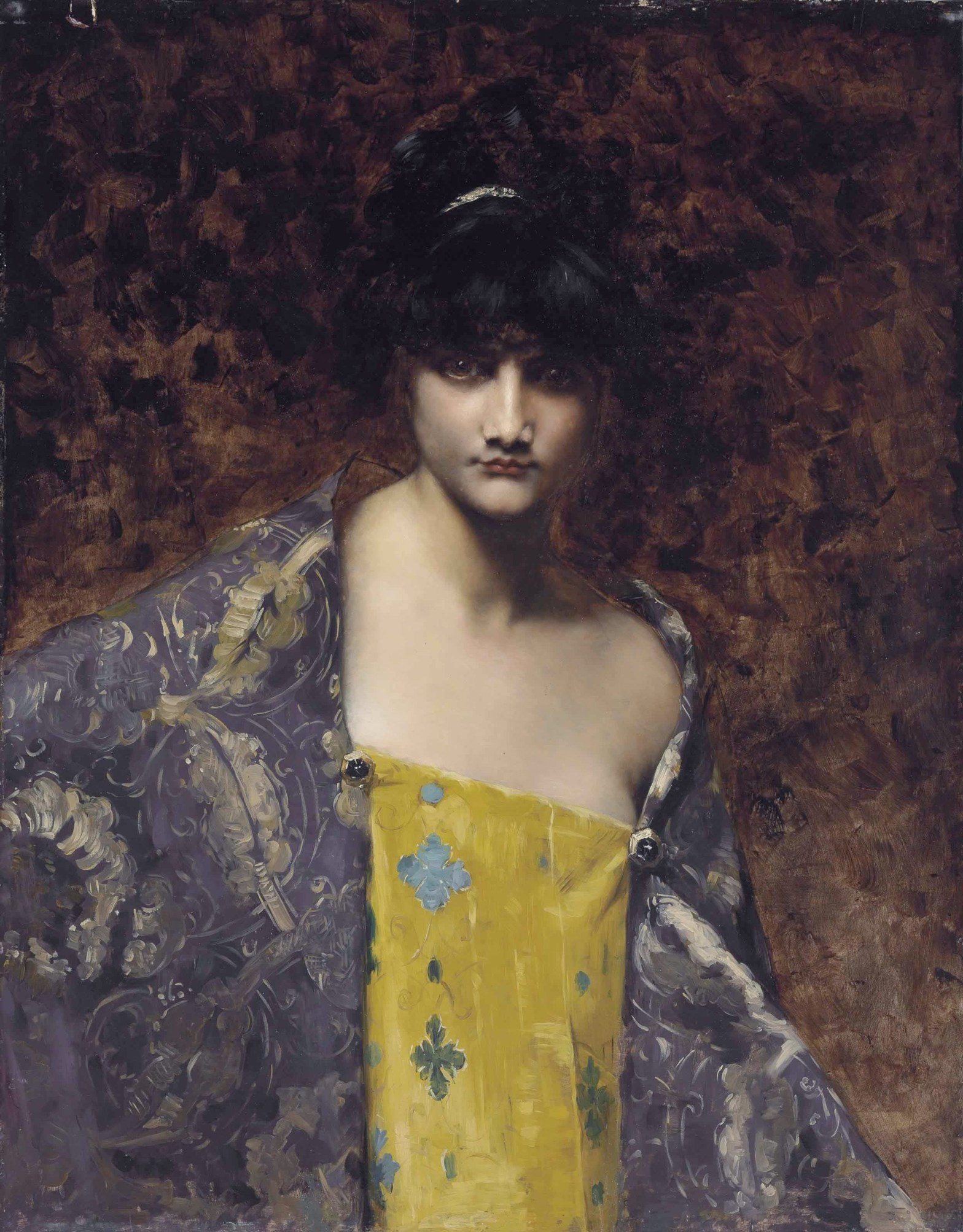
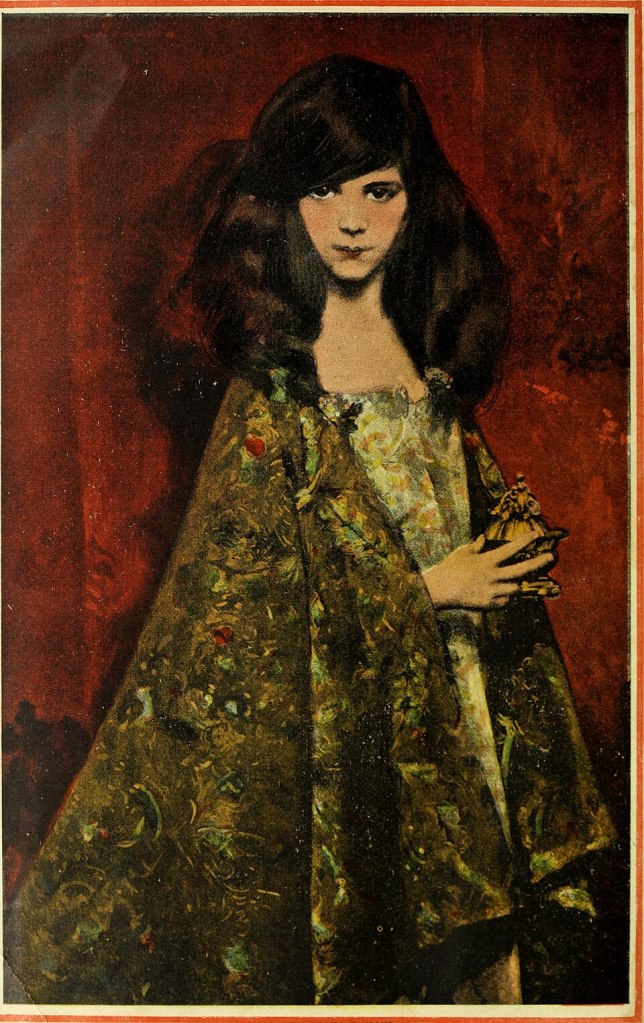
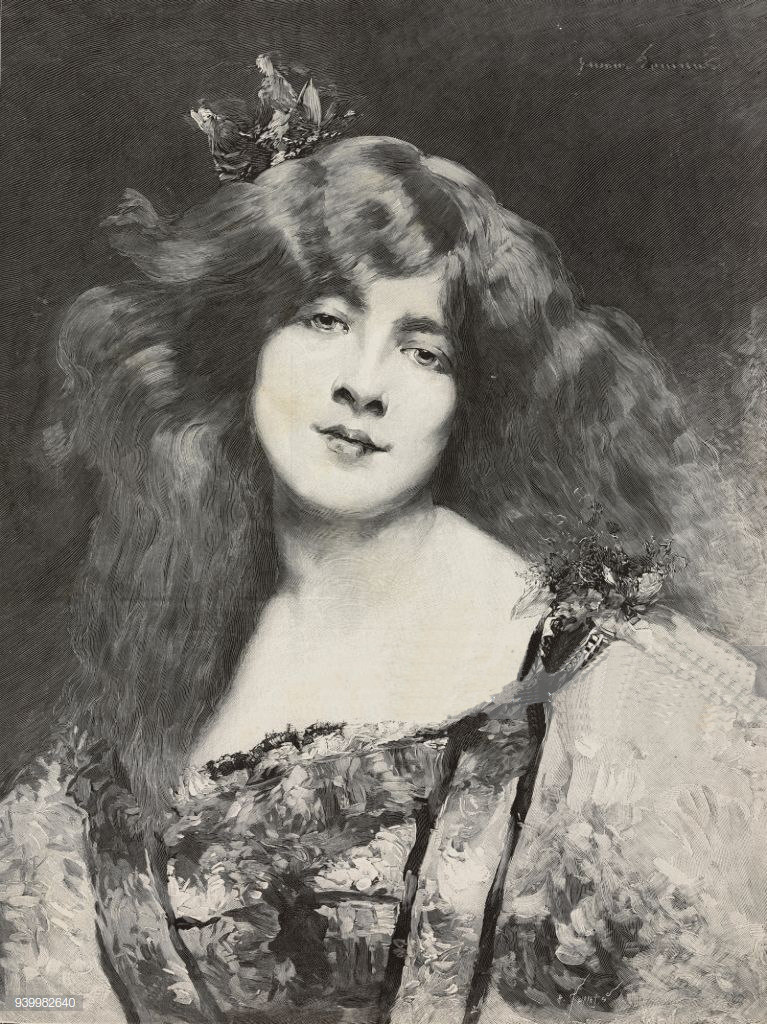
Juana Romani, La fille de Théodora (A Dark-Haired Beauty), 1898, oil on panel, 81.3 × 63.8 cm, current location unknown. Image: Wikimedia Commons, public domain.
Origins and migration
Juana Romani was born Giovanna Carolina Carlesimo in Velletri on 30 April 1867, in circumstances far removed from the Parisian art world in which she would later become a conspicuous figure. Her parents, Marianna Schiavi and Giacinto Carlesimo, were illiterate agricultural labourers, and her early childhood belonged to the precarious social world of the countryside south-east of Rome. Giacinto became involved in brigandage and was wanted by the authorities by 1871. He subsequently spent long periods away and eventually disappeared from his daughter’s life.
A decisive change came through Marianna’s relationship with Temistocle Romani. The contrast between the two families was considerable. The Romanis were comparatively prosperous and possessed political and cultural connections in Velletri. Temistocle’s father, Girolamo, had interests in antiquarian and artistic culture, wrote on Vitruvius, contributed to the Memorie romane di antichità e belle arti, and moved within circles that included figures such as Thorvaldsen and Giuseppe Valadier. This should not be made into an inherited artistic education for Carolina, but it does complicate the later image of Juana Romani as an entirely untutored peasant girl whose talent somehow emerged spontaneously in Paris. She could read and write in both Italian and French, developed a serious appetite for books, and entered through Temistocle a family environment considerably more culturally connected than that into which she had been born.
In 1877 Temistocle, Marianna and the ten-year-old Carolina left Italy for Paris. Their migration formed part of a much wider movement from central and southern Italy towards European cities in the decades following Unification. They settled at 56 boulevard du Montparnasse, in a district that was becoming one of the centres of Parisian artistic life and that contained a particularly visible population of Italian artists’ models. Marianna and Temistocle married in Paris in September 1878. For Carolina, the move involved more than geographical displacement. Paris was also the place in which an unstable family history could be partly remade and in which she effectively entered the Romani family.
The circumstances of that migration are important because movement between different worlds was to remain characteristic of her life. She had been born on the margins of provincial Italian society but came of age in one of the most cosmopolitan quarters of Paris. She belonged to an Italian immigrant community while acquiring the habits and cultural confidence of a Parisian. Even the family name by which she became known came not from her biological father but from the man who had assumed that role after the family crossed into France.
The Parisian community supplied the route by which Carolina entered the art world. Italian women were particularly visible as models, and both Carolina and her mother appear to have worked in artists’ studios and to have had connections with the Académie Julian and Académie Colarossi. Modelling was economically precarious and carried uncomfortable associations with sexual availability, while Italian models were often subjected to stereotypes of southern sensuality and instinctive physicality. Yet it offered access to places from which women were otherwise substantially excluded. A model could observe how poses were constructed, how artists worked from the model, and how different studios operated. Carolina began to use that access with increasing purpose.
This makes her early biography less a simple story of escape from poverty than one of movement between contrasting social and cultural positions. Migration brought her into a new social world; modelling gave her access to artistic culture; and through the Romani family she acquired a name and a cultural environment unlike that of her birth. These identities did not replace one another so much as overlap. She could be simultaneously Italian and increasingly Parisian, the daughter of agricultural labourers and a young woman moving within cultivated artistic circles, a professional model and an aspiring painter.
This ability to move between different worlds would remain characteristic of both her career and her sense of identity.
From model to painter
Carolina’s first sustained contact with the making of art came through modelling. By the early 1880s she was working for Alexandre Falguière and posed for Nymphe chasseresse, exhibited first in plaster in 1884, as well as for figures in Hylas. Gabriele Romani records that Carolina helped shape the pose of the Nymphe chasseresse, an indication that modelling could involve judgement and participation as well as endurance. The studio gave her an early practical knowledge of how poses were constructed and how artists worked from the living model.
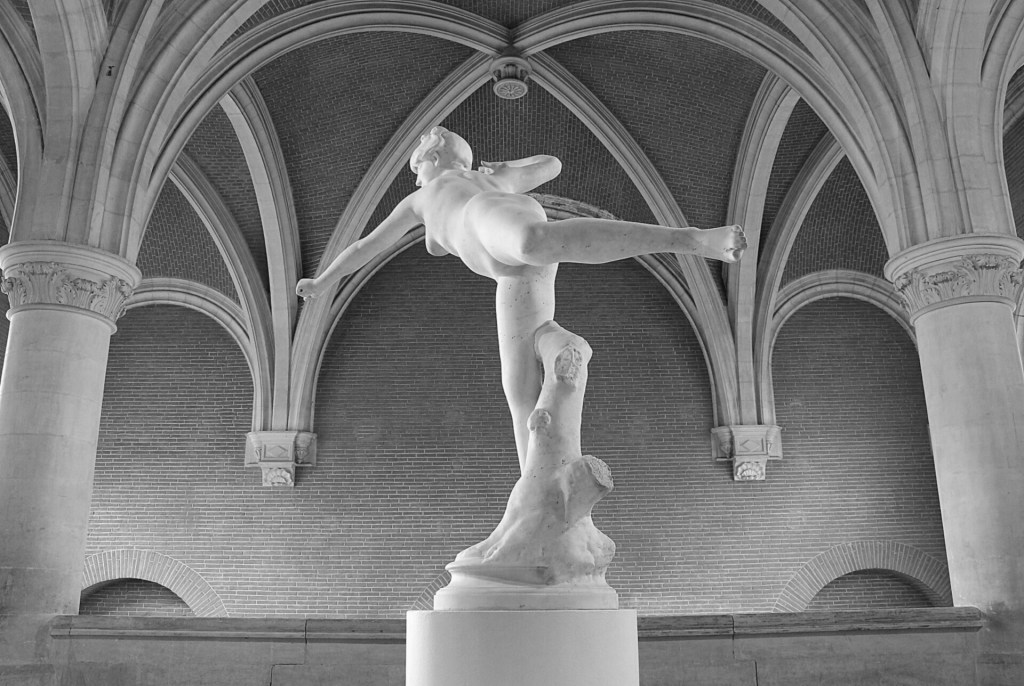
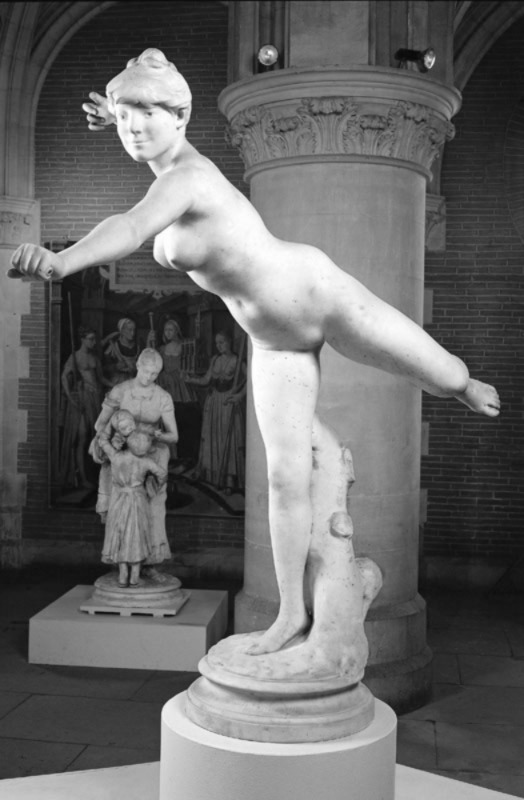
Victor Prouvé occupied a different place in this early formation. From around 1884 he repeatedly used Carolina, by then increasingly known as Juana, in works including Magicienne, Une japonerie and Les visions roses. Contemporary descriptions often remarked upon her slight strabismus and the unusual force of her eyes. Prouvé made this quality central to works such as Magicienne, also known as Jettatura, in which looking itself becomes part of the subject. His interest in this aspect of her appearance may also have encouraged Juana’s awareness of the expressive possibilities of the face and of the figure’s direct engagement with the spectator, both of which would become important in her mature work.
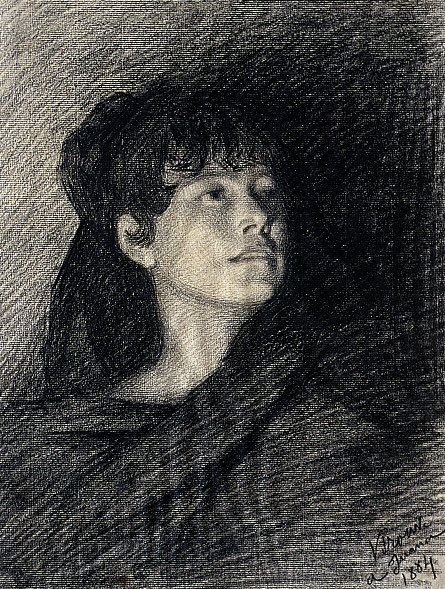
Her relationship with Jean-Jacques Henner was more sustained and more directly formative. Juana actively sought access to his studio, and Henner remembered her as intelligent, widely read and unusually knowledgeable about painting. One anecdote records her reciting or singing a line from Musset while posing and comparing its autumnal pallor with Henner’s pictures. The episode suggests a young woman already interpreting the work around her and developing a critical vocabulary of her own.
Henner also provided some of the basic pictorial language from which Juana’s mature work developed. His women are often isolated against dark grounds, their forms softened rather than sharply outlined and their settings reduced so that attention remains concentrated on the figure. The body emerges through tonal transition, while the distinction between portrait, ideal type and imagined figure can remain uncertain. Juana retained much of this economy: the concentrated female presence, the subdued ground, the emphasis on face and flesh, and the relative suppression of narrative setting.
Her training also included a more structured element. Around 1887 she attended the Atelier des dames directed by Henner and Carolus-Duran, one of the private alternatives available to women excluded from much official artistic education. Carolus-Duran’s teaching emphasised personal interpretation and painterly immediacy, and his admiration for Velázquez is relevant to Juana’s later development. He had studied the Spanish painter closely and made Velázquez an important point of reference in his own teaching. Juana’s visit to the Prado in 1893 deepened an interest already present in the artistic culture in which she had trained.
Ferdinand Roybet brought another important dimension to her formation. His painting drew upon seventeenth-century art, historical costume and a studio culture rich in fabrics, furniture and decorative objects. Through him Juana encountered the past not only through museums and reproductions but through the physical presence of materials that could be worn, arranged and painted. His handling of costume and surfaces, together with his broader interest in Spanish and northern seventeenth-century painting, became part of the visual environment from which her own style developed.
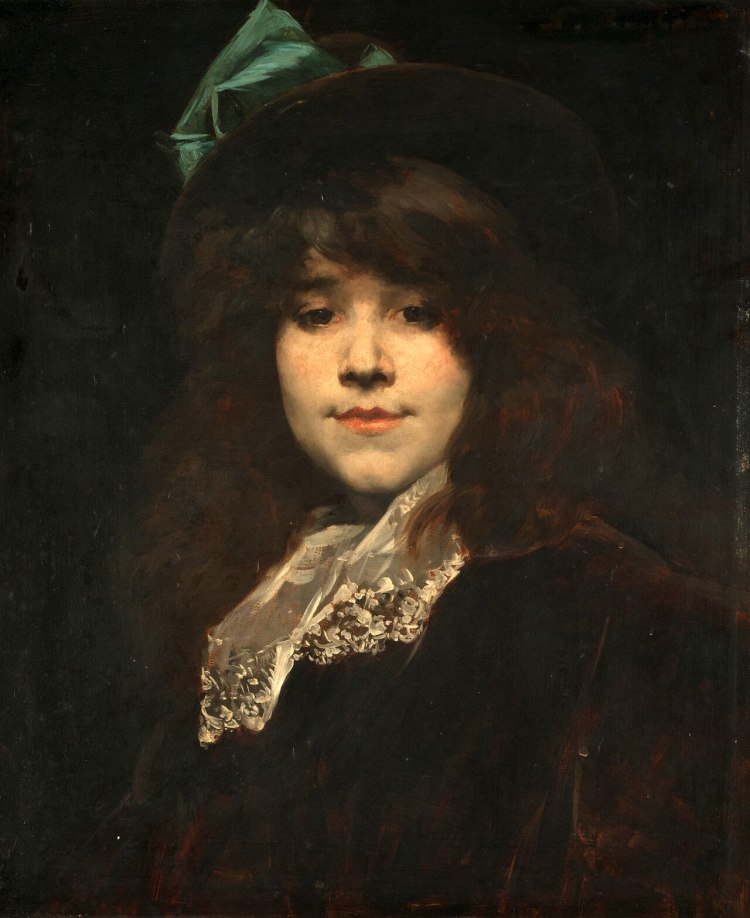
Marco Nocca situates this formation within the still-vigorous Salon culture of late nineteenth-century Paris, where portraiture, historical costume and neo-seventeenth-century painting continued to enjoy critical and commercial success even as Impressionism and newer movements developed alongside them. Juana’s education took place within an artistic world that was established and competitive rather than already obsolete.
These influences increasingly became part of an artistic identity she was constructing for herself. In 1884, at the age of seventeen, Carolina adopted the name Juana Romani. Gabriele Romani interprets the change as a form of self-authorship, and the timing is significant: the new name appears at the point when the model was beginning to define herself as an artist.
A gradual path can be traced from modelling to independent practice. Falguière and Prouvé exposed her to different possibilities in the representation of the body and face; Henner, Carolus-Duran and Roybet provided overlapping forms of artistic education. By the end of the 1880s that development had become public. Gitane was accepted at the Salon in 1888, and in 1889 two of her studies received a silver medal at the Exposition Universelle, giving her hors concours status and allowing her to exhibit subsequently without passing through the ordinary Salon jury.
By then Juana Romani had moved from the studios of other artists into a professional identity of her own.
Style, inheritance and self-fashioning
By the early 1890s Juana Romani’s painting was beginning to move beyond the more immediately recognisable manner of her teachers. Critics could still identify Henner and Roybet in her work, but they also increasingly recognised a distinct artistic personality. Gabriele Romani, whose 2024 study is the principal recent source for her life and career, presents these years as a period of emancipation in which Juana retained much of what she had learned while beginning to organise it around her own priorities.
Nocca identifies Pensierosa at the Salon of 1894 as a first real public consecration of that independence. Gustave Geffroy praised the mastery of the rich fabrics surrounding the figure, while Émile Trogan reported that spectators were already comparing Juana with Velázquez. The significance lies less in the comparison itself than in the fact that critics were now responding to her as an artist with a recognisable manner of her own.
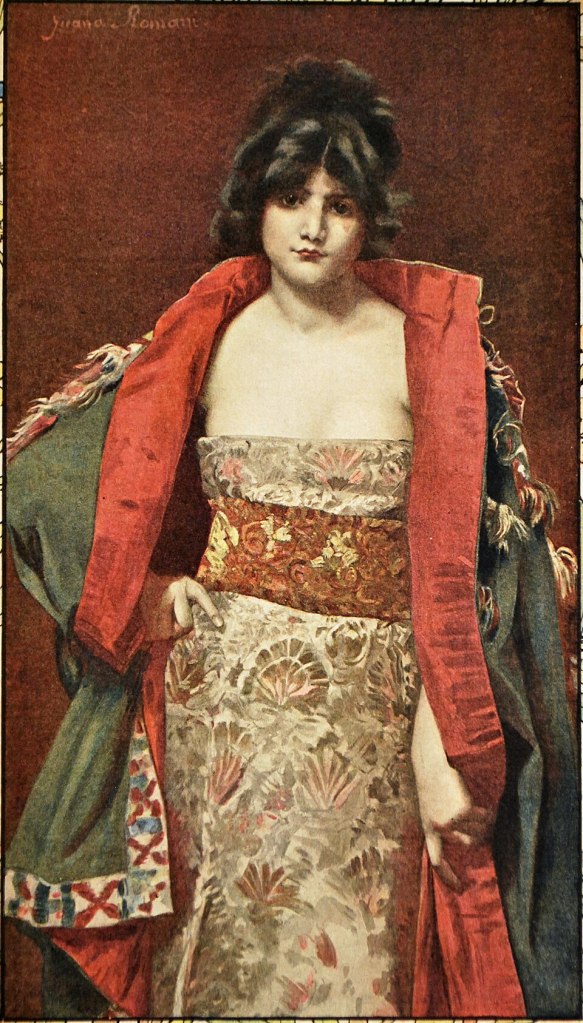
Her own comments on technique help define that shift. She preferred form to be generated through colour and brushwork rather than through an insistent linear framework, summarising the principle in the phrase that one should “draw with the brush, not with the pencil”. This was associated with Henner and Carolus-Duran, but also with Juana’s growing attraction to Venetian painting, where colour could itself become a means of constructing form.
Her historical references were both inherited and actively extended. Henner, Roybet and Carolus-Duran had already brought her into contact with different forms of Renaissance and seventeenth-century painting. Juana then pursued those traditions directly through museums and travel, studying Leonardo in the Louvre, travelling in Italy and visiting the Prado in 1893. These encounters did not replace what she had absorbed through her teachers, but broadened the visual culture from which she was selecting.
Leonardo offered one important point of reference. Gabriele Romani stresses Juana’s interest in works such as Saint John the Baptist, Virgin of the Rocks and Portrait of a Woman (traditionally known as La Belle Ferronnière). The attraction seems to have included ambiguity of expression, softened transitions and the concentration of attention on the figure against a dark ground. In Juana’s mature paintings, faces and flesh often emerge gradually from shadow while hard contour is suppressed. The resulting figures can appear both immediate and difficult to fix psychologically, a quality that sits comfortably within her wider interest in ambiguous identities.
Venetian painting offered something different again. Juana aligned herself with Titian, Veronese and Tintoretto, and with a colouristic tradition in which form is built through paint rather than merely filled in after drawing. This also suited the material richness of her own work. Flesh, hair, velvet, lace and brocade could be differentiated through changes of colour and handling, while the surrounding costume became an active part of the composition rather than simply an accessory.
By 1892 that decorative element had become more pronounced. Heavy fabrics and patterned costume begin to enclose and divide the body, exposing selected areas of flesh while giving the figure a more rigid and constructed appearance. This became one of the decisive developments of her mature style. The woman can appear almost object-like in the density of her clothing, while the face retains an intense individual presence.
This balance between containment and presence helps explain the relevance of Mino da Fiesole. Gabriele Romani argues that Mino’s portrait busts offered Juana a formal analogue: the figure compressed to bust length, the body largely contained by clothing, and attention concentrated on the relationship between face and costume. In Mina da Fiesole, however, the reference becomes more than formal. Juana feminises Mino’s name and assigns it to a woman, turning an artistic predecessor into an invented female identity.
The same imaginative freedom appears elsewhere. Pensierosa evokes Michelangelo’s Pensieroso without any intention of repeating it. Juana could refer playfully to herself as a “daughter of Benozzo Gozzoli”, while Tizianella feminises another male position within Renaissance artistic genealogy. These gestures suggest that the old masters served not only as formal precedents but as figures through whom she could fashion a place for herself within artistic history.
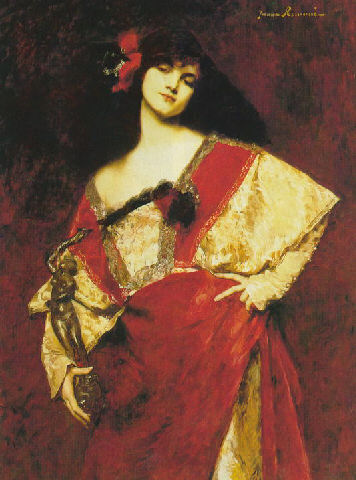
Her mature style developed through both continuity and transformation. She worked within a visual culture transmitted by teachers and strengthened by direct study, while selecting and recombining its elements according to her own interests: concentrated female figures, dark or richly coloured grounds, softened modelling, assertive faces, historical costume and ever more elaborate surfaces. The past supplied usable forms, but also a language through which she could construct an artistic identity.
Juana herself expressed something close to this in 1903 when she argued that Greek, Gothic and Renaissance art had all once been new. The old masters, in her view, were examples rather than models to be copied. Her own work can be understood in much the same way: historical forms remain visibly present, but they are made to serve a new and highly personal image of the female figure.
The female figure: costume, surface and presence
By the mid-1890s Juana Romani had developed a highly recognisable female type. Her figures are usually shown at relatively close range, often half-length or bust-length, with little surrounding space. Dark or strongly coloured backgrounds isolate the sitter, while the body is frequently enclosed by elaborate costume.
This concentration on the single figure gives the paintings an unusual intensity. The women are often presented without a developed narrative setting, even when their titles evoke historical, biblical or literary identities. Angelica, Salomé, Bianca Capello or Fior d’Alpe do not function primarily as illustrations of stories. In some cases Juana appears to have chosen the title only after completing the figure, attaching names such as Gitana, Schiava or Favorita afterwards. The historical or literary identity could be added to a painted presence that had already taken shape.
In Leonora d’Este (1900), Renaissance identity is not treated as historical reconstruction so much as a way of giving form to a modern female presence.
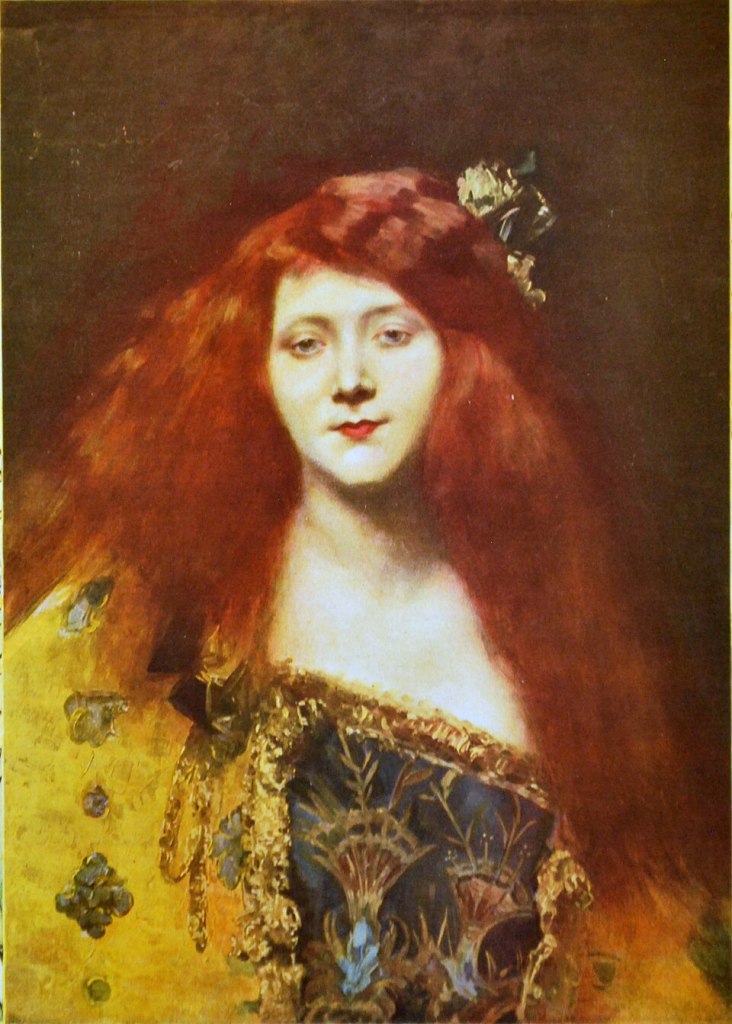
Joven oriental, also known as Bohémienne, shows how challenging that presence could become. The sitter’s breasts are exposed, but the image is not conventionally seductive. Her expression is fixed and self-contained, and her direct look introduces an element of unease into the encounter. Laura Malosetti Costa and Georgina G. Gluzman describe a tension between display and resistance: the woman is presented to the viewer, yet she appears simultaneously to scrutinise the person looking at her. The erotic conventions of the image are present, but they are made unstable by the sitter’s refusal to inhabit the role of a willing seductress.
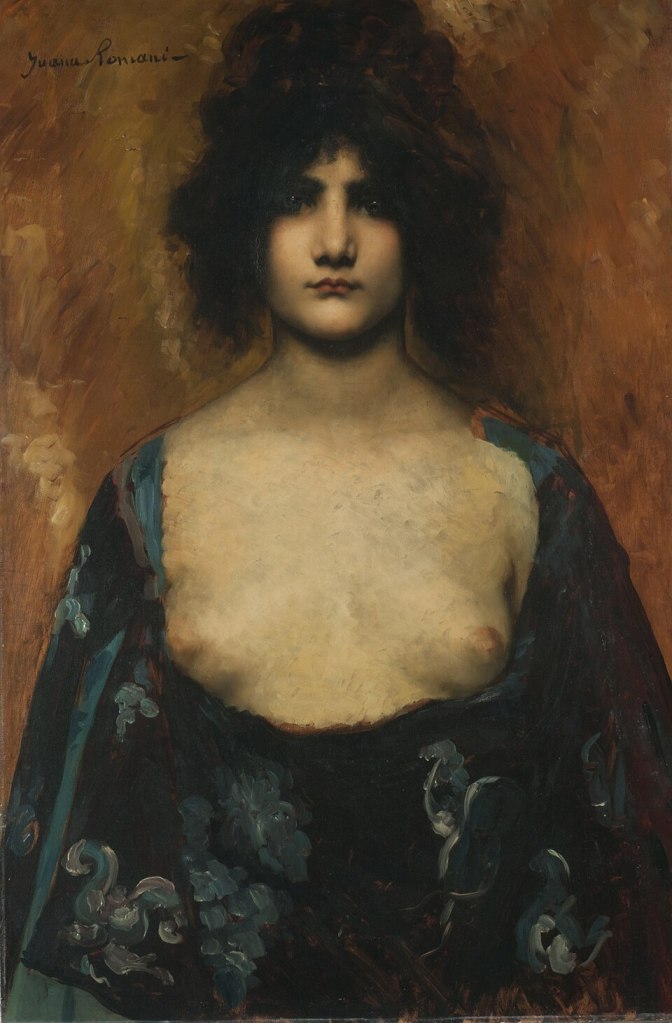
That resistance is important more generally. Juana’s women are very often available to be looked at, but they are rarely passive. Their expressions can be cool, challenging or self-contained, and the spectator is not always placed in a position of uncomplicated visual possession. In some works the concentrated face and direct look also suggest an inner life that remains inaccessible to the spectator, an effect that has an affinity with Juana’s interest in Leonardo and with the Leonardesque concern for making the “motions of the mind” perceptible through the visible figure.
Costume plays a structural role in this effect. From the early 1890s Juana increasingly used heavy fabrics and patterned clothing to contain and divide the body. Arms and shoulders can disappear beneath dense textiles, while selected areas of flesh remain exposed. The woman can appear almost static or constructed, yet the face prevents that containment from becoming complete.
The treatment of fabric is equally important. The Museo Nacional de Bellas Artes in Buenos Aires emphasises the richness with which Juana paints textiles and costume and the way luxurious materials are suggested through loose and vibrant brushwork rather than painstaking description. The splendour of the clothing becomes one of the places where her handling is freest. More concentrated treatment of face and flesh can sit beside rapidly suggested silk, lace or embroidered fabric, giving the paintings a marked contrast between physical presence and painterly movement.
Sensuality takes different forms within this language. In Fior d’Alpe it is comparatively explicit: the semi-nude figure is wrapped in green textiles and presented with a strong erotic charge. Contemporary criticism divided sharply over the painting, praising its nervous grace and sensuality on one side and attacking it as vulgar or excessively decorative on the other. The responses are revealing because admiration for colour, surface and physical presence could quickly become moral judgement.
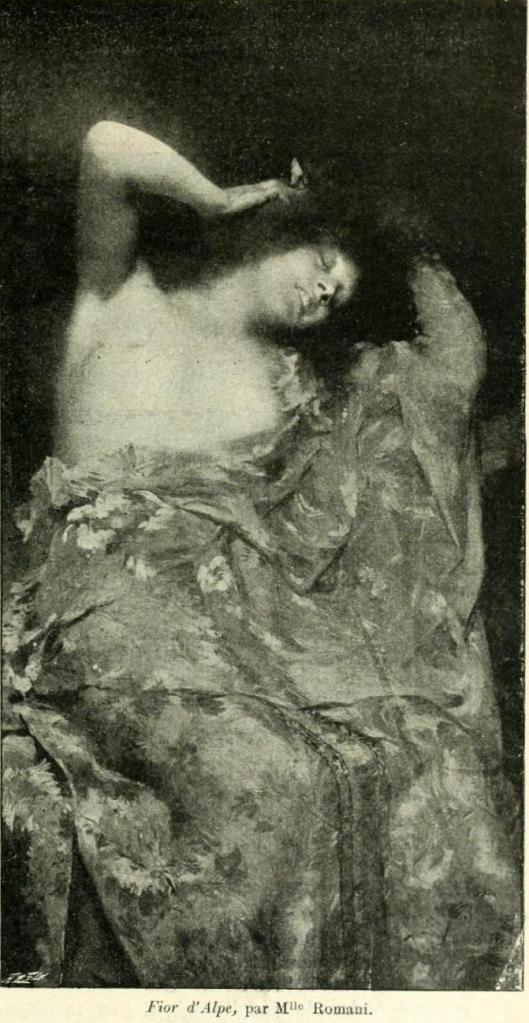
More often sensuality is produced through partial concealment rather than nudity. Rich clothing, exposed flesh, hair, lips and the direct look of the sitter create an erotic charge while leaving the woman substantially clothed. The attraction of the image can coexist with reserve, severity or resistance. That instability is one of the reasons the mature figures are more complex than conventional fin-de-siècle images of seduction.
The Ringling’s Femme au fond rouge, painted around 1900, gives a particularly clear example of the mature formula. A richly dressed woman is set against a strong coloured ground and looks directly towards the spectator. The museum emphasises the sensuality of the figure, the luxurious textiles and the virtuosity of the brushwork. The painting shows how fully Juana had integrated costume, colour, surface and direct visual address into a single pictorial language.
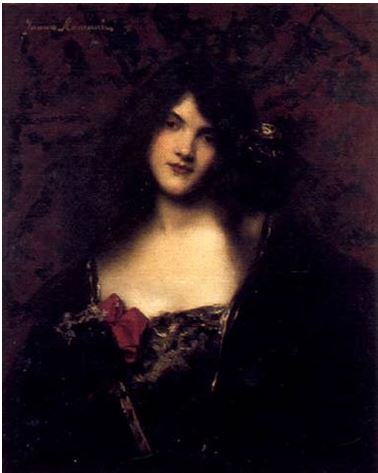
The force of these figures lies partly in their ambiguity. They can appear decorative without becoming merely ornamental, erotic without becoming entirely available, and historical without being tied closely to narrative. The body is frequently contained by costume, but the face remains insistently present. That balance between material display and individual presence became one of the most distinctive features of Juana Romani’s mature painting.
Public image, print culture and celebrity
By the 1890s Juana Romani’s reputation was being formed not only through exhibitions but through an expanding culture of illustrated journalism, photography and publicity. Her paintings were reproduced in magazines, while her own image circulated alongside them. She was acutely aware of this environment and of the network of critics, editors and cultural intermediaries through whom her work reached a wider public.
A photograph taken by Edmond Bénard around 1892–93 makes that process especially visible. Juana is shown in the studio she shared with Roybet at 24 rue du Mont-Thabor, surrounded by her own paintings, including Bianca Capello and Vénitienne. The setting is carefully arranged: works, objects and the artist herself contribute to a composed image of professional identity. She appears not as a model within another artist’s studio but as the maker and proprietor of the paintings around her.
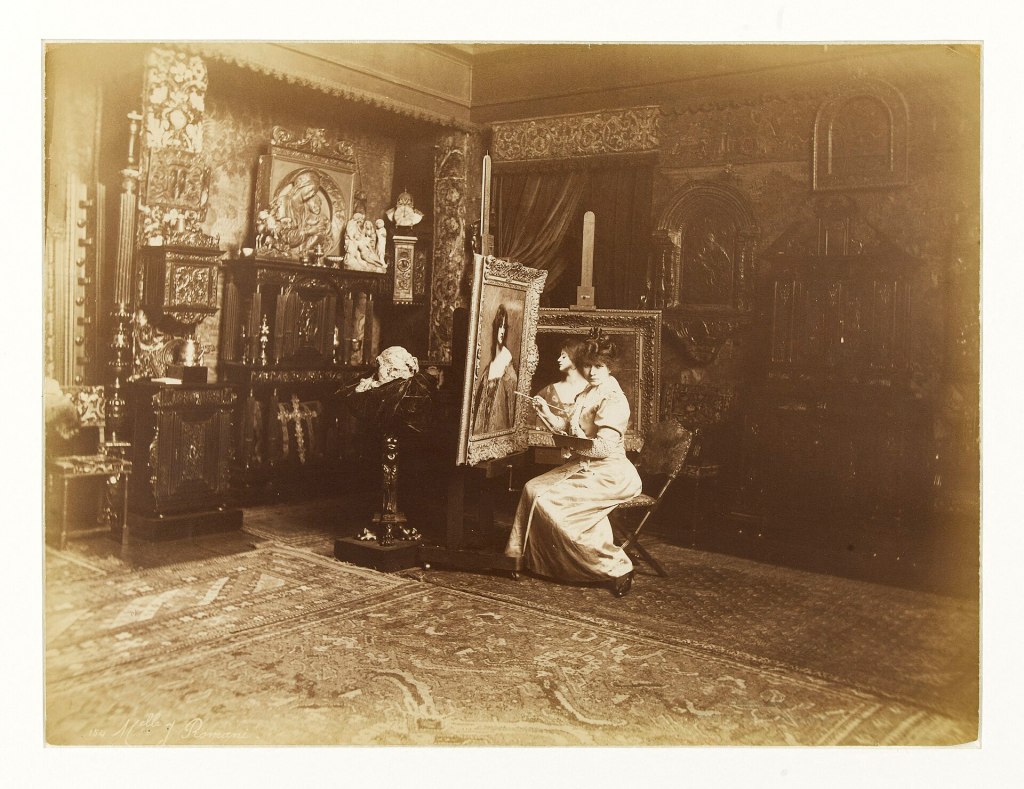
Dress formed another part of this self-presentation. Contemporary descriptions noted both fashionable and occasionally unconventional elements in her appearance, and she wore clothes associated with leading designers such as Redfern and Jacques Doucet. Clothing had a double role in her career. It was one of the principal expressive materials of her paintings, but it also helped shape the appearance of Juana Romani herself in public.
She also cultivated social networks actively. In Paris she organised her own “Italian dinners” at Passy, bringing together artists, critics and other cultural figures. These gatherings offered an alternative to male social circles such as the journalist Jacopo Caponi’s Circolo della Polenta and gave Juana a role in creating, rather than merely entering, professional networks.
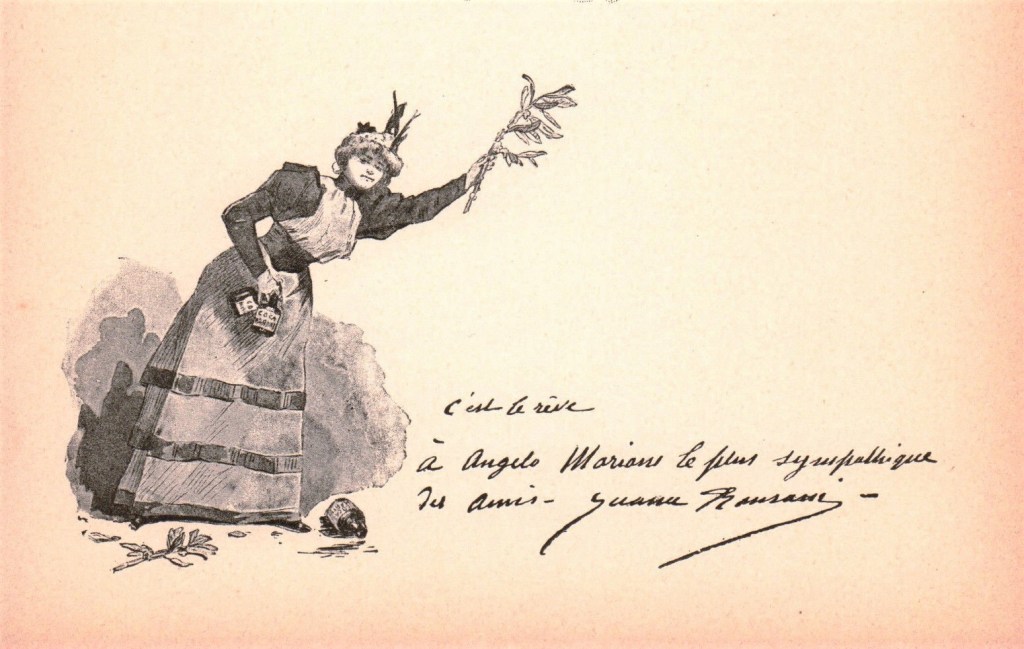
The expanding print culture around her could readily merge artistic reputation with celebrity. The French poet, art critic and inspector of fine arts Armand Silvestre wrote a biographical piece on Juana for the Album Mariani, a publication associated with Angelo Mariani, the entrepreneur behind Vin Mariani. The drink was a coca-infused tonic wine marketed as a restorative, and the album combined profiles of notable figures with commercial publicity. Juana and Roybet later gave a dinner in Mariani’s honour in 1898. The episode is characteristic of a social world in which journalism, artistic promotion, commerce and celebrity overlapped more closely.
Her own appearance was already becoming closely associated with her paintings. Roybet’s portrait of Juana, exhibited at the Salon of 1892, attracted considerable attention; critics dwelt on her eyes, smile and enigmatic presence, sometimes comparing her to a modern Mona Lisa or sphinx. The portrait helped establish Juana herself as a recognisable public image at precisely the moment when she was exhibiting independently as a painter.
This proximity between the artist and her painted women became especially important in contemporary criticism. Silvestre, for example, described Juana’s physical appearance while simultaneously discussing her artistic power, sometimes using language that made the painter herself resemble one of the sensual and enigmatic women in her pictures. Gabriele Romani argues that the resulting public mythology could encompass several identities at once: model, pupil, lover, immigrant, exotic woman and successful painter.
That overlap contributed to the magnetism of her public reputation, but it also made the boundary between judgement of the paintings and judgement of the woman unusually porous. Sensuality, luxury, mystery and virtuosity could generate attention and admiration; the same qualities could be recast by hostile critics as theatricality, superficiality, excess or vulgarity. Her career developed within an environment in which visibility was valuable but also unstable.
Juana’s management of publicity should be understood as part of her professional practice rather than as something external to the paintings. She used photography, print culture, dress, social networks and the circulation of her own likeness to establish a recognisable artistic persona. The closeness between that persona and the women she painted was one of the sources of her wider appeal, while also leaving the artist herself unusually exposed to changes in critical and popular response.
Italy, France and precarious belonging
Juana Romani’s attachment to Italy became more explicit as her career developed, but it existed alongside the fact that almost all of her artistic formation and professional success had taken place in France. The tension was present relatively early. At the Exposition Universelle of 1889 she exhibited in the Italian section, organised by Giovanni Boldini, where two of her studies received the silver medal that gave her hors concours status at the Salon. Her identification with Italy was not a late addition to an otherwise entirely French career.
Around 1900 that identification became much more pronounced. Juana spoke publicly of wanting to contribute to the honour and prestige of Italian art, while continuing to work from a visual and professional culture that had been formed overwhelmingly in Paris. The contradiction was central: she wanted to claim an Italian artistic inheritance at precisely the moment when her technique and reputation could appear particularly French to Italian observers.
The Exposition Universelle of 1900 provided an unusually conspicuous expression of that allegiance. Juana was the only woman painter represented in the Italian section, where she exhibited Salomé, Primavera, Fior d’Alpe and Angelica, alongside artists including Segantini, Pellizza da Volpedo, Morbelli, Sartorio, Mancini and Boldini. These were not tentative or peripheral works but some of the paintings through which she had established her mature reputation. To present them as Italian art was consequently a deliberate public positioning.
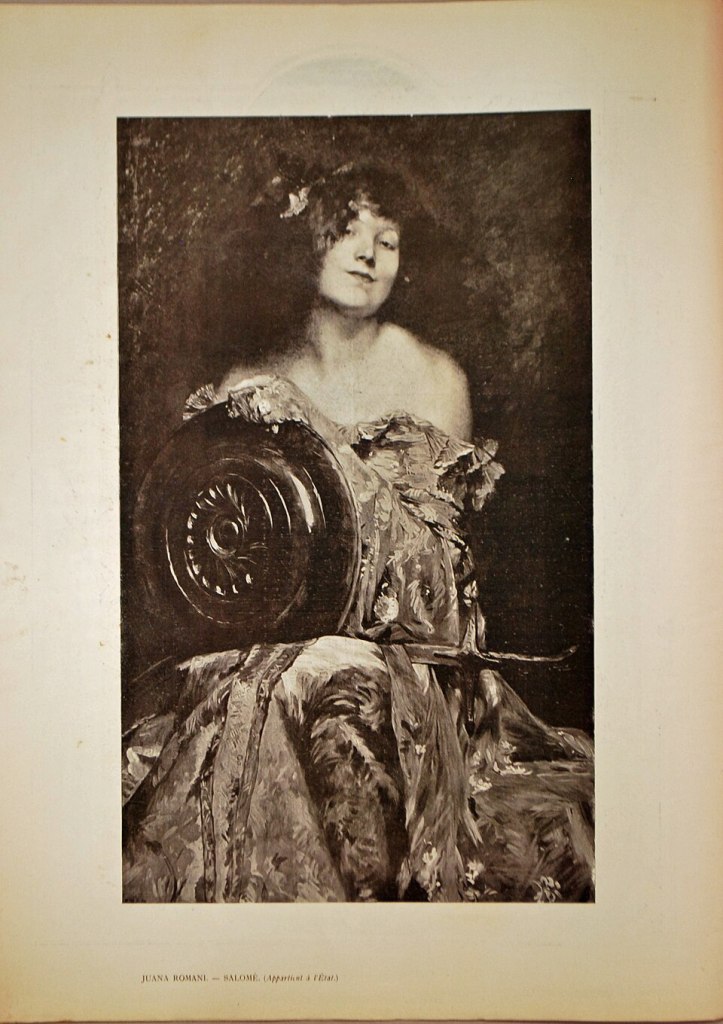
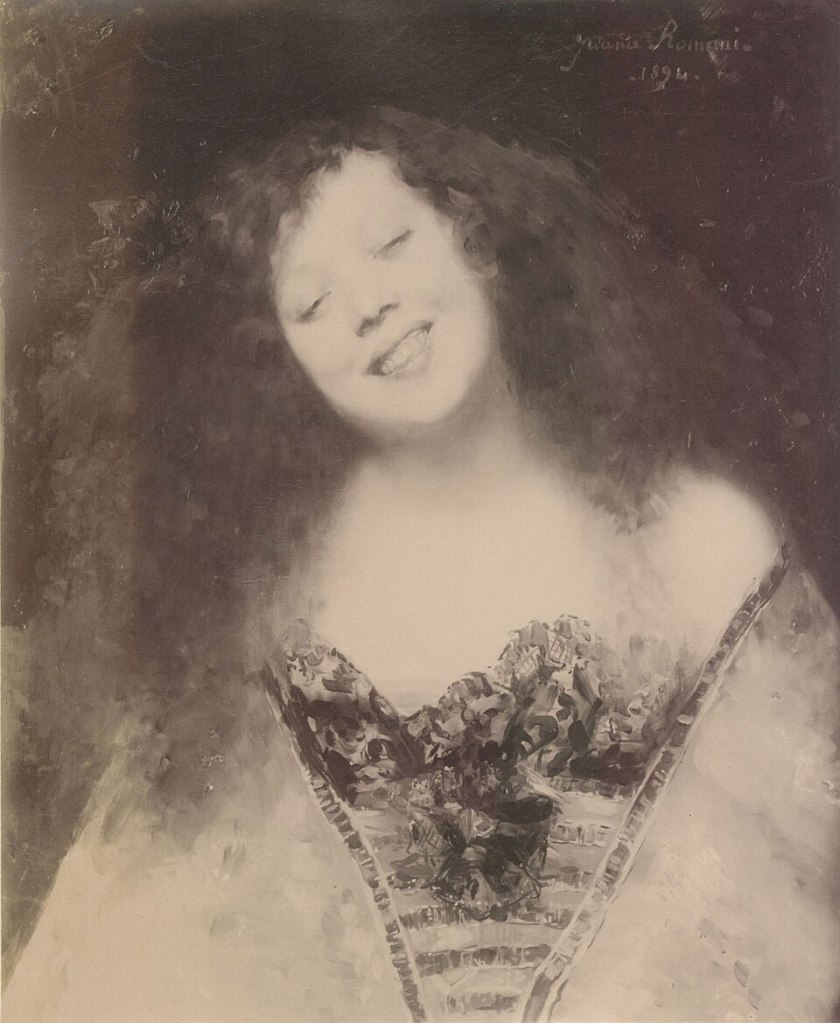
Juana herself left little doubt about the importance she attached to that identity. Italian newspapers reported her insistence that, despite her long residence in Paris, she remained Italian: “Je suis italienne.” She declared that nothing could make her forget the country she regarded as her own. Marco Nocca sharpens the paradox by noting that she declined an invitation to take French citizenship despite the professional advantages it might have brought. Her refusal to allow professional formation in France to cancel her Italian identity was more than rhetorical. The two identities overlapped, but they did not always do so comfortably.
Velletri became central to this process. Her relationship with her birthplace went beyond nostalgic attachment. She provided prizes for students, donated paintings, gave money to the poor and proposed establishing a museum of contemporary art in the Palazzo Comunale, partly from works belonging to herself and Roybet. In November 1900 she wrote that “the Italian name is venerable to me”. These activities suggest an attempt to establish a concrete relationship with Italian cultural life rather than merely to claim a national identity from Paris.
Her official return to Velletri on 21 October 1901 accordingly became a civic celebration. She travelled with a distinguished group that included Roybet, Antoine Lumière and Trilussa, and publicly declared that she worked “with ardour” in the hope of making her own contribution to the honour of Italian art. Velletri offered a form of recognition in which the emigrant child could return as an internationally successful artist and benefactor.
The national artistic reception was more difficult. At the Venice Biennale of 1901 Juana exhibited Angelica in the Lazio room. Several Italian critics responded harshly. One notoriously described the figure as “a consumptive woman dressed as a Russian priest”; others acknowledged Juana’s technical ability while finding the picture superficial, excessively decorative or foreign in spirit. What was at stake was not simply the quality of a single painting. Her cosmopolitanism, decorative richness and stylistic mixture could themselves be treated as evidence that she had been compromised by French culture and no longer represented an authentic Italian tradition.
There is a sharp irony in this reception. The very mobility that had made Juana’s career possible now became grounds for criticism. French critics recognised her as an Italian presence within Parisian culture, while Italian critics could regard the same artist as essentially French. One critic found it difficult to believe that her “entirely French” manner belonged to an Italian painter. She crossed cultural boundaries with unusual freedom, but that freedom did not guarantee secure membership on either side.
The contrast between Velletri and Venice is revealing. In Velletri, her return was celebrated as a homecoming; in Venice, her claim to participate in contemporary Italian art was challenged precisely because of the cosmopolitan formation that had enabled her success. National identity was not simply something Juana possessed and expressed. Institutions and critics could recognise, question or withhold it.
She did not exhibit again at the Venice Biennale. Jacopo Caponi later suggested that the hostility and calumnies she encountered in Italy affected her deeply. At the same time, Juana continued to exhibit at the Paris Salon until 1904 and remained publicly active after the Biennale. The Venetian episode is best understood not as a decisive ending but as one of the clearest manifestations of a difficulty that had become more acute: she was intensely attached to Italy, professionally formed in France, and never entirely reducible to either.
Illness, persistence and the withdrawal of attention
After 1903 Juana Romani’s active career contracted sharply, but neither her public identity nor the circulation of her work disappeared at once.
In February 1903 Juana made a public declaration of chastity, renouncing maternity and presenting herself as wholly dedicated to art. Gabriele Romani relates this to the importance that ideas of inheritance and artistic genealogy had acquired in her work: having repeatedly imagined herself within artistic lineages drawn from the Renaissance, she now publicly rejected biological succession in favour of a life devoted to art. By April she was experiencing serious psychological difficulties and was unable to attend the opening of the Salon. A possible suicide attempt is mentioned in the sources, but not firmly established. She was already receiving medical care.
During 1904 she spent periods in Sanremo and Turin and was treated by neurologists and alienists. She exhibited at the Salon for the final time that year, showing Portrait de Roger de Legge and a work titled Desdemona. In 1905 she returned briefly to Paris, but her health remained poor. In 1906 she spent further periods in Italy and was eventually transferred, at Roybet’s request, to a private clinic at Ivry-sur-Seine, where she remained for many years.
Institutionalisation did not, however, immediately remove her from public consciousness. In 1907 she was still being included among contemporary celebrities. The following year Roybet exhibited a portrait of her in London, while her work was included in a retrospective exhibition of women painters alongside Rosalba Carriera, Élisabeth Vigée Le Brun and Rosa Bonheur. In 1911 Buste de jeune femme was exhibited at Mulhouse, apparently sent from the clinic at Ivry, and in 1913 Salomé was shown in Turin and again attracted public attention.
The contraction of her active career was not the same as disappearance from public view. Juana was no longer sustaining an active professional career, but earlier paintings continued to circulate, her name retained some cultural currency, and the public image created during the 1890s did not disappear at once. Even a newspaper account published in 1909 could still present her story as that of a celebrated former model who had become one of the foremost women artists in France.
Roybet remained closely involved in her care. He visited her and continued to support the costs of treatment, and by 1917 had made arrangements intended to protect her financially. His death in 1920 had immediate material consequences for her care. The payments that had supported her stay at Ivry ceased, and she was subsequently transferred into the public institutional system. Medical records from this period describe persecutory and grandiose delusions accompanied by hallucinations; by 1921 she had been transferred to Ville-Évrard.
Her social world had by then contracted drastically. Consuelo Fould visited her in January 1922, and Sonia Hansen later that month, but such visits appear to have been rare. In July she was transferred to Sainte-Anne, and in 1923 to the Maison de Santé de Suresnes. She died there on 13 June 1923, aged fifty-five, and was buried at Suresnes. Gabriele Romani’s documentation supports 1923 as the correct date of death, correcting the 1924 date still repeated in some modern accounts.
The more striking loss came gradually. Juana had spent the 1890s actively building a professional presence: she exhibited consistently, cultivated critics and social networks, negotiated for state acquisitions, allowed her paintings and likeness to circulate in the illustrated press, and shaped a recognisable persona through photography and dress. As illness increasingly prevented her from maintaining those activities, the network of attention around her began to loosen. Her paintings remained in museum collections and occasionally returned to exhibitions, but she was no longer in a position to generate the continual encounters, publicity and professional relationships through which an artistic reputation is sustained.
There is an additional historical irony here. Juana had succeeded within the Salon system at a moment when admission, medals, hors concours status and state purchases represented substantial professional achievements, especially for a woman artist. Yet the Salon-centred artistic culture through which she had established herself lost critical prestige as twentieth-century histories of modern art gave greater weight to other forms of innovation. Her success had been real; the hierarchy that had validated it did not retain the same authority for later generations.
Her subsequent obscurity was neither instantaneous nor explained by illness alone. It resulted from a gradual weakening of attention: the end of her own professional activity, the erosion of the networks that had sustained her, the changing status of Salon painting, and the dispersal of works that had once made her a conspicuous public figure. The evidence of her achievement remained, but the critical and institutional attention that had sustained her reputation did not.
Producing these essays requires care, time, research, and resources. Contributions to help sustain this exploration would be greatly appreciated.
Donate to Inner Surfaces here.
Bibliography
These are the sources consulted. Any errors are mine.
Malosetti Costa, Laura, and Georgina G. Gluzman, ‘El imaginario erótico de Juana Romani’, in Marco Nocca and Gabriele Romani (eds), Juana Romani. La petite italienne. Da modella a pittrice nella Parigi fin-de-siècle, Rome, L’Erma di Bretschneider, 2017, pp. 65–70.
Nocca, Marco, ‘Juana Romani: la “petite italienne”. Modella e pittrice nella Parigi fin-de-siècle’, in Marco Nocca and Gabriele Romani (eds), Juana Romani. La petite italienne. Da modella a pittrice nella Parigi fin-de-siècle, Rome, L’Erma di Bretschneider, 2017, pp. 11–22.
Nocca, Marco, and Gabriele Romani (eds), Juana Romani. La petite italienne. Da modella a pittrice nella Parigi fin-de-siècle, exhibition catalogue, Velletri, Convento del Carmine, 22 December 2017–28 January 2018, Rome, L’Erma di Bretschneider, 2017.
Romani, Gabriele, Confini d’identità. Juana Romani, modella e pittrice, Rome, Castelvecchi, 2024.
Online and institutional sources
Cartwright, Sarah, ‘Juana Romani – Femme au fond rouge’, The Ringling, 2022.
Museo Nacional de Bellas Artes, Buenos Aires, ‘Juana Romani, Joven oriental’, collection entry.

