Isabella d’Este and Leonardo
Isabella d’Este was born in Ferrara in 1474, the daughter of Ercole I d’Este and Eleonora d’Aragona, and in 1490 married Francesco II Gonzaga, marquis of Mantua. Her position at the Mantuan court involved political as well as dynastic responsibilities, while her collecting and patronage brought her into sustained contact with many of the leading artists and writers of her time. Paintings, antiquities, medals and other precious objects were brought together in the rooms she created for herself in the Gonzaga palace, and portraiture formed part of this wider concern with artistic representation, possession and exchange.
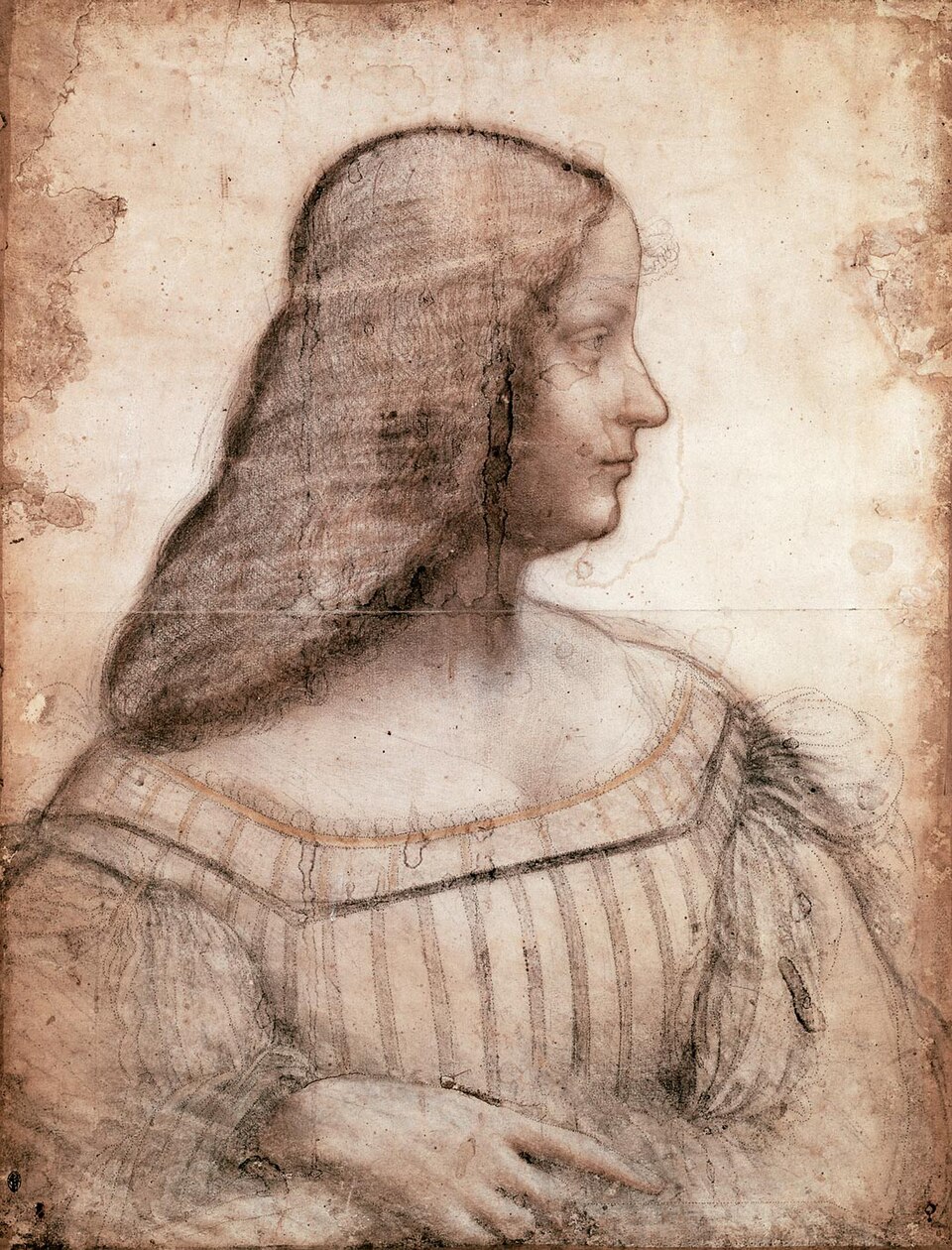
Leonardo reached Mantua in the aftermath of the French conquest of Milan in 1499, which had brought his long association with the Sforza court to an end. He travelled through Mantua on his way towards Venice. It was probably towards the end of 1499 that he drew Isabella. The encounter itself seems to have been relatively brief, but Isabella continued for several years to seek a painted portrait from him. The project was never realised.
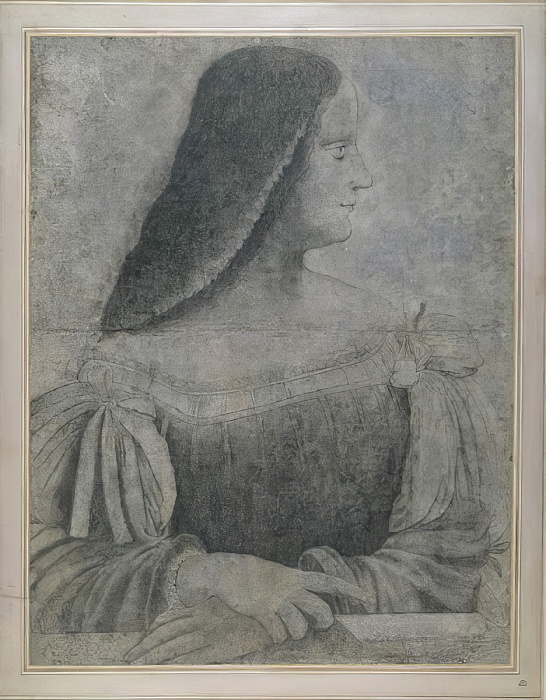
The surviving drawing in the Louvre is on an exceptional scale. Measuring approximately 61 × 46.5 cm, it approaches the largest paper format then available, known as the imperiale. The heavy sheet was prepared and worked with unusual elaboration, and Isabella is represented at approximately life size. Her head is shown in strict profile, while the torso turns more gently beneath it. The drawing has subsequently been cut down, particularly at the bottom, so that part of the original composition has disappeared. An early copy in the Ashmolean Museum preserves more of the lower section, including Isabella’s hands and a closed book towards which her right index finger points.
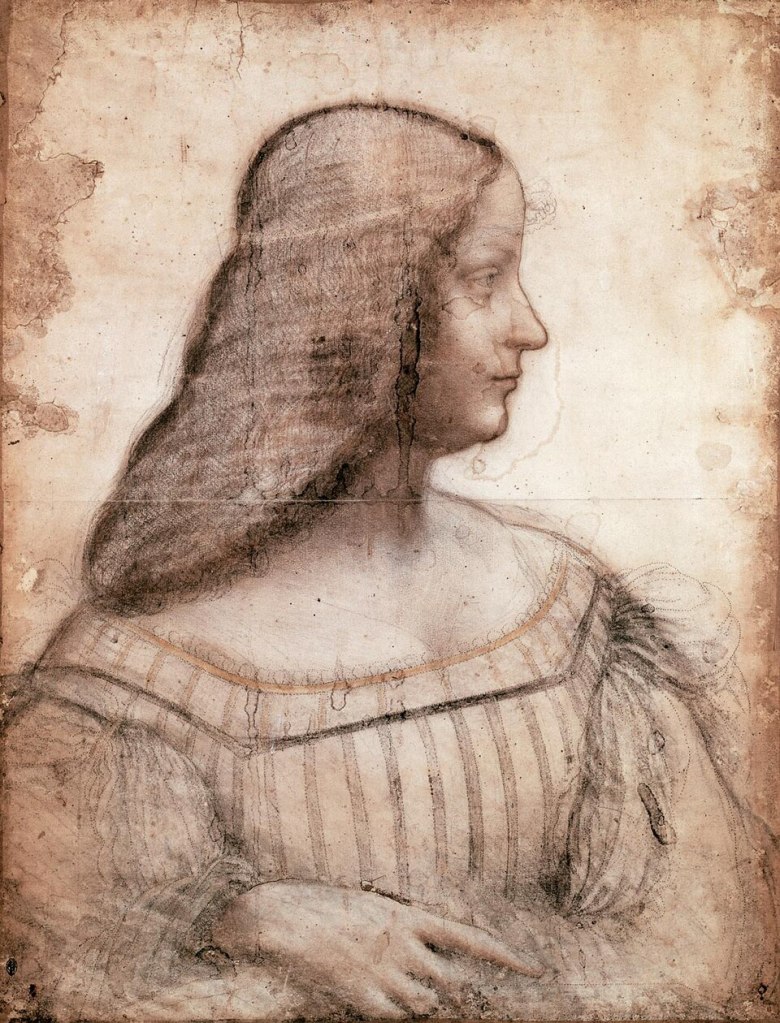
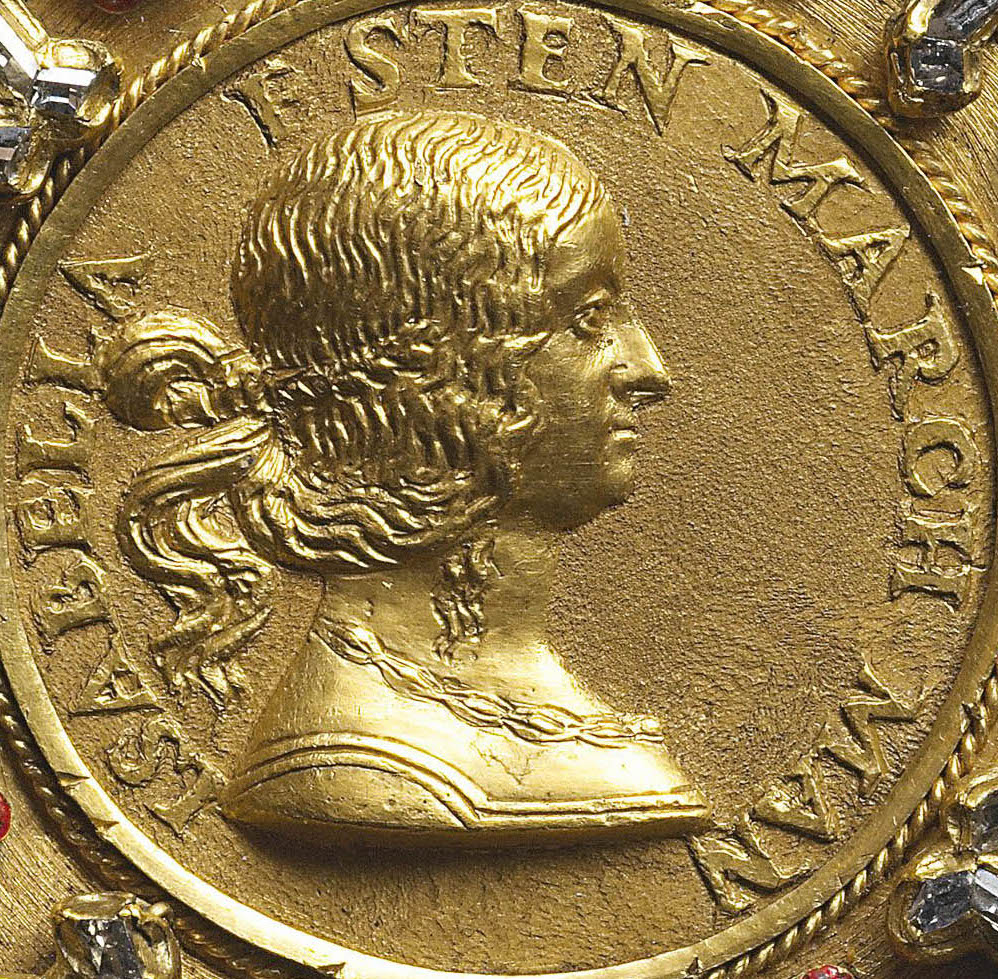
The identification of the Louvre sitter with Isabella was made in the nineteenth century by Charles Yriarte, who connected the drawing with the portrait by Leonardo mentioned in Isabella’s correspondence. Comparison with Gian Cristoforo Romano’s portrait medal of Isabella, cast in 1498, provided an important visual argument for the identification: the sharply defined profile in the two works is closely related. Taken together, the documentary evidence and the comparison with the medal link the Louvre sheet convincingly with Leonardo’s stay in Mantua at the turn of the century.
The drawing as an object
The Louvre sheet is not merely large; it is conceived at the scale of a finished likeness. Isabella’s head is close to life size, and the figure originally extended farther down the page than it does today. The surviving composition gives particular prominence to the profile, neck and upper torso, but its present truncation is misleading. Several centimetres have been lost from the lower edge, and the left side has also been cut back. The sheet has moreover been folded, rubbed, stained and exposed to damp, so that what survives is materially far removed from its original condition.
Even in this reduced state, the pose is unusual. Isabella’s head is held in strict profile, but the shoulders turn more gently, creating a slight disjunction between the orientation of the face and that of the body. Her right arm crosses the front of the torso and the surviving hand points downwards. In the Louvre drawing alone, that gesture is difficult to interpret because the object towards which it was directed has disappeared with the lower part of the sheet.
An early workshop copy in the Ashmolean Museum helps recover the missing arrangement. It preserves both hands and shows a closed book resting on a parapet or narrow support. Isabella’s left hand lies across this lower edge, while the right index finger points towards the book. The Ashmolean drawing cannot be treated as an exact record: its copyist lengthened the torso, lowered the hands and adjusted aspects of the anatomy and facial features. Nevertheless, the correspondence of the transferred contours, together with surviving spolvero traces, makes it indispensable for reconstructing elements of Leonardo’s original design that are now lost.
The book is particularly important because it changes the character of the gesture. Isabella is not simply shown with elegantly arranged hands; one of them directs attention towards an attribute. Francis Ames-Lewis interprets the book in relation to her cultural ambitions and to the intellectual identity she wished to project.
How Leonardo made the drawing
Technical examination undertaken for the Louvre’s 2019–20 Leonardo exhibition has made it possible to reconstruct the making of the portrait with greater precision. In the exhibition catalogue, Bruno Mottin’s laboratory study identifies a sequence of prepared paper, metalpoint, charcoal and coloured media that is now partly obscured by the sheet’s damaged surface.
Leonardo began with a heavy sheet prepared with a pale ground containing lead white. On this surface he established at least the head in metalpoint, probably silverpoint. The earliest lines survive most clearly along the nose and chin, with further traces around the skull and hair. No equivalent metalpoint drawing has been identified with certainty in the costume, and Mottin raises the possibility that Leonardo concentrated first on the head while Isabella herself was sitting before him.
The design was then developed in carboncino, a powdered wood charcoal whose particles can still be detected within the fibres of the paper even where much of the original material has disappeared from the surface. Leonardo used it to strengthen the contours and to model the hair, cheek and neck, but also to revise the composition. Infrared examination has revealed an earlier arrangement of the costume, including what appears to have been a gauze veil over the shoulders and a differently constructed upper garment. The portrait was therefore not simply recorded in a single sitting and then finished; its forms were adjusted as Leonardo worked.
Red chalk supplied much of the modelling of the face. Leonardo blended it softly across the flesh, concentrating stronger accents around the eye and in the shadow of the cheek, while darker lines reinforced the profile around the nose, lips and chin. Charcoal hatching was used more sparingly across the face and more extensively in the hair and sleeves. White heightening was added selectively, while the yellow edging of the dress was produced with an iron-rich ochre pigment, probably applied in liquid form rather than as a dry chalk or pastel.
The result was technically elaborate but visually restrained. Metalpoint, charcoal, red chalk, white heightening and liquid colour were brought together on a prepared sheet, allowing Leonardo to move from precise contour to increasingly soft tonal modelling. The present faded and abraded surface obscures some of that original richness, but the surviving evidence still shows how carefully the portrait was constructed and revised.
The afterlife of the drawing
The Louvre sheet was made in connection with a projected painted portrait, and Isabella continued to expect Leonardo to carry that project forward. Yet it was much more than a provisional study. Its scale, finish and technical refinement gave it a status of its own, and Ames-Lewis places it within a northern Italian tradition in which highly finished portrait drawings could themselves be valued as prestigious objects. At Mantua, Mantegna had already distinguished between portraits that were to remain drawings and those that were subsequently to be painted. Leonardo’s portrait could therefore have been esteemed in its own right even while remaining tied to the unrealised painting.
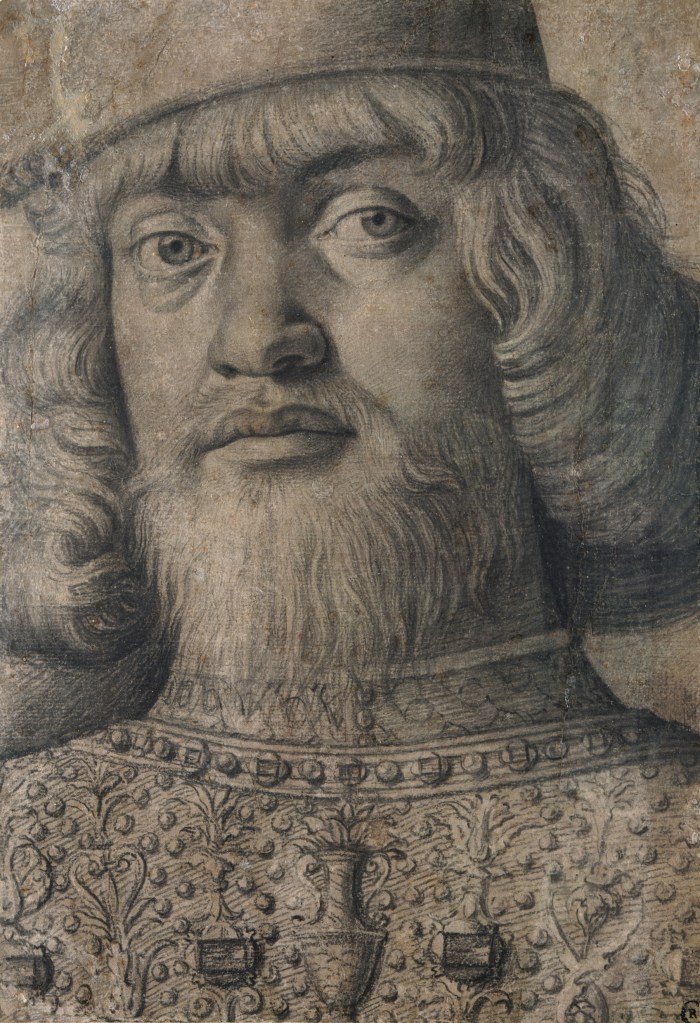
Its later physical history shows that the image also became useful as a model for reproduction. Mottin’s technical examination for the Louvre concludes that the pricking now visible across the sheet was a later intervention rather than part of Leonardo’s original execution. The holes are exceptionally fine and their spacing varies according to the part of the figure being followed; they are especially dense around the profile and hands, and in places the needle has torn the paper. The pricking also stops some distance from the surviving left and right edges. Since those edges were only slightly trimmed later, the original sheet must have extended a little farther still, so the pricking must always have stopped well short of the sides of the composition. Mottin takes this as further evidence that the transfer operation was a later use of the drawing and was probably not carried out under Leonardo’s direction.
The transfer history is not entirely straightforward. There is no pouncing dust on the drawn face of the Louvre sheet, and Ames-Lewis proposes an intermediate stage. The Louvre sheet may first have been placed over a blank sheet and pricked through, producing a secondary cartoon with the same pattern of holes. Charcoal could then have been pounced through this second sheet onto another surface, allowing the Louvre drawing to avoid contact with the charcoal used in the pouncing operation. This reconstruction would explain why the Louvre recto carries no pouncing residue while the early copy in the Ashmolean Museum preserves traces of spolvero and is not itself pricked.
There is, however, a further complication. Ames-Lewis notes traces of charcoal on the verso of the Louvre sheet and within some of the prick-holes. If the design had been pounced from the reverse, it would have produced a reversed image, with Isabella facing left. He considers whether such a transfer might have been connected with a reproductive process that would reverse the image again. An engraving of this scale would have been highly unusual around 1500; a woodcut is somewhat easier to imagine, since the printed impression would restore the original orientation, but no such print survives. The evidence therefore points to further use of the sheet without allowing that use to be reconstructed with certainty.
The Ashmolean drawing belongs closely to this practical afterlife. Its surviving spolvero dots and the exact correspondence of important contours show that mechanical transfer lay behind it, but the copyist did not preserve that framework unchanged. The costume was modified, the bust lengthened by about 4.5 centimetres and the hands lowered; aspects of the anatomy and physiognomy were also adjusted. The Ashmolean sheet is consequently both a record of lost features of Leonardo’s composition and a distinct reworking of it.
The damaged condition of the Louvre original complicates such comparisons. Kenneth Clark regarded the awkward articulation of Isabella’s right shoulder and arm as evidence that the Paris sheet could not be Leonardo’s original, since the corresponding arm in the Ashmolean copy appeared correctly drawn. Ames-Lewis argues that the Louvre drawing has lost too much for the comparison to be decisive. Cropping has affected the area of the right arm, while abrasion has removed much of the modelling that once clarified its structure. What now appears anatomically uncertain may therefore owe something to the physical deterioration of the sheet rather than to the quality of the original drawing.
A further group of four head-and-shoulders copies shows a different mode of transmission: one in the Uffizi, one in the British Museum, and two in the Staatliche Graphische Sammlung in Munich. All are executed in red chalk over light black-chalk underdrawing, and none shows evidence of spolvero. Their slight differences in scale, placement and facial construction indicate that they were copied by eye rather than transferred mechanically. Ames-Lewis regards the Uffizi sheet as the finest of the group and possibly the one copied most directly from the Louvre original. Its profile remains very close to Leonardo’s, although the nose projects slightly less and the hair is lengthened over the shoulder, alterations that he suggests may have made Isabella appear somewhat younger, prettier and less formal.
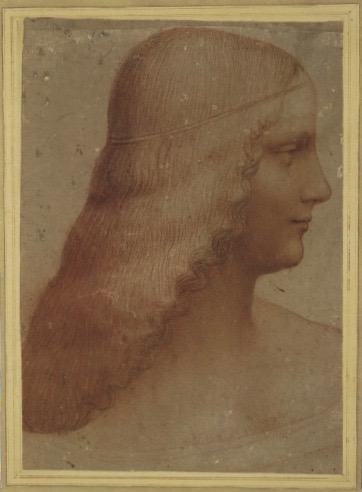
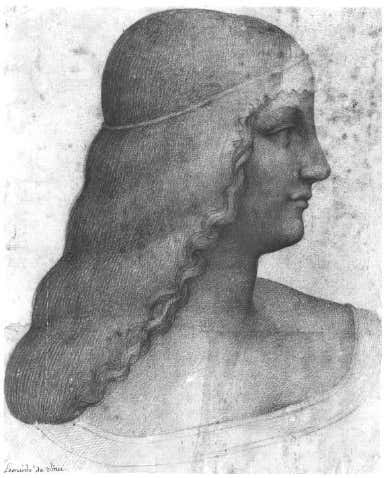
The British Museum and Munich drawings are less uniform. The British Museum version is comparatively weak in the treatment of the hair and hair-band, while its smaller eye alters the expression. The two Munich sheets enlarge the eyes and turn the corners of the mouth upwards more markedly. These are small variations, but they show the profile being interpreted rather than simply reproduced. The copies also have documentary value. All four preserve details of the veil and hair-band that are now difficult to read in the damaged Louvre sheet, and on this point Ames-Lewis considers them more faithful to Leonardo’s design than the Ashmolean version.
Ames-Lewis resists the idea that these four drawings formed a formally produced edition. If exact replicas had been required, mechanical transfer would have provided a more straightforward method. He leaves open several alternatives: the sheets may have arisen as workshop exercises in copy-drawing, as marketable versions of a prestigious likeness, or as portraits intended for circulation among friends or courtiers. The Uffizi drawing may in turn have served as the model for the British Museum and Munich copies, although that sequence cannot be demonstrated securely.
What emerges is not a single, orderly programme of reproduction but a more varied afterlife. Leonardo’s portrait could have been esteemed as the work of a celebrated master while also serving as the source for transferred and freehand versions. Those functions were not necessarily opposed. The prestige of the image may itself have helped to generate the desire to preserve, adapt and reproduce it.
The problem of the profile
The strict profile in which Leonardo represented Isabella was already firmly associated with her public image. Gian Cristoforo Romano’s portrait medal, cast in 1498, presents a sharply defined silhouette that corresponds closely with the Louvre drawing, and copies of the medal were circulating before Leonardo reached Mantua. Ames-Lewis considers it quite possible that Leonardo had an example before him when he made the portrait. There are, however, differences between the two. Isabella’s hair falls more freely in the medal, while in Leonardo’s drawing it is restrained by a band and a fine veil. He wonders whether this greater control may itself have answered Isabella’s wish for a more formal image. Taken together, these similarities suggest that Leonardo was not inventing her profile afresh, but working within a form of representation already associated with her.
That form had a longer history in the representation of princely women. Profile portraiture could enforce reserve and decorum, but it could also carry associations of lineage, authority and the classical past. A particularly relevant example is the portrait of Isabella’s mother, Eleonora d’Aragona, in the frontispiece to Antonio Cornazzano’s Del modo di regere e di regnare. Eleonora is shown in pure profile in a manuscript devoted to the conduct of rulership and the qualities required of a prince. Her features are idealised, but the image does not simply render her passive or ornamental: Ames-Lewis relates it to the justice, wisdom, prudence and strength articulated in the accompanying text. In this context the profile could signify not only feminine modesty but the self-command appropriate to rule.
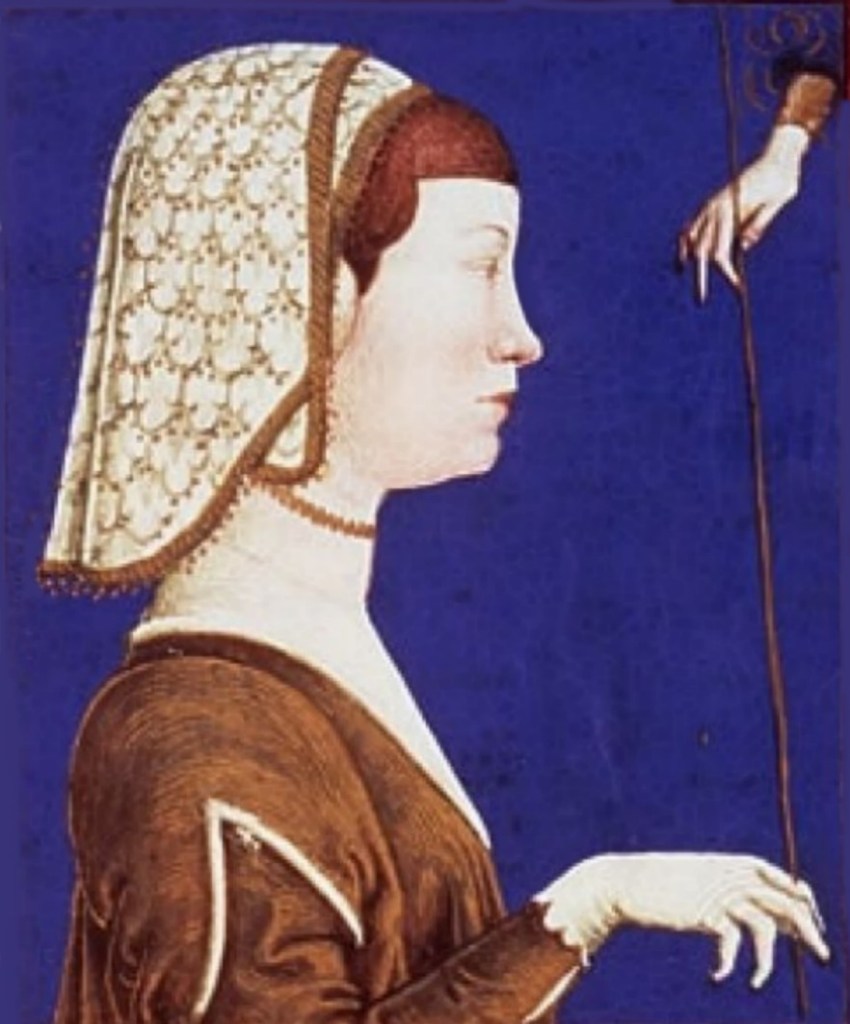
This helps to place Isabella’s choice within the court culture in which she had been formed. By 1500 the strict profile was no longer the only available means of representing an elite woman, and in Florence it had already yielded substantially to three-quarter and frontal formats. At the northern Italian courts, however, it retained a particular force. Its apparent conservatism was part of its meaning: the sitter was presented as a figure of rank and continuity, less caught at a particular instant than removed from the accidents of time.
A terracotta bust in the Kimbell Art Museum, attributed to Gian Cristoforo Romano and sometimes identified as Isabella, complicates the picture. The identification is uncertain, but the hairstyle, profile and physiognomy have all been compared with the 1498 medal and Leonardo’s drawing. Sculpture, of course, does not confine the sitter to a single aspect. The bust can be encountered frontally as well as in profile, and in that respect it offers a more immediate physical presence than either medal or drawing. Yet the eyes are left without pupils or irises. Ames-Lewis suggests that this may have been deliberate: even when the face is encountered directly, the blank eyes deny reciprocal contact with the viewer. If the sitter is Isabella, the bust shows that reserve did not depend upon profile alone.
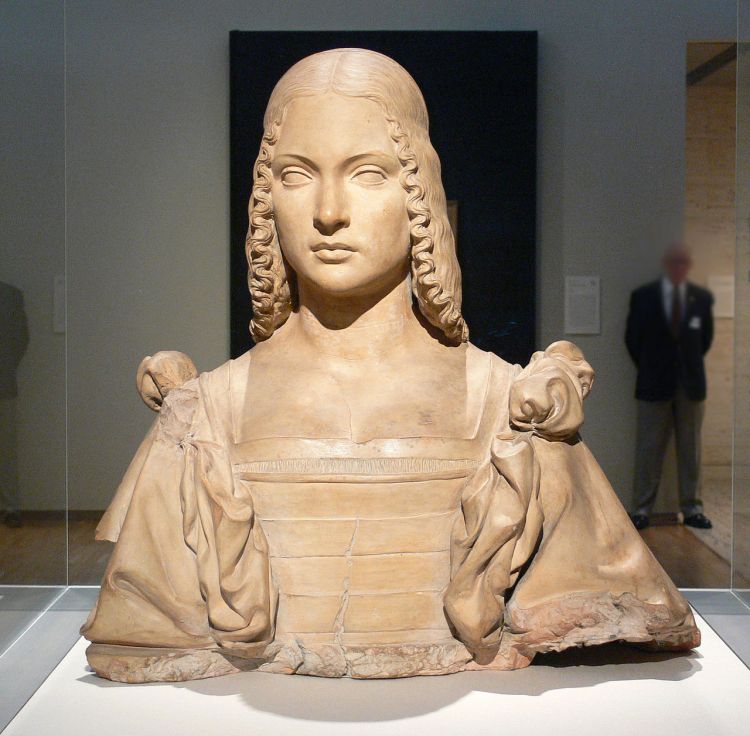
Costume forms another part of Isabella’s presentation. Ames-Lewis notes that Leonardo shows her in the latest fashion, adopting the French style of around 1500, with a loosely fitting bodice, broad neckline and generously puffed sleeves. The Ashmolean copy modifies this arrangement, adding elaborate bows at the shoulders and regularising the striped decoration of the dress. The proposed Gian Cristoforo bust also has flounced detachable sleeves tied with large bows, although its square-cut bodice sits lower. Dress, then, was not simply carried unchanged from one version of the likeness to another, even where other aspects of Isabella’s appearance remained closely recognisable.
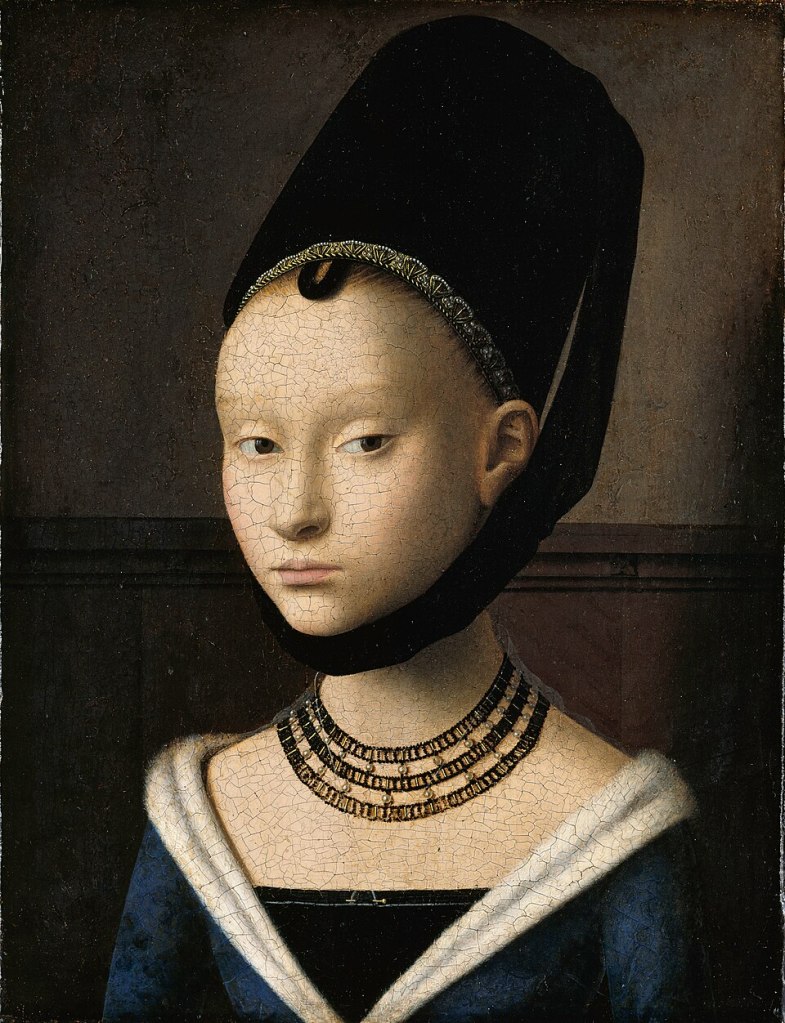
By this date Leonardo had already found other ways of preserving dignity without sacrificing psychological presence, and some of those possibilities may have been stimulated by Netherlandish portraiture. Ames-Lewis compares Ginevra de’ Benci with Petrus Christus’s Portrait of a Young Woman, now in Berlin and tentatively identified with a portrait of a French woman by Christus recorded in Lorenzo de’ Medici’s collection. The comparison concerns more than the adoption of a three-quarter pose. Christus’s sitter turns towards the beholder and meets the viewer’s gaze, yet remains markedly self-contained. The portrait thus establishes a direct relationship with its audience without sacrificing the reserve expected in the representation of an elite woman.
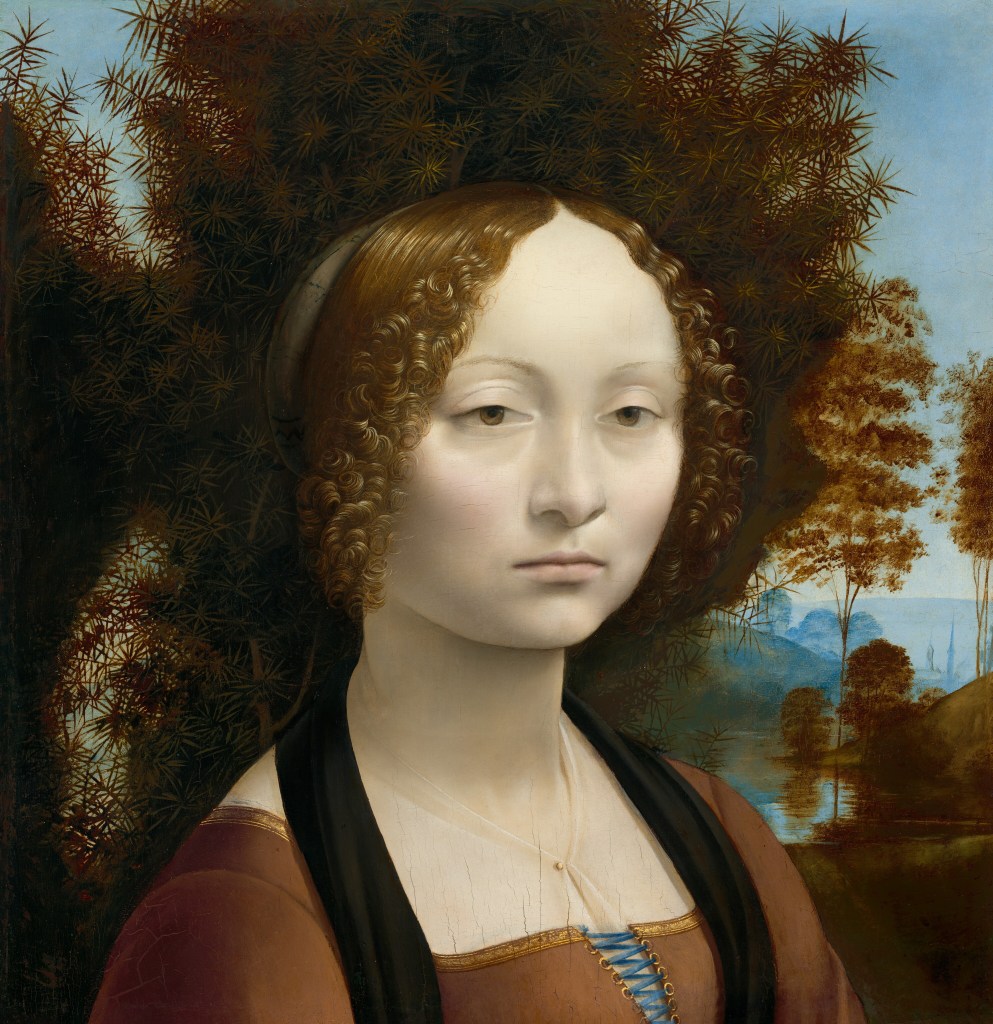
In Ginevra de’ Benci, painted in Florence in the 1470s, Leonardo develops a comparable relationship with the viewer. Ginevra turns towards us rather than withdrawing into profile, making eye contact possible, but her gaze is direct rather than inviting. Ames-Lewis describes it as piercing and scrutinising, while her expression remains cool and remote. The reverse of the panel, with its juniper, laurel and palm and the motto VIRTUTEM FORMA DECORAT, places her appearance within a carefully constructed language of virtue. Leonardo could therefore make an elite woman psychologically present to the viewer without surrendering either decorum or distance.
With Cecilia Gallerani in Lady with an Ermine, the possibilities become more radical. The head turns against the shoulders, the body seems to respond to something outside the painting, and the sitter appears to have been caught in a moment of attention. Ames-Lewis connects this quality with Leonardo’s interest in the concetti dell’anima, the movements of the mind made perceptible through the movements of the body. Cecilia remains composed, but her composure is animated rather than fixed.
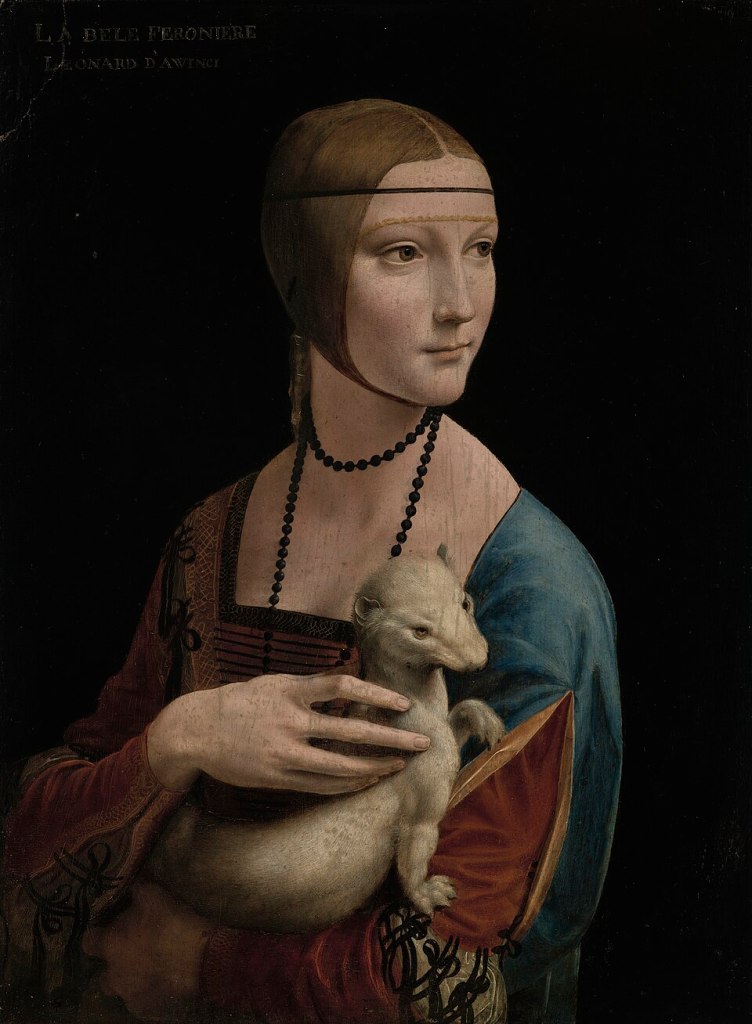
Isabella knew this portrait. In 1498 she borrowed it from Cecilia in order to compare Leonardo’s work with portraits by Giovanni Bellini. The episode is important because it means that Isabella did not approach Leonardo without knowledge of what his portraiture could do. She could have seen at close quarters an image in which a woman’s identity was conveyed through the turn of the body, the direction of the gaze and an apparently fleeting response to something beyond the picture.
Her own portrait nevertheless returned to the strict profile. Ames-Lewis argues that this was very likely to have been Isabella’s choice rather than Leonardo’s. Her position as Marchioness of Mantua, the conventions of northern Italian court portraiture and her increasing interest in medals, coins and antiquities all offered reasons for preferring a form that carried associations of decorum, rank and the antique. The decision need not be understood as simple conservatism. It answered to a different idea of what her portrait was required to represent.
Leonardo’s response was not to leave the image entirely static. The shoulders turn more gently beneath the head, while the hands introduce another rhythm into the composition. Most importantly, the right index finger directs attention towards the book resting below. In the Ashmolean copy the gesture is clear. Movement and meaning are concentrated in the body and hands even as the head remains fixed in profile.
It is here that the drawing acquires its peculiar tension. The torso, hands and gesture suggest an image capable of unfolding in space and of communicating something about the sitter’s mind; the profile, by contrast, withdraws Isabella from any reciprocal exchange with the viewer. Ames-Lewis sees the result as a compromise between Isabella’s representational requirements and the direction in which Leonardo’s portraiture had been moving. His phrase is a telling one: the drawing becomes more a portrait of status than a study of individual personality.
Why the painted portrait was never realised
Isabella did not quickly abandon the idea of a painted portrait. In May 1504 she was still reminding Leonardo of his promise to portray her “once in colours”, but in the same letter she shifted the request, asking him instead for a religious painting. By 1506, however, she seems to have given up hope of obtaining further work from him.
Ames-Lewis suggests that the unresolved tension between Isabella’s representational expectations and Leonardo’s developing approach to portraiture may have been one factor in the project’s failure to progress. The suggestion is necessarily tentative: Leonardo’s unsettled circumstances after 1499 make any single explanation implausible.
The intended painting was probably not conceived primarily for circulation as a diplomatic gift. Ames-Lewis argues that its life-size scale makes that unlikely and that Isabella probably wanted it for herself, both as a likeness and as a work by Leonardo to add to her collection. Her continued efforts to have the drawing realised in colour also suggest that, whatever difficulties the conception may have presented to Leonardo, Isabella herself remained satisfied with it.
Conclusion
The Louvre portrait is a remarkable document in part because so many aspects of Isabella’s relationship with images converge upon it. Its exceptional, almost life-size scale and elaborate technique place it well beyond the category of a casual study, while its subsequent pricking, transfer and copying reveal the practical uses to which even so highly finished a drawing could be put. The damaged sheet and the versions derived from it also preserve evidence for the circulation and adaptation of a prestigious likeness at the beginning of the sixteenth century.
The drawing also opens onto the culture of court portraiture that shaped Isabella’s expectations: the authority of the profile, the example of medals and sculpture, the claims made through dress, gesture and the book, and the changing possibilities of representing an individual sitter. Leonardo’s portrait belongs to all of these histories at once. It is for that reason a particularly valuable record of an encounter between Isabella’s understanding of how she should be represented and Leonardo’s developing ideas about what a portrait might do.
Producing these essays requires care, time, research, and resources. Contributions to help sustain this exploration would be greatly appreciated.
Donate to Inner Surfaces here.
Bibliography
This essay draws particularly on Francis Ames-Lewis’s “Isabella and Leonardo”, in which many of the questions discussed here are explored in considerably greater depth. I have necessarily selected and condensed his arguments, and readers interested in Leonardo’s relationship with Isabella d’Este should consult the book itself.
Ames-Lewis, Francis. Isabella and Leonardo: The Artistic Relationship between Isabella d’Este and Leonardo da Vinci, 1500–1506. New Haven and London: Yale University Press, 2012.
Delieuvin, Vincent, and Louis Frank, eds. Léonard de Vinci. Paris: Musée du Louvre Éditions and Hazan, 2019.
Viatte, Françoise. Léonard de Vinci: Isabelle d’Este. Solo 12. Paris: Réunion des musées nationaux, 1999.

