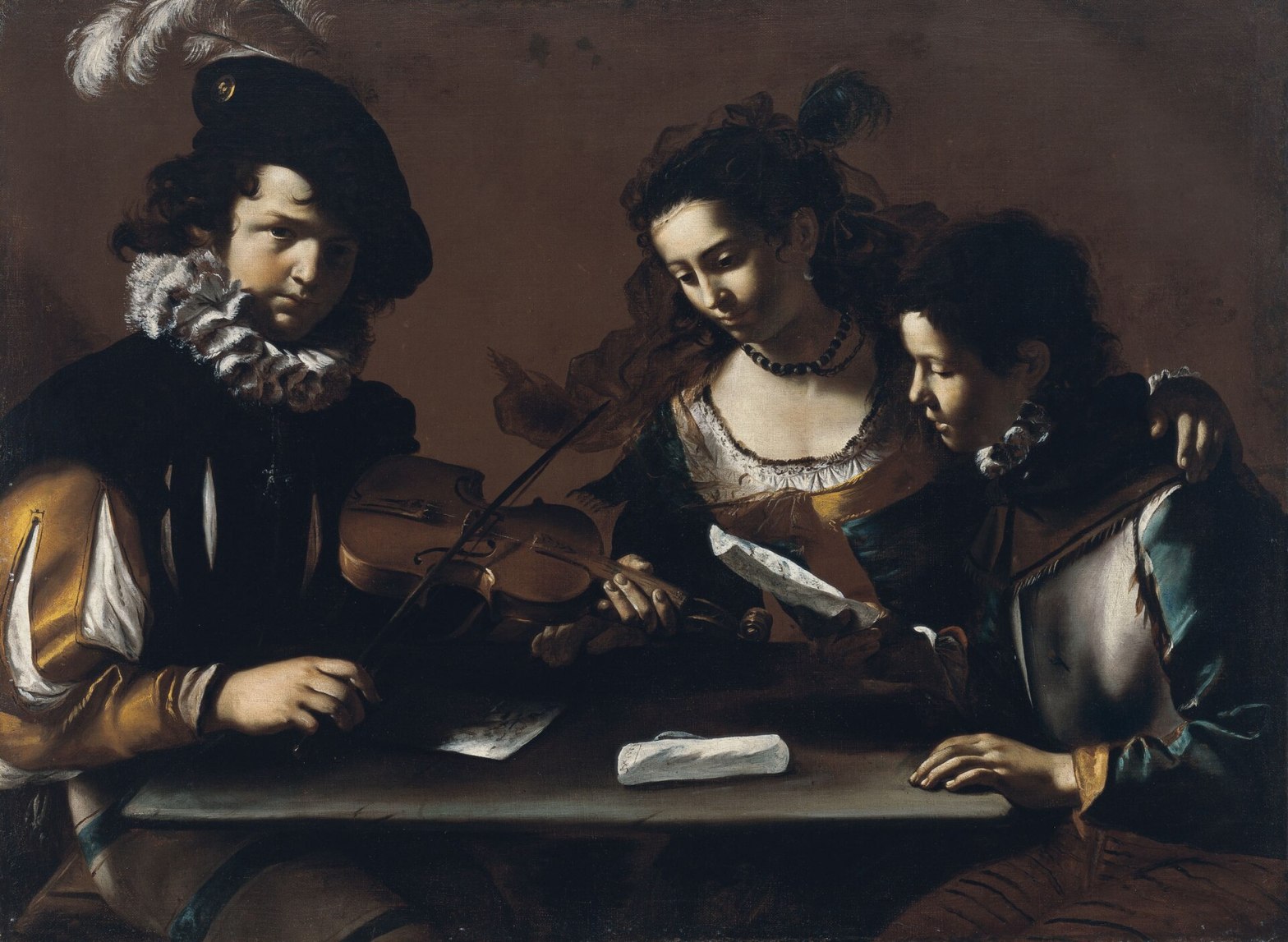
Three secular paintings by Mattia Preti, all generally assigned to his early Roman career in the first half of the 1630s, form a closely related group. Both A Concert, c. 1630–35, now in the Museo Nacional Thyssen-Bornemisza, Madrid, and the Concert in the State Hermitage Museum, St Petersburg, generally dated to the early or mid-1630s, bring three half-length figures together around music. The Game of Draughts, in the Ashmolean Museum, Oxford, usually dated to around 1635, centres instead on play, arranging its three figures around a draughts board. The subjects differ, but the pictures share a restricted cast, compressed staging, elaborate contemporary dress and a controlled chiaroscuro. Their precise order remains uncertain, but all belong to the period in which the young Preti was establishing himself in Rome.
From Caravaggio to Manfredi
The tradition on which they draw was already several decades old. Musical gatherings had a Giorgionesque ancestry, while Caravaggio’s naturalism drew on a broader north Italian inheritance in which Lombard and Venetian traditions were closely implicated. In Rome, however, he gave such subjects a new immediacy. The Musicians, painted in 1597 and now in the Metropolitan Museum of Art, New York, presses its figures close to the picture plane; The Cardsharps, c. 1596–97, in the Kimbell Art Museum, Fort Worth, turns a game into an intricately observed drama of deception; the Louvre version of The Fortune Teller, c. 1595–98, similarly concentrates attention on a brief encounter between figures seen at close range. Music, games and everyday encounters had become subjects through which the physical presence of contemporary figures, their gestures and their relationships could be closely examined.
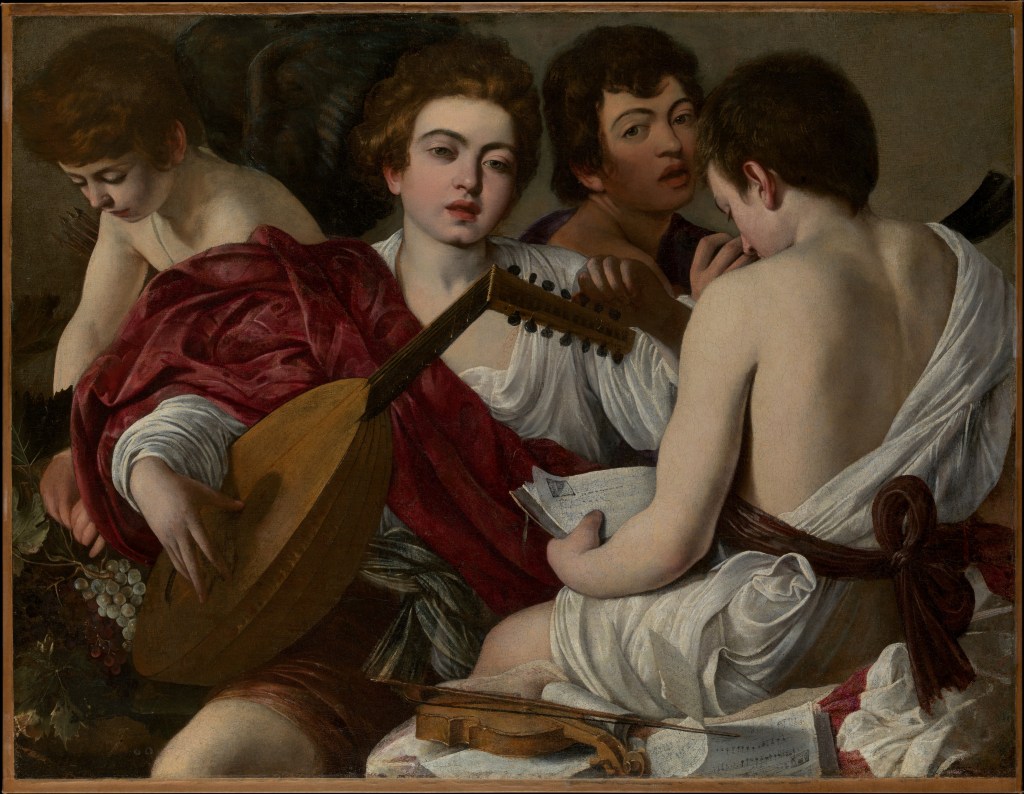
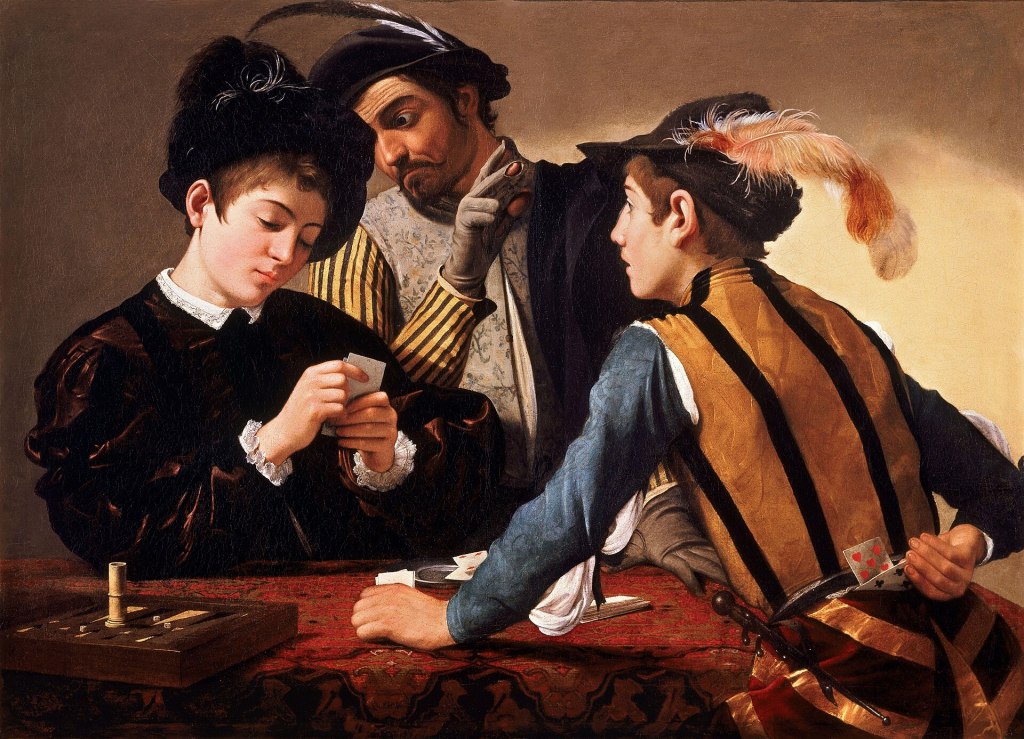
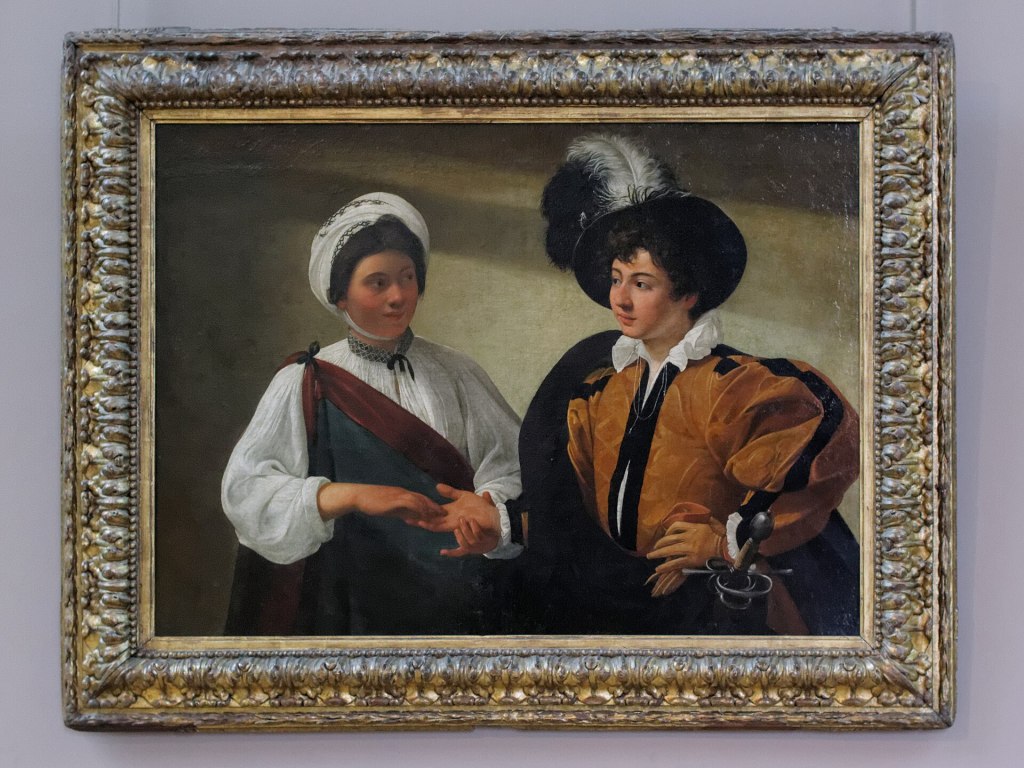
Caravaggio’s departure from Rome in 1606 did not diminish the appetite for such paintings. His absence, and later his death, left an existing demand increasingly to be met by other painters. Bartolomeo Manfredi became particularly important in this process. Working largely for private collectors, he adapted successful Caravaggesque subjects and arrangements into paintings of musicians, gamblers, drinkers and soldiers. Maurizio Marini has described the process neatly as imitare l’imitato: what had begun in Caravaggio as an encounter with nature was itself becoming a model that could be imitated.
The expression traditionally attached to this development, the manfrediana methodus, can make it sound more systematic than it was. Yet it identifies something recognisable. Manfredi repeatedly brought half-length figures together in shallow, dark spaces, often around a table, modelling faces, hands and fabrics through concentrated light. Jean-Pierre Cuzin has emphasised both the tactile quality of these paintings and the adaptability of their compositions: a gathering of figures might accommodate cards, dice, drink, fortune-telling or a religious narrative. Manfredi’s manner was not simply a repetition of Caravaggio. His figures are often softer and more substantial, their interactions slower and sometimes more troubled.
Manfredi died around 1620–21, when Preti was still a child, so there can have been no direct relationship between them. Yet the formula proved remarkably portable. Nicolas Régnier, Nicolas Tournier, Gerard Seghers and Valentin de Boulogne were among those who developed related forms of Caravaggesque genre painting in Rome.
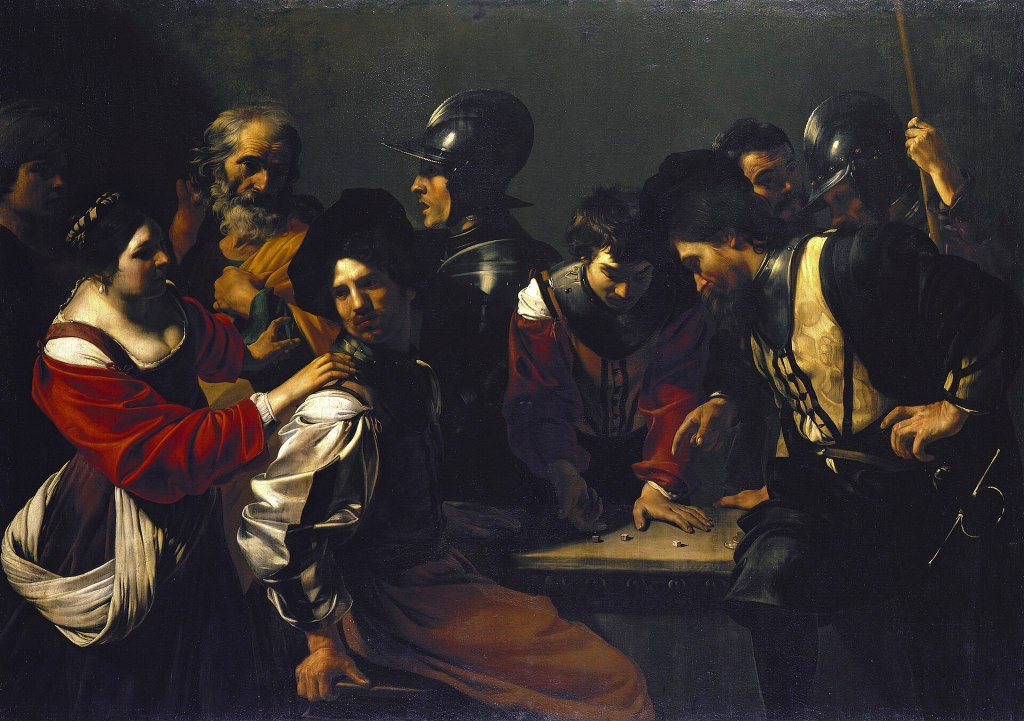
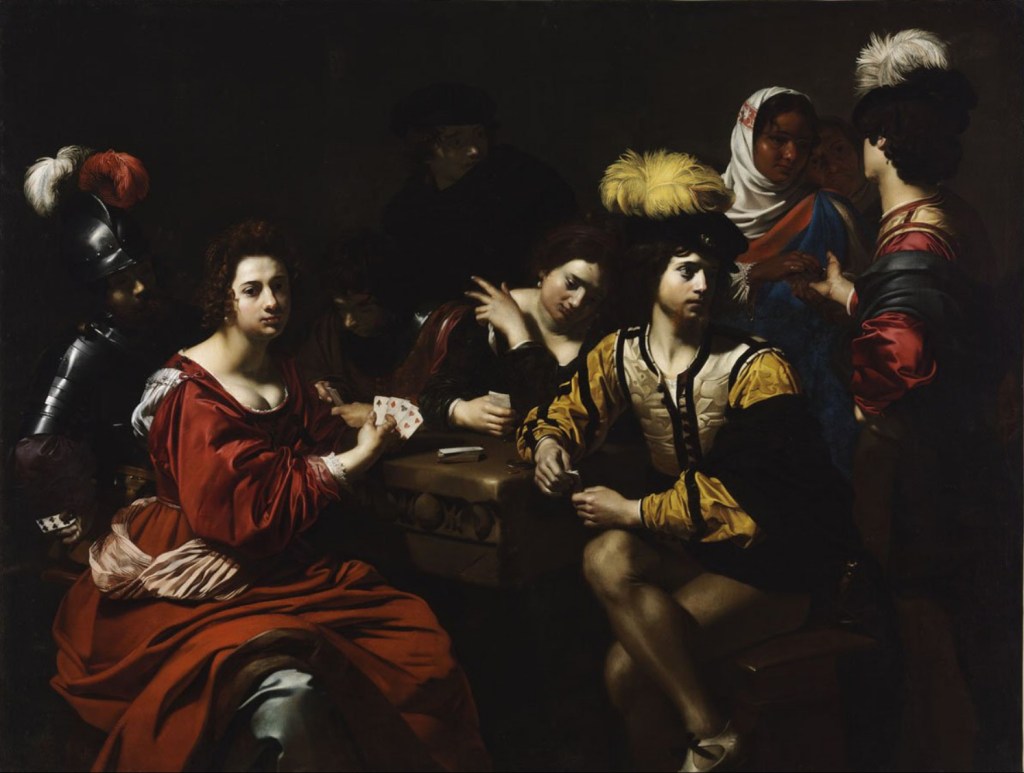
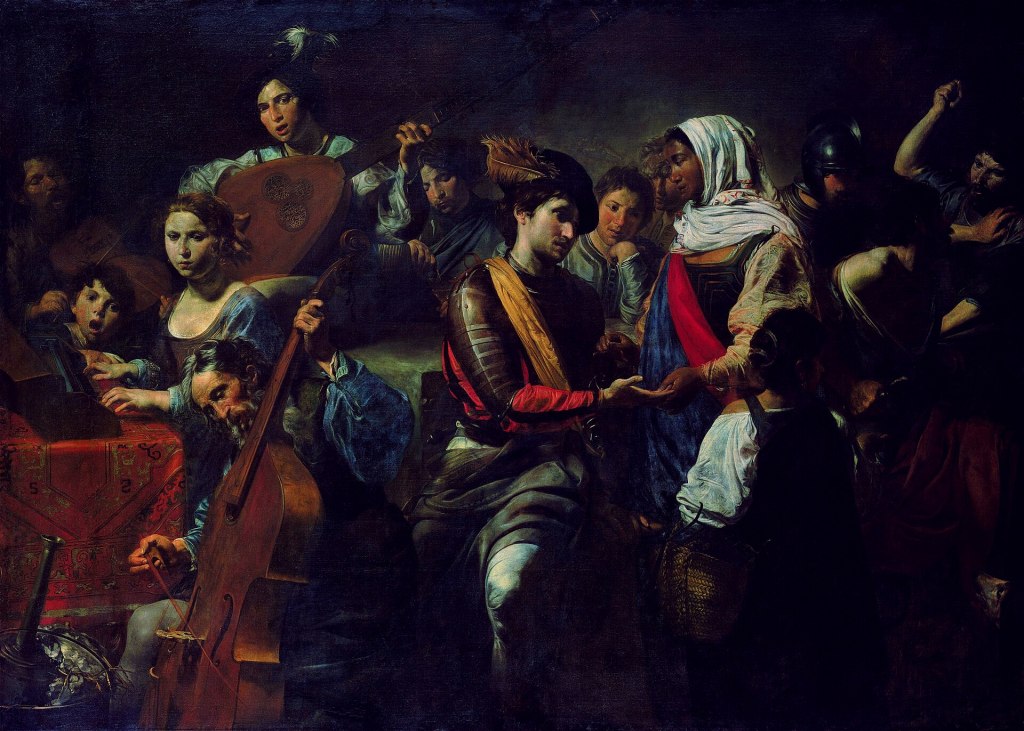
By the time Preti arrived in Rome in the early 1630s, what he encountered was the afterlife of a manner already disseminated through paintings, copies, variants and the work of other artists. A Concert, the Hermitage Concert and The Game of Draughts belong to that inheritance. The more interesting question, therefore, is not whether Preti followed Manfredi directly, but what happened to this established language of music, gaming, darkness and light when Preti began to make use of it himself.
The Thyssen Concert
Mariella Utili regards A Concert, c. 1630–35, in the Museo Nacional Thyssen-Bornemisza, Madrid, as one of Preti’s earliest Roman paintings. Three half-length figures occupy a shallow space against a dark ground. At the left, a violinist turns his face towards the spectator; beside him a younger man, partly clad in armour, looks across the composition, while a third figure completes the group. The subject belongs to a familiar Caravaggesque repertory; much of the visual interest lies in the way illumination defines the figures and the different surfaces of their clothing and armour.
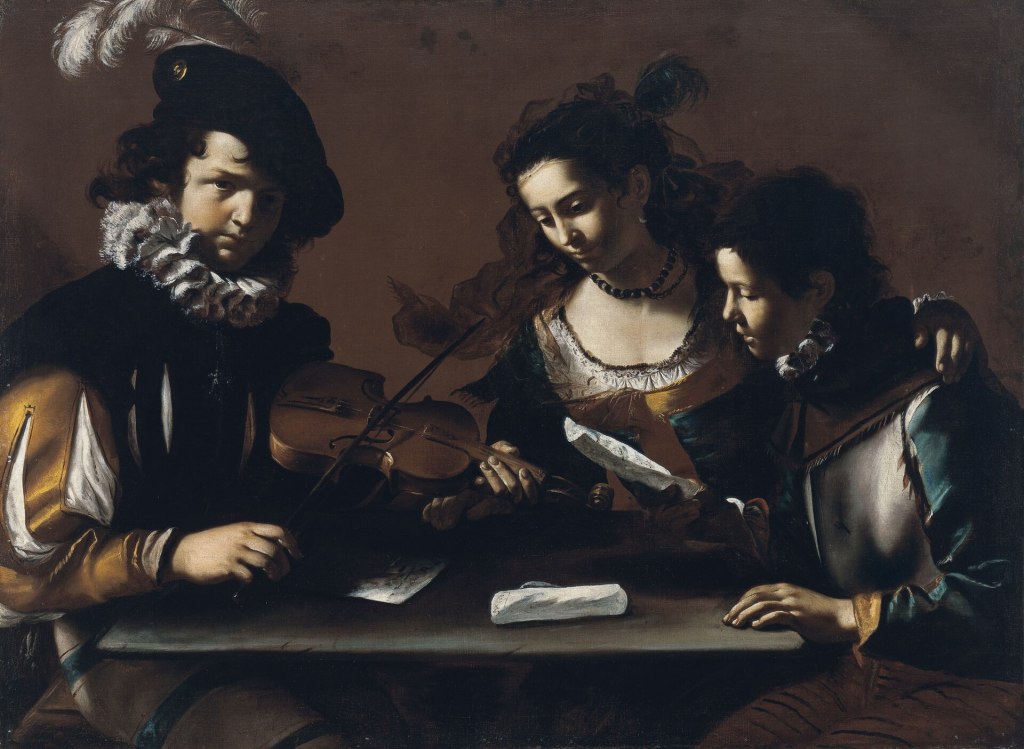
Illumination plays a determining role. It catches the faces and hands, the violin and bow, the folds of clothing and, more sharply, the metal worn by the young man at the right. Utili draws particular attention to Preti’s interest in armour as a reflective surface, an effect that was to recur throughout his career. The light does not merely reveal the figures; it distinguishes one material from another, allowing flesh, fabric, feathers and metal to register differently against the surrounding darkness. Utili sees Caravaggio’s most enduring legacy for Preti in the possibilities of chiaroscuro. Throughout his career, she argues, contrasts of light and dark could serve different purposes: intensifying drama, bringing out the material character of surfaces, or creating a sense of space and movement.
At the same time, the painting belongs to a larger process of repetition and variation. Utili compares the violinist directly with figures in the Concert in the Hermitage and the related Concerto a tre figure in the Fondazione Roberto Longhi. Similar feathered hats, costumes and figure types recur across the group. The repetitions need not imply mechanical copying. Rather, they suggest a repertory of models and pictorial solutions that Preti could rearrange from one composition to another.
There is, however, something less convivial about the result than the subject might suggest. The figures have been brought physically close together, yet their attention does not coalesce around a single action. Their glances travel in different directions, and the illumination gives each a certain independence within the group. Music supplies the occasion for their proximity, but it is light, rather than any strongly expressed social exchange, that most convincingly holds the composition together. That quality becomes still more apparent in the related Concert now in St Petersburg.
The Hermitage Concert
The Concert in the State Hermitage Museum, St Petersburg, generally dated to c. 1630–35, has a somewhat different internal balance. A young woman holding a fan occupies the centre, flanked by two musicians, with sheets of music lying on the table before them. Light enters from above and to the left, outside the depicted space. As Vittorio Sgarbi observes, it falls across the woman’s skin, the costumes and the feathers on the men’s hats, while substantial areas of the composition remain in shadow.
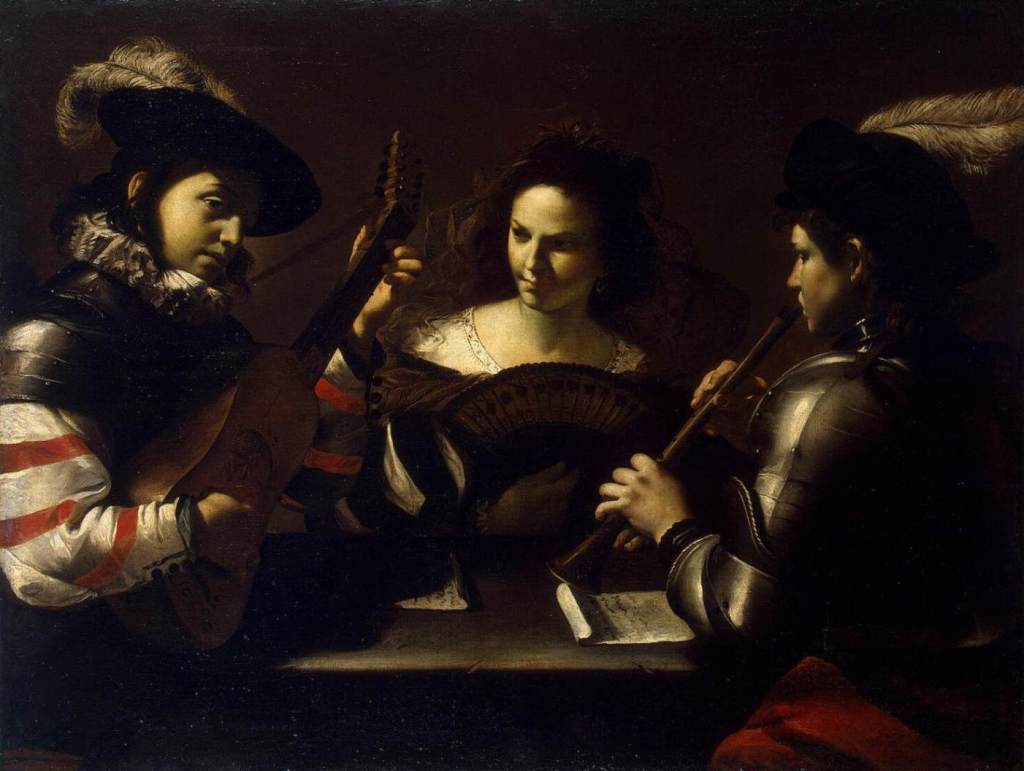
The dispersal of attention noted in the Thyssen picture is especially clear here. The young man turns towards the spectator, while the woman looks intently towards the musician beside her. Their different lines of sight complicate the ostensible sociability of the concert: music has brought the group together, but it has not produced an image of easy convivial exchange. The effect is quieter and more suspended. Once again, the illumination articulates relationships that the figures themselves leave unresolved.
The Game of Draughts
In The Game of Draughts, now in the Ashmolean Museum, Oxford, the same repertory has been redirected towards play. The painting is generally dated to around 1635, although earlier dates have also been proposed. Catherine Whistler describes it as ostensibly a scene of everyday life but markedly theatrical in its design, setting, lighting and costume. The two players sit around what appears to be a fragment of architectural moulding or cornice, perhaps intended as a piece of ancient Roman architecture, while a young woman with a guitar occupies the centre of the group.
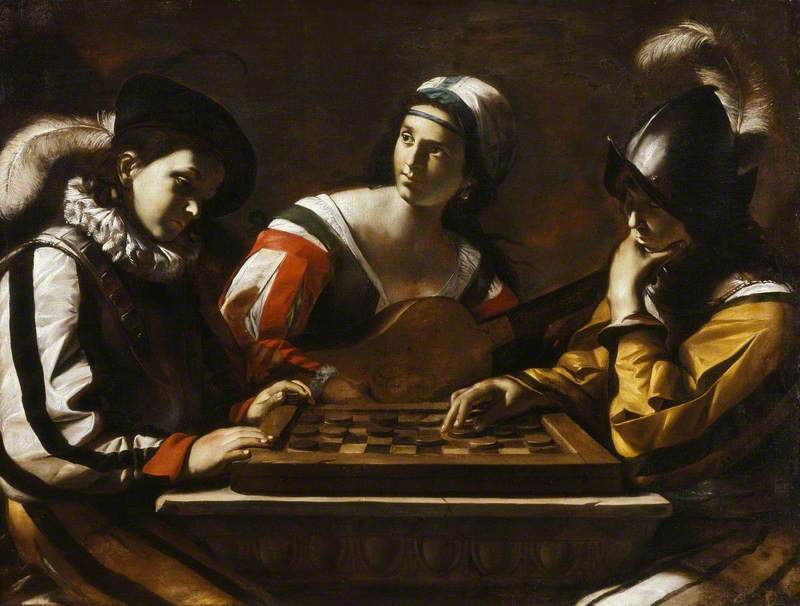
Whistler is cautious about attaching any precise symbolic significance to the game itself, which may principally provide the occasion for bringing the figures together. Music-making, however, had long carried associations with courtship and love in Italian literary and pictorial traditions. Against that background, she tentatively raises the possibility that the game between the two men might also imply rivalry for the woman’s attention. Nothing is made explicit. As in the Hermitage Concert, the relationships are suggested through glances, proximity and gesture rather than developed into a clear narrative.
The connection with the Hermitage picture is unusually close. Whistler notes that the feather-hatted youth in the St Petersburg Concert appears again here in similar costume. Such repetitions suggest that Preti was drawing on a relatively compact repertory of models and dress while varying the circumstances in which they appeared. The change from music to gaming alters the ostensible subject, but not the underlying interest in how a small group might be arranged and illuminated within a restricted space.
Technical examination has shown that the painting was executed in a thin paint layer over a thick brown ground, with much of the modelling built up through patchy glazes. The technique is consistent with the way forms emerge from darkness rather than being uniformly described. Richard Spear drew attention more generally to the selective illumination of faces, hands and shoulders in this group of early works. In The Game of Draughts, that selective light reinforces the impression of a carefully staged encounter rather than a casually observed anecdote. Attention is divided between the game, the figures and the surfaces that briefly catch the light.
Seen together, these paintings show Preti working within a language already shaped by Caravaggio, Manfredi and the wider Roman Caravaggesque tradition. Yet their subjects of music and play do not result in uncomplicated images of sociability. The figures remain curiously self-contained, their relationships suggested rather than resolved, while chiaroscuro organises the scene and differentiates bodies, fabrics and objects. In these early Roman works, a familiar repertory becomes the basis for a distinctive theatrical language.
Producing these essays requires care, time, research, and resources. Contributions to help sustain this exploration would be greatly appreciated.
Donate to Inner Surfaces here.
Bibliography
I have consulted the following texts. Any errors are mine.
Cuzin, Jean-Pierre, ‘Manfredi’s “Fortune Teller” and Some Problems of “Manfrediana Methodus”’, Bulletin of the Detroit Institute of Arts, 58, no. 1 (1980), pp. 14–25.
Gregori, Mina (ed.), Caravaggio e la modernità. I dipinti della Fondazione Roberto Longhi, Florence: Giunti/Sillabe, 2010.
Marini, Maurizio, ‘Equivoci del caravaggismo 2: A) Appunti sulla tecnica del “naturalismo” secentesco, tra Caravaggio e “Manfrediana methodus”; B) Caravaggio e i suoi “doppi”. Il problema delle possibili collaborazioni’, Artibus et Historiae, 4, no. 8 (1983), pp. 119–154.
Poma, Maria Cristina (ed.), Dopo Caravaggio. Bartolomeo Manfredi e la Manfrediana Methodus, exhibition catalogue, Cremona, Santa Maria della Pietà, March–May 1988, Milan: Arnoldo Mondadori Editore, 1987.
Sgarbi, Vittorio, Mattia Preti, Soveria Mannelli: Rubbettino, 2013.
Spear, Richard E., Caravaggio and His Followers, Cleveland: Cleveland Museum of Art, 1971.
Utili, Mariella (ed.), Mattia Preti tra Roma, Napoli e Malta, exhibition catalogue, Museo di Capodimonte, Naples, 28 March–6 June 1999, Naples: Electa Napoli, 1999.
Vsevolozskaja, Svetlana (ed.), Museo statale Ermitage. La pittura italiana del Seicento. Catalogo della collezione, Milan: Skira, 2010.
Whistler, Catherine, Baroque and Later Paintings in the Ashmolean Museum, London: Modern Art Press, 2016.

