A late altarpiece
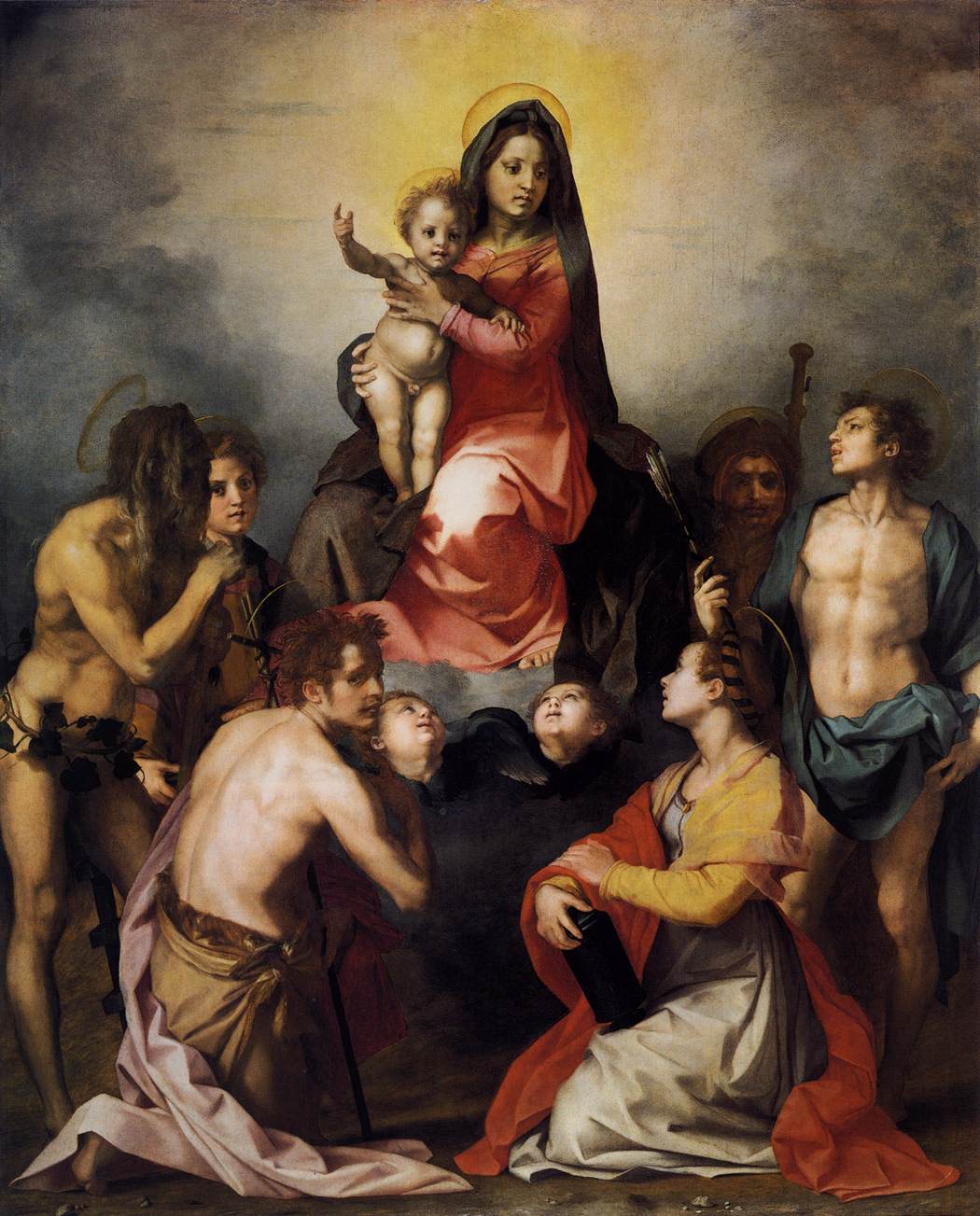
Andrea del Sarto’s Madonna and Child with Saints Onofrio, Lawrence, John the Baptist, Mary Magdalene, Roch and Sebastian, generally known as the Pala di Gambassi, belongs to the last years of a career that had placed him at the centre of Florentine painting. Now in the Galleria Palatina at Palazzo Pitti, the large panel was painted for the Benedictine convent of Santi Lorenzo e Onofrio at Gambassi, some forty kilometres from Florence. Its date is not quite settled. John Shearman placed it around 1525–26, while Sydney Freedberg and Antonio Natali preferred 1527–28, the dating now adopted by the Italian national catalogue. What is certain is that it followed Andrea’s withdrawal to Luco in the Mugello during the plague of 1523–24 and belongs to the concentrated final phase of his career.
The painting is monumental without being entirely static. The Virgin and Child are raised above a substantial group of six saints, but the resulting structure is more complicated than the familiar pyramidal organisation of a sacra conversazione. The 1986 exhibition catalogue described the composition as combining pyramidal and spherical structures: the saints establish a broad base below, while the relationships between the figures create a more enveloping movement around the centre. Andrea was also working with forms he had used before. The arrangement recalls the Disputa sulla Trinità, while the Virgin develops a conception already explored in the Madonna della Scala. Yet these earlier ideas have not simply been repeated; they have been recombined within a denser and more spatially elaborate construction.
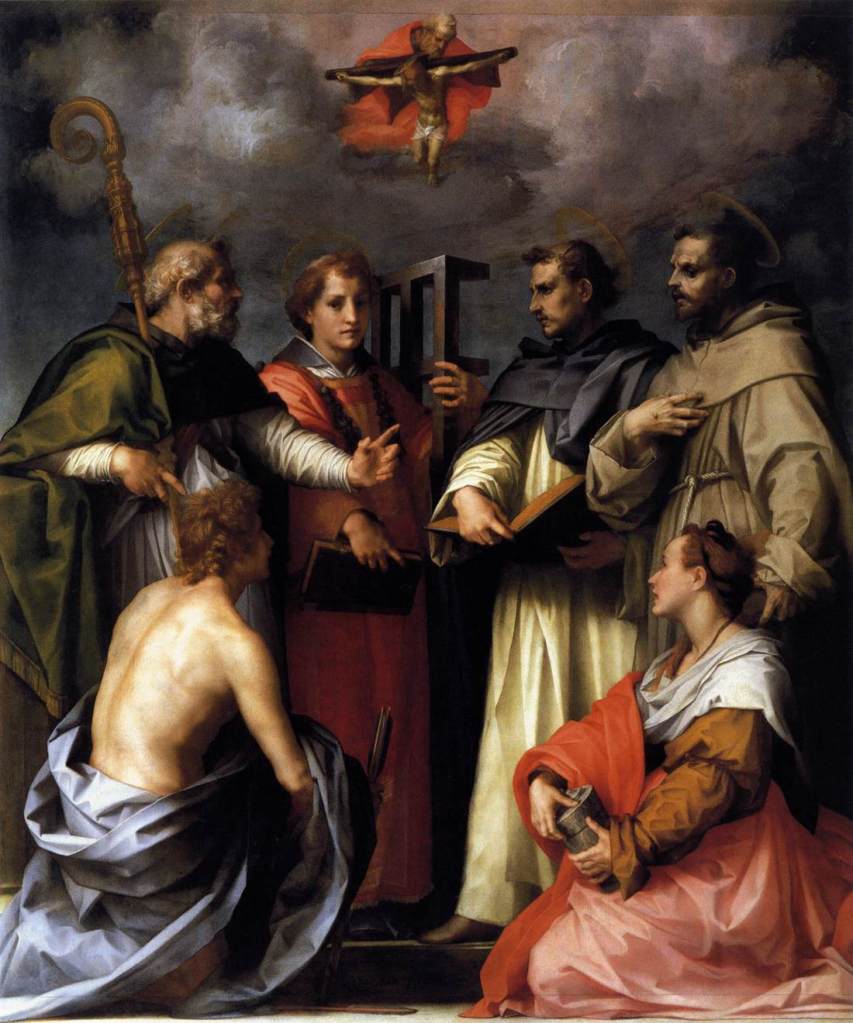
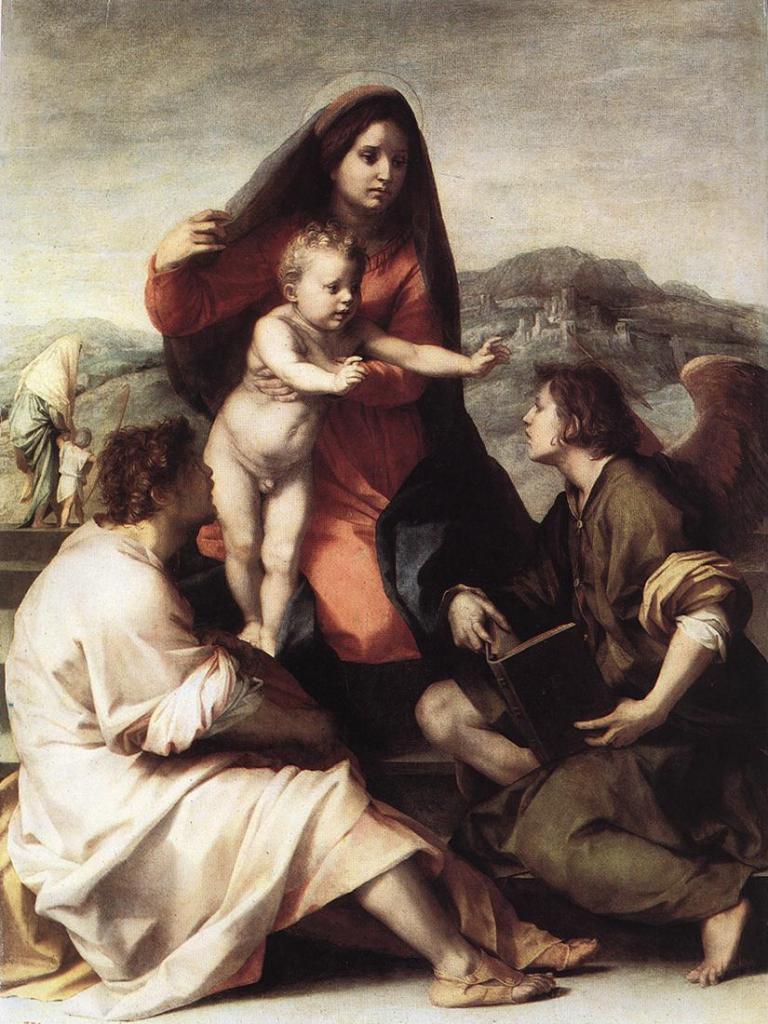
It is worth pausing here, since the Pala di Gambassi stands at a point in Andrea’s career that has proved difficult to describe. He was only eight years older than Pontormo and nine years older than Rosso Fiorentino, yet he had matured within the artistic world of Leonardo, Raphael and Fra Bartolommeo. His position therefore cuts across the convenient division between the High Renaissance and the emerging maniera. Freedberg saw Andrea as maintaining and repeatedly reformulating a fundamentally classical language after 1520, at a time when younger Florentine painters were moving in more conspicuously experimental directions. Shearman regarded the same period less as a retreat into classicism than as one in which several possibilities remained open. In his account, Andrea’s final years encompass aspects of Mannerism, arte sacra and even forms that might be described as proto-Baroque. The Pala di Gambassi can consequently be approached from quite different directions: either as part of a late formalisation of the monumental Florentine altarpiece, or as the work of an artist who was still testing the possibilities available to painting in the later 1520s.
Neither description, however, quite catches the sensuous character of Andrea’s painting. His classicism was never simply a matter of orderly composition. Leonardo had been important to him not only through sfumato, but through the capacity of tonal modelling to soften transitions and give psychological animation to the human figure. At the same time, Andrea developed a chromatic language in which tonal modelling could coexist with strong local colour. This helps to explain how he could remain committed to compositional balance while sustaining the sensuous effects of surface, drapery and colour.
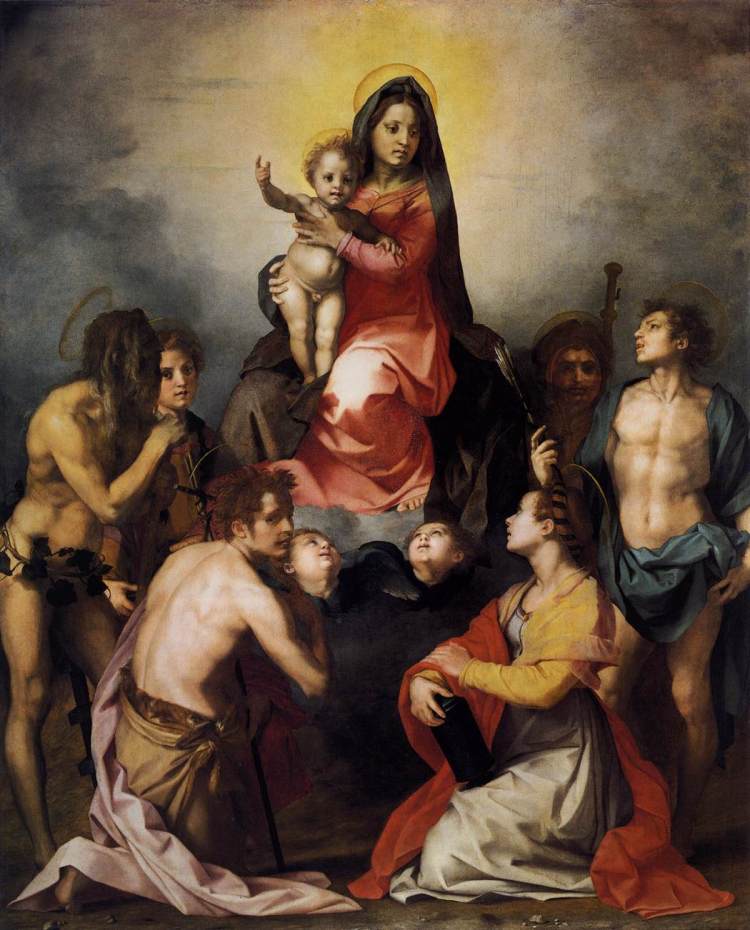
The Pala di Gambassi is a particularly good place from which to consider this late language because its formal control is accompanied by a distinct emotional register. Natali draws attention to the sorrowful expressions of the two cherubs and to the almost swooning devotion of some of the saints, above all Saint John the Baptist, whose languid turn towards the spectator opens the sacred gathering towards the viewer. The 1986 catalogue describes the transformation rather differently, emphasising the increasing weight and mass of Andrea’s figures and a new contemplative gravity in his late work. Against the physical presence of the saints below, however, the elevated Virgin and Child are set within a much lighter tonal field. The opening of the sky and the cloud that supports them provide a visual counterpoint to the denser, darker lower register without dissolving the solidity of Andrea’s forms.
The circumstances of the commission add another dimension to the painting. Giorgio Vasari records that it was made for Becuccio Bicchieraio da Gambassi, whom he describes as Andrea’s amicissimo. Becuccio was a Florentine glass-worker of Gambassi origin and a substantial benefactor of the convent for which the altarpiece was painted.
The connection has acquired particular interest because two small portraits of Becuccio and his wife Lucrezia, now in Chicago, have survived from the lost predella. Their recovery restores something of the relationship between Andrea’s altarpiece and the patron who commissioned it, and gives the Pala di Gambassi a rich social as well as pictorial history.
Florentine practice: drawing and colour
The qualities visible in the Pala di Gambassi were grounded in working methods that remained strongly Florentine. Carmen C. Bambach has stressed the fiorentinità of Andrea as both draughtsman and painter: his formation, his workshop procedures and his reliance on disegno belonged to a culture shaped by Leonardo, Michelangelo, Raphael and Fra Bartolommeo, but also by the practical traditions of Florentine craft. Andrea was an exceptional draughtsman, particularly in red chalk, but drawing for him was not simply a preliminary stage through which a finished composition was fixed in advance.
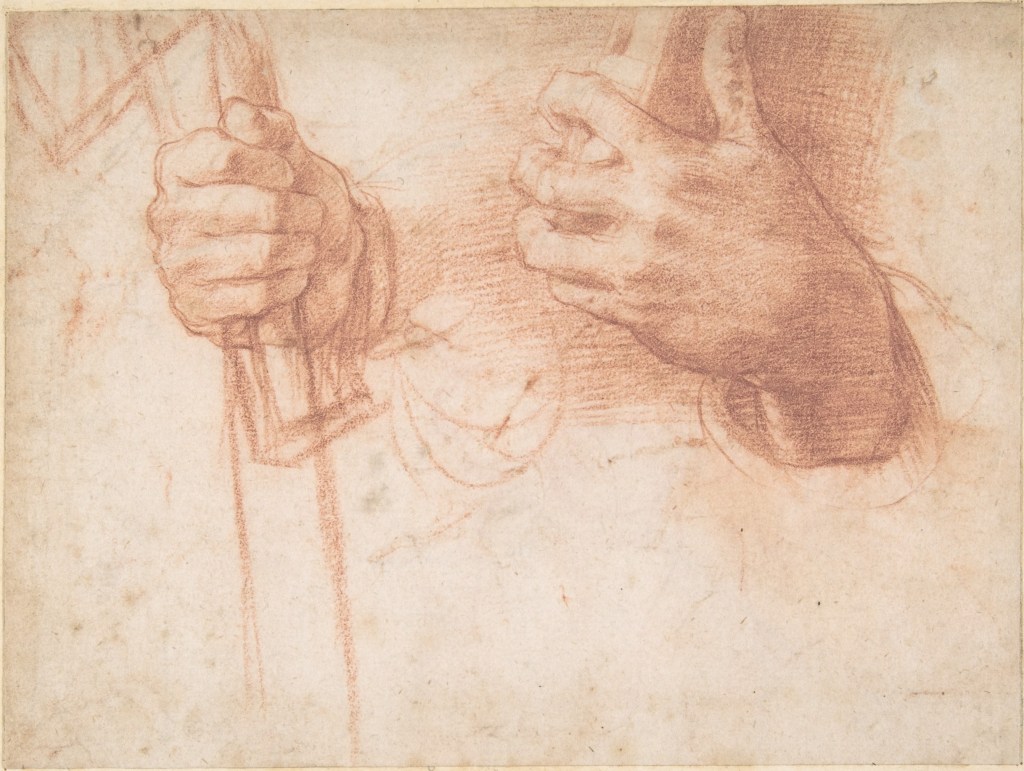
Vasari remarked that Andrea used his drawings as a memory of something seen rather than as forms to be transcribed literally into paint. Technical investigations assembled for the 2015 Getty exhibition make the flexibility of this process more concrete. Andrea could transfer figures from full-scale cartoons, recombine existing designs and then alter them freehand on the panel. The Pala di Gambassi itself preserves evidence of this continuing process. Infrared reflectography has revealed changes to the Virgin and Child, the Magdalene and, most strikingly, John the Baptist, whose head was substantially reconsidered during execution. The monumental order of the finished painting was therefore achieved through revision rather than the mechanical transfer of an already settled design.
The practical character of these procedures has a suggestive resonance with Andrea’s family background. The name by which he is known preserves that background: his father was a tailor (sarto), and tailoring remained prominent in his immediate family. Bambach notes that the trade itself depended upon pricked and pounced patterns, tracing and other methods of transferring designs, and compares Andrea’s flexible use of cartoons with the tailor’s cutting and adjustment of patterns and cloth. The analogy does not imply that his pictorial methods were simply derived from tailoring; rather, it places them within a broader Florentine culture in which designs were transferred, adapted and reused across different forms of skilled production.
Colour formed an equally important part of this process. Andrea’s debt to Leonardo included the use of tonal transitions and sfumato, but his painting did not depend upon the suppression of strong local colour. Shearman regarded the conjunction of Leonardesque tonal unity with increasing chromatic intensity as one of Andrea’s distinctive achievements, particularly during the 1520s. Earlier criticism had already recognised something similar. Emma Micheletti described works such as the Birth of the Virgin in terms of a soft atmospheric unity within which greens, reds and yellows retain considerable brilliance. Light, modelling and colour operate together rather than as separate elements of the picture.
This conjunction remained important in Andrea’s late work. The fuller, more sustained colour associated with the Pala di Gambassi accompanies the increasing weight and gravity of its figures rather than competing with them. Andrea’s mature style consequently depended upon a balance that was never entirely rigid: firm design could be revised during painting, while tonal coherence could accommodate considerable chromatic richness. In the Pala di Gambassi, both contribute to the combination of formal stability and sensuous presence that characterises the finished work.
Becuccio and the commission
The Florentine world in which Andrea worked also helps to explain the circumstances of the Pala di Gambassi. Vasari’s Becuccio Bicchieraio can now be identified securely as Domenico, a glass-worker from Gambassi who established himself in Florence. Alessandro Conti first reconstructed much of his identity from guild and commercial records, describing him as an affluent small entrepreneur and shopkeeper rather than a modest craftsman working in isolation. More recent archival research by Franco Ciappi and Silvano Mori has strengthened that picture considerably. A Florentine census of 1525 records both the furnace of “Domenico decto Becuccio” in the quarter of Santa Croce and his shop in San Giovanni.
His rise had been marked. Becuccio’s father, Iacopo di Maffio, had begun as a mezzadro, or sharecropper, and Becuccio entered the Florentine glass trade through connections with the Buonamici family of Gambassi. He progressed from apprentice to master and eventually to entrepreneur. The glass business served a distinguished lay and ecclesiastical clientele and enabled him to acquire property and diversify his activities into credit and the second-hand trade. The later histories of his wife Lucrezia and their daughter Marsilia intersected with families including the Medici and Strozzi, while the family’s wider circle included Andrea del Sarto and connections with Pontormo. Alessia Meneghin, reviewing Ciappi and Mori’s study, presents this trajectory as an instance not only of economic mobility but of the acquisition of an aesthetic and cultural sensibility within the prosperous artisanal classes of Renaissance Florence.
The commission at Gambassi belonged to this broader pattern of advancement, but it also had a specific religious context. A testamentary document of 1522 establishes Becuccio’s connection with the Benedictine convent of Santi Lorenzo e Onofrio before the altarpiece was painted. The pastoral visitation of 1576 remembered Domenico da Gambassi as a benefactor who had founded an altar there and furnished it with a major painted panel in a gilded frame, while Ciappi and Mori’s archival research establishes a testamentary bequest of 200 scudi. The Pala di Gambassi was therefore part of an endowed religious foundation rather than an isolated act of private patronage.
Conti has also drawn attention to the social proximity between Andrea and men such as Becuccio. Vasari repeatedly presents the painter as accepting commissions from craftsmen, merchants and personal acquaintances, and Becuccio belongs naturally within that pattern. More recent archival research identifies Andrea as Becuccio’s vicino di bottega, placing the two men within the same immediate Florentine working environment. Vasari’s description of Becuccio as amicissimo remains his testimony rather than something independently documented, but the friendship it implies is entirely compatible with the overlapping neighbourhood, professional and familial networks in which both men moved.
Seen in this context, Becuccio’s role as patron is less anomalous than it might first appear. The commission belongs to a Florentine culture in which artistic sophistication was not confined to courtly or patrician circles, and in which successful artisans and entrepreneurs could participate directly in the production and appreciation of ambitious painting. The Pala di Gambassi gives concrete form to that relationship between artistic and artisanal worlds.
The saints and the plague
The original setting at Santi Lorenzo e Onofrio gives Andrea’s gathering of saints a more precise institutional context. Lawrence and Onofrio correspond to the dedication of the convent church, a connection already noted in the 1986 catalogue. The current national catalogue also identifies Lawrence as a protector of glass-workers, which, if that association was intended here, would have given his presence a further relevance to Becuccio. Mary Magdalene introduces a penitential element, while John the Baptist occupies an active place within the sacred company.
Most conspicuous in relation to the circumstances of the 1520s are Saints Roch and Sebastian, both widely invoked as protectors against plague. Their presence has played an important part in the differing chronologies proposed for the picture. Shearman associated them with deliverance from the epidemic of 1523–24 and interpreted the altarpiece in ex-voto terms; Natali, favouring the later date, connected them instead with the renewed outbreak of 1527.
Within this context, Natali gives particular importance to John the Baptist, whose outward turn directs attention towards the space occupied by the worshipper. The Virgin above may consequently be understood as an intercessory figure approached by a community confronting epidemic disease, with John drawing the viewer into the act of appeal and veneration. Titular saints, plague protectors and figures associated with penitence and intercession thus give the Pala di Gambassi a specificity that goes beyond the general form of the sacra conversazione. The presence of Becuccio and Lucrezia in the predella extended that specificity further by placing the donors themselves within the original ensemble.
The lost predella
Vasari’s remark that Andrea portrayed Becuccio and his wife in the predella is valuable because two parts of that lost structure survive. The small panels now in the Art Institute of Chicago, showing Becuccio and Lucrezia di Lippo di Iacopo Guidi, are dated 1525–28. Their format was itself unusual. Roundels containing saints and other sacred figures were familiar in Tuscan and Umbrian altarpieces, but Elizabeth Wigfield and Christine Zappella describe the Pala di Gambassi as a rare instance in which donor portraits occupied the predella.
Conti first argued that the Chicago paintings were the portraits described by Vasari, but conservation undertaken in 2019 has given the identification a much firmer material basis. The direction of the wood grain and fine grooves left by planing tools continue across both supports, indicating that they were cut from a single horizontal plank. Cleaning also recovered part of Andrea’s original decorative scheme. Each likeness was enclosed by a terracotta-coloured circular border, while yellow areas enlivened with strokes of red, blue and green apparently formed a continuous fictive marble or variegated-stone surround. The light falling across the portraits was conceived as entering from the upper left, corresponding to the illumination of the figures in the principal panel. The small likenesses were therefore visually integrated with the altarpiece above rather than conceived as independent portraits.
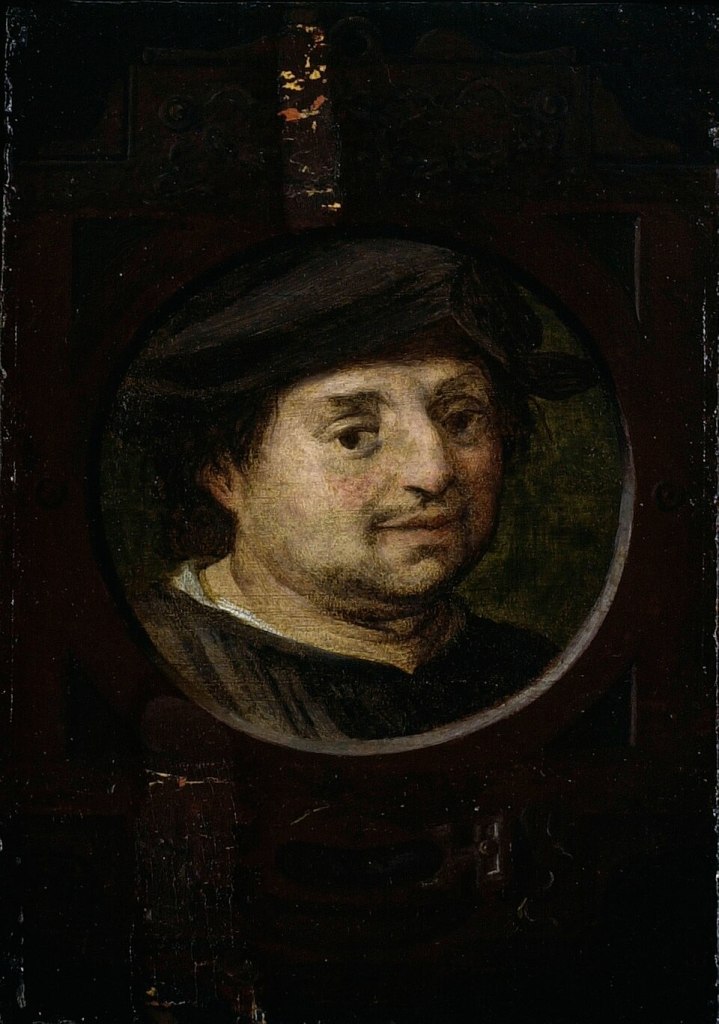
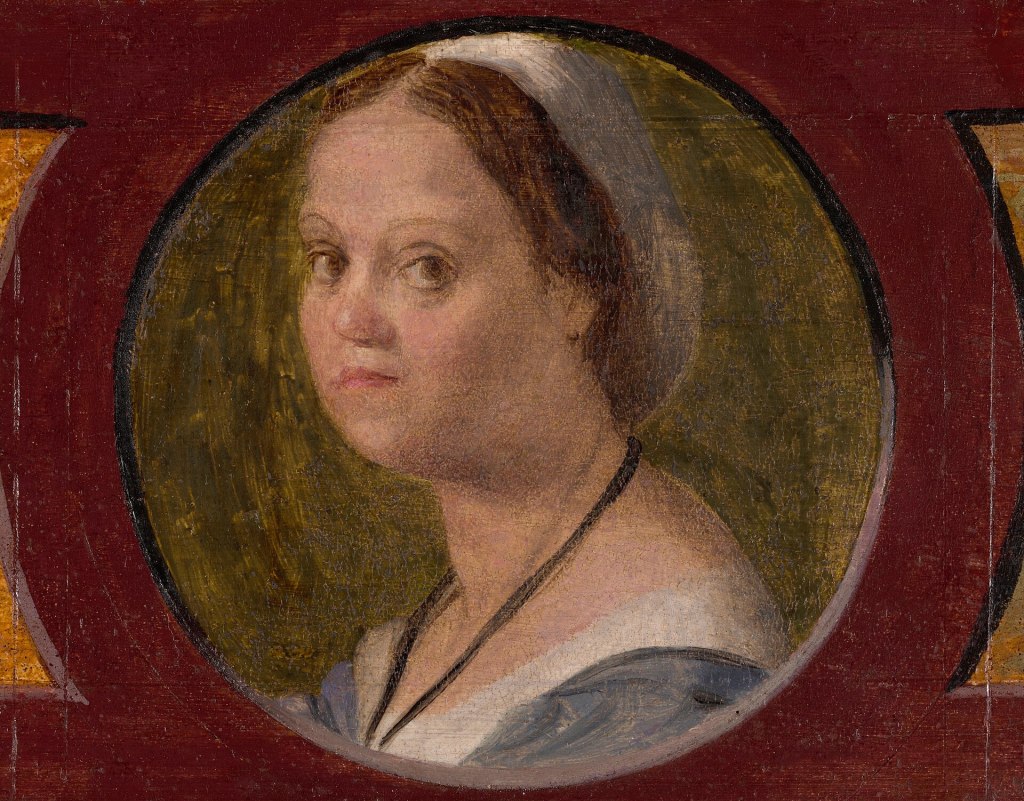
Their subsequent history shows how completely that original context could be lost. The altarpiece was probably removed from Gambassi between 1620 and 1637, when the predella was cut up and dispersed. By the inventories of Leopoldo de’ Medici in 1655 and 1692 the names of the sitters had already disappeared: the two roundels were described instead as portraits of Andrea and his wife. Later alterations reinforced their new existence as a pair of autonomous portraits, obscuring their original place within a religious ensemble. Their modern restoration has consequently recovered more than their appearance. It has restored the connection between the likenesses, their patronal function and the Pala di Gambassi itself.
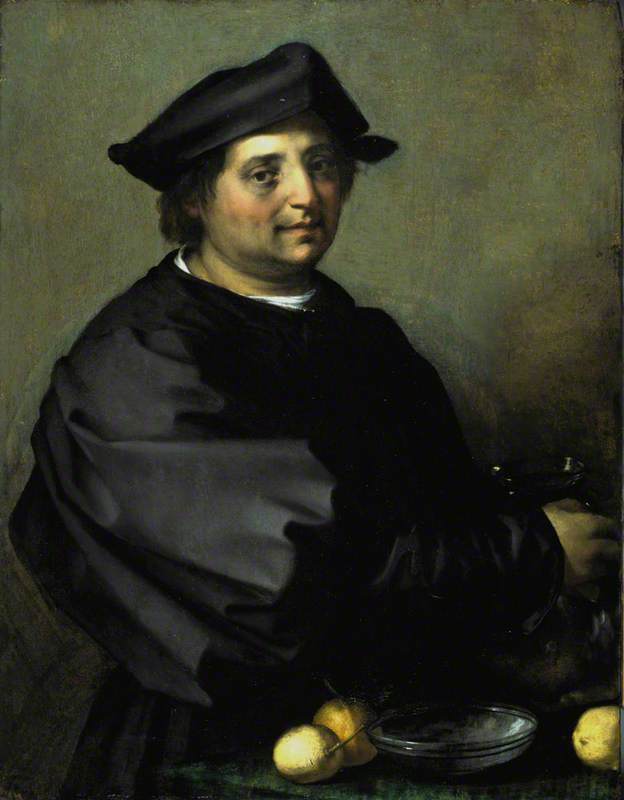
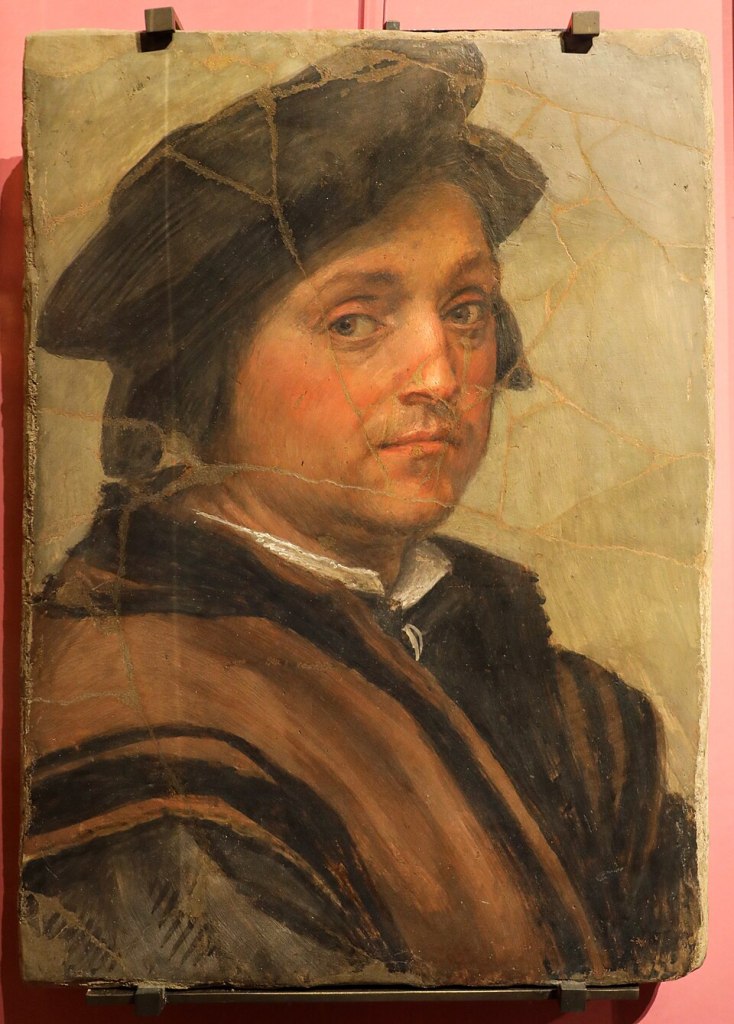
Becuccio appears again, at approximately the same period, in the larger independent portrait now in the National Galleries of Scotland. There he is shown holding a glass carafe and dish, objects that Conti recognised as discreet references to the profession from which his prosperity had developed. The gallery now accepts the identification and dates the portrait to about 1528–30. The scale and purpose are very different from the predella roundel, but the two likenesses bring us close to the individual behind the commission: once incorporated as a donor beneath the sacred image, and once presented independently through the materials of his working life.
Andrea and Becuccio
The Pala di Gambassi brings together two men whose careers were rooted in the productive world of Florence. Becuccio’s prosperity had grown from the glass trade; Andrea, himself from an artisanal family, had risen to become one of the city’s leading painters. Their friendship belongs to a culture in which painting, skilled manufacture and commerce were closely connected, and did not correspond neatly to the modern distinction between fine and applied art. The altarpiece, its lost predella and the independent portrait of Becuccio in Edinburgh offer testimony to that relationship.
The formal order, emotional intensity and chromatic richness that coexist in the Pala di Gambassi belonged to a pictorial language that younger Florentine artists could take in more experimental directions. As Iris H. Cheney observed, qualities already present within Andrea’s art became starting points for more audacious developments among his pupils. The Pala di Gambassi can therefore be seen both as the product of a particular friendship and of a particular Florentine social world, and as the late work of a painter whose possibilities did not end with him.
Producing these essays requires care, time, research, and resources. Contributions to help sustain this exploration would be greatly appreciated.
Donate to Inner Surfaces here.
Bibliography
These are the sources for this essay. Any errors are mine.
Andrea del Sarto, 1486–1530: dipinti e disegni a Firenze. Edited by Marco Chiarini. Exhibition catalogue, Palazzo Pitti, Florence, 8 November 1986–1 March 1987. Milan: D’Angeli-Haeusler, 1986.
Bambach, Carmen C. “Andrea del Sarto: Los Angeles and New York.” The Burlington Magazine 158 (January 2016), pp. 70–72.
Brooks, Julian, with Denise Allen and Xavier F. Salomon. Andrea del Sarto: The Renaissance Workshop in Action. Los Angeles: J. Paul Getty Museum, 2015.
Caneva, Caterina. “Andrea del Sarto, Madonna col Bambino e i santi Onofrio, Lorenzo, Giovanni Battista, Maddalena, Rocco e Sebastiano (‘Pala di Gambassi’).” In Andrea del Sarto, 1486–1530: dipinti e disegni a Firenze, exhibition catalogue, pp. 134–35. Milan: D’Angeli-Haeusler, 1986.
Cecchi, Alessandro. “Andrea del Sarto, Madonna col Bambino in gloria e santi (Pala di Gambassi).” In Serena Padovani, ed., I dipinti della Galleria Palatina e degli Appartamenti Reali. Le Scuole dell’Italia Centrale 1450–1530, pp. 80–83. Florence: Giunti, 2014.
Cheney, Iris H. Review of S. J. Freedberg, Andrea del Sarto, and John Shearman, Andrea del Sarto. The Art Bulletin 53, no. 4 (December 1971), pp. 532–35.
Ciappi, Franco, and Silvano Mori. «Becuccio bicchieraio da Gambassi». Competenze professionali e mobilità sociale nella Firenze rinascimentale. Biblioteca della Miscellanea Storica della Valdelsa, 33. Pisa: Pacini, 2020.
Conti, Alessandro. “Andrea del Sarto e Becuccio bicchieraio.” Prospettiva 33–36 (1983–84), pp. 161–65.
Freedberg, Sydney J. Andrea del Sarto. 2 vols. Cambridge, MA: Belknap Press of Harvard University Press, 1963.
Hall, Marcia B. Color and Meaning: Practice and Theory in Renaissance Painting. Cambridge: Cambridge University Press, 1992.
Meneghin, Alessia. Review of Franco Ciappi and Silvano Mori, «Becuccio bicchieraio da Gambassi». Competenze professionali e mobilità sociale nella Firenze rinascimentale. Archivio Storico Italiano 179, no. 4 (2021), pp. 859–60.
Micheletti, Emma. “Andrea d’Agnolo, detto Andrea del Sarto.” Dizionario Biografico degli Italiani, vol. 3. Rome: Istituto della Enciclopedia Italiana, 1961.
Natali, Antonio. Andrea del Sarto. New York and Milan: Abbeville Press Publishers, 1999.
Sammer, Jan. “Andrea del Sarto at the court of France.” The Burlington Magazine 168 (September 2026), pp. 852–59.
Shearman, John. Andrea del Sarto. 2 vols. Oxford: Clarendon Press, 1965.
Vasari, Giorgio. Le opere di Giorgio Vasari con nuove annotazioni e commenti di Gaetano Milanesi. 9 vols. Florence: G. C. Sansoni, 1878–85.
Wigfield, Elizabeth, and Christine Zappella. “Becuccio Bicchieraio and his wife, Lucrezia, restored.” The Burlington Magazine 165 (March 2023), pp. 302–305.
Collection catalogues
Art Institute of Chicago. Andrea del Sarto, Domenico da Gambassi, 1525–28. Collection catalogue.
Art Institute of Chicago. Andrea del Sarto, Lucrezia di Lippo di Iacopo Guidi, 1525–28. Collection catalogue.
Catalogo generale dei Beni Culturali. Andrea del Sarto, Pala di Gambassi. Madonna con Bambino in gloria e Santi. Galleria Palatina, Palazzo Pitti, catalogue no. 0900228547.
Fondazione Federico Zeri. Catalogue record for the copy after Andrea del Sarto’s Pala di Gambassi, Pieve di Santa Maria Assunta, Chianni, Gambassi.
National Galleries of Scotland. Andrea del Sarto, Domenico di Jacopo Becuccio, called ‘Becuccio Bicchieraio’, c. 1528–30, NG 2297. Collection catalogue.

