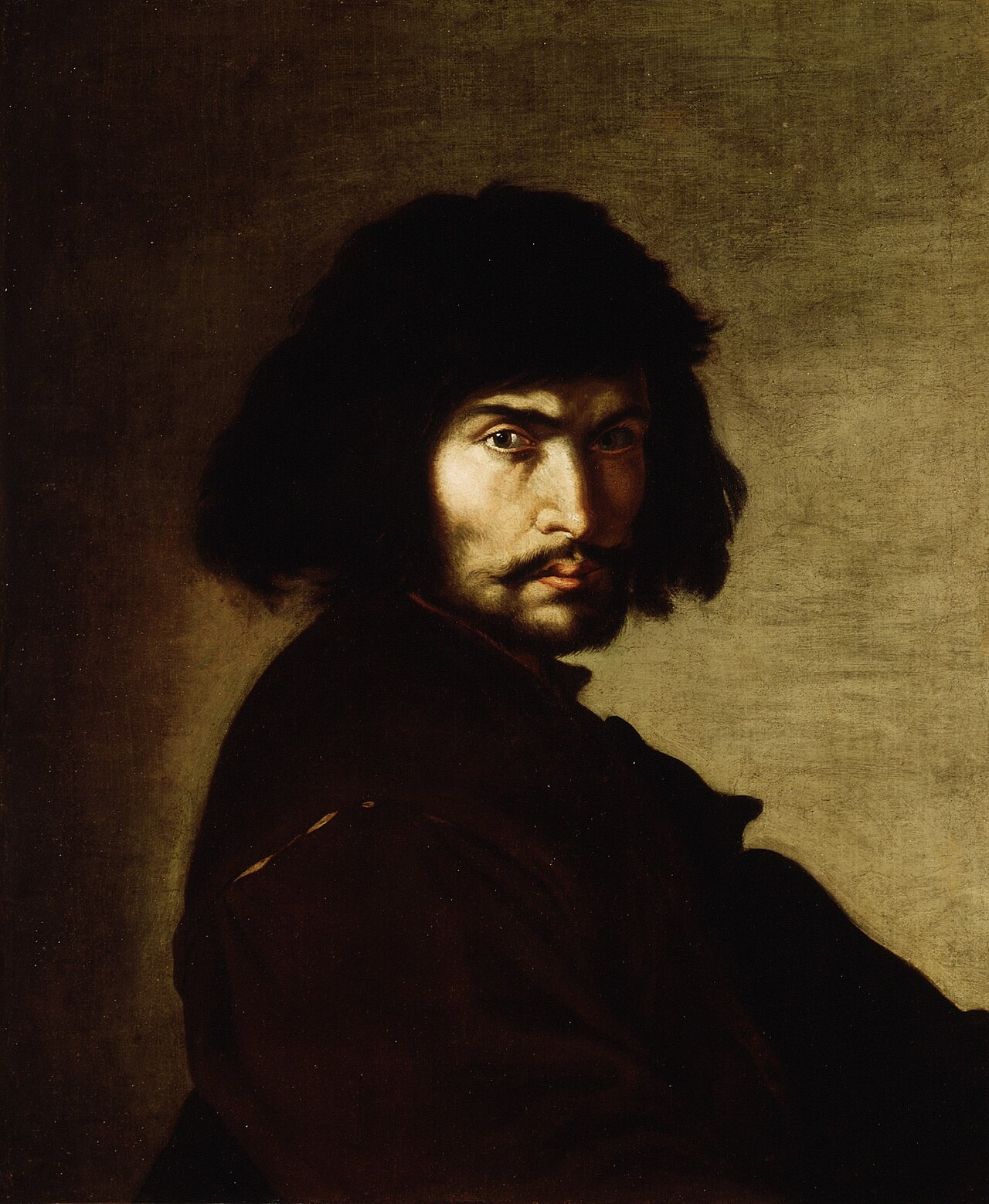
Portraiture occupies an unusual place within the work of Salvator Rosa (1615–1673). Although celebrated by his contemporaries for landscapes, battle scenes and increasingly ambitious history paintings, he repeatedly returned to images of the individual figure, producing portraits of remarkable variety and psychological intensity. Some are straightforward likenesses, others adopt theatrical or philosophical roles, while still others stand on the uncertain boundary between portrait, allegory and fantasy figure. Even those works generally accepted as self-portraits resist the expectation that they should present a stable or consistent image of the artist.
The variety of these paintings reflects the circumstances of Rosa’s career. During the 1640s, particularly in Florence, he moved within a circle of writers, actors and scholars centred upon the Accademia dei Percossi, developing friendships with individuals such as Giulio Maffei and Giovanni Battista Ricciardi that proved as important to his intellectual life as his more formal relationships with patrons. His portraits belong to this environment of conversation, theatrical performance, literary exchange and philosophical enquiry no less than to the conventions of seventeenth-century portrait painting.
The paintings considered here range from secure self-portraits to works whose identification remains disputed. Rather than attempting to resolve every uncertainty, this essay examines the different purposes these images served. Rosa appears in turn as actor, painter, philosopher, friend and observer, while certain later works draw upon his own features without necessarily functioning as self-portraits in the conventional sense. Together they reveal an artist who repeatedly explored the possibilities of portraiture as a means of presenting character, learning, friendship and memory.
The painted self
One of Rosa’s earliest appearances within his own paintings occurs in the large Battle made for the Medici during his Florentine years. He included himself among the combatants, turning towards the spectator from within the confusion of the scene. Filippo Baldinucci, the seventeenth-century Florentine artist-biographer, believed that the commission came from Prince Gian Carlo de’ Medici, whereas Jonathan Scott argues that the picture was more probably executed in 1642 for Grand Duke Ferdinando II during Gian Carlo’s absence on a naval expedition. Scott further suggests that it may have responded to poems celebrating the birth of the future Cosimo III, in which Rosa was encouraged to imagine the infant prince’s eventual victories over the Turks.
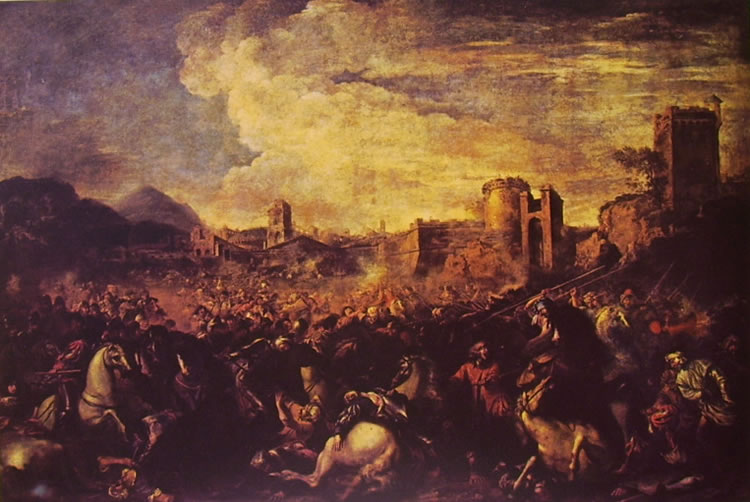
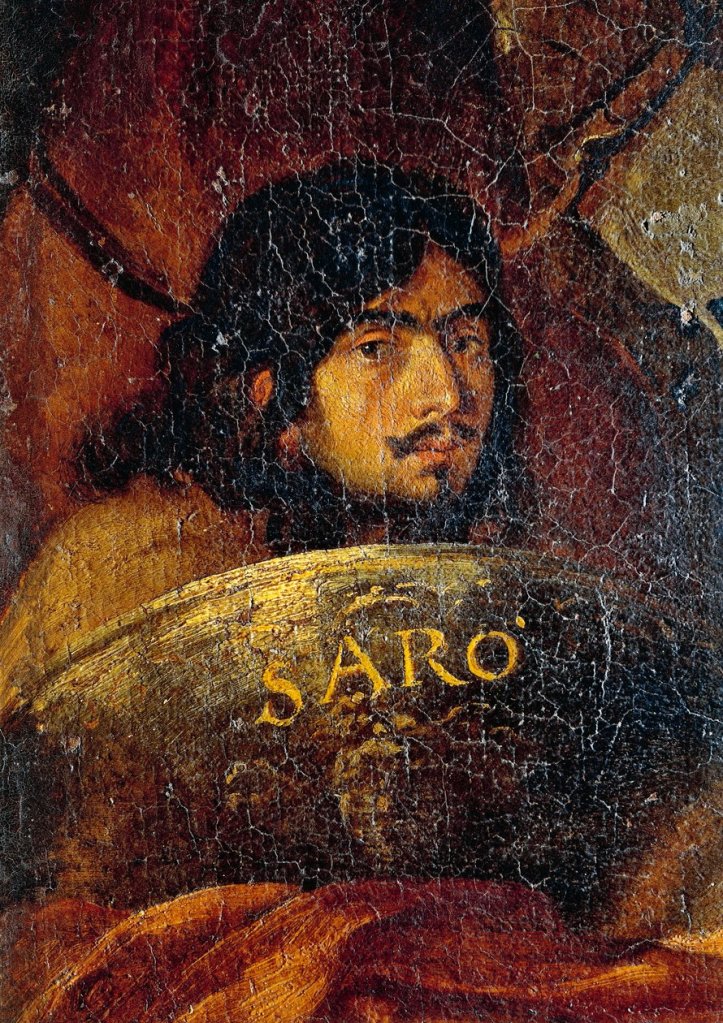
Unlike Rosa’s earlier battle scenes, the composition unfolds across an expansive landscape before the walls of a classical city. Christian cavalry charge against turbaned opponents in a conflict that avoids any precise historical setting. Amid the confusion of horses, weapons and fallen soldiers, Rosa introduced his own likeness in the lower left corner of the canvas. Half concealed behind a fallen horse, he peers over a shield bearing the word SARÒ, “I shall be”, which also forms an anagram of ROSA. The inscription links the painter’s name with an assertion of future presence or endurance, without defining precisely what that promise entails. Rosa enters the picture, yet remains detached from its action, observing rather than fighting and defining his place through the act of representation itself.
Self-Portrait as Pascariello
The identification of this painting as a self-portrait rests upon documentary evidence rather than resemblance alone. Filippo Baldinucci records that Rosa gave his friend and publisher Girolamo Signoretti a portrait of himself dressed as Pascariello and wearing torn gloves. The unusual conjunction of character and costume corresponds so closely to the surviving painting that its identification with the work described by Baldinucci is highly persuasive. The picture is also thought to have belonged subsequently to Leopoldo de’ Medici, whose collection included a substantial group of artists’ self-portraits.
Salvator Rosa, Self-Portrait as Pascariello, c. 1645–49, oil on canvas, 115.5 × 94 cm, The Ramsbury Manor Foundation, on loan to the National Gallery, London. View the image on the NG website:
https://www.nationalgallery.org.uk/paintings/salvator-rosa-self-portrait-as-pascariello
Rosa stands against a plain brown background, wearing a dark coat, a cloak thrown over one shoulder and a soft black berretto cascante pulled low over his hair. The hilt and upper part of a sword appear beneath the cloak. His right hand rests on his hip, bringing the bent arm forward and enlarging the figure’s presence within the canvas. The face is exposed to a concentrated light that defines the long nose, prominent eyebrows, pointed beard and curled moustache. His dark eyes meet the viewer directly. The narrow range of blacks and browns concentrates attention upon the face and hands, while the shallow, undefined setting gives the figure an unusual immediacy.
The torn glove is among the painting’s most distinctive passages and also connects it with Baldinucci’s account. The worn leather is described with loose strokes, and the fingers emerge through rents in the material. It is a small but conspicuous display of painterly freedom: the glove is conveyed through broken touches and variations of brown rather than through a smooth and meticulous finish. The compact darkness of the coat and cloak is similarly relieved by the illuminated flesh and the roughened surface of the damaged leather.
The physical authority of the figure is striking. Rosa gives Pascariello the scale and directness of a substantial portrait rather than treating him as a comic type observed in performance. The hand placed on the hip, the steady gaze and the closeness of the figure establish a commanding presence. At the same time, the berretto, worn glove and partly concealed sword retain the character’s informality. The portrait is imposing without becoming ceremonious. Rosa’s likeness remains sharply individualised, but it is inseparable from the costume and bearing of the role he has assumed.
Pascariello was a comic character associated with Naples, Rosa’s native city. Baldinucci describes Rosa performing the role at gatherings in Florence and using its licence for bold humour to express opinions that might have been more dangerous if delivered directly. Pascariello therefore provided more than a theatrical disguise. The character allowed Rosa to combine satire, social observation and criticism within a form of speech whose audacity could be attributed partly to performance.
These performances belonged to the activities of the Accademia dei Percossi, the informal society founded by Rosa after his arrival in Florence in 1640. Its members included painters, poets, musicians, dramatists and men interested in philosophy and science. Jonathan Scott describes gatherings in which meals, poetry, improvisation and theatrical entertainment accompanied intellectual discussion. The academy’s name, which may be translated as the “struck” or “battered”, was deliberately comic, but its members’ interests extended from performance and satire to ancient philosophy, literature and the study of nature.
The Percossi gave social form to the unusually wide range of Rosa’s ambitions. During these Florentine years he wrote poetry, performed comic roles, developed friendships with men of letters and sought subjects that would demonstrate the intellectual reach of painting. His association with Giulio Maffei and Giovanni Battista Ricciardi joined artistic production to a culture of friendship in which poems, portraits, letters and performances circulated among people who knew one another closely. The portrait of Pascariello belongs to this setting rather than to the theatre alone.
The academy also gave Rosa a degree of independence within the patronal world of Medicean Florence. He had arrived under the protection of Prince Gian Carlo de’ Medici, but the Percossi placed him at the centre of a society of his own making. Rosa was not merely one performer among others. He organised the gatherings and brought together the literary, theatrical and artistic interests that shaped them. The portrait preserves one of the public identities through which he exercised that role.
For members of Rosa’s circle, the painting would have depended upon a double recognition. They knew the features of the painter and had also seen him perform as Pascariello. The costume does not efface Rosa’s appearance, nor does his individual likeness neutralise the theatrical character. Both remain present. Pascariello’s wit, licence and Neapolitan origins become part of the image through which Rosa presents himself to friends who understood the associations of the role.
Baldinucci’s reference to the portrait as a gift to Signoretti adds another dimension to the work. It was not necessarily conceived for an anonymous public or primarily as an assertion of professional status. Like several portraits connected with Rosa’s Florentine friendships, it appears to have passed between people joined by literary and artistic interests. The specificity of the costume would have carried a personal meaning for its recipient, who knew both Rosa and the social world in which Pascariello had been performed.
As Helen Langdon has argued, the portrait parodies the conventions of aristocratic male portraiture. The sword, jutting elbow and commanding gaze suggest the swagger of a gentleman or soldier, while the torn glove turns elegance into comic pretence. Through Pascariello, a recognisably Neapolitan character performed before a Florentine audience, Rosa could present pride, independence and social ambition without abandoning irony. The result is not simply a record of theatrical disguise, but a self-portrait constructed through the unstable boundary between assertion and parody.
The painter and poet
A second Florentine self-portrait presents Rosa through activities that had become inseparable during the 1640s. He turns towards the spectator with a brush and another slender implement held together in his raised hand. The latter has been interpreted differently. Helen Langdon identifies it as a pen, joining painting and poetry, while Jonathan Scott describes it as a dart and connects it with the satirical edge of Rosa’s verse. Both readings place the image within a period when Rosa was seeking recognition not only as a painter but also as a poet and intellectual.
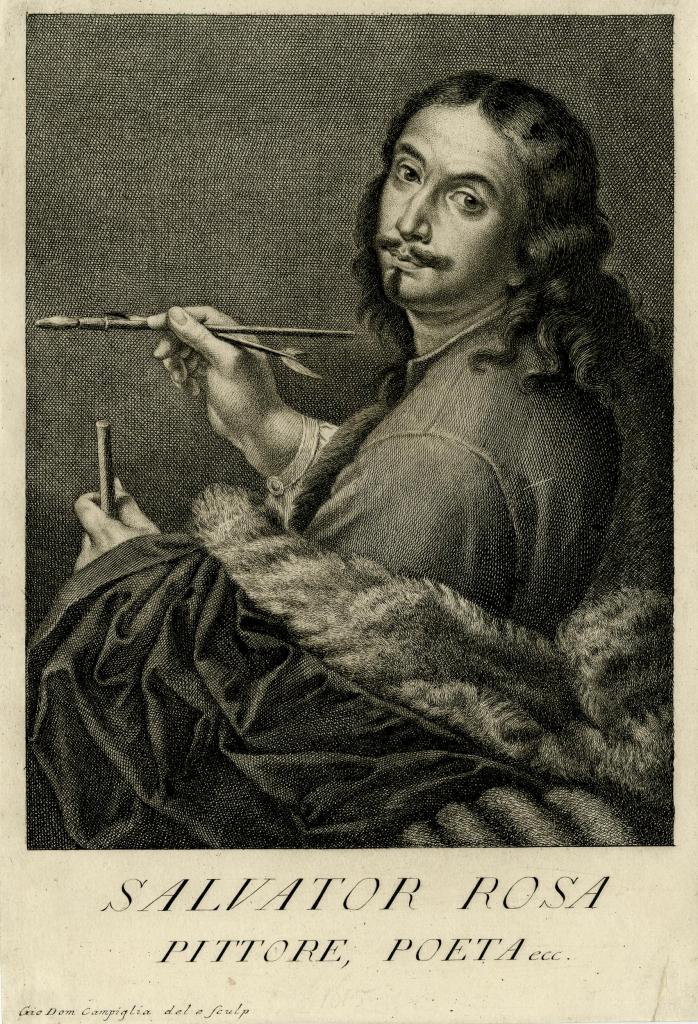
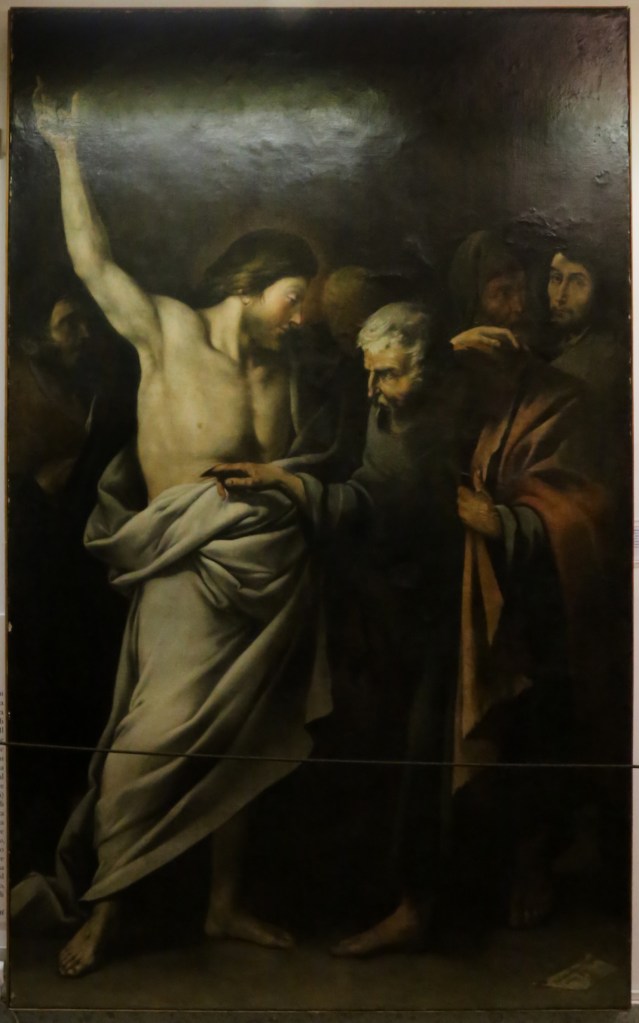
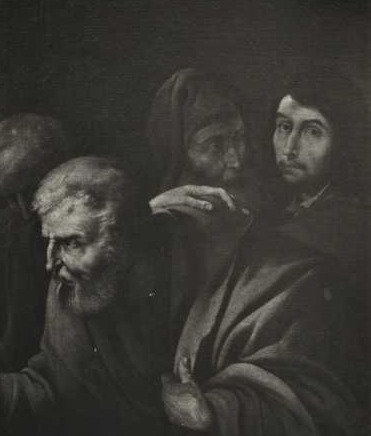
Rosa is shown at half length, turning sharply over his shoulder as though his attention has been drawn away from work. His body remains angled from the viewer, while the head reverses that movement and brings the face into direct contact with us. Thick dark hair falls around his neck, corresponding to the description given by Giovanni Battista Passeri, the seventeenth-century painter and biographer of artists who knew Rosa personally. The lower face is framed by a narrow moustache and beard. A fur-lined garment surrounds the figure with a broad area of brown, its weight and softness set against the more precise articulation of the face and hand. The dark ground removes any identifiable setting, but the turn of the body suggests the momentary action of a painter looking from a mirror or canvas towards an observer. Daprà connects this turning pose with Rosa’s earlier self-insertion in the Incredulità di san Tommaso at Viterbo, where the painter appears behind Saint Thomas and directs his gaze towards the spectator. The comparison suggests that Rosa transferred an expressive device developed within narrative painting into his presentation of himself.
The portrait is more relaxed than Pascariello. The earlier image confronts the viewer through an upright stance, a hand planted on the hip and the firm geometry of dark costume. Here the body is wrapped rather than fitted, and the turning movement gives the figure greater ease. Rosa turns from his easel towards the spectator with an alert but difficult-to-define expression. Langdon connects the gesture with the convivial life of the Maffei circle, interpreting it as an invitation to share in the pleasures of that company. The turning pose establishes contact with the spectator, while the close grouping of his face, hand and implements keeps the image focused upon his identity as an artist.
The objects held in Rosa’s hand condense two forms of work that occupied him in Florence. The brush identifies painting, while the second object is more difficult to identify. A later engraving after the portrait describes it as a quill and gives the artist the designation “Pittore, Poeta”. Langdon’s interpretation therefore has an early visual and textual precedent. Scott’s reading of the object as a dart, however, gives it a sharper significance: the instrument would allude to the satires through which Rosa directed attacks against artistic incompetence, corruption and the compromises of court life. The object is narrow enough to sustain the uncertainty, and the two interpretations need not lead to entirely opposed accounts. Whether pen or dart, it associates literary expression with the hand that holds the painter’s brush.
The portrait belonged to the Maffei family of Volterra. Scott records that Rosa presented it to them and that they gave it to Grand Duke Cosimo III in 1681. Its history therefore connects the image with a particular group of friendships rather than with an impersonal claim to artistic distinction. The Maffei preserved works made during the years when Rosa stayed at their villas at Barbiano and Monterufoli, including paintings of philosophical subjects, small theatrical scenes and decorations executed directly within the house. The self-portrait formed part of this body of work before entering the Medici collection.
Rosa travelled to the Maffei estates with Giovanni Battista Ricciardi and other members of the Florentine circle. Removed from court life, they read, wrote, drew, dined and discussed philosophy in a landscape of wooded hills and strange rock formations near Volterra. Langdon describes these visits as a rural continuation of the society formed around the Percossi. They offered companionship without the formality of a court and solitude without complete withdrawal from friendship. Rosa drew constantly, while the surrounding country contributed to the development of the rugged landscape forms that Langdon calls his aesthetic of orrida bellezza.
A letter from Ricciardi to Ascanio della Penna records the mixture of sociability and retreat cultivated there. The friends read philosophy among water, rocks and woodland, satirising the world from the apparent distance of the mountains. The letter accompanied a drawing in which Rosa represented himself as a hermit beside another young man writing upon a rock. Above them appeared the words Hic aevi mihi prima dies, “Here begins the first day of my life”. The phrase casts their departure from the city as a form of renewal, although the solitude remained shared and consciously literary. Langdon compares the drawing with Nicolas Poussin’s Et in Arcadia Ego, since both combine an inscribed stone, human figures and a landscape of philosophical reflection. Rosa’s image is nevertheless very different in mood: its inscription announces renewal, while the rugged setting replaces Poussin’s ordered Arcadia with wilderness and creative retreat.
The Maffei provided Rosa with a setting in which his different activities could be exercised together. Scott calls this the happiest period of his life. At Barbiano the family preserved chalk sketches made on the walls, paintings and the decorated lid of a harpsichord. When told that the instrument was out of tune, Rosa reportedly replied that, although useless, he would make it worth at least one hundred scudi. Inside the lid he painted a singing skull with its jaws open beside a music book and loose sheets. The anecdote places painting, music, wit and friendship within the same domestic setting as the self-portrait.
The portrait was therefore both a statement about Rosa’s abilities and a record of the society in which they flourished. Painting and poetry are joined in the raised hand, but the fur-lined garment, turning pose and responsive expression prevent the image from becoming a diagram of artistic accomplishments. Its manner is closer to conversation than proclamation. Langdon interprets it as a gift to the Maffei and as a recollection of creative companionship at Monterufoli. The recipient would have understood the brush and pen, or brush and dart, through direct knowledge of Rosa’s paintings, poems, performances and conversation.
Rosa later attempted to persuade Giulio Maffei to preserve “the memory of our triumvirate”, meaning the friendship shared by Rosa, Maffei and Ricciardi. The phrase gives particular weight to portraits made within this circle. They did not merely record isolated individuals; they belonged to relationships maintained through visits, letters, poems, drawings, food and gifts. In Self-Portrait as an Artist, Rosa presents the union of painting and literature not as an abstract theory of the arts, but as a life practised among friends.
Philosophy
The painting now titled Philosophy has long been associated with Rosa’s appearance, but it is better understood first as an allegorical figure and only secondarily as a possible self-image. The inscription on the reverse identifies it as Rosa’s own portrait, painted for the Niccolini household in Florence, yet the wording is later than the canvas and cannot establish its original conception. Wendy Wassyng Roworth also notes that a seventeenth-century description of the Niccolini collection referred more generally to pictures of philosophers, while the first explicit identification of the man as Rosa dates from the Florentine exhibition of 1767. Rosa may have used his own features, but the image was not devised simply to preserve his appearance.
The figure appears at half length against a muted background, wearing a scholar’s cap and a heavy brown gown wrapped closely around his body. The folds form a broad, compact mass whose smooth solidity has been compared by the National Gallery to a sculpted Roman bust. His head turns slightly, while his eyes meet the spectator with severe and distrustful intensity. Cold light falls across one side of the face, leaving the other in shadow and accentuating the long nose, irregular hair, unshaven cheek and deeply furrowed brow. The firmly closed mouth gives visual form to the subject announced by the tablet he holds before him.
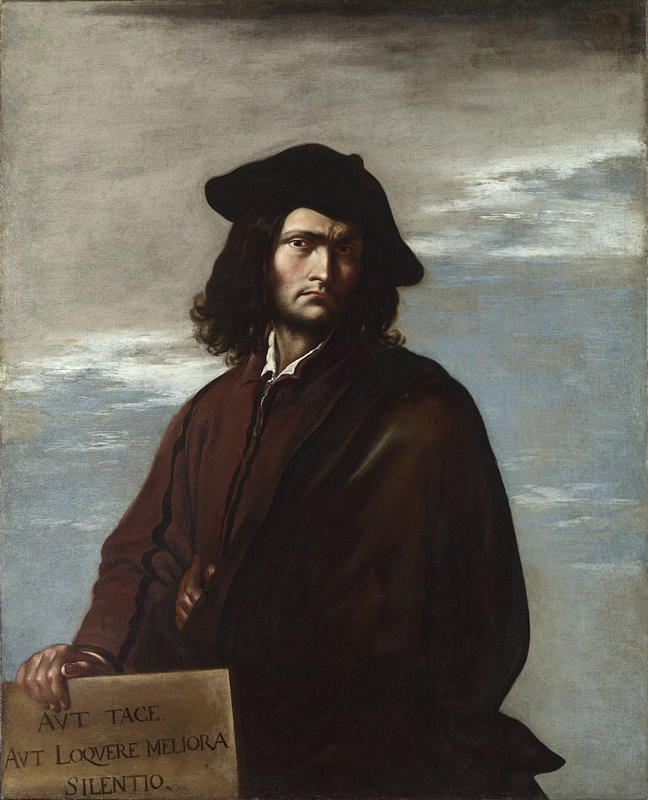
Philosophy
about 1645
Oil on canvas, 116.3 x 94 cm
Presented by the 6th Marquis of Lansdowne in memory of his father, 1933
NG4680
https://www.nationalgallery.org.uk/paintings/NG4680
The inscription reads AUT TACE / AUT LOQUERE MELIORA / SILENTIO: “Keep silent, or say something better than silence.” Eckhard Leuschner has shown that the phrase is not merely a general proverb. It is Rosa’s Latin adaptation of two closely related sayings preserved in the Anthologia of Stobaeus, one attributed explicitly to Pythagoras and the other expressed in the imperative form adopted by the painting. Rosa does not appear to have copied a single published translation. He combined and reshaped the material into a concise motto suited to the tablet and to the figure who presents it.
The inscription therefore works at several levels. Any spectator could understand it as an injunction against idle or worthless speech. A more learned viewer might associate silence with the discipline imposed upon the followers of Pythagoras, and perhaps also recall the ancient tradition that credited Pythagoras with introducing the word philosophy. A still smaller circle could have recognised the source in Stobaeus and appreciated Rosa’s manipulation of an unusually recondite classical text. The maxim may even have functioned as a private signal to one of the learned friends among whom Rosa’s philosophical interests developed.
Silence is not presented as passivity. Rosa himself described it paradoxically as a virtue capable of proclaiming its own glory more eloquently than speech. The painting embodies that idea. The tightly closed lips and contracted brow enact restraint, while the tablet makes restraint conspicuously articulate. The figure says nothing, yet the work speaks in words and displays the learning required to formulate them. Philosophical modesty and intellectual self-assertion are held together rather than separated.
This paradox also clarifies the painting’s relation to Rosa’s identity. Ubaldo Meroni argued that the sitter must be Giovan Battista Ricciardi, partly because Ricciardi was learned and habitually taciturn whereas Rosa was famously talkative. The psychological argument is too literal to be decisive. A talkative painter could present silence as an ideal precisely because it was a discipline rather than a natural condition. More importantly, Leuschner’s evidence shows that Rosa was deeply engaged with Pythagorean subjects and wished to be associated with Greek learning, whether he encountered the texts directly or with the assistance of friends. The motto therefore suits the intellectual identity Rosa cultivated even if the face is not accepted as a straightforward likeness.
The painting is restrained almost to austerity. The scholar’s tightly wrapped mantle reinforces the ideal of philosophical reserve. Together with the inscription advocating silence, it presents philosophy not simply as a field of learning but as a disciplined moral practice. The containment of the figure, the absence of distracting attributes and the economy of gesture all contribute to this impression of self-command.
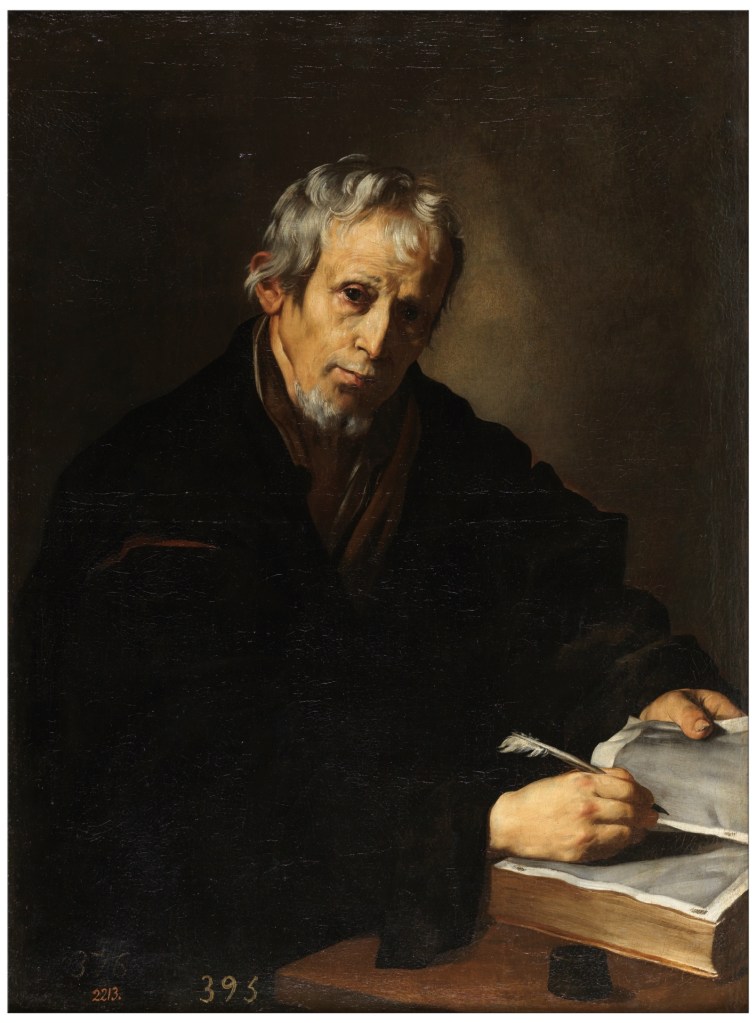
The restricted palette of browns and greys is enlivened chiefly by the pallor of the face and hands and by the lighter surface of the tablet. As Brigitte Daprà observes, the contrasts of light and shadow are softer than those of the half-length philosophers painted by Jusepe de Ribera in Naples, while the more refined colour reflects Rosa’s immersion in Florentine painting, particularly the circles of Lorenzo Lippi and Cesare Dandini. Rosa retains Ribera’s conception of the philosopher as a physically immediate presence, but removes the ragged costume and emphatic naturalism found in many of the older painter’s figures.
The result is neither an idealised ancient sage nor an ordinary contemporary sitter. The disordered hair and unshaven face resist courtly refinement, but the tightly organised silhouette gives the figure monumental authority. Where Pascariello occupies the canvas through stance, costume and direct social encounter, Philosophy withdraws behind a judgement upon speech. The tablet stands between figure and spectator, converting the encounter into a test: communication is justified only when it surpasses silence.
The picture belonged to Filippo Niccolini, tutor and later chamberlain to Prince Gian Carlo de’ Medici, and was paired with the painting now called Poetry in the Wadsworth Atheneum. The two canvases share their early Niccolini history, dimensions and half-length format, although their colour and settings differ markedly. Roworth stresses that the later inscriptions identifying the figures as Rosa and his mistress are confused and probably added to increase the interest of the pair. The male and female models may have drawn upon Rosa and Lucrezia Paolini; however, their personal identities, if present, remain subordinate to the allegories they embody.
Daprà relates the pendants to the ancient comparison of painting and poetry: painting as poesia muta, mute poetry, and poetry as pittura parlante, speaking painting. Philosophy praises silence through a written sentence and thus becomes a mute image that speaks. The companion Poetry holds the instruments through which language might be produced but contains no written verse. The pair does not divide neatly into silence and utterance, but explores the different ways in which word, image and restraint can become expressive.
The conception belongs closely to Rosa’s Florentine years. The Accademia dei Percossi joined poetry, dramatic performance, learned conversation and the visual arts, while Rosa’s friendships with Ricciardi, Giulio Maffei and Niccolini encouraged his engagement with ancient philosophy. The comic licence of Pascariello allowed difficult opinions to be voiced through performance; the tablet in Philosophy proposes an apparently opposite standard in which speech must prove itself superior to silence. These identities are not contradictory. Together they reveal the range of positions Rosa could test through self-presentation and allegorical figure painting.
Rosa’s interest in philosophical subjects extended well beyond this allegory. During the same Florentine period he painted assemblies of ancient thinkers in wooded landscapes, including the Selva dei filosofi in the Palazzo Pitti. Daprà has noted a resemblance between Rosa and a bearded figure in that painting, suggesting that he may have imagined himself as a follower of Diogenes. In later works, he returned more explicitly to individual philosophers, representing Diogenes discarding his bowl after seeing a boy drink with his hands and Democritus meditating among tombs and fragments of human and animal remains. Philosophy therefore belongs to a sustained enlargement of the painter’s identity rather than to an isolated experiment in costume.
The classification of the work as a self-portrait is therefore understandable but should remain qualified. Roworth observes that the face differs noticeably from Rosa’s secure Florentine self-images: it is longer, narrower and more ascetic, with little facial hair. It may be another sitter, or an invented philosopher whose features incorporate something of the artist. In either case, likeness serves an intellectual construction. The painting presents Philosophy not as an abstract emblem but as a difficult human presence, simultaneously silent, admonitory and conspicuously learned.
Daprà suggests that the painting may have influenced the young Luca Giordano, whose Self-Portrait as a Philosopher of the early 1650s similarly presents a brown-robed figure displaying an inscribed tablet. The comparison indicates how quickly Rosa’s conception could become a model for a new kind of artistic image: not merely the likeness of a painter, but the painter, or a figure based upon him, represented as a participant in philosophical life.
Poetry
The companion to Philosophy is securely documented as an allegory of Poetry, although the identity of the woman who served as its model remains uncertain. On 19 September 1641 Filippo Niccolini paid Rosa for two large landscapes and two half-length figures, which Helen Langdon identifies with the present pair, and a Niccolini inventory of 1658 lists the paintings together as Philosophy and Poetry. Their allegorical subjects therefore belong to their early history and do not depend upon the later inscriptions on the reverse.
A young woman appears at half length, turning towards the spectator while holding a book in one hand and a pen poised for writing in the other. Laurel is woven into her dark, freely falling hair. Pen, book and wreath correspond to the conventional attributes of Poetry described by Cesare Ripa, but Rosa avoids an elaborate emblematic apparatus. The figure is established through a few immediately legible objects and through the concentration of face, hands and interrupted action.
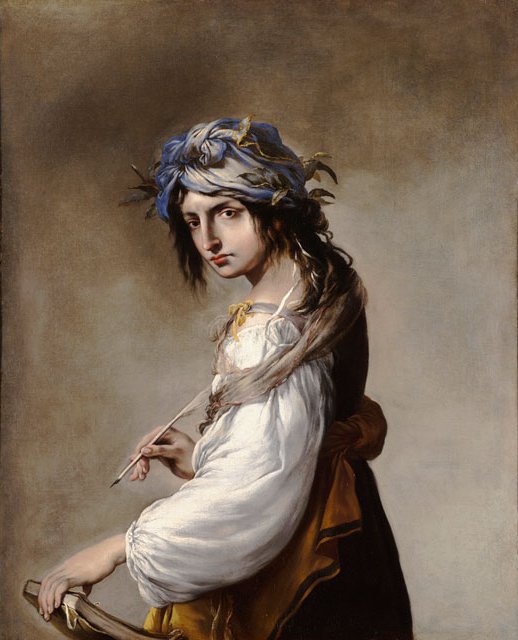
Her presence is direct but not welcoming. The dark eyes meet the spectator with an expression Langdon describes as both challenging and withdrawn. The head turns towards us, while the pen remains suspended above the book, as though composition has been interrupted but not abandoned. There is little suggestion of graceful inspiration or decorative reverie. Langdon remarks that this Poetry appears more likely to be composing satire than pleasing verse, a perception that connects her severity with Rosa’s own developing literary ambitions.
The painting is much richer in colour than its companion. Cool greys, blues and lilacs move through the garments, and Langdon praises the luminous harmonies and brilliance of Rosa’s handling. The folds open around the figure in broader and more varied passages than the compact brown mass of Philosophy, while the loose curls, laurel wreath and slightly disordered clothing give the figure a less contained silhouette. Daprà describes this combination as distinctly picturesque. Colour does not make the image light-hearted, however. Its brilliance intensifies a presence that remains sombre and psychologically guarded.
Daprà draws particular attention to the contrast between the pendants. The brown robe of Philosophy is associated with silence, while the clothing of Poetry appears almost to speak through colour. Yet the opposition is not simply one of silence against expression. Philosophy contains actual language and pushes its verbal injunction towards the viewer. Poetry possesses the pen and book from which language might emerge, but no words are visible. The philosopher speaks through a painted text; Poetry remains silent at the instant before writing.
The Pythagorean source of the London inscription sharpens the relationship. Philosophy advocates control over speech and presents silence as a learned discipline. Poetry represents the activity that must justify breaking that silence. The poised pen makes composition appear not as effortless inspiration but as the production of words that must earn the right to exist. The sternness of the figure is therefore central to the allegory. Poetry is an exacting intellectual and moral practice rather than an ornamental accomplishment.
The differences in background and colour have sometimes raised doubts about whether the two canvases were conceived as pendants. Philosophy appears enclosed within a dark and indeterminate space, whereas Poetry is set against a lighter, more open background. Their documentary history nevertheless establishes their relationship, and Langdon argues that they are also united by mood. Both are isolated half-length figures, both confront the spectator directly, and both resist easy communication. The pair depends upon tension rather than visual symmetry.
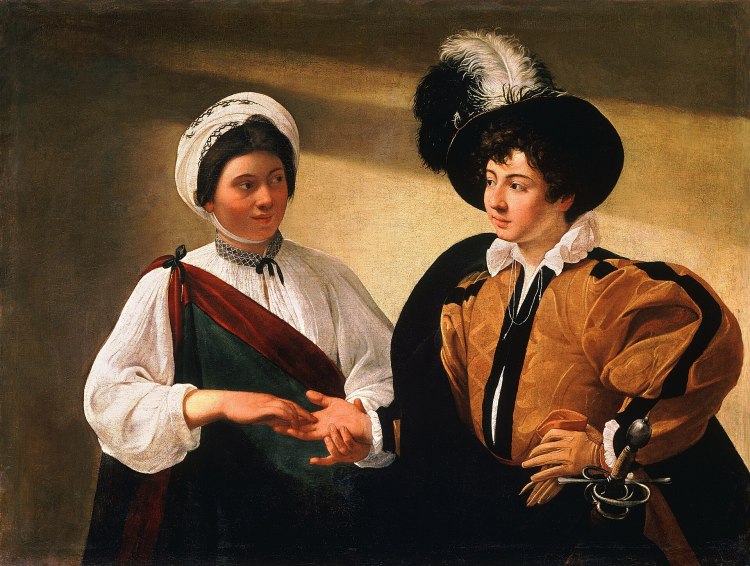
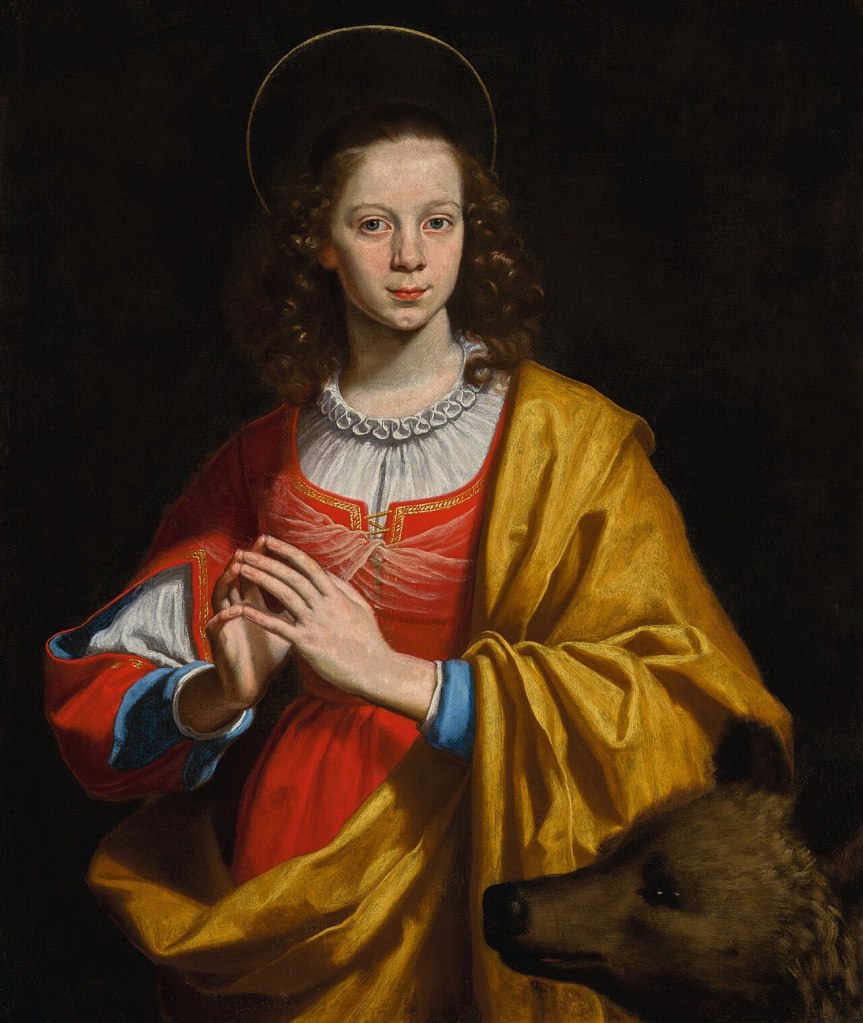
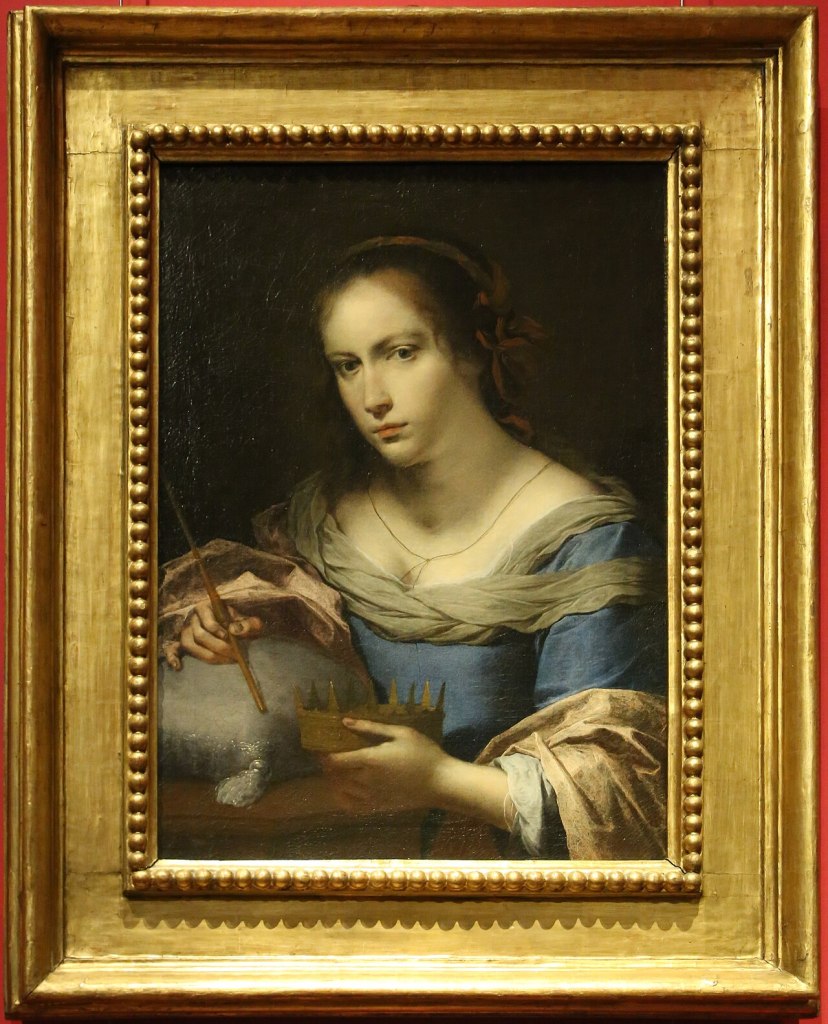
The painterly language of Poetry brings together Rosa’s Neapolitan formation and his recent experience of Florentine art. Langdon traces its naturalism ultimately to Caravaggio’s Fortune Teller: like Caravaggio’s young woman, Poetry appears as an observed contemporary presence caught in the midst of an action rather than as a remote classical ideal. The direct gaze, individualised features and suspended hand give the allegory an immediacy that exceeds its attributes. At the same time, the clearer contours and refined colour reflect Rosa’s response to half-length female allegories by Lorenzo Lippi, Giovanni Martinelli and Cesare Dandini. Daprà similarly relates the pair to Ribera’s philosopher paintings while noting the softened chiaroscuro and increased refinement of Rosa’s Florentine manner.
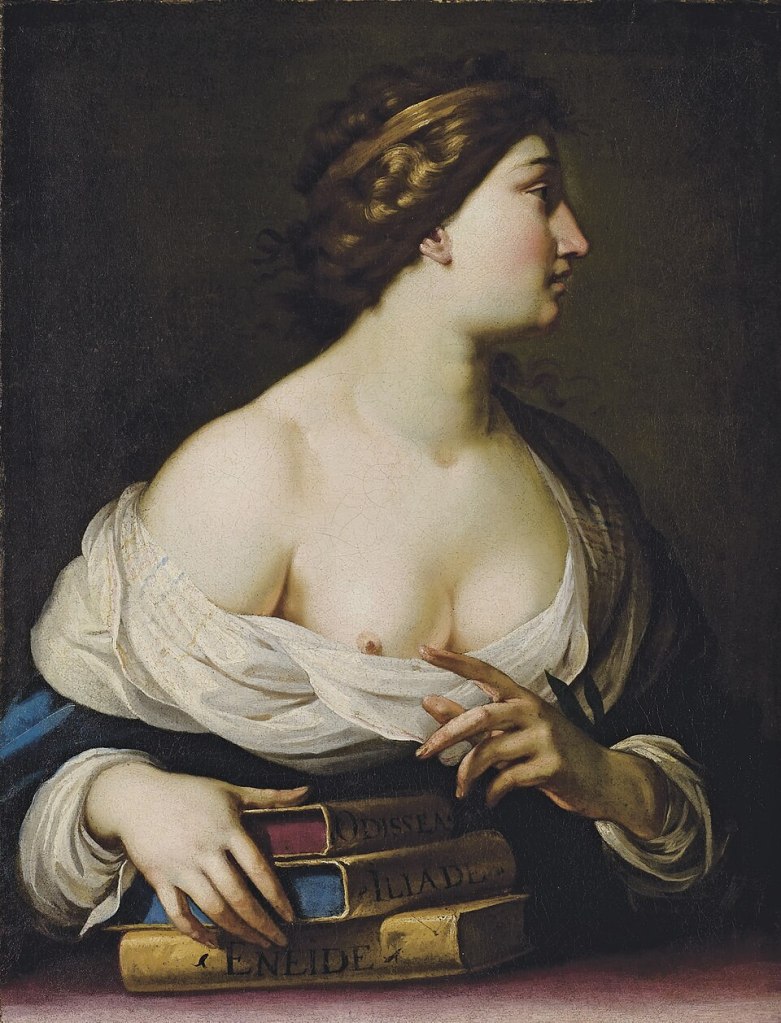
The painting has often been called Lucrezia as Poetry. Rosa met Lucrezia Paolini soon after arriving in Florence, and Giovanni Battista Passeri records that she sometimes served as his model. Their first child was born in 1641, and she remained Rosa’s companion until his death. The association is therefore plausible, but it is not documented by the painting’s early records. The later inscription calls the woman “La Ricciardi”, confuses her with Rosa’s male friend Ricciardi and describes the subject incorrectly as a Sibyl. Roworth sees such confusion as part of the later transformation of the pendants into a Romantic story of artist and mistress.
Passeri’s testimony prevents Lucrezia’s possible involvement from being dismissed, but the question is one of modelling rather than secure portraiture. Rosa may have drawn upon her features while altering them to meet the demands of the allegory. Even if Rosa and Lucrezia are present in the pendants, they appear as the human material of Philosophy and Poetry rather than simply as themselves.
The association of painting and poetry was especially important to Rosa. During the Florentine years he began to define himself publicly as more than a painter, writing satire, reciting verse and organising performances in which literary and pictorial identities overlapped. The Hartford allegory does not present poetry as a courtly pastime. Its stern gaze and arrested gesture give composition the character of work. The book is a working surface, and the pen is held with purpose. Poetry appears capable of moral criticism and satirical attack as readily as praise.
The relationship between the pendants also clarifies the range of Rosa’s Florentine self-presentation. Pascariello uses comic performance and licence; the Uffizi self-portrait joins the brush to a pen or dart; Philosophy demands disciplined speech; Poetry holds language in suspension before it is committed to the page. Whether or not the Hartford figure preserves Lucrezia’s appearance, it belongs to a society in which poetry, painting, philosophy and friendship were understood as related forms of intellectual action.
The portrait made for Ricciardi
The painting in the Metropolitan Museum of Art has traditionally been regarded as one of Rosa’s most elaborate self-portraits. Federico Zeri, Ubaldo Meroni and Jonathan Scott instead identified the sitter as Giovan Battista Ricciardi, Rosa’s closest Florentine friend. Neither position can now be treated as secure. The uncertainty is unusually significant because the painting is concerned with friendship, mortality and philosophical reflection. Whether Rosa represented himself for Ricciardi or represented Ricciardi himself changes the biographical emphasis, but not the intellectual and emotional world to which the image belongs.
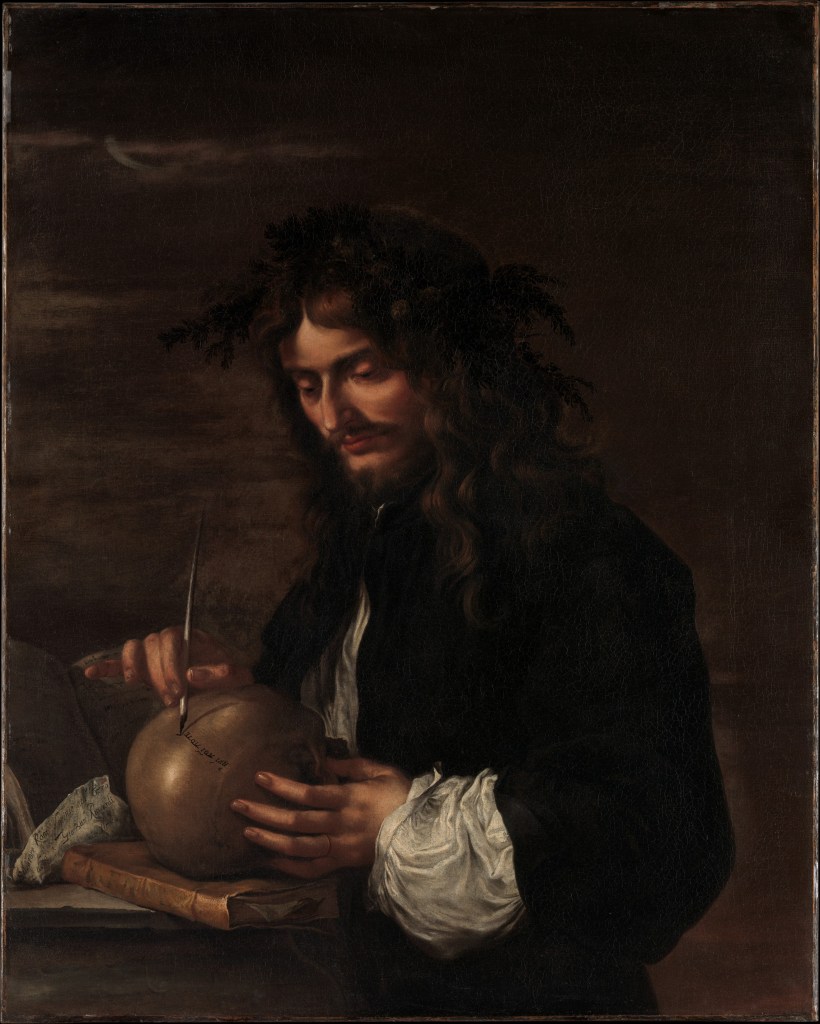
The sitter is shown at half length, seated behind a table and turning his face towards the spectator. His long dark hair falls around his shoulders, and a thin moustache and beard frame the lower part of the face. A wreath of cypress branches rests upon his head. One hand supports a human skull placed on a large book, while the other writes Greek words across the skull’s forehead. A single tear is visible on the sitter’s right cheek. The objects are arranged close to the picture plane, so that the skull, book, hand and inscriptions form a compact field of signs beneath the face.
The restricted colouring contributes to the painting’s gravity. Browns and blacks dominate the clothing and background, relieved by the pale surfaces of the face, hands, paper and bone. The cypress wreath is dark and dry rather than luxuriant, and its narrow leaves break irregularly against the sitter’s hair. The skull receives a stronger light than the surrounding objects, making its smooth, exposed surface the visual centre of the lower half of the painting. Rosa distinguishes the texture of bone, paper, hair and cloth without allowing the still-life elements to detach themselves from the sitter’s meditation.
The figure’s expression is difficult to define. The lowered eyebrows and concentrated gaze suggest intellectual absorption, but the tear prevents the image from becoming an impersonal demonstration of Stoic composure. Sorrow has not overwhelmed the sitter, yet neither has philosophical reflection removed it. The hand continues to write while the face acknowledges grief. Emotional vulnerability and intellectual discipline are held together rather than presented as simple alternatives.
On the skull Rosa writes three Greek words, translated variously as “Look. Whither? When?” and “Behold, whither, when.” Their compressed grammar resists a single fluent English rendering. The phrase directs attention towards the skull, the destination towards which human life moves and the unknown moment of death. Rather than explaining the symbolism, it confronts the spectator with mortality as both a universal end and an event whose time remains concealed.
The volume beneath the skull once bore the name of Seneca. Cleaning revealed that the word survives as a pentimento beneath Rosa’s own overpainting. Seneca’s writings provided an important model for early modern reflection upon fortune, the brevity of life and preparation for death, but the alteration warns against reading the picture as a straightforward illustration of Senecan doctrine. The tear and funeral wreath introduce lived grief into the philosophical meditation, while the suppression of the name may indicate some reservation about the adequacy of Stoic consolation.
Cypress had long been associated with death and mourning. Here it functions as a funeral crown, replacing the laurel that appears in Rosa’s allegories of poetry and artistic achievement. The sitter is not crowned as a victorious poet but marked as one who confronts the proximity of death. The contrast with Rosa’s laurel-wreathed figures is especially telling. Both crowns identify an intellectual condition, but cypress turns authorship and reputation towards the question of what, if anything, survives the individual life.
A sheet of paper beside the skull records that Rosa painted the work “at the hermitage” and gave it to Giovan Battista Ricciardi. The phrase “nell’Eremo” has been interpreted in sharply different ways. Meroni and Scott connect it with the Tuscan retreats shared by Rosa, Ricciardi and Giulio Maffei, perhaps at Monterufoli, Barbiano or Strozzavolpe, and Scott favours a date around 1648. In this reading, the painting belongs to a culture of philosophical retirement in which withdrawal from court and city was combined with reading, conversation, drawing and companionship.
Wendy Wassyng Roworth proposed a substantially later origin. She dated the work to the end of 1656 or early 1657, after the deaths of Rosa’s son Rosalvo, his brother Giuseppe and his friend Giulio Maffei. For Roworth, “the hermitage” describes Rosa’s isolation in Rome rather than a literal country residence. She interprets the painting as a response to a consolatory poem addressed to Rosa by Ricciardi and as a work closely related in conception to Human Frailty. Roworth identifies this poem with an ode that Rosa praised in August 1656, although it had previously been associated with a letter of 1652. Her chronology is therefore plausible but not demonstrable: it depends upon that redating of the poem and upon a metaphorical reading of eremo. It nevertheless gives particular force to the tear, the overpainted name of Seneca and the act of writing upon the skull.
The case for Ricciardi as sitter rests upon unusually specific evidence. Ricciardi’s posthumous inventory records a large painting of a philosopher writing upon a skull. More importantly, Giovanni Cinelli Calvoli, who knew both men, described a painting in which Ricciardi appeared in philosophical dress contemplating a human skull and transcribed the dedication found on the Metropolitan canvas. Meroni regarded this as conclusive, and Scott developed the same identification.
Roworth nevertheless showed that the documents do not settle the question. The inventory calls the sitter only a philosopher and records a separate portrait of Ricciardi. Cinelli does not mention the distinctive action of writing upon the skull, and it is uncertain whether he had seen the painting himself or repeated information received from others. Most strikingly, Ricciardi’s descendants exhibited a work identifiable as the Metropolitan painting as Rosa’s self-portrait in 1706, 1729 and 1767. These descriptions belong to the family that owned the picture and create a serious counterweight to Cinelli’s testimony.
The physiognomic evidence is similarly divided. The sitter’s prominent nose, full lips, deep-set eyes and long curling hair have been compared with Rosa’s recognised self-images in the Pitti Battle, the Uffizi portrait, the Incredulity of Saint Thomas and Giovanni Battista Bonacina’s engraved portrait of him.
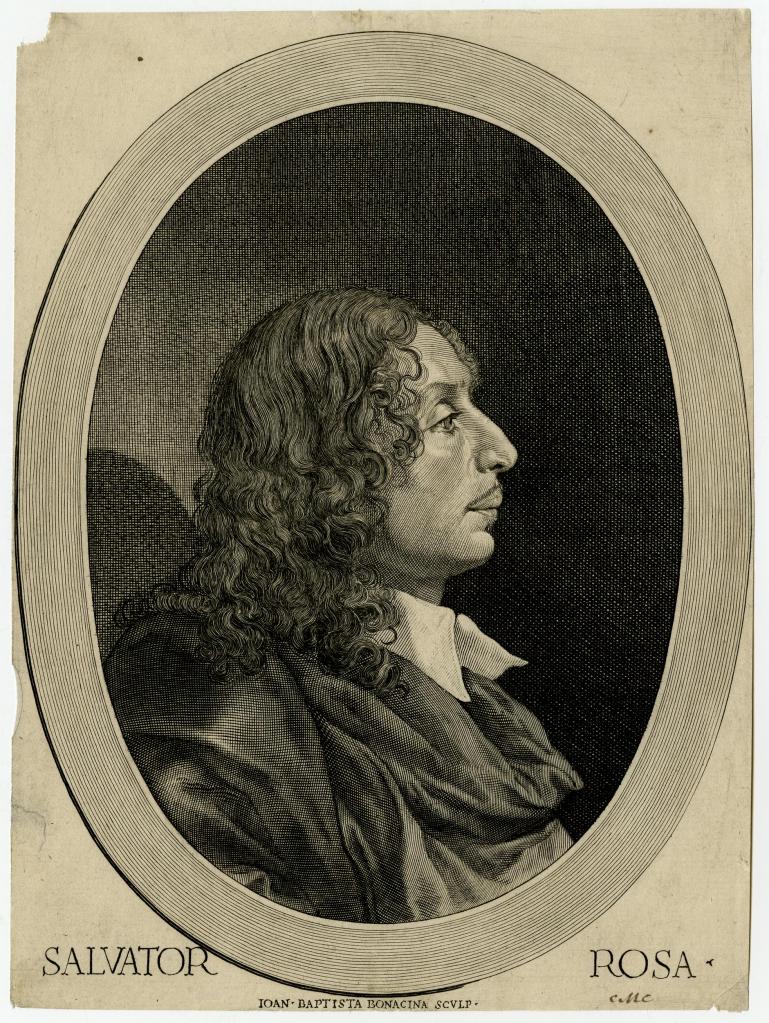
Roworth regarded the Metropolitan figure as an older and more emaciated version of the same man. Meroni and Scott instead understood the features as Ricciardi’s and emphasised the suitability of the Greek inscription and philosophical attributes to a scholar who regularly assisted Rosa with classical sources.
The argument that Rosa could not have presented himself writing Greek is less persuasive than it once seemed. His exact competence in the language remains uncertain, but his letters, poems and paintings show a sustained desire to engage with Greek literature and to be recognised as a learned artist. He could also draw upon Ricciardi and other humanist friends, as well as Greek-Latin editions and translations. The presence of Greek therefore suits the intellectual culture shared by the two men and cannot by itself determine the sitter’s identity.
Roworth interprets the painting as a friendship portrait made for an absent Ricciardi. On this reading, Rosa offers his own image as a substitute for physical presence. The composition is unusual because the sitter does not pose directly for the recipient but remains absorbed in writing, as though seen through Ricciardi’s eyes. The tear belongs not only to conventional melancholy but to an exchange between friends conscious of separation and loss.
Roworth’s proposed connection with Human Frailty also gives new importance to writing. In the portrait, the sitter writes upon the skull while books, the dedication and other forms of script surround his hands. In Human Frailty, the infant writes a statement about birth, labour and death while the skeleton personifying Death controls his arm. In the portrait, the adult writer attempts to give mortality intellectual form; in Human Frailty, Death physically directs the production of the words. Even without accepting that the paintings were conceived together, the contrast clarifies Rosa’s interest in writing as an activity through which grief could be confronted but not overcome.
The painting may have encouraged conflicting identifications because Rosa’s artistic and intellectual identity had developed so closely through his friendship with Ricciardi. Ricciardi recommended books, supplied subjects, explained classical sources and commented upon Rosa’s poetry. Rosa, in turn, gave visual form to the philosophical and literary interests they shared. A portrait of Ricciardi devised by Rosa could consequently resemble a self-image in conception, while a self-portrait intended for Ricciardi could embody qualities cultivated through their friendship.
The friendship was unusually intense. Rosa’s letters to Ricciardi are more emotionally open than much of his other correspondence. He described writing without carefully choosing his words, following instead the first impulses of imagination and affection. The relationship could also become strained and possessive, particularly when Ricciardi felt displaced by Rosa’s friendship with the Maffei. Yet Rosa continued to value his intellectual companionship and eventually reserved for Ricciardi the privilege of proposing subjects for paintings.
Rosa’s conception draws upon two closely related strands of Neapolitan painting: the naturalistic representation of philosophers and the imagery of hermits contemplating skulls, both strongly associated with Jusepe de Ribera. The half-length format, concentrated illumination and physical immediacy of the skull recall that inheritance. Yet Rosa replaces Ribera’s often anonymous ancient sages with a figure embedded in a documented contemporary relationship. Philosophy becomes not only a subject inherited from earlier painting but an activity practised between friends.
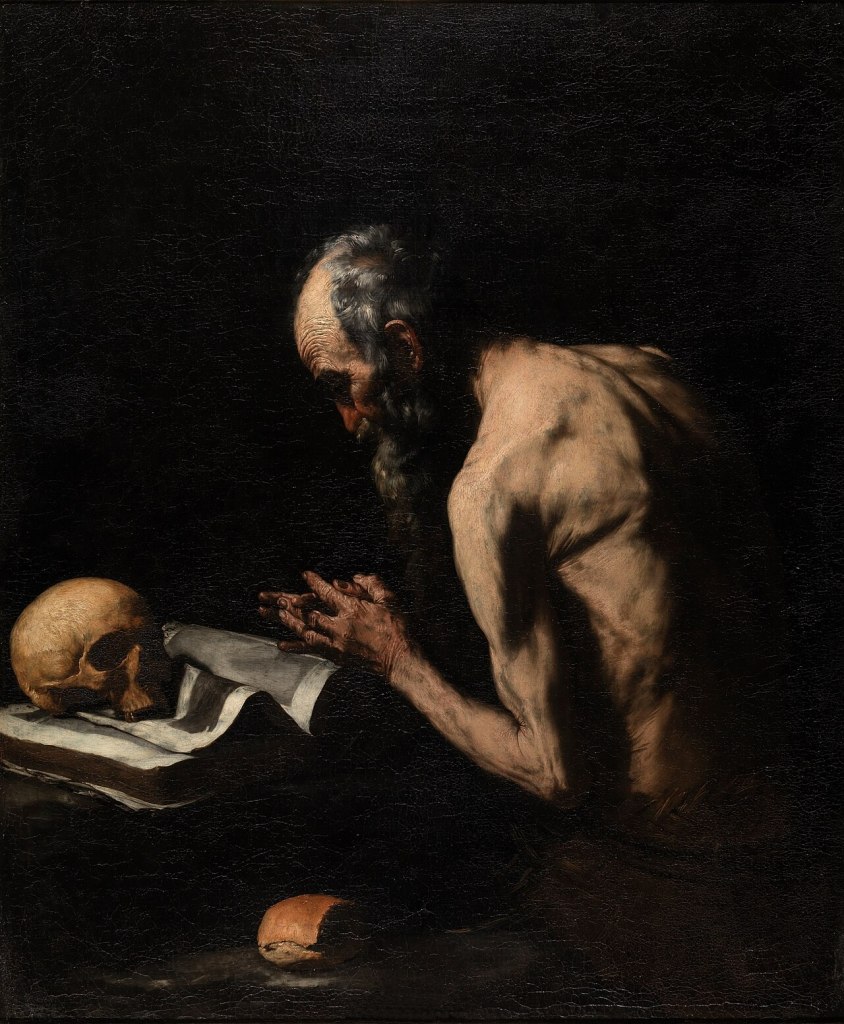
The evidence therefore remains balanced rather than merely deficient. Cinelli Calvoli’s description strongly favours Ricciardi, while the early exhibition history within the Ricciardi family and the resemblance to recognised likenesses of Rosa sustain the traditional identification. The painting’s meaning does not depend upon forcing a final decision. Its objects are too carefully chosen for it to function as a simple likeness, but the emotional specificity of the face prevents it from becoming an abstract personification. Whether the sitter is Rosa or Ricciardi, the work gives visible form to a friendship in which philosophical study, literary collaboration and personal attachment had become inseparable. Mortality is contemplated not in isolation, but through the memory and imagined presence of another person.
Head of a Man in a Turban
After the elaborate philosophical imagery of the Metropolitan Museum portrait, the Head of a Man in a Turban presents a more ambiguous kind of likeness. The sitter has sometimes been identified as Rosa himself, but there is no documentary evidence that the picture was intended as a self-portrait. Helen Langdon instead places it among Rosa’s teste di fantasia: expressive heads that might draw upon observed faces, including his own reflection, without representing a particular person. Brigitte Daprà similarly regards the identity of the model as less important than Rosa’s transformation of him into an idealised philosopher or cultivated man.
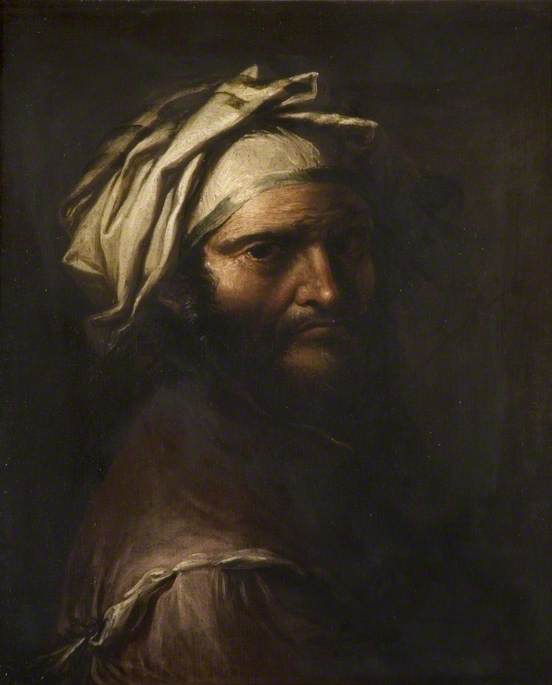
The man is shown close to the picture plane, his head turned slightly while his eyes look outward towards the spectator. A loosely wound turban rises above his forehead, its folds catching the light and creating a broad, irregular silhouette. Dark hair and a short beard frame the face. The figure wears a garment whose folds gather around his shoulders, but little of the body is visible. Rosa concentrates attention upon the head, the changing fall of light across the cloth and the sitter’s searching expression.
The composition is simple, but the paint handling gives it considerable variety. Light moves unevenly across the turban, picking out ridges and hollows before dissolving into the darker background. The cloth is not described through hard contours. Its structure emerges from broad strokes, broken highlights and passages in which one fold appears to merge into another. The face is more closely modelled, although here too Rosa avoids a polished finish. The cheek, brow and beard are built from small shifts of light and colour that preserve a sense of movement within the surface.
Langdon suggests that the picture may have begun as a study of illumination falling upon a turban and richly folded cloth. Rosa might have transformed such an exercise into something more suggestive. The half-shadowed face and loosely described costume give the man an air of distance, as though he has been interrupted in thought. No book, inscription or philosophical attribute explains his identity. His character is conveyed through expression, bearing and costume rather than through a developed allegorical programme.
The turban does not necessarily identify the sitter as a member of a particular ethnic or religious group. In seventeenth-century painting it could suggest the ancient world, the eastern Mediterranean or a more general remoteness from contemporary European society. Rosa used similar head coverings for philosophers, soldiers and unidentified figures. The costume removes the man from ordinary social portraiture and allows him to appear as an imagined type whose place and time remain uncertain.
Such ambiguity distinguishes the painting from a commissioned likeness. A conventional portrait would normally establish the sitter’s social identity through dress, setting, gesture or accompanying objects. Here those signs have been reduced almost to nothing. The turban is visually striking but biographically uninformative, while the plain background offers no clue to occupation or status. Rosa seems less interested in preserving an individual identity than in creating the presence of a man whose appearance encourages speculation.
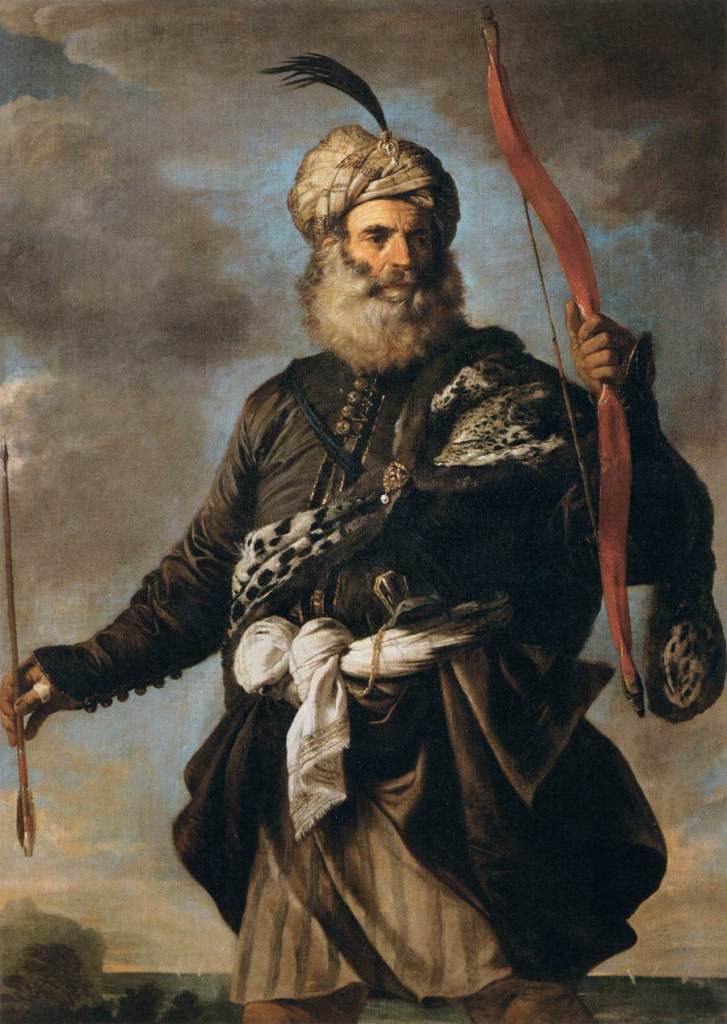
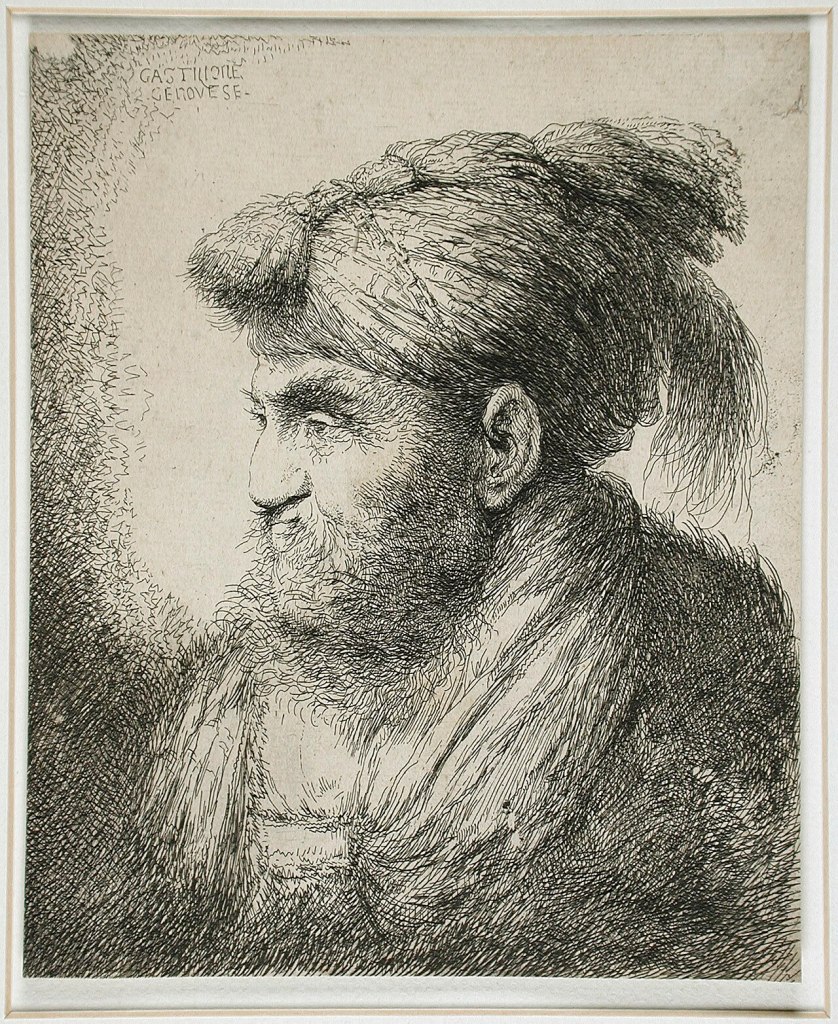
Pier Francesco Mola painted similarly isolated figures in eastern dress, while Giovanni Benedetto Castiglione produced numerous etched and drawn studies of bearded men in turbans. These images allowed artists to explore expression, costume and character without the obligations of formal portraiture. Rosa’s examples are generally more sombre. His figures often appear to possess an inward life that remains inaccessible to the spectator.
His Neapolitan formation remained important. Jusepe de Ribera’s imaginary philosophers had established a model in which wisdom could be represented through the worn face and humble clothing of an ordinary man. Ribera often identified his figures through books, inscriptions or attributes, but their authority depended equally upon their physical presence. Rosa adopts that naturalistic foundation while making the identity of his sitter still less determinate. The man may evoke a Stoic philosopher, but he cannot be identified as a particular thinker.
Rosa frequently studied his own face in a large mirror. Filippo Baldinucci records that he experimented with different expressions, using his reflection to develop heads that could later be adapted for paintings. This practice helps to explain why some of the teste di fantasia resemble the artist without necessarily being self-portraits. His features could provide starting material for an imagined character, just as another model’s face could be altered until individual likeness gave way to a more general type.
Baldinucci also states that Rosa painted numerous small heads for friends, alongside the landscapes and other works that circulated within his social circle. In 1651 Rosa painted a head for Pietro Pandolfini, secretary to Cardinal Giovanni Giacomo Panciroli, and his correspondence records comparable gifts to friends in Pisa. Daprà has suggested that the Birmingham painting may be one of the testacce sent to Ricciardi in 1650 or 1651. The identification cannot be demonstrated, but it places the work plausibly within this practice of exchange.
A relatively small painting made for a knowledgeable friend did not need to explain whether its figure was a particular philosopher, an eastern traveller or an imagined solitary. The uncertainty may have been part of its attraction, inviting discussion of expression, costume and character. In the Head of a Man in a Turban, observed physiognomy and invention remain deliberately intertwined. The result is not an incomplete portrait but a concentrated study of a human presence whose identity is withheld.
Portrait of a Man
The Portrait of a Man in the State Hermitage Museum has passed through a particularly unstable history of identification. During the eighteenth and nineteenth centuries the figure was variously described as an Italian brigand, a captain of bandits or a portrait of a bandit. In the early twentieth century Leandro Ozzola and Hermann Voss identified it as a self-portrait, possibly showing Rosa in the theatrical role of Pascariello or Formica. Later scholars rejected that interpretation, and the sitter is now generally treated as unidentified. The painting may represent an actual individual, but it has also been proposed as one of Rosa’s teste di fantasia, an expressive head constructed from observation and invention.
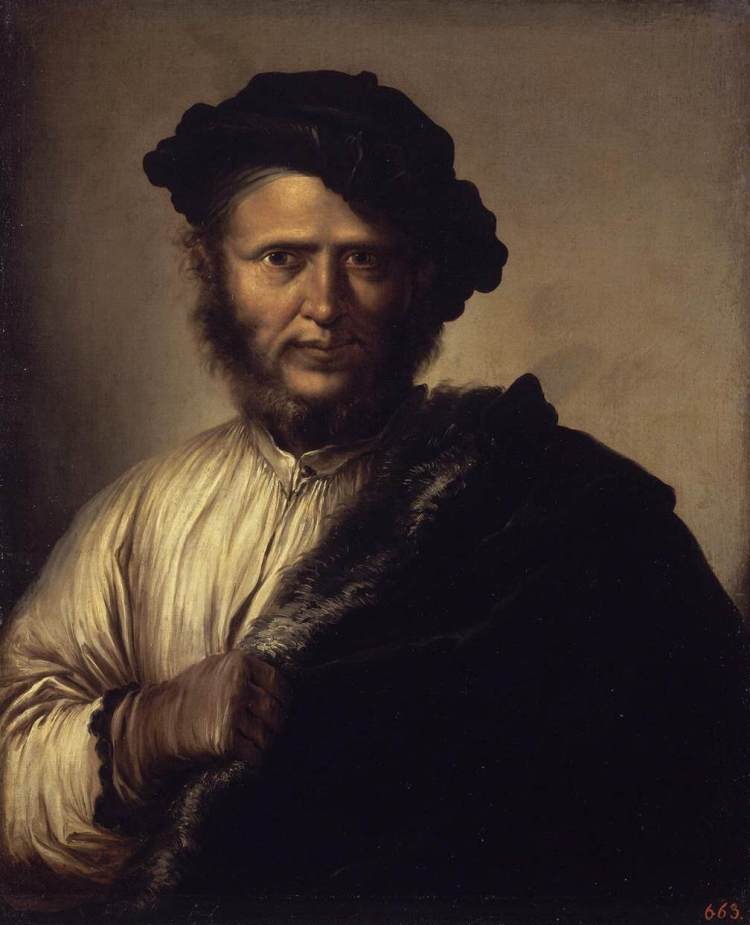
The man is shown at bust length against a dark background, facing almost directly towards the spectator. He wears a dark cap and a white shirt beneath a heavy dark cloak, which is drawn across the body and gripped at the left by his gloved right hand. The close cropping brings the head, hand and gathered fabric near the picture plane. His gaze is direct but difficult to interpret. The eyebrows draw slightly together, and the mouth is firmly closed. The expression is ambiguous; Rosa avoids the dramatic grimace sometimes found in his more overt studies of expression. Instead, the face holds itself in a state of contained alertness. The man appears ready to respond, but the circumstances of that response remain unknown.
The painting is organised through a narrow range of browns, blacks and flesh tones. Light strikes the forehead, the bridge of the nose and one side of the face before falling away across the cheek and beard. The shirt supplies the strongest pale accent, but even this is subdued. The cloak is built from broad passages of paint rather than closely described folds: its weight grounds the figure, while the dark surrounding of the head, by the beard and hat, sharpens the focus on the face.
Particular attention is given to the differing surfaces of the costume. The soft cloth of the cap, the heavier folds of the brown cloak and the leather glove are distinguished through variations in handling and texture. This tactile treatment gives the figure a strong physical presence while retaining an overall air of mystery.
The earliest known descriptions did not identify the figure as a brigand. In Aedes Walpolianae, published in 1752, the picture was called simply A Man’s Head. The Walpole catalogue of 1773 used the equally cautious title Portrait of a Man. The more romantic interpretation was attached to the image later in the eighteenth century. Jean-Baptiste Michel’s engraving after the painting described the figure as “A Captain of Banditti”, and this title helped establish a narrative that continued long after the picture entered the Hermitage.
The painting had belonged to Sir Robert Walpole and hung at Houghton Hall before its transfer to Russia in 1779. In 1777 it was reproduced in an engraving by Jean-Baptiste Michel, after George Farington, under the title A Captain of Banditti. The print therefore records the brigand identity before the painting left England. That identity belongs securely to the history of the picture’s reception, but there is no evidence that Rosa himself conceived the man as a bandit.
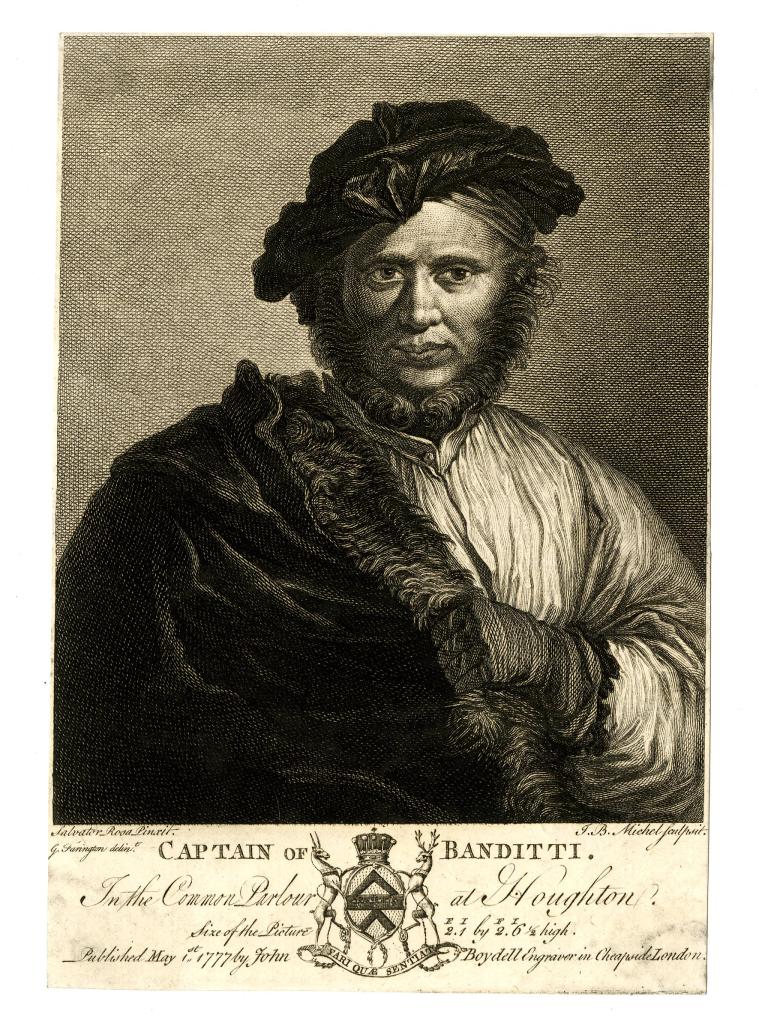
The brigand interpretation is nevertheless understandable. The uncombed hair, coarse cloak, unadorned costume and guarded expression contrast sharply with the conventions of aristocratic portraiture. Nothing in the painting connects the sitter with civic office, wealth or learned occupation. Later viewers therefore supplied a social role that appeared to suit his rough appearance. Rosa’s own reputation as the supposed painter of bandits and wild landscapes made the identification still more persuasive.
That reputation was itself greatly enlarged after his death. Eighteenth- and nineteenth-century writers transformed Rosa into a rebellious wanderer closely acquainted with soldiers, outlaws and the inhabitants of remote landscapes. Paintings of unidentified men could consequently be absorbed into the developing mythology of the artist. The Hermitage figure became a brigand not because of an inscription or early document, but because later viewers believed that such a figure belonged naturally within Rosa’s world.
Ozzola attempted to replace the brigand with the artist himself. Drawing upon Filippo Baldinucci’s account of a self-portrait in the costume of Pascariello, he proposed that the Hermitage painting represented Rosa in theatrical dress. Baldinucci describes a portrait given to Girolamo Signoretti in which Rosa wore the coarse costume of the comic character, including a large rough cloak. Ozzola associated that description with the Hermitage canvas.
The identification cannot be sustained. Baldinucci’s account refers to a painting that later passed into the collection of Cardinal Leopoldo de’ Medici, while the early history of the Hermitage work leads instead to the Walpole collection. More importantly, the rediscovery of the portrait now generally accepted as Self-Portrait as Pascariello provides a much closer correspondence with Baldinucci’s description, including the worn glove and recognisably theatrical costume. The Hermitage painting lacks those specific signs.
Voss nevertheless supported the self-portrait interpretation in 1924. The frontal pose, slightly fixed position of the head and gaze towards the spectator suggested to him the activity of an artist studying himself in a mirror. Luigi Salerno rejected the proposal in 1963, and later scholarship has generally followed him. The figure bears some resemblance to Rosa, but resemblance alone is insufficient in an artist who repeatedly used his own physiognomy as material for invented heads.
Comparison with the secure self-portraits also raises difficulties. The Hermitage man possesses Rosa’s dark colouring, prominent nose and abundant hair, but the shape of the face, the beard and the overall proportions are not exact. These differences might be explained by changes of age, angle or expression, yet there is no accompanying attribute or documentary record to support a self-portrait identification. The work therefore remains outside the group of reliable likenesses.
Daprà connects the Hermitage painting with the Head of a Man with a Turban discussed above, formerly in the Mahon Collection and now in Birmingham Museum and Art Gallery. She also compares the Hermitage painting with a bearded testaccia then in the K. Davies Collection and known to her through Luigi Salerno’s catalogue, apparently the Portrait of a Bearded Man later sold at Sotheby’s in 2019.
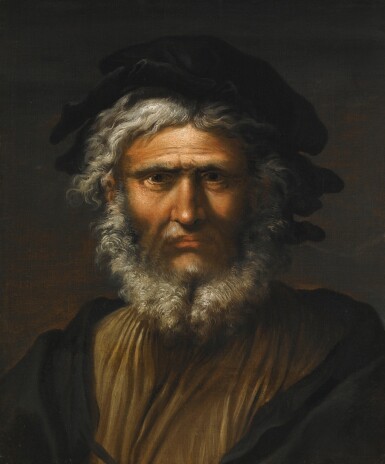
The men share unruly hair, strongly modelled features and an ambiguous status between individual portrait and imagined character. Daprà even raises the possibility that the Hermitage and Davies pictures represent the same model at different ages. Such comparisons are suggestive, but they do not restore a name to the sitter.
The proposed classification as a testa di fantasia may provide the most productive way of understanding the painting. Such works resemble portraits in their concentration upon a single face, but they need not preserve the identity of a particular person. Rosa might begin with a living model or his own reflection and then modify the physiognomy, costume and expression until the image became a character rather than a likeness.
The category overlaps with what northern European painting termed the tronie: a study of an expressive human type rather than a conventional commissioned portrait. Turbans, rough cloaks, beards and unusual hairstyles could remove a model from ordinary society, allowing the figure to evoke a philosopher, soldier, foreigner, rebel or bandit without being firmly identified as any one of them. The Hermitage man belongs within this field. He looks as though he has emerged from a narrative, although the narrative itself has disappeared.
The Hermitage catalogue cautiously associates him with brigands or fugitive rebels from the period of Masaniello’s revolt. That suggestion should not be treated as established historical fact. Rosa’s relationship with the revolt became entangled with later legend, and the painting contains no specific reference to Naples in 1647. Its power lies instead in the encounter between a strongly individualised face and the absence of information that would turn observation into biography.
This distinguishes it from the Metropolitan portrait. In New York, the cypress wreath, skull, Seneca volume, Greek inscription and dedicatory sheet locate the sitter within a particular network of friendship and philosophical thought. The Hermitage man possesses no comparable framework.
The successive titles attached to the work reveal how difficult later viewers found that anonymity to accept. A man without an identity became a brigand; the brigand was transformed into Rosa himself; the supposed self-portrait was eventually returned to anonymity. The history of the painting therefore belongs not only to a catalogue problem but to its imaginative suggestiveness.
The warrior self-image
Two paintings traditionally connected with Rosa’s self-image extend the problem of identity into the territory of martial costume and dramatic role. The first, in the Detroit Institute of Arts, is still catalogued by the museum as a Self-Portrait of the 1650s. The second, in the Chigi Saracini collection in Siena, has generally been called a Warrior or Self-Portrait as a Warrior. Their attribution, dating and relationship have all been questioned, and neither possesses the documentary security of Pascariello or the Uffizi self-portrait. They remain compelling, however, because they show how readily Rosa’s appearance could be transformed into an image of proud and potentially aggressive independence.
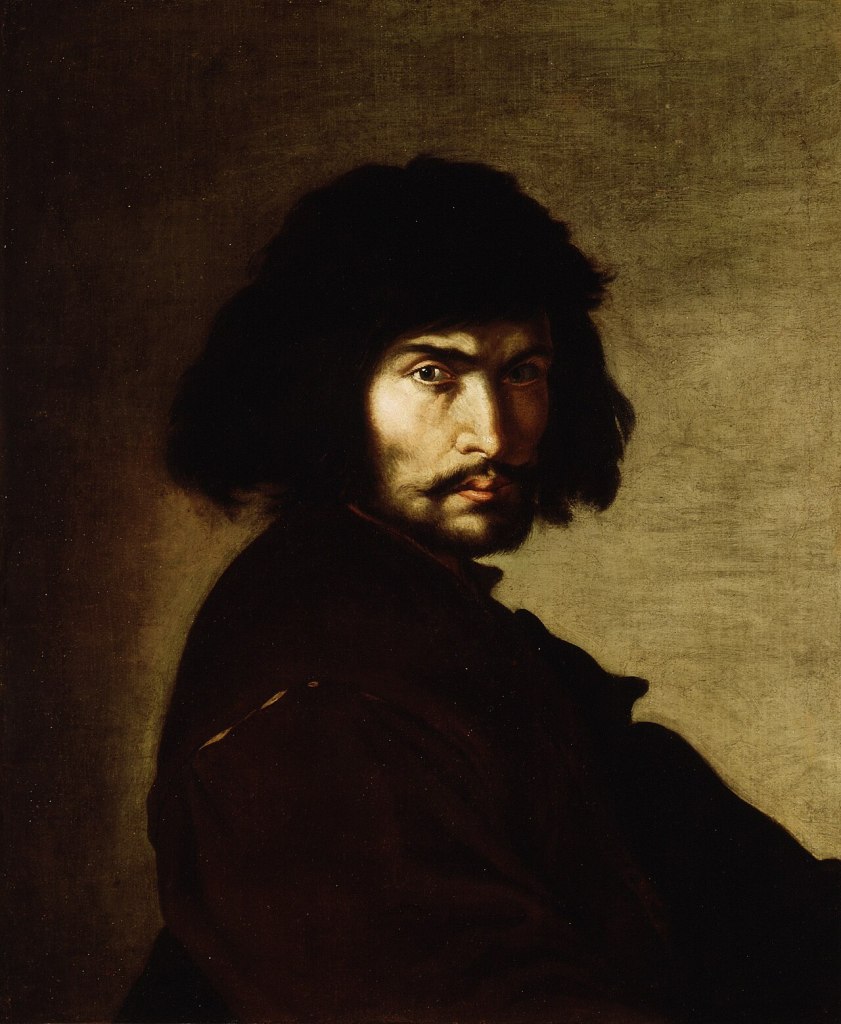
The Detroit figure is shown close to the picture plane, turning his head sharply towards the spectator. Long dark hair falls around a lean face framed by a narrow moustache and beard. The body remains partly in profile, while the head reverses the movement and establishes a direct, wary encounter. Dark clothing absorbs much of the figure into the surrounding shadow, leaving the face as the principal focus. There are no books, inscriptions or implements to define an intellectual or professional identity. Instead, character is conveyed through the turn of the head, the tightened expression and the concentration of the gaze; the painting therefore differs from Rosa’s more programmatic self-images.
The Detroit Institute dates the picture to the 1650s and identifies it as Rosa, but the early history of the work is poorly documented. Its recorded provenance begins only with a French private collection and later ownership in New York before its purchase by the museum in 1966. The absence of an early provenance does not disprove Rosa’s authorship or the identification of the sitter, but it deprives both claims of the support available for his more secure self-portraits. Wendy Wassyng Roworth consequently treated the attribution with caution, placing the work among the disputed images whose resemblance to Rosa may depend partly upon an already established facial type.
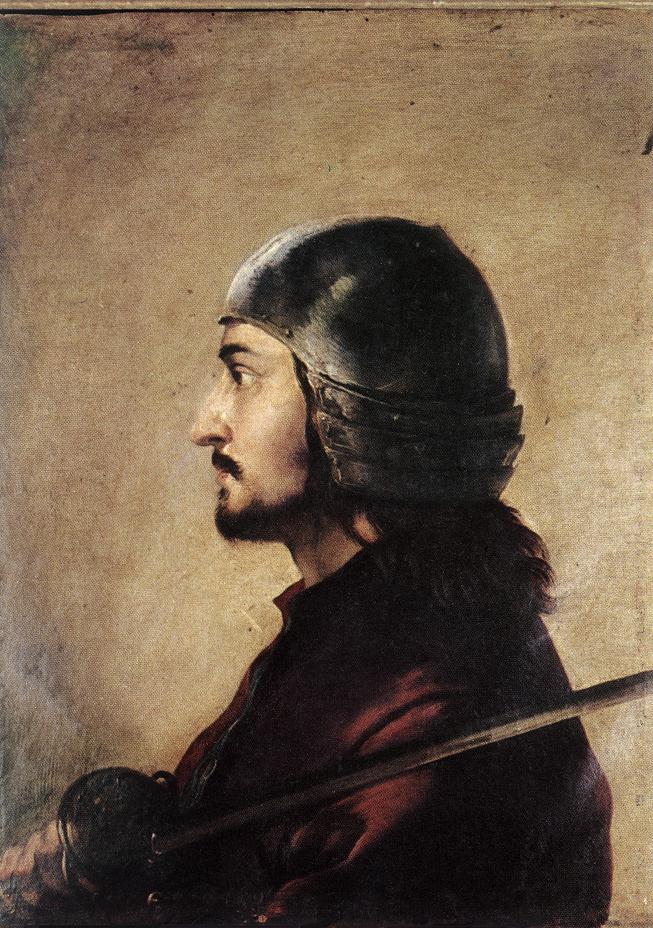
The Siena painting converts a related physiognomy into a much more explicit role. The figure is shown in profile, wearing a helmet and holding a drawn sword whose diagonal dominates the composition. Costume, weapon and pose define a martial identity that is absent from the more ambiguous Hermitage painting. The drawn sword also helped later viewers associate the painting with the legend of Rosa as a rebellious outsider. Roworth notes that its martial character accorded readily with the nineteenth-century image of the artist as brigand, insurgent or proto-Romantic hero. The traditional self-portrait title may therefore owe something to Rosa’s later reputation as well as to any perceived resemblance.
Ubaldo Meroni rejected the self-portrait identification and proposed that the Siena sitter was Prince Agostino Chigi, governor of Castel Sant’Angelo from 1656 to 1667. The military gesture would suit such a sitter, but Meroni offered no contemporary document comparable to the evidence he produced for the Metropolitan portrait of Ricciardi. The identification therefore remains conjectural. It replaces one uncertain name with another rather than securely resolving the painting’s status.
The relationship between the Detroit and Siena pictures raises a further difficulty. Richard Wallace suggested that the Siena painting may depend upon the Detroit composition and may even be by another hand. Roworth was also cautious. She noted that each resembles the Metropolitan portrait and considered whether one or both might be later constructions based upon an accepted image of Rosa. Of the two, Detroit presents the more coherent and inwardly concentrated likeness. Siena converts comparable features into a more overtly martial image, defined by helmet, drawn sword and emphatic profile.
Together the two paintings occupy an unstable place between portrait, self-portrait and character study. They lack the objects and inscriptions through which Rosa usually defines an intellectual persona, yet they are not neutral likenesses. Detroit constructs vigilance and self-containment; Siena turns similar qualities towards martial display. Whether both were painted by Rosa, and whether either represents him directly, they testify to the continuing attraction of a facial and psychological type associated with the artist: solitary, severe, resistant to easy access and capable of being recast as the image of a warrior.
Self-Portrait as a Poet
The presumed self-portrait in Strasbourg returns from the uncertain territory of Rosa’s teste di fantasia to an image that is more plausibly connected with the artist himself. The identification is not supported by an inscription or an early record of ownership, and should therefore retain some qualification. The facial resemblance to Rosa’s recognised self-images is nevertheless strong, while the wreath worn by the figure gives the painting a specific relation to poetry. Brigitte Daprà interprets it as an image in which Rosa presents himself as a poet, one of the identities that he had cultivated particularly intensively during his Florentine years.
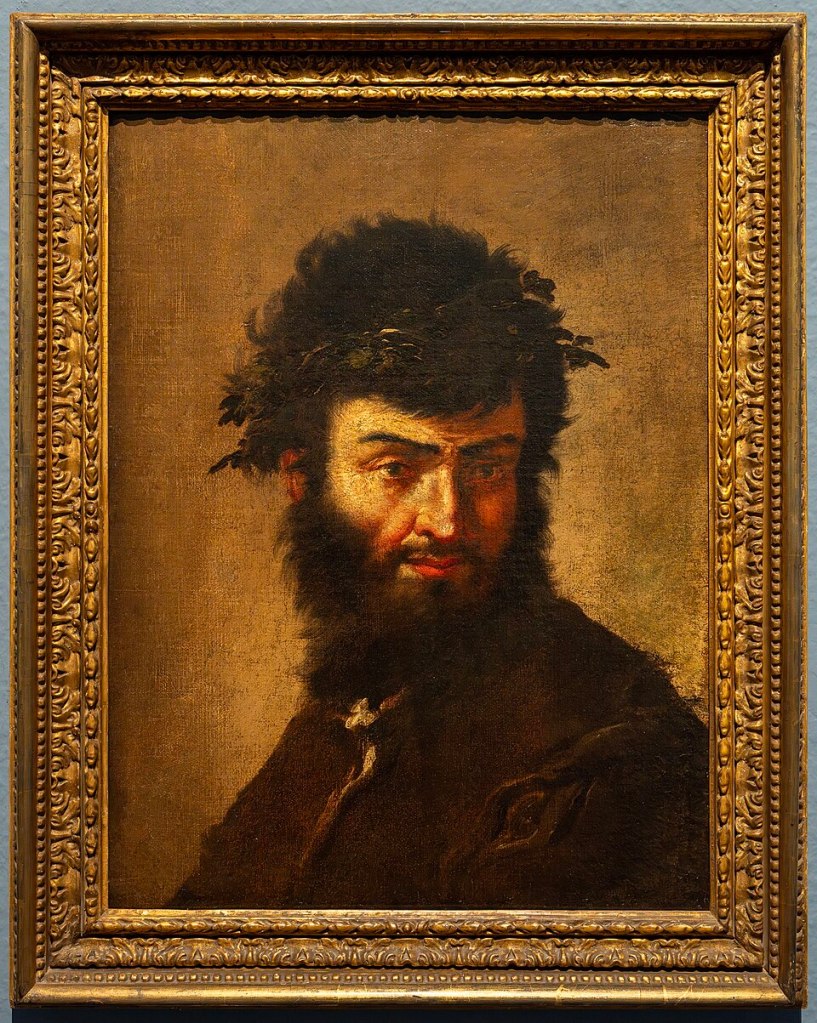
The figure is shown at bust length, turned slightly away while looking back towards the spectator. Thick black hair rises untidily beneath a wreath, while a full beard covers much of the lower face. The dark clothing contrasts with a warm golden background, while the right side of the face has a similarly golden light. No hand, book or writing instrument appears within the narrow composition. The poetic identity therefore depends almost entirely upon the wreath and upon the expression and character that Rosa gives to the head itself.
The wreath is difficult to read at first because its leaves are absorbed into the dark hair. It does not form a clear ornamental crown of the kind worn by the woman in Poetry. Instead, its irregular leaves only just break out from the outline of the head. Laurel traditionally signified poetic fame and artistic achievement, but Rosa suppresses its ceremonial splendour. The poet is crowned, yet the crown seems subtle and even subdued. The gaze is directed outwards from the frame, but it lacks the confrontational steadiness of Pascariello or the commanding severity of Philosophy. The eyes appear tired, perhaps reddened, and the raised brows contribute to an expression of melancholy absorption.
Daprà describes the expression as dreamlike and presents the figure as saturnine and deeply reflective. Saturn had long been associated with melancholy, solitude and intellectual or artistic contemplation. The term does not necessarily imply a temporary sadness. It describes a temperament inclined towards inwardness, imaginative intensity and withdrawal from ordinary sociability. Rosa had already developed aspects of this identity through his philosophical portraits, but the Strasbourg painting gives it a more personal and less declarative form.
Nothing here resembles the elaborate allegorical apparatus of some of Rosa’s other portraits. The narrow format strengthens the sense of inward concentration. The spectator is brought close to the face, but this proximity does not produce intimacy in the ordinary sense. The figure remains psychologically distant. He looks outward without appearing fully present to what he sees, as though his attention remains divided between the spectator and an internal train of thought.
Rosa’s poetry had become central to his identity during his years in Florence. Within the Accademia dei Percossi he recited satirical verse, organised performances and developed a public role that combined painter, actor, musician and poet. His satires attacked artistic ignorance, corruption, social pretension and the dependence of artists upon patrons. Poetry therefore offered him more than an additional accomplishment. It allowed him to claim intellectual independence and to address subjects that painting could express only indirectly.
The Strasbourg painting also differs from Rosa’s Poetry in Hartford. There, the allegorical figure holds the instruments of composition and confronts the spectator with alertness and energy. Her brilliant garments contribute to the sense of poetry as an active art. The Strasbourg figure, by contrast, is enclosed within a golden tonality and lacks both movement and overt attributes of authorship. If the Hartford painting personifies poetry in action, the Strasbourg image presents the poet as withdrawn into introspection and melancholy.
The laurel wreath in the Strasbourg painting introduces a further comparison, this time with the cypress-crowned sitter in the Metropolitan portrait. Conventionally, the two plants carry opposing meanings: cypress belongs to mourning and preparation for death, while laurel promises poetic fame and survival through art. Rosa nevertheless brings them visually close. Both wreaths are dark, irregular and partly absorbed into the sitter’s hair, rather than standing out as festive or ceremonial crowns. That visual association may suggest that, in the Strasbourg painting, the promise of poetic immortality is shadowed by mortality and melancholy rather than set securely against them.
Rosa’s Neapolitan formation remains visible in the concentrated lighting and vigorous naturalism of the face. Ribera’s philosophers and saints provided precedents for half-length figures whose intellectual or spiritual lives were expressed through weathered features and dramatic illumination. Rosa adapts that language to a self-image of artistic melancholy. The rough beard and dark complexion resist the polished elegance of official portraiture, while the laurel elevates the figure without disguising his physical particularity.
The resemblance to Rosa is persuasive when compared with his more secure self-portraits. The elongated face, prominent nose, abundant dark hair and strongly marked eyes recur elsewhere, although the fuller beard and wreath make exact comparison difficult. Rosa may have used his own features while intensifying them into an expressive type. As we have seen, such a procedure would be consistent with his other self-images, in which likeness is combined with costume, allegory or assumed character.
The Strasbourg painting adds a more subtle emotional register to the group. It lacks the social confidence of the Uffizi portrait, the theatrical wit of Pascariello and the heroic gesture of the warrior. Here the laurel proclaims poetry, but the shadowed eyes and darkened surface suppress any sense of triumph. Rosa presents authorship not simply as a public accomplishment but as an inward condition marked by melancholy, ambition and uncertain recognition.
Portrait of Lucrezia
The Portrait of Lucrezia in Palazzo Barberini differs fundamentally from Rosa’s allegorical figures and ambiguous teste di fantasia. Helen Langdon regards it as the only surviving portrait by Rosa that can be understood securely as a direct likeness of a particular individual. No emblem, theatrical role or philosophical attribute intervenes between the woman and the spectator. Lucrezia Paolini appears simply as herself, although the simplicity of the image carries the weight of a long relationship and, very probably, of recent bereavement.
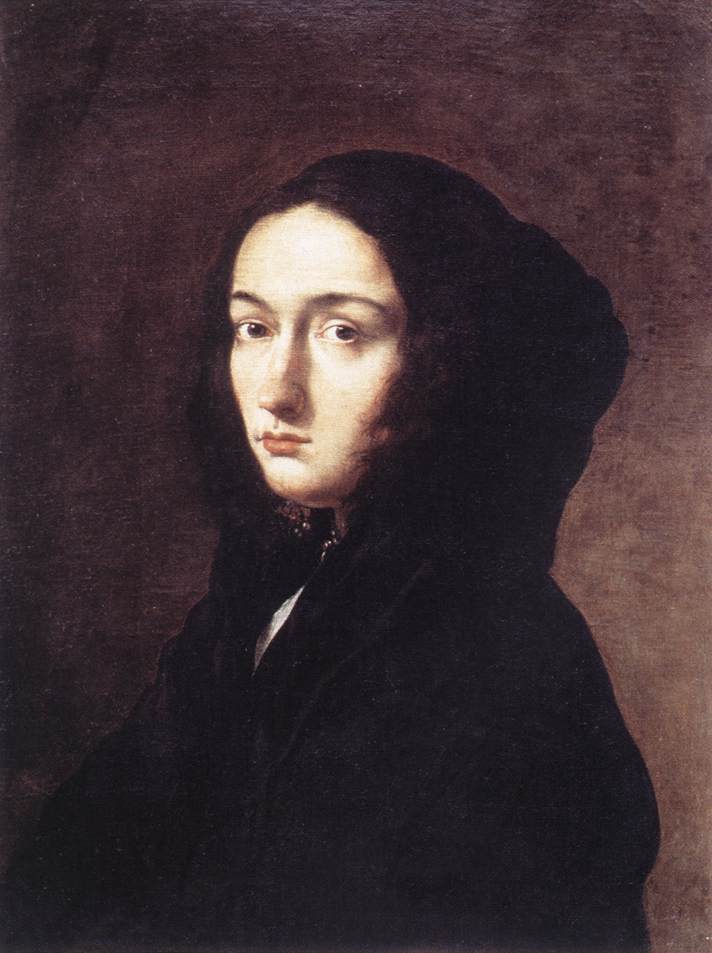
Lucrezia is represented at bust length against a plain brown background. Her body turns slightly away, while her head returns towards the spectator. Rosa frequently used this movement in his portraits, allowing the face to meet the viewer without making the sitter appear rigidly frontal. Here the turn is restrained and almost imperceptible. It gives the impression that Lucrezia has looked up quietly rather than consciously adopted a pose.
She is dressed in black, with her hair drawn back beneath a dark head covering. The clothing forms a broad dark mass that merges with the surrounding shadow, interrupted only by a rapid streak of white paint where the outer garment parts at the front. No jewellery, ornament or domestic object indicates her social position. The black clothing has usually been understood as a sign of mourning, but it also removes nearly every distraction from the face. The head covering gives the head a compact, almost sculptural outline. Unlike the abundant loose hair of the youthful allegories associated with her, nothing breaks the sober containment of the figure. The face is fully exposed, with its broad forehead, long nose, softly modelled cheeks and firmly closed mouth.
The expression combines reserve with unusual emotional immediacy. Lucrezia does not display grief through tears, lowered eyes or dramatic gesture. She looks outward steadily. Her gaze has been described as intense, proud and saddened, although none of those qualities operates alone. Pride prevents sorrow from becoming helplessness, while sadness modifies the apparent firmness of her bearing. The face appears composed because feeling is being contained, not because it is absent.
The distinction from the earlier Poetry is striking. In the youthful allegory, the woman turns energetically towards the viewer, surrounded by brilliant colour and the attributes of literary creation. Her loose curls, laurel wreath and informal clothing create a picturesque liveliness. In the Barberini portrait, produced perhaps fifteen years later, colour has almost disappeared. The youthful model transformed into a personification has been replaced by a woman shown in the fullness of adult experience.
The comparison should nevertheless be made cautiously. The identification of the Hartford model as Lucrezia remains probable rather than certain. The Barberini portrait, by contrast, is documented in the inventory drawn up after Rosa’s death in 1673. It hung in the salone, the principal room of his house in the via Gregoriana, and remained with his descendants until it was purchased from his heirs by the Italian State in 1914. Caterina Volpi concludes from its place in the household and its intimate character that it was painted for personal or family use rather than for sale. Whatever Lucrezia’s relationship to the earlier allegory, the Roman canvas provides the secure likeness against which proposed images of her must be judged.
Rosa met Lucrezia in Tuscany soon after his arrival in Florence in 1640. She was the daughter of Silvestro Paolini and was still legally married to another man. Unmarried or irregular cohabitation was not uncommon in seventeenth-century Italy, but their relationship remained legally vulnerable. Lucrezia became Rosa’s companion, model and the mother of his children, and the circumstances of her existing marriage prevented them from marrying for most of their life together. They lived as husband and wife for more than thirty years before marrying in March 1673, shortly before Rosa’s death.
Rosa and Lucrezia’s domestic situation became increasingly precarious during the 1650s, when the Church was seeking to regulate extramarital relationships more actively. Rosa had influential connections who offered some protection, but his enemies within Roman literary and artistic society recognised that Lucrezia’s continued marriage to another man gave them a means of attacking his moral character.
A quarrel that had begun with ridicule of his poetry and social ambitions could therefore be redirected towards the Holy Office. The danger became more immediate after the election of Fabio Chigi as Pope Alexander VII, when the balance of influence at the papal court changed and Rosa could no longer rely upon his existing connections to shield the household. He feared that denunciation might bring investigation, imprisonment or enforced separation.
Rosa’s alarm emerges vividly in a letter to Giovan Battista Ricciardi of February 1656. He feared imprisonment through some “becco fottuto di spia di Santo Offizio” and cursed the institution and its inventor. Yet the same outburst becomes an emphatic declaration of his attachment to Lucrezia. He insisted that he was not driven by lust, but wished to enjoy the comfort and cordial companionship of women like her, immediately adding that he did not believe another Lucrezia existed anywhere in the world.
Fearing denunciation, Rosa sent Lucrezia and their son Rosalvo temporarily to Naples, where they stayed with members of his family. The separation was intended as a protective measure, but it placed them in the city shortly before the devastating outbreak of plague in the summer of 1656. The plague killed the fifteen-year-old Rosalvo and Rosa’s brother Giuseppe. Rosa also received news that his sister and her family had died, although Helen Langdon (2022) reports that this later proved false. He believed the report at the time and wrote under the impression that much of his family had been destroyed, describing himself as the unhappiest man alive.
Lucrezia survived and returned to Rome, and it is possible that the portrait belongs to this moment. Jonathan Scott connects its solemn character with her return after Rosalvo’s death. Rosa wrote of the bitterness of finding himself alone with her after the loss of their son, and the painting has therefore been interpreted as a record of their reunion and shared mourning. The dating is not secure, however. Although the portrait is generally placed around 1656, Caterina Volpi allows that it may have been painted earlier in the decade, before Lucrezia left for Naples.
Daprà suggests that, in painting Lucrezia, Rosa may have intended to oppose oblivion by preserving her likeness. On this reading, the portrait might have been a response to the losses he had already suffered and to the consequent fear that she might also be taken from him. For that reason, Daprà writes that the image acquires the dignity of a lasting memorial, even though Lucrezia was still alive.
The absence of idealisation is one of the painting’s most affecting features. Rosa does not restore the beauty that Passeri attributed to the young Lucrezia or disguise the marks of maturity. Her cheeks have softened, and the pallor of her face is emphasised by the brown background and black dress. Yet the treatment is neither harsh nor clinical. The face is painted with close attention and considerable tenderness, allowing physical specificity to carry emotional meaning.
Rosa’s Neapolitan formation remains evident. The concentrated format, sober colouring and strong physical presence recall once again the naturalism of Ribera. Yet the dramatic illumination and rough surfaces associated with Ribera’s saints and philosophers have been quietened. Light spreads gently across Lucrezia’s face rather than cutting it into opposing areas. The result retains naturalistic directness while becoming more private and restrained.
Tomaso Montanari has also detected a profound reflection upon the portraiture of Velázquez. The comparison is plausible in the suppression of ornament, the muted colouring and the sitter’s unforced psychological presence. As in Velázquez’s portraits, outward simplicity intensifies rather than diminishes the encounter. The sitter does not perform an emotion for the viewer; she exists before us with a reserve that cannot be completely entered.
The painting has often been described as modern. That impression arises partly from its suppression of elaborate seventeenth-century portrait conventions. Lucrezia is not presented through rank, possessions or allegorical disguise, and Rosa imposes no courtly elegance upon her. The plain setting, close cropping and attention to an inwardly complicated expression can seem surprisingly immediate to a later viewer.
Its apparent modernity should not obscure its historical circumstances. Lucrezia was Rosa’s companion but not yet his wife, a central figure in his household whose legal and social position remained insecure. Her lack of public status might explain why she could not be represented through the language of aristocratic portraiture. The privacy of the image may therefore reflect both intimacy and exclusion from more formal modes of representation.
Lucrezia does not appear defeated, nor is the portrait merely an image of sorrow. Her steady gaze and reserve give her a presence that cannot be reduced to Rosa’s feelings about her. The painting may be the most intimate work in the group, but intimacy does not amount to complete access. Rosa preserves the appearance of a woman he knew closely while allowing her inward experience to remain her own.
Human Frailty
In this study, the sequence of portraits and self-images now culminates in a work that is not itself a portrait in any straightforward sense, but which gathers together many of the essay’s central concerns. In L’Umana Fragilità, Human Frailty, Rosa turns from the identities that people fashion for themselves towards the mortal condition those identities cannot overcome. The actor’s costume, the philosopher’s learning, the poet’s laurel and the cultivated sitter’s emblems all belong to a world of social and intellectual distinction. Here such distinctions are overwhelmed by birth, suffering, time and death.
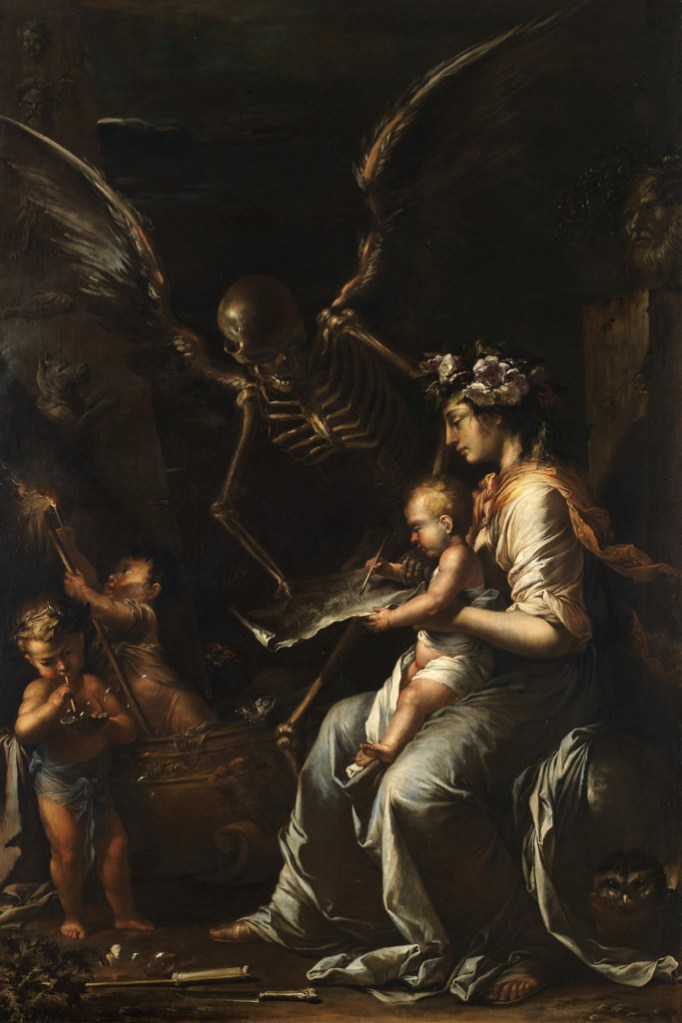
A woman sits near the centre of the tall canvas, holding a naked child on her lap. She wears a wreath of pale pink roses, while a heavy mantle falls around her body. Her face is tired and strangely passive. She does not attempt to defend the child or turn away from what approaches them. Mother and infant are enclosed within a nocturnal space in which figures and objects emerge gradually from the darkness. They appear less to occupy a coherent setting than to have been trapped within an accumulation of emblems.
A gigantic winged skeleton bends over them. Its skull and ribcage catch the light, while the remainder of its body merges with the surrounding gloom. The wings spread over the mother and child like a dominating canopy: their function seems to be to oppress the figures, rather than to carry Death away. Jonathan Scott compares the skeleton to a malignant spider, an apt description of the way it hangs above the two human figures and extends its limbs towards them.
Death has seized the child’s wrist and guides his hand across a sheet of paper. The infant writes:
Conceptio culpa, nasci poena, labor vita, necesse mori.
“Conception is sin, birth is pain, life is toil, death a necessity.”
The phrase, derived from a medieval poem attributed to Adam of Saint Victor, compresses the course of human existence into four severe propositions. The child is made to write the sentence before he can properly have learned to write or even to understand it. The gesture eliminates the comforting idea that knowledge of mortality belongs only to adulthood. Death instructs the infant from the moment of birth, as though the conclusion of life were already contained in its beginning.
The child’s dependence makes the action particularly disturbing. His hand does not resist, but neither does he write independently. Death controls the movement. The image resembles an inverted lesson in which the teacher does not prepare the pupil for life but reveals that life itself is governed by extinction. The mother watches, yet her downcast stillness suggests that she is powerless to interrupt the lesson.
Around them Rosa assembles a profusion of objects associated with mortality and the instability of earthly existence. At the lower left, a putto blows bubbles, recalling the familiar formula homo bulla: man is a bubble. The transparent spheres rise briefly before bursting, turning play into an image of life’s brevity. Nearby, another putto applies a flame to a loose bundle of tow suspended above a cradle. Such coarse flax fibre, historically used as tinder, catches fire almost immediately and burns away within moments, making it a striking emblem of life’s brevity. Infancy, play and destruction are brought into uncomfortable proximity.
Butterflies, whose short lives made them natural symbols of transience, flutter within the darkness. A spent firework has fallen after its momentary ascent and illumination. A thistle sheds its seed. An owl, traditionally associated with darkness and ill omen, watches from beneath the woman’s robe. None of these details merely repeats the message of the inscription. Together they establish a world in which existence is defined by brief emergence, dispersal and disappearance.
At the right stands a herm crowned with cypress. It represents Terminus, the Roman divinity of boundaries and endings. His stony face is impassive, indifferent to the scene unfolding beside him. In ordinary life a boundary might distinguish one territory or possession from another. Here the ultimate boundary is death, the point beyond which all human claims and distinctions cease to operate.
The stone obelisk at the left carries a sequence of carved images referring to the stages and conditions of human life. The faces of a child and an old man mark the span between beginning and end. A falcon signifies vitality, but is partly obscured by the skeleton’s wing. Other creatures allude to hatred, violence and death. The monument that might conventionally preserve memory or fame is itself absorbed into Rosa’s darker meditation upon extinction.
A knife lies near the woman’s feet. Its blade bears Rosa’s initials. It can be understood as the instrument that cuts the thread of life, but the position of the signature also draws the artist himself into the allegory. Rosa does not place his name upon a book, a painter’s palette or an object signifying intellectual accomplishment. He signs the weapon of severance. Authorship is brought under the same law as everything else in the painting.
The woman’s wreath introduces a more personal note. Its pale roses may allude to the name Rosa, connecting the seated figure with the artist’s family. This detail contributes to Jonathan Scott’s interpretation of the painting as an intensely private response to the losses that struck Rosa’s household in 1656.
Rosa believed that much of his family had been destroyed. In his letters to Giovan Battista Ricciardi he described himself as the most unhappy man alive, unable to work, wandering through Rome and weeping as he wrote. He rejected the philosophical consolations offered by his friend, insisting that Stoic principles were powerless before actual bereavement. Philosophers, he suggested, might have written differently had they endured comparable suffering.
Scott identifies the seated woman as Lucrezia and the child as an image of the dead Rosalvo. He consequently reads Human Frailty as a pictorial epitaph for Rosa’s son and the relatives whom the artist believed he had lost. In this interpretation, the rose wreath refers not simply to Rosa’s name but to a particular family, while the skeleton directs Rosalvo’s hand to acknowledge the necessity of his own death. The painting becomes both an allegory of universal mortality and a record of personal catastrophe.
The identification cannot be demonstrated conclusively. Neither the woman nor the child is named, and the imagery belongs to a long tradition of moralising representations of mortality. The child is far younger than Rosalvo was when he died, while the female figure may function principally as an allegorical mother rather than as a recognisable likeness. The painting’s precise date is also uncertain, and its subsequent acquisition by Cardinal Flavio Chigi complicates the idea that it remained a purely private memorial.
Scott’s reading nevertheless remains compelling because it accounts for the painting’s peculiar intensity. Rosa did not invent its individual symbols, and much of its imagery can be traced to emblem books, philosophical traditions and earlier meditations upon death. Yet their accumulation does not feel merely scholarly. The work presses its emblems upon the human figures with an almost oppressive insistence. Mother and child are not placed at a safe distance from the symbols of mortality. They are surrounded, hemmed in and physically handled by them.
The possible identification of the woman as Lucrezia becomes particularly powerful when the painting is considered after her portrait. In the Barberini canvas, she appears alone, dressed in black and meeting the spectator with an expression that Scott associates with the events of 1656. In Human Frailty, it feels as though the same grief is transformed into allegory. The solitary woman becomes a mother holding a child, while the sorrow contained within the portrait expands into a universe governed by death.
The two works offer different approaches to bereavement. The portrait concentrates grief within a living face through dress, pose and lighting; the allegory enlarges it through personification, inscription and emblem. One preserves the presence of a survivor. The other makes grief into an environment from which there is no escape.
The passivity of the mother is essential. She does not enact the dramatic gestures conventionally associated with lamentation. Her arms continue to support the child, but she has no power over what happens to him. She is neither an allegorical victor over Death nor a Christian mourner visibly sustained by the promise of resurrection. Rosa offers no consoling angel, heavenly light or indication that the child’s death forms part of a providential design.
The absence of consolation distinguishes the painting from many religious treatments of mortality. Its message is not that death will be overcome, but that it is unavoidable. The Latin inscription identifies conception itself with guilt and birth with suffering. Life is labour, and death is necessity. Even the mother-child grouping, one of the most familiar visual forms of tenderness and hope in Christian art, is invaded and controlled by the skeleton.
The philosophical identities explored elsewhere in the essay draw upon several ancient traditions, but they share an ideal of learning as a means of self-command and consolation. After the deaths of his son and brother in 1656, Ricciardi addressed Rosa in a poem that offered a specifically Stoic response to suffering, praising the moral strength with which adversity might be endured. Rosa’s letters, however, insist that such principles could provide no true relief from bereavement.
Roworth connects both the Metropolitan portrait and Human Frailty with Ricciardi’s poem and identifies writing as their strongest link. In the New York painting, the adult sitter inscribes a skull and retains control of the pen; in Human Frailty, Death possesses the infant’s wrist and dictates the sentence. On this basis, the two works can be seen to assign very different meanings to writing. In the portrait, it remains an act of philosophical reflection, an attempt to make sense of mortality. In Human Frailty, it records the conditions imposed upon a life that has scarcely begun.
The painting also places a limit upon the forms of self-presentation explored throughout the essay. In Pascariello, Rosa transforms social inferiority into theatrical assurance; elsewhere he assumes the roles of painter, poet, philosopher and warrior. The uncertain male heads similarly turn observed features into brigands, thinkers or poetic characters. In Human Frailty, neither invention nor social identity offers protection. The child has no opportunity to fashion a self before Death writes its conclusion, while the mother’s role and the artist’s signature remain powerless to prevent loss.
This severity does not entail a rejection of artistic ambition. The scale, complexity and intellectual density of the painting demonstrate Rosa’s determination to compete as a painter of learned invention, and the work subsequently entered the collection of Cardinal Flavio Chigi. Rosa drew upon emblem books, ancient philosophy, Christian poetry and his own earlier imagery to give personal grief a form capable of public circulation. Emotional urgency and professional ambition are not mutually exclusive here.
Scott’s biographical interpretation must nevertheless remain a proposal rather than a recovered fact. The woman cannot securely be identified as Lucrezia, nor can the infant be assumed to represent Rosalvo. Yet the probable date, the rose wreath, Rosa’s letters and the extraordinary concentration of imagery concerned with birth and death make the association more than arbitrary. The painting’s private and universal meanings cannot readily be separated: a particular experience of bereavement is given the form of a general statement about human life.
Conclusion
Rosa’s portraits and self-images do not form a conventional record of appearances. Instead, they explore the roles through which identity could be fashioned and recognised: actor, painter, poet, philosopher, warrior, friend or lover. Costume, attributes, inscriptions and resemblance allowed faces to move between portrait, allegory and imagined character. Several of these works also belonged to relationships of friendship and exchange rather than to formal patronage, so that identity was constructed not in isolation but through conversation, gifts and shared intellectual life.
The portrait of Lucrezia and Human Frailty bring these experiments into contact with grief and mortality. Rosa’s assumed roles and philosophical emblems may give experience intellectual or artistic form, but they cannot remove the body from time and death.
Rosa’s portraiture therefore moves continually between invention and vulnerability. Art can preserve an appearance, create a role and extend the presence of the absent. It cannot make those identities permanent. That tension gives these varied works their coherence.
Producing these essays requires care, time, research, and resources. Contributions to help sustain this exploration would be greatly appreciated.
Donate to Inner Surfaces here.
Bibliography
I have consulted the following sources. Any errors are mine.
Daprà, Brigitte, ‘I ritratti di Salvator Rosa’, in Salvator Rosa: tra mito e magia, exhibition catalogue, Museo di Capodimonte, Naples, Naples: Electa, 2008, pp. 58–65.
Langdon, Helen, Salvator Rosa: Paint and Performance, London: Reaktion Books, 2022.
Langdon, Helen, Xavier F. Salomon and Caterina Volpi, Salvator Rosa: Bandits, Wilderness and Magic, London: Paul Holberton Publishing, 2010.
Leuschner, Eckhard, ‘The Pythagorean Inscription on Rosa’s London “Self-Portrait”’, Journal of the Warburg and Courtauld Institutes, 57, 1994, pp. 278–83.
Meroni, Ubaldo, Fonti per la storia della pittura e della scultura antica, VIII: Serie documentaria. Lettere ed altri documenti intorno alla storia della pittura. Giovanni Benedetto Castiglione detto il Grechetto, Salvator Rosa, Gian Lorenzo Bernini, Monzambano, 1978.
Meroni, Ubaldo, ‘Salvator Rosa: autoritratti e ritratti di amici’, Prospettiva, 25, April 1981, pp. 65–70.
Montanari, Tomaso, ‘Rosa, Salvatore’, Dizionario Biografico degli Italiani, vol. 88, Rome: Istituto della Enciclopedia Italiana, 2017.
Roworth, Wendy Wassyng, ‘The Consolations of Friendship: Salvator Rosa’s Self-Portrait for Giovanni Battista Ricciardi’, Metropolitan Museum Journal, 23, 1988, pp. 103–24.
Roworth, Wendy Wassyng, ‘Salvator Rosa’s Self-Portraits: Some Problems of Identity and Meaning’, The Seventeenth Century, 4, 1989, pp. 117–48.
Salerno, Luigi, L’opera completa di Salvator Rosa, Milan: Rizzoli, 1975.
Scott, Jonathan, Salvator Rosa: His Life and Times, New Haven and London: Yale University Press, 1995.
Vsevolozhskaya, Svetlana, Museo Statale Ermitage: La pittura italiana del Seicento. Catalogo della collezione, Milan: Skira, 2010.
Wallace, Richard W., ‘Salvator Rosa’s Democritus and L’Umana Fragilità’, The Art Bulletin, 50, 1968, pp. 21–32.
Wallace, Richard W., The Etchings of Salvator Rosa, Princeton: Princeton University Press, 1979.

