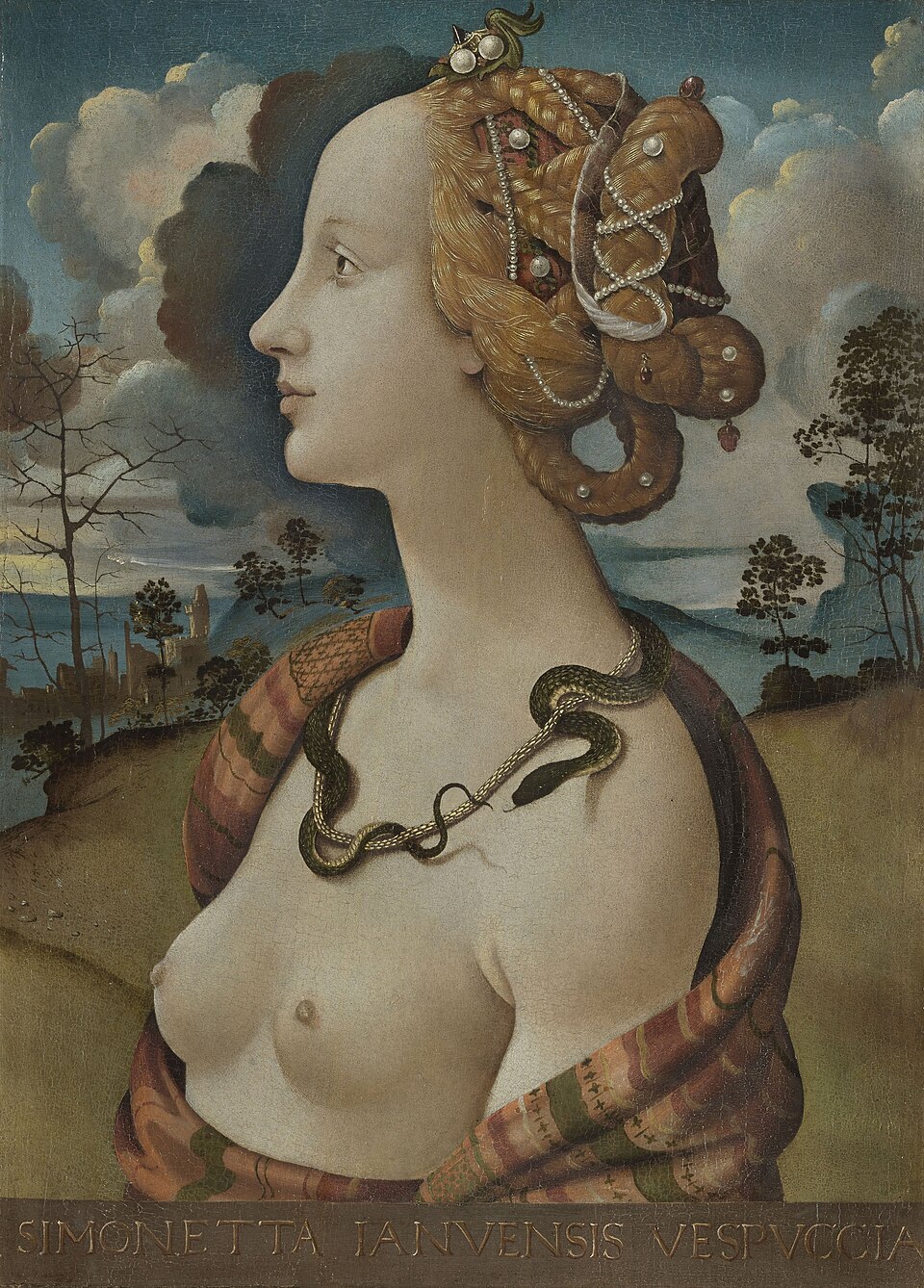
A young woman appears in strict profile against a landscape darkening beneath storm clouds. Her pale face is calm and remote, her elaborately plaited hair threaded with pearls and precious stones. Her breasts are uncovered, and around her neck a living serpent winds itself through a gold chain. Along the lower edge of the panel, an inscription identifies her as Simonetta Vespucci of Genoa.
Its painter, Piero di Cosimo, was among the most original artists active in Florence around the turn of the sixteenth century. Born Piero di Lorenzo in Florence in 1462, he acquired the name by which he is known from his master, Cosimo Rosselli. Piero accompanied Rosselli to Rome when the older painter was summoned to work on the walls of the Sistine Chapel in 1481–82, probably assisting with the extensive landscape passages in Rosselli’s frescoes. Back in Florence, he developed a remarkably varied career, producing altarpieces and devotional works alongside portraits and secular paintings drawn from mythology and the imagined beginnings of human civilisation.
What distinguishes Piero is less any single category of subject than the independence of his pictorial imagination. He was an attentive observer of animals, plants, rocks, weather and changing light, but he employed this naturalism in scenes that are frequently strange, elusive or without close precedent. Familiar stories seem to become unfamiliar in his hands. Figures and landscape often carry equal weight, while meanings remain understated rather than being declared through conventional gestures or attributes. His paintings can consequently appear at once meticulously concrete and curiously dreamlike.
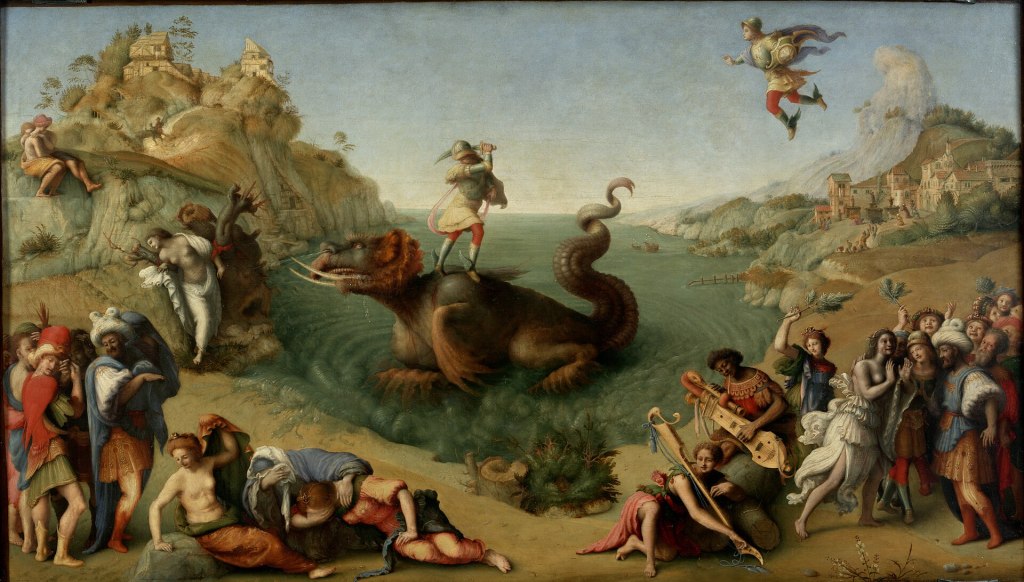
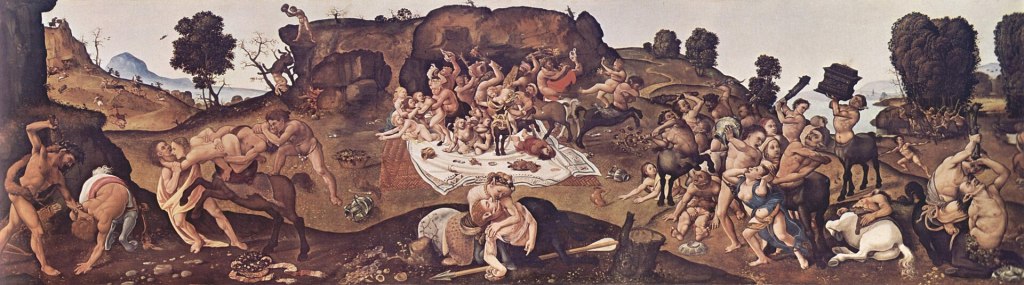
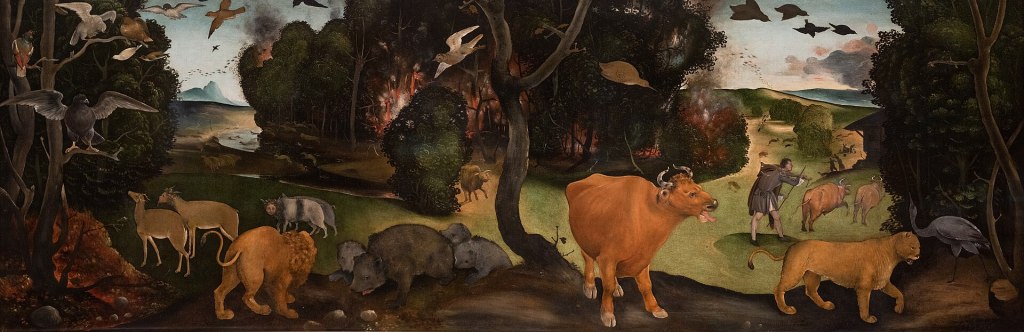
Our view of Piero has long been coloured by Giorgio Vasari, who presented him as an eccentric recluse, living on boiled eggs, delighting in storms and discovering fantastic landscapes and battles in clouds and stains on walls. Some of these anecdotes may preserve memories of the artist’s habits, but taken together they construct an almost literary character, in which unusual paintings are explained through an equally unusual way of life. Modern scholarship has treated this account more cautiously. Piero was not an isolated outsider but a painter who worked for cultivated and prosperous Florentine patrons and responded with considerable sophistication to poetry, classical mythology, religious tradition and contemporary visual culture. His strangeness belongs primarily to the imaginative forms he gave these materials rather than to the picturesque eccentricity of Vasari’s biography.
Simonetta Vespucci was born Simonetta Cattaneo in Genoa in 1453. Her father, Gaspare Cattaneo, and her mother, Cattocchia di Marco Spinola, belonged to prominent Genoese families. In 1468, while still very young, she married Marco Vespucci and came to Florence soon afterwards. The marriage was not merely private. The Vespucci were firmly associated with the Medici regime, while Simonetta’s relatives were connected through the Appiani with the rulers of Piombino and the mineral resources of Elba. The union therefore joined families linked by commerce, diplomacy and Medicean political interests.
Her position in Florence was greatly enlarged by her association with Giuliano de’ Medici, Lorenzo’s younger brother, who publicly celebrated her as the object of an idealised devotion. Contemporary culture presented their relationship through the conventions of courtly and Petrarchan love. Through the ceremonial and literary culture surrounding the Medici, the beauty of a young married noblewoman acquired a significance that extended far beyond her immediate social circle.
The decisive public occasion was Giuliano’s joust in Piazza Santa Croce in January 1475. A standard reportedly designed by Botticelli showed a white-robed figure of Pallas Athena, while Angelo Poliziano’s unfinished Stanze per la giostra transformed Simonetta into a radiant and mythological presence. The poem preserves details of her biography, including her Ligurian origins and Florentine marriage, but translates them into poetic fiction. Simonetta appears simultaneously as a historical woman and as a nymph associated with Venus, Minerva and Diana.
Her name also became attached to Botticelli’s images of ideal female beauty. No surviving painting by him can be securely identified as a portrait of Simonetta from life, but several elaborate female profiles have traditionally been associated with her. One of the best known is the Portrait of a Young Woman in Mythological Guise in Frankfurt, in which the woman’s braided hair is threaded with pearls and crowned with feathers. Its remote profile and fanciful coiffure have often encouraged comparison with Piero’s painting. Such works are perhaps better understood as ideal or commemorative “Simonetta” types than as reliable records of her individual appearance.
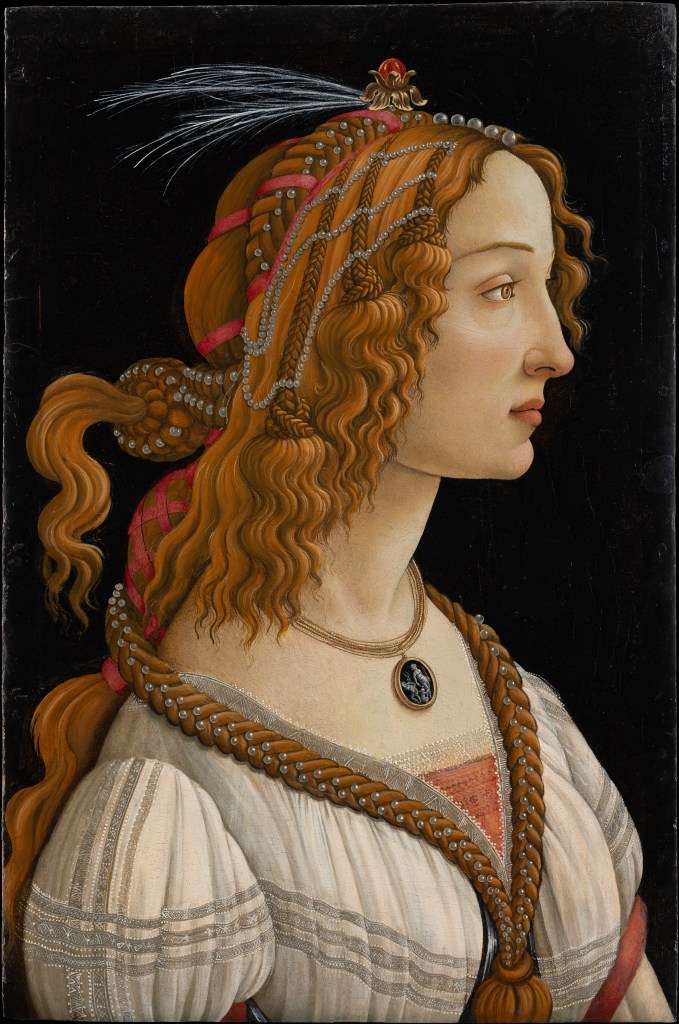
Simonetta died on 26 April 1476, probably of tuberculosis, at the age of twenty-three. Her death was followed by an unusually public expression of grief. Her body was carried through Florence in an open coffin, allowing spectators to see her face, and poets described death as having preserved or even intensified her beauty. Lorenzo de’ Medici had followed the progress of her illness closely and sent his physician to the Vespucci household, while reports of her condition were conveyed to him during his absence from Florence.
A substantial body of poetry grew up around her. Bernardo Pulci imagined her ascending to heaven as a new phoenix and joining Laura and Beatrice; elsewhere she became Daphne, a nymph or a beneficent star. Poliziano gave lasting form to the idealised love of Giuliano for Simonetta in the figures of Iulio and Simonetta in the Stanze. Other poets and humanists contributed elegies, sonnets and Latin epigrams, transforming her premature death into a shared literary event.
The cult that followed therefore arose from a conjunction of beauty, youth, Medici association, public spectacle, poetry and early death. Giuliano’s murder exactly two years later, on the same calendar date, made it still easier to bind their stories together symbolically. Simonetta ceased to belong only to biography and became an emblem of youthful beauty, unattainable love and continuing fame.
That transformation is essential to understanding Piero’s painting. Even before the panel was made, the historical Simonetta had already been converted into a poetic figure whose identity lay somewhere between memory and myth. A portrait of her did not therefore need to function simply as a record of physical appearance. It could present the woman Florence remembered, celebrated and reinvented after her death.
It is only in comparatively recent scholarship that the identification of the woman as Simonetta Vespucci has acquired a substantial degree of confidence. The inscription along the lower edge of the panel, SIMONETTA IANUENSIS VESPUCCIA, would seem to provide an obvious answer, but for many years it was suspected of having been added long after the painting was completed, perhaps after the work entered the possession of the Vespucci family in the late sixteenth century.
Technical examination has considerably weakened that possibility. Earlier investigation found that the craquelure, the fine network of cracks that develops as an old painted surface ages, remains consistent across the inscription and the surrounding paint. A name added centuries later might be expected to possess a different pattern of cracking or to sit visibly above an already aged surface. The continuity of the craquelure therefore suggested that the inscription and the rest of the painting had aged together.
The picture was examined and restored by the Centre for Research and Restoration of the Museums of France before the 2014–15 exhibition Fra Angelico, Botticelli… Chefs-d’œuvre retrouvés at Chantilly. The conservators concluded that the position of the inscription had been planned from the outset and was not a later sixteenth-century addition.
Technical examination and restoration of the Portrait of Simonetta Vespucci, with radiographs and infrared images, Centre for Research and Restoration of the Museums of France:
https://c2rmf.fr/collection/objet/portrait-de-simonetta-vespucci
Documentary evidence may support this conclusion. In 2001 Gabriele Donati drew attention to an undated note, probably written around 1550–52, in which Paolo Giovio asked the sculptor Francesco da Sangallo to send him “la Simonetta”. Since the object could be handed to a messenger, Donati identified it as a painting, probably Piero di Cosimo’s panel, which was then in Sangallo’s collection. If this identification is correct, the picture was already known as the Simonetta several decades before it passed into the possession of the Vespucci family in 1586.
The serpent has also been reconsidered. It was long treated as the asp associated with Cleopatra’s suicide, but more recent study has identified it as a harmless Mediterranean whipsnake. It winds through the gold chain without biting or alarming the woman, and its almost circular movement is unlike the active, threatening snakes found in unequivocal representations of Cleopatra’s death. This does not by itself prove that the sitter is Simonetta, but it removes one of the strongest arguments for identifying her as the Egyptian queen.
Before these findings were brought together, the picture occupied a much less stable position. Vasari had described what was almost certainly the same work as “a very beautiful head of Cleopatra, with an asp wound around her neck,” and his account shaped its interpretation for centuries. Since he did not mention the inscription, scholars who accepted his testimony were inclined either to regard the lettering as a later addition or to treat it as unreliable. Once the inscription was doubted, the unusual imagery encouraged a succession of alternative identifications, among them Proserpina, Pallas Athena and Boccaccio’s Lady Fiammetta. The recent evidence has made Simonetta the most persuasive identification, but it has not made the painting straightforward. It has instead shifted the problem from the identity of the woman to the manner in which Piero chose to represent her.
Dennis Geronimus has offered one of the most sustained attempts to understand the painting’s unusual details in relation to Simonetta. His reading is valuable because it does not treat the inscription as sufficient in itself. Instead, he asks whether the hair, jewellery, serpent, exposed body and landscape can be understood as parts of a posthumous image in which Simonetta’s historical identity has been transformed by poetry, ceremony and commemoration.
The pearls and other jewels woven into the woman’s hair form an important part of this argument. Pearls were costly objects and conspicuous signs of wealth, but they also belonged to the visual language of marriage. They appeared in bridal jewellery and could suggest purity, value and social status. Geronimus identifies the elaborate pearl-covered acconciatura as a vespaio, a type of hairstyle whose name literally means “wasp’s nest”, and suggests that it may pun on the Vespucci name through vespa, the Italian word for wasp. The allusion is possible rather than demonstrable, but it shows how family identity might have been embedded in ornament rather than stated only through the inscription.
Other aspects of the hairstyle are no less difficult to interpret. Its braids, knots and rubies seem far removed from the restrained presentation expected in an ordinary Florentine marriage portrait. Yet Geronimus argues that such extravagance need not indicate vanity or lasciviousness. He compares it with the artificial coiffures found in images of Venus, ideal female heads and festival costume. In this context the woman’s appearance may belong less to everyday dress than to the ceremonial world of jousts, pageants and mythological disguise through which Simonetta had already been presented during her lifetime. The coiffure could therefore recall her public reinvention at Giuliano de’ Medici’s joust, when poetry and spectacle placed her between historical woman, nymph and goddess.
Geronimus develops this nuptial aspect further by proposing a possible connection with the marriage in 1482 of Simonetta’s niece, Semiramide d’Appiano, to Lorenzo di Pierfrancesco de’ Medici. The union renewed links among families already connected through Simonetta and the Medici, and Geronimus suggests that the painting may have been commissioned in relation to it. On this reading, Simonetta’s image would have served not simply as a memorial to a woman who had died six years earlier, but as a youthful presence imaginatively restored at the moment of a new dynastic alliance. The bridal pearls would then belong simultaneously to remembrance, marriage and renewal.
The proposal is ingenious, but it remains a hypothesis. No document connects the painting securely with the wedding, and the argument depends upon bringing several circumstantial details into alignment: the identities of the families, the possible date of the panel, the nuptial associations of the pearls and the regenerative meanings assigned to the serpent. It may explain why the image seems to combine commemoration with bridal display, but it also risks making the painting conform too neatly to a reconstructed occasion. The ambiguity of the objects may not require a single historical event to account for it.
The serpent introduces a still wider and less stable field of meaning. It winds through and around the links of a gold chain necklace, so that living creature and manufactured ornament become part of the same circle. The woman shows neither fear nor pain, and the snake does not behave like an instrument of attack. Its body curves back towards itself, although it neither bites its tail nor completes a full circle.
Geronimus relates this form to the ouroboros, the tail-devouring serpent associated with time, eternity and regeneration. The snake’s ability to shed its skin supplied a further image of renewal. Applied to Simonetta, such meanings would allow the serpent to acknowledge mortality while also resisting it: her life has ended, but her beauty, memory and fame are imagined as continuing beyond death.
This interpretation has a more particular Medicean context. A circular serpent device also appears on medals bearing the name of Lorenzo di Pierfrancesco de’ Medici, although the resemblance to Piero’s image is suggestive rather than exact. Joost Keizer draws a further comparison with the frieze made by Bertoldo and his workshop for the Medici villa at Poggio a Caiano, where a serpent biting its tail encircles a mountainous form associated with the regenerative powers of the earth. Together, these examples show that the circular serpent, with its associations of time, renewal and regeneration, belonged to a visual environment connected with the Medici. They therefore lend some support to the proposed association between the painting and Lorenzo di Pierfrancesco.
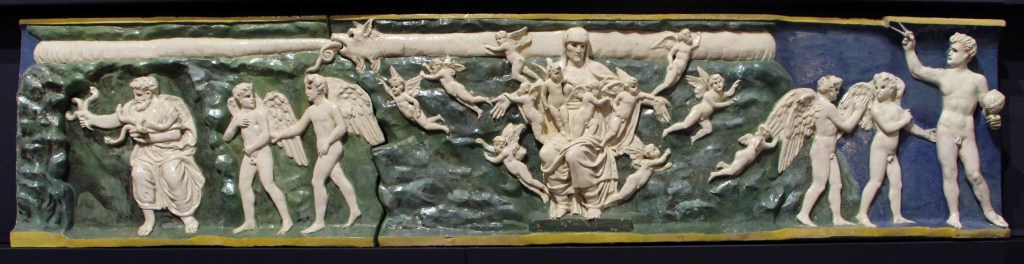
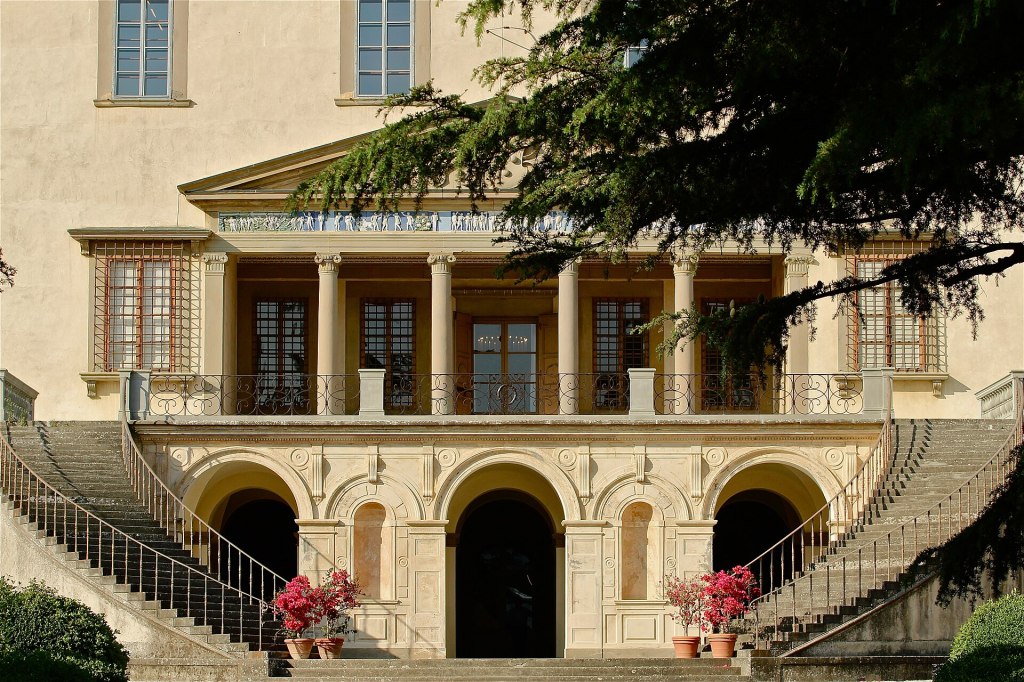
The comparison remains suggestive rather than conclusive. Piero’s snake does not reproduce the completed circle of the Medicean device, and Sharon Fermor has reasonably objected that an ouroboros conventionally bites its own tail. The serpent may evoke that emblem without quoting it precisely, but it may also retain meanings that resist so specific an identification. Its sinuous form and its proximity to the woman’s body make it at once decorative, sensual and potentially threatening.
Geronimus also proposes a more verbal form of family allusion. Since the Italian word for chain is catena, he suggests that the necklace may contain a pun on Simonetta’s birth family, the Cattaneo. As with the supposed reference to Lorenzo di Pierfrancesco’s emblem, the possibility belongs to a cultivated culture of names, devices and poetic wordplay, but it cannot be demonstrated. Such associations help to show how the image might have been read, but they should not be mistaken for a securely recoverable programme.
The serpent can therefore be placed within a commemorative interpretation of Simonetta without being reduced to a single meaning. It may suggest death, continuity, regeneration and visual desire at once. Its incompleteness is important. It approaches the form of an emblem but does not settle into one, leaving the viewer to move between creature and symbol.
The landscape extends the painting’s uncertainty beyond Simonetta’s body and ornaments. Its open sea, distant fortified architecture, changing light, dead and living vegetation, and gathering clouds have all encouraged interpretation, but not in a way that produces a single stable account.
The maritime setting may first carry a loose geographical association. It does not amount to an identifiable view, yet in a portrait that names Simonetta as Genoese, the sea and fortified coast could have suggested Liguria and the maritime world from which she came. Such a connection should remain tentative. The landscape is too generalised to be treated as a topographical record, but it may still participate in the construction of her identity.
Sarah Blake McHam gives the setting a more explicitly temporal and commemorative structure. Simonetta faces a setting sun, dead trees and darkening clouds, while behind her the vegetation remains greener and the sky brighter. On this reading, the landscape describes a movement from remembered vitality towards extinction. The woman turns towards the signs of her fate, while the serpent, with its near-circular movement, offers a counter-image of continuity and enduring fame.
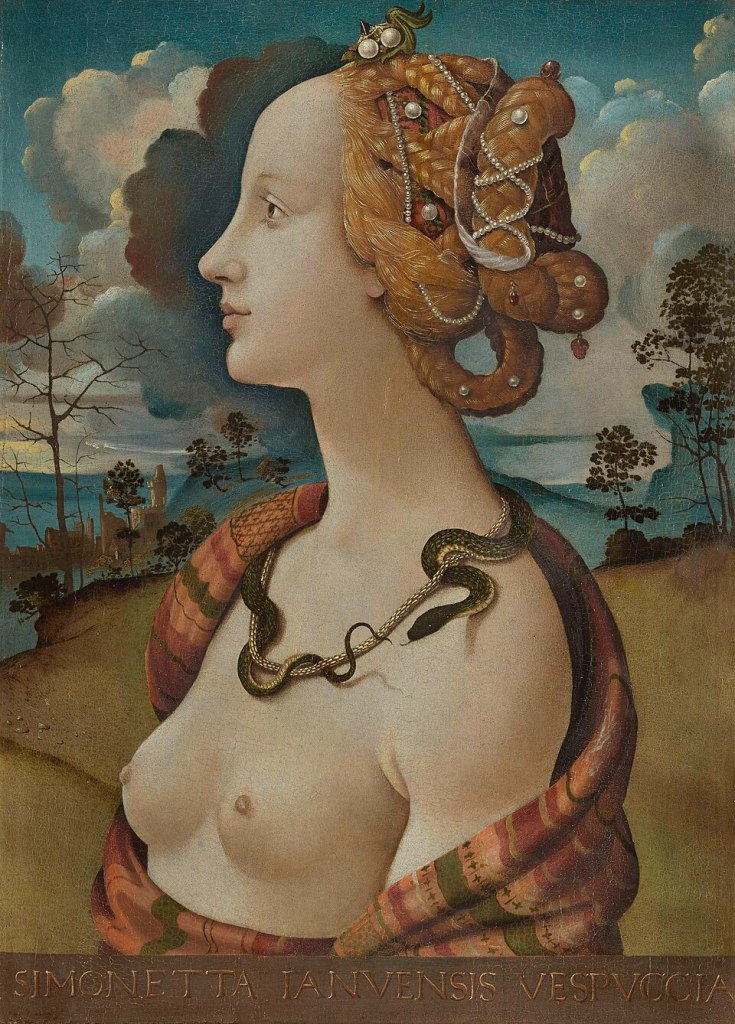
The force of this interpretation lies in the way it connects different parts of the painting. Landscape and serpent become complementary: one points towards death, the other towards survival in memory. Yet the argument remains dependent upon accepting the dead tree, declining light and storm cloud as signs of Simonetta’s premature death. Fermor objects that no secure contemporary convention requires the stormy landscape to be read in this way, and warns against imposing a modern emotional conception of landscape upon a fifteenth-century image.
Fermor places particular emphasis on the woman’s exposure within an open, untamed landscape. Female sitters were more commonly shown within interiors or framed by windows, balconies and doorways, pictorial structures that echoed the social enclosure expected of respectable women. Piero removes those boundaries. Simonetta appears directly before an extensive landscape with nothing to contain or regulate her. Fermor interprets this freedom from enclosure as part of the painting’s erotic licence and its departure from conventions of female decorum.
The setting also serves more immediate pictorial purposes. Its relative bareness intensifies the richness of the woman’s hair, pearls and pale flesh. The rolling contours of the terrain echo the curves of her body, while the dark cloud throws her profile into relief and repeats aspects of its outline. The storm may therefore be understood less as an emblem of death than as an instance of Piero’s interest in changing weather and his ability to use atmosphere to heighten the physical presence of the figure.
Joost Keizer draws attention to a still more intimate relationship between Simonetta and the clouds. He observes that their forms appear to repeat her profile, almost as though the contour of her head were passing into vapour. The effect makes her seem at once bodily present and immaterial. The landscape no longer merely surrounds the figure or foretells Simonetta’s fate; it participates in her transformation from a historical person into memory, apparition and myth.
John Onians, writing in an essay on the biological basis of Renaissance aesthetics, has perceived another, more speculative profile within the same clouds. He suggests that the dark mass immediately behind Simonetta contains the indistinct face of an ugly old man. The supposed face is difficult to discern, although a rounded projection in the cloud may be read as a prominent nose and the profile as facing in the same direction as Simonetta. Onians relates the effect to Piero’s reported habit of discovering figures in clouds and stained walls, and interprets the contrast as one between an object of desire and one of aversion.
Whether or not the old man can be securely seen, the observation reinforces Keizer’s broader point that the clouds do not operate merely as background. Their unstable forms interact with Simonetta’s profile and invite the viewer to move between atmosphere and figure. As with the serpent, the landscape approaches symbolic meaning without settling into a fixed emblem. It may evoke origin, death, freedom, desire, memory and dissolution, but no single reading exhausts its role.
Portrait, ideal image and painted presence
The identification of Simonetta does not make the picture a conventional portrait. Piero’s woman is named, but she is not presented as an ordinary Florentine sitter. Her exposed breast, elaborate coiffure, costly ornaments, serpent and open landscape place her at a distance from the social world in which female portraits usually affirmed marriage, lineage and decorum. The image preserves historical identity while transforming it into something less stable.
Geronimus describes the painting as poised between ritrarre, the recording of a particular likeness, and imitare, the more selective and inventive reconstruction of nature. The distinction is useful because the face does not appear to have been taken directly from Simonetta in life. Piero’s other paintings contain women with related features, suggesting that he drew upon an ideal type of his own. Geronimus compares the Chantilly figure with female heads in several of Piero’s religious paintings and with one of the nymphs in The Finding of Vulcan on Lemnos. Although the latter faces in the opposite direction, her high forehead, long straight nose, small chin and elongated neck closely resemble the Chantilly figure’s profile. Yet the inscription, the specificity of the profile and the accumulated associations with Simonetta prevent the figure from becoming wholly generic. The painting remains suspended between remembered individuality and ideal beauty.
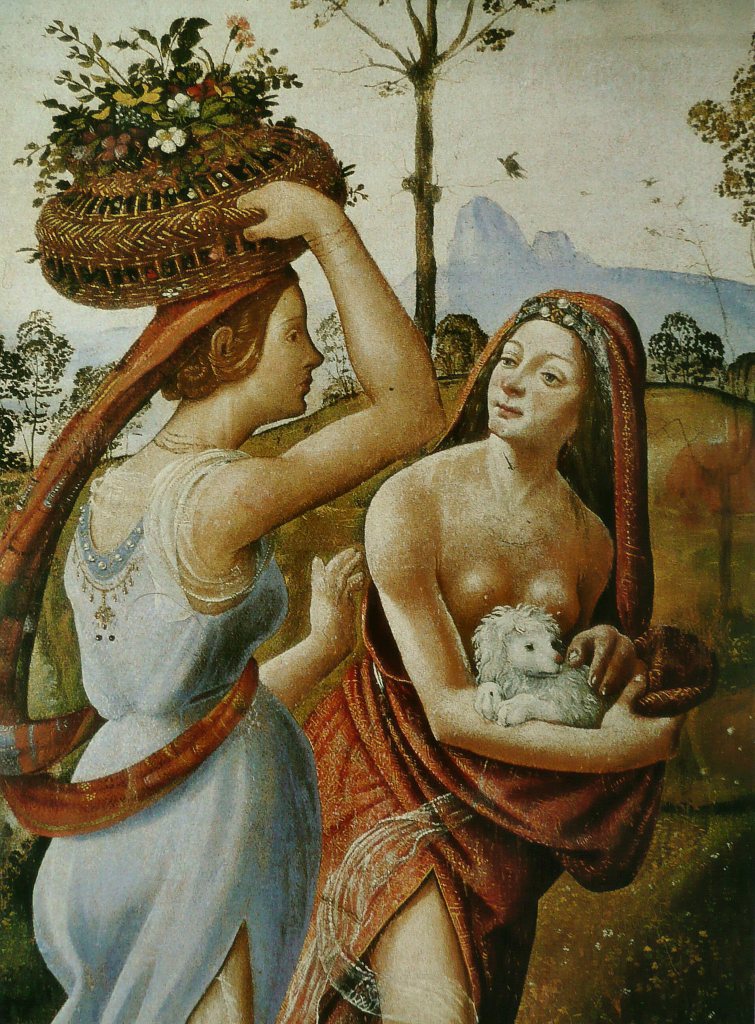
Geronimus therefore calls it an “evocation of the mind.” The phrase acknowledges both the absence of the historical woman and the imaginative work required to restore her. Simonetta is neither marked by the unequivocal pallor of death nor reconstructed simply as she might once have appeared. She is reconstituted as a youthful presence in which bodily beauty, social identity, memory and poetic invention coexist: not a direct likeness or a free fantasy, but a posthumous image shaped by what she had come to mean.
Commemoration and sensuality are therefore not easily separable. The exposed body and elaborate ornaments do not simply threaten the dignity of a memorial image; they intensify its promise of renewed presence. Piero asks the viewer not only to remember Simonetta’s beauty but to experience it as vividly available to sight. Her pale flesh, intricate hair and jewels invite prolonged looking, even as the strict profile denies any reciprocal encounter.
Joost Keizer places particular emphasis on this capacity of painting. Poetry could preserve Simonetta in language, praise her and transform her into an ideal, but painting could offer the semblance of a body. Renaissance writers sometimes imagined the painted likeness as a substitute for an absent beloved, capable of attracting desire in its own right. Piero’s panel gives Simonetta’s poetic afterlife a sensuous material form: she appears present, yet neither addresses the viewer nor returns the gaze. The image restores her to sight without pretending that access to her has been recovered.
This tension may also help to explain the persistence of the Cleopatra identification. Vasari’s description was not arbitrary. The exposed breast, jewels and serpent readily evoke an ancient heroine associated with beauty, luxury, erotic power and death. Even if the inscription and technical evidence make Simonetta the most persuasive identification, Piero may have allowed the historical woman to assume something of the visual character of Cleopatra or another antique beauty. The image gains part of its power from the uncertainty between portrait and mythological invention.
Fermor’s interpretation of the woman as Cleopatra gives full weight to the picture’s eroticism, but it is difficult to reconcile with the apparent originality of the inscription and the early association of the panel with Simonetta. Geronimus and Keizer offer a more inclusive account. Simonetta’s chastity, fame and posthumous idealisation need not exclude sensual attraction. The erotic charge may be integral to the commemorative process, since the painting preserves not only her name but the desire attached to her beauty.
The inscription and technical evidence make Simonetta Vespucci the most persuasive identification, but they do not turn the painting into a straightforward portrait. Piero combines a named historical woman with the visual languages of ceremony, sensuality, antiquity and commemoration. Marriage, public display, mortality and renewal remain present as associations rather than resolving into a single programme. The painting’s ambiguity is not an obstacle to its meaning, but the means by which a woman who died young is transformed into an enduring image of beauty, memory and desire.
[Producing these essays requires care, time, research, and resources. Contributions to help sustain this exploration would be greatly appreciated.]
https://donorbox.org/inner-surfaces-resonances-in-art-and-literature-837503
Bibliography
I have relied on the following sources. Any errors are mine.
Cropper, Elizabeth. ‘On Beautiful Women, Parmigianino, Petrarchismo, and the Vernacular Style’. The Art Bulletin, vol. 58, no. 3, September 1976, pp. 374–94.
Donati, Gabriele. ‘Francesco da Sangallo, Paolo Giovio e la “Simonetta” di Piero di Cosimo’. Prospettiva, no. 101, January 2001, pp. 81–85.
Ettle, Ross Brooke. ‘The Venus Dilemma: Notes on Botticelli and Simonetta Cattaneo Vespucci’. Source: Notes in the History of Art, vol. 27, no. 4, Summer 2008, pp. 3–10.
Fermor, Sharon. Piero di Cosimo: Fiction, Invention and Fantasia. London: Reaktion Books, 1993.
Geronimus, Dennis. Piero di Cosimo: Visions Beautiful and Strange. New Haven and London: Yale University Press, 2006.
Keizer, Joost. ‘A High Renaissance Oddity’. Zeitschrift für Kunstgeschichte, vol. 71, no. 1, 2008, pp. 136–43.
Laclotte, Michel, and Nathalie Volle, eds. Fra Angelico, Botticelli… Chefs-d’œuvre retrouvés. Chantilly and Paris: Domaine de Chantilly, Musée Condé and Cercle d’Art, 2014.
McHam, Sarah Blake. Piero di Cosimo: Eccentricity and Delight. London: Reaktion Books, 2024.
Mineo, Nicolò. ‘Cattaneo, Simonetta’. Dizionario Biografico degli Italiani, vol. 22. Rome: Istituto della Enciclopedia Italiana, 1979.
Onians, John. ‘The Biological Basis of Renaissance Aesthetics’. In Concepts of Beauty in Renaissance Art, edited by Francis Ames-Lewis and Mary Rogers, pp. 12–27. Aldershot: Ashgate, 1998.
Woods-Marsden, Joanna. ‘“Ritratto al Naturale”: Questions of Realism and Idealism in Early Renaissance Portraits’. Art Journal, vol. 46, no. 3, Autumn 1987, pp. 209–16.
 Inner Surfaces