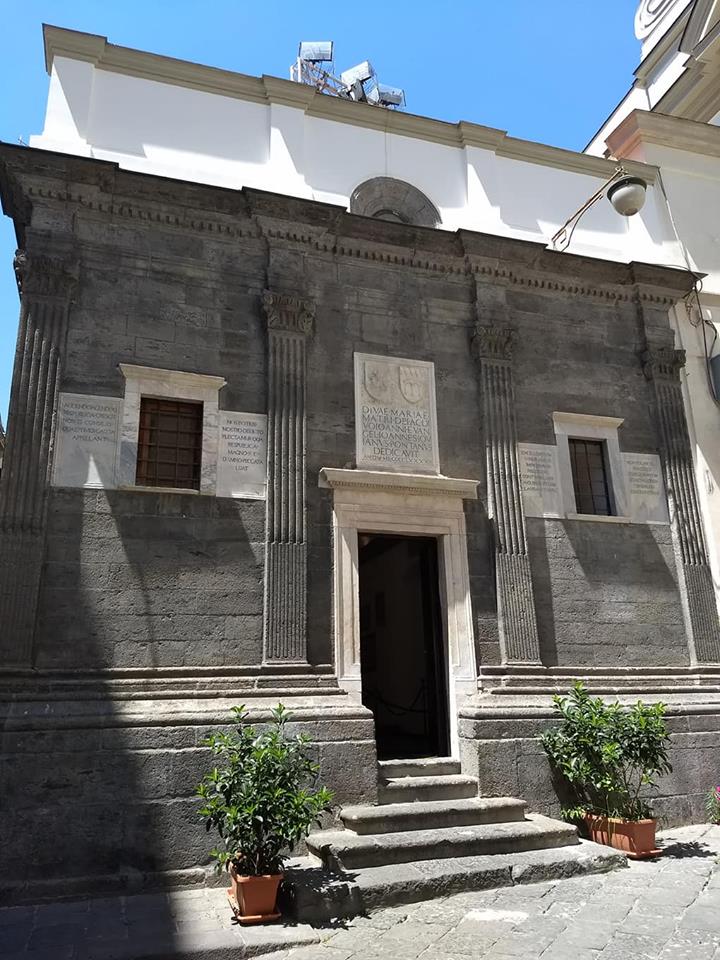
The Pontano Chapel stands on the Via dei Tribunali, one of the busiest and most historically dense streets in Naples. It is not hidden, yet it is remarkably easy to pass without understanding what it is. Its grey piperno exterior is austere, its Latin inscriptions are inaccessible to many viewers, and the intellectual culture that produced it now feels remote. Even its deliberately classical architectural language can appear strangely mute amid the visual abundance of the city.
The chapel remains physically present, and Pontano’s name is still attached to it, but much of what gave the building meaning has receded from view. It was conceived not simply as a family tomb or private place of worship, but as a monument to memory, learning and public life. Its interpretation begins with Giovanni Pontano himself.
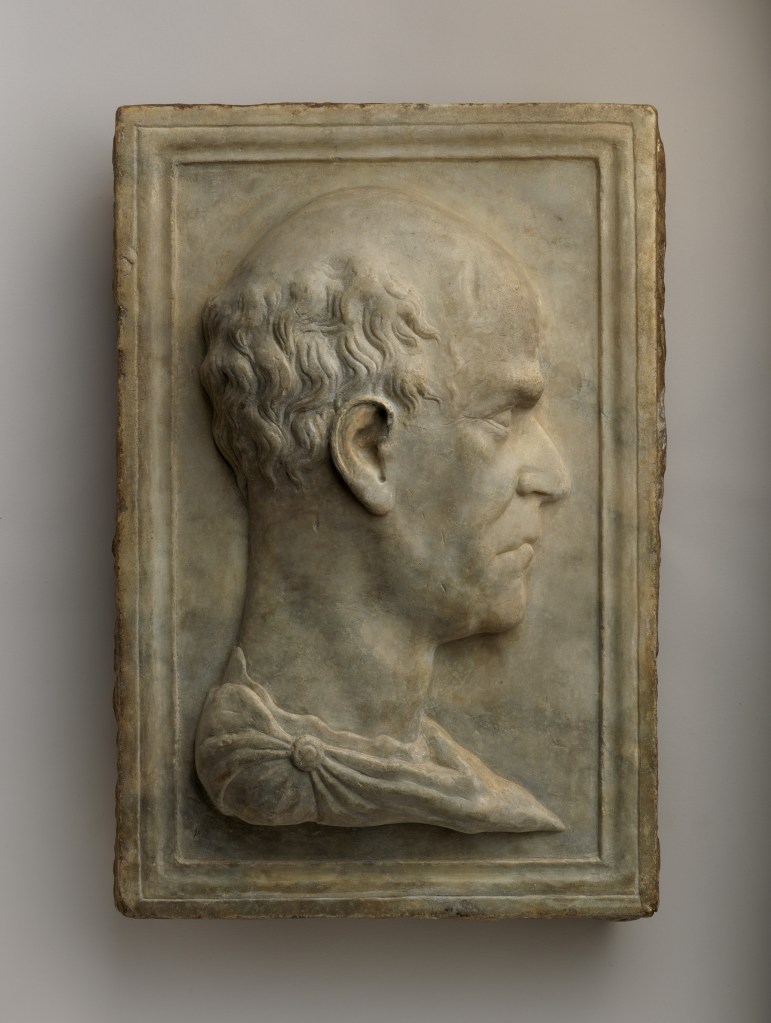
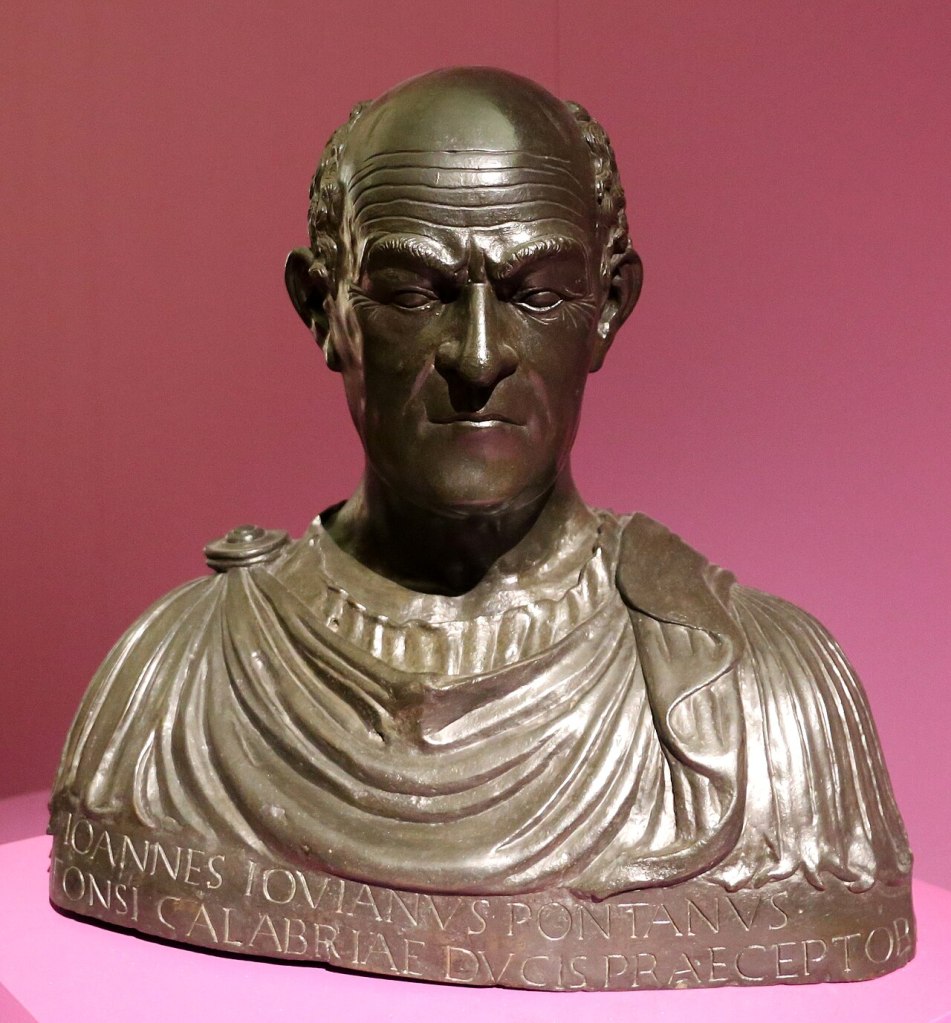
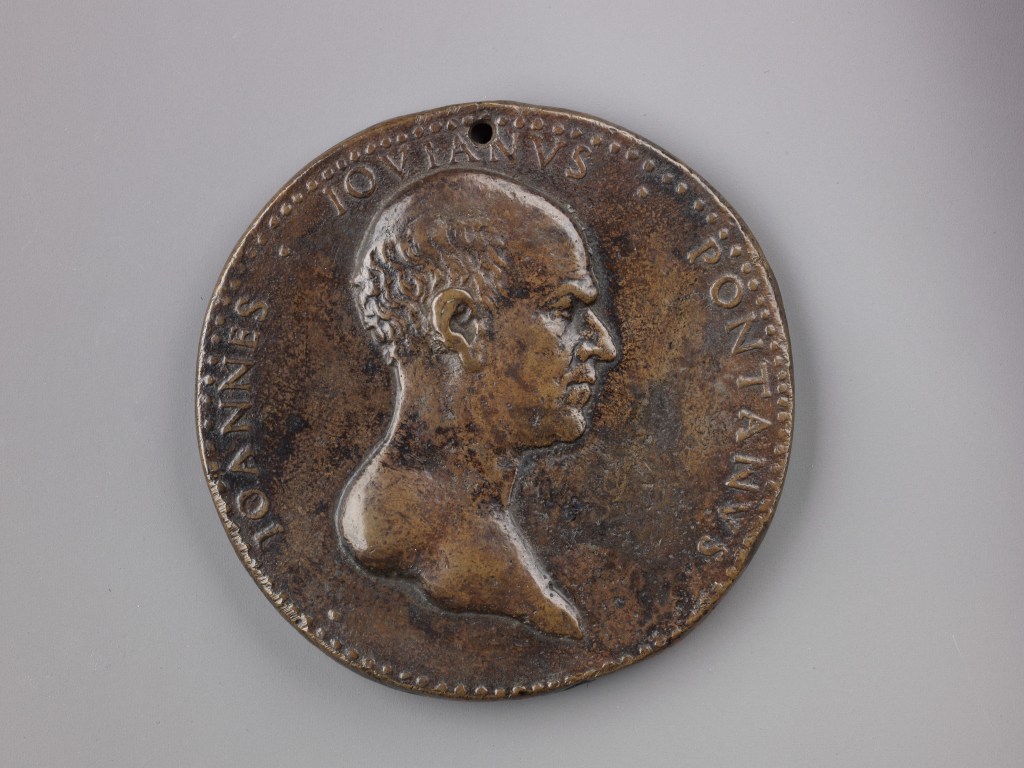
Pontano was born at Cerreto di Spoleto in Umbria, but his identity and career were formed in Naples. He entered the service of Alfonso I in the middle of the fifteenth century and rose steadily through the Aragonese administration. He worked in the royal chancery, drafted diplomatic and political correspondence, accompanied military campaigns, and participated in negotiations with other Italian states and the papacy. He eventually became one of the most trusted officials in Ferrante’s government. His responsibilities placed him not only within the royal household but at the centre of the machinery through which the kingdom was administered.
His public career was inseparable from his humanism. The studia humanitatis, centred upon grammar, rhetoric, poetry, history and moral philosophy, trained men for precisely the kinds of work Pontano undertook. Skill in rhetoric was essential to the composition of letters, speeches and diplomatic documents. History supplied examples through which rulers and political conduct might be judged, while moral philosophy provided the language of virtue, prudence, clemency and civic responsibility.
Humanists also helped rulers fashion and defend their public authority. Through histories, speeches, diplomatic letters and works in the speculum principis, or mirror-for-princes, tradition, they presented monarchy as the rule of a virtuous and cultivated prince. Drawing particularly upon Senecan ideals of self-command and clemency, and adapting classical ethics to Christian kingship, such writing could impose moral limits upon power in theory while simultaneously lending prestige and legitimacy to the dynasty that employed its author.
Pontano’s writings therefore did more than reflect the experience he gained in government. They participated in the representation of Aragonese rule, furnishing its princes with a language of virtue, magnificence and public responsibility. At the same time, his thought gradually extended beyond the prince and the court. His later works increasingly addressed urban elites, citizens, households and the conduct of social life.
Contemporaries were struck by the scale of his achievement. Antonio Galateo praised him for sustaining an extraordinary literary production while immersed in affairs of state, observing that even a man wholly devoted to learned leisure might scarcely have accomplished more. Bartolomeo Facio, writing as early as 1456, presented the still relatively young Pontano as an outstanding Latinist, a lyric poet working in the tradition of Catullus, an author of epigrams and astrological poetry, and a respected teacher of the humanities. His reputation was therefore established long before he reached the highest levels of government.
The range of his writing was exceptional. He composed Neo-Latin love poetry, elegies and epitaphs, dialogues, historical works, treatises on astrology and the natural world, and a substantial body of moral and social writing. Some of these works belonged to the traditional literature of counsel addressed to rulers. Others widened their attention to friendship, conversation, household management, the display and use of wealth, magnificence and the conduct appropriate to civic life. His career joined public office and private writing so closely that each helps explain the other.
Pontano also occupied a position between the court and the wider intellectual life of Naples. His offices brought him into contact with rulers, ambassadors, administrators and military commanders, while his teaching, scholarship and participation in the academy connected him with an urban elite of lawyers, clerics, officials and learned citizens. He was not confined either to the royal household or to the study. His career moved continually between government, literary culture and the social life of the city.
The chapel belongs to this same breadth of experience. It commemorated Pontano’s wife, children and friends, but it also gave durable form to the identity he had constructed through public service and writing. Ideas about reputation, civic virtue, magnificence, memory and political conduct were not external additions to a family monument. They belonged to the intellectual world from which the building emerged.
The chapel should therefore be understood as the monument of a humanist statesman. Its severity is not simply an absence of ornament. Architecture, inscription, classical allusion and the organisation of memory work together across its surfaces. Much of its meaning depends upon ideas that are no longer immediately available to the passer-by.
Yet one fundamental question remains unresolved: we still do not know with certainty who designed it. Several architects active in or connected with Aragonese Naples have been proposed, but none can be securely identified. Pontano succeeded in preserving his own name in stone at the centre of Naples, while the identity of the person who translated his project into architecture has largely disappeared.
The problem of the architect
The identity of the architect responsible for the Pontano Chapel has never been securely established. Giuliano da Maiano, Fra’ Giocondo, Francesco di Giorgio Martini and Baccio Pontelli have all been proposed, and each can be connected plausibly with the architectural culture of Aragonese Naples. Unless new documentary evidence appears, the question is unlikely to be resolved beyond dispute, although stylistic analysis has produced several serious proposals.
Giuliano da Maiano remains a plausible candidate because he was active in Naples during the later 1480s and was known to Pontano. His Porta Capuana offers several suggestive points of comparison with the chapel, including the contrast between dark piperno and pale marble, the use of classical capitals and certain ornamental details. The principal difficulty is chronological: Giuliano died in 1490, before the chapel was probably executed. His involvement would therefore require the assumption that he had supplied a design, drawing or model before his death which was realised later. The similarities are not sufficient to prove authorship, but they make that possibility difficult to dismiss entirely.
Fra’ Giocondo and Francesco di Giorgio are more difficult to separate. Both combined architectural practice with antiquarian study, and both investigated the ancient remains of the Campi Flegrei. A document of 1492 records payment to Fra’ Giocondo for 126 drawings associated with two works by Francesco di Giorgio, the Libro de architectura and the Libro de artigliaria. Whether these were original drawings or copies remains uncertain, but the document shows how closely their work could intersect.
Roberto Pane made the most sustained case for Francesco di Giorgio’s authorship. He acknowledged that the attribution was initially reached partly by excluding other candidates, but then developed a detailed stylistic argument from the chapel’s architectural vocabulary. He compared the unusual capitals, fluted pilasters and strongly articulated bases with forms used at Santa Maria al Calcinaio in Cortona, the Palazzo Comunale at Jesi and in Francesco’s drawings and treatises. More important for Pane than individual motifs was what he regarded as a recurring compositional sensibility: the interruption of the raised base by the doorway, the treatment of the small rectangular windows, the round oculus and the relationship between wall, opening and classical order all found parallels in Francesco’s studies and reconstructions of Roman architecture, particularly funerary monuments. Pane also noted Francesco’s familiarity with Neapolitan piperno. Although he began cautiously, he ultimately regarded the accumulation of these affinities as sufficient to place the chapel among Francesco di Giorgio’s architectural inventions.
Fra’ Giocondo nevertheless remains an important possibility because of his humanist and antiquarian interests. He belonged to a wider culture in which ancient inscriptions were copied, collected and studied as historical and literary evidence. That antiquarian interest would become central to the identity of the chapel itself, although its full significance belongs to a later discussion.
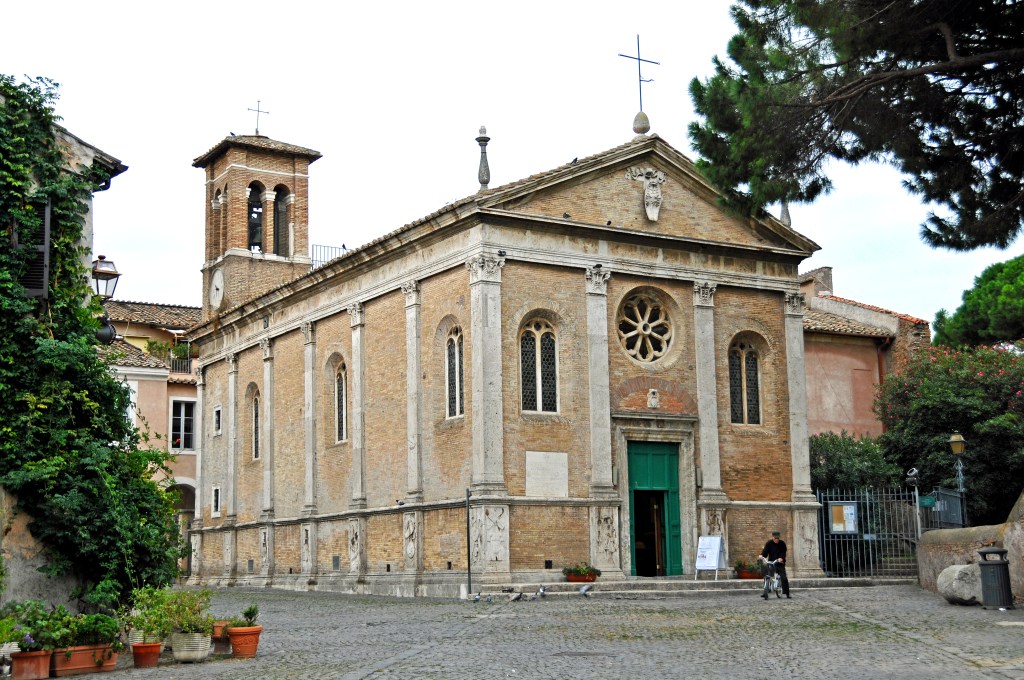
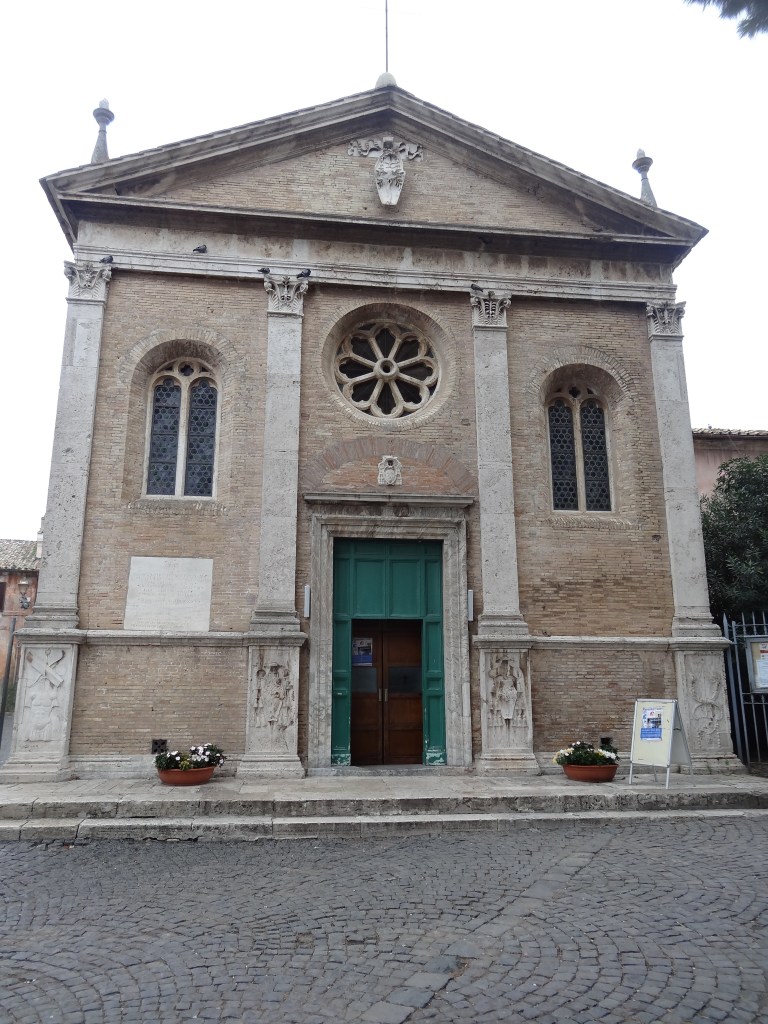
In more recent scholarship, Baccio Pontelli has been proposed as the architect of the chapel. Christoph Frommel first drew attention to the comparison with Santa Aurea at Ostia, while Francesco Benelli placed the church within a broader analysis of the architectural languages of Pontelli and Francesco di Giorgio. Santa Aurea’s compact, temple-like form, its walls articulated by pilasters, its emphatic horizontal entablature and its restrained use of classical ornament offer suggestive points of comparison with the Pontano Chapel. Pontelli is also documented in the Kingdom of Naples in 1494, when he supervised work at Reggio Calabria and was summoned by Alfonso II to Sessa Aurunca. Although this evidence postdates the chapel, it demonstrates that he was known to and employed by the Aragonese court. The comparison therefore gives Pontelli a credible place among the candidates without resolving the question of authorship.
Credit: Wikimedia Commons.
Credit: Wikimedia Commons.
The range of plausible candidates is revealing. Several architects and antiquarians connected with Aragonese Naples possessed the experience and interests required by such a commission, and their work sometimes intersected closely. This helps to explain why stylistic comparison has produced possibilities rather than a secure attribution.
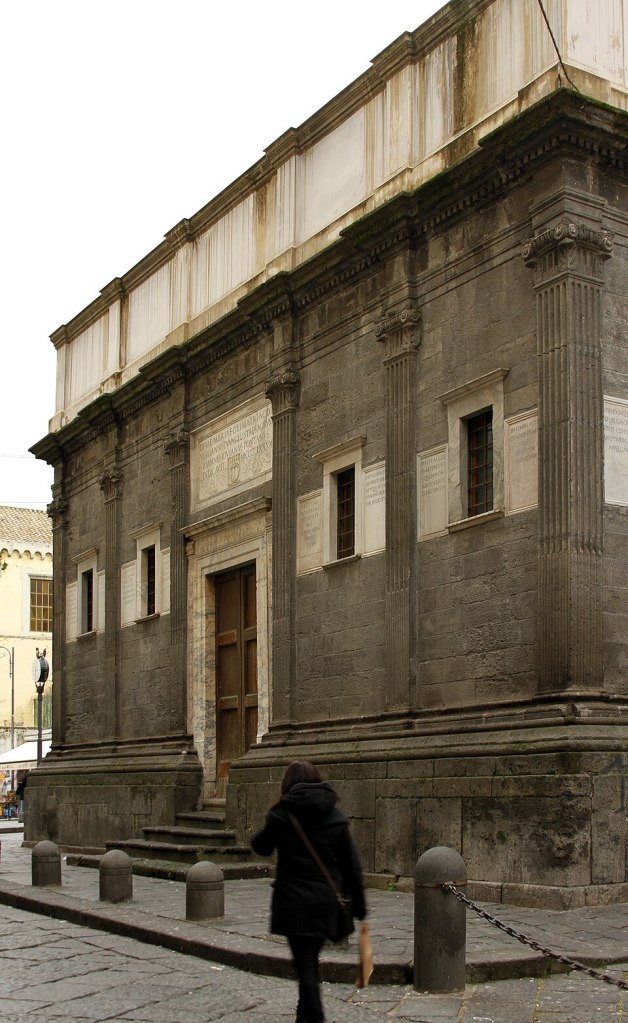
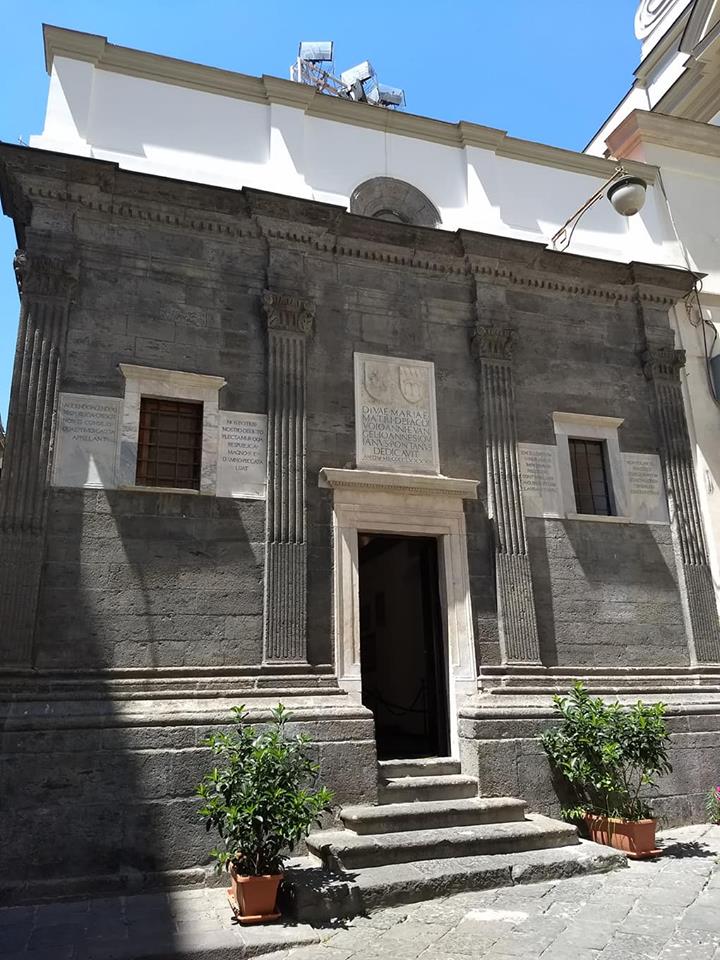
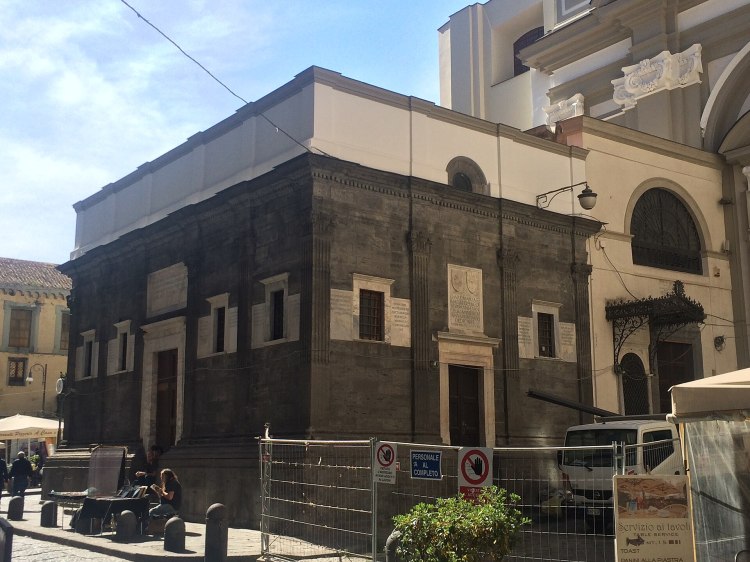
The identity of the architect may be uncertain, but the unusual nature of the commission is immediately apparent. Indeed, the building scarcely presents itself as a chapel at all. Seen from the street, it resembles an antique mausoleum or small temple more readily than a Christian place of worship. Its religious function is present, but it is not proclaimed through the familiar external signs of a church. The classical order, funerary form and inscribed surfaces dominate the viewer’s first impression.
There can be no comparable uncertainty about Pontano’s determining role in the conception of the monument. The exterior dedicatory inscriptions name him as founder, while the interior contains epitaphs and poems composed by him for his wife, his children, his friend Pietro Golino and eventually himself. The maiolica pavement also repeatedly carries the words Pontanus fecit. Bianca de Divitiis has shown how suggestive this formula is: it recalls an artist’s signature and allows Pontano to present himself not merely as patron, but as the author of the chapel in a broader humanist sense.
Yet the evidence for his direction does not depend on that inscription alone. The choice of an antique funerary type, the family commemorative function, the conspicuous urban setting and the integration of architecture with texts all point towards Pontano’s sustained involvement. Whoever prepared the drawings, calculated the vault or supervised the masons was giving built form to a conception that was unmistakably his.
The professional architect remains elusive, but the larger conception does not. The building may be architecturally anonymous, but intellectually it is unmistakably Pontano’s.
A Roman monument remade
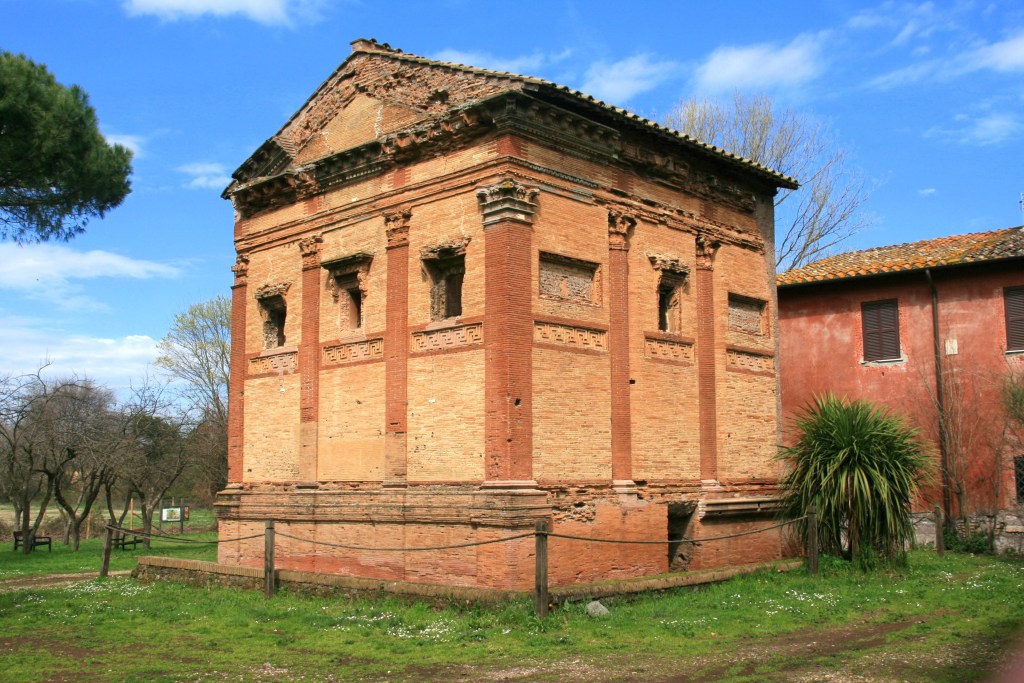
The closest surviving parallel for the Pontano Chapel is the second-century funerary monument traditionally associated with Annia Regilla beside the Via Appia. Both are compact rectangular structures raised above ground level, with their walls divided into regular bays by pilasters and small openings set within an ordered classical framework. Continuous horizontal mouldings bind the elevations together.
Credit: Wikimedia Commons.
Pontano may well have seen the so-called tomb of Annia Regilla during one of his diplomatic journeys to Rome. Its scale and proportions might well have offered a suitable model for the chapel he wished to build in Naples, while its antique funerary form could be adapted through the humanist practice of imitatio.
Imitatio did not imply mechanical reproduction. It involved recognising an authoritative ancient model and remaking it for new circumstances. The Pontano Chapel preserves the essential form of the Roman house tomb while transforming it into a Christian family memorial in the centre of Renaissance Naples. The process might also be understood as aemulatio: not merely following the ancient precedent, but adapting and enriching it. The Roman form was translated into local piperno and combined with marble inscriptions, heraldry and a programme of Neo-Latin writing. A funerary monument beside an ancient road became a chapel on one of the principal streets of Naples, facing Pontano’s own residence.
Humanist imitation was governed by restraint and appropriateness. Horace’s Ars poetica famously warned against the arbitrary combination of incompatible forms. The chapel’s originality lies not in the accumulation of unrelated antique motifs, but in the controlled adaptation of a recognisable funerary type. Its classical model remains legible even as it is made to serve new religious, familial and civic purposes.
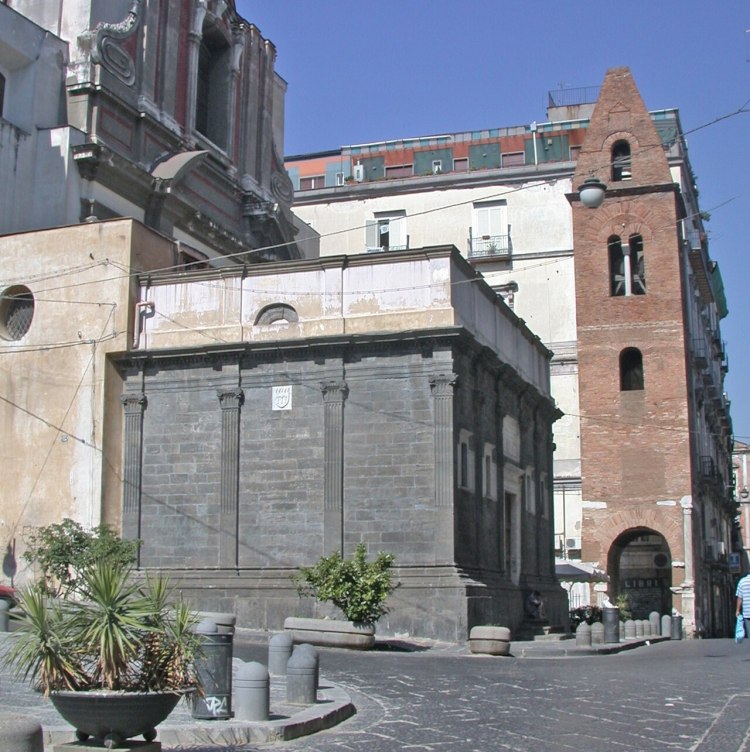
The chapel’s present appearance is not identical with its fifteenth-century form. Maria Teresa Como has drawn attention to the earliest known views of the monument, commissioned around 1727 by the Dutch antiquary Jacques Philippe d’Orville and made by the royal architect Carmine Perretti. Because they predate the restoration of 1759, they preserve evidence for the chapel’s earlier state.
On the basis of these views, Como argues that the original attic was taller and plainer than the present one. If the recorded proportions are accurate, its composition may have recalled Roman triumphal arches, particularly those of Septimius Severus in Rome and Trajan at Benevento.
The raised base contributes to the chapel’s dignitas. Alberti’s statement that a temple should be elevated above the level of the city offers a suggestive parallel, though there is no need to assume that Pontano followed De re aedificatoria directly. The resemblance may instead reflect a shared classical culture in which elevation, ordered proportion and durable materials expressed honour and authority. The podium lifts the chapel above the ordinary surface of the street and gives a relatively small building the presence of a monument.
The principle of decorum offers a particularly rewarding way of reading the building. In rhetorical and architectural thought, decorum required an appropriate relationship between form, purpose and social identity. The chapel’s severe classical order, durable piperno and predominance of inscriptions are suited to the memorial of an orator, statesman and scholar. Its appearance does not merely display antiquarian learning; it embodies the identity Pontano wished to preserve.
The Vitruvian terms firmitas, utilitas and venustas provide a related framework. The piperno construction promises durability. The chapel’s uses were multiple: a place of worship, a family mausoleum, a setting for poetry and commemoration, and at times a meeting place for Pontano’s academy. Its beauty arises from the ordering of these functions within a coherent architectural form.
Architecture, rhetoric and memory
The chapel’s inscribed surfaces can be approached through the classical art of memory. In the Rhetorica ad Herennium, then accepted as a work of Cicero, artificial memory is created by assigning vivid images to a sequence of clearly defined places. A house, an arch, a recess or the space between columns might all serve as mnemonic loci. Ideas could then be recovered by mentally revisiting the places in which they had been deposited.
This provides a rewarding context for the exterior of the Pontano Chapel. Its pilasters divide the walls into distinct architectural compartments, and the marble inscriptions occupy the spaces between them. The texts are assigned to a measured sequence of places. The visitor encounters the monument by moving from one inscribed field to another, following an order created by the architecture.
Cicero’s De oratore similarly connects memory with orderly location and with writing upon tablets. Facts are preserved by placing them within distinct mental settings, just as letters are fixed upon a writing surface. The analogy acquires unusual physical immediacy in a chapel whose texts are actually engraved upon marble tablets and set within clearly bounded architectural spaces.
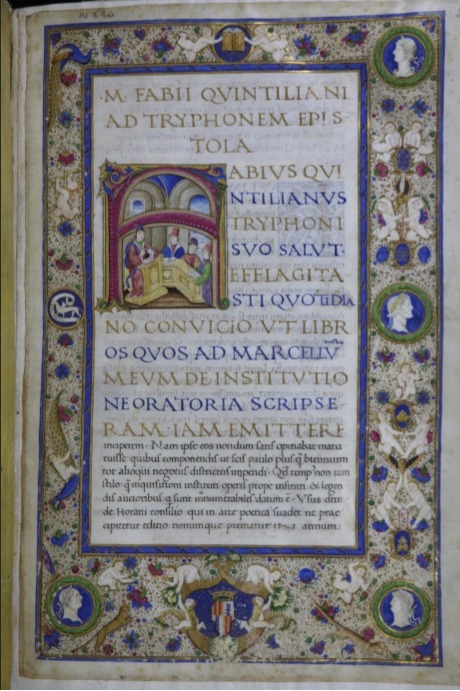
Quintilian extends the mnemonic method beyond the imagined house. In the Institutio oratoria, public buildings, city walls, journeys and pictures can all provide an ordered sequence of places through which memory moves. His account suggests that the art of memory need not remain enclosed within a private or imaginary interior, but may also be attached to places encountered within the city itself. This wider association between memory and urban locus will become relevant later, when the chapel’s place within Pontaniana and its relationship with the surrounding streets and buildings are considered.
Quintilian’s separate comparison between the arrangement of a speech and the construction of a building is equally suggestive. The gathering of materials achieves little unless each part is assigned its proper position within a firm and coherent structure. The chapel brings this rhetorical principle unusually close to architectural form. Its pilasters establish a measured succession of bays, while the inscriptions are assigned to the spaces between them. The Roman house-tomb supplies the basic architectural inventio, but the placing and ordering of its textual elements may be understood as an act of dispositio.
The distinction between exterior and interior may also reflect different kinds of address. On the street-facing walls, Pontano placed texts concerned with conduct, authority and public life. Inside, the inscriptions and poems speak more intimately of his wife, children and friends. The separation is not absolute, but the movement from public counsel outside to familial commemoration within accords with the wider distinction in Pontano’s writing between civic and domestic spheres.
The exterior maxims are brief, aphoristic and sometimes difficult. Their meaning is not exhausted at a glance. Like material gathered in a humanist commonplace book, they invite recollection, comparison and reflection. Their subjects include government, public service, ambition, reputation and personal conduct. The building therefore does more than preserve examples of Pontano’s writing. It continues to address those who pass it, turning the street into a setting for moral and political thought.
These parallels are perhaps best understood as evidence of a shared rhetorical culture rather than a direct architectural application of mnemonic theory. The same habits of thought that placed ideas in ordered loci, arranged the parts of a discourse through dispositio, and fixed words upon tablets find a striking architectural counterpart in the chapel. Its walls become at once a structure, a writing surface and an ordered field of memory.
A monument to memory
The chapel’s position was part of its commemorative meaning. It stood on the Decumanus Maior, the modern Via dei Tribunali, opposite Pontano’s city residence and beside the ancient complex of Santa Maria Maggiore alla Pietrasanta.
Pontano’s late dialogue Aegidius, written around 1501, gives the locality a more personal identity. Suardo Suardino and a companion arrive in Naples seeking Pontano’s city house. They recognise the noble and much-frequented district generally known as Pontaniana by the square tower of Santa Maria Maggiore. The episode suggests that Pontano’s residence and chapel had become closely associated with a recognisable part of the city already bearing his name. Together, the house and chapel marked out this area as distinctly Pontano’s; the campanile, the inscriptions and the name Pontaniana reinforced that association.
Classical writing offered a powerful account of the way memory adheres to place. In De finibus, Cicero describes the particular force of locations associated with eminent men. Places where philosophers, poets and orators had lived, spoken or been buried could make the absent seem present, stimulating recollection more vividly than a verbal account alone. Such places also encouraged emulation: the memory of distinguished predecessors could influence the conduct of those who came after them.
The Pontano Chapel can be understood within this tradition. Its antique form, its elevation above the street and its inscribed surfaces established a fixed point of memory within the movement of the city. The passer-by encountered not only a family tomb, but a monument that attached Pontano’s literary and political identity to a particular urban locus. Memory belonged to the chapel, but also to the house, the street and the surrounding district.
The chapel’s commemorative reach was not confined either to its walls or to those buried within it. Just as the monument formed part of the wider urban fabric of Pontaniana, its literary programme extended beyond the building through Pontano’s De tumulis. Some of these poems were inscribed upon tablets inside the chapel, including those written for his wife Adriana Sassone, his children and his close friend Pietro Golino. Others remained within the poetic collection, extending commemoration to figures beyond the immediate family and into the wider Neapolitan civitas. The stone inscriptions and the poems on the page therefore belonged to a related project: together they created a community of the dead whose memory was sustained through both architecture and literature.
Pontano’s De magnificentia gives this commemorative architecture a civic dimension. Tombs might be private works, raised by individuals or families, yet they could also contribute to the beauty and dignity of a city. When they preserved the memory of deserving citizens, they encouraged virtue and glory among the living. A sepulchral monument could therefore justify private expenditure through public benefit, becoming a form of civic benefaction as well as an expression of personal or familial grief.
The chapel appears to enact precisely this argument. It commemorated Pontano’s wife, children and friends, but it also presented his own learning, public service and moral authority as worthy of preservation. His desire for posthumous reputation need not be understood simply as vanity. Within the Ciceronian tradition, fama was connected with public usefulness: poets, statesmen and other persons of distinction continued to benefit the community through the examples and words they left behind.
Cicero’s quotation from Ennius, volito vivus per ora virum — “I fly living through the mouths of men” — is especially suggestive here. Roman funerary inscriptions often addressed the passer-by, who might stop before a tomb, read its words and speak the name of the dead aloud. A comparable encounter may well have taken place before the Pontano Chapel. Those passing along the street could pause to read its inscriptions, and may have read them aloud. In doing so, they gave Pontano a voice again. Through the breath and speech of the living passer-by, the illustrious humanist became momentarily present, almost recalled to life.
This understanding of memorial fame was not inevitable even within the intellectual culture of the Aragonese court. Lorenzo Valla, who had served Alfonso of Aragon in Naples, offered a sharply different view. In De voluptate, his Epicurean spokesman ridicules the pursuit of posthumous glory and questions the value of tombs and statues to those who can no longer benefit from them. Pontano’s chapel embodies another choice: the more affirmative Ciceronian belief that the remembrance of worthy individuals can enrich civic life and provide examples for posterity.
The inscription on Pontano’s city house made his claim upon the future unusually explicit. Addressed to whoever might later possess the property, it praised Pontano as one who loved literature, the liberal arts, kings and honourable men, and urged his successor not to be ashamed of him. It also called down divine anger upon anyone who damaged the stone. The inscription attempted to ensure that a change of ownership would not efface Pontano’s presence: the house might pass to another family, but the prestige and character of its former inhabitant were to remain attached to it.
After the house was demolished in 1564, the text nonetheless reappeared inside the chapel. Whether the original stone was transferred or the inscription was reproduced is not entirely clear, but the effect was the same: part of the lost residence’s commemorative identity was absorbed into the monument that survived.
The chapel was therefore only one element within a larger memorial landscape. House, chapel, campanile, inscriptions, poetry and place-name reinforced one another, creating a small urban territory in which Pontano’s identity could survive his death. The success of the project is visible even now. The architect’s name remains uncertain, the intellectual culture of the monument has become remote, and many passers-by may scarcely notice the building. Yet Pontano’s name still inhabits this part of Naples. Hidden in plain sight, the chapel continues to perform the work for which it was made.
Producing these essays requires care, time, research, and resources. Contributions to help sustain this exploration would be greatly appreciated.
Donate to Inner Surfaces here.
Bibliography
I have consulted the following texts. Any errors are mine.
Alberti, Leon Battista, On the Art of Building in Ten Books, trans. J. Rykwert, N. Leach and R. Tavernor, Cambridge, Massachusetts, and London, 1988.
Alisio, Gian Carlo, ‘La cappella Pontano’, Napoli Nobilissima, 3, 1963–64, pp. 29–35.
Benelli, Francesco, ‘Baccio Pontelli e Francesco di Giorgio: alcuni confronti stilistici fra rocche, chiese, cappelle e palazzi’, in Francesco di Giorgio alla corte di Federico da Montefeltro, ed. Francesco Paolo Fiore, Florence, 2004, pp. 551–555.
Borsi, Stefano, Leon Battista Alberti a Napoli, Florence, 2006.
Brooke, John, ‘Giovanni Pontano (1429–1503) and Social Mores, Memorial and Material Culture in Renaissance Naples, c. 1450–1490’, unpublished PhD thesis, Department of History of Art and Screen Media, Birkbeck College, University of London, 2010.
Cicero, Brutus; Orator, ed. and trans. G. L. Hendrickson and H. M. Hubbell, Cambridge, Massachusetts, 1962.
Cicero, De Finibus Bonorum et Malorum, ed. and trans. H. Rackham, Cambridge, Massachusetts, 1961.
Cicero, De Oratore, ed. and trans. E. W. Sutton and H. Rackham, Cambridge, Massachusetts, 1959.
Cicero, Tusculan Disputations, ed. and trans. J. E. King, Cambridge, Massachusetts, 1960.
Como, Maria Teresa, ‘Nuove acquisizioni sulla Cappella Pontano. Il contesto originario e l’architettura’, Rinascimento Meridionale, 7, 2016, pp. 35–48.
de Divitiis, Bianca, Architettura e committenza nella Napoli del Quattrocento, Venice, 2007.
de Divitiis, Bianca, ‘Pontano and his Idea of Patronage’, in Some Degree of Happiness: Studi di storia dell’architettura in onore di Howard Burns, eds Maria Beltramini and Caroline Elam, Pisa, 2010, pp. 107–131, 684–692.
de Divitiis, Bianca, ‘PONTANVS FECIT: Inscriptions and Artistic Authorship in the Pontano Chapel’, California Italian Studies, 3.1, 2012, pp. 1–36.
Filangieri di Candida, Riccardo, ‘Il tempietto di Gioviano Pontano in Napoli’, Atti dell’Accademia Pontaniana, 56, 1926, pp. 103–139.
Frommel, Christoph L., ‘Il tempio e la chiesa: Baccio Pontelli e Giuliano della Rovere nella chiesa di S. Aurea a Ostia’, in Architettura e committenza da Alberti a Bramante, Florence, 2006, pp. 390–393.
Gahtan, Maia Wellington, ‘Reading Pontano’s “Libretto co’ fogli di marmo”’, Opus Incertum, 8, 2022, pp. 48–59.
Horace, Satires, Epistles and Ars Poetica, ed. and trans. H. R. Fairclough, Cambridge, Massachusetts, 1966.
Kidwell, Carol, Pontano: Poet and Prime Minister, London, 1991.
Koortbojian, Michael, ‘In commemorationem mortuorum: Text and Image along the “Streets of Tombs”’, in Art and Text in Roman Culture, ed. Jas Elsner, Cambridge, 1996, pp. 210–234.
Pane, Andrea, ‘Architettura e urbanistica del Rinascimento’, in Storia di Napoli, vol. IV, pt. 1, Naples, 1977, pp. 315–417.
Pane, Roberto, Il Rinascimento nell’Italia meridionale, 2 vols, Milan, 1975.
Pane, Roberto, ‘L’attività napoletana di Francesco di Giorgio’, in Storia di Napoli, vol. IV, pt. 1, Naples, 1977, pp. 389–395.
Payne, Alina, The Architectural Treatise in the Italian Renaissance, Cambridge, 1999.
Pontano, Giovanni Gioviano, I dialoghi, ed. Carmelo Previtera, Florence, 1943.
Pontano, Giovanni Gioviano, I libri delle virtù sociali, ed. Francesco Tateo, Rome, 1999.
Quintilian, The Institutio Oratoria, 4 vols, ed. and trans. H. E. Butler, Cambridge, Massachusetts, 1920–22.
Rhetorica ad Herennium, ed. and trans. Harry Caplan, Cambridge, Massachusetts, 1954.
Valla, Lorenzo, On Pleasure (De voluptate), trans. A. Kent Hieatt and Maristella de Panizza Lorch, New York, 1977.
Van Eck, Caroline, ‘Architecture, Language and Rhetoric in Alberti’s De re aedificatoria’, in Architecture and Language, eds G. Clarke and P. Crossley, Cambridge, 2000, pp. 72–81.
Varro, De Lingua Latina, vol. II, ed. and trans. R. G. Kent, Cambridge, Massachusetts, 1958.

