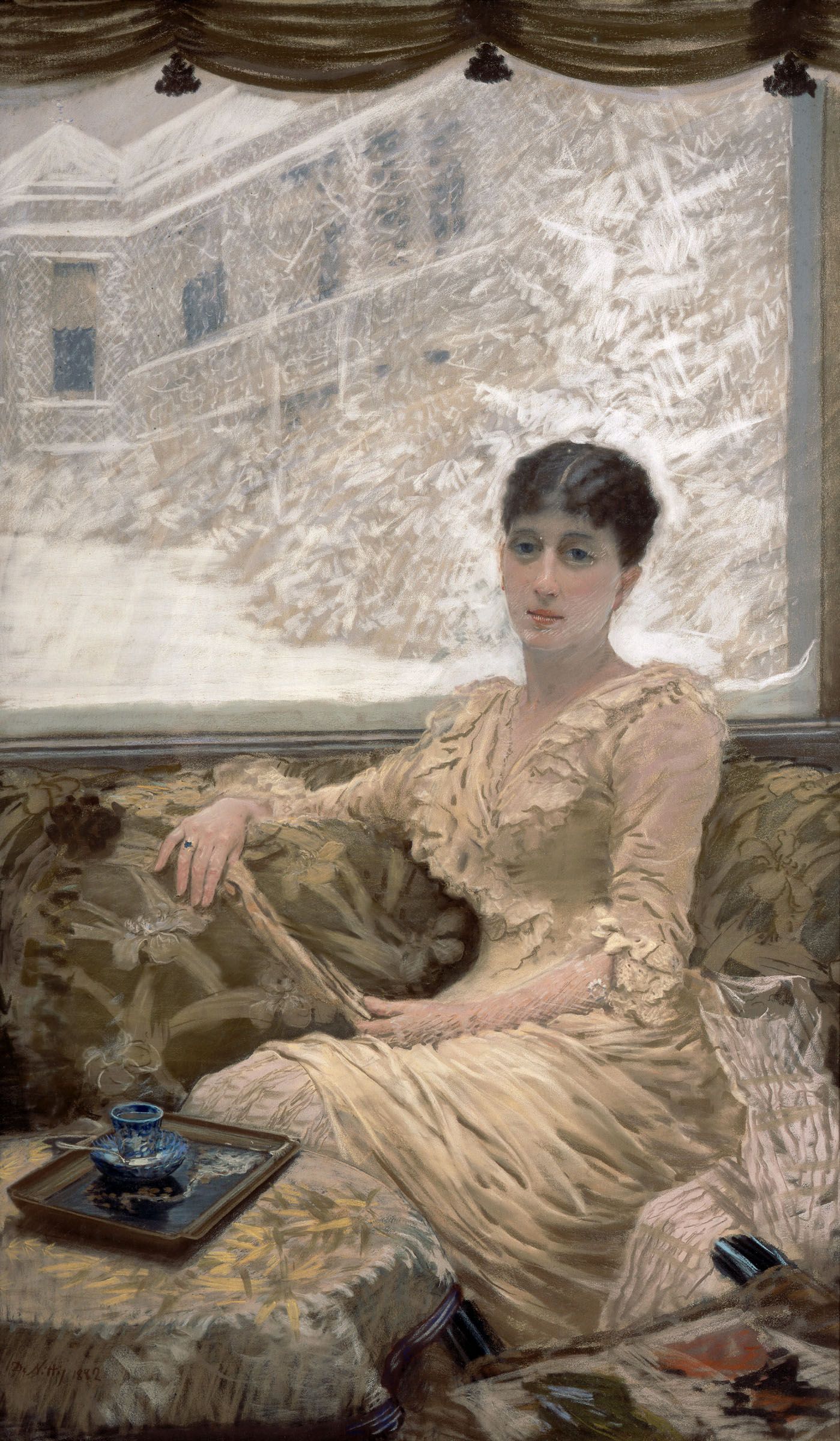
This essay brings together Giuseppe De Nittis’s Giornata d’inverno. Ritratto della signora De Nittis of 1882 and James McNeill Whistler’s Symphony in White, No. 2: The Little White Girl of 1864 as an accostamento: a juxtaposition of two works that share a contextual affinity. They are separated by nearly two decades. Yet Edmond de Goncourt’s description of De Nittis’s pastel as “the most extraordinary symphony of whiteness” inevitably recalls Whistler’s title. Whether this parallel was merely rhetorical, or reflected some more direct line of artistic inspiration, cannot now be known.
Each work presents a woman within a refined interior. In both, the pale dress gives the artist an opportunity to display remarkable technical virtuosity, transforming costume into an alluring study of texture, light and colour. Furnishings and East Asian objects further enrich the scenes, while the women establish markedly different relationships with the viewer. Yet the two artists arrive at distinct forms of modernity. Whistler draws Joanna Hiffernan into an enigmatic, self-contained aesthetic arrangement, whereas De Nittis allows Léontine’s personality to emerge from a continuous field of light and atmosphere.
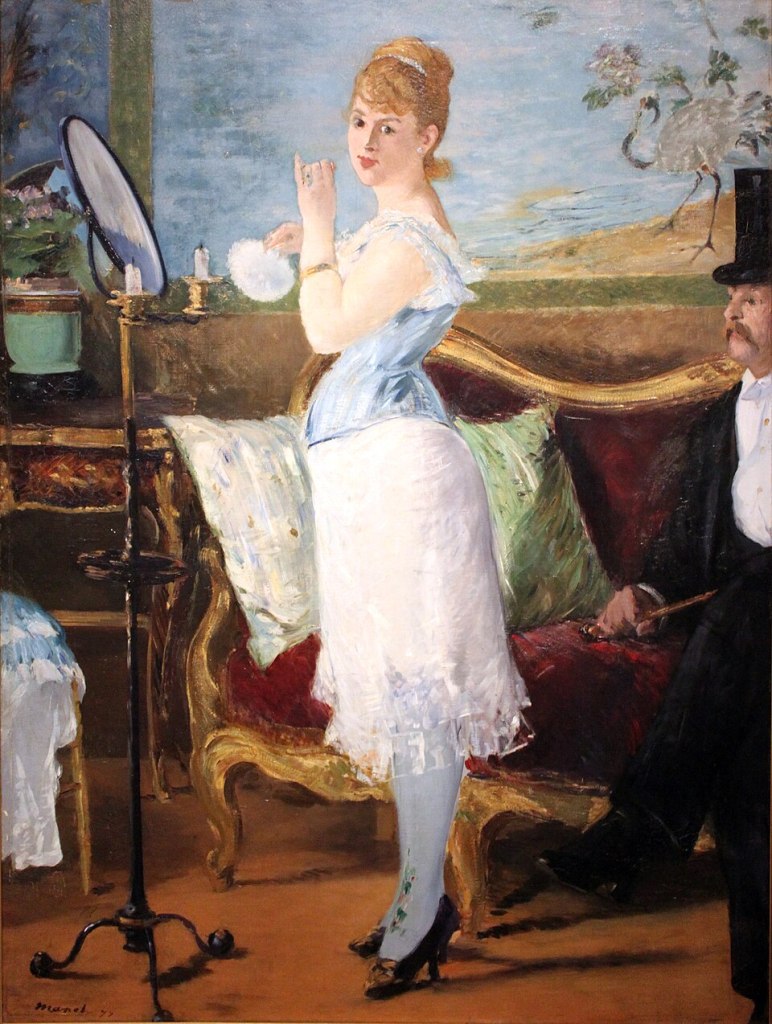
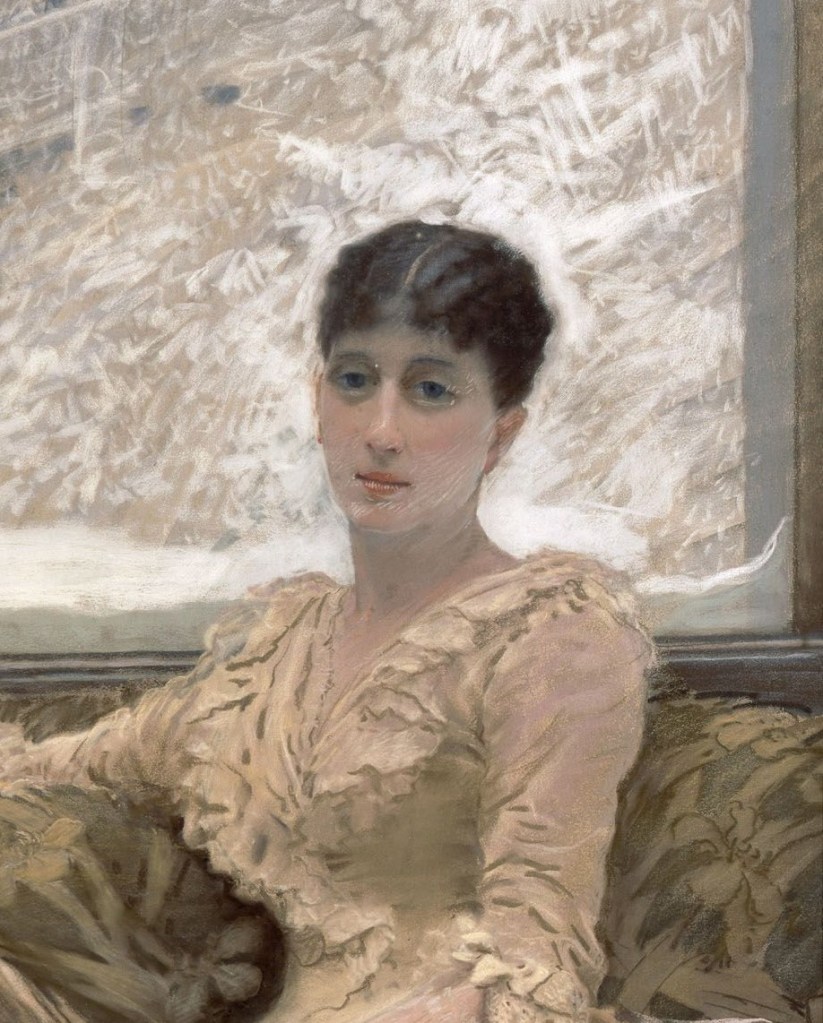
In Whistler’s work, Hiffernan turns away, her profile and reflected image suggesting an inward state that remains inaccessible. Léontine, by contrast, looks directly out of the picture. Her steady, frontal gaze recalls the directness with which women in Manet’s paintings often confront the viewer, though De Nittis gives the phenomenon a quieter and more intimate emotional character. Composed but pensive, Léontine establishes the mood of the painting through her expression and gaze.
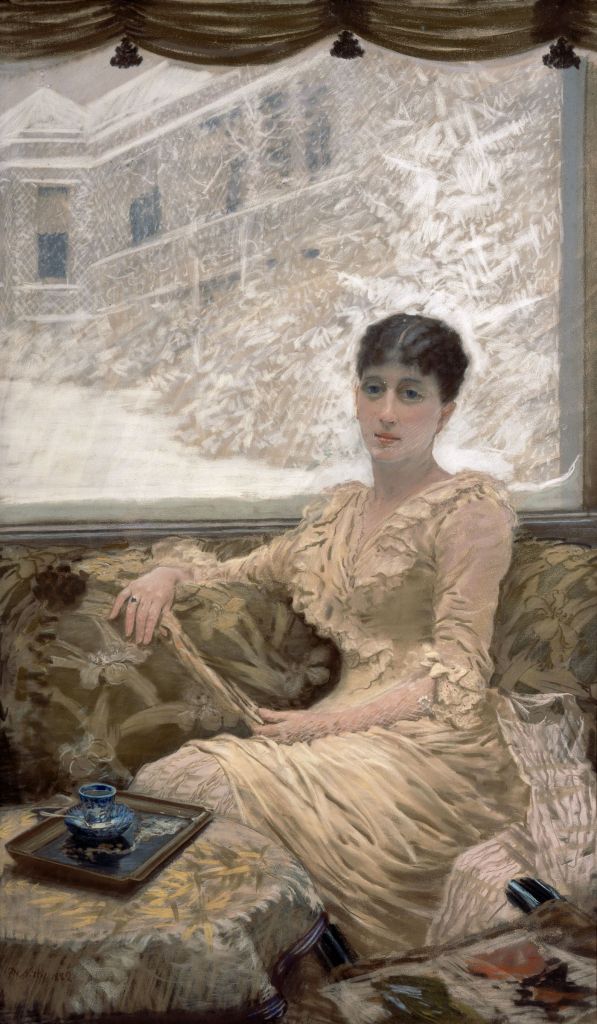
In Giornata d’inverno, Léontine is seated slightly to the right of centre before a large window. The composition is divided almost equally between the snowy landscape beyond and the domestic interior in the foreground, where her figure, the table and the surrounding furnishings are concentrated. In Symphony in White, No. 2, Joanna Hiffernan stands to the left, extending one arm along the mantelpiece. The mirror, her reflection and the objects arranged across the mantel occupy the space beside her, producing a more oblique and compressed arrangement.
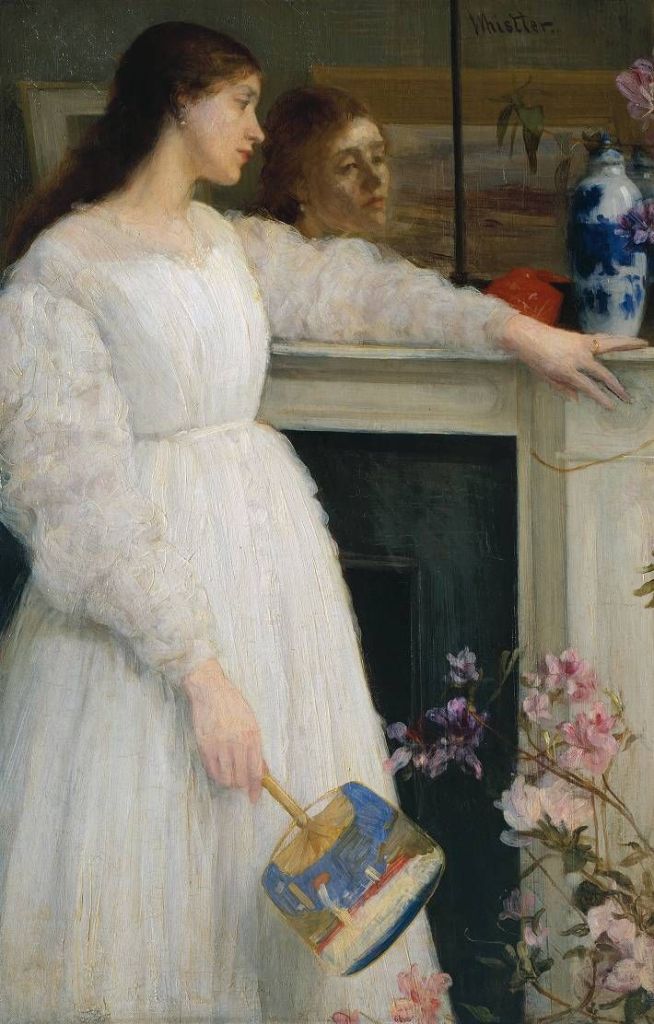
In her essay “Fashioning White in the Work of Whistler and His Contemporaries,” Aileen Ribeiro describes the dress in The Little White Girl as being made from very fine white muslin. The fabric is sufficiently transparent for the lines of the chemise to remain visible at the neckline and for the tone of Hiffernan’s skin to appear through the sleeves. The sleeves are gathered into small rolls in a form influenced by sixteenth-century Italian costume. Ribeiro relates this feature to a drawing of a woman in Whistler’s Valparaiso Notebook, whose dress has sleeves puffed along the length of the arm and a lightly sketched ruff.
Ribeiro places Hiffernan’s garment firmly within contemporary fashion. Dresses of this kind were popular in progressive and fashionable circles during the middle decades of the nineteenth century, valued for their femininity, simplicity and faint reference to the past. The puffed sleeves and soft, relatively unstructured form allowed the then modern garment to acquire a slightly archaic and timeless character. Ribeiro also cites the art critic Charles Blanc’s admiration for muslin’s soft, hazy outlines and freshness of appearance, which he associated with moral purity and, more broadly, with children and young women. These associations help to establish the cultural resonance of the fabric, though they should not in themselves be treated as a complete symbolic interpretation of Whistler’s painting, the theme of which seems deliberately elusive.
Léontine’s dress is no less firmly rooted in contemporary fashion, but it can be identified more precisely with the fashionable world of Paris in the early 1880s. Alice Guerrieri describes it as a robe princesse in the fashionable Gloire de Dijon shade, understood as a pearl grey. The V-shaped neckline is framed by flounced trimming that continues down the bodice in a gently curving, slightly S-shaped line, while corresponding flounces edge the elbow-length sleeves. Lace inserts emerge beneath them and are fastened with small bows. The lower part of the dress is arranged in broad, flowing folds across Léontine’s lap, where a pale pink underskirt, perhaps of taffeta, becomes visible, its edges gathered along the divan. These details establish the dress as an object of contemporary fashion, but De Nittis does not treat it merely as a record of costume. The interplay of pearl grey, cream and pink, together with the varied textures of flounces, lace and drapery, contributes directly to the broader harmony of colour and surface throughout the composition.
The contrast, then, is one of emphasis rather than chronology. Hiffernan’s gown belongs to contemporary fashion but draws upon historical associations that soften its temporal specificity. Léontine’s robe princesse, by contrast, is tied more closely to a particular moment through its cut, trimmings and fashionable colour. Whistler presents modern dress in a form that also suggests remoteness and timelessness, while De Nittis makes Léontine’s fashionable contemporaneity an integral part of the portrait.
In both paintings, white is better understood as a governing harmony than as a single colour. Whistler’s title directs attention to an arrangement dominated by pale tones, but these are continually punctuated by other hues. The dress moves between cool and warmer whites, with pink visible in the translucent sleeves, while the mantelpiece and mirror surround take on a pale celadon cast. The stronger colours of the hair, flowers, fan and porcelain do not interrupt this harmony so much as give it definition. De Nittis works within a warmer register. Léontine’s dress ranges through cream, fawn and beige tones, with darker touches that shift towards brown and muted green. Related pinks recur in her skin, the underskirt and other passages in the foreground, while similar subdued tones in the building and vegetation beyond the window extend the interior harmony into the landscape. The snow between foreground and distance introduces a far more brilliant white. In both works, then, the predominantly white harmony is given richness and variety through the interplay of warm and cool tones, muted passages and stronger accents.
The chromatic richness of the two paintings is inseparable from their different media. De Nittis’s pastel depends upon an active relationship between viewing distance and pictorial coherence. Seen from nearby, the dress, skin and surrounding interior dissolve into a dense accumulation of flecks, strokes and touches of colour, from which clearly bounded forms are difficult to extract. As the viewer moves back, these dispersed marks combine optically, allowing Léontine’s figure and the room around her to emerge without losing the vibration of the surface. The apparent continuity of the sitter, furnishings and landscape is therefore created from a technique that, at close range, repeatedly breaks their forms apart.
The treatment of Léontine’s glove offers a particularly subtle example of De Nittis’s handling. The pale strokes describe what appears to be a very light écru tulle glove, yet they are so delicately dispersed that they almost cease to read as fabric and begin instead to suggest light passing across the hand. The effect is reinforced by comparable white hatching around Léontine’s chin, where the marks operate less as local colour than as flickering illumination. In this way, pastel allows material description and the rendering of light to approach one another without becoming fully separable.
Technical examination has shed considerable light on Whistler’s working process in Symphony in White, No. 2. Joyce H. Townsend’s analysis shows that the paint was applied thickly throughout, even though Whistler’s handling had become freer during the early 1860s. The translucency of Hiffernan’s sleeves was achieved by laying pale pink over the white of the fabric to suggest the flesh beneath. Much of the sleeve was painted with a relatively broad brush, while the flounces were added later. The final spray of flowers was painted while the white paint of the dress was still wet, suggesting how substantially Whistler had built up its surface. The chromatic richness of the dress therefore depends not on a single uniform white, but on variations in paint thickness, colour and brushwork.
The distinction lies in the way each artist organises pictorial unity. In De Nittis, form emerges from dispersed touches that allow fabric, flesh and light to approach one another. Whistler, by contrast, sustains the harmony of the whole while preserving clearer differences between the materials represented. The two works therefore arrive at chromatic richness by contrasting means: one through the optical fusion of marks, the other through the varied but controlled differentiation of painted surfaces.
The modernity of the two paintings does not rest upon a common technique or a shared rejection of inherited practice. De Nittis and Whistler work in different media, each carrying its own history, conventions and material possibilities. Pastel offered De Nittis a tradition of softness, luminosity and refined portraiture that he could enlarge and loosen from within. Oil painting presented Whistler with a more established language of portraiture, which he redirected towards tonal arrangement, surface unity and a deliberately reduced narrative presence.
De Nittis’s use of pastel is rooted in a medium long associated with portraiture, softness of finish and the rendering of flesh and fabric. Anne F. Maheux is particularly valuable in showing that he does not discard those inherited strengths. In Giornata d’inverno, the sitter’s complexion, the lace, the folds of the dress and the upholstered interior still depend upon pastel’s capacity for delicacy and tonal refinement. At the same time, the work moves beyond the more uniformly blended surfaces associated with eighteenth-century practice. De Nittis allows the individual strokes to remain visible, varies their direction and density, and builds colour through adjacent touches that resolve more fully at a distance.
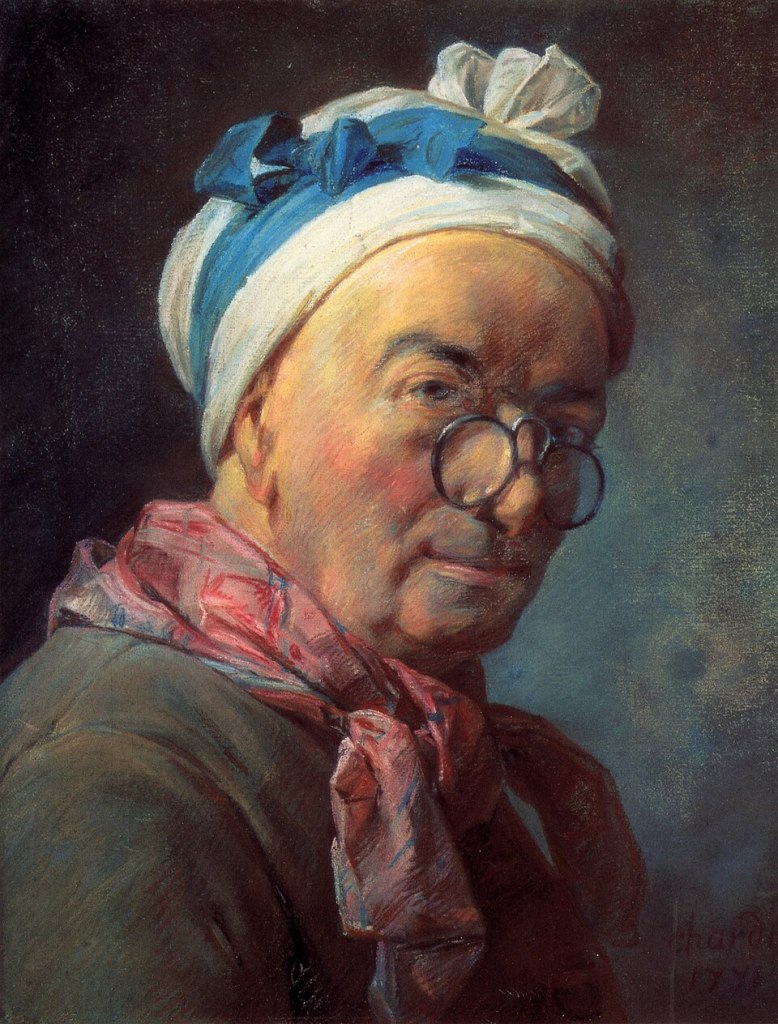
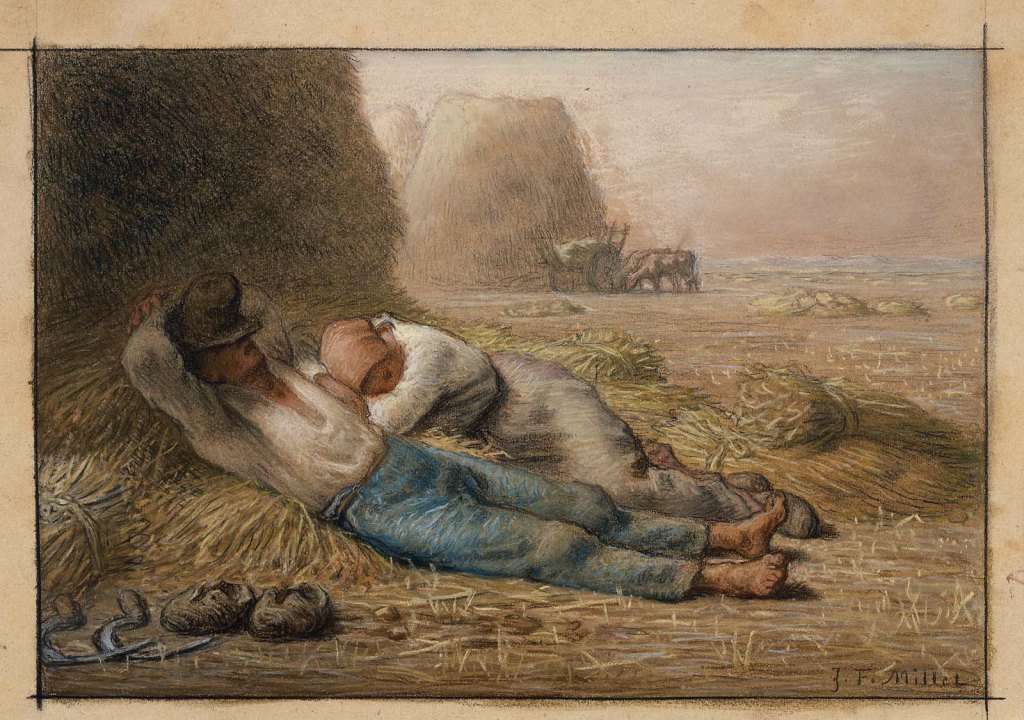
This procedure links him with earlier and more recent precedents without making the work derivative. Maheux relates his handling to Chardin’s construction of colour through juxtaposed marks and to Millet’s use of hatching as a means of building form. In De Nittis, however, these procedures are adapted to a much lighter and more mobile surface. The broken strokes across the dress and figure, together with the freer handling of the snowy landscape, contribute to an image in which finish no longer means the suppression of the mark. The portrait retains the elegance expected of pastel, but its harmony is produced through a visibly active surface.
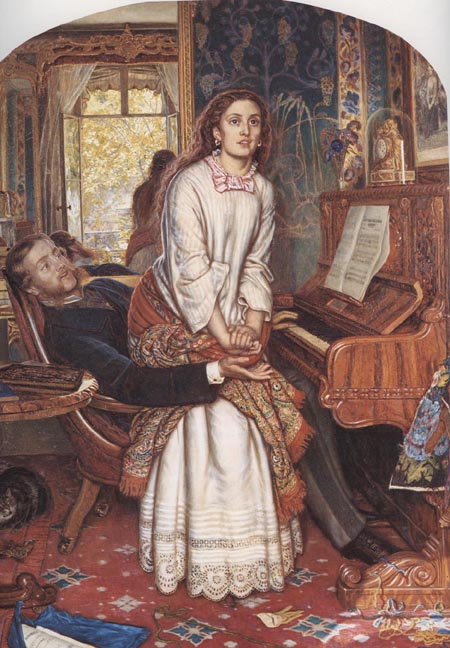
Whistler’s point of departure was different. Symphony in White, No. 2 belongs recognisably to the Victorian tradition of the single female figure posed within a carefully appointed domestic interior. Yet it withholds the kind of explicit narrative and moral interpretation found in works such as William Holman Hunt’s The Awakening Conscience (1853–54), where the woman’s gesture and expression are surrounded by a dense accumulation of symbolic detail that directs the viewer towards a particular story and judgement.
The white dress, mirror, flowers, porcelain and fan could all have supported a familiar kind of narrative or moralised subject. Joanna Hiffernan’s wedding ring, prominently displayed on her left hand, intensifies the suggestion that some story lies behind the image. Yet Whistler withholds the information needed to complete it. The sitter remains absorbed and emotionally indeterminate, while the mirror multiplies her presence without clarifying her state of mind. The painting therefore borrows the outward form of Victorian subject painting while refusing its usual explanatory structure. In doing so, it belongs to a broader movement away from fully articulated narrative and towards the more open depiction of modern life that became increasingly prominent during the later nineteenth century. This was the artistic climate in which a painting such as Giornata d’inverno became possible.
Swinburne’s Before the Mirror, written after Whistler’s painting was completed but before its exhibition at the Royal Academy, responds to the ambiguity in the work. The poem develops associations of snow, flowers, memory, pleasure and regret, but does not supply the story that the painting withholds. Whistler’s decision to attach it to the frame did not turn it into an explanation. As Richard Dorment argues, poem and painting function as parallel works, each preserving the mystery of the other.
This withholding of narrative belongs to a wider change in Whistler’s artistic development. Dorment suggests that the painting’s two titles register its transitional position. The Little White Girl, under which it was exhibited at the Royal Academy in 1865, retains the language of a subject centred upon a particular female figure. The later title, Symphony in White, No. 2, redirects attention towards the organisation of the painting itself. Whistler had not yet reached the explicit repudiation of Courbet expressed in his letter to Fantin-Latour of 1867, but the work already suggests a growing dissatisfaction with the earthy realism he had encountered in Courbet’s painting. For Whistler here, observation remains fundamental, but it is increasingly recast through refinement, tonal harmony and the controlled relation of forms and colours.
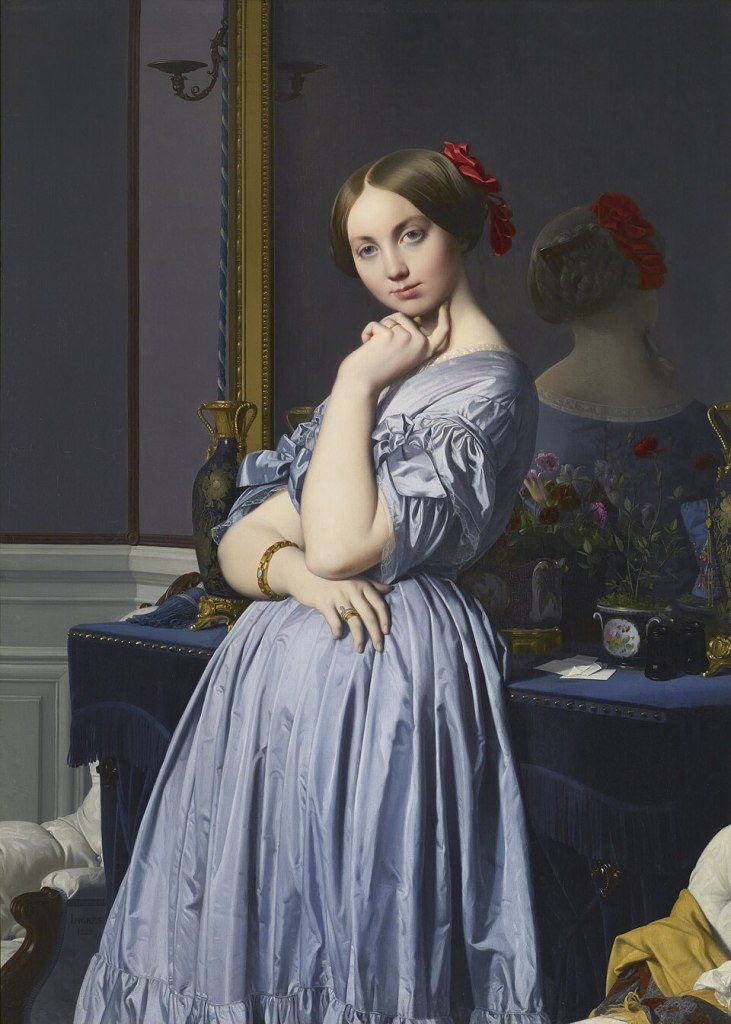
The painting seems to draw upon several possible artistic sources without closely following any one of them. Dorment notes an affinity with Ingres’s Portrait of the Comtesse d’Haussonville, especially in the conjunction of a fashionably dressed woman, a mirror and a refined interior, although Whistler does not adopt Ingres’s precise linear manner.
A more immediate compositional parallel has been identified in the etching Before the Mirror (1861), attributed to John Everett Millais, in which a woman is similarly placed beside a mantelpiece and reflected in a mirror. Edward John Poynter’s The Bunch of Blue Ribbons (1862) has also been suggested as a compositional precedent for the arrangement of the figure and interior. Japanese art enters the painting in a different way. The hand-screen, porcelain, red and blue accents and spray of azalea are not merely exotic accessories, but contribute to the balance of colour and pattern across the surface. Whistler absorbs these varied references into a work that remains a portrait while increasingly presenting itself as an arrangement of colour, tone and form.
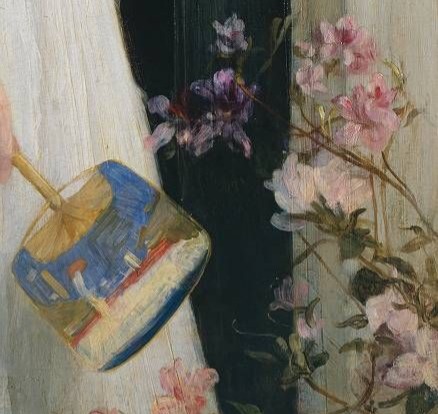
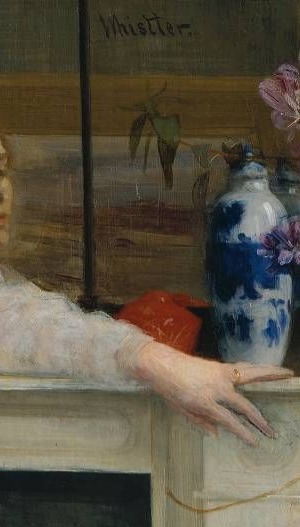
Japonisme offers a further point of contact between the two artists, although it is more explicitly stated in Whistler’s Symphony in White, No. 2. Hiffernan holds a rigid Japanese hand-screen decorated with an image derived from Hiroshige, while a small red vessel and a blue-and-white Chinese porcelain vase on the mantelpiece extend the painting’s engagement with East Asian objects and design.
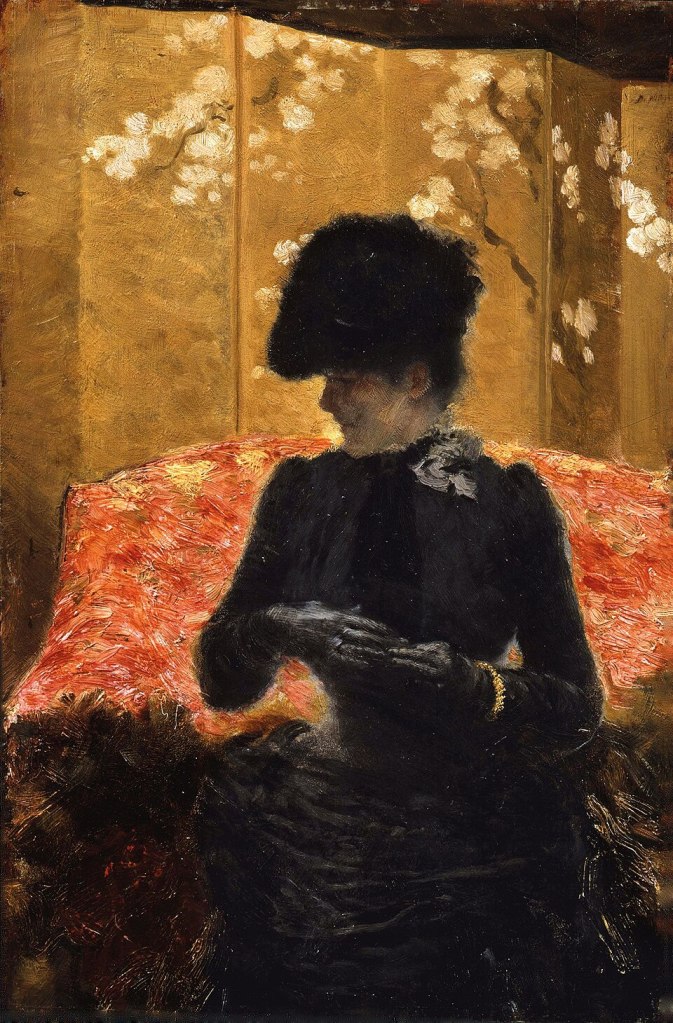
De Nittis’s participation in the Japoniste culture of contemporary Paris is more conspicuous elsewhere in his work. In Signora sul divano rosso (Lady on the Red Sofa) of 1876, the sitter is placed before a Japanese screen whose decorative pattern forms an active part of the interior, while works such as Woman with a Fan (1875) and Il paravento giapponese (c. 1878) further demonstrate his recurring interest in fans, screens and Japanese decorative art. In Giornata d’inverno, this interest is expressed more discreetly through a small number of carefully integrated objects, principally the black lacquer tray decorated with a flowering branch and the blue Chinese porcelain cup and saucer. Their presence belongs to a wider Japoniste sensitivity to colour, pattern and compositional arrangement that extends throughout the painting.
The comparison between Symphony in White, No. 2 and Giornata d’inverno begins with an evident visual affinity, but its value lies in the different uses to which that affinity is put. Both artists place a solitary woman within a carefully arranged interior and allow pale fabrics, furnishings and reflected light to determine much of the painting’s effect. In each case, white is not a neutral absence of colour but a field of subtle variation, animated by shadow, texture and adjacent tones.
However, Whistler increasingly subordinates description to harmony. The dress, the Japanese hand-screen, the flowers and the objects on the mantelpiece are held within an arrangement whose suggestive power depends upon tonal relation and incomplete narrative. In contrast, De Nittis remains more closely attached to the observed circumstances of modern life: Léontine’s fashionable dress, the richly differentiated surfaces of the room and the snow-covered city beyond the window. Yet this descriptive fullness does not prevent formal unity. Colour recurs across figure, furnishings and landscape, while the handling of pastel draws fabric, atmosphere and falling snow into a continuous pictorial surface.
The two paintings therefore belong to a shared international culture without becoming versions of the same aesthetic. Whistler moves towards the autonomy of the pictorial arrangement, while De Nittis brings close observation, fashionable modernity, an immediate psychological presence and inherited pastel technique into a highly integrated whole. Seen together, the works show how similar motifs and formal concerns could sustain two distinct conceptions of modern painting: one founded upon tonal suggestion and ambiguity, the other upon the transformation of observed experience through colour, atmosphere and surface.
[Producing these essays requires care, time, research, and resources. Contributions to help sustain this exploration would be greatly appreciated.]
Donate to Inner Surfaces here.
Bibliography
I have consulted the following sources. Any errors are mine alone.
Dorment, Richard, “Symphony in White, No. 2: The Little White Girl,” cat. no. 15, in Richard Dorment and Margaret F. MacDonald, James McNeill Whistler, London: Tate Gallery Publications, 1994, pp. 78–80.
Dorment, Richard, and Margaret F. MacDonald, James McNeill Whistler, London: Tate Gallery Publications, 1994.
Guerrieri, Alice, La donna nella pittura di Giuseppe De Nittis: l’arte, la moda, la vie moderne, Florence: Maremmi Editori Firenze, 2010.
Jacobi, Carol, ed., James McNeill Whistler, London: Tate Publishing, 2026.
MacDonald, Margaret F., The Woman in White: Joanna Hiffernan and James McNeill Whistler, with contributions by Charles Brock, Patricia de Montfort, Joanna Dunn, Grischka Petri, Aileen Ribeiro and Joyce H. Townsend, Washington, London and New Haven: National Gallery of Art, Royal Academy of Arts and Yale University Press, 2020.
MacDonald, Margaret F., Joanna Dunn and Joyce H. Townsend, “Painting Joanna Hiffernan,” in Margaret F. MacDonald, The Woman in White: Joanna Hiffernan and James McNeill Whistler, Washington, London and New Haven: National Gallery of Art, Royal Academy of Arts and Yale University Press, 2020, pp. 33–45.
MacDonald, Margaret F., et al., “Symphony in White, No. 2: The Little White Girl,” The Paintings of James McNeill Whistler: A Catalogue Raisonné, University of Glasgow, online edition, accessed 21 July 2026.
Maheux, Anne F., “Sogni di una nuova arte: Giuseppe De Nittis e il pastello,” in Renato Miracco, ed., Giuseppe De Nittis: La donazione di Léontine Gruvelle De Nittis. Catalogo generale, Rome: Gangemi Editore, 2022, pp. 267–86.
Miracco, Renato, ed., Giuseppe De Nittis: La donazione di Léontine Gruvelle De Nittis. Catalogo generale, Rome: Gangemi Editore, 2022.
Miracco, Renato, “‘Ella mi è stata compagna, amica, modella e moglie.’ La ritrattistica in De Nittis,” in Renato Miracco, ed., Giuseppe De Nittis: La donazione di Léontine Gruvelle De Nittis. Catalogo generale, Rome: Gangemi Editore, 2022, pp. 359–400.
Ribeiro, Aileen, “Fashioning White in the Work of Whistler and His Contemporaries,” in Margaret F. MacDonald, The Woman in White: Joanna Hiffernan and James McNeill Whistler, Washington, London and New Haven: National Gallery of Art, Royal Academy of Arts and Yale University Press, 2020, pp. 157–66.

