
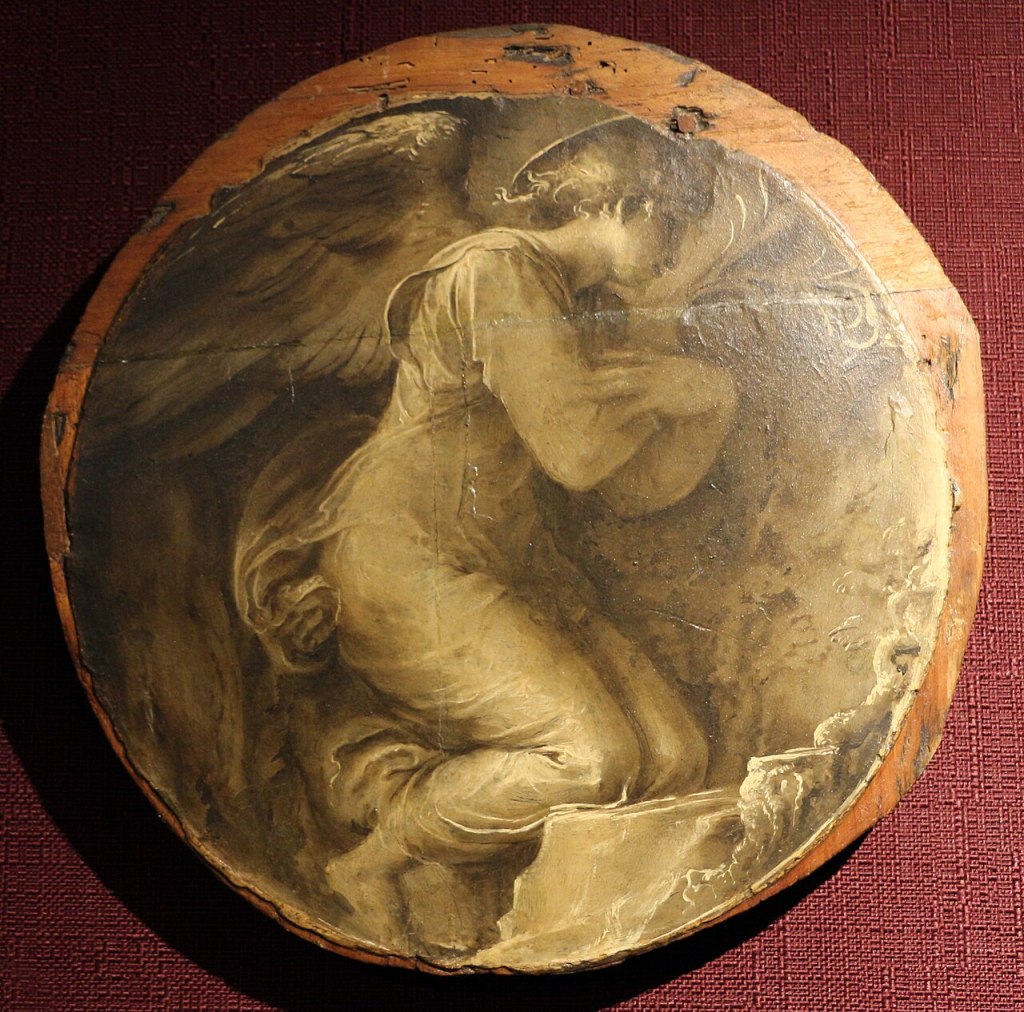
Two small roundels, the Angelo annunciante and the Vergine annunciata, painted in Naples in 1527–28 and now in the Museo e Real Bosco di Capodimonte, are closely connected with a double-sided sheet of red-chalk studies of approximately the same date, now in the Fitzwilliam Museum, Cambridge. Together, the drawings and paintings offer an unusually concentrated view of Polidoro’s working process. Studies made from living models are gradually redirected towards sacred narrative, while the finished panels retain something of the immediacy, tonal delicacy and psychological attentiveness of the chalk drawings.
The drawings and roundels offer a particularly revealing glimpse of Polidoro’s individuality. Trained in the artistic environment created by Raphael in Rome, he absorbed its principles of design, classical form and monumental composition, but developed a language that was increasingly his own. In the Annunciation studies and roundels, refinement is joined to close observation, while religious meaning emerges less through elaborate narrative than through posture, light and the inward concentration of the figures.

Formation in Rome
Polidoro was born at Caravaggio in Lombardy, probably around 1499, but his artistic formation took place in Rome. According to Vasari, he first found work on the Vatican Logge during Raphael’s direction of the project, initially in a subordinate role before his ability as a draughtsman brought him into more demanding forms of decoration. The circumstances of his arrival remain partly anecdotal, but the essential point is clear: he developed within the most ambitious artistic environment of the period, in close proximity to Raphael, Giovanni da Udine, Giulio Romano and Perino del Vaga.
This training gave him a grasp of classical form, large-scale design and the organisation of figures across architectural surfaces. It also prepared him for the work for which he became especially celebrated in Rome: the monochrome decoration of palace façades, often executed in collaboration with Maturino da Firenze. These painted schemes, devised to evoke ancient relief sculpture, demanded rapid invention, clarity of silhouette and the ability to create the impression of sculptural form through restricted colour and strongly controlled light and shadow.
Yet Polidoro did not remain simply a follower of Raphael. Even within the language he inherited, his work shows an increasing attraction to compressed movement, emphatic gesture and more forceful contrasts of tone. Classical balance persists, but it is often unsettled by a sharper emotional intensity. The refinement associated with Raphael’s circle becomes, in Polidoro’s hands, less ceremonious and more immediate.
The Sack of Rome in 1527 interrupted this career and prompted his departure for Naples, before his eventual move to Messina. It also coincided with a decisive change in his art. The southern works retain the discipline of his Roman training, but they increasingly turn towards direct observation, concentrated religious feeling and a darker, more personal tonal language. The Annunciation drawings and roundels belong to this moment of transition, when the lessons of Rome were being reshaped into something more inward and distinctive.
The Fitzwilliam sheet
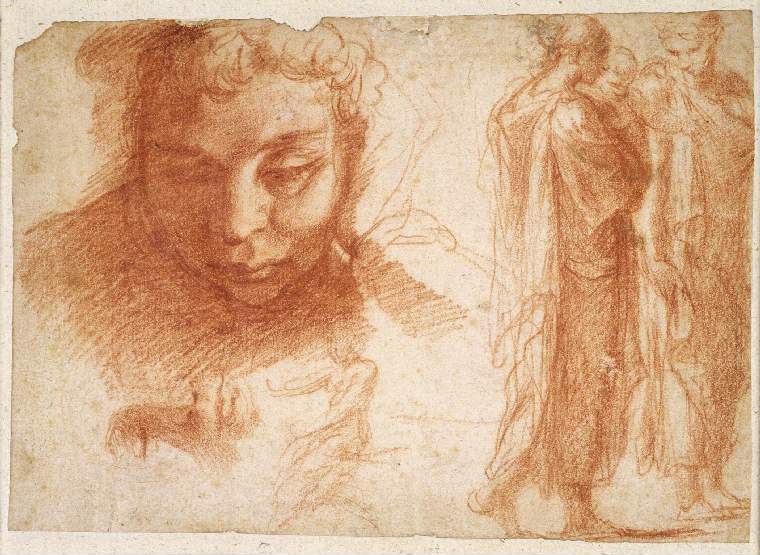

A double-sided sheet in red chalk, now in the Fitzwilliam Museum (PD.1-2003), brings Polidoro’s working method into unusually close view. The museum catalogues one side as Two Head Studies of a Youth Looking Down; Study for the Virgin of the Annunciation; Two Standing Women, One Holding a Baby. Across the sheet, highly resolved head studies coexist with slighter investigations of standing figures, changes of pose and partially developed ideas. It does not record a single composition advancing neatly towards completion, but preserves several stages of attention, from rapid indication to concentrated tonal modelling.
The study associated with the Vergine annunciata is the most immediately compelling passage. The head is inclined and the eyes lowered, while light passes gently across the forehead, cheek and eyelids. Contour is softened by closely worked transitions of chalk, so that the face appears to emerge from shadow rather than being firmly enclosed by line. The result retains the particularity of a living model, but the expression is sufficiently reserved to become the basis for a sacred figure.
Elsewhere on the sheet, Polidoro works more freely. Heads are repeated at different angles, while lightly drawn bodies test gesture, balance and the fall of drapery. The contrast between these passages is important. The less finished studies do not merely surround a completed central image; they show the artist moving between observation and invention, allowing one idea to generate another without imposing a fixed sequence upon the page.
The sheet therefore reveals draughtsmanship as more than preparation for painting. It is the means through which Polidoro discovers the emotional character of his figures. The bowed heads, suspended gestures and variations of posture gradually establish the inwardness of the Virgin and the more active presence of the angel. When these forms pass into the roundels, they are altered and refined, but the paintings retain the concentration and sensitivity first explored in chalk.
The Annunciation roundels
The two circular panels were probably conceived as part of a larger altarpiece or decorative ensemble, although their original setting and arrangement cannot now be reconstructed with certainty. Their modest dimensions and circular format impose an unusual compositional discipline, requiring each figure to be fully resolved within a self-contained field.
The Vergine annunciata is distinguished by its stillness. The Virgin sits in quiet contemplation, her head inclined and her gaze lowered, as though the announcement has already begun to turn her attention inward. Light passes gently across her forehead, cheek and folded drapery, modelling the figure through soft tonal transitions rather than emphatic contour. The face retains the individuality of the life study from which it developed, yet Polidoro has refined observation into an image of spiritual receptivity. Nothing is exaggerated. Expression is conveyed through restraint, allowing posture and light to carry the emotional weight of the scene.
The Angelo annunciante offers a complementary solution. The angel kneels as if arriving in the very act of proclamation, the body curving diagonally across the circular field while the wings press against its perimeter. Although more animated than the Virgin, the figure avoids theatrical display. The movement remains controlled and graceful, with the gesture directed beyond the edge of the panel towards its unseen counterpart. The composition therefore derives its energy less from dramatic action than from the contained momentum of the figure itself.
Viewed together, the roundels reveal Polidoro’s ability to create narrative through relationship rather than description. The angel advances, the Virgin receives; one figure is characterised by movement, the other by stillness. Yet both are united by the same subdued tonal language, the same careful modelling and the same inward concentration. Their dialogue depends less upon explicit gesture than upon the psychological equilibrium established between them. The result is an Annunciation of unusual intimacy, in which sacred meaning emerges through attentive observation of the human figure rather than through elaborate symbolic display.
Drawing, Tone and the Legacy of Rome
The relationship between the drawings and the roundels reflects habits formed during Polidoro’s years in Rome. His monochrome façade decorations demanded an exceptional skill in modelling through light and shadow. Within a restricted palette, volume, texture and the appearance of sculptural relief had to be created through gradations of tone. This experience encouraged a conception of drawing that extended beyond contour, allowing light itself to construct form.
The Annunciation roundels retain this tonal discipline. Their restrained colour and carefully controlled transitions between light and shadow give the figures a sculptural presence without diminishing their softness or immediacy. Flesh, drapery and hair emerge gradually from the surrounding tone, preserving an unusually close relationship with the red-chalk studies from which the paintings developed. Drawing and painting appear not as separate stages, but as closely connected forms of invention.
Polidoro nevertheless adapts the monumentality of Roman façade painting to a more intimate devotional purpose. The habits acquired through large-scale monochrome decoration become a means of expressing inward concentration, so that technical discipline and religious feeling remain inseparable.
A Personal Language
The Annunciation studies and roundels show how Polidoro transformed the discipline acquired in Raphael’s circle into a more personal language. His figures retain clarity of design and an assured understanding of bodily form, but these qualities are directed towards a more immediate emotional effect. In the roundels, feeling is concentrated within the inclination of a head, the direction of a gaze and the controlled movement of the body. Their relative stillness does not diminish their expressive intensity; it gathers it into a few closely observed gestures.
Within these roundels, Polidoro achieves emotional intensity without relying upon elaborate narrative or theatrical gesture. The sacred figures retain the particularity of living models, while observation is refined into devotional meaning. The encounter is intimate in scale, but the emotional effect remains sustained and compelling.
Polidoro’s individuality in these works therefore lies not in small scale or restraint alone, but in his ability to adapt the discipline of his Roman formation to an intimate devotional format. Monumental training remains present in the firmness of the designs, while psychological immediacy emerges through posture, tone and the relationship between the figures. The result is a pair of images that remain connected to Raphael’s legacy, yet are marked by an emotional concentration that is recognisably Polidoro’s own.
Conclusion
The Fitzwilliam drawings and the Annunciation roundels reveal a remarkably close continuity between observation, invention and painting. Polidoro does not begin with an abstract sacred type and then clothe it in naturalistic detail. He works from the living figure, tests variations of pose and expression, and gradually redirects those observations towards devotional meaning. The finished paintings preserve the sensitivity of the drawings because the process of invention remains legible within them.
This continuity also helps to explain the distinctive character of the roundels. The tonal habits formed through Polidoro’s Roman experience of monochrome decoration are adapted here to a quieter and more intimate purpose. Light does not merely describe the figures; it gives form to their emotional presence. Seen together, the drawings and paintings show an artist moving beyond inherited models not through rejection, but through transformation. Raphael’s discipline remains, yet it has been absorbed into a language in which close observation, tonal subtlety and concentrated feeling become inseparable.
[Producing these essays requires care, time, research, and resources. Contributions to help sustain this exploration would be greatly appreciated.]
Donate to Inner Surfaces here.
Bibliography
This essay is based on the following sources. Any errors are mine.
Leone de Castris, Pierluigi (ed.), Polidoro da Caravaggio fra Napoli e Messina. Exhibition catalogue, Museo e Gallerie Nazionali di Capodimonte, Naples, 11 November 1988–15 February 1989. Milan: Arnoldo Mondadori; Rome: De Luca Edizioni d’Arte, 1988. See catalogue entries V.9–V.10, pp. 72–73.
Keith, Larry, Minna Moore Ede and Carol Plazzotta, ‘Polidoro da Caravaggio’s Way to Calvary: Technique, Style and Function’, National Gallery Technical Bulletin, 25 (2004), pp. 36–47.
The Fitzwilliam Museum, Cambridge, Two Head Studies of a Youth Looking Down; Study for the Virgin of the Annunciation; Two Standing Women, One Holding a Baby (PD.1-2003), online collection catalogue.
Museo e Real Bosco di Capodimonte, online collection entries for Angelo annunciante and Vergine annunciata.

