Joseph Rebell’s Neapolitan landscapes range from carefully observed views of royal residences and coastal sites to more dramatic paintings of storms, shipwrecks and volcanic light. The three works considered here belong to this second group: Mareggiata al Fusaro of 1819, Burrasca al chiaro di luna nel Golfo di Napoli of 1822 and Burrasca al tramonto presso i Faraglioni di Capri of 1823. Placed in chronological order, they show Rebell returning to the stormy coast as a setting in which changing weather, unstable light and human vulnerability could be brought together.
These paintings are Romantic in their scale of feeling, but their drama does not depend on an abandonment of observed nature. Rebell knew the Neapolitan coastline closely and developed a practice of working directly before the landscape, studying the movement of the sea, the effects of light and the changing character of particular places. A number of his larger finished canvases were produced later, especially during his years in Rome, from drawings and oil studies made in Naples. Such works therefore combine topographical knowledge with imaginative reconstruction.
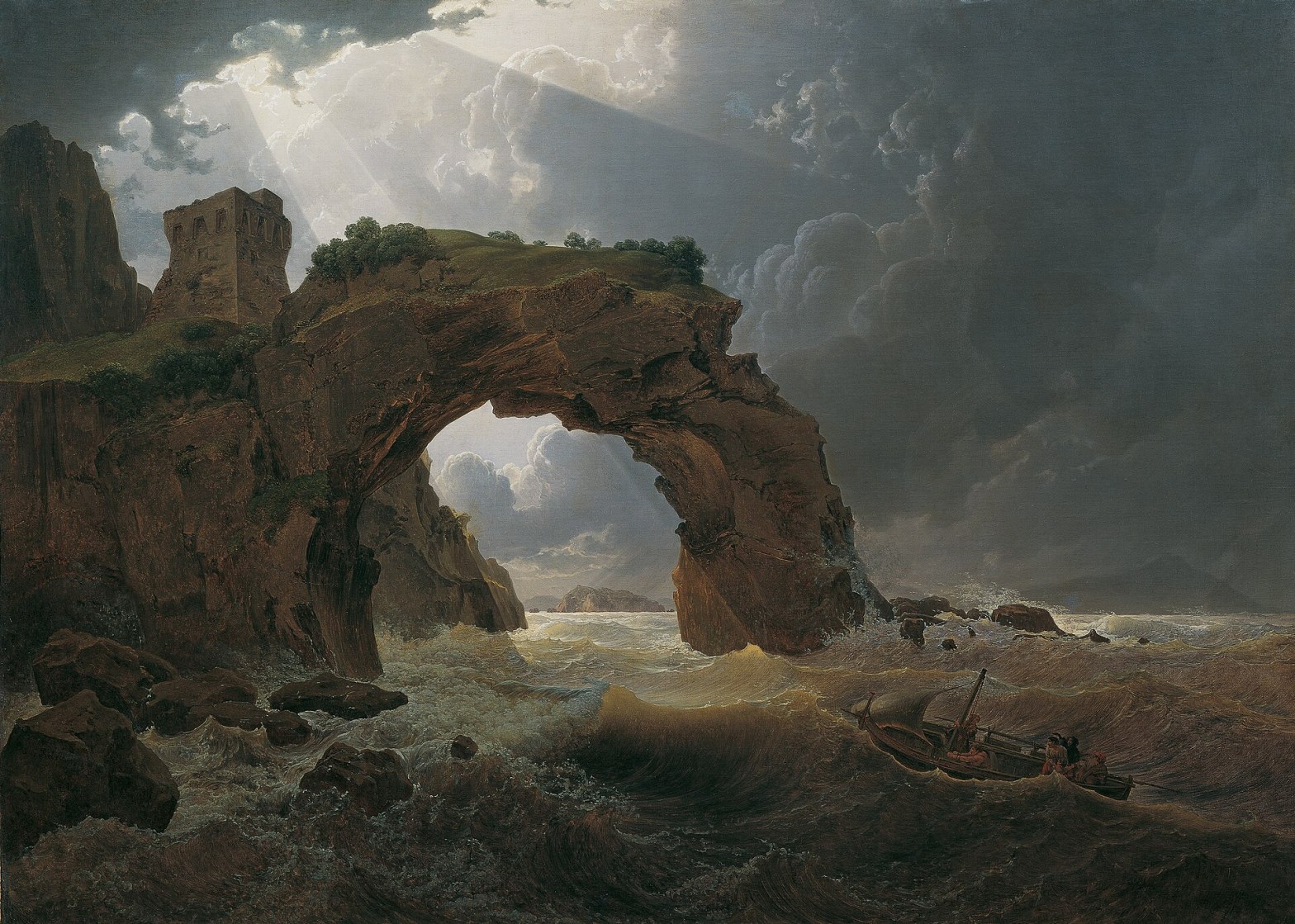
Although the three paintings were not conceived as a series, they present distinct treatments of maritime danger. In Mareggiata al Fusaro, a boat has been driven dangerously close to the rocks and disaster appears imminent. In Burrasca al chiaro di luna nel Golfo di Napoli, the emphasis broadens from a specific human emergency to the larger spectacle of sea, storm, moonlight and volcanic fire. In Burrasca al tramonto presso i Faraglioni di Capri, the shipwreck has already occurred and the scene is shaped by the struggle for survival amid the wreckage.
Before turning to the paintings individually, it is useful to consider Rebell’s formation, his arrival in Naples during the rule of Joachim and Caroline Murat, and the artistic culture in which his approach to landscape developed. His storm paintings emerged from a conjunction of eighteenth-century landscape traditions, close study from nature and a growing Romantic interest in the power of the natural world.
Naples under the Murats and Caroline Murat’s patronage
French forces entered the Kingdom of Naples in 1806, displacing the Bourbon monarchy, which withdrew to Sicily under British protection. Napoleon initially installed his elder brother Joseph Bonaparte as king, but transferred him to the Spanish throne in 1808. Naples then passed to Joachim Murat, one of Napoleon’s leading generals and the husband of his sister Caroline. Joachim and Caroline ruled until 1815, when the collapse of Napoleonic power allowed the Bourbons to return.
The Murat government pursued administrative, legal and urban reforms intended to present Naples as a modern capital. Its cultural ambitions were expressed through public works, archaeology, museums and artistic patronage. The excavations at Pompeii and Herculaneum were already internationally renowned, while the combination of ancient remains, volcanic scenery and the Bay of Naples continued to attract artists, scholars and travellers from across Europe. The court itself became notably cosmopolitan, bringing together painters, architects, antiquarians and collectors from France, Austria, Germany and elsewhere.
Caroline Murat took an especially active interest in the arts. Her patronage extended beyond dynastic portraiture and history painting to landscape, topographical views and scenes connected with Naples and its royal residences. Such works could record the appearance of the kingdom while also contributing to the court’s presentation of itself as cultivated and reforming. Caroline supported or collected artists including Simon Denis (1755–1813), Alexandre-Hyacinthe Dunouy (1757–1841), François-Marius Granet (1775–1849) and Joseph Rebell, whose different approaches demonstrate the range of landscape and historical painting encouraged around the court.
The history and original function of Rebell’s work for Caroline have been clarified in particular by Gennaro Toscano, who has reconstructed the passage of the paintings from Naples to the Musée Condé at Chantilly. Between 1813 and 1815 Rebell produced thirteen views for the queen, ten of which are now at Chantilly. Toscano has suggested that the group was probably intended for the Villa Favorita at Resina, a royal residence on the Vesuvian coast, since the paintings do not appear in the surviving inventories of either the Royal Palace in Naples or the palace at Portici.
The views depict royal residences, harbours and recognisable sites around the Bay of Naples. They remained in Naples after Caroline’s departure and later entered the collection of Leopoldo di Borbone, Prince of Salerno, a younger son of the restored Bourbon king Ferdinand I. In 1854 they were purchased by Henri d’Orléans, Duke of Aumale, the French prince and collector whose collections eventually formed the Musée Condé. At Chantilly the group lost some of its original unity, with the paintings distributed among different rooms and two adapted as overdoors, but their common origin in Caroline’s patronage can still be reconstructed.
The commission established Rebell’s reputation as a painter of lucid and carefully observed views. In Il Palazzo Reale di Napoli visto dall’Arsenale (1814), the palace, its hanging gardens and the buildings along the waterfront are seen from an unusual position near the naval arsenal. Architecture, shipping and military installations are recorded precisely, but the clarity of the description is softened by the atmosphere of the bay and by small details of contemporary activity.

Veduta di Baia (1813) presents another aspect of the commission. The historical and antiquarian associations of the site are absorbed into a quieter coastal landscape of trees, open water, paths and figures. Its human presence is anecdotal rather than dramatic: everyday life is included within the broader character of the place rather than separated from it as an independent subject.

In Il Palazzo Reale di Portici visto dal parco (1814), Rebell joins courtly representation to archaeology and landscape. The palace is approached through its park, while the ancient statue of Marcus Nonius Balbus, excavated at Herculaneum and transferred to Portici, occupies the foreground. The painting thus brings together a modern royal residence, the material remains of antiquity and the natural setting of the Vesuvian coast.

Predominantly calm and descriptive, these works are very different in mood from the storm paintings considered below. They nevertheless established Rebell’s close knowledge of the coastline, royal estates and changing atmospheric conditions around the Bay of Naples, material to which he would return during his later years in Rome.
Formation, observation and invention
Rebell’s approach to landscape developed through a combination of academic training, direct study from nature and the continued transformation of those studies in the studio. As Serenella Rolfi has outlined, he entered the Vienna Academy in 1799 and initially trained in architecture under Louis de Montoyer. Around 1807 he turned more decisively towards landscape under Michael Wutky (1739–1822), whose own experience of Italy and interest in volcanic and maritime subjects provided an important early model. Wutky’s influence remained visible in Rebell’s handling of perspective and in his attraction to dramatic natural phenomena, but Rebell gradually developed a more precise and sustained engagement with particular places.
A journey through Switzerland in 1809 was followed by a period in Milan, where his connection with Eugène de Beauharnais, Napoleon’s stepson and viceroy of the Kingdom of Italy, helped to open the way to Naples. After a short stay in Rome, Rebell reached Naples in 1812 and entered Caroline Murat’s service the following year. The views he produced for the queen gave him prolonged access to royal estates, harbours and coastal sites around the Bay.
Surviving evidence suggests that observation before nature was central to his practice. Luisa Martorelli has drawn attention to Rebell’s request, in the summer of 1814, to erect a temporary pavilion in the gardens at Portici. The structure would have allowed him to continue painting outdoors while protecting himself and his materials from the weather. Oil studies made around Portici also survive in Vienna, indicating a working process that moved between observation on the spot and more elaborate compositions completed later.
Sabine Grabner cites the memoirs of the Austrian painter and writer Countess Lulu von Thürheim (1788–1864), who visited Rebell’s Roman studio in December 1822. Thürheim recalled that he devoted considerable time to studying storms at sea and that both he and his palette were sometimes thoroughly soaked by rain and waves. The anecdote should not be taken to mean that the finished storm paintings simply reproduce particular events he witnessed. It does, however, confirm the intensity of his attention to the sea under changing conditions. Waves, reflected light, cloud, rain and the physical structure of the coast were observed separately and repeatedly before being brought together within larger compositions.
After the fall of the Murat regime in 1815, Rebell settled in Rome. There he developed his Neapolitan studies and memories into finished paintings for exhibitions and private patrons. Martorelli identifies the years 1822 and 1823 as a decisive phase in this process, when Rebell produced increasingly ambitious marine landscapes in which Romantic feeling became more pronounced. The move to Rome did not sever his connection with Naples; it changed the terms in which that experience was used.
Giuseppe Scavizzi has described Rebell’s development as a movement beyond an initially Hackert-like manner, indebted to the lucid, carefully ordered landscapes of Jacob Philipp Hackert (1737–1807), towards a more immediate participation in landscape and in the lives of the figures who inhabit it. At the same time, Scavizzi stresses that Rebell never entirely abandoned the inheritance of eighteenth-century classical landscape. His larger canvases retain carefully organised recession, balanced masses and a composed relation between foreground, middle distance and horizon. What changes is the emotional temperature of the scene and the degree to which observed weather and human incident disturb that order.
Rebell’s storm paintings therefore emerge at the intersection of several traditions. Claude Lorrain (c. 1600–1682) and the classical landscape offered an inherited compositional structure. Joseph Vernet (1714–1789) and Pierre-Jacques Volaire (1729–1799) provided important precedents for storms, shipwrecks, volcanic eruptions and extraordinary effects of light. Wutky offered a more immediate connection with the observation of Vesuvius and southern Italian scenery. Rebell absorbed these examples without merely repeating them. His coastlines are more often topographically recognisable, while the drama depends upon closely studied effects of sea and atmosphere rather than theatrical incident alone.
There is no secure evidence that the three paintings considered here record particular storms or maritime disasters witnessed by Rebell. Their dramatic incidents appear instead to have been imagined. Mareggiata al Fusaro formed part of Emperor Francis I’s commission for four large views of the Neapolitan region, but Rebell transformed the coastal landscape into a scene of impending disaster, choosing the moment at which a boat is threatened by the violent sea. In Burrasca al tramonto presso i Faraglioni di Capri, the familiar coastline likewise becomes the setting for an imagined catastrophe, with shipwreck survivors and traces of a damaged vessel among the rocks.
Observation and Romantic invention are therefore complementary elements in Rebell’s art. He studied the form of rocks, the movement and translucency of waves, the passage of sunlight through cloud and the changing colour of the sea. The finished composition selected, intensified and combined these effects. A known place could become the setting for an event that had never occurred there, while retaining enough topographical and atmospheric truth to make the imagined danger convincing.
His Romanticism lies in this reorganisation of observed nature around an emotional idea. The landscape no longer functions only as a record of place. It becomes a means of exploring anticipation, natural violence, loss and human vulnerability. Yet the drama remains dependent upon knowledge acquired through looking. Rebell did not turn away from the visible world in order to create Romantic landscape; he discovered within close observation the materials from which it could be made.
Mareggiata al Fusaro, 1819

In Mareggiata al Fusaro, Rebell places maritime danger within a setting that is unusually precise. Sabine Grabner identifies the site as Torre Gaveta, beside the Foce Vecchia, the old outlet of Lake Fusaro on the Phlegraean coast west of Naples. Lake Fusaro is a shallow coastal lagoon separated from the sea by a narrow strip of land and connected to it by channels. Rebell’s scene is set not on the sheltered waters of the lake, but on the exposed coast outside it, where a great natural arch projects into the sea. The square watchtower above the rocks and the distant islands of Procida and Ischia further establish the location.
Against this familiar coastline, Rebell places a fishing boat in immediate danger, suspending the action at the moment before catastrophe. The boat has drifted dangerously close to the rocks beneath the arch. The worsening weather is unmistakable: dark clouds gather over the coast, the sea rises in broken waves and the vessel appears to have little room in which to recover. Grabner interprets the scene as the moment in which the sailor recognises the probable outcome. Rebell does not depict the boat breaking apart or figures struggling in the water. The catastrophe remains imminent, and the emotional effect depends upon suspense rather than the spectacle of disaster itself.
This restraint distinguishes the painting from more theatrical treatments of storms and shipwrecks. Rebell was working within an established eighteenth-century tradition represented by painters such as Joseph Vernet and Philip James de Loutherbourg (1740–1812), but his drama is tied to the closely observed character of a particular place. The natural arch is not merely a picturesque stage-set. Its weight, scale and projection into the water make the danger intelligible. The very specificity of the landscape strengthens the imagined event.
The composition is organised around the contrast between the rocky mass on the left and the open sea on the right. The cliff rises steeply from the water, its dark surface culminating in the watchtower above. Against this apparent solidity, the sea is restless and unstable. The endangered boat is caught between the two, pressed towards the rocks by the movement of the water. Rebell therefore makes the structure of the setting itself part of the drama.
Light prevents the scene from becoming uniformly dark. Shafts of sunlight penetrate the cloud and pass through the opening of the arch, while pale, translucent highlights appear along the crests of the waves. These effects introduce a visual complexity that belongs to Rebell’s sustained study of air and reflected light. The storm is expressed through rapid contrasts between illumination and shadow, clarity and obscurity. The water remains physically convincing even as it contributes to the heightened atmosphere.
The observed effects of water, reflected light and changing weather accord with Lulu von Thürheim’s recollection of Rebell’s persistent study of the sea. The imagined danger depends upon such observation: the motion of waves around rock, the passage of light through rain cloud and the changing visibility of the distant coast.
A contemporary notice in the Giornale arcadico compared Rebell’s treatment of tragedy with that of Nicolas Poussin, praising its “desolate simplicity” rather than theatrical excess. Mareggiata al Fusaro helps to clarify what such praise might mean. The sea is violent and the boat is in danger, but Rebell withholds the wreck itself. The drama lies in the interval between recognition and catastrophe, when the familiar coast has become threatening but the outcome remains unresolved. In later marine paintings, Rebell returned to this tension while making the human consequences more explicit.
Burrasca al chiaro di luna nel Golfo di Napoli, 1822
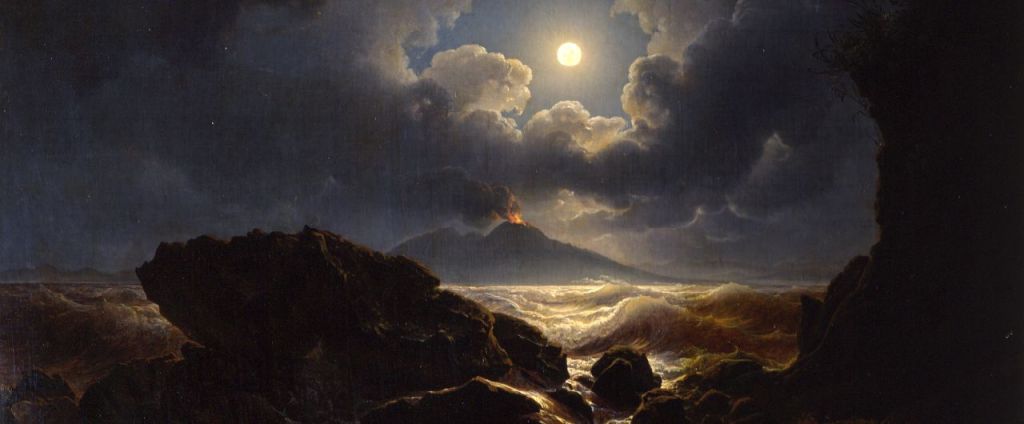
In Burrasca al chiaro di luna nel Golfo di Napoli, painted three years after Mareggiata al Fusaro, the emphasis shifts from a threatened vessel within a precisely identified coastal site to a more encompassing transformation of the landscape. The painting remains rooted in Rebell’s knowledge of the Bay of Naples, but topographical description no longer governs the composition as firmly. Moonlight, cloud, agitated water, smoke and volcanic fire spread the drama across the scene as a whole.
The painting was given by Rebell to Maria Luigia of Austria, Duchess of Parma, who presented it to the gallery in Parma in November 1826. It later came to be associated with Burrasca al tramonto presso i Faraglioni di Capri, although Marco Riccomini has pointed out that the two are not exact pendants. The moonlit storm is smaller and was painted a year earlier. Their relationship is thematic and historical rather than the result of a single, precisely coordinated commission.
The most striking feature of the painting is its divided illumination. Moonlight falls across the water with a cold, silvery brilliance, while the fire issuing from Vesuvius introduces a warmer and more unstable light. Sea and sky are caught between these different sources. Clouds interrupt the moonlight, while the eruption adds a warmer glow near the horizon; across the broken sea, silver light is touched by warmer tones.
This interplay of light is central to the painting’s Romantic character. Rebell does not simply represent a storm taking place at night. He constructs a landscape in which natural phenomena are gathered into a single atmospheric event. The moon, cloud, water, smoke and volcanic glow remain distinct, yet each alters the appearance of the others.
Riccomini places the work within Rebell’s movement away from the lucid and orderly tradition of the Neapolitan veduta, particularly the measured topographical clarity associated with Gaspar van Wittel (1653–1736). The contrast should not be overstated, since Rebell had not abandoned his knowledge of place or his habit of close observation. What changes is the hierarchy within the painting. In the views made for Caroline Murat, architecture and location are described with courtly precision. Here recognisable geography is subordinated to weather, light and the emotional effect of natural instability.
Writing in 1896, Corrado Ricci, who had directed the Parma gallery in 1893–94, described the painting as “of exceptionally powerful effect, though not of equal truth”. The distinction is revealing: he admired its dramatic intensity while remaining uneasy about its fidelity to observed appearance. Rebell presents the Bay less as a topographical view than as a landscape transformed by storm, moonlight and volcanic fire.
Seen beside Mareggiata al Fusaro, the difference is not one of simple development from restraint to spectacle. The two paintings address maritime danger in different ways. In the earlier work, attention is concentrated upon an endangered boat and the physical particularity of the coast. In Burrasca al chiaro di luna, the natural world itself appears generally unsettled. Rebell’s close observation remains fundamental, but it is absorbed into a broader atmospheric vision.
Burrasca al tramonto presso i Faraglioni di Capri, 1823

Painted the following year, Burrasca al tramonto presso i Faraglioni di Capri returns to the subject of shipwreck in a markedly different emotional register. If Mareggiata al Fusaro derives much of its power from anticipation, this painting begins after the decisive event has taken place. The tilted remains of the wreck are visible among the rocks, while survivors cling to the shoreline or try to make their way towards safety. The immediate drama of the storm has given way to its consequences.
The setting is equally specific. Rebell chose the Faraglioni, the great limestone stacks lying just off the south-eastern coast of Capri, one of the most celebrated landmarks in the Bay of Naples. Their forms dominate the composition, providing both a recognisable topographical setting and a powerful structural framework. As in the earlier storm paintings, the landscape remains rooted in a real place, but the human event unfolding within it is imagined.
Martorelli argues that the painting was executed in Rome, drawing upon studies made during Rebell’s years in Naples. The work is not the transcription of a witnessed shipwreck but the reconstruction of a remembered landscape transformed by artistic invention. The Faraglioni retain their geological identity, yet they become the setting in which Rebell explores danger, exhaustion and survival.
The title identifies sunset, but Martorelli draws attention to the ambiguity of the illumination. The grey and ochre light could equally suggest the first light of dawn. Rather than fixing the viewer within a precise hour, the uncertain light contributes to the scene’s temporal and emotional suspension. The violence of the storm has passed, yet calm has not fully returned. The sea remains unsettled, the sky retains traces of disturbance and the figures continue to inhabit a landscape marked by catastrophe.
Unlike Burrasca al chiaro di luna, where the principal subject is the transformation of the entire bay by weather and light, here the human incident again assumes greater importance. Rebell nevertheless avoids melodrama. Human vulnerability is conveyed through the small figures clinging to the rocks and attempting to reach the shore, yet they occupy only a small proportion of the canvas. Their struggle is measured against the enduring scale of sea and rock.
The composition reinforces this relationship. The vertical masses of the Faraglioni establish a sense of permanence, while the diagonal movement of waves, wreckage and figures carries the eye across the foreground. The contrast between the immobility of the rocks and the restless movement of the sea recalls Mareggiata al Fusaro, although here the opposition is less immediate and more reflective. The landscape bears the traces of the event rather than merely threatening it.
Martorelli places the painting among the large marine landscapes exhibited in Rome during the early 1820s, when Rebell’s reputation increasingly rested on ambitious compositions developed from the studies he had made in Naples over the previous decade. In the Capri painting, this accumulated observation is shaped into a carefully constructed image in which topographical specificity and poetic feeling remain closely connected. It is among the most complete expressions of his mature landscape painting.
The three paintings were not conceived as a sequence, but comparison clarifies the variety of Rebell’s approach. Mareggiata al Fusaro concentrates on imminent danger within a closely defined coastal setting; Burrasca al chiaro di luna gives greater prominence to weather and illumination; the Capri painting centres on the struggle for survival after shipwreck.
Conclusion
These dramatic marine landscapes represent only one aspect of Rebell’s achievement. Alongside them stand the quieter views painted for Caroline Murat and numerous studies of royal residences, harbours and coastal settlements. Yet the storm paintings grew from the same sustained attention to the Bay of Naples. Rebell’s achievement was to find within its recognisable coastlines, changing skies and restless seas the means to create landscapes of unusual emotional range.
[Producing these essays requires care, time, research, and resources. Contributions to help sustain this exploration would be greatly appreciated.]
Donate to Inner Surfaces here.
Bibliography
I have consulted the following texts. Any errors are mine.
Grabner, Sabine, ‘Mareggiata al Fusaro, 1819’, cat. 61, in Sabine Grabner, Luisa Martorelli, Fernando Mazzocca and Gennaro Toscano, eds, Napoli al tempo di Napoleone. Rebell e la luce del Golfo, Milan, Skira, 2023, p. 220.
Martorelli, Luisa, ‘Rebell e la pittura di paesaggio a Napoli dal 1812’, in Sabine Grabner, Luisa Martorelli, Fernando Mazzocca and Gennaro Toscano, eds, Napoli al tempo di Napoleone. Rebell e la luce del Golfo, Milan, Skira, 2023, pp. 49–58.
Martorelli, Luisa, ‘Burrasca al tramonto presso i Faraglioni di Capri, 1823’, cat. 60, in Sabine Grabner, Luisa Martorelli, Fernando Mazzocca and Gennaro Toscano, eds, Napoli al tempo di Napoleone. Rebell e la luce del Golfo, Milan, Skira, 2023, p. 218.
Riccomini, Marco, ‘Burrasca al chiaro di luna nel Golfo di Napoli’, in Lucia Fornari Schianchi, ed., Galleria Nazionale di Parma. Catalogo delle opere. Il Settecento, Milan, Franco Maria Ricci, 2000; online collection entry, Complesso Monumentale della Pilotta.
Riccomini, Marco, ‘Burrasca al tramonto presso i Faraglioni di Capri’, in Lucia Fornari Schianchi, ed., Galleria Nazionale di Parma. Catalogo delle opere. Il Settecento, Milan, Franco Maria Ricci, 2000; online collection entry, Complesso Monumentale della Pilotta.
Rolfi, Serenella, ‘Joseph Rebell’, in Carlo Sisi, ed., La pittura di paesaggio in Italia: l’Ottocento, Milan, Electa, 2003, p. 325.
Scavizzi, Giuseppe, Il paesaggio napoletano nella pittura straniera, Naples, 1962, p. 74.
Toscano, Gennaro, ‘Paysages, vedute et tableaux troubadour dans les collections de Caroline Murat, reine de Naples (1808–1815)’, in Maria Teresa Caracciolo and Gennaro Toscano, eds, Jean-Baptiste Wicar et son temps, 1762–1834, Villeneuve-d’Ascq, Presses universitaires du Septentrion, 2007, pp. 269–309.
Toscano, Gennaro, ‘Da Napoli a Chantilly. Dieci vedute dipinte da Rebell per Carolina Murat’, in Sabine Grabner, Luisa Martorelli, Fernando Mazzocca and Gennaro Toscano, eds, Napoli al tempo di Napoleone. Rebell e la luce del Golfo, Milan, Skira, 2023, pp. 59–66.

