“The eye must be opened to the true and wondrous life of nature, and the hand must be trained to do the soul’s bidding quickly, easily, and beautifully. This alone can be the aim of instruction in any of the pictorial arts.”
Carl Gustav Carus, Nine Letters on Landscape Painting, Letter VIII.
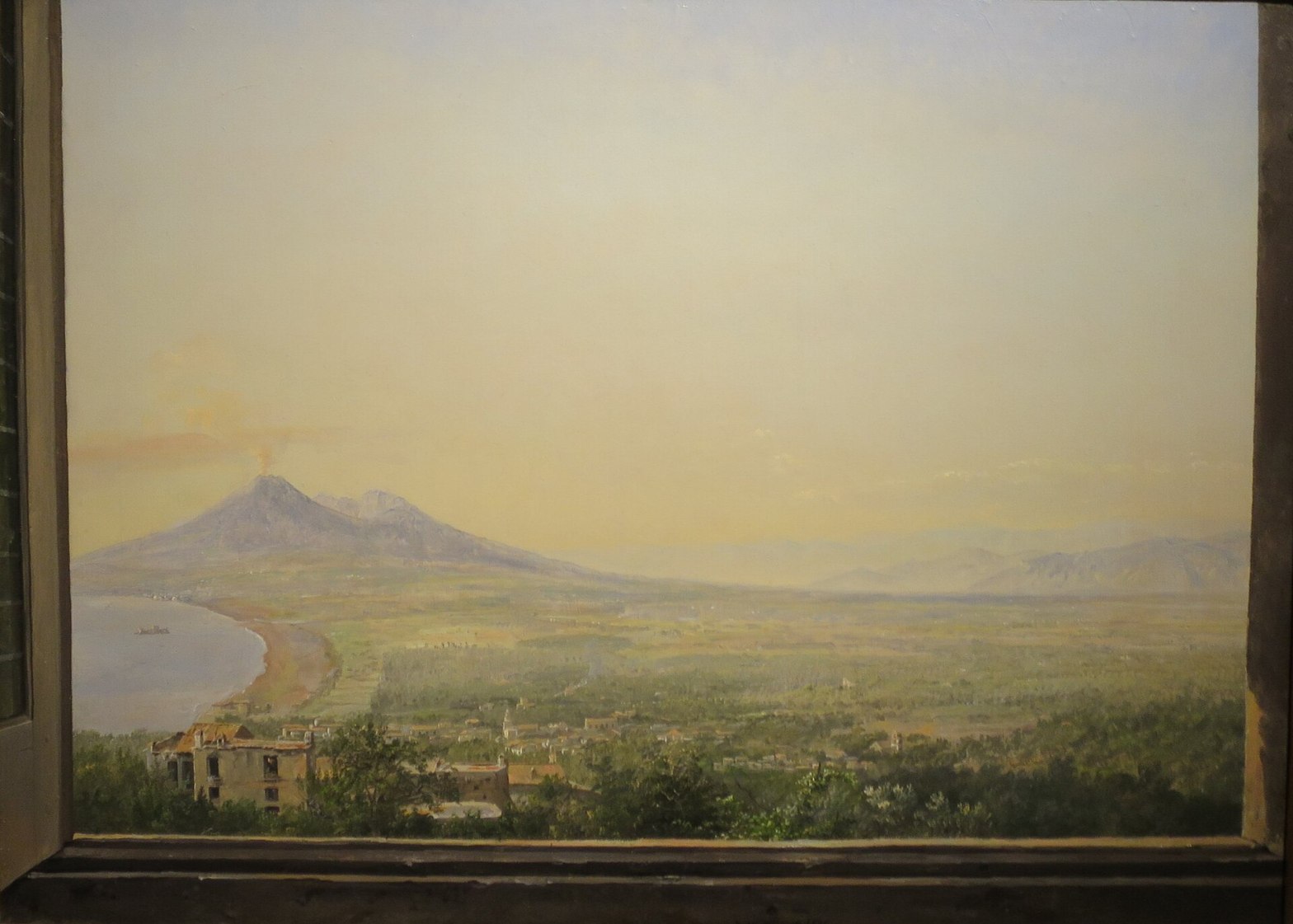
Johan Christian Dahl’s View from a Window at Quisisana, dated 14 August 1820, is painted in oil on paper laid on cardboard and measures 42.8 × 58.6 cm. It is now in the Rasmus Meyers Collection in Bergen. The view was made at Quisisana, the royal residence above Castellammare di Stabia on the southern side of the Bay of Naples, and looks across the bay towards Vesuvius.
View of Pillnitz Castle, painted in 1823, is an oil on canvas measuring 70 × 45.5 cm. It is now in the Museum Folkwang in Essen. Pillnitz Palace stands beside the River Elbe to the east of Dresden in Saxony and was used as a summer residence by the rulers of Saxony.
These two works belong to a formative period in the career of the Norwegian painter Johan Christian Dahl (1788–1857). Born in Bergen, Dahl entered the Royal Danish Academy of Fine Arts in Copenhagen in 1811, where he received an academic training grounded in the Dutch landscape tradition, particularly the work of Jacob van Ruisdael, Meindert Hobbema and Allaert van Everdingen. In 1818 he settled in Dresden, which remained his home for the rest of his life, and became closely associated with Caspar David Friedrich.
The Quisisana painting belongs to Dahl’s Italian journey of 1820–21, undertaken shortly after his admission to the Dresden Academy, while View of Pillnitz Castle was painted after his return to Saxony. In 1823 Dahl moved into the same house as Friedrich, and the following year he was appointed extraordinary professor at the Dresden Academy. The two paintings thus stand on either side of the Italian journey, at a point when close study of nature, the experience of travel and an increasingly assured artistic identity came together.
Dahl’s artistic development took place at the intersection of different traditions and ways of looking at nature. During his years in Copenhagen, he combined the study of earlier European landscape painting with a practice founded on close observation. Marit Lange has compared him with Constable: although the two painters worked independently, both arrived at a form of rapid oil study made directly from nature and shared an interest in clouds, weather and changing atmospheric effects. Dahl’s art nevertheless retained the compositional discipline and descriptive clarity of the landscape traditions in which he had been trained.
His move to Dresden placed him within a different artistic milieu. Friedrich’s landscapes had already shown how the visible world might answer to contemplation, memory and inward feeling. The open window, in particular, had become a means of joining an enclosed interior to a world extending beyond it, while making the observer’s position part of the image. Dahl’s friendship with Friedrich forms an important part of the context for the two paintings, although his own treatment of landscape remained distinctive.
Carl Gustav Carus gave contemporary expression to some of the ideas circulating within this Dresden culture. A physician, naturalist, painter and writer, Carus composed his Nine Letters on Landscape Painting between 1815 and 1824. He argued that the artist should attend closely to nature rather than merely imitate the work of others, but that observation must also answer to an inward imaginative life. His insistence that the eye remain open to nature while the hand responds to the soul offers an illuminating context for Dahl, whose landscapes are at once exact and personal.
Dahl did not entirely abandon inherited pictorial structures in order to achieve that personal vision. The architecture, terrain and recession of his landscapes can retain a degree of linear precision and topographical order, especially in View of Pillnitz Castle. Even the Quisisana view preserves a firm separation of forms. Yet colour, light and atmosphere soften that underlying structure, while his command of spatial recession allows sharply observed foreground details to remain part of a broad and coherent landscape. The paintings therefore belong neither wholly to an older descriptive tradition nor to an unrestrained art of immediate sensation. Their interest lies in the coexistence of these elements.
View from a Window at Quisisana
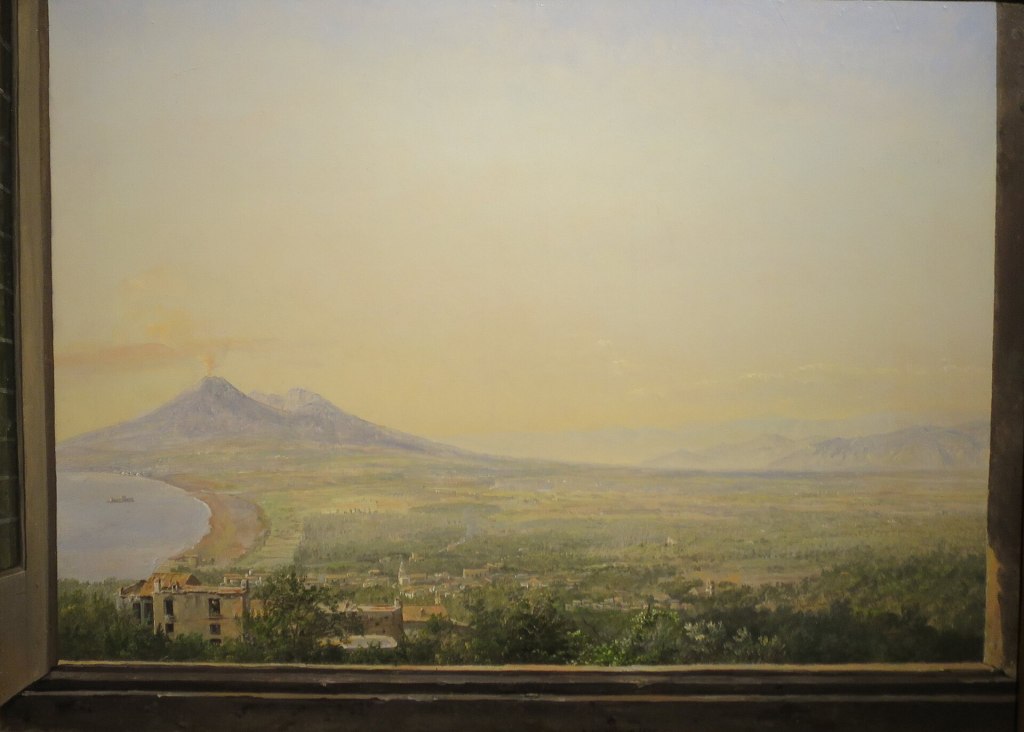
Dahl painted View from a Window at Quisisana during his Italian journey, dating it 14 August 1820. The landscape opens across the Bay of Naples towards Vesuvius, seen from Quisisana above Castellammare di Stabia. Although modest in scale, the work encompasses a broad sweep of terrain, water and distant mountain.
The immediate foreground is occupied by the dark structure of the open window. Dahl describes it with close attention to surface and light. A narrow strip of illumination runs along the base of the frame, while a diagonal wedge of light enters at the lower right. The wood has a rough, worn texture, and beneath the sill there is a slight indication of the point at which it gives way to the plastered wall. These details are intensely tangible and make our experience of the painting psychologically compelling, fixing us within a particular interior before the eye moves outward into the landscape.
Beyond the frame, the view passes across the nearer buildings and slopes towards the pale expanse of the bay, with Vesuvius rising on the horizon. Forms remain clearly articulated, but colour and the gradual modification of tone create a convincing sense of atmosphere and distance. Dahl’s precision does not impede recession: the closely observed foreground and middle distance remain integrated within the larger landscape.
The painting was completed over two days, and the landscape was painted before Dahl added the window around it. The finished work therefore does not simply preserve the circumstances of an uninterrupted act of observation. Instead, the carefully rendered wood, light and wall retrospectively establish a credible interior from which the landscape appears to have been seen. The immediacy belongs principally to the view itself, while the position of the observer was more deliberately constructed.
Giuseppe Scavizzi understood Dahl’s freedom not as improvisation alone, but as the mature result of repeated study. Behind the Quisisana painting he discerned a long practice of light drawings and rapidly touched watercolours, progressing from close fidelity to nature towards an increasingly assured and independent handling. Its freshness rests upon disciplined observation, while the later addition of the window transforms the observed landscape into a more consciously shaped and personal image.
View of Pillnitz Castle
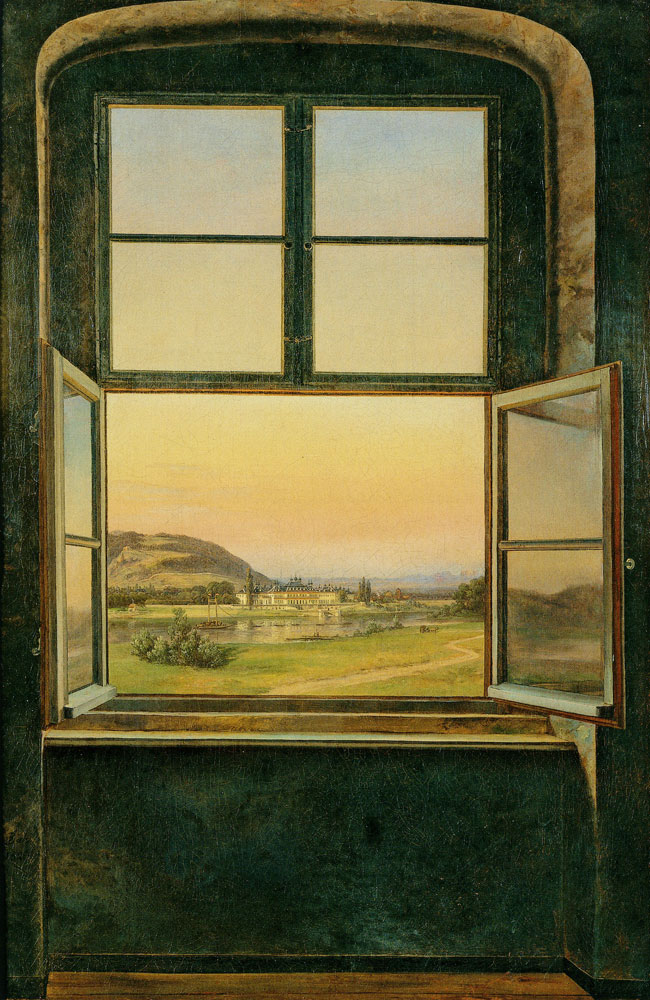
Painted in 1823, View of Pillnitz Castle belongs to the period after Dahl’s return from Italy and his re-establishment in Dresden. The composition is narrower and more vertical than the Quisisana view. A darkened interior occupies much of the foreground, while the landscape opens beyond the window towards the River Elbe and the palace at Pillnitz.
The room is rendered with a strong sense of material presence. The window recess, sill and opened panes establish the depth of the wall, while reflections and small passages of light give substance to the glass and surrounding surfaces. From this close and tangible foreground, the eye moves towards the path, the river and the distant palace before rising into the broad evening sky.
Helmut R. Leppien emphasised the unusual contrast between these two parts of the painting. For him, the work “radiates magic” because the dark, backlit room appears almost tangible, like a trompe-l’œil, while the landscape is “pushed into the distance and shrunk like a small toy”. Although the palace and its surroundings are rendered with considerable sharpness and clarity, their reduction and remoteness make them appear strangely detached, almost like an apparition.
That effect is not produced by vagueness. The architecture, terrain and course of the river are carefully described, and the composition retains a marked topographical clarity. Yet colour and atmosphere alter the character of that precision. The changing tones of the sky and the evening light soften the firmness of the drawing, while the scale of the distant landscape gives its exact forms an unexpected strangeness.
The apparent relationship between room and landscape is itself invented. Pillnitz lies to the east of Dresden, upriver along the Elbe, and could not have been seen from Dahl’s studio window. The painting brings together a credible interior and a view drawn from elsewhere, presenting them as a continuous visual experience. Whereas at Quisisana the window was added around an observed landscape, here the conjunction of interior and exterior is more thoroughly imagined. Arguably, the result can be read not simply as an illusion made persuasive, but as a deliberate conjunction of realism and fantasy.
Together, the two paintings show Dahl moving between close observation and imaginative reconstruction. Their windows do not simply frame the landscape, but alter the terms on which it is seen. In each case, the view remains grounded in place while becoming something more inward, uncertain and invented.
[Producing these essays requires care, time, research, and resources. Contributions to help sustain this exploration would be greatly appreciated.]
Donate to Inner Surfaces here.
Bibliography
Carl Gustav Carus, Nine Letters on Landscape Painting: Written in the Years 1815–1824, with a Letter from Goethe by Way of Introduction, introduction by Oskar Bätschmann, translated by David Britt (Los Angeles: Getty Research Institute, 2002).
Catherine Johnston, Helmut Börsch-Supan, Helmut R. Leppien and Kasper Monrad, Baltic Light: Early Open-Air Painting in Denmark and North Germany (New Haven and London: Yale University Press, 1999).
Jane Munro, ed., Nature’s Way: Romantic Landscapes from Norway: Oil Studies, Watercolours and Drawings by Johan Christian Dahl (1788–1857) and Thomas Fearnley (1802–1842) (Manchester: Whitworth Art Gallery, University of Manchester; Cambridge: Fitzwilliam Museum; Oslo: Nasjonalgalleriet, 1993).
Il paesaggio napoletano nella pittura straniera, exhibition catalogue, Palazzo Reale, Naples, 19 May–22 July 1962 (Naples, 1962).

