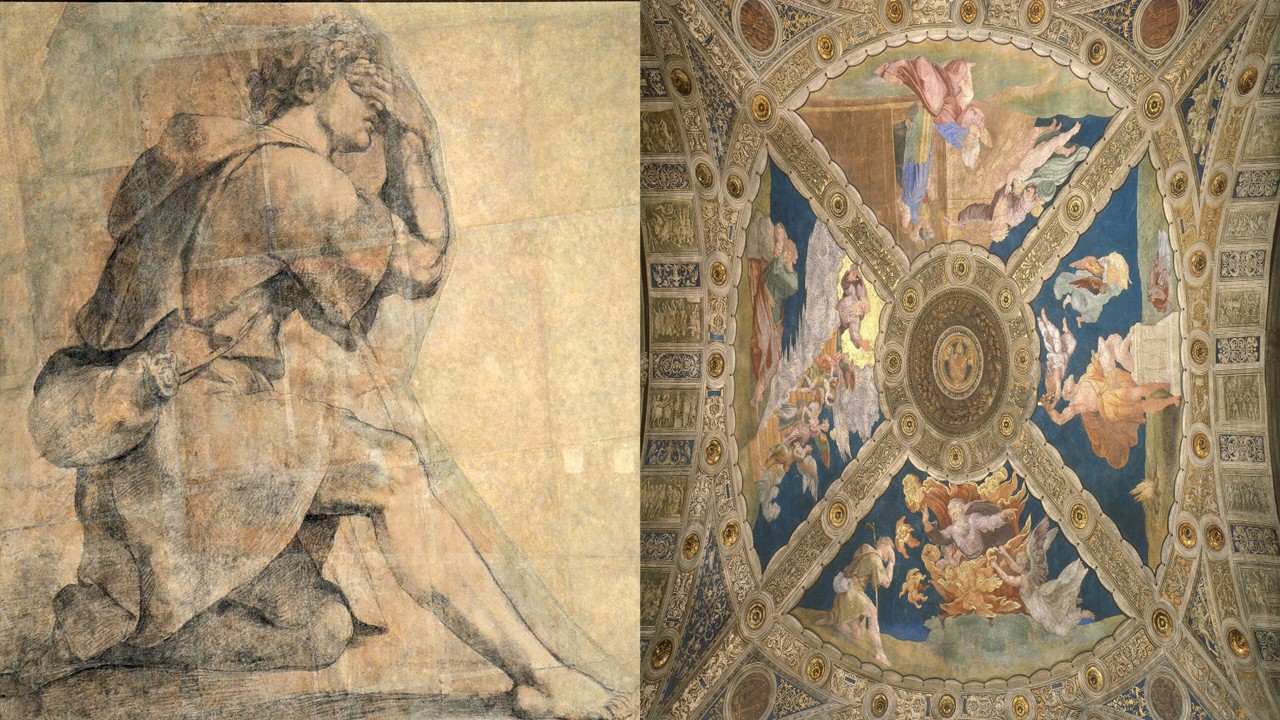
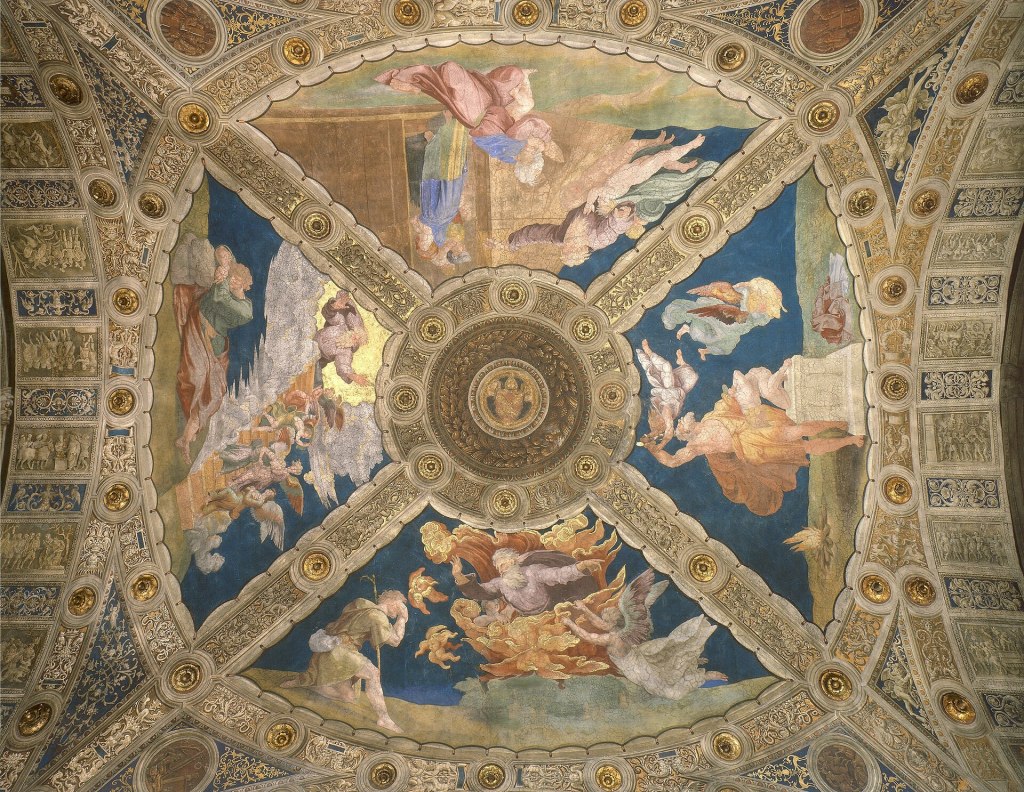
The drawings considered here converge around Raphael’s decoration of the vault of the Stanza di Eliodoro. Their significance lies not only in the light they cast on the completed frescoes, but also in what they reveal about Raphael’s working practice, his movement between projects, his responsiveness to different visual sources and his adaptation of drawing to the particular demands of ceiling decoration.
A drawing in the Uffizi broadens this enquiry beyond the preparations for Moses before the Burning Bush. Its studies of flying angels appear to be associated with the neighbouring scene of God Appearing to Noah, while it also contains a seated woman derived from an antique relief and a group of architectural sketches connected with St Peter’s. Its importance therefore lies not in completing a simple sequence of preparations for a single fresco, but in revealing the breadth and mobility of Raphael’s practice as a draughtsman. On one sheet, ideas connected with painting, sculpture and architecture coexist and overlap without necessarily belonging to the same commission. Their conjunction nevertheless gives the page a wider coherence, suggesting the primacy of disegno as the means by which Raphael could move between the three disciplines, translating sculptural form, pictorial invention and architectural structure into a shared language of line.
Raphael, Young Woman Seated on a Parapet and Other Studies, Uffizi Galleries:
https://www.uffizi.it/en/artworks/raphael-drawing-womanseated
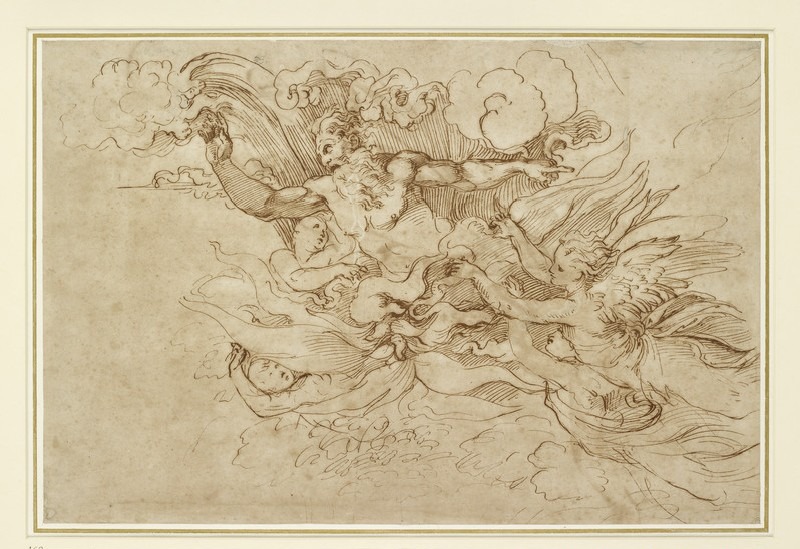
The two drawings that correspond most closely are the large cartoon fragment in Capodimonte and the Ashmolean study of God the Father Appearing to Moses. They prepare the opposing elements of the same scene. In the Ashmolean sheet, God advances through flames, smoke and attendant angels; in the Capodimonte cartoon, Moses kneels, shielding his eyes from the apparition. One drawing is a highly concentrated study of the divine presence, executed in pen and brown ink, while the other is a full-scale working cartoon in black chalk with white heightening, pricked for transfer to the plaster. Seen together, they recover much of the essential structure of Moses before the Burning Bush: the expansive movement of revelation set against the contracted, defensive response of the human figure.
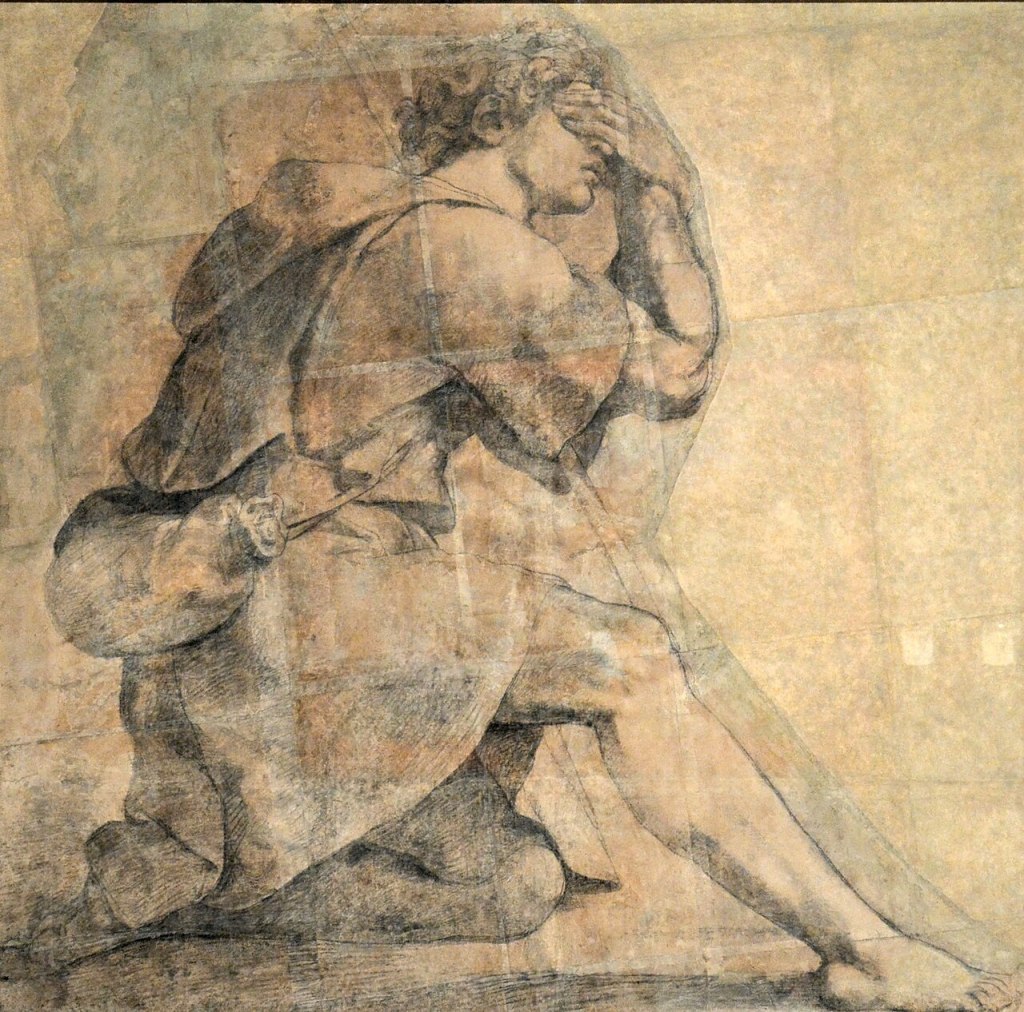
The cartoon’s present appearance also reflects a complex modern conservation history. It came down to Capodimonte mounted on canvas and supplemented by two triangular additions of paper. In 1839 Camillo Checcacci subjected it to extensive repainting, which was removed during a later conservation campaign to prevent further damage to the original paper support.
Despite their differences of medium, scale and purpose, the Ashmolean study and the Capodimonte cartoon share an unusually firm and concentrated manner of drawing. In the Ashmolean sheet, Raphael defines the figures through decisive contours, close hatching and long directional lines that run through wings, drapery, flame and smoke.
In the much larger cartoon, black chalk and white heightening produce a comparable organisation of the figure: the outline remains emphatic, areas of untouched paper serve as highlights, and dense shadows are gathered into clearly bounded passages. Long chalk strokes follow the direction of Moses’s drapery and bodily movement, while rubbed chalk establishes broader areas of tone.
These qualities were especially appropriate to the intended setting of the designs. The restrained colour and distant position of the ceiling compartments placed greater emphasis on contour, silhouette and broad divisions of light and shadow than was necessary in the more painterly wall frescoes, where colour, atmospheric depth and gradual tonal transitions could do more to distinguish forms and organise space. Yet the manner cannot be explained by function alone. Joannides sees the Capodimonte cartoon as an example of a darker, polished style with which Raphael was experimenting at this period, while the elaboration of the Ashmolean sheet suggests that its disciplined linear technique could itself become an object of admiration.
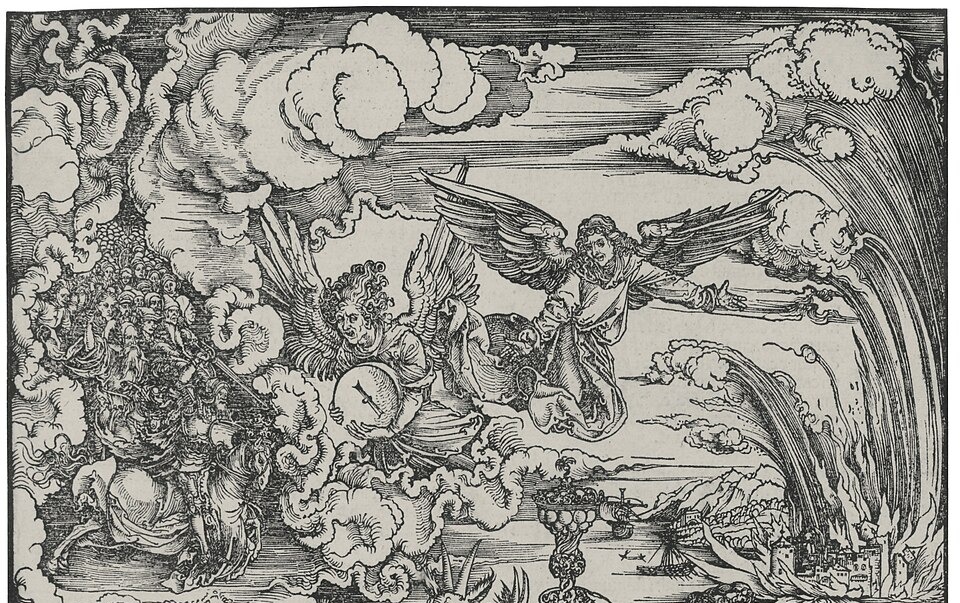
Dürer provided one important stimulus for this graphic language, particularly in the treatment of smoke and cloud as curling, ribbon-like forms. In the Ashmolean drawing, the angels appear to draw these forms aside, while wings, drapery and vapour are organised through similar currents of line. Raphael did not simply imitate a northern print. He absorbed its graphic energy into a design that was both suited to the demands of ceiling decoration and sufficiently elaborate to be appreciated as a drawing in its own right.
In the completed fresco, these separate acts of invention are brought into a single encounter. God and the angels descend amid fire, smoke and cloud, while Moses contracts below, shielding himself from a presence he cannot directly confront. The drawings reveal how differently Raphael approached the two halves of that encounter: the apparition was developed through the concentrated movement of the pen, while the human response was enlarged and stabilised in the full-scale cartoon. They illuminate the finished image, but they also preserve stages of thought whose graphic character cannot be entirely absorbed into the fresco.
[Producing these essays requires care, time, research, and resources. Contributions to help sustain this exploration would be greatly appreciated.]
Donate to Inner Surfaces here.
Bibliography
Joannides, Paul. The Drawings of Raphael: With a Complete Catalogue. Berkeley and Los Angeles: University of California Press; Oxford: Phaidon, 1983. See plate 34, God the Father Appearing to Moses, pp. 100–101; catalogue nos. 343r–v and 344, p. 219.
Whistler, Catherine, and Ben Thomas, with Achim Gnann and Angelamaria Aceto. Raphael: The Drawings. Oxford: Ashmolean Museum, 2017. See catalogue nos. 94 and 95, pp. 204–207.
Museo e Real Bosco di Capodimonte. “Raffaello e la sua bottega: indagini diagnostiche per una nuova mostra.” 22 April 2021. Accessed 15 July 2026.
Syremont. “Napoli, Gallerie Nazionali di Capodimonte: Raffaello, i ‘Cartoni Farnesiani’. Indagini e pulitura della superficie.” Conservation report, sheet 0416.
Uffizi Galleries. “Young Woman Seated on the Parapet of a Window and Other Studies.” Online collection entry. Accessed 15 July 2026.

