Part Three: Selected Works by Battistello Caracciolo
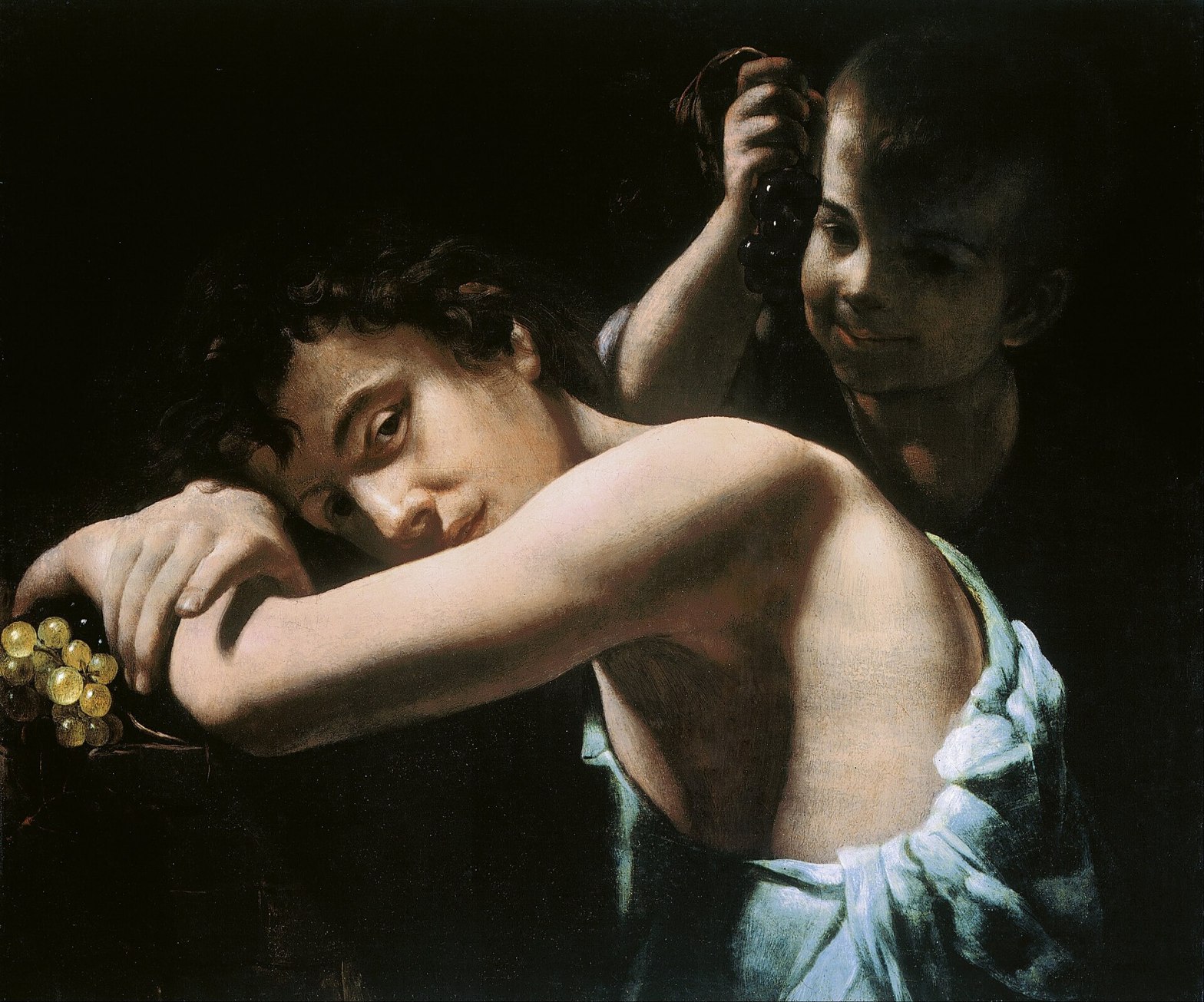
Battistello Caracciolo, Due putti vendemmianti / Two youths with grapes, 1605–10; oil on poplar panel; 58.5 × 70.5 cm; Art Gallery of South Australia, Adelaide.
Credit: Wikimedia Commons.
Raffaello Causa first brought this small early panel to scholarly attention in 1950, when it belonged to the Moretti collection in Rome. The following year it was exhibited at the Palazzo Reale in Milan in Roberto Longhi’s landmark Mostra del Caravaggio e dei caravaggeschi. Now in the Art Gallery of South Australia, where it is titled Two Youths with Grapes, it is one of Battistello’s rare profane or Bacchic subjects. Stefano Causa relates it to the youthful angels in the Santa Maria della Stella altarpiece and to other early half-length figures by the artist, seeing in its strongly cast shadows and close physical presence one of the earliest expressions of Caravaggism in Naples. He also singles out the bunch of grapes at the left, treating it not merely as an accessory but as an early indication of southern still-life painting. The picture can therefore be approached from two directions: as evidence of Battistello’s immediate response to Caravaggio, and as a small, unexpected Bacchic experiment in which the grapes point towards the emergence of still-life painting in southern Italy.
(Credit: Wikimedia Commons).
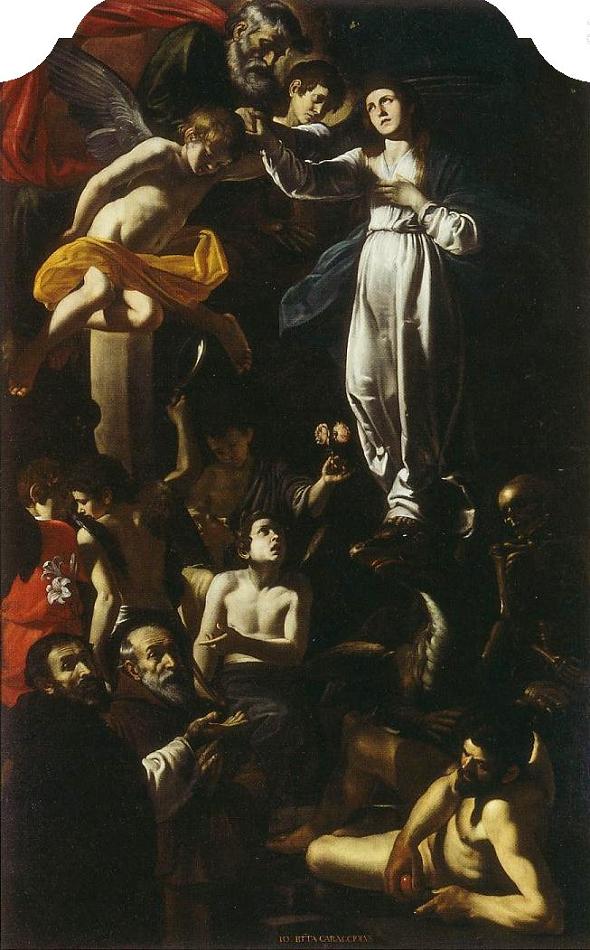
Giovanni Battista Caracciolo’s Immacolata Concezione con san Domenico e san Francesco di Paola was painted in 1607–08 for the chapel of the Immaculate Conception, the second chapel on the left in Santa Maria della Stella, Naples. The chapel had been acquired by Domenico Barrile on 16 July 1607. Signed in full in the lower part of the canvas, the altarpiece is Battistello’s earliest securely documented public painting in oil and his first sustained response to Caravaggio. He was not yet thirty. During the eighteenth century the painting was transferred to the sacristy, a move that saved it from the fire that devastated the church in 1944. It is now displayed on the rear wall of the presbytery.
The work presents the iconography of the Immaculate Conception in a fully developed form. The Virgin stands over a monstrous dragon emerging from the fiery mouth of hell, signalling her triumph over Satan and original sin, while Adam, holding the apple, and the skeleton beside him evoke sin and death. Around her appear the traditional Marian symbols of lilies, a mirror, thornless roses and a palm frond; above, God the Father takes her hand as she raises the other to her breast in a gesture of humility. At lower left are Saint Dominic and Saint Francis of Paola, the latter linking the image directly to the Minims of Santa Maria della Stella. The figure of Adam, who holds the apple in one hand and points with the other to Battistello’s signature, has also been read, since Longhi, as a self-portrait. The suggestion is strengthened by the self-referential gesture and by the pronounced humping of the shoulders, traditionally associated with Battistello’s own physical appearance.
Although Due putti alla vendemmia / Two youths with grapes shows Battistello already working through Caravaggesque adolescent figure-types in a private, profane register, the Immacolata Concezione is his earliest securely documented public statement in the new idiom. Causa sees the painting not as a simple act of Caravaggesque conversion, but as an attempt to renovate an older Neapolitan sacred altarpiece formula, associated above all with Fabrizio Santafede and still indebted to neo-Cinquecento compositional habits. The painting is densely threaded with references to Caravaggio’s mature Roman and Neapolitan works, but those references are absorbed into a more traditional public, devotional structure. The result is therefore neither purely Caravaggesque nor merely local and late-Mannerist, but an early attempt to make Caravaggio’s language function inside the established traditions of the Neapolitan altarpiece.
Modern criticism, from Raffaello Causa to Ferdinando Bologna and Stefano Causa, has emphasised the painting’s many references to Caravaggio’s Roman and Neapolitan works, including the Martyrdom of Saint Matthew, the Madonna of the Rosary, the Seven Works of Mercy and the Vienna David with the Head of Goliath. The closest model appears to be the Madonna of the Rosary, from which Battistello adapts the general grouping, the upward movement of the figures and details such as the head of Saint Dominic. Yet his composition is less tightly concentrated than Caravaggio’s: the movement rises along a broad diagonal from the two saints at lower left, through the angel with the palm, to the Virgin at upper right, while the subsidiary angels and their separate illumination create a more dispersed arrangement of forms.
Spinosa also singles out the carnations held by the angel as a small but striking still-life insertion, and one of the early signs of the Neapolitan taste for natura in posa. Technical examination has revealed significant pentimenti in the Immacolata Concezione. In the lower part of the composition, traces of dark wings suggest that Battistello first planned an angel in the area later occupied by the two saints; the Virgin, too, was revised, her hair apparently having been first conceived as falling loose over her shoulders.
(Credit: Wikipedia).
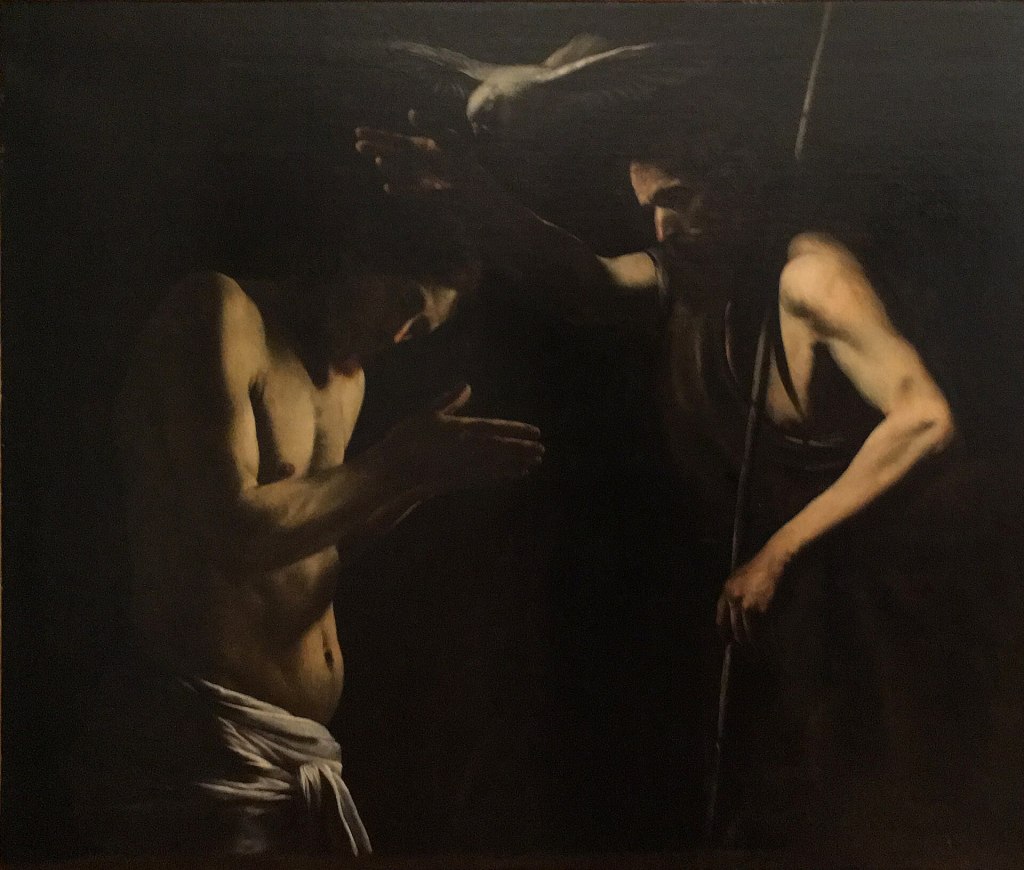
The Battesimo di Cristo is one of Battistello’s most concentrated statements of early Neapolitan Caravaggism. Its debts to Caravaggio are evident: Christ’s loincloth recalls the Flagellation formerly in San Domenico Maggiore and now at Capodimonte, while the close structural affinity with Caravaggio’s Martyrdom of Saint Ursula of 1610 suggests a date shortly afterwards. For Stefano Causa, the work is one of the “hard” masterpieces of Caravaggism, establishing Battistello as the leading local interpreter of Caravaggio before the new upheaval caused by Ribera’s arrival in Naples in 1616.
Against a dark, almost unfathomable ground, Saint John baptises Christ as the dove of the Holy Spirit enters the scene. The two figures are caught by a cutting lateral light that slips between the Baptist’s fingers, spreads across his arm, and casts the shadow of the reed cross onto Christ’s chest. Battistello turns away from the contemporary colourism of Francesco Curia towards an almost bronze tonality, reducing the subject to an intense, mute exchange between Christ and the Baptist. The painting’s force lies in this stripping down: no narrative digression distracts from the dialogue of bodies, light and shadow. For Causa, the result marks a decisive acceleration in Neapolitan painting, opening the way to the city’s later naturalism.
(Credit: Wikipedia).
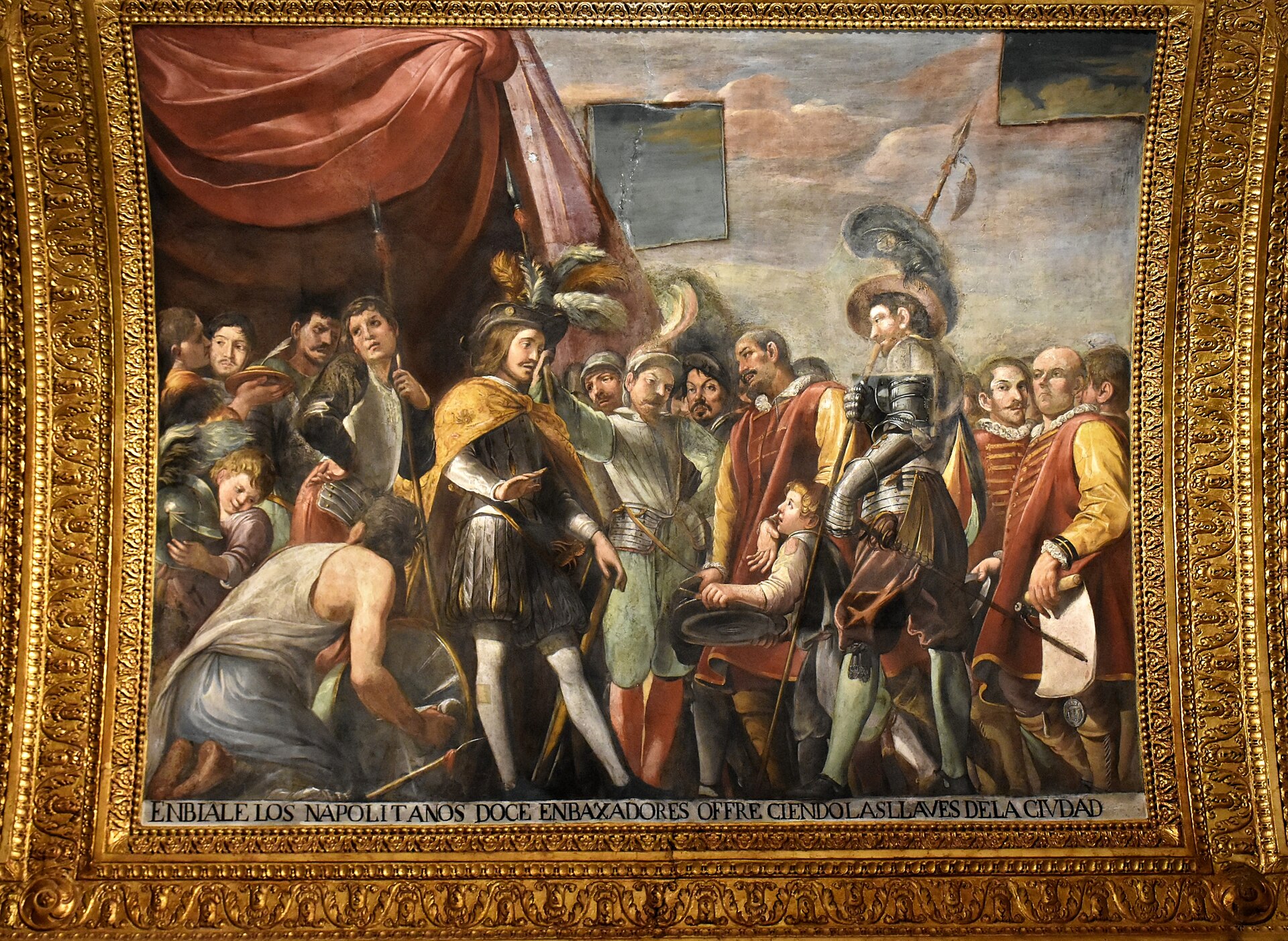
Battistello’s fresco cycle in the Palazzo Reale marks an unusual moment in his early career: a large-scale secular history subject, painted for the ceremonial spaces of viceregal Naples rather than for a church. The cycle celebrates Gonzalo Fernández de Córdoba, the “Gran Capitano”, whose victories over the French led to his appointment as the first Spanish viceroy of Naples. The 2022 Capodimonte/Palazzo Reale chronology gives the cycle a working date of 1611 and describes it as one of the rare historical fresco cycles in Neapolitan painting of the early seventeenth century. The fuller account explains the basis for that dating more broadly: the arms and devices of Don Pedro Fernández de Castro, VII Count of Lemos, probably place the frescoes within the years of his viceroyalty, between 1610 and 1616.
The frescoes narrate episodes from the Spanish conquest of the kingdom: the taking of Calabria; the assault on the French at Barletta; the Duello con La Palisse a Ruvo di Puglia, which refers to the Spanish assault on Ruvo; the meeting with the Neapolitan ambassadors offering the keys of the city; and the triumphal entry into Naples. The same account records that the cycle was extensively repainted in the mid-nineteenth century and restored in 1990, so its present appearance has to be treated with some caution. Even so, the frescoes remain important evidence of Battistello’s ability to translate Caravaggesque naturalism into a monumental public language.
The account also stresses Battistello’s use of portraiture within the historical scenes. In the Incontro con gli ambasciatori di Napoli, the face of a man with dark moustache and pointed beard, visible between two figures near the centre of the composition, is identified as Caravaggio and read as a tribute to the painter whose example had been decisive for Battistello. Whether treated cautiously as an identification or accepted as a deliberate portrait, the detail is suggestive: it places Caravaggio’s memory inside a dynastic fresco cycle, and reminds us that Battistello was one of the few Caravaggesque painters to test Merisi’s innovations in fresco.
(Credit: Catalogo Generale dei Beni Culturali).
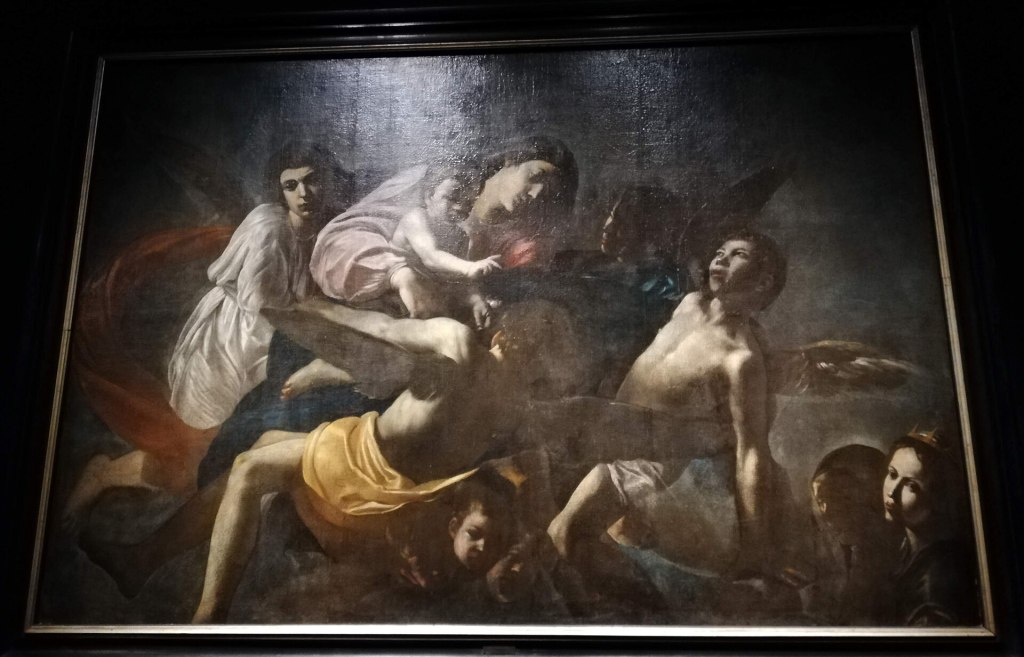
The Madonna col Bambino in gloria, now at MARCA in Catanzaro, has had a complicated attributional and critical history. Recorded in the early museum inventories as a work by Mattia Preti, it was reassigned to Battistello by Longhi in 1943, though Stoughton later treated it more cautiously as a work close to Caracciolo’s school. The official catalogue now gives its provenance as the church and convent of the Cappuccini of Santa Maria degli Angeli in Catanzaro. It also records that the painting entered the Museo Provinciale after a request made in 1872, at which point it was still listed as a Preti. Earlier scholarship had left the provenance less securely defined, even allowing for the unverified suggestion that the painting may have come from a church in Taverna which had been closed or suppressed.
The painting survives in a damaged and reduced state. The lower part has evidently been cut away, leaving only the heads of two female saints at the lower right; Giorgio Leone has suggested that the surviving canvas may be a fragment of a much larger altarpiece. This helps explain the compressed appearance of the lower-right figures and the unresolved questions around the original commission and iconography.
The dating of the Madonna col Bambino in gloria has also been debated. Vincenzo Pacelli proposed an early date, between 1607 and 1610, relating the Virgin and Child with angels to Caravaggio’s Sette opere di misericordia and to the lost Radolovich altarpiece of 1606. Stefano Causa preferred a date around the middle of the second decade, seeing in the softened colour and richer handling an effect of Battistello’s encounter with Orazio Gentileschi in Rome. The later date does not mean that the painting has moved away from the influence of Caravaggio. It suggests, rather, that Battistello was modifying a Caravaggesque foundation through a softer chromatic range and a richer handling of the painted surface.
The technical evidence helps make this distinction clearer. As Giorgio Leone notes, diagnostic examination shows that the Catanzaro painting was constructed from a dark preparation layer. Battistello did not begin with a pale ground and then model the forms by adding shadow. He allowed the dark ground to remain active in the deepest parts of the image, then brought the forms forward by adding lighter passages over it. The figures are therefore made to emerge from darkness through a relatively rapid and economical addition of light, a procedure close to Caravaggio’s mature practice.
Angela Cerasuolo’s wider studies of Battistello’s technique help prevent this from sounding like simple imitation. She presents Battistello as one of the earliest and most sensitive interpreters of Caravaggio in Naples, but not as a passive follower. His Caravaggism had its own technical character: a stronger attachment to drawing and preparation, a preference for light, thinly applied paint layers, and a personal way of adapting the dark ground and strong chiaroscuro inherited from Caravaggio. In the Catanzaro painting, the underlying construction remains Caravaggesque, while the softened colour and fuller surface help explain why Causa placed the work after Battistello’s Roman contact with Orazio Gentileschi.
The painting nevertheless remains deeply rooted in Caravaggio’s Neapolitan invention. The Virgin clasps the Child to her breast and enters the scene amid restless angels, adapting the apparition-like upper group of the Sette opere di misericordia. In the Catanzaro picture, Battistello’s late-Mannerist Neapolitan formation under Imparato and Santafede is redirected through Caravaggio’s realism and sharp contrasts of light and shadow, producing a sacred image that is both more immediate and more graphically forceful.
(Credit: Wikimedia Commons).
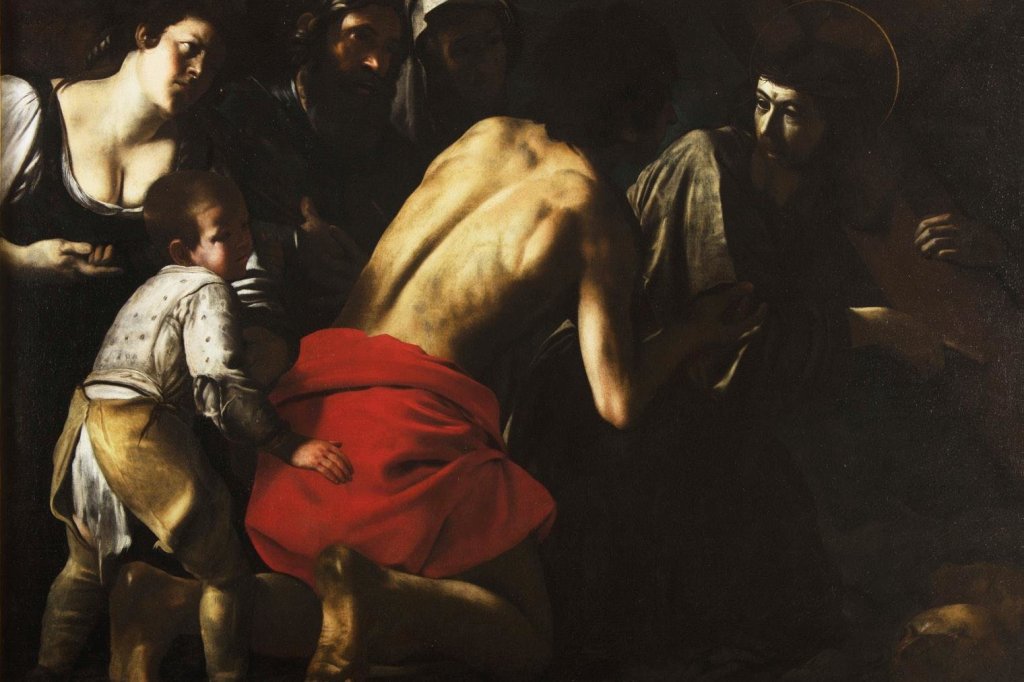
Caracciolo’s Qui vult venire post me / Cristo e Simone da Cirene is now generally understood as a documented work of 1614, executed for the Genoese patron Marcantonio Doria. It appears in the Doria inventory of 1620 as “Qui vult venire post me con la croce in spalla del Battistello”, a title that gives the image a broader meaning than the more usual descriptions as a Via Crucis or as Christ and Simon of Cyrene. Rather than representing only one episode from the Passion, Battistello expands the subject into an image of Christ’s injunction in Mark 8:34: “If anyone wishes to follow me, let him deny himself, take up his cross and follow me.” Christ points to the cross with the index finger of his right hand while turning towards the kneeling figure beside him. Around them, a small group of bystanders, including a ragged boy at the left, turns the Gospel address to the crowd into a concrete encounter with figures drawn from Battistello’s own world.
The Doria provenance is central to the work’s meaning and history. The painting is signed with Battistello’s monogram on the front, and inscriptions formerly recorded on the reverse apparently included both the artist’s name and a cross with the letters M.A.D., standing for Marcantonio Doria. The same initials appear on the reverse of Caravaggio’s Martyrdom of Saint Ursula, also owned by Doria and now in the Gallerie d’Italia, Naples. Marcantonio Doria’s patronage of Neapolitan artists is well documented, and the 1620 inventory listed a substantial group of works by Battistello. Rediscovered by Roberto Carità in a house at Casale Monferrato, the painting was published in Paragone and entered the Piedmontese collections in 1952, perhaps on Longhi’s advice. Its subject was long misunderstood until the 1984 exhibition Civiltà del Seicento a Napoli restored the importance of the Doria title; for Stefano Causa, Thierry Radelet’s 2018 restoration was another critical event, allowing the painting to regain its place among the sharpest Caravaggesque inventions between Rome, Naples and Genoa.
The painting’s Caravaggesque debts are precise, not merely generic. The foreground man adapts the kneeling figures before Saint Dominic in Caravaggio’s Madonna of the Rosary, with the soles of the feet turned towards the viewer, while the boy’s torn breeches recall the kneeling child in the same work. The shadowed profile of the man in Qui vult venire post me has been related to the executioner on the left in Caravaggio’s Flagellation of Christ of 1607, and the expressive power of the scene suggests Battistello’s close understanding of Caravaggio’s late works, especially the Denial of Saint Peter and the Martyrdom of Saint Ursula. At the same time, the painting remains tied to Battistello’s own development: details of physiognomy and modelling recall the Immacolata Concezione of 1607–8, while Causa links the whole foreground structure to the Liberazione di san Pietro of 1615, almost anticipated here in horizontal format.
The 2018 restoration sharpened the painting’s physical presence and pictorial structure. Causa draws attention to three compelling details: the child in ragged clothing, the small hand painted directly over the red patch of drapery, and the illuminated back of the kneeling foreground figure, which becomes one of the visual centres of the scene. Taken together, these details seem to intensify the Gospel episode by making it bodily, immediate and contemporary. The ragged child brings the sacred scene into contact with the visible poverty of the modern street; the hand over the red drapery gives the image a sudden tactile immediacy; and the strongly lit back of the foreground figure helps draw the viewer into the group of bystanders at Calvary. The face of the old woman may suggest some early awareness of Ribera, but Battistello’s paint does not yet have Ribera’s dense material weight. Instead, the handling opens into long strokes and patches, especially in the hair of the ragged figure seen from behind. For Causa, this handling points forward both to the young Velázquez and, in Naples, to Andrea Vaccaro. The young woman at the left, with her revealed décolleté, helps set the group in motion and suggests Battistello’s contact with Orazio Gentileschi in Rome around 1614. Causa notes that this passage was later partly concealed beneath a painted strip, appearing covered in older black-and-white reproductions before becoming visible again after restoration.
The close framing is itself a strategy of involvement. The viewer is drawn into the group of bystanders rather than placed at a detached devotional distance. Causa connects this device not only with Battistello’s chamber pictures, but also with his mural work, especially the Storie del Gran Capitano Consalvo di Cordova in the Palazzo Reale, Naples, of 1611, and in particular the scene of the taking of Calabria. In this sense, the painting’s Caravaggism is not only a matter of quoted motifs or dramatic lighting; it also depends on compositional experiments Battistello had already tested in fresco.
(Credit: Wikimedia Commons).
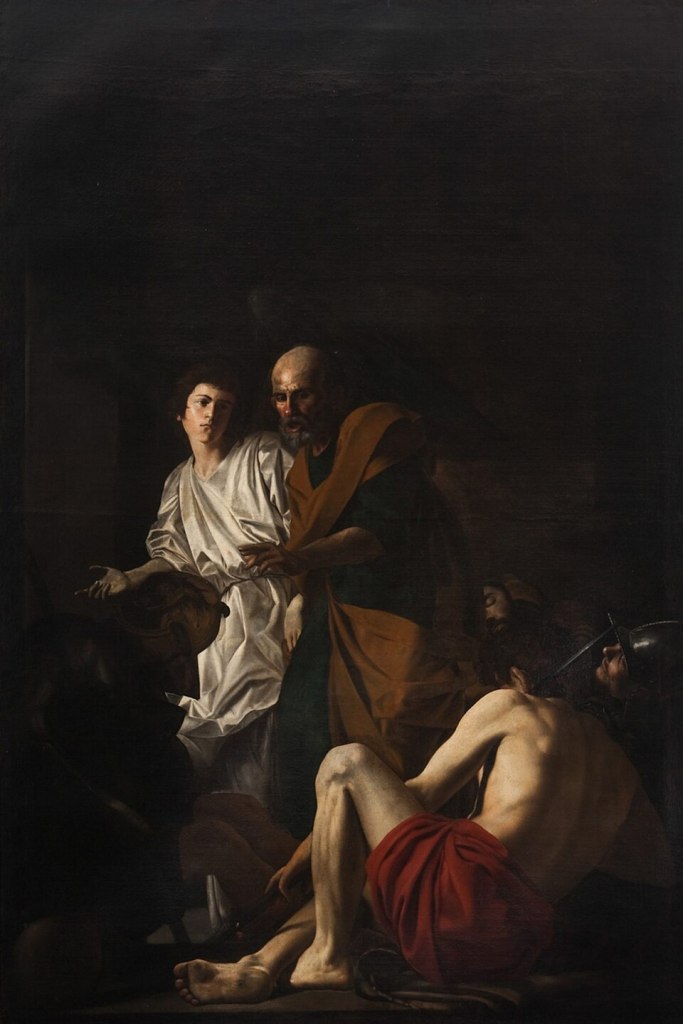
Still in situ in the first chapel on the left of the church of the Pio Monte della Misericordia, Battistello’s Liberazione di San Pietro dal carcere belongs directly to the charitable programme of the institution. Its subject corresponds to the work of mercy of visiting prisoners, already evoked by Caravaggio in the Sette opere della misericordia on the high altar through the ancient exemplum of Caritas Romana. As Caravaggio had translated the abstract idea of the works of mercy into terms of lived human experience, so Battistello presents the miraculous liberation of Saint Peter as something close to an episode from ordinary life. The darkness almost effaces the angel’s wings; only the luminous white satin of his robe declares the divine nature of the intervention. Peter’s strongly characterised face becomes a realist portrait of stunned incredulity, with wide-open eyes and an open mouth showing the tongue and lower teeth. Taking Peter by the hand, the angel leads him silently past the sleeping soldiers towards the open doorway at the left, from which light enters the prison and illuminates the scene.
The commission had first been given to Carlo Sellitto on 2 June 1613 for one of the lateral altars of the church, but after Sellitto’s death in 1614 it passed to Battistello. He was already at work on the painting when he received the first of two recorded payments, on 6 June 1615, promising that the work would be finished by the end of the following month. A second payment, on 15 September 1615, was made when the painting had already been completed. The Liberazione di San Pietro is therefore Caracciolo’s second securely dated oil painting, eight years after the Immacolata Concezione for Santa Maria della Stella. Nicola Spinosa adds an important social and intellectual dimension to this history, noting that the transfer of the commission to Battistello took place through the intervention of Giovan Battista Manso, marchese di Villa: one of the promoters of the Pio Monte, founder in 1611 of the Accademia degli Oziosi, and a figure connected with Giovan Battista della Porta, Tommaso Campanella and Galileo Galilei. Battistello himself also had links with members of the Accademia degli Oziosi, so the commission belongs not only to the devotional and charitable programme of the Pio Monte, but also to a cultivated Neapolitan milieu.
The work is intensely Caravaggesque in its chiaroscuro, its individualised faces and its realist interpretation of the miracle. Spinosa places it among the most important examples of Battistello’s still lucidly Caravaggesque direction after 1610, relating it not only to Caravaggio’s Sette opere della misericordia in the same church, but also to the Martyrdom of Saint Matthew in San Luigi dei Francesi, the Negazione di Pietro, now in the Metropolitan Museum of Art, and the lost Resurrection formerly in the Fenaroli Chapel in Sant’Anna dei Lombardi, known through early descriptions and later visual echoes.
More specific visual echoes reinforce the connection. The nude soldier at the lower right acts as a repoussoir, recalling the naked beggar at the lower left of Caravaggio’s Sette opere della misericordia: in both figures the dirty soles of the feet are turned towards the spectator. Battistello’s soldier on the left also wears a helmet very close to that worn by the soldier in Caravaggio’s Negazione di San Pietro. There is a comparable play, too, between the illusionistic space of the painting and the real space of the viewer. What Caravaggio had done in the San Matteo of the Contarelli Chapel, by projecting the stool beyond the lower edge of the composition, Battistello does with the mat on which the nude soldier sits, letting it hang over the edge of the stage-like space in which the action takes place.
For Stefano Causa, however, the painting is not simply a sharpening or continuation of Caravaggio. Battistello’s problem was how to extract the theme of visiting prisoners, drawn from Acts 12:1–19, from the enveloping Caravaggesque precedent of the Pio Monte altarpiece and give it an independent pictorial form. Causa’s essential point is that Battistello finds the necessary authority by stepping back to Raphael. Almost exactly a century after Raphael’s Liberation of Saint Peter in the Stanza di Eliodoro, Battistello’s painting becomes, for Causa, the most authoritative attempt to relaunch the Raphael myth in seventeenth-century Naples. The comparison is not merely iconographic: in gestures, poses and the gleam of armour, Causa sees Battistello measuring himself against the Vatican fresco. His phrase “reculer pour mieux sauter” catches the logic: Battistello retreats to the canonical authority of Raphael in order to make a new leap within the altered conditions of post-Caravaggio Naples.
Both Causa and Spinosa also connect the painting with Battistello’s contact with Orazio Gentileschi in Rome around 1614, if not earlier. The suspended atmosphere, the slower and more caressing movement of light, the elegant draperies and the polished reflections on the armour all suggest a new refinement of surface and illumination. Spinosa especially stresses the precious effect of light on fabric: the angel’s white robe, Saint Peter’s red garment, and the play of illumination across draperies and armour. The chiaroscuro is no longer only starkly dramatic; it has become more elegant, controlled and spacious. The angel and Saint Peter move within a dilated, almost unfathomable darkness, with only the prison grating visible in the right background. For Spinosa, this points to Orazio’s model of a caravaggismo riformato, a reformed Caravaggism in which the force of Caravaggio is softened, clarified and made more precious. Causa recalls that the young Longhi had already intuited this Battistello–Orazio connection when he attributed Orazio’s Salita al Calvario in the Kunsthistorisches Museum, Vienna, to Caracciolo, while defining Orazio as a sartor di lusso, a “luxury tailor” of Caravaggesque painting.
Battistello signed the picture in an unusually discreet way, with initials painted in black against a dark brown ground and therefore only noticed relatively recently. Stoughton reported two sets of initials on the painting, although the more recent Capodimonte material records the lower-left monogram simply as GBCA. In either case, the signature confirms Battistello’s authorship of a work that was already completed by September 1615. The painting has also been connected with a possible Roman stay around 1614, since no document places him in Naples between 7 February 1614 and the first payment for the Liberazione di San Pietro more than a year later.
Nicola Spinosa also notes that the Louvre preserves a drawing connected with the figure of the sleeping soldier. This is, almost certainly, a reference to a drawing, Guerrier à demi étendu, de dos, et main tenant un objet (INV 17838, recto), now catalogued as anonymous Italian but with a proposed attribution to Battistello by Marina Causa Picone. The Louvre note records Causa Picone’s view that the sheet contains preparatory studies for the Liberazione di San Pietro at the Pio Monte della Misericordia. The connection is especially suggestive for the half-recumbent soldier seen from behind in the foreground of the painting.
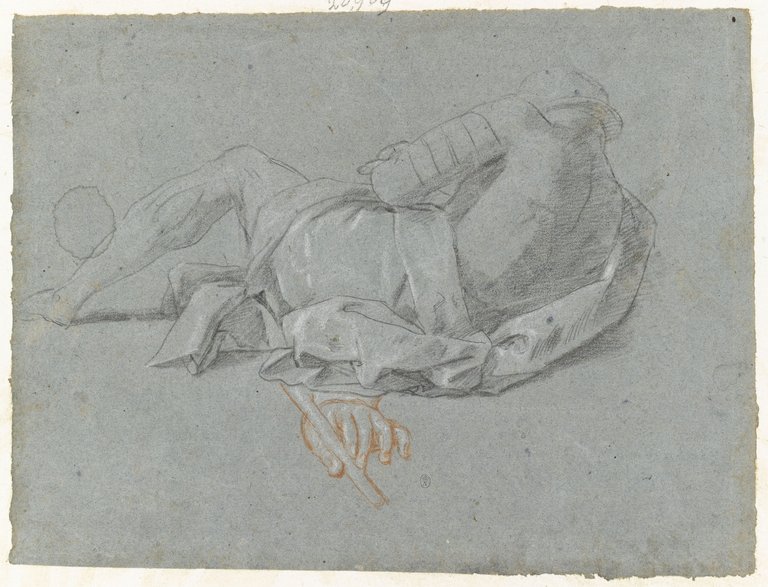
https://collections.louvre.fr/ark%3A/53355/cl020205327
Credit: GrandPalaisRmn (Musée du Louvre) / Thierry Le Mage. Source: Musée du Louvre, Guerrier à demi étendu, de dos, et main tenant un objet, INV 17838, recto.
(Credit: Wikipedia).
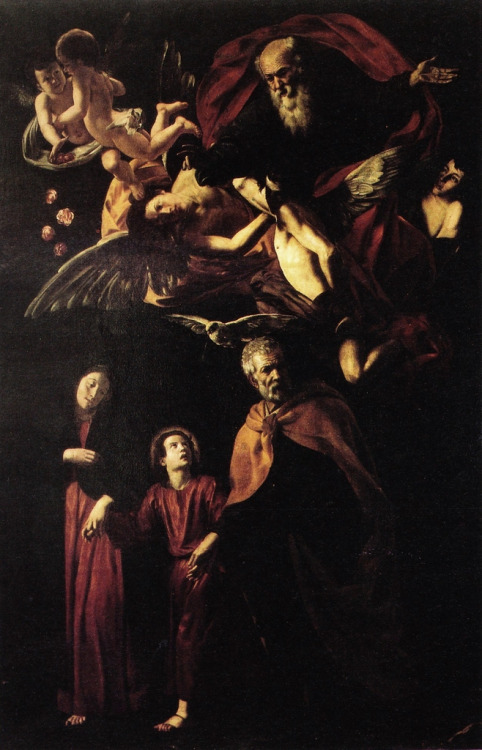
Battistello’s Trinità terrestre, painted in 1617 for the church of the Pietà dei Turchini in Naples, is one of his major altarpieces from the years immediately following the Liberazione di San Pietro. It is also known in guide literature as a Sacra Famiglia, but the more specific title points to the unusual structure of the image. Below, Mary and Joseph lead the young Christ by the hand on the journey into Egypt; above them, God the Father, the Holy Spirit and a dense company of angels transform the scene into a vision of the Trinity. The earthly family is therefore set beneath, and implicitly joined to, its heavenly counterpart. Commissioned together with its frame by Sebastiano and Santolo Manso, the painting still occupies the chapel for which it was made. Stoughton places the work among Battistello’s large, multi-figure altarpieces of around 1615–20, in which the painter continued to think through the monumental Neapolitan models left by Caravaggio, especially the Sette opere di Misericordia and the Madonna del Rosario. At the same time, the picture belongs to the moment just after Jusepe de Ribera’s arrival in Naples. Causa identifies the head of St Joseph as a direct response to Ribera’s San Pietro in the Quadreria dei Girolamini, suggesting that Battistello was already absorbing the Spaniard’s more tactile and materially emphatic pictorial language. The result is not a departure from Caravaggism so much as a broadening of it: Battistello adapts the vertical drama of Caravaggio’s Neapolitan altarpieces to a tender subject, while giving the figures greater bodily weight and a more worked, tactile surface.
(Credit: Wikimedia Commons).
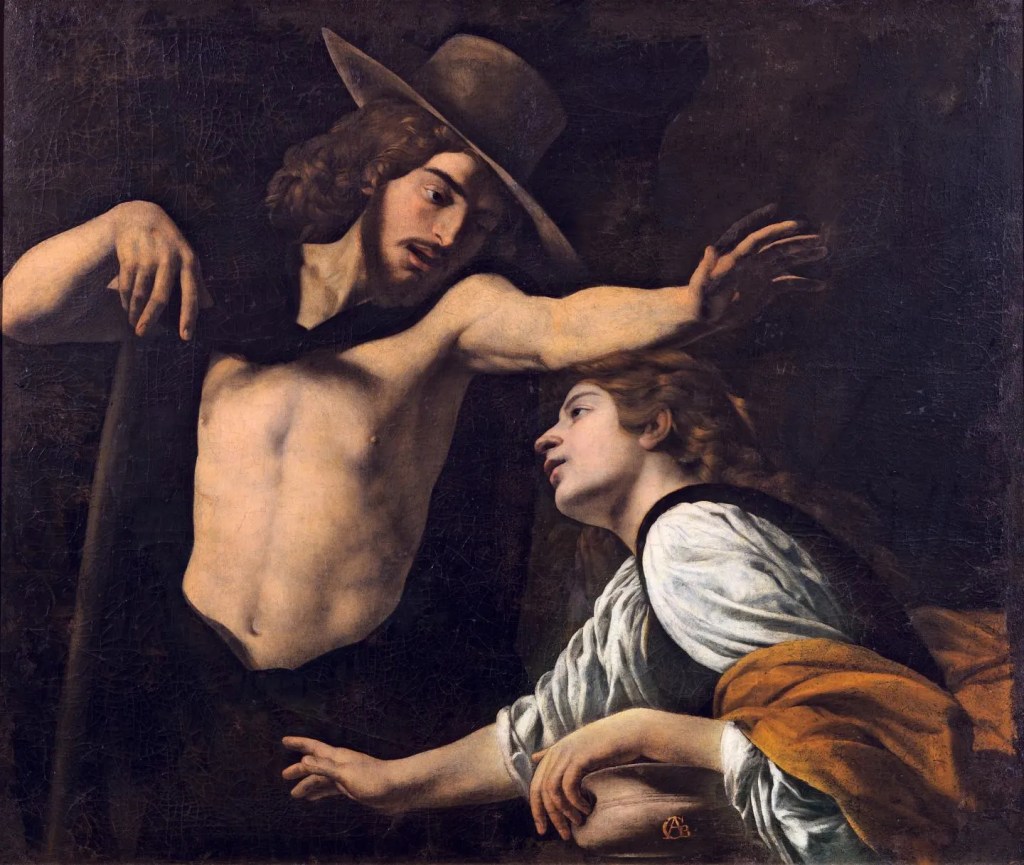
Battistello’s Noli me tangere shows the pivotal moment of recognition after the Resurrection, when Mary Magdalene encounters Christ outside the tomb and at first mistakes him for a gardener. Christ is therefore shown wearing a broad hat and resting his right hand on a working tool, perhaps a spade of a kind also found in Lavinia Fontana’s Noli me tangere in the Uffizi; in that painting too, Christ wears an almost identical hat. Battistello’s version, however, is more compressed and confrontational. The two figures are brought close to the front of the canvas, seen from a low viewpoint that makes Magdalene’s head and shoulder rise sharply into the foreground while Christ’s extended arm cuts across the space between them.
Causa describes the Prato painting as one of the most memorable Caravaggesque treatments of this subject, stressing its half-length format, dramatically lowered viewpoint and intense exchange between Christ and Magdalene. The format does not merely crop a larger scene: it turns the encounter into an almost immediate dialogue of gesture, gaze and interruption. The horizontal proportions of the canvas, together with the upward viewing angle implied by Magdalene’s head, led Stoughton to suggest that the picture may originally have been conceived as a sovrapporta, an overdoor painting. That possibility helps explain the boldness of the composition: it was designed to be seen from below, with the sacred encounter pressing outward into the spectator’s space.
The painting also carries traces of its own making. Caracciolo signed it on the ointment jar in the foreground, a detail Causa takes as evidence that the painter recognised the success of the invention. X-rays have shown that the canvas had previously been almost entirely covered by another, now unidentified, composition before the present painting was laid over it. There are also visible changes in the figure of Christ: a pentimento in one finger suggests that his left hand was first placed slightly higher, while a restored loss at the edge of the torso indicates that this line too was modified. These technical details reinforce the sense of an image actively worked into its final, tense arrangement.
The dating remains slightly fluid. Although the picture is often given as around 1618, Stoughton preferred a somewhat later placement, perhaps between 1620 and 1625, on the basis of its softer modelling and less severe contrast of light and dark. He connected it with Battistello’s earlier two-figure compositions, such as the Ecce Homo at Capodimonte and the Baptism of Christ in the Quadreria dei Girolamini, while also noting affinities with the Miracle of Saint Anthony of Padua. For a general account, the exact year matters less than the painting’s position within Battistello’s development. It belongs to the moment when he was transforming the Caravaggesque language of close-set figures, dark spaces and heightened gestures into a more concentrated chamber painting, in which narrative is activated by the intense relation between two bodies brought close to the viewer.
(Credit: Wikimedia Commons).
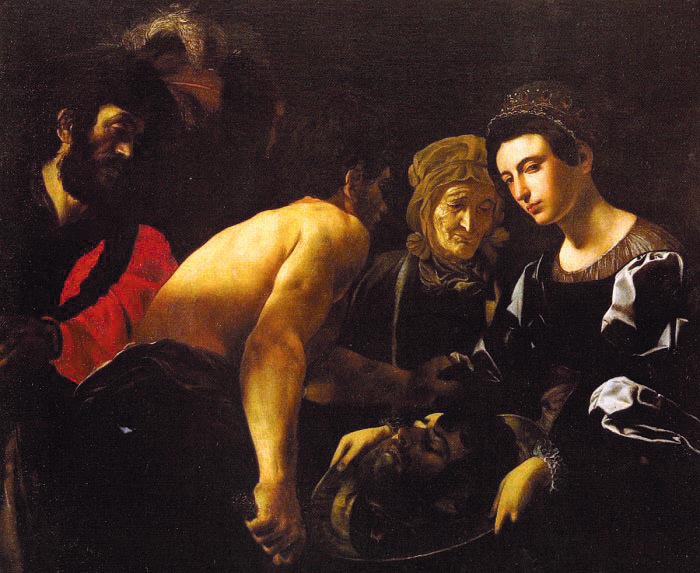
For Causa, Battistello’s Salomé con la testa di San Giovanni Battista sul piatto is the most important seventeenth-century Neapolitan painting preserved in Florence. Its status, however, was not always secure. Once treated as anonymous in the Uffizi, it was restored to Battistello by Hermann Voss in 1927, and then consolidated in the modern literature through Evelina Borea’s 1970 Florentine catalogue Caravaggio e caravaggeschi nelle gallerie di Firenze and the 1991 Naples exhibition catalogue Battistello Caracciolo e il primo naturalismo a Napoli, curated by Ferdinando Bologna. Causa describes Salomé’s gaze as the painting’s “hook”: she arrests the viewer with a face of pitiless, polished smoothness. He also sets the Uffizi canvas beside another Salomé by Battistello, now in a Neapolitan private collection, suggesting that the two works, if hung together, would form a small exhibition in themselves.
The two Salomé paintings also help to clarify the artistic world in which Causa places Battistello during the second decade of the century. This was not a simple movement from Naples to Florence, or from Caravaggio to one local follower. It was a more complicated exchange between several centres: the Rome of Orazio Gentileschi and Antiveduto Gramatica, a Naples newly altered by Ribera’s arrival, and a Tuscan setting into which Caravaggesque painting had begun to intrude, not least through Battistello himself. The dating of the Uffizi picture has therefore varied slightly. Older catalogue records tend to place it around 1618, often in relation to Battistello’s brief stay at the grand-ducal court; the Zeri catalogue gives 1614–1618, while Causa’s more recent chronology broadens the range to c. 1615–1620. That broader dating is useful because it prevents the Uffizi Salomé from being treated simply as a product of Battistello’s Florentine stay. It allows the painting to be seen instead within a longer phase in which he was reworking Caravaggio’s late inventions while responding to artistic pressures from Rome, Naples and Tuscany.
The painting’s early Florentine history strengthens its significance. Elena Fumagalli discovered a mention of Caracciolo’s painting, under another title, in the 1638 inventory of Palazzo Pitti, where it was recorded in a room of the apartment of the young Prince Leopoldo de’ Medici, already an attentive collector. Fumagalli also suggested that the painting may have come from the inheritance of Cardinal Francesco Maria del Monte, who died in 1627. These archival discoveries establish a terminus ante quem and give the painting a secure early place in the Florentine reception of Neapolitan Caravaggism. For Causa, however, the style of the work itself argues for a date in the later 1610s: it is a high point of mature Caravaggism, and one that was recognised as such by the twentieth-century rediscoverers of the Seicento, from Voss to Longhi and his circle.
The starting point is Caravaggio’s Madrid Salomé: the compact group of figures, the dark and indeterminate interior, and the violent subject compressed into a half-length scene. Battistello preserves the basic arrangement of a small group of figures enclosed in an undefined room, but he sharpens the formula in his own way. The figures are pressed close to the front of the canvas, so that the viewer is not allowed the safe distance of historical narrative. Salomé, the old woman, the ruffian and the severed head of the Baptist form a group in which looking, receiving and presenting become part of the same disturbing action. Causa gives particular importance to the figure of the scherano, or ruffian, who animates what might otherwise be a constraining scheme. He seems to have entered the scene like a set photographer adjusting a pose: an illusionistic device that Causa links to the solution Battistello had already tried in the Disfida di Barletta in the Palazzo Reale.
Light entering from the left cuts through the dark tonality of the canvas and reveals the wine-red garment of the man in the feathered hat. Causa sees this figure as anticipating Mattia Preti, whose own Caravaggesque formation would be sharpened through works of this kind. The same light also brings out the still-life-like puffs of the young man’s sleeve, where Battistello’s virtuosity of surface enters into competition with Orazio Gentileschi, whom he had known in Rome around 1614. Gentileschi becomes, in Causa’s phrase, the painting’s true “guest in silk”: a presence felt above all in the polished handling of the fabrics. The result is a work in which brutality and elegance coexist: a scene of execution transformed into a theatre of glances, textiles, flesh and implicated spectatorship.
(Credit: Wikimedia Commons).
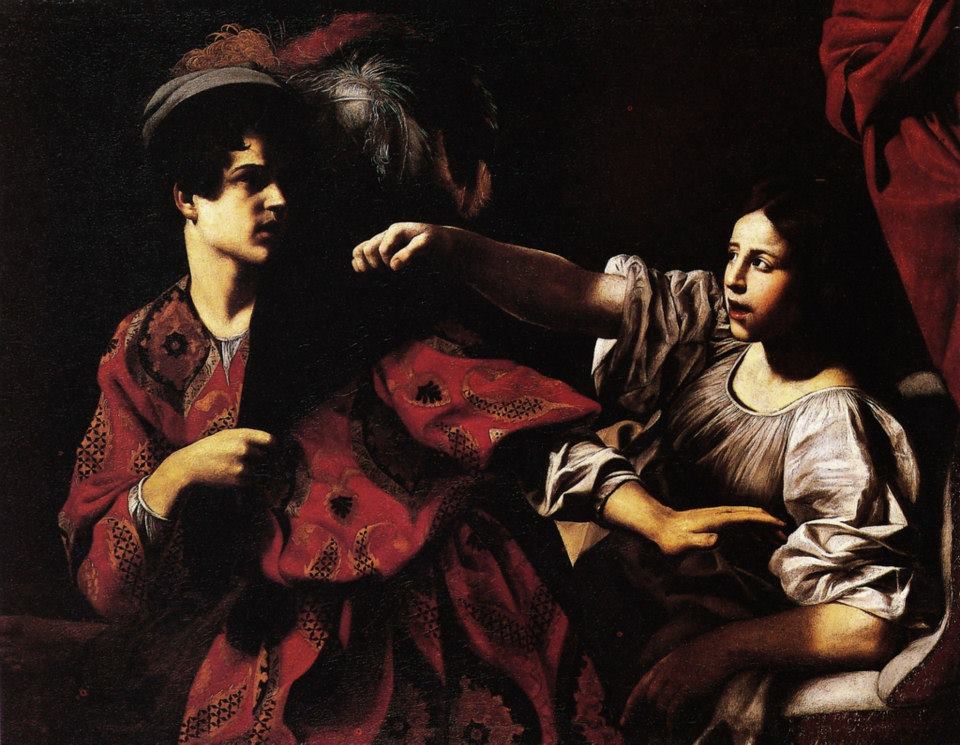
This powerful chamber painting, Giuseppe e la moglie di Putifarre, belongs to the group of early mature works in which Battistello turned biblical narrative into a close, psychologically strained encounter between half-length figures. The subject comes from Genesis 39: Joseph, resisting the attempted seduction of Potiphar’s wife, leaves his garment in her hand and is later falsely accused. Battistello concentrates the story into the instant of refusal. Joseph turns away, caught between withdrawal and alarm, while the woman’s outstretched arm and grasping gesture give the scene its dramatic impetus.
Nicola Spinosa justly connects the painting, on stylistic grounds, with works that document Battistello’s brief activity at the grand-ducal court in Florence in 1618, especially the Riposo durante la fuga in Egitto in the Cappella delle Reliquie, Palazzo Pitti. The comparison is useful because the Rau painting is not simply a stark Caravaggesque confrontation. Its dark ground, compressed space and abrupt moral drama still belong to Battistello’s naturalist formation, but the splendid fabrics, more elaborate pose and heightened elegance suggest the more refined language he absorbed during the Florentine interlude.
The painting appeared at Sotheby’s, London, in July 1988, without a stated provenance, and was later shown in the Battistello exhibition curated in Naples by Ferdinando Bologna, with the collaboration of Stefano Causa, in 1991–92. Spinosa also records that two related drawings have been connected with the painting, one in a private collection and the other in the Scuola Superiore di Belle Arti, Porto.
Causa further noted the painting’s importance for later artists. Its treatment of the subject influenced painters such as the still-anonymous Maestro di Fontanarosa, Pacecco de Rosa and Andrea Vaccaro, who returned to the same biblical episode in different ways and, at times, with fairly direct dependence on Battistello’s invention. That later reception is significant. It shows that Giuseppe e la moglie di Putifarre was not merely an isolated exercise in Caravaggesque drama, but a memorable composition within Neapolitan painting: a compact model for staging temptation, recoil and accusation through the tense choreography of bodies, hands and fabrics.
(Credit: Wikimedia Commons).
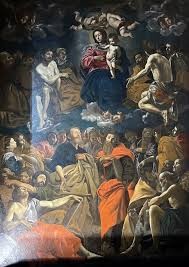
Battistello’s Madonna di Ognissanti, traditionally known as the Paradiso, is one of the most ambitious public altarpieces of his mature Caravaggesque phase. Painted in Naples in 1618–19 for the high altar of the Duomo of Stilo in Calabria, it translates the painter’s naturalist language into a vast devotional image of Paradise. The Virgin and Child preside over an assembly of saints, angels and holy figures arranged in two superimposed registers: the Church Triumphant above and the Church Militant below. As Nicola Spinosa notes, it is also the composition with the greatest number of figures that Battistello ever painted on canvas.
The attribution and dating of the painting were clarified only gradually. After having been treated in the early twentieth century as the work of an unknown Neapolitan artist, the altarpiece was first assigned to Battistello by Roberto Longhi in 1943. After a restoration carried out in 1976, it was thought to belong to a later moment in Battistello’s career, after the Lavanda dei piedi in the choir of the Certosa di San Martino, dated 1622. Payment documents discovered by Michael W. Stoughton later fixed its execution instead in 1618–19. These documents connect the commission to Tiberio Carnevale, a physician from Stilo, and record payments for the Madonna di Tutti i Santi in November 1618 and April 1619.
Carnevale was not merely a local donor. Born into a noble family in Stilo in 1574, he had achieved standing in Naples as a physician and moved in literary and philosophical circles, not least through his long association with his fellow Calabrian Tommaso Campanella. His relationship with Battistello seems to have been personal as well as professional: more than fifteen years later, in his will, the painter left a painting to Carnevale, described as his “patron and physician.” The Stilo altarpiece therefore speaks not only to local piety, but also to Carnevale’s wish to affirm his own prestige and that of his family, whose history had included involvement in the anti-Spanish conspiracy of 1599.
The painting occupies a crucial place in Battistello’s career. It was made after his activity in Genoa for Marcantonio Doria, including work on the now-lost fresco cycle of the Stories of Abraham for Doria’s casino at Sampierdarena, a project later completed by Orazio Gentileschi, and after his second stay in Florence at the Medici court. In this sense the Madonna di Ognissanti marks his return to Naples after important experiences beyond the city. It also stands at the threshold of the painter’s mature grande maniera: a broader, more monumental and more complex mode in which his Caravaggesque foundations are expanded by a fuller command of space, colour and pictorial orchestration.
The altarpiece is carefully organised without the help of architecture. Dense masses of cloud support the heavenly register, while the lower section gathers the saints into a crowded but controlled field of figures. At the centre of the upper register, Mary looks down while supporting the standing, blessing Child. Below, Peter and Paul occupy a commanding position as compositional and spiritual pillars, associated with the idea of Maria Chiesa — Mary understood as an image of the Church. Around them are the Evangelists, the Doctors of the Church, apostles, martyrs and female saints, only some of whom can be securely identified.
One of the lower register’s most compelling details is the open book held by Saint John, where the words In principio erat verbum give the image its doctrinal centre of gravity. Causa and Giuseppe Mantella emphasise the importance of this inscription, linking it to the painting’s Counter-Reformation meditation on the Incarnation. The text does not simply identify the Evangelist; it points from written word to divine presence. John’s upward glance, the mediating figure of the Baptist, and the blessing Child above create a visual movement from the Gospel text to the Word made flesh. The presence of Carlo Borromeo, identified after cleaning by his profile, aquiline nose and red dress, sharpens the post-Tridentine significance of the image. The work is not simply a crowded parade of sanctity; it is an altarpiece organised around Church, doctrine and intercession.
Stylistically, the painting shows Battistello moving beyond the taut, half-length dramas of his earlier Caravaggesque production. The figures retain his taste for strong physical presence and individualised heads, but the scale is more expansive, the lighting more varied, and the colour richer. The brown-earth tonal base is animated by reds, blues and yellows, sometimes of considerable brilliance, while the light gives weight and volume to flesh, drapery and cloud. Scholars have also pointed to Battistello’s study of Roman models, especially in the figures of Peter and Paul, which recall Aristotle and Plato in Raphael’s School of Athens. A drawing in the Uffizi, connected with the head of one of the saints in the lower right of the canvas, gives further evidence of his preparatory process.
What makes the Madonna di Ognissanti so important is this combination of documentation, scale and artistic transition. It is a securely dated work, tied to a named and intellectually sophisticated patron; it records Battistello’s return to Naples after Genoa and Florence; and it shows him adapting Caravaggesque naturalism to the demands of a large, learned and public altarpiece. Its complexity is not incidental, but neither is it merely recondite. The heavenly assembly, the Gospel inscription, the figure of Maria Chiesa, and the presence of Carlo Borromeo all serve to turn a devotional image of All Saints into a carefully structured and dramatic theological meditation.
(Credit: Wikimedia Commons).
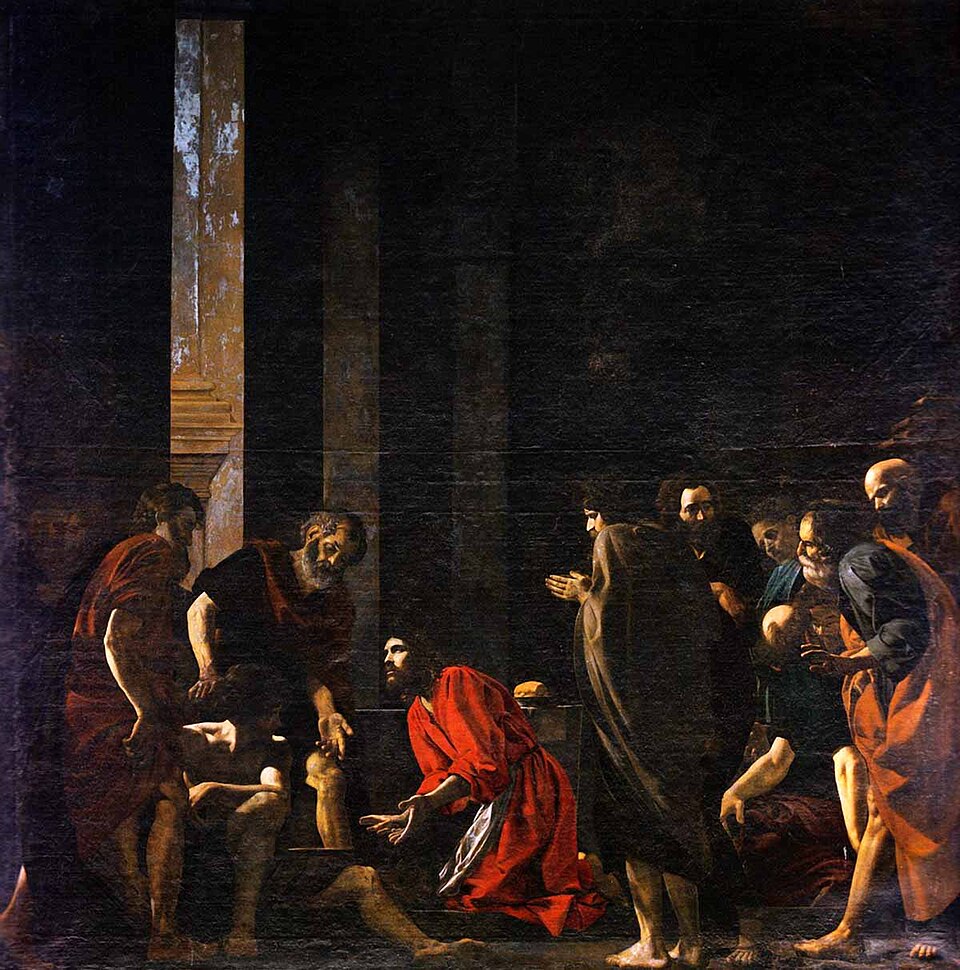
Painted in 1622 for the choir of the Certosa di San Martino, Battistello’s Lavanda dei piedi belongs to the great Eucharistic programme of the Carthusian church. The official San Martino/Capodimonte material describes the choir as the heart of the monastic complex, whose decoration developed from the 1589 commission to Cavalier d’Arpino for the vault frescoes to Ribera’s Comunione degli Apostoli of 1651. Stefano Pierguidi has likewise analysed the choir as a long-developing iconographic programme, only gradually brought into coherent form around the theme of the Eucharist. Within that setting, Battistello’s canvas was commissioned by the Carthusians in April 1622 and placed on the left wall of the choir in September of the same year.
The subject is taken from the Gospel of John: before the Last Supper, Christ kneels to wash the feet of his disciples, turning an act of physical service into an image of humility, purification and sacramental love. The San Martino/Capodimonte account describes the scene as set in a vast room immersed in smoky shadow, with Christ in a scarlet robe, girded by a white cloth, kneeling before the troubled Peter. Around them, the apostles respond through looks and gestures that register the dramatic importance of the act. The bread placed on the table behind Christ is therefore not a casual accessory, but an explicit Eucharistic sign, tying Battistello’s canvas to the larger programme of the choir.
Nicola Spinosa, following Raffaello Causa, treats the painting as one of the decisive works of seventeenth-century Neapolitan painting. Causa called it «il caposaldo di tutta la pittura del Seicento napoletano», and Spinosa explains the judgement by pointing to the sustained and sumptuous monumentality of the figures, which seem almost like sculptures cut out of stone by a light of Caravaggesque intensity. At the same time, Spinosa notes that the painting is not untouched by the example of Giovanni Lanfranco in Rome. That reference is important: by 1622 Battistello’s Caravaggism has become more spacious, monumental and deliberately constructed, absorbing Roman examples into a language that is no longer simply Caravaggesque.
Spinosa also warns that the painting is now considerably altered in its original colour and almost illegible in some details. Even so, he finds that it still preserves, beside the statuesque quality of the foreground figures, remarkable passages of what he calls natura in posa. This is important because it links Battistello not only to the monumental history painting of early Seicento Naples, but also to the formation of the Neapolitan still-life tradition. In Spinosa’s account, Battistello, like Sellitto, Ribera and Finson, could reach a very high level in the treatment of such object passages, well before Giacomo Recco and Luca Forte gave the genre its later independent development.
The canvas therefore gathers several of Battistello’s mature strengths into a single large composition: Caravaggesque light, sculptural figure construction, Romanising breadth, and a Neapolitan attention to the palpable physical presence of things. Its Eucharistic setting sharpens rather than reduces these qualities, since the naturalist handling of objects — above all the bread on the table — becomes part of the painting’s sacramental meaning.
(Credit: Wikimedia Commons).
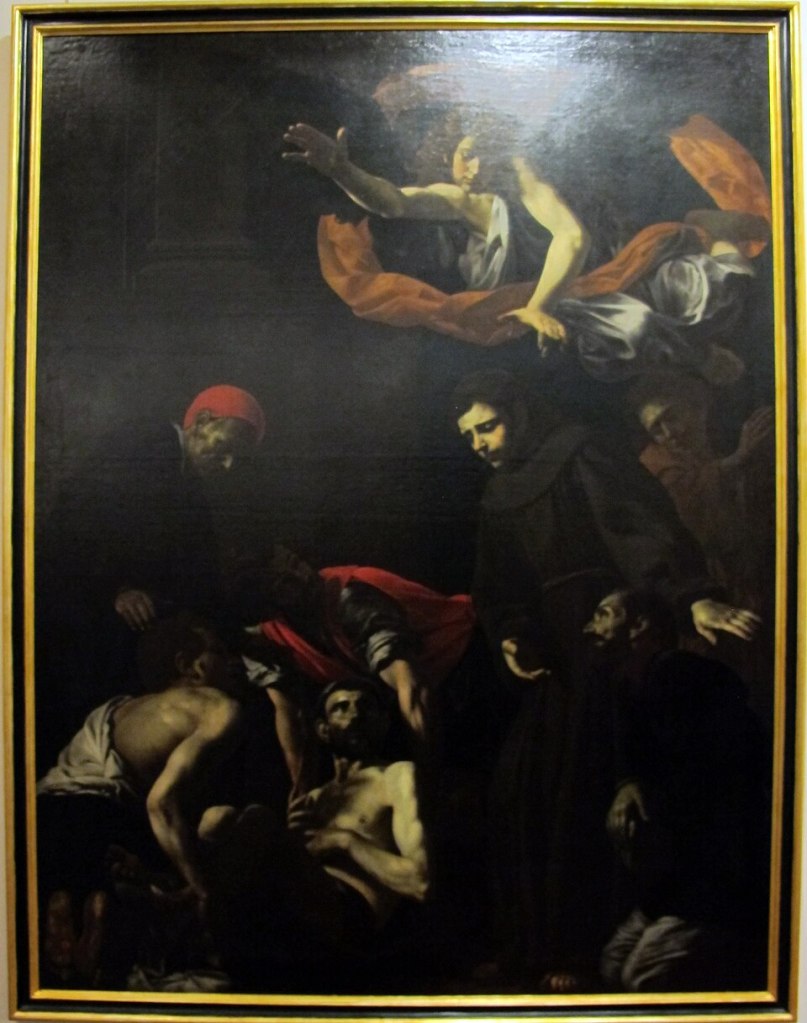
Battistello Caracciolo’s Miracolo di Sant’Antonio da Padova is a large altarpiece painted for San Giorgio dei Genovesi in Naples and now in the Museo e Real Bosco di Capodimonte. The subject is one of the miracles of Saint Anthony of Padua: the saint raises a murdered man from the dead so that he can testify to the innocence of his father, who has been wrongly accused of the killing. The accused father appears at the lower right, kneeling with his wrists bound. De Dominici later described the work at some length, though without great enthusiasm, as an altarpiece showing Saint Anthony’s miracle, with a small glory of angels above.
Spinosa clarifies the painting’s original position within San Giorgio dei Genovesi, the church of the Genoese community in Naples. Only from D’Afflitto’s guide of 1834 do the sources begin to record its exact location: the second altar on the left, in the Serra chapel, not counting the niche of the baptismal font. The earliest of the two inscriptions there is dated 1639 and belongs to the tomb-slab of Ottavio Serra, placed by his son Giovanni Battista. Some confusion over the altarpiece’s location arose because another work by Battistello, the now-lost Baptism of Christ with Angels, was also in the same church and had originally stood on the first altar to the right. Fondazione Zeri’s record likewise confirms the present Capodimonte painting as a deposit from San Giorgio dei Genovesi.
The dating of the Miracolo di Sant’Antonio da Padova has caused understandable difficulty, with proposals ranging from around 1607 to the early 1620s. At one end, the painting was once brought close to the period of the Liberation of Saint Peter; at the other, it has been associated with the moment of the Washing of the Feet, documented in 1622. Spinosa favours the later dating, especially in the light of comparisons with Battistello’s Madonna di Ognissanti for the church at Stilo, on which the artist was working in 1618 and for which the final payment was made the following year. Causa also dates the painting to the early 1620s and sees it as a severe masterpiece from Battistello’s mature phase, when the Caravaggesque system was beginning to loosen and recombine with fuller, more complex groupings and a more monumental handling of the altarpiece format.
For Causa, the recent possibility of examining the canvas in very close detail through Capodimonte’s digital resources has changed the way the picture can be understood. The painting’s making was anything but straightforward, and its difficult evolution remains visible in the pentimenti left on the surface, above all in the angel wrapped in drapery. That figure seems to bring together memories of Caravaggio and Curia, while also marking the point at which the final painting moved beyond the simpler structure preserved in the preparatory modello. Causa stresses the dense physical quality of Battistello’s handling: a synthetic, modelling brushwork which reminded Longhi not of Ribera, whose “lenticular” precision he disliked, but of the young Velázquez. If the chronology is accepted, this smoothness of touch can be followed through contemporary works shown in the exhibition, from the Longhi Trasporto di Cristo to the Cristo e la Maddalena at Prato, before reaching its culmination in the Lavanda in the choir of San Martino.
The wider context is important. Causa presents the Miracolo di Sant’Antonio da Padova as the work of a painter operating at a moment when mature Caravaggism was being reconfigured between Rome and Naples. Ribera’s rise in Naples from 1616, and the arrival of Simon Vouet’s Circumcision of 1622 for Sant’Arcangelo a Segno, helped redirect the attention of Neapolitan painters moving out of Caravaggism, above all Stanzione and Vaccaro. Battistello, however, also seems to be looking towards a major statement of the classical ideal: Domenichino’s Communion of Saint Jerome of 1611–14, painted in Rome for San Girolamo della Carità, and soon regarded as one of the normative achievements of modern religious painting.
The preparatory modello is central to both Spinosa’s and Causa’s account of the work. Usually dated to around 1620, the small canvas is catalogued in the 2022 Capodimonte exhibition as Miracolo di Sant’Antonio da Padova, oil on canvas, 44.5 × 33 cm, private collection, cat. 38. It differs from the final altarpiece in two significant respects: the angel in the upper part of the composition is absent, and Saint Anthony is not yet marked by a halo. B. T. D’Argaville suggested that the smaller work might be a contemporary, non-autograph copy made before the angel was added, but Spinosa rejects this, arguing that the bozzetto is unmistakably by Battistello and should be understood as a preparatory study. The differences between the two works are precisely what one would expect in a working modello rather than in a replica. Capodimonte’s later Battistello material similarly describes the bozzetto as autograph and specifically notes its lack of the upper section with the angelic apparition.
Spinosa’s comparison with Battistello’s Sorrento bozzetto, Sant’Ignazio in gloria e le opere dei Gesuiti, usually dated around 1629 and now in the Museo Correale, gives the argument a wider methodological point. A preparatory sketch does not have to correspond exactly to the completed work. The Sorrento bozzetto for the lost Carminello altarpiece apparently omits portraits of the church’s founder that are mentioned in descriptions of the final painting. By the same logic, the absence of the angel in the Miracolo di Sant’Antonio da Padova modello is not evidence against its autograph or preparatory status. It is one of the changes Battistello introduced between sketch and final altarpiece.
Nor, for Spinosa, should the angel in the completed painting be dismissed as a later addition on stylistic grounds. It appears to belong to the original painted surface and, more importantly, derives from an earlier and highly significant model: Caravaggio’s Seven Works of Mercy. Battistello reflects the two-tiered organisation of Caravaggio’s composition, with a supernatural upper zone set above the dense human action below. Although his angel is physiognomically distinct, and is characterised as individually as the figures beneath him, the downward extension of the right arm and open hand repeats a corresponding detail in Caravaggio’s painting. The angel is also wrapped in a magnificent sweep of drapery, whose curving movement likewise depends on the Caravaggesque model. The absence of the angel in the modello therefore does not make the study suspect, and the angel in the final painting is not an afterthought. It is central to the way Battistello builds the altarpiece out of Caravaggio’s precedent, translating its vertical division between earthly action and heavenly apparition into his own miracle scene.
Causa also notes a partial copy of the Miracolo di Sant’Antonio da Padova, formerly on loan from Capodimonte to the Museo del Sannio in Benevento and now in the Capodimonte deposits. This version lacks the upper section with the angel and is slightly extended on the left. The copy belongs to the later reception of Battistello’s altarpiece from San Giorgio dei Genovesi, a work Causa treats as a significant turning point in the Neapolitan painting of the 1620s. It is also relevant to the circle of the artist first isolated by scholarship in 1991 under the conventional name Maestro di Fontanarosa, and now commonly associated with Giuseppe Di Guido, a Neapolitan painter usually dated, with caution, to around 1590 and active in the first half of the seventeenth century. The copy therefore belongs to the painting’s afterlife, whereas the autograph modello belongs to the earlier process by which Battistello arrived at the final composition.
The modello and the completed painting had already been brought together in the section devoted to Caracciolo in Ferdinando Bologna’s exhibition on Neapolitan naturalism. Their comparison served not only to reaffirm the autograph status of the modello, which had at times been questioned, but also to resist a more negative reading of it. Its sketch-like character should not be taken as exposing some underlying Mannerist scaffolding, or as evidence of a decisive retreat from Battistello’s naturalist phase. On the contrary, it belongs to the disciplined preparatory life of the San Giorgio dei Genovesi altarpiece and helps clarify how Battistello arrived at the more explicitly miraculous structure of the finished work.
Without this disciplined use of the modello, Battistello could hardly have reinterpreted, in his own terms, so commanding a precedent as Domenichino’s rapidly canonical Communion of Saint Jerome (1611–14). More broadly, as Causa suggests, the history of the bozzetto in Naples — from Battistello to Stanzione and Vaccaro, and even to talented lesser figures such as Agostino Beltrano — offers a valuable index of the working practice of local masters. The Miracolo di Sant’Antonio da Padova therefore stands not only as a major altarpiece of Battistello’s maturity, but also as a document of invention: a work in which Caravaggesque structure, classical ambition, local devotional setting and the concrete procedures of the studio all remain visible.
(Credit: Wikimedia Commons).
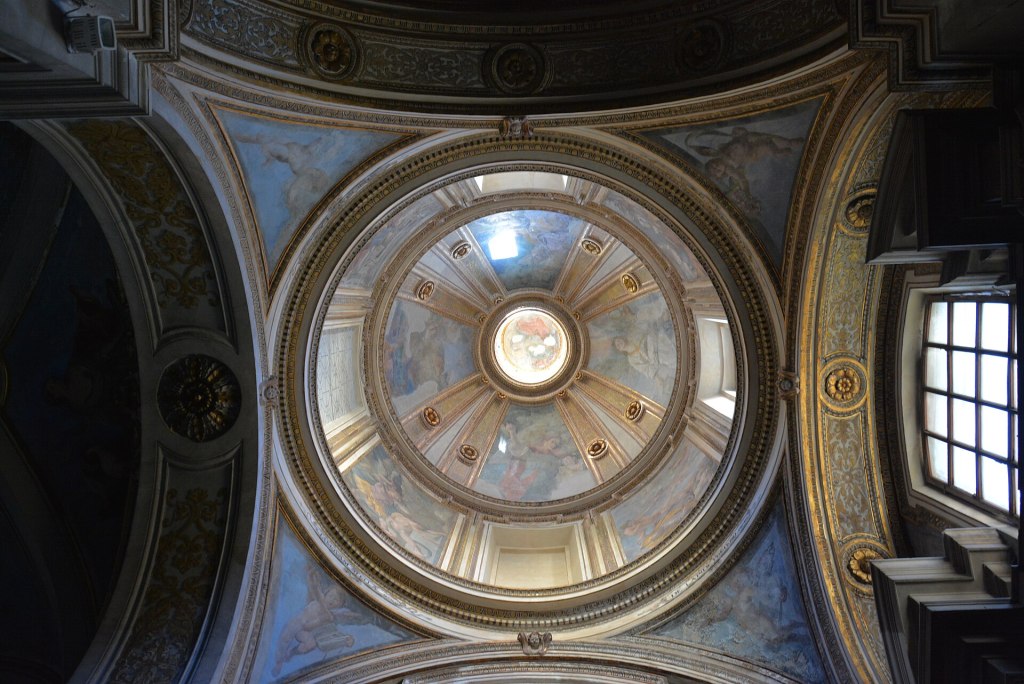
Battistello’s frescoes in the Cappella Sanseverino at Santa Maria la Nova belong to a less familiar but important phase of his career, when the intense Caravaggism of his earlier canvases was being drawn into more open, decorative and architectural settings. The cycle, usually described as the Storie di san Michele Arcangelo e corolle di putti, is documented between 1622 and 1625 and should be understood as a chapel decoration rather than as a single isolated work. Its subject centres on the Archangel Michael, but its effect also depends on the angelic figures and clusters of putti placed high in the chapel’s structure.
For Stefano Causa, this is one of the lesser-known trials of Battistello’s “outgoing” Caravaggism. That phrase is useful: the frescoes do not abandon the physical gravity, sharpened contour and dramatic habits associated with his earlier work, but they translate them into a brighter and more dispersed decorative language. In Santa Maria la Nova, Battistello appears not simply as a follower of Caravaggio, but as a painter negotiating between naturalistic force, fresco practice and the demands of a complex chapel ensemble. The result is a useful reminder that his career was not confined to concentrated oil paintings, but also extended into the public, architectural and devotional language of mural decoration.
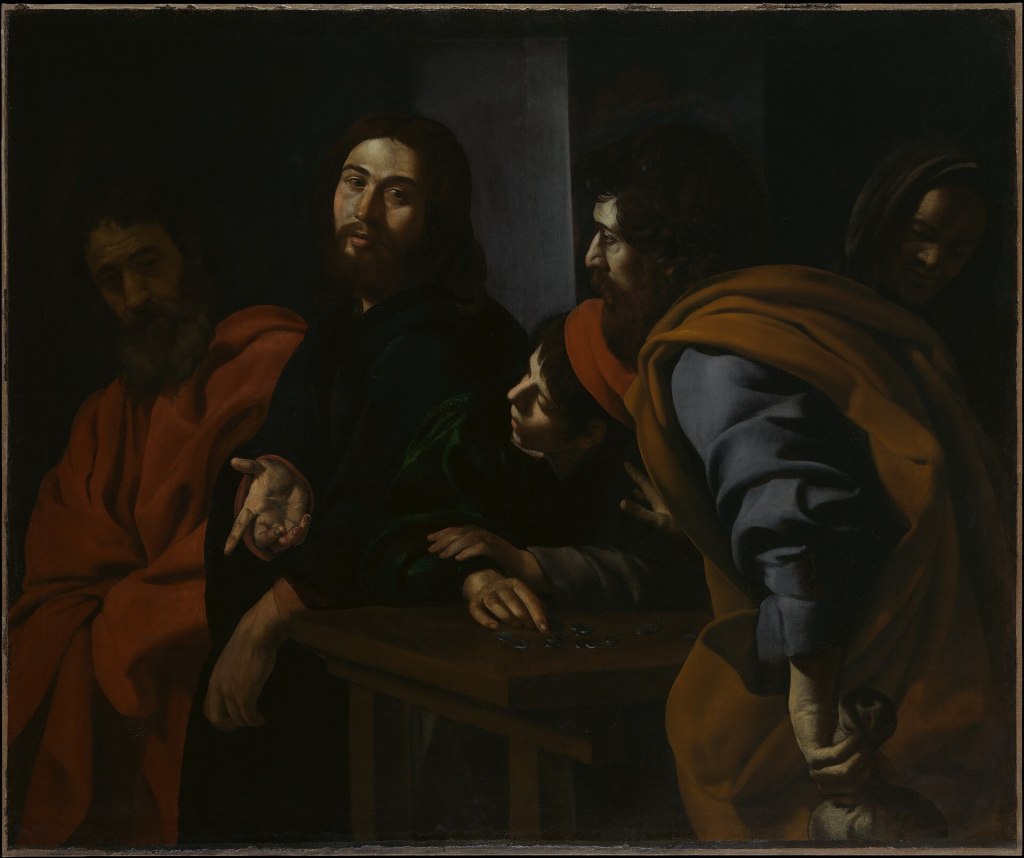
(Credit: Wikipedia).
Formerly identified as the Vocazione di san Matteo, or The Calling of Saint Matthew, this painting has also been more cautiously understood as a broader Predica di Cristo ai discepoli. In the account given by Nicola Spinosa, the revised title allows the subject to be connected not only with the calling of Matthew, or Levi, son of Alphaeus, but with several passages in the Gospels of Matthew and Luke in which Christ warns his followers against the spiritual danger of money. The old title is therefore not simply wrong, since the painting still turns on the tension between Christ’s summons and worldly attachment, but the alternative identification gives the scene a more allusive and meditative character.
That moral pressure is concentrated in the apostle in the foreground at the right, who carries a small bag of coins in his left hand with visible embarrassment. The Met’s own reading of the picture usefully stresses the placement of this money bag at the very front of the canvas, almost within the viewer’s reach. The choice offered to Matthew, whether to follow Christ or cling to wealth, is therefore turned outward towards the spectator. Battistello uses a Caravaggesque half-length format not simply to dramatise recognition, but to create a moment of ethical pressure.
The painting was originally in the Doria collection in Genoa, later in the Arenberg collection in Brussels, and then in a private collection in Germany, before passing through Matthiesen Gallery, London, and several subsequent collections and dealerships. It entered the Metropolitan Museum of Art, New York, in 2016. Published by Ferdinando Bologna in 1993, it was dated by him to after 1625 and closer to 1630. Spinosa confirms its place in this phase of Battistello’s activity, noting its affinities with works of the same period, especially in the monumental treatment of individual figures wrapped in large, flowing draperies. Comparisons have been made with the Giudizio di Salomone in the Serlupi collection, Florence, and above all with the Madonna and Child with Saint Anne in the Kunsthistorisches Museum, Vienna, both in Stefano Causa’s monograph and in Wolfgang Prohaska’s catalogue entry for Ritorno al Barocco. Da Caravaggio a Vanvitelli, Naples, 2009, cat. 1.2.
Seen in this way, the painting belongs to Battistello’s later Caravaggesque language rather than to the more abrupt naturalism of his earlier work. The figures are still close, cropped and morally immediate, but their scale, draperies and slower rhythm give the scene a more monumental gravity. Christ’s gesture, the apostle’s uneasy possession of the purse, and the sharply foregrounded bag of money together make the painting less a simple narrative of vocation than a meditation on renunciation, embarrassment and the difficulty of release from worldly things.
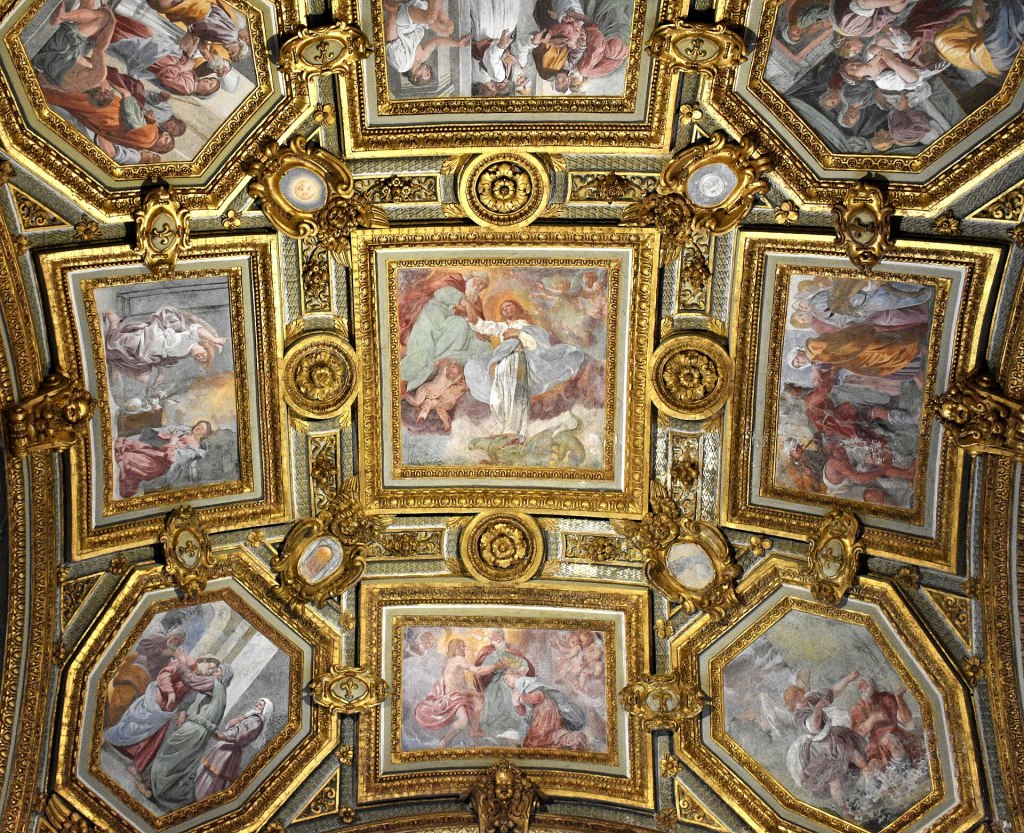
Decorazioni e dipinti per la Certosa di San Martino, c. 1622–35; oil on canvas and fresco; Certosa e Museo di San Martino, Naples.
(Credits: Wikimedia Commons).
Battistello’s work for the Certosa di San Martino was not a single commission but a sustained relationship with one of the most important religious complexes in seventeenth-century Naples. Beginning with the great Lavanda dei piedi of 1622, treated separately here, his activity at the Certosa extended across more than a decade and included both large canvases and fresco decoration. Among the principal works were the paintings for the Sala del Capitolo, including the Adorazione dei Magi, San Giovanni Battista and San Martino, followed by later interventions in the chapels of the Assumption and of San Gennaro.
The importance of San Martino lies partly in the way it shows Battistello moving beyond the concentrated Caravaggesque idiom of his earlier years. The drama of light and shade, the weight of bodies and the gravity of gesture remain central to his language, but they are increasingly adapted to more expansive, architectural and devotional settings. In the Sala del Capitolo and the chapel decorations, the figures are no longer pressed into the kind of close, dark space associated with his most intense early paintings. They belong instead to a broader decorative field, in which colour, movement, drapery, putti and the surrounding architecture all help to organise the religious meaning of the ensemble.
Stefano Causa treats this later phase of Battistello’s career as a crucial complication of the usual Caravaggesque label. At San Martino, the painter is still marked by Caravaggio’s lessons, but he is also responding to other pressures: the monumental demands of fresco, the ceremonial dignity of Carthusian devotion, the prestige of large-scale chapel decoration, and the more classicising or luminous examples offered by painters such as Domenichino, Guido Reni and Lanfranco. The outcome is not a rejection of Caravaggism, but its transformation. Battistello’s art becomes more open, more spatially ambitious and more decorative, while retaining the physical seriousness that gives his figures their authority.
Taken together, the San Martino works show Battistello at full maturity. They are especially useful because they prevent him from being reduced to a painter of dark, dramatic canvases. At the Certosa he appears as a painter able to work across media and scale: in oil and fresco, in single images and larger programmes, in intimate narrative scenes and public devotional spaces. San Martino therefore offers one of the clearest views of Battistello’s later ambition, where the inheritance of Caravaggio is absorbed into the richer, more various language of Neapolitan Baroque decoration.
[Producing these essays requires care, time, research, and resources. Contributions to help sustain this exploration would be greatly appreciated.]
https://donorbox.org/inner-surfaces-resonances-in-art-and-literature-837503
Bibliography
I have relied on the following publications, but any errors are mine.
Abbate, Francesco, ‘Corenzio, Belisario’, in Dizionario Biografico degli Italiani, vol. XXIX, Rome, 1983.
Bologna, Ferdinando, ed., Battistello Caracciolo e il primo naturalismo a Napoli, exhibition catalogue, Naples, Electa Napoli, 1991.
Borea, Evelina, ed., Caravaggio e caravaggeschi nelle gallerie di Firenze, exhibition catalogue, Florence, Palazzo Pitti, summer 1970, Florence, Sansoni, 1970.
Cassani, Silvia, ed., Civiltà del Seicento a Napoli, exhibition catalogue, 2 vols., Naples, Electa Napoli, 1984.
Causa, Stefano, Battistello Caracciolo: l’opera completa, Naples, Electa Napoli, 2000.
Causa, Stefano, “Notizia di un nuovo Battistello,” Kronos, 11, 2007, pp. 79–84.
Causa, Stefano, “Battistello (Giovanni Battista Caracciolo) (Napoli 1578–1635),” in Alessandro Zuccari, ed., I caravaggeschi: percorsi e protagonisti, vol. 2, Milan, Skira, 2010, pp. 307–316.
Causa, Stefano, “Naturalismo deciduo. Un racconto di Battistello Caracciolo (1578–1635),” in Stefano Causa, ed., Il patriarca bronzeo dei caravaggeschi: Battistello Caracciolo (1578–1635), exhibition catalogue, Rome and Naples, Editori Paparo, 2022, pp. 71–94.
Causa, Stefano, ed., Il patriarca bronzeo dei caravaggeschi: Battistello Caracciolo (1578–1635), exhibition catalogue, Rome and Naples, Editori Paparo, 2022.
Causa Picone, Marina, “Giunte a Battistello: appunti per una storia critica di Battistello disegnatore,” Paragone Arte, XLIV, nos. 519–521, 1993, pp. 24–87.
Cerasuolo, Angela, “Indagini su tre dipinti di Battistello: appunti per uno studio in itinere,” in Stefano Causa, ed., Il patriarca bronzeo dei caravaggeschi: Battistello Caracciolo (1578–1635), exhibition catalogue, Rome and Naples, Editori Paparo, 2022, pp. 111–117.
Di Majo, Ippolita, “Tra Francesco Curia e Battistello Caracciolo: disegni della collezione Tessin a Stoccolma,” Prospettiva, nos. 95–96, 1999, pp. 182–194.
Fumagalli, Elena, ed., «Filosofico umore» e «maravigliosa speditezza»: pittura napoletana del Seicento dalle collezioni medicee, exhibition catalogue, Florence, Giunti, 2007.
Leone, Giorgio, “La Madonna col Bambino in gloria di Battistello del Museo Provinciale di Catanzaro: nuove riflessioni,” in Maria Giulia Aurigemma, ed., Dal Razionalismo al Rinascimento: per i quaranta anni di studi di Silvia Danesi Squarzina, Rome, Campisano Editore, 2011, pp. 248–253.
Longhi, Roberto, “Battistello,” L’Arte, XVIII, 1915, pp. 58–75, 130–137.
Pacelli, Vincenzo, “New Documents concerning Caravaggio in Naples,” The Burlington Magazine, CXIX, no. 897, December 1977, pp. 819–827, 829.
Pacelli, Vincenzo, “Caracciolo Studies,” The Burlington Magazine, CXX, no. 905, August 1978, pp. 493–497, 499.
Porzio, Giuseppe, Pittura a Napoli intorno a Caravaggio. 1606–1610, Naples, artem, 2026.
Pugliese Carratelli, Giovanni, ed., Storia e civiltà della Campania, vol. 3, Il Rinascimento e l’età barocca, Naples, Electa Napoli, 1994.
Russo, Augusto, “Sulla prima ora del caravaggismo a Napoli,” in Maria Cristina Terzaghi, ed., Caravaggio Napoli, Milan, Electa, 2019, pp. 80–91.
Spinosa, Nicola, Pittura del Seicento a Napoli: da Caravaggio a Massimo Stanzione, Naples, Arte’m, 2010.
Stoughton, Michael W., “Giovanni Battista Caracciolo: New Biographical Documents,” The Burlington Magazine, CXX, no. 901, April 1978, pp. 204, 206–213, 215.
Terzaghi, Maria Cristina, ed., Caravaggio Napoli, exhibition catalogue, Milan, Electa, 2019.
Whitfield, Clovis, and Jane Martineau, eds., Painting in Naples 1606–1705: From Caravaggio to Giordano, exhibition catalogue, London, Royal Academy of Arts in association with Weidenfeld and Nicolson, 1982.
Zuccari, Alessandro, ed., I caravaggeschi: percorsi e protagonisti, 2 vols., Milan, Skira, 2010.
 Inner Surfaces