Part Two: Ribera, Lanfranco, and the Wider Neapolitan Field
That darker current was associated above all with Ribera. His arrival in Naples around 1616 did not simply displace Caravaggio, but changed both the character and the reach of the local naturalist tradition. Causa’s distinction between the two painters is less a judgement of artistic greatness than of historical effect. The late Caravaggio appears, in this account, as a kind of terminal intensity, so stripped, radical and singular that his example could be followed only with difficulty. Ribera, by contrast, offered a heightened, corporeal and materially insistent language that other painters could more readily adopt and develop. In his wake, Neapolitan naturalism acquired a greater physical weight, a richer sense of texture and a denser handling of paint. Yet the very breadth of Ribera’s influence carried its own risk: his authority could make the later tradition appear more uniformly concerned with the physical presence of the body and the expressive handling of paint than it really was.
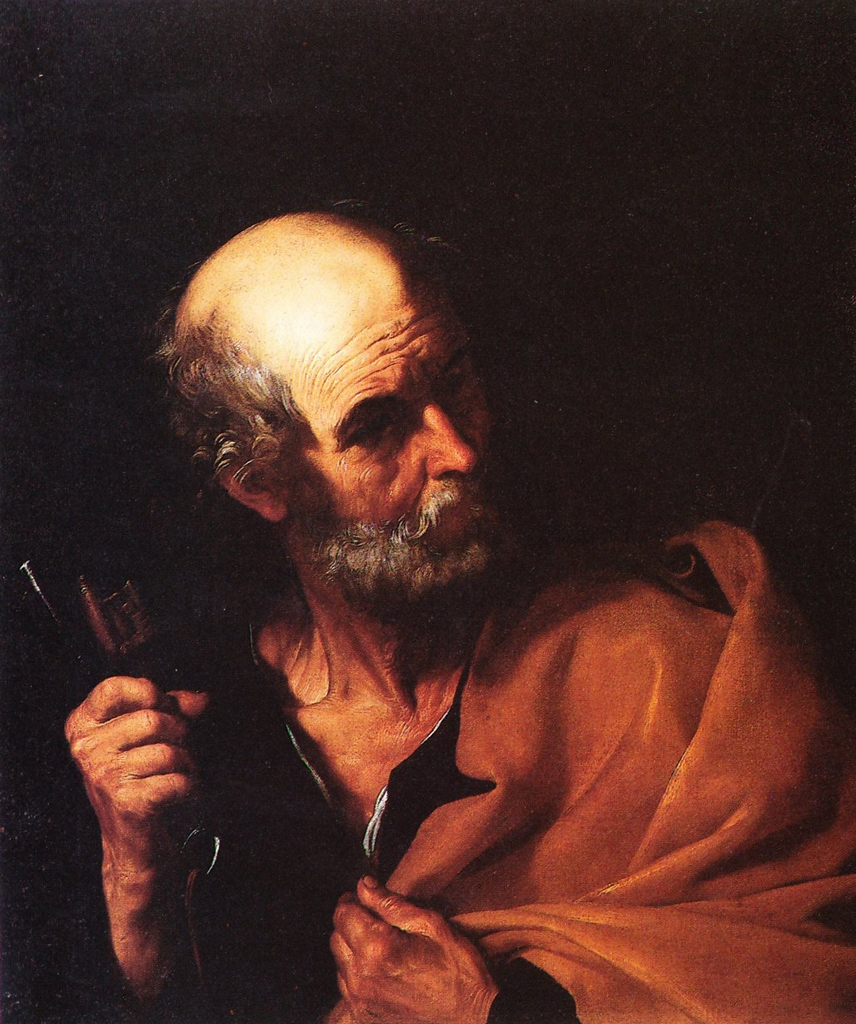
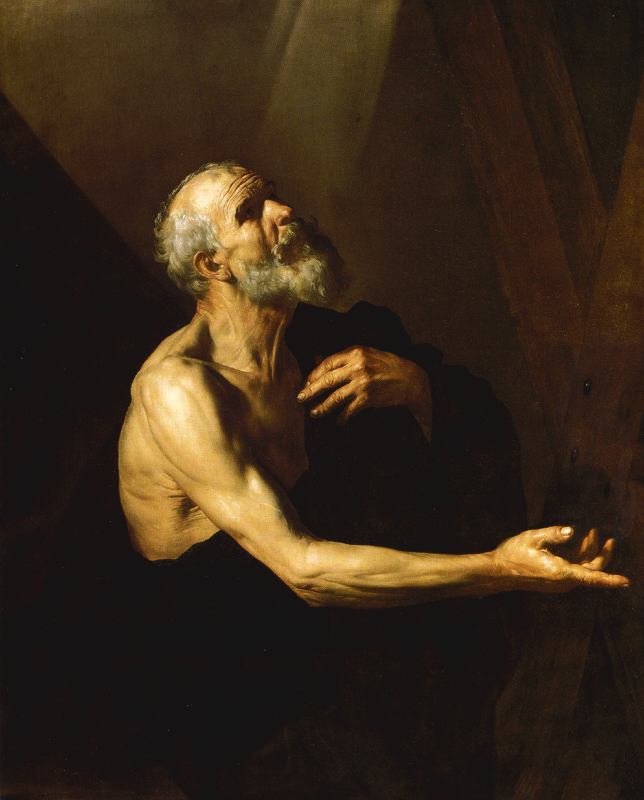
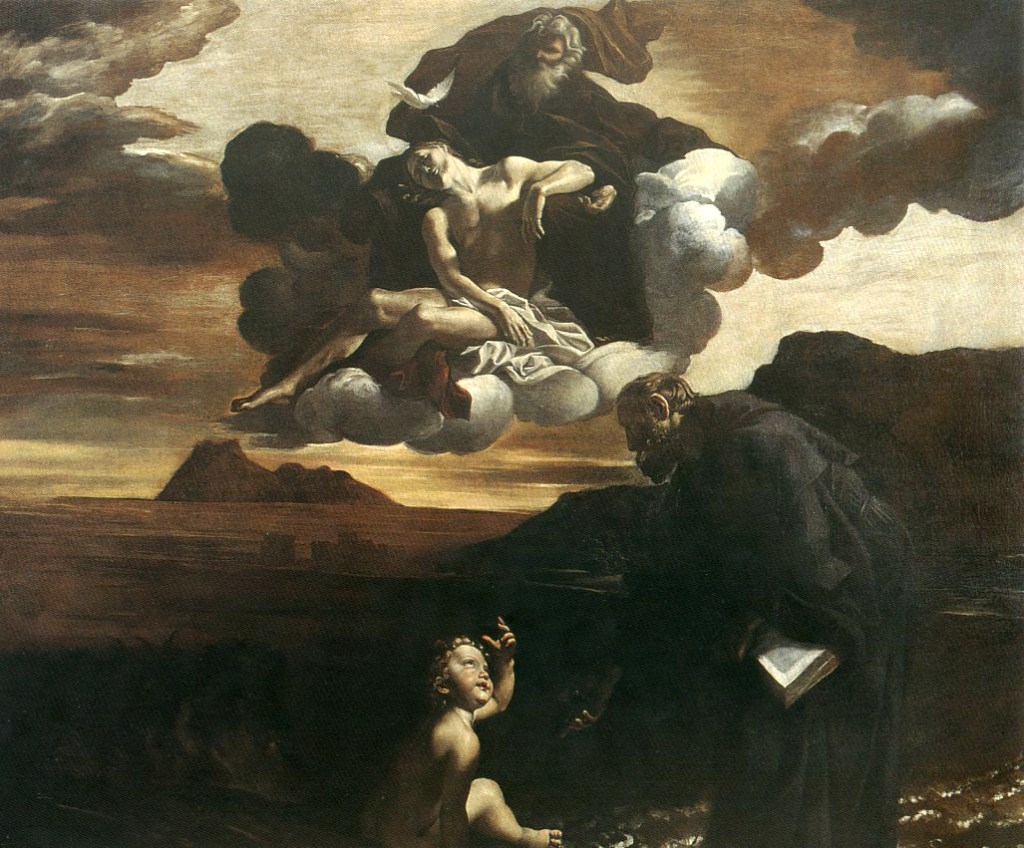
Battistello was among the first to respond to this change. Causa measures the shift by placing two altarpieces side by side: the Liberazione di san Pietro dal carcere, painted in 1615 for the Pio Monte della Misericordia, and the Trinitas terrestris, commissioned in 1617 by Sebastiano and Santolo Manso for the chapel of San Giuseppe at Santa Maria Incoronatella della Pietà dei Turchini. The Liberazione still belongs to the moment of Caravaggio mediated through Raphael and Gentileschi. The Trinitas terrestris, by contrast, already registers the impact of Ribera’s arrival. It remains dark and turbulent, with Caravaggesque echoes in the arrangement of the angels above, but its decisive novelty appears in the head of Saint Joseph. Here Battistello moves away from some of his earlier synthetic simplification and attends more closely to the texture and surface of aged flesh.
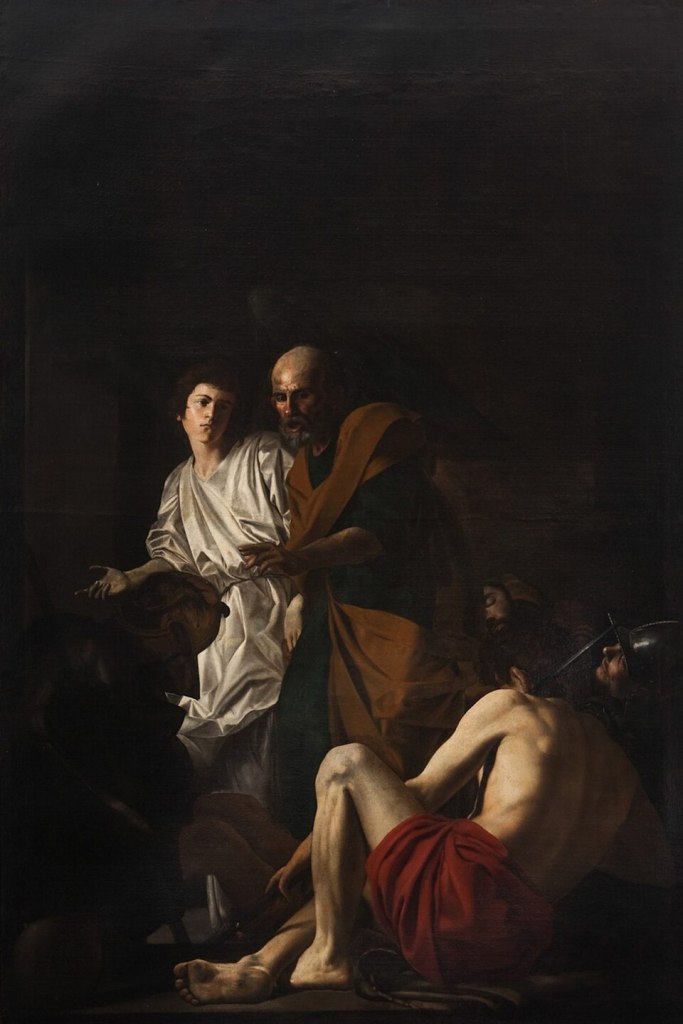
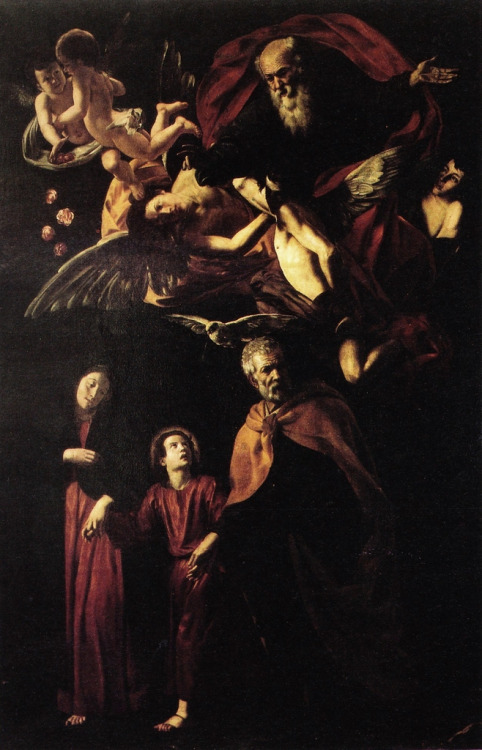
(Credit: Wikimedia Commons).
The head of Saint Joseph in the Trinitas terrestris seems specifically related to Ribera’s San Pietro in the Quadreria dei Girolamini. Causa also measures Battistello’s stylistic shift against Ribera’s three-quarter-length Sant’Andrea and the surviving apostle paintings in the same collection. Seen in relation to these works, the Trinitas terrestris reveals a denser and more tactile naturalism: roughened skin, the grave head of an old man, and paint handled with greater material emphasis. Ribera does not replace Caravaggio so much as modify Battistello’s Caravaggism from within, giving it greater weight, age and physical presence.
(Credit: Wikipedia).
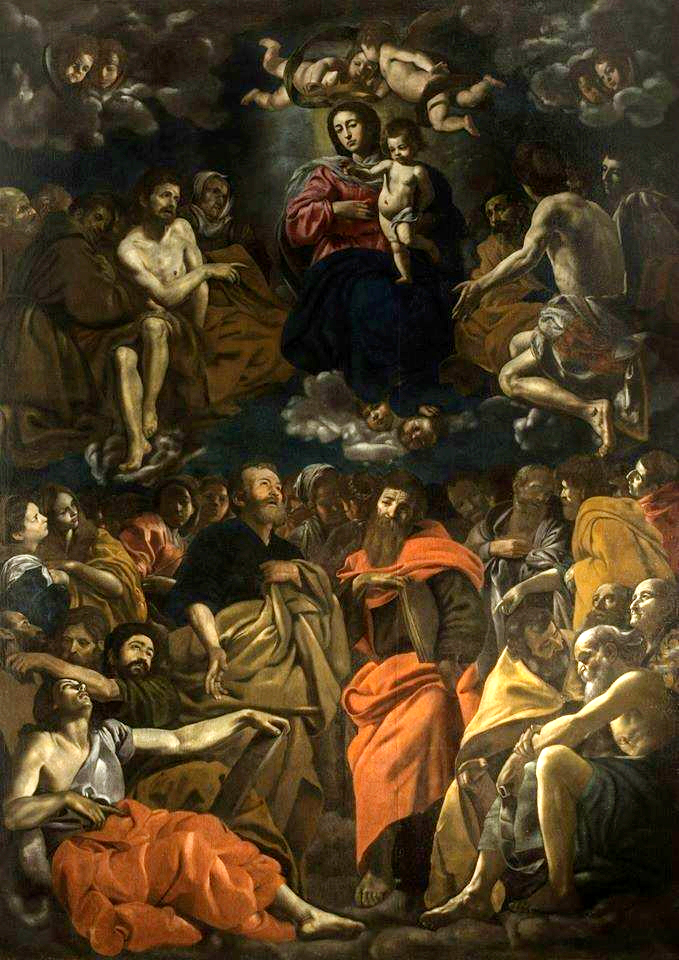
The same influence extends to the large Madonna di Ognissanti, or Madonna col Bambino e santi, made for Stilo in Calabria and usually dated at around 1618–19. In Causa’s reading, its crowded company of saints belongs to the same recalibration as the Trinitas Terrestris. Here too, the silvery control of the Liberazione has given way to a denser, more tactile and more emphatic sacred vision. This is no longer Battistello simply domesticating Caravaggio. It is Battistello registering the force of Ribera’s example, a pictorial language powerful enough to alter the terms of Neapolitan naturalism. The Stilo altarpiece is also significant because it carries that development beyond Naples itself, showing how Battistello’s Riberesque turn could take shape within the wider artistic geography of the southern kingdom.
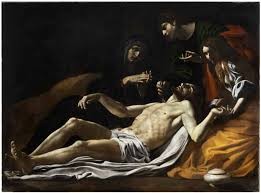
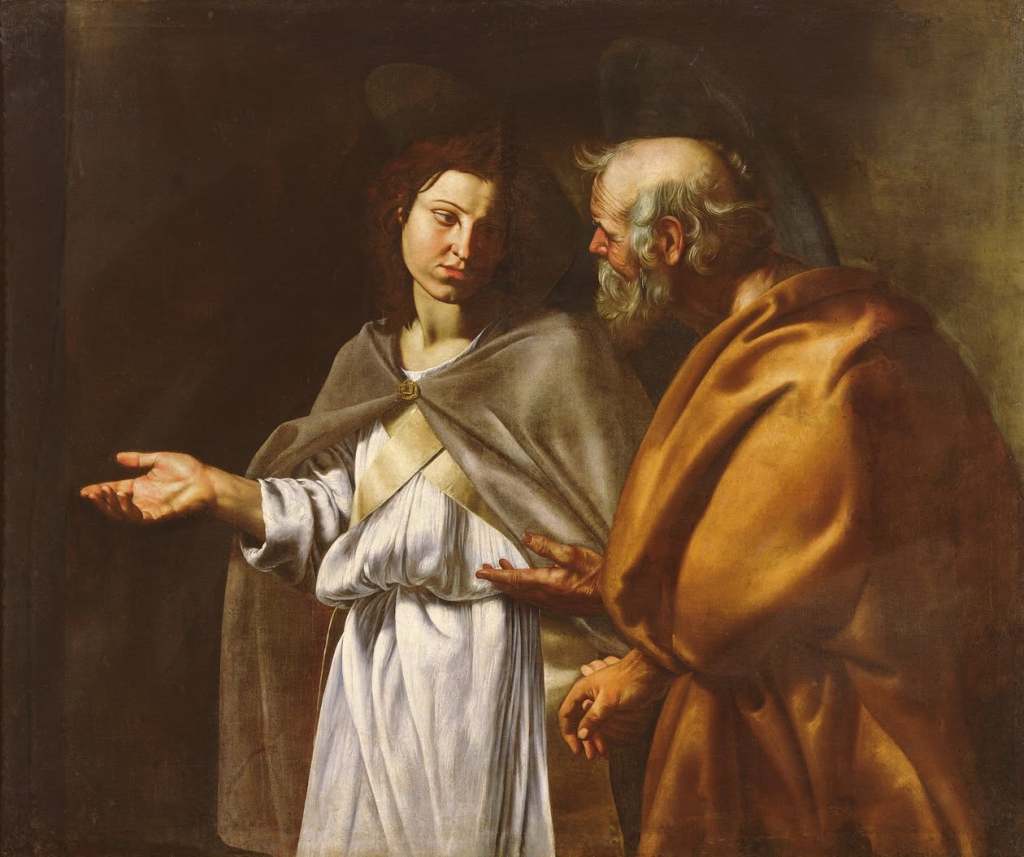
The Compianto sul Cristo morto at Baranello belongs to the same unsettled moment. Its location in Molise has probably contributed to its relative marginality in accounts of Battistello, while its title has also varied. It has sometimes been called a Deposizione, but since no cross is shown, it is more accurately described as a Compianto or Pietà, with the dead Christ lying on a sheet among the Virgin, Saint John and the Magdalene, all emerging from darkness. The painting was once associated with Annibale Carracci, and that earlier attribution is understandable, since older sixteenth-century and Carraccesque structures remain visible. Causa’s point, however, is that the energising force is now Ribera: a heavier surface, stronger contrasts and a more insistent physicality. The picture becomes a hinge work, still tied to an inherited devotional composition but driven by a darker and more material naturalism.
(Credits: Restituzioni and Ars Europa).
Causa also adds an important caution. Battistello’s response to Ribera should not be imagined as a simple one-way transmission from the Spanish master to the Neapolitan painter. The local field was more densely interactive than that. Filippo Vitale is especially important here. In his Liberazione di san Pietro dal carcere at Nantes, Vitale rethinks Battistello’s earlier version at the Pio Monte della Misericordia. He tightens the framing around the two protagonists, concentrating the scene’s dramatic urgency in their weathered faces and emphatic gestures, whose almost expressionistic force is heightened by a handling of paint rougher and less luminous than Battistello’s. Neapolitan naturalism in these years was therefore not merely the afterlife of Caravaggio or the triumph of Ribera. It was a local exchange in which painters sharpened, roughened and redirected one another’s solutions.
Russo’s account of Vitale helps further to define his place within this local exchange and the particular form of naturalism he represents in Naples during the later 1610s. Here Vitale belongs to the same early Caravaggesque generation as Battistello, but his realism has a different intensity. The main fixed points in his early career are the ceiling of the Annunziata at Capua, on which he worked between 1617 and 1619, and the Santi Gennaro, Niccolò di Bari e Severo, dated 1618 and now at Capodimonte. Together, they reveal a painter drawn to a dense, unsmoothed bodily presence. In works such as the Martirio di San Sebastiano, the Santo Stefano condotto al martirio, the Sacrificio d’Isacco at Capodimonte, and related half-length figure groups, Vitale avoids complex architectural space and tightens the picture around the bodies themselves. Russo’s description suggests a concentration on a plane of truthfulness: the image does not open out into elaborated space, but closes in upon the immediate physical reality of the figures.
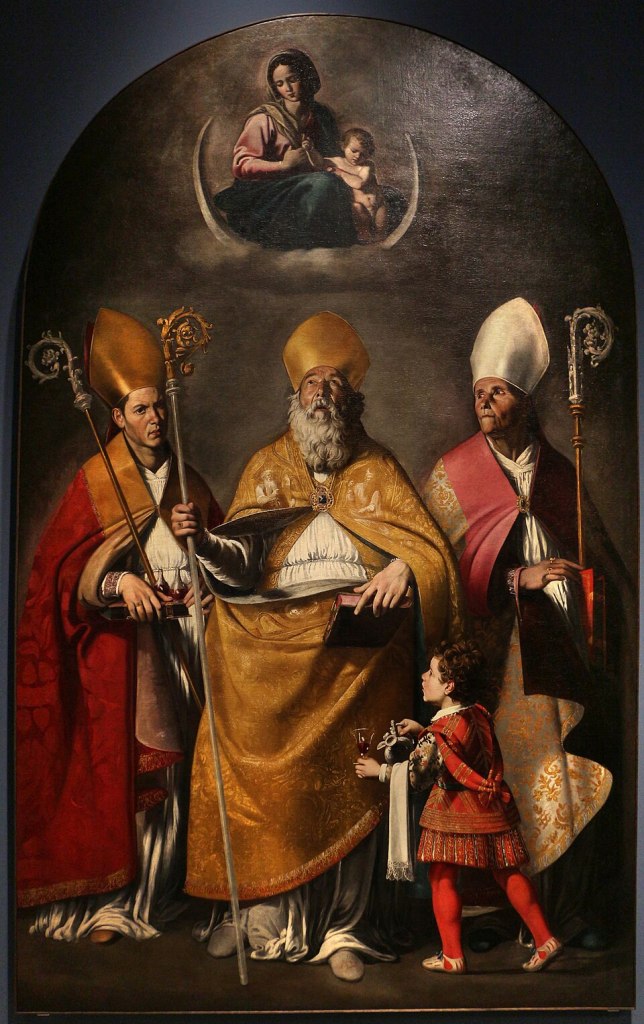
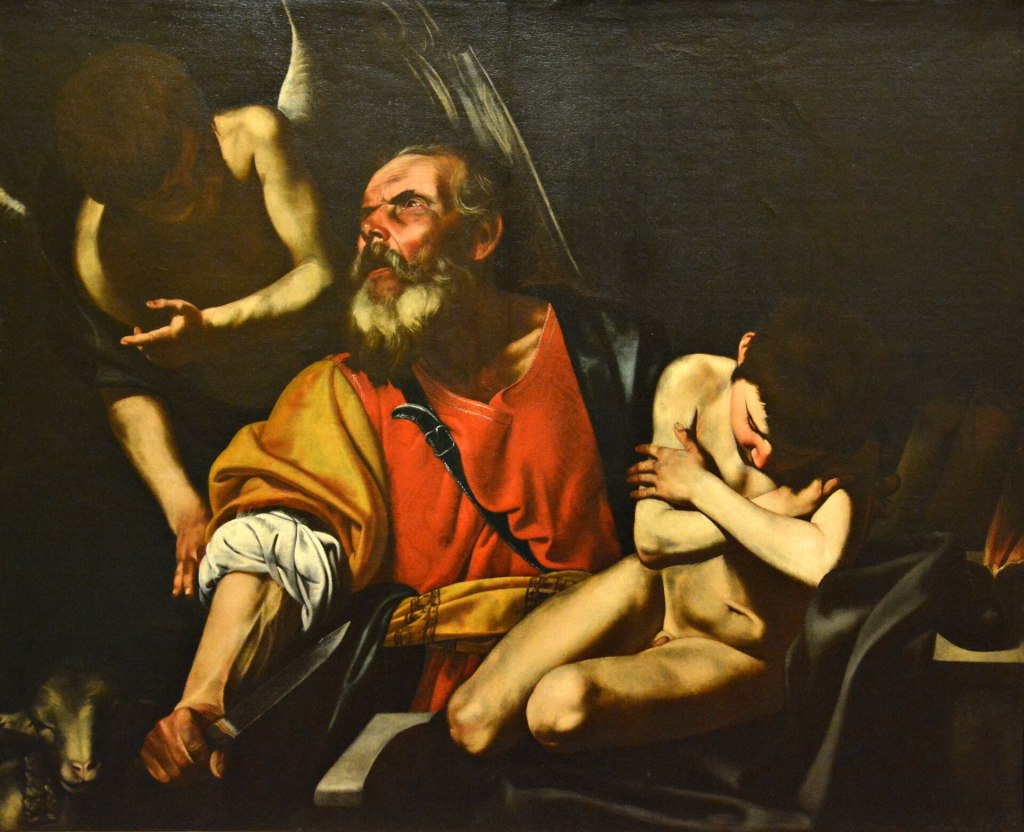
(Credit: Wikimedia Commons and Artnet).
The comparison with Battistello’s Liberazione is therefore revealing. In the Nantes painting, Vitale compresses and roughens the composition of the Pio Monte altarpiece. Battistello’s version is more luminous and refined, while Vitale gives greater weight to taut bodies, forceful expressions and a harsher treatment of form. Nor can Vitale be understood simply as a follower of Ribera. Compared with Ribera’s Sant’Andrea in the Quadreria dei Girolamini, his treatment of flesh is drier and more compact, with less sustained attention to the varied textures of skin. His naturalism emerged instead from a difficult convergence of influences: Battistello’s Caravaggism, Ribera’s arrival, Sellitto’s legacy and the continuing presence in Naples of painters from northern Europe. The result is a manner that remains distinctly his own, severe, physically concentrated and resistant to polished finish.
This makes Vitale useful for understanding Battistello’s position. Early Neapolitan naturalism was not a single current flowing from Caravaggio to Ribera and then into the local school, but a crowded field of adjacent solutions. Battistello developed a severe but increasingly refined Caravaggism, Sellitto a more mediated and atmospheric response, Vitale a compact and unsmoothed bodily realism, and Ribera a more tactile and investigative treatment of painted surfaces. There may also have been lingering currents of northern Caravaggism, associated with painters such as the Master of the Emmaus at Pau or Cecco del Caravaggio. Russo remains cautious about precise priorities, especially around Ribera’s arrival and the possible presence of Cecco in Naples. That caution is useful because it prevents the early Neapolitan field from being reduced to a clean sequence of influence. Battistello developed instead within a convergence of local, Spanish, Roman and northern pressures, as painters repeatedly absorbed, corrected and intensified one another’s solutions.
Causa gives this transformation an anthropological as well as a stylistic dimension. The change concerns not only light, paint and surface, but also the kinds of human beings who populate Battistello’s paintings. His figures become older, weightier, more strongly characterised and more physically specific. Causa sees this development as shaped partly by Ribera’s heroic old men and partly by Battistello’s possible contact with the northern Caravaggesque painters active in Naples, including Louis Finson and the anonymous Master of the Emmaus at Pau. It is within this latter context that he places Battistello’s Cristo tra i dottori, now in a private Neapolitan collection and probably datable to around 1620 or slightly earlier. The painting bears Battistello’s initials on the book held by the elderly figure at the right. It suggests that the changing physical and human character of Battistello’s naturalism arose from several currents acting upon him at once.
The Florentine episode around 1618 is revealing, but not radically transformative. At the Medici court, Battistello seems to have worked especially as a portraitist, perhaps producing now-lost likenesses of Grand Duke Cosimo II and Maria Maddalena d’Austria. The surviving Riposo durante la fuga in Egitto col Battista in the Cappella delle Reliquie at Palazzo Pitti gives substance to the stay and places him in contact with early Seicento Florentine painting. Yet for Causa the episode does not fundamentally redirect Battistello’s career. It belongs rather to the moment when his original Caravaggesque force is beginning to lose momentum and to seek other forms of renewal.
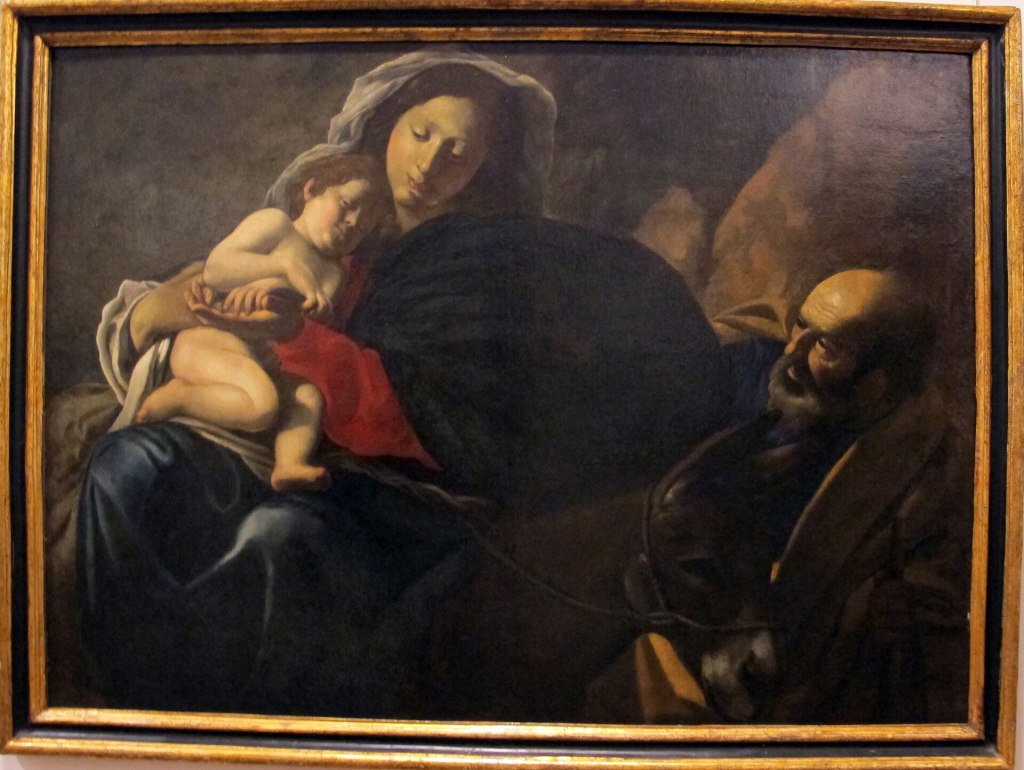
(Credit: Wikipedia and Wikimedia Commons).
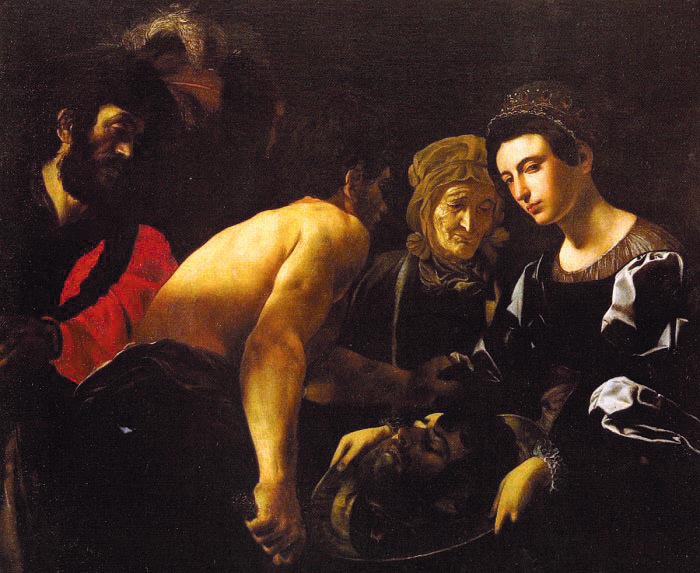
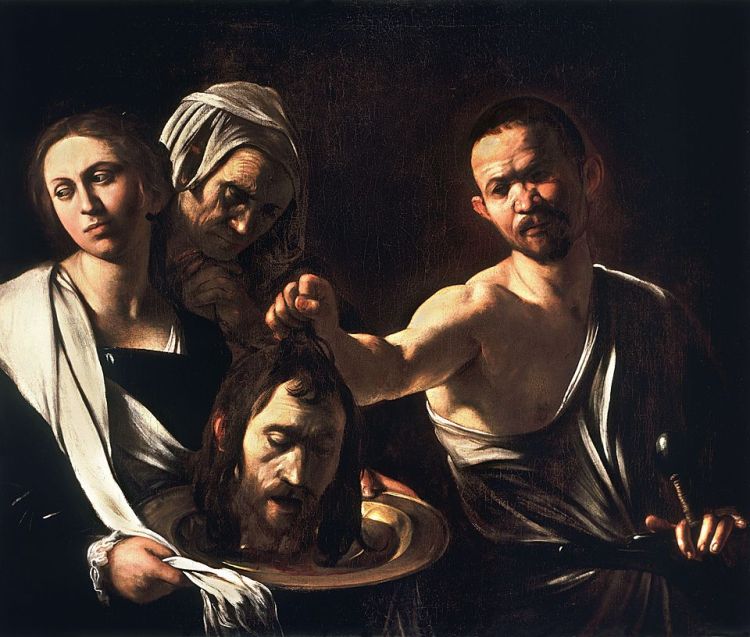
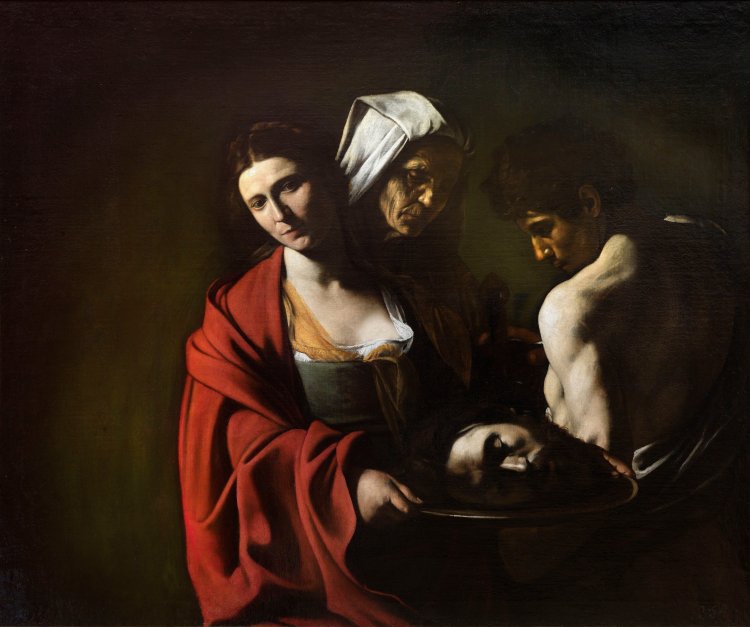
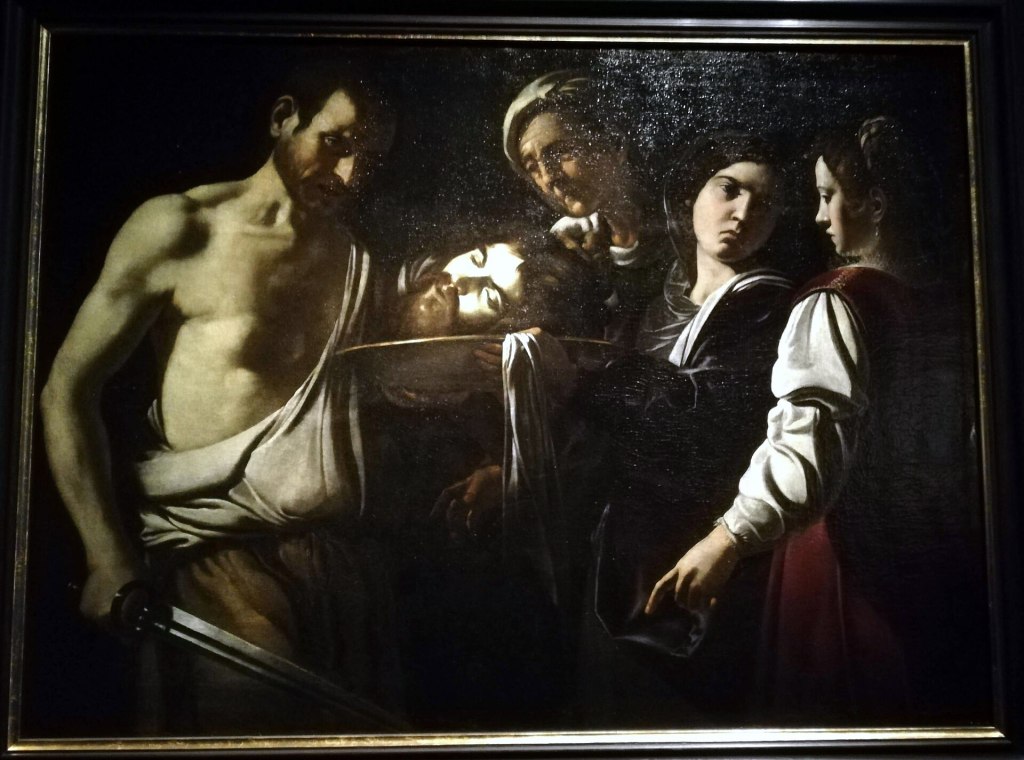
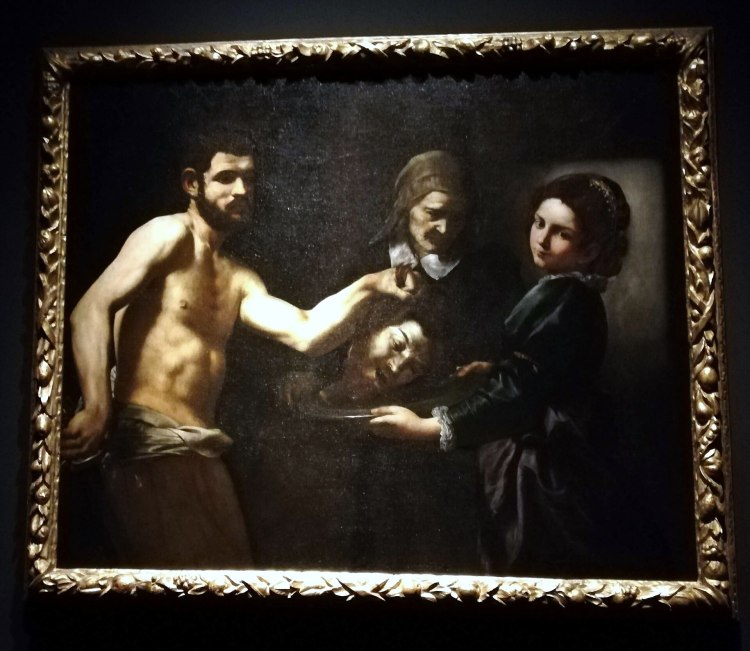
The more unsettling Florentine work is the Salomè con la testa del Battista in the Uffizi, now tied to the Medici context and documented in the collection of Prince Leopoldo by 1638. Causa calls it one of Battistello’s last Caravaggesque blows. As Russo observes, this subject was highly important within early Neapolitan naturalism. The Salomè theme became especially useful because it was prestigious, repeatable and morally uneasy, allowing painters to measure themselves against Caravaggio’s prototypes, now in London and Madrid, while also producing variations suited to collectors and connoisseurs. Caravaggio’s own versions are based on severe three-figure concision: Salomè, the executioner, and the severed head of the Baptist. Neapolitan painters did not simply copy this structure. They received it as a formula to be altered, expanded and recombined.
(Credits: Wikipedia).
Sellitto’s Salomè e Erodiade che presentano la testa del Battista a Erode, attributed by Gianni Papi, shows how early this process could begin. Since Sellitto died in 1614, the painting must belong to the first phase of Neapolitan Caravaggism, yet Russo finds it somewhat atypical in its Roman-inflected character. The sacred subject is treated almost as a worldly chamber scene, poised between evangelical narrative and genre painting. That hybridity helps define the broader field into which Battistello’s own Salomè pictures belong.
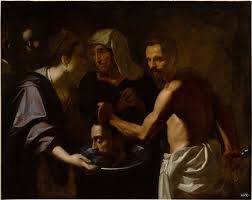
(Carlo Sellitto, Salomè ed Erodiade che presentano a Erode la testa di Giovanni Battista, c. 1612–14; oil on canvas; 100 × 133 cm; private collection, present whereabouts unknown. Credit: Mutual Art).
Battistello’s versions in Seville and in the Uffizi are therefore not simple imitations of Caravaggio, but acts of poetic recombination. The Seville painting carries a mood of incredulity and resignation; the Florentine version, generally linked with the Medici context around 1618, aims at a more seductive and insinuating effect through Salomè’s gaze and the careful handling of fabric. Russo’s phrase pensoso arrangiamento is exact. Battistello rearranges inherited material thoughtfully, often softening Caravaggio’s implacable three-figure compression by adding a fourth figure around the Baptist’s severed head. The result is more mediated and conciliatory, but not weaker. Violence is no longer concentrated in the blunt fact of presentation alone; it circulates through glances, fabrics, bodily nearness and the uneasy social atmosphere of the scene.
In a private-collection version Battistello returns to the three-figure format, responding especially to Caravaggio’s London Salomè. Yet even there the emphasis shifts. Battistello is less interested in Caravaggio’s stark dramatic severity than in the ambiguous innocence of the young woman’s expression. By setting her against a zone of brightness in the background, he offers what Russo calls a mental rather than physical homage to the way light enters the studio: not a literal copy of Caravaggio’s illumination, but a reflective rethinking of its poetic effect. His relation to Caravaggio is therefore close but not submissive. Caravaggio provides the concentrated chamber format, the small group of figures, the severed head and the moral pressure of the scene. Battistello takes over these elements but loosens their effect, replacing Caravaggio’s tense compression and implacable drama with a more reflective arrangement, in which violence gives way to ambiguity, seduction and pictorial meditation.
(Credit: Wikimedia Commons, il Sistemone).
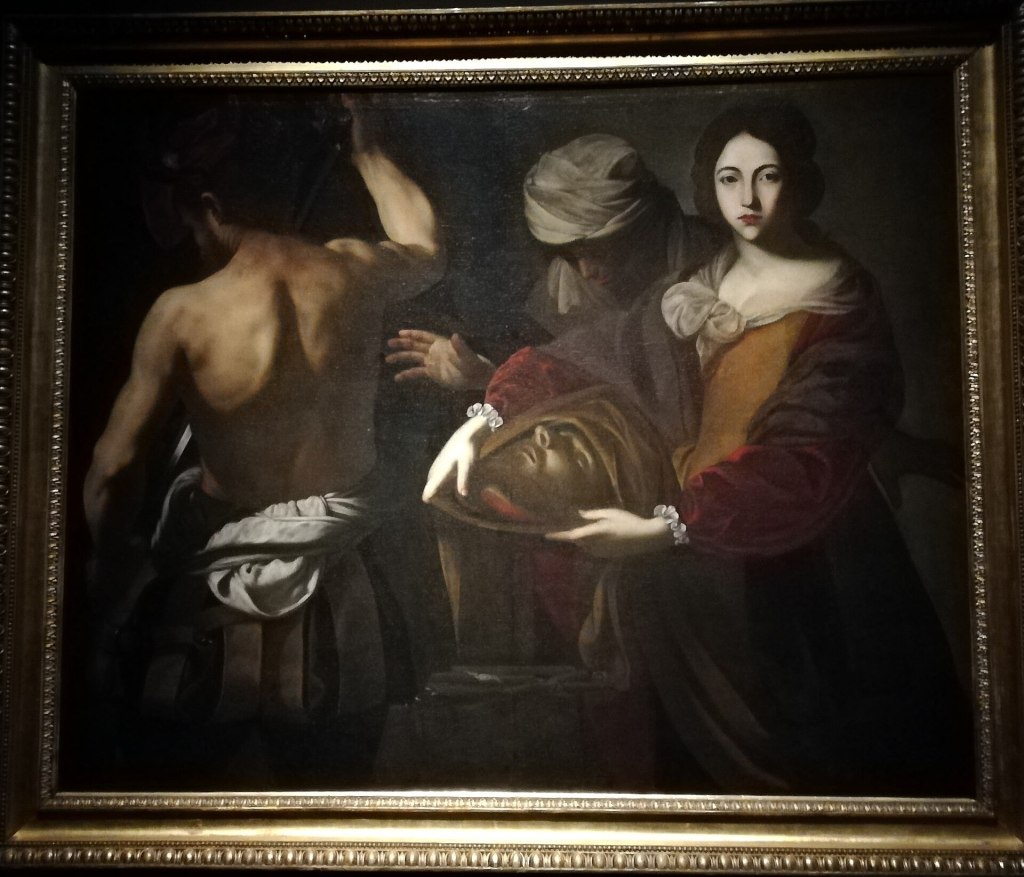
Comparison with the young Massimo Stanzione makes the distinction clearer. His private-collection Salomè, probably datable to around or just after 1620, depends on Caravaggio’s Madrid Salomè but opens its tightly bound design into a broader horizontal opposition. Salomè is presented frontally, while the executioner turns his back as he puts away his sword. That back becomes a powerful exercise in naturalistic observation and chiaroscuro. Where Battistello recombines Caravaggio’s example in a reflective and emotionally nuanced way, Stanzione sharpens and theatricalises it. He transforms Caravaggio’s compact arrangement of three figures into a more rhetorical structure, organised around the contrast between the woman’s frontal presence and the executioner’s turned back, and between pictorial concentration and staged eloquence.
In the Uffizi Salomè, what matters is not simply the subject’s violence, but the way that violence is held in glance, surface and proximity. Salomè’s insinuating, climbing look introduces a murky, knowing and almost eroticised note into an artist too often confined to the role of grave bronze patriarch. The comparison with Artemisia Gentileschi is useful only if handled carefully. Causa’s point is not to diminish Artemisia, but to suggest that Battistello’s Salomè does not announce itself as personal drama. Violence and complicity circulate more obliquely within the image, making the painting one of the last powerful survivals of his Caravaggesque imagination even as the larger energy of that mode is beginning to exhaust itself.
As Causa elucidates, Lanfranco opens another route out of Caravaggism. In the Cappella Bongiovanni in Sant’Agostino in Rome, he had created a new model for sacred painting: expansive, narratively organised, and structured across altarpiece, side canvases, lunette and vault. For art in Naples this was significant because it offered a way beyond the increasingly exhausted formula of compressed Caravaggesque naturalism. Caravaggio had given Neapolitan painting immediacy, darkness and physical power; Ribera had thickened that inheritance into a denser and more tactile and repeatable ‘super-style’. Lanfranco reintroduced amplitude, narrative articulation, spatial breadth and the compositional intelligence of sixteenth-century painting.
(Credit: Wikimedia Commons).
This helps explain why mature Battistello can sometimes seem close to painters such as Pasquale Ottino and Alessandro Turchi without requiring direct influence between them. The affinity lies rather in a shared Roman and Lanfranchian root: a set of solutions that move beyond strict Caravaggism while retaining dramatic force. In this sense Lanfranco “shows Caravaggism to the door” not by rejecting it crudely, but by emptying it out from within. Its compressed naturalism is replaced by broader sacred theatre: grouped figures, episodes, gestures, architectural settings and compositional hinges.
Battistello’s Miracolo di sant’Antonio da Padova and Madonna delle anime purganti, now at Capodimonte, belong to this shift. They do not simply continue Caravaggio, nor are they only responses to Ribera’s material force. They put Lanfranco’s larger compositional ideas back into circulation within Neapolitan painting. The field around Battistello is therefore no longer organised by the single question of how to absorb Caravaggio. By the 1620s, the problem is how to hold together Caravaggesque gravity, Riberesque density, Roman narrative breadth and the demands of large public religious painting.
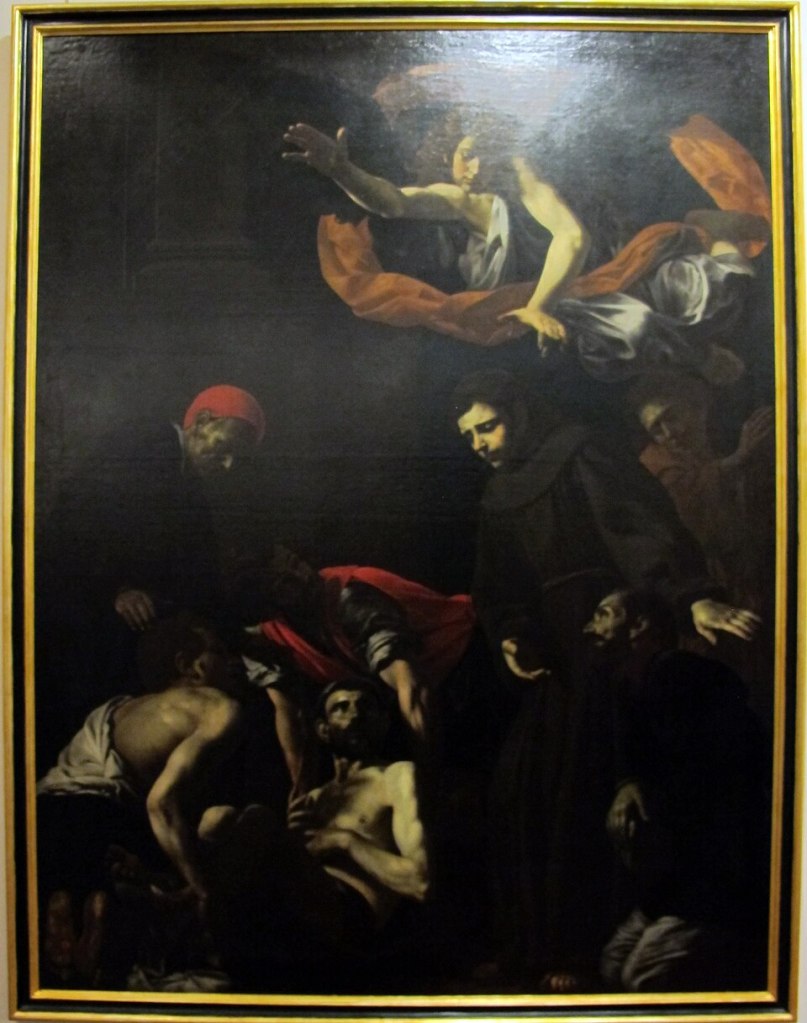
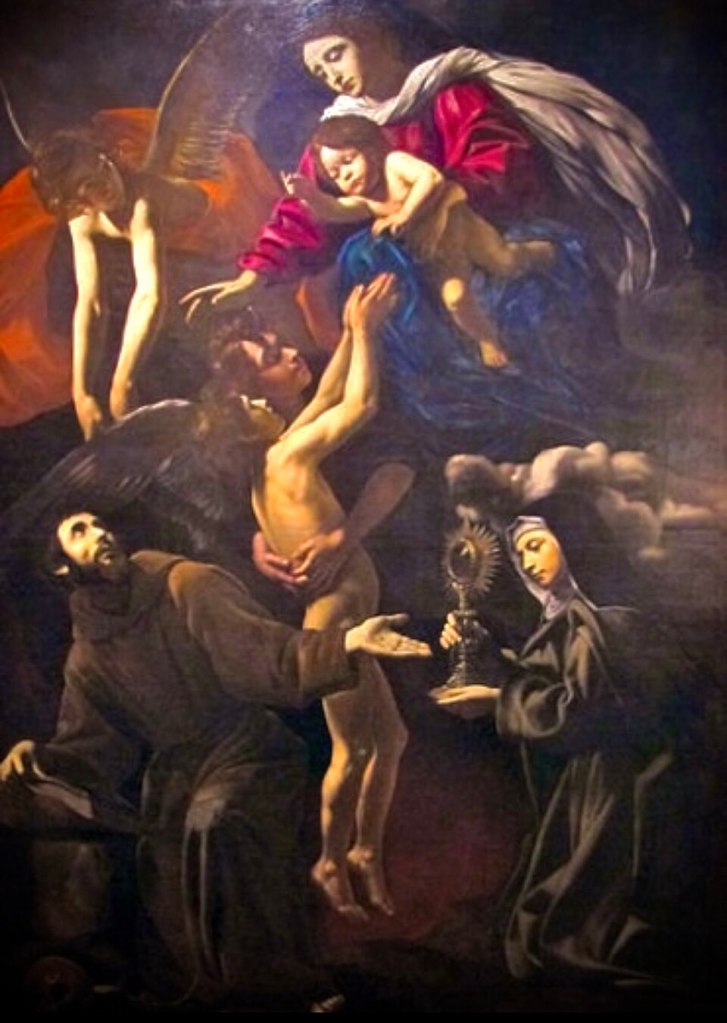
(Credit: Wikimedia Commons).
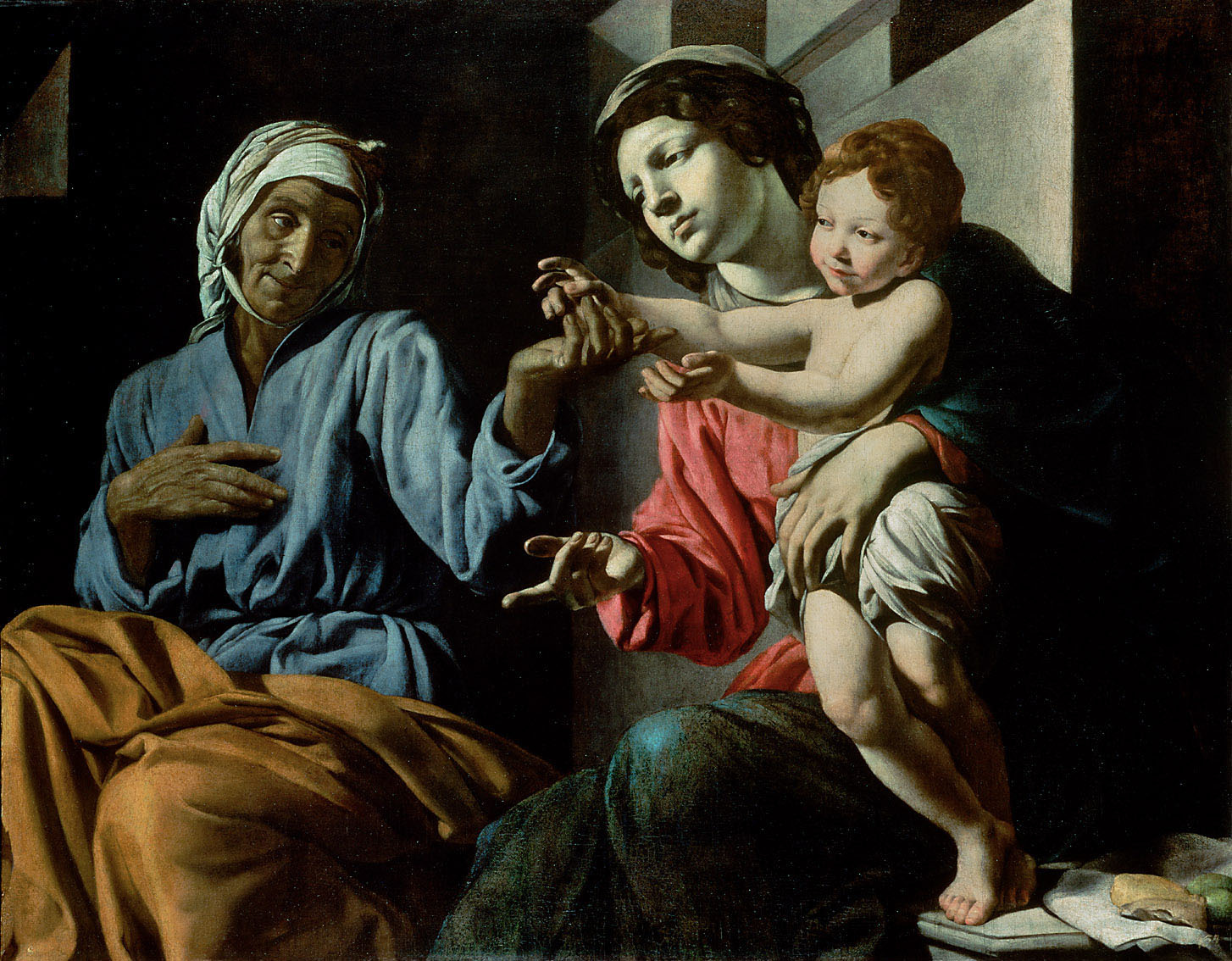
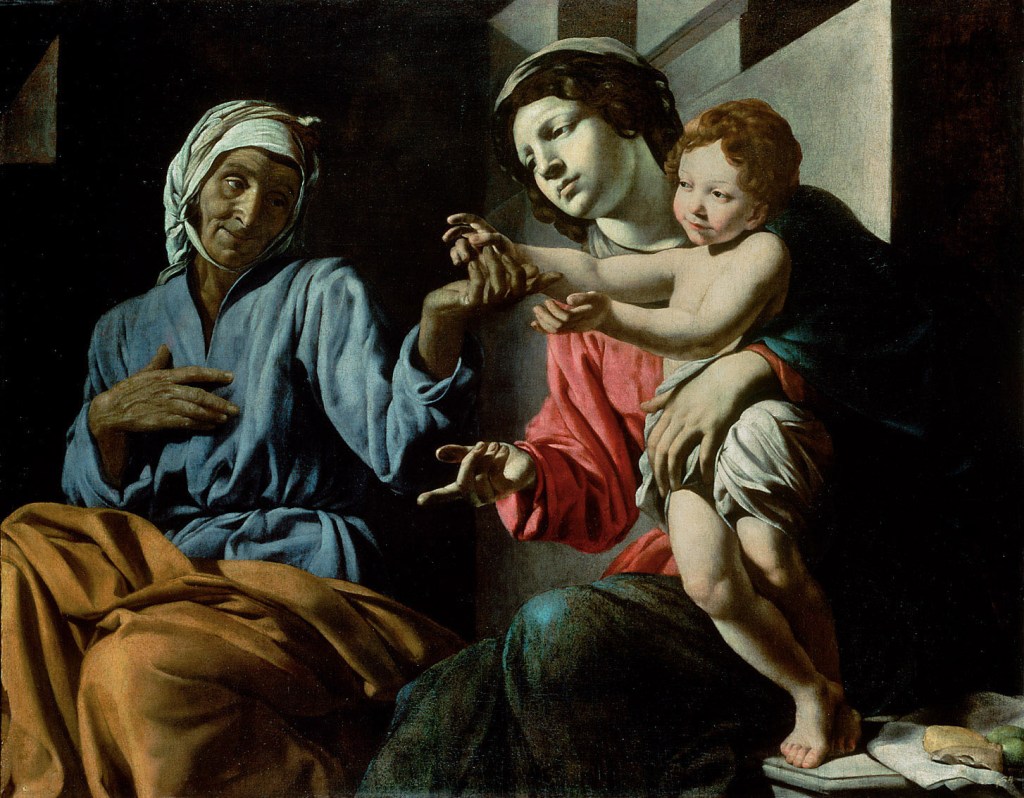
The late Madonna col Bambino e Sant’Anna in Vienna makes this Lanfranchian enlargement especially visible because it is not a fresco or chapel decoration, but a cabinet picture. Battistello tries to carry into a smaller format the breadth, architectural presence and upward view associated with larger sacred painting.
(Credit: Wikimedia Commons).
The half-figures are seen from below and set against emphatic architectural profiles; heads, bodies and fabrics seem thickened, monumentalised and almost swollen. Causa’s phrase “confezione ipertrofica e massiccia” is exact: the painting is no longer spare, nocturnal or immediate in the manner of early Caravaggism, but massive, overcharged and stylistically burdened. Seen beside other Caravaggesque pictures in Vienna by Orazio Gentileschi, Valentin or Saraceni, Battistello’s work looks less like an act of concentrated naturalism than an attempt to force Caravaggism into a broader and heavier pictorial structure.
Saint Anne’s head gives the picture its strangest force. To describe its effect, Causa introduces a comparison with the eighteenth-century Neapolitan painter Gaspare Traversi. He is not proposing a strict line of descent, but using the later artist to make Battistello’s physiognomic intensity more visible. Longhi taught modern viewers to see Traversi as a late aftershock of Neapolitan Caravaggism, and Causa’s comparison encourages us to recognise something related in Battistello’s Saint Anne: an acute, almost grotesque presence that exceeds the merely devout or domestic. Her face has the character of a life closely observed and marked by age and experience. Late Battistello is therefore not simply exhausted. He remains dense, resistant to easy resolution, physiognomically alert and sometimes powerfully strange.
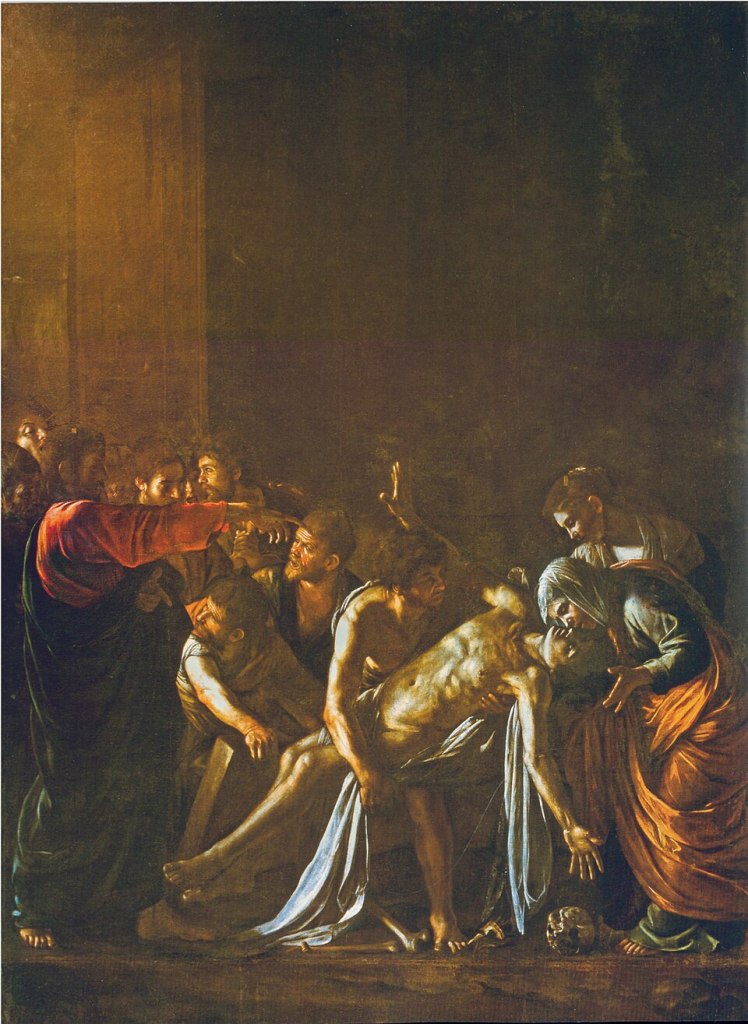
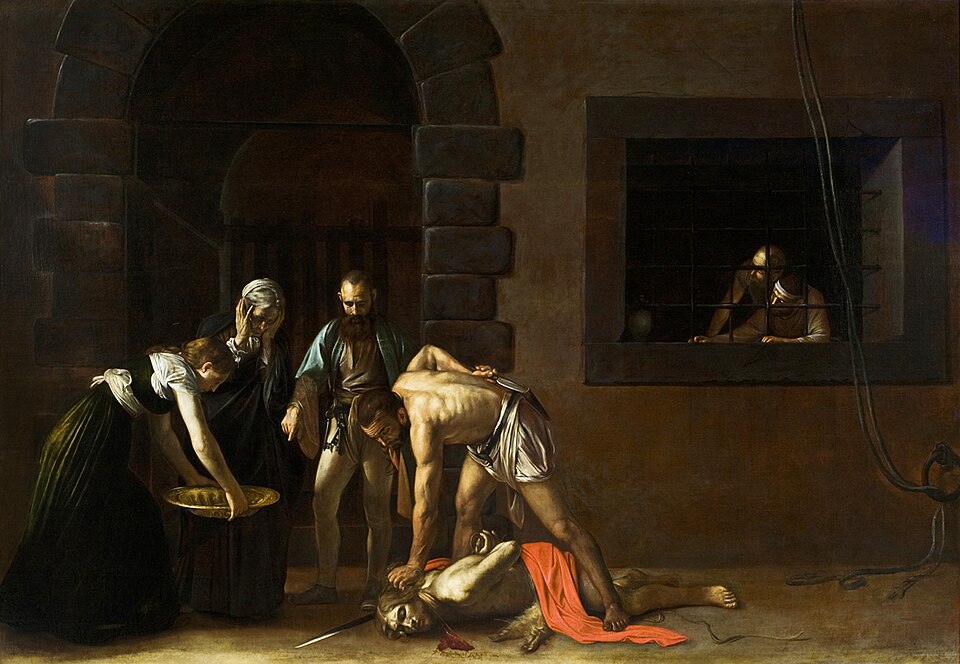
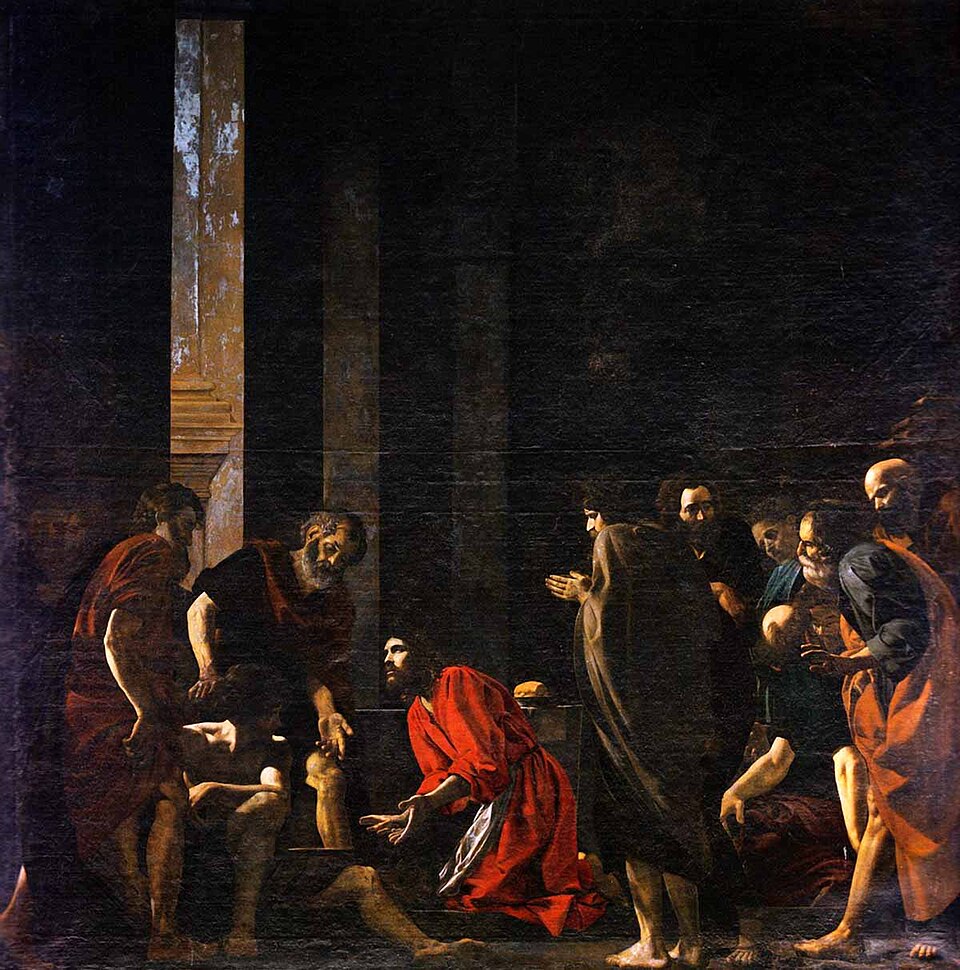
The Lavanda dei piedi, painted in 1622 for the choir of the Certosa di San Martino, marks Battistello’s entry into the patronage of the Carthusian monks. It is also one of the last great expressions of his conscious Caravaggism.
(Credits: Wikipedia and Wikimedia Commons).
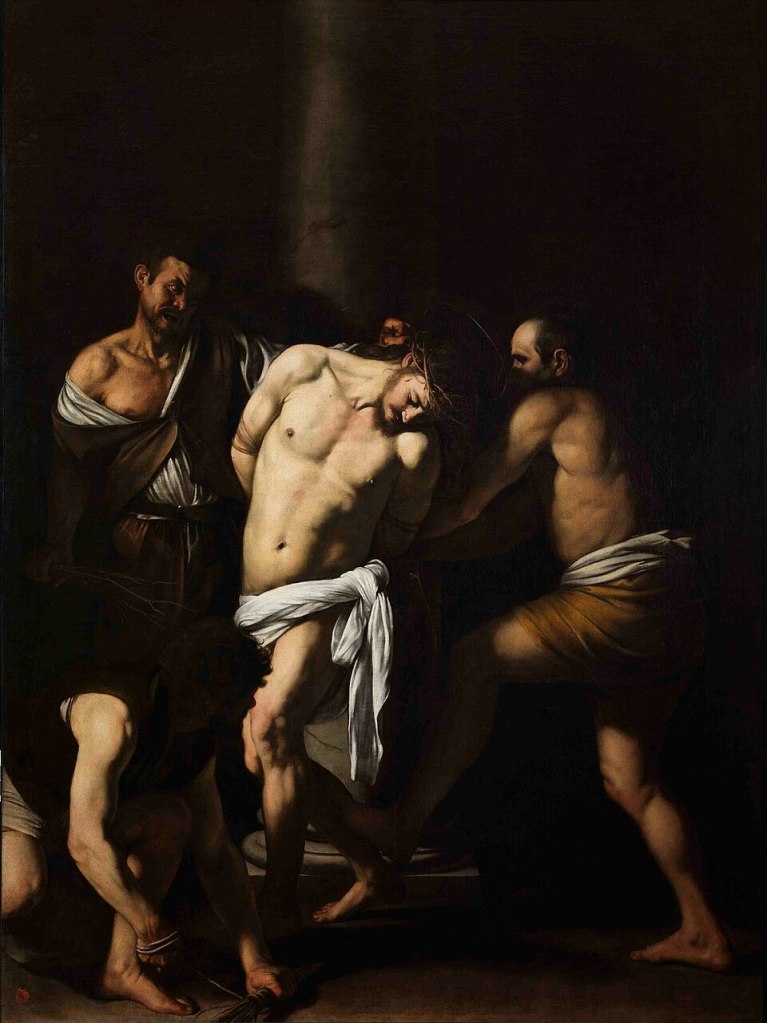
The painting was conceived in relation to its architectural setting: the columns in the painted background seem to extend the real space of the adjoining chapel, giving the image an illusionistic continuity with the building around it. Causa reads this as a further development of Battistello’s response to the late Caravaggio. The work recalls the vast, dark, almost unreadable space of Caravaggio’s Flagellazione, but also the Maltese and Sicilian works, where the physical setting is no longer a neutral backdrop but part of the drama itself. Battistello is no longer concerned only with figures emerging from darkness. He is exploring the dramatic force of space.
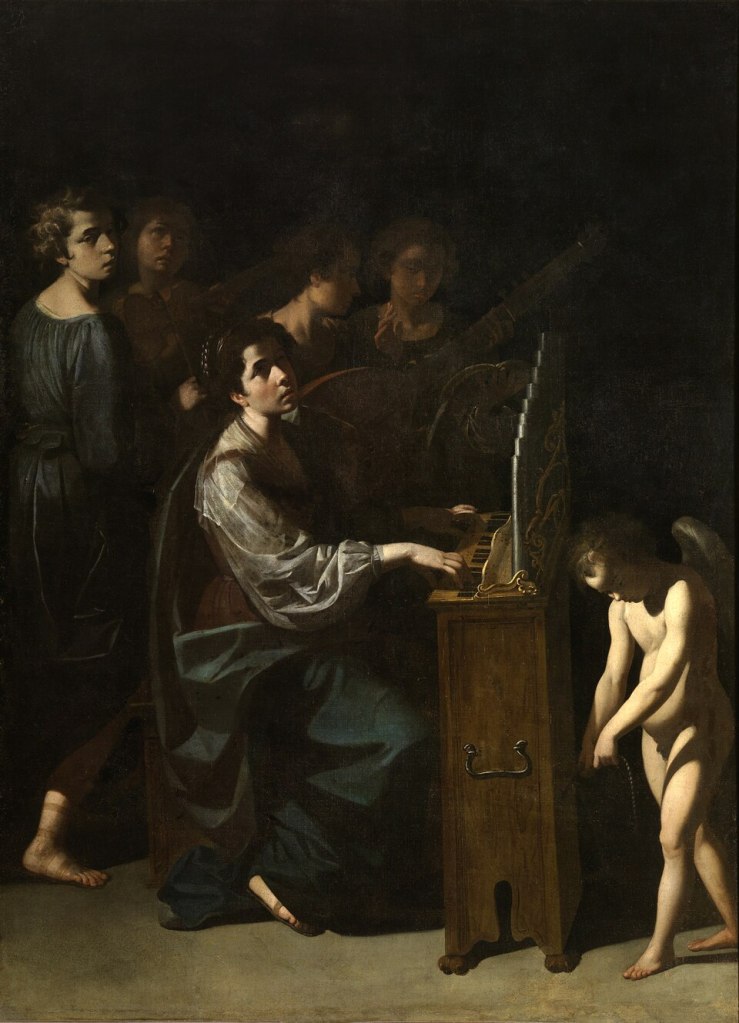
This is where Sellitto becomes important again. Causa argues that Battistello was not alone in recognising the spatial force of the late Caravaggio. Sellitto, who died prematurely in 1614, had also grasped the importance of Caravaggio as a kind of painter-architect: a maker of bare, severe spaces in which human figures are dwarfed, pressured or held in suspense. Paintings such as Sellitto’s Santa Cecilia and San Carlo Borromeo suggest what he might have achieved had his career not been cut short. Battistello’s Lavanda dei piedi can therefore be seen as the mature outcome of a local Neapolitan exploration of late Caravaggesque space, not simply as an isolated response to Caravaggio.
(Credit: Wikimedia Commons).
Russo treats the Lavanda dei piedi as Battistello’s “capolavoro d’addio” to even this revised form of Caravaggism. After it, the Cristo alla colonna at Capodimonte belongs to a fully mature, post-Caravaggesque phase. In his analysis, Caravaggio’s Flagellazione from San Domenico Maggiore remains the unavoidable point of comparison, especially for the body of Christ at the column. But Battistello is no longer responding to Caravaggio in the heat of encounter. By this stage he has been to Florence and Genoa and has returned to Rome. The natural body is rethought through drawing, geometry, colder light and a more deliberately modulated space. The picture is less an act of dependence than a later meditation on Caravaggio: a measured reconfiguration of the body into a more structured and stylised image.
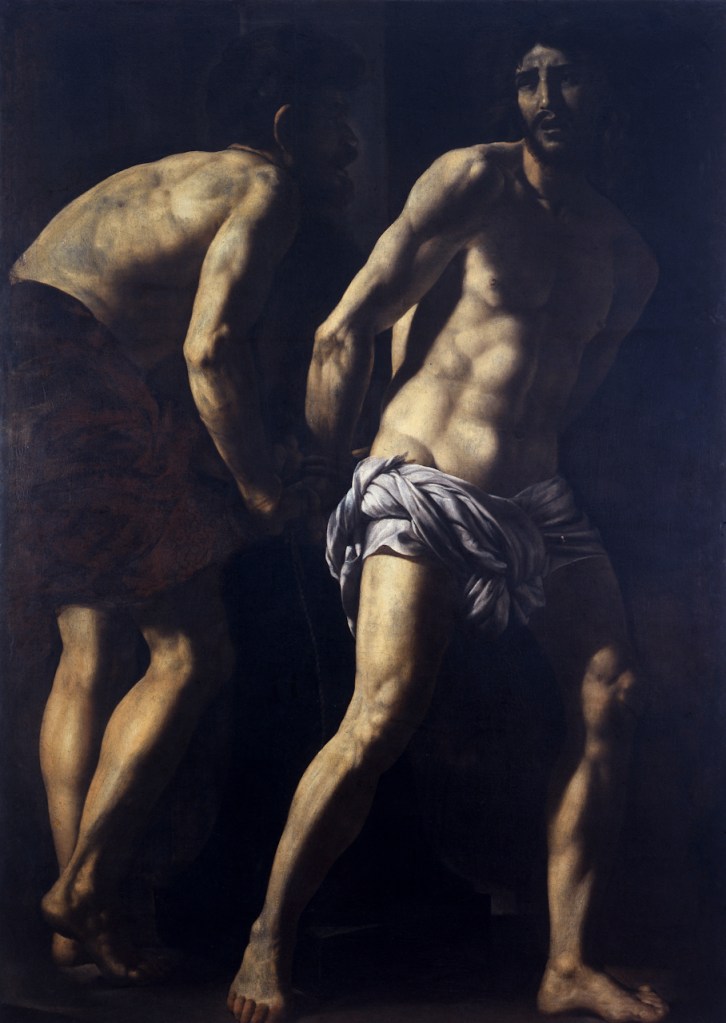
(Credit: Wikipedia).
By 1626, with the Adorazione dei Magi for the chapter house of San Martino, the most severe phase of Battistello’s Caravaggism begins to recede. The shift belongs to a broader softening of naturalism in Naples, visible also among the painters represented in the same decorative project: Simon Vouet, Paolo Finoglio and Massimo Stanzione. San Martino marks the point at which the hard early naturalism of Battistello’s generation begins to bend towards a more moderated Baroque language. Caravaggio has not disappeared, but he is no longer the sole organising force. The demands of institutional decoration, the continuing practice of fresco, the material pressure of Ribera’s painting, and the clearer, more expansive language emerging in Naples now begin to modify Battistello’s early severity.
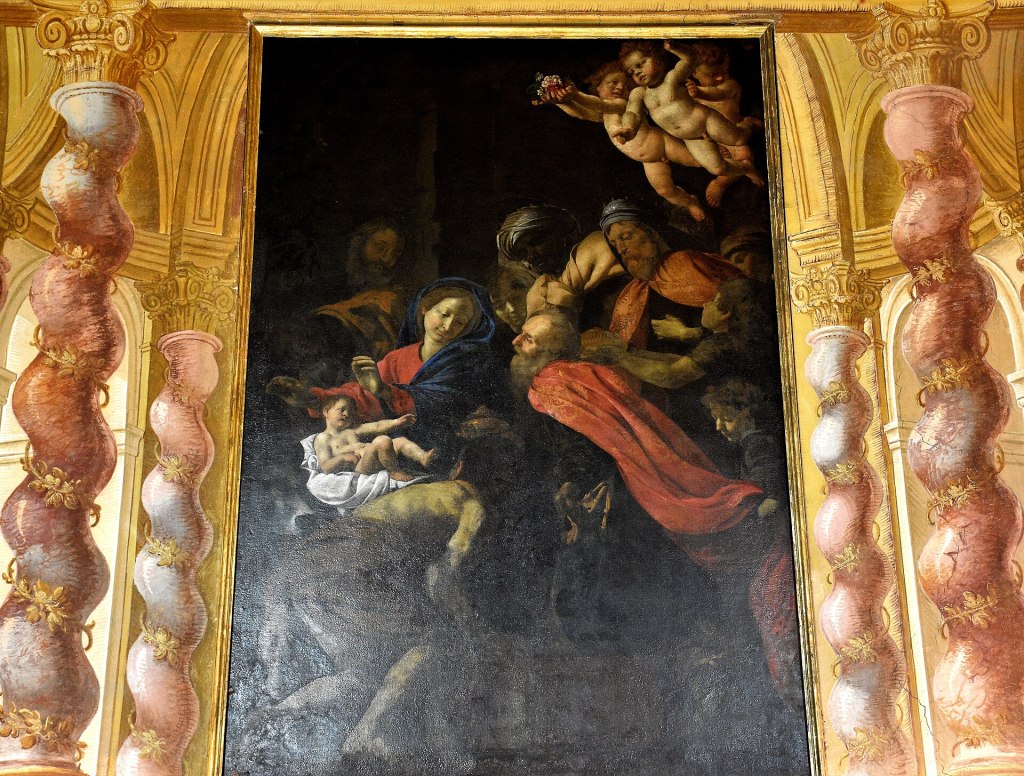
(Credit: Wikimedia Commons/Giuseppe Guida).
The great missed opportunity was the Cappella del Tesoro di San Gennaro. For Causa, this was one of the major artistic projects of seventeenth-century southern Italy, comparable in importance to the Certosa di San Martino. Between 1623 and 1625 Battistello was called by Fabrizio Santafede to collaborate on the decoration of the chapel, but the results did not satisfy the Deputation, and Battistello was eventually relieved of the commission. His role was therefore real but abortive: he entered the project, produced trial work that failed to win approval, and did not become part of the chapel’s final decorative language.
Causa therefore treats the Tesoro as a débâcle for local authorship. The decisive identity of the chapel was shaped instead by Domenichino, Lanfranco, Ribera, Fanzago and Finelli. Even Stanzione, when he later entered the chapel after Battistello’s death, did so through a response to Domenichino: his painting on copper, San Gennaro guarisce un’ossessa, made to replace Domenichino’s unfinished version of the same subject, becomes a lesson from painter to painter in the purist language of the Emilian master.
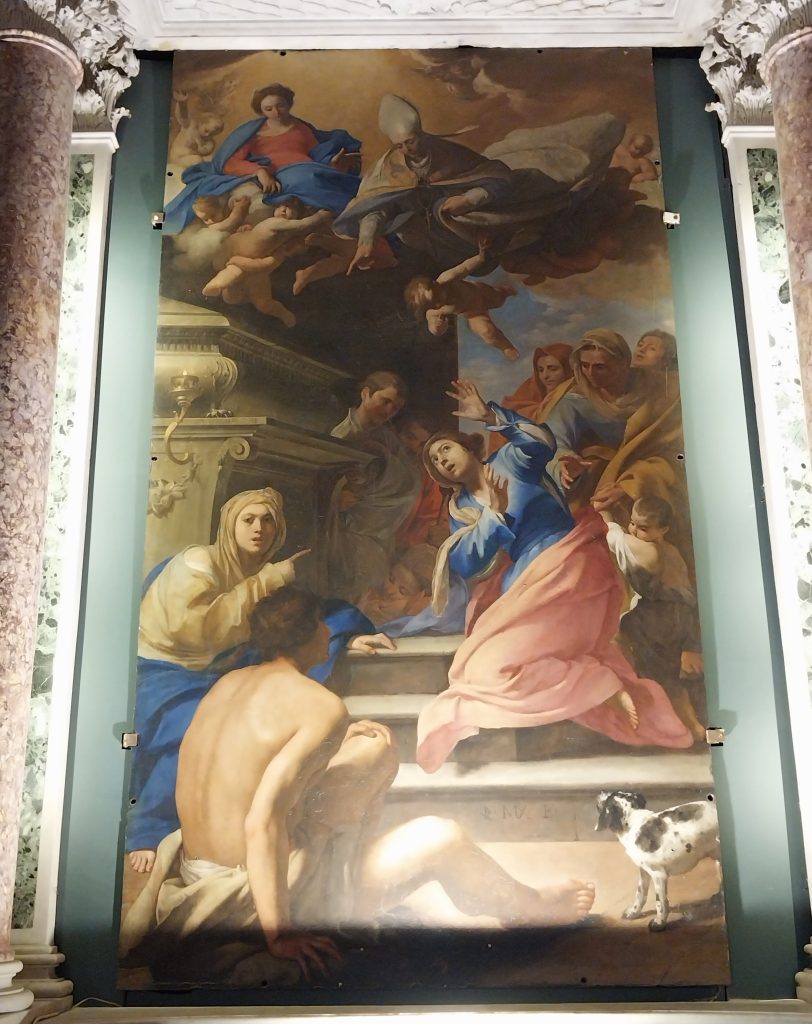
(Credit: author’s photograph).
The local school is therefore being formed under external influence: Emilian classicism, Roman and Lombard invention, Ribera’s Spanish naturalism, and the sculptural magnificence of Fanzago and Finelli. The bitterness surrounding the chapel, including the old stories of threats against foreign painters and the dark tradition around Domenichino’s death, should be understood in that context. The Tesoro was a civic-sacred monument of immense prestige; for Neapolitan painters to be displaced from it was a symbolic defeat.
This adds significance to Battistello’s work in the chapel of San Michele Arcangelo at Santa Maria la Nova, associated with the Severino, or Sanseverino, family. Since his contribution to the Cappella del Tesoro di San Gennaro was rejected, lost or never properly realised, the decorations at Santa Maria la Nova become important surviving evidence of his continued activity within the public religious culture of Naples. They cannot replace the Tesoro in importance, but they show Battistello still working inside the city’s decorative tradition at the moment when that tradition was being reorganised around other masters.
The clearest starting point for understanding the San Michele chapel is Battistello’s intervention on Teodoro d’Errico’s San Michele, the altarpiece already occupying the space. This was not a commission in which he simply supplied a new set of decorations for an empty chapel. He was required to restore, or remodel, the lower part of an existing late-sixteenth-century panel damaged by candles, while also contributing frescoes to the surrounding chapel space.
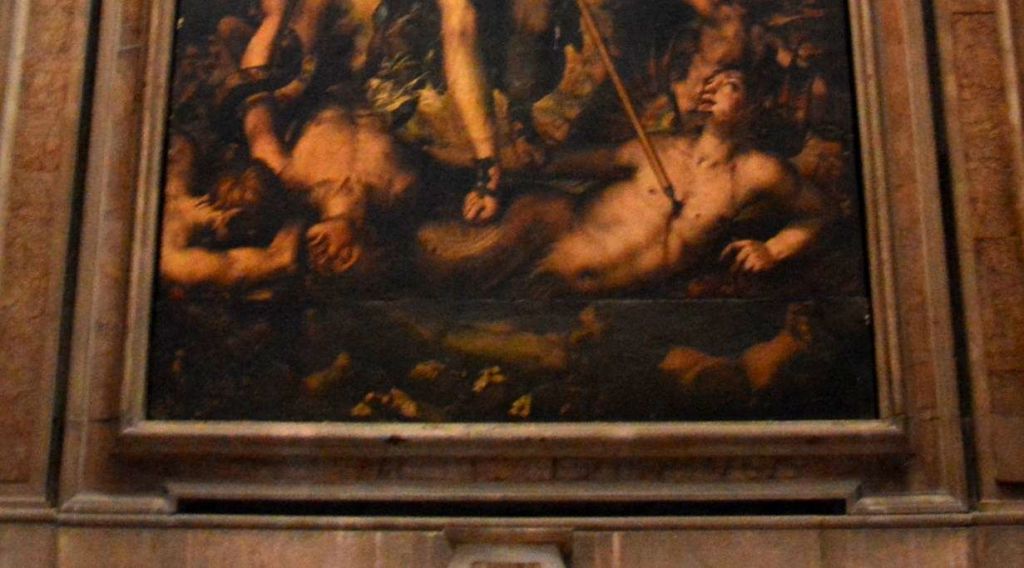
The photograph shows the lower part of d’Errico’s San Michele, where Battistello’s intervention brings the damned souls beneath the archangel into dialogue with antique sculpture, above all the Laocoön.
Credit: Photograph by IlSistemone, Wikimedia Commons.
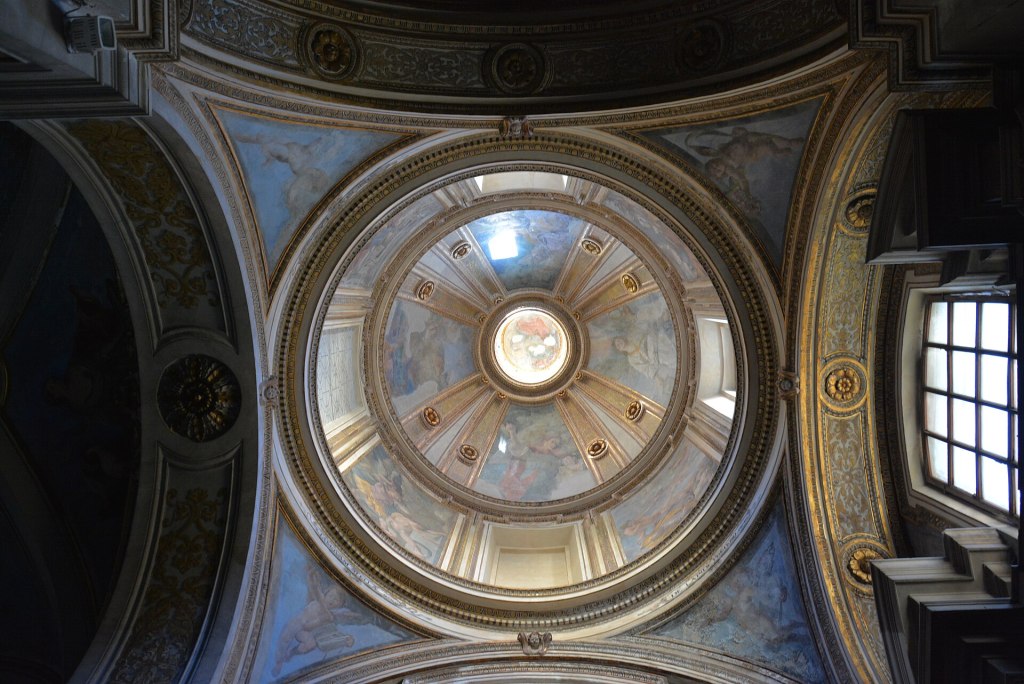
The task placed him in direct material contact with a very different pictorial language: the brilliant, neo-Raphaelesque, late-Mannerist style of d’Errico, an Italianised Netherlandish painter active in Naples until the early seventeenth century. For Causa, the result is one of the strangest grafts in Caravaggesque painting. Battistello does not simply repair the older work; by remodelling its lower section, with the damned souls beneath Saint Michael, he enters into its inherited structure and reactivates its dialogue with antique sculpture, above all with the Laocoön.
The episode should have changed the way Battistello was discussed. Restoration evidence had allowed Raffaello Causa to recognise Battistello’s hand in the lower part of the older altarpiece, beneath the feet of Saint Michael, but the discovery remained largely attributional. Stefano Causa’s point is that its implications are wider. In this period, Battistello was not only moving from Caravaggio towards Ribera, Lanfranco and fresco. He was also physically engaging with the late-sixteenth-century painting still embedded in Neapolitan churches. By working inside d’Errico’s altarpiece, he came into contact with the “Naples without Caravaggio”: colour, decorum, classical quotation, neo-Raphaelesque structure, perhaps even memories of Bronzino. Briganti’s 1945 attribution of the picture to Marco Pino, in his book on Mannerism, was wrong as an attribution but suggestive in instinct, since the work does carry a strong late-Mannerist character.
The San Michele chapel therefore becomes an important site for understanding continuity as well as rupture. Battistello’s Caravaggism is not a clean break with the previous generation; it is grafted onto an older pictorial culture that remained visible and active in Naples. In this sense Santa Maria la Nova is not a marginal restoration episode, but one of the places where Battistello’s composite identity becomes clearest: not only as a painter formed by Caravaggio and later pressures, but as an artist still in dialogue with the late-Cinquecento world that Caravaggio did not erase.
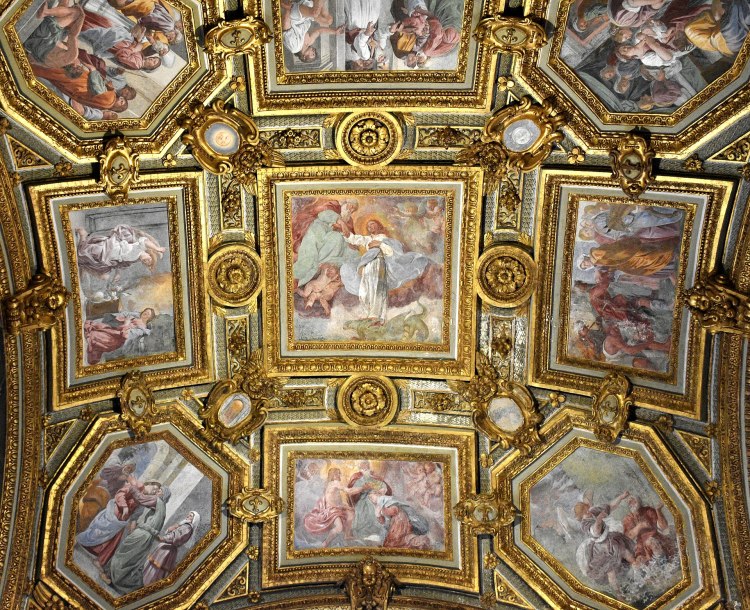
By the time of the Sala Capitolare decoration at the Certosa di San Martino, around 1626, the original Caravaggesque matrix has largely exhausted itself. Causa invokes Bruno Schulz’s image of Neapolitan painting as a brown, smoky afternoon seen through a dark bottle only to reject it for Battistello’s moment. That aged, tobacco-coloured idea of the Neapolitan school does not fit the early second quarter of the seventeenth century, when the local masters are moving towards a striking brightening of colour and atmosphere. Battistello’s mature work should therefore not be read simply as late Caravaggism grown tired or obscure. It belongs to a changed field: brighter, more spatial and more influenced by Lanfranco, Ribera and the late-Cinquecento tradition.
(Credit: Wikimedia Commons).
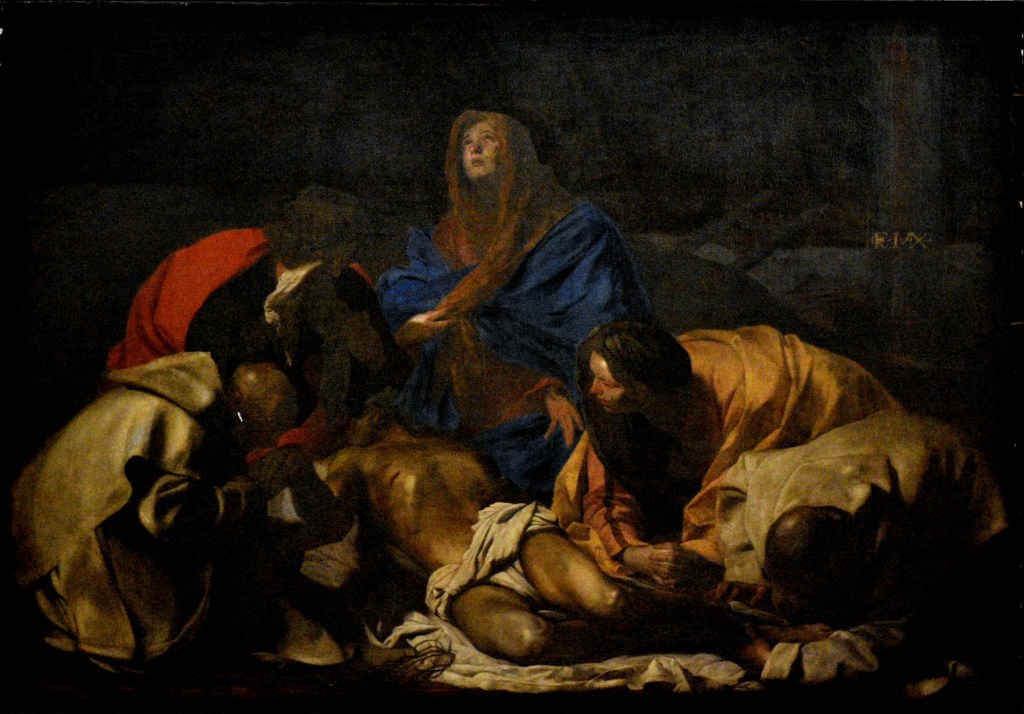
The comparison with Stanzione makes the difficulty of late Battistello clearer. The two painters are near contemporaries, but by the 1630s they seem to belong to different pictorial worlds. At the Certosa di San Martino, Stanzione is learning how to turn Ribera’s severe naturalism into bella pittura: a painting of surface, rhythm, shadow, pauses and controlled elegance. His Carthusian figures, with their deeply shadowed habits and carefully staged surfaces, point towards a relaunching of style. Causa calls this caravaggismo ben temperato: not raw Caravaggism, but Caravaggism absorbed into a decorous, stylish and publicly acceptable language.
(Credit: Wikipedia).
Battistello’s late phase looks less settled, but for that reason more revealing. At San Martino, often with considerable workshop participation, he seems to be negotiating between Ribera’s physical force, Lanfranco’s expansive mural language and the sculptural magnificence associated with the Cappella del Tesoro di San Gennaro. He remains important, but increasingly defilato, edged aside by the decorative and stylistic culture taking shape in Naples in the 1630s. The earlier wall paintings for the chapel of Porzia Caracciolo di Loffredo in Santa Teresa degli Studi, around 1616–17, had already shown him testing mural scale and measuring himself against Ribera’s first successes in Naples; by the later fresco cycles, however, the problem had become more complex. His Caravaggism becomes unstable when carried into fresco, public decoration, collaborative execution and the larger spatial demands of the Neapolitan Seicento. That instability should not simply be called failure. It shows a painter caught at the point where the first Caravaggesque revolution was being absorbed into a broader Baroque system that he helped to prepare but could not command as fluently as Stanzione.
The detached frescoes from San Diego all’Ospedaletto bring the same difficulty into focus. Causa uses the 1991 Battistello exhibition at Castel Sant’Elmo as a test case. In the main body of the exhibition, Battistello could still be made to “hold the course” as a Caravaggesque painter. The San Diego frescoes, however, made that course harder to maintain. They raise, among other things, the still open question of Neapolitan landscape painting before Micco Spadaro; more broadly, they show Battistello working in an artistic field not easily contained by Caravaggism alone, one shaped by fresco, workshop practice, decorative cycles, landscape setting and the organisation of mural space.
By the 1630s, the certificate of Caravaggism is badly faded. Neapolitan painting has moved on. Domenichino offers one kind of classicising and purist authority; Ribera’s followers another kind of refined, mannered naturalism. More decisively, mural painting in Naples is moving towards the spatially integrated world of Stanzione and Fanzago at San Martino, especially in the Cappella di San Bruno. Battistello’s late frescoes are therefore fascinating partly because they are hard to define. They do not show a simple decline from Caravaggism, but a painter being carried into a decorative and spatial culture that Caravaggio alone can no longer explain.
That difficulty is the point. Battistello’s career is not a straight road from Caravaggio to naturalism, nor from naturalism to decline. It is better understood as a field of influences, each of which altered what painting could do for him. Caravaggio gave him a new sacred naturalism: dark, compressed, immediate and grounded in the physical presence of ordinary bodies. Ribera intensified that inheritance through surface, density and physical force, while Lanfranco opened it towards amplitude, movement and narrative space. The older Neapolitan Cinquecento remained present as a source of colour, decorum and antique memory, and his experience of Florence, Genoa and Rome widened the field of reference still further. Fresco offered scale, workshop practice and public space; drawing gave him a way to test poses, transfer motifs and hold together experiences that might otherwise have pulled apart. Battistello stands between the Naples before Caravaggio, the first Caravaggesque revolution, and the more expansive Baroque language that would later be handled with greater ease by Stanzione and Giordano. His apparent elusiveness, therefore, is not a weakness to be explained away, but the sign of an artist working productively within the dense, living intricacy of Neapolitan culture.
Proceed to Battistello Caracciolo: Painting after Caravaggio in Naples, Part 3: Gallery. The bibliography is at the end of Part 3.
[Producing these essays requires care, time, research, and resources. Contributions to help sustain this exploration would be greatly appreciated.]
https://donorbox.org/inner-surfaces-resonances-in-art-and-literature-837503
 Inner Surfaces