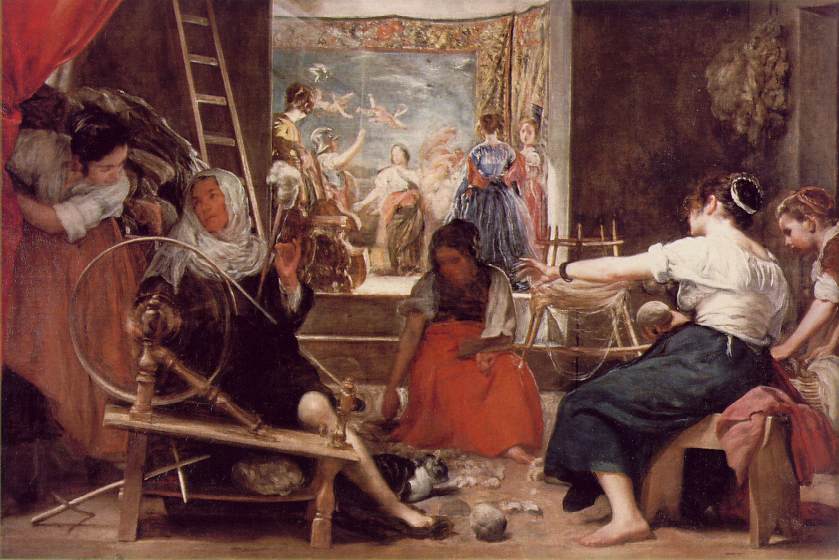
Diego Velázquez, Las Hilanderas (The Spinners, or The Fable of Arachne), c. 1657–58, oil on canvas, Museo Nacional del Prado, Madrid. (Credit: Wikipedia).
« Ce qui m’a le plus ravi en Espagne, ce qui, à lui seul, vaut le voyage, c’est l’œuvre de Vélasquez. C’est le peintre des peintres ; je n’ai, cependant, été nullement étonné ; j’ai trouvé chez lui la réalisation de mon idéal en peinture ; la vue de ces chefs-d’œuvre m’a donné grand espoir et pleine confiance. »
“What delighted me most in Spain — what alone makes the journey worthwhile — is the work of Velázquez. He is the painter of painters. Yet I was not in the least surprised: in him I found the realization of my ideal in painting. The sight of these masterpieces has given me great hope and complete confidence.”
— Édouard Manet to Zacharie Astruc, 17 September 1865
In broad terms, Velázquez’s late work Las Hilanderas comprises two scenes: the darker lower register is a genre scene, while the brighter upper register is mythological. The lower plane offers us a workshop-like setting in which five women are engaged in the spinning and winding of wool. At the centre, a seated figure cards wool, reaching down to gather fibres from the floor. To one side, another woman operates a spinning wheel, drawing out thread, while at the right a third winds the finished yarn into a ball. Behind them, assistants pull back a curtain and carry away (or deliver?) a basket of wool. A cat lies nearby, reinforcing the sense of an unposed domestic setting, suggestive of a Dutch domestic interior.
Beyond this foreground, a second, more brightly lit space opens up; a room dramatically flooded with light. Its walls are hung with tapestries, and here a mythological scene unfolds. A helmeted figure raises her arm against another woman whose arm is lowered in response; these figures may be identified as Minerva and Arachne at the moment of their confrontation. Behind them hangs a tapestry depicting The Rape of Europa, derived from Titian’s composition. Three finely dressed women stand in attendance in this background space. Beside one of them, what is most likely a viola da gamba appears to be propped against a chair. A figure at the far right turns outward, appearing to meet the viewer’s gaze.
This background episode alludes to the story of Arachne in Ovid’s Metamorphoses, in which the mortal weaver, famed for her skill, challenges Minerva to a weaving competition. This is an act not merely of pride but of reckless overreaching. In Ovid’s version, Arachne issues the challenge first, refusing to acknowledge the goddess as the source of her gift and declaring, in effect, that Minerva should compete with her and exact the penalty if she loses. Minerva then appears disguised as an old woman and warns Arachne not to seek equality with a goddess, urging her instead to be content with mortal renown and to ask forgiveness. Arachne rejects the warning and demands that Minerva appear openly. Only then does the goddess cast off her disguise and the contest begin.
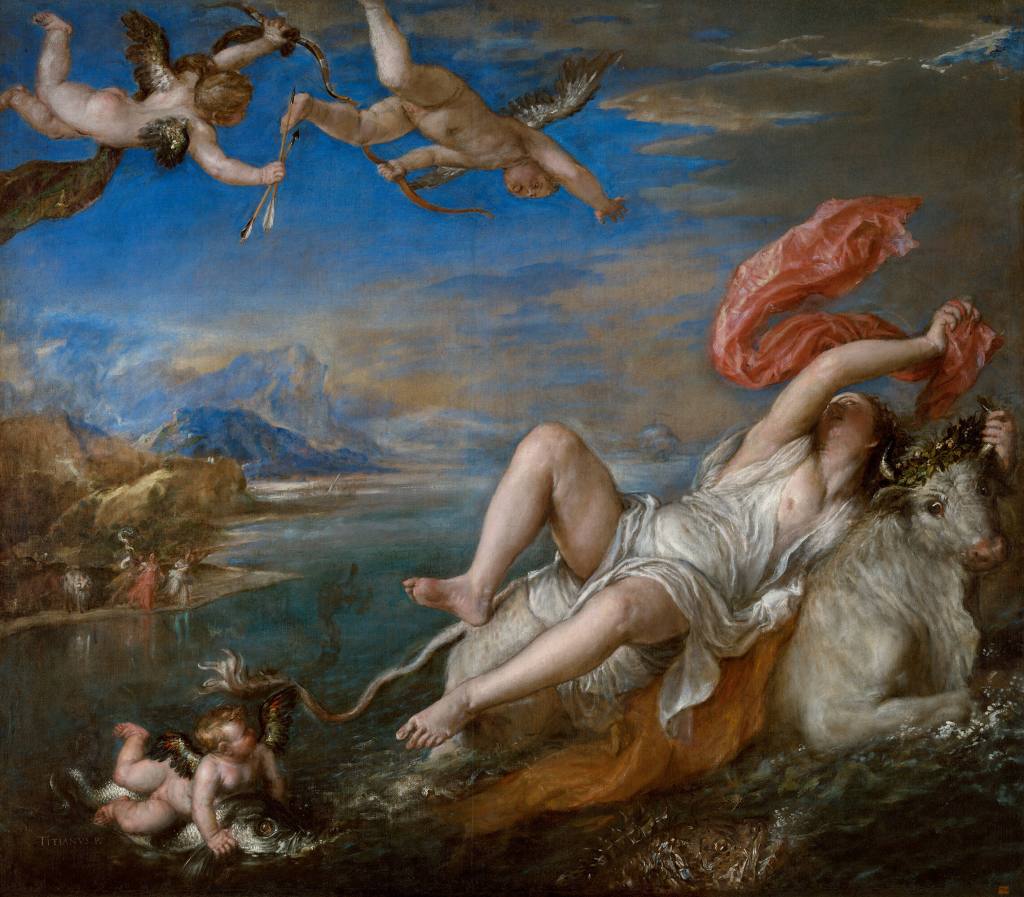
Once the contest begins, the contrast between the two works is absolute. Whereas Minerva’s tapestry affirms divine order, Arachne’s exposes the gods’ deceptions, including Jupiter’s abduction of Europa. What enrages Minerva is not simply the subject of Arachne’s work, but its faultless execution, which makes it a true rival to divine craftsmanship. In Ovid’s account, Arachne attempts suicide in order to escape her fate; Minerva prevents her death only to convert it into a perpetual punishment, condemning her to continue weaving in diminished form as a spider. Velázquez suspends the fable before its violent resolution. In Las Hilanderas Minerva confronts Arachne in a scene poised on the verge of punishment and transformation.
Already we can see the painting’s potential for interpretive entanglement. It presents two contrasting scenes, each with five female figures engaged in apparently unrelated activities: in the foreground, an everyday scene of textile labour; in the background, the enactment of a fable. Yet the foreground has also been read as an earlier phase of the same narrative. In this reading, the older woman engaged in spinning is identified as Minerva in disguise and the woman to the right, gathering wool into a ball, as Arachne.
Another interpretation sees the foreground workers as the Three Fates. At once, then, we move between related but distinct subjects and, consequently, the mythological component of the painting seems to prompt some viewers to decode the scene. For them, there is the possibility that every object and figure in the painting might be part of a preconceived intellectual programme. Iconographical speculation and close cross-referencing with texts and images in Velázquez’s library ensue; clearly, we need to tread carefully if we are not to lose our way.
Reading Las Hilanderas as an example of meta-painting offers a coherent line of analysis, and we may now turn to this more directly. Two earlier painters are invoked in the upper zone of Velázquez’s painting. As previously noted, Titian’s The Rape of Europa (1559–62) reappears as a tapestry at the back. There is also a more indirect, twofold reference to Rubens. First, Rubens made a copy after Titian’s composition in Madrid in 1628–29.
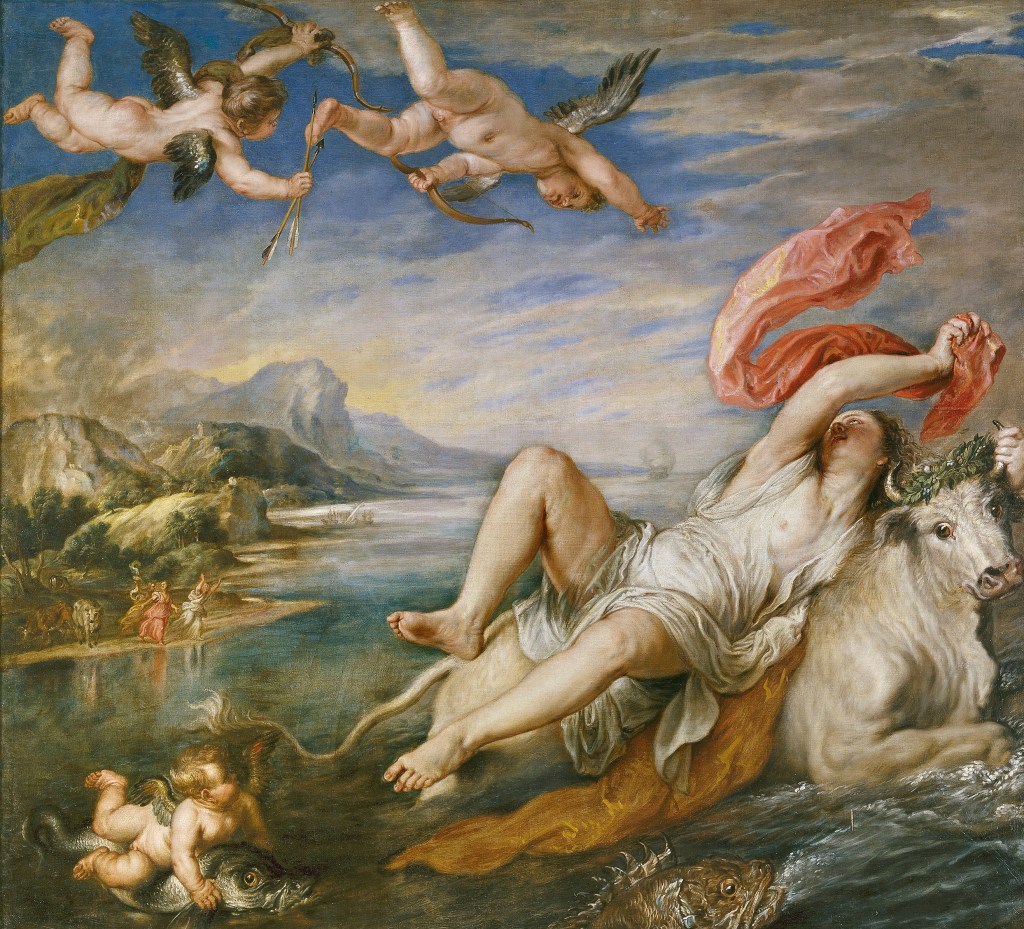
(Credit: Wikimedia Commons).
Second, Rubens devised his own Pallas and Arachne for the Torre de la Parada in the later 1630s. The full-scale painting no longer survives, but an autograph oil sketch, officially titled Pallas and Arachne (1636–37), is in the Virginia Museum of Fine Arts, Richmond, Virginia. Many scholars have also identified the left-hand background picture in Las Meninas (1656) as a copy, by Juan Bautista Martínez del Mazo, after that Rubens composition.
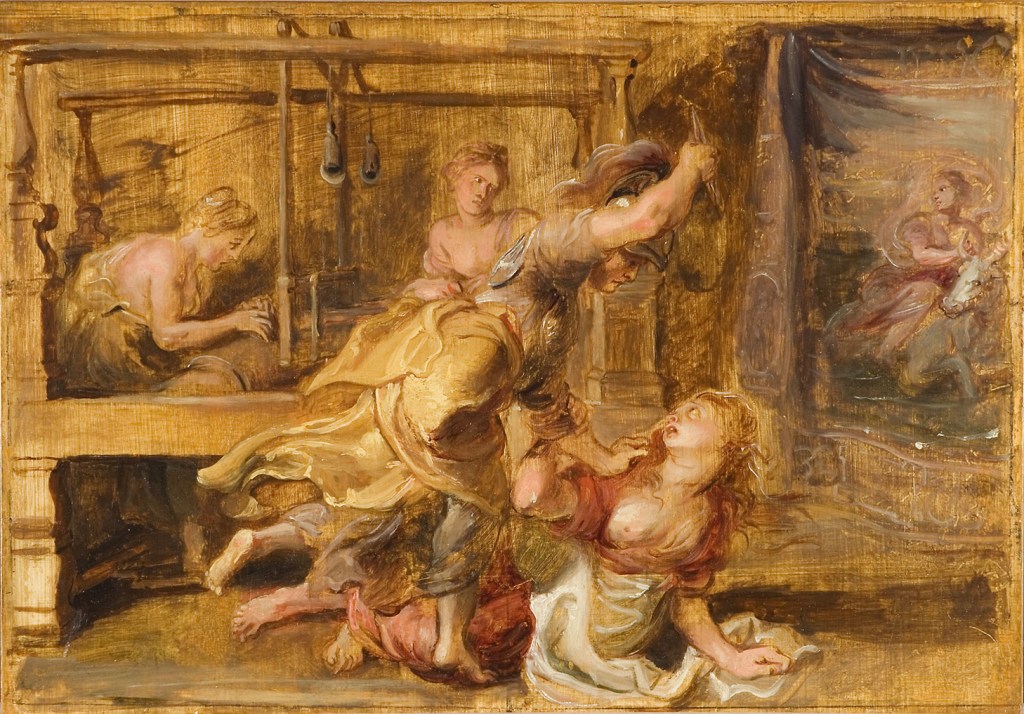
(Credit: Wikipedia).
These nested allusions open possible lines of interpretation; one of them concerns artistic and social status. Titian, already patronised by Charles V and later by Philip II, stood as the great Habsburg model of painterly prestige. Rubens gave that model a more immediate seventeenth-century form. When he visited Madrid in 1628–29, Rubens copied numerous works by Titian in the royal collection and painted a now-lost equestrian portrait of Philip IV for the Alcázar, replacing an earlier equestrian portrait by Velázquez, itself now known only from literary sources. Throughout the 1630s Philip IV continued to commission major works from Rubens, and after the artist’s death in 1640 the king acquired further paintings from his heirs, including works Rubens had kept in his own collection.
As Svetlana Alpers has observed, Rubens’s skill would also have been evident through his designs for tapestries, an art form that itself enjoyed high prestige. Velázquez had seen him engage brilliantly with designs for the medium in the great Eucharist series made for the convent of the Descalzas Reales in Madrid. Perhaps the transposition of Titian’s Rape of Europa serves not only to fulfil the Ovidian narrative, but also to introduce a slightly ironic paragone between painting and tapestry, one that would also have implicated Rubens.
A further detail noted by Alpers, and relevant to both of Velázquez’s late works, is that the Eucharist tapestries engage in a kind of play of their own. These designs exemplify Rubens’s characteristic intelligence and wit: scenes of the Church Triumphant appear as tapestries that are themselves shown being hung within the woven image. This act of hanging alludes to the veiling of the Temple, producing an effect that is at once illusionistically playful and iconographically purposeful.
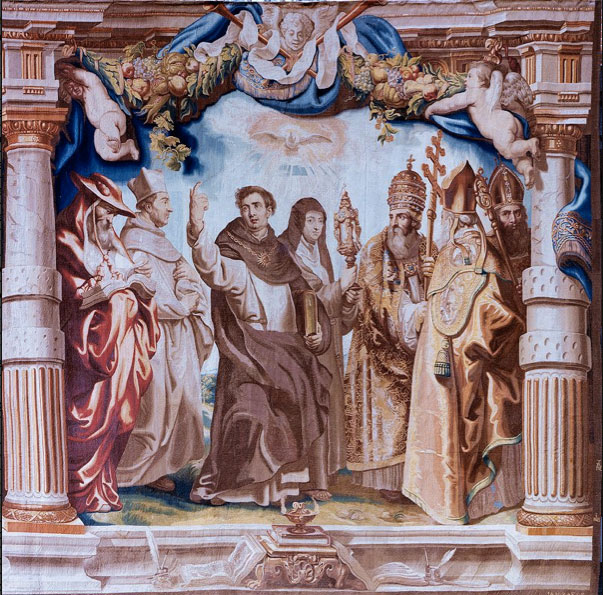
To evoke Titian and Rubens in Las Hilanderas is therefore to invoke not simply influence, but a tradition in which painterly authority and courtly distinction are closely bound together. At the same time, Rubens may carry a more immediate competitive significance, since he belonged not only to the pantheon of great predecessors but also to Velázquez’s own professional world, and had once displaced him in an important genre of royal representation.
In a very subtle way, Velázquez assimilates his rivals within his own painting. In doing so, he not only aligns himself with them in terms of status, but also marks out his inventive difference. Their example is reworked in a singular and personal manner: this is not mere emulation, but a kind of surpassing, a movement towards a new mode of painting.
The allusions are so refined that they passed unnoticed for years. Yet the dialogue with Titian and Rubens in Las Hilanderas is not only iconographical but technical. It can be seen in the way colour helps organise the canvas, in the way the spatial planes are bound together atmospherically rather than through rigid geometrical recession, and in the varied handling of the paint itself. Velázquez works here with remarkable flexibility, setting freer and more abbreviated passages beside richer and denser ones. In that sense, the pocos golpes praised in the seventeenth century remain crucial, though they do not define the painting’s entire surface. Rather, they form part of a broader orchestration in which bravura abbreviation, stronger colour, and more palpable paint are held in deliberate relation.
It is not only atmospheric perspective that creates shape and depth. The arrangement of the figures also contributes to the painting’s sense of order and recession, and here too there is a degree of mirroring between the two planes. In the lower plane, three seated figures form a circular grouping, flanked by two assistants. In the upper plane, this configuration is echoed in the arrangement of Minerva, Arachne, and the woman in the blue dress turned away from us. The two Lydian women at the sides likewise correspond to the assistants in the foreground. Alongside these two circular groupings, the foreground also contains a distinct V-shape formed by the spinner and the woman gathering wool into a ball. This directs the eye towards the centre and the rear of the scene.
A talk by Ángel Aterido suggests that a possible graphic antecedent for the foreground trio may be found in the illustrated opening of Liber Quartus in the 1565 Venetian Gryphius edition of Ovid’s Metamorphoses. Although the scene belongs not to the story of Arachne but to Alcithoe and her sisters, who persist in wool-work instead of joining the Bacchic celebrations, it nonetheless offers a potentially relevant model for a compact grouping of women absorbed in textile activity. Its value, then, lies not in establishing a direct iconographical source but in indicating a visual tradition in which such labouring female groupings were already available.
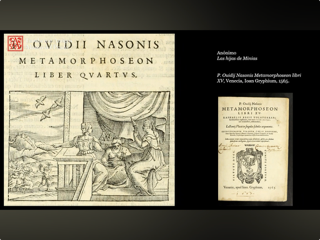
Watch the lecture on You Tube: https://www.youtube.com/watch?v=6SD4jMZB8aQ&t=1572s
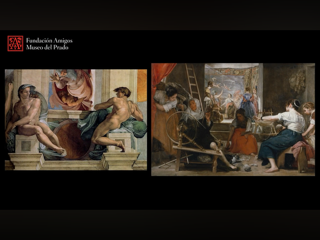
Aterido also recalls a compositional parallel for the V-shape, first noted by Diego Angulo Íñiguez: a visual correspondence between the two seated foreground figures in Las Hilanderas and a pair of Michelangelo’s ignudi on the Sistine ceiling, usually identified as those beside the Persian Sibyl. While these comparisons are necessarily tentative and concern formal choices, I find the comparison with the ignudi persuasive. Indeed, if one were to press the point further, such an allusion would not be out of place. In a work that arguably reflects on the status of the artist, an oblique reference to the “divine” Michelangelo could only reinforce its visual rhetoric.
There is another possible artistic connection to be made, albeit a slightly more tenuous one, between the foreground spinners in Las Hilanderas and works by Titian and Rubens. This suggestion also comes from Svetlana Alpers in The Vexations of Art, where she identifies Titian’s Diana and Callisto as a possible source for the working women in Velázquez’s painting. Rubens enters the discussion again here, since during his stay in Madrid he studied and copied Titian’s work. Mazo, moreover, made a smaller copy of the Diana and Callisto, while Rubens’s Nymphs and Satyrs, acquired in the 1640s, was itself a transformation of the composition. Philip IV also acquired Rubens’s copy after Titian at some point, but the first documentary record of its presence in the palace inventory dates only from 1666. Since Velázquez died in 1660, we cannot know whether he ever saw it at court. Even so, he would have been well aware of Rubens’s sustained engagement with Titian’s art.
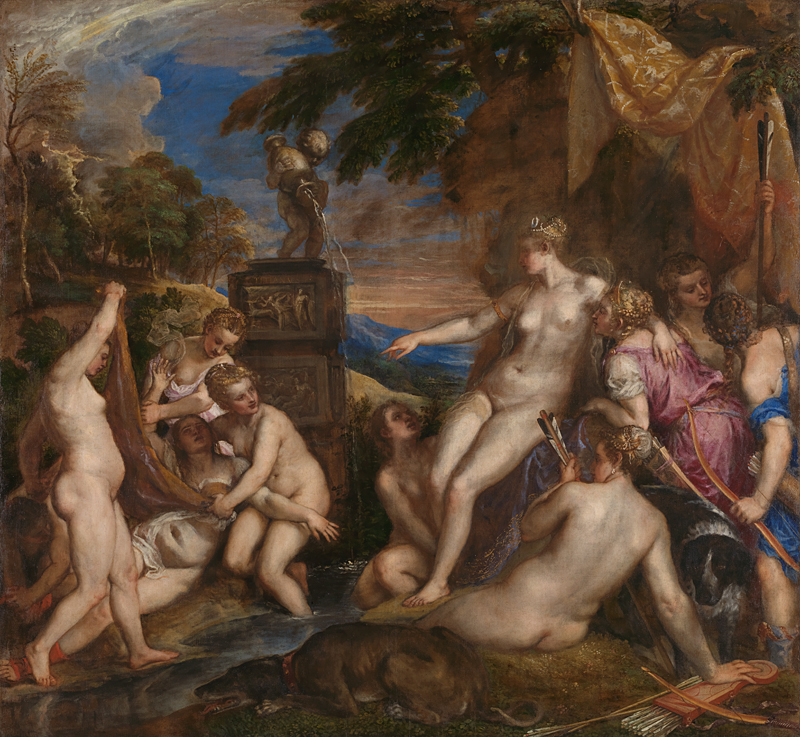
Diana and Callisto
1556-9
Oil on canvas, 187 × 204.5 cm
Bought jointly by the National Gallery and National Galleries of Scotland with contributions from the National Lottery through the Heritage Lottery Fund, Art Fund (with a contribution from the Wolfson Foundation), The Monument Trust, J Paul Getty Jnr Charitable Trust, Mr and Mrs James Kirkman, Sarah and David Kowitz, Chris Rokos, The Rothschild Foundation, Sir Siegmund Warburg’s Voluntary Settlement, and through private appeal and bequests, 2012
NG6616
https://www.nationalgallery.org.uk/paintings/NG6616
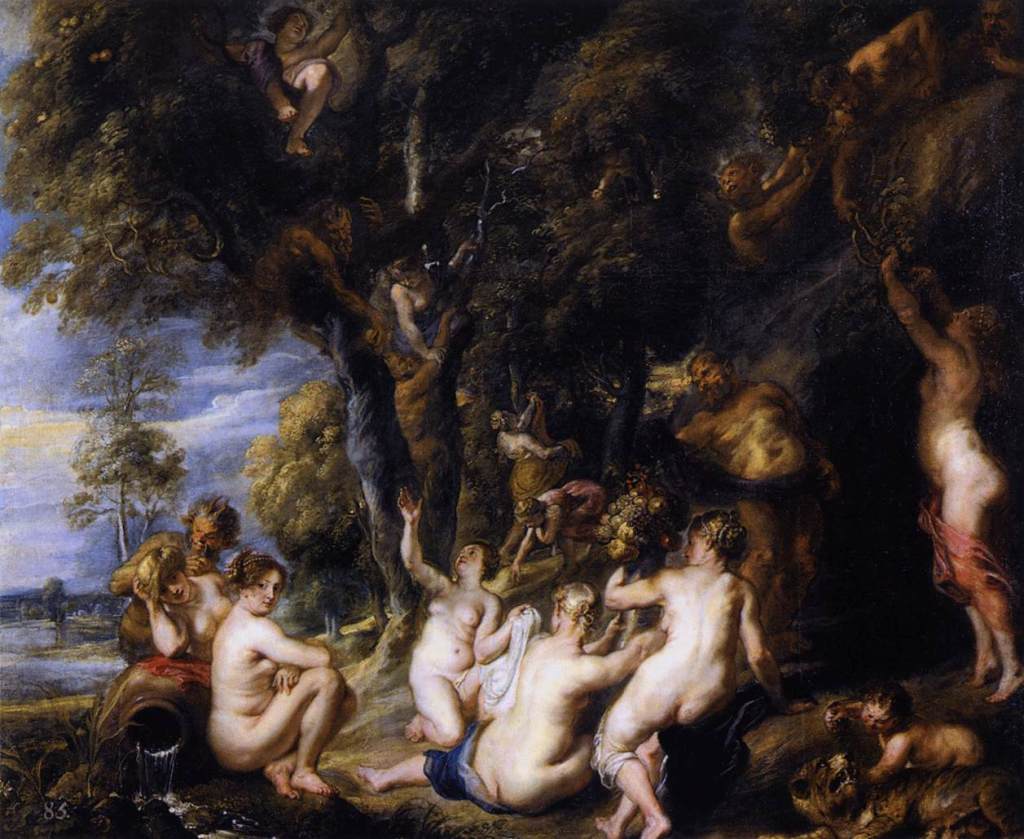
(Credit: Rubens, Nymphs and Satyrs, Wikimedia Commons).
If we are to accept the influence of the figures in Diana and Callisto on Velázquez’s foreground group, then, following Alpers, we must do so on the basis of their “scale… weight… and freedom of movement.” The spinners are, necessarily, clothed and set in a very different context, but Alpers seems to suggest that, through imitation and transformation, something of the erotic charge of Diana and Callisto persists in Las Hilanderas. She states that “Velázquez locates erotic pleasure in the energy and purpose of women’s bodies at work.” Camón Aznar offers a tamer, and now somewhat dated, account of the scene’s sensuality. He sees Las Hilanderas as an exalted image of womanhood in labour: women absorbed in work yet retaining beauty, grace, and intelligence. He dwells especially on the sensual elegance of the spinner, the palpable rapport among the figures, and the cat and fallen wool as signs of ordinary domestic reality. Nonetheless, both accounts, in different ways and to differing degrees, acknowledge the scene’s sensual appeal.
The idea that this could be art about art is reinforced by the woman, on the upper plane at the far right, who appears to meet our gaze, confirming the presence of observers before two scenes which, in all other respects, depict unselfconscious activity. Equally, the woman drawing the curtain in the foreground seems to be inviting us to view two snapshots of creation in motion: one of artisanal manufacture and one of courtly mythological representation.
Carl Justi offered the interpretation that the rear scene could be a theatrical performance, citing the presence of a musical instrument as evidence. Christine Lang subsequently developed this idea in an article on the pictorial dramaturgy of the painting. There is a case for seeing the arrangement and gestures of the figures at the back of the work as representing a rehearsal. The idea that the three Lydian women might be a small group of onlookers offering guidance in such a context seems plausible. There is also something unheroic and ordinarily human in the costumed Minerva, in my view. The masterful understatement of such a reading would also fit the witty dislocation of expectations characteristic of Velázquez.
If we are looking at a painting about artistic creation, then we are also looking at a process which transforms, transmits culture and adds value. In this context, we can reflect on the dynamism of the work. The spinning wheel, which is transforming fibre into useful thread that could then become a prestigious tapestry, is itself depicted with bravura skill. Gombrich wrote of the “stroboscopic effect” of this wheel’s blurred spokes and how Velázquez captured “the streaking after-image that trails its path across the field of vision when an object is whizzing past.” The foreground Arachne figure has active fingers which also seem to leave an after-image.
Beyond the obvious activities of the spinners and the figures at the back, we also have the dynamic tension of the Michelangelesque V-shaped contrapposto in the foreground and the similar interplay of Minerva’s raised hand and Arachne’s lower, opened palm. Minerva’s gesture here is borrowed from Rubens, but the act has mutated. It is no longer an arm raised in threat, intending to attack the presumptuous Arachne with a weaving shuttle; it is something altogether different, perhaps an obviously theatrical gesture, mimicking the casting of a spell.
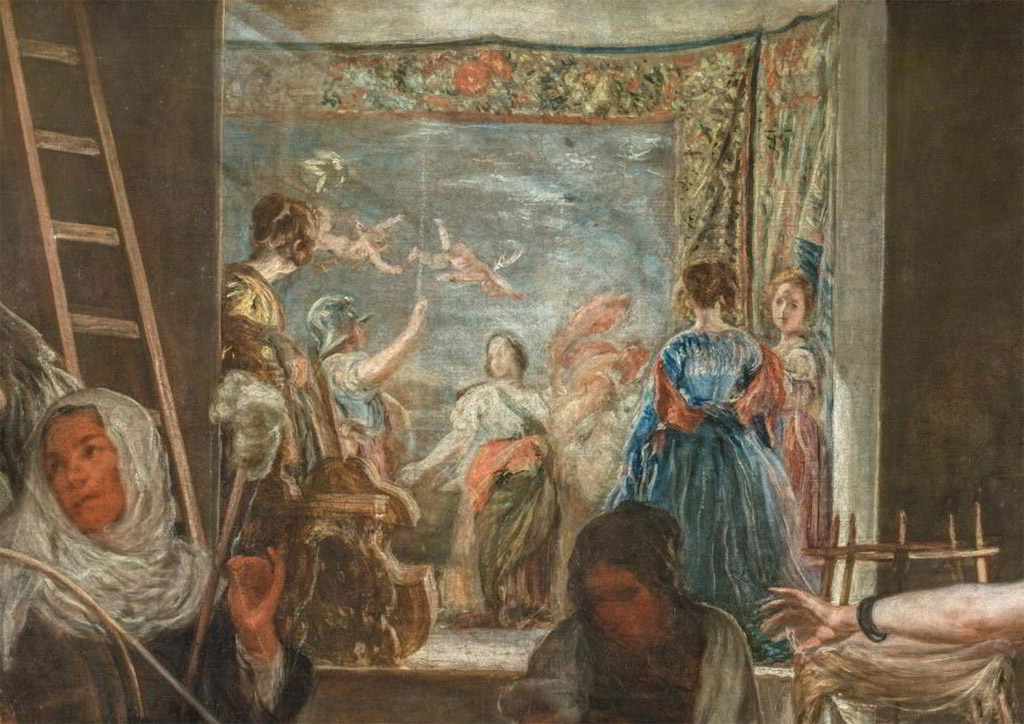
(Credit: Museo Nacional del Prado).
We have noted that this possible meditation on the status of artistic creation seems to integrate Titian and Rubens, figures widely celebrated in their own time. But we also need to mention another often-cited aspect of Velázquez’s bid for recognition. Jonathan Brown presents Velázquez’s admission to the Order of Santiago in 1659 as the culmination of a protracted and revealing struggle. Objections to the painter’s nobility forced repeated appeals, including papal dispensations, before he was finally admitted on 28 November 1659. Brown treats this episode of resistance to the elevation of a painter as a poignant backdrop to Velázquez’s last years, and as especially relevant to the interpretation of his two late masterpieces, The Fable of Arachne (Las Hilanderas) and Las Meninas. One close analysis of possible iconographical interpretations even sees the shadow cast by a spinning tool in the bottom left of the painting as a possible allusion to the cross of the Order.
Following Svetlana Alpers, Velázquez’s singularity appears as a courtly as well as an artistic achievement. His distinction lies not in open confrontation but in a highly intelligent indirection: a manner marked by tact, reserve, and self-command, in which rivalry is neither denied nor declared too openly. Drawing on Gracián and on Palomino’s anecdotes of envy and emulation, Alpers presents Velázquez as someone who responds to challenge not by direct contest but by displacement, wit, and measured self-possession. The same traits seem to inform Las Hilanderas. Its ambitions are considerable, yet they are not stated in bluntly heroic terms; its more dazzling effects are intermittent, concentrated in a few bravura touches, while elsewhere force is deferred, muted, or displaced. The result is an exceptional painting that, paradoxically, enters into rivalry without ever wholly presenting itself as a challenge.
Portús’s account in ‘Connecting Threads: Meninas, Spinners and a Musical Fable’, the final chapter of Velázquez’s Fables, is useful here because it makes explicit the theoretical force of this chain of allusions. In Golden Age mythography, writers such as Pérez de Moya, whose work was represented in Velázquez’s library, had read the fable of Arachne as an allegory of artistic progress: art was not fixed, but susceptible to refinement, emulation and improvement. Seen in this light, Velázquez’s treatment of the subject becomes more than an ingenious reworking of Ovid. It turns the myth into a meditation on artistic succession itself, in which inheritance from Titian and Rubens is not merely acknowledged but absorbed into the structure of a new and more complex pictorial invention.
Javier Portús also places this complexity within a broader culture of layered narration. In Golden Age literature, tapestries had a recognised role as vehicles for embedded stories: woven images could introduce one narrative inside another, as in Garcilaso de la Vega’s Égloga tercera, where nymphs working on tapestries allow the poet to unfold a sequence of mythological tales. This makes the tapestry in Las Hilanderas more than an appropriate attribute of the Arachne story. For a cultivated Spanish viewer, it would have been a familiar means of concealment, displacement and narrative deepening — a surface through which another story, or another order of meaning, could enter the work.
What distinguishes Velázquez from Rubens, as Portús stresses, is the audacity of that structure. Rubens gives the Arachne story a clear dramatic order: violence, competition and mythological action are placed where one expects to find them. As we have seen, Velázquez, by contrast, sends the fable to the rear of the painting and allows the foreground to appear almost genre-like. Yet this apparent demotion of the mythological subject is precisely what gives the painting its depth. Golden Age culture was well able to accommodate such polysemous constructions: like the drama or prose fiction of the period, Las Hilanderas could operate at more than one level, yielding different degrees of meaning according to the viewer’s knowledge and attentiveness. The viewer is made to reconstruct the hierarchy of meanings, and in doing so becomes aware of the painting’s own contrivance. The displacement of narrative priority is not a complication added to the subject; it is the means by which Velázquez turns the subject into a meditation on artistic intelligence.
Postscript
The preceding discussion has largely followed Las Hilanderas through its mythological, pictorial and courtly references. A final, more speculative observation may be added. In Velázquez there is often a tendency to place what is highest — the royal, the sacred, the mythological, the fabular — slightly out of reach. Rather than presenting such things directly and fully at the centre of attention, he displaces them, recesses them, mediates them, or allows them to appear only indirectly. In Las Meninas, the king and queen are not given as the obvious visual centre, but appear through reflection and through the responses of those around them. In Velázquez’s early Sevillian bodegones, especially Christ in the House of Martha and Mary and Kitchen Maid with the Supper at Emmaus, sacred narrative is likewise pushed into an opening, framed zone, or ambiguous secondary field beyond the world of kitchen labour. In the court portraits, too, royal authority can seem marked not by blunt centrality but by distance, reserve and remoteness.
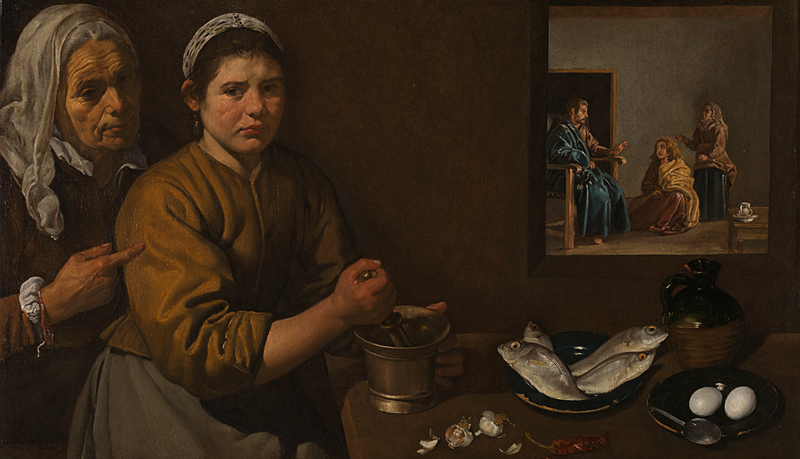
Christ in the House of Martha and Mary
probably 1618
Oil on canvas, 60 x 103.5 cm
Bequeathed by Sir William H. Gregory, 1892
NG1375
https://www.nationalgallery.org.uk/paintings/NG1375
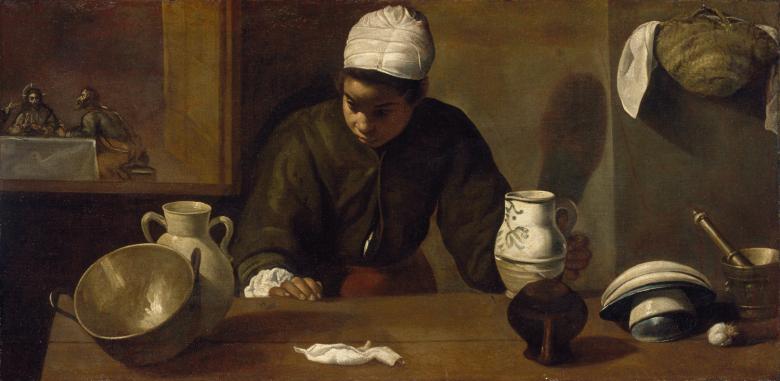
(Credit: Kitchen Maid with the Supper at Emmaus, National Gallery of Ireland).
This obliqueness is not merely a formal device. It may be one of the ways Velázquez generates value. Distance can reduce, but it can also exalt. What is remote, withheld, or only partially disclosed acquires rarity, distinction and a kind of sacred apartness. The inaccessible becomes charged precisely because it is not fully yielded to ordinary sight. Velázquez does not simply diminish the ideal by setting it at a distance; he may intensify it by making it elusive. Remoteness becomes a form of elevation.
In Las Hilanderas, this tendency is especially rich and complicated. The painting does not simply illustrate the fable of Arachne. It suspends the myth between several states: work and performance, artisan process and fabular revelation, reality and theatricality, ordinary labour and courtly spectacle. The rear scene has something of a stage or rehearsal space: the drawn curtain, the viol da gamba, the elevated zone, and the small group before the tapestry all contribute to the impression that myth is not simply being narrated, but staged — or perhaps only half-staged. It feels less like a fully declared performance than a dramatic space not yet entirely activated.
This theatricality works because it strengthens the sense that the painting is built around deferral. Everything in it seems to postpone full possession of the subject. The foreground is a scene of process: wool becoming thread, labour becoming form, perhaps also an allusion to the earlier phase of the Arachne story, and perhaps, more broadly, to the Fates and to human mutability. The background presents the “higher” realm of image and fable, but even that remains unstable. The tapestry is an image after Titian, mediated through Rubens, then woven rather than painted, and finally re-presented by Velázquez. It is never simply the thing itself, but always a translated or mediated thing. The myth is present, but held at a distance and stopped short of full climax.
Part of the painting’s beauty may lie in this incompletion. It suggests that human desire never quite coincides with full possession. Form is always in process, always deferred, always transformed through another medium, another level, another frame. The ladder can sit within this structure too: practical, theatrical, symbolic, perhaps even carrying an echo of Arachne’s hanging, yet refusing to settle into a single meaning. Likewise, the partial obscurity of the figures, the effaced faces, and the difficulty of assigning fixed functions to the background group all contribute to a staging that also resists stable theatrical legibility. Theatre normally clarifies role and action; here theatricality thickens ambiguity.
Velázquez’s borrowings and allusions do not advertise themselves in a pedantic or static way. The painting may contain echoes of Titian, Rubens, Michelangelo, print culture, library culture and other visual traditions, but these are absorbed into an image that can make the viewer forget, for stretches of time, that it is so densely constructed. The work seems at once deeply artificial and uncannily immediate. It reflects on image-making while still drawing the viewer into the illusion.
The larger thought, then, is that Velázquez repeatedly organises his paintings around a paradox: the highest things are most powerful when they are not directly possessed. The sacred, the royal, the ideal, the fabular, and even finished pictorial form become more potent by being withheld, displaced, refracted, or glimpsed obliquely. In Las Hilanderas, this produces a vision in which beauty is tied to transience, mediation and incompletion — not to the secure presentation of an ideal object, but to the restless process by which such an object is imagined, staged, translated and desired.
[Producing these essays requires care, time, research, and resources. Contributions to help sustain this exploration would be greatly appreciated.]
Donate to Inner Surfaces here.
Bibliography
The following works were consulted but any errors are mine.
Alpers, Svetlana, The Vexations of Art: Velázquez and Others, New Haven and London, 2005.
Bauer, George, and Linda Bauer, ‘Astrology in “Las Hilanderas”’, Source: Notes in the History of Art, 22, no. 4, Summer 2003, pp. 22–29.
Bedaux, Jan Baptist, ‘Velázquez’s “Fable of Arachne” (“Las Hilanderas”): A Continuing Story’, Simiolus: Netherlands Quarterly for the History of Art, 21, no. 4, 1992, pp. 296–305.
Brown, Jonathan, Painting in Spain: 1500–1700, New Haven, 1998.
Brown, Jonathan, Velázquez: Painter and Courtier, New Haven and London, 1986.
Carr, Dawson W., with Xavier Bray, John H. Elliott, Larry Keith and Javier Portús, Velázquez, exh. cat., London, 2006.
Gombrich, E. H., Art and Illusion: A Study in the Psychology of Pictorial Representation, New York, 1960.
Harris, Enriqueta, Velázquez, Oxford, 1982.
Justi, Carl, Velázquez and His Times, New York, 2006; first published as Diego Velazquez und sein Jahrhundert, Bonn, 1888.
Kahr, Madlyn Millner, ‘Velázquez’s Las Hilanderas: A New Interpretation’, The Art Bulletin, 62, no. 3, September 1980, pp. 376–385.
Lang, Christine, ‘The Rehearsal as Metaphor for Metamorphosis: The Pictorial Dramaturgy in Velázquez’s The Spinners, or The Fable of Arachne’, in Sabeth Buchmann, Ilse Lafer and Constanze Ruhm, eds, Putting Rehearsals to the Test: Practices of Rehearsal in Fine Arts, Film, Theater, Theory, and Politics, Berlin, 2016.
Marini, Maurizio, Velázquez, Milan, 1997.
Montanari, Tomaso, Velázquez e il ritratto barocco, Turin, 2018.
Pacheco, Francisco, and Antonio Palomino, Lives of Velázquez, trans. Nina Ayala Mallory, intro. Michael Jacobs, London, 2006.
Portús Pérez, Javier, ‘Connecting Threads: Meninas, Spinners and a Musical Fable’, in Javier Portús Pérez, ed., Velázquez’s Fables: Mythology and Sacred History in the Golden Age, exh. cat., Madrid, 2007, pp. 279–303.
Portús Pérez, Javier, ed., Velázquez’s Fables: Mythology and Sacred History in the Golden Age, exh. cat., Madrid, 2007.
Stapleford, Richard, and John Potter, ‘Velázquez’ Las Hilanderas’, Artibus et Historiae, 8, no. 15, 1987, pp. 159–181.
Tomlinson, Janis A., Painting in Spain: El Greco to Goya, 1561–1828, London, 1997.

