Part One: Caravaggio, Naples, and the First Inheritance
Overview
Giovanni Battista Caracciolo, known as Battistello, was born in Naples in 1578 and died there in December 1635. In 1598 he married Beatrice di Mario da Gaeta, with whom he had a large family, and by the beginning of the new century he was already active in the decorative culture of late-Mannerist Naples. His earliest documented commission, in 1601, concerned painted putti on the façade of the Monte di Pietà, now almost entirely lost. His formation appears to have taken place in the orbit of Neapolitan painters such as Belisario Corenzio, Fabrizio Santafede and Francesco Imparato.
Caravaggio’s arrival in Naples at the end of 1606 marked the decisive turning point in Battistello’s career. He was among the first Neapolitan artists to absorb the lesson of the new naturalism, and his closeness to Caravaggio was still recognised decades later. In the 1659 inventory of Archduke Leopold Wilhelm’s collection in Vienna, the painter of Cristo nell’orto degli ulivi, now in the Kunsthistorisches Museum, was identified as “Michelangelo Caraccio”: a telling error, which gives Battistello part of the name of Michelangelo Merisi and reveals how closely he was associated with the great Lombard painter. His Immacolata Concezione con san Domenico e san Francesco di Paola, painted for Santa Maria della Stella in 1607–08, was his first major public statement in this new idiom. The Liberazione di San Pietro dal carcere, painted in 1615 for the Pio Monte della Misericordia, confirmed his early maturity and his growing importance within the religious institutions of Naples. Around the same years he painted other ambitious works, including the Trinitas terrestris for the Pietà dei Turchini.
Battistello’s reputation was not confined to devotional painting. He moved in cultivated circles and was connected with Giovanni Battista Manso, Marchese di Villa, a literary patron and founder of the Accademia degli Oziosi. Through this milieu Battistello stood close to figures such as Giambattista Marino and Giambattista Basile. Basile dedicated a poem to him in his Madrigali e Ode of 1617, and Battistello’s lost portrait of Basile is known through an engraving. These connections suggest an artist whose career was embedded not only in workshop practice and ecclesiastical patronage, but also in the literary and aristocratic culture of early seventeenth-century Naples.
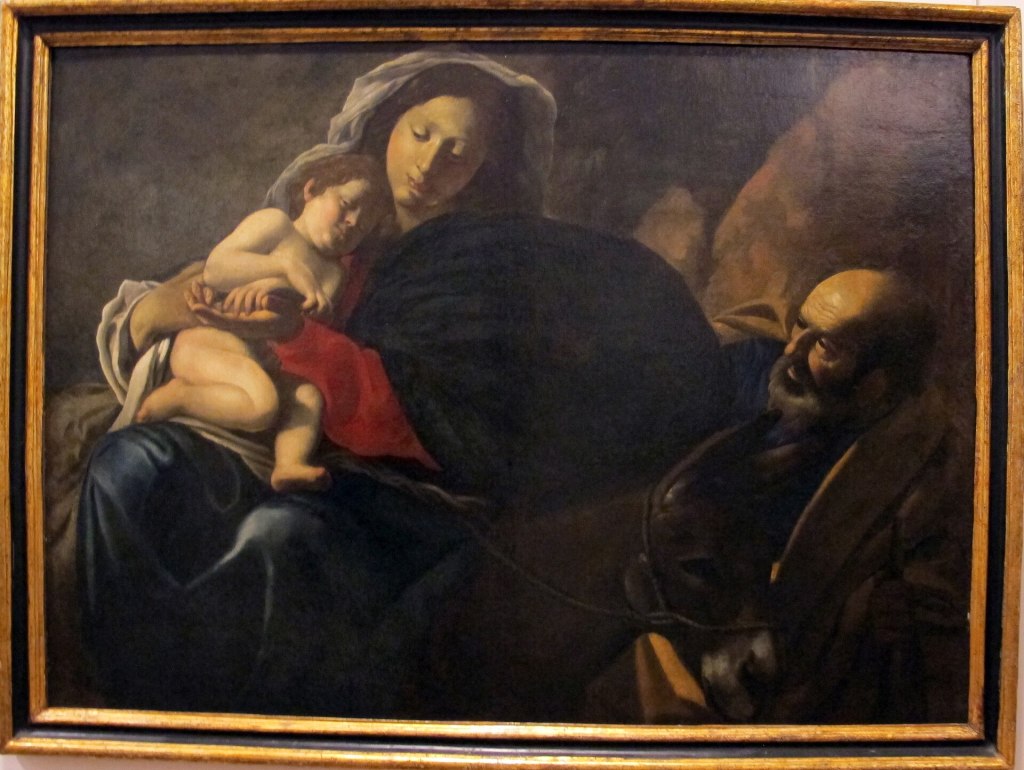
From the later 1610s Battistello’s career broadened beyond Naples. In 1614 he had been in Rome, where he came into contact with Orazio Gentileschi, and in 1618 he worked for the grand-ducal court in Florence, painting the Riposo nella fuga in Egitto now in Palazzo Pitti. He also travelled to Genoa under the patronage of Marcantonio Doria, Caravaggio’s former patron, for whom he worked on the now-lost fresco decoration of the Doria villa, or casino, at Sampierdarena. After these journeys he returned to Naples, continuing to develop a language rooted in Caravaggio’s example but increasingly modified by Roman, Florentine and Genoese experience.
(Credit: Wikipedia).
The Lavanda dei piedi, painted in 1622 for the choir of the Certosa di San Martino, marks the first major success of Battistello’s mature phase. During the 1620s and early 1630s he became one of the leading painters of major ecclesiastical and institutional commissions in Naples, working for the Gesù Nuovo, Santa Maria la Nova, San Diego all’Ospedaletto and, above all, the Certosa di San Martino. His brief involvement with the decoration of the Cappella del Tesoro di San Gennaro in the Duomo was less successful, and appears to have ended with his removal from the commission; but his decorations for the chapels of the Assumption and of San Gennaro at San Martino belong to the central achievements of his later career.
In his final years Battistello remained responsive to the changing artistic climate of Naples, which included the presence of painters such as Ribera, Domenichino and Lanfranco. His career traces one of the central transformations of early seventeenth-century Neapolitan painting. Formed within the local tradition of late Mannerism, he responded to Caravaggio’s insistence on painting from life and to the unidealised authority of bodies caught in sharp, selective light. He subsequently moved towards a Baroque pictorial language shaped by the experience of travel, the demands of fresco and the scale of institutional patronage.
Part One: Caravaggio, Naples, and the First Inheritance
Stefano Causa has called Battistello Caracciolo il più infedele dei Caravaggeschi, “the most unfaithful of the Caravaggists”. The phrase acknowledges the determining importance of Caravaggio while also suggesting the limits of viewing Battistello entirely through his example. Battistello belongs among the foremost caravaggeschi of Naples, but the term describes only one aspect of his formation and practice. The limits of the label are also evident in his working methods: unlike Caravaggio, he made preparatory drawings, devised extensive decorative schemes and continued to work in fresco. His later development was shaped by encounters with Ribera and Lanfranco, as well as by sculpture and by the particular demands of public decoration. His career consequently occupied a broader and more varied artistic field than the designation “Caravaggist” alone can convey.
In Naturalismo deciduo. Un racconto di Battistello Caracciolo, his essay for the 2022 Capodimonte exhibition catalogue, Causa begins from Longhi’s famous image of Battistello as the “grave bronze patriarch” of the Neapolitan Seicento, but turns that monument into a more historically mobile figure. In this account, Battistello’s Caravaggism should not be treated as a permanent identity. It is the strongest and most obvious aspect of his formation, running broadly from the Immacolata Concezione con san Domenico e san Francesco di Paola in Santa Maria della Stella, painted in 1607–08, to the Lavanda dei piedi in the choir of the Certosa di San Martino in 1622. After that point, however, Caravaggio remains present without being sufficient to explain the work. Battistello’s later painting opens onto other demands and other models: fresco, public decoration, the practice of the workshop, the example of Lanfranco and Ribera, and the re-emergence of sixteenth-century Neapolitan painting as a living influence.
(Credits: Wikimedia Commons and Catalogo Generale dei Beni Culturali).
This does not diminish Caravaggio’s importance for Battistello; it allows us to see that importance as just part of a higher resolution image. In Sulla prima ora del caravaggismo a Napoli, his essay for the 2019 Capodimonte exhibition catalogue Caravaggio Napoli, Augusto Russo usefully keeps the Caravaggio question at the centre. He presents Battistello as the first and most alert representative of a specifically Neapolitan Caravaggism: not one follower among others, but the painter who grasped the new direction before the rest. Yet even here the story does not begin abruptly with Caravaggio’s arrival in Naples at the end of 1606. Russo allows for the possibility that Battistello had already encountered Caravaggio’s Roman works, perhaps during a journey connected with Belisario Corenzio and the Jubilee year of 1600. A drawing associated with Belisario Corenzio after the Vocazione di san Matteo suggests how rapidly news of Caravaggio’s Roman breakthrough could circulate between Rome and Naples. Battistello’s Caravaggism may therefore have begun as an informed response to the Roman Caravaggio before it became a direct encounter with the Neapolitan works.
There is no denying the radical impact that Caravaggio created in Naples, but his arrival did not simply overturn the local traditions within which painters had already been formed. Battistello had been trained within the late-sixteenth-century decorative and fresco culture of Naples, in a world shaped by Belisario Corenzio, Fabrizio Santafede, Girolamo Imparato, Francesco Curia and the Romanising habits of the previous generation. Moreover, as we have already indicated, he is first documented in 1601, working under Corenzio on the fresco decoration of the Monte di Pietà.
The scale and influence of Corenzio’s activity in Naples should not be underestimated. In the Dizionario Biografico degli Italiani, Francesco Abbate speaks of the indubbia egemonia Corenzio had established in the city: a dominance measured less by isolated masterpieces than by the sheer reach of his fresco campaigns and sacred commissions. This orbit gave Battistello a command of fresco, which he would exploit throughout his career in a way neither Caravaggio nor Ribera did, and it also grounded him in drawing, a practice to which he remained consistently attached. Naples around 1600 was not inert or provincial. It possessed a cultivated decorative culture, visible in collaborative projects such as the ceiling of Santa Maria la Nova, and sustained by fresco, colour, sculpture, prints, Roman models and elaborate workshop practice. The radical changes brought by Caravaggio were therefore assimilated into an already complex local language; they did not sweep away everything that had come before.
The recovery of Battistello as a draughtsman is crucial to this broader argument. Marina Causa Picone’s important 1993 article, “Giunte a Battistello. Appunti per una storia critica di Battistello disegnatore”, published in Paragone. Arte, did more than assign further sheets to the painter: it gave Battistello’s drawings a critical shape. The drawings could now be related not only to major works such as the Liberazione di san Pietro dal carcere and the frescoes in the Palazzo Reale, but also to Raphaelesque models known through Raphael and Marcantonio Raimondi. What emerges is a different kind of artist: one who prepared and varied figures on paper, used drawing to think through pose, light and bodily emphasis, and retained a live awareness of older graphic habits even while becoming one of the central painters of Neapolitan Caravaggism.
Ippolita Di Majo’s later study of the Stockholm collection further developed this picture. By separating a group of Battistello drawings from the so-called Francesco Curia album in the Tessin collection, she showed how closely his graphic language remained tied to late-Mannerist Neapolitan practice while simultaneously developing beyond it. Against Curia’s lighter, more pointed line, Battistello’s sheets show fuller volumes, heavier limbs, stronger contour, rapid parallel hatching and a melancholy plasticity that Di Majo sees as characteristic of him. The distinction is one of weight and structure as much as attribution. Battistello’s naturalism is not simply an effect of Caravaggio’s darkness; it is built through drawing, through the conversion of older graphic habits into a more solid, synthetic and seventeenth-century language.
The Stockholm works also reveal a working method based on variation, transfer and reuse. Some sheets are figure studies; others are rapid compositional sketches for whole paintings or frescoes, including the Sant’Ignazio in gloria e le opere dei padri gesuiti, the Storie della Vergine and Storie di san Gennaro at the Certosa di San Martino, and the frescoes in the Cappella Severino at Santa Maria la Nova. Di Majo’s examples suggest that Battistello used drawing to test poses, redistribute groups, convert Caravaggesque memories into new dramatic situations, and carry motifs from one project to another. The drawings therefore complicate the image of Battistello as simply a Neapolitan Caravaggist. They show an artist whose naturalism was constructed through a sustained graphic practice, rooted in earlier local habits but increasingly directed towards breadth of form, dramatic light and large-scale pictorial invention.
De Dominici’s story of Battistello as Caravaggio’s pupil, imitator and copyist is a revealing myth, but too simple as biography. It imagines Battistello choosing the newly arrived Caravaggio as his true master and allowing his earlier training to fall away. Russo accepts the underlying insight: Caravaggio did represent for Battistello a passionate new beginning, almost an act of artistic contestation. But modern research makes the sequence less linear. Battistello’s later turn towards Bolognese and more classicising currents should be understood as a correction or enlargement of his early naturalism, not as a renunciation of Caravaggio. From the start, his Caravaggism was layered over an existing Neapolitan formation.
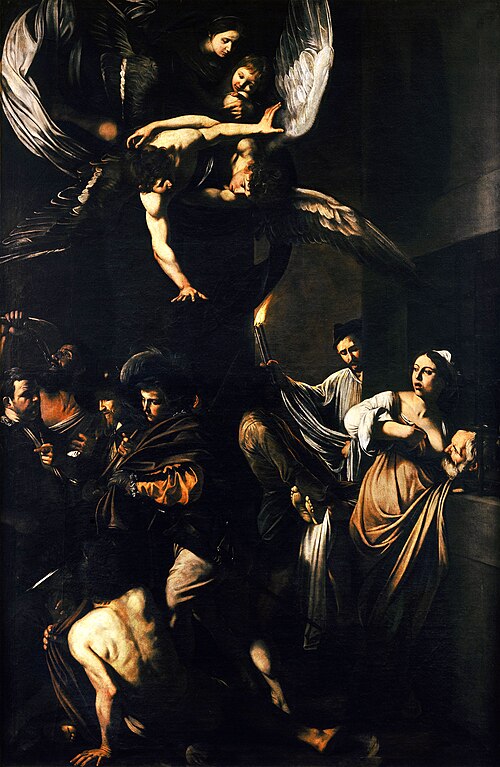
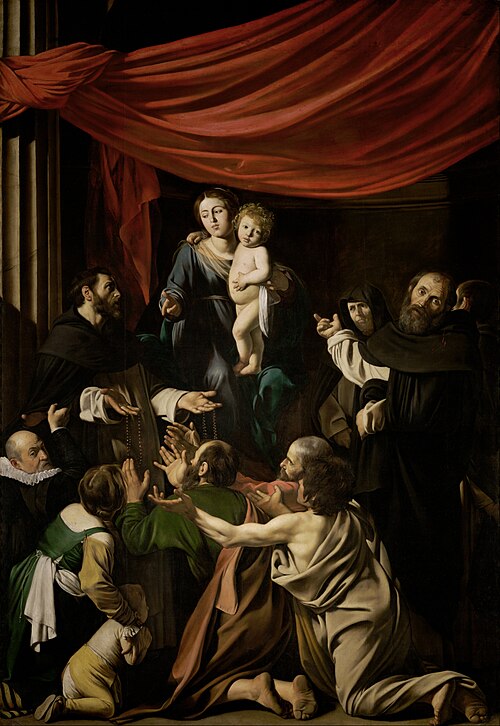
That selective, layered response is already visible in the way Battistello absorbs the two great paintings by Caravaggio then available in Naples. Russo identifies these as the Sette opere della Misericordia, completed early in 1607, and the Madonna del Rosario, whose importance for the Neapolitan painter was first recognised by Longhi. They were the works that most decisively allowed Battistello to “infuse Caravaggio into his imagination”, in De Dominici’s phrase, but they offered very different kinds of example. The more radical altarpiece for the Pio Monte made itself felt through the force of its dark tonal structure and through the selective adaptation of its compositional and figural inventions, while the Madonna del Rosario was more readily approachable in its syntax and colour. Battistello’s Immacolata Concezione may be understood as emerging from these two modes of Caravaggesque influence.
(Credits: Wikipedia).
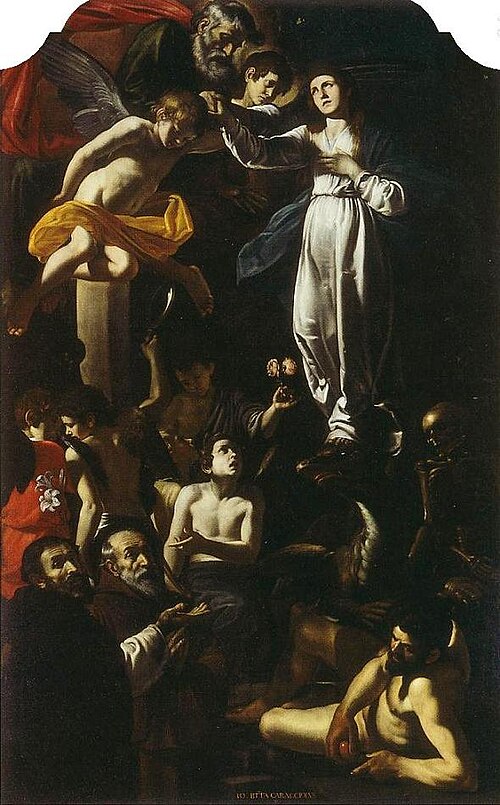
The Immacolata Concezione con san Domenico e san Francesco di Paola, painted for Santa Maria della Stella in 1607–08, is Battistello’s first fully signed and public work in which Caravaggio’s example is brought to bear on the older Neapolitan altarpiece tradition. It is one of the earliest naturalistic altarpieces in Naples, but its sources are mixed. The crowded, episodic difficulty of Caravaggio’s Sette opere della Misericordia meets the more assimilable late-Roman language of the Madonna del Rosario, especially in the three-quarter-length saints who point towards the Virgin and mediate between viewer and vision. At first sight, the work still preserves something of the inherited Raphaelesque altarpiece, familiar from the sacre conversazioni of the previous generation. Yet the structure no longer breathes with the same ease. Battistello darkens the field, brings the figures into closer relation, and uses light less as a general clarifying medium than as a means of stressing particular faces, gestures and devotional emphases. Saints, angels, symbolic apparatus and even the dragon are gathered into a denser and more urgent pictorial order.
As Causa observes, Battistello is not passively imitating Caravaggio’s Neapolitan masterpieces. What he confronts in the Sette opere della Misericordia is Caravaggio’s extraordinary command of a dynamic structure that seems always on the verge of breaking apart, yet never does. Multiple actions, bodies, gestures and divine presences are brought to the edge of confusion, yet the painting holds because that very risk is contained by our awe at Caravaggio’s personal vision and invention. In the Immacolata Concezione, Battistello tries to answer that example without pretending that Caravaggio’s freedom can simply be reproduced. The dragon, angels, saints and symbolic objects occupy the same crowded field, but they are held in a more deliberate order. Rather than risk confusion by imitating the hazardous freedom of the Sette opere, Battistello develops a modified compositional language: compressed, Caravaggesque, but more visibly governed.
This helps clarify the particular kind of Caravaggism at work in Battistello’s Immacolata Concezione. Some of its Caravaggesque signs are powerful, but they remain partly exterior: reddened hands, real boys posing as angels, wings treated almost like theatrical attachments, and bodies lit with the selective force associated with Caravaggio’s darkened pictorial spaces. These devices intensify the naturalistic character of the painting, but they do not mean that Battistello has fully internalised Caravaggio’s revolution. The work remains a hybrid. Its observed bodies and dramatic lighting are attached to a traditional iconographic and theological structure: the Virgin, the saints, the dragon, the animated skeleton, and the whole machinery of sin and redemption. In Caravaggio, theological meaning can seem to pass into the immediacy of bodies observed dal vero, faces drawn from the contemporary street, and actions that retain the dangerous energy of events still unfolding. In Battistello, naturalism is powerful, but it remains visibly bound to inherited signs and sacred design. His Caravaggism is therefore serious but partial: he takes over darkness, posing, light and bodily truth, but translates them into something more controlled, more reserved and more silent.
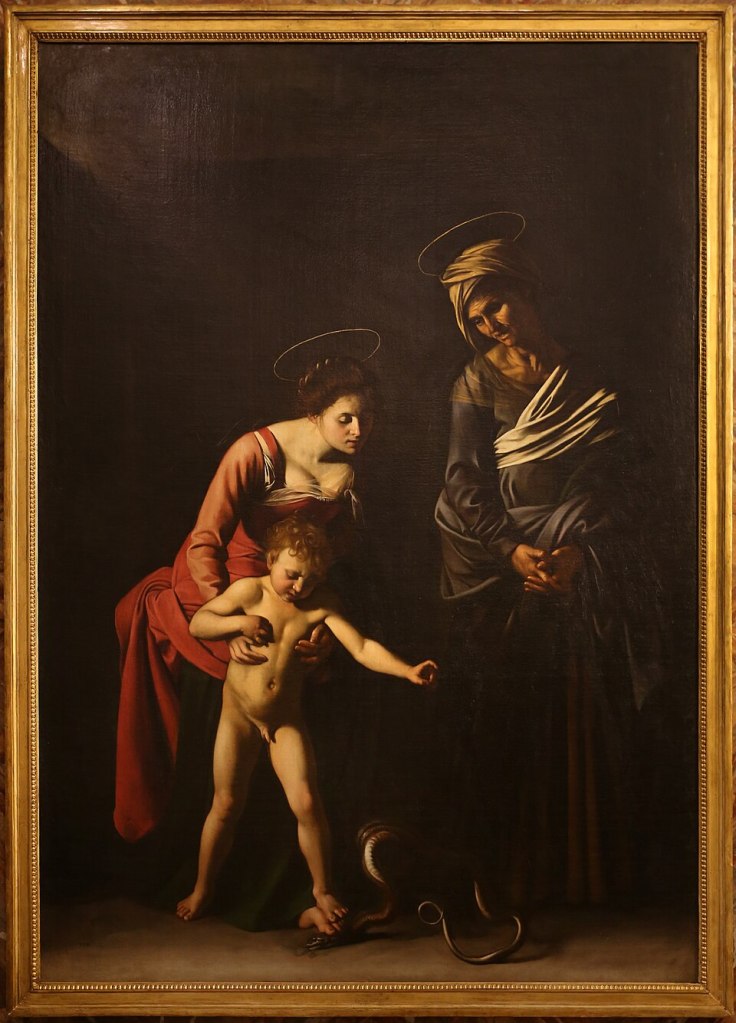
As Causa observes, the dragon in the work is a revealing case. Caravaggio would hardly have painted such a creature, except perhaps as a grotesque enlargement of the serpent in the Madonna dei Palafrenieri. Battistello, however, paints an impossible animal as if it were observed fact. Its scales, nostrils and tongue are given a physical credibility that makes older painted dragons look almost childish. In this sense the painting does something more complicated than import Caravaggesque darkness into an inherited devotional scheme. It applies the pressure of naturalism to a type of symbolic image that Caravaggio himself would have avoided.
Nor is the Immacolata Concezione only an exercise in darkness and compression. Causa’s point is not simply that Battistello relieves the late Caravaggesque language of ellipsis, abbreviation and shadow with passages of colour and surface. The painting also looks ahead. In those “refreshing pauses of fine painting”, including the angel on the left who seems to take his leave while chatting with another, and above all in the astonishing red of the Virgin’s robe, Causa sees a naturalism of colour in which later Neapolitan painters could recognise a path of their own. Stanzione, Vaccaro and Guarino are therefore not incidental names here, but witnesses to what the painting made possible: a Caravaggism that did not abandon compression, but allowed colour, fabric, incidental human exchange and painterly pleasure back into the field. Battistello remains deeply engaged with Caravaggio, even acting as a kind of interpreter of the Lombard master’s Neapolitan altarpieces; but the adjustment is not only structural. It opens Caravaggism towards a richer and more sensuous Neapolitan Seicento.
(Credit: Wikipedia and Catalogo Generale dei Beni Culturali).
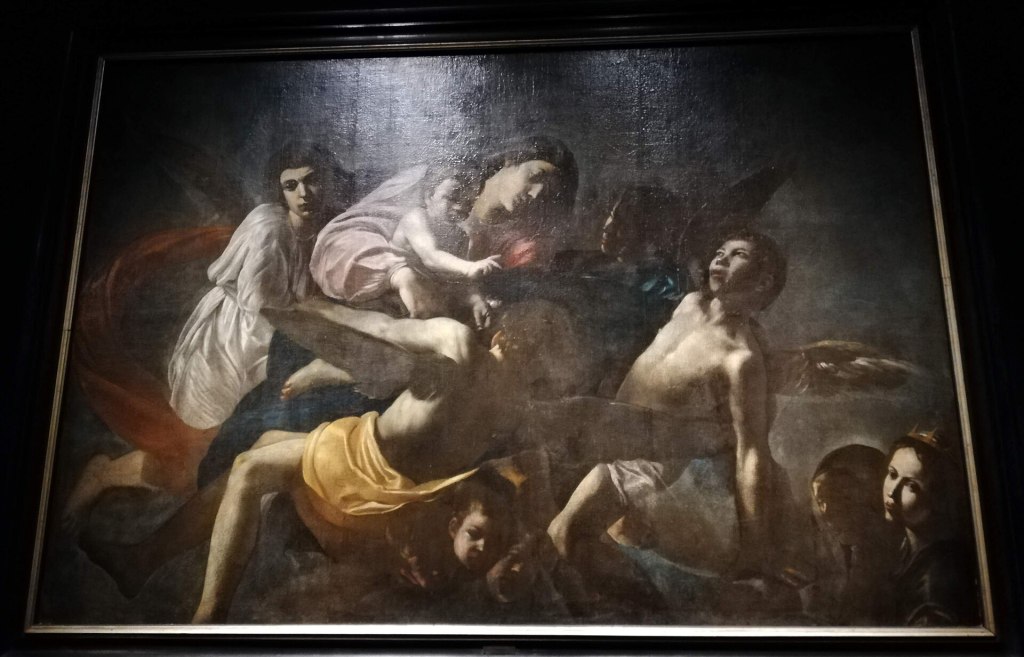
Russo’s discussion of Battistello’s relation to Caravaggio begins with Le sette opere di misericordia. Radiographic studies revealed an earlier arrangement of the heavenly group in Caravaggio’s altarpiece, and something close to this provisional solution seems to recur in Battistello’s Madonna col Bambino in gloria at Catanzaro. Vincenzo Pacelli therefore proposed that Battistello may have seen the altarpiece while it was still in progress, perhaps registering an arrangement that Caravaggio subsequently altered before bringing the work to completion. Russo treats the suggestion with appropriate caution, but values it for the possibility it raises: that Battistello may not merely have studied Caravaggio’s finished inventions, but at times stood close enough to their making to absorb choices that never reached the completed surface. The issue lies, as Russo puts it, between adherence and participation, between the imitation of a completed Caravaggesque image and a more direct proximity to Caravaggio’s act of invention.
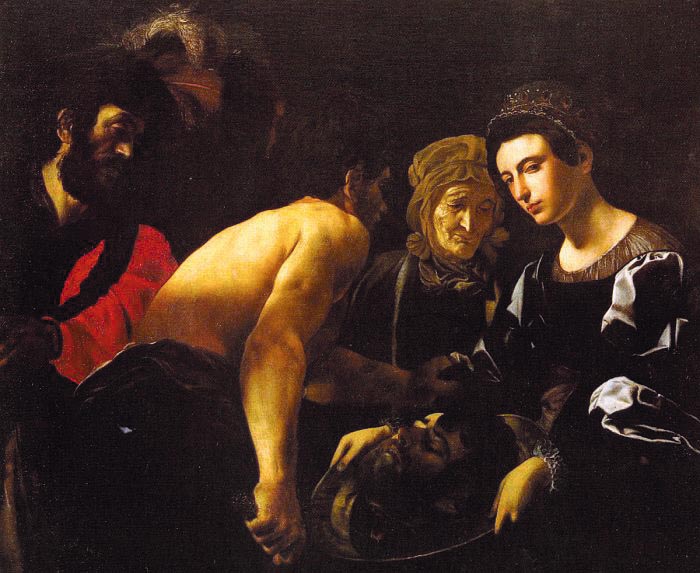
Battistello’s response to Caravaggio can also be followed on a smaller and more intimate scale in the figure paintings of his first Caravaggesque phase. Here the elaborate doctrinal components of the Immacolata Concezione fall away: no dragon, no skeleton, no crowded theological apparatus. In works such as the San Giovanni Battista in a New York private collection, and in other youthful Baptists, adolescent Bacchuses, Ecce Homo subjects and Salomè figures, Battistello tests what can be done with a single figure, a close-up body and a strongly directed light. Sacred and mythological identity begin to blur into the presence of the studio model; saint, pagan youth and street boy are held together without being fully reconciled.
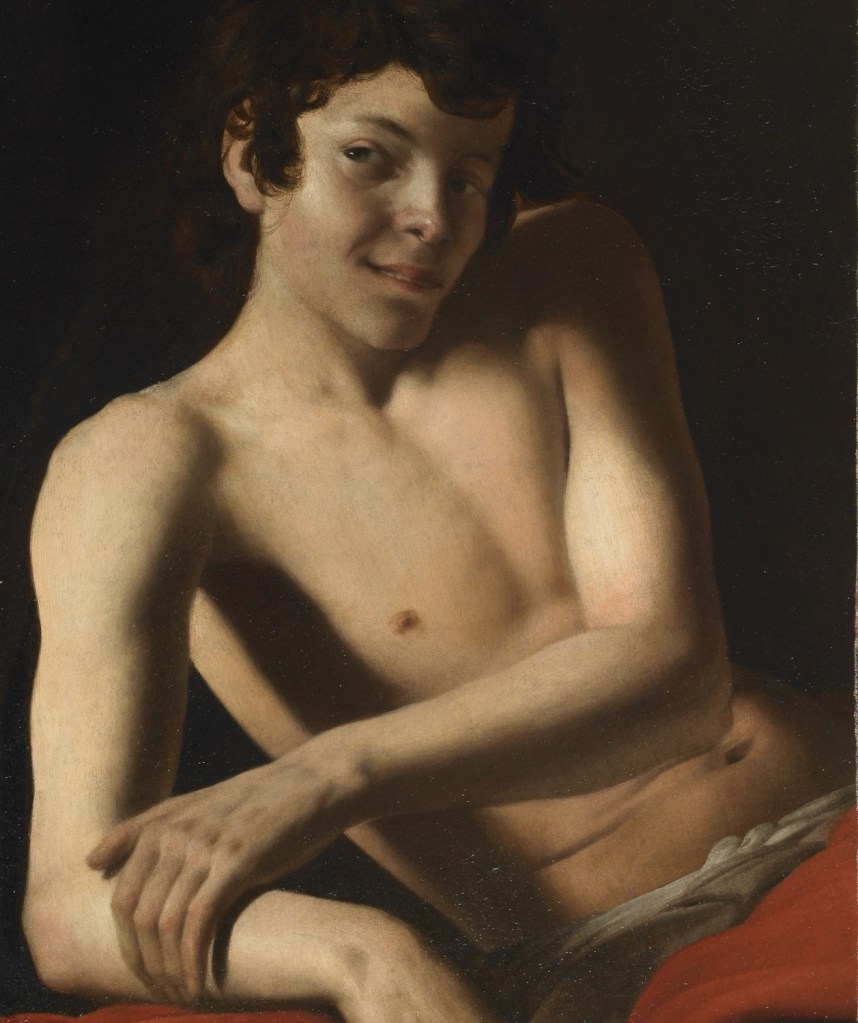
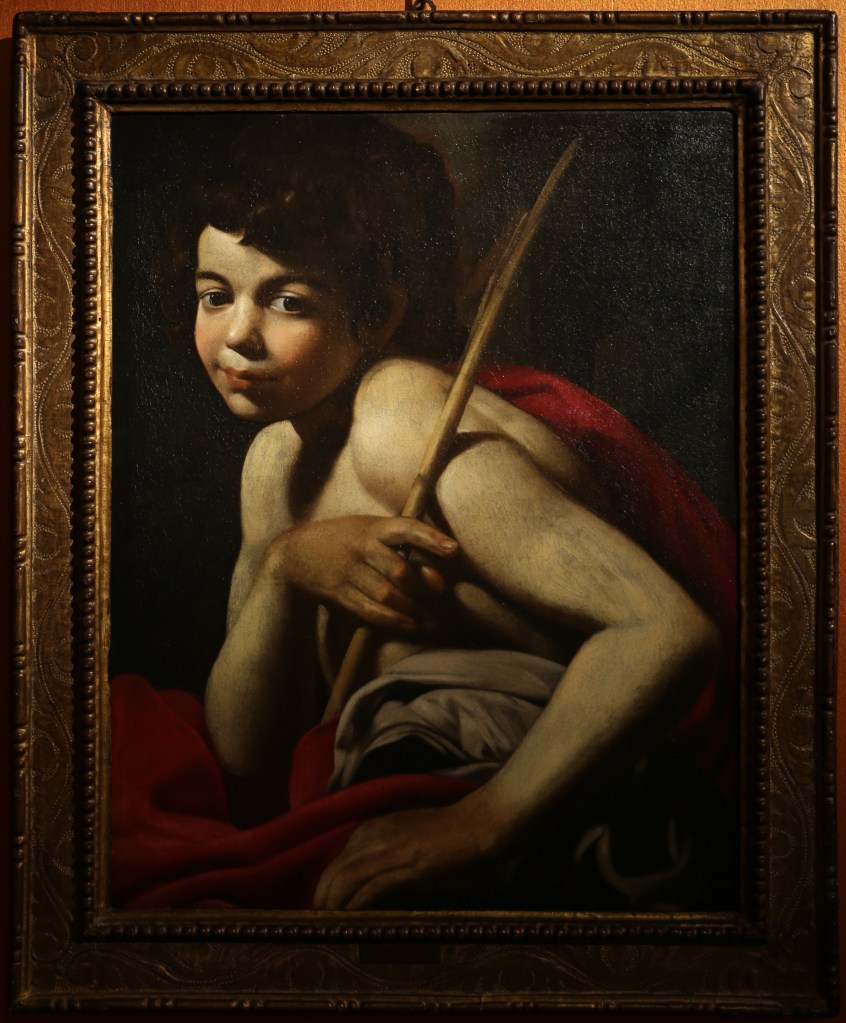
(Credit: Galerie Canesso, Paris and Wikimedia Commons).
That ambiguity prevents these works from being merely textbook Neapolitan Caravaggism. Battistello’s adolescents are not simply Caravaggio’s sensuous, equivocal youths translated into a local idiom. They are rougher, more abrupt and more closely tied to the physical pressure of the model before the painter. This is why Causa can extend the observation into a longer Neapolitan pattern, not as a demonstrable chain of influence but as a recurring pictorial possibility. One later point of contact is Preti’s Scena di carità con tre fanciulli mendicanti, where boys from the urban margins are brought close to the surface of the picture and made to address the viewer directly. From there the line can be extended, somewhere between analogy and direct descent, towards Kiprensky, Gemito and Mancini. What persists is not a single inheritance, but a Neapolitan way of allowing sacred, charitable or mythological subjects to be unsettled by the presence of figures that refuse to remain wholly inside their assigned roles.
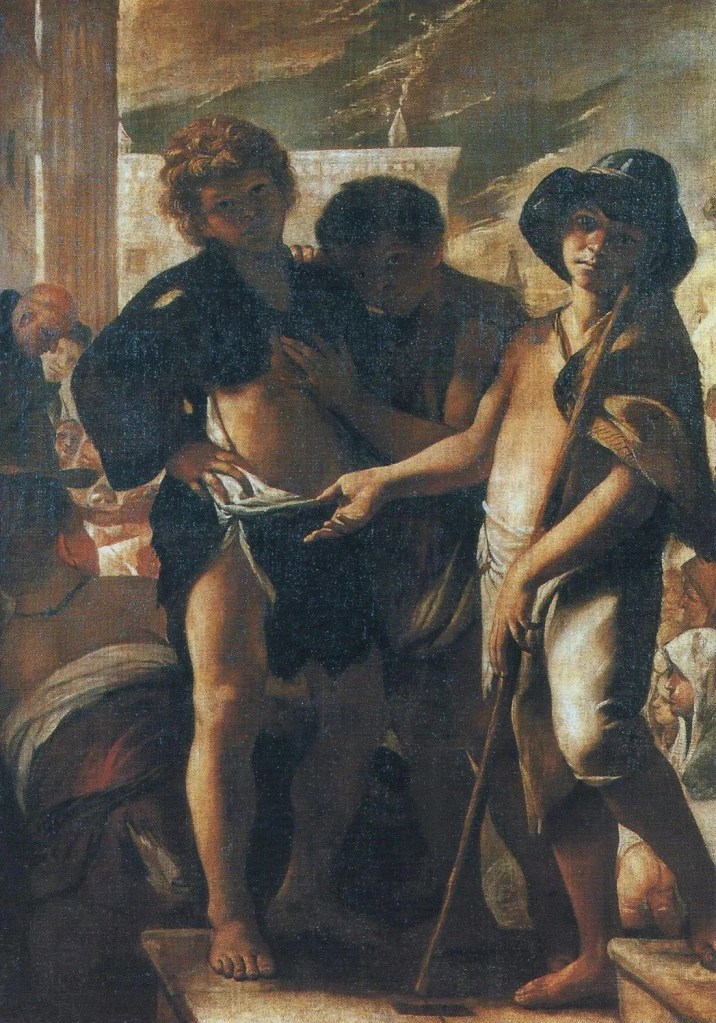
(Credit: Mattia Preti, il Cavalier Calabrese, catalogo di Giglio Italiano).
Russo places Battistello’s most radical Caravaggesque experiments around the threshold of 1610. The Crocifissione from the Annunziata, now at Capodimonte, shows him confronting a precise Caravaggio model, the Martirio di sant’Andrea now in Cleveland. Yet the response is selective. Battistello does not take over the old woman with the goitre, one of the details in Caravaggio’s painting that might have appealed strongly to northern painters because of its expressive grotesquerie. It does not belong to his conception of the scene. Even at his most Caravaggesque, he is choosing, suppressing and reordering, not merely imitating.
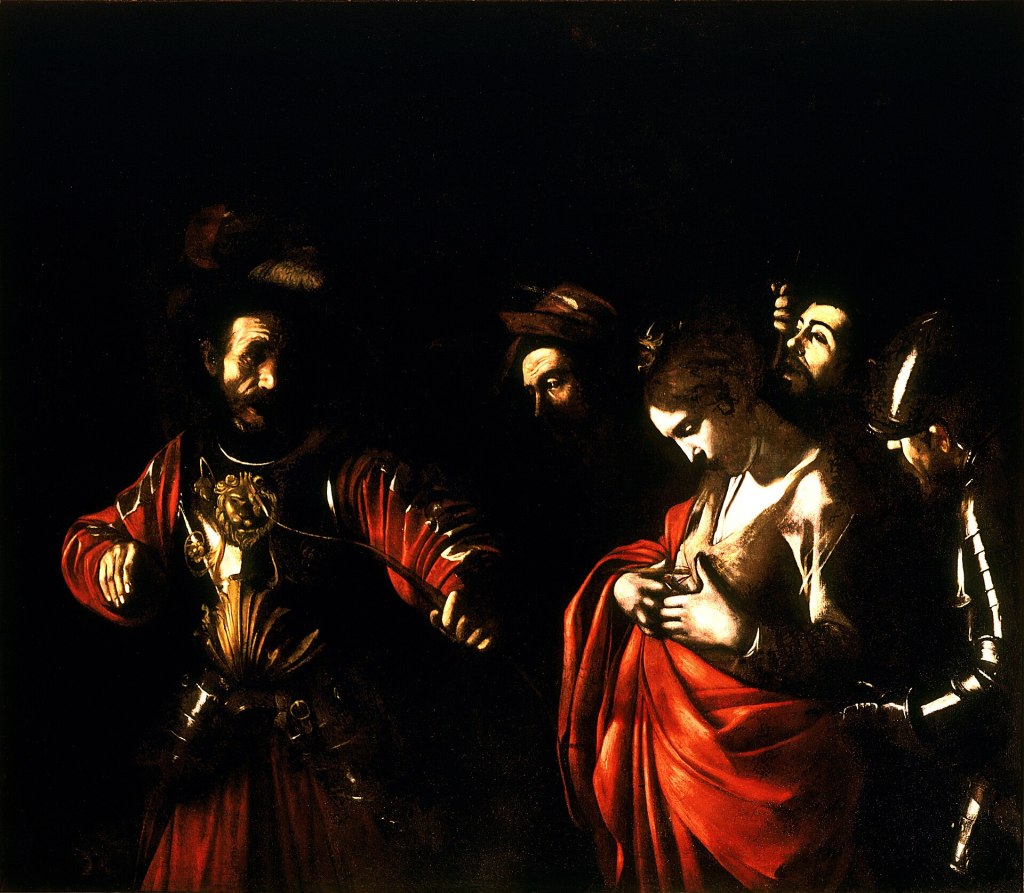
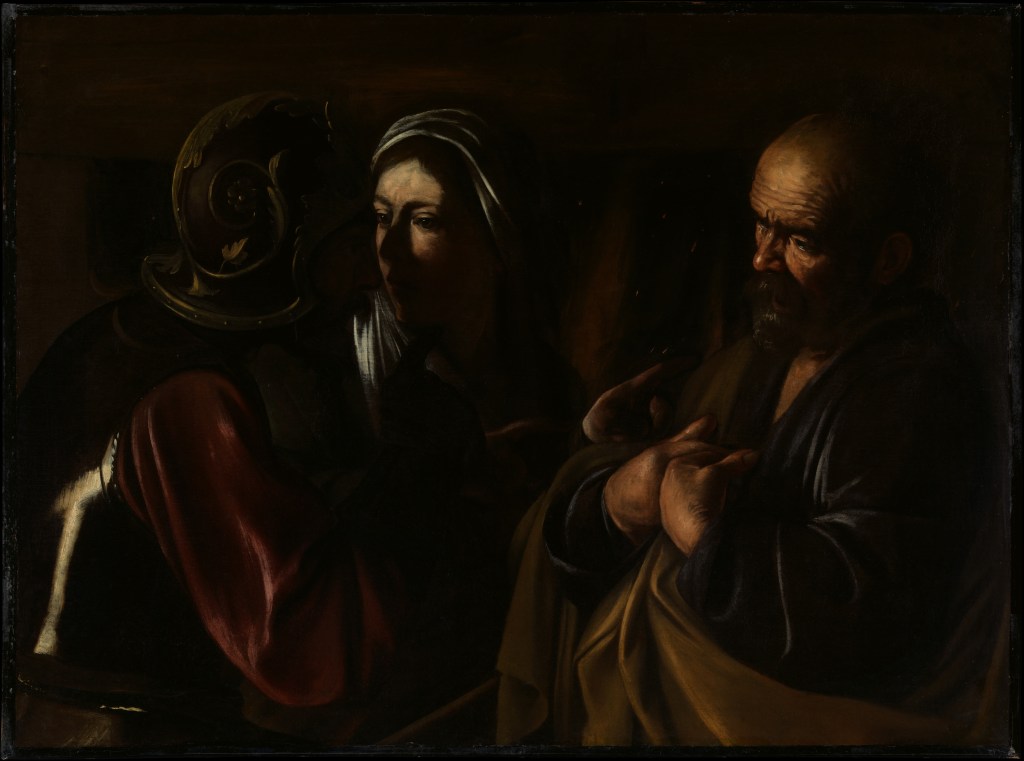
The Battesimo di Cristo in the Pinacoteca dei Girolamini, probably painted not long after 1610, belongs to the same severe moment. Russo sees it as almost an emblem of Battistello’s understanding of the late Caravaggio. Its darkness, meagre colour and lack of environmental detail bring it close to the final Caravaggio of the Martirio di sant’Orsola and the Negazione di Pietro: a painting reduced almost to bare human and spiritual fact. Russo’s phrase pittura della rinuncia is especially helpful. Late Caravaggio becomes a painting of renunciation: a withdrawal from abundance, rich colour, elaborate setting, descriptive incident, decorative satisfaction and perhaps even narrative fullness. In the Battesimo, Battistello briefly follows him into that territory. He understood this art of reduction more deeply than other Neapolitan painters, but only temporarily. It was an extraordinary moment of comprehension, not the settled direction of his whole career.
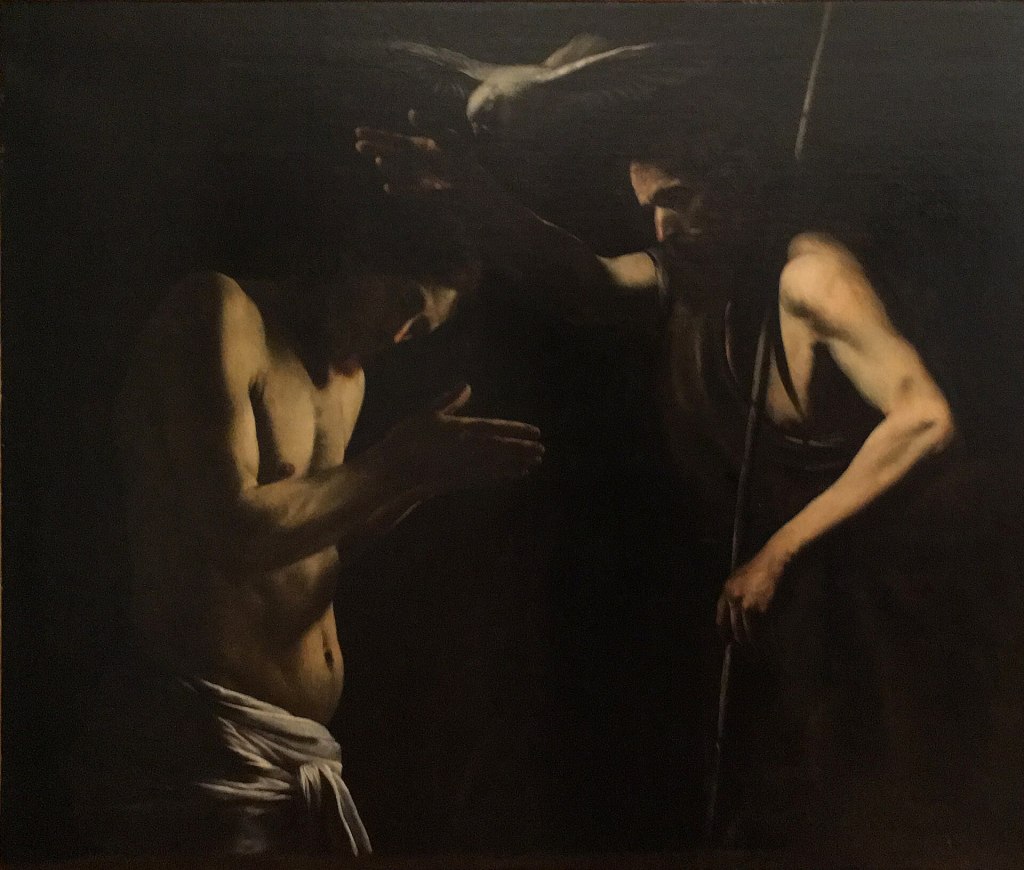
(Credits: Wikimedia Commons and Wikipedia).
Yet the painting is not simply an imitation of Caravaggio. Battistello measures himself against the severe late Caravaggio, but his own temperament is different. He loosens the inherited framework of drawing and moves towards a more summary, synthetic handling, yet he never acquires Caravaggio’s fierce freedom of brushwork. What is specifically his is the emotional temperature: distilled pathos, monumental calm, and an absence of explosive violence. His figures are not dramatic protagonists in Caravaggio’s sense, but Causa’s “sad men of the seventeenth century”: grave, inward and physically present.
Battistello’s early response to Caravaggio was not isolated. Carlo Sellitto, his near-contemporary, worked close enough to the same field for their languages occasionally to overlap: an Adorazione dei pastori by Sellitto at Santa Maria del Popolo agli Incurabili, for example, has at times carried an attribution to Battistello. Both painters came to Caravaggio from within a Neapolitan culture still marked by late-Mannerist habits, and neither can be treated as a pure Caravaggist. Sellitto’s brief career, ending in 1614, suggests a more gradual assimilation, moving from the legacy of Imparato and the older maniera towards a sharper naturalism, and then, in works such as the Santa Cecilia of 1613 or the Santa Candida Brancaccio in Sant’Angelo a Nilo, towards a softer atmosphere perhaps touched by Guido Reni. Battistello’s own development was no less mixed, but in works such as the Battesimo di Cristo of the Girolamini he could move further into the compressed structures and stark lateral light of Caravaggio’s late Neapolitan paintings. The difference is one of emphasis rather than kind: Sellitto’s Caravaggism appears more gradual and transitional, Battistello’s at certain moments more abrupt and concentrated.
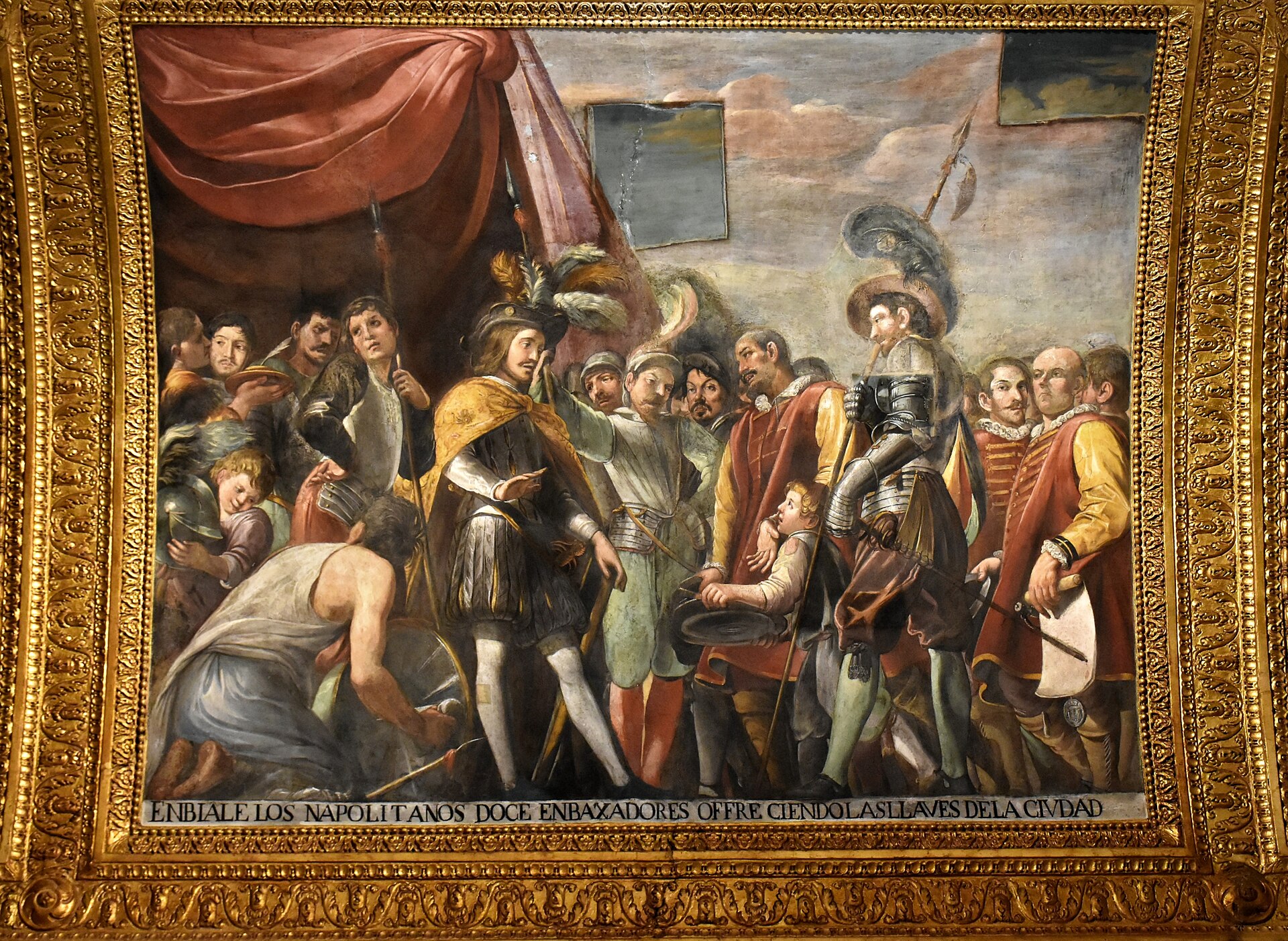
Battistello’s early Caravaggesque language was also being adapted to fresco. In the Storie del Gran Capitano Consalvo di Cordova at the Palazzo Reale, connected with a 1611 payment but still debated in date, Battistello appears in the less familiar role of history painter. The cycle shows Caravaggism being stretched into an unexpected public and celebratory form. Its difference lies not only in the use of fresco, a medium foreign to our usual mental image of Caravaggio, but also in the subject: Spanish viceregal history drawn from the early sixteenth-century Mezzogiorno and adapted to the ceremonial setting of the royal palace. Battistello works in continuity with the vigorous local fresco tradition associated with Corenzio and other mural painters, while transferring into public decoration some of the devices associated with his smaller and more concentrated paintings: compact figure groups, emphatic gestures, abrupt exchanges of look and action, and a newly naturalistic weight of presence.
(Credit: Wikipedia).
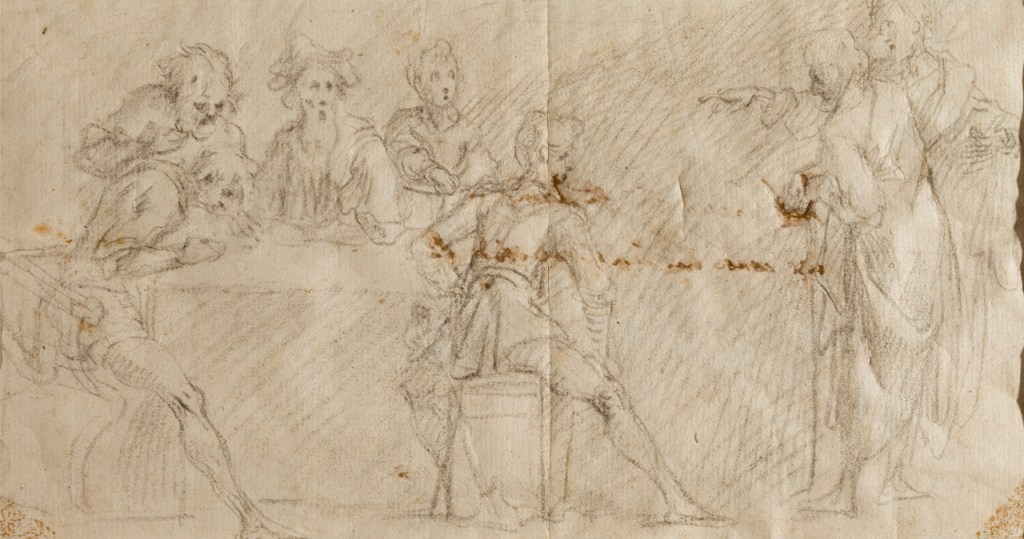
In the Incontro di Consalvo con gli ambasciatori, the surviving drawing and the relatively well-preserved fresco suggest a sober, chronicle-like approach to historical narrative, without the usual machinery of heroic celebration. Following Ferdinando Bologna, Causa sees in this an anti-rhetorical gravity that anticipates, at distance, the factual restraint Velázquez would later bring to the Resa di Breda. Battistello’s public history is not theatrical or triumphalist, but grave, measured and unusually attentive to the weight of circumstance. One figure in the cycle has sometimes been imaginatively associated with Caravaggio himself: a dark, penetrating, weathered face, with black hair, moustache and pointed beard. The identification is necessarily uncertain, but suggestive, and perhaps more than merely fanciful: it makes Battistello’s relation to Caravaggio feel almost immediate and personal, rather than merely stylistic. His presence is not simply a matter of borrowed lighting or naturalistic force; it seems to inhabit Battistello’s earliest public historical painting.
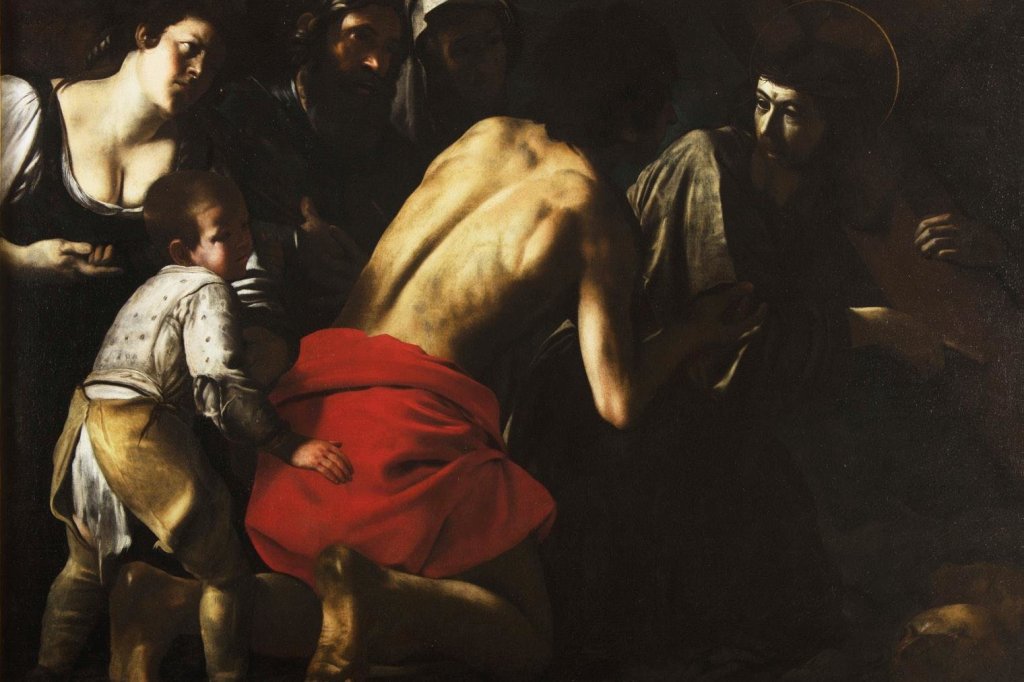
The Palazzo Reale frescoes also have chronological importance. Causa places them within a group of Battistello’s early works, comparing them above all with the Turin Qui vult venire post me, or Cristo portacroce con il Cireneo, documented in 1614. The picture’s Latin title, drawn from Christ’s command that those who follow him must take up the cross, makes it not only a foreshadowing of the Passion but an image of discipleship. Its close-up figures, ragged clothing and dirty foreground feet also show Battistello rethinking Caravaggio’s late Neapolitan models, including the Madonna del Rosario in Vienna. If the Turin picture belongs near the Palazzo Reale cycle, the two works show Battistello moving between different forms of early Caravaggesque practice: intimate devotional drama and the more public, ceremonial language required by fresco and courtly historical painting.
(Credit: Wikimedia Commons).
The Pio Monte della Misericordia offers one of the clearest examples of the next stage in this process. Causa sees the chapel as a place where Caravaggio’s dangerous invention was almost immediately made usable for institutional, devotional and decorative purposes. Caravaggio’s Sette opere della Misericordia had proposed a nocturnal, compressed and conceptually explosive model, in which several acts of mercy unfold simultaneously within a single irregular field. The surrounding altarpieces show how quickly Neapolitan painters and patrons began to absorb, clarify and regularise that model. Caravaggism, in this context, was not simple discipleship. It was a negotiation: the radical impact of Caravaggio was filtered through decorum, narrative clarity, inherited style and institutional need.
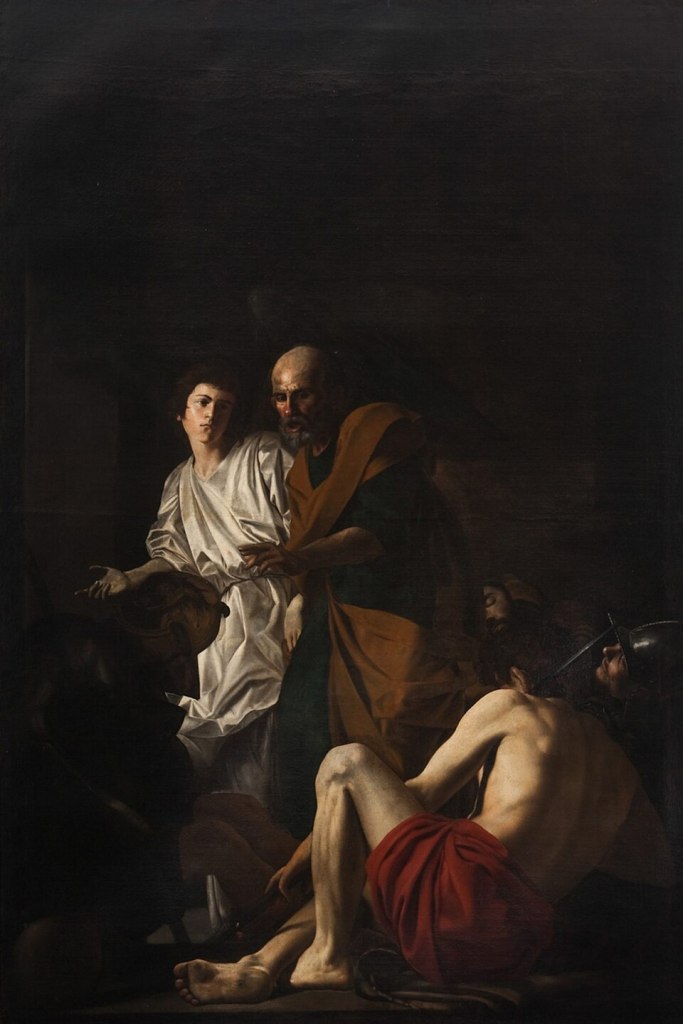
This is the setting in which Battistello painted the Liberazione di san Pietro dal carcere for the Pio Monte, signed and documented in 1615.
(Credit: Wikimedia Commons).
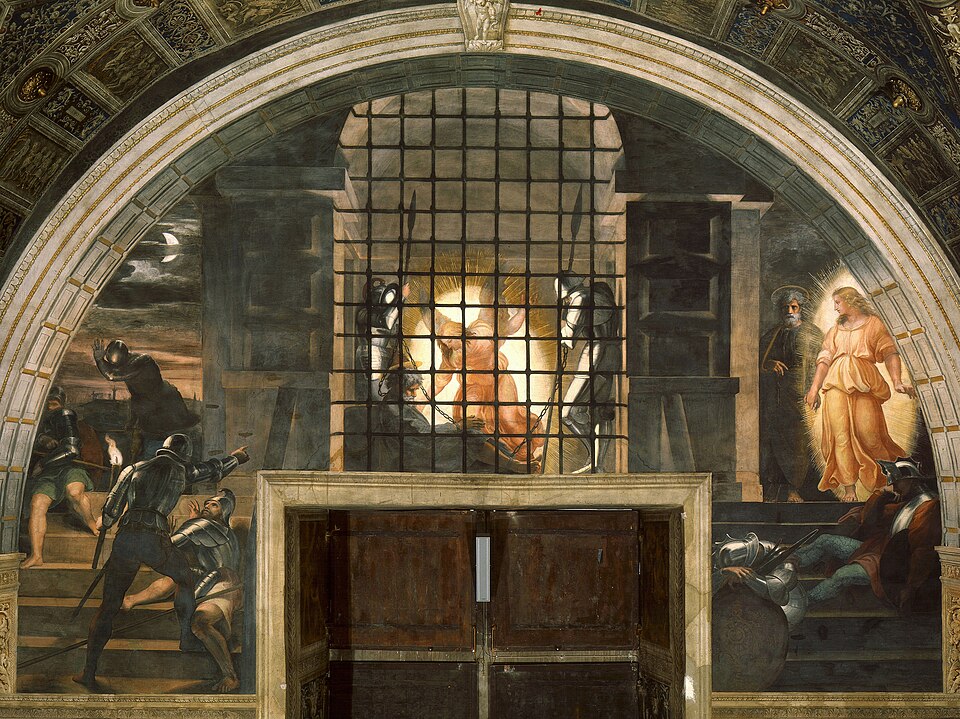
Hung almost opposite Caravaggio’s Sette opere della Misericordia, it inevitably enters into dialogue with the earlier Neapolitan masterpiece. Yet it is not a simple continuation of Caravaggio’s severity. For Causa, the problem had changed. If, in the Immacolata Concezione, Battistello had attempted to remake Raphael from nature, here he attempts something still more complex: to remake Caravaggio through Raphael. The relevant precedent is Raphael’s Liberazione di san Pietro in the Vatican Stanze, the celebrated fresco of miraculous nocturnal light. Battistello does not simply borrow Raphael’s prestige. He translates the fresco’s order, luminous structure and sacred decorum into a Neapolitan Caravaggesque idiom. The result is one of the great acts of controlled naturalism in early Seicento Naples: Caravaggio recast through Raphael, his dramatic naturalism brought into a more measured sacred order.
(Credit: Wikimedia Commons).
Russo gives the Liberazione a slightly different emphasis by stressing Battistello’s Roman experience. Documented in Rome at the beginning of 1612, Battistello seems to have encountered Orazio Gentileschi’s work at first hand, while also responding to the example of Guido Reni. On his return to Naples, this refinement found what Russo nicely calls an “occasione di stoffa” in the Pio Monte picture. The phrase is exact because the angel’s luminous white fabric becomes the place where Battistello most visibly departs from Caravaggio’s harsher principle of the “attimo folgorato”. Caravaggesque light remains present, but it is slowed, polished and spatially elaborated. The carefully profiled helmet of the soldier in penumbra, almost a stage prop recalling the earlier Negazione di Pietro, stands out against the enriched white of the angel and becomes a refined perspectival cue.
The painting therefore cannot be placed neatly on one side of a divide between adherence to Caravaggio and departure from him. It is both a powerful Caravaggesque cimento and a personal deviation from Merisi’s method. Russo deepens the connection by recalling the suggestion that Battistello’s Liberazione may preserve, however indirectly, something of the conception of Caravaggio’s lost Resurrezione di Cristo for the Fenaroli chapel. That connection cannot be proved visually, since Caravaggio’s painting has disappeared; it depends instead on early descriptions, especially the account left by Charles-Nicolas Cochin, the French engraver and art writer who saw the work in Naples in the mid-eighteenth century. Cochin describes a Christ who does not rise triumphantly into the air, but passes among the guards with a hesitant, almost fugitive humanity.
This is why Causa reopens the painting against its orthodox Longhian reputation. In the first half of the twentieth century, and especially through the exhibitions and critical writings that shaped the modern rediscovery of Caravaggio and his followers, the Liberazione came to be seen as one of the exemplary monuments of Neapolitan Caravaggism. Its inclusion in Longhi’s 1951 Milan exhibition helped fix Battistello’s reputation as one of the principal Neapolitan followers of Caravaggio. Yet that reading begins to fracture as soon as one attends to details already noticed by earlier critics: above all the angel’s silken robe, its polished surface and its silvery luminosity. Aldo De Rinaldis had even brought in Pietro Bernini as a possible comparison as early as 1929, a striking intuition at a time when Neapolitan sculpture had not yet been fully integrated into the discussion. Others sensed in the robe a refinement that looked forward to Bernardo Cavallino, while Ortolani wrote of its argentine light. Such observations suggest that the seven years separating Battistello’s painting from Caravaggio’s Sette opere della Misericordia had not passed without consequence.
The Liberazione is therefore Caravaggio already mediated, refined and redirected. Its darkness and dramatic subject still look back to Merisi, but the angel’s robe, silvery light and polished surface point towards Raphaelising discipline, Gentileschi’s refinement, sculptural suggestion and the later elegance of Neapolitan painting. Causa’s warning is useful: if one still wants to call the painting Caravaggesque, it should be said almost sottovoce.
For Causa, the Liberazione is the local culmination of this mid-1610s moment: the most coherent Neapolitan answer to Caravaggio’s Sette opere della Misericordia. It offers not a simple continuation of the raw, destabilising Caravaggio of the high altar, but a Caravaggio recast through Raphael, through sixteenth-century normative models, and through a more ordered sacred language. This is why Causa wants the painting understood within a wider Neapolitan culture, rather than within painting alone. His parallels with Basile’s return to Bembo and Della Casa, or with Trabaci’s learned court music, need not be pressed too far here; their importance is that they place Battistello within a broader climate of disciplined return to authoritative models. In each case, tradition is not treated as a retreat, but as a way of gathering force for a new advance. Yet this equilibrium was fragile. Beyond the Liberazione, Neapolitan painting would soon be pulled into a darker, denser and more materially compelling current.
Proceed to Battistello Caracciolo: Painting after Caravaggio in Naples, Part 2. The bibliography is at the end of Part 3.
[Producing these essays requires care, time, research, and resources. Contributions to help sustain this exploration would be greatly appreciated.]
https://donorbox.org/inner-surfaces-resonances-in-art-and-literature-837503
 Inner Surfaces