Overview
The contemporary understanding of Giovanni Antonio Galli, known as lo Spadarino (Rome, 1585–1652), has been hard-won. His biography is fragmentary, his corpus remains uncertain, and much of the scholarship depends on close documentary and stylistic work. Rather than attempt a full reconstruction, this article begins from the more stable parts of his history, before turning to two paintings that reveal different aspects of his Caravaggesque art.
Rita Randolfi’s account of Spadarino in I caravaggeschi: percorsi e protagonisti begins from the documentary record. Giovanni Antonio Galli, known as lo Spadarino, was born in Rome on 16 January 1585, the son of Salvatore, originally from Poggibonsi, and Brigida Galli. The clarification of this identity had already been made possible by Clemente Marsicola’s work on the baptismal record, which helped distinguish Giovanni Antonio from the older Giacomo Galli, probably his brother, who was also called Spadarino but worked mainly as a frame-maker, carver, gilder and dealer. The distinction affects the whole shape of the painter’s career. Giovanni Antonio’s beginnings belong not to a lingering late-Mannerist world, but to a Rome already transformed by Caravaggio’s Contarelli Chapel and by the Carracci.
The earliest known document concerning him is a complaint that Giovanni Antonio himself lodged on 2 February 1603 against two painters and a fencing master. While the available secondary sources do not seem to reveal the details of the quarrel, the document preserves useful biographical information: by the age of eighteen, Galli had already left his father’s house in Parione and was living or working in Palazzo San Marco, under the protection of Giovanni Dolfin, who became a cardinal the following year. He remained in Dolfin’s household at least until 1620. It is not known why this Venetian prelate chose to protect the young artist, but the connection gives Spadarino an early place within a specific Roman and Venetian environment.
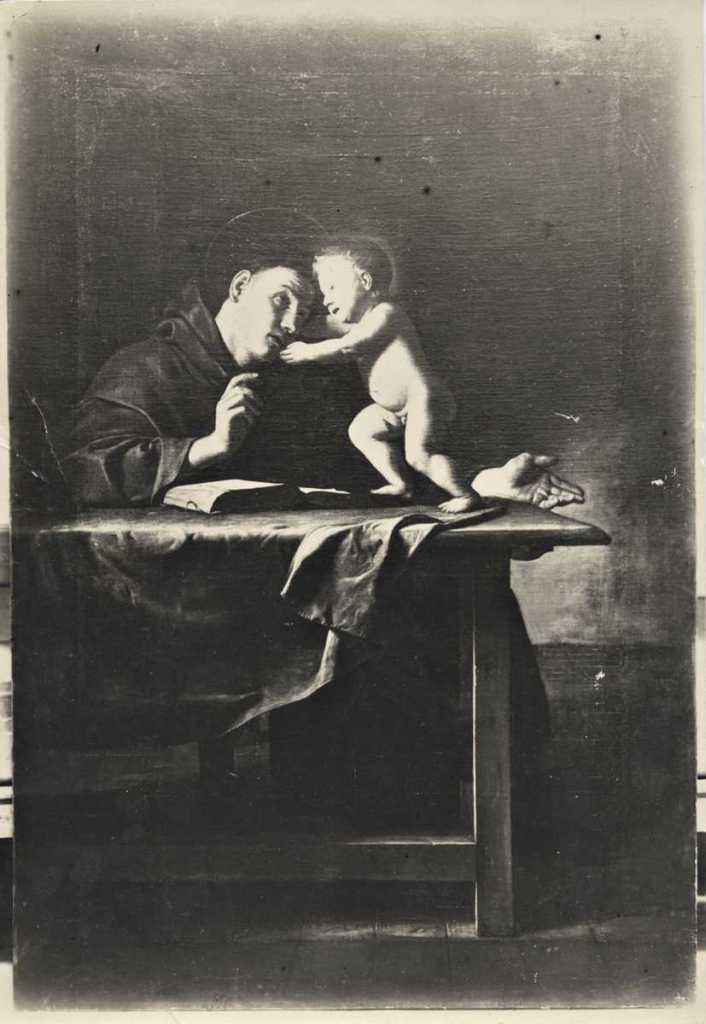
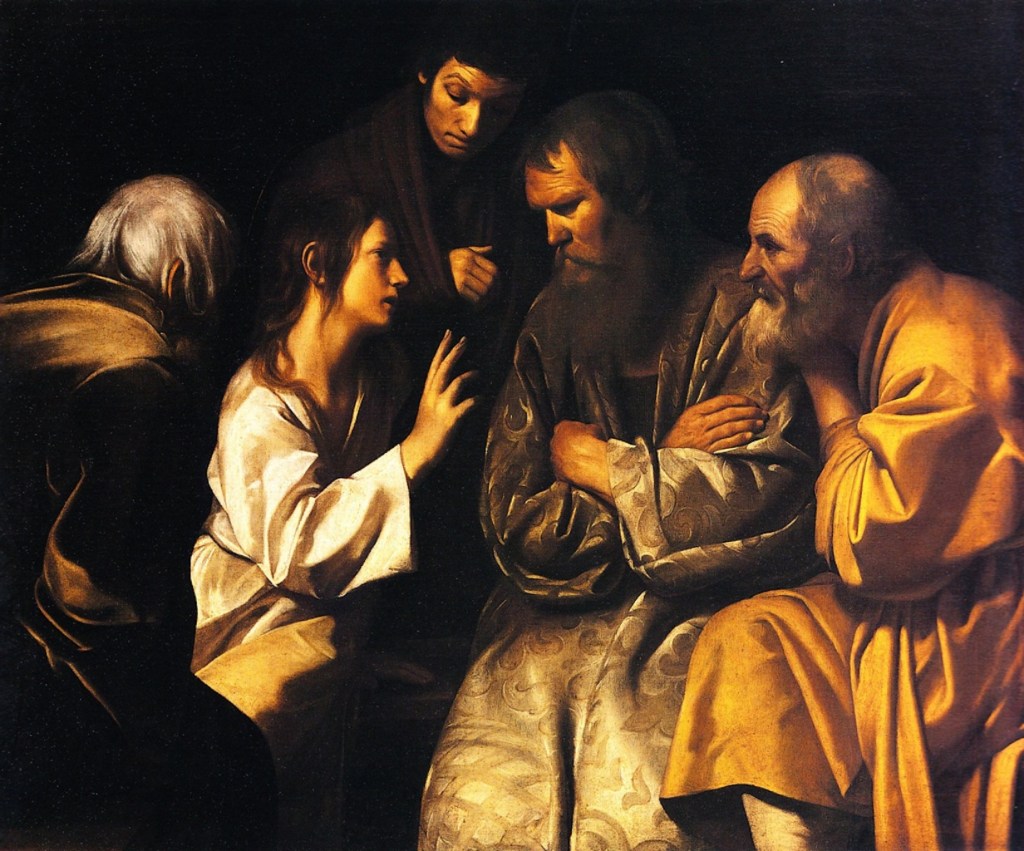
Those years in Dolfin’s household may also have brought Galli into contact with Carlo Saraceni. Saraceni’s example offered a gentler, more lyrical form of Caravaggesque painting than the more emphatic naturalism associated with Bartolomeo Manfredi. This affinity has been seen in works such as the Sant’Antonio di Padova con il Bambino in Santi Cosma e Damiano, where the religious encounter is treated with softened intimacy rather than overt dramatic force. Longhi had also connected Spadarino’s Gesù tra i dottori in Naples with Saraceni’s altarpieces for Santa Maria dell’Anima, while Randolfi notes a possible compositional debt to Saraceni’s Morte della Vergine. Yet Saraceni cannot explain Spadarino by himself. He is one presence in a more complicated formation.
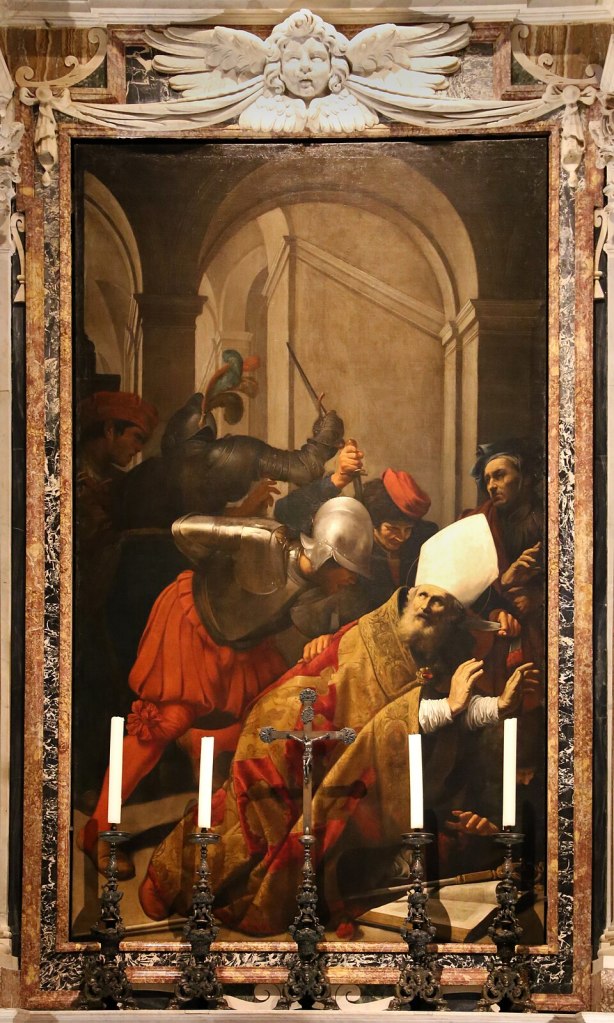
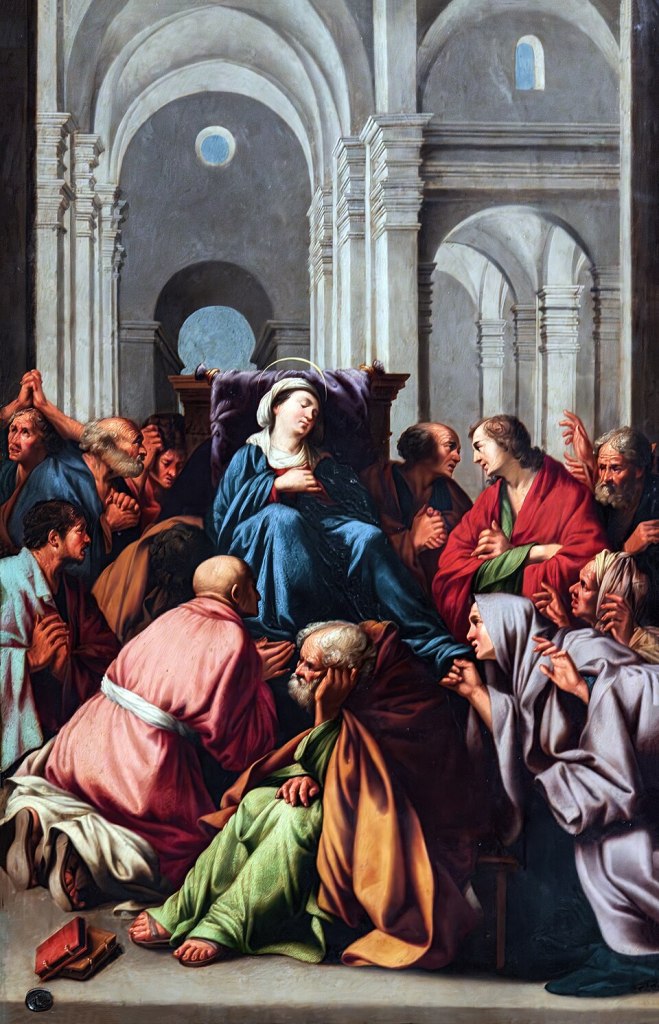
(Credits: Wikimedia Commons).
Randolfi’s account is marked by caution about the limits of Spadarino’s catalogue. Papi had placed among the painter’s earliest works the Cena in Emmaus in Santa Maria Assunta at Arrone, a San Giovanni Battista formerly in the Corsini collection and now in a private collection, the Negazione di san Pietro formerly in the deposits of the Pinacoteca Nazionale in Bologna, the Cristo deriso in the Pinacoteca Comunale at Spoleto, and an Ecce Homo of unknown location. Randolfi questions at least part of this group, especially the Cristo deriso, whose exaggerated gesture seems to her foreign to the sensitivity and delicacy more usual in Spadarino’s work. The current image of Spadarino has therefore been formed not simply by adding works to the name of a neglected painter, but by testing the corpus painting by painting.
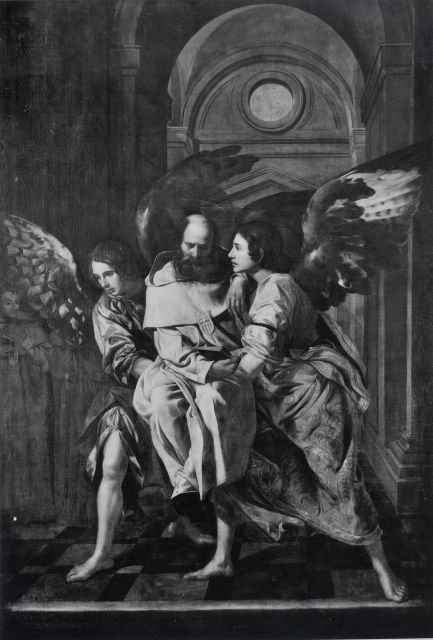
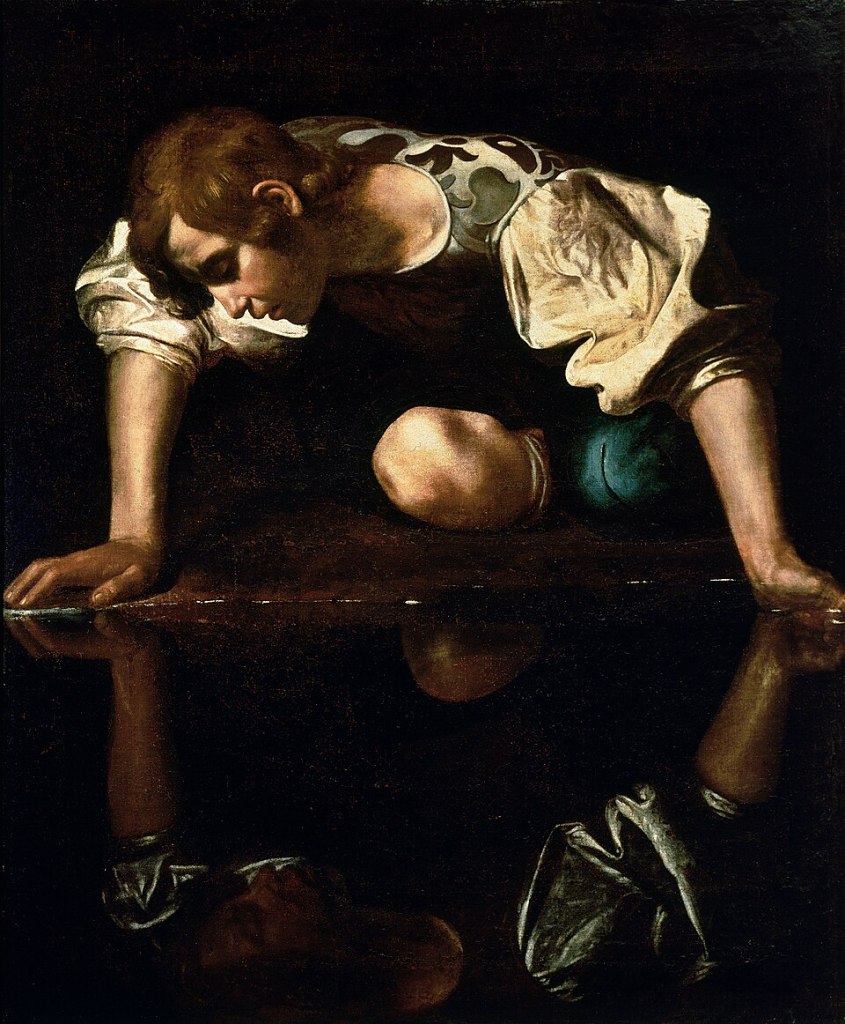
The same applies to later attributional problems. Randolfi removes the Elemosina di san Tommaso da Villanova at Ancona from Spadarino’s catalogue, following and developing an idea first proposed by Luigi Salerno, and gives it instead to Tommaso Salini. She also rejects the attribution to Spadarino of the San Pietro Nolasco trasportato dagli angeli, preferring to place it closer to Savonanzi. On the Narciso in Palazzo Barberini, Randolfi takes a similarly firm position against the attribution to Galli. She argues that the restoration evidence favours Caravaggio, as does the documentary trail first published by Antonino Bertolotti, brought back into discussion by Maurizio Marini, and later reconsidered by Rossella Vodret. These are not marginal disputes. They show how much of Spadarino’s artistic personality has been constructed through acts of comparison, exclusion and correction.
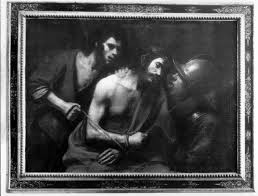
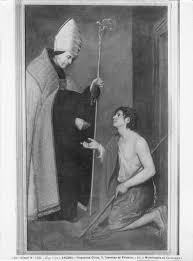
(Credits: Catalogo generale dei Beni Culturali; Wikimedia Commons; Fondazione Federico Zeri; Wikimedia Commons).
Randolfi’s account gives a clear sense of the painter’s professional connections in the later 1610s. From the spring of 1614 Giovanni Antonio collaborated with Agostino Tassi at the Casino Montalto at Villa Lante in Bagnaia, and in 1617 he received forty scudi for work connected with the decoration of the Sala Regia at the Quirinale. The same relationship is supported by Tassi’s 1619 trial deposition, where he stated that Giovanni Antonio Spadarino had “served” him over the previous five years, and by Spadarino’s own testimony in 1620 that he had known Cesare Turpin, a French painter close to Tassi, for five or six years. As Gabriele Persichetti has recently argued, Tassi mattered less as a direct stylistic model than as a professional context. Spadarino did not become a painter of Tassi-like landscape, architecture and illusionistic scenery. The importance of the connection lay rather in fresco practice, teamwork, patronage and the organisation of large decorative commissions.
The Quirinale makes this especially clear. The Sala Regia project was a vast frescoed frieze for one of the principal reception rooms of the papal palace, combining painted architecture, allegorical figures, Borghese emblems, biblical scenes and groups of foreign envoys looking out from a fictive loggia. It placed Spadarino within a fast-moving decorative enterprise directed by Tassi, Lanfranco and Saraceni, and carried out by a workshop that may have involved nearly a hundred people. The documentary evidence confirms his involvement, even if the precise extent of his hand in the frieze remains difficult to define. Longhi recognised him in the two central oval scenes from the Moses cycle, Il Ritrovamento di Mosè and Mosè con le Madianite; Giuliano Briganti added the putti above them; Clemente Marsicola went further, attributing the regal figure at the lower left of the Ritrovamento, and eventually the whole oval, to Spadarino. Later scholarship has complicated Longhi’s neat pairing by associating Mosè con le Madianite with Paolo Novelli, leaving Il Ritrovamento di Mosè as the firmer Spadarino attribution. What remains important is that the Quirinale brought him out of the small, concentrated world of easel painting and into the collaborative practice of Roman decorative painting.
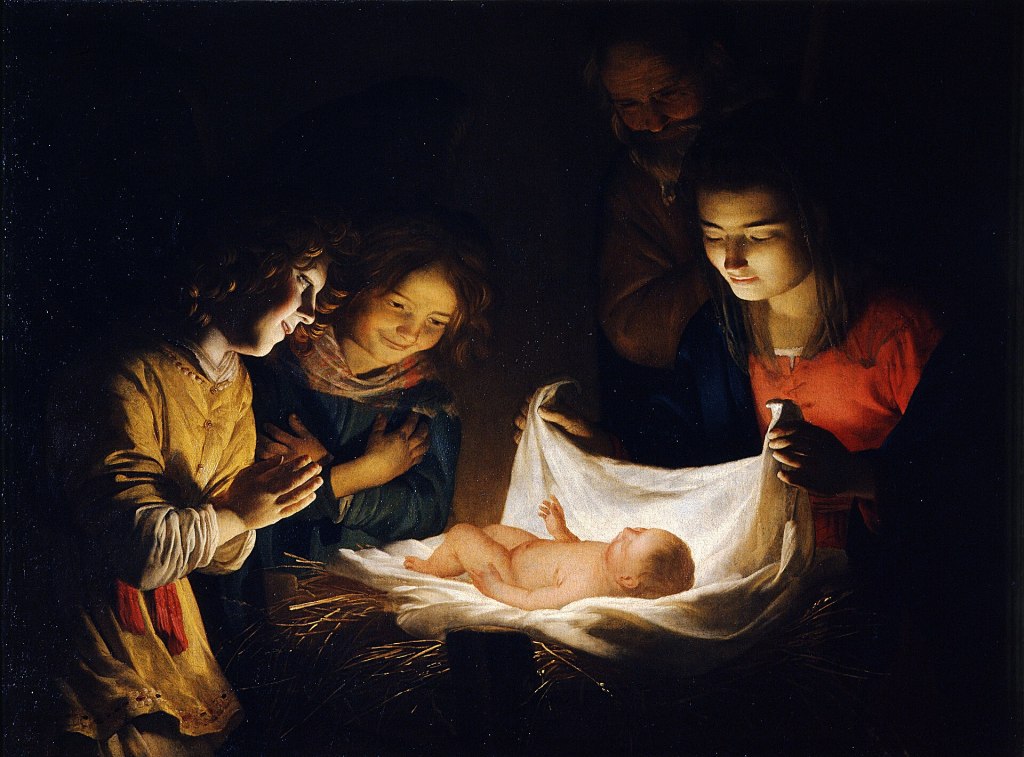
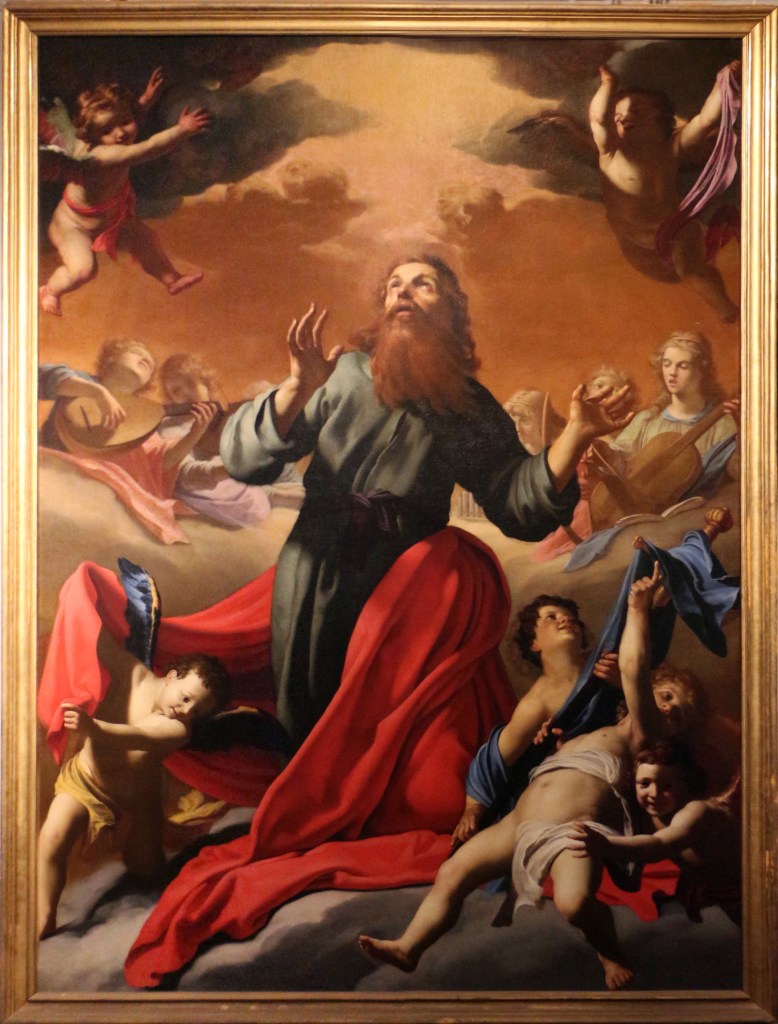
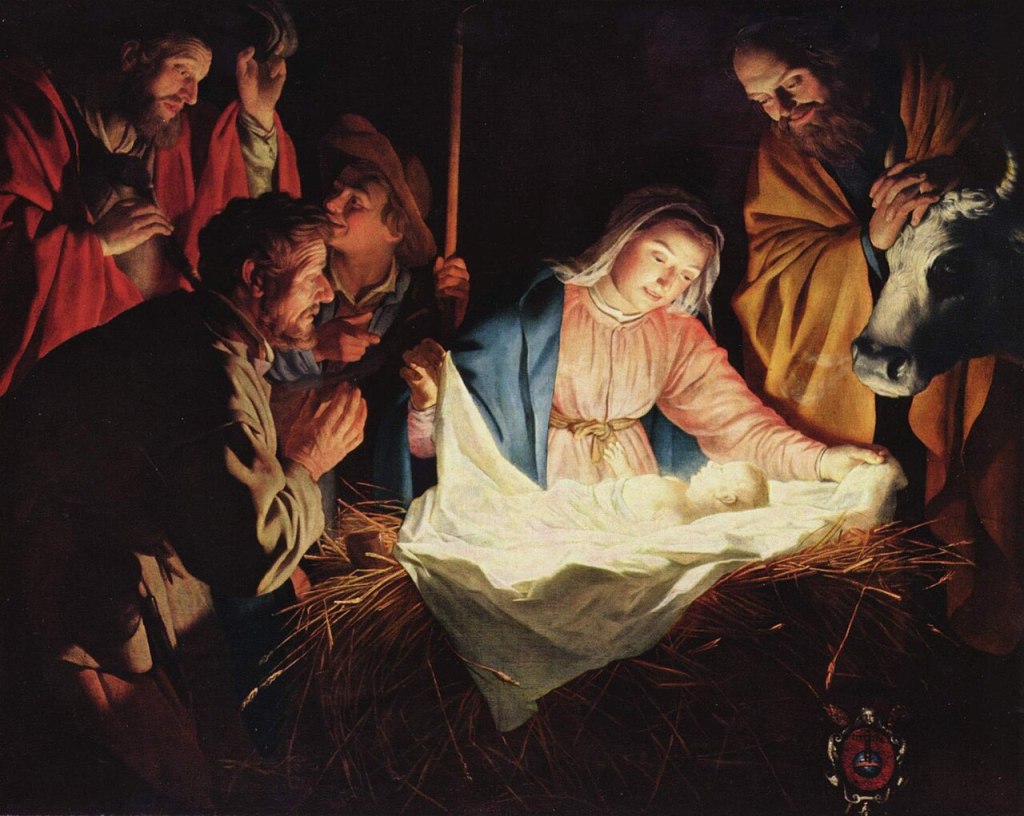
Randolfi also brings in the Honthorst problem, recalling Elisabetta Giffi Ponzi’s comparison between Galli’s Quirinale putti and the naturalised angelic figures in Honthorst’s Adorazione del Bambino in the Uffizi, as well as the cherubs in San Paolo rapito al terzo cielo. Papi, drawing on documents published by Tommaso Megna, preferred to see the relation between Galli and Honthorst as more equal than subordinate. Their contact is documented by their work for the Guicciardini chapel in Santa Felicita, Florence, where Honthorst painted the large Adorazione dei pastori and Galli supplied a now-lost Crocifissione, paid for between September 1619 and June 1620. This is worth keeping in view: Galli was not simply passing through Honthorst’s shadow, but working alongside him within overlapping circles of patrons, commissions and exchange between Rome and Florence.
(Credits: Wikimedia Commons).
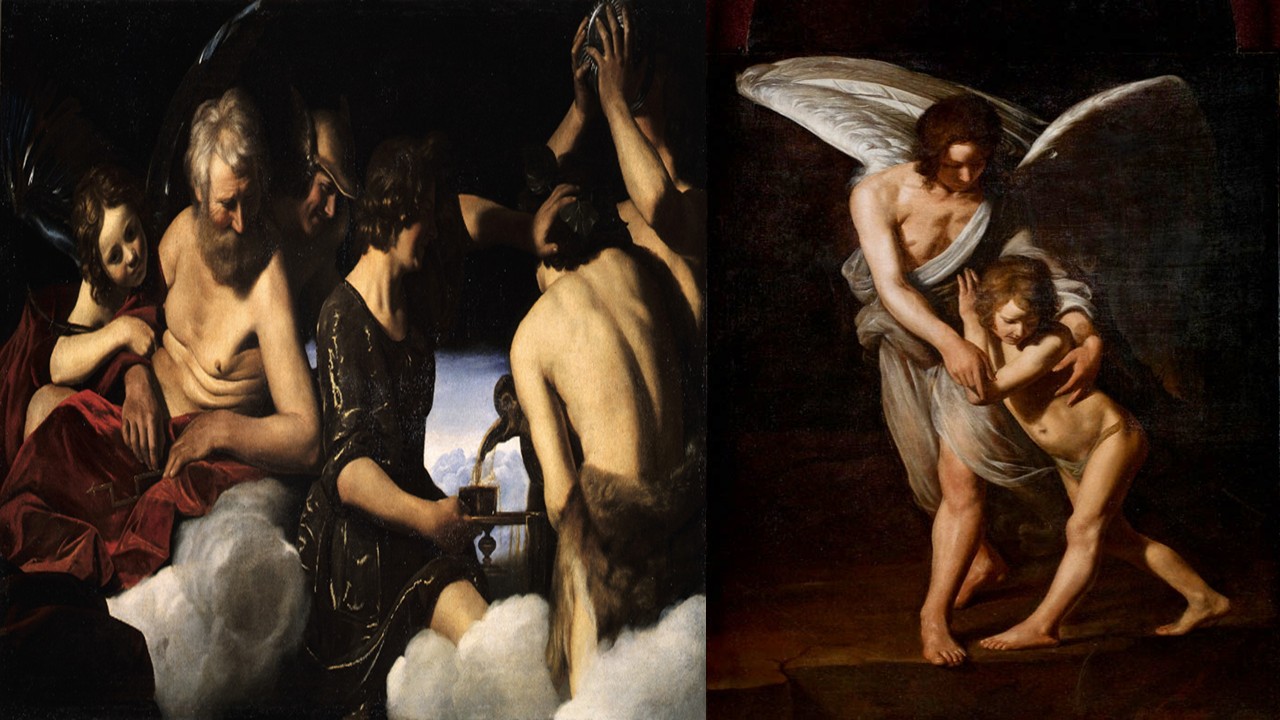
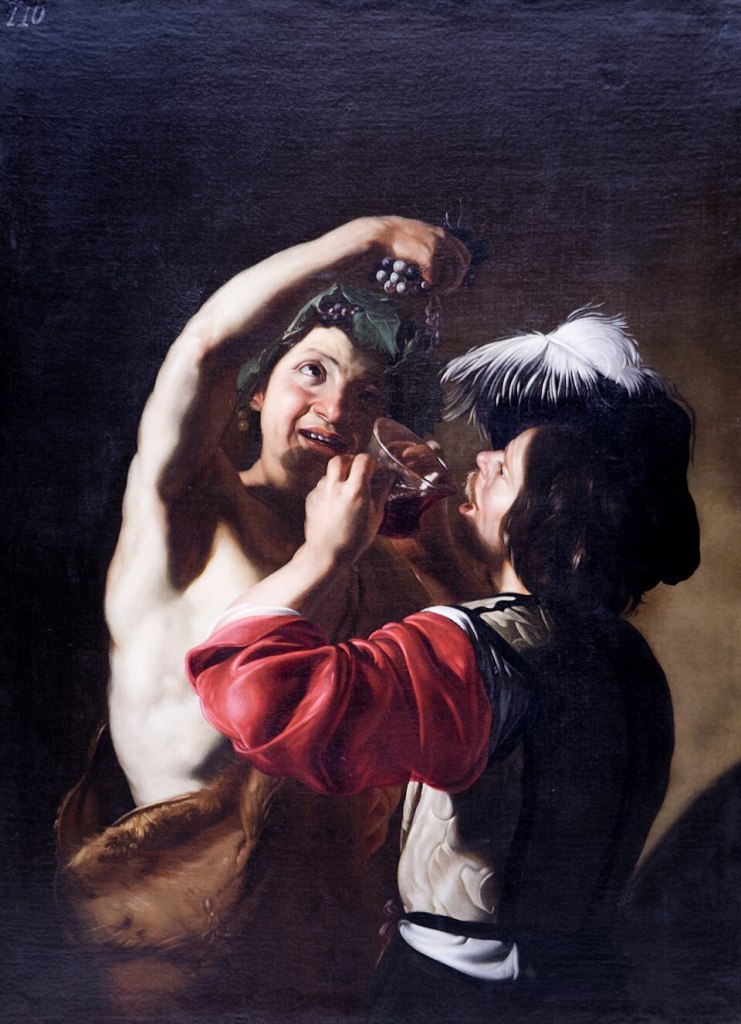
This helps explain why the Convito degli dei in the Uffizi has had such a complex attributional history. Giffi Ponzi argued that Evelina Borea’s earlier attribution of the painting to Honthorst was wrong, but perceptive: Borea had seen something real. She singled out the full, fleshy, laughing figure of Hebe, the goddess of youth and cupbearer of the gods, as well as the warm humanity of the group, the velvet shadows, the luminous surface, and the bright touches on cloth, hair and skin. All these features bring the painting close to Honthorst’s Roman works around 1617–18.
Erich Schleier restored the Convito to Spadarino after it had been exhibited in Florence in 1970 under Honthorst’s name, while also recognising that the picture belongs to a wider pictorial field that includes Bartolomeo Manfredi. The older Honthorst attribution has been superseded, but it remains useful because it points to one of the contexts in which the painting was made and later understood. It is not merely a picture “influenced by Honthorst”, but a work shaped by the range of experience Galli had acquired by the later 1610s: fresco practice, workshop collaboration, chapel commissions, nocturnal naturalism and contact with some of the most active painters in Rome.
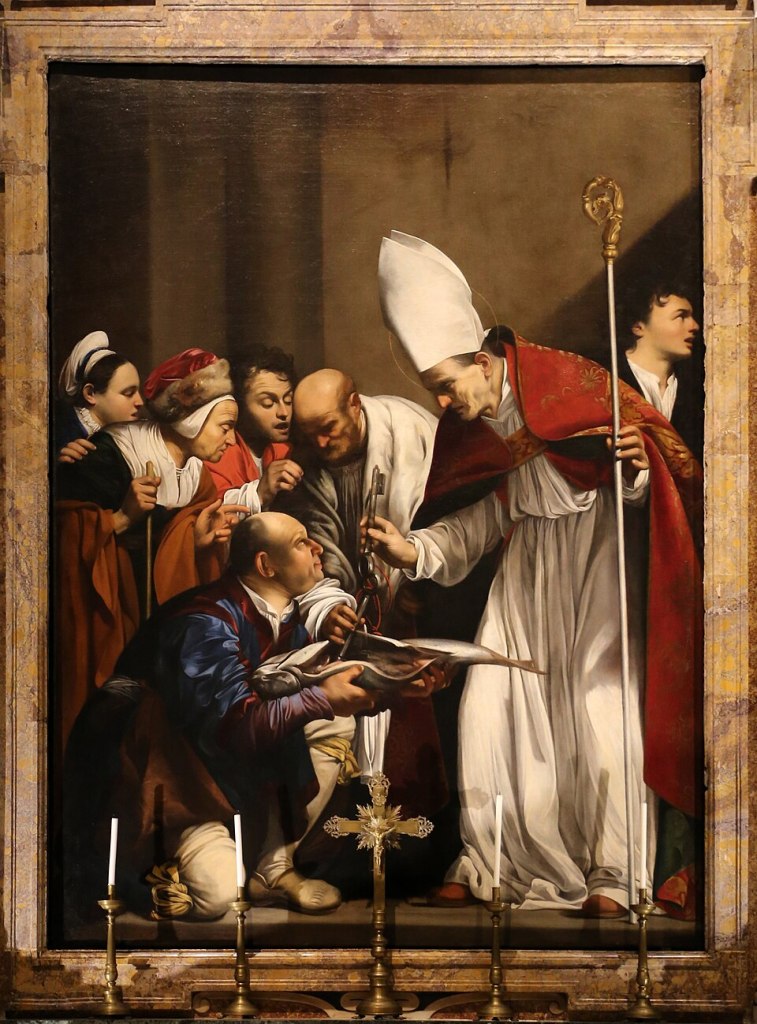
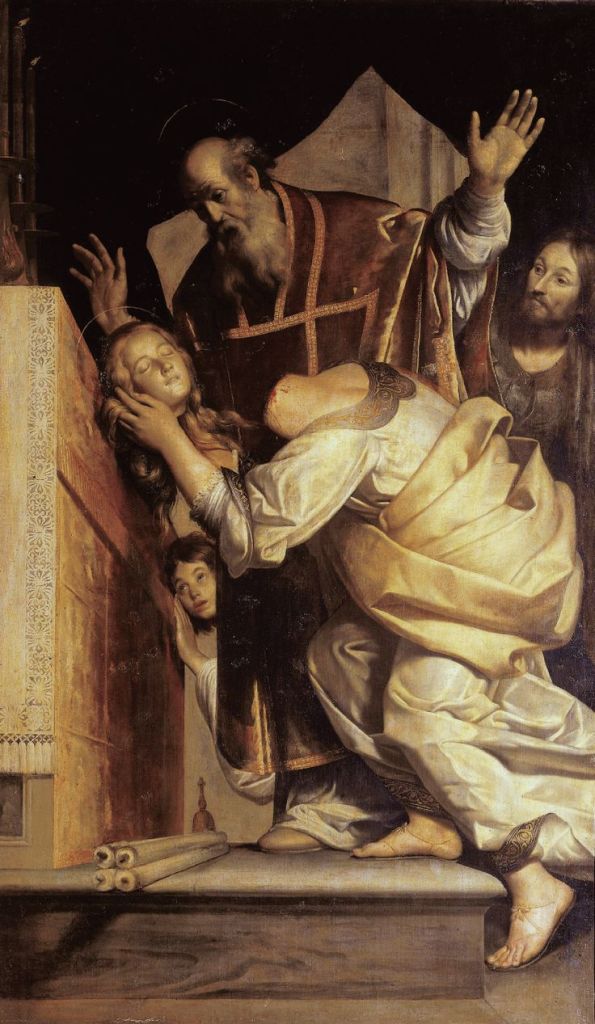
One of the firmest documentary anchors in Spadarino’s career is the Miracolo di santa Valeria dinanzi a san Marziale, painted for St Peter’s. Its payment history is unusually clear. In May 1626 Galli wrote to Cardinal Biscia seeking the promised commission. In November of the same year he received an advance of fifty scudi; on 12 June 1629 the support was prepared; on 22 November 1632 he received 150 scudi for the completed painting; and the final payment followed on 22 January 1633. This documentation makes the Santa Valeria one of the firmest fixed points in Spadarino’s career, even if it has not become the painting most readily associated with his name. It also provides a secure point of comparison from which later scholars could reconstruct the more uncertain parts of his corpus.
(Credit: Wikimedia Commons).
Santa Valeria dopo la decapitazione porta la propria testa a san Marziale is one of Spadarino’s strangest and most demanding works. The legend itself has an almost grotesque literalness: after her decapitation, Valeria appears before Saint Martial and returns her severed head to her neck. Yet the painting is compositionally and dramatically interesting. As Randolfi’s description makes clear, the scene is carefully organised around the ritual space of the altar. The altar is seen obliquely; the candles are placed low in the foreground in strong foreshortening; Saint Martial is interrupted during the celebration of Mass and opens his arms in astonishment; the altar boy emerges from the background; Valeria performs the impossible act with a strange slowness and solemnity.
The gruesome subject is held within a liturgical order. Randolfi also sees a debt to the Contarelli Chapel, especially Caravaggio’s Martirio di san Matteo. What is being referred to is not a borrowing of subject, but a way of staging the moment, a Caravaggesque mode described by Argan as “colta nella flagranza del suo accadere”. Santa Valeria may not show Spadarino at his most inward or tender, but it is indispensable: a securely documented work for a major Roman commission, and a painting in which an improbable legend is given a complex, theatrical and carefully staged form.
The two works
With this substantial but often uncertain background in view, we can turn to the two works chosen for closer consideration: the Angelo custode and the Convito degli dei. They do not necessarily mark fixed stages in Spadarino’s development, but they offer insight into the range of pictorial approaches available to him, and into the different uses he made of them.
(Credit: Wikimedia Commons).
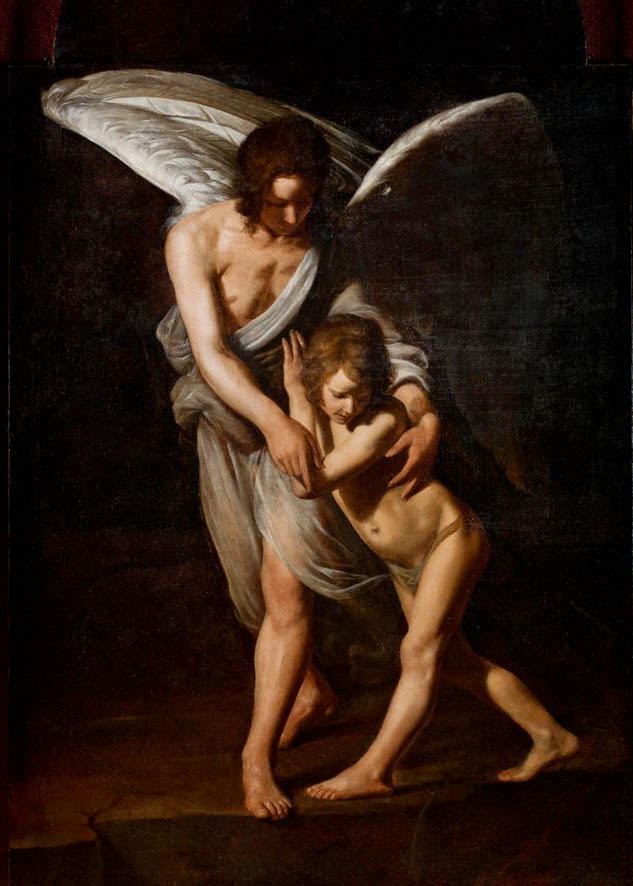
The Angelo custode at Rieti was already recorded on the altar of the Guardian Angel in the records of an episcopal visitation on 2 April 1620, and Francesco Palmegiani later stated that the church registers placed it around 1618. The dating is therefore unusually secure by Spadarino’s standards. Papi describes the painting as probably Galli’s most famous work, and perhaps the one most readily associated with his name. Its critical history is part of its importance: after earlier associations with Caravaggio and Orazio Gentileschi, Longhi’s 1943 reassignment of the painting to Spadarino helped form the modern image of Galli’s artistic personality. Papi also returns to Longhi’s description, in which the picture is distinguished from both Caravaggio and Gentileschi before being called “an elegy in black and white”, miraculously expressed by shadow as it settles “like brown dust” over the forms. Longhi’s formulation remains valuable because it identifies the particular register of the painting: a Caravaggesque image stripped of overt drama, in which darkness becomes the medium of tenderness rather than violence. The bare setting, the reduced action and the soft pressure of light on flesh all contribute to an effect of grave intimacy.
Papi connects the painting with Caravaggio’s Madonna dei Palafrenieri: the relation between the figures, the protective crossing of bodies, and the guided movement of the child all recall Caravaggio’s invention. But Spadarino lowers the dramatic temperature. The angel does not stride into a scene of doctrinal confrontation; he leads the child through darkness, their bodies close and interdependent, with almost nothing to distract from their passage. The drama has been transferred from action to relation. Tomaso Montanari has sharpened this point by describing the altarpiece as a kind of risky pas de deux, in which the angel guides a frightened child along the edge of an abyss. The tenderness of the image is inseparable from danger: protection is imagined as a bodily act, precarious, intimate and immediate.
The angel himself is one of Spadarino’s most extraordinary figures. Papi stresses the “almost dancing weightlessness” of the two figures, the crossing of their feet, and the strange ambiguity of the angel, at once muscular, soft, masculine, feminine, fleshly and veiled. The wings are handled with particular delicacy: light catches the rib of one while the other withdraws into shadow. Papi even suggests a comparison with Caravaggio’s Amorino dormiente in Florence, wondering whether Spadarino could have seen it on a Tuscan journey. That remains hypothetical, but the visual point is clear. The supernatural is not separated from the physical. It is made through flesh, light, movement and touch.
Elisabetta Giffi Ponzi places the Angelo custode with the compact group first gathered by Longhi around Spadarino: the Rieti painting, the Elemosina di san Tommaso da Villanova at Ancona, the Sant’Omobono, and the Sant’Antonio con Gesù Bambino. Randolfi later questioned parts of this grouping, especially the attribution of the Elemosina, but the critical point remains useful. The Angelo custode represents the inward pole of Spadarino’s art: reduced space, soft shadow, fragile bodies, and a silent exchange carried by gesture. Clemente Marsicola’s reading of Spadarino adds a possible theological dimension to this inwardness. He argued that Galli’s long connection with Cardinal Giovanni Dolfin placed him in an anti-Jesuit Venetian milieu, close to debates between Molinist and Thomist positions on grace, free will and providence. In that context, the subject of the guardian angel leading a child may be read cautiously as more than a generic devotional image: it gives visible form to protection, dependence and providential guidance.
(Credit: Wikimedia Commons).
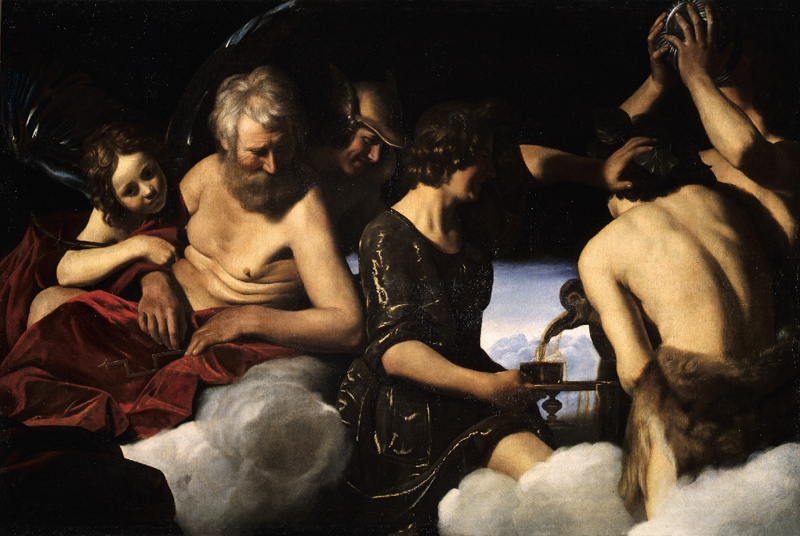
The Convito degli dei in the Uffizi presents a very different Spadarino. Also known as the Brindisi in Olimpo, the painting is usually dated broadly to the 1620s. Its attributional history reflects the mixed character of the work: Zeri records older attributions to Honthorst and Guido Cagnacci; Borea exhibited it under Honthorst’s name in 1970; and Schleier restored it to Spadarino. Randolfi accepts Spadarino’s authorship, but sees the painting as one in which the example of Honthorst is joined by the stronger, more structural presence of Manfredi. The old attributions need not be treated simply as errors; they point to real features in the painting’s construction, lighting and social tone.
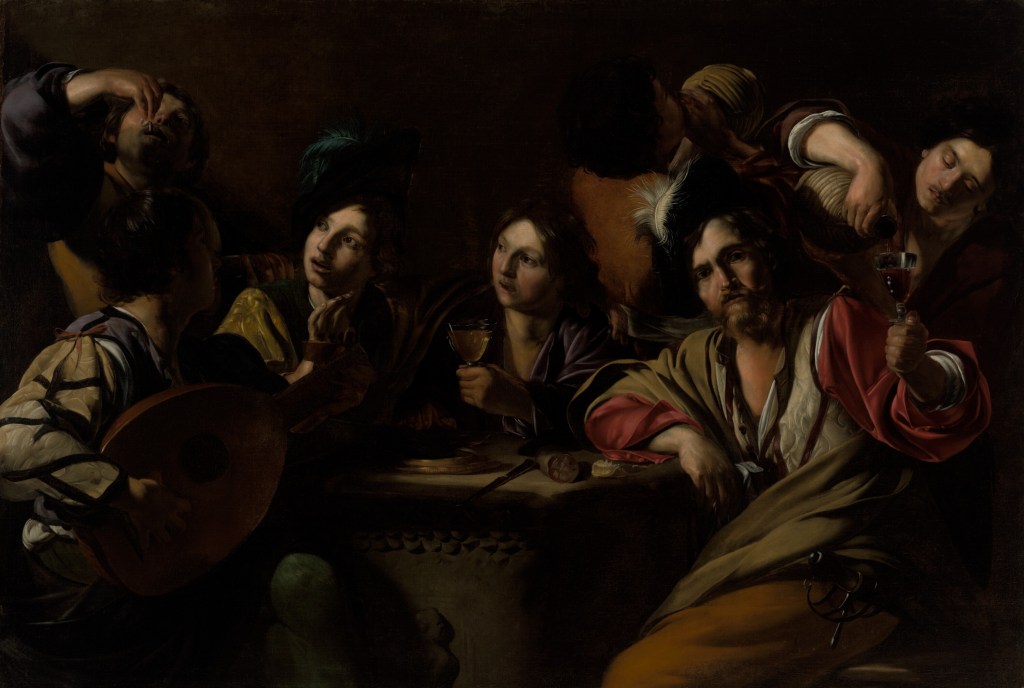
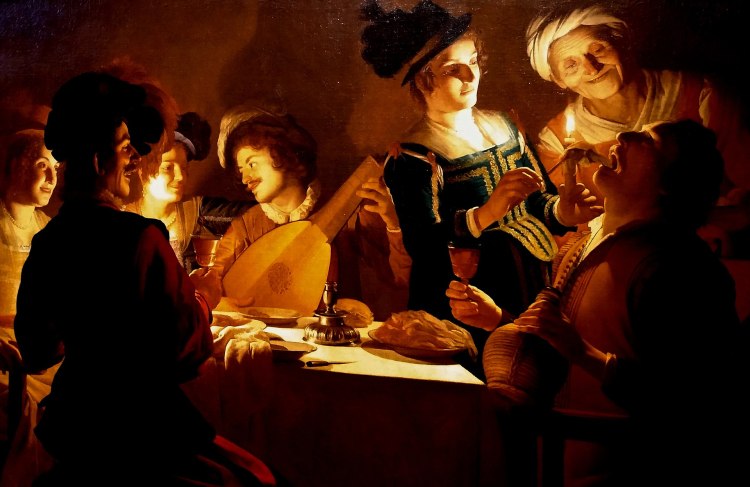
Here Spadarino’s Caravaggism is not inward and devotional, but social, sensuous and mythological. The gods are not idealised. Jupiter is an ageing, fleshy figure, exposed to light rather than ennobled by it. Bacchus, Cupid, Mercury and Hebe are gathered in a scene of drinking, leaning, touching and exchange. The mythological setting is brought down to earth: Olympus becomes a place of bodily presence, informal contact and shared pleasure. The picture belongs to the same broad Caravaggesque appetite for real flesh and immediate encounter, but the mood is warmer than in the Angelo custode. It is closer to Honthorst’s artificial light, his convivial figures and his ability to make religious or mythological subjects feel almost like scenes of human sociability.
Giffi Ponzi’s account of the painting’s Honthorstian qualities remains valuable. The full bodies, the laughing Hebe, the velvet shadows, the luminous surface, and the highlights on hair, skin and fabric all place the Convito close to Honthorst’s Roman work. Randolfi’s emphasis on Manfredi adds another dimension. The half-length or three-quarter-length figures, the atmosphere of drinking and physical exchange, and the lowering of an elevated subject into an almost tavern-like world recall the pictorial culture associated with Manfredi and his followers. Yet the Convito is not simply Manfredian: Spadarino’s bodies are softer, the light more gentle, and the comedy less coarse.
(Credits: Wikimedia Commons; J. Paul Getty Museum; Wikimedia Commons).
The stylistic differences between the Angelo custode and the Convito degli dei should not be turned into a firm chronology. The Rieti painting is comparatively well anchored: it was already recorded in 1620 and is usually placed around 1615-18. The Convito is less secure. Giffi Ponzi placed it close to the Quirinale frescoes and to Honthorst’s Roman works, around 1617-18; other datings are broader and later, extending into the 1620s. The two paintings may therefore be close in date or, equally, the Uffizi picture may belong somewhat later. What can be said more safely is that they represent different pictorial solutions.
The fragmentary state of Spadarino’s corpus should not be mistaken for artistic slightness. The surviving record points to a painter more varied and more professionally embedded than a small group of familiar works can suggest. Later documents place him at Palazzo Madama, in Palazzo Pamphilj and in relation to the mosaic projects for St Peter’s, as well as working with assistants of his own. The inventories drawn up after his death in 1652 list religious paintings, mythological subjects, landscapes, still lifes and repeated angelic heads. Much remains unidentified, and some works once thought central to his catalogue have been questioned or removed. Even so, the evidence is enough to show a painter with a wider activity than his uncertain reputation might imply.
Spadarino remains difficult to summarise, but not because there is nothing solid to say. The documents place him in Cardinal Dolfin’s household, in relation to Tassi’s decorative projects, at the Quirinale, later at Palazzo Madama and in connection with work for St Peter’s. The paintings and their attribution histories place him near several forms of Caravaggesque painting: Saraceni’s softer devotional manner, Honthorst’s warm nocturnal naturalism, and Manfredi’s world of bodily sociability, but none of these affiliations fully accounts for him.
Naturally, the Angelo custode and the Convito degli dei cannot give a complete account of Spadarino’s corpus. They can, however, offer a partial view of its variety, and of the difficulty of assigning the painter to any single strand of Roman Caravaggism.
Producing these essays requires care, time, research, and resources. Contributions to help sustain this exploration would be greatly appreciated.
Donate to Inner Surfaces here.
Bibliography
I have relied on the following sources in preparing this essay; any errors or misreadings are mine alone.
Alessi, Cecilia. “Novelli, Paolo”, in Dizionario Biografico degli Italiani, vol. 78 (Rome, 2013).
Bertolotti, Antonino. “Esportazione di oggetti di belle arti nella Liguria, Lunigiana, Sardegna e Corsica nei secoli XVI, XVII e XVIII”, Giornale Ligustico, III-IV, 1876.
Borea, Evelina. “Caravaggio e i caravaggeschi”, in Maestri del colore (Milan, 1966).
Briganti, Giuliano. Il Palazzo del Quirinale (Rome, 1962).
Giffi Ponzi, Elisabetta. “Per lo Spadarino”, Prospettiva, no. 50, July 1987, pp. 71-81.
Longhi, Roberto. “Presenze alla sala Regia”, Paragone. Arte, vol. 10, no. 117, 1959, pp. 29-38.
Longhi, Roberto. “Ultimi studi su Caravaggio e la sua cerchia”, Proporzioni, I, 1943, pp. 28-29, 51-53.
Longhi, Roberto. Mostra del Caravaggio e dei caravaggeschi, exhibition catalogue (Milan, 1951).
Marini, Maurizio. Io Michelangelo da Caravaggio (Rome, 1974).
Marsicola, Clemente. “Note allo Spadarino”, Prospettiva, no. 16, January 1979, pp. 45-52.
Megna, Tommaso. “Gherardo delle Notti a Roma: le commissioni pubbliche, il ‘patronage’ Giustiniani e nuovi elementi documentari”, in Francesca Cappelletti, ed., Decorazione e collezionismo a Roma nel Seicento. Vicende di artisti, committenti, mercanti (Rome, 2003), pp. 87-100.
Papi, Gianni. “Giovanni Antonio Galli, detto lo Spadarino, Angelo custode”, in Rossella Vodret and Giorgio Leone, eds., I colori del buio: i caravaggeschi nel patrimonio del Fondo edifici di culto, exhibition catalogue, Rome, Palazzo Ruspoli, 15 April-18 July 2010 (Milan, 2010), cat. 16, pp. 96-97.
Papi, Gianni. “La vocazione caravaggesca di Giovanni Antonio Galli detto lo Spadarino”, Arte Cristiana, no. 734, vol. 77, 1989, pp. 369-384.
Papi, Gianni. Spadarino (Soncino, 2003).
Papi, Gianni. “Una precisazione biografica e alcune integrazioni al catalogo dello Spadarino”, Paragone, no. 435, 1986, pp. 20-28.
Persichetti, Gabriele. “Alcune osservazioni su Spadarino e il suo rapporto con Agostino Tassi”, Storia dell’arte in tempo reale, 13 November 2025, updated 15 November 2025.
Randolfi, Rita. “Galli Giovanni Antonio, detto lo Spadarino, pittore”, in Dizionario Biografico degli Italiani, vol. 51 (Rome, 1998), pp. 624-627.
Randolfi, Rita. “Giovanni Antonio Galli detto lo Spadarino (Roma 1585-1652)”, in Alessandro Zuccari, ed., I caravaggeschi: percorsi e protagonisti, vol. 2 (Milan, 2010), pp. 395-406.
Treccani. “Spadarino, Giovanni Antonio Galli, detto lo”, Enciclopedia Treccani.
Vodret, Rossella. “Brevi note sul Narciso in Caravaggio. Nuove riflessioni”, Quaderni di Palazzo Venezia, no. 6, 1989.
Vodret, Rossella. “Il restauro del Narciso”, in Stefania Macioce, ed., Michelangelo Merisi da Caravaggio. La vita e le opere attraverso i documenti (Rome, 1996), pp. 163-183.
Vodret, Rossella, and Giorgio Leone, eds. I colori del buio: i caravaggeschi nel patrimonio del Fondo edifici di culto, exhibition catalogue, Rome, Palazzo Ruspoli, 15 April-18 July 2010 (Milan, 2010).
Zeri, Fondazione Federico. “Galli Giovanni Antonio, Convito degli dei”, Catalogo Fototeca Zeri.
Zeri, Fondazione Federico. “Galli Giovanni Antonio, Santa Valeria dopo la decapitazione porta la propria testa a san Marziale”, Catalogo Fototeca Zeri.
Zuccari, Alessandro, ed. I caravaggeschi: percorsi e protagonisti, 2 vols. (Milan, 2010).

