Among the most ambitious works undertaken by Hans Holbein the Younger during his first visit to England was a monumental portrait of Sir Thomas More and his household, painted around 1527. The original, measuring approximately eight by thirteen feet, was destroyed in a fire at Kremsier Castle, in present-day Czechia, in 1752. Its disappearance represents a considerable loss, not only to the history of English portraiture but also to our understanding of Holbein’s early achievements as a painter of large-scale compositions.
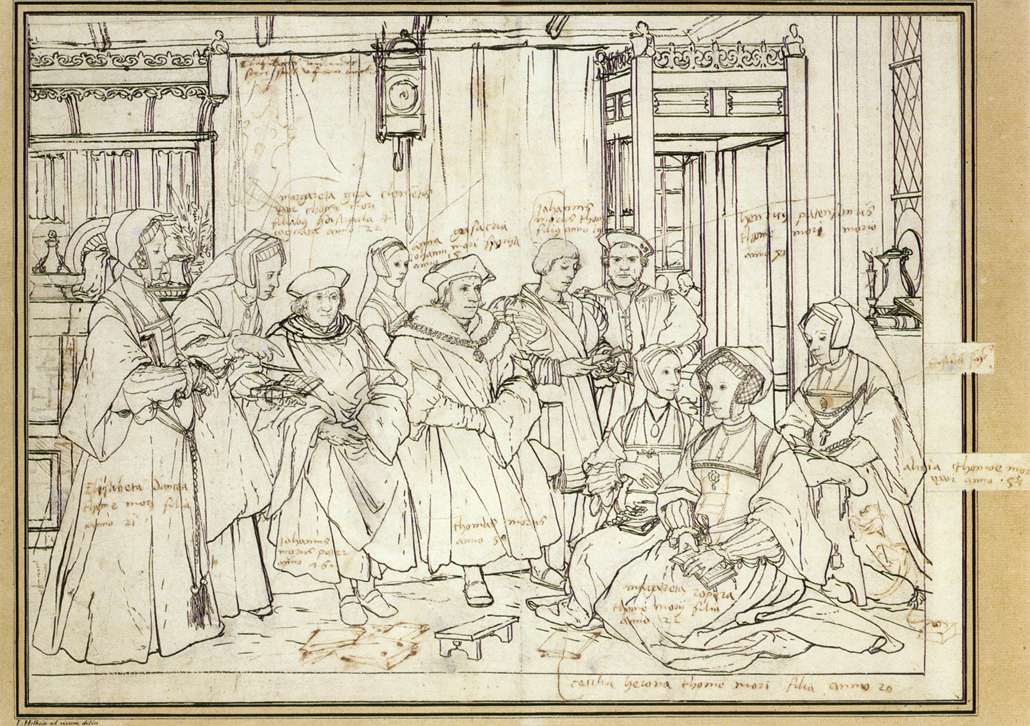
The painting has nevertheless left a substantial body of evidence. A detailed preparatory drawing, now in the Kunstmuseum Basel, records the arrangement of the figures within an elaborate domestic interior, together with annotations and revisions made during the development of the design. A remarkable series of individual portrait studies, principally in the Royal Collection at Windsor, reveals how Holbein approached the likenesses of More’s family and household. Later painted copies, most notably the version at Nostell Priory in Yorkshire, provide further indications of the completed work’s appearance, although their relationship to the lost original has remained a subject of scholarly investigation.
Taken together, these surviving works offer an opportunity to examine the conception and development of an ambitious family portrait, from Holbein’s studies of individual sitters to the arrangement and subsequent revision of the larger composition.
Holbein’s First Visit to England
By the time Hans Holbein the Younger arrived in England in 1526, he had established himself as one of the most accomplished painters working in Basel. Born in Augsburg around 1497–98 and initially trained in the workshop of his father, Hans Holbein the Elder, he had moved to Basel by 1515. There he developed a remarkably varied practice, producing portraits, religious paintings, decorative schemes and designs for stained glass and printed books. His work for the city’s publishers brought him into contact with its humanist scholars, above all Erasmus of Rotterdam, whom he portrayed on several occasions.
Holbein’s position in Basel had nevertheless become less secure. The spread of religious reform had disrupted traditional patterns of artistic patronage, while the painter’s ambitions extended beyond the opportunities available locally. Having explored the possibility of employment in France in 1524, he travelled to England in 1526, apparently carrying a letter of introduction from Erasmus to his friend Sir Thomas More.
More was already a prominent figure in English intellectual and political life, celebrated throughout Europe for his Utopia and his friendship with Erasmus. In December 1526 he wrote to the latter acknowledging Holbein’s arrival and expressing admiration for his work. Through More and his associates, the painter gained access to a cultivated network of scholars, churchmen and courtiers, securing commissions that included individual portraits and the ambitious family group.
Holbein’s first English visit, which lasted until 1528, thus brought together two important strands of his earlier career: his exceptional gifts as a portraitist and his involvement in the intellectual culture of northern European humanism.
Thomas More and the Family Commission
By the time Holbein arrived in England, Sir Thomas More had acquired a considerable reputation as a lawyer, statesman and scholar. His Utopia, published in Latin in 1516, had established his standing among European humanists, while his friendship with Erasmus had brought him into an international community of intellectual exchange. In 1526 he held the office of Chancellor of the Duchy of Lancaster and was increasingly occupied with royal business, although his appointment as Lord Chancellor still lay several years ahead.
More’s household at Chelsea was an important expression of his intellectual and domestic ideals. His children, including his daughters, received an extensive education, and the family was celebrated for its command of classical languages, religious learning and music. Erasmus had described More’s home in affectionate terms, emphasising its cultivated atmosphere and the pleasure its members took in one another’s company. The household extended beyond More, his second wife Alice and their immediate descendants to include wards and other dependants, among them Margaret Giggs and Anne Cresacre.
The commission for Holbein’s family portrait coincided with More’s extensive rebuilding of his Chelsea residence. Elizabeth Goldring has argued that the architectural improvements and the painting formed complementary expressions of More’s concern for the standing and continuity of his family. The projected portrait, with figures approaching life-size, was conceived on a scale far exceeding that of an ordinary domestic likeness. Goldring has proposed that it was intended for the first-floor long gallery, although neither its original position nor the precise relationship between the depicted interior and the rooms at Chelsea can be established securely.
The composition was also selective in its representation of the household. More’s father, Sir John More, and his son, John More the Younger, joined him in a succession of three generations, while his daughters Elizabeth Dauncey, Margaret Roper and Cecily Heron appeared alongside the two young women brought up within the family, Margaret Giggs and Anne Cresacre. Alice, Lady More, occupied a place towards the edge of the gathering, as did Henry Patenson, the household fool. The omission of More’s sons-in-law and grandchildren suggests that the portrait was not intended as a comprehensive record of everyone living at Chelsea. Its arrangement brought together dynastic continuity, religious observance and the cultivated life of a household whose reputation had already extended well beyond England.
The Basel Compositional Drawing
The most important surviving record of Holbein’s conception is a pen-and-ink drawing in the Kunstmuseum Basel, in which the members of More’s household are assembled within an elaborate interior. Although relatively small in scale, the sheet establishes the relationships between the figures, the architectural setting and the principal elements of the composition. Its numerous annotations and alterations have made it a revealing document of Holbein’s working practice.
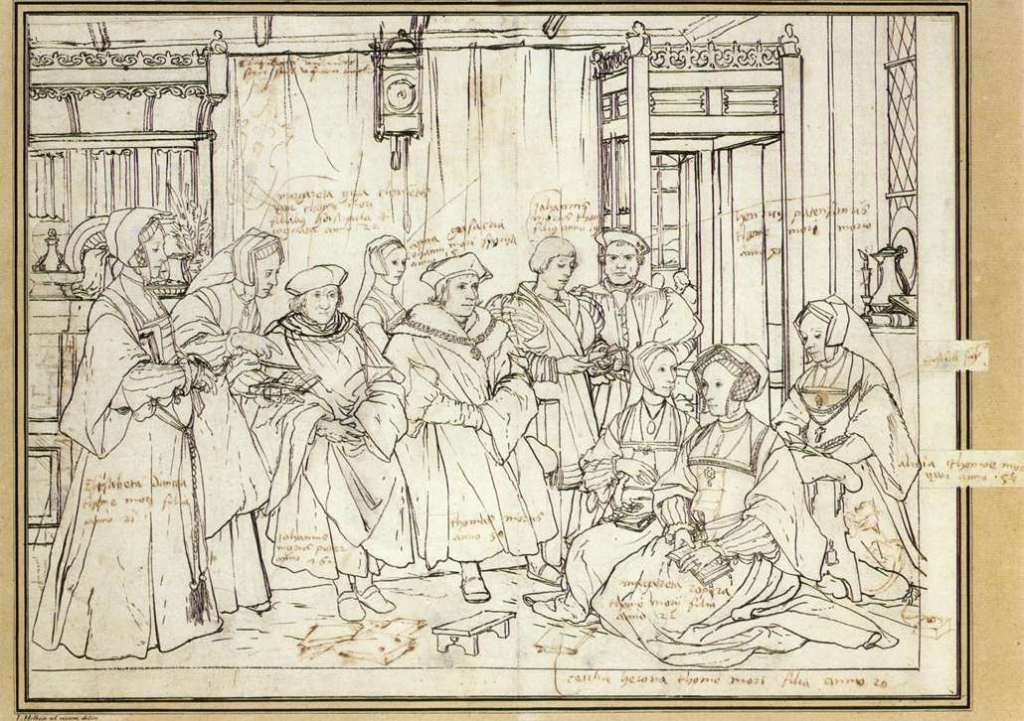
More occupies the centre, seated before a hanging curtain that lends his position a ceremonial dignity. His father, Sir John More, and his son are placed to either side, establishing a succession of three generations. The women of the household are distributed around them, some occupied with books, others engaged in quieter forms of attention or movement. Margaret Giggs leans towards the elderly Sir John, apparently drawing his attention to a passage in a book, while Anne Cresacre passes behind the central figures. At the right, Alice More kneels at a prayer desk, and Henry Patenson stands near the doorway, looking out towards the spectator. The arrangement combines the ordered presentation of a family with gestures and activities that suggest the less formal rhythms of domestic life.
The drawing was not, however, a definitive design. Latin inscriptions identifying the sitters and recording their ages were added by Nikolaus Kratzer, the German-born astronomer associated with More’s circle. Other notes, written in German, concern changes to the figures, their clothing and the objects in the room. Among the revisions are instructions concerning musical instruments, the addition of books in the foreground, the introduction of a monkey beside Alice More and the removal of a candlestick. An instruction beside Alice calls for her to be seated rather than kneeling. These interventions have suggested that the design was discussed and reconsidered as the commission developed, although the extent of More’s direct involvement cannot be established.
The Individual Portrait Studies
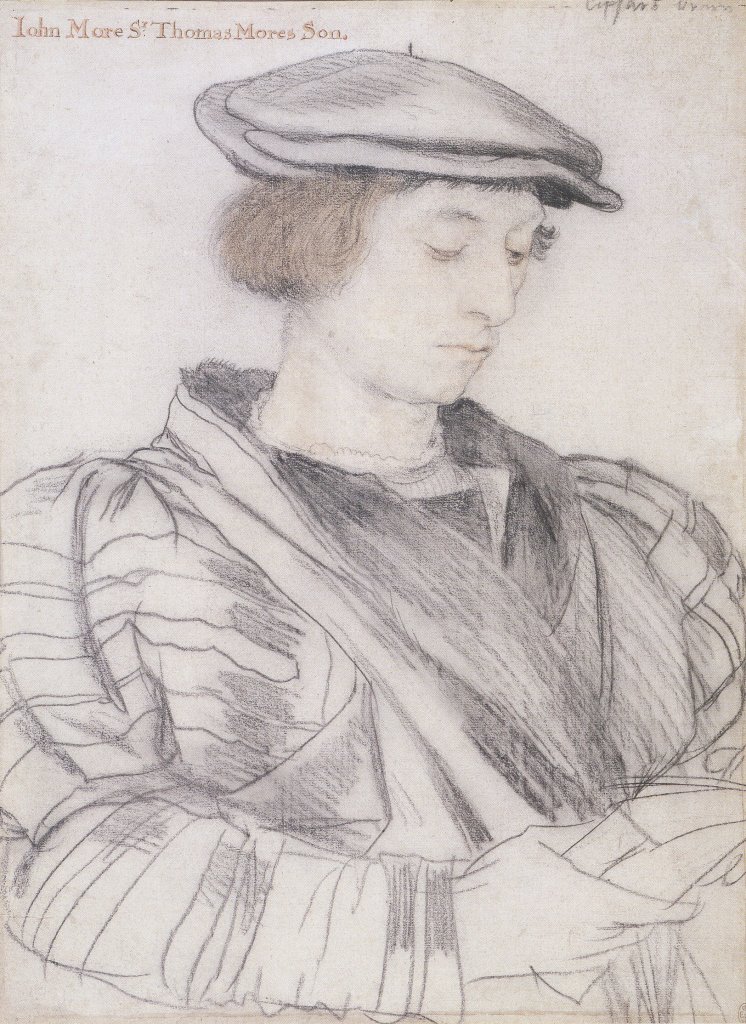
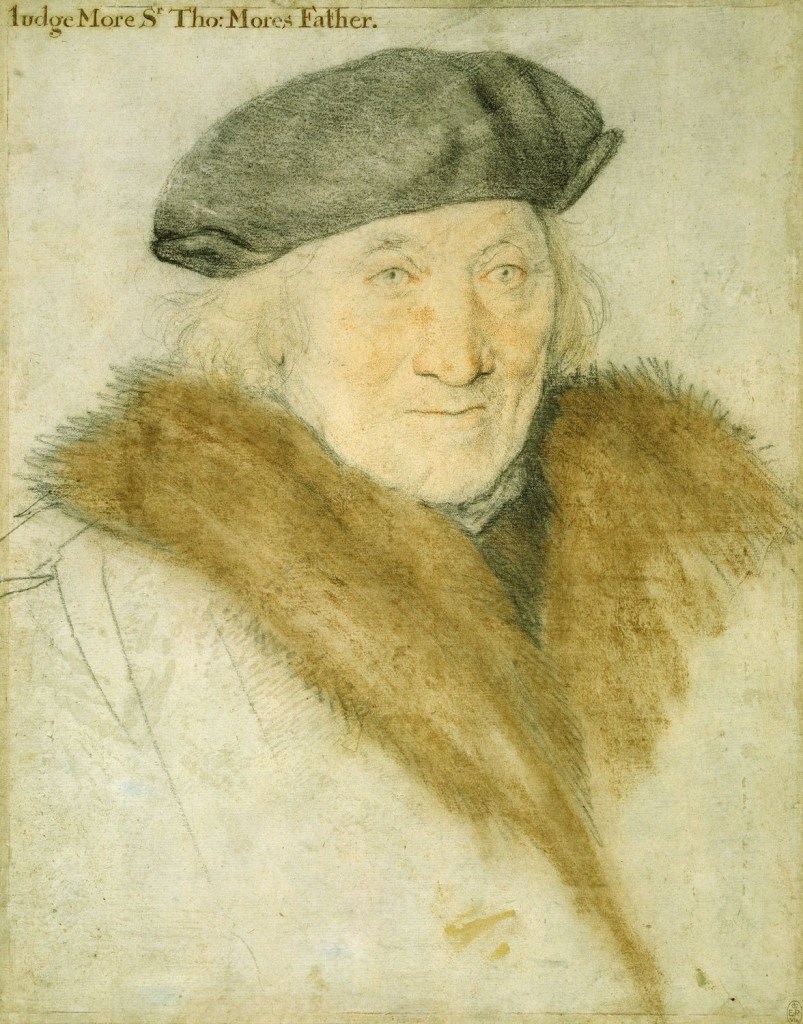
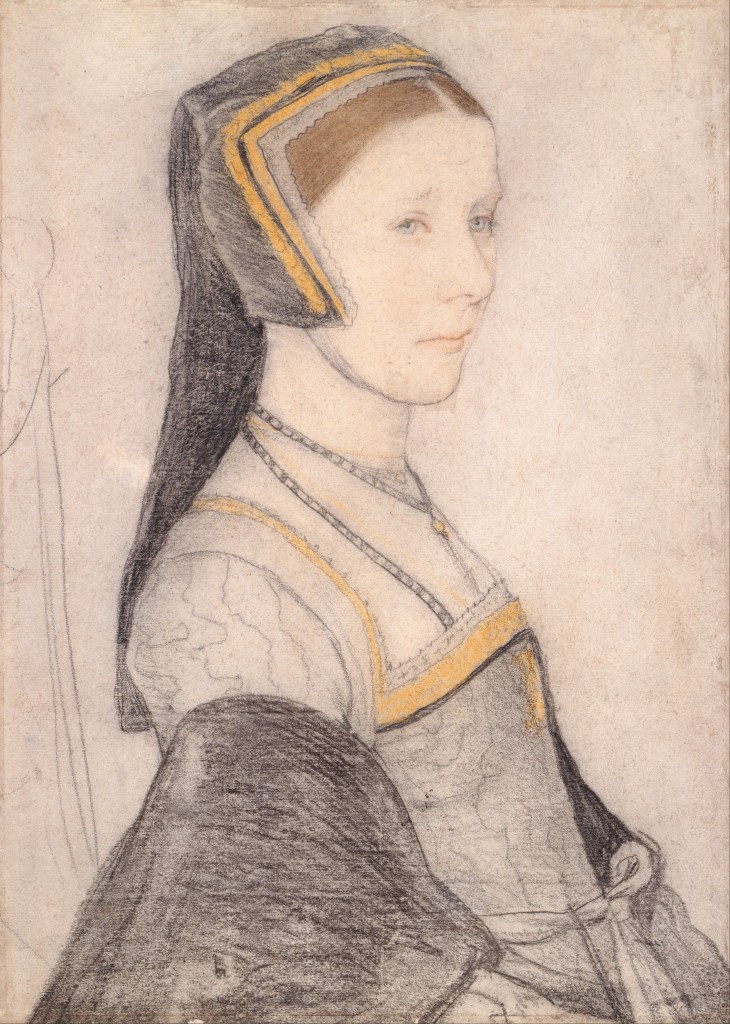
Holbein’s preparations for the family portrait included a remarkable series of studies made from life in black and coloured chalks, seven of which survive in the Royal Collection at Windsor. Although conceived in connection with a larger undertaking, they possess an immediacy and precision that give them considerable interest as independent works of portraiture. The drawings record individual features with great economy, combining sharply defined contours with delicate transitions of tone. Holbein used the chalks selectively, concentrating his attention on the face while allowing the clothing and surrounding forms to emerge through variations in pressure, line and shading.
The portrait of John More the Younger offers a striking example of this versatility. The face is carefully modelled, while the elaborate costume is described with a more vigorous handling of chalk. Foister has drawn attention to the energetic strokes used for the puffed and slashed sleeves, whose contrasting textures are suggested without the laborious description of every fold. A different approach is apparent in the study of Sir John More, where the aged features are rendered through subtle tonal variations, while the hair and fur collar receive a freer, more broken treatment. The contrast between these passages demonstrates Holbein’s ability to distinguish materials and surfaces through the character of his marks.
In the study of Anne Cresacre, the delicacy of the facial modelling is accompanied by a carefully controlled description of her costume. The drawing also retains a lightly indicated chair, showing that she was originally represented seated. In the Basel compositional study, however, she appears standing behind the central figures. Holbein was therefore not simply transferring individual studies into predetermined positions: the poses could be adapted as the larger design developed.
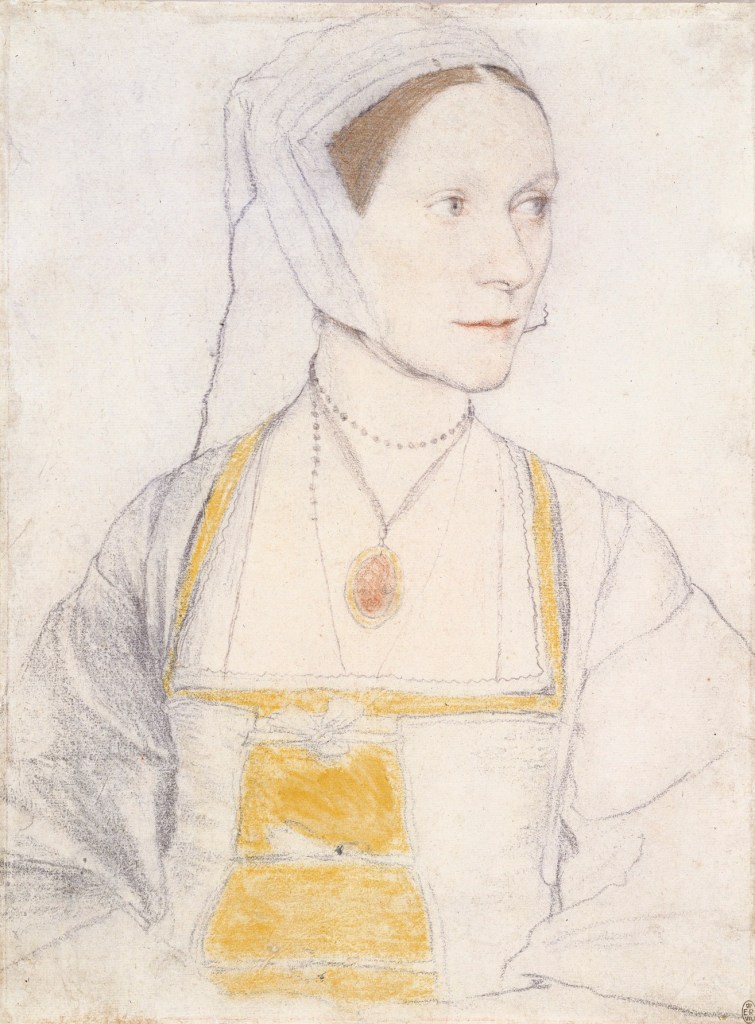
Cecily Heron’s portrait is distinguished by the movement of her head and the subtle relationship between its turning pose and the direction of her gaze. Susan Foister has suggested a possible connection with Leonardo da Vinci’s portrait of Cecilia Gallerani, Lady with an Ermine, an idea also considered by Elizabeth Goldring. Although a direct relationship cannot be established, the comparison draws attention to Holbein’s familiarity with the expressive possibilities of the three-quarter portrait and the animation introduced by a turning figure.
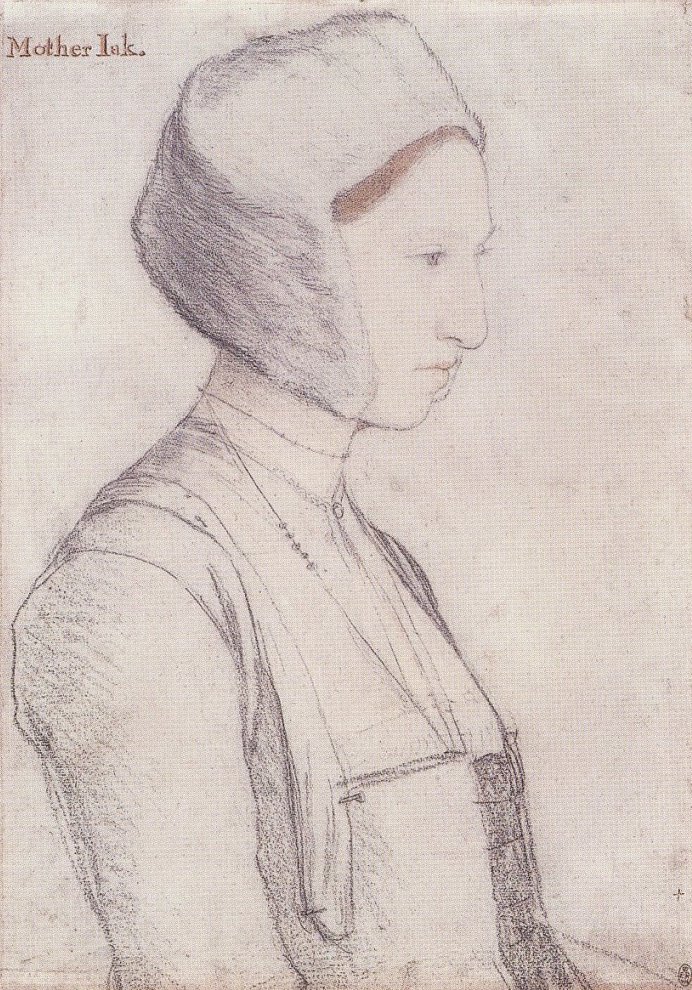
The drawing of Margaret Giggs raises a different question about the development of the composition. In the Basel design she leans towards Sir John More, apparently sharing his attention to a book, whereas the surviving individual study shows her standing upright and wearing a fur cap. This corresponds more closely to her appearance in the later painted version at Nostell Priory, where she has been moved to the far left of the gathering. The differences suggest that Holbein reconsidered both her likeness and her place within the composition, although the precise sequence of revisions remains uncertain. Goldring has raised the possibility that Margaret’s pregnancy and the birth of her first child in 1527 affected the timing of her sittings, but this remains conjectural.
The drawings’ differing degrees of finish and changes of pose indicate that Holbein developed the family portrait through successive decisions, rather than assembling a fixed group of sitters.
Thomas More: The Drawings and the Frick Portrait
The preparations for Holbein’s independent portrait of Sir Thomas More, now in the Frick Collection in New York, have raised questions about the relationship between that painting and the larger family commission. Two chalk studies of More survive in the Royal Collection, both associated with Holbein’s first visit to England. Although closely related, they differ in their handling of the sitter’s features, costume and expression, and bear evidence of different methods of transferring a design to another surface.
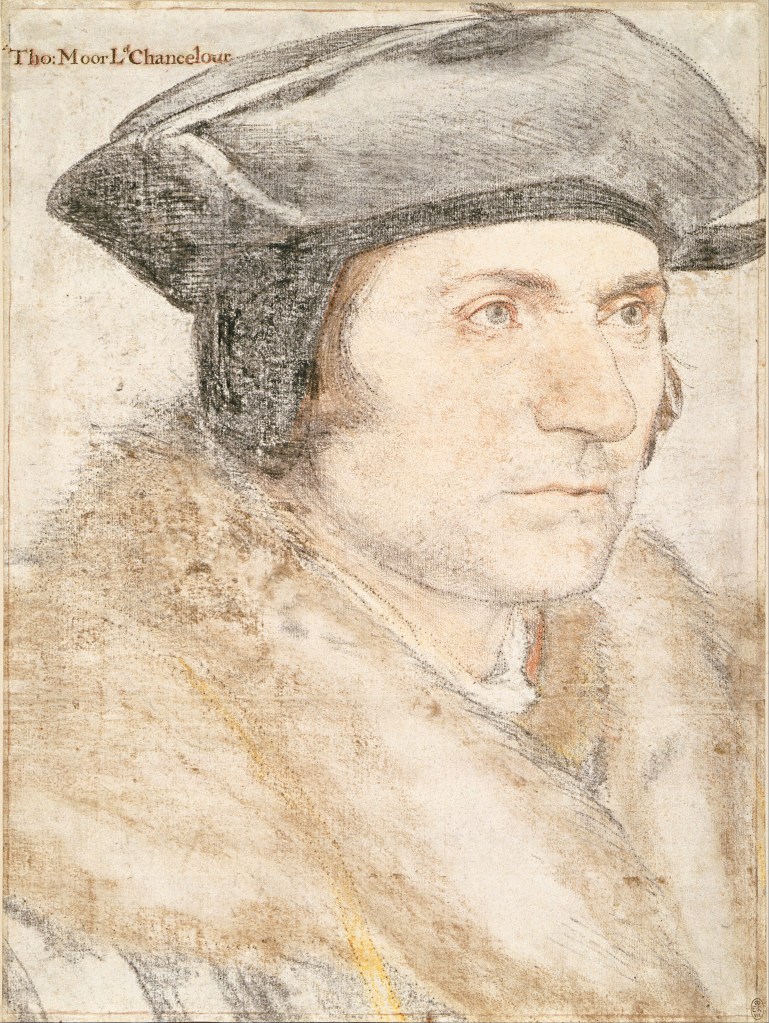
The drawing traditionally known as Parker 3 (RCIN 912268) is generally regarded as an autograph work by Holbein. Its outlines have been pricked for pouncing, a process in which powdered pigment was passed through small holes to transfer the principal contours of a drawing. The other study, Parker 2 (RCIN 912225), is more highly finished in certain passages and has a more restrained expression. Its attribution has been questioned, notably by Xavier F. Salomon, although Alexander Marr has defended Holbein’s authorship. Instead of pricked outlines, it bears blind lines made by tracing the contours with a stylus, indicating a different procedure for transferring the design.
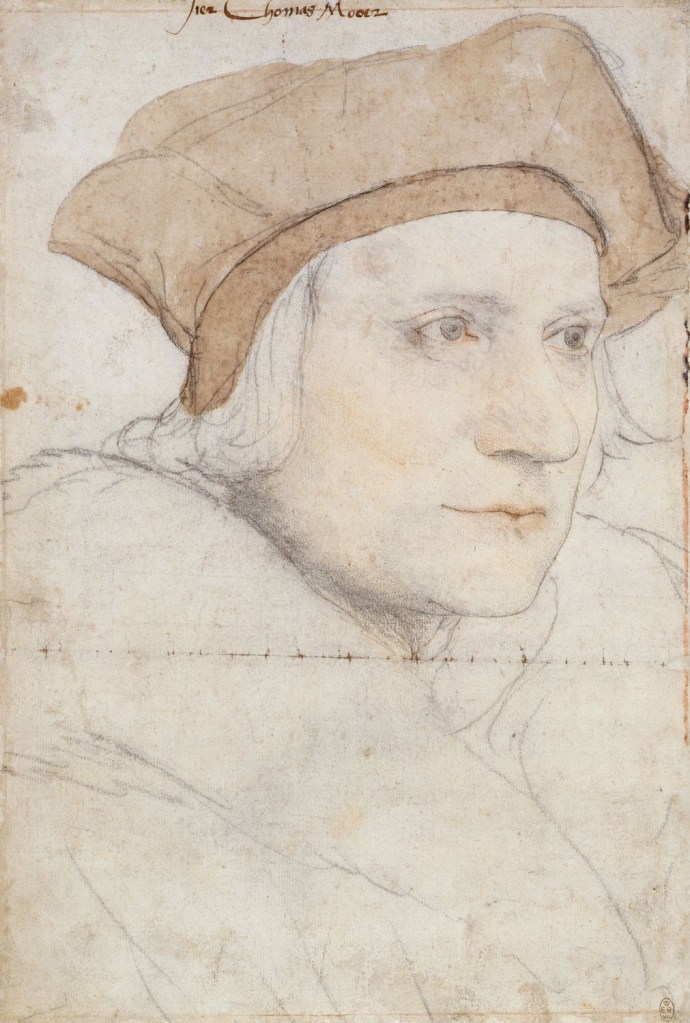
Marr has brought these drawings into a closer relationship through his examination of the Frick portrait’s technical evidence. Infrared reflectography and X-radiography have revealed changes made during the painting’s execution, including alterations to More’s hat, hair, fur collar and facial features. Marr argues that the earlier forms correspond more closely to Parker 3, while subsequent revisions approach the appearance recorded in Parker 2. He also notes that the two drawings were made on papers bearing different watermarks. The paper used for Parker 2 corresponds to that of the family studies, whereas Parker 3 is associated with sheets employed for other English portrait commissions.
Marr therefore proposes that Holbein began the independent portrait using Parker 3, probably before the commission for the family group had been undertaken. When work on the larger portrait began, Holbein produced Parker 2, incorporating changes to More’s appearance for his place among the household. The second drawing may then have informed revisions to the Frick painting, which was still in progress. On this reconstruction, the two commissions overlapped: rather than completing one portrait before beginning the other, Holbein worked on both during the same period, allowing changes developed for the family composition to influence the independent likeness. Marr interprets a slight alteration to the mouth as introducing the suggestion of a smile, perhaps intended to give More a more approachable expression within the family gathering. The proposed sequence is supported by the technical evidence, although its precise chronology and the reasons for the changes remain uncertain.
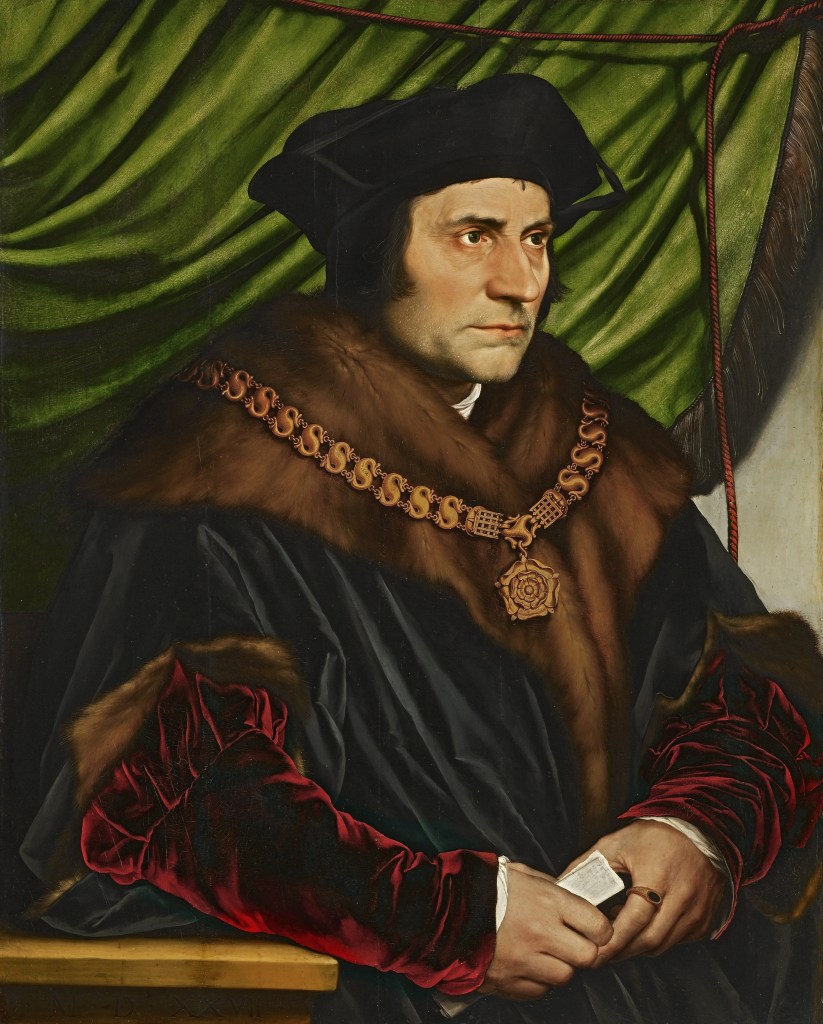
The Frick portrait nevertheless differs fundamentally in its purpose from the family composition. More appears alone, wearing a fur-lined gown and the gold chain of office that identifies his position as a royal servant. The painting conveys the dignity of a man whose public responsibilities had become increasingly important, while the directness and precision of the likeness resist any reduction of the sitter to his official standing. In the family portrait, the same individual is placed among relatives whose varied activities and relationships alter the circumstances in which his image is encountered.
The Lost Painting and Its Copies
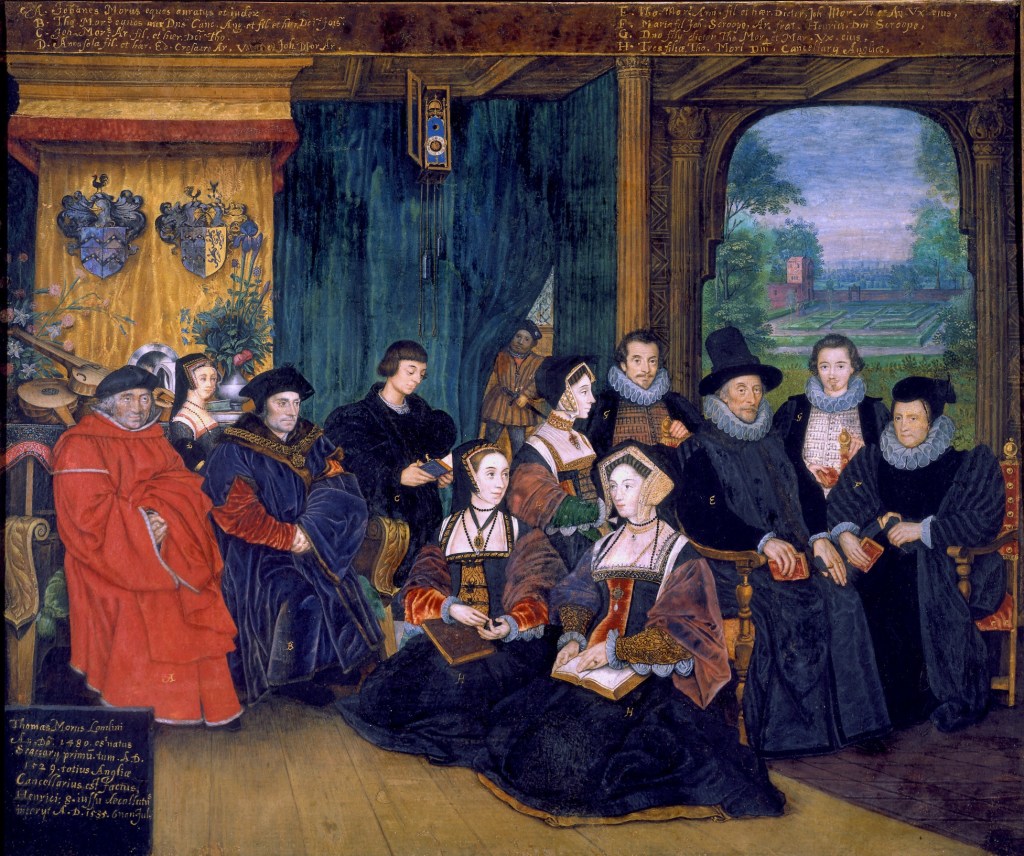
Although Holbein’s original family portrait has disappeared, its appearance can be approached through a series of later copies, the closest to Holbein’s original composition being the large painting at Nostell Priory in Yorkshire. Bearing a later inscription naming Rowland Lockey and giving the date 1592, it follows the arrangement established in the Basel drawing while incorporating numerous changes. The Nostell painting has consequently acquired considerable importance as a witness to a work whose scale and complexity cannot be fully appreciated from the preparatory drawing alone.
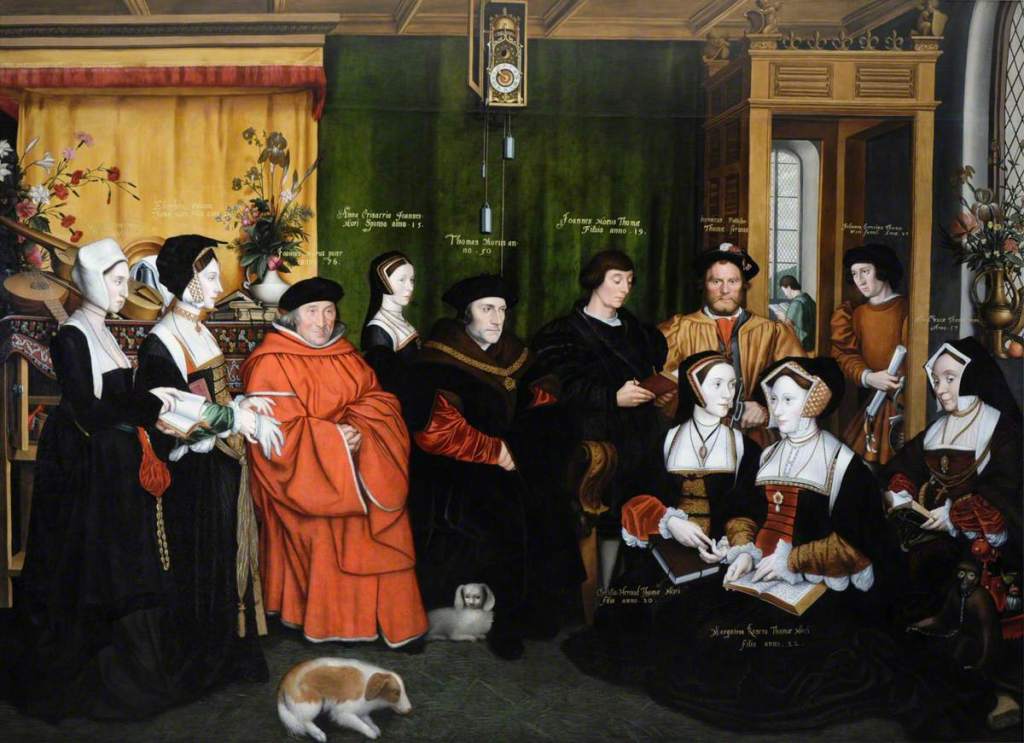
The relationship between the Nostell picture and Holbein’s original has nevertheless proved difficult to establish. Jane Eade and David Taylor, in their 2015 investigation, questioned its traditional attribution to Lockey while examining the history and relationships of the surviving versions. Although the Nostell painting has generally been regarded as the closest surviving representation of Holbein’s completed composition, it was produced more than sixty years after the original. Its details cannot therefore be assumed to reproduce Holbein’s intentions without alteration.
Comparison with the Basel drawing reveals a number of significant differences. The composition has become more symmetrical and ceremonious, with the curtain and clock above More reinforcing his central position. Alice More is seated rather than kneeling, and the arrangement of the younger women has changed. Margaret Giggs now stands at the far left, while Elizabeth Dauncey, More’s second daughter, stands immediately beside Sir John More, identifiable by his red judicial robes. The books and musical instruments have also been rearranged, and the interior contains additional decorative elements. Some of these developments correspond to annotations on the Basel sheet, suggesting that Holbein continued to revise the composition after its initial design had been established.
The painted version also provides evidence of the intellectual character of the household through the identification of books represented within the scene. David R. Smith has drawn attention to the presence of Boethius’s Consolation of Philosophy and works by Seneca, whose writings address the uncertainties of fortune, the exercise of judgement and the moral dangers of ambition. Of special interest is the open volume on Margaret Roper’s lap, which Smith identifies as Seneca’s Oedipus. The passages represented on its facing pages contrast the virtues of moderation with the disastrous aspiration of Icarus, whose attempt to rise beyond human limits ends in destruction. Smith interprets this juxtaposition as a learned reflection upon the responsibilities and temptations of public life.
The significance of these texts becomes clearer in relation to Smith’s interpretation of the painting as a ‘counter-portrait’. More occupies the centre of the gathering in the robes and insignia of royal service, retaining much of the ceremonial dignity familiar from his portrait in the Frick Collection. Yet Erasmus described him as a man who disliked ostentation and valued freedom from the demands of public office. Within the household, the statesman’s authority is placed alongside other qualities that More himself cherished: learning, family affection, humility and independence of mind. Smith sees in this contrast an element of affectionate irony. More appears almost enthroned among people whose cultivation and intellectual freedom invite reflection upon the claims of worldly rank. His daughter Margaret Roper assumes a significant role in this reading. Celebrated for her learning and closeness to her father, she resembles him in her composed expression but kneels rather than occupying a position of authority. The passages from Seneca in her open book reinforce the contrast between moderation and ambition, suggesting that personal worth cannot be measured by public distinction alone.
Henry Patenson, the household fool, introduces a more openly comic element. Standing at the edge of the gathering, he looks directly towards the spectator, unlike the other figures, whose attention remains largely within the scene. Smith relates his presence to the traditional licence enjoyed by fools to mock ceremony and expose pretension. Such humour had a close affinity with the writings of Erasmus and More, particularly The Praise of Folly, dedicated to More and illustrated by Holbein early in his career. The fool’s presence does not necessarily ridicule the central figure; rather, it allows the dignity of public office to coexist with an awareness of its limitations. In Smith’s interpretation, the painting’s humour belongs to the same cultivated household that it celebrates.
Catherine Hunt develops this understanding of humanist irony through the metaphor of life as a theatrical performance, familiar from the writings of Lucian and their reception by Erasmus and More. In this tradition, rank, costume and social position could be compared to the roles assigned to actors, concealing the common humanity and uncertain fortunes of those who assumed them. Hunt’s interpretation extends beyond the exposure of pretension to consider the precarious relationship between outward identity and the circumstances that determine an individual’s life. The classical texts represented in the painting acquire a further resonance within this framework. Seneca’s warnings against excessive ambition and Boethius’s reflections upon the reversals of fortune suggest the instability of distinctions that appear secure. More’s official position, however dignified, belongs to a world in which authority and reputation remain vulnerable to change. Hunt also understands Patenson’s outward gaze as a means of drawing the spectator into this reflection, comparable to the role of a fool who comments upon the performance in which he participates.
These interpretations depend in differing degrees upon details transmitted through the Nostell painting, and their more elaborate implications cannot always be assigned securely to Holbein’s original conception. They nevertheless offer a richer understanding of the family’s intellectual culture than a straightforward account of domestic learning and religious devotion. The portrait could affirm More’s public standing and the accomplishments of his household while accommodating the wit, scepticism towards worldly honours and moral seriousness that characterised his humanist friendships.
Erasmus and the Later History of the Portrait
Holbein returned to Basel in 1528, but his association with Thomas More and his family continued. In September 1529 Erasmus wrote to More and his eldest daughter, Margaret Roper, expressing his delight at receiving an image of the family from Holbein. The representation evidently brought back vivid memories of the household he knew so well, giving him a sense of being once again among his absent friends. His response provides valuable contemporary testimony to the personal significance of Holbein’s undertaking and to the close relationship between the painter’s English patrons and the European humanist community.
The image Erasmus received has traditionally been identified with the surviving compositional drawing in Basel. Elizabeth Goldring has recently challenged this assumption, suggesting that Holbein may instead have painted a second, smaller version of the family portrait after returning to Switzerland. She draws attention to the interval between Holbein’s departure from England and Erasmus’s acknowledgement of the gift, as well as the terminology employed in the correspondence. Erasmus describes the work as a pictura, a word which Goldring argues more readily suggests a painting than a preparatory drawing. On this interpretation, the detailed Basel sheet may have served Holbein as a record from which he could reconstruct the composition without further access to the sitters. The proposal is intriguing, although no such painting has survived and the traditional identification remains open to debate.
The monumental original followed a different course. Its subsequent history is incompletely documented, but it eventually entered the collections of the bishops of Olomouc at Kremsier, where it was destroyed by fire in 1752. By then, the composition had already acquired a considerable afterlife through copies and adaptations made for More’s descendants. A large painting by Rowland Lockey, dated 1593 and now in the National Portrait Gallery, expanded the original gathering to incorporate later generations of the family. A related miniature, attributed to Lockey and now in the Victoria and Albert Museum, likewise adapted Holbein’s design to the interests of its later patrons. These works transformed a portrait conceived for More’s own household into a broader statement of family history and continuity.
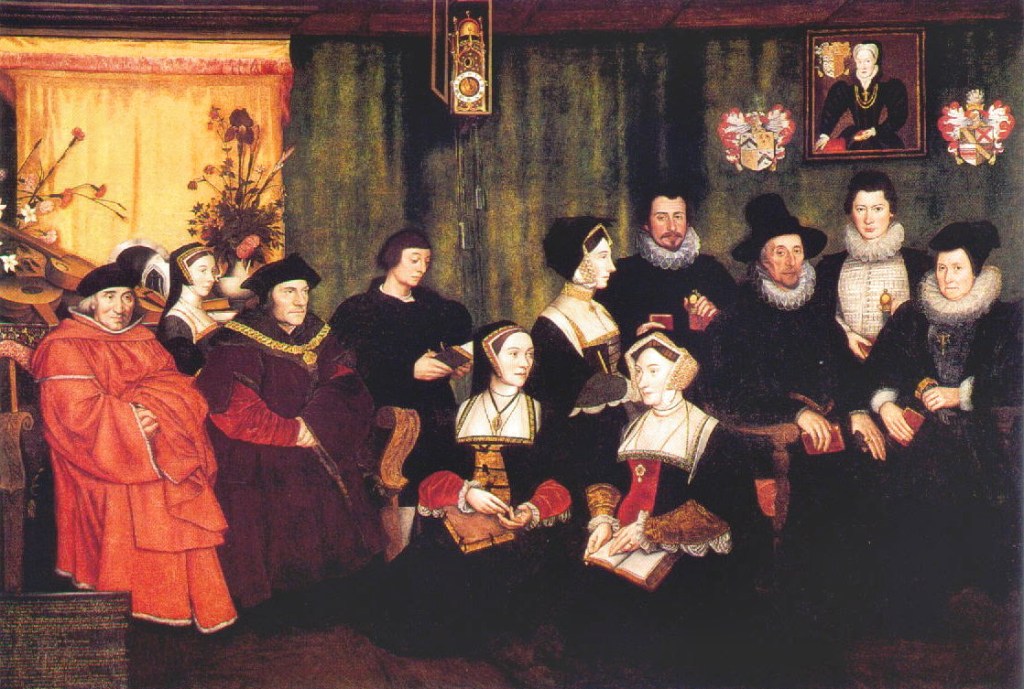
The destruction of Holbein’s painting has inevitably limited our understanding of its finished appearance. Yet the Basel composition, the Windsor portrait studies and the later copies have retained substantial evidence of its development and influence. Few lost Renaissance portraits have left so revealing a record of the artist’s preparations, or of the successive meanings attached to an image as it passed beyond the circumstances of its original commission.
Donate to Inner Surfaces here.
Bibliography
Eade, Jane, and David Taylor. ‘The Family of Sir Thomas More Revisited’. In The National Trust Historic Houses & Collections Annual 2015, edited by David Adshead, pp. 4–11. Published in association with Apollo, 2015.
Foister, Susan, with contributions by Tim Batchelor. Holbein in England. London: Tate Publishing, 2006.
Goldring, Elizabeth. Holbein: Renaissance Master. New Haven and London: Yale University Press for the Paul Mellon Centre for Studies in British Art, 2025.
Heard, Kate. Holbein at the Tudor Court. London: Royal Collection Trust, 2023.
Hunt, Catherine. ‘Role Playing in The Family of Sir Thomas More by Hans Holbein the Younger (1497/8–1543)’. The British Art Journal, vol. 19, no. 1 (Spring 2018), pp. 62–71.
Marr, Alexander. ‘Holbein’s Earliest Portraits in England? The Sequence of His Work for Sir Thomas More’. The British Art Journal, vol. 24, no. 3 (Winter 2023), pp. 49–57.
Smith, David R. ‘Portrait and Counter-Portrait in Holbein’s The Family of Sir Thomas More’. The Art Bulletin, vol. 87, no. 3 (September 2005), pp. 484–506.

