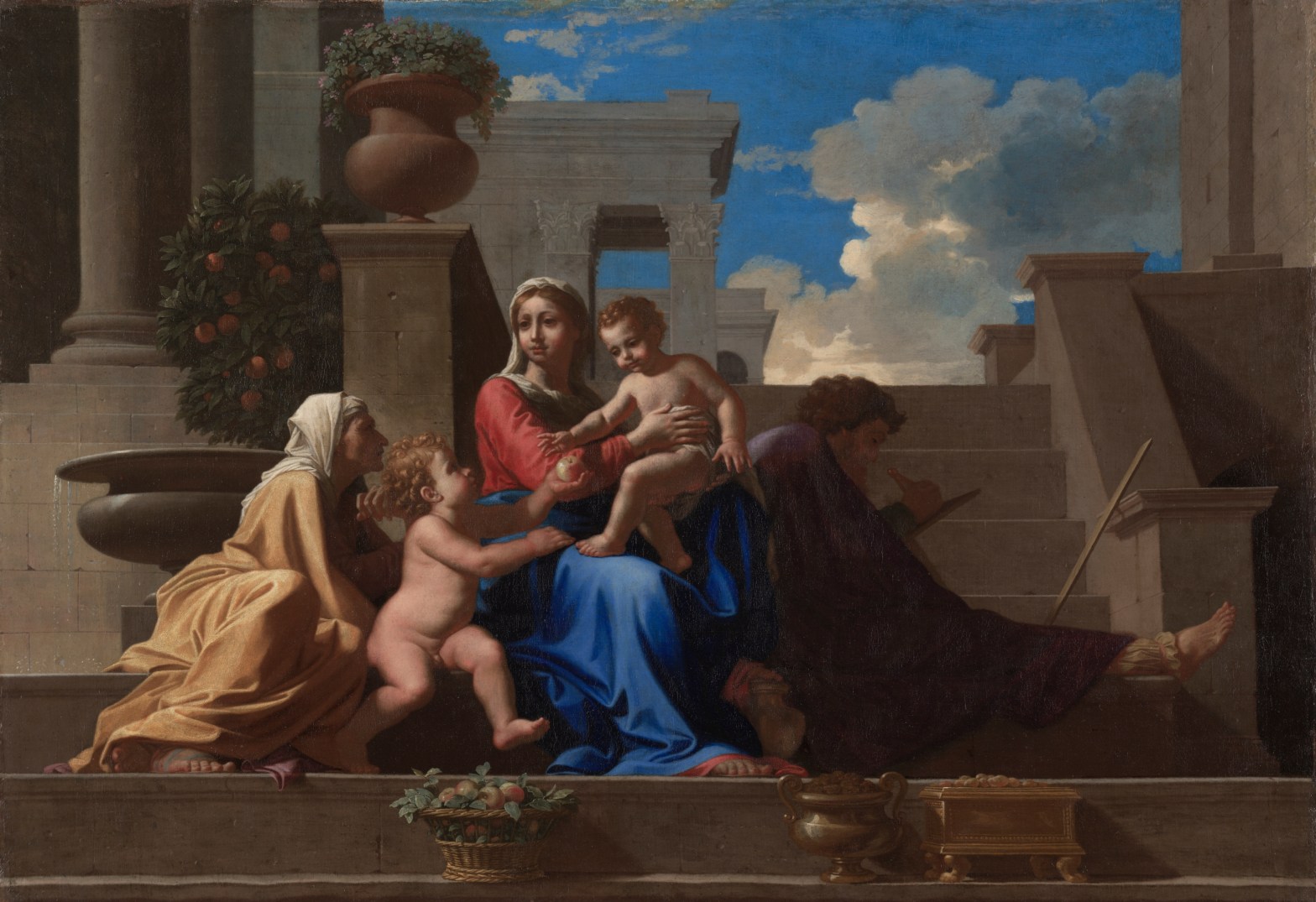
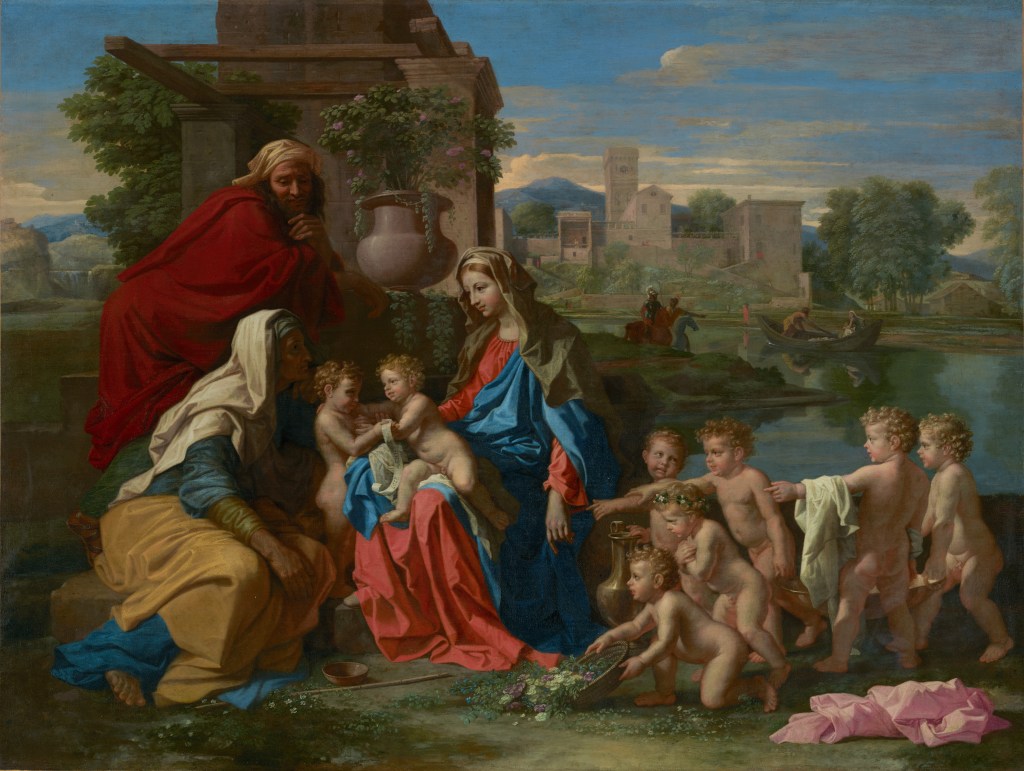
Nicolas Poussin completed The Holy Family on the Steps in 1648, during a period of exceptional achievement in which his art attained a new degree of concentration and formal discipline. Having returned to Rome from Paris in 1642, he had resumed work for private patrons, free from many of the demands imposed upon him during his employment at the French court. The second series of Seven Sacraments, commissioned by Paul Fréart de Chantelou, occupied much of the following six years. Towards its conclusion Poussin produced a succession of paintings remarkable for their gravity and clarity of design, among them Landscape with the Funeral of Phocion, Eliezer and Rebecca, The Judgement of Solomon and Christ Healing the Blind Men of Jericho. Richard Verdi, in Poussin as a Painter, identifies the years 1648–50 as the culmination of the artist’s classicism, and places The Holy Family on the Steps among its finest achievements.
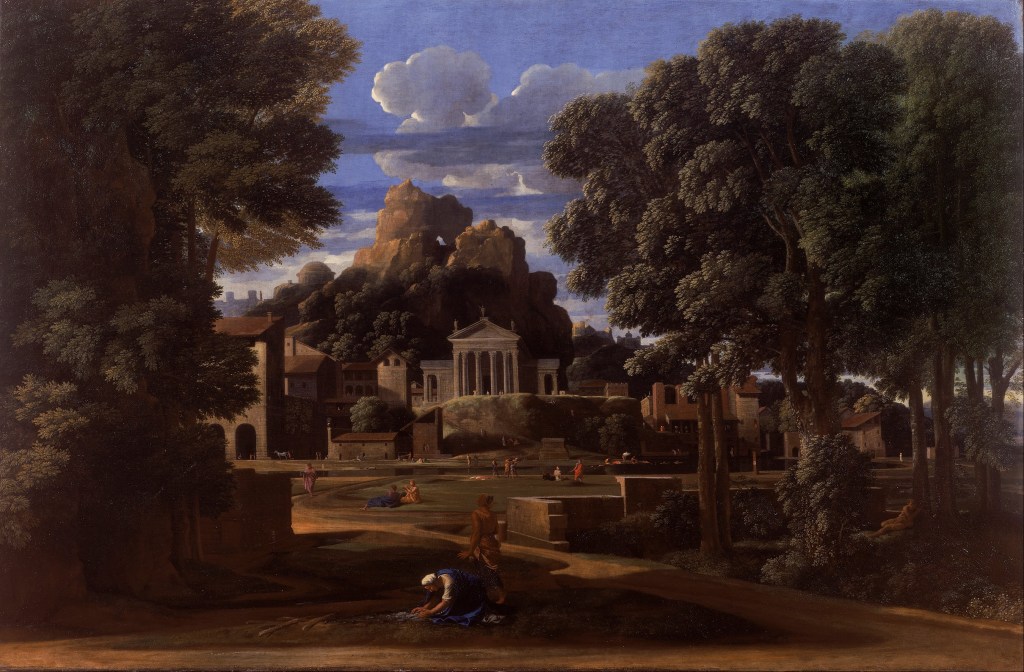
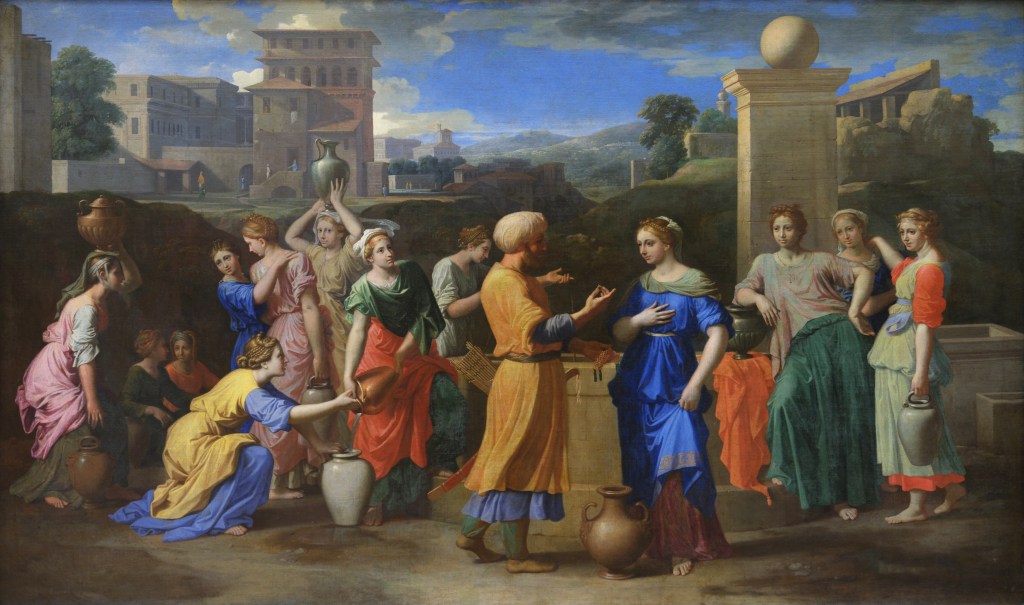
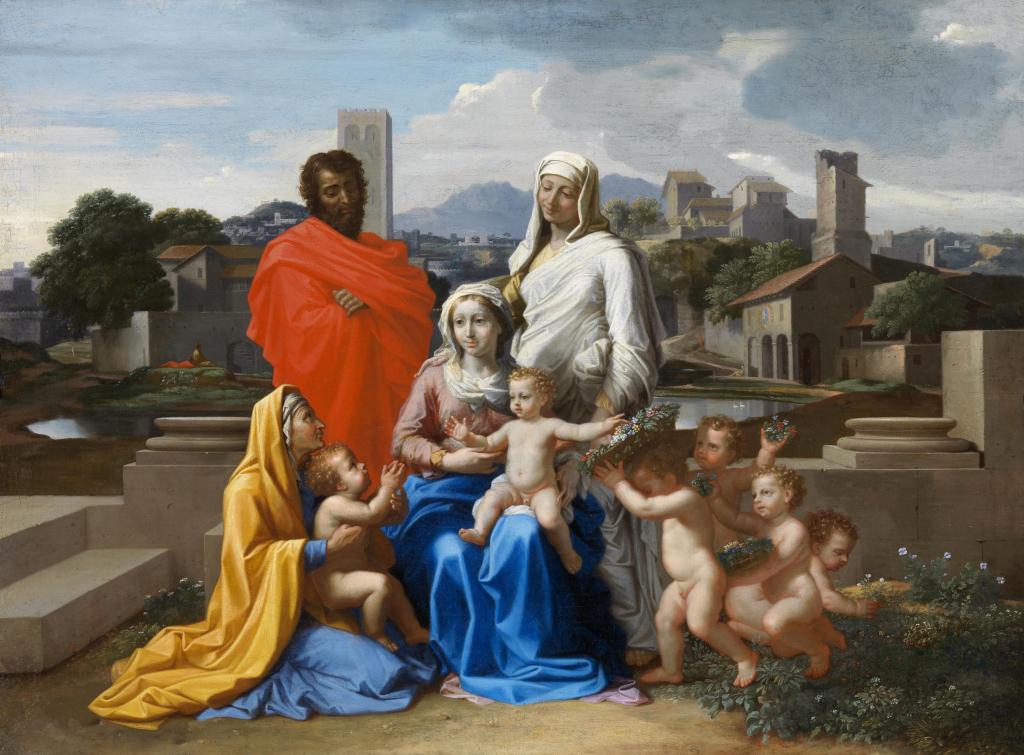
The painting belongs to a group of Holy Family compositions that Poussin developed during the late 1640s and early 1650s. He had treated the subject on several earlier occasions, but the new paintings show a marked change in ambition. Their figures possess a monumentality and composure more commonly associated with grand religious or historical subjects. Anthony Blunt, writing in his Mellon Lectures on Poussin, considered this development a decisive departure from the more picturesque, Venetian character of the artist’s earlier Holy Families. The figures were now arranged with a simplicity and stillness that anticipated aspects of his late work, while their grouping acquired a grandeur that Blunt regarded as surpassing even that of the Sacraments.
The Artistic Inheritance
Poussin’s engagement with the art of the High Renaissance was fundamental to the development of his mature classicism. In The Holy Family on the Steps, this inheritance is particularly apparent, although the painting resists identification with any single precedent. Howard Hibbard, in his 1974 monograph devoted to the work, examined the range of sources available to Poussin, finding in its conception an assimilation of Florentine, Roman and Venetian traditions. The central grouping recalls the pyramidal structures developed by Leonardo da Vinci, Michelangelo and Raphael, but Poussin’s arrangement is broader and more severely articulated. Hibbard compared it with Leonardo’s Virgin and Child with Saint Anne, Michelangelo’s Doni Tondo and Raphael’s Canigiani Holy Family, while observing that the treatment of the figures could also be related to the more relaxed compositions of Palma Vecchio and Titian. The painting emerges from this account as a deliberate transformation of earlier models, in which their compositional principles have been subjected to a more exacting order.
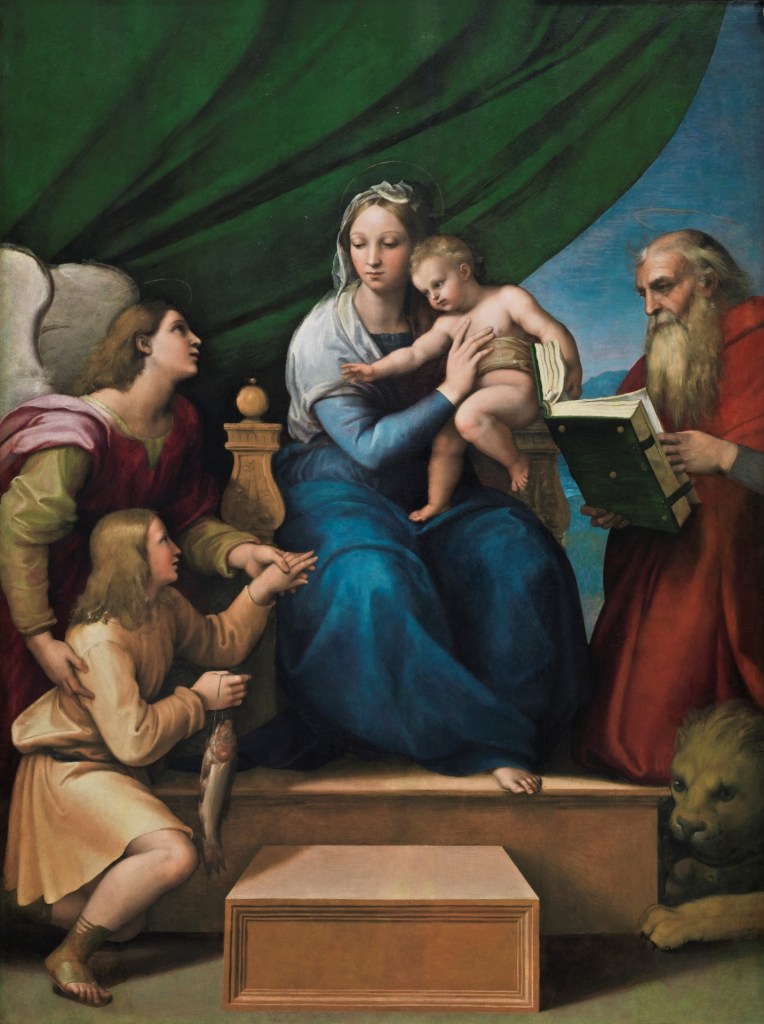
The most persuasive individual comparison concerns Raphael’s Madonna of the Fish, painted around 1513. Both Blunt and Hibbard regarded it as an important precedent for the relationship between the Virgin and Christ Child. Hibbard identified correspondences in the turn of the Virgin’s head and the disposition of the Child’s upper body, suggesting that Poussin adapted a recognisable arrangement while altering its character. Raphael’s painting was originally in San Domenico Maggiore in Naples, where Poussin may have seen it before its removal in 1638. Alternatively, he could have known the composition through an engraving. Whatever the means of transmission, the comparison concerns more than a borrowed pose. Poussin has retained the close physical relationship between mother and child while bringing their forms into a larger arrangement governed by the architecture and the disposition of the accompanying figures.
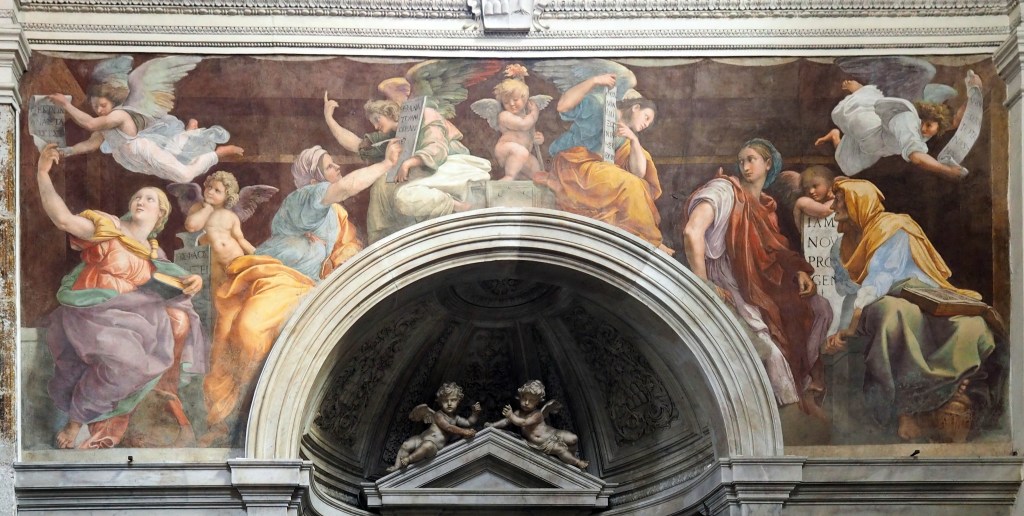
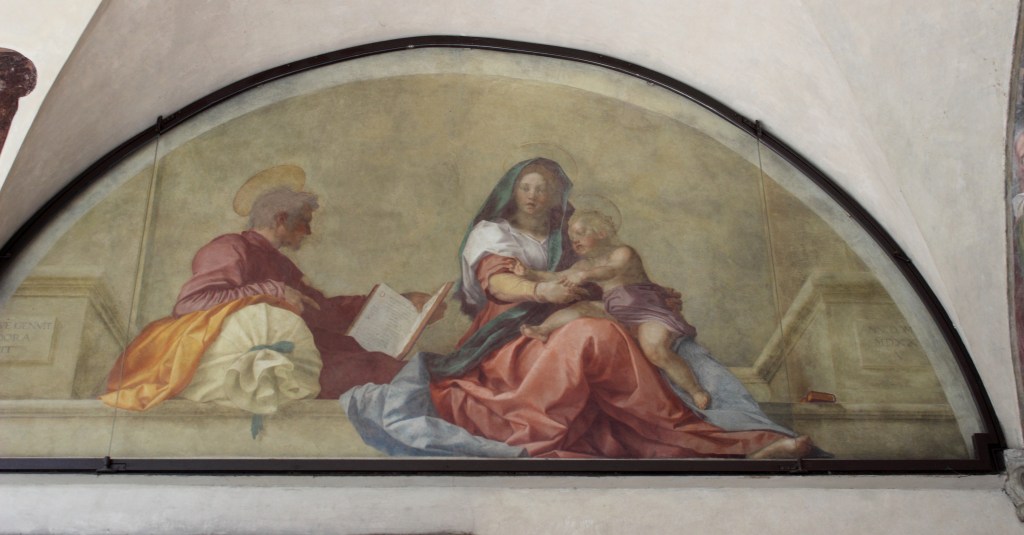
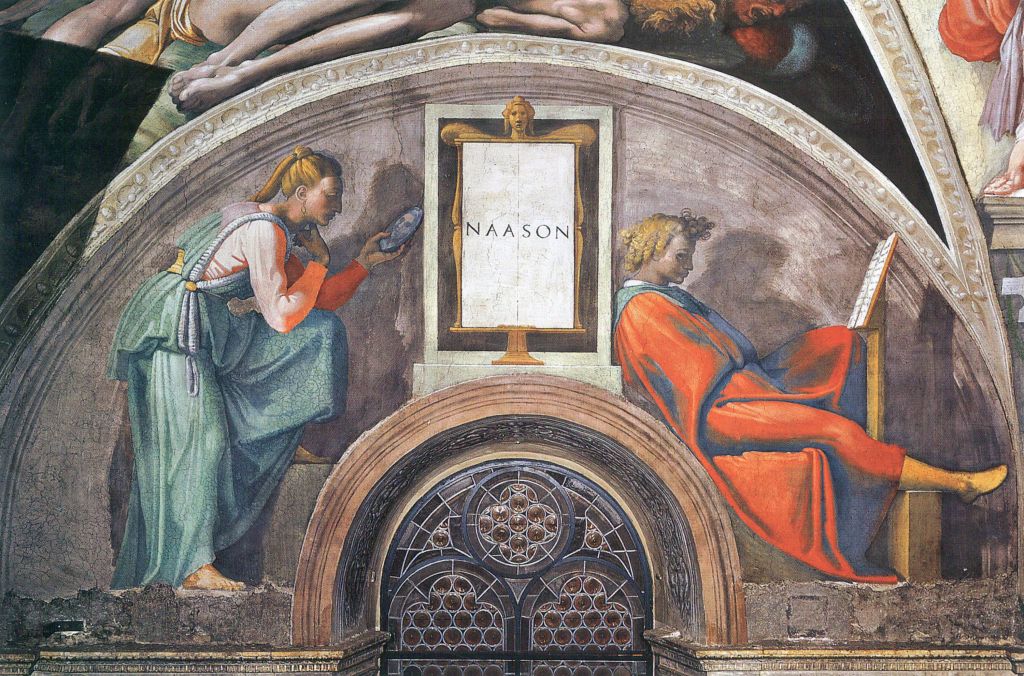
Hibbard also traced the individual figures to different artistic traditions. He compared Saint Elizabeth with Michelangelo’s Persian Sibyl on the Sistine Chapel ceiling, finding a precedent for the elderly woman’s strongly characterised profile and monumental bearing. Francis Dowley subsequently suggested Raphael’s sibyls in Santa Maria della Pace as an alternative point of comparison. Joseph’s seated figure has likewise been related to more than one source. His pose recalls the figure in Andrea del Sarto’s Madonna del Sacco of 1525, while the extended leg and foot have been compared with Michelangelo’s Naason, among the Ancestors of Christ in the Sistine Chapel. These parallels are important to Hibbard’s argument because they reveal a process of selective adaptation rather than the wholesale adoption of an existing composition.
The infant John the Baptist introduces another possible source. Hibbard proposed a connection with the sculpted children of François Duquesnoy, whose work Poussin knew during his earlier years in Rome. Duquesnoy’s representations of childhood had themselves absorbed aspects of Titian and Rubens, and Hibbard regarded Poussin’s treatment as a further transformation of that tradition. The proposed relationship remains less secure than the comparison with Raphael’s Madonna of the Fish, but it broadens the account of the painter’s sources to include contemporary sculpture alongside Renaissance painting.
Poussin’s familiarity with antiquity also enters the discussion. Walter Friedlaender had suggested that the disposition of the figures and surrounding spaces owed something to the Aldobrandini Wedding, the ancient Roman fresco that Poussin had copied. Hibbard found the comparison consistent with the painter’s interest in antique compositions, particularly the relationship between enclosed spaces, solid forms and intervening voids. Diane De Grazia, however, questioned whether the visual correspondence was sufficiently convincing to establish a direct connection.
What emerges from these comparisons is the remarkable attention Poussin devoted to the possibilities of earlier art. Hibbard’s investigation reveals a process of close discrimination, in which individual poses, gestures and compositional relationships were examined and adapted to the requirements of a new conception. The precision of this engagement is itself a significant aspect of Poussin’s artistic practice.
The Preparatory Drawings and the Making of the Painting
The surviving drawings for The Holy Family on the Steps offer an exceptionally revealing account of Poussin’s methods. Three principal compositional studies, now in Dijon, New York and Paris, record successive stages in the development of the painting, although they do not represent the full extent of his preparatory work. Blunt regarded the Cleveland composition as one of Poussin’s most carefully conceived inventions, while Verdi traced a progressive movement towards greater geometrical concentration through the drawings. More recently, technical examination of the painting has shown that this process continued after Poussin had begun working on the canvas. The drawings consequently provide the beginnings of a history that can be pursued through the material evidence of the finished work.
The earliest surviving study, in the Musée des Beaux-Arts, Dijon, has been dated by De Grazia to approximately 1646. On the reverse of the sheet is a sketch connected with the Baptism from Poussin’s second series of Seven Sacraments, providing a useful indication of when the artist first began considering the composition. The central grouping is already conceived on a monumental scale, with the Virgin and Child forming the principal focus. Yet the arrangement differs substantially from the painting. Saint Elizabeth and the infant Baptist have not assumed their eventual positions, while several additional children occupy the scene. De Grazia has proposed that these figures represent the Holy Innocents, rather than conventional decorative putti, and has related their presence to themes of martyrdom and Christ’s future sacrifice. The setting is comparatively simple, consisting principally of a wall, an opening and indications of a raised platform. Neither the staircase nor the elaborate classical architecture of the finished painting has yet emerged.
The drawing in the Morgan Library, New York, represents a considerably more advanced conception. The principal figures have been brought into an arrangement close to that of the Cleveland painting, with Elizabeth and John introduced beside the Virgin and Child. An attendant child still scatters flowers behind Elizabeth, while a cloth hanging nearby provides another element subsequently discarded. De Grazia associates the flowers with the Holy Innocents and the cloth with both the bathing of Christ and his future burial. Such readings belong to her larger interpretation of the religious themes informing Poussin’s successive Holy Family compositions. Whatever their intended significance, the elimination of these details can be followed through the later studies.
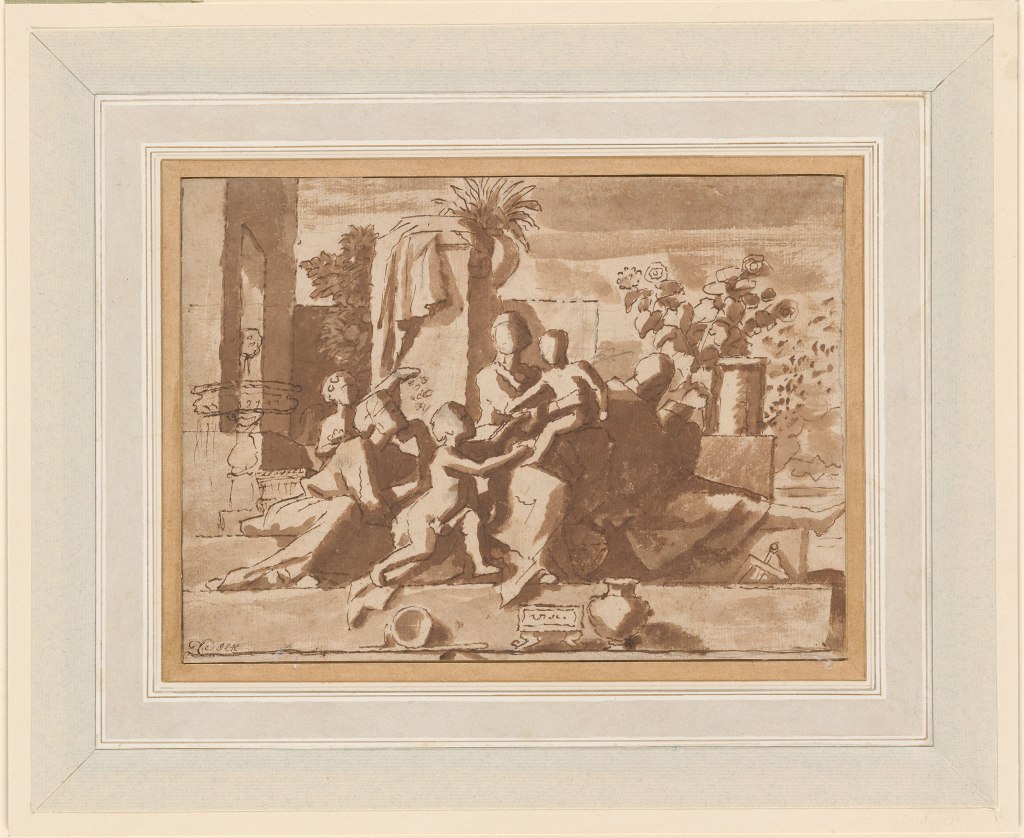
The architectural setting has also become more elaborate. Buildings, a fountain and abundant vegetation surround the figures, while Joseph sits apart, reading a book, with his measuring instruments placed nearby. Verdi draws attention to the relatively pastoral character of this conception, which anticipates something of the more expansive Holy Family compositions Poussin would develop during the following years. The figures are already more firmly ordered than in the Dijon sheet, but the surrounding landscape and subsidiary incidents give the drawing a character quite distinct from the architectural severity of the completed painting.
A smaller study in the Louvre, devoted to Joseph’s extended leg, provides additional evidence of Poussin’s reconsideration of the figure’s position. De Grazia places it after the Morgan drawing and relates its treatment of the leg, drapery and projecting foot to the development of the elevated setting.
The final surviving compositional study, also in the Louvre, approaches the finished arrangement much more closely. The broad flight of steps has appeared, the attendant child behind Elizabeth has been removed, and the architectural background has acquired greater prominence. A large pergola extends across the upper portion of the drawing, its intersecting members establishing a geometrical framework over the figures and buildings. Verdi regards this feature as especially significant. Although the pergola disappears from the painting, the formal organisation developed through its intersecting lines remains important to his account of the finished composition.
The Louvre drawing also records Poussin’s continuing uncertainty over certain details. Elizabeth still rests her chin upon her hand, while the Baptist is associated with drapery and a scroll that were subsequently omitted. De Grazia observes that some of these elements were added in black chalk over the original pen drawing, indicating that Poussin reconsidered them after establishing the composition. Joseph’s activity has likewise changed from reading to working with his compass. The figural arrangement is now substantially established, but the evidence of these additions and alterations suggests that individual gestures and attributes remained open to revision.
The Louvre sheet was squared in black chalk, apparently in preparation for transferring the design. Carol Sawyer, assisted by Marcia Steele, demonstrated in their technical study of the Cleveland painting that the grid corresponds closely with the arrangement of the principal figures and other compositional elements on the canvas. Although examination of the painting did not reveal the precise method of transfer, the correspondence establishes the practical importance of the drawing in the final stages of preparation.
The technical findings published by Sawyer and Steele in 1999 considerably extend our knowledge of what followed. X-radiography and infrared examination revealed a succession of architectural schemes beneath the finished paint surface, confirming that Poussin continued to experiment with the background even after the principal figural group had been established. The most extensive changes occurred in the upper left portion of the composition, where an elaborate arcade supported by four Doric columns was introduced and subsequently abandoned. The surviving traces correspond closely with elements of the Louvre drawing, providing direct evidence of the relationship between preparatory invention and the painting process.
Further examination revealed an intermediate arrangement in which Poussin divided the architecture into separate buildings with arched openings. These structures were subsequently replaced or modified as he developed the final combination of columns, porticoes and more distant architectural masses. Sawyer and Steele proposed a sequence of reconstructed stages to illustrate these changes, while acknowledging that their exact order cannot be established with certainty. The evidence nevertheless demonstrates the extent of Poussin’s reconsideration of the architectural setting, which became progressively more complex as the painting developed.
One alteration is especially consequential. The Corinthian pilaster behind the Virgin originally stood farther to the left, immediately behind her head. Poussin moved it towards the right, changing the relationship between the figures and the opening in the architecture. Sawyer and Steele argue that this adjustment strengthened the prominence of the Christ Child within the principal grouping. The change is revealing because the relationship between the Child and the architecture, so carefully calculated in the completed work, was achieved through revision rather than determined definitively in the preparatory drawing.
The radiographs disclose smaller alterations to the figures and their garments. Joseph’s left leg was originally bent to support his tablet, while the Virgin’s mantle extended more fully behind her head and shoulders. Poussin subsequently reduced the volume of this drapery and modified the contours of her dress. Traces beneath the painted surface also suggest that the Baptist was initially accompanied by a scroll and a piece of fabric, both corresponding to details considered in the Louvre and Morgan drawings. These findings establish that Poussin continued to test elements that he eventually excluded from the finished composition.
The lowest steps underwent comparable adjustments. A fold of the Virgin’s blue drapery originally fell over the edge of the stonework, as it does in the preparatory studies. Microscopic examination identified blue paint beneath the grey layer of the finished step, confirming its removal. Conversely, the fold of Elizabeth’s pink garment that extends over the stair was added after the stonework had been painted. The foreground vessels and basket were also introduced after the steps were established, rather than occupying spaces reserved for them from the beginning. Their eventual position thus belonged to the continuing refinement of the composition on the canvas.
The physical evidence reveals a working procedure in which drawing, measurement and painted revision remained closely connected. Sawyer and Steele identified incised lines used to establish and adjust architectural contours, together with a small indentation marking the central vanishing point. The latter remained available as a reference throughout the painting’s execution. The precision of this perspectival construction is especially striking when considered alongside successive revisions to the buildings themselves. Poussin was prepared to alter substantial portions of the setting while maintaining careful control over its geometrical framework.
The surviving studies and the technical examination therefore disclose a process more intricate than a straightforward progression from preliminary sketch to finished design. The principal grouping attained a relatively stable form while subsidiary figures and attributes were reduced or removed. The architectural setting followed a less settled course, undergoing substantial alteration even after work on the canvas was well advanced. The austerity of the finished painting belies the extensive process of selection and revision through which Poussin arrived at its seemingly inevitable arrangement.
The Classical Ideal: Composition, Space and Colour
Blunt considered The Holy Family on the Steps one of the supreme achievements of Poussin’s classicism. In his Mellon Lectures, he described it as a work in which nothing could be added or removed without diminishing the result, concluding that it possessed a finality rare even in classical art. Such praise is remarkable for its absoluteness, but Blunt’s judgement rests upon a close examination of the painting’s organisation. The impression of completeness arises, in his account, from the exact relationship of figures, architecture and surrounding space. Every component seems to have found its necessary place within a composition whose equilibrium depends upon the adjustment of its smallest parts.
Poussin’s adoption of a horizontal canvas gave the Holy Family a breadth and monumentality that distinguished it from the predominantly upright arrangements of Raphael’s Madonnas. The figures occupy an elevated platform, with the ground below them excluded from view. The broad flight of steps establishes their position above the spectator, while the architecture rises behind them through a succession of solid masses and openings. Blunt identified a large underlying triangle in the arrangement of the figures, its two sides differentiated by light and shadow. Yet the familiar pyramidal structure is modified at its summit. Rather than converging upon a single head, it is divided between the Virgin and the shadowed figure of Joseph, with the architecture participating in the organisation of the group.
The most carefully calculated relationship, for Blunt, concerns the position of the Christ Child. His head is set against a square of grey masonry, immediately above which appears a rectangle of brilliant blue sky. These two simple geometric areas establish a precise setting for the Child’s face, giving it prominence without recourse to an explicitly painted halo. The arrangement also brings the living figure into a close relationship with the architecture, so that the latter assumes an active compositional function. Blunt’s assertion of classical completeness becomes more readily understandable when considered through details of this kind. The painting’s apparent simplicity depends upon relationships whose exactness might escape attention at a first viewing.
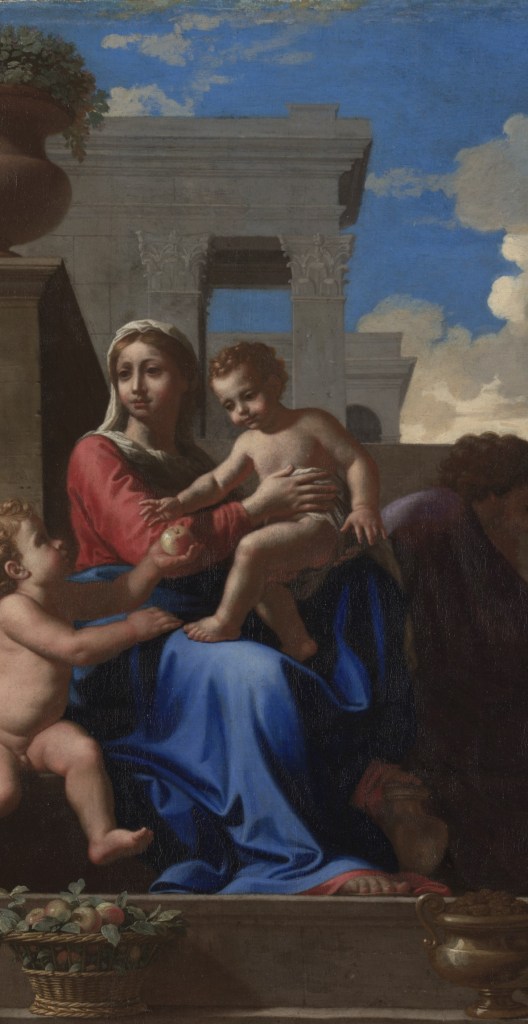
Verdi has approached the composition from a rather different perspective. In his essay ‘The Modernity of the “Holy Family on the Steps”’ and subsequently in Poussin as a Painter, he examines the painting’s organisation as an arrangement of shapes, colours and intervals across the canvas. His analysis does not contradict Blunt’s appreciation of its equilibrium, but it identifies an additional source of pictorial coherence. The apparent rationality of the setting is accompanied by spatial relationships that resist translation into a completely convincing architectural environment. The buildings, fountain, orange tree and intervening spaces seem to have been brought together according to the demands of the picture rather than the requirements of an actual location. Verdi compares this process to the construction of a collage or theatrical setting.
This tension between spatial illusion and pictorial organisation is central to his interpretation. The architecture supplies convincing individual forms, yet the relationships between them are sometimes abrupt. Distances appear compressed, while objects at different depths retain a comparable clarity of definition. The result is an image that can be understood both as a representation of figures occupying a monumental setting and as an arrangement of coloured shapes upon a flat surface. Verdi regards this dual character as one of the painting’s most significant achievements, anticipating concerns that would become prominent in modern art.
The technical investigations of Carol Sawyer introduce an important qualification to this account. Her reconstruction of the perspective establishes that the principal architectural orthogonals converge with considerable accuracy upon a point near the Virgin’s foot. The small indentation identified in the paint surface confirms that Poussin had established a precise geometrical reference. Moreover, although the vanishing point lies near the bottom of the canvas, Sawyer’s reconstruction indicates that the spectator occupies an elevated position relative to the ground plane, while remaining below the principal figures. The imposing height of the Holy Family does not therefore depend upon a disregard for perspectival construction.
Sawyer also demonstrates that several apparent spatial difficulties can be accommodated within a plausible architectural reconstruction, although the precise circumstances remain hypothetical. Her findings complicate Verdi’s description of the setting as a collection of partly incompatible elements. The two interpretations need not, however, be mutually exclusive. A construction may be geometrically consistent without appearing entirely natural or continuous to the viewer. Poussin’s attention to perspective is fully compatible with a deliberate concentration upon relationships that operate across the picture surface. The question is less whether he understood the construction of architectural space than how he chose to employ it in the interests of the painting.
Colour plays an equally important part in this organisation. Against the prevailing grey-brown stone, the Virgin’s red and blue garments, Elizabeth’s golden yellow and Joseph’s deeply shadowed purple establish a concentrated sequence of hues. Hibbard emphasised the selective distribution of light, through which the principal figures acquire varying degrees of prominence. Joseph’s foot, for example, receives a distinct accent of illumination despite his position within the darker portion of the composition. Hibbard compared this controlled lighting with Caravaggesque practice, while recognising that Poussin had subordinated its effects to a more restrained and stable arrangement.
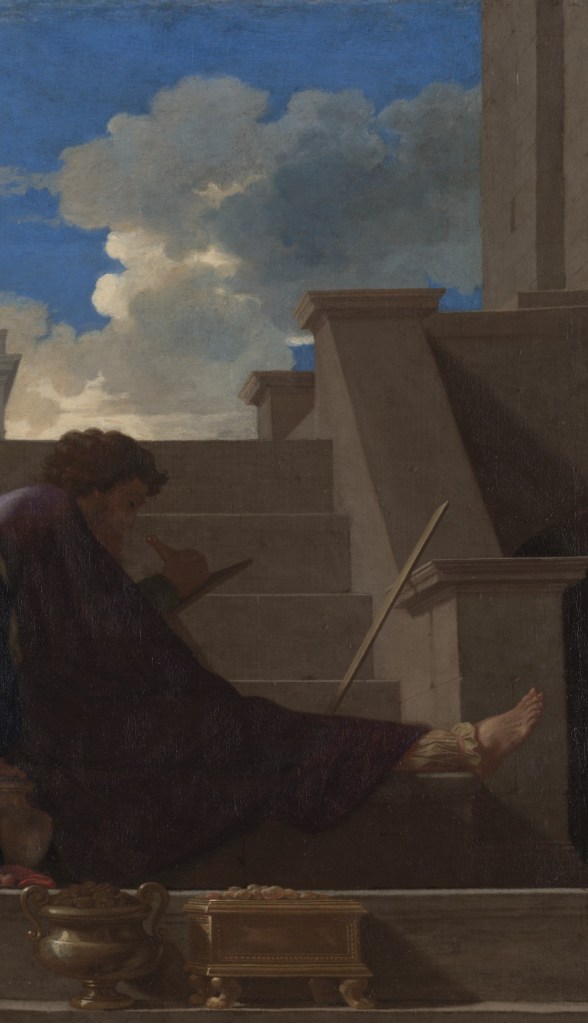
Verdi gives particular weight to the purity and recurrence of the principal colours. The brilliant blue of the Virgin’s mantle finds an answering passage in the sky above the Child, creating a relationship across intervening figures and architecture. White and blue accents elsewhere establish similar correspondences. In his account, colour is no longer simply a means of modelling solid objects or describing their illumination. It becomes an independent means of organising the canvas, reinforcing connections between elements that occupy different positions within the represented space.
Sawyer’s examination of the paint layers provides a material counterpart to these observations. The apparent purity of the principal colours was achieved through combinations of pigments, underpainting and transparent glazes. The Virgin’s red garment, for instance, contains vermilion, earth pigments and red lake, with the shadows enriched by successive applications of translucent colour. Her blue mantle combines ultramarine and white, while deeper passages depend upon darker preparations and glazes. The restrained chromatic relationships identified by Verdi were therefore the product of a sophisticated and carefully differentiated painting technique.
The still-life objects arranged upon the lower steps are integral to these relationships. Beneath Joseph stand a bronze vessel and a golden casket, while a basket of apples occupies the opposite portion of the foreground. Hibbard drew attention to Poussin’s interest in antique vessels, identifying comparable objects in his drawings, and compared the containers with those in the Adoration of the Magi of 1633. Blunt had proposed that they might contain frankincense and myrrh, although the identification remains uncertain. Hibbard developed the contrast between the precious vessels and the living fruit into a broader interpretation of the painting’s religious meaning.
Whatever their iconographic significance, these objects possess considerable compositional importance. Verdi observes that their distribution counterbalances the greater concentration of figures towards the left, while their distinct contours interrupt the succession of horizontal steps. Their careful definition also contributes to the effect that he describes as a still life inhabited by human figures. Movement and overt emotion have been reduced almost to suspension; figures, fruit, vessels and architecture participate in the same measured organisation. The stillness of the human participants consequently belongs to the pictorial character of the work as a whole.
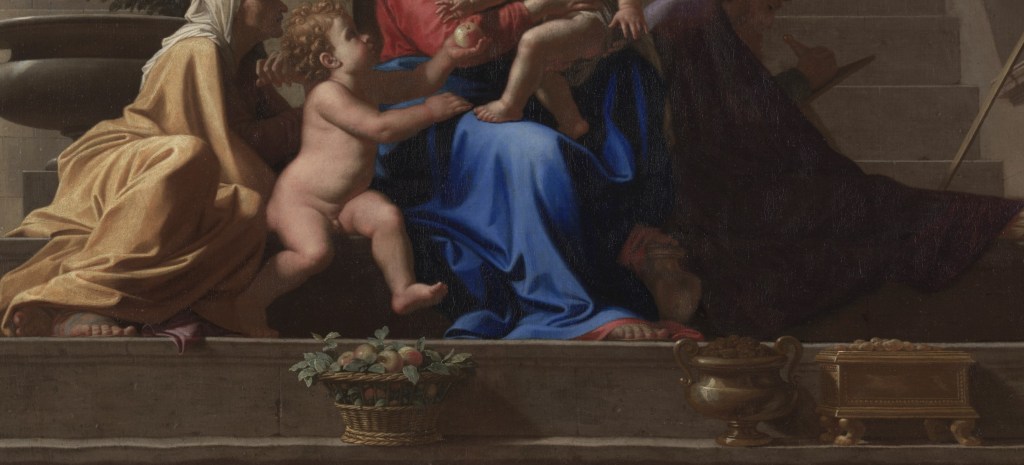
Such concentration does not eliminate subtle variations within the design. Joseph’s head rises beyond the uppermost step, breaking an otherwise insistent horizontal, while the draperies of Elizabeth and the objects in the foreground introduce smaller departures from the prevailing geometry. Verdi regards these adjustments as essential to the vitality of the composition. The order is stringent, but it has not become mechanically regular. Blunt’s classical completeness and Verdi’s emphasis upon pictorial invention can thus be understood as different responses to the same extraordinary degree of control.
The position of Joseph nevertheless raises questions that extend beyond formal organisation. His separation from the Virgin and Child, his comparative obscurity and his activity with the compass have prompted several interpretations. Blunt associated his instruments with mathematical and architectural knowledge, while Hibbard developed a reading in which Joseph represents the wisdom of antiquity and the Old Law, contrasted with the new Christian dispensation embodied by the Virgin and Child. Joseph F. Chorpenning challenged this interpretation, drawing upon patristic and seventeenth-century devotional literature to identify the saint with the earthly craftsman who reflects God the Father as the divine architect. In this reading, the shadow surrounding Joseph refers less to a superseded order than to the hidden presence of divine authority.
These differing interpretations demonstrate the difficulty of assigning a single meaning to Joseph’s distinctive place within the picture. The compass provides an evident association with measurement and construction, and the contrast between his shadowed figure and the illuminated group is unmistakable. Yet the theological implications are less securely established. Chorpenning’s argument is particularly valuable in recalling the elevated devotional status accorded to Joseph during Poussin’s lifetime, and in questioning the assumption that his position in shadow necessarily diminishes his significance.
The compositional role of Joseph is, by comparison, more readily demonstrable. His figure anchors the right side of the principal grouping, while the objects below him and the architecture behind establish a network of relationships extending across the canvas. The contrast between his shadowed absorption and the illuminated Virgin and Child contributes to the painting’s stillness without resolving the meanings it may contain.
Blunt’s judgement of the painting’s completeness remains compelling because it identifies a quality sustained across every register of the work. Verdi’s analysis, however, suggests that this completeness cannot be explained entirely through classical proportion or the construction of an ideal three-dimensional space. The painting possesses a second order, established through the disposition of forms and colours across the surface. Its grandeur arises from the coexistence of these two kinds of organisation, neither of which can be reduced to the other.
The Modernity of Poussin
The apparent severity of The Holy Family on the Steps helps to explain its subsequent significance for painters concerned with the independent organisation of the picture surface. Verdi, in his essay ‘The Modernity of the “Holy Family on the Steps”’, finds affinities between Poussin’s classical discipline and certain developments in modern French painting. His argument concerns the transformation of pictorial principles rather than a continuous history of direct influence. The clarity of the painting’s geometry, its restrained movement and the deliberate relationship between figures and their surroundings anticipate qualities that later artists would pursue through radically different subjects and techniques.
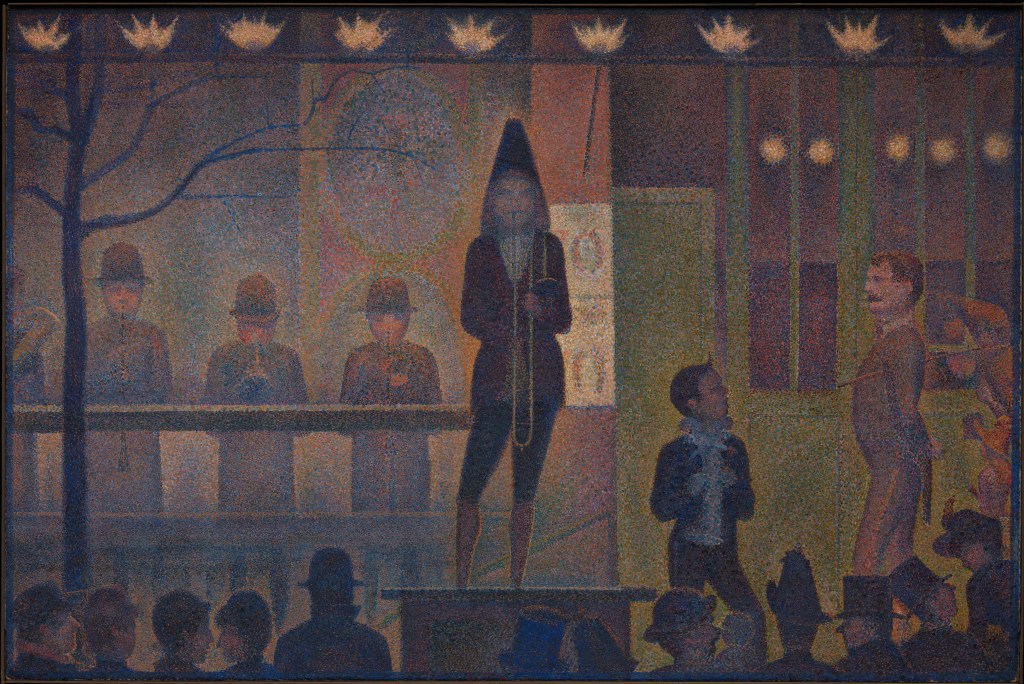
Verdi’s comparison with Georges Seurat’s Parade de cirque of 1887–88 is especially suggestive. Both compositions place relatively static figures within a frontal, symmetrical arrangement governed by horizontal and vertical divisions. Their architecture provides a framework extending across the canvas, while the simplification of individual forms contributes to an impression of permanence and stillness. Seurat’s modern spectacle and Poussin’s sacred gathering belong to entirely different worlds, yet each achieves a sense of order that seems to suspend the ordinary passage of time. The comparison is strengthened by Seurat’s documented interest in Poussin, although Verdi does not propose that Parade de cirque was directly modelled upon the Cleveland painting.
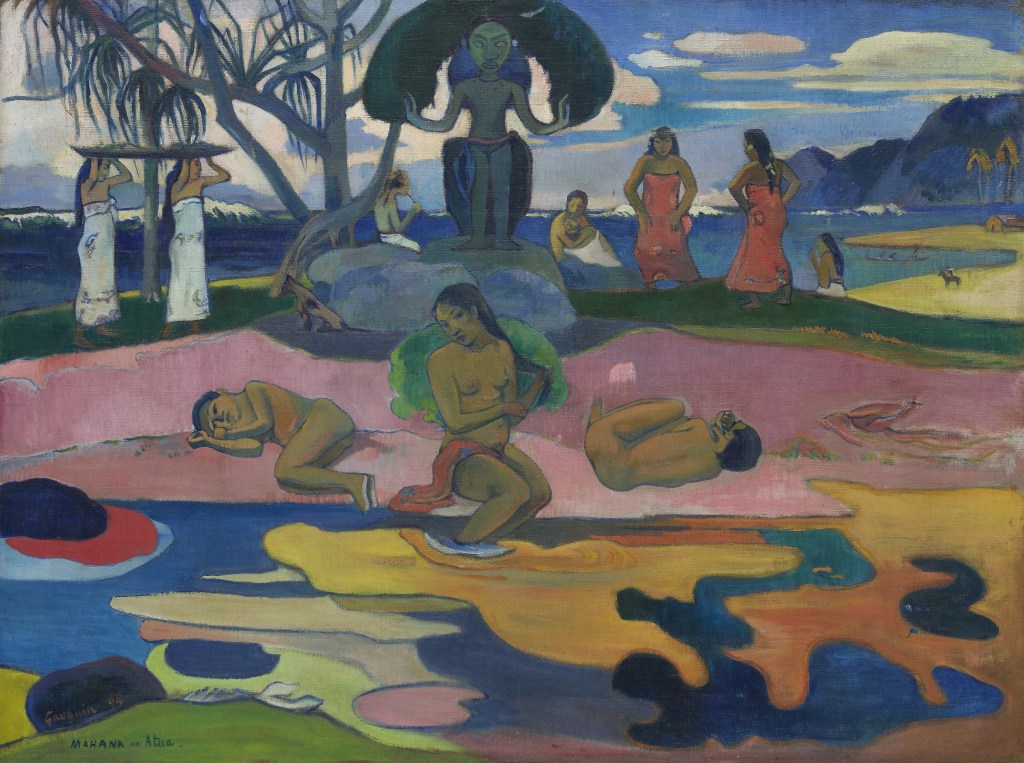
A more distant analogy appears in Paul Gauguin’s Mahana no atua (The Day of the Gods) of 1894. Verdi identifies a comparable hieratic arrangement, with figures disposed around a central focus and the composition organised through repeated forms and areas of colour. The abstract passages representing water in Gauguin’s foreground offer a particularly striking example of pictorial design asserting itself over the conventions of spatial description. There is no evidence that Gauguin drew upon Poussin in devising this painting. The comparison instead suggests how a similar concern for compositional unity could emerge within an artistic language far removed from seventeenth-century classicism.
These later affinities return us to the central achievement of The Holy Family on the Steps. Its classical character arises from a profound engagement with earlier art, yet its organisation cannot be explained by inherited conventions alone. The preparatory drawings and technical discoveries reveal the prolonged process of invention beneath its apparent simplicity, while the finished painting establishes an equilibrium in which figures, architecture, colour and light are held in exact relationship. What Blunt recognised as an exceptional completeness and Verdi understood through the independent structure of the picture are complementary aspects of Poussin’s achievement. The painting’s enduring power lies in the precision with which its serene austerity has been conceived and realised.
Donate to Inner Surfaces here.
Bibliography
Blunt, Anthony. Nicolas Poussin. A. W. Mellon Lectures in the Fine Arts, Bollingen Series XXXV:7. Princeton: Princeton University Press, reprint of the 1967 edition.
Blunt, Anthony. The Drawings of Poussin. New Haven and London: Yale University Press, 1979.
Chorpenning, Joseph F. ‘The Enigma of St Joseph in Poussin’s Holy Family on the Steps’. Journal of the Warburg and Courtauld Institutes, vol. 60 (1997), pp. 276–281.
De Grazia, Diane. ‘Poussin’s “Holy Family on the Steps” in Context’. Cleveland Studies in the History of Art, vol. 4 (1999), pp. 26–63.
Hibbard, Howard. Poussin: The Holy Family on the Steps. Art in Context series. London: Allen Lane, 1974.
Rosenberg, Pierre, with Christel Dupuy. Nicolas Poussin: Catalogue raisonné de l’œuvre peint. Paris: Flammarion, 2026.
Sawyer, Carol, assisted by Marcia Steele. ‘Poussin’s “Holy Family on the Steps”: New Technical Discoveries, Comparisons, and the Washington Copy’. Cleveland Studies in the History of Art, vol. 4 (1999), pp. 112–160.
Verdi, Richard. ‘The Modernity of the “Holy Family on the Steps”’. Cleveland Studies in the History of Art, vol. 4 (1999), pp. 96–111.
Verdi, Richard. Poussin as a Painter: From Classicism to Abstraction. London: Reaktion Books, 2020.

