Introduction
Eugenio Viti belonged to a generation of Neapolitan painters who sought to renew the artistic traditions of their city while responding to developments in Italian and European painting during the early twentieth century. Although he enjoyed considerable recognition during his lifetime, exhibiting in Naples, Milan, Rome and Venice, as well as abroad, his work remains relatively little known outside Italy. His career reveals an artist of considerable versatility, whose receptiveness to modern developments was matched by a continuing engagement with the pictorial inheritance of Naples.
Born in Naples in 1881, Viti entered the city’s Istituto di Belle Arti in 1894, studying under Michele Cammarano and Vincenzo Volpe. The contrast between their approaches was important to his formation. From Cammarano he acquired an appreciation of vigorous brushwork and the construction of solid forms, while Volpe represented a more restrained academic naturalism. Viti soon began to explore possibilities beyond either tradition, becoming involved in the Secessione dei ventitré, a group of younger artists who challenged the conventions of Neapolitan exhibition culture and sought closer engagement with contemporary European art.
Over the following decades, his painting absorbed elements of Divisionism, Post-Impressionism and the expressive colour of the European avant-garde. Yet his interest in modernity did not entail a rejection of the past. The dramatic illumination and physical intensity of seventeenth-century Neapolitan painting remained important to him, while the more controlled and enigmatic tendencies of Italian art during the 1920s offered further possibilities. These different approaches sometimes coexisted, making his development difficult to describe as a straightforward progression from one style to another.
Landscape was also a significant part of Viti’s achievement. Drawing upon the Neapolitan tradition, he developed an increasingly personal response to the coastal scenery, gardens and terraces around Massalubrense, where he spent his summers. Many of these paintings were executed rapidly, recording familiar surroundings with an immediacy that attracted the admiration of contemporary critics. His attachment to these places continued into his later years, when landscape became an important vehicle for a freer and more lyrical treatment of colour.
Eugenio Viti, Paesaggio di Massalubrense (1940s) — Vincent Galleria
The present essay, however, concentrates chiefly on Viti’s paintings of the human figure, especially women. These works range from intimate, melancholy portraits to compositions of considerable formal ambition, revealing the changing relationship between colour, light, bodily form and psychological expression. They offer an illuminating introduction to the individuality of a painter whose achievement deserves a wider audience.
Early experiments: The female figure
Viti’s early figure paintings reveal an increasingly adventurous approach to colour and brushwork during the years before and immediately after the First World War. These experiments did not displace the concern for solid form acquired during his academic training. Instead, the two tendencies developed alongside one another, sometimes producing markedly different results within a relatively short period.
Danzatrice (1914), now in the Galleria dell’Accademia di Belle Arti in Naples, offers an early example. Exhibited at the Società Promotrice di Belle Arti in 1914, it was purchased by the Ministry of Public Instruction for the Academy’s collection. The subject of the young dancer recalls the longstanding fascination with ballet and theatrical life in modern European painting, most conspicuously associated with Edgar Degas. Yet, as Mariantonietta Picone Petrusa observes, Viti’s treatment differs in its emotional emphasis. The girl appears absorbed and melancholy, recalling the children and adolescents portrayed by Neapolitan artists such as Antonio Mancini and Vincenzo Esposito, as well as the more introspective figures of Georges Seurat and Pablo Picasso.
The painting also reveals Viti’s experiments with divided colour. Picone Petrusa draws attention to the parallel brushstrokes arranged diagonally, a method that recalls aspects of Italian Divisionism without surrendering the solidity of the figure. The relationship between expressive handling and formal construction, already evident here, would remain important throughout his career.
Eugenio Viti, Danzatrice (1914) — Galleria dell’Accademia di Belle Arti, Naples
A different aspect of his painting emerges in Olga in rosso, also known as Olga alla finestra, generally dated to about 1915–18. The sitter was Olga d’Ippolito, Viti’s longstanding companion, whom he eventually married in 1929. Their relationship had begun before the First World War, and she appeared in numerous paintings over the following decades.
Picone Petrusa identifies the picture with a period of heightened colouristic experimentation, describing its brilliant, almost Fauvist chromatic effects. The glimpse of sea through the window, reduced to an intense blue, exemplifies Viti’s willingness to depart from naturalistic colour. The elaborate dress does not provide reliable evidence for dating the painting, since he maintained a collection of theatrical costumes in his studio and enjoyed dressing his models in them. More important is the atmosphere he creates through the arrangement of the figure and the expressive use of colour. The resulting image belongs to a period when his interests extended well beyond the conventions of Neapolitan academic portraiture.
Eugenio Viti, Olga in rosso (c. 1915–18)
Around 1917, another tendency becomes apparent in Busto di donna, a painting in the Emeroteca Tucci in Naples, catalogued by Picone Petrusa under the title Ritratto. Here the emphasis shifts towards dramatic chiaroscuro and the emotional intensity of the sitter. The scholar describes the woman’s tense expression, her head thrown backwards and her almost closed eyes. The powerful contrast of light and shadow appears to divide the composition vertically, heightening its psychological effect. The picture recalls the dramatic resources of seventeenth-century painting, but its expressive character belongs equally to Viti’s contemporary experiments.
The painting has a complicated physical history. A period photograph in the Viti Archive reveals that the canvas was subsequently cut down along its right and lower edges, bringing the figure more closely into the composition. Picone Petrusa suggests that Viti himself may have made the alteration, although the circumstances remain uncertain. She also identifies a second, closely related painting, likewise dated to around 1917 and catalogued as Busto di donna, which depicts the same model in a similar pose but with an even tighter framing. Its present whereabouts are unknown. The Emeroteca’s account identifies Olga as the sitter in its painting, whereas Picone Petrusa does not establish her identity.
Eugenio Viti, Busto di donna (c. 1917) — Emeroteca–Biblioteca Tucci, Naples
These works reveal the range of Viti’s early investigations. The subdued melancholy of Danzatrice, the chromatic freedom of Olga in rosso and the dramatic illumination of the later portrait represent different responses to the possibilities of figure painting. Their diversity helps explain why contemporary critics found his work difficult to classify, even as they recognised the seriousness of his attempts to develop a more independent artistic language.
A more enigmatic modernity: La finestra and L’album bianco
During the later 1920s, Viti’s painting underwent another significant transformation. The expressive colour and vigorous handling of his earlier work were increasingly accompanied by a more deliberate organisation of form and space. This development brought him closer to the Italian return to order and, in certain paintings, to the enigmatic atmosphere associated with Magical Realism. Yet the change was not absolute: different approaches continued to coexist within his work, reflecting an artistic personality resistant to a single stylistic direction.
La finestra, generally dated to about 1928–30, illustrates this development. The painting depicts a seated woman beside a window in Viti’s studio above Monte Echia in Naples. Although the model resembles Olga d’Ippolito, Picone Petrusa considers it unlikely that she was the sitter. The figure is simplified into substantial geometrical forms, while the cool illumination contributes to an effect approaching abstraction. The scholar compares these qualities with the painting of Felice Casorati, particularly Raja (1925), in which a similarly controlled treatment of form and light produces an atmosphere of detachment.
The comparison is significant because Casorati represented one of the most distinctive approaches to modern Italian figure painting. His carefully constructed compositions, with their restrained gestures and often enigmatic settings, offered an alternative both to the expressive freedom of Post-Impressionism and to conventional academic naturalism. Viti’s affinities with this tendency did not involve abandoning his painterly interests, but they introduced a greater emphasis on formal simplification and the psychological possibilities of pictorial space.
Eugenio Viti, La finestra (c. 1928–30) — Galleria Berardi
These concerns receive a more elaborate treatment in L’album bianco (1929), one of Viti’s best-known paintings. A woman turns away from the viewer towards a succession of receding rooms, while a large open book occupies the foreground. According to Picone Petrusa, the artist initially used Lodoviska Sanfelice di Bagnoli as his model and subsequently Olga, who conceals her recognisable features by turning her head. The arrangement of the figure, the open book and the successive interiors creates an atmosphere of ambiguity and mystery.
Picone Petrusa again identifies affinities with Casorati, citing his use of receding interiors and the motif of the open book in paintings such as Le due sorelle (also known as Libro aperto e libro chiuso, 1921). The comparison helps to situate Viti within the broader developments of Italian painting during the 1920s, when the formal clarity associated with the return to order could coexist with a distinctly unsettling treatment of familiar subjects.
L’album bianco was exhibited at the Galleria Pesaro in Milan in 1929, where it attracted considerable critical attention. Its relationship with Casorati was recognised at the time, although commentators also praised Viti’s individual handling of form and colour. The painting subsequently appeared at the Venice Biennale of 1932 and the Carnegie International in Pittsburgh in 1934, where it was again favourably received. Its international exhibition history provides some indication of the recognition he had achieved by this stage of his career.
Eugenio Viti, L’album bianco (1929)
Viti’s interest in spatial ambiguity was not confined to these compositions. His experiments with mirrors and reflections had produced one of his most controversial works, Lo specchio del barbiere, exhibited in Naples in 1928. The painting represented a customer in a barber’s shop whose face was multiplied through a succession of confronting mirrors. According to contemporary accounts discussed by Picone Petrusa, the work provoked protests from conservative observers, who found its treatment of an ordinary subject provocatively unconventional. The painting was subsequently lost and is now known through documentary accounts.
The nude reconsidered: La schiena and Lucilla
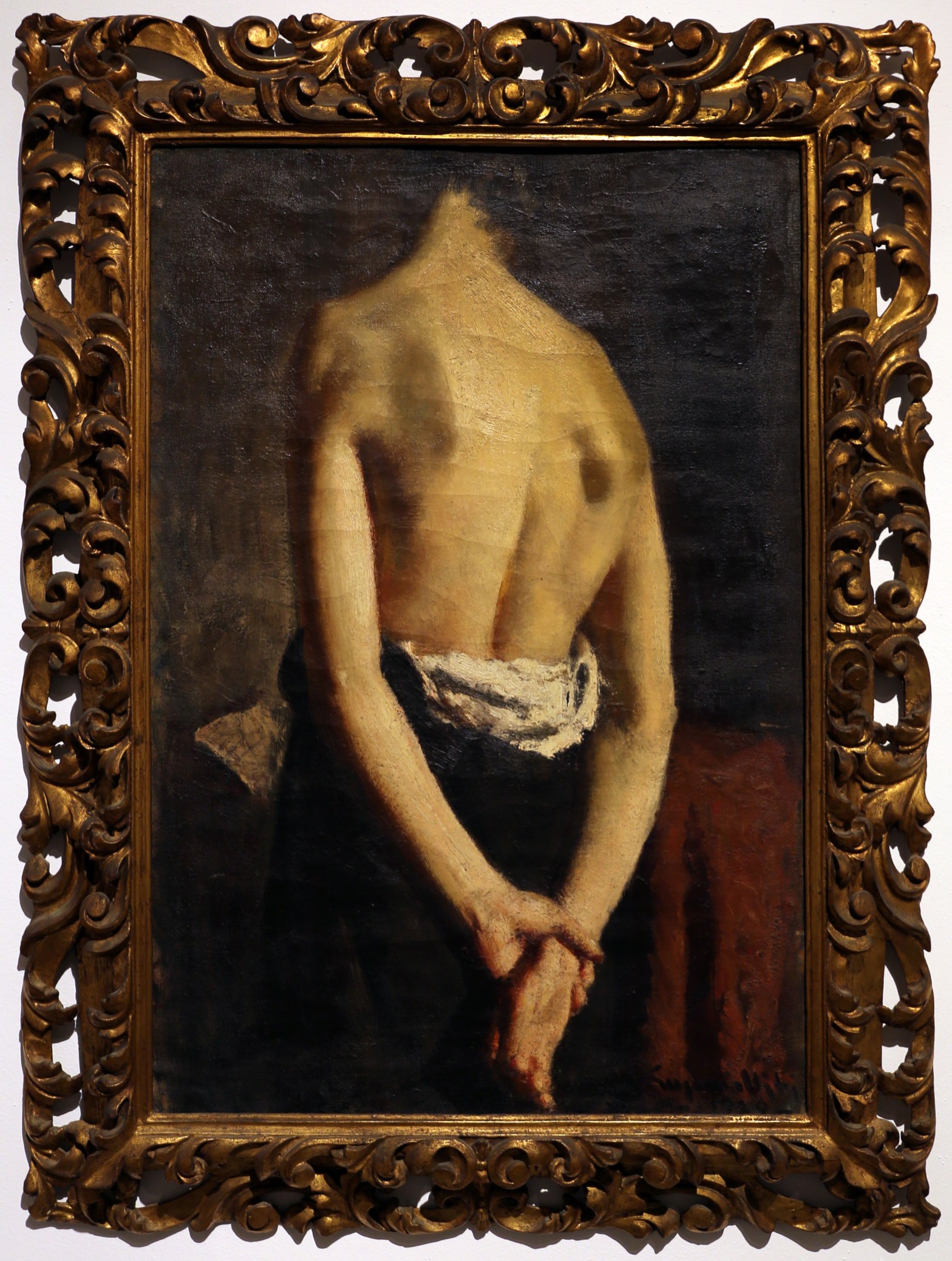
The diversity of Viti’s artistic interests during the later 1920s is apparent in La schiena (1929), one of his most widely reproduced paintings. Although produced during the period in which he was exploring the formal restraint and enigmatic interiors associated with Magical Realism, the work draws upon a different pictorial inheritance. Its powerful chiaroscuro and forceful handling recall seventeenth-century Neapolitan painting, while its treatment of the human body challenges conventional ideals of beauty.
The model was Lodoviska Sanfelice di Bagnoli, whose angular physique and pronounced spinal curvature attracted Viti’s attention. As Picone Petrusa explains, he was less interested in celebrating ideal bodily proportions than in exploring the expressive possibilities of physical irregularity. She associates this preference with a kind of bruttezza metafisica, or ‘metaphysical ugliness’, which resists the familiar conventions of the female nude. Strongly illuminated against deep surrounding shadows, the woman’s back becomes the principal subject of the composition, its diagonal movement accentuated by robust brushwork.
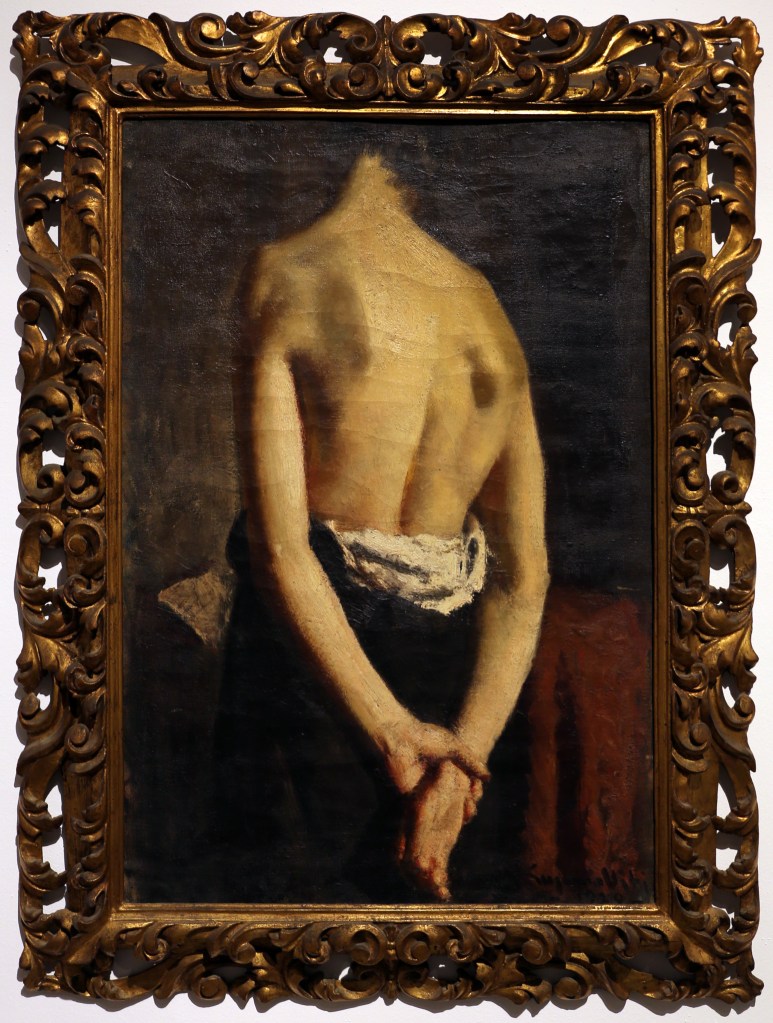
Picone Petrusa regards the painting as a challenge to the Neapolitan tradition of nineteenth-century figure painting. A study of the back might conventionally have belonged to academic exercises in anatomy, but those exercises generally relied upon models whose proportions corresponded more closely to accepted ideals. Viti instead made the sitter’s individual physical characteristics the basis of a substantial independent composition.
Contemporary criticism recognised the relationship with the Neapolitan Seicento. Following the painting’s appearance at the International Exhibition in Barcelona in 1929, reviewers praised its execution and its recovery of the expressive resources of seventeenth-century painting. Pietro Girace later suggested that La schiena might have stood alongside works of that period, while a contemporary review in La Fiera Letteraria admired its historical inheritance without regarding it as an exercise in imitation. The latter critic nevertheless questioned whether Viti had chosen the subject primarily as an exercise in resolving pictorial problems, rather than for its expressive possibilities.
The painting was subsequently exhibited at the Venice Biennale in 1932 and continued to attract attention in later retrospectives. Its importance lies in the conjunction of a historical pictorial language with an uncompromising approach to the human figure, demonstrating how Viti could draw upon established traditions without accepting their conventions.
A different treatment of the nude appears in Lucilla (1931), exhibited at the first Rome Quadriennale. Here the figure is organised with greater formal clarity and a more detached expressive character. Picone Petrusa draws attention to the contrast between the exceptionally pale body and the deep cobalt-blue drapery upon which it rests. The combination produces an almost abstract effect, while the carefully arranged composition suggests affinities with the formal discipline of Novecento painting and the more intellectualised tendencies of Magical Realism.
The critical reception of Lucilla was divided. Girace praised its striking chromatic contrasts and the almost unreal quality of the figure, while Michele Biancale, writing in 1931, found the painting somewhat academic, particularly in the pose. Paolo Ricci subsequently regarded it as representative of a period in which Viti had become excessively concerned with formal elegance and decorative refinement. Nevertheless, he considered this phase a productive crisis in the artist’s development, rather than an unqualified failure.
Picone Petrusa places Lucilla within Viti’s attempt to reconcile a rigorous conception of form with the expressive possibilities of colour, acknowledging the tensions that contemporary critics had identified. The contrast with La schiena, painted only two years earlier, is revealing. One emphasises the physical individuality of the model through dramatic illumination and vigorous handling; the other explores a cooler, more controlled conception of the nude. Their differences demonstrate the breadth of Viti’s artistic language at a moment when his reputation was becoming firmly established beyond Naples.
The later years: A freer manner
During the 1930s and 1940s, Viti continued to experiment with different approaches to painting, although his work increasingly revealed a preference for a freer and more economical handling of paint. The formal restraint evident in Lucilla did not disappear altogether, but it ceased to dominate his treatment of the figure. The expressive qualities of brushwork and colour, so important to his earlier development, again became central to his practice.
Viti remained active in the artistic life of Naples, exhibiting at national and regional exhibitions, including those organised through the official artistic institutions of the Fascist period. His work continued to appear at the Venice Biennale and other major exhibitions. The Second World War, however, brought considerable disruption. In 1944 his studio was destroyed, resulting in the loss of paintings, drawings and documentary material.
A revealing example of his later figure painting is La lettura, generally dated to about 1946–47. The sitter was his daughter Paola, represented reading in a blue dress. Mariantonietta Picone Petrusa associates the painting with the greater freedom of execution characteristic of his later work, in which the immediacy of the painted surface becomes more conspicuous. The intimate subject also recalls his longstanding interest in figures absorbed in ordinary activities, although the handling is less tightly controlled than in the compositions of the late 1920s.
Eugenio Viti, La lettura (c. 1946–47)
Picone Petrusa records an anecdote concerning Viti’s reluctance to produce the kind of fashionable portraiture associated with Giacomo Grosso. His concern was not simply to achieve a convincing likeness but to retain an independent conception of painting, even when working with familiar subjects.
Something of Viti’s temperament emerges from the recollections of Alfredo Schettini, who described the extraordinary disorder of the artist’s studio. The disorder was deliberate: Viti maintained that an excessively comfortable or orderly working environment would diminish the irritation that kept him alert and productive. Although the story should not be treated as an explanation of his artistic development, it offers a glimpse of the restless personality described by those who knew him.
The landscapes around Massalubrense remained an important part of his later work. Carlo Barbieri and Paolo Ricci admired their vitality and directness, qualities increasingly associated with his economical handling of paint. His standing in Italian artistic life was reaffirmed in 1950, when he received the inaugural Luigi Einaudi Prize for Painting, awarded by the Accademia Nazionale di San Luca in Rome. He died in Naples on 8 March 1952.
His achievement deserves to be better known beyond Italy. Drawing freely upon the traditions of Neapolitan painting and the developments of modern art, Viti established an individual approach whose ambition and vitality are evident in his finest works.
Donate to Inner Surfaces here.
Bibliography
Picone Petrusa, Mariantonietta. Eugenio Viti (1881–1952). Naples: Paparo, 2006; second edition, 2007.
Picone Petrusa, Mariantonietta. ‘Viti, Eugenio.’ Dizionario Biografico degli Italiani, vol. 99. Rome: Istituto della Enciclopedia Italiana, 2020.
Emeroteca–Biblioteca Tucci, Naples. ‘Busto di donna.’ Online collection entry.
Mediterranea. Eugenio Viti: complete video presentation of selected paintings. YouTube.

