Raphael and the Sistine Chapel Tapestries
In 1515 Pope Leo X commissioned Raphael to design a series of tapestries illustrating episodes from the lives of Saints Peter and Paul for the Sistine Chapel. Intended for the lowest register of the walls, beneath frescoes by Perugino, Botticelli, Ghirlandaio and their contemporaries, the tapestries would complete a decorative programme already crowned by Michelangelo’s celebrated ceiling, finished in 1512. The subjects chosen for the new cycle affirmed the apostolic foundations of the Roman Church and the authority of the papacy.
The commission came during a period of extraordinary activity in Raphael’s Roman career. Alongside his work on the Vatican Stanze, he had assumed responsibility for the building of St Peter’s following Bramante’s death in 1514, while continuing to undertake commissions for ecclesiastical and private patrons. His expanding workshop was essential to the management of these commitments. Among its leading members were Giulio Romano and Gianfrancesco Penni, both closely involved in the development and execution of Raphael’s designs, and Giovanni da Udine, whose expertise extended to ornamental decoration and the observation of natural forms. The precise extent of their individual contributions to the tapestry project remains a matter of scholarly discussion.
The Miraculous Draught of Fishes: Subject and Sources
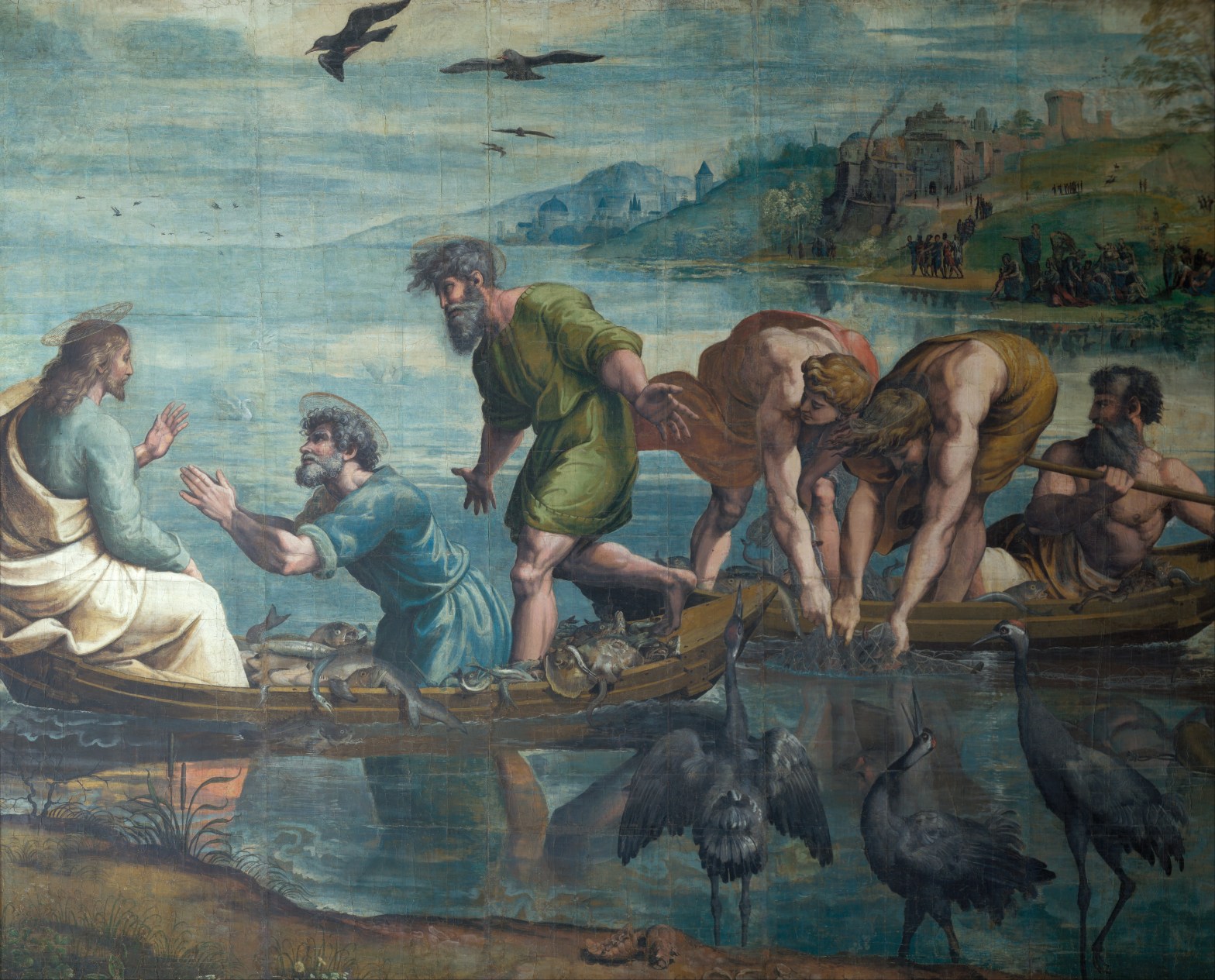
Raphael’s Miraculous Draught of Fishes illustrates Luke’s account of the calling of the first disciples (5:1–11). After a fruitless night’s fishing on Lake Gennesaret, Simon Peter obeys Christ’s instruction to cast his nets once more. The resulting catch is so abundant that a second boat is summoned to assist. Overcome by the miracle, Peter falls to his knees before Christ, confessing his own unworthiness, but is reassured that he will henceforth become a fisher of men. Raphael brings together the moment of revelation and the fishermen’s response, with Peter kneeling before Christ, Andrew raising his arms in astonishment, and James and John drawing in the laden net.
A number of possible sources of influence have been identified, among them a Byzantine Gospel miniature in the Biblioteca Medicea Laurenziana, Florence (Plut. VI.23, fol. 111v). Other elements of the cartoon have been related to classical sculpture. The seated figure of Zebedee, at the far end of the second boat, has been compared with the reclining river gods of antiquity, an association noted by Kenneth Clark.
The Preparatory Drawings
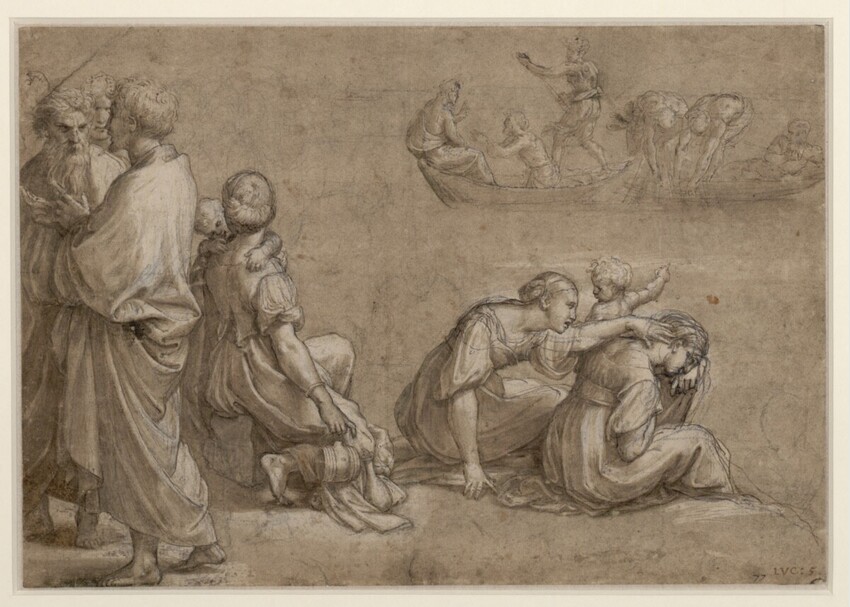
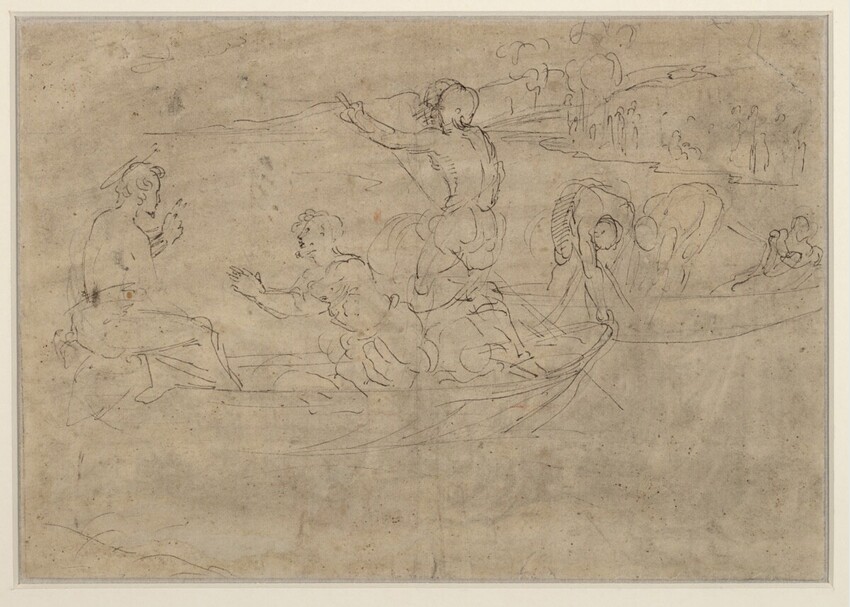
The surviving preparatory drawings reveal how extensively the composition of The Miraculous Draught of Fishes was reconsidered before the execution of the cartoon. An important witness to this process is a sheet in the Albertina, Vienna (inv. 192), whose recto and verso preserve markedly different treatments of the subject. On the recto, spectators occupy much of the foreground, while the miraculous event unfolds at a distance. The sketch on the verso, by contrast, concentrates attention upon the two boats and their occupants, giving greater prominence to the encounter between Christ and the fishermen. Rapid pen lines record successive adjustments to the figures, including a reconsideration of the direction in which one of the apostles turns his head.
Raphael: Gold & Silk (2023 exhibition, Kunsthistorisches Museum, Vienna)
The relationship between the two designs has prompted differing interpretations. Paul Joannides attributed the more elaborate recto to Gianfrancesco Penni and the rapid verso to Raphael, a distinction also broadly supported by Francis Ames-Lewis. On this reading, the sheet might preserve an instance of Raphael reconsidering a composition developed within his workshop, replacing its extended narrative setting with a more concentrated arrangement. Ben Thomas, however, has argued for Raphael’s involvement on both sides, interpreting the contrasting designs as expressions of his own inventive process. Neither interpretation establishes the precise circumstances in which the drawings were made.
Whatever those circumstances, the differences between the designs are closely related to the demands of the commission. The more concentrated arrangement gives the figures greater scale and the narrative greater immediacy, qualities suited to a monumental tapestry intended for the lower walls of the Sistine Chapel. The relationships between the apostles could be conveyed through a smaller number of gestures, without the competing activity of the spectators. Raphael was also devising a composition that would eventually be translated into woven silk and wool, rather than reproduced directly in paint.
A further study in the Royal Collection at Windsor (RCIN 912749) presents a more developed arrangement, approaching that of the finished cartoon. Executed in pen, brush and wash, with white heightening over black chalk, it brings the principal figures into a closely related grouping. The drawing retains evidence of revision, including adjustments to the drapery and the position of the horizon. Its more sustained treatment of the figures marks a considerable departure from the rapid invention of the Albertina verso, although the precise relationship between the two sheets remains open to interpretation.
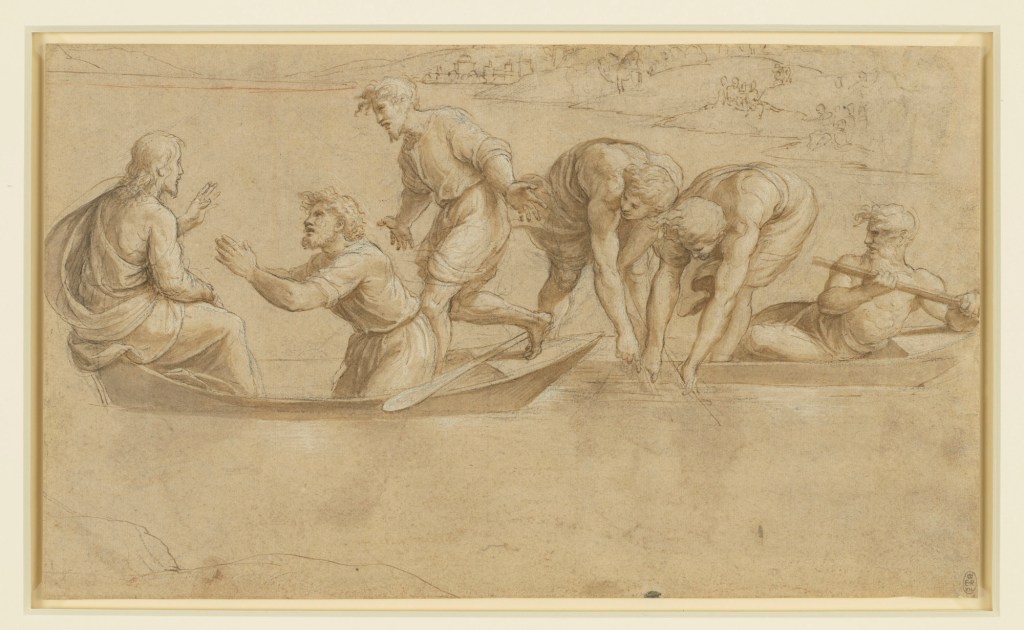
Royal Collection Trust: The Miraculous Draught of Fishes (Windsor preparatory drawing, RCIN 912749)
The Windsor drawing has generated a comparable disagreement over authorship. John Shearman attributed it to Penni, suggesting that it might reproduce a lost drawing by Raphael or represent an intermediate stage in the workshop’s development of the composition. Joannides likewise favoured Penni, whereas the Royal Collection currently catalogues the sheet as attributed to Raphael. Its importance rests upon its close relationship to the cartoon and its preservation of decisions made before the final design was established.
Other surviving studies illuminate more specialised aspects of the undertaking. A small drawing in Munich (Staatliche Graphische Sammlung, inv. 8235), representing a woman associated with the more elaborate conception, has been cautiously attributed to Raphael by Joannides. It belongs to the phase in which spectators were given a prominent place within the narrative. The drawing is of interest as evidence of the attention devoted to individual figures even within a composition subsequently transformed.
The contribution of Raphael’s workshop can also be considered through Giovanni da Udine’s studies of birds. A sheet now in the Albertina (inv. 48641), containing studies of cranes and other birds, has been connected with the two cranes represented in the foreground of the cartoon. Giovanni’s observations of natural forms supplied material of a different order from the figure studies, but one that could be incorporated into the monumental composition. The extent of Giovanni’s direct participation in the finished cartoon remains uncertain. Shearman and the 2010 V&A catalogue connect his work with the cranes and other natural details, while Larissa Mohr has more recently examined the preparatory studies now in the Albertina.
Giovanni da Udine, Studies of Eagles and Cranes (Albertina, Vienna, inv. 48641)
From Cartoon to Tapestry
The surviving cartoon of The Miraculous Draught of Fishes, painted around 1515–16, measures approximately 319 × 399 cm. Executed in opaque water-based paint (bodycolour) over a charcoal underdrawing on joined sheets of paper, it was conceived at the scale of the tapestry itself. Infrared examination has revealed adjustments beneath the painted surface, including small alterations to Christ’s forehead and eye. The 2010 V&A catalogue considers the extensive underdrawing evidence of Raphael’s close involvement in the preparation of the cartoon, while differences in the handling of certain painted passages suggest that assistants also participated in its execution.
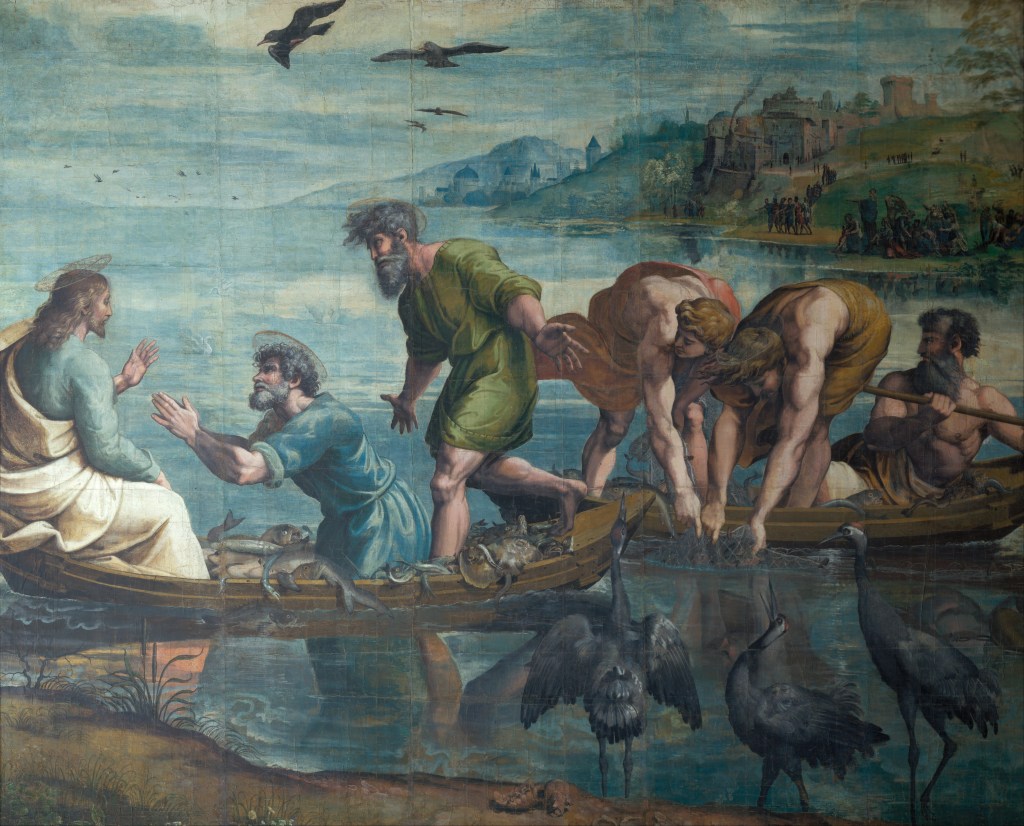
The cartoon occupied a position between two quite different processes of artistic production. It translated the exploratory inventions of the smaller drawings into a monumental design, but was itself intended to guide the manufacture of a woven textile. Francis Ames-Lewis emphasises the importance of understanding Raphael’s preparatory work in relation to this final purpose. The composition had to be conceived with the conditions of weaving already in mind, including the fact that the finished tapestry would reverse the direction of the painted design. The cartoons were sent to Brussels, where they were cut into vertical strips for use on the looms of Pieter van Aelst’s workshop. Their subsequent reconstruction has allowed them to survive as monumental paintings, although their original function was fundamentally practical.
The translation into tapestry involved more than the reproduction of outlines and colours. The weavers worked with wool, silk and metal threads, materials capable of producing effects quite different from those of the painted cartoon. As the 2010 V&A catalogue explains, Christ’s robe was originally deep pink but has faded almost to white, while its reflection in the water preserves the original colour. In the tapestry the robe is red with gold highlights. The tunic presents a different problem: blue in the cartoon, it is purplish-red on the reverse of the tapestry but now appears beige on its faded front. The catalogue also notes the greater brilliance of the woven colours and the weavers’ more emphatic treatment of vegetation, while the distant landscape is less prominent than in the cartoon.
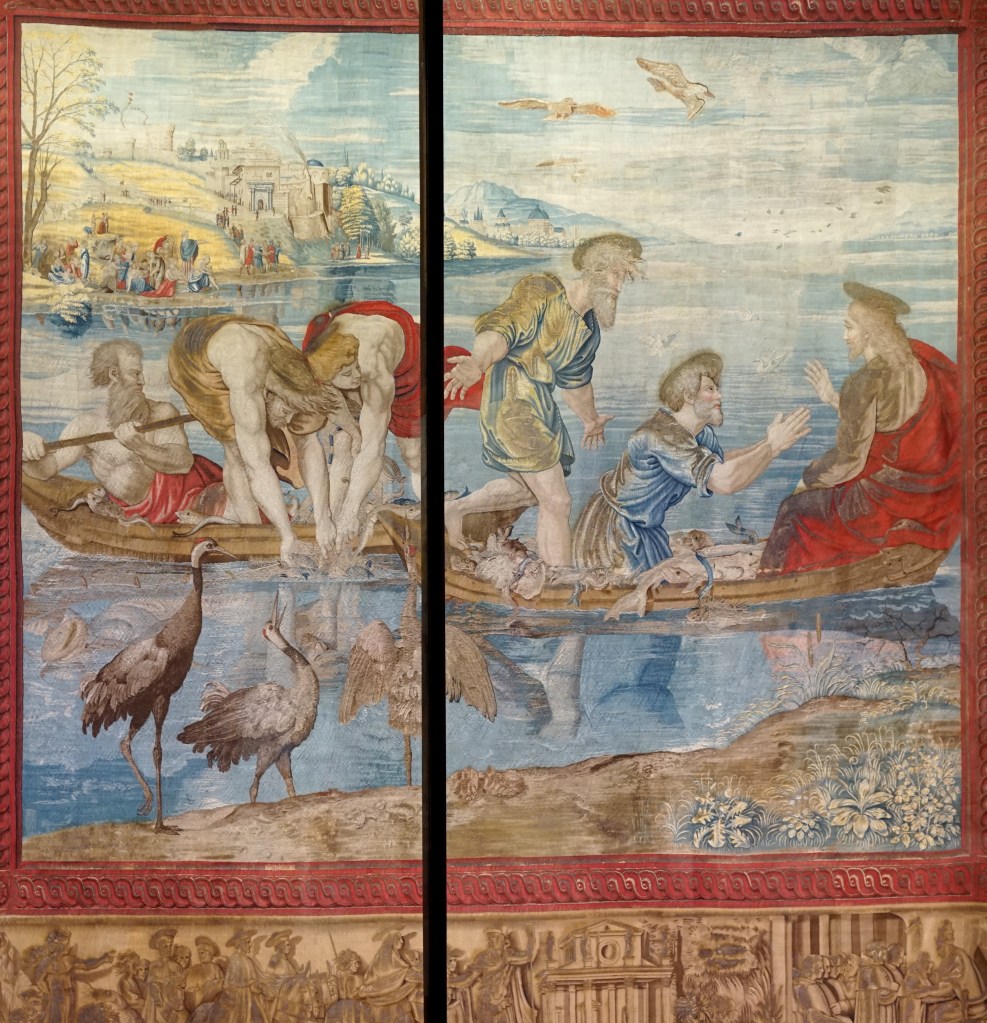
Raphael’s composition is remarkable for the way in which the figures communicate the biblical event through their positions and gestures. Christ sits calmly at the right, raising his hand towards the kneeling Peter, whose response becomes the emotional centre of the narrative. Behind him Andrew extends his arms in astonishment, while the fishermen in the second boat continue their struggle with the laden net. The action thus passes from the physical labour of fishing to the recognition of the miracle, bringing together successive moments of Luke’s narrative within a single pictorial arrangement. The relationships between the figures are strengthened by their proximity, yet each retains a distinct part in the unfolding event.
The natural setting contributes to this organisation. The lake extends into the distance beneath a luminous sky, while the reflections of the boats and their occupants establish their presence upon the water. The cranes in the foreground and the fish crowded into the boats and nets introduce a degree of naturalistic observation that approaches the concerns of still-life painting. David Ekserdjian has drawn attention to the remarkable variety of fish represented in the cartoon, noting that their individual species are less readily distinguished in the tapestry. The 2010 V&A catalogue suggests that Giovanni da Udine probably painted the cranes and the fish in the foreground of the cartoon. Their careful observation introduces a different kind of pictorial interest alongside the figures and their gestures, enriching the representation of the miraculous catch.
The tapestry introduced a further element absent from the painted cartoon: an elaborate decorative framework. Beneath the principal scene ran a woven frieze representing episodes from the history of Leo X, while ornamental borders completed its presentation as a ceremonial furnishing. The relationship between the Gospel narrative and the history of the reigning pope belonged to the wider conception of the tapestry cycle. The Miraculous Draught of Fishes was displayed in the Sistine Chapel on 26 December 1519, when the first group of tapestries was exhibited. Raphael was still alive to see the transformation of his design into the sumptuous textile for which it had been conceived.
The Chiaroscuro Woodcut and the Circulation of Raphael’s Design
The dissemination of Raphael’s inventions through prints extended their influence beyond Rome. His collaboration with engravers, notably Marcantonio Raimondi, brought compositions and individual figures before artists who had no direct access to the originals. A chiaroscuro woodcut of The Miraculous Draught of Fishes, closely related to the preparatory drawing at Windsor, offers another example of this circulation. The print was long attributed to Ugo da Carpi, who was among the pioneers of chiaroscuro woodcut in Italy and produced prints after Raphael and other leading painters.
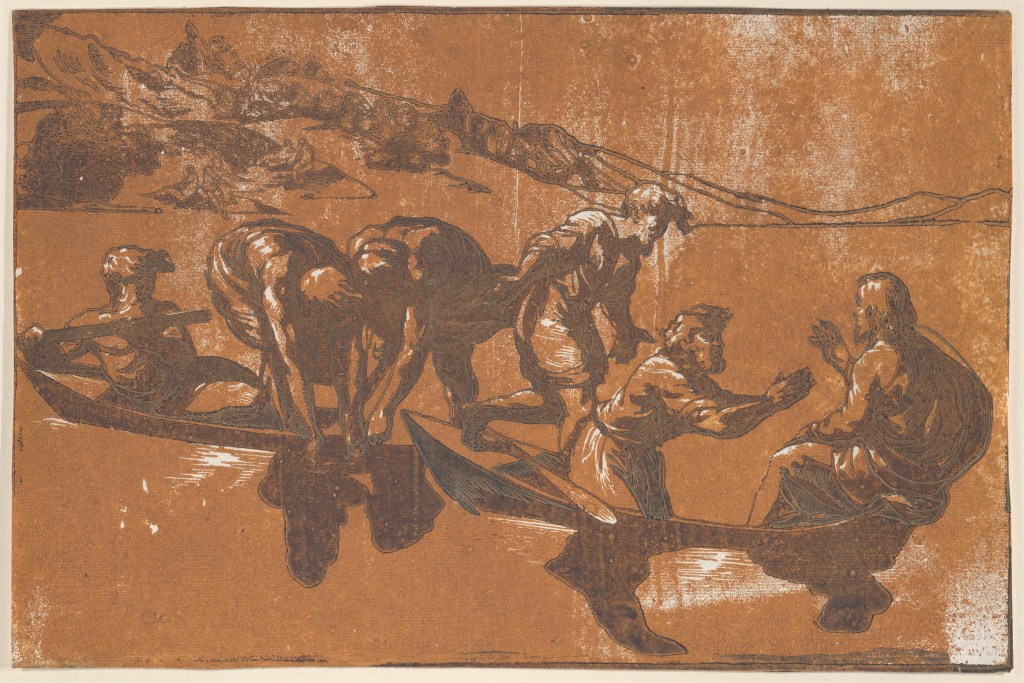
In chiaroscuro woodcut, successive impressions from differently inked blocks create an image through contrasting tones. The Miraculous Draught was printed from three blocks, using light and dark areas to give the figures a painterly solidity. It reproduces, in reverse, a design close to the Windsor drawing, though the precise model used by the printmaker is uncertain. Unlike the finished cartoon, the print omits the fish from the boats and nets, an omission also found in Titian’s later treatment of the subject.
The attribution is no longer settled. Niccolò Vicentino, active as a chiaroscuro printmaker in the middle decades of the sixteenth century and associated with prints after Parmigianino, has emerged as an alternative to Ugo. Scholars have differed over the print’s handling of tonal blocks and its painterly effects: features taken by some to support Vicentino have been read by others as characteristic of Ugo. Following Naoko Takahatake’s reassessment in 2011, the Metropolitan Museum of Art catalogues the print under Vicentino’s name, dating it to 1540–50; the Royal Collection likewise attributes its impression to Vicentino and dates it to about 1540. The 2010 V&A catalogue, by contrast, retains Ugo’s name and a date of about 1518.
The later dating raises a question for its relationship to Jacopo Bassano’s painting, commissioned in April 1545: the museum date ranges do not by themselves establish when the woodcut first circulated. Yet its close compositional relationship to Bassano’s picture has long been recognised, independently of the unresolved attribution. Reproduced on a portable scale and in a medium quite unlike the Sistine Chapel tapestry, Raphael’s design could become the starting point for a new treatment of the biblical subject.
Jacopo Bassano: The Transformation of Raphael’s Invention
Jacopo Bassano’s Miraculous Draught of Fishes, painted in 1545 and now in the National Gallery of Art, Washington, provides a striking example of Raphael’s continuing influence upon Venetian painting. Born Jacopo dal Ponte, the artist worked principally in his native Bassano del Grappa, maintaining close contact with artistic developments in Venice and beyond through the circulation of prints. During the 1540s his painting assumed an increasingly animated character, distinguished by emphatic movement, compressed compositions and brilliant colour. The Miraculous Draught belongs to this fertile period of experimentation.
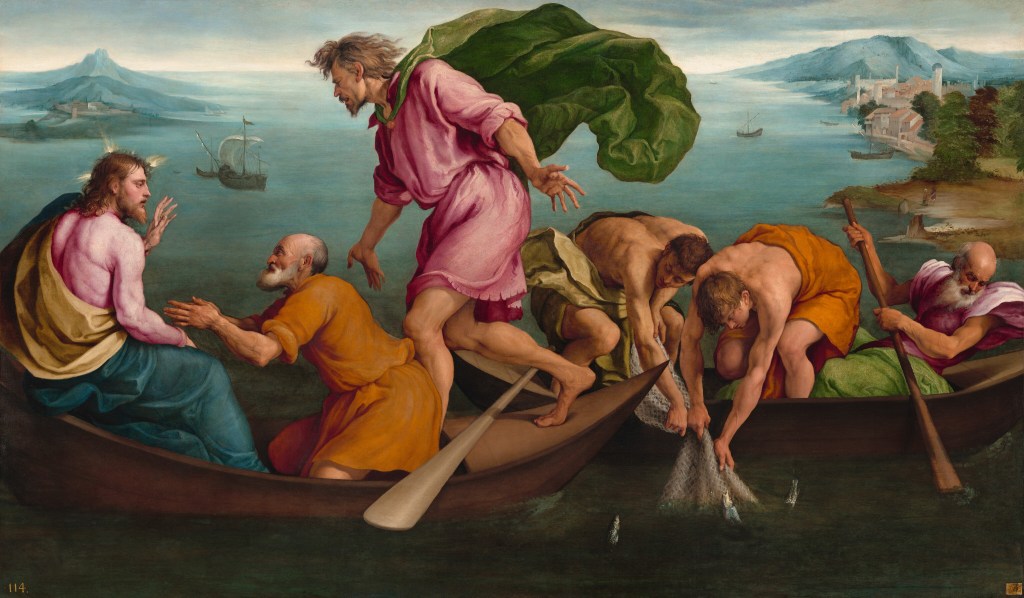
The circumstances of the commission are recorded in the painter’s account book, the Libro secondo. On 12 April 1545 Pietro Pizzamano, the Venetian podestà of Bassano, ordered a painting of Christ in the boat with the apostles for twelve gold scudi. The work was completed before Pizzamano returned to Venice later that year, and was probably intended for his private residence on the Giudecca. Its subsequent history is obscure until its reappearance in a London collection in 1989. Following restoration in 1990–91, it was included in the Bassano exhibition of 1992–93 and acquired by the National Gallery of Art in 1997.
Bassano appears to have drawn upon the printed version of Raphael’s composition, reversing its orientation while retaining the two boats and the arrangement of their principal occupants. Yet the result is far removed from a straightforward reproduction. The figures occupy a much greater proportion of the picture, while the boats extend almost across its entire width. The apostles are brought forward into a shallow pictorial space, their gestures forming a vigorous sequence of movements. James and John bend low over the net, while Andrew’s sweeping cloak connects the two principal groups. As David Alan Brown observes, the resulting arrangement contrasts the exchange between Christ, Peter and Andrew with the concentrated physical activity surrounding the catch.
Colour provides another decisive departure from the printed model. Strong passages of rose, orange and green are set against the expanse of blue water, establishing relationships that could scarcely be conveyed by the tonal organisation of the chiaroscuro woodcut. The figures acquire a heightened presence through their animated draperies and the juxtaposition of saturated colours. Bassano’s treatment reflects the expressive tendencies of his painting during the 1540s, in which the inherited forms of Renaissance composition were subjected to increasingly elaborate movement and colouristic invention.
The landscape introduces a further element of independence. Bassano replaces Raphael’s setting with an extensive prospect of water, mountains and distant buildings, incorporating features associated with his native territory. Brown identifies a view of Bassano and Monte Grappa in the distance, while the 1992–93 exhibition catalogue considers the possibility that a fortified settlement alludes to the patron’s Dalmatian connections. These suggestions point to the adaptation of Raphael’s biblical composition to a more localised setting. Bassano also gives renewed attention to the physical particulars of the episode, notably the effort of Zebedee at the oar and the fish struggling in the net.
The painting thus preserves the essential structure of Raphael’s invention while altering its scale, spatial relationships and expressive character. Its dependence upon a printed model did not restrict Bassano’s freedom of interpretation. The composition devised for a papal tapestry had become the basis of a richly coloured Venetian painting, in which the fishermen’s movements and the setting assume a character distinctly Bassano’s own.
Titian and the Afterlife of Raphael’s Invention
Raphael’s composition found a further echo in Titian’s Madonna and Child in Glory with Saints Andrew and Peter, commissioned in 1542 for the church of Santa Maria Nuova at Serravalle, now part of Vittorio Veneto. The altarpiece incorporates a small representation of the Miraculous Draught of Fishes in its landscape background, recalling both Raphael’s original design and Bassano’s treatment of the subject. Although Titian declared the painting finished in 1547, Giorgio Tagliaferro has argued, on the basis of the surviving documents, that its completion should be placed closer to 1550–52.
The fishing episode was absent from the original commission, which specified the Virgin with Saints Andrew and Vincent. The subsequent replacement of Vincent by Peter gave the inclusion of the biblical narrative a new relevance. Tagliaferro identifies several details linking Titian’s treatment to the chiaroscuro woodcut, including the absence of fish in the boats and nets and the position of an oar. He also follows William Rearick in recognising Bassano’s painting as a probable intermediary, suggesting that Titian could have encountered it in Venice after its completion in 1545.
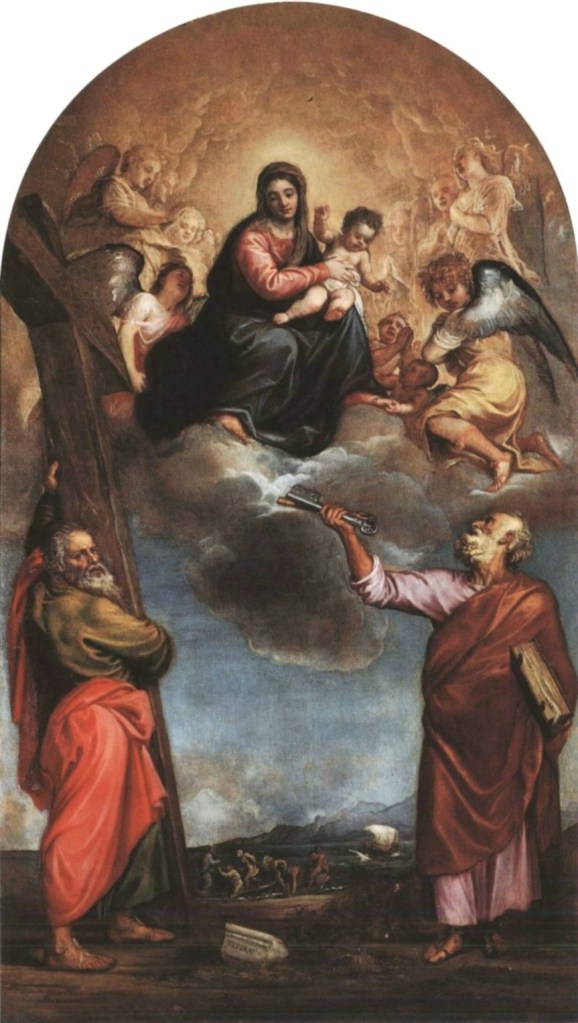
Titian nevertheless altered the inherited arrangement, placing the figures within a mountainous landscape and modifying their positions. Tagliaferro has proposed that these changes, notably a possible exchange of the identities of Peter and Andrew, introduce a critical reflection on papal authority, connected with Titian’s disappointed dealings with the Farnese. The interpretation remains open to debate, but the presence of Raphael’s invention within the altarpiece is unmistakable. Conceived for a tapestry celebrating the apostolic foundations of the papacy, the composition had entered a wider artistic repertory, capable of serving different patrons, settings and purposes across several generations of Venetian painting.
Donate to Inner Surfaces here.
Bibliography
These are the sources. Any errors are mine.
Ames-Lewis, Francis. The Draftsman Raphael. New Haven and London: Yale University Press, 1986.
Brown, David Alan. ‘Jacopo Bassano, The Miraculous Draught of Fishes’. In Art for the Nation: Collecting for a New Century, pp. 16–17. Washington: National Gallery of Art, 2000.
Brown, Beverly Louise, and Paola Marini (eds.). Jacopo Bassano, c. 1510–1592. Exhibition catalogue, 1992–93. Bologna: Nuova Alfa Editoriale, 1992.
Clark, Kenneth. Looking at Pictures. London: John Murray, 1960.
Ekserdjian, David. Still Life Before Still Life. New Haven and London: Yale University Press, 2018.
Evans, Mark, Clare Browne and Arnold Nesselrath (eds.). Raphael: Cartoons and Tapestries for the Sistine Chapel. London: V&A Publishing, 2010.
Joannides, Paul. The Drawings of Raphael: With a Complete Catalogue. Oxford: Phaidon, 1983.
Mohr, Larissa. ‘Remarks on the Use of Colour in the Drawings of Giovanni da Udine’. Opus, new series, 7 (2023), supplement, pp. 7–22.
Shearman, John. Raphael’s Cartoons in the Collection of Her Majesty the Queen, and the Tapestries for the Sistine Chapel. London: Phaidon, 1972.
Tagliaferro, Giorgio. ‘La pala di Serravalle e la congiuntura degli anni ’40’. Venezia Cinquecento, XVIII, no. 35 (2008), pp. 41–77.
Takahatake, Naoko. ‘Niccolò Vicentino’s “Miraculous Draught of Fishes”’. Print Quarterly, 28, no. 3 (2011), pp. 256–260.
Whistler, Catherine, and Ben Thomas (eds.). Raphael: The Drawings. Oxford: Ashmolean Museum, 2017.

