Frans Hals was born in Antwerp in 1582 or 1583, the son of a clothworker from Mechelen. His family settled in Haarlem following the Spanish reconquest of Antwerp in 1585, and it was there that he spent almost his entire working life. His early training remains obscure. A later account identifies him as a pupil of Karel van Mander, but the connection cannot be established with certainty. By 1610 he had entered the Haarlem Guild of St Luke as a master painter. He subsequently served in the St George Civic Guard and belonged to one of the city’s chambers of rhetoric, associations that placed him within the civic and cultural institutions from which much of his patronage would emerge.
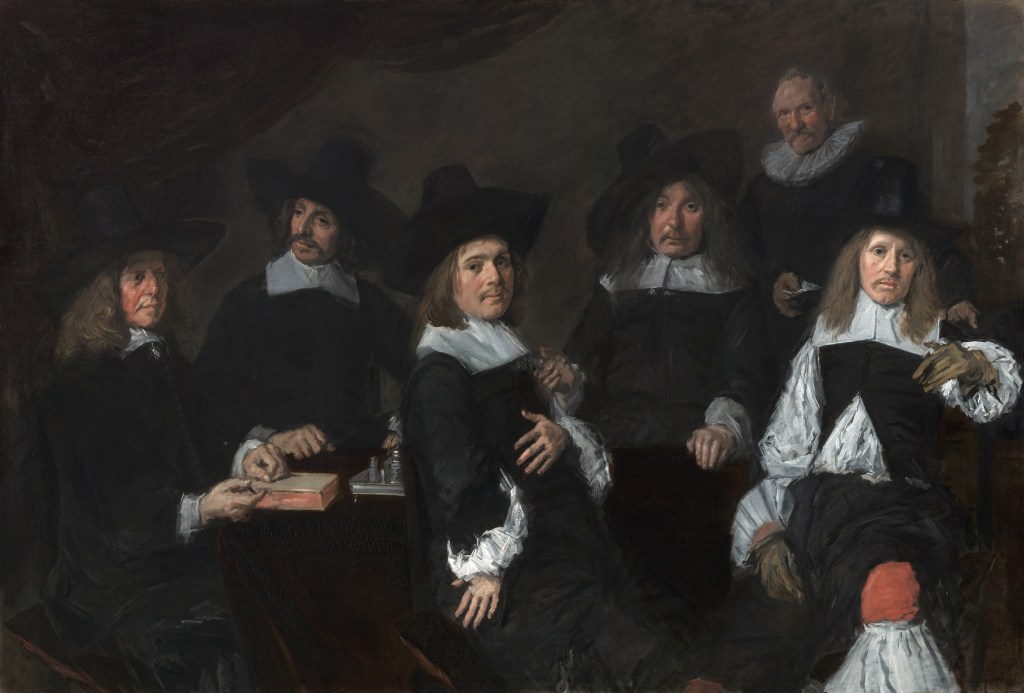
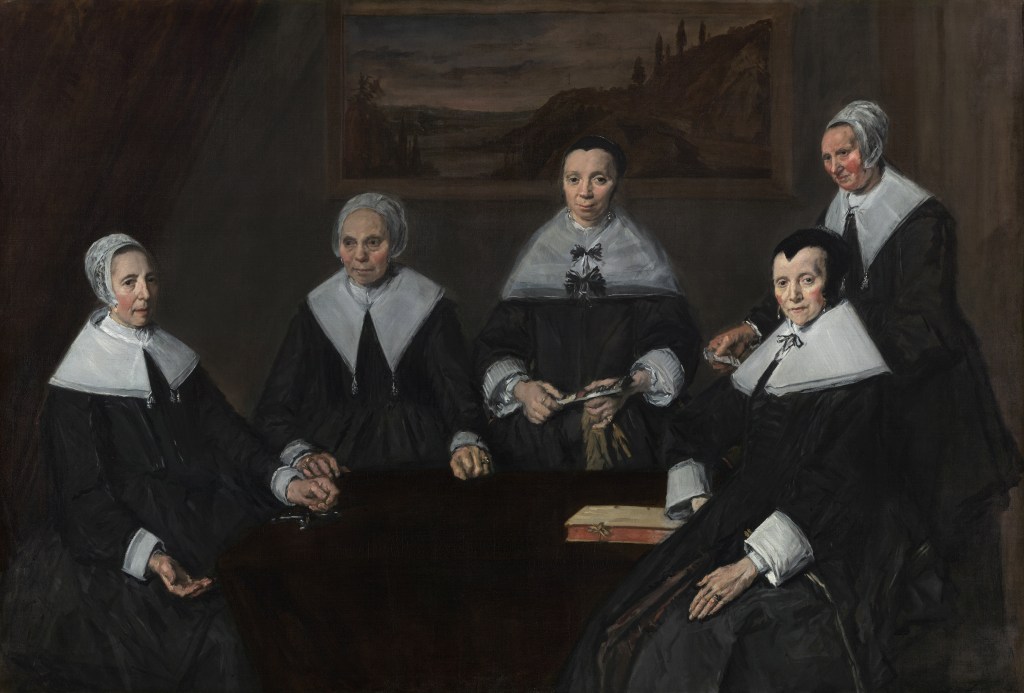
Hals’s career developed principally through portraiture, although his early production also included genre subjects and representations of musicians, drinkers and other figures drawn from contemporary life. His first major civic commission, the Banquet of the Officers of the St George Civic Guard of 1616, established his reputation as a painter of large group portraits. Over the following decades he portrayed Haarlem’s merchants, magistrates, militia officers and charitable governors, alongside individuals whose identities have since been lost. He remained active into old age, painting the regents and regentesses of Haarlem’s Old Men’s Alms House during the early 1660s, shortly before his death in 1666.
Hals belonged to the generation preceding Rembrandt, who was born in 1606, and had established himself as a portraitist before the younger painter began his career. His achievement was concentrated more narrowly upon the representation of people, whereas Rembrandt worked extensively in biblical and historical subjects, landscape and printmaking. Hals occupied a prominent position in Haarlem’s artistic life and received substantial commissions, although financial difficulties accompanied much of his career. His later reputation proved considerably less secure than Rembrandt’s, and by the early nineteenth century his work had fallen far from the esteem it would subsequently recover.
The history of Hals’s reputation is marked by a striking reversal of critical judgement. During the eighteenth and early nineteenth centuries, the freedom of his execution was often regarded as a defect, evidence of a painter whose considerable gifts were compromised by insufficient discipline. Arnold Houbraken’s biography of 1718 had established an enduring association between Hals’s vigorous brushwork and his supposedly dissolute habits. Although the account contained elements of admiration, particularly for his facility in capturing a likeness, its anecdotes were repeated by subsequent writers with little regard for their reliability. Joshua Reynolds, writing in 1774, praised Hals’s representation of individual character but regretted his apparent failure to bring his pictures to a satisfactory finish.
As Frances Suzman Jowell has demonstrated, the reassessment of his work during the nineteenth century depended upon a change in the significance attached to precisely these qualities. The French critic Théophile Thoré-Bürger, whose sustained interest in Hals developed during the 1850s and culminated in two articles published in 1868, challenged the inherited estimate of the painter. His directness of execution, boldness of touch and apparent disregard for conventional finish became signs of an independent artistic intelligence. Thoré also argued for Hals’s importance in the development of Dutch painting, placing him alongside the foremost masters of the seventeenth century rather than among the lesser painters of popular entertainment with whom earlier biographers had associated him.
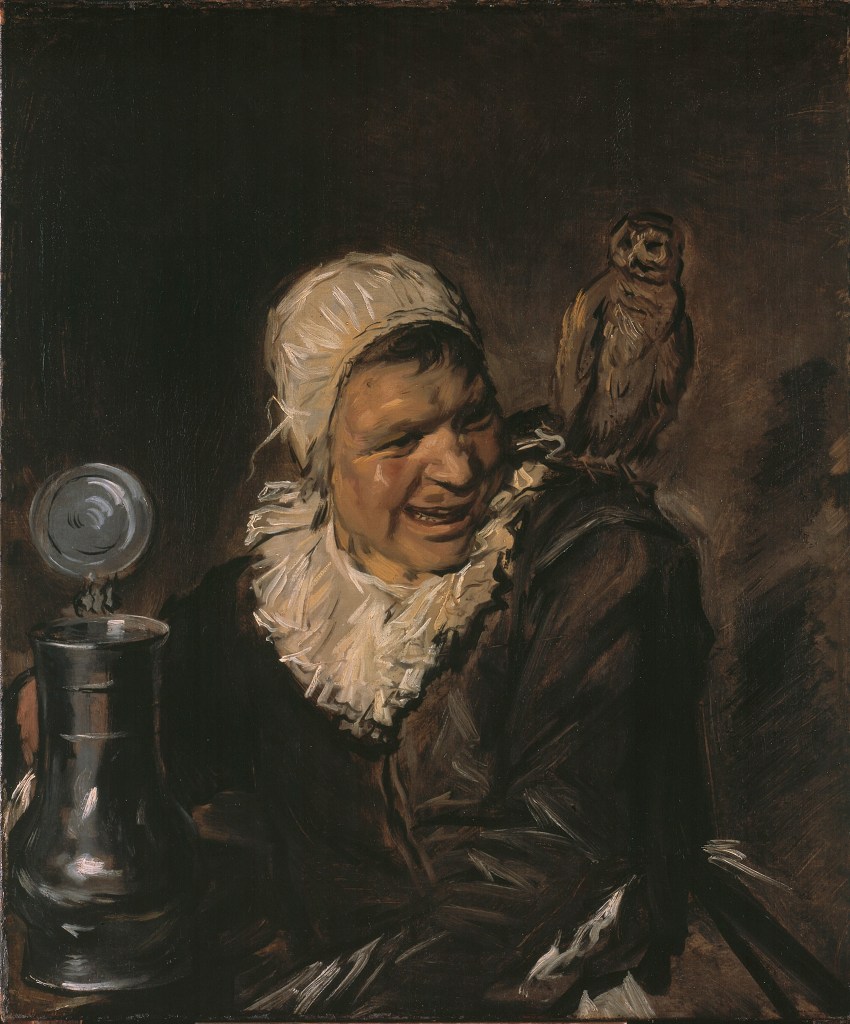
This rehabilitation coincided with the emergence of artistic values that were increasingly receptive to visible brushwork and abbreviated forms. Gustave Courbet copied Hals’s Malle Babbe in Munich in 1869; Manet and other painters subsequently travelled to Haarlem, where the great civic guard portraits had become more accessible following the establishment of the municipal museum in 1862. To nineteenth-century artists, Hals offered an admired precedent for methods of painting that departed from the carefully concealed execution associated with academic finish. Yet this enthusiasm also encouraged a tendency to regard his work as an anticipation of modern painting, rather than as a product of its own artistic culture.
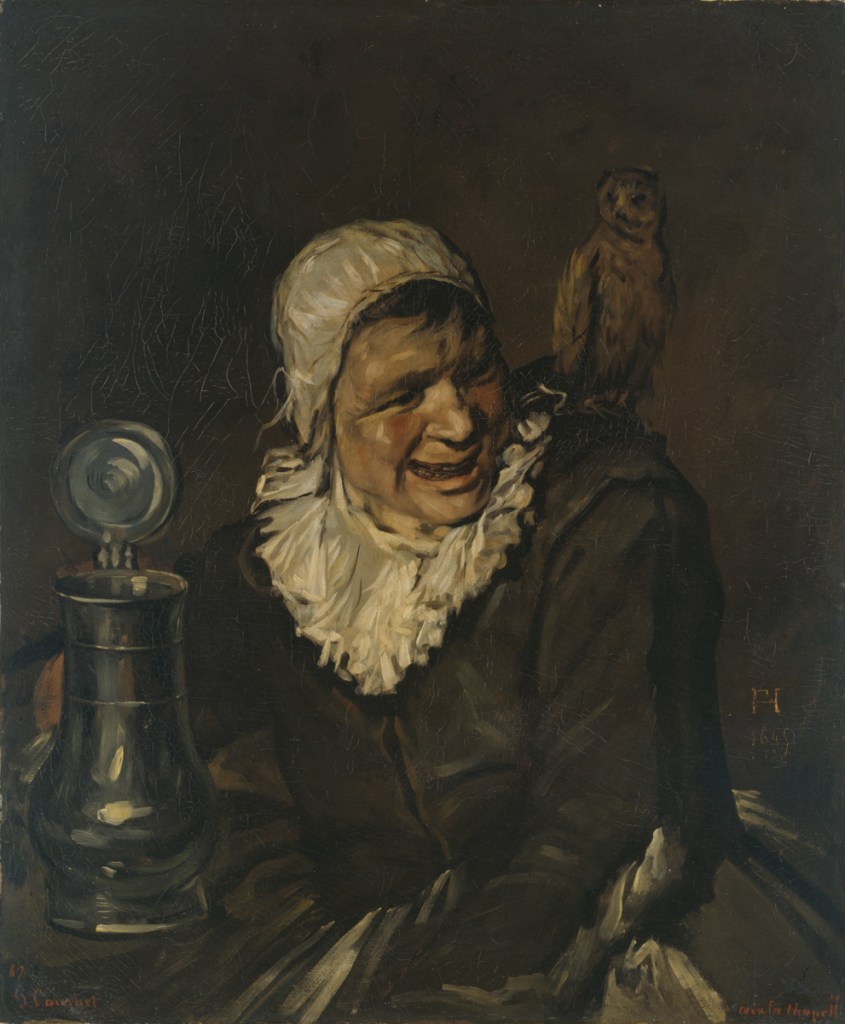
Christopher Atkins has challenged the assumption that the virtuosity of Hals’s brushwork was first properly appreciated in the nineteenth century. Contemporary testimony indicates otherwise. Samuel Ampzing praised the energy of his painting in 1628, while Theodorus Schrevelius, writing in 1648, celebrated the force and vitality of his portraits. Cornelis de Bie subsequently described their bold, rough handling and the convincing effect achieved when they were viewed from a distance. These responses belong to a tradition in which the distinction between rouw, or rough, and net, or neat, execution was already familiar. Karel van Mander had discussed both methods, recognising the difficulty of achieving a successful result through the freer manner associated with Titian.
Hals’s visible brushwork was therefore neither simply an expression of temperament nor an aesthetic innovation awaiting recognition by modern painters. It represented a demanding form of execution whose value could be understood by knowledgeable contemporaries, even if opinions about its appropriateness differed. The apparent absence of finish was itself capable of being judged as a calculated artistic effect.
Technical research has reinforced this distinction between appearance and procedure. Despite the impression that his portraits were rapidly brought to completion, Hals frequently worked in successive applications of relatively thin paint, allowing coloured grounds and earlier layers to contribute to the finished image. Contours could be revised during execution, while individual highlights and accents were introduced at a late stage. The conspicuous strokes that seem to record a moment of effortless invention were thus part of a more extended process of construction. Their economy is inseparable from the precision with which they were placed.
His early development took place within the artistic culture of Haarlem, where Hendrick Goltzius and Cornelis Cornelisz. van Haarlem had established a tradition of ambitious figure painting. Walter Liedtke has questioned the tendency to regard Hals’s originality as evidence of independence from earlier masters. Flemish painting offered further possibilities, especially following his visit to Antwerp in 1616. Liedtke draws attention to affinities between his early work and the vigorous, broadly handled paintings of the young Jacob Jordaens, although the extent of any direct influence remains uncertain. His achievement developed through the assimilation of existing pictorial resources rather than through a rejection of them.
His Banquet of the Officers of the St George Civic Guard of 1616 provides an early indication of the direction his portraiture would take. The genre was already firmly established in Haarlem, and Hals could study the large civic portraits of Cornelis Cornelisz. van Haarlem. The innovation, as Liedtke observes, lay principally in the relationships established between the figures. The officers retain their individual identities and positions within the company, but their arrangement introduces a degree of conversational interaction absent from many earlier examples. The painting reconciles the requirements of an official commemoration with the conventions of a social gathering.
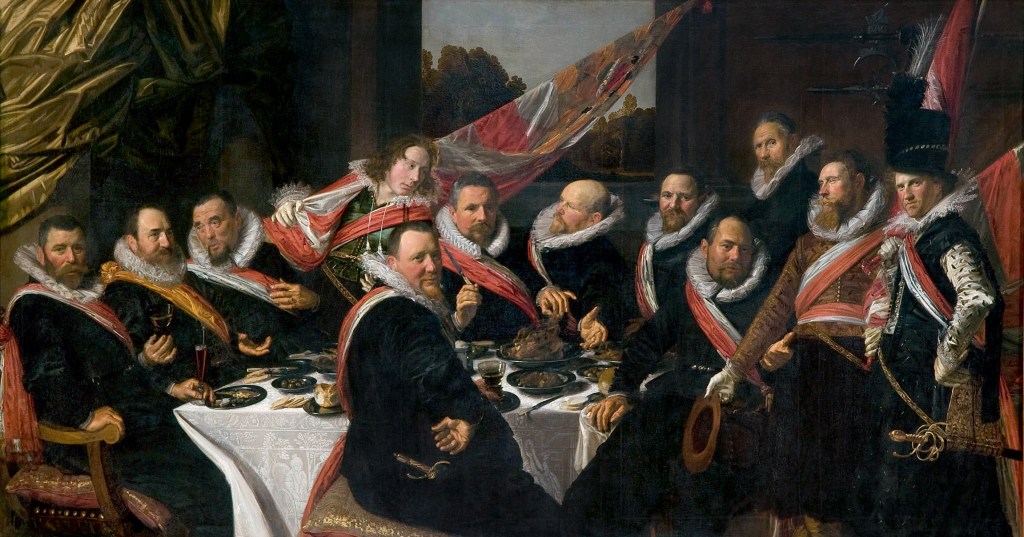
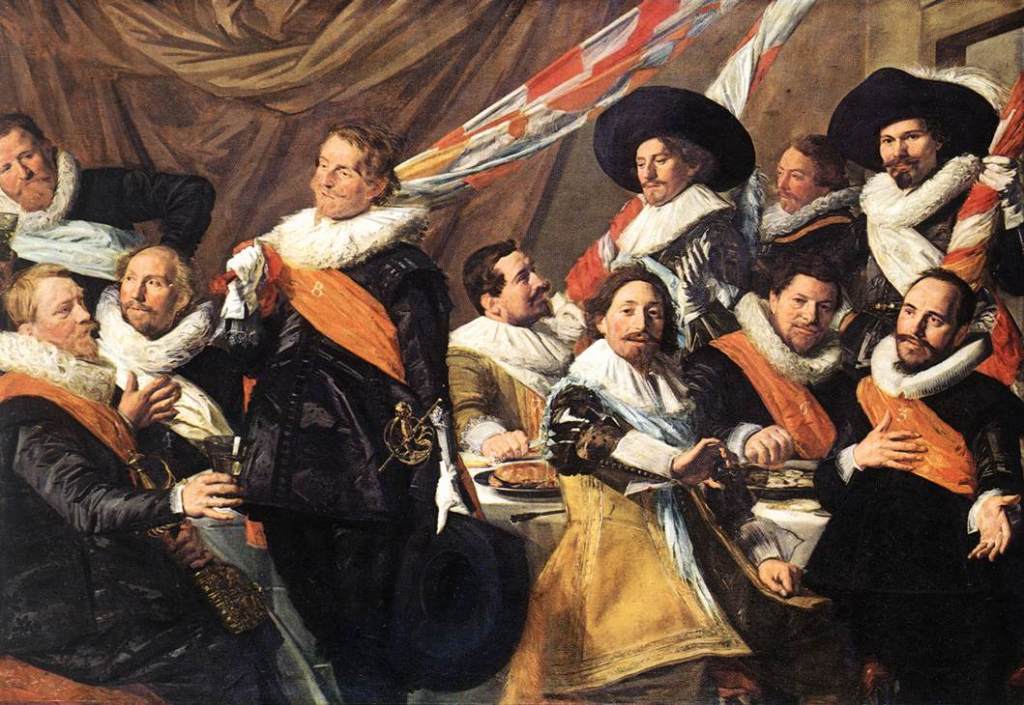
He developed these possibilities in the civic guard paintings of the following decades. The Banquet of the Officers of the St George Civic Guard of 1627 commemorates officers whose period of service extended from 1624 to 1627, including several who had participated in the expedition to reinforce Heusden in 1625. The composition retains distinctions of military rank, yet the assembled men are organised into smaller groups absorbed in conversation. The online scholarly catalogue Frans Hals and His Workshop, published by the RKD, the Netherlands Institute for Art History in The Hague, observes that relatively few address the spectator directly. Their exchanges give the painting the character of an event taking place, although the arrangement remains governed by the institutional purpose of the commission. The catalogue, which examines Hals’s paintings and their relationship to workshop production through stylistic and technical research, also considers differences in handling between individual heads and passages of costume. These have prompted questions concerning the stages of execution and possible workshop participation, questions that remain open within the scholarship.
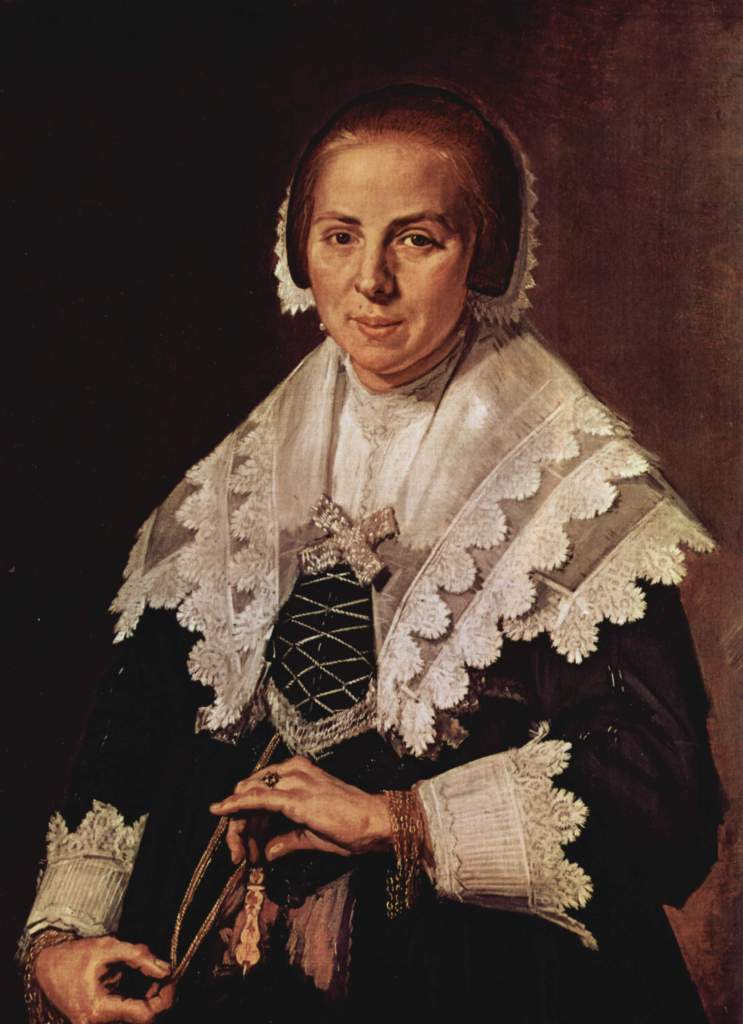
A comparable negotiation between convention and individuality informs his portraits of single sitters. The Portrait of a Woman Holding a Fan, generally dated around 1640, demonstrates his ability to accommodate the requirements of fashionable representation without adopting the more evenly finished manner of Johannes Cornelisz. Verspronck. Seymour Slive contrasted the relative stillness of Verspronck’s figures with the greater animation of Hals’s poses and gestures. The expensive fan and elaborate costume establish the sitter’s social position, while the execution gives those conventional elements a distinctive pictorial character.
The Portrait of Jaspar Schade, painted around 1645, provides another instructive example. Schade belonged to a prominent Utrecht family and was known for his extravagant expenditure on clothing, a reputation supported by contemporary correspondence cited by Slive. The portrait’s fashionable grey taffeta costume offered Hals an opportunity to display the breadth and precision of his handling. Slive compared the painting with Cornelis Jonson van Ceulen’s portrait of the same sitter, executed in 1654, whose smoother treatment and more studied elegance reflect a different approach to fashionable portraiture.
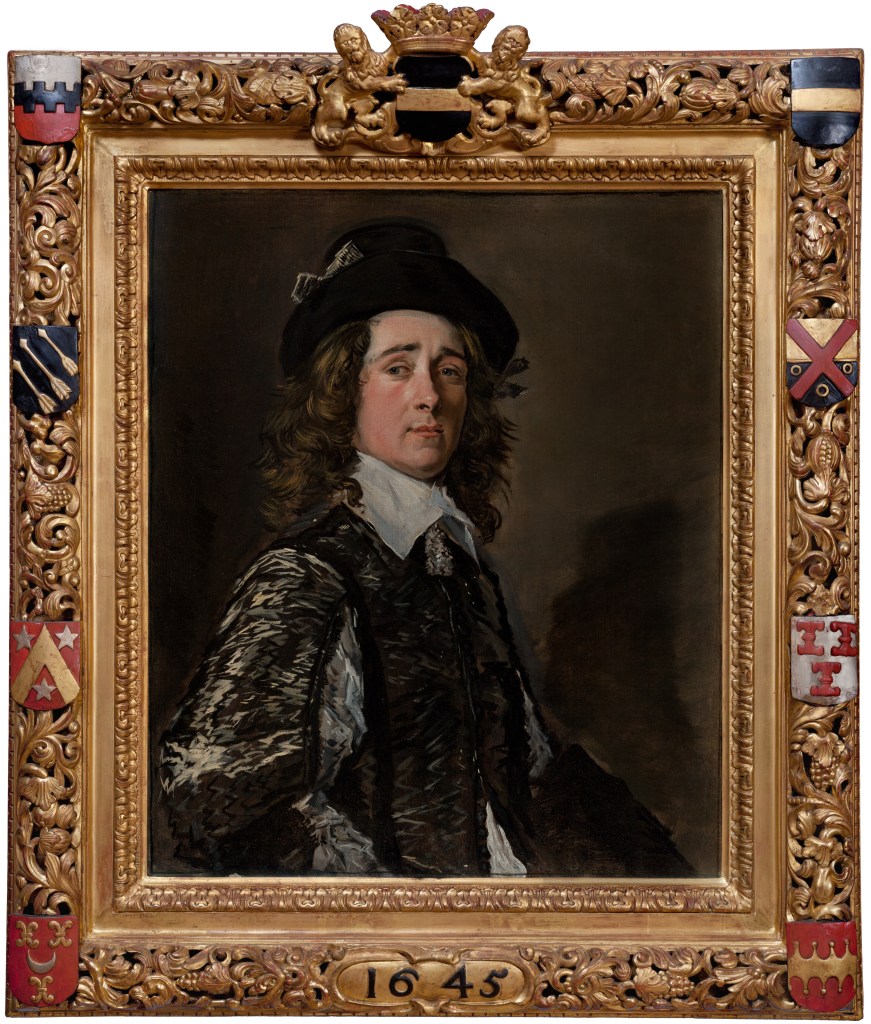
Such distinctions were meaningful to patrons. As Atkins has argued, Hals worked for members of a prosperous and cultivated society in which the ability to appreciate artistic virtuosity could itself signify refinement. The choice of his manner need not have implied indifference to decorum or social standing. His portraiture accommodated these concerns while exploiting the expressive possibilities of visible brushwork, gesture and the relationships between figures. These were qualities that could operate within the familiar format of a single likeness, but they also allowed the painter to develop more elaborate connections between sitters represented on separate canvases.
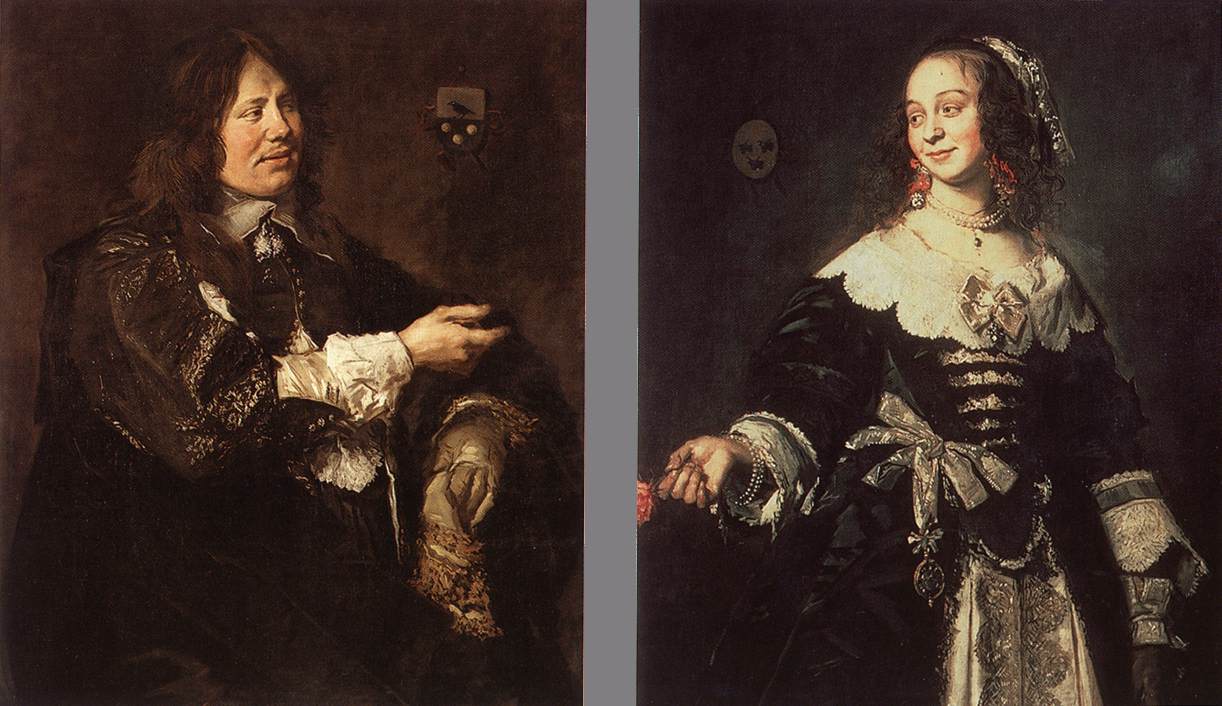
The portraits of Stephanus Geraerdts and Isabella Coymans, generally dated around 1650–52, occupy a distinctive place in his work. Pendant portraits of married couples were a familiar form of Dutch domestic and commemorative painting, but the relationship between these two sitters is developed with particular ingenuity. Although each occupies an independent canvas, the painter made their gestures and expressions interdependent. Isabella turns towards her husband and offers him a rose, while Stephanus extends his right hand to receive it. Their exchanged glances complete an encounter that unfolds across the space separating the pictures.
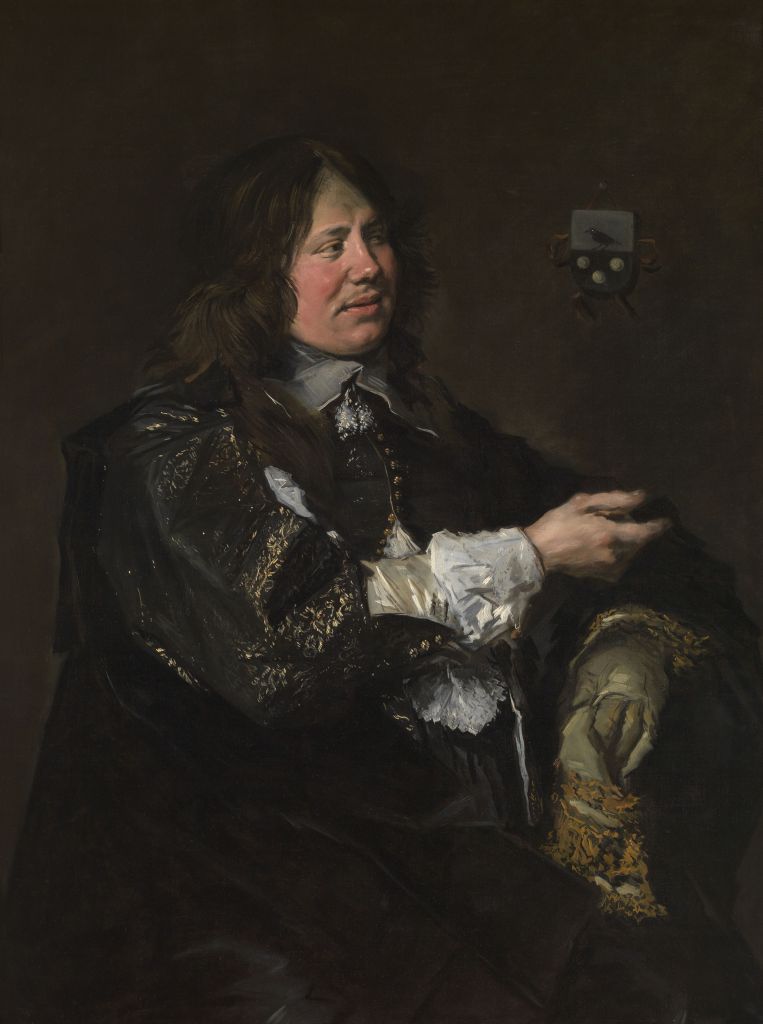
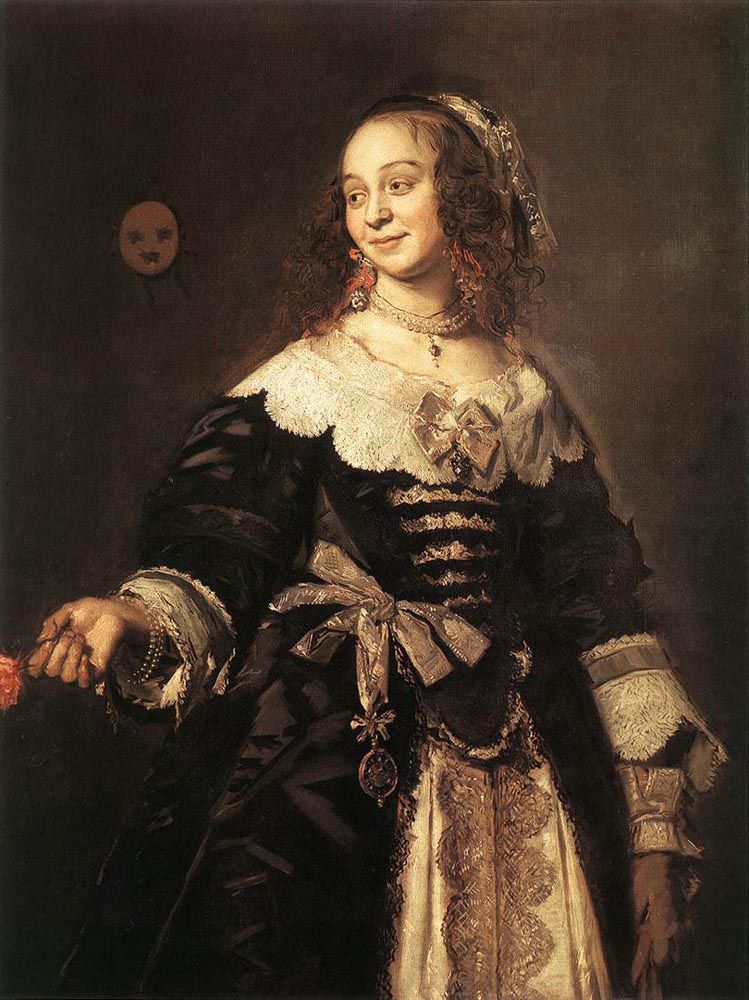
The couple had married in Haarlem on 4 October 1644. Stephanus Geraerdts was born in Amsterdam and subsequently held municipal office in Haarlem, where he died in 1671. Isabella belonged to the wealthy Coymans family, whose commercial interests and international connections placed its members among the most prosperous merchants of the Dutch Republic. Her father, Josephus Coymans, was a merchant and banker, while her uncles Balthasar and Johannes commissioned Jacob van Campen to design their imposing double house on Amsterdam’s Keizersgracht in 1625. Such connections provide some indication of the social circumstances in which Hals received the commission.
His association with the family was already established. In 1644 he painted portraits of Isabella’s parents, Josephus Coymans and Dorothea Berck, and the following year portrayed Willem Coenraetsz. Coymans, a member of another branch of the family. Atkins has drawn attention to Dorothea Berck’s collection of paintings, which included works by Adriaen Brouwer, Jacob van Ruisdael, Cornelis Vroom and Philips Wouwerman. The collection provides evidence of an interest in painting within the family’s immediate circle and supports Atkins’s broader argument that Hals’s patrons could appreciate virtuoso handling as a mark of artistic distinction. It does not, however, establish the particular tastes of Stephanus and Isabella or the circumstances of their commission.
The date of the paintings presents a related difficulty. Their affectionate character and the conventional association between pendant portraits and marriage have encouraged their identification as wedding portraits. Yet the stylistic evidence, as assessed by Slive in the 1989 exhibition catalogue, favours a date around 1650–52, several years after the marriage. The couple’s wedding consequently provides a biographical context rather than a secure occasion for the commission. Hals was by then in his late sixties, with several decades of experience in the representation of individuals and groups.
The two portraits follow the customary arrangement in which the husband occupies the viewer’s left and the wife the right. Both sitters are presented predominantly frontally, while their heads and gestures establish a connection across the division. Slive describes this relationship in terms of psychological and rhythmic unity, drawing attention to the way the extended arms and exchanged expressions bring the two compositions together. The rose gives Isabella’s gesture its purpose and makes Stephanus’s response intelligible as part of the same action. Their separate identities remain intact, but neither portrait is fully understood without the other.
The costumes contribute another aspect of their presentation. Stephanus wears an elaborately embroidered jacket, its brilliant whites and gold ornament providing an opportunity for Hals’s characteristic handling of richly varied surfaces. Isabella’s dress is no less conspicuous. Slive draws attention to the lowered neckline, the elaborate lace at her collar and cuffs, the veil decorated with pearls and coloured ribbons, and the large silver bow at her waist. Her costume is exceptionally elaborate in the context of Hals’s portraits of patrician women. These details establish the couple’s fashionable standing, while the differences between the fabrics allow the painter to vary the treatment of colour, light and texture.
As Liedtke argues, the apparent informality of Hals’s portraits should not be mistaken for an absence of social convention. The presentation of wealth and cultivated taste remained integral to commissioned portraiture, even when the figures appeared momentarily absorbed in an encounter. In the Geraerdts and Coymans pendants, the conventions governing the representation of a prosperous married couple coexist with the suggestion of a personal exchange.
The rose has naturally attracted iconographic interpretation. Boot, writing in 1973, associated it with the vanitas tradition, proposing that the flower might allude to the transience of earthly affection or warn against sensual pleasure. Slive acknowledged that roses could carry such meanings in seventeenth-century emblematic literature but found the interpretation difficult to reconcile with the affectionate relationship established between the sitters. He preferred the flower’s longstanding association with love. A comparable disagreement concerns the watch suspended beneath Isabella’s large silver bow. Although watches could serve as reminders of passing time and mortality, Slive considered its appearance here more readily explained as a fashionable accessory.
Neither interpretation can be regarded as conclusively established. The meanings of such objects depended upon context, and a conventional association does not necessarily determine the significance of an accessory within a particular painting. What can be said with greater confidence is that the rose participates directly in the relationship between the portraits. Whatever additional associations it may have carried, its pictorial function is to connect the actions of husband and wife.
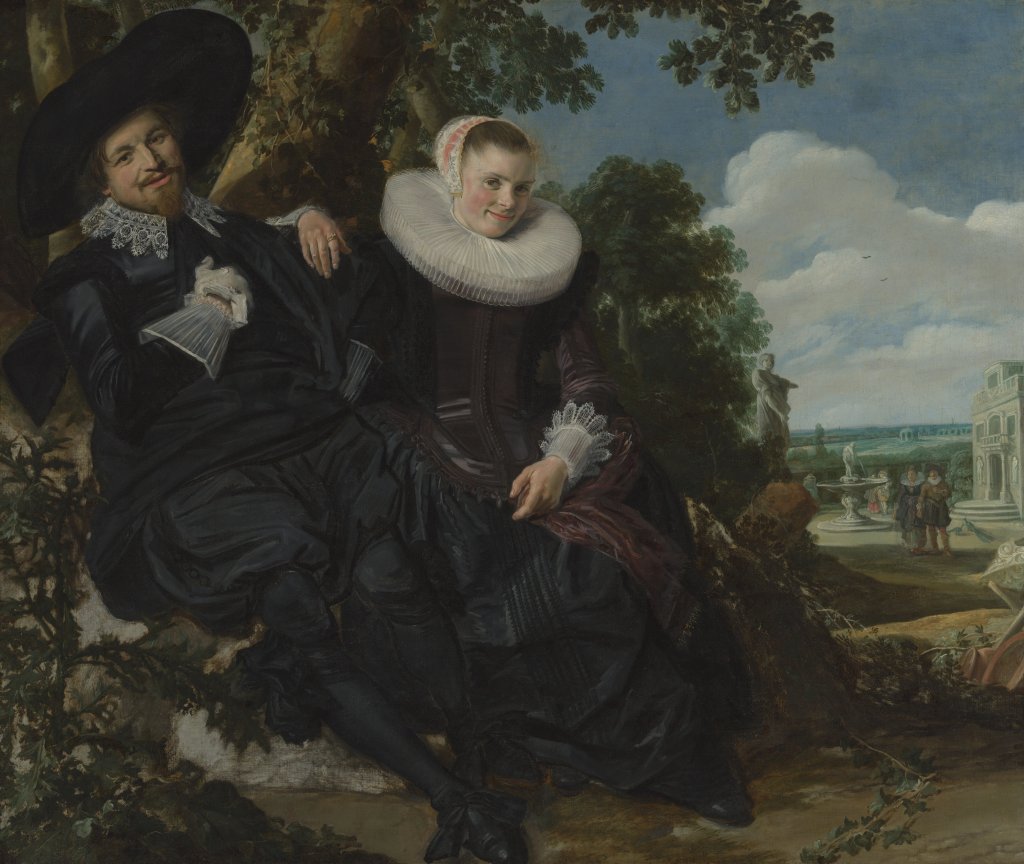
Hals had represented affectionate relationships before, most notably in the portrait of a married couple, generally identified as Isaac Massa and Beatrix van der Laen and dated around 1622. The apparent ease of that earlier composition has sometimes encouraged an interpretation of the figures as an informal couple observed in a garden. Yet, as Jowell points out in her discussion of the painting’s nineteenth-century reception, its naturalism coexists with established conventions of marriage portraiture. In both cases, Hals gives conventional representations of marriage a degree of animation without abandoning their commemorative character. In the later pendants, however, the relationship must be sustained across two separate pictures rather than within a single composition.
The portraits of Stephanus Geraerdts and Isabella Coymans were exhibited together at the Royal Academy in London in 1877, but were separated in 1886, when the dealer Stephen Bourgeois sold Stephanus’s portrait to the museum in Antwerp and Isabella’s to Alphonse de Rothschild in Paris. Their subsequent histories diverged, with Isabella’s portrait seized during the Second World War and later recovered. The two paintings were reunited for the Hals exhibition of 1989–90, their first joint exhibition since 1877. Their renewed proximity restored one of the most engaging aspects of Hals’s conception: the palpable and charming sense of affection sustained across two independent portraits.
Donate to Inner Surfaces here.
Bibliography
These are the sources. Any errors are mine.
Atkins, Christopher D. M. ‘Frans Hals’s Virtuoso Brushwork’. Nederlands Kunsthistorisch Jaarboek, vol. 54 (2003), pp. 280–307.
Bezold, John. ‘Frans Hals Connoisseurs and Exhibitions: From Thoré to Today’. In Norbert E. Middelkoop and Rudi E. O. Ekkart (eds), Frans Hals: Iconography – Technique – Reputation. Amsterdam: Amsterdam University Press, 2024, pp. 221–243.
Grimm, Claus. Frans Hals and His Workshop. RKD Studies, Netherlands Institute for Art History, The Hague, online catalogue raisonné, 2023–24.
Jowell, Frances Suzman. ‘Thoré-Bürger and the Revival of Frans Hals’. The Art Bulletin, vol. 56, no. 1 (March 1974), pp. 101–117.
Liedtke, Walter. ‘Frans Hals: Style and Substance’. The Metropolitan Museum of Art Bulletin, vol. 69, no. 1 (Summer 2011), pp. 4–48.
Slive, Seymour (ed.). Frans Hals. Exhibition catalogue, National Gallery of Art, Washington; Royal Academy of Arts, London; Frans Hals Museum, Haarlem, 1989–90. Munich: Prestel-Verlag, in association with Mercatorfonds, Antwerp, 1989. Particularly catalogue entries 53, 62 and 68–69.

