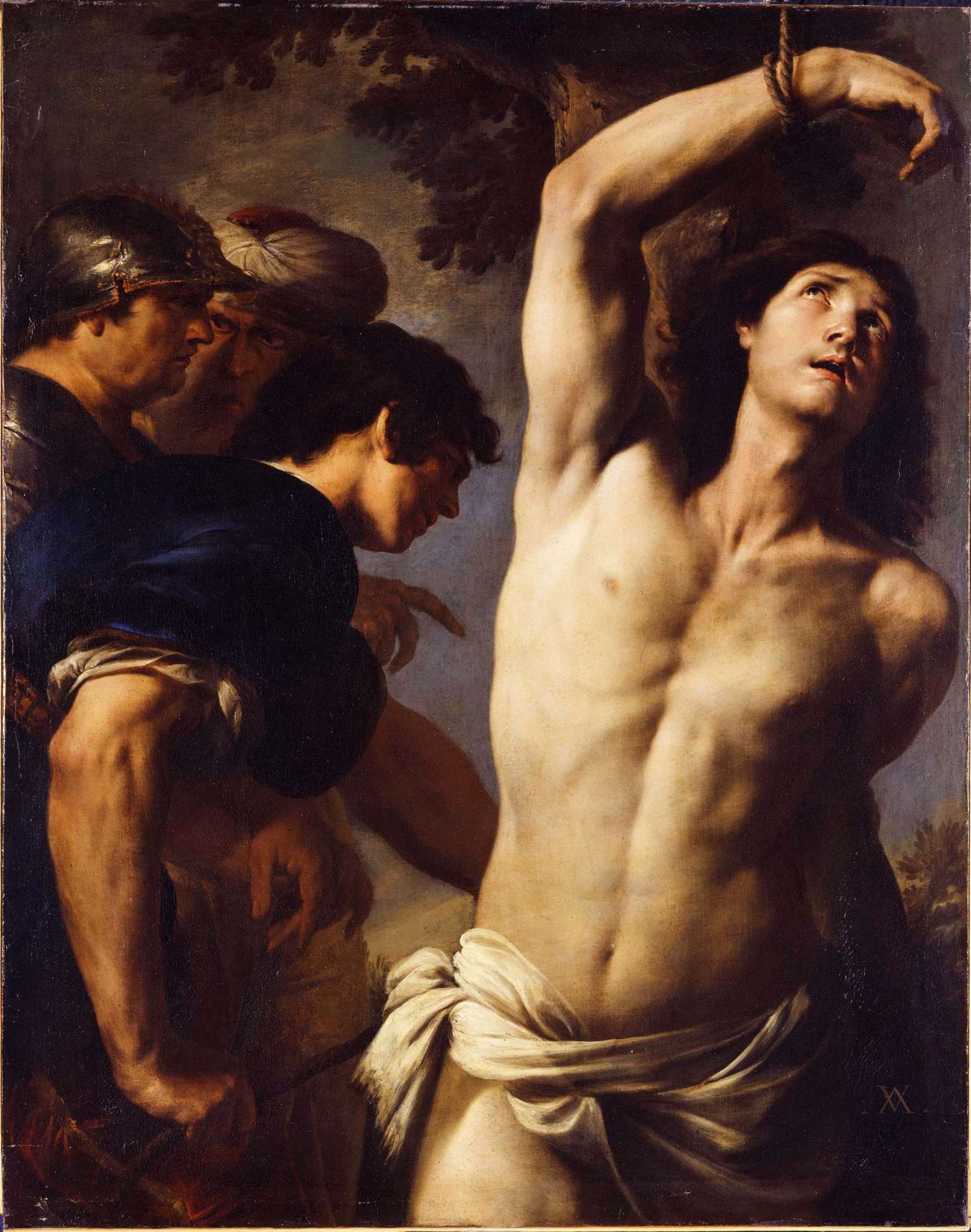
Andrea Vaccaro (1604–1670) enjoyed considerable prominence in the artistic life of seventeenth-century Naples. His paintings were sought after by ecclesiastical patrons and private collectors, circulated widely beyond his native city and found an especially receptive market in Spain. His reputation was recognised by writers elsewhere in Europe, while the eighteenth-century Neapolitan historian Onofrio Giannone went so far as to call him the ‘Neapolitan Raphael’. Few painters could have appeared more securely established in the artistic culture of their time.
Yet Vaccaro’s subsequent reputation has been considerably less assured. Modern historians have frequently characterised his painting as eclectic, academic, derivative or repetitive, finding in his combination of Caravaggesque naturalism and the idealising tendencies of Bolognese classicism an accomplished but insufficiently original compromise. His considerable productivity has compounded the problem. The large number of works attributed to him, including copies, variants and paintings of uncertain authorship or questionable quality, has contributed to an impression of stylistic inconsistency that may owe as much to the uncertain boundaries of his oeuvre as to the character of his art.
Research into Vaccaro’s documented commissions and professional activities has challenged some of these assumptions. His artistic standing did not simply diminish with the emergence of a younger generation, and his later career brought prestigious commissions and responsibilities within the Corporation of Neapolitan Painters. Meanwhile, investigations of his early production have revealed a more complex relationship with the naturalistic tradition. The legacy of Caravaggio reached him through painters working in Naples and through practices of copying and adaptation, while other artistic possibilities, including those associated with Guido Reni and Roman painting, entered into his developing pictorial vocabulary.
Such diversity need not be regarded as evidence of an uncertain artistic identity. Vaccaro’s ability to draw upon different pictorial traditions could also serve the particular requirements of a commission, allowing him to adapt his approach to its subject, setting and devotional purpose. In his religious paintings, naturalism and idealisation could be employed selectively, according to the expressive and iconographic demands of the scene. His extensive production also encompassed biblical narratives and episodes from classical mythology, inviting consideration of the different pictorial approaches he employed.
The following selection of works provides an opportunity to explore some of these interests, drawing upon historical evidence and modern scholarship while allowing the individual paintings to suggest the direction of the discussion.
The Martyrdom of Saint Bartholomew belongs to a group of paintings through which Riccardo Lattuada reconstructs Vaccaro’s early engagement with Caravaggism. The work appeared at Sotheby’s in Florence in December 2009 alongside a Saint Stephen Taken to His Martyrdom, both then attributed to Filippo Vitale on the authority of Nicola Spinosa. Having examined the paintings before and during their restoration, Lattuada proposed a different attribution, regarding both as important achievements of Vaccaro’s early naturalistic period.
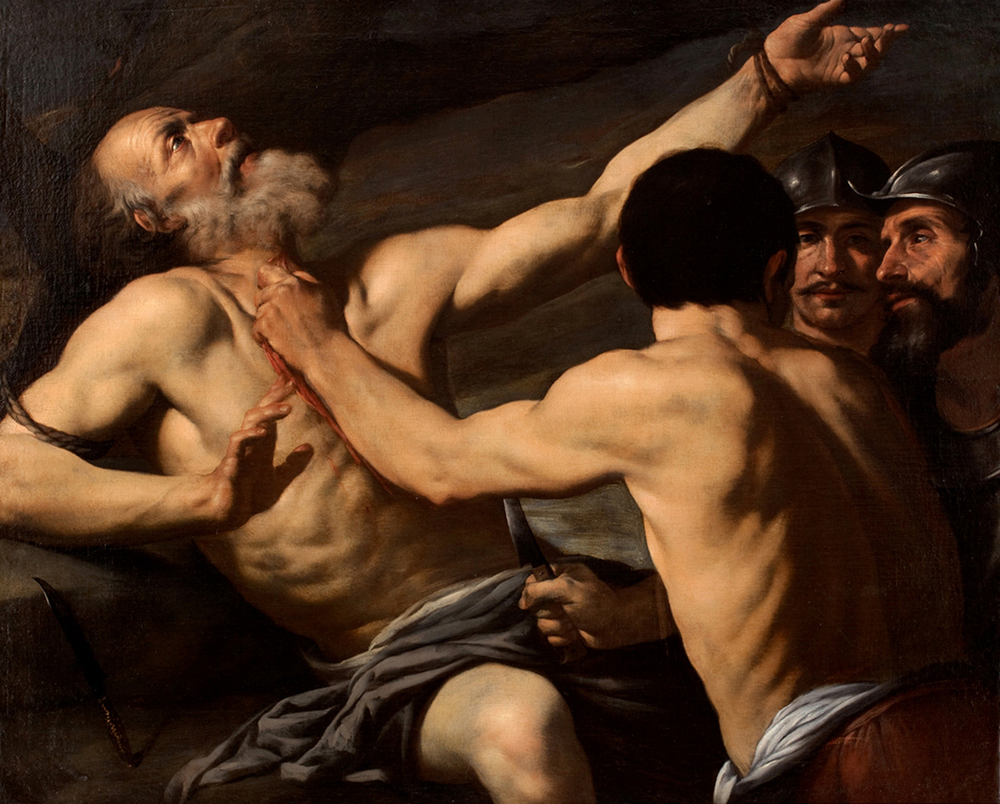
In the Martyrdom, the executioner’s knife has already begun its work. Lattuada describes the tormentor from behind, turning towards two soldiers on the right, while Bartholomew looks upwards as though seeking the strength to endure his suffering through faith. Another knife rests against a rock in the foreground, casting its shadow upon the ground. The restricted setting and closely grouped figures belong to the Caravaggesque pictorial language that Lattuada finds in both Roman and Neapolitan painting.
He finds the strongest artistic parallels in Jusepe de Ribera’s representations of martyrdom, especially the Martyrdom of Saint Lawrence of around 1615 and the Martyrdom of Saint Bartholomew painted for the Collegiate Church of Osuna in 1627. More specific correspondences emerge in the executioner’s head, seen from behind, which recalls figures in Battistello Caracciolo’s Flagellation at Capodimonte and his Salome in the Uffizi. Lattuada also considers the repertoire of figures and costumes associated with Bartolomeo Manfredi and Nicolas Tournier. He compares the soldiers’ helmets and the figures wearing berets with those appearing in Tournier’s various treatments of The Dice Players and The Denial of Saint Peter, while finding related details in Manfredi’s Card Players. These comparisons suggest the extent to which Vaccaro’s early painting, if the attribution is accepted, participated in a pictorial culture extending beyond Naples.
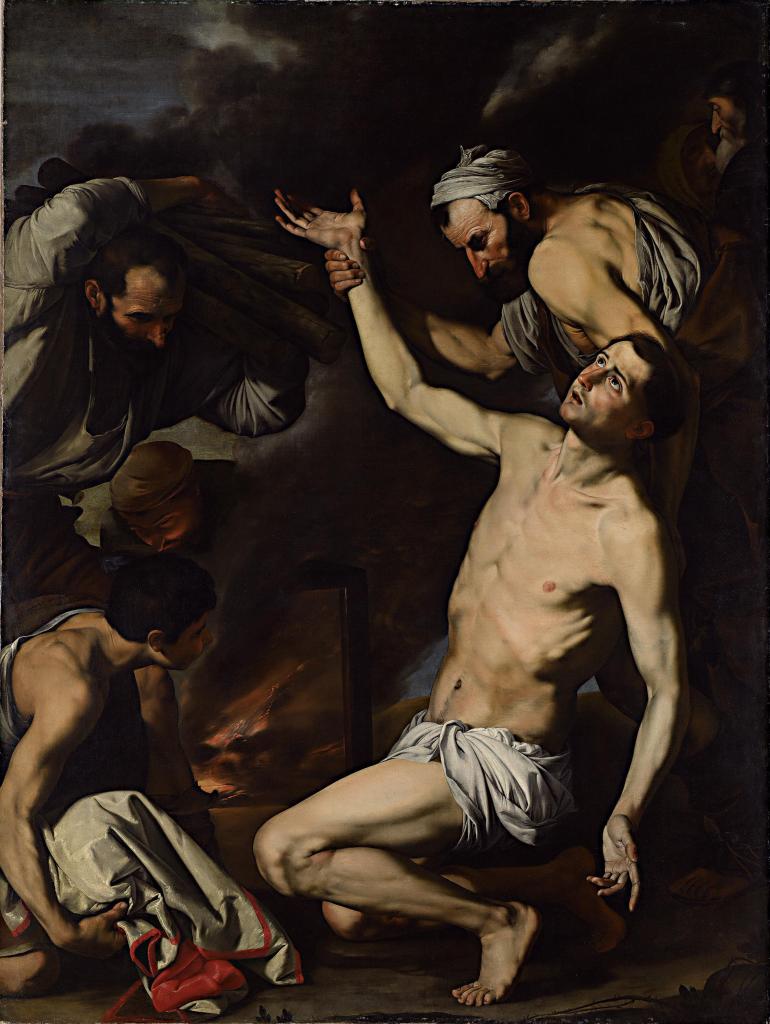
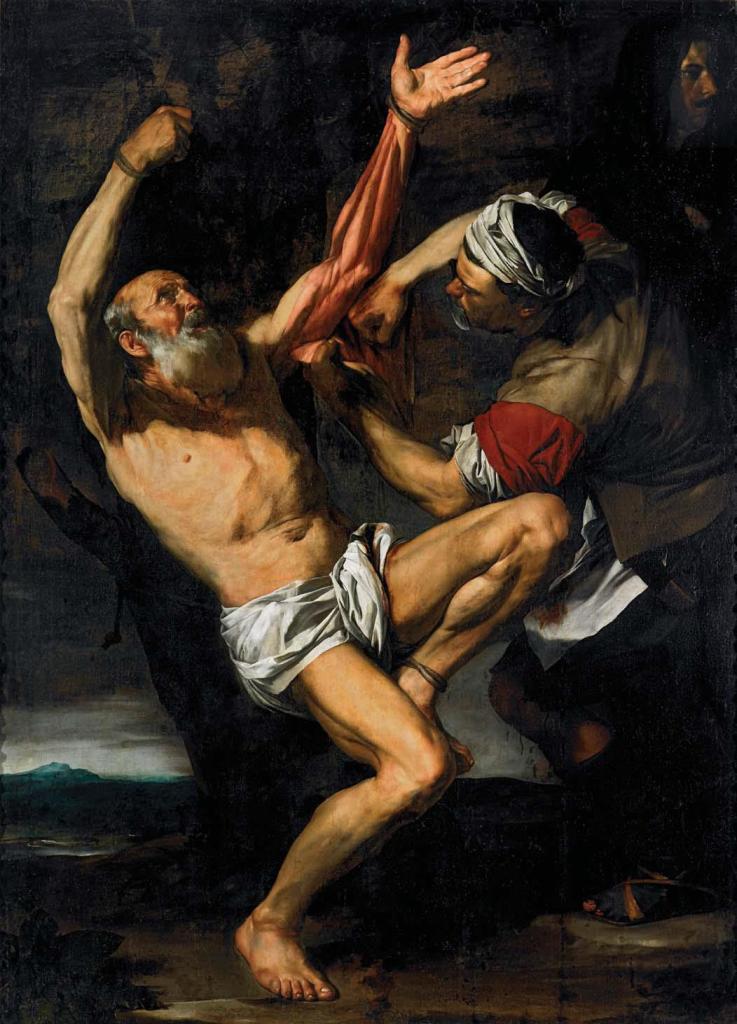
Lattuada uses these relationships in support of his proposed chronology, placing Vaccaro’s more rigorously Caravaggesque phase approximately between 1622–25 and 1630. The dating is not uncontested. Viviana Farina, for example, has placed the Martyrdom of Saint Bartholomew around 1640, a later date recorded by Lattuada without further discussion.
In Saint Stephen Taken to His Martyrdom, the companion painting to the Martyrdom of Saint Bartholomew, the execution has yet to begin. Dressed in his deacon’s robes, Stephen walks towards his fate with bowed head and hands joined in prayer. Lattuada draws attention to the men surrounding him: a moustached figure carrying a basket of stones, a soldier who appears to glance towards him, and another man, wearing a red beret, standing immediately behind the saint. Lattuada identifies the latter as Saul, the future Saint Paul, who, according to the Acts of the Apostles, witnessed Stephen’s stoning and consented to his death.
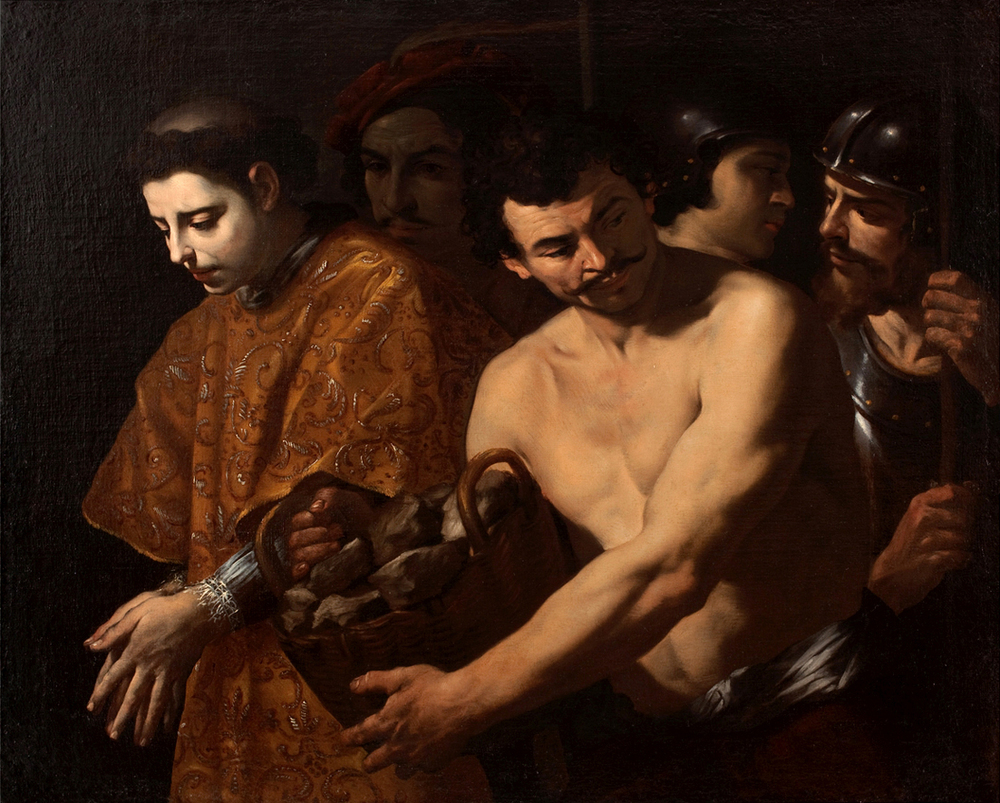
The painting’s psychological interest extends beyond its identifiable participants. The glances that seem never quite to meet, the half-turned head of the man carrying the stones, and the subtle distribution of light across the deacon’s robes and the bodies of his persecutors invite conjecture about the relationships between the figures. There is perhaps a suggestion of hesitation or divided conviction among those preparing to carry out the execution, complicating the apparent opposition between martyr and persecutors.
Lattuada also detects a classical element in the profile of one soldier, comparing it with representations of Roman emperors, notably Vitellius, on ancient coins. He identifies the recurrence of particular figures in other works attributed to Vaccaro: the soldier’s profile reappears, with variations, in the later Martyrdom of Saint Sebastian formerly with Galerie Canesso, while the man carrying the stones provides a model for a figure supporting Lazarus in the Resurrection of Lazarus formerly in the Leonetti Collection.
Vaccaro’s Deposition of Christ in the Pio Monte della Misericordia, Naples, and the Lamentation over the Dead Christ of 1652, now in the Art Institute of Chicago, provide important evidence of his assimilation of different pictorial traditions. Vincenzo Pacelli regarded the Deposition as one of Vaccaro’s finest achievements, dating it to around 1635–40, while Riccardo Lattuada has suggested a date in the 1640s or later. Pacelli recognised a debt to Jusepe de Ribera’s Pietà in the Certosa di San Martino, although he also discerned the moderating influence of Massimo Stanzione in the idealisation of the figures. Lattuada identified a further relationship with Anthony van Dyck’s Lamentation, formerly in Berlin and destroyed during the Second World War, whose composition was disseminated through copies and an engraving by Paulus Pontius.
The Chicago Lamentation reveals a further development of these interests. Paola Santucci noted its relationship with the Neapolitan Deposition, while recognising a more pronounced classicising tendency in the later painting, particularly in its affinities with Stanzione’s Deposition of 1638–39. Dominique Vasseur, however, questioned the coherence of Vaccaro’s arrangement, comparing it unfavourably with the more unified compositions of Stanzione and Guercino. The differing judgements are revealing. Vaccaro’s treatment of these subjects brought together the physical immediacy of Neapolitan naturalism and the increasingly measured language of classicism, although the reconciliation of those tendencies was not always regarded as successful. His adaptations of Ribera, Van Dyck and Stanzione also demonstrate the selective character of his borrowing, through which established inventions could be reconsidered in response to his own compositional and expressive interests.
Vaccaro’s Adoration of the Golden Calf, in the Museo di Capodimonte, Naples, belongs to a group of ambitious biblical and mythological compositions that Lattuada associates with the painter’s maturity, placing it approximately between the 1640s and 1650s. The subject, taken from Exodus, concerns the Israelites’ worship of the golden idol fashioned by Aaron during Moses’ absence on Mount Sinai. Lattuada identifies broad affinities with representations of the sacrifices of Moses derived from Nicolas Poussin and developed by Neapolitan painters such as Andrea de Lione, whose mature work reflects the influence of Giovanni Benedetto Castiglione.
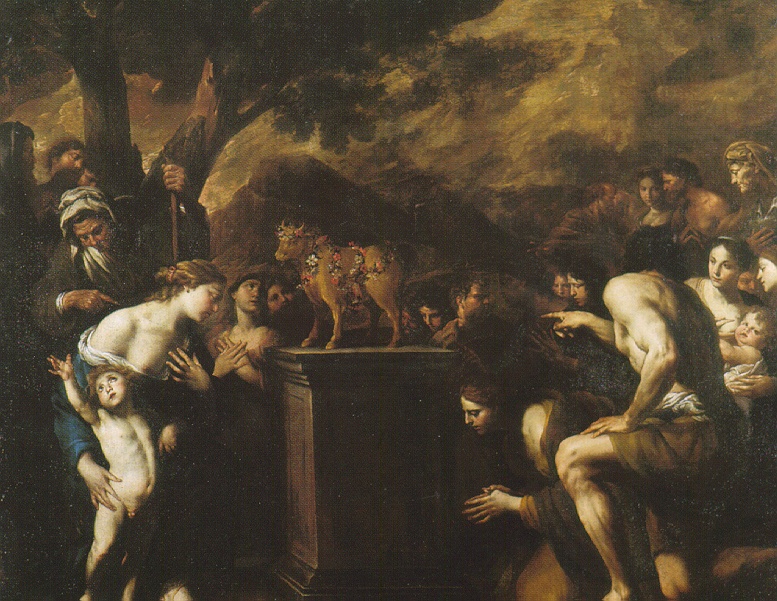
A particularly revealing detail is the child standing on the left, whom a woman attempts to restrain as he looks upwards and raises his arm. In a catalogue essay devoted to Vaccaro’s Study for the Head of a Child, Lattuada identifies a nearly definitive preparatory study for this figure, executed in oil on paper and measuring 28 × 22 cm. He considers the work a rarity within Vaccaro’s surviving artistic production, given the scarcity of securely attributed drawings and the absence, to his knowledge, of comparable oil studies documenting the transition from drawing to finished painting. Lattuada reads the child’s upward appeal as an expression of awareness of the sacrilege taking place around him. He cautiously proposes that the figure might represent Khur, son of Miriam, who, according to traditions outside the Book of Exodus, opposed the worship of the Golden Calf and was killed by the idolaters. The identification remains hypothetical, but the preparatory study provides exceptionally specific evidence of Vaccaro’s attention to the figure.
Elsewhere, Lattuada discusses another instance of Vaccaro’s reuse of an earlier invention. The woman holding an infant on the right corresponds to a Madonna and Child formerly on the art market, which he relates in turn to a composition by Massimo Stanzione in the Museo Diocesano, Naples. His discussion thus connects the Golden Calf both with the preparation of individual figures and with the adaptation of existing compositions.
Lattuada groups the painting with Susanna and the Elders and Rinaldo and Armida, recognising a closely related treatment of illumination in all three works. He describes an ochre-coloured light developed through a complex range of brown tones, resembling darkened gold, interrupted by powerful accents of colour and luminosity among the foreground figures. These qualities form part of his argument for associating the three paintings with the same broad phase of Vaccaro’s development.
Vaccaro’s Rinaldo and Armida, in the Museo di Capodimonte, Naples, depicts an episode from the sixteenth canto of Torquato Tasso’s Gerusalemme liberata, in which the Christian warrior Rinaldo has abandoned his military obligations for the enchanted garden of the sorceress Armida. His companions Carlo and Ubaldo arrive to recover him, discovering the lovers in their secluded paradise. The painting, formerly in the d’Avalos collection, belongs to the relatively small but distinguished group of secular narratives within Vaccaro’s extensive production.
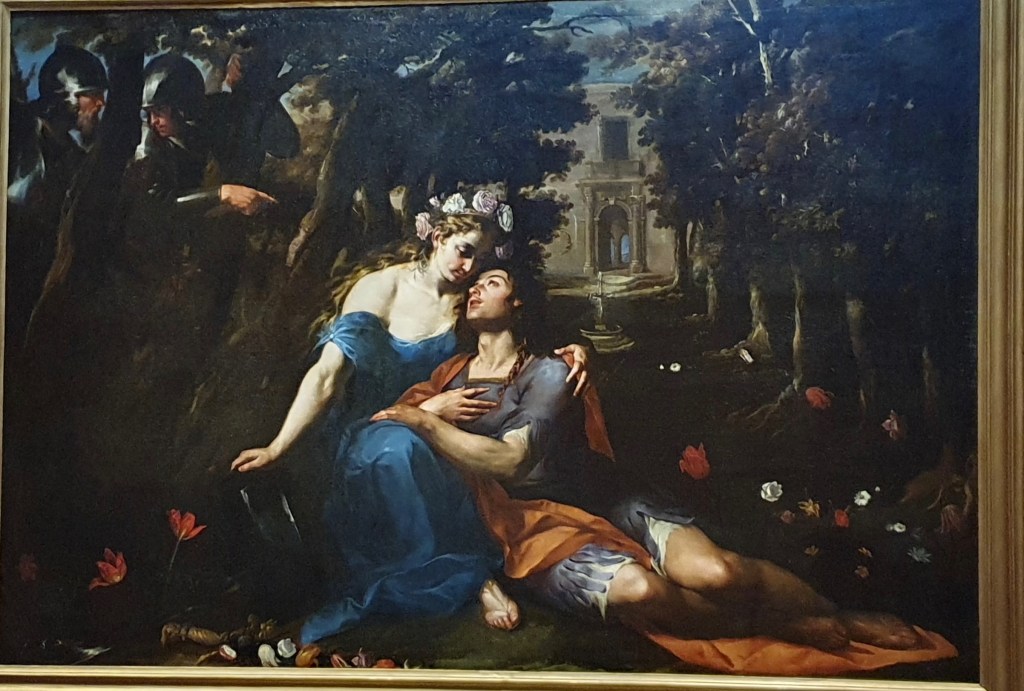
In his study of the d’Avalos paintings, Pierluigi Leone de Castris places the work among Vaccaro’s finest achievements of the 1640s. He draws attention to a pictorial language in which the influence of Van Dyck and the example of Pietro Novelli have been assimilated alongside those of Massimo Stanzione, Artemisia Gentileschi and Bernardo Cavallino. More specifically, Leone de Castris identifies the triangular grouping of the lovers as the compositional centre of the painting, while two receding screens of trees direct the eye towards Armida’s palace. He finds the extensive landscape setting especially noteworthy, distinguishing the work from compositions more narrowly concentrated upon their principal figures.
Lattuada also considers the landscape setting, essential to Tasso’s narrative, finding in its treatment an awareness of contemporary outdoor paintings by Domenico Gargiulo, known as Micco Spadaro, and Viviano Codazzi. He connects the sumptuous clothing of the two protagonists with Stanzione and Gentileschi, particularly in the treatment of Armida.
A further question concerns the flowers scattered throughout the enchanted garden. Leone de Castris had already remarked upon their distinctive execution, comparing them with the work of the Neapolitan specialist Giacomo Recco. Lattuada develops the comparison by raising the possibility of involvement of Pietro Fiammingo, a painter of animals and flowers documented in seventeenth-century Neapolitan collections.
Vaccaro’s Orpheus and the Bacchantes, preserved in the Palazzo Reale, Naples, represents the mythological musician charming the animals with his music while a group of Bacchantes prepares to attack him. The painting brings together two contrasting episodes in the story of Orpheus: his extraordinary power over the natural world and the violence that will bring about his death. Lattuada considers it one of Vaccaro’s most accomplished narratives, alongside the Triumph of David in the Museo di Capodimonte.
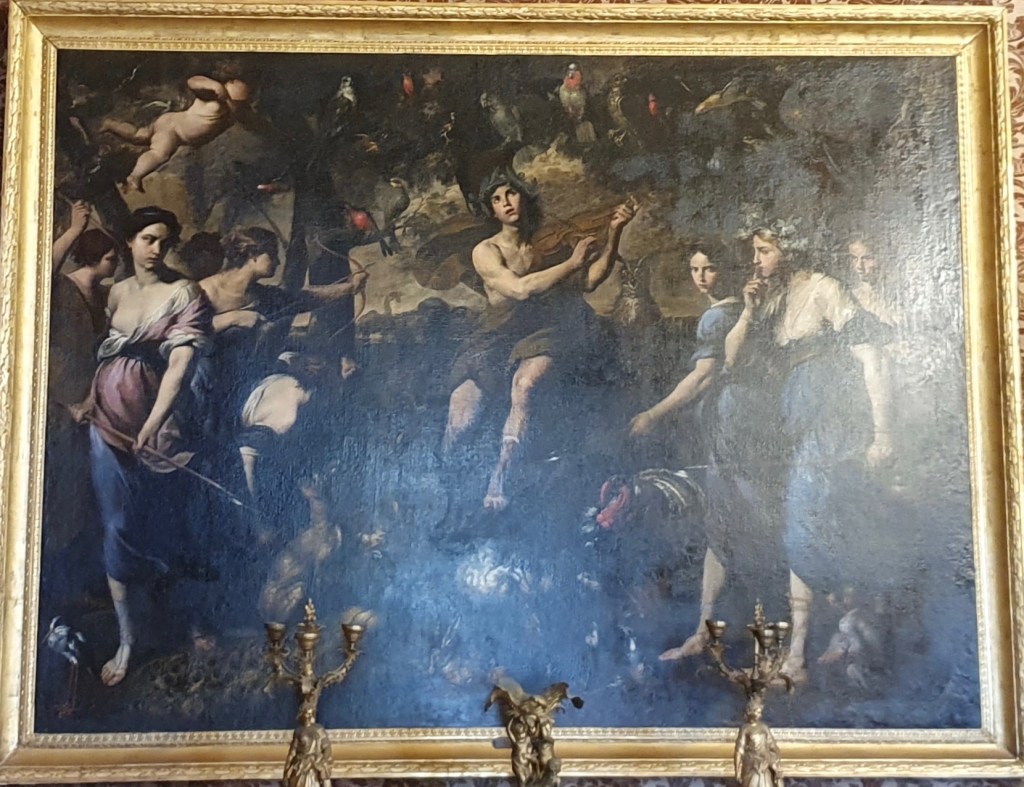
Stefano Causa identifies a significant Renaissance precedent for the figure of Orpheus in the Apollo of Raphael’s Parnassus, painted in the Stanza della Segnatura in the Vatican. He also draws attention to the painting’s relationship with Genoese art, suggesting possible affinities with animal paintings by Sinibaldo Scorza and raising the question of Vaccaro’s familiarity with illustrated books and prints. Causa points to the relative scarcity of representations of Orpheus in seventeenth-century Neapolitan painting, making the artistic sources of this composition of particular interest.
The animals in Vaccaro’s Orpheus and the Bacchantes have prompted speculation about the possible involvement of a specialist painter. Stefano Causa and subsequently Vincenzo Pacelli suggested that they might have been executed by Pietro Fiammingo, an artist whose work is documented in several Neapolitan collections. Riccardo Lattuada lends some support to this hypothesis through another painting of Orpheus, now in the Musée des Beaux-Arts at Besançon, whose principal figure has been attributed by Giuseppe Porzio to Pacecco de Rosa. Lattuada tentatively identifies this work with a painting recorded in Giuseppe Carafa’s collection in 1648, in which the animals were attributed to Fiammingo. The identification is uncertain, however, and offers a precedent for such a collaboration rather than proof of Fiammingo’s participation in Vaccaro’s painting.
Orpheus Charming the Animals , in the Musée des Beaux-Arts et d’Archéologie, Besançon. Inv: 843.3.15
Lattuada extends the argument to the northern European character of these passages. He singles out the numerous birds gathered in the upper part of the painting, relating them to the work of Frans Snyders, particularly his Concert of Birds, known in versions in Madrid and Saint Petersburg. Such compositions could have circulated through copies or prints, providing models for artists working in Naples. The possible involvement of Fiammingo acquires further interest in this context, given the relative scarcity of painters specialising in living animals in seventeenth-century Naples.
Lattuada also considers the painting’s condition. The animal passages had been extensively retouched at an earlier date, complicating attempts to distinguish the original execution from subsequent interventions. His assessment therefore leaves an important question open concerning the precise contribution of the artists involved.
Vaccaro’s Triumph of David, in the Museo di Capodimonte, Naples, depicts the young biblical hero celebrated by the women of Israel following his victory over Goliath. Lattuada regards the painting as one of Vaccaro’s most accomplished exercises in narrative composition, drawing particular attention to the relationship between the dancing women and David himself. Their sinuous movements and festive gestures contrast with the hero’s troubled expression as he contemplates the severed head of his defeated adversary. The giant’s enormous head still bleeds from the mouth, emphasising the brief interval between the violence of the encounter and the celebrations that follow. David appears still affected by the struggle, rather than wholly absorbed in the rejoicing around him.
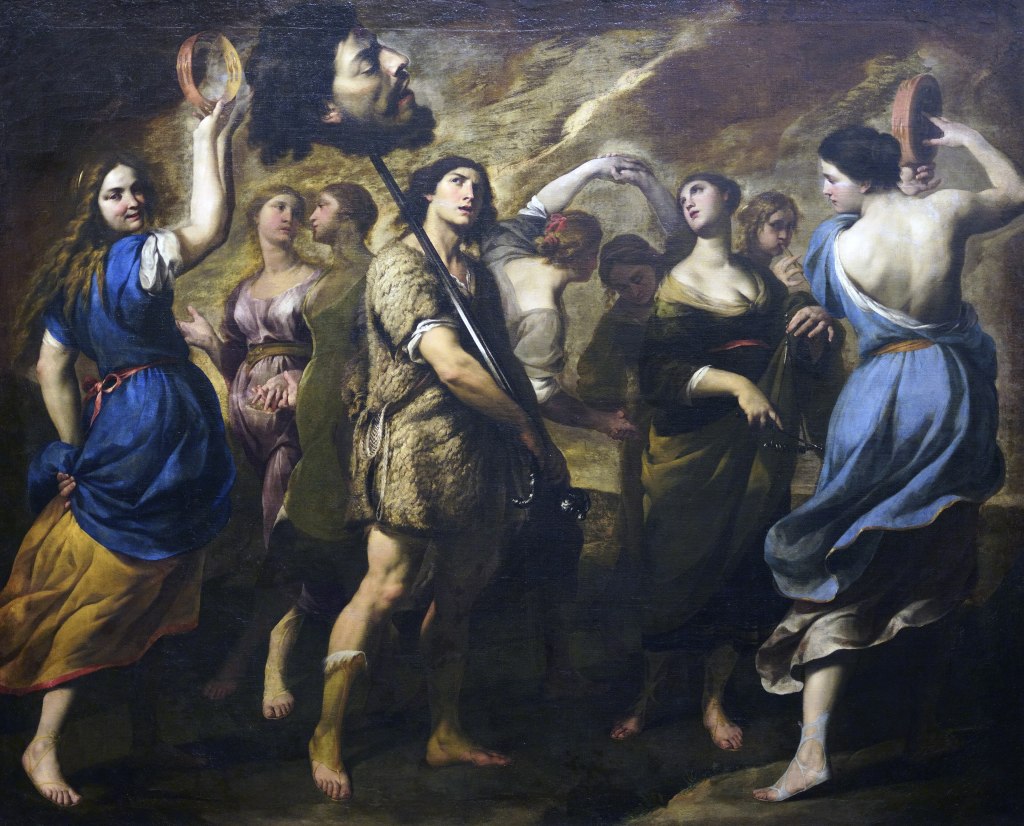
The female figures receive equally close attention. Several appear to be variations upon the same model, their changing postures providing the composition with movement and variety. Lattuada singles out the woman holding a tambourine on the left, whose richly coloured garments combine blue, white, yellow and red. Her physical type and opulent treatment recall the artistic environment of Massimo Stanzione, Artemisia Gentileschi, Francesco Guarino and Francesco Fracanzano. By directing her gaze towards the spectator, she also establishes a connection between the celebration and the viewer. At the opposite side, the woman seen from behind, dressed in pale blue, reveals a more specific debt to Stanzione in the clear contours and animated folds of her drapery.
The painting presents Vaccaro with the challenge of reconciling the expressive movement of a ceremonial celebration with the moderation of gesture characteristic of his mature classicism. Lattuada traces a complex inheritance involving Guido Reni and Stanzione, together with possible affinities with Giacinto Gimignani, Andrea Sacchi and Carlo Maratta. The varied postures of the dancers and the idealisation of their faces allow Vaccaro to develop an animated composition while retaining the recognisable figural types of his established repertory.
A closely related Triumph of David is preserved in the Musée d’Art et d’Histoire, Geneva. The two paintings are organised around comparable groups of figures, although elements of the Neapolitan composition are reversed in the Geneva version. David and Goliath’s head face in the opposite direction, while the woman seen from behind with a tambourine occupies the other side of the composition. Lattuada finds the Geneva painting more nervous and less measured in execution, proposing that it may precede the Neapolitan version by as much as a decade, perhaps dating from around 1640.
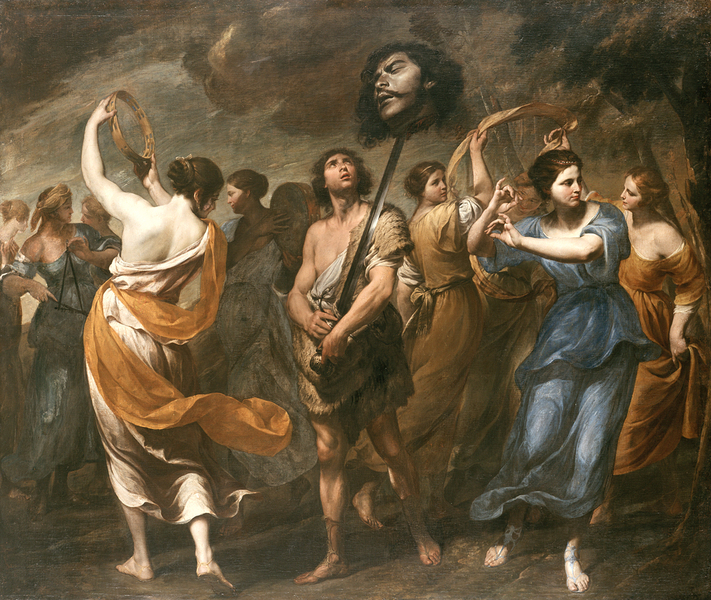
A scientific examination and restoration of the Geneva painting, published in 2015 by Victor Lopes, Andrea Mantelli and Stefano Volpin, has also provided evidence of Vaccaro’s working procedures. The authors report numerous alterations made during execution, including a change to the right hand of a foreground dancer that allowed the face of another woman to remain visible behind her. The restoration also brought to light a small grotesque face painted on the pommel of David’s sword, an intriguing incidental detail that the authors tentatively associate with the symbolism of death.
Vaccaro’s Susanna and the Elders, formerly in the d’Avalos collection and now in the Museo di Capodimonte, belongs to a pictorial tradition in which moral instruction and sensual appeal were not always easily distinguished. The biblical story recounts how Susanna, surprised while bathing by two elderly judges, refuses their advances despite the threat of a false accusation of adultery, and is eventually vindicated. For painters, the episode offered the opportunity to depict the female nude under the respectable authority of sacred history, introducing an element of voyeurism into what was ostensibly a celebration of virtue.
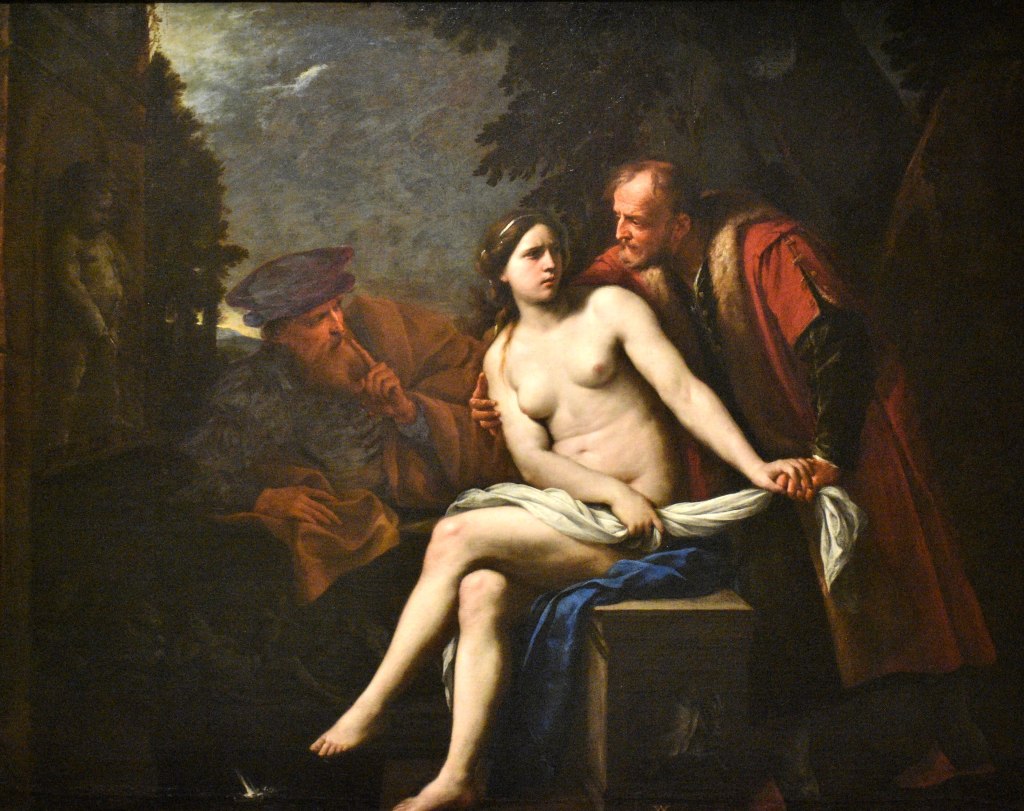
Riccardo Lattuada suggests that the head of the elderly man behind Susanna may reflect Vaccaro’s familiarity with Giovanni Benedetto Castiglione’s celebrated series of Oriental Heads. The comparison concerns the characterisation of the figure rather than a specific borrowing of costume or pose. Castiglione’s presence in Naples during the later 1630s provides a possible historical setting for this connection. His influence extended to Andrea de Lione, who later collaborated with Vaccaro on the frescoes in San Paolo Maggiore. Lattuada thus places the head in Susanna and the Elders within a broader exchange of artistic ideas between Genoa and Naples.
Vaccaro’s Martyrdom of Saint Sebastian, formerly with Galerie Canesso in Paris, depicts the preparations for the saint’s execution, when, on the orders of the Emperor Diocletian, he was bound to a tree to serve as a target for Roman archers. Dated to around 1640 by Vincenzo Pacelli, the painting brings the youthful martyr into the immediate foreground, his exposed torso illuminated against the darker figures of his tormentors. One arm is raised above his head while the other is drawn behind his back, imparting a gentle contrapposto to the body. To the left, three men prepare for the torture, including a centurion wearing an elaborately decorated helmet and another figure in a turban.
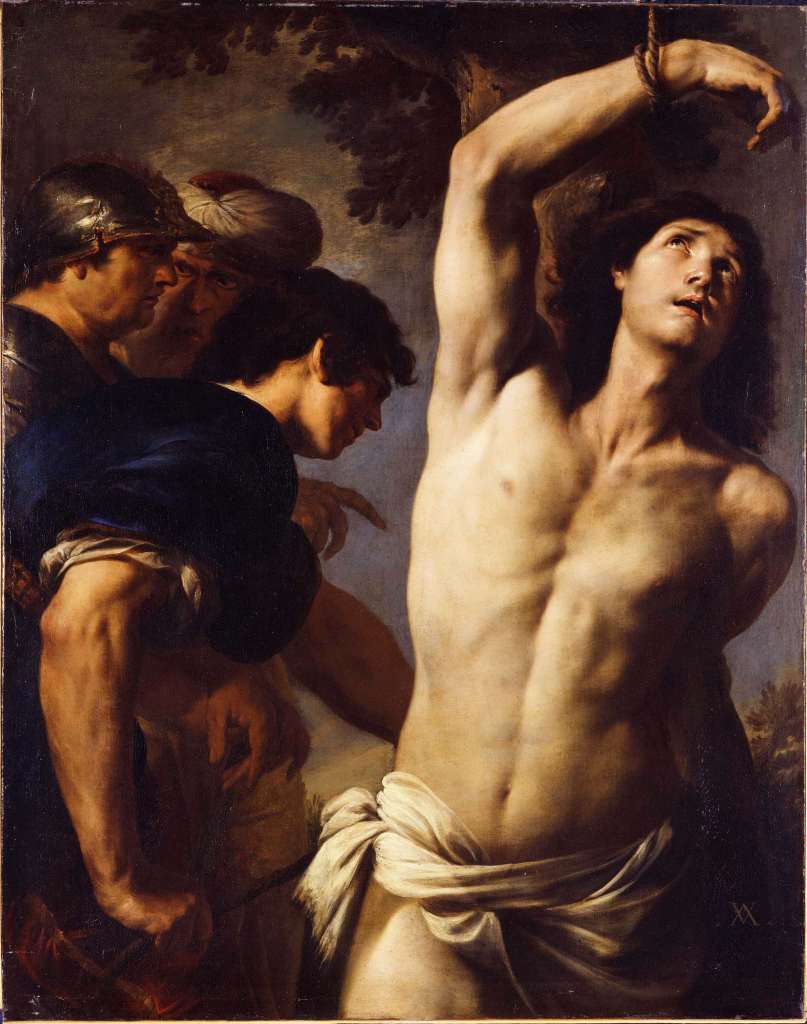
The composition occupies an important place in Vaccaro’s engagement with Jusepe de Ribera and Guido Reni. Lattuada follows Pacelli in recognising its relationship with Ribera’s Saint Sebastian in the Prado, but also identifies close affinities with Reni’s treatments of the subject, especially the version in Palazzo Rosso, Genoa. Whereas Reni represents the saint already pierced by arrows, Vaccaro selects the moment before his suffering begins. A centurion shown in profile directs the executioners as they secure Sebastian to the tree, an invention recalling Caravaggio’s Flagellation of Christ, originally painted for San Domenico Maggiore in Naples and now in the Museo di Capodimonte. The compositional relationship introduces a Caravaggesque element into the reinterpretation of Reni’s classical prototype, while the centurion’s elaborate helmet recalls representations of the Roman emperor Vitellius.
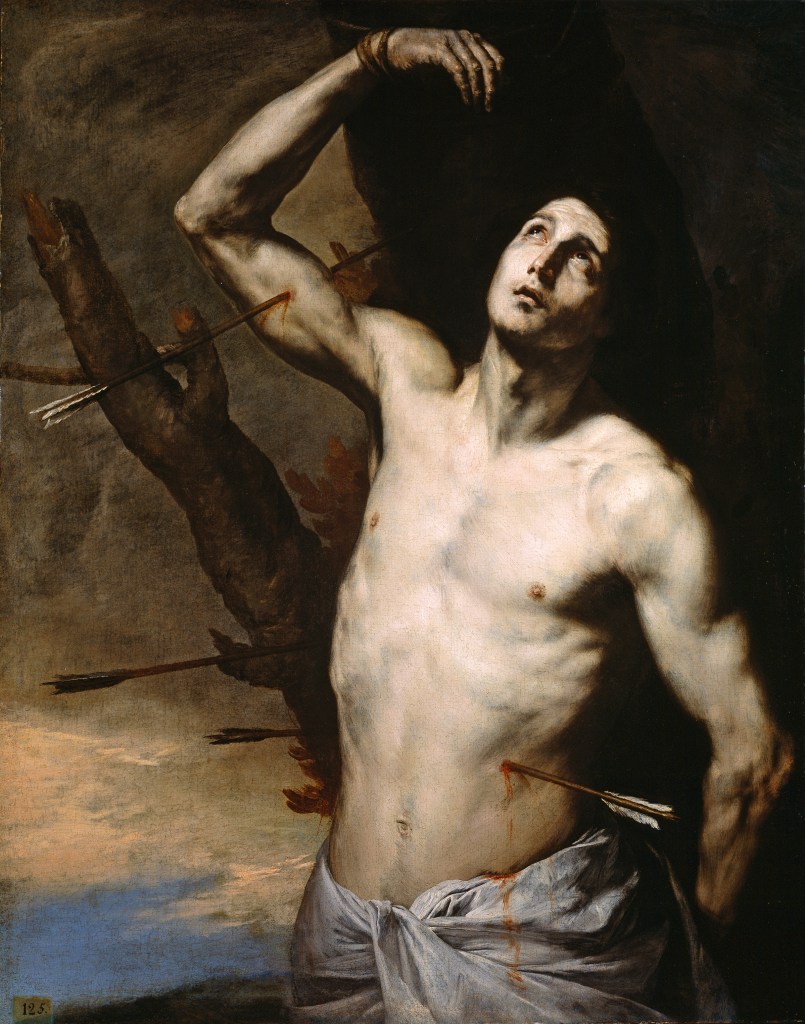
Lattuada examines the characterisation of the centurion and the executioner bending forward to attend to the rope behind the saint, associating their treatment with the example of Van Dyck. The modelling of the figures through carefully graduated chiaroscuro is accompanied by a rich and increasingly luminous palette, exemplified by the lapis-lazuli blue of the executioner’s garment. The expense of this pigment suggests the care and ambition invested in the painting. These qualities belong to a period when Neapolitan naturalism was itself undergoing considerable transformation. Ribera’s increasingly adventurous treatment of colour, the renewed appeal of Venetian painting and the classicising example of Reni had opened possibilities that extended well beyond the darker conventions of early Caravaggism. Vaccaro’s response drew upon this developing artistic culture, rather than simply alternating between naturalistic and idealising models.
The expressive conception of Sebastian himself is central to the painting’s achievement. The subject had long encouraged an association between the suffering Christian martyr and the physical perfection of classical antiquity, particularly the youthful beauty of Apollo. Yet that beauty presented painters with a problem extending beyond the representation of an idealised nude: the saint’s bodily perfection had to coexist with the violence awaiting him and the spiritual significance of his endurance. Lattuada addresses this question in his disagreement with Wolfgang Prohaska, who had characterised Vaccaro’s Sebastian as a muscular studio model lacking the idealising qualities of Reni’s figures. For Lattuada, the young man’s sensual beauty possesses a more profound expressive significance precisely because the viewer knows that his body is about to suffer a terrible violation. The physical immediacy of the figure becomes inseparable from the dignity of the martyr.
Sebastian’s upward gaze further connects the painting with Reni’s conception of religious suffering, in which bodily vulnerability is accompanied by an appeal to divine strength. Vaccaro nevertheless preserves a substantial element of naturalistic observation, resisting the complete transformation of the figure into an abstract ideal of beauty.
Vaccaro’s Saint Teresa’s Vision of the Golden Collar, painted in 1642 and preserved in the Real Academia de Bellas Artes de San Fernando, Madrid, illustrates an episode described by Teresa of Ávila in her autobiography. On 15 August 1562, she experienced a vision in which the Virgin Mary presented her with a golden collar, a sign of divine approval for her foundation of the reformed Carmelite convent of Saint Joseph in Ávila. The monastery was inaugurated nine days later. As Anna Kiyomi Tuck-Scala observes, the subject was more familiar in Spanish religious painting than in Italy, an interesting circumstance given Vaccaro’s considerable reputation among Spanish collectors.
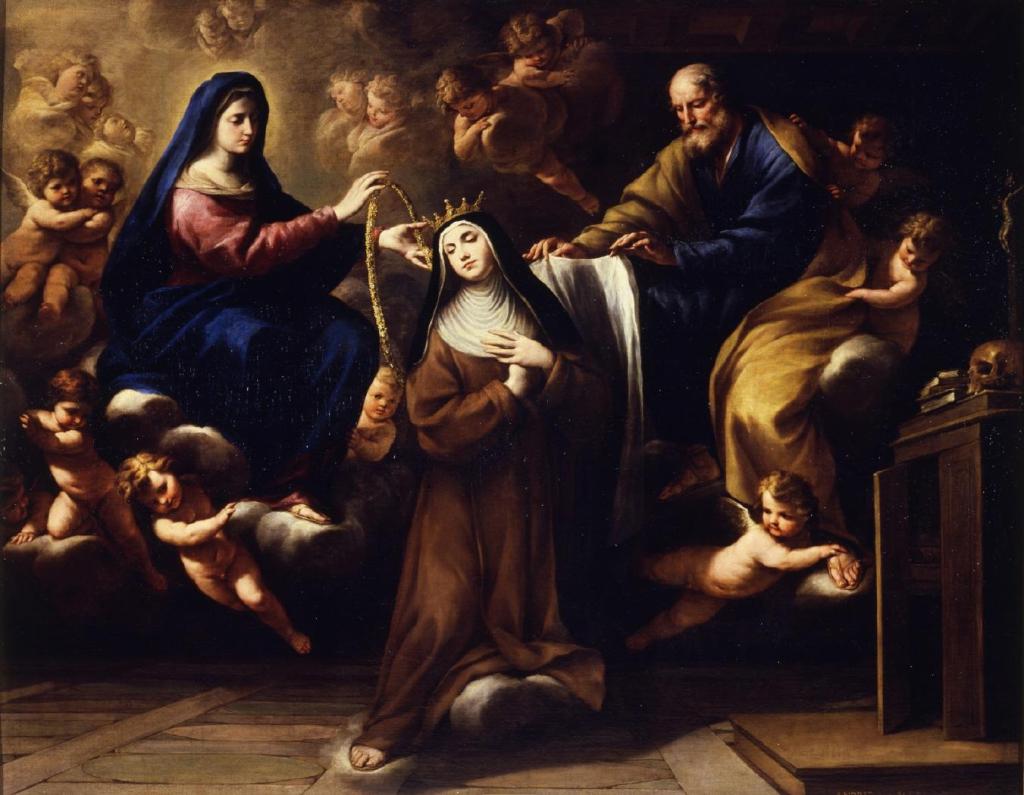
The arrangement of the figures gives the vision a striking compositional clarity. Teresa occupies the centre, partially kneeling upon clouds, her eyes closed and her hands crossed over her breast. On the left, the Virgin lowers the golden collar towards Teresa, while Saint Joseph, on the right, presents her with a white cloak. As Anna Kiyomi Tuck-Scala explains, Vaccaro combines successive moments of Teresa’s vision into a single, balanced composition. He also departs from her account in several details: the collar lacks the cross she describes, the Virgin wears her traditional blue and rose-coloured garments rather than white, and Teresa is crowned, an addition that Tuck-Scala associates with her authority as the founder of a reformed religious order.
The supernatural encounter takes place within a carefully constructed architectural interior. The patterned floor and exposed ceiling beams establish a convincing spatial setting, while the clouds supporting Teresa and the celestial figures interrupt its everyday reality. At the right, a crucifix accompanied by a skull and books introduces the familiar imagery of contemplation and mortality. The juxtaposition of these elements allows Vaccaro to give tangible form to an experience that Teresa describes as intensely personal. The figures’ restrained gestures, idealised faces and symmetrical disposition lend the scene an almost ceremonial character, in keeping with the classicising tendencies of Neapolitan painting during the 1640s.
The painting has nevertheless attracted differing critical judgements. Alfonso E. Pérez Sánchez regarded its frontal arrangement and symmetry as evidence of a less inventive phase in Vaccaro’s career, whereas Oreste Ferrari associated these qualities with the artist’s growing engagement, alongside Massimo Stanzione, with the classical language of Guido Reni. Tuck-Scala proposes a different emphasis, suggesting that the measured organisation of the composition responds to the requirements of religious imagery, particularly the need to communicate an extraordinary event with clarity. What one critic regards as a limitation of invention may therefore be understood as a deliberate choice of pictorial language, appropriate to the subject and its intended audience.
The painting is also an important chronological reference. Its full signature, Andrea Vaccarius F., and the date 1642 emerged during restoration, making it one of the relatively few securely dated works in Vaccaro’s surviving production. Its recorded Spanish provenance includes the Discalced Carmelite convent of San Hermenegildo in Madrid, from which the Marqués de Astorga acquired it in 1786. He donated it to the academy in 1818.
Vaccaro’s Meeting of Isaac and Rebecca, in the Museo del Prado, Madrid, represents the encounter between the biblical patriarch and his future wife, who has travelled from Mesopotamia in the company of Abraham’s servant. Generally dated to around 1645–50, the painting belongs to Vaccaro’s mature production. Its balanced composition, refined figures and delicate colouring have been associated with the example of Bernardo Cavallino, although the painting’s larger scale and more pronounced Roman-Bolognese classicism distinguish it from the work of the younger Neapolitan artist.
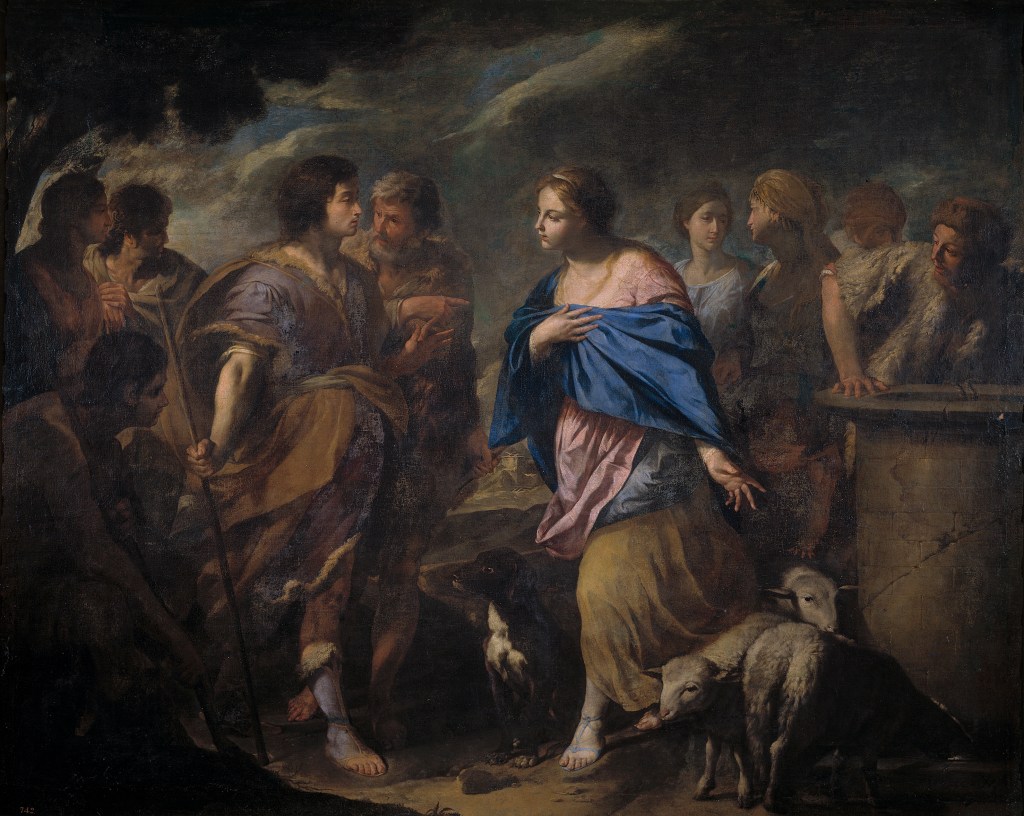
The painting has recently been discussed by Begoña Álvarez Seijo in a study of the difficulties surrounding the identification of biblical scenes involving Rebecca and Rachel. Both women feature in narratives of encounters leading to marriage, and the similarities between these episodes have sometimes resulted in confusion over their representation in painting. Álvarez Seijo accepts the established identification of the Prado canvas as The Meeting of Isaac and Rebecca. Her principal reassessment concerns a separate painting by Vaccaro in the Palazzo Reale, Naples, traditionally known as Jacob and Rachel. She argues that this title is incorrect and that the Neapolitan painting also represents the meeting of Isaac and Rebecca.
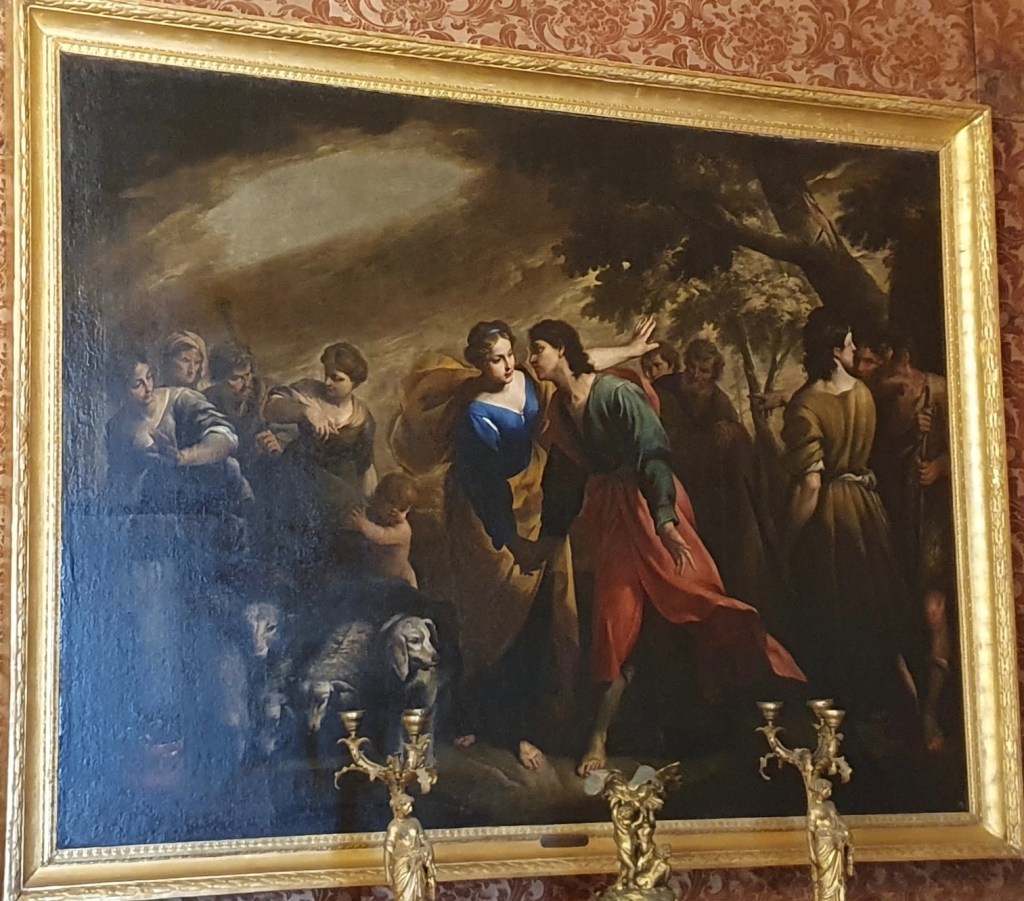
The history of the Prado painting itself illustrates the difficulty of identifying these closely related subjects. Formerly in the possession of the art dealer Florencio Kelly, it was acquired by Charles III and recorded in the Spanish royal collections in 1772. Subsequent inventories identified the figures differently, including as Eliezer and Rachel and as Jacob and Rachel, before the present identification became established. Álvarez Seijo follows Alfonso E. Pérez Sánchez in identifying details that support the interpretation of the scene as Isaac’s meeting with Rebecca. Although sheep appear in the composition, the young woman lacks the staff and clothing normally associated with Rachel as a shepherdess. The presence of Abraham’s elderly servant, traditionally identified as Eliezer, further supports the identification of the scene. The dog between the principal figures may also allude to the fidelity of their forthcoming marriage. The painting’s iconography is thus more specific than its conventional arrangement might initially suggest, while its measured organisation and subtle treatment of colour exemplify the classicising tendencies of Vaccaro’s mature style.
Vaccaro’s Tobias and the Angel, in the Museu Nacional d’Art de Catalunya, Barcelona, belongs to a series of paintings illustrating the Old Testament Book of Tobit. Four canvases survive in the museum, originally forming part of a larger cycle of twelve owned by Pedro Antonio de Aragón, Viceroy of Naples from 1666 to 1672. Their history has been reconstructed by Ida Mauro and Anna K. Tuck-Scala, whose research places the paintings within the extensive circulation of Neapolitan works of art to Spain during the seventeenth century.
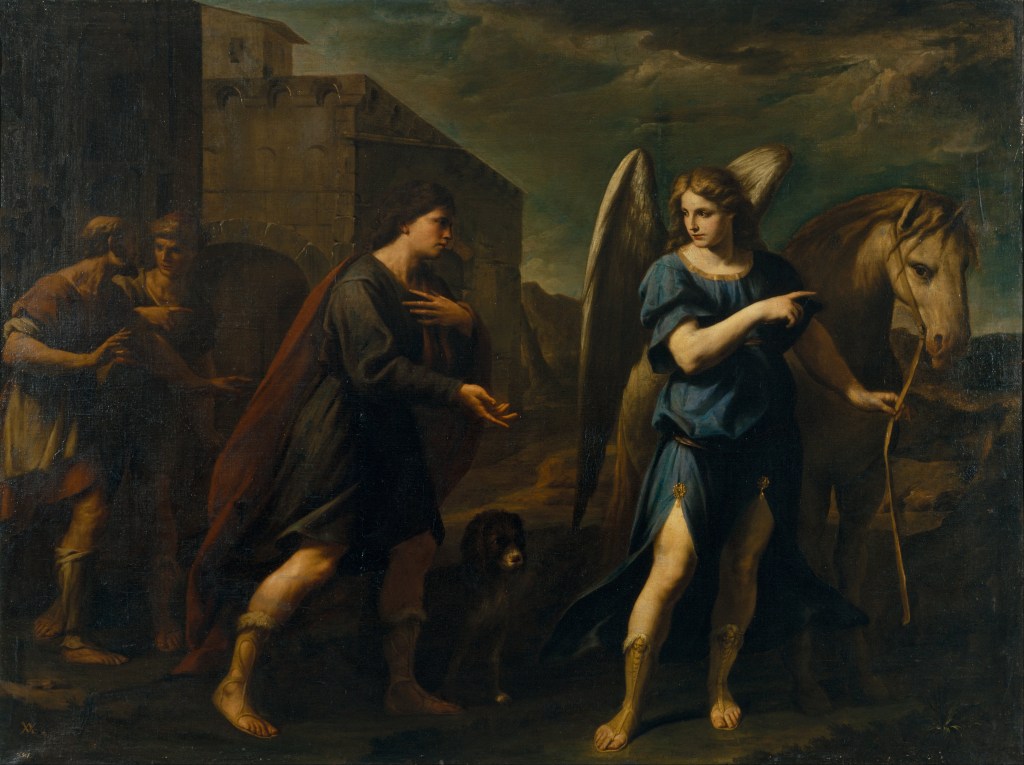
The chronology of the series is of particular interest. Earlier scholarship generally assigned the paintings to around 1640, principally on stylistic grounds. Mauro and Tuck-Scala, however, draw attention to a payment of 2 June 1667, made by Diego Ulloa, President of the Regia Camera della Sommaria, for six paintings illustrating the story of Tobias, at a price of 100 ducats each. An inventory of Pedro Antonio de Aragón’s collection subsequently recorded twelve paintings by Vaccaro devoted to the subject, six of which had been presented to the viceroy by Ulloa. Although the payment does not identify the individual scenes, the documentary evidence supports the authors’ proposed dating of the Barcelona paintings to around 1667.
In Tobias and the Angel, Vaccaro depicts the young Tobias seeking guidance from the Archangel Raphael before setting out to recover money owed to his blind father. Mauro and Tuck-Scala observe that the painter departs from the biblical account by representing Raphael openly as an angel, whereas in the Book of Tobit he appears to the young man in human form, under the name Azarias. The painting belongs to a group distinguished by idealised figures, carefully organised gestures and the integration of landscape and classical architecture. Stefano Causa has associated the measured organisation of these compositions with a developing classicism in Neapolitan painting, recognising affinities with the example of Nicolas Poussin. The revised chronology makes these qualities especially relevant to Vaccaro’s final years, when his work continued to command the attention of distinguished Spanish patrons.
In The Healing of Tobit, Vaccaro represents the conclusion of Tobias’s journey and the restoration of his father’s sight. Following the Archangel Raphael’s instructions, Tobias applies the gall of the fish caught earlier in his travels to his father’s eyes, miraculously curing his blindness. Mauro and Tuck-Scala observe that the painting follows the biblical narrative closely, setting the episode in a courtyard suggested by the architectural columns. The action centres upon Tobias’s hand as he performs the cure under Raphael’s supervision, concentrating the significance of the event within a restrained arrangement of figures.
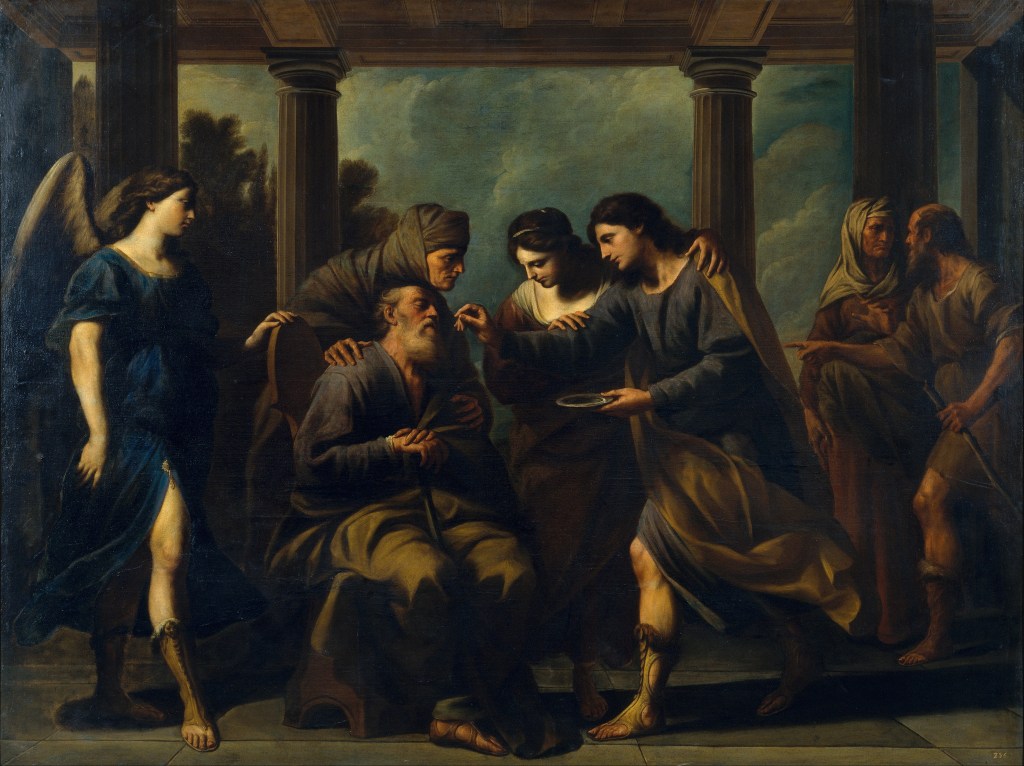
Riccardo Lattuada has drawn attention to a more specific connection between this painting and Tobias and the Angel. The profile of Raphael, standing to the left of the healing scene, repeats that of Tobias in the earlier episode. As Mauro and Tuck-Scala observe, the repetition provides a visual link between separate moments of the narrative, giving the series a degree of continuity beyond the recurrence of its principal characters.
The paintings also belong to a wider tradition in which the story of Tobias offered lessons in filial obedience, divine protection and the obligations of family life. Mauro and Tuck-Scala discuss the popularity of the subject in Counter-Reformation religious culture, particularly its association with devotion to guardian angels. The two episodes considered here encompass the young man’s initial dependence upon divine guidance and the fulfilment of his duty towards his father. Their place within the larger cycle lends these themes a broader narrative and devotional significance.
Andrea Vaccaro’s Self-Portrait, formerly in the church of San Giovanni Battista delle Monache, Naples, is generally dated to around 1664–1666, when the painter was approaching his early sixties and had attained considerable professional standing. The painting bears his characteristic interlaced AV monogram and has long been accepted as an image of the artist himself. Vincenzo Pacelli, writing in the catalogue of Civiltà del Seicento a Napoli, associates it with the reorganisation of the Corporation of Neapolitan Painters, in which Vaccaro played a leading part.
Andrea Vaccaro’s Self-Portrait
Established in its new form in 1664, the corporation sought to protect the interests and standing of painters within the city’s artistic community. Vaccaro served as its first prefect, assisted by Francesco Di Maria and the younger Luca Giordano. Its headquarters were initially situated in the chapel of the Sciabica, in the cloister of the Gesù Nuovo, for which he painted Saint Luke Portraying the Virgin and Child, signed and dated 1666. Pacelli suggests that the self-portrait may also have been associated with the corporation, perhaps as an official or semi-official image of its first prefect. The organisation subsequently changed premises several times, a history that offers a possible explanation for the portrait’s eventual presence in San Giovanni Battista delle Monache.
The interpretation of the sitter’s age has itself undergone revision. Bernardo De Dominici gave Vaccaro’s year of birth as 1598, an error that informed Ferdinando Bologna’s assessment of the painting when it was exhibited in Naples in 1954. Documentary research established that the artist was born in 1604, making him approximately sixty to sixty-two years old at the proposed date of execution. Pacelli finds in the portrait an image of professional dignity tempered by fatigue and melancholy, reading its restrained expression against the material prosperity and public recognition Vaccaro had achieved. Such an interpretation necessarily remains subjective, but it offers an interesting counterpoint to the painter’s prominent position in the Neapolitan artistic establishment.
The connection with the corporation lends the portrait a significance beyond personal likeness. Vaccaro’s involvement in the organisation coincided with substantial commissions and the consolidation of his professional authority. Anna Kiyomi Tuck-Scala nevertheless cautions against using his institutional activities to characterise his late painting as merely academic. The corporation’s statutes were concerned substantially with practical assistance and charity among its members, while the artistic differences between Vaccaro and colleagues such as Giordano resist any simple identification of the institution with a single aesthetic programme.
Donate to Inner Surfaces here.
Bibliography
These are the sources. Any errors are mine.
Álvarez Seijo, Begoña. ‘Two Matriarchs, One Well: The Misinterpretation of Rebekah and Rachel in 17th Century Neapolitan Painting. The Cases of Luca Giordano and Andrea Vaccaro’. BSAA arte, vol. 91, 2025, pp. 155–186.
Causa, Stefano. La strategia dell’attenzione: Pittori a Napoli nel primo Seicento. Naples: Libreria Dante & Descartes, 2007.
Causa, Stefano. ‘Quel che resta di un capolavoro di Giordano’. Kronos, no. 9, 2005, pp. 51–113 (especially p. 103, note 57).
De Vito, Giuseppe. ‘Appunti per Andrea Vaccaro con una nota su alcune copie del Caravaggio che esistevano a Napoli’. In Ricerche sul ’600 napoletano: Scritti in memoria di Raffaello Causa, 1994–1995, Naples, 1996, pp. 63–144.
Forgione, Gianluca. ‘Vaccaro, Andrea’. Dizionario Biografico degli Italiani, vol. 97. Rome: Istituto della Enciclopedia Italiana, 2020.
Lattuada, Riccardo. ‘I percorsi di Andrea Vaccaro (1604–1670)’. In Mariaclaudia Izzo, Nicola Vaccaro (1640–1709): Un artista a Napoli tra Barocco e Arcadia. Todi, 2009, pp. 49–108.
Lattuada, Riccardo. ‘Andrea Vaccaro’s David and an Outline of Vaccaro’s Early Career’. Muse: Annual of the Museum of Art and Archaeology, vol. 51, 2017, pp. 45–73.
Lattuada, Riccardo. ‘Andrea Vaccaro: Studio per la testa di un bambino’. In Arabella Cifani (ed.), Galleria Giamblanco. Dipinti antichi: Pittura italiana dal Seicento al Novecento. Turin: Umberto Allemandi & C., n.d., p. 18.
Leone de Castris, Pierluigi. Catalogue entries 56–57. In I tesori dei D’Avalos, exhibition catalogue, Naples, 1995, pp. 114–116.
Lopes, Victor, Andrea Mantelli and Stefano Volpin. ‘Le Triomphe de David: Un chef-d’œuvre de la peinture napolitaine au Musée d’art et d’histoire’. Genava, vol. 63, 2015, pp. 89–96.
Mauro, Ida, and Anna K. Tuck-Scala. ‘Les Històries de Tobies d’Andrea Vaccaro: de Nàpols al Museu Nacional d’Art de Catalunya’. Butlletí del Museu Nacional d’Art de Catalunya, no. 10, 2009, pp. 87–109.
Pacelli, Vincenzo. Catalogue entries on Andrea Vaccaro. In Civiltà del Seicento a Napoli, exhibition catalogue, Naples, Museo di Capodimonte, 1984–1985, vol. I. Naples: Electa, 1984, pp. 488–494, nos. 2.265–2.269.
Pacelli, Vincenzo. ‘Andrea Vaccaro patriarca della pittura del Seicento a Napoli: Inediti e considerazioni’. Studi di Storia dell’Arte, vol. 19, 2008, pp. 137–168.
Santucci, Paola. ‘Un dipinto firmato di Andrea Vaccaro e alcune riflessioni sulla sua formazione’. Prospettiva, nos. 93–94, 1999, pp. 184–188.
Tuck-Scala, Anna Kiyomi. The Documented Paintings and Life of Andrea Vaccaro (1604–1670). PhD dissertation, Pennsylvania State University, 2003.
Tuck-Scala, Anna K. Andrea Vaccaro (Naples, 1604–1670): His Documented Life and Art. Pozzuoli: Paparo Edizioni, 2012.
Vasseur, Dominique H. ‘Lamentation over the Dead Christ by Andrea Vaccaro’. Bulletin of the Art Institute of Chicago, vol. 71, no. 5, September–October 1977, pp. 14–17.
Online collections and electronic resources
Fondazione Federico Zeri, Università di Bologna. Catalogo della Fototeca. Photographic and attributional records concerning works by Andrea Vaccaro.
Galerie Canesso, Paris. ‘Andrea Vaccaro: The Martyrdom of Saint Sebastian’. Online artwork catalogue.
Museo e Real Bosco di Capodimonte, Naples. ‘Susanna e i vecchioni’. Online collection record.
Museo Nacional del Prado, Madrid. ‘Encuentro de Isaac y Rebeca’, Andrea Vaccaro, inv. P000468. Online collection record.
Museu Nacional d’Art de Catalunya, Barcelona. ‘Tobias and the Angel’, inv. 024177-000, and ‘The Healing of Tobit’, inv. 011541-000, Andrea Vaccaro. Online collection records.
Musée d’art et d’histoire, Geneva. ‘Le Triomphe de David’, Andrea Vaccaro. Online collection record.
Real Academia de Bellas Artes de San Fernando, Madrid. ‘Santa Teresa con la Virgen y San José’, Andrea Vaccaro, inv. 0375. Online collection record.

