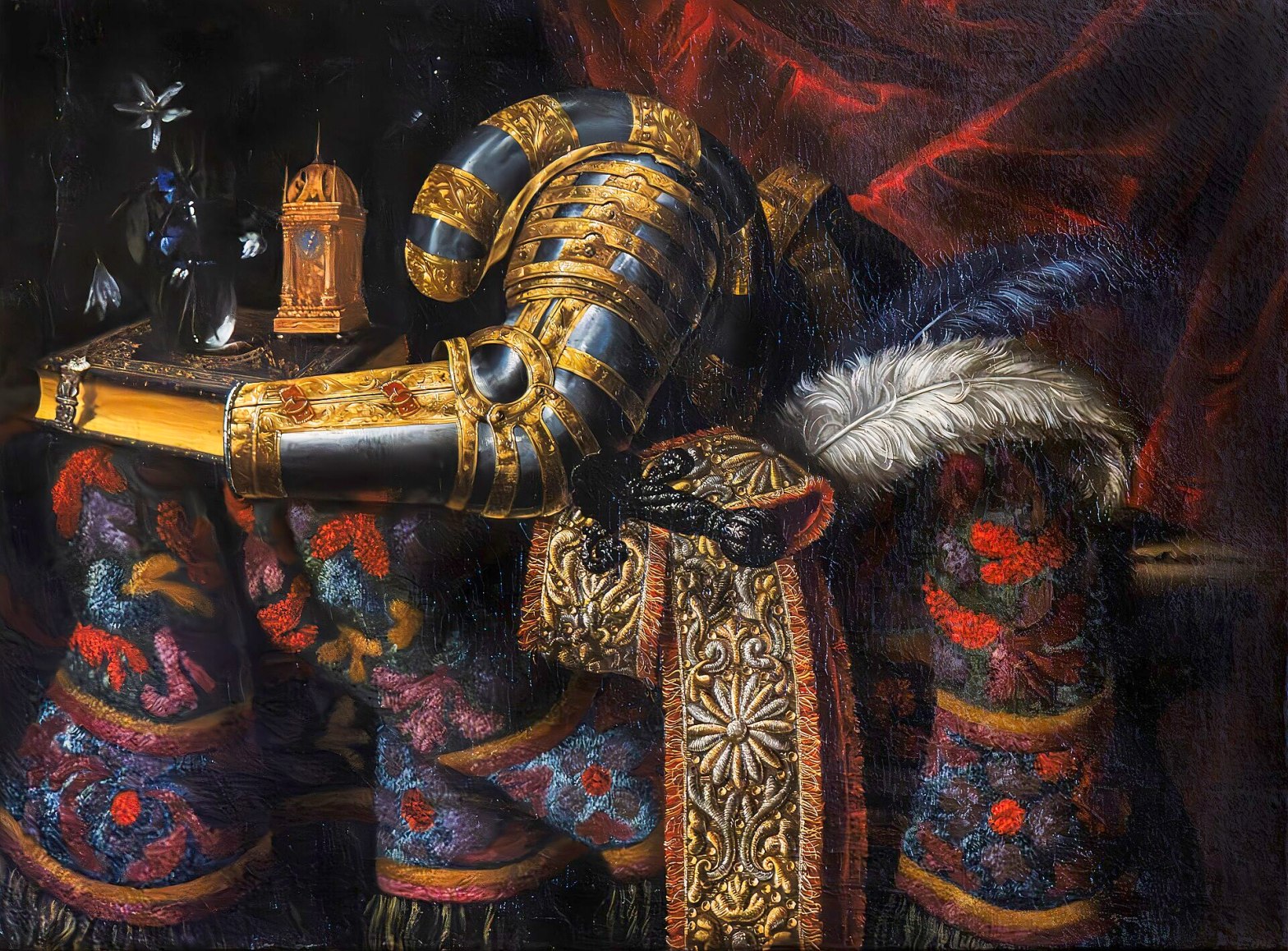
Francesco Noletti, Still Life with Armour, c. 1650, oil on canvas, 76 × 108 cm, Museo Correr, Venice, inv. Cl. I no. 1049. Image: Didier Descouens, Wikimedia Commons, CC BY-SA 4.0.
The Painted Carpet
In 1662, the Flemish writer Cornelis de Bie related a story about a pope visiting the house of Francesco Noletti, the Maltese painter celebrated for his carpets. A courtier in the papal entourage, encountering what appeared to be a folded carpet in a handsomely arranged loggia, reached down to lift it. He discovered, to his embarrassment, that the carpet and its surroundings had all been painted. De Bie compared the deception to the ancient contest between Zeuxis and Parrhasius, in which one artist’s painted grapes deceived the birds while the other’s curtain deceived his rival.
De Bie was not recording a historical event. The fictional episode belongs to a literary tradition in which an artist’s skill was measured by the capacity of painting to rival nature. Even so, the story tells us what Noletti’s contemporaries valued in his work. His carpets reproduced more than ornamental pattern. Paint conveyed their weight, thickness and resistance so persuasively that sight prompted an imagined act of touch. Their folds advance towards the spectator, conceal the furniture beneath them and impart movement to otherwise immobile objects.
De Bie himself knew the artist as Francesco Maltese, or il Maltese, following the Roman custom of identifying foreign artists by their place of origin. The designation was clear enough to contemporaries, but over time it obscured Noletti’s surname and contributed to his confusion with another painter. The carpet painter remained memorable; the man behind the sobriquet did not. Modern scholarship has therefore had to reunite the name Francesco Noletti with the artist celebrated in De Bie’s story.
Recovering Francesco Noletti
Seventeenth-century sources distinguish il Maltese from Benedetto Fioravanti. They were two separate still-life painters, although their subjects overlapped. A painting signed in full by Fioravanti combines musical instruments, a carpet and flowers. An inventory of Archduke Leopold Wilhelm’s collection distinguished works by the two artists in 1659, while André Félibien later named “Fieravante et le Maltois” separately, noting their reputation for carpets, musical instruments, vases and other objects. No contemporary document has been found in which Noletti is called Fieravino.
The confusion began in 1777, when a French sale catalogue attributed a group of paintings to “Fieravins dit le Maltais”, meaning “Fieravins, called the Maltese”. In effect, the cataloguer attached a corrupted form of Fioravanti’s name to the artist known as il Maltese. Later writers inherited the error and, by the twentieth century, Noletti was generally known as Francesco Fieravino. This brought the works of two painters beneath a single attribution, while archival searches conducted under the name Fieravino could reveal nothing about the Maltese artist’s life.
The clue needed to correct the mistake came from an anonymous early eighteenth-century portrait preserved in the Old University Building in Valletta. Its inscription identifies the sitter as “Franciscus Noletti Melitensis”, meaning “Francesco Noletti of Malta”. He holds a brush and palette, with an abraded still life visible on an easel behind him. Although the image was made after his death and may not preserve a reliable likeness, the conjunction of his name, Maltese origin and artistic specialisation made it possible to identify Francesco Noletti as the painter previously known simply as il Maltese.
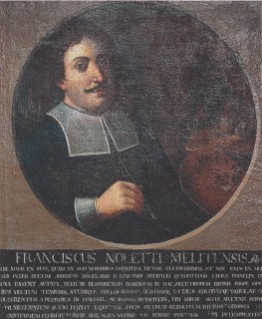
The archival picture has since become considerably fuller, although Noletti’s early life remains obscure. He appears to have been born in Malta around 1611, a date inferred from the age of approximately forty-three given at his death. His parentage presents another documentary knot. The record of his second marriage calls him the son of the deceased Stefano of Malta, whereas the testament he made in October 1654 identifies his father as the deceased Vincenzo. The latter document has encouraged attempts to reconstruct his Maltese genealogy, but the contradiction cannot presently be resolved.
Nothing certain is known about Noletti’s training or his earliest work. He may have reached Rome during the 1630s and is documented there by 1642, when a parish census recorded “Francesco da Malta pittore”, living in Via Laurina with his wife Dorotea, their young daughter and his widowed mother-in-law. The family moved to Via Margutta in 1644 and subsequently lived for a time in Via Vittoria before returning to Via Laurina. Noletti and Dorotea had three surviving children. Following Dorotea’s death in 1651, he married the Maltese widow Giovanna Viva Maddalena in June 1653.
These household entries give Noletti’s Roman life a tangible outline, but his professional position emerges more clearly elsewhere. Payments made in 1651 show that Cardinal Federico Cornaro purchased paintings from him. In the following year Noletti attended meetings of the Congregazione dei Virtuosi al Pantheon, an important artistic confraternity in Rome. The organisation’s annual exhibition on the feast of St Joseph brought together artists, patrons and connoisseurs in the portico of the Pantheon. The precise nature of Noletti’s participation in those exhibitions is unknown, but his attendance at the meetings places him within a significant Roman artistic circle.
The inscription in Valletta also names Fra Pietro Cesarini as Noletti’s patron, a claim that is plausible but unconfirmed. Cesarini belonged to a distinguished Roman family and had been invested as a Knight of St John in 1629. He remained in Malta until 1636 and could therefore have encountered the young Noletti there before the painter left for Rome. No such meeting, however, has been documented. For the moment, the inscription records a tradition of patronage rather than a relationship that can be traced with certainty.
When Noletti died in Rome in December 1654, the parish register described him as a pittore celebre, a “celebrated painter”, providing a direct measure of his contemporary standing. His reputation survived him. Joachim von Sandrart later praised his representation of fabrics, while a Roman inventory compiled for the Nunes collection in 1740 listed thirteen works by il Maltese containing carpets and fruit. His career had been brief, but it had not been obscure.
Restoring Noletti’s name has not resolved every problem surrounding his paintings. No surviving work carries an authenticated signature, and none of those recorded in seventeenth-century inventories has been identified beyond doubt. His oeuvre has therefore been reconstructed from two engravings published by Jacques Coelemans in 1703 and 1704 after paintings attributed to Le Maltois. These supply the firmest visual points from which recurring carpets, objects and compositional habits can be traced. What has emerged is a carefully assembled body of work rather than a catalogue secured by signatures.
The Carpet Still Life
To understand what Noletti changed, it helps to remember that oriental carpets already had a long history in European painting. Northern and Venetian artists represented them as coverings for tables and podia, as wall hangings or as costly backdrops to religious and secular figures. Lorenzo Lotto made particularly effective use of Turkish carpets laid across tables, while painters working in Rome placed them within scenes of musicians, gamblers and fortune tellers. Their patterns might be recorded with considerable precision, but the carpet generally remained a support for the principal subject or a sign of cultivated wealth.
Noletti altered that relationship. The carpet occupies much of the pictorial field, with objects gathered along its upper edge and the supporting table or ledge pushed almost entirely from view. The consequences extend beyond the tactile effects with which De Bie’s story began. As the fabric descends through a succession of deep, irregular folds, it carries the eye between objects placed at different heights and distances. The still life is no longer organised upon a clearly visible horizontal surface. The carpet creates its own shifting terrain. This conception appears to have been developed in Rome, where Noletti encountered an established market for still life and a broader Baroque visual culture. Malta had no comparable tradition of still-life specialisation.
His repertory was closely associated with luxury. Silver and gilt vessels, armour, musical instruments, books, flowers, fresh and candied fruit appear against Turkish carpets, velvet hangings and embroidered fabrics. Their effect is not simply cumulative. Objects gain intensity through juxtaposition: a reflective vessel set against dense wool, a hard metal edge interrupting a fold, or a piece of fruit catching the light amid darker textiles. Directed illumination distinguishes matt, polished and translucent surfaces, while cast shadows help to establish the position and volume of forms within an often compressed space.
The handling of paint changes accordingly. Noletti used substantial impasto to build the carpet’s threads, fringe and worn pile, while smoother or more sharply placed touches evoke metal, glass and cultivated fruit. The effect invites the viewer to marvel at paint’s ability to assume the appearance of dense wool, polished metal, transparent glass or the skin of fruit. Noletti did not pursue the same finish throughout: wool catches the light differently from silver, and velvet from armour.
Repetition formed part of this practice. Particular carpet designs, vessels, flowers and pieces of armour recur in different settings, sometimes in closely related versions of an entire composition. Sciberras has suggested that Noletti may have retained drawings or cartoons through which individual objects could be transferred and rearranged. Such procedures were familiar to contemporary figure painters and are also documented in the still lifes of Evaristo Baschenis. Repetition, then, need not indicate mechanical workshop production. It could provide the basis for variations in scale, lighting and the fall of the surrounding fabrics.
The two Coelemans engravings were given Latin titles: Quaedam Sensuum Instrumenta (“Certain Instruments of the Senses”) and Omnis Salus in Ferro Est (“All Safety Lies in Iron”). Sciberras sees these as giving the compositions an interpretative frame beyond the display of painted objects. We must remember, however, that the titles belong to their early eighteenth-century reception. Published nearly fifty years after Noletti’s death, they cannot provide evidence of how he or his contemporary audience understood the original paintings.
Noletti’s specialisation was therefore narrower in appearance than in practice. The carpet provided a recognisable foundation, but around it he explored spatial construction, reflected light, the behaviour of different materials and the movement of forms across a shallow stage. As we shall see, he could also extend this language into compositions containing figures, sometimes working alone and sometimes in collaboration.
Figures and Collaboration
Noletti’s reputation as a specialist in carpets and still life might suggest that he confined himself to inanimate objects. Nothing firm is known about a workshop or named pupils, and the surviving evidence presents a less settled picture. Some compositions containing figures can be connected with him, but Roman painters also divided work according to specialisation. It is therefore necessary to distinguish between Noletti’s capacity to paint figures and the presence of figures within paintings associated with him.
The strongest evidence is the large Allegory of Wealth, formerly catalogued simply as seventeenth-century Italian School and sold at Christie’s in 2014. Three life-size figures gather behind a characteristic carpet still life. A young woman stands at the centre, flanked by a youth and an elderly man, while jewellery spills from a casket among a crown and baton, a mirror and pieces of armour. The carpet is of a design found elsewhere in Noletti’s reconstructed oeuvre. Sciberras finds no technical or stylistic reason to separate the figures from the still-life elements and regards the picture as Noletti’s most substantial surviving figurative composition.
The modern title arises from the conjunction of the figures and objects. The young woman opens her arms and directs her gaze and gesture upwards, while the elderly man appears to read or explain something from a sheet of paper. Sciberras interprets this as a warning against the allure of accumulated wealth and the transience of material possessions. That reading is plausible, although the absence of a documented title or commission advises some restraint. What matters here is that the picture extends Noletti’s familiar repertory into an allegorical composition conceived on the scale of figure painting.
https://www.christies.com/lot/italian-school-17th-century-an-allegory-of-5813650
Attributed to Francesco Noletti by Keith Sciberras, Allegory of Wealth, c. 1650, oil on canvas, 151.5 × 226.7 cm, private collection. Image: Christie’s.
Technical examination of another painting has made the question more complicated. X-radiography of the Bilbao Still Life with a Turkish Carpet and a Putto Holding a Garland of Fruit revealed a fully painted, bare-shouldered woman beneath the visible composition. Her face had received modelling and final highlights, so she was not an abandoned preliminary sketch. Paint analysis established that the background covering her belongs to Noletti’s visible composition rather than to a later intervention. He therefore painted over an already finished figure, perhaps when reusing the canvas. Whether he had also painted the woman remains uncertain.
https://bilbaomuseoa.eus/en/explore/art-work/resource/70a561a4-ec87-4c55-a657-780f20925f79
Francesco Noletti, Still Life with a Turkish Carpet and a Putto Holding a Garland of Fruit, c. 1650, oil on canvas, 124 × 173.5 cm, Bilbao Fine Arts Museum, inv. 69/381.
The visible putto raises a related problem. Sciberras considers it possible, though unlikely, that Noletti painted the figure himself and regards collaboration with an unidentified figure painter as the more probable explanation. Scientific examination could not settle the matter. Documentary evidence confirms that Noletti sometimes worked collaboratively. An inventory compiled in 1662 for Countess Anna Maria Costaguti Vidman records a lost painting of “a Moor and a carpet” executed jointly by Andrea Sacchi and il Maltese. The history painter and the still-life specialist presumably divided the figurative and object painting between them.
The Allegory of Wealth gives us grounds for thinking that Noletti may have painted figures. The visible Bilbao putto suggests that he also collaborated with figurative specialists, while the documented work with Sacchi proves that he did so on at least one occasion. He should not be confined too rigidly to the painting of objects, but neither can every figure appearing beside one of his carpets be assigned automatically to his hand.
The Carpet as Protagonist
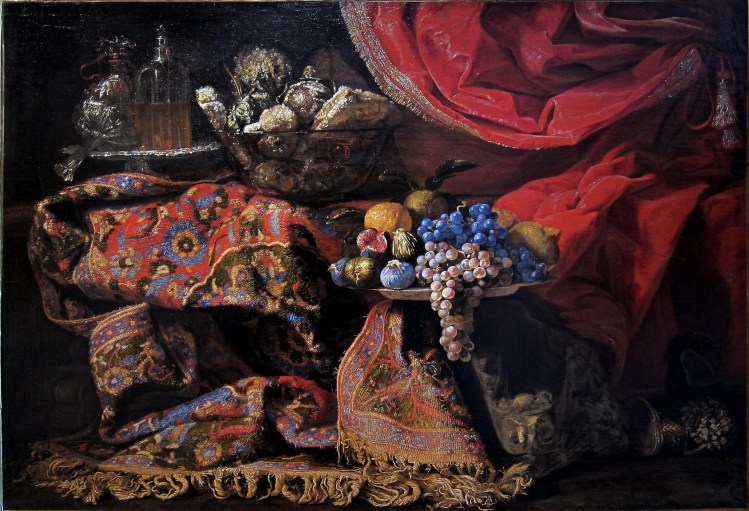
This painting in Ajaccio shows most clearly how Noletti could make a carpet govern an entire composition. It cascades across the foreground in a succession of heavy folds, concealing the table and seeming to overflow its boundaries. At one point the carpet turns back upon itself, exposing its underside, while its tangled fringe spreads irregularly along the lower edge. Its reds, blues and golds are answered by the great crimson hanging above, whose metallic trim twists with the fabric before ending in a pendant tassel. These smaller turns and entanglements extend the movement established by the larger folds.
Between the two expanses of fabric, the remaining objects occupy a comparatively narrow strip of space. The upper ledge holds glassware, fine vessels and a basket of fruits confits. One glass vessel lies across a tray and projects beyond its edge, as though it might slip and fall. Below, a dish bears grapes, figs and other fresh fruit; one fig has been split open to expose its interior. At the lower right, a richly worked cup or chalice lies on its side. The picture is filled with things that tip, twist, open or spill towards the viewer.
Light falls strongly from the left but illuminates the objects selectively. It catches the edges of the glassware, the crystalline surfaces of the preserved fruit, the opened fig and individual grapes, while the upper left, the far left edge and the lower right remain in shadow. The eye moves between these isolated points of brightness and the deeper passages into which objects partially disappear. This uneven illumination adds to the instability of the arrangement: forms emerge sharply and then recede before their outlines can be followed.
The carpet is the painting’s most conspicuous luxury object, but it also governs its structure. Its folds establish the composition’s weight and direction, drawing the design downwards and forwards. Some motifs remain legible; others are compressed, inverted or lost in shadow as the fabric changes course. The smoother folds of the hanging offer a contrast, although its twisting border prevents it from becoming static. Noletti has built the painting around the different ways in which cloth can fall, turn and resist repose.
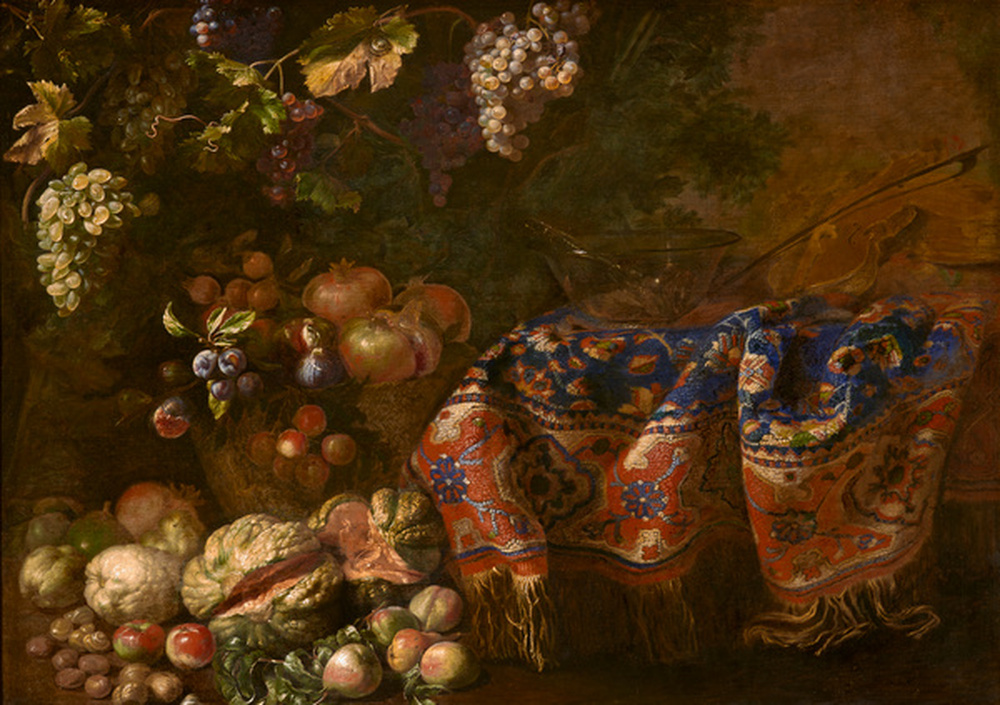
The painting in Grenoble is less densely furnished, and its emphasis falls upon produce gathered from the garden rather than upon precious possessions. Bunches of grapes hang among leafy vines in the upper left, while fruit and gourds accumulate below. The carpet occupies the right half of the picture, falling from the table in two broad lobes. Behind it is a broad transparent glass vessel, while what appears to be a violin and its bow extends diagonally into a pale brown area of the background. The softened boundaries of the instrument allow it to merge gradually with the surrounding tones.
Here the carpet does not overwhelm the other objects. Its patterned mass balances the foliage and fruit on the opposite side. The greater openness of the arrangement alters the effect of Noletti’s familiar repertory. In the Ajaccio painting, carpet, hanging and objects are pressed together into a compact display of luxury. In the Grenoble work, the fruit descends in a loose diagonal from the suspended grapes to the heap in the foreground, while the carpet forms a more stable counterweight. The former is built upon compression and accumulation; the latter depends upon the balance between two unequal masses, one organic and spreading, the other folded and contained.
Sciberras has identified the carpet in these paintings as the same Turkish design that recurs in at least fourteen works attributed to Noletti, including examples in Bilbao and the Hermitage. Its free floral motifs, blue ground and broad patterned border remain recognisable even when only selected areas are exposed. Yet the recurrence does not make the paintings repetitions of one another. Noletti changes which parts of the design can be seen and how the carpet falls.
The Materials of Luxury
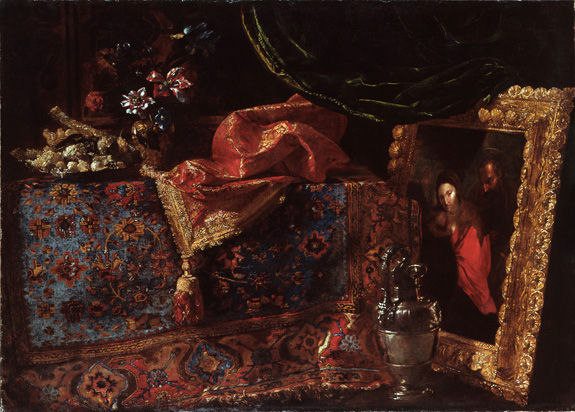
The painting in Bilbao allows us to approach Noletti’s work from a different direction. It has been subjected to detailed technical examination, making it possible to relate the splendour of its objects to the materials and procedures through which they were painted. The results are especially valuable in the case of an artist whose surviving works are unsigned and whose identity has been recovered largely through comparison.
The composition presents an interior filled with manufactured and cultivated luxuries. A tapestry can be glimpsed behind an open curtain, while the table bears a vase of flowers, a silver ewer, embroidered fabric and a platter of frosted fruit. Once again, the table itself has almost disappeared beneath a Turkish carpet, whose descent divides the composition horizontally and dominates its lower half. Yet the arrangement is not simply a catalogue of possessions. The objects overlap, obscure one another and occupy different levels, creating a space that is crowded without becoming incoherent.
At the right, Noletti has included a small painting of the Holy Family after Anthony van Dyck. Its elaborate gilt frame is set obliquely, with two of its corners approaching the edges of the larger canvas. The picture within the picture therefore contributes to the construction of space as well as to the display of wealth. Its gilded frame catches the same warm light as the ornamented fabrics, the flower vase, the silver ewer and the crystalline coating of the frosted fruit.
It would be unwise to treat the religious image as the key to a developed allegorical programme. It introduces a sacred subject into the composition, but it is also presented as a beautifully framed and costly possession. Indeed, the distinction between image and object has been deliberately blurred. The Holy Family invites recognition as a devotional painting, while the carved frame, thick paint and oblique placement draw attention to its physical presence among the other things assembled on the table.
Technical examination has shown that the picture was painted on a comparatively coarse, handwoven linen canvas prepared with a brown ground. Over this Noletti applied a slightly darker reddish-brown layer, leaving it visible in places and using it as an intermediate tone within shadows and modelling. The darker passages do not consist of black paint alone. They preserve parts of the underlying preparation and allow forms to emerge without every transition having to be painted afresh.
The pigments themselves disclose the expense invested in the picture. Most strikingly, Noletti used natural ultramarine extensively throughout the carpet. The blue was not confined to isolated highlights but occurs in the deeper paint layers and in mixtures where a less costly pigment might have served. Small quantities were even detected in passages representing the silver ewer and the gilt frame. The material luxury displayed within the scene was consequently matched by the actual cost of the paint from which it was made.
Noletti adjusted the consistency and application of that paint according to the surface represented. The carpet, embroidery and tassels were built with pronounced relief and broken touches, while the vessels and other smoother objects received longer, more blended strokes. Red passages in the carpet were constructed from darker foundations overlaid with brighter mixtures of vermilion and red lake. Its individual fibres and frayed edges were picked out with small raised touches, so that the carpet was, in effect, reconstructed strand by strand upon the canvas.
This technical evidence helps to explain why Noletti’s paintings appealed to patrons with cultivated and expensive tastes. Their attraction did not rest solely upon the number of costly objects represented. It also depended upon the transformation of pigment into substances that seemed to possess weight, texture and value. In the Bilbao painting, the luxury of the subject and the luxury of its making have become inseparable.
Armour and Ornament
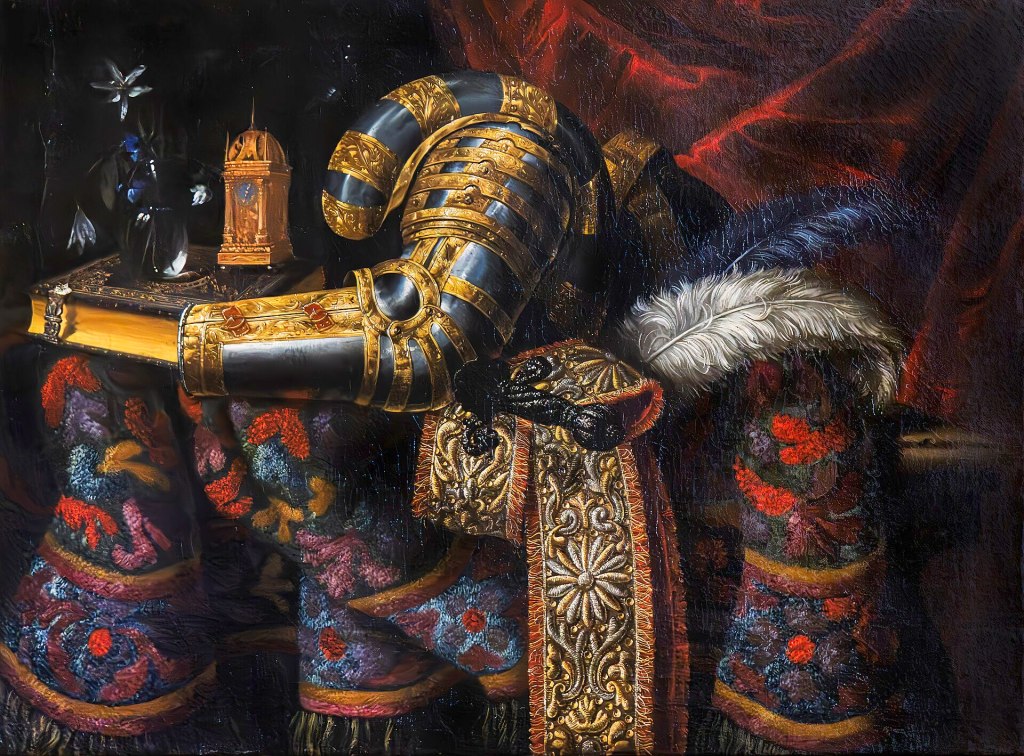
The Still Life with Armour in the Museo Correr replaces the fresh and preserved fruit of the preceding paintings with objects associated with ceremony, protection and display. An articulated arm defence occupies the centre, its dark steel divided by embossed gilded bands. It rests diagonally across a richly embroidered textile, while two plumes extend towards the right. Behind them, a crimson hanging gathers in broad folds across the upper right of the composition. The picture is smaller than the large canvases in Ajaccio, Grenoble and Bilbao, but its concentration gives the objects a commanding presence.
The armour provides Noletti with a different range of surfaces. Light travels across the curved steel in broad grey reflections before catching the relief patterns embossed upon the gilded bands. The articulated plates divide the form into a sequence of overlapping sections, each casting a narrow shadow upon the next. Two short leather straps, secured by small buckles across the forearm defence, introduce a more yielding material among the rigid plates. Below the elbow, the black-bound hilt of a sword is partly lost against the dark textile. Its grip and the surrounding fabric are so close in tone that the boundary between them becomes difficult to follow.
Although made to enclose and protect a moving body, the armour has been detached from its wearer and rearranged as an intricate object. Its diagonal placement and successive curves preserve something of the movement for which it was designed. To the right, a deep blue-violet plume describes a broad arc that answers the bend of the armour, while a white plume catches the light below it. The feathers supply an answering sequence of curves, but their softness and irregularity oppose the armour’s engineered articulation. Individual strands separate, cross and bend before merging into the embroidered fabric beneath them.
The textile is itself far from passive. Its folds swell across the foreground, while the broad ornamental band descending near the centre appears almost modelled in relief. The contrasts between metal, leather, feather and embroidery cannot be reduced to hard and soft materials. Each has its own density, structure and response to light.
The smaller objects at the left are more reticent. A large closed book, with gilded page edges and metal clasps, provides a raised support for several vessels, one of which holds a pale flower against the dark background. Their vertical forms counter the long diagonal of the armour, while their relative delicacy prevents the central mass from becoming immovable. The eye is first drawn to the gilded plates, but the picture gradually discloses quieter reflections in the glass and the isolated brightness of the flower.
Armour appears repeatedly in Noletti’s reconstructed oeuvre. The lost composition engraved by Jacques Coelemans as Omnis Salus in Ferro Est arranged pieces of armour and a sword upon a Turkish carpet, while surviving paintings show related objects transferred into different settings. Such repetitions suggest that armour belonged to the repertory from which Noletti constructed his still lifes. Yet its appeal was not merely that of a studio prop. Curved steel, gilded relief and overlapping plates presented complex problems of reflection, shadow and spatial recession, allowing him to extend his investigation of material appearance beyond the textile surfaces for which he was celebrated.
The Venice painting brings us back, finally, to the fiction with which this account began. In Cornelis de Bie’s story, a courtier mistakes a painted carpet for an object that can be lifted. Here Noletti offers a more varied test of sight and imagined touch. It is a form of haptic seeing: the eye moves across the painted surfaces while imagining how each might yield to or resist the hand. Paint assumes the rigidity of steel, the flexibility of leather, the fine disorder of feathers, the raised surface of embroidery and the weight of folded cloth. Once Noletti’s identity had been recovered, these transformations could again be recognised as the work of the painter whom his contemporaries remembered for bringing woven surfaces remarkably close to nature.
Producing these essays requires care, time, research, and resources. Contributions to help sustain this exploration would be greatly appreciated.
Donate to Inner Surfaces here.
Bibliography
Fiorentino, Luca, ‘Cornelis De Bie, il Gulden Cabinet e la pittura di natura morta e di genere in Italia: I casi di Francesco Noletti detto il Maltese, Mario dei Fiori, Grechetto, Michelangelo Cerquozzi e una riflessione su Pieter Boel e David De Coninck’, Venezia Arti, n.s. 29 (2020), pp. 65–88.
Laureati, Laura, ‘Francesco Maltese; Benedetto Fioravanti’, in Federico Zeri, ed., La natura morta in Italia, 2 vols, vol. II (Milan: Electa, 1989), pp. 768–69.
Merino Gorospe, José Luis, ‘Analytical and Stylistic Study for an Approach to His Technique’, B’08: Buletina/Boletín/Bulletin del Museo de Bellas Artes de Bilbao, no. 4 (2009), pp. 161–94.
Sciberras, Keith, Caravaggio to Mattia Preti: Baroque Painting in Malta (Valletta: Midsea Books, 2015), pp. 79–94.
Sciberras, Keith, ‘Francesco Noletti (c. 1611–1654) and a Conclusion for Proposing His Oeuvre’, in Pietro di Loreto, ed., Una vita per la storia dell’arte: Scritti in memoria di Maurizio Marini (Foligno: Etgraphiae, 2015), pp. 367–80.
Sciberras, Keith, ‘Three Paintings by Francesco Noletti at the Bilbao Fine Arts Museum’, B’08: Buletina/Boletín/Bulletin del Museo de Bellas Artes de Bilbao, no. 4 (2009), pp. 129–59.
Trastulli, Federico, ‘Novità documentarie sulla figura di Francesco Noletti detto “Francesco Maltese”’, Strenna dei Romanisti, 69 (2008), pp. 693–704.
Online references
Bilbao Fine Arts Museum, ‘Still Life with a Silver Ewer, a Turkish Carpet and a Painting of the Holy Family’, online collection record, accessed 29 August 2026.
Christie’s, ‘Italian School, 17th Century: An Allegory of the Riches’, sale record, 2014, accessed 29 August 2026.
Musée de Grenoble, ‘Francesco Noletti dit il Maltese: Nature morte avec tapis et fruits’, online collection record, accessed 29 August 2026.
Palais Fesch–Musée des Beaux-Arts, Ajaccio, ‘Francesco Noletti dit il Maltese: Nature morte au tapis turc et à la tenture’, online collection record and digital catalogue commentary, accessed 29 August 2026.
University of Malta, ‘Francesco Noletti: The Grand Roman Baroque Carpet Still-Life’, exhibition notice, 4 April 2016, accessed 29 August 2026.

