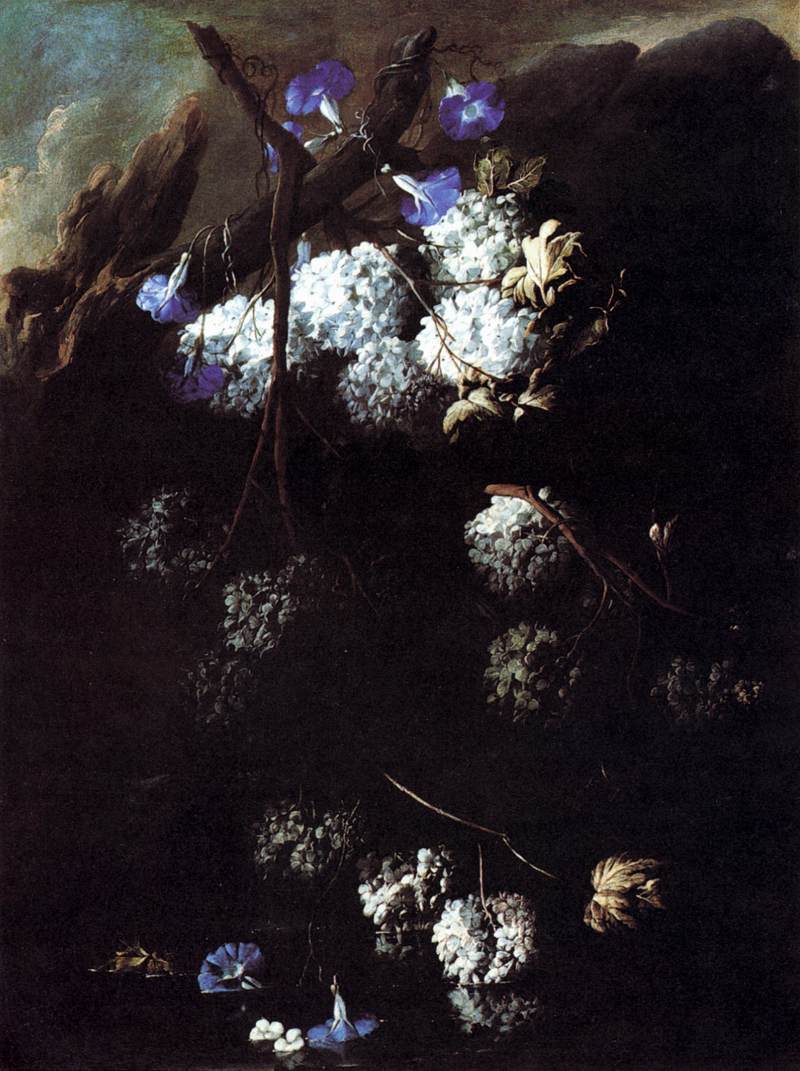
Andrea Belvedere was born in Naples around 1652 and became one of the most accomplished flower painters of the later seventeenth century. His career belonged to a particularly rich moment in Neapolitan still life. By the time he began to work, painters such as Paolo Porpora, Giuseppe Recco and Giovan Battista Ruoppolo had already established a varied tradition in which close observation of natural things could coexist with increasingly ambitious effects of colour, abundance and display. Belvedere absorbed much from all three, but his painting was never simply an extension of theirs.
His earliest known flower pieces can, in fact, be remarkably spare. The pair now in the Museo Correale at Sorrento presents only a few carnations or tulips in simple glass bottles. There is little to distract from the flowers themselves: their stems, the transparency of the vessels, and the slight irregularity of the arrangements. These youthful works still owe much to Giuseppe Recco, but they also establish a taste for delicacy and restraint that would not disappear when Belvedere began to work on a much larger scale.
During the 1680s his compositions became more elaborate and his range of reference widened. Alongside the Neapolitan painters came the example of artists working in Italy from northern Europe, among them Abraham Brueghel, Karel von Vogelaer and Franz Werner von Tamm. Yet the change was not simply one from simplicity to profusion. Belvedere increasingly explored the different settings in which flowers might be seen: against darkness, beside water, among birds and sculpture, or assembled into the monumental displays that he would later paint in Spain. One of the most distinctive results of that process is the painting now at Capodimonte, Ipomee e boules de neige sull’acqua.
Ipomee e boules de neige sull’acqua
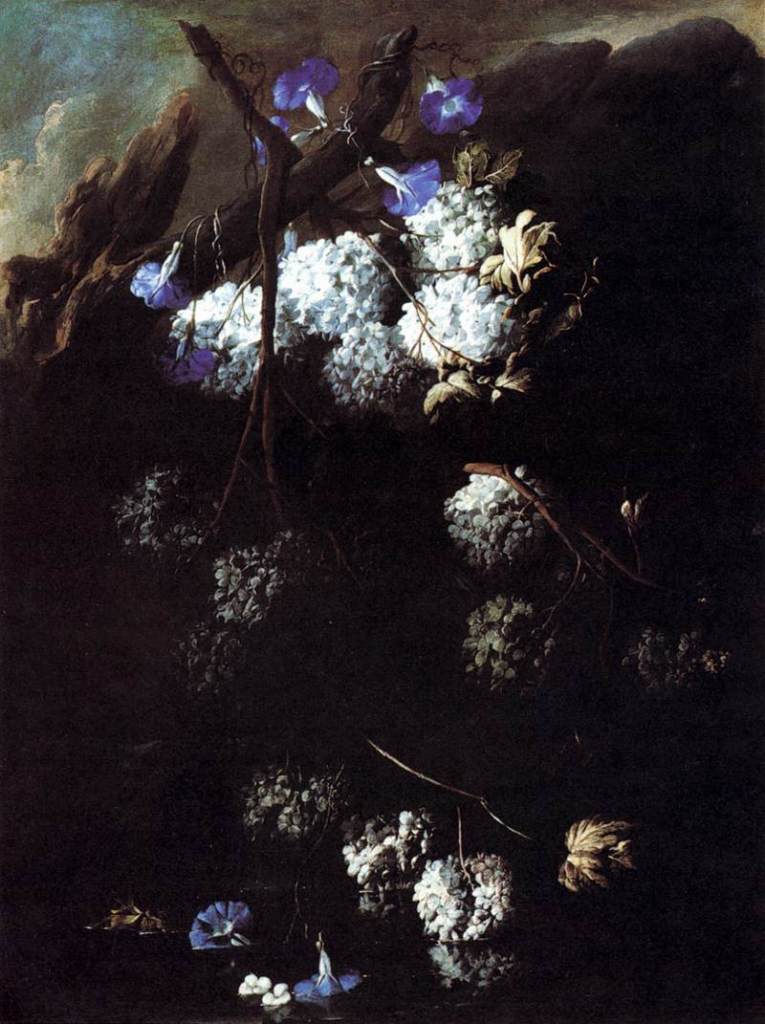
Painted probably in the 1680s, Ipomee e boules de neige sull’acqua is among Belvedere’s most unusual works. Instead of arranging flowers in a vase, he has set them within a fragment of landscape. A broken branch of Viburnum opulus ‘Roseum’, laden with the rounded white blooms known as boules de neige, is caught against a tree and entwined with blue morning-glory. Below, a few fallen flowers touch the surface of the water. The narrow opening of sky at the upper left suggests that daylight is fading.
The composition depends as much upon what is withheld as upon what is shown. Much of the canvas is given over to shadow, from which the white flower heads emerge with remarkable intensity. The morning-glories provide smaller flashes of blue, while thin stems and tendrils thread their way through the darker areas. Nothing has been gathered for display. The flowers appear instead as part of a passing natural circumstance, held briefly between growth and decay, light and obscurity.
The painting also has an early history. It belonged to Giuseppe Valletta, the Neapolitan jurist and philosopher, whose collection was well known in the city. Bernardo De Dominici, writing in the eighteenth century, remembered seeing and admiring the work in Valletta’s house. Its precise provenance has led to the suggestion that Valletta may have commissioned it directly from Belvedere. His interest in botany may also have contributed to the choice of subject. Belvedere may in addition have known Giovan Battista Ruoppolo’s earlier still life of celery and boules de neige, now in the Ashmolean Museum, although here the motif is absorbed into a quieter and more atmospheric setting.
That balance helps to explain why Ipomee occupies such an important place in his career. The observation of individual plants remains precise, but the painting is no longer organised around the presentation of specimens. Flowers, branches, water and twilight have become inseparable parts of a single visual experience. In place of the restrained clarity of the early bottle paintings, Belvedere has found a more atmospheric and unstable kind of still life.
Anatre e fiori
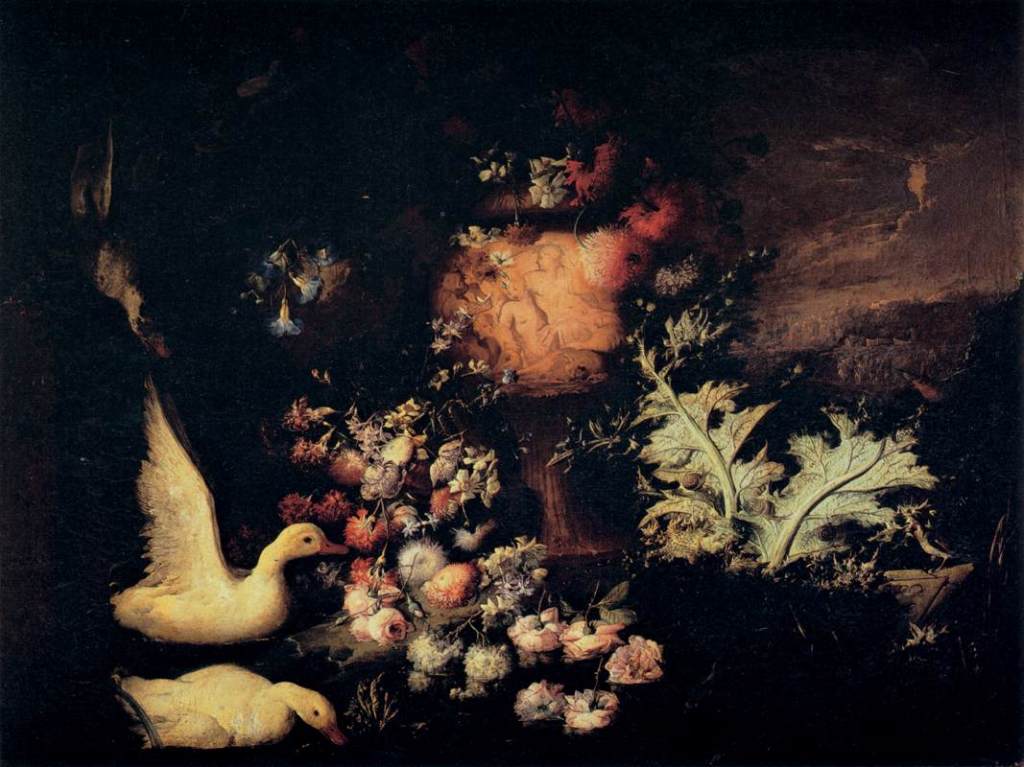
In the following decade Belvedere began to work on a markedly larger scale. The signed Anatre e fiori, now in the Galleria Palatina, belongs to this mature phase and brings together a much wider range of motifs: flowers, ducks, water and landscape, together with an elaborate historiated vessel whose relief has been tentatively identified as a Triumph of Galatea. The scope of the still life has plainly expanded. Flowers are no longer presented as a concentrated group but have become part of a larger pictorial setting in which natural and ornamental forms coexist.
This change took place within an increasingly international culture of flower painting. Abraham Brueghel, Karel van Vogelaer and Franz Werner von Tamm, all active in Italy, are repeatedly cited among the artists who affected Belvedere’s mature style. Their work belonged to the taste sometimes described as lusso floreale: an opulent mode of still life in which flowers might be combined with fruit, animals, sculpture, architecture or landscape and conceived on a scale suited to grand interiors. Belvedere did not simply adopt this vocabulary wholesale, but it offered possibilities quite different from the restrained flower pieces of his youth.
The enlargement of the composition was accompanied by a more complex treatment of light and colour. In works of this period, brilliant passages emerge from darker surroundings, while changes of illumination help to distinguish flowers, foliage, water and sculptural surfaces. Nicola Spinosa has emphasised both the increasingly scenographic character of Belvedere’s mature painting and its refined effects of colour and light. In Anatre e fiori, richness does not depend solely on abundance: much of the effect comes from the way these varied elements are held within a common atmosphere.
The painting therefore shows how far Belvedere had extended the possibilities of the Neapolitan flower piece before his departure for Madrid in 1694. The close observation of individual blooms remains important, but it now operates within a considerably broader decorative and spatial conception.
Madrid: Florero
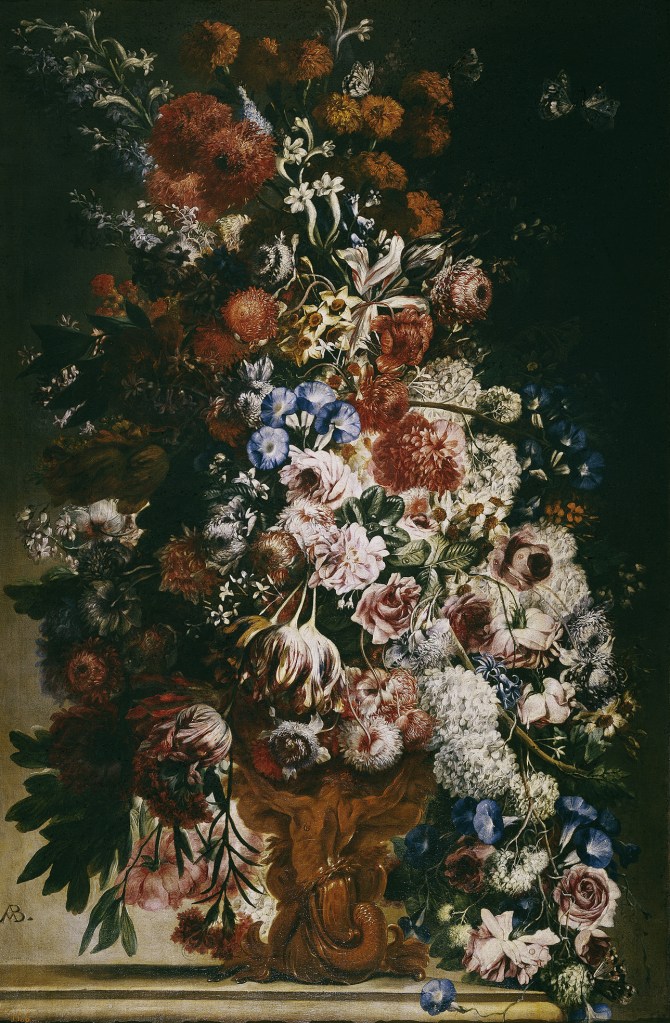
Belvedere left Naples for Madrid in 1694, probably through the intervention of Luca Giordano, who was already working for Charles II. He remained there until about 1700, producing flower paintings for the court and aristocratic collectors. His work during these years became increasingly monumental and richly ornamented, a development represented particularly well by the two large Floreros now in the Prado.
In the Florero (P550), a prodigious bouquet rises from an elaborate bronze vase whose base is embraced by tritons. The flowers occupy almost the whole surface of the canvas, their colours and textures deliberately contrasted to create what the Prado describes as an effect of extraordinary variety and volume. The background is lighter below and darkens progressively towards the top, allowing the mass of flowers to stand out with particular force. Despite the profusion, colour is carefully orchestrated: abundance has itself become a means of organising the composition.
The change from Anatre e fiori is striking. Landscape and the wider setting have disappeared, and attention has returned to the bouquet and its vessel; yet this is hardly a return to the concentrated flower pieces of Belvedere’s youth. Scale, variety and decorative splendour have transformed the terms of the genre. Robert Middione saw something of a loss as well as a gain in the Spanish works, suggesting that their ostentatious magnificence could come at the expense of the more intimate qualities of Belvedere’s earlier painting. At the same time, however, he recognised in the Prado pictures a renewed refinement of colour.
That ambiguity has persisted in accounts of Belvedere’s career. Some earlier criticism described the Spanish period as a phase of involuzione, or decline. Seen from another direction, many of the same characteristics point forward rather than back. The lighter backgrounds, tonal variety and increasingly sumptuous arrangements have been understood as anticipating aspects of eighteenth-century, and ultimately Rococo, flower painting. Belvedere’s Madrid pictures thus stand at an interesting threshold: still rooted in the naturalism and material specificity of the Neapolitan tradition, but adapting them to a courtly decorative culture in which the flower piece could assume a new scale and splendour.
Coda
Belvedere returned to Naples around 1700 and largely abandoned painting. Middione’s account, following De Dominici, helps to place this change within a broader picture of an artist who had long been a man of letters as well as a painter, with a strong interest in the theatre. He increasingly devoted himself to directing performances, adapting plays and training actors, and became associated with a more natural style of performance in reaction against the conventions of spagnoleggiante drama. For roughly the last three decades of his life, the theatre became his principal field of activity.
His influence as a painter nevertheless continued after his withdrawal from the profession. Middione names Tommaso Realfonso and Nicola Casissa among the younger Neapolitan flower painters formed in part through his example. Their subsequent careers point in rather different directions: Realfonso became associated with a renewed naturalistic tendency in early eighteenth-century still life, while Casissa helped carry Neapolitan flower painting into the more decorative culture of the late Baroque and Rococo.
Producing these essays requires care, time, research, and resources. Contributions to help sustain this exploration would be greatly appreciated.
Donate to Inner Surfaces here.
Bibliography
Litvinovich, Michal, ‘Andrea Belvedere, Boules-de-neige et ipomées se reflétant dans l’eau’, in Michel Hilaire and Nicola Spinosa, eds, L’Âge d’or de la peinture à Naples, de Ribera à Giordano, exhibition catalogue, Musée Fabre, Montpellier, Paris: Lienart, 2015, cat. 85, p. 308.
Middione, Roberto, ‘Andrea Belvedere’, in Civiltà del Seicento a Napoli, 2 vols, Naples: Electa Napoli, 1984, vol. I, p. 118.
Middione, Roberto, ‘Andrea Belvedere’, in Federico Zeri, ed., La natura morta in Italia, 2 vols, Milan: Electa, 1989, vol. II, pp. 936–40.
Spinosa, Nicola, ‘La natura morta a Napoli’, in Federico Zeri, ed., La natura morta in Italia, 2 vols, Milan: Electa, 1989, vol. II, pp. 852–963.
Spinosa, Nicola, Pittura del Seicento a Napoli: da Mattia Preti a Luca Giordano. Natura in posa, Naples: arte’m, 2011, especially pp. 247–50, nos. 252–59.
Museum and collection pages consulted: Museo e Real Bosco di Capodimonte; Museo Nacional del Prado; Fondazione Federico Zeri.

