Introduction
Diana Di Rosa occupies an unusual position in the history of seventeenth-century Neapolitan painting. Celebrated in later tradition as “Annella di Massimo”, she acquired a reputation that rested as much on the dramatic story of her life as on the paintings associated with her. Yet while Artemisia Gentileschi has generated an extensive modern literature, Diana’s career has only recently begun to emerge from a much thinner and more uncertain historiography; Giuseppe Porzio’s 2023 study was the first monograph devoted to her.
Recent research has made it possible to approach her rather differently. A more critical consideration of the documentary record has substantially revised the biography inherited from Bernardo De Dominici, while the reassessment of early references to her paintings and, most importantly, the emergence of a signed Saint Cecilia with an Angel have provided a firmer basis from which to reconsider her work. Even so, the picture remains incomplete. Diana belonged to a closely interconnected artistic world in which family relationships, workshop practice and collaboration frequently overlapped, and some of the works now associated with her still resist easy separation from those of the painters around her.
Biography
Several basic points about Diana Di Rosa’s life can now be established with some confidence. A baptismal record gives the date of 20 May 1602 and names her parents as the painter Tommaso Di Rosa and Caterina De Mauro; Diana was the elder sister of Giovanni Francesco Di Rosa, better known as Pacecco. Tommaso died in 1610, and Caterina’s marriage two years later to Filippo Vitale placed Diana within another important branch of Neapolitan painting.
In 1626 Diana married the painter Agostino Beltrano. The marriage agreement was drawn up by Gaspare Del Popolo, who also contributed 200 ducats to her dowry, a detail that points to the close overlap between family, professional and financial ties within the circle in which she worked. A notarial act of January 1644, made when Beltrano was already a widower, refers to her as “Annella” and records provision for their six surviving children. The familiar name, then, belongs to the documentary record as well as to the later literary tradition.
Diana died in December 1643 and was buried, according to her wishes, in the Gesù Nuovo. Her death record does not establish a cause of death, but the presence of confessors suggests an attended death rather than the sudden violence later described by De Dominici. More decisively, Beltrano is documented as a widower the following month. The surviving evidence does not sustain De Dominici’s account of Diana being murdered by her husband in 1649, though it would be going too far to claim that the precise circumstances of her death are known.
What can now be recovered is a much plainer biography, but also a more substantial one: a woman born into an artistic family, married into another professional partnership, active within a densely connected circle of painters, and dead by the end of 1643.
Training and professional status
Diana’s earliest artistic education is not documented in detail, but the circumstances of her upbringing provide a strong context for it. Her father, Tommaso Di Rosa, died in 1610. Two years later her mother, Caterina De Mauro, married Filippo Vitale, who thereby became Diana’s stepfather. She consequently spent much of her formative period in the household of one of the leading painters of the new Neapolitan naturalism. The inference that Vitale contributed to her training is not documented directly, but it is entirely consistent with both the family structure and the level at which Diana was already working by 1621.
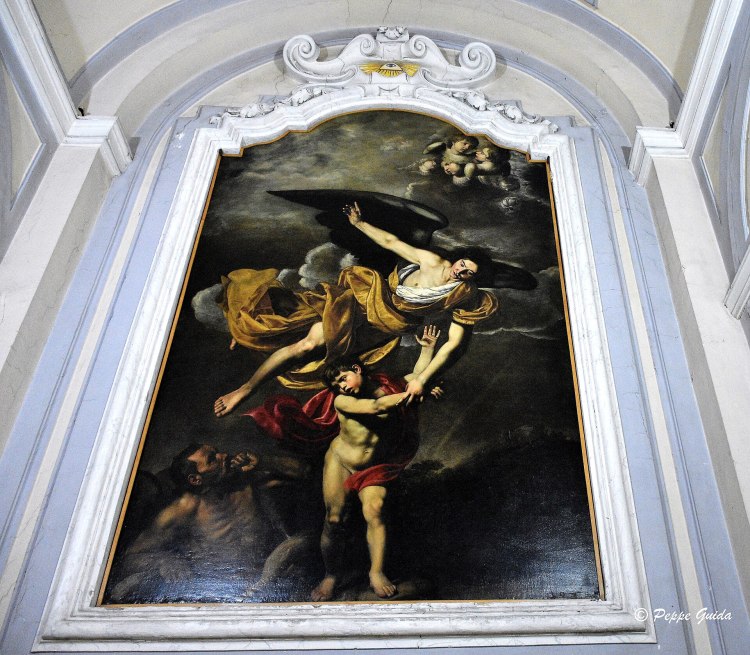
Her subsequent arrangement with Gaspare Del Popolo, a Roman-born painter active in Naples, makes that point more tangible. Del Popolo was himself bound into the same family network: he had trained with Tommaso Di Rosa and married Isabella De Mauro, Caterina’s sister, making him Diana’s uncle by marriage. In 1621 he took both Diana and Agostino Beltrano into his service, but on markedly different terms. Beltrano, then fourteen, entered what Marshall regards as a conventional six-year apprenticeship. Diana, aged eighteen, was contracted for three years and was to receive fifty ducats annually. The distinction suggests that she was already functioning at a more advanced level, closer to a paid junior assistant than to a beginner acquiring the rudiments of painting.
The relationship with Del Popolo remained unusually close. A will drawn up in 1623 provided Diana with an annual pension of ten ducats and a further payment of fifty ducats in the event of his death. In 1626 he prepared the marriage agreement between Diana and Beltrano and contributed substantially to her dowry; the following year the couple renewed their service with him for another five years, with provision for expenses connected with Diana’s possible pregnancies.
Taken together, the evidence suggests not a simple sequence of master and pupil, but a professional formation embedded within family life. Tommaso Di Rosa, Filippo Vitale and Gaspare Del Popolo were linked to Diana not only as painters but as father, stepfather and uncle by marriage. Her early career emerged within a network in which artistic instruction, paid labour, household structure and marriage were unusually difficult to separate.
Family, workshop and collaboration
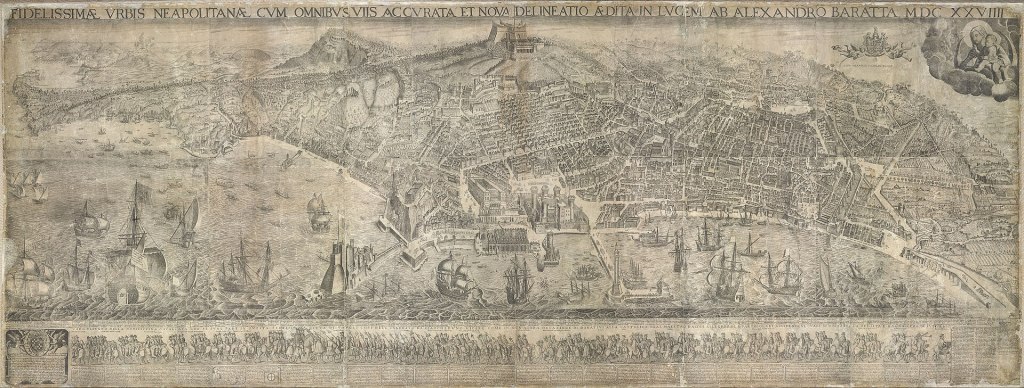
The interweaving of kinship and artistic practice extended well beyond Diana’s immediate household. Christopher Marshall places the Di Rosa family within a dense community of painters and craftsmen clustered around the Piazza della Carità and nearby streets, where marriage, godparenthood, apprenticeship and business partnerships repeatedly overlapped. Diana’s sister Grazia married the Valencian painter Juan Dò in 1626, with Battistello Caracciolo and Jusepe de Ribera as witnesses; Caterina and Filippo Vitale’s daughter Orsola later married Aniello Falcone. Across successive generations, the family became connected to an unusually broad section of the Neapolitan artistic world.
This was more than a social network. Marshall argues that such alliances helped to consolidate workshops, circulate commissions and blur the boundary between household and business. Painters could at once be independent practitioners, relatives, assistants and occasional collaborators. In that environment, the modern expectation that every painting should resolve neatly into a single artistic hand can itself become misleading, especially in larger or more complex commissions.
Diana’s marriage to Agostino Beltrano in 1626 formalised a connection already established through their shared service with Gaspare Del Popolo. Recent studies increasingly support the possibility of direct collaboration between them, particularly in ambitious works. This need not imply that their individual styles were indistinguishable. Rather, it suggests a working relationship in which designs, figure types and even parts of a painting might be shared between closely associated hands. The attributional difficulties surrounding Diana may therefore reflect, at least in part, the conditions under which some of the paintings were originally made.
Massimo Stanzione: what kind of relationship?
No aspect of Diana’s career has been more strongly coloured by later tradition than her association with Massimo Stanzione. De Dominici made her his favoured pupil and transformed their relationship into the centre of the story that culminated in her supposed murder. The documentary evidence does not support that account of her training, but neither does it allow Stanzione simply to be removed from her career. The designation “Annella di Massimo” already occurs in seventeenth-century inventories, and an inventory drawn up in 1648 for Giuseppe Carafa, Duke of Maddaloni, records a Saint Agatha by Diana that had been “retouched by the hand of Massimo”. The painting itself has not been securely identified, but the entry provides unusually strong evidence that Stanzione intervened directly upon a work regarded as hers.
There were other points of contact. Stanzione had longstanding connections with Diana’s maternal family, acting as godfather to children within the De Mauro circle, while Beltrano’s involvement in Stanzione’s professional activity is documented much more firmly. In 1644 Stanzione transferred to him part of the payment for the frescoes of San Paolo Maggiore, and a later inventory records seventeen bozzetti made by Beltrano from Stanzione’s designs for the same cycle. These documents do not establish Diana’s own position in Stanzione’s workshop, but they place her husband and family in close proximity to him.
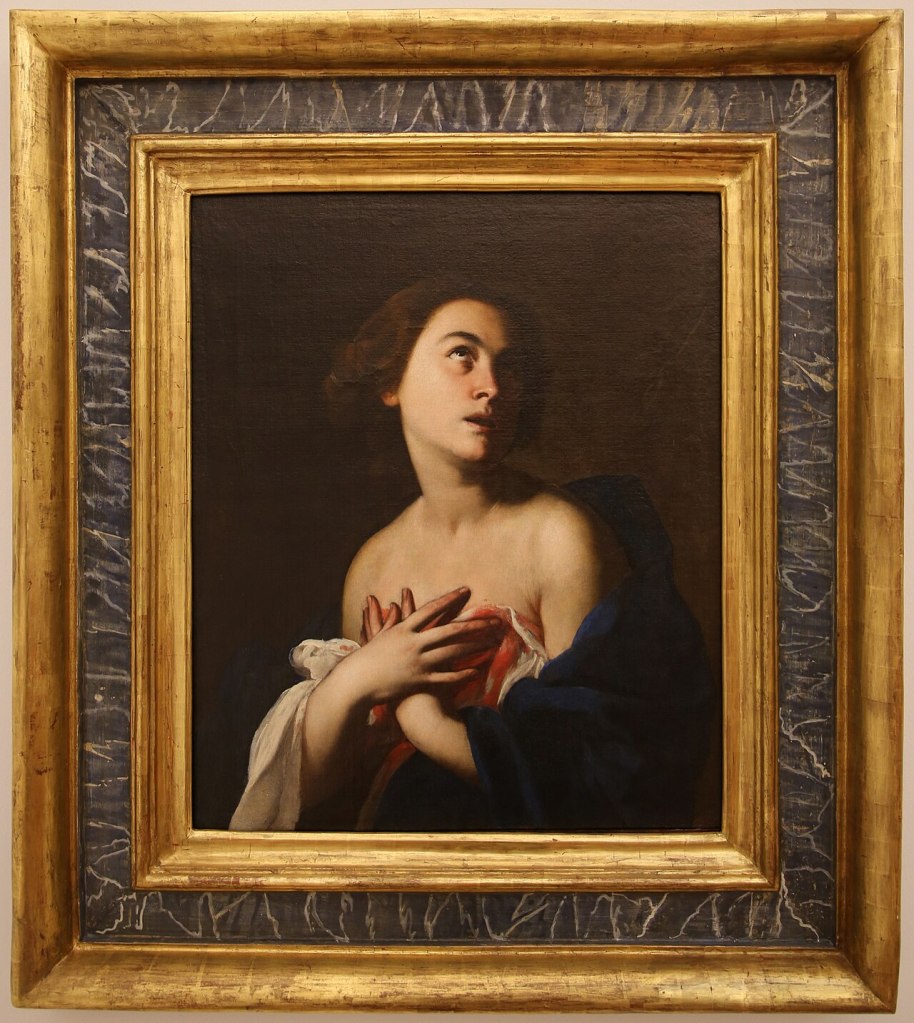
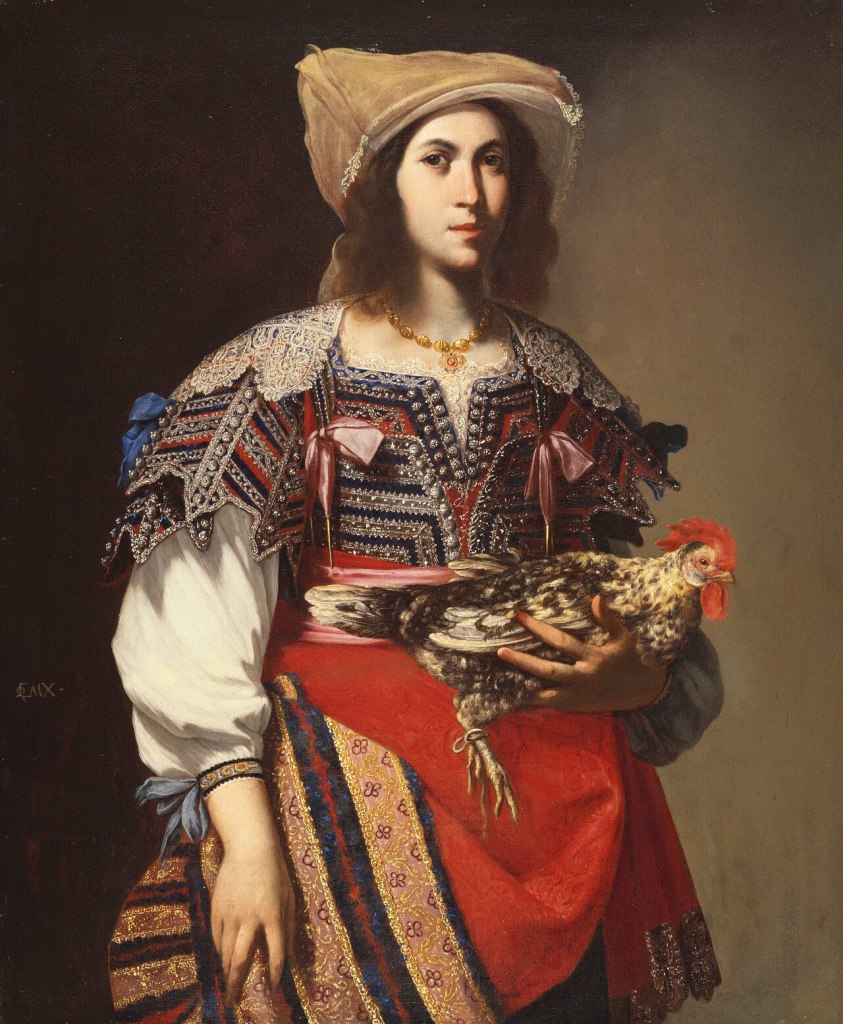
Marshall has proposed that Diana eventually worked as a junior assistant within Stanzione’s establishment, perhaps in the later 1630s or early 1640s. The proposal is plausible but undocumented. It is important not to make stylistic resemblance carry more weight than it can bear: Stanzione’s manner was widely absorbed by painters in Naples who need not have belonged to his workshop at all. What can be said with greater confidence is that the connection was real and professionally significant, even if its precise form remains uncertain.
Why the catalogue is difficult
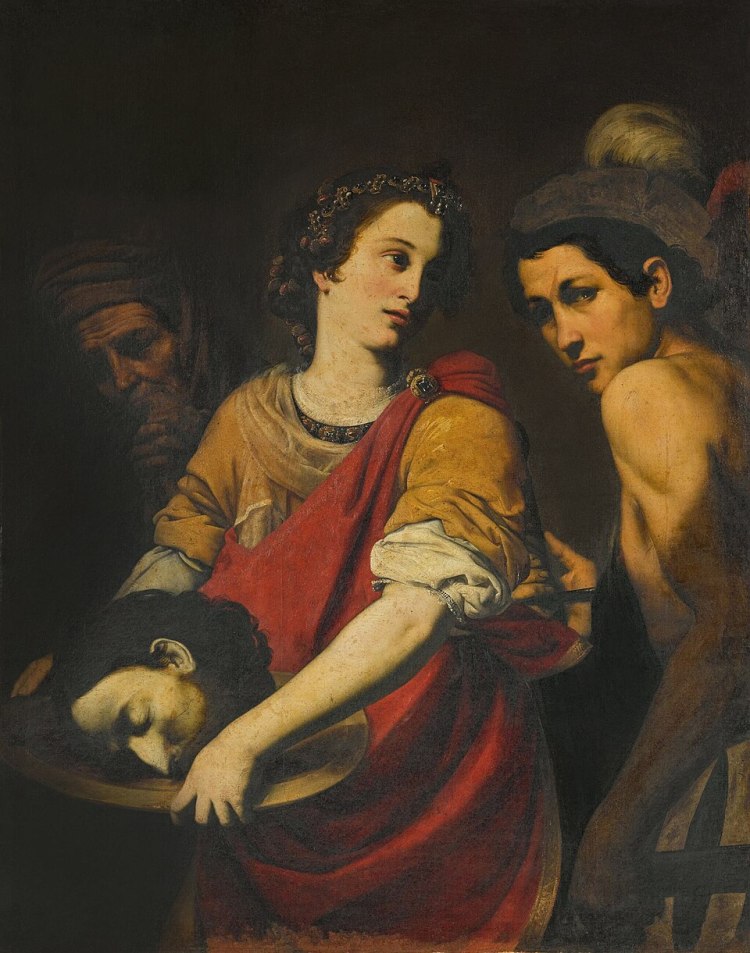
Establishing a reliable catalogue of Diana’s works presents an awkward problem. Seventeenth-century inventories demonstrate that paintings by “Diana”, “Annella” and “Annella di Massimo” circulated in important Neapolitan collections, but descriptions in inventories cannot always be connected securely with surviving works. A striking example is the 1649 inventory of Eleonora Carafa, which records a substantial painting of Herod, Herodias and the head of Saint John the Baptist “de mano di Annella”. The reference confirms that Diana painted such a subject, but it does not establish that the picture was the Salome with the Head of Saint John the Baptist now at Braunfels, recently attributed to her by Giuseppe Porzio.
The surviving paintings present a different challenge. Works now associated with Diana have at various times been assigned to Pacecco Di Rosa, Filippo Vitale, Agostino Beltrano, Massimo Stanzione and other painters working within the same Neapolitan milieu. Stylistic comparison is indispensable, but it can easily become circular: an uncertain painting cannot safely be used to authenticate another uncertain painting. The problem is particularly acute where collaboration may have been involved, or where an old attribution rests upon testimony that is itself difficult to verify.
For much of the modern literature there was, in effect, no uncontested surviving work from which Diana’s individual manner could be defined. That situation has changed decisively with the recognition of the signed Saint Cecilia with an Angel now in Boston. It does not settle the attribution of the surrounding works, but it supplies something previously missing: a secure point against which proposals based on physiognomy, handling, composition and decorative detail can actually be tested. The catalogue that results is still necessarily graded, with a signed centre surrounded by works of differing degrees of probability.
The secure centre: Saint Cecilia with an Angel
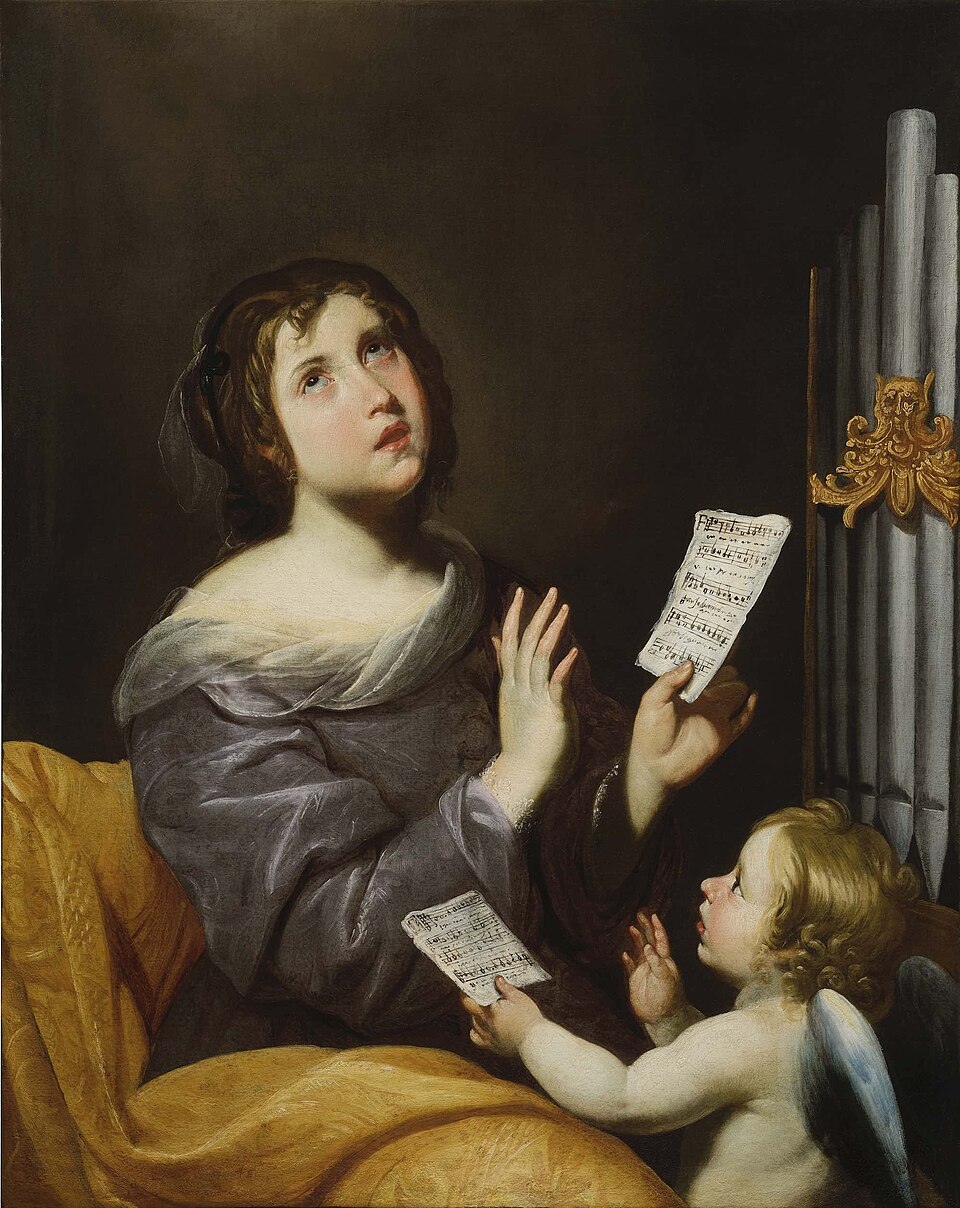
The work that has transformed the study of Diana’s oeuvre is the Saint Cecilia with an Angel, now in the Museum of Fine Arts, Boston. Painted around 1635–40, it is a relatively intimate canvas, measuring 97.5 × 76.5 cm. On the sheet of music held by the saint appears the inscription “Io Diana di Rosa / Sor di Giovane”, understood as a reference to her brother Giovanni Francesco, Pacecco. It is the only autograph inscription by Diana presently known and provides the firmest surviving basis for defining her artistic personality.
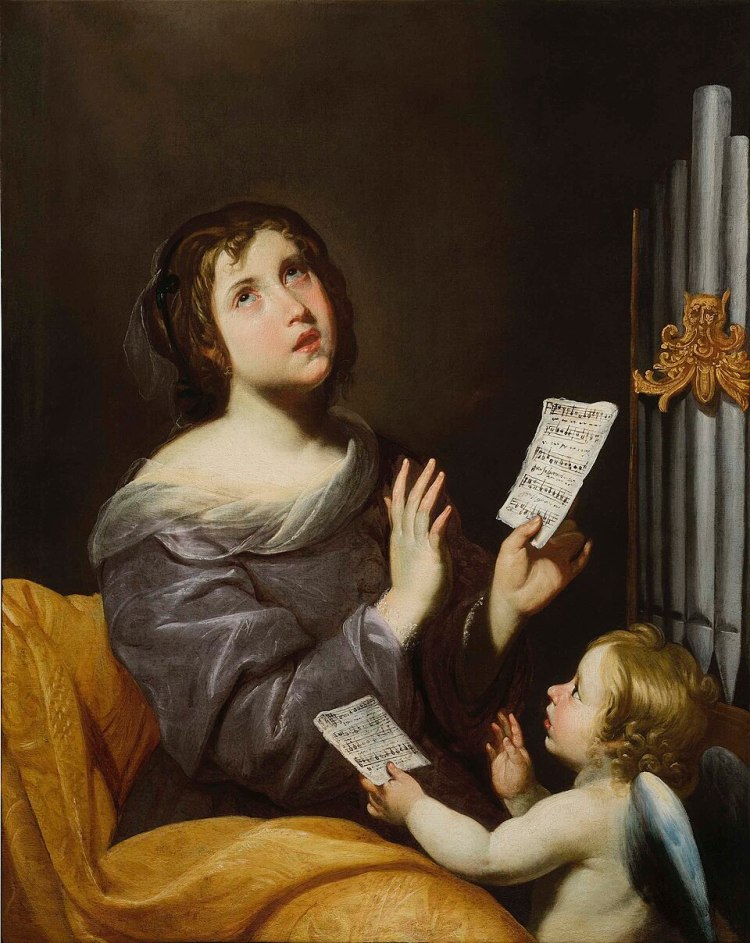
The painting is strikingly refined. Cecilia is arranged on a strong vertical axis beside an organ, her head tilted upwards and her lips parted in song. The angel at the lower right echoes her pose on a smaller scale, looking up towards her while holding his own sheet of music. The effect is devotional without becoming theatrical: the saint’s upward gaze suggests ecstasy, but the angel introduces a gentler, more intimate exchange.
Several details are useful when testing the surrounding attributions. The saint has softly modelled flesh, delicate pink accents around the eyes, cheeks and chin, ringlets falling across the forehead, and finely drawn brows and eyelashes. Her features are contained within an elegant oval, while the contours remain unusually precise without becoming hard. These characteristics recur, to varying degrees, in a number of female half-length figures now attributed to Diana, including Saint Agatha, Saint Barbara, Lucretia and Samson and Delilah.
The picture also helps to explain why Diana’s work has proved so difficult to isolate. Its refinement places it within a classicising current that could readily invite comparison with Guido Reni, while its more immediate naturalistic presence belongs more closely to the Neapolitan world of Stanzione. The delicate female type also stands near enough to Pacecco and to other painters of the same milieu for individual authorship to become difficult to distinguish on style alone. The signature changes the direction of the argument: instead of trying to construct Diana from a cluster of uncertain pictures, those pictures can now be tested against a painting whose authorship is secure.
Extending the corpus: Eliezer and Rebecca at the Well
Among the paintings now attributed to Diana, Eliezer and Rebecca at the Well, dated around 1630–35 and now with Galleria Porcini in Naples, is one of the most persuasive attributions beyond the signed Saint Cecilia. The large canvas, measuring 129.5 × 180.5 cm, has also been identified as Moses and Zipporah at the Well, though Porzio prefers the more conventional interpretation of the episode as the meeting of Abraham’s servant Eliezer with Rebecca.
Its attributional history is revealing. When the painting appeared at Sotheby’s in New York in 2007, it was presented as a work by Pacecco Di Rosa, following an attribution by Riccardo Lattuada. Vincenzo Pacelli, however, had already noted a degree of stylistic incongruity within Pacecco’s works. Porzio now assigns the picture to Diana, and the comparison with Pacecco is central to his argument.
The difference is not based simply on recurring facial types. Porzio describes Diana’s handling as more fluid and transparent, against Pacecco’s denser, smoother and more enamelled surface. In Eliezer and Rebecca, the figures are disposed with a relaxed elegance, and particular attention is given to jewellery, lace and other ornamental details. The pastoral setting is also noticeably less rustic than that of Pacecco’s Jacob and Rachel at the Well, in which a more strongly Riberesque note survives among the subsidiary figures.
The comparison is valuable because Diana and Pacecco shared so much: family, training environment and many of the same stylistic points of departure. Their distinction therefore lies less in opposing artistic languages than in differences of handling and temperament. Pacecco tends towards a more polished and compact surface; Diana, if Porzio’s attribution is accepted, towards greater translucency, spaciousness and ease. Eliezer and Rebecca thus provides an important intermediate case: not an autograph work, but a substantial attribution that can now be measured against the securely signed Boston painting rather than against an entirely hypothetical Diana.
Collaboration as evidence: Marriage of the Virgin
The Marriage of the Virgin, dated to around 1640, provides a different kind of evidence from either the signed Saint Cecilia or the attributed Eliezer and Rebecca. A large canvas measuring 135.5 × 250 cm, it formed part of a Marian cycle for San Giovanni Maggiore and is now attributed jointly to Diana and Agostino Beltrano. Its importance lies precisely in the possibility that more than one hand can be distinguished within a substantial public commission.
The composition itself is conventional, with Mary and Joseph joining hands before the priest, but recent analysis separates the figures stylistically. The youthful Virgin, dressed in blue, is assigned to Diana: her delicate oval face and pale, almost ivory flesh correspond to characteristics now associated with her elsewhere. The two witnesses beside her have likewise been compared with figures in the Death of the Virgin at the Pietà dei Turchini. Joseph and the prominent male figure in the foreground, by contrast, are related more closely to Beltrano’s established types.
The attribution is necessarily more interpretative than that of the Boston Saint Cecilia, but it matters for another reason. The Marriage of the Virgin suggests that the attributional entanglement surrounding Diana need not always be understood as a failure of connoisseurship. In at least some ambitious works, stylistic difference within a single canvas may reflect the way the painting was actually produced. The broader reconstruction of the San Giovanni Maggiore cycle similarly allows for Beltrano’s participation alongside Diana. Another painting from the same Marian cycle, Christ Child in Saint Joseph’s Carpentry Workshop, has likewise been included by Porzio among Diana’s attributed works.
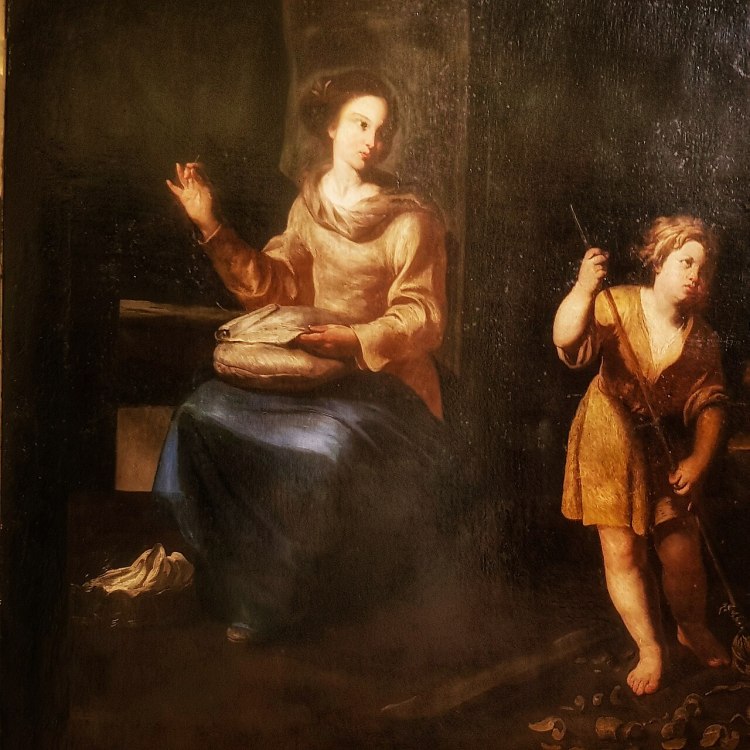
Seen in this way, collaboration becomes part of the evidence for Diana’s career rather than simply an obstacle to recovering it. The difficulty is not always to decide which of two painters made the whole work, but to recognise that Diana and Beltrano may sometimes have worked together while retaining sufficiently distinct habits for their contributions to remain partially visible.
Further works and attributional boundaries
Among the works Porzio has attributed to Diana are a Triumph of David, whose present location is unknown, and a Rape of Europa, shown in the 2022–23 exhibition Artemisia Gentileschi a Napoli. The latter had previously oscillated between Pacecco Di Rosa and Francesco Guarino. Porzio’s attribution to Diana rests on the female type, the refined treatment of jewellery and coiffure, and a softer handling that he relates to the broader Stanzionesque current in her work.
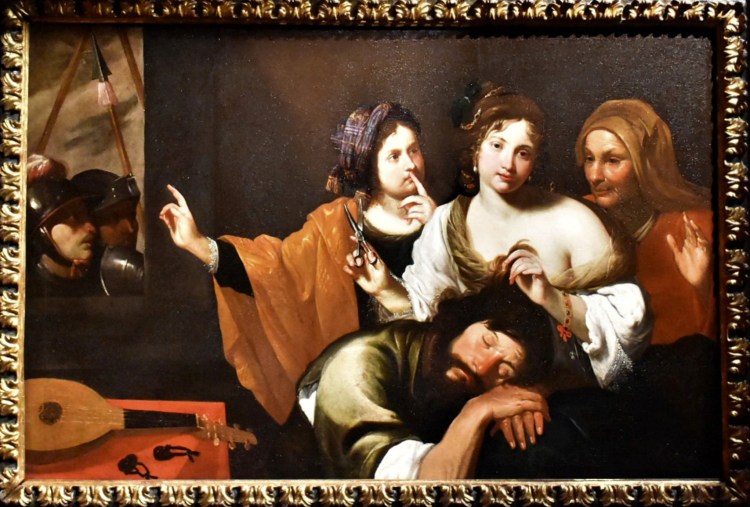
A compelling work is Samson and Delilah, now in a private collection. Porzio presented it in the 2022–23 exhibition Artemisia Gentileschi a Napoli at the Gallerie d’Italia in Naples as an important addition to Diana’s still restricted corpus, relating Delilah’s physiognomy and the softer handling of the paint to the emerging profile of the artist. The painting also has an exceptionally close relationship with Artemisia Gentileschi’s treatment of the same subject, although Porzio considers it impossible to establish securely the direction of dependence between them.
The Birth and Death of the Virgin at the Pietà dei Turchini occupy an important place in Porzio’s reconstruction. He regards their identification with the paintings historically associated with Diana as almost certain and treats them as significant evidence for her artistic personality. At the same time, their very close affinities with Beltrano, together with the documented involvement of Giuseppe Marullo in the Turchini decoration, make the precise division of authorship difficult to determine. Probably executed after an explosion damaged the church in 1638 and before Diana’s death in 1643, they appear at the end of Porzio’s provisional chronology.
More problematic, but especially intriguing, is the Salome with the Head of Saint John the Baptist at Schloss Braunfels. Porzio includes it in Diana’s catalogue after an earlier, cautious attribution to Stanzione by Rebecca Krämer, while also identifying a particularly clear intervention by Beltrano in the figure of the executioner. The 1649 Carafa inventory records a painting of closely related Baptist subject matter “de mano di Annella”, though, as already noted, the document does not prove that the surviving Braunfels canvas is the picture described there.
A still more uncertain case is the unpublished Sacrifice of Noah in the Limentani collection, Rome. Porzio singles it out as the highest-quality work he was able to examine at first hand within an early group in which Diana’s developing manner overlaps with Beltrano and Stanzione. He nevertheless considers the individual authorship of works in this group impossible to define with precision, and the Sacrifice of Noah is consequently not included among the twenty-nine paintings in his catalogue of Diana’s works.
The selection points less towards a fixed canon than towards different levels of certainty within the proposed corpus. The Boston Saint Cecilia remains unique in its security; Eliezer and Rebecca and several of the works discussed here can be attributed with increasing confidence, while others reveal how closely Diana’s artistic identity remained bound to collaboration and to the painters around her.
Towards a definition of Diana’s style
The recent scholarship assembled in Donne nella Napoli spagnola, above all Giuseppe Porzio’s work on Diana’s oeuvre, provides the basis for a cautious stylistic profile.
With the signed Saint Cecilia as a point of departure, and the surrounding attributions treated with appropriate caution, a more coherent artistic personality begins to emerge. Diana appears to favour relatively controlled compositions in which the principal figures are clearly separated and emotional attention is concentrated rather than dispersed. Even in narrative subjects there is often a sense of poise: gestures are restrained, exchanges are carried through glances and small movements, and dramatic incident is rarely allowed to overwhelm the figures themselves.
Her female figures provide the most immediately recognisable element. The elongated or delicately oval face, small mouth, clearly articulated eyes, soft pink accents and carefully arranged curls recur often enough to be useful, particularly when combined with pale, softly modelled flesh. Yet physiognomy alone is not sufficient. Porzio’s distinction from Pacecco also depends upon handling: Diana’s paint tends towards greater fluidity and transparency, whereas Pacecco more often produces a denser, smoother and almost enamelled finish.
Refinement of ornament is another recurrent feature. Jewellery, lace and patterned fabrics receive close attention, although this should not be detached from the example of Filippo Vitale and the wider family tradition. What seems more individual is the way Diana combines such detail with lightness and emotional restraint. Her naturalism remains recognisably Neapolitan, but the harsher Riberesque inheritance is softened through classicising elegance and a quieter treatment of expression.
Comparison with Beltrano helps sharpen the distinction further. His narratives tend to open outwards into landscape, subsidiary incident and anecdote; Diana’s, on the present evidence, are more selective and concentrated upon the central encounter. This does not amount to a rigid stylistic formula, particularly where the two may have collaborated, but it suggests a painter whose language was more intimate, fluid and measured than those of the closest artists around her.
None of these characteristics should yet be treated as diagnostic in isolation. The reconstructed corpus remains too provisional and too uneven for that. Their value lies in recurrence: where handling, physiognomy, ornament, compositional restraint and documentary context begin to reinforce one another, the case for Diana becomes correspondingly stronger.
Conclusion
Diana Di Rosa emerges less as a painter recovered through a single decisive discovery than through the gradual convergence of documents, early references and a more discriminating use of connoisseurship. The signed Saint Cecilia with an Angel has altered the balance of the discussion by providing a firm autograph point of reference, but the surrounding corpus is necessarily uneven. Some works can be argued with increasing confidence; others are best understood within the collaborative field shared with Beltrano and the wider Di Rosa–Vitale–Stanzione circle.
That unevenness is itself historically revealing. Diana’s career was embedded in a working environment in which artistic training, marriage, family organisation and workshop production continually overlapped. The difficulty of extracting an entirely autonomous oeuvre from that setting may therefore tell us something about the way paintings were actually produced rather than simply about the limitations of later scholarship.
The resulting picture is more convincing precisely because it remains provisional. The legendary “Annella di Massimo” has given way to a documented professional painter whose relationship with Stanzione was real but more complex than De Dominici allowed, and whose artistic identity can now be approached through a small but increasingly coherent group of paintings. There is still much that cannot be settled, but Diana no longer needs the dramatic story of her life to secure her place within seventeenth-century Neapolitan painting.
Producing these essays requires care, time, research, and resources. Contributions to help sustain this exploration would be greatly appreciated.
Donate to Inner Surfaces here.
Bibliography
I have consulted the following works. Any errors are mine.
Barnes, Margaret M., “Maestra mia”: Artemisia Gentileschi, Diana di Rosa and Women Artists within Seventeenth-Century Neapolitan Workshops, MA thesis, University of Washington, 2025.
Catello, Angela, “De Rosa, Diana,” Dizionario Biografico degli Italiani, vol. 39, 1991.
De Dominici, Bernardo, Vite de’ pittori, scultori ed architetti napoletani, Naples, 1742–45.
Ilchman, Frederick, and Cara Wolahan, “Saint Cecilia with an Angel,” in Donne nella Napoli spagnola. Un altro Seicento, Turin: Allemandi, 2025, cat. V.6, pp. 140–41.
Marshall, Christopher R., Baroque Naples and the Industry of Painting: The World in the Workbench, New Haven and London: Yale University Press, 2016.
Porzio, Giuseppe, “Artemisia a Napoli. Novità, problemi, prospettive,” in Antonio Ernesto Denunzio and Giuseppe Porzio, eds., Artemisia Gentileschi a Napoli, Milan: Skira, 2022.
Porzio, Giuseppe, Diana Di Rosa. “Bellissima, onestissima, virtuosa dipintrice” nella Napoli del Seicento, Naples: Porcini, 2023.
Porzio, Giuseppe, “Diana Di Rosa e un complesso familiare di artisti nella Napoli del Seicento,” in Donne nella Napoli spagnola. Un altro Seicento, Turin: Allemandi, 2025, pp. 115–22.
Porzio, Giuseppe, “Eliezer and Rebecca at the Well,” in Donne nella Napoli spagnola. Un altro Seicento, Turin: Allemandi, 2025, cat. V.3, pp. 128–29.
Prota-Giurleo, Ulisse, Un complesso familiare di artisti napoletani del secolo XVII, Naples: Rivista Municipale, 1952.
Scorzoni, Anna, “Sposalizio di Maria Vergine / Marriage of the Virgin,” in Donne nella Napoli spagnola. Un altro Seicento, Turin: Allemandi, 2025, cat. V.8, pp. 148–49.
Willette, Thomas, “La scuola stanzionesca,” in Massimo Stanzione: L’opera completa, Naples: Electa, 1992, pp. 121–51.
Reproductions of works discussed but not illustrated
All references are to Giuseppe Porzio, Diana Di Rosa. “Bellissima, onestissima, virtuosa dipintrice” nella Napoli del Seicento (2023).
Triumph of David — fig. 6.
Rape of Europa — pls. 15–17.
Marriage of the Virgin — pl. 36.
Birth of the Virgin — figs. 48, 50; pls. 38–40.
Death of the Virgin — figs. 52–53; pls. 41–43.

