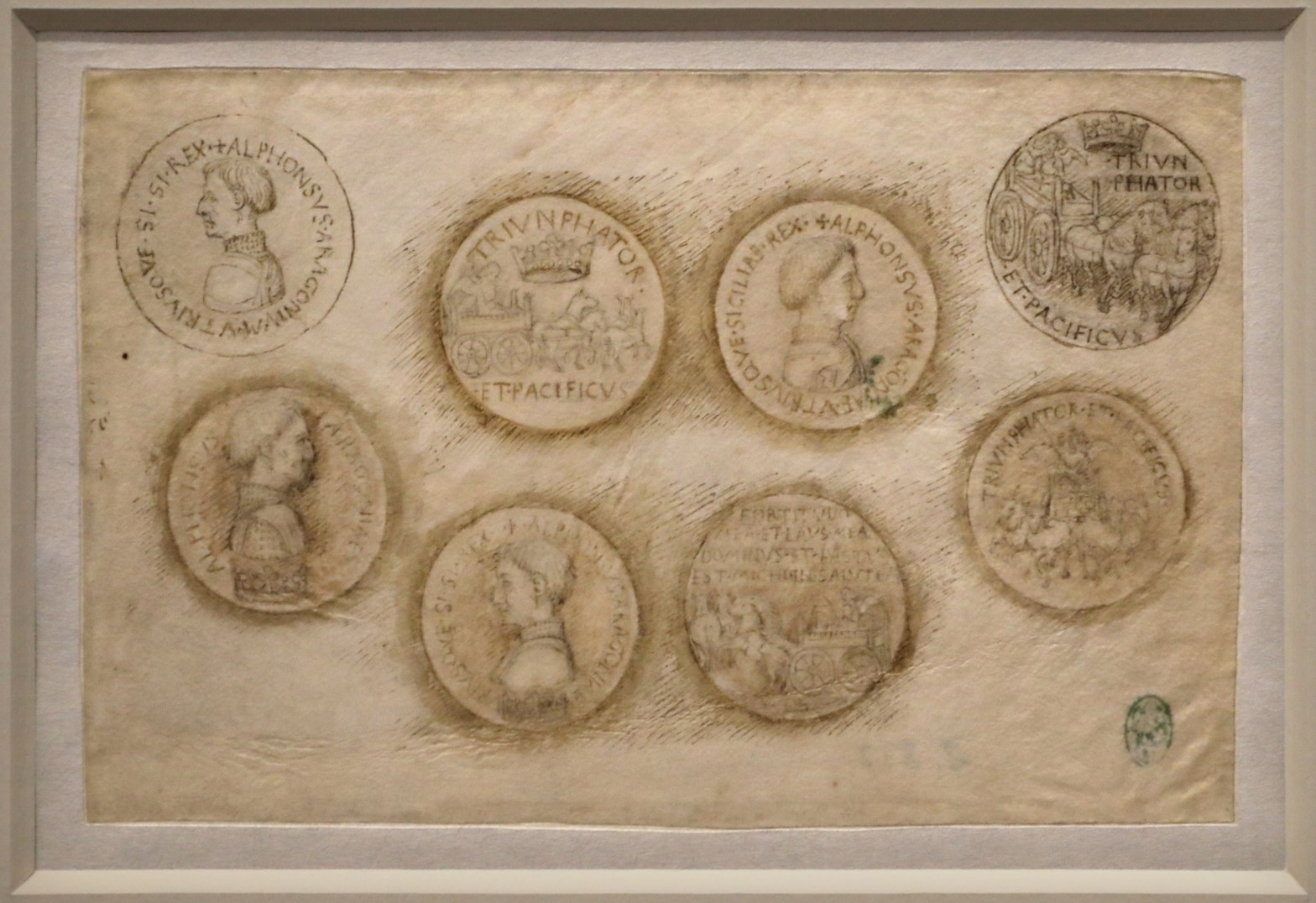
Pisanello, studies for the obverse and reverse of four medals of Alfonso V of Aragon, 1449. Pen and brown ink with ochre wash over metalpoint. Musée du Louvre, Paris, inv. 2317. Image: Wikimedia Commons / Musée du Louvre, Département des Arts Graphiques.
The interior as a different kind of text
The inscriptions on the exterior of the Pontano Chapel address the street. Their moral and political precepts are directed towards an audience beyond the building, to readers who encounter them as they pass. Inside, inscription assumes a different character. The texts become more personal and commemorative, recording the deaths of Pontano’s wife, his daughter Lucia Marzia, his sons Lucio Francesco and Lucilio, and his friend Pietro Golino, while ancient inscriptions, heraldic devices and the decorated maiolica pavement introduce other forms of memorial and self-representation. The distinction is not absolute, but the movement into the chapel is also a movement from public counsel towards family, friendship and the dead.
What we see today accumulated over time, as successive deaths gave Pontano new reasons to write and commemorate. The funerary writing of the chapel also overlaps with the much larger body of verse gathered in De tumulis, so that the monument and the printed collection belong to the same commemorative culture.
This essay will not document all the inscriptions in full, but will instead examine the different strands of meaning that emerge from the interior: family and friendship, funerary commemoration, the appropriation of antiquity, and Pontano’s wider literary and intellectual world. Individual texts will be quoted where their wording is important to the discussion.
Adriana Sassone
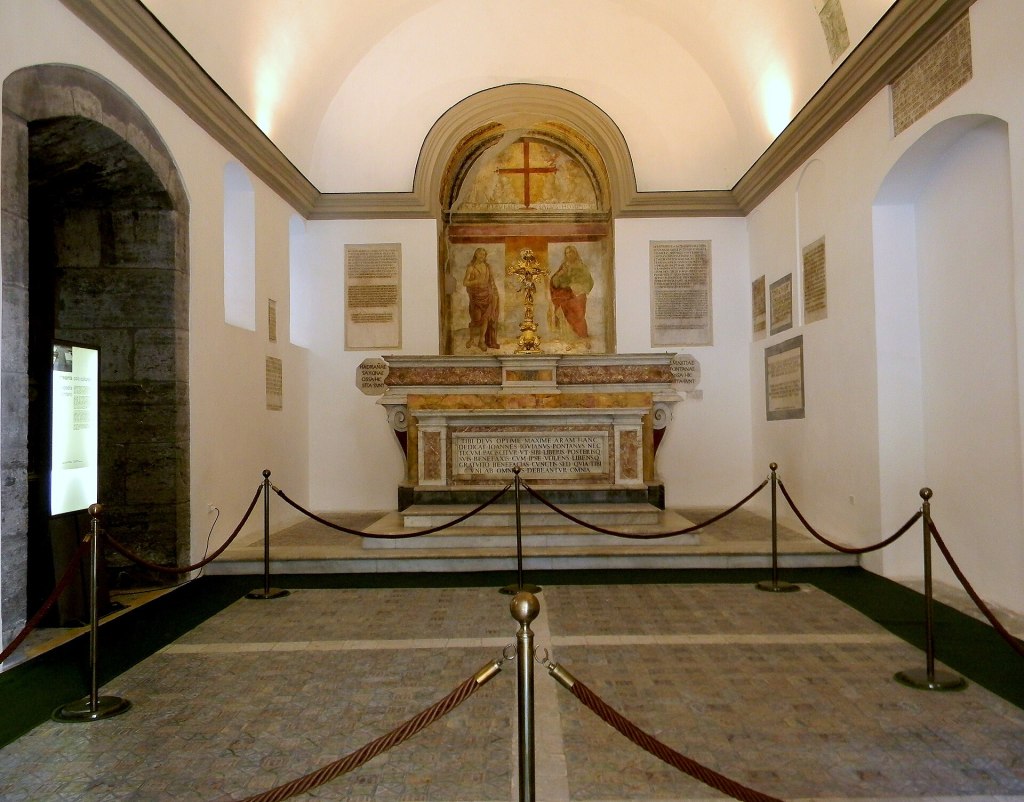
Adriana Sassone died on 1 March 1490, aged forty-six. Permission for Pontano’s new chapel followed later that year, on 13 September, and the building was consecrated in 1492. Her death was therefore closely bound up with its foundation, even though the chapel would soon acquire a much wider commemorative purpose. Pontano had married Adriana in 1461, when she was seventeen. As Ariadna, she had already become an important presence in his poetry, above all in the three books of De amore coniugali; after her death she appeared again in Meliseus and in De tumulis. The chapel gave permanent material form to a relationship that Pontano had been representing in different literary forms for almost thirty years.
The simplest of her surviving memorials is an octagonal tablet:
HADRIANAE SAXONAE OSSA HIC SITA SVNT
“Here lie the bones of Adriana Sassone.” Italo Sarcone associates it with her burial in the hypogeum, the subterranean burial chamber beneath the chapel, although he also suggests that its octagonal shape may once have related to the geometrical pattern of the maiolica pavement. Its original position cannot now be established with certainty. Alongside this terse identification, Pontano provided a much more elaborate epitaph consisting of three distinct parts: a passage in verse, a prose commemoration, and a concluding dedicatory inscription. Adriana is therefore remembered through several kinds of language within the same monument, ranging from the bare identification of her remains to literary praise and direct address.
The longer epitaph begins with verse. This inscribed poem is closely related to an elegy that Pontano also included in De tumulis, although the monumental and literary versions are not identical. Sarcone records variants between them, so the poem on the wall should not simply be treated as a transcription from the book. What matters here is that both versions commemorate Adriana through a recognisably Roman language of marital and domestic virtue.
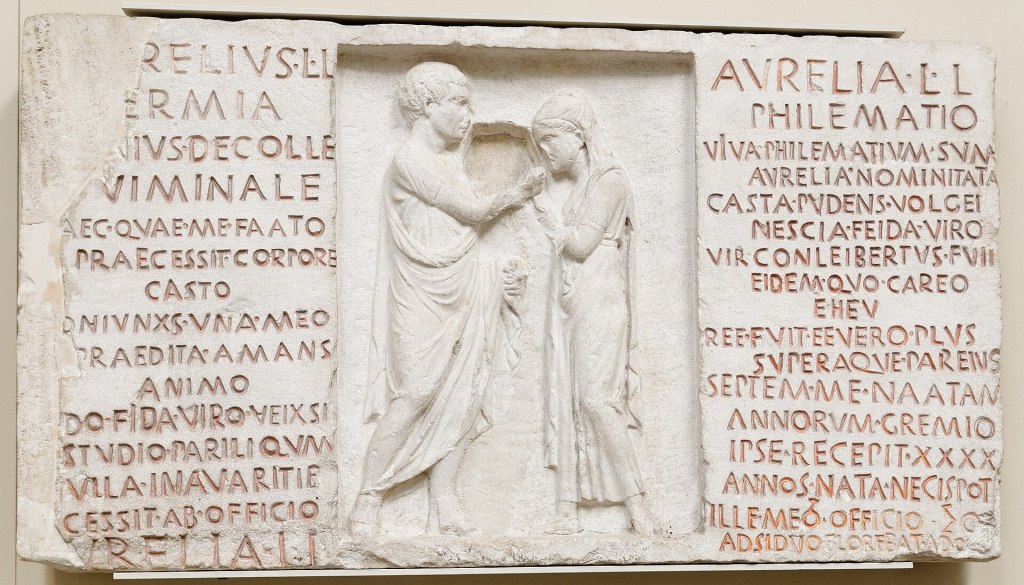
She is presented as the faithful companion and guardian of a chaste marriage, a woman devoted to one husband, an affectionate mother, and the custodian of the household and its Lares. The needle and distaff also appear among the attributes through which her domestic life is characterised. Sarcone connects this vocabulary with Roman funerary commemoration, in which wives were repeatedly praised through fidelity, motherhood, chastity and care of the household. Pontano is not merely writing in a vaguely classical manner. He selects precisely the kinds of qualities through which Roman epitaphs had long constructed the exemplary married woman.
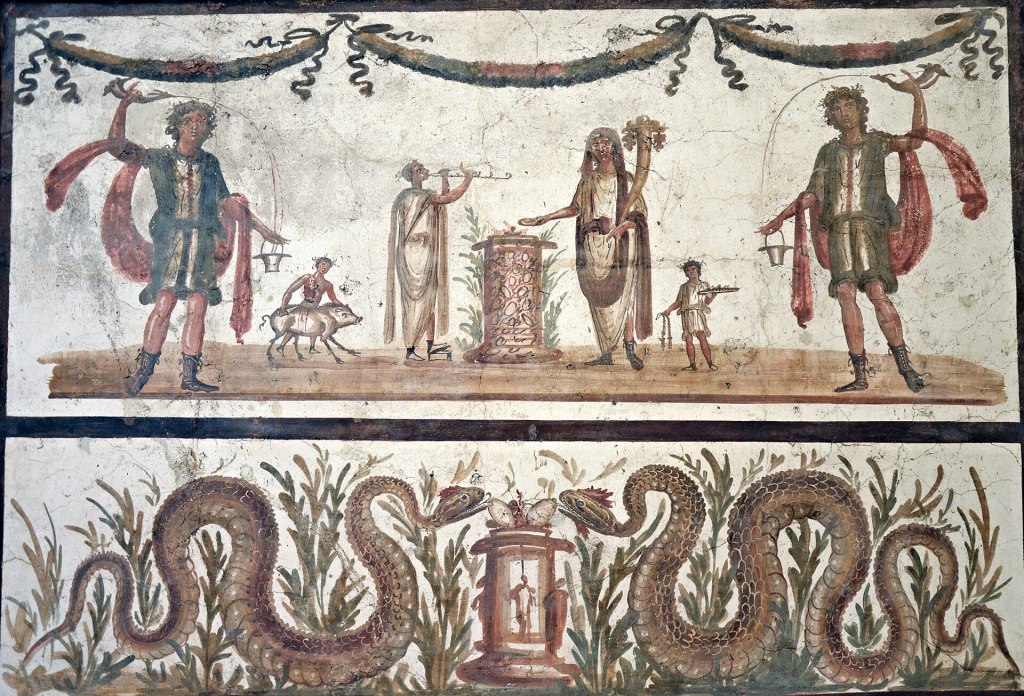
An unusually revealing comparison is the ancient funerary inscription conventionally known as the epitaph of Claudia. It is not a passage preserved by a Roman literary author but an actual funerary inscription, now lost, known through the epigraphic tradition. It is catalogued in the Corpus Inscriptionum Latinarum, the standard scholarly collection of Roman Latin inscriptions, as CIL I² 1211. Claudia herself is otherwise unknown. The inscription praises her love for her husband, records that she bore two sons, and describes her as agreeable in speech and dignified in manner before ending with the compressed domestic formula domum servavit, lanam fecit: “she kept house; she worked wool.” Pontano does not copy the inscription, but the constellation of virtues is strikingly similar. Adriana too is commemorated as wife, mother and guardian of the household. The comparison shows how readily a highly personal loss could be articulated through an inherited epigraphic language of exemplary womanhood.
That funerary image should not be mistaken for a complete portrait of Adriana or of the marriage. De amore coniugali had already fashioned her through a different literary convention. Its opening poem is an elaborate Ovidian address to the prospective bride, populated by Elegy, Cupid, Venus and the Graces, and rich in myrtle, flowers and perfume. Ariadna is advised to value song above wealth, to avoid ostentation and foreign fashions, to speak modestly and to reserve herself for the poet who promises companionship and fidelity into old age. The poem is highly stylised and prescriptive. Carol Kidwell rightly raises the question of how directly such a literary exercise should be taken as evidence for the woman to whom it was addressed.
Elsewhere Pontano presents a rather different Adriana. In the Antonius she appears not as a passive embodiment of domestic virtue but as a wife capable of asserting herself forcefully and humiliating her husband when he was unfaithful. The difference is useful precisely because it warns against trying to extract a single stable personality from texts belonging to different genres. The prospective bride of De amore coniugali, the formidable wife of the Antonius, and the exemplary uxor of the funerary inscription are not necessarily competing claims about which Adriana was “real.” They are different literary constructions shaped by different occasions and inherited forms. In the chapel, the Roman language of the virtuous wife is the one appropriate to commemoration.
The poem then turns from Adriana’s virtues in life to the honours paid at her grave. Roses and violets are to flourish where she lies; Syrian perfume fills the place; crocus, amomum and other aromatic substances are imagined around her ashes. These are recognisably antique funerary gestures, but in Pontano they are not confined to a reconstructed pagan past. They enter a Christian commemorative practice that included repeated visits to Adriana’s grave and the celebration of a funeral mass for her on the first day of each month. Ancient and Christian forms of remembrance therefore coexist without any obvious sense of incompatibility. The flowers and fragrances of classical funerary poetry could belong to the same commemorative world as prayer and the mass.
The literary form itself participates in that process. Pontano is not simply reporting objects that might be placed at the tomb. By naming roses, violets, incense and aromatic spices, the poem recreates in language something of the sensory character of funerary offering. It would be too strong to say that the poem simply becomes an offering in place of material ritual, but it performs an analogous commemorative work: it summons the substances, gestures and atmosphere through which the dead might be honoured.
The same vocabulary also extends beyond death. In De amore coniugali, when Pontano celebrates the birth of his long-awaited son Lucio Francesco, multicoloured roses are scattered through the house, perfumed fires fill the dwelling, and myrtle and laurel decorate the household shrine. After Lucio’s death, offerings and annual prayers return in the commemorative verse. Flowers, fragrance and ritual gesture therefore belong to a wider language of family observance, accompanying marriage, birth and death. In Pontano’s writing, antique forms of celebration and mourning could be absorbed into the life of a Christian household rather than standing apart from it.
Five years after Adriana’s death, Pontano added a prose commemoration that is much more direct in tone. He explains that, after the chapel had been dedicated, he set up the monument so that he might speak with his wife every day. Although Adriana cannot answer him, his desiderium tui, his longing for her, will answer, and the memoria through which he now speaks with her will not fall silent. The language is worth attending to because Pontano does more than claim that memory preserves the dead. Longing itself is made to respond in Adriana’s absence, while remembrance becomes the medium through which the conversation continues.
He then looks forward to their physical reunion. When his bones have been mingled with hers, he says, they will be together again. The close measures the life they shared with extraordinary precision: he had lived with Adriana for twenty-nine years and nineteen days. Against that finite and countable span he sets the eternity he expects after death. The effect depends upon the contrast between measured earthly time and an afterlife without measure. The chapel does not erase Adriana’s absence, but it establishes a place in which Pontano can continue to address her while anticipating the eventual reunion of their remains.
The final dedicatory inscription returns to a much more conventional epigraphic register. Pontano names himself as the dedicator and describes Adriana as his “excellent and most deserving wife.” Here the Roman precedent lies not only in the virtues assigned to her but in the very structure of the inscription: deceased, relationship, dedicator, age and date of death are compressed into a formal public record. Within the same memorial, Pontano therefore moves between poetic praise, intimate second-person address and the terse documentary conventions of the funerary inscription.
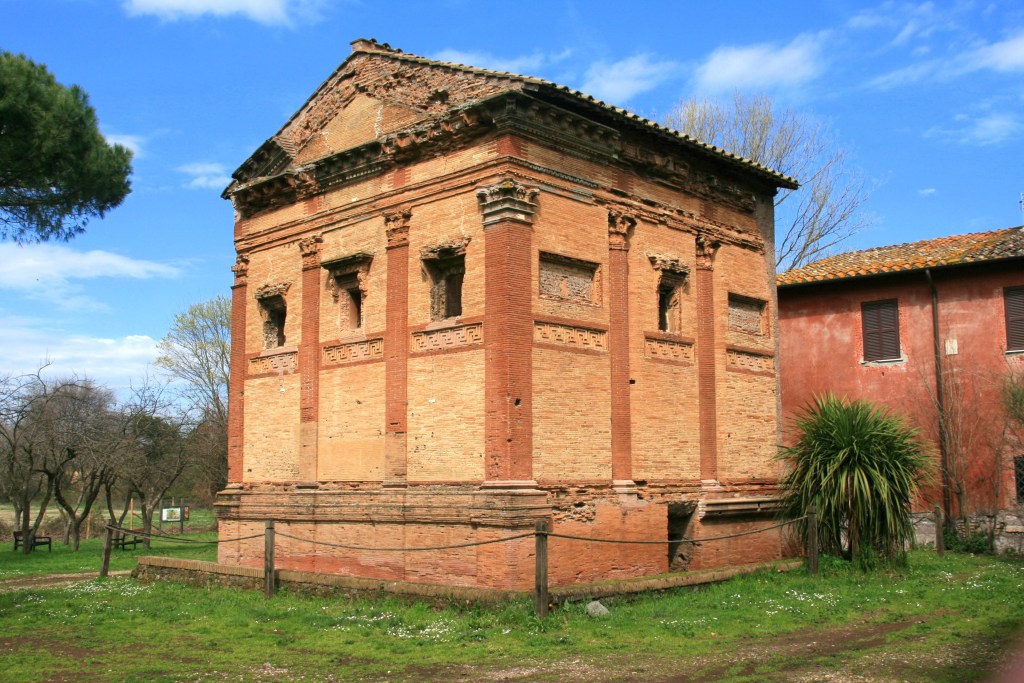
The wider antiquarian context may have offered further precedents for such conjugal commemoration. Maia Wellington Gahtan has drawn attention to Herodes Atticus, the wealthy second-century Greek sophist and Roman senator, and the elaborate memorial culture surrounding his wife Annia Regilla, who died around AD 160. Herodes commemorated her extensively, particularly at the Triopion, an estate and funerary precinct on the Via Appia associated with her memory. Greek inscriptions there protected the precinct and its objects from disturbance. These inscriptions were known to Renaissance antiquarians, including Fra Giocondo, and Gahtan suggests that Pontano’s circle may also have known the association between them, Herodes and the commemoration of Regilla.
The comparison remains hypothetical, but it is more specific than a general appeal to Roman funerary custom. Herodes’ memorialisation of Regilla joined the remembrance of a wife to architecture, inscription and the appropriation of antiquity. Gahtan also notes a possible architectural resemblance between Pontano’s chapel and the funerary building traditionally associated with Regilla, as well as the unusual inscription protecting Pontano’s own family burial place. None of this establishes direct imitation, but it indicates the kind of ancient conjugal monument that could have been available to a humanist antiquarian imagination.
A contemporary Neapolitan example brings us closer to Pontano’s own circle. In 1497 Antonio Rota, a high-ranking Aragonese official associated with the Accademia Pontaniana, commissioned for the family chapel in San Pietro a Maiella a cenotaph for himself and his still-living wife Lucrezia Brancia. The monument was later transferred to the Rota chapel in San Domenico Maggiore. Its inscription anticipates their eventual shared burial and praises the concord of their married life. Scipione Ammirato later attributed the epitaph itself to Pontano. If that attribution is accepted, Pontano was composing conjugal funerary language not only for his own chapel but for another prominent Neapolitan household. The Rota monument therefore suggests that the commemoration of marriage through classical funerary forms formed part of a wider humanist culture in which Pontano himself may have acted as both author and exemplar.
The children: Lucia Marzia, Lucio Francesco and Lucilio
The deaths of Pontano’s children altered the commemorative character of the chapel still further. If Adriana’s inscriptions centre on marriage and the continuation of an intimate relationship after death, those for Lucia Marzia, Lucio Francesco and Lucilio repeatedly confront another form of loss: children dying before their father. Pontano makes the reversal of generations itself one of the subjects of commemoration. The inscriptions record not simply premature death but the disruption of an expected sequence in which children should survive their parents, inherit from them and continue the family.
Lucia Marzia, the youngest of Pontano and Adriana’s three daughters, died while still in her teens, probably in 1479, although the precise date remains uncertain. Like Adriana, she was commemorated by an octagonal tablet and by a larger inscription combining verse, prose and a final dedicatory statement. The latter identifies her as Pontano’s “dearest daughter” and records her age with characteristic precision: fourteen years, seven months and twelve days. Her octagonal tablet states simply that her bones lie there. Sarcone suggests that it may originally have been associated with the hypogeum, the subterranean burial chamber beneath the chapel, although its precise original position is uncertain.
The verse inscription is organised around light and darkness. Lucia’s name itself invites association with lux, light. Pontano initially presents himself as the one left in darkness because his daughter has been taken from daylight, but the image is then reversed: Lucia has not simply been carried from light into darkness. She has escaped the darkness of earthly existence and now shines in celestial light. Pontano looks towards heaven and asks whether she in turn looks back at her father, before wondering whether the consolation he seeks may itself be something produced by paternal grief.
Sarcone places this uncertainty within a much older classical tradition of mourning. He compares Pontano’s attempt to address Lucia with Catullus’ lament for the unresponsive ashes of his brother, and sees another ancient resonance in the suggestion that Lucia might count herself fortunate to have died young. The thought has a specific Greek pedigree. In verses associated with Theognis, the best fate is said to be never to have been born and seen the light of the sun; for those who have been born, the next best is to reach death as quickly as possible. Sophocles gives the idea one of its most famous formulations in Oedipus at Colonus, where the chorus similarly declares that not to be born is best and that, once born, a swift return from life is next best. Sarcone’s comparison places Pontano’s effort to find meaning in Lucia’s early death within a tradition in which the brevity of life could paradoxically be imagined as an escape from its sufferings.
The prose inscription turns to the circumstances of Lucia’s death. Pontano dwells on the fact that she died without her immediate family beside her. He himself was absent and could not ease her suffering; her sisters were not there to mingle their tears with her groans; her brother could not give her even a little water in her thirst; and Adriana was unable to take her daughter into her arms, embrace her and kiss her departing soul. Sarcone draws attention to Pontano’s use of diminutives, including aquulam, “a little water”, and animula, the “little soul” or “dear little soul” leaving the body. The inscription preserves not only grief at Lucia’s death but Pontano’s distress that neither he nor the rest of the family had been present to comfort her as she died.
The ending draws Lucia back into the family burial place. Pontano says that he expects soon to sleep with both his daughter and Adriana, and asks Lucia in the meantime to warm her mother’s cooling ashes until he himself comes to join them. The image carries a Christian expectation of reunion after death, but its concentration on shared burial and the physical proximity of family remains also has strong Roman precedents. Roman family tombs commonly gathered successive generations together, while continuing rites maintained relations between the living household and those already buried. Christianity did not simply displace those familial habits of commemoration. In Pontano the two traditions could coexist: Lucia, Adriana and eventually Pontano himself are imagined not simply as separate dead individuals but as members of a family whose relationships continue within the tomb.
The imagery of light in Lucia’s inscription can be understood at the level of familiar poetic convention, but it also belonged to a much larger intellectual vocabulary for Pontano. In De rebus coelestibus, his extensive work on the heavens and their effects upon the terrestrial world, the sun is a principal agent in generation, and its heat is connected with sensation and intellectual activity. In the dialogue Aegidius, Pontano reasons from the extraordinary reach of physical sunlight to the still greater power of divine action. Elsewhere, in Book V of Urania, his major astronomical poem, Lucia herself appears as a source of heavenly illumination: Pontano imagines his own ashes lying in the obscurity of the tomb while the light she sends from heaven dispels that darkness and preserves his reputation among later generations.
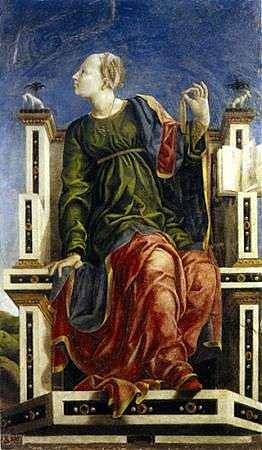
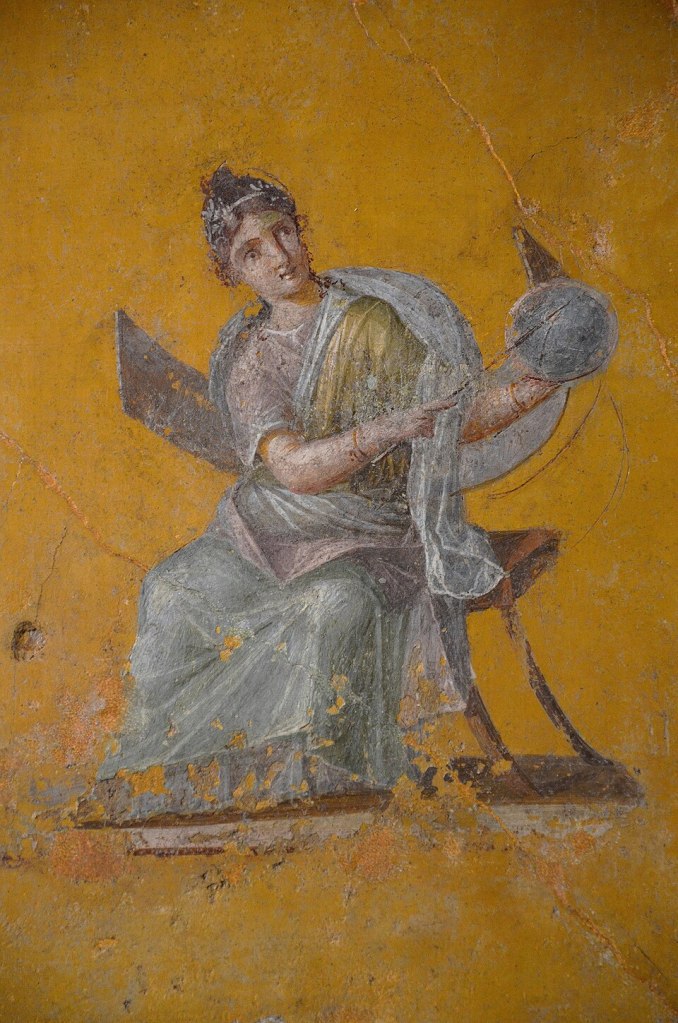
This does not require us to turn Lucia’s epitaph into a coded cosmological statement. Light and darkness were fundamental images of life and death in many traditions. But Pontano’s wider writings give them an additional range of associations. Light could signify generation, sensation, intellectual activity, divine action and continuing fame. Charles Trinkaus has shown how Pontano attempted to understand the celestial order through analogies with human life, society and volition. The stars and planets exerted real influences upon terrestrial existence, including bodily constitution and human temperament, but Pontano did not regard those influences as absolute: his cosmology continued to leave room for divine providence and human freedom. Lucia’s movement from earthly darkness into celestial light therefore belongs to an intellectual world in which the sun and stars were understood to exercise real effects on life below.
The death of Lucio Francesco in 1498 brought another kind of rupture. Born in 1469 after Pontano’s three daughters, he was the long-awaited male heir. Pontano’s hopes for him are visible throughout his writing. The twelve Naeniae in De amore coniugali are lullabies addressed to the young child, while Urania, one of Pontano’s largest and most ambitious poems, was dedicated to him. Lucio later married and had a daughter, Tranquilla, but died at only twenty-nine.
His chapel inscription concentrates less on light and darkness than on the reversal of generations. Pontano recalls that he had prepared the altar and chapel to God in the expectation that his son would one day cover his father’s ashes there. Instead, the father finds himself constructing the son’s tomb. The language repeatedly sets the generations against one another: father and son, old man and boy, parent and child. Sarcone draws attention to these pairings, through which the inversion of the expected order becomes embedded in the language of the poem itself.
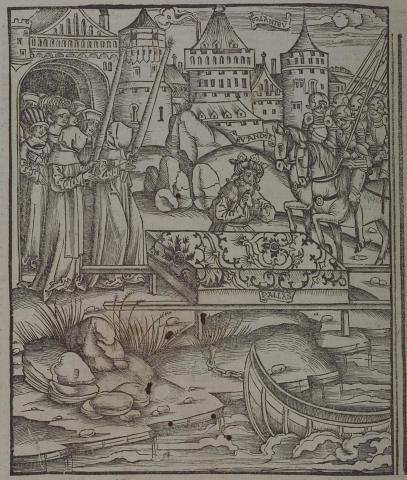
That sense of generational disorder belongs to a long classical tradition. Herodotus gives it memorable form when Croesus observes that in peace sons bury their fathers, whereas war reverses the proper order and fathers bury their sons. Roman literature repeatedly returns to the same horror. In Book XI of Virgil’s Aeneid, the death of the young Pallas is made especially painful by the knowledge that his ageing father Evander must receive his body and perform the rites that the son might normally have been expected to perform for him. Pontano gives this inherited theme a private and dynastic form: the father who had expected his son eventually to bury him finds himself building the son’s tomb.
The bitterest conceit comes at the end. Lucio had been the heir, yet what he receives from his father is a tomb as his patrimonium, his inheritance. Pontano in turn describes himself as the heir to grief. The inscription therefore differs markedly from those for Lucia and Lucilio. Its subject is not only premature death, but the collapse of an expected succession: the father who had anticipated leaving property, name and responsibility to his son instead leaves him a monument.
The pathos is intensified by Pontano’s insistence on his own role as maker. He says that he himself raised the altar and temple and now himself constructs the son’s tomb. The chapel, elsewhere marked by the assertion PONTANUS FECIT, becomes implicated in the reversal it records. Pontano can make a monument durable, but he cannot restore the succession the monument had been intended to outlast.
Lucio’s death continued to occupy him outside the chapel. In the Iambici addressed to Tranquilla, Pontano repeatedly returns to her father’s absence. In one poem he remembers Lucio as a child caring for plants and flowers. After his death the plants themselves seem to mourn: their leaves wither because no one remains to tend them, and Pontano promises to water them with his tears. The image is painfully domestic, intimate and personal. It returns the dead heir from the level of succession and dynastic expectation to the remembered habits of an individual child.
Lucilio belongs to a different branch of Pontano’s family life. He was not Adriana’s son, but the child of Stella, Pontano’s Ferrarese mistress, with whom he began an extramarital relationship in 1483 while Adriana was still alive. Pontano celebrated Stella extensively in the Eridanus. Its title uses the classical poetic name of the Po, evoking the river and landscape of the Ferrarese region from which Stella came. Stella bore Pontano Lucilio, who survived for scarcely fifty days. She herself died shortly before the infant, and both mother and child received poems in De tumulis. Lucilio was also commemorated in the chapel.
Here the language of light becomes more elaborate and more painful. Stella’s name means “star”, while Lucilio is associated with lux, light. Pontano asks whether he and Stella gave the child a name that seemed to promise light, only for “black Night” and “black Gloom” to take both mother and son away. The initial letter of Lucilio’s name supplies a second and harsher conceit: L is also the Roman numeral for fifty, and the infant lived scarcely as many days as that letter signifies.
Sarcone interprets this convergence of name, number, light and death as more than verbal ingenuity. He sees in it an attempt to discover signs of fate in what has happened to the child. The interpretation has particular resonance in the context of Pontano’s sustained interest in astrology and the celestial influences already encountered in the discussion of Lucia. Lucilio’s inscription does not formulate a theory of fate, but its anguished attempt to read destiny in a name and a number belongs naturally within that intellectual world.
At its close, however, the poem returns from names, stars and possible signs of destiny to the material language of funerary care. Flowers are to grow over the tomb, perfume is to rise from the urn, and fragrance is to surround the ashes. The prose statement records that Lucilio did not complete fifty days of life and describes him as an enduring source of parental grief and longing. The vocabulary recalls that used for Adriana: whatever intellectual meanings Pontano draws from the child’s name and fate, commemoration eventually returns to the familiar gestures of flowers, fragrance, ashes and continuing care.
Taken together, the three children’s memorials do not repeat a single language of grief. Lucia’s moves uncertainly between darkness and celestial light while dwelling on a death made more painful by the absence of her family. Lucio Francesco’s turns on inheritance and the reversal of generations: the son who should have buried his father instead receives a tomb from him. Lucilio’s transforms names associated with light and stars into signs of mortality and possible fate. Each inscription therefore finds a different structure through which to make an early death intelligible.
What joins them is Pontano’s continuing effort to preserve relationships after their expected future has disappeared. Lucia is imagined with her mother in the family burial place; Lucio receives the monument that has replaced his inheritance; Lucilio is surrounded in verse by the flowers and perfume denied to his brief life. The chapel becomes increasingly crowded not simply with the dead but with interrupted futures: children who did not survive their father, an expected male succession overturned, and relationships repeatedly reconstructed through inscription. The precision with which their ages are recorded, down to months and days, gives these losses a documentary exactness, while the poems refuse to leave them as bare facts.
De tumulis: a wider community of the dead
The family inscriptions in the chapel belong to a much larger body of funerary writing. Several have counterparts in De tumulis, Pontano’s collection of epitaphic poems, although the versions preserved in the book and those carved in stone are not always identical. The relationship is therefore not simply one of transcription. The chapel monumentalises a small and intensely personal group of texts, while De tumulis extends the same practice of commemoration into a far wider human world.
The physical setting strengthens the connection. Poems whose imagery repeatedly moves between light and darkness were placed within a chapel whose austere interior strongly recalls an ancient Roman house tomb. Pontano’s family inscriptions stood in the company of ancient Greek and Roman epigraphs, even if the precise history and arrangement of some of those stones remains uncertain. Beyond the walls of the chapel, De tumulis creates what might be called a literary Via Appia: a succession of the dead encountered through their epitaphs rather than their tombs.
The range is remarkable. Mario Santoro described the collection as embracing illustrious figures and members of Pontano’s family alongside humble or unknown people of very different origins, collectively producing the image of a large and varied society. A person may be caught in a characteristic gesture, an occupation, a vice, a misfortune or the particular event that brought about death. Social distinction does not disappear, but commemoration is not confined to the distinguished. Nobles, poets and learned men share the collection with servants, peasants, merchants and people whose lives would rarely have secured monumental remembrance.
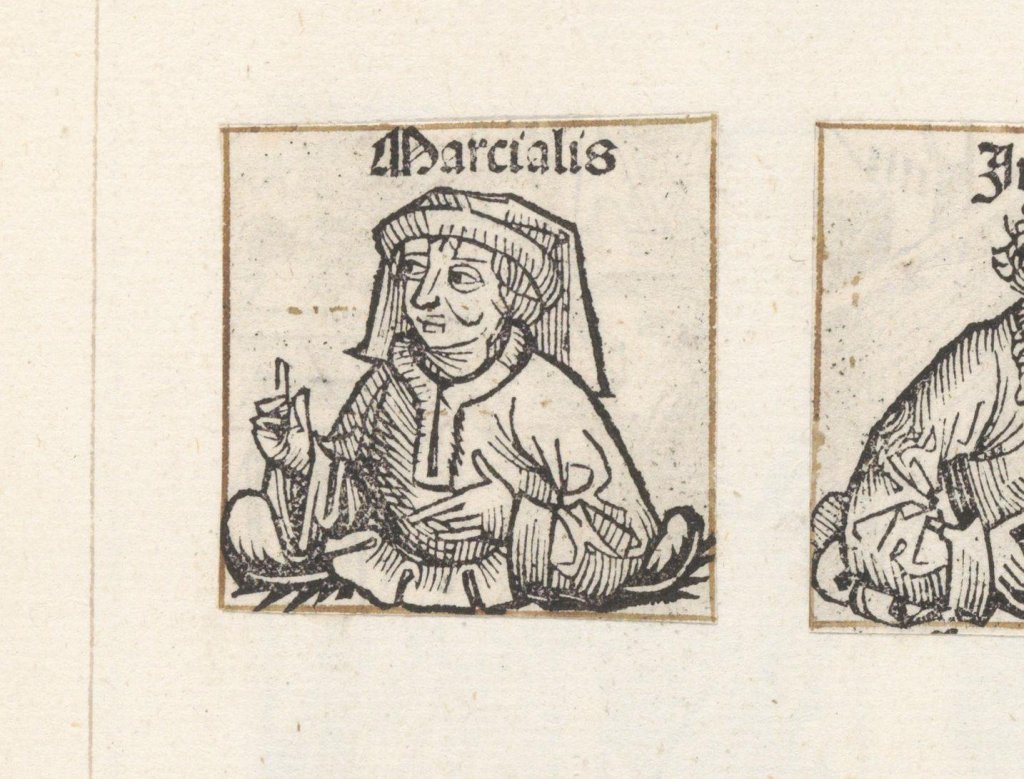
This breadth also reflects the literary tradition in which Pontano was working. The short, pointed epitaph belongs to the world of the classical epigram, particularly Catullus and Martial. That tradition allowed an unusual degree of social observation. Martial could move rapidly between admiration, mockery, obscenity, affection and cruelty, turning the inhabitants of Rome into the subjects of an intensely observant social poetry. Pontano’s earlier verse had exploited the erotic and comic possibilities of the same tradition. In De tumulis the subject has changed, but something of its freedom remains. Tragedy and tenderness coexist with irony, satire and occasionally very dark humour. Death does not oblige every dead person to become exemplary.
This makes the inclusion of Pontano’s own family poems particularly striking. The anguish surrounding Adriana, Lucia, Lucio Francesco and Lucilio forms part of the same collection that records much less elevated lives and deaths. Private bereavement is therefore placed within a larger social field. Pontano the husband and father cannot be entirely separated from Pontano the administrator and citizen, a man whose career had made him unusually attentive to the complicated human fabric of Naples. The collection moves across social boundaries because his literary imagination does too.
There is also a more fundamental equality imposed by the subject itself. Whatever distinctions remained between the people commemorated, every poem begins from the fact that a life has ended. Santoro saw in this a dimension extending beyond a simple picture of contemporary society: the individual is caught at a point where the accidents of profession, status and circumstance meet the universal condition of mortality. De tumulis does not abolish social hierarchy, but death repeatedly exposes its limits.
The opening of the collection gives this commemorative project a ritual dimension. Pontano announces a change from the poetry of love and marriage towards songs for the dead, encompassing young and old, men and women. The funerary landscape is animated by figures from his poetic world. Urania gathers flowers and myrtle; the Graces participate in the act of mourning; and places around Naples themselves seem to join the rite. Classical poetry and the actual geography of Pontano’s life are brought together around the graves.
At the centre of this passage is the insistence that tombs possess their own honour and graves require their own care: Est suus et tumulis honor, est sua cura sepulcris. The Manes are invoked, the spirits of the dead understood in Roman religion as recipients of continuing funerary honour. Familiar from inscriptions dedicated Dis Manibus, “to the divine spirits of the dead”, they belonged to a culture in which burial did not bring the obligations of the living towards the deceased to an end.
That language belongs more broadly to the Roman mos maiorum, the “custom of the ancestors”: the inherited practices and obligations through which Roman society understood proper conduct. In the sphere of death this included duties towards burial, family tombs and the continuing commemoration of the dead. Pontano brings this Roman language of obligation into a Christian funerary setting, allowing the two traditions to coexist rather than treating them as separate systems.
The prologue to De tumulis goes further by presenting poetry itself as part of that commemorative duty. Even mute ashes are owed words and prayers, and the dead are imagined as receptive to mournful song. A funerary poem therefore becomes not merely a description of grief but an act of address and remembrance. The same impulse that made Pontano set words into marble also generated a literary collection in which commemoration could continue beyond the physical limits of the chapel.
In Aegidius, Pontano treats burial and commemoration as obligations with consequences beyond private grief. He praises the victor who allows a defeated enemy time to bury the dead and maintains that families should observe funeral rites even while acknowledging the danger of superstition. Funerary observance therefore appears in his thought as part of the proper ordering of family and community.
That wider perspective prevents the chapel from becoming entirely enclosed within Pontano’s immediate family. De tumulis places Adriana and the children among a much larger population of the dead, while the ancient inscriptions within the chapel similarly introduce spouses, children, freedmen, officials, patrons and other inhabitants of the ancient city. The parallel should not be pressed into a claim about a deliberately constructed programme, but the resonance is suggestive. Both the literary collection and the epigraphic environment preserve human lives through short, concentrated acts of naming and description.
The movement beyond blood relationship is completed within the chapel itself by Pietro Golino. He belonged not to Pontano’s family but to the circle of friends and intellectual companions who had shared much of his adult life. De tumulis is dedicated to Golino, and after his death he too became one of its subjects. His burial beside Pontano’s wife and children therefore introduces another kind of relationship into the monument: friendship freely maintained across more than half a century. With Golino, the social world of Pontano’s academy and his sodales, his companions and associates, enters the family tomb. His epitaph will also introduce a very different voice, one in which grief gives way to scepticism, complaint and affectionate mockery.
Pietro Golino: friendship and the academy
The burial of Pietro Golino extends the chapel beyond family commemoration. Golino, sometimes called Pietro Compatre, had been one of Pontano’s closest friends for more than half a century. Like Pontano, he belonged to the administrative world of the Aragonese kingdom as well as to its literary culture. He worked in financial administration, served at times as president of the Sommaria and became vice-chancellor of the Kingdom in 1483. His presence in the chapel therefore introduces a relationship different from those represented by Adriana and Pontano’s children: not kinship, but a friendship sustained through intellectual, social and public life.
Such friendship had a strong classical pedigree. Cicero’s De amicitia had treated friendship as an ethical bond grounded in affection, constancy and shared values, capable of extending beyond private companionship into civic life. The culture of Pontano’s sodales belonged to this wider humanist recovery of classical forms of association. Reading, conversation, argument, poetry and shared leisure helped define the intellectual community that gathered around Pontano. Golino’s burial within the chapel gives physical permanence to one of those chosen relationships.
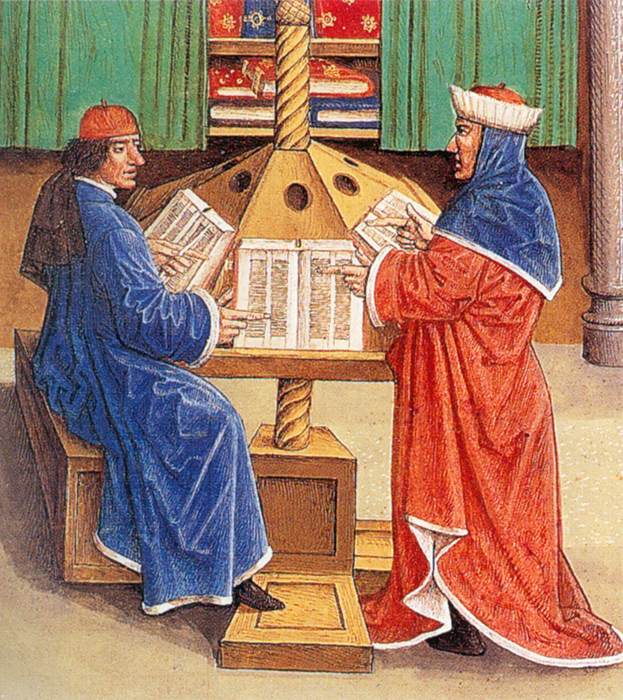
The tone of Golino’s epitaph is nevertheless strikingly different from that of the family inscriptions. The dead man speaks for himself in an abrupt exchange with an imagined interlocutor. Asked what he is doing, he answers that he is mouldering, tabesco. Asked who he is, he replies with the brutally compressed fui: “I was.” Golino had occupied important offices and shared the intellectual life of one of the most distinguished humanists in Naples, yet the epitaph initially reduces identity to physical decay and a verb in the past tense.
The dialogue then expands into an inventory of life’s experiences. Golino recalls labour, pain, illness and mourning, service beneath powerful masters, the burden of superstition, the burial of beloved friends and the spectacle of his country ruined and its people driven into exile. The catalogue moves between bodily suffering, personal bereavement and public disillusionment. It is difficult to read it without sensing the historical world in which both Golino and Pontano had grown old: long service to the Aragonese monarchy followed by political upheaval, foreign invasion and the collapse of institutions to which they had devoted much of their lives.
The epitaph does not, however, remain solemn. After enumerating the miseries he endured, Golino observes that there was one affliction from which he escaped: the troubles caused by a wife. The joke depends upon his lifelong bachelorhood and recalls the social world in which the friendship had been lived. Golino appears repeatedly in Pontano’s Baiae, poems set at the celebrated thermal resort of Baia. Since Roman antiquity the place had carried a notorious reputation for luxury and sexual licence: Seneca condemned its drinking, boating parties and lovers’ assignations, while Martial and Propertius made its capacity to compromise respectable sexual behaviour a subject of epigram. Pontano deliberately revives something of that ancient Baiae in his own poems, populating the resort with friends and members of the Aragonese court engaged in bathing, flirtation, erotic pursuit and comic social encounters. The ageing Golino belongs to this world. In one poem women initially avoid him, only to become markedly more attentive when they discover that he is wealthy.
The corresponding poem in De tumulis continues the joke after death. A passer-by asks Golino about marriage, the dead bachelor advises against it, and when the traveller admits that he is already married, Golino offers little consolation beyond urging him to escape its burdens. The literary version thus expands a joke compressed in the monumental epitaph. As elsewhere, book and stone preserve related material without simply duplicating one another.
The humour does not erase the bleakness of fui. Work, office, friendship, suffering and political experience are all gathered retrospectively beneath the knowledge that the speaker now belongs to the dead. Yet Pontano places that declaration where it can continue to be read. Golino’s voice, once part of the conversation and banter of the academy, is given one final form of continuance through inscription.
Antiquity made personal
Some of the ancient inscriptions in the chapel may have been chosen because they carried a direct relevance to Pontano’s own experience. That possibility is especially suggestive in a funerary setting where his wife, children and closest friend were also commemorated. Ancient epigraphy need not have remained a detached survival from the past: once collected and placed within a new setting, an inscription could acquire meanings generated by the lives of those who now read it.
One particularly suggestive case is the funerary dedication associated with Pomponius Rhenus, who commemorated younger members of his family who had died before him. Such a text would have had obvious resonance for Pontano, who himself survived several of his children. Another inscription commemorates Maecenatia Erusa, who died at fifteen, close in age to Lucia Marzia. Neither parallel proves why an individual stone was selected, but both show how readily the ancient dead could enter into dialogue with the losses recorded elsewhere in the chapel.
The collection was also socially and religiously varied. Husbands and wives, children and descendants, freedmen and freedwomen, civic figures and professionals all appear. The Christian physician Cyriacus, for example, is said to rest in the “sleep of peace”, bringing late antique Christian funerary language into the same epigraphic environment as pagan material.
Sarcone draws particular attention to the Greek inscriptions and places them within the unusually long survival of Greek culture in Naples. The point is more than a general reminder of the city’s origins. Ancient Naples continued to preserve Greek language and institutions under Roman rule, something already remarked upon by Strabo. Among the inscriptions in the chapel are Greek texts commemorating figures such as Philip, praised for learning and public office, and Alcibiades, whose epitaph adapts a celebrated Greek epigram by substituting the dead man’s name for that of Homer. Such stones connected Pontano’s antiquarian interests not simply with an abstract classical world but with the specifically Greek history of Naples.
The clearest instance in which antiquity appears to have been drawn directly into Pontano’s family world is the now-lost inscription involving the forms Saxono and Saxanus. An ancient-looking text was apparently altered or fabricated so that it incorporated a Latinised version of Adriana Sassone’s surname. It may have been intended less as a deception than as a learned joke, making an apparently ancient monument unexpectedly acknowledge Pontano’s own wife. The example suggests how playfully the boundary between recovery and recreation could sometimes be treated.
The physical survival of the stones also has a wider significance. Renaissance antiquarian culture repeatedly involved the movement, reuse and recontextualisation of older fragments. Such acts of translatio could make continuity materially present: an object survived the people and circumstances for which it had first been made and entered another historical setting. Within a funerary chapel that quality of endurance was particularly resonant. Human lives ended, families altered and political worlds disappeared, while inscribed stone could be carried forward and made legible again.
The ancient inscriptions therefore need not constitute a tightly coordinated programme for their presence to matter. They place Pontano’s own commemorations among earlier records of spouses, children, citizens and the dead of another age. In doing so, they make antiquity less a remote object of study than a continuing material presence within the chapel.
The maiolica pavement
The pavement introduces a strikingly different visual register into the chapel. Against the restraint of the architecture and the density of its marble inscriptions, the floor is animated by colour, foliage, animals, heraldry, profile figures and short texts. Square tiles are combined with elongated hexagonal tiles, or alfardons, to form repeating geometrical units. Within them appear the arms of Pontano and Adriana Sassone and inscriptions including AVE MARIA, PONTANUS FECIT, ADRIANA SAXONA and LAURA BELLA. Writing is therefore unusually prominent within the decorative scheme, interwoven with heraldic, figurative, floral and animal motifs.
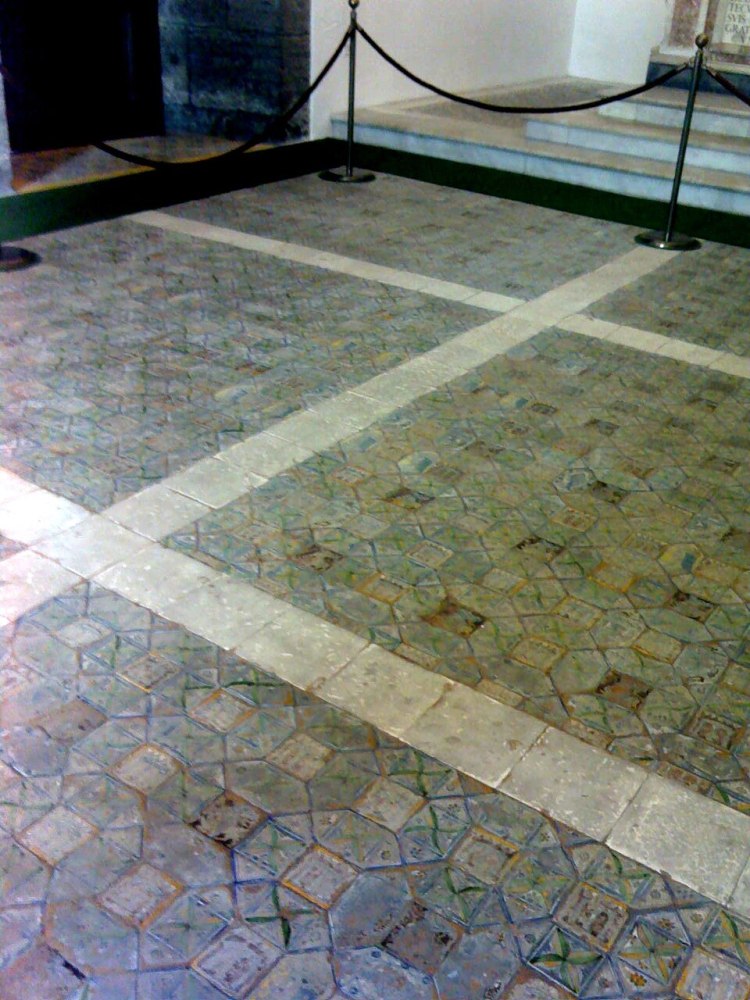
The floor belongs to a much wider culture of maiolica paving in Aragonese Naples. The taste had been established at the highest level under Alfonso the Magnanimous. Valencia formed part of the Crown of Aragon, and nearby Manises was one of the principal centres of ceramic production in the western Mediterranean. Muslim mudéjar craftsmen there continued highly developed traditions of painted and lustred ceramics under Christian rule. Large quantities of Valencian tiles were ordered for Alfonso’s residences in the Kingdom of Naples during the 1440s and 1450s. Their arrival in Naples therefore represented the movement of an established element of Aragonese-Valencian court culture within Alfonso’s Mediterranean dominions rather than simply the importation of a foreign luxury.
The fashion was soon adopted by patrons closely connected with the dynasty and its government. Marino Caracciolo, admitted to Alfonso’s council in 1449, was probably responsible for the azulejos pavement in San Giovanni a Carbonara. The descendants of Cardinal Rinaldo Brancaccio probably commissioned the tiles of the Cappella Brancaccio in the later 1440s. At Gaeta, a pavement commissioned after 1440, probably by Onorato II Gaetani and Giordano Gaetani, included the arms of the Aragonese kings, apparently making dynastic allegiance part of the decoration. Around 1470 Antonio and Turco Cicinello, both of whom served Ferrante as ambassadors in Milan, were associated with the tiled pavement of the Cappella del Crocifisso in San Pietro a Maiella. Some tiles bearing the Carafa stadera, or scales, probably from the palace of Diomede Carafa, are now preserved in the Museo Civico Gaetano Filangieri. Maiolica paving had consequently become associated with patrons of considerable social and political standing.
The fashion remained vigorous in the later 1480s. A document of 1488 records an order for 20,000 tiles from Giuliano da Maiano, sent from Florence to Naples. Their destination is uncertain, although the now-lost royal palace of Poggioreale has been suggested. The period saw several ambitious Aragonese building campaigns, and whatever the destination of this particular shipment, its scale confirms the continuing prestige of tiled decoration in the years when Pontano’s chapel was taking shape.
The origin of Pontano’s own pavement has itself been disputed. Earlier scholars proposed a Tuscan origin, while more recent studies have argued for production in Naples. Angela Dressen supports the latter view, identifying strongly Neapolitan characteristics not found in Tuscan pavements. The floor is now only partly preserved in its original state, and additional tiles were introduced between the fifteenth and seventeenth centuries, but the parts bearing the emblems, inscriptions and profile images connected with Pontano and Adriana belong to the original decoration.
That decoration is intensely personal. Pontano’s bridge emblem appears alongside that of Adriana, represented by Hercules struggling with the lion, while her identity is stated explicitly in ADRIANA SAXONA. Several tiles also carry the same profile head, generally identified as Pontano, although it does not closely correspond to his known medal or bust. Among the zoomorphic motifs are a fish, a hare and another animal which Dressen cautiously identifies as possibly a leopard. Such motifs belonged to an established Neapolitan repertory.
The repeated PONTANUS FECIT makes an unusually strong claim about Pontano’s relationship to the chapel. Bianca de Divitiis has shown that the formula could operate in more than one register. In ancient and Renaissance dedicatory inscriptions, a patron could use fecit to declare that he had caused a monument to be made. The celebrated M. AGRIPPA … FECIT on the Pantheon provided an obvious ancient example, while comparable formulas had been revived in contemporary all’antica architecture. But fecit could also be the language of an artist’s signature. Pontano, deeply familiar with ancient inscriptions, would have known both uses.
The choice of tense sharpened the point. In the preface to his Natural History, Pliny distinguished the comparatively modest faciebat, “was making”, from the much rarer fecit, “made”. Faciebat could leave a work notionally unfinished and open to correction; fecit announced it as complete, with what Pliny understood as an exceptional degree of artistic confidence. Angelo Poliziano revived precisely this distinction in his Miscellanea of 1489, while Pontano’s chapel was taking shape. In writing PONTANUS FECIT repeatedly across the pavement, Pontano could therefore identify himself as the man responsible for the monument while adopting the confident language associated with the maker of a finished work.
Pontano’s own De magnificentia helps explain how such a claim could belong to a patron. Magnificent building was not simply a matter of expense. The excellence of a building reflected upon the judgement of the person responsible for bringing it into existence: an admired work made its maker admired, drew visitors from distant places and provided poets and historians with something worthy of praise. Patronage could therefore encompass conception, judgement and direction as well as expenditure. PONTANUS FECIT does not claim that Pontano physically made the chapel. It makes a more ambitious claim that the completed monument was, in an important sense, his work.
The meaning of LAURA BELLA is much less certain. Stefano Borsi drew attention to an architectural image in a manuscript of Petrarch’s Rime, formerly in the collection of Major J. R. Abbey, which he compared with the Pontano Chapel. The comparison, together with the commemorative importance of a woman in both contexts, raises the possibility of a Petrarchan resonance in the name Laura, although the connection with the particular inscription on the pavement remains conjectural.
Riccardo Filangieri di Candida offered a very different possibility, suggesting that the words might have been introduced by an unknown ceramicist or could simply have entered the batch by mistake. Angela Dressen, approaching the phrase through the history of ceramics, relates LAURA BELLA to the tradition of vasellame amoroso, ceramics associated with courtship and marriage, and compares it with inscribed decoration in other late-fifteenth-century pavements. No single explanation is conclusive.
The foliage and animals introduce a further range of associations. A suggestive contemporary comparison comes from Lorenzo Valla’s Gesta Ferdinandi regis Aragonum, written in 1445–46. Describing the marriage of Alfonso the Magnanimous to Maria of Castile in Valencia, Valla praises an interior pavement laterculo quadrato vitreatoque ac picto constratum, laid with glazed and painted square tiles, and compares its beauty with the groves of Elysium and with an earthly paradise. His description shows that richly coloured tiled decoration could carry explicitly paradisal associations.
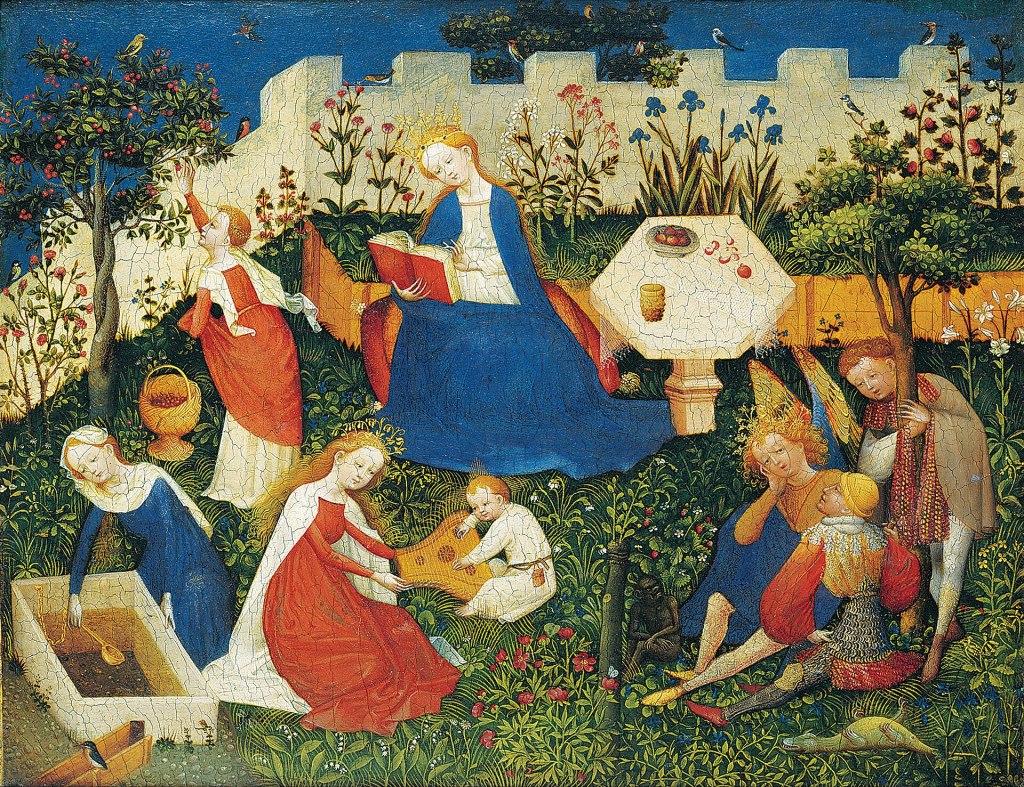
Nature also occupied an important place in Pontano’s own experience and writing. In De hortis Hesperidum, his poem on citrus cultivation, he turns explicitly to ocia nunc hortique, “now leisure and gardens”, linking cultivated nature with otium. Gardens, rural settings and withdrawal from public business recur through his literary world, associated with repose, poetry, learned conversation and release from the demands of office.
In that context, the animals and foliage of the pavement could bring into the chapel associations with paradise, cultivated nature and repose. They also change its emotional register. Colour, flowers and animals introduce something vivid and life-giving into an interior dominated by commemoration and death.
The pavement thus belongs both to an established Aragonese culture of prestigious maiolica and to the particular world Pontano created inside the chapel. It joins him repeatedly with Adriana through image and inscription, gives unusual prominence to writing as part of the decoration, and allows him, in PONTANUS FECIT, to make an exceptionally self-conscious claim upon the monument he had brought into being.
Outliving an age
By the end of Pontano’s life, the personal losses recorded inside the chapel had been accompanied by the destruction of the political order in which he had spent more than forty years. The French invasion of 1494 was followed by the final collapse of the Aragonese dynasty in 1501. That collapse was not simply an external catastrophe imposed upon a previously stable kingdom. Raffaele Colapietra has traced the longer crisis of the monarchy through fiscal pressure, political isolation, tensions between crown and baronage, and incomplete attempts at reform and centralisation.
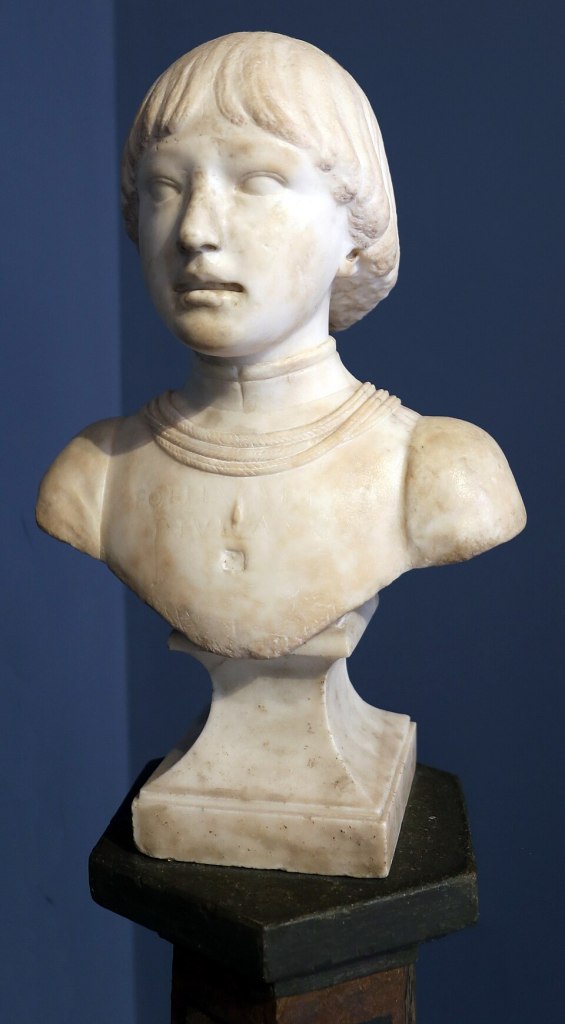
Pontano himself had been involved in those attempts to strengthen the state. In November 1484, writing on behalf of Alfonso, Duke of Calabria, to Lorenzo de’ Medici, he described the duke’s intention to put the affairs of the kingdom in order while acknowledging the difficulty of the task. He therefore lived not merely to see the dynasty he had served overthrown, but to see the failure of a political order he had helped to administer and, at moments, to reform.
A contemporary judgement gives this accumulation of loss an unusually sharp form. Antonio de Ferrariis, known as Galateo, was a physician and humanist of Pontano’s circle. Shortly after Pontano’s death in 1503 he wrote to another member of that circle, the Neapolitan humanist Girolamo Carbone. Galateo argues that Pontano’s death itself should scarcely be mourned. What was lamentable was that he had lived long enough to witness the devastation of Italy and the dismemberment of the kingdom, including the French sack of Capua and the Spanish occupation of Calabria. His conclusion is brutal in its simplicity: Pontano had lived too long.
Seen from that perspective, the chapel had acquired a significance that could hardly have been foreseen when it was dedicated in 1492. It now contained the commemoration of wife, children and friend within a political and intellectual world that had itself largely disappeared.
Conclusion
The Pontano Chapel is at once a family memorial, a humanist monument and a public statement of intellectual identity. Its exterior inscriptions address the city through moral and political counsel; inside, the emphasis shifts towards family, friendship, antiquity, grief and self-commemoration. The ancient inscriptions, funerary poems, maiolica pavement and repeated acts of naming all contribute to a monument in which writing is inseparable from architecture.
Across the chapel, Pontano brought together the different worlds he had inhabited: public service, classical learning, poetry, friendship, marriage, bereavement and the hope of enduring reputation. By the end of his life, many of the people and institutions commemorated or implied by the monument had disappeared. The chapel remained.
Producing these essays requires care, time, research, and resources. Contributions to help sustain this exploration would be greatly appreciated.
Donate to Inner Surfaces here.
Bibliography
For a compact but detailed guide to the chapel and its inscriptional programme, including Italian translations of the inscriptions, see I. Sarcone, Il libro di pietra. Le iscrizioni della Cappella Pontano in Napoli (2014).
I have consulted the following texts. Any errors are mine.
Arbace, L., ed., Il pavimento maiolicato di San Giovanni a Carbonara, Naples, 1998.
Arbace, L., et al., eds, Valenza-Napoli. Rotte mediterranee della ceramica, Valencia, 1997.
Ascher, Y., ‘Renaissance Commemoration in Naples: The Rota Chapel in San Pietro a Maiella’, Renaissance Studies, 14.2 (2000), pp. 190–209.
Ascher, Y., ‘Architecture in Sixteenth-Century Campania: The Carafa Chapel in Montecalvo Irpino’, Journal of the Society of Architectural Historians, 61.3 (2002), pp. 296–309.
Ascher, Y., ‘“Renovatio” and “Translatio” in Renaissance Naples: An Addendum to the Story of the Rota Chapels’, Notes in the History of Art, 25.1 (2005), pp. 33–42.
Balsdon, J. P. V. D., Roman Women: Their History and Habits, London: Bodley Head, 1962.
Brooke, J., Giovanni Pontano (1429–1503) and Social Mores, Memorial and Material Culture in Renaissance Naples, c. 1450–1490, unpublished PhD thesis, Department of History of Art and Screen Media, Birkbeck College, University of London, 2010.
Colapietra, R., ‘Gli aspetti interni della crisi della monarchia aragonese’, Archivio Storico Italiano, 119.2 (430) (1961), pp. 163–199.
Como, M. T., ‘Nuove acquisizioni sulla Cappella Pontano. Il contesto originario e l’architettura’, Rinascimento Meridionale, 7 (2016), pp. 35–48.
Coppini, D., ‘Memoria e ricordo. Tumuli di carta e tumuli di pietra nella poesia di Giovanni Pontano’, in A. Raffarin and G. Marcellino, eds, La mémoire en pièces, Paris: Classiques Garnier, 2020, pp. 389–416.
de Divitiis, B., ‘Pontano and his Idea of Patronage’, in M. Beltramini and C. Elam, eds, Some Degree of Happiness: Studi di storia dell’architettura in onore di Howard Burns, Pisa: Edizioni della Normale, 2010, pp. 107–131, 684–692.
de Divitiis, B., ‘PONTANVS FECIT: Inscriptions and Artistic Authorship in the Pontano Chapel’, California Italian Studies, 3.1 (2012), pp. 1–36.
de Divitiis, B., ‘Castel Nuovo and Castel Capuano in Naples: The Transformation of Two Medieval Castles into “all’antica” Residences for the Aragonese Royals’, Zeitschrift für Kunstgeschichte, 76.4 (2013), pp. 441–474.
De Ferrariis, A., Epistole, ed. A. Altamura, Lecce: Centro di Studi Salentini, 1959.
Donatone, G., La maiolica napoletana del Rinascimento, Naples: Gemini Arte, 1993.
Dressen, A., Pavimenti decorati del Quattrocento in Italia, Venice: Marsilio, 2008.
Filangieri di Candida, R., Il tempietto di Gioviano Pontano in Napoli, Naples: Accademia Pontaniana, 1926.
Frothingham, A. W., Lustreware of Spain, New York, 1951.
Gowing, A. M., Empire and Memory: The Representation of the Roman Republic in Imperial Culture, Cambridge: Cambridge University Press, 2005.
Griffin, J., Latin Poets and Roman Life, London: Duckworth, 1985.
Kidwell, C., Pontano: Poet and Prime Minister, London: Duckworth, 1991.
Lyne, R. O. A. M., The Latin Love Poets: From Catullus to Horace, Oxford: Clarendon Press, 1980.
Marsh, D., The Quattrocento Dialogue: Classical Tradition and Humanist Innovation, Cambridge, MA: Harvard University Press, 1980.
Middione, R., ‘Importazione di azulejos valenzani a Napoli negli anni di Alfonso il Magnanimo’, Faenza (1979), pp. 71–77.
Parenti, G., Poëta Proteus alter. Forma e storia di tre libri di Pontano, Florence: Leo S. Olschki, 1985.
Parenti, G., ‘L’invenzione di un genere, il “tumulus” pontaniano’, Interpres, 7 (1987), pp. 125–158.
Percopo, E., Nuovi documenti sugli scrittori e gli artisti dei tempi aragonesi, ed. M. Del Treppo, Naples, 1997.
Pontano, G. G., Baiae, ed. and trans. R. G. Dennis, Cambridge, MA: Harvard University Press, 2006.
Pontano, G. G., De immanitate liber, ed. L. Monti Sabia, Naples: Loffredo, 1970.
Pontano, G. G., De magnanimitate, ed. F. Tateo, Florence: Istituto Nazionale di Studi sul Rinascimento, 1969.
Pontano, G. G., De principe, ed. G. M. Cappelli, Rome: Salerno Editrice, 2003.
Pontano, G. G., De sermone libri sex, ed. S. Lupi and A. Risicato, Lugano: Thesaurus Mundi, 1954.
Pontano, G. G., Dialogues, Volume 3: Aegidius and Asinus, ed. and trans. J. H. Gaisser, Cambridge, MA: Harvard University Press, 2020.
Pontano, G. G., Eclogues. Garden of the Hesperides, ed. and trans. L. Roman, Cambridge, MA: Harvard University Press, 2022.
Pontano, G. G., I dialoghi, ed. C. Previtera, Florence: Sansoni, 1943.
Pontano, G. G., I libri delle virtù sociali, ed. F. Tateo, Rome: Bulzoni, 1999.
Pontano, G. G., Poesie latine, 2 vols, ed. L. Monti Sabia, introduction by F. Arnaldi, Turin: Einaudi, 1977.
Santoro, M., ‘La cultura umanistica’, in Storia di Napoli, vol. IV, part II, Naples, 1973, pp. 317–498.
Sarcone, I., Il libro di pietra. Le iscrizioni della Cappella Pontano in Napoli, Editrice Domenicana Italiana, 2014.
Spisak, A. L., Martial: A Social Guide, London: Duckworth, 2007.
Thornton, D. and Wilson, T., Italian Renaissance Ceramics: A Catalogue of the British Museum, 2 vols, London: British Museum Press, 2009.
Trinkaus, C., ‘The Astrological Cosmos and Rhetorical Culture of Giovanni Gioviano Pontano’, Renaissance Quarterly, 38.3 (1985), pp. 446–472.
Valla, L., Gesta Ferdinandi regis Aragonum, ed. O. Besomi, Padua: Antenore, 1973.
Vitale, G., Modelli culturali nobiliari nella Napoli aragonese, Salerno, 2002.
Warrior, V. M., Roman Religion, Cambridge: Cambridge University Press, 2006.
Wellington Gahtan, M., ‘Reading Pontano’s “libretto co’ fogli di marmo”’, Opus Incertum, 8.1 (2022), pp. 48–59.

