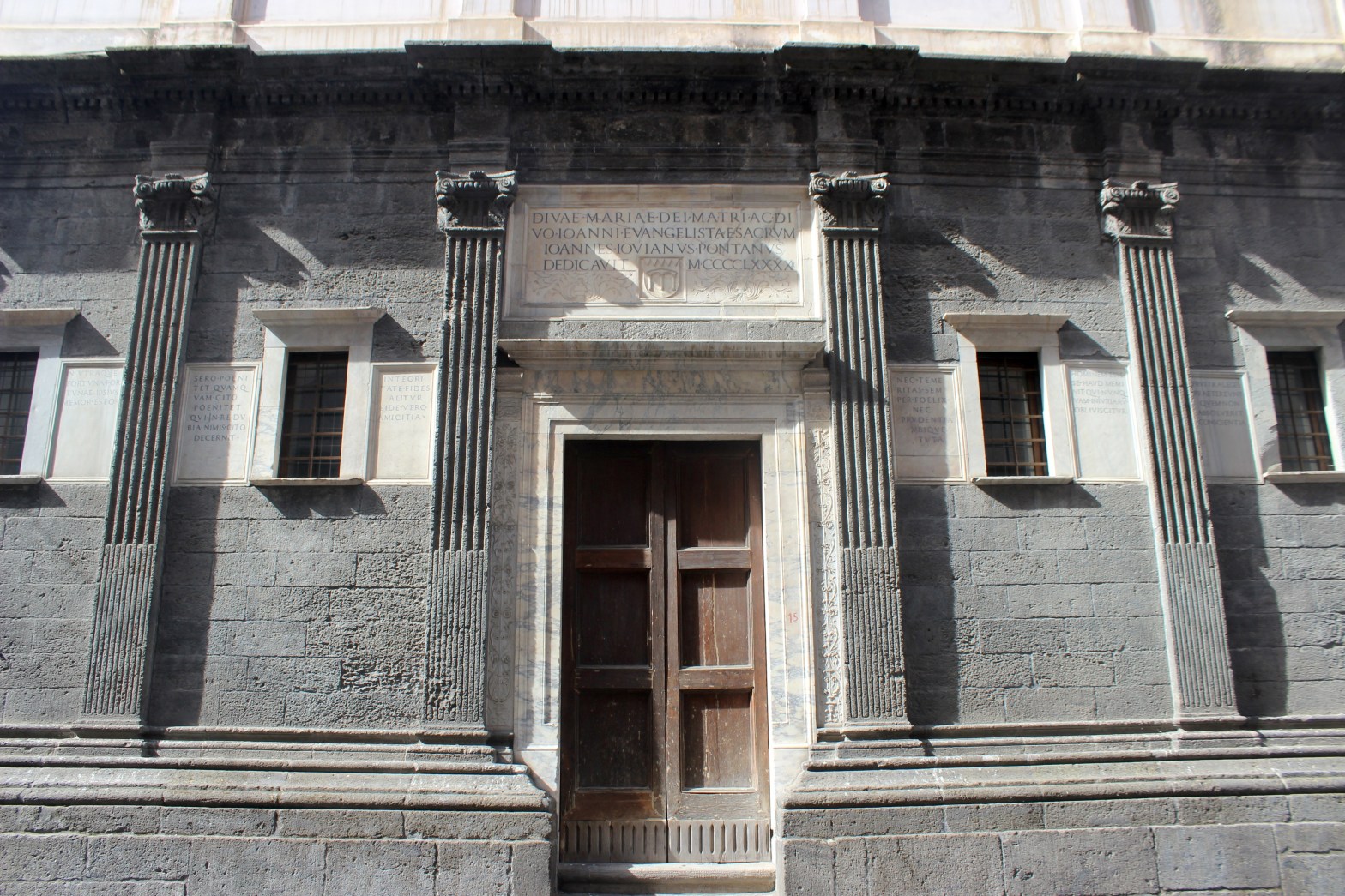
Pontano Chapel, Naples, exterior, 1490–92. Photograph: Miguel Hermoso Cuesta. Credit: Wikimedia Commons.
Reading the inscriptions
For convenience, the discussion follows the tablets from the façade along Via dei Tribunali and then around onto the side facing Piazzetta Pietrasanta, beside the campanile of Santa Maria Maggiore alla Pietrasanta. This corresponds to one natural route of approach through the streets, but should not be taken to imply that the inscriptions were necessarily intended to be read in a fixed linear sequence.
Twelve marble tablets carrying short Latin maxims are set into the exterior walls of the Pontano Chapel. Their subjects are strikingly secular: power and self-restraint, fortune, prudence, trust, clemency, conscience, self-knowledge, political action and responsibility. Carol Kidwell described them as “political and moral maxims” and, more pointedly, as “worldly maxims”, intended for the passer-by rather than primarily for the Christian worshipper. Their position reinforces that public character. They occupy the exposed faces of a building erected in Pontano’s own neighbourhood, across the road from the house in which he lived and around which members of his intellectual circle gathered.
The inscriptions are classical in language and appearance, but it would be misleading to regard them simply as a collection of ancient commonplaces. Their themes recur throughout Pontano’s political and ethical writings, while several have close or suggestive parallels in classical authors. They also speak with particular resonance when set against Pontano’s long experience of Aragonese government: his service to Ferrante and Alfonso II, his diplomatic activity, the crises of the 1490s and the eventual collapse of the dynasty he had served. The degree to which particular tablets refer to particular events cannot always be established. Their brevity gives them precisely the capacity to move between the immediate and the general, between political counsel rooted in experience and propositions capable of addressing an unknown reader in the street.
Previous scholars have recognised something of this political character. Kidwell suggested that some of the inscriptions, particularly those she regarded as the last four, might reflect the crisis surrounding the French invasion and Pontano’s own loss of political authority. More recently, Italo Sarcone has treated the exterior tablets as a connected body of civil and moral admonition, observing that individual maxims can reinforce, qualify or even appear to contradict one another. That observation is important. Read together, the inscriptions do not offer a straightforward catalogue of virtues. They repeatedly confront the reader with distinctions: between prudence and timidity, daring and rashness, law and conscience, punishment and clemency, individual action and responsibility towards the state.
Such tensions have a particular significance in the intellectual world of Pontano. Victoria Kahn has shown that his understanding of prudentia belongs to the contingent realm of practical action, where decisions cannot normally be secured by demonstrative certainty. Pontano associates prudence with deliberation and repeatedly employs the rhetorical practice of arguing in utramque partem, considering a question from opposing positions. Correct judgement consequently depends upon circumstances, place and time rather than the mechanical application of universal rules.
The reading that follows therefore does not attempt to reconstruct a lost political code or to assign a single historical occasion to every tablet. It takes the inscriptions individually and in relation to one another, considering their classical precedents, parallels in Pontano’s writings and possible connections with the political circumstances in which he lived. Some of those connections are considerably firmer than others. Taken cumulatively, however, they suggest that the exterior of the chapel offered its readers something more demanding than a series of precepts. Its maxims repeatedly require the passer-by to compare competing claims, distinguish between neighbouring virtues and vices, and exercise judgement about what particular circumstances require.
Power and self-command
IN MAGNIS OPIBVS VT ADMODVM DIFFICILE SIC MAXIME PVLCHRVM EST SE IPSVM CONTINERE
“When one has great powers, as it is very difficult, so it is particularly admirable to practise self-restraint.”
The first maxim addresses the moral danger created by prosperity and power. Maia Wellington Gahtan identifies it as a paraphrase of a longer speech attributed by Polybius to the Roman general Lucius Aemilius Paullus after the defeat of Perseus of Macedon. Confronted with the fallen king, Aemilius warns his companions against becoming overbearing in success. It is precisely when private individuals or states are most fortunate that they should remain conscious of the possibility of reversal, although moderation is then particularly difficult to maintain. Pontano removes the historical setting and condenses the lesson into an aphorism. Opes can encompass wealth, resources, prosperity and power, while se ipsum continere turns attention from outward possession to inward command. The greater a man’s freedom to act, the more difficult, and therefore the more admirable, his mastery of himself.
Pontano develops essentially the same argument in De principe. Success, he writes, acts as a mirror in which character becomes visible, and self-control is most necessary when someone possesses the freedom to do exactly as he wishes. He immediately connects that freedom with the instability of worldly position. The ruler should discipline his mind by remembering that freedom may become slavery, wealth poverty, and high position disgrace. The affinity with Polybius is close in thought even without assuming direct dependence between the passages. Prosperity is dangerous because it both enlarges the capacity for action and encourages confidence in circumstances that Fortune may abruptly reverse. Restraint is therefore required not despite the possession of power but because of it.
A second passage in De principe gives the principle an exemplary form. Pontano asks whether Scipio Africanus deserves greater praise for his courage in war or for the continentia maintained throughout his life. Through courage he defeated his enemies two or three times; through continence he continually conquered himself. The lexical relationship between continentia and the inscription’s continere strengthens the comparison. External victory and self-command belong to the same language of conquest, but the latter is represented as the more continuous achievement. Panormita had made a comparable distinction in a letter of 1443. Citing Cato, he argues that it is absurd for a man capable of conquering many others to be unable to conquer himself. Alexander remained undefeated in arms but was defeated by anger, while Hannibal’s cruelty diminished the glory of his victories.
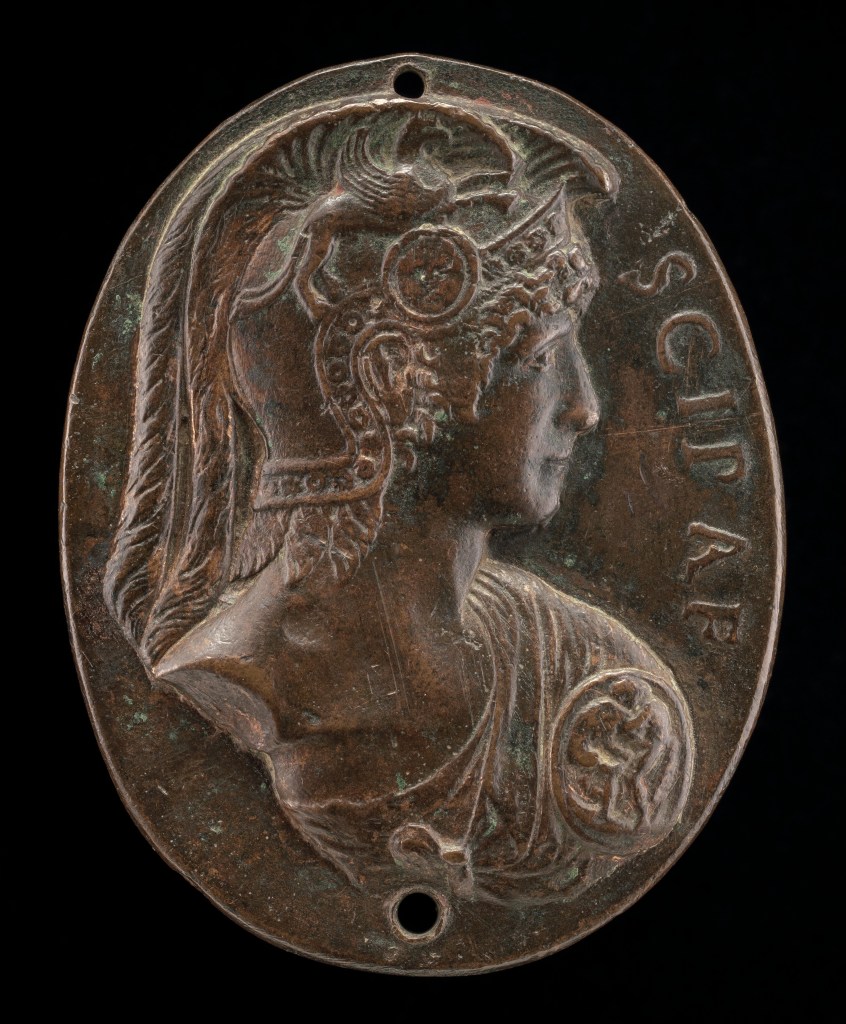
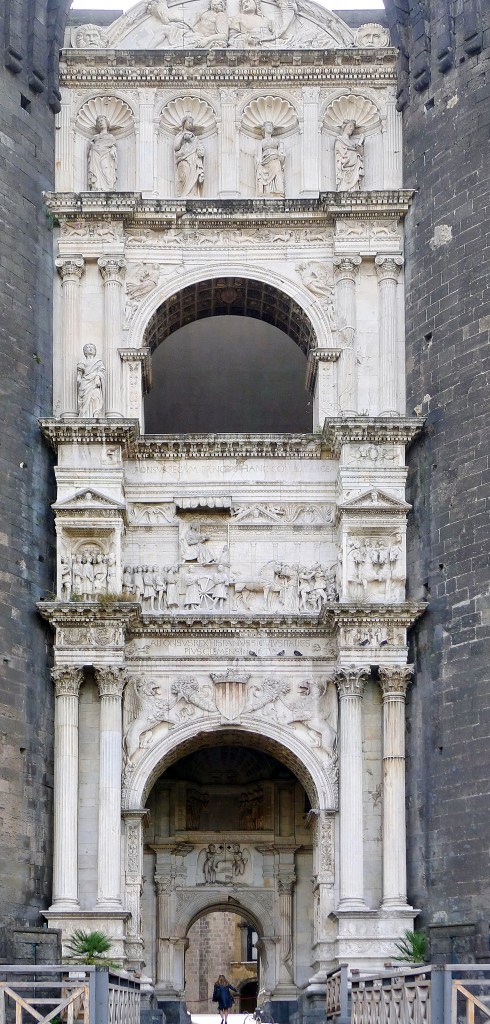
The same conception of rulership had acquired monumental form in Aragonese Naples. As Peter Stacey has observed, Alfonso I’s proclamation as INVICTUS on the triumphal arch at Castel Nuovo is qualified by the epithets CLEMENS and PIUS. Invincibility therefore extends beyond military success. The ruler who remains unconquered by his enemies must also remain unconquered by his own passions in peace. Pontano supplies the negative counterpart in De immanitate. There tyrannical rule is associated with torture, robbery, killing and exile, while reason itself is degraded by anger, appetite and violent instinct. The distinction between victory and self-victory thus becomes political as well as ethical. Without restraint, the strength that enables a ruler to command others may itself become the source of tyranny.
That argument acquired a more uncomfortable resonance under Ferrante. The more sensational traditions surrounding his ruthlessness need to be treated cautiously, but Pontano’s own writings could be sharply critical. In De sermone Ferrante appears as a practised dissembler and as a ruler deeply suspicious of his subjects, angered by the sight of two or three people walking and talking together. The detail suggests a form of government shaped by anxiety and mistrust, in marked contrast to the self-possession expected of the good ruler. Panormita’s Alfonso I provides the opposite model. He could move among his subjects without armed protection, relying on his innocence and their goodwill, and was praised for maintaining the same expression, dress, speech, mildness, benevolence and humanity through changing circumstances and unexpected victories. In this idealised image, authority is accompanied by inward steadiness rather than suspicion and fear.
The contrast becomes still sharper in Pontano’s letter to Ferrandino of 9 February 1494. With the French threat intensifying, he attributed the kingdom’s predicament in part to what he called the “mean and violent bearing” of Ferrandino’s grandfather Ferrante and father Alfonso II. The connection with De principe is especially pertinent because that work had itself been addressed to Alfonso as Duke of Calabria. None of this requires the inscription to be read as a covert denunciation of either ruler. Its aphoristic form allows the principle to exceed any single political occasion, addressing monarchs, administrators, barons and other holders of authority. Yet Pontano’s long experience of Aragonese government gave the maxim an immediate political weight. At the beginning of the sequence, it establishes a demanding premise: before the exercise of power can be judged prudent, courageous or just, the person who possesses it must first be capable of governing himself.
Fortune and constancy
IN VTRAQVE FORTVNA FORTVNAE IPSIVS MEMOR ESTO
“In good or bad fortune, remember that fortune changes.”
The second inscription develops a theme already implicit in the first: the instability of worldly success. If power demands self-command because prosperity can encourage arrogance, it also requires an awareness that prosperity itself is insecure. Maia Wellington Gahtan draws attention to the close relationship between the two maxims, noting that the warning against confidence in good fortune follows naturally from the Polybian lesson associated with Aemilius Paullus. The ruler who knows that Fortune may reverse itself has an additional reason to remain moderate in success.
Pontano returns to the same principle in De principe. In one passage he insists that it is particularly important for a ruler to preserve clarity of mind in adversity and not succumb when Fortune deteriorates. He then offers Ferrante himself as an example. At the beginning of his reign, when nobles, common people and entire provinces defected to Jean d’Anjou, Ferrante, according to Pontano, showed no visible agitation. He did not insult those who deserted him, and even when the rebellion of a prominent noble was announced, he responded not with rage but with regret that a man of such a family should have acted dishonourably.
Ferrante’s conduct provides one possible historical parallel for the maxim. In De principe, Pontano presents the king’s composure at the beginning of his reign as an example of how adversity should be met. The comparison is suggestive because the inscription can be read against conduct that Pontano himself had once praised, although there is no reason to assume that Ferrante was its specific or exclusive subject.
The broader point lies in the maxim’s refusal to privilege either prosperity or adversity. In utraque fortuna embraces both conditions. Good fortune should not produce arrogance, and bad fortune should not produce despair. Constancy depends upon recognising that neither condition can safely be treated as permanent. The inscription therefore turns mutability itself into a reason for steadiness of conduct.
Prudence and premature decision
SERO POENITET QUAMQUAM CITO POENITET QUI IN RE DUBIA NIMIS CITO DECERNIT
“He repents too late though he repents quickly, who decides too quickly in a dubious affair.”
The third inscription turns from constancy to judgement. Its subject is not hesitation as such, but the danger of committing oneself before the grounds of a doubtful matter have been sufficiently examined. The paradox of the wording is deliberate: even immediate regret comes too late once an ill-considered decision has already been made.
Pontano gives the principle a specifically political form in De principe. In his discussion of maiestas, he argues that all planning and action require counsel. A ruler should listen to many points of view, examine carefully the grounds upon which individual cases rest, and avoid both immediate assent and automatic rejection. Prudence therefore consists neither in endless delay nor in instinctive decisiveness. It requires the capacity to suspend judgement long enough for the circumstances of a case to become clear.
This belongs to a broader rhetorical conception of prudence in Pontano’s thought. Victoria Kahn has shown that practical judgement operates precisely where certainty is unavailable. Prudence concerns contingent matters and therefore requires deliberation, comparison and the weighing of alternatives. Pontano’s repeated use of in utramque partem, arguing a question from opposing positions, makes rhetoric itself part of the exercise of judgement. Read in that context, the inscription does more than recommend caution. It presents the res dubia as a situation in which judgement must remain open until competing considerations have been weighed.
This emphasis fits closely with Pontano’s own experience of government. Between November 1491 and February 1492 he conducted lengthy negotiations with Innocent VIII in Rome, working to secure papal recognition of Ferrante’s legitimacy and to repair relations between Naples and the papacy. An agreement was eventually reached, but Ferrante soon failed to honour his obligations. Pontano recognised the danger of damaging relations with Rome in an already unstable political climate. The episode therefore offers one possible historical context in which the maxim’s warning against premature decision would have had particular force.
The tablet need not be reduced to that episode. Its formulation remains general, but Pontano’s experience as a counsellor makes the political application especially suggestive. His work depended upon negotiation, comparison of alternatives and attention to changing circumstances, while decisions taken elsewhere could undo that process. The maxim can therefore be read as articulating a principle central both to his political writing and to his practical experience of government.
Integrity, trust and friendship
INTEGRI / TATE FIDES / ALITVR / FIDE VERO / AMICITIA
“Trust feeds on integrity, but friendship on trust.”
The fourth inscription moves from judgement to the conditions upon which relationships between people depend. Its structure is unusually compressed. Integrity gives rise to trust, and trust in turn makes friendship possible. The sequence is cumulative: friendship cannot simply be demanded from another person, since the confidence upon which it rests must first be made possible by conduct worthy of trust. The maxim therefore places responsibility first upon the character and behaviour of the person who seeks the confidence of others.
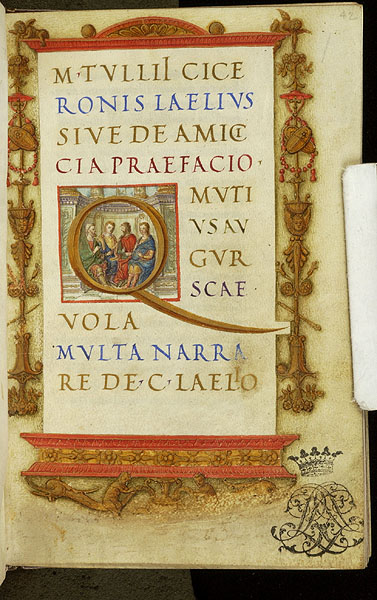
A passage in De principe provides a suggestive political parallel. Pontano advises the ruler to secure the regard of servants and courtiers by treating them with affability, courtesy, kindness and generosity, by overlooking some faults, praising worthy actions and recognising the value of those who serve him. Such behaviour encourages continued loyalty and goodwill. The circumstances are specifically courtly, whereas the inscription is much broader, but both depend upon a reciprocal conception of human relations. Loyalty is not secured by authority alone: the conduct of the ruler helps to create the conditions in which it becomes possible.
This corresponds with the importance Pontano elsewhere attaches to mutua caritas, the reciprocal goodwill through which social relationships are sustained. The inscription is particularly striking because it reduces that process to three linked terms: integritas, fides and amicitia. Lodi Nauta has shown that Pontano attached philosophical importance to the precision of moral language. In his account, words do more than describe conduct: by naming and marking out actions and qualities, they enable distinctions within the complexity of human experience to be recognised. An insufficiently discriminating vocabulary risks allowing different moral qualities to blur into one another. Here the distinctions are carefully staged. Integrity, trust and friendship are related, but they are not interchangeable: integrity makes trust possible, and trust in turn sustains friendship.
The maxim also had an obvious relevance to political life at court. The Congiura dei Baroni of 1485–87 provides one possible context in which the fragility of trust had become especially visible. Two of the figures implicated in the conspiracy, Antonello Petrucci and Francesco Coppola, Count of Sarno, were not simply hostile barons but men who had occupied positions of exceptional confidence close to Ferrante. Petrucci was the king’s secretary and counsellor, while Coppola was a prominent courtier whom Ferrante, together with Petrucci, had entrusted with negotiations with the rebellious barons. Their eventual implication in the conspiracy therefore represented a breakdown of fides within the ruler’s own political circle. The episode gives particular resonance to a maxim that makes trust dependent upon integrity, although there is no reason to identify the conspiracy as the inscription’s specific subject.
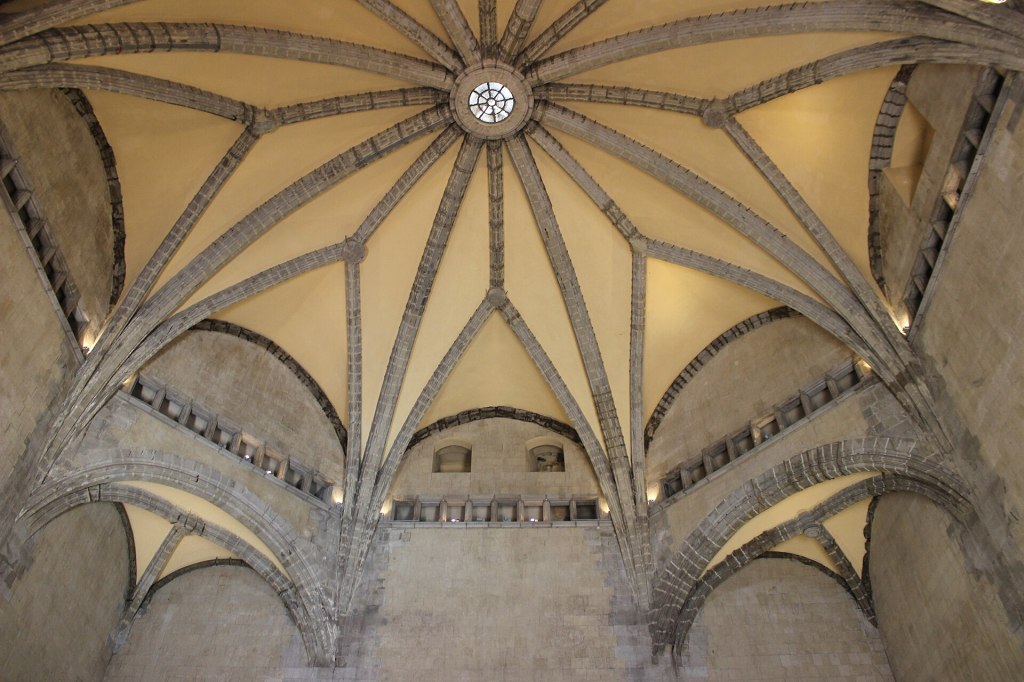
The point also recalls a comparison made earlier in this essay. In discussing the inscription on power and self-command, Pontano’s De sermone provided the striking image of Ferrante suspicious of his subjects and angered by the sight of small groups walking and talking together. The present maxim allows that evidence to be seen from another direction. Fides is not presented as something that can simply be demanded from those around one: it depends upon conduct capable of sustaining it. Without making Ferrante the necessary subject of the inscription, the contrast suggests how far a political culture governed by suspicion could stand from the reciprocal relationships Pontano describes here.
Rashness, prudence and fortune
NEC TEME / RITAS SEM / PER FOELIX / NEC / PRVDENTIA / VBIQVE / TVTA
“Rashness does not always prosper, nor is prudence everywhere safe.”
The fifth inscription is more difficult than the preceding maxims because it refuses to turn prudence itself into an absolute rule. Its two clauses qualify one another. Rash action cannot be relied upon to succeed, but prudent action cannot be relied upon to provide safety either. The point is not that prudence and rashness are equivalent. Rather, conduct takes place in circumstances in which no virtue can guarantee its outcome. The maxim therefore returns to a problem already encountered in the inscriptions on deliberation and Fortune: judgement remains necessary precisely because events cannot be reduced to a dependable formula.
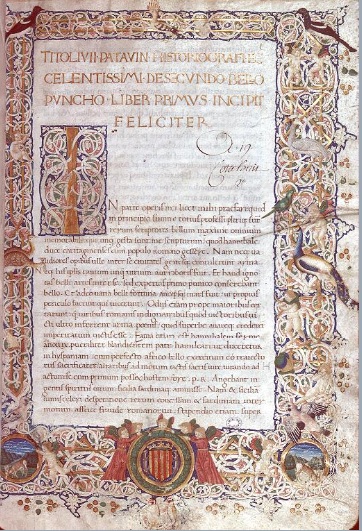
Gahtan has identified a particularly revealing classical source. The first half, nec temeritas semper foelix, comes from Livy’s account of the debate between Quintus Fabius Maximus and Scipio Africanus over Scipio’s proposed invasion of Africa. Fabius opposes the expedition and warns the senate against confusing previous success with proof that hazardous decisions will always prosper. The second half of Pontano’s maxim is not a direct quotation but, as Gahtan observes, effectively condenses Scipio’s reply. Pontano has therefore compressed the opposed positions of two Roman statesmen into a single double sententia: the caution of Fabius is immediately answered by the recognition that prudence itself offers no universal security. Plutarch, discussing the same episode, makes the related observation that it is difficult for the same man always to enjoy good fortune.
The form of the inscription is consequently as significant as its subject. Victoria Kahn has shown that Pontano repeatedly treats prudence and Fortune by arguing in utramque partem, bringing competing arguments to bear upon questions that do not admit demonstrative certainty. Prudence belongs to the contingent realm of action, where different courses may remain defensible and where the consequences of a decision cannot be known in advance. The opposing clauses of the inscription enact precisely that kind of reasoning. They do not cancel one another; they require the reader to discriminate between circumstances in which caution is necessary and those in which caution itself may become dangerous. Sarcone similarly reads the apparent contradictions among the tablets as a demand for judgement rather than as inconsistency: there is a time for deliberation and a time for rapid decision.
Pontano’s De fortuna gives the problem a more disconcerting political dimension. In an anecdote concerning Theodore Gaza, men criticise Ferrante during the early years of his reign for governing with insufficient thought or prudence. Gaza answers that the king’s apparently imprudent methods have nevertheless prospered, and that altering a successful manner of acting merely to conform to rational expectations might itself change his Fortune. Pontano’s discussion goes further still, allowing for a form of instinct or divinely inspired spontaneity that may exceed ordinary prudential calculation. The anecdote does not make rashness a virtue. It instead exposes the difficulty of judging action solely by the rationality of the decision or solely by its eventual success.

It would therefore be hazardous to assign the inscription a single political target. One possible contemporary resonance lies in Ferrante’s long record of political success, which might have encouraged confidence in methods that were not always conventionally prudent. Pontano later warned him against trusting too confidently in Fortune. But the maxim is more interesting if its uncertainty is allowed to remain intact. Placed within the developing programme, it qualifies the earlier warning against deciding too quickly without reversing it. Deliberation is necessary, but prudence cannot abolish contingency; daring may sometimes succeed, but success does not retrospectively turn rashness into wisdom. The problem confronting the reader is therefore not to choose once and for all between caution and boldness, but to judge when each is appropriate.
Clemency and the memory of injury
HOMINEM ESSE SE HAVD MEMI / NIT QVI NVNQ / VAM INIVRIARVM / OBLIVISCITVR
“He does not remember that he is a man, who never forgets injuries.”
The sixth inscription concerns the moral use of power after an injury has been received. Its formulation is striking because it makes the capacity to forget an offence part of what it means to remember one’s own humanity. The opposite condition, the permanent preservation of injury in the mind, is presented as a failure of self-understanding. The maxim does not say that every offence should go unpunished. Rather, it rejects the idea that resentment should itself become permanent, and therefore raises the question of when the power to retaliate ought deliberately to be restrained.
Pontano gives the principle a specifically political application in De principe. Some things, he writes, are better forgiven than punished, while others should be passed over as though unnoticed or postponed until another occasion. The important point is the discrimination involved. Clemency is not equivalent to passivity, nor does it require the ruler to surrender judgement. It demands that he distinguish between offences that require punishment and those for which punishment would be unnecessary, excessive or politically unwise.
The intellectual background is strongly Senecan. In De clementia, mercy acquires its fullest moral significance precisely where the ruler possesses the ability to punish. Forbearance imposed by weakness is not the same as the restraint of someone who has the means to avenge an injury and chooses not to do so. The great-minded ruler is therefore capable of enduring offences even at the height of his power; the refusal to exact vengeance can itself become evidence of greatness.
Peter Stacey has emphasised the particular importance of clemency to Alfonsine ideas of monarchy. The ruler’s exceptional power required a corresponding capacity for self-restraint: by mastering resentment and foregoing vengeance, he demonstrated that his authority was governed by reason rather than anger. Clemency could therefore help distinguish legitimate kingship from tyranny. Seneca gives the idea an almost divine dimension by presenting the ruler’s power to spare and preserve his subjects as a particularly exalted expression of princely virtue.
The maxim also had an evident relevance to the political circumstances of late Aragonese Naples. By the time the chapel was being constructed, the problem of punishment, resentment and reconciliation had become acute in the aftermath of the Congiura dei Baroni. Ferrante had experienced genuine betrayal, but the inscription places the moral burden upon the person who possesses the power to respond. Remembering an injury indefinitely is not presented as strength. The stronger act may be the deliberate decision not to allow vengeance to become permanent policy. There is no need to identify Ferrante as the inscription’s exclusive subject, but in such a political setting the maxim’s insistence upon clemency could hardly have been without resonance.
Law and conscience
FRVSTRA LEGES PRAETEREVNT QVEM NON ABSOLVERIT CONSCIENTIA
“The laws pass over him in vain whom his conscience does not absolve.”
The seventh inscription shifts attention from external judgement to an authority within the individual. A person may escape legal condemnation and yet remain condemned by his own conscience. Legality and moral innocence are therefore not identical, and formal acquittal cannot supply the latter. Sarcone connects the maxim with the opening of Juvenal’s thirteenth satire, where consciousness of guilt itself becomes a punishment. In monumentalising the idea, Pontano turns that inward judgement into a public admonition: the person passing beneath the inscription is asked to measure conduct by something more exacting than the possibility of legal sanction.
A related argument appears in De principe, although the point there is approached from the opposite direction. Pontano observes that “the greatest justice sometimes constitutes the greatest injustice” and that it may be better to act from fairness and goodness than according to the letter of the law. The inscription concerns someone whom the law fails to condemn, whereas De principe concerns the possibility that strict legality may itself produce injustice. In both cases, however, law is denied complete moral authority. Neither obedience to its letter nor escape from its penalties can substitute for ethical judgement.
The distinction belongs to a wider problem in humanist political thought. Discussion of law among Quattrocento humanists repeatedly brought positive law into relation with justice, reason and individual judgement. Some writers treated law and ethics as distinct, while others questioned whether institutional rules could by themselves secure just conduct. Pontano’s maxim belongs naturally within that environment: conscience supplies an internal standard by which the adequacy of external law can itself be measured.
The inscription also has a possible contemporary political application. Ferrante increasingly used the legal machinery of the Studio in his efforts to curtail baronial autonomy. Against such a background, the maxim could acquire a sharper resonance: government conducted through legal institutions was not thereby guaranteed to be just, any more than an individual who escaped legal condemnation was necessarily innocent. The comparison should remain cautious, since the inscription states a general moral principle rather than identifying a particular abuse. But Pontano’s insistence upon conscience and personal judgement places limits on any assumption that legality alone can legitimate political action.
The inscription therefore continues a recurrent movement in the programme from external power towards self-government. Law can judge conduct from outside, but it cannot absolve the individual who knows himself to have acted wrongly. That emphasis upon inward judgement also relates closely to the injunction to know oneself on the neighbouring tablet.
Self-knowledge
IN OMNI VITAE / GENERE PRIMVM / EST / SE IPSVM / NOSCERE
“In every station in life the first thing is to know one’s self.”
The eighth inscription takes the Delphic injunction to “know thyself” and makes it the foundation of conduct in every condition of life. Coming immediately after the warning that legal acquittal is worthless without the approval of conscience, it deepens the emphasis upon internal judgement. Right conduct depends not simply upon conformity to external rules, but upon an individual’s capacity to understand himself and judge his own actions. The words in omni vitae genere are important because they extend this requirement beyond rulers or political office-holders to people in every station of life.
It is likely that self-knowledge here has a strongly practical and social meaning. To know oneself is also to understand one’s place, the traditions within which one acts and the demands of decorum. The maxim can consequently be read in relation to the civitas as a whole. A coherent political community depends upon individuals possessing sufficient wisdom and integrity to understand both themselves and what their particular circumstances require of them. In this sense self-knowledge underlies many of the distinctions made by the preceding tablets: between prudence and timidity, daring and rashness, integrity and mistrust, legitimate punishment and vengeance.
The classical pedigree of the maxim gives this apparently simple proposition considerable weight. Gahtan notes that, unlike the other eleven sententiae, “know yourself” can be associated with the façade of an actual ancient building, the Temple of Apollo at Delphi, and traces its long Socratic, Platonic and Neoplatonic association with temperance and self-examination. The maxim also appears in Pontano’s own De magnanimitate, where the magnanimous man is especially required to reflect upon himself and practise moderation. By placing it publicly on the chapel façade, Pontano gives the injunction a wider application, and Gahtan goes so far as to suggest that self-knowledge may provide a foundation for the reflection invited by the other inscriptions.
Its importance within the chapel is reinforced by its recurrence in Pontano’s own epitaph, where the passing traveller is ultimately directed away from attempting to know the dead Pontano and towards knowing himself. The same injunction therefore addresses the living from both the public moral programme of the exterior and Pontano’s personal commemoration within the chapel. The present tablet also concludes the sequence of exterior tablets on the side of the chapel running parallel to the Via dei Tribunali.
Daring, action and political judgement
AVDENDO AGENDOQ[VE] RESPVBLICA CRESCIT NON IIS CONSILIIS QVAE TIMIDI CAVTA APPELLANT
“The state grows through daring and action, not through those counsels which the timid call cautious.”
The ninth inscription marks a change of emphasis. Earlier tablets have warned against deciding too quickly and against confusing rashness with courage. Here the danger lies at the opposite extreme: hesitation may disguise itself as prudence, and caution may become an excuse for failing to act. The distinction is again one of judgement rather than rule. Pontano does not reject deliberation. He insists that deliberation must eventually issue in action, and that apparent prudence should be judged by whether it serves the needs of the res publica.
The political circumstances of the early 1490s give this maxim a particularly close contemporary resonance. During the negotiations with Innocent VIII in 1491–92, Pontano became increasingly frustrated by Ferrante’s irresolution at a moment when relations with the papacy were precarious and the possibility of French intervention remained in view. On 1 January 1492 he wrote to Alfonso, Duke of Calabria, and Federico d’Aragona, and separately to the queen, pressing the need for an agreement with the pope. In the first letter he acknowledged the unusual boldness with which he had already addressed Ferrante; in the second he complained directly of the king’s irresolution and feared that delay might jeopardise the peace. The maxim need not have been composed as a comment upon this particular episode, but the correspondence shows that its distinction between timely action and timid counsel belonged very directly to Pontano’s experience as a political adviser.
Sarcone adds a classical and political dimension by connecting the maxim with Livy. He sees Pontano’s use of Livy as part of a broader political realism, in which historical example teaches responsiveness to changing circumstances rather than adherence to a fixed formula. He also places beside the inscription a letter of 12 October 1493 in which Pontano again urges the king to act, warns against excessive reliance upon Fortune and stresses the need for timely human intervention. The comparison strengthens the sense that audendo agendoque concerns not simple boldness but the responsibility to act when circumstances demand it.
Its significance becomes clearer when it is read against the earlier inscriptions. The warning against premature decision remains valid, as does the observation that rashness does not always prosper. Yet neither proposition can be turned into an argument for permanent caution. Sarcone explicitly recognises this tension, arguing that the tablets require the reader to distinguish between moments when audacity becomes recklessness and those when caution becomes damaging timidity. The apparent contradiction is therefore central to the political ethic of the programme. The good counsellor or statesman must know not only how to deliberate, but when deliberation has reached its limit and action has become necessary.
Individual guilt and public loss
NOS POTIVS / NOSTRO DELICTO / PLECTAMVR QVA / RESPVBLICA / MAGNO SVO / DAMNO PECCATA / LVAT
“It is right that we ourselves should be punished for our offence, rather than that the state should pay for our faults at great cost to itself.”
The tenth inscription is drawn directly from Livy, Ab urbe condita VIII.7.17. Its original setting is the episode of Titus Manlius Torquatus, whose son disobeys a consular order forbidding individual combat, defeats his opponent and returns victorious, only to be condemned to death by his father. Manlius insists that the offence must be punished rather than allow a breach of military discipline to impose its consequences upon the res publica. The sentence therefore establishes a sharp distinction between individual guilt and collective loss: those responsible for an offence should bear its punishment rather than allowing the state to suffer for it. Gahtan identifies this tablet, together with the preceding maxim on daring and action, as one of the direct Livian quotations on this façade.
Once removed from Livy’s narrative and placed upon the chapel, the maxim acquires a wider political application. The opposition between nos and res publica is fundamental. Responsibility belongs to those who have committed the delictum, while the damnum threatens the political community. Political misconduct is therefore not presented as a private matter. If those responsible for it fail to bear its consequences, the cost may be transferred to the state itself.
The severity of the Livian exemplum also gives the maxim an uncomfortable force. Manlius places the claims of the res publica above even the bond between father and son. Sarcone draws attention to the tension between this uncompromising Roman example and the intensely paternal language of Pontano’s commemorative inscriptions within the chapel. The exterior maxim demands that private attachment yield to public responsibility, while the interior preserves the grief of a father for members of his own family. The contrast does not cancel either position, but it gives particular weight to Pontano’s decision to monumentalise this episode of Roman civic discipline.
The inscription also had an evident contemporary resonance in late Aragonese Naples. Pontano had spent decades advising rulers whose individual decisions could impose consequences upon the kingdom as a whole, and the political tensions of the early 1490s made the relationship between failures of judgement and damage to the wider community increasingly pressing. There is no need to identify Ferrante or any particular episode as the subject of the maxim. Its Livian formulation already provides a general political principle: responsibility should remain with those whose actions have produced the fault rather than being displaced onto the res publica.
A contrasting comparison can be made with Matteo Palmieri’s Vita civile. In that work, Palmieri considers the political community as a living body which may tolerate disorder for a time, but which, if that disorder becomes excessive, falls ill and must purge itself; if badly reformed, it may relapse and ultimately perish. Palmieri’s argument moves in a different direction from Livy’s. Livy seeks to prevent individual wrongdoing from becoming a burden upon the state, while Palmieri imagines disorder becoming so deeply embedded that the civic body itself must undergo purgation. The comparison is suggestive because both formulations consider the point at which failures within political life cease to concern individuals alone and become a danger to the community as a whole.
A small textual complication is worth noting. The tablet itself clearly reads NOS POTIUS. Sarcone observes that Filangieri probably printed non in error, a transcriptional slip which may have contributed to some later uncertainty over the wording. The visible inscription, however, leaves the reading nos in no doubt.
Reputation and the judgement of the wicked
EXCELLENTIVM / VIRORVM EST / IMPROBORVM / NEGLIGERE CONTVMELIAM / A QVIBVS / ETIAM LAVDARI TVRPE
“It is the mark of excellent men to disregard the insults of the wicked, by whom even to be praised is shameful.”
The eleventh inscription turns from public responsibility to reputation and judgement. Its argument depends upon the character of the person who praises or condemns. The abuse of the improbi should carry no weight for the vir excellens, since approval from the same people would itself be dishonourable. Moral worth therefore cannot be measured simply by praise or blame. What matters is the standing of the judge and the values from which the judgement proceeds.
Sarcone connects the maxim with the Spartan moral tradition in Plutarch and draws particular attention to the opposition between probi and improborum. He compares the latter with Pontano’s repeated use of probi in his own commemorative inscriptions, where the approval of honourable men becomes a measure of reputation. Gahtan also traces the maxim to the Spartan tradition, linking it with anonymous sayings transmitted in Plutarch’s Apophthegmata and noting that the same Latin formulation appears in Erasmus’s later translation and elaboration.
The distinction between worthwhile and worthless reputation has particular force in relation to Pontano’s own concern with public standing. The contrast between probi and improbi implies a hierarchy among audiences. Praise from the morally corrupt may compromise rather than enhance reputation, while their hostility need not diminish it. The inscription therefore turns an apparently defensive maxim about insult into a more demanding proposition about whose judgement one should value.
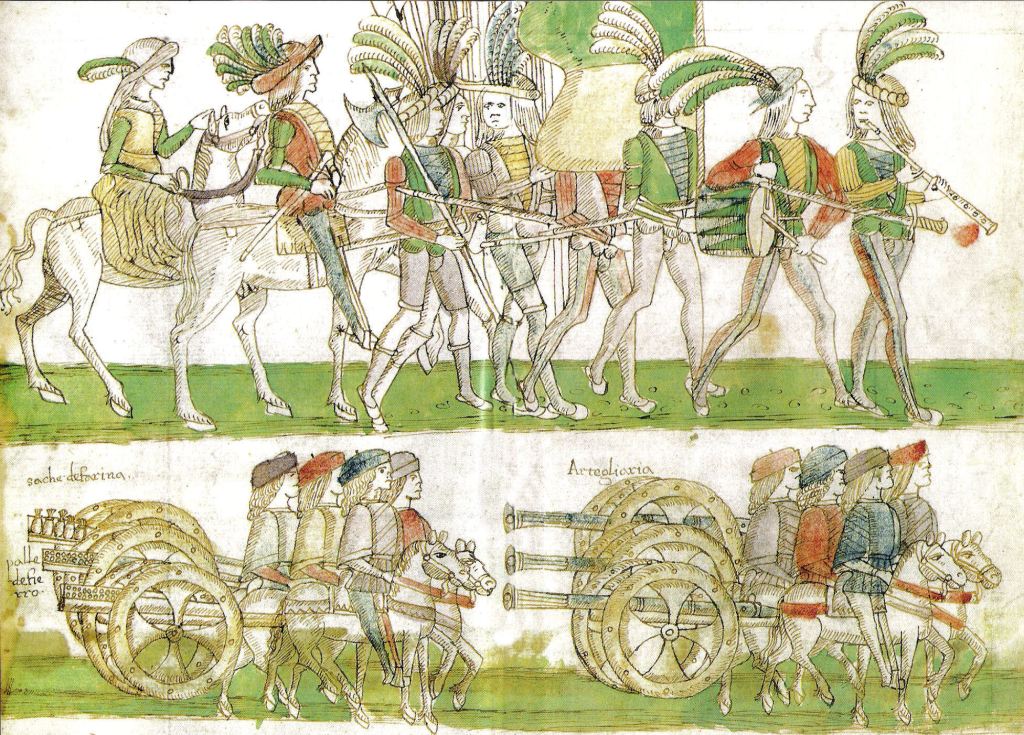
The maxim was also to acquire a striking personal resonance for Pontano after the French invasion. In a letter to Francesco Caracciolo written around July 1495, he defended his conduct after the collapse of the Aragonese cause and complained of the attacks of “stupid and malevolent men”, while insisting upon his lifelong loyalty to the Aragonese kings. If, as seems likely, the exterior inscriptions were already in place before these events, the letter cannot explain the origin of the maxim. It does, however, show how closely its distinction between the judgement of honourable and dishonourable men came to correspond with Pontano’s own later experience of accusation and damaged reputation.
Within the sequence, the maxim also complements the preceding insistence upon accepting responsibility for one’s own wrongdoing. The two propositions are not contradictory. One should accept deserved punishment, but one need not accept the judgement of those unqualified to give it. The distinction again depends upon discrimination rather than upon a fixed rule: neither public blame nor public praise has moral authority merely because it is public.
Excellence, education and the patria
NON SOLVM TE / PRAESTES EGREGIVM VIRVM SED ET ALIQVEM TIBI SIMILEM / EDVCES PATRIAE
“You should not only show yourself to be an exceptional man, but also educate another like yourself for your country.”
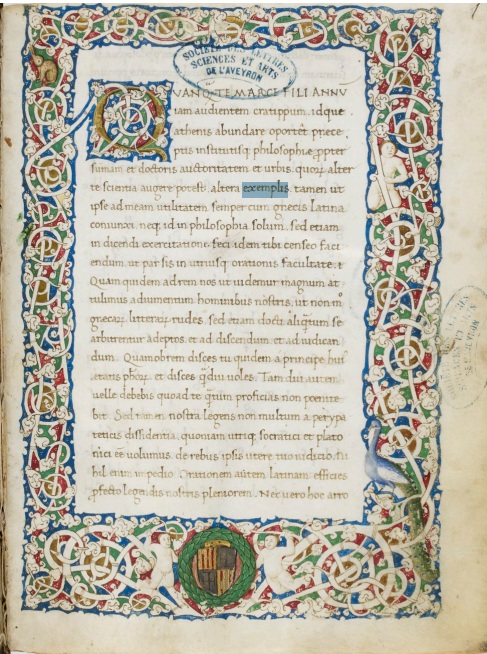
The inscription shifts the emphasis from individual excellence to its transmission. Personal virtue is not sufficient in itself. The vir egregius also has an obligation to form another person capable of serving the patria. Gahtan identifies the maxim as a paraphrase of Cicero’s De officiis II.46. She places it with the preceding maxim among the two inscriptions on the right of the doorway which address the conduct and responsibilities of public men, rather than the fortunes of the res publica itself. Read together, their relationship becomes clearer. The first asks the statesman to distinguish between worthy and unworthy judgement; the second insists that his own excellence should not end with himself, but should be reproduced through the education of another.
The principle is particularly appropriate to Pontano’s own intellectual activity. Beyond his poetry, much of his writing was devoted to moral and political education, and during the 1490s works that had often developed over long periods were being prepared for printing. While there is no certain evidence that Pontano was cultivating a single successor, the later Aegidius shows him looking explicitly towards intellectual continuity. He presents Giovanni Pardo as a worthy successor within the academy and places hopes in Giles of Viterbo as a figure capable of carrying humanist eloquence into religious discourse. More broadly, Pontano’s writings offered a means of transmitting experience and counsel beyond his own lifetime.
The word patria gives that transmission a specifically civic purpose. The successor is not merely to preserve the reputation or teachings of an individual master, but to put the qualities he has acquired at the service of the wider political community. In this sense education becomes a form of public action. The exceptional individual has an obligation to reproduce the moral and intellectual capacities on which good government depends, passing them to a later generation of men engaged in public life.
The same principle could apply to the chapel inscriptions themselves. Permanently displayed and addressed to those passing through the city, they preserve Pontano’s political and moral counsel beyond the immediate circumstances in which it was formed. The monument therefore does more than commemorate its patron. It also makes his accumulated experience available to later readers, turning the exterior of the chapel into an enduring instrument of ethical and political education.
The inscription was also to acquire a personal resonance after the collapse of the Aragonese regime. In his letter to Francesco Caracciolo of around July 1495, Pontano declares that he has withdrawn from public life and returned to his books. If, as seems likely, the tablet already existed by then, the letter cannot explain its composition. It nevertheless gives retrospective force to the maxim. As Pontano’s direct participation in government diminished, writing, teaching and the transmission of political experience assumed greater importance.
Conclusion
One reading of the programme of inscriptions would suggest that their coherence lies in a repeated demand for discrimination and considered judgement. Power requires self-command, but prudence does not always guarantee safety; a doubtful question should not be decided prematurely, yet caution can become timidity when circumstances demand action. Law cannot replace conscience, punishment must be distinguished from vengeance, and neither praise nor blame possesses moral authority independently of the character of those who bestow it. The apparent tensions between individual tablets are therefore part of the intellectual character of the programme. They ask the reader to distinguish between neighbouring virtues and vices according to circumstance.
This accords closely with Victoria Kahn’s account of Pontano’s prudentia. Practical action belongs to a contingent world in which certainty is seldom available, and rhetorical argument does not simply deliver conclusions but requires the reader or counsellor to compare alternatives and exercise discrimination. Argument in utramque partem, the capacity to entertain competing positions, is consequently related to practical judgement rather than indecision. The inscriptions do not reproduce a formal humanist disputation, and their arrangement cannot be demonstrated to constitute one. Yet the pattern repeatedly encountered across them, in which one maxim qualifies or appears to counter another, belongs comfortably within a rhetorical culture in which prudent action depends upon weighing circumstances rather than obeying a fixed rule.
Virginia Cox’s discussion of consilium in Quattrocento political rhetoric provides a useful wider context. Consilium concerns matters that remain doubtful, concealed or disputed and therefore requires the weighing and comparison of circumstances rather than the application of a fixed rule. Cox also shows how rhetorical understanding could be sharpened through the experience of political life itself, not merely through formal instruction. Although her principal examples are Venetian, the broader conjunction of rhetoric, practical judgement and political experience is closely relevant to the world in which Pontano worked.
In Naples, that humanist culture developed within the setting of Aragonese monarchy. Pontano’s own writings move beyond the traditional concerns of the speculum principis towards questions of social conduct, domestic life, civic relations and the responsibilities of a wider urban elite. His position therefore seems to bridge the world of royal government and that of a wider urban and administrative elite increasingly addressed by his moral and political writings. The chapel itself occupies something of the same position. Its inscriptions emerge from the language and problems of princely government, but they are placed openly before the city rather than reserved for the ruler and his counsellors.
Marta Celati’s study of Giuniano Maio’s De maiestate, composed in Naples in 1492, provides an especially close contemporary parallel for the adaptation of classical political language to Aragonese circumstances. Maio’s work draws repeatedly upon Cicero, Quintilian, Aristotle and Seneca, while reshaping their arguments in relation to the problems of monarchical government. One revealing instance is his treatment of Cicero’s Pro Sestio. Cicero’s passage describes the defence of religion, magistracies, the Senate, laws, ancestral custom, justice, provinces and other foundations of the Roman political order. Maio translates much of this material closely but introduces the language of maiestas where Cicero had spoken of dignitas, adapting a Ciceronian account of public political responsibility to the conceptual framework of Aragonese monarchy. Celati presents this not as an isolated operation but as characteristic of a treatise in which classical authorities are repeatedly reworked in relation to contemporary political experience.
The comparison is particularly pertinent because Pontano’s De principe and De obedientia were important foundations for Maio’s political thought, while maiestas already occupied an important place in Pontano’s understanding of princely government. Yet the chapel inscriptions also show how political and ethical ideas formed in the orbit of royal government could address a constituency extending beyond the immediate court. Questions concerning restraint, counsel, reputation, responsibility and political action are presented publicly to the city, even if their most engaged contemporary readers are likely to have belonged principally to its educated and administrative elite.
That widening of audience accords with Pontano’s own understanding of language. As Lodi Nauta has shown, De sermone treats speech as part of the social bond itself. Human life consists in actions, public meetings and assemblies, and Pontano states that deliberations, counsels and reasonings themselves consist in discourse and words. Language is therefore not merely the vehicle in which a completed political thought is subsequently expressed. It participates in the processes by which people deliberate, communicate judgement and act together. Nauta also emphasises the importance Pontano gives to precise moral vocabulary, through which neighbouring forms of conduct may be distinguished rather than blurred together. Both aspects are suggestive for the chapel: the tablets publicly name distinctions whose proper application can only be determined through judgement.
Sarcone’s comparison with the Porticus Antoniana gives this public dimension a particularly vivid form. In the Antonius, people passing the humanist portico could be addressed, questioned and drawn into conversation through remarks, jokes and discussion. Sarcone sees something of that dialogic habit continuing in the exterior inscriptions. The analogy need not imply that the stone tablets simply reproduce the exchanges of the portico, but it suggests a productive way of understanding their position in the street. Something of the spirit of humanist conversation has been made monumental and extended beyond Pontano’s immediate circle. The spoken exchange becomes a fixed public text, available not only to associates, officials and members of the contemporary urban elite, but to successive generations of Neapolitan readers.
The permanence of the inscriptions does not, however, make their counsel rigid. Their words are fixed in stone, while the circumstances in which they are to be understood remain variable. That tension may be one of the most characteristic features of the programme. Pontano monumentalises ethical and political counsel without eliminating the need for interpretation. The passer-by is not simply told what prudence, courage or responsibility require in every case, but repeatedly confronted with the possibility that a virtue pushed too far may become its neighbouring vice, or that circumstances may call for a response apparently opposed to one that was appropriate elsewhere. The monument preserves counsel for posterity while leaving judgement active.
The inscription concerning the education of another for the patria gives this concern with transmission a specifically civic form. In the chapel, political and moral judgement itself becomes part of the inheritance Pontano offers to later readers and to the patria.
Yet this public ethical voice represents only one side of the chapel’s epigraphic programme. On the exterior, the inscriptions address an open and changing audience through maxims concerned with conduct, judgement and political life. Within the chapel, the language changes register and enters a more restricted world shaped by family, death, grief, memory and Pontano’s own commemoration. The relationship between these public and private voices, and between the civic discourse of the exterior and the funerary and commemorative language within, forms the subject of the next article.
Producing these essays requires care, time, research, and resources. Contributions to help sustain this exploration would be greatly appreciated.
Donate to Inner Surfaces here.
Bibliography
I have consulted the following texts. Any errors are mine.
Beccadelli, A., Dels fets e dits del gran rey Alfonso: versió catalana del segle XV de Jordi de Centelles, ed. E. Duran, Barcelona: Editorial Barcino, 1990.
Bentley, J. H., Politics and Culture in Renaissance Naples, Princeton, NJ: Princeton University Press, 1987.
Brenzoni, R., Fra Giovanni Giocondo Veronese, Verona 1435–Roma 1515, Florence: L. S. Olschki, 1960.
Brown, A., ed., Language and Images of Renaissance Italy, Oxford: Clarendon Press, 1995.
Brooke, John, Giovanni Pontano (1429–1503) and Social Mores, Memorial and Material Culture in Renaissance Naples, c. 1450–1490, unpublished PhD thesis, Department of History of Art and Screen Media, Birkbeck College, University of London, 2010.
Celati, M., ‘Classical Sources and a New Theory of the State in the Renaissance: A Neapolitan Mirror for Princes’, Annali d’Italianistica, 38 (2020), pp. 19–46.
Cicero, On Duties, trans. W. Miller, Loeb Classical Library 30, Cambridge, MA: Harvard University Press, 1913.
Cicero, Pro Sestio. In Vatinium, trans. R. Gardner, Loeb Classical Library 309, Cambridge, MA: Harvard University Press, 1958.
Cox, V., ‘Rhetoric and Humanism in Quattrocento Venice’, Renaissance Quarterly, 56.3 (2003), pp. 652–694.
de Divitiis, B., ‘Giovanni Pontano and His Idea of Patronage’, in M. Beltramini and C. Elam, eds, Some Degree of Happiness: Studi di storia dell’architettura in onore di Howard Burns, Pisa: Edizioni della Normale, 2010, pp. 107–131.
de Divitiis, B., ‘PONTANVS FECIT: Inscriptions and Artistic Authorship in the Pontano Chapel’, California Italian Studies, 3.1 (2012), pp. 1-36.
Erasmus, D., Apophthegmatum libri I–IV, ed. T. L. ter Meer, Opera Omnia Desiderii Erasmi, IV.4, Leiden: Brill, 2010.
Filangieri di Candida, R., ‘Il tempietto di Gioviano Pontano in Napoli’, Atti dell’Accademia Pontaniana, 56 (1926), pp. 5-41.
Holmes, G., The Florentine Enlightenment, 1400–1450, London: Weidenfeld and Nicolson, 1969.
Juvenal and Persius, Juvenal and Persius, trans. S. M. Braund, Loeb Classical Library 91, Cambridge, MA: Harvard University Press, 2004.
Kahn, V., ‘Giovanni Pontano’s Rhetoric of Prudence’, Philosophy & Rhetoric, 16.1 (1983), pp. 16–34.
Kidwell, C., Pontano: Poet and Prime Minister, London: Duckworth, 1991.
Livy, History of Rome, vol. IV: Books 8–10, trans. B. O. Foster, Loeb Classical Library 191, Cambridge, MA: Harvard University Press, 1926.
Livy, History of Rome, vol. V: Books 21–22, trans. B. O. Foster, Loeb Classical Library 233, Cambridge, MA: Harvard University Press, 1929.
Maffei, D., Alessandro d’Alessandro: giureconsulto umanista (1461–1523), Milan: Giuffrè, 1956.
Nauta, L., ‘Philology as Philosophy: Giovanni Pontano on Language, Meaning, and Grammar’, Journal of the History of Ideas, 72.4 (2011), pp. 481–502.
Palmieri, M., Vita civile, ed. G. Belloni, Florence: Sansoni, 1982.
Percopo, E., ‘La vita di Giovanni Pontano’, Archivio Storico per le Province Napoletane, n.s. 22 (1936), pp. 116–250.
Plutarch, Moralia, vol. III: Sayings of Kings and Commanders; Sayings of Romans; Sayings of Spartans; The Ancient Customs of the Spartans; Sayings of Spartan Women; Bravery of Women, trans. F. C. Babbitt, Loeb Classical Library 245, Cambridge, MA: Harvard University Press, 1931.
Polybius, The Histories, vol. VI: Books 28–39, trans. W. R. Paton, Loeb Classical Library 161, Cambridge, MA: Harvard University Press, 1927.
Pontano, G. G., De immanitate liber, ed. L. Monti Sabia, Naples: Loffredo, 1970.
Pontano, G. G., De magnanimitate, ed. F. Tateo, Florence: Istituto Nazionale di Studi sul Rinascimento, 1969.
Pontano, G. G., De principe, ed. G. M. Cappelli, Rome: Salerno Editrice, 2003.
Pontano, G. G., De sermone libri sex, ed. S. Lupi and A. Risicato, Lugano: Thesaurus Mundi, 1954.
Pontano, G. G., I dialoghi, ed. C. Previtera, Florence: Sansoni, 1943.
Pontano, G. G., I libri delle virtù sociali, ed. F. Tateo, Rome: Bulzoni, 1999.
Pontano, G. G., ‘On the Prince’, trans. N. Webb, in J. Kraye, ed., Cambridge Translations of Renaissance Philosophical Texts, vol. 2: Political Philosophy, Cambridge: Cambridge University Press, 1997, pp. 69–87.
Sarcone, I., Il libro di pietra: le iscrizioni della Cappella Pontano in Napoli, Naples: Editrice Domenicana Italiana, 2014.
Seneca, Moral Essays, vol. I, trans. J. W. Basore, Loeb Classical Library 214, Cambridge, MA: Harvard University Press, 1928.
Soria, A., Los humanistas de la corte de Alfonso el Magnánimo (según los epistolarios), Granada: Universidad de Granada, 1956.
Stacey, P. J. F., Imperial Rome and the Legitimation of Political Authority in Renaissance Naples, unpublished PhD thesis, University of Cambridge, 2000.
Wellington Gahtan, M., ‘Reading Pontano’s “libretto co’ fogli di marmo”’, Opus Incertum, 8.1 (2022), pp. 48–59.

