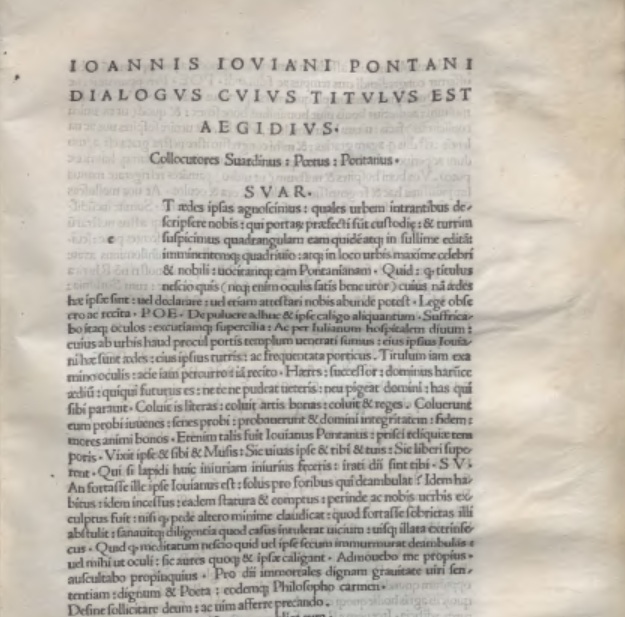
Written around 1501–3, during the last years of Giovanni Pontano’s life, the humanist dialogue Aegidius belongs to a period marked by an accumulating sense of loss. That process had begun more than a decade earlier with the death of his wife, Adriana Sassone, on 1 March 1490. Permission to construct the Pontano Chapel was granted that September, and the building was dedicated in 1492. What began in the immediate aftermath of bereavement developed into a wider monument to family, friendship, learning and Pontano’s own memorial.
The years that followed brought losses of another kind. The French descent into Italy in 1494 began the destruction of the Aragonese political order in which Pontano had spent his public life. The dynasty finally collapsed in 1501. In October of that year Sannazaro followed King Federico into exile; towards the end of the year, Pontano’s lifelong companion Pietro Golino died, adding a further personal loss to the political catastrophe that had already overtaken the kingdom.
Aegidius gathers this diminishing world into conversation. Friends are remembered or mourned, Pontano appears as an old man whose achievements are already being recounted by others, and the future of the Academy becomes an urgent concern. Yet the dialogue is not simply elegiac. It also looks towards intellectual succession and towards a possible accommodation between Christian belief and humanist learning.
Read retrospectively, Aegidius offers a suggestive context for the chapel completed nearly a decade earlier. It cannot explain the building’s conception directly, but its valedictory temper helps us recognise the chapel as an earlier stage in the same work of preservation: an attempt to gather those people, values and forms of identity that age, death and political upheaval were beginning to carry away.
The architecture and inscriptions of the chapel have already demonstrated how emphatically the building belongs to the culture of Renaissance humanism. The present essay approaches it from another direction. It considers a small group of themes from Pontano’s later writings that help to explain how a Christian funerary chapel could assume so markedly classical a form. It offers a sketch of the place occupied by religion within his humanism, particularly in relation to old age, public life, commemoration and the responsibilities of the living.
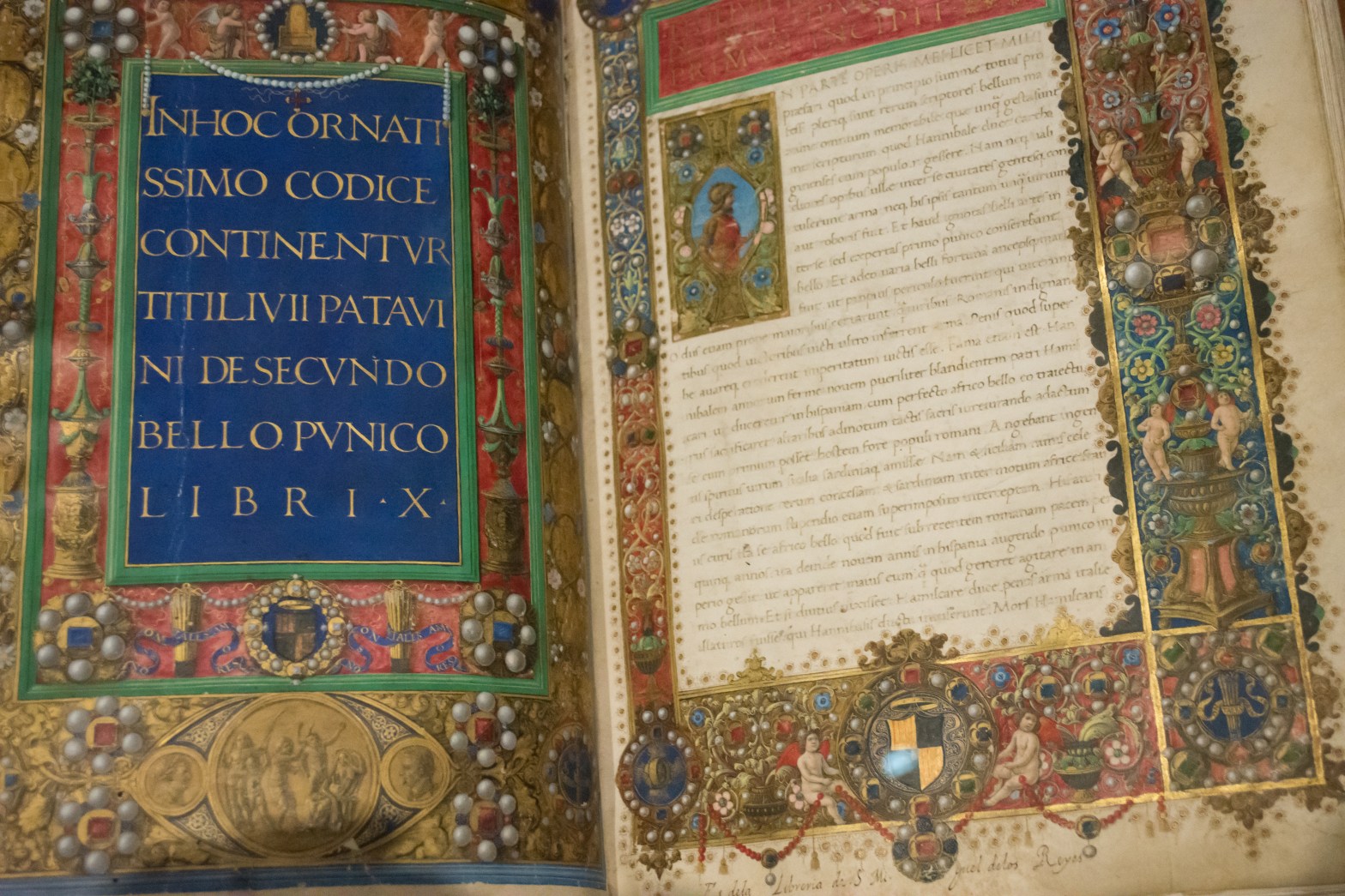
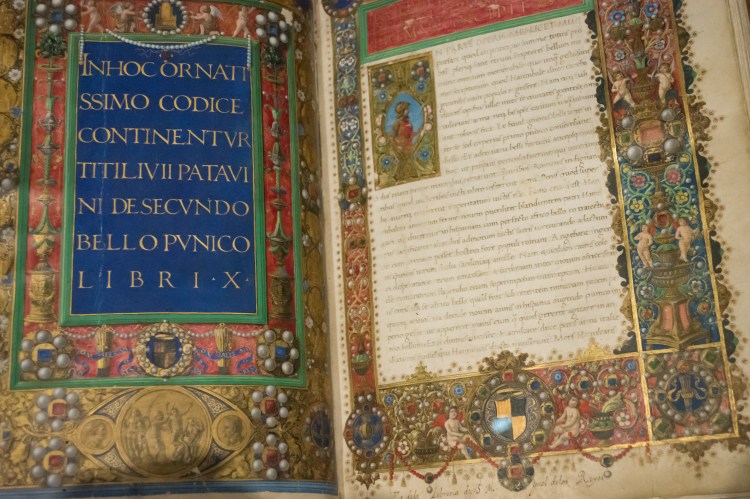
The reported preservation of a relic of Livy’s arm within the chapel provides an arresting emblem of this intellectual world. Pontano had received the relic through his early mentor Panormita, and a now-lost inscription recorded its presence in the building. Later guidebooks described the relic as being on or near the altar, although the original arrangement can no longer be reconstructed. The association is nevertheless striking: the relic of a pagan historian were preserved within a consecrated Christian chapel.
The chapel’s Christian observance
The chapel’s Christian identity was explicit. The dedicatory inscription over the principal entrance records that Giovanni Gioviano Pontano dedicated the building in 1492 to the Virgin, Mother of God, and Saint John the Evangelist. A shortened version of the same dedication appears over the lateral entrance. Its sacred purpose was therefore publicly declared on both approaches.
Inside, the altar is surmounted by a fresco generally attributed to Francesco Cicino da Caiazzo and probably executed soon after the chapel’s completion. It represents the Virgin and Child between Saint John the Baptist and Saint John the Evangelist, while the lunette above contains the Cross between angels. The inclusion of the Virgin and Saint John the Evangelist corresponds closely with the dedication announced outside.
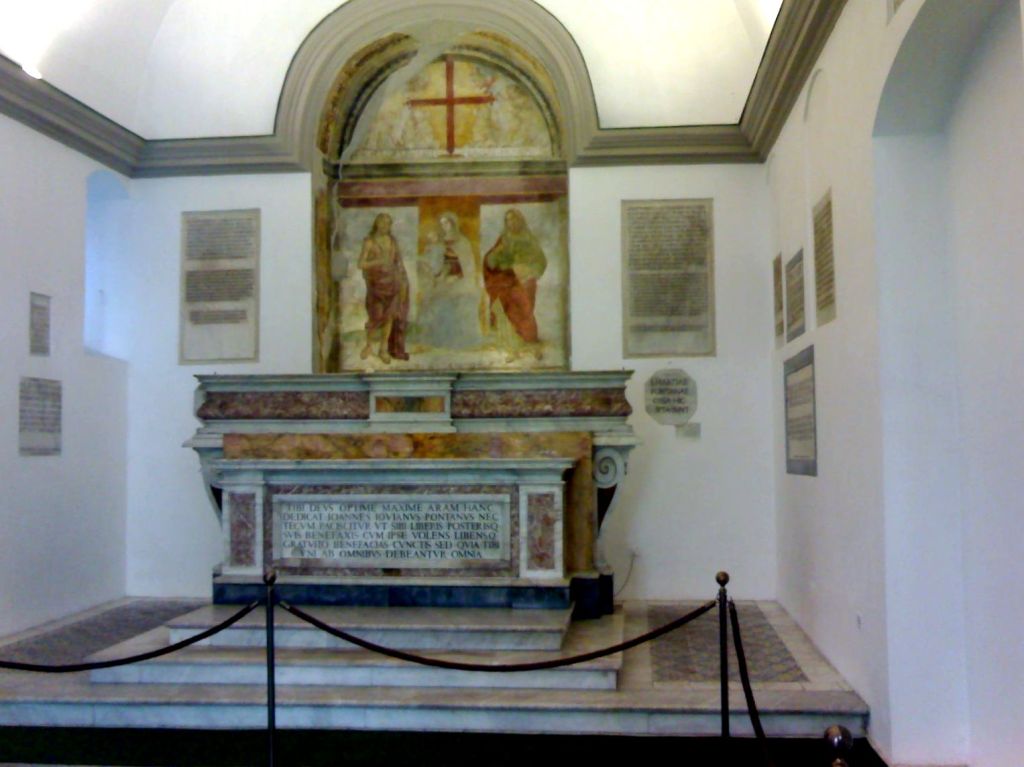
These elements should not be treated as marginal qualifications to an otherwise classical monument. The chapel was a consecrated funerary space centred upon a Christian altar. The question is not whether its religious purpose was genuine, but how that purpose related to the forms of classical architecture, moral instruction and commemoration through which Pontano chose to express it.
Religion in Aegidius
In Aegidius, Pontano is introduced as an old man walking and speaking to himself. The words overheard by his visitors are characteristic of the dialogue’s religious temper: “Stop bothering God and badgering him with prayers. His is the private and public care of men.”
Pontano immediately explains that he is not rejecting prayer. God already knows what is useful or harmful to each person, while repeated petitions may ask for things that would bring no benefit. The passage combines confidence in divine providence with a certain impatience towards excessive or importunate devotion.
Elsewhere in the dialogue Pontano affirms the immortality of the soul. His arguments, however, draw upon natural belief and the consensus of peoples as much as upon formal theology. Religious truth is approached through the habits of humanist enquiry as well as through Christian doctrine.
This characteristic has led to different emphases in modern scholarship. Claudio Finzi sees Aegidius as evidence of a stronger religious concern in Pontano’s final years, whereas David Marsh stresses the dialogue’s attempt to bring sacred learning and humanist culture into closer relationship. The two interpretations are not incompatible. If Aegidius reflects a deepening engagement with religious questions, it does so without abandoning the intellectual methods or literary culture that had shaped Pontano’s career.
The figure of Giles of Viterbo is important in this respect. Pontano presents him as both learned and holy, a religious man who could recognise the moral value of humanist learning. The Augustinian theologian offered the possibility that humanist eloquence might become a vehicle for sacred thought rather than its adversary.
This did not mean that Pontano accepted every form of religious teaching or authority without question. Aegidius criticises corrupt teachers, contentious doctrines, popular superstition and practices encouraged by self-interested clergy. His concern is with the effects of such teaching upon conduct and communal life.
Pontano’s hope for a new Latin philosophy belongs to the same context. He imagined a philosophical language that would be more elegant, more properly Roman and less dominated by aggressive disputation. Intellectual reform was also a reform of manners. Language, belief and social interaction were connected by the demand that learning should improve the lives of those who practised it.
Religion and public life
Pontano’s writings also show that religion was not simply a matter of private belief. Like many Renaissance humanists, he understood it as having an important role in the ordering of public life.
In De principe, he remarks that Alexander the Great recognised the political value of appearing religious. A reputation for piety increased goodwill and helped rulers establish authority over their subjects. Pontano even reports the usefulness of superstition as a means by which leaders might enter the minds of the people.
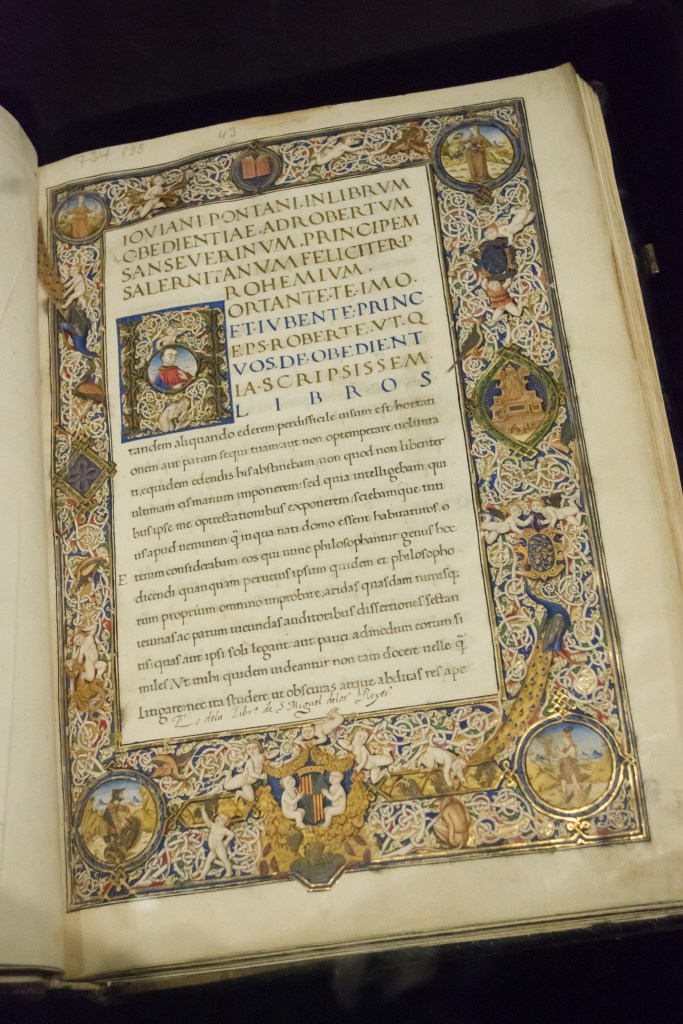
This should not be read straightforwardly as a confession of Pontano’s private beliefs. De principe belongs to the literature of advice to rulers and is concerned with the practical operation of government. It nevertheless shows that Pontano regarded religion as a public and political force. Religious reputation could encourage obedience, confirm authority and reinforce the bonds between ruler and subject.
This practical understanding had powerful classical precedents. Cicero repeatedly presents religion as one of the foundations of civil society. Oaths confirm agreements, treaties acquire sanctity, fear of divine punishment restrains wrongdoing, and the gods become witnesses to the obligations citizens undertake towards one another. Religion therefore helps to sustain the trust upon which political communities depend.
Pontano’s writings on the studia humanitatis point in a similar direction. In De immanitate, humanist learning is associated with the cultivation of virtue. It moderates destructive passions, encourages gentleness in social relations and makes communal life possible. The contrast between humanitas and immanitas is not merely educational. It concerns the difference between civilised conduct and the violence that threatens social order.
Religion and humanist education are therefore not presented as interchangeable, but they can perform related tasks. Both may restrain disorder, guide conduct and strengthen the relationships upon which civic life depends. The moral language displayed on the exterior of the chapel belongs within this practical world of advice, judgement and social responsibility.
Commemoration and the living
Pontano did not understand commemoration simply as a service performed for the dead. In De magnificentia, echoing an argument found in Lorenzo Valla’s De voluptate, he remarks with characteristic directness that praise is of no use to corpses, since the dead are no longer concerned with human affairs. Its benefits fall instead upon their children and descendants. Funeral honour preserves the reputation of a family, but it also presents the living with examples worthy of emulation.
This practical view sits well with the chapel’s inscriptions. The epitaphs preserve the names of Pontano’s wife, children, friends and finally Pontano himself, but they do more than identify those buried or commemorated there. They address visitors, recall virtues and invite reflection upon lives that have ended. The dead remain present through words, while the living are made responsible for interpreting what those words preserve.
Cicero provides a broader classical context for this concern with posterity. In the Tusculan Disputations, he places monuments, epitaphs, children, laws and public institutions among the signs that human beings act with future generations in mind. Like those who plant trees whose fruit they will never see, they undertake works that extend beyond their own lives.
Cicero also connects the desire for posthumous fame with public service. Without some expectation of being remembered, few people would willingly endure toil and danger for the commonwealth. The desire for reputation after death need not therefore amount only to vanity. It may encourage conduct whose benefits will be enjoyed by others.
The Pontano Chapel belongs to this forward-looking culture of remembrance. It preserves a family and an individual reputation, but it also places a memorial of civic virtue within the life of the city. Its commemorative purpose depends upon later visitors continuing to read, recognise and respond.
“Know thyself”
Pontano’s own epitaph makes that relationship with the visitor explicit:
“While alive I prepared this house in which I would rest when dead. I beg you not to injure the dead, since while living I injured no one. I am Giovanni Gioviano Pontano, whom the good Muses loved, honourable men respected and kings and lords honoured. You now know who I am, or rather who I was. But I cannot know you, visitor, from the darkness. I ask you instead to know yourself. Farewell.”
The inscription begins by naming the dead man and recording the esteem in which he believed himself to have been held. It then changes direction. Pontano acknowledges that the visitor can now know who he was, while he, confined to darkness, cannot know the person standing before him. The final injunction, “know yourself”, turns attention away from the identity of the deceased and towards the moral life of the reader.
The phrase derives from the Delphic tradition rather than explicitly Christian teaching, but its meaning need not be confined to philosophical introspection. In Neapolitan humanist writing, self-knowledge could include recognition of one’s character, circumstances, duties and proper sphere of action. Mario Santoro connected this practical understanding of the maxim with Pontano’s own commitment to public life. Knowledge of the self could therefore lead outwards into conduct rather than away from society.
The epitaph gives the chapel’s commemoration a reciprocal form. The visitor is invited to remember Pontano, but that encounter is incomplete unless it also produces self-examination. The monument preserves the dead by making demands upon the living.
Conclusion
The chapel began in the aftermath of Adriana Sassone’s death, but its commemorative purpose gradually widened as Pontano’s own world contracted. It came to preserve not only the memory of his wife and family, but also the friendships, public service and intellectual values that had shaped his life. Read beside Aegidius, it appears less as a static family monument than as an early attempt to preserve a world that bereavement, political collapse and old age were beginning to dismantle.
Aegidius was written almost a decade after the chapel’s completion, at a time when age, death and political upheaval had taken away much of the world Pontano had known. The dialogue cannot be used as a direct explanation of the building, but it helps recover the intellectual atmosphere in which the chapel continued to acquire meaning. Christian belief, classical philosophy, humanist learning, public responsibility and the desire for remembrance remain closely connected throughout the dialogue.
The chapel should not therefore be understood as a classical monument whose Christian purpose is merely incidental, nor as a conventional religious foundation decorated with antiquarian references. Its forms belong to the particular religious and commemorative culture of a humanist who continued to approach death, belief and moral conduct through the intellectual traditions of classical antiquity.
Producing these essays requires care, time, research, and resources. Contributions to help sustain this exploration would be greatly appreciated.
Donate to Inner Surfaces here.
Bibliography
I consulted these sources. Any errors are mine.
Brooke, John, Giovanni Pontano (1429–1503) and Social Mores, Memorial and Material Culture in Renaissance Naples, c. 1450–1490, unpublished PhD thesis, Department of History of Art and Screen Media, Birkbeck College, University of London, 2010.
Cicero, De re publica; De legibus, ed. and trans. Clinton Walker Keyes, Cambridge, Massachusetts, 1961.
Cicero, Tusculan Disputations, ed. and trans. J. E. King, Cambridge, Massachusetts, 1960.
de Divitiis, Bianca, ‘PONTANVS FECIT: Inscriptions and Artistic Authorship in the Pontano Chapel’, California Italian Studies, 3.1, 2012, pp. 1–36.
Finzi, Claudio, Re, baroni, popolo: la politica di Giovanni Pontano, Rimini, 2004.
Kidwell, Carol, Pontano: Poet and Prime Minister, London, 1991.
Marsh, David, The Quattrocento Dialogue: Classical Tradition and Humanist Innovation, Cambridge, Massachusetts, 1980.
Miletti, Lorenzo, ‘Studying Local Antiquities in the Kingdom of Naples: Giovanni Pontano, Francesco Soderini, and the Varronianum of Fondi’, Mitteilungen des Kunsthistorischen Institutes in Florenz, 60.1, 2018, pp. 54–65.
Percopo, Erasmo, ‘La biblioteca di Giovanni Pontano’, in In onore di Giovanni Gioviano Pontano nel quinto centenario della sua nascita, Naples, 1926, pp. 53–65.
Pontano, Giovanni Gioviano, Aegidius and Asinus, ed. and trans. Julia Haig Gaisser, Dialogues, vol. III, Cambridge, Massachusetts, 2020.
Pontano, Giovanni Gioviano, De immanitate liber, ed. and trans. Liliana Monti Sabia, Naples, 1970.
Pontano, Giovanni Gioviano, De principe, ed. Guido M. Cappelli, Rome, 2003.
Pontano, Giovanni Gioviano, I dialoghi, ed. Carmelo Previtera, Florence, 1943.
Pontano, Giovanni Gioviano, I libri delle virtù sociali, ed. Francesco Tateo, Rome, 1999.
Pontano, Giovanni Gioviano, ‘On the Prince’, trans. Nicholas Webb, in Cambridge Translations of Renaissance Philosophical Texts, vol. II: Political Philosophy, ed. Jill Kraye, Cambridge, 1997, pp. 69–87.
Santoro, Mario, Tristano Caracciolo e la cultura napoletana della Rinascenza, Naples, 1957.
Valla, Lorenzo, On Pleasure: De voluptate, trans. A. Kent Hieatt and Maristella de Panizza Lorch, New York, 1977.
Wellington Gahtan, Maia, ‘Reading Pontano’s “libretto co’ fogli di marmo”’, Opus Incertum, 8.1, 2022, pp. 48–59.
Wood, Neal, Cicero’s Social and Political Thought, Berkeley, 1988.

