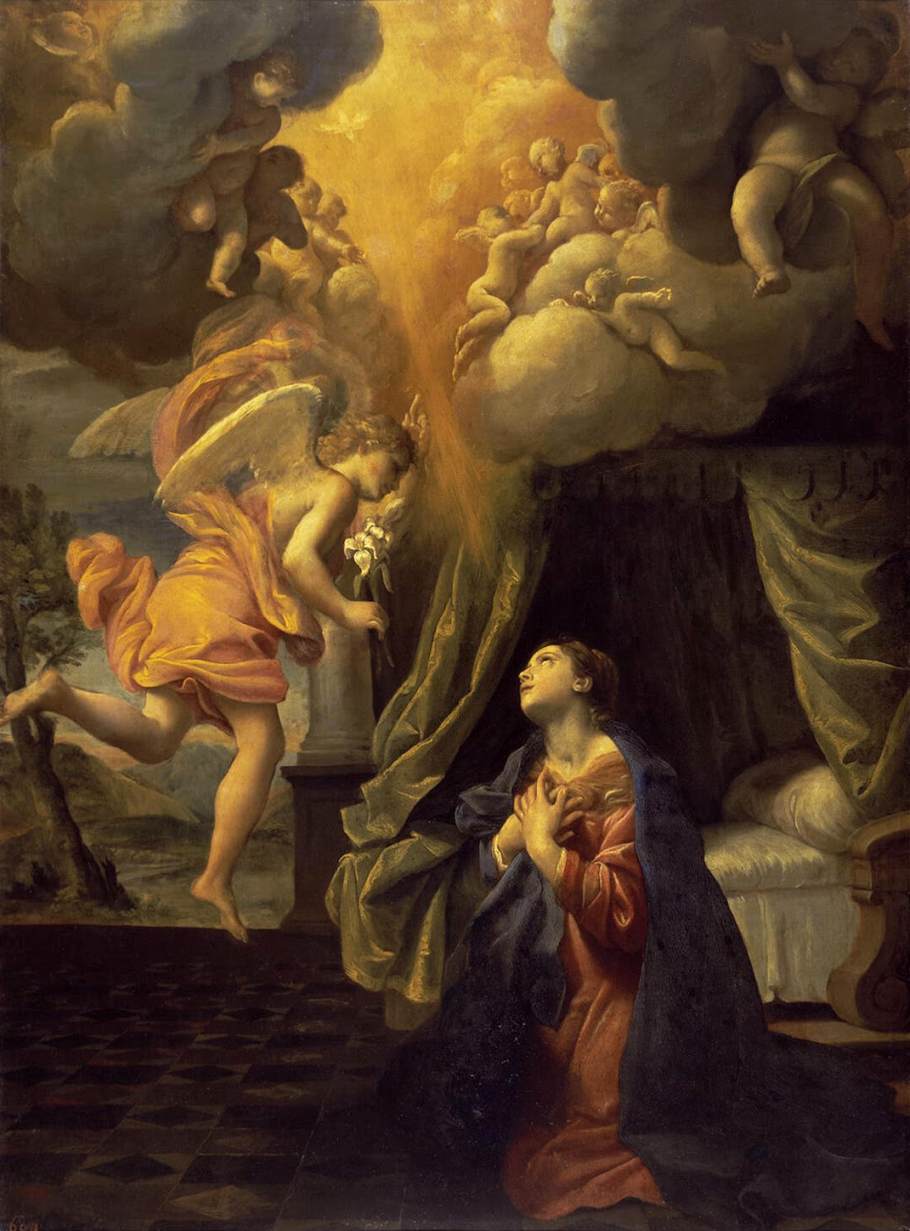
A group of three related Annunciations by Giovanni Lanfranco seems to trace the reworking of a successful invention: the small copper now in the Hermitage, the large canvas in Notre-Dame-de-Bonne-Nouvelle in Paris, and the later altarpiece in the Costaguti Chapel of Santi Biagio e Carlo ai Catinari in Rome. The precise dating of the Hermitage work has been debated, but recent scholarship places it before the Paris canvas and the Roman altarpiece. Taken together, the three paintings offer a compact view of Lanfranco’s development of a composition as it moved from a work intended for private devotion to large altarpieces for public church settings.
Giovanni Lanfranco (1582–1647) emerged from the Carracci circle in Rome to become one of the leading painters of the early Baroque. Trained first by Agostino Carracci and later working with Annibale Carracci, he renewed his engagement with Correggio during a return to Parma before developing an increasingly personal style that combined dramatic lighting, fluid movement and expansive spatial invention. During the 1620s his Roman career culminated in major fresco commissions, above all the dome of Sant’Andrea della Valle. He moved to Naples in 1634, where his freer handling, luminous colour and illusionistic ceiling painting had a strong influence on local artists, before returning to Rome in the final years of his life. The three Annunciations discussed here belong to the years between about 1615 and 1625, when Lanfranco’s mature Roman language was taking shape.
The small Annunciation in the Hermitage provides the starting point. Painted on copper, probably around 1615–16, it belonged to the world of private devotion, refined collecting and aristocratic patronage. Its domestic setting is rendered with exquisite attention: the bed and its rumpled sheets, the tiled floor and the architectural setting all invite close inspection. To the left, the room opens onto a landscape, extending the composition beyond the immediate encounter and adding a further sense of pictorial depth. Gabriel enters along a controlled diagonal, while the Virgin raises her head towards him. Paradoxically, the smallest of the three works combines the greatest concentration of fine detail with, arguably, the most expansive sense of space. Descending light, Gabriel’s airborne movement and the attendant putti animate the scene, but the small format keeps the drama contained.
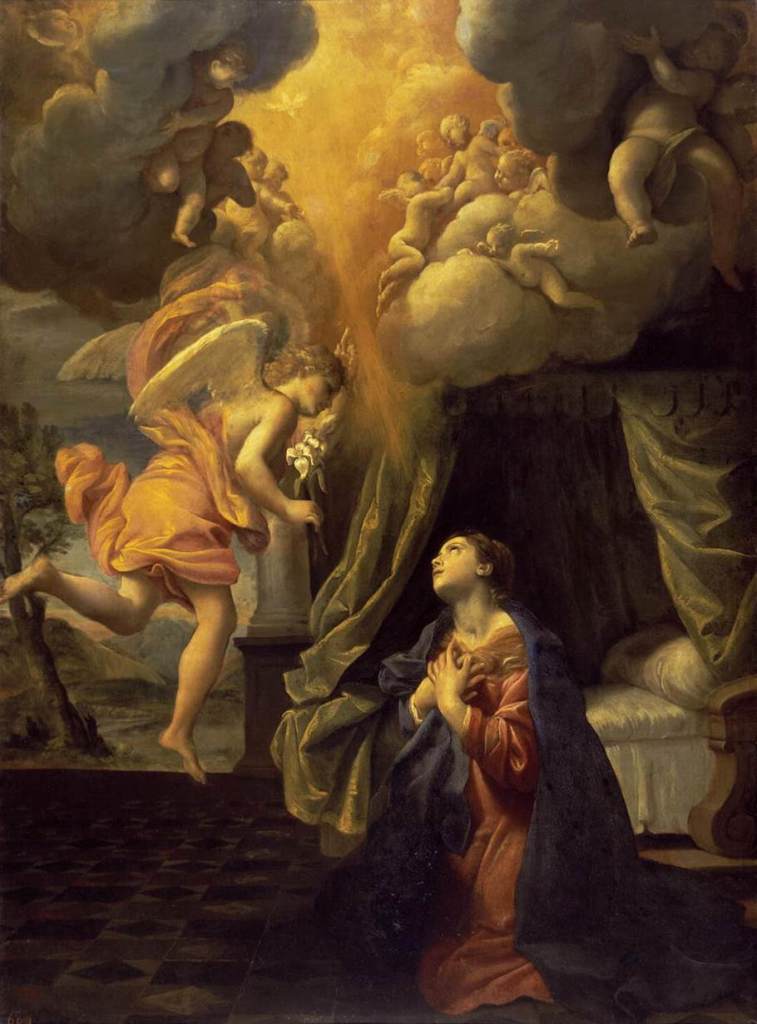
Its early history links it with Cardinal Alessandro Peretti Montalto, and its subsequent passage through major collections suggests that it was valued as more than a minor cabinet picture. It entered the collection of Cardinal Silvio Valenti Gonzaga, appeared in Panini’s painted view of his gallery, passed through François Tronchin’s collection in Geneva, and entered the Hermitage in 1770.
In her entry in Museo Statale Ermitage: La pittura italiana del Seicento, Svetlana Vsevolozskaja notes that the Hermitage Annunciation was known through copies and engravings, including prints by Cornelis Bloemaert and Nicolas Bazin. This wider circulation suggests that, before Lanfranco reworked the subject on a monumental scale, the composition already had a clarity and devotional appeal that made it repeatable.
The dating of the Hermitage copper has nevertheless remained unsettled. Blunt and Cooke associated it with a drawing in the Royal Collection at Windsor, now catalogued as Studies for the Virgin Annunciate (RCIN 905709), and linked both sheet and painting with Lanfranco’s Neapolitan period.
The related Windsor drawing (RCIN 905709) can be viewed here:
Other scholars placed the work much earlier. Schleier initially dated it to around 1607–08, but later revised his view and assigned the painting instead to about 1615–16. The Windsor sheet contains three exploratory studies of the Virgin, adjusting the upward inclination of her head and the placement of her hands. Its connection with the Hermitage painting is therefore useful, although it does not by itself settle the work’s date.
The Paris Annunciation, now in the choir of Notre-Dame-de-Bonne-Nouvelle, appears to be the first monumental treatment of the invention developed in the Hermitage copper. Painted on canvas and measuring 242 × 169 cm, it is generally dated to about 1617–19. The domestic detail of the copper has largely disappeared. The bed, landscape and sharply defined architectural setting give way to a less terrestrial conception, in which the Virgin is surrounded by a celestial apparition described through cloud, diffused light and softened contours. Figures and atmosphere seem to merge, dissolving the clear distinction between earthly interior and heavenly vision.
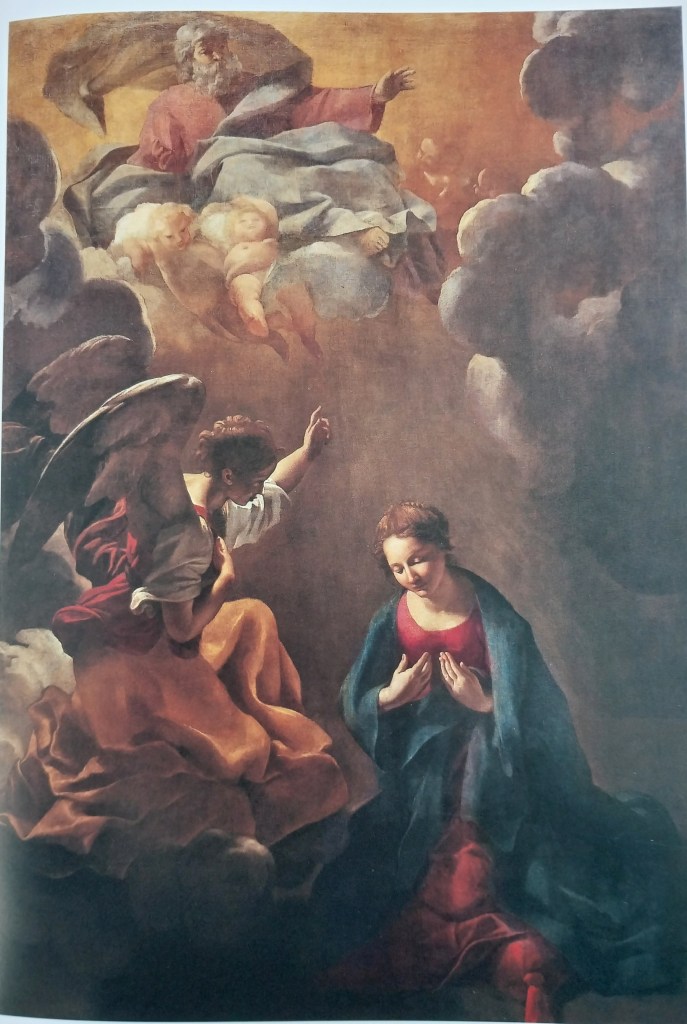
The basic relationship between Gabriel and the Virgin remains recognisable, but the emotional tone has changed. The Virgin lowers her head, responding with a quieter and more inward humility than in the Hermitage painting. Above her, God the Father appears among angels, while the heavenly light spreads through the upper part of the canvas in a soft, smoky diffusion. The effect is more ethereal than in the copper, and less dependent on the precise description of surfaces and objects.
The painting’s modern history is unusually eventful. It was placed in the apse of Notre-Dame-de-Bonne-Nouvelle in 1829–30, after the rebuilding of the church, and modified to fit the curved setting through the addition of shaped panels around the original canvas. Later changes to the interior left it hidden behind the organ, where it remained until its rediscovery in 1970. Pierre Rosenberg drew attention to it in 1976, and Arnauld Brejon de Lavergnée published it as a work by Lanfranco the following year. Its recovery altered the chronology of the related Annunciations, since it revealed that the Costaguti altarpiece in Rome was not Lanfranco’s first monumental treatment of the composition.
A preparatory drawing of Gabriel at Capodimonte, catalogued in the Gabinetto Disegni e Stampe as inv. Mosca 515 recto and executed in black and white chalk, relates to the angel in the Paris painting rather than to the later Roman version. The folds of Gabriel’s yellow garment correspond in many details to those in the finished Paris canvas, although his right arm remains bare and his head is only lightly sketched in the drawing. The sheet therefore provides further evidence for the separate preparation of the Paris altarpiece.
The Roman Annunciation, now in the Costaguti Chapel in Santi Biagio e Carlo ai Catinari, represents a further reworking of the composition rather than a simple enlargement of the Paris altarpiece. Executed on canvas and measuring 296 × 183 cm, it is generally dated to about 1624–25. The principal figures are brought forward and given greater physical weight, while the smoky diffusion of the Paris canvas gives way to a more clearly articulated setting. A broad hanging in subdued red-brown and muted vermilion tones reintroduces a terrestrial, domestic element, though without recovering the detailed bedchamber and landscape of the Hermitage copper. The encounter is now organised with greater clarity for viewing at a distance.
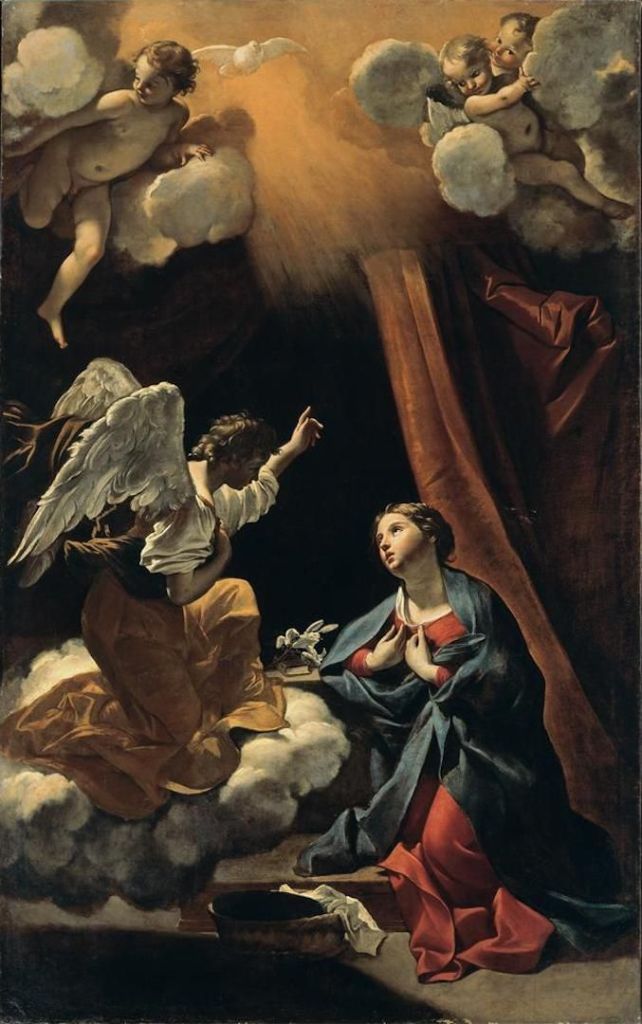
Gabriel kneels at the left, his body turned firmly towards the Virgin, while she raises her head in response. The exchange between them is more direct than in the Paris painting, where her lowered gaze gives the scene a more inward character. Lanfranco also reorders the heavenly zone. God the Father disappears, and the celestial company is reduced to three putti around the descending dove. Fewer in number than in the earlier versions, they are also more fully modelled, with a greater sense of bodily weight and a more recognisably human presence. Beneath the celestial group, the centre and left of the composition are held in shadow, while the large hanging occupies the right-hand side, helping to define the interior without restoring the detailed domestic setting of the Hermitage copper.
The Roman version also introduces a more emphatic group of devotional and domestic objects. The lectern and open book, the lily and what Schleier identifies as a small basket containing wool (Giovanni Lanfranco: un pittore barocco tra Parma, Roma e Napoli, 2001, cat. 62) establish the Virgin’s room without recreating the extensive bedchamber, landscape and architecture of the Hermitage copper. The objects are larger and more isolated, serving as clearly readable signs within an altarpiece rather than as details intended principally for close inspection. The composition is adjusted to the scale and devotional function of a chapel interior, where clarity takes precedence over descriptive detail.
The date of the altarpiece was long uncertain. Earlier scholars placed it around 1615 or 1620, before the chronology of Lanfranco’s related works had been fully clarified. The rediscovery of the Paris canvas helped to establish that the Costaguti painting was the later version. A date around 1624–25 also places it close to Lanfranco’s work for the Costaguti family in their Roman palace, including the fresco of Justice and Peace.
The circumstances of the commission remain less clear than its approximate date. The final arrangement of the Costaguti Chapel belongs to the later seventeenth century, when Giovanni Battista Costaguti junior acquired and refashioned the first chapel on the right. The altarpiece itself, however, must have been painted much earlier, probably for an earlier member of the family, perhaps Giovanni Battista Costaguti senior or Prospero Costaguti. Its original destination may therefore have preceded the chapel setting in which it was eventually installed.
Seen after the Hermitage and Paris versions, the Roman altarpiece shows Lanfranco preserving the basic relationship between Gabriel, the Virgin and the descending light while revising almost everything around it. The intimate description of the copper and the atmospheric softness of the Paris canvas give way to firmer contours, more monumental figures and a composition designed to remain clear within a public devotional setting.
[Producing these essays requires care, time, research, and resources. Contributions to help sustain this exploration would be greatly appreciated.]
Donate to Inner Surfaces here.
Bibliography
Blunt, Anthony, and Hereward Lester Cooke. The Roman Drawings of the XVII and XVIII Centuries in the Collection of Her Majesty the Queen at Windsor Castle. London: Phaidon, 1960.
Schleier, Erich. Disegni di Giovanni Lanfranco. Florence: Leo S. Olschki, 1983.
Schleier, Erich, ed. Giovanni Lanfranco: un pittore barocco tra Parma, Roma e Napoli. Exhibition catalogue, Colorno, Naples and Rome. Milan: Electa, 2001. See cat. 45, Annunciazione alla Vergine, Notre-Dame-de-Bonne-Nouvelle, Paris, pp. 192–93; and cat. 62, Annunciazione, Santi Biagio e Carlo ai Catinari, Rome, pp. 232–33.
Schleier, Erich. “Lanfranco, Giovanni.” Dizionario Biografico degli Italiani. Rome: Istituto della Enciclopedia Italiana.
Vsevolozskaja, Svetlana. Entry on Giovanni Lanfranco’s Annunciazione. In Museo Statale Ermitage: La pittura italiana del Seicento. Catalogo della collezione. Milan: Skira, 2010.
Online resource
Royal Collection Trust. Giovanni Lanfranco, Recto: Studies for the Virgin Annunciate; verso: Studies of an Arm and Drapery, RCIN 905709.

