Luca Giordano was born in Naples on 18 October 1634, the son of Antonio Giordano and Isabella Imparato. According to Maria Giovanna Sarti, his father was a picture dealer of Puglian origin and also a modest painter, and seems to have introduced him early to the practical world of painting. Although the sources report an early journey to Rome around 1650, Sarti stresses that Giordano’s formation was essentially Neapolitan. He grew up in a city still profoundly marked by Caravaggio’s two Neapolitan stays and by the powerful example of Jusepe de Ribera. His earliest works, from the beginning of the 1650s, show both a Caravaggesque inheritance and a close study of Ribera, especially in the philosopher types and in the strongly naturalistic treatment of figures.
From the beginning, however, Giordano’s art was not confined to a single model. The presence of Mattia Preti in Naples from 1653 gave him an important stimulus at the moment when he was beginning to move beyond the severe naturalism of Ribera. Preti brought with him a broader Baroque experience shaped by Rome, by a more theatrical handling of light and by the wider movement of mid-century painting. His example helped Giordano imagine how Neapolitan naturalism might be opened towards movement, colour and theatrical breadth. At the same time, Lanfranco’s major fresco cycles were directly visible in Naples, especially at the Gesù Nuovo and in the Cappella del Tesoro di San Gennaro, while Cortona’s language could be absorbed through works, prints and Giordano’s own Roman experience. The change can already be felt in works of the later 1650s, where the darker Riberesque inheritance begins to give way to a more expansive Baroque idiom.
In the 1660s and 1670s Giordano became one of the dominant painters in Naples, working for ecclesiastical patrons, viceroys, private collectors and a widening international market. His links with Spanish viceregal circles were already important before he went to Spain, and Sarti notes that many works were made for Spanish patrons in Naples. His contact with Venice, probably in 1665, also mattered: there he could confront the painting of Tintoretto, Veronese and Titian directly. These experiences enlarged his colour, loosened his handling, and strengthened the Venetian strand that would remain crucial in his mature art.
By the later 1670s and 1680s Giordano’s reputation extended well beyond Naples. In Florence he worked for important Medici and private patrons, most notably in the Corsini Chapel in Santa Maria del Carmine and in the Galleria Riccardiana of the Palazzo Medici Riccardi. These Florentine projects were decisive because they showed that he could command large decorative programmes in fresco, not merely altarpieces and easel paintings. In the Riccardi Gallery, Sarti emphasises his use of a light palette, abundant natural illumination, and a continuous allegorical structure without rigid compartmentalisation, qualities that help explain why he later became so attractive to the Spanish court.
Giordano left for Spain on 22 April 1692 and reached Madrid on 3 July. Sarti explains his summons as part of a long Spanish tradition of employing Italian artists for royal decoration, but also as a particularly natural choice at that moment. Spanish taste was deeply marked by Neapolitan painting, while Giordano’s Florentine frescoes had already shown that he could manage complex decorative programmes on a monumental scale. His first great Spanish commission was at the Royal Monastery of San Lorenzo de El Escorial, where he painted the Imperial Staircase and then a series of vaults in the basilica. The work was carried out with extraordinary speed, but also with careful attention to the ideological and devotional traditions of the Habsburg foundation.
During the following decade Giordano became the chief painter of large-scale royal fresco decoration in Spain. His Spanish projects included the Casón del Buen Retiro, the sacristy of Toledo Cathedral, the royal chapel of the Alcázar in Madrid, the Basilica of Atocha, and San Antonio de los Alemanes. Alongside these frescoes he continued to produce a large number of easel paintings. In Spain, therefore, he was not simply repeating his Neapolitan manner abroad. He adapted his Neapolitan, Roman, Venetian and Florentine experience to the ceremonial needs of the Spanish monarchy, creating schemes in which religious history, dynastic allegory and spectacular pictorial invention could be made to serve a courtly programme.
After the death of Charles II in 1700, Giordano’s relationship with Philip V continued only briefly. He left Madrid for Naples on 8 February 1702. Even in old age he remained capable of large-scale work, notably in Donnaregina Nuova and in the Trionfo di Giuditta, or Triumph of Judith, in the Cappella del Tesoro Nuovo at San Martino. Sarti makes an important final point about his famous speed: the rapidity of Giordano’s touch did not mean that invention itself was casual or instantaneous. His final works, like earlier ones, were often prepared through drawings and bozzetti. He died in Naples on 3 January 1705 and was buried in Santa Brigida, the church where his early Miracolo di San Nicola di Bari had announced his ambitions half a century earlier, and where the unfinished frescoes of the sacristy would be completed after his death by his pupils from his sketches.
A Painter’s Speed and Invention
The nickname Luca fa presto belongs to Giordano’s legend, but it is also a trap. His rapidity was real, and it astonished contemporaries, but the anecdote can make the paintings look easier than they are. In “Dalla natura alla pittura. Una lettura di Luca Giordano (1634–1705)”, published in the catalogue Luca Giordano. Dalla natura alla pittura in 2020, Stefano Causa asks for a slower encounter with the painter of speed. The point is not to deny Giordano’s facility, but to look through it: to see the memory, practice and concealed labour that allowed the surface to appear so free. Patrice Marandel makes a related argument in his introduction to the exhibition catalogue Luca Giordano, 1634–1705, published by Electa Napoli in 2001. Too much emphasis on fa presto reduces Giordano to a merely facile painter, when speed was only the most visible sign of a deeper command.
Giuseppe Scavizzi, in Luca Giordano. La vita e le opere (Naples: Arte’m, 2017), gives this account of speed as disciplined practice a firm historical basis. Giordano’s early formation was not narrow, passive or improvised. His father Antonio, ambitious, controlling and commercially minded, pushed him towards churches, galleries, collections and Rome itself. Scavizzi describes Giordano as essentially self-formed, but not untaught: his real master was the art of the past. In Rome, in the early 1650s, he copied ancient sculpture, Raphael, Giulio Romano, Polidoro da Caravaggio, Guglielmo della Porta, the Carracci, Domenichino and Pietro da Cortona. These copies were exercises in skill and memory, but they also belonged to a practical market for drawn recollections of famous works. De Dominici’s account of Giordano preparing paper with powdered gesso, drawing in black chalk and heightening with white gives a material basis for the speed: the hand was being trained to seize form, shadow and light rapidly, but not carelessly.
Copying was therefore not a marginal or accidental part of Giordano’s formation. It was one of the conditions from which his art emerged, and also one of the sources of later suspicion. Scavizzi does not present the young Giordano as a simple plagiarist, but he does make clear that imitation had a practical, even pressured, dimension. Under Antonio’s direction, copies and works in the manner of older masters could serve the market as well as education. They trained the young painter’s eye and hand, but they could also be sold to collectors who wanted the aura of Raphael, Dürer, Bassano, Titian, Veronese or Tintoretto. Some works came close enough to older models, or bore initials ambiguous enough, to create later accusations of deceit, false attribution or plagiarism.
That charge cannot simply be dismissed, because it belongs to the reality of Giordano’s early practice. But it also needs to be understood historically. In the seventeenth century, copying was a form of training, a commercial resource, a display of skill and a way of entering into rivalry with the past. Giordano’s particular gift was that he did not remain imprisoned by the copy. What began under paternal pressure and market demand became one of the foundations of his art: the ability to enter another painter’s language, grasp its procedures, and then bend it towards his own purposes. The accusation of copying therefore points to something real, but it also helps explain the later power of his invention. His freedom was built out of imitation, not opposed to it.
This early discipline was unusually wide. Giordano did not form himself through Ribera alone, nor through a simple sequence of Caravaggio, Ribera and Preti. Scavizzi gives real weight to the young painter’s experiments with historical styles: small works after or in the spirit of Dürer, Lucas van Leyden and northern Passion prints; neo-Raphaelesque Holy Families and Baptisms; Venetianising pictures in the manner of Bassano, Titian, Veronese and Tintoretto; and early attempts at large historical composition through Giulio Romano. Some of these works were awkward, some commercially opportunistic, and some close enough to old models to cause later confusion. But they were not merely youthful oddities. They trained Giordano to inhabit different pictorial languages, to repeat and vary compositions, and to treat earlier art as a repertoire of forms, gestures, colours, devotions and dramatic situations.
This helps explain why Giordano’s speed was inseparable from memory. Causa’s distinction between copying and emulation is useful here. Giordano could imitate with dazzling skill, but imitation was not the end of the process. A gesture might recall Caravaggio; a body might carry the weight of Ribera; a figure might derive from Raphael, Polidoro or a northern print; a colour or spatial arrangement might come from Venice, Lanfranco, Cortona or Rubens. But once such material entered Giordano’s painting, it rarely remained in its first state. It was absorbed, tested, recomposed and returned with a new pictorial behaviour. The source could still be perceptible, but it had begun to move according to Giordano’s own logic.
The relation to Ribera is therefore best understood as contact and confrontation, not simple apprenticeship. Giordano may not have been Ribera’s formal pupil, but he studied Ribera’s works intensely and repeatedly. Ribera gave him density, physical presence and a Neapolitan reworking of Caravaggesque naturalism. Yet Giordano did not merely continue that inheritance. He took it apart and redirected it. In works such as the Miracolo di san Nicola for Santa Brigida, the force of Ribera’s matter is still present, but it is loosened into a broader, more luminous and more mobile Baroque language. The painting made Giordano’s new manner publicly visible in Naples. It also provoked resistance from painters attached to the older claims of disegno, decorum and controlled devotional clarity. Francesco De Maria and Andrea Vaccaro could see in Giordano’s colouristic freedom a threat to drawing, truth and propriety. The controversy is revealing: Giordano’s speed was not just facility, but part of a deliberate and contentious painterly position.
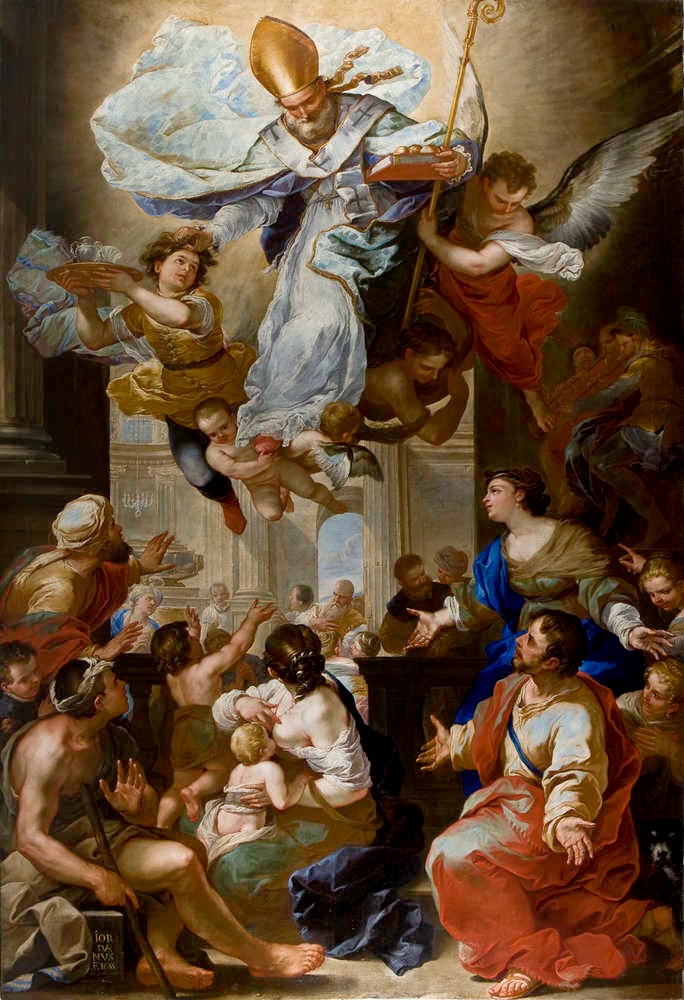
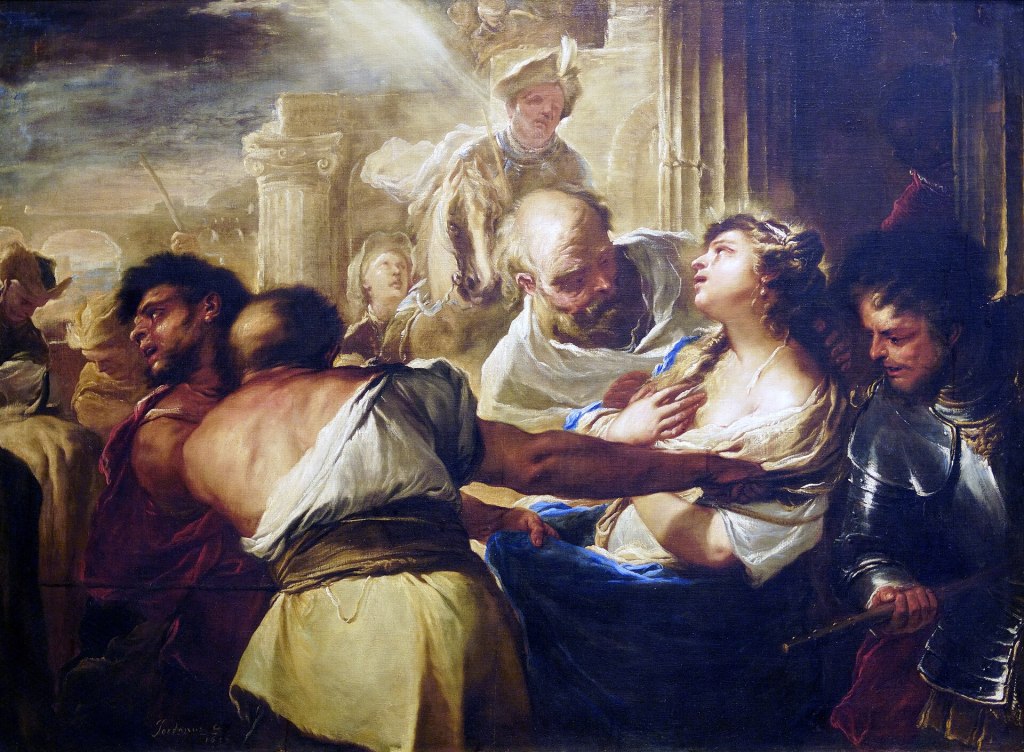
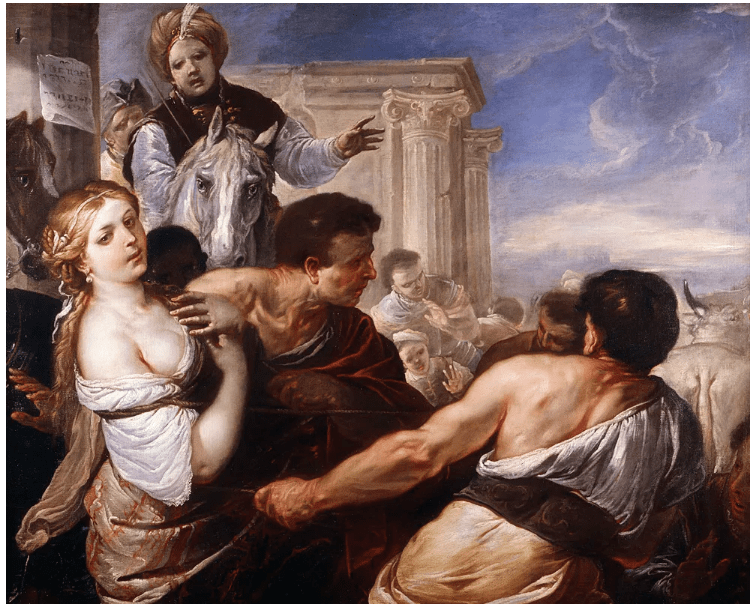
Preti occupies an important but more specific place in this development. He did not simply teach Giordano scale. Scavizzi’s account is more precise. In the later 1650s Giordano was measuring himself against Preti’s dramatic compositions, forceful chiaroscuro, half-length groupings, narrative action and pathos. Works such as the Martirio di santa Lucia and Santa Lucia condotta al martirio show him absorbing Pretian structure while pushing it towards warmer colour and more fluid painterly beauty. Preti helped open Neapolitan naturalism towards theatrical breadth; Giordano made that breadth more chromatic, supple and various.
At the same time, Causa insists on the importance of Giovanni Lanfranco. Lanfranco offered something different from Preti: not simply drama or larger narrative, but a way of organising vision across a continuous Baroque field. In the Cappella del Tesoro di San Gennaro, Giordano could study Lanfranco’s cupola, Domenichino’s frescoes and Ribera’s San Gennaro che esce illeso dalla fornace. The chapel presented a dense school of competing possibilities: naturalist force, classicising order, illusionistic space and decorative continuity. Lanfranco’s example helped Giordano imagine painting beyond the fixed viewpoint and the concentrated episode, as a mobile system of light, movement and distributed attention. Causa also notes that the chapel’s bronzes by Giuliano Finelli, with their relation to Bernini’s inventions, contributed to this formation. Giordano’s Baroque language did not develop from painting alone. It emerged from an environment in which fresco, sculpture, stucco, architecture and theatrical movement were already working together to animate sacred space.
Rubens then became decisive in a different way. For Scavizzi, the years after the plague of 1656 mark Giordano’s passage into a fuller Baroque language. Naples had lost or seen removed many leading painters of the previous generation, and the field of major ecclesiastical commissions opened to a young artist of extraordinary energy. In works of 1657 and after, Giordano’s painting becomes larger in ambition, more luminous in colour and more openly dramatic. Rubens supplied not only models of colour and movement, but a repertory of bodily action, religious intensity, mythological violence, allegory and public meaning. Through engravings after Rubens, Giordano studied and reworked compositions such as the Education of the Virgin, the Fall of the Rebel Angels, Samson and Delilah, the Massacre of the Innocents and the Roman Charity. These were not passive borrowings. Giordano reversed, condensed, enlarged and recomposed Rubensian inventions until they served his own theatrical and colouristic purposes.
The Rubensian example also helped Giordano think about the social role of painting. In Rubens Painting the Allegory of Peace, he honours Rubens not only as a painter of movement and colour, but as a courtly and diplomatic figure, an artist whose work could serve peace, monarchy, public celebration and political hope. This is directly relevant to the later Spanish works. Giordano was learning how myth, allegory and spectacle could carry meanings that were public as well as pictorial. Around 1660, in paintings such as Perseo e Fineo, Gezabele divorata dai cani and the Städel Youth Tempted by the Vices, he began to handle ancient story, violent action, moral emblem and political allusion with increasing ambition. The iconography could be dense, sometimes even difficult, but the visual method was clear: earlier images, prints, myths and dramatic situations became material for large, animated compositions in which narrative, allegory and political suggestion were carried by colour, movement and display.
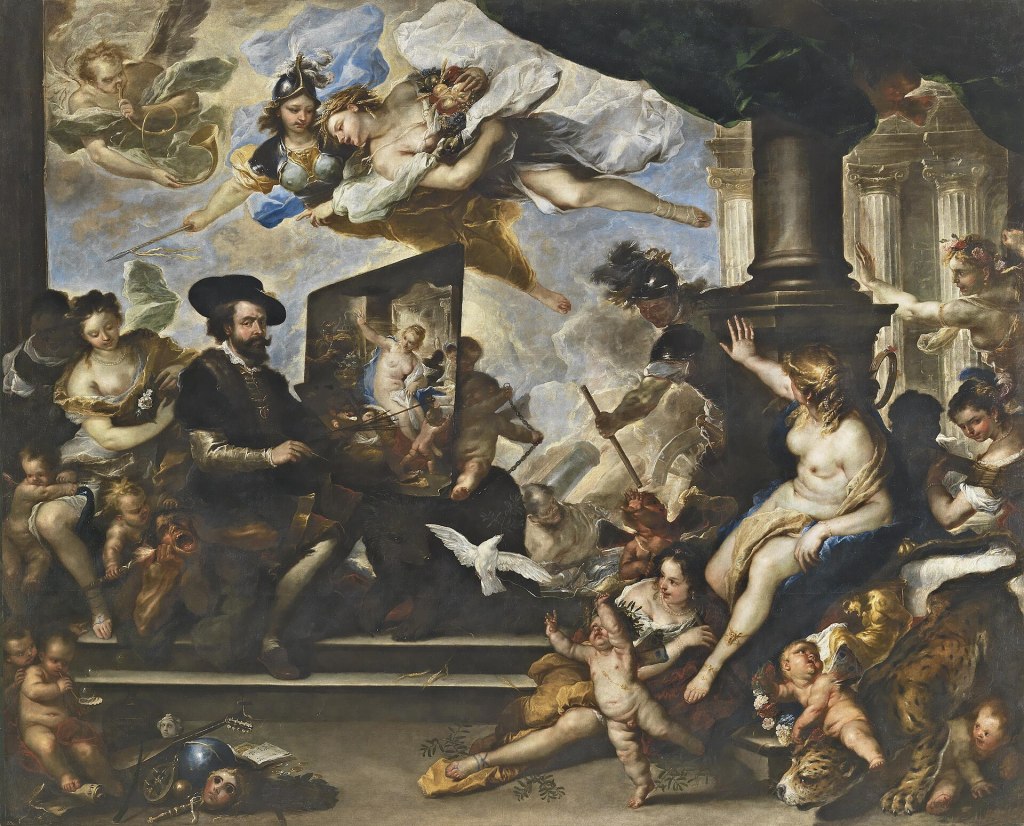
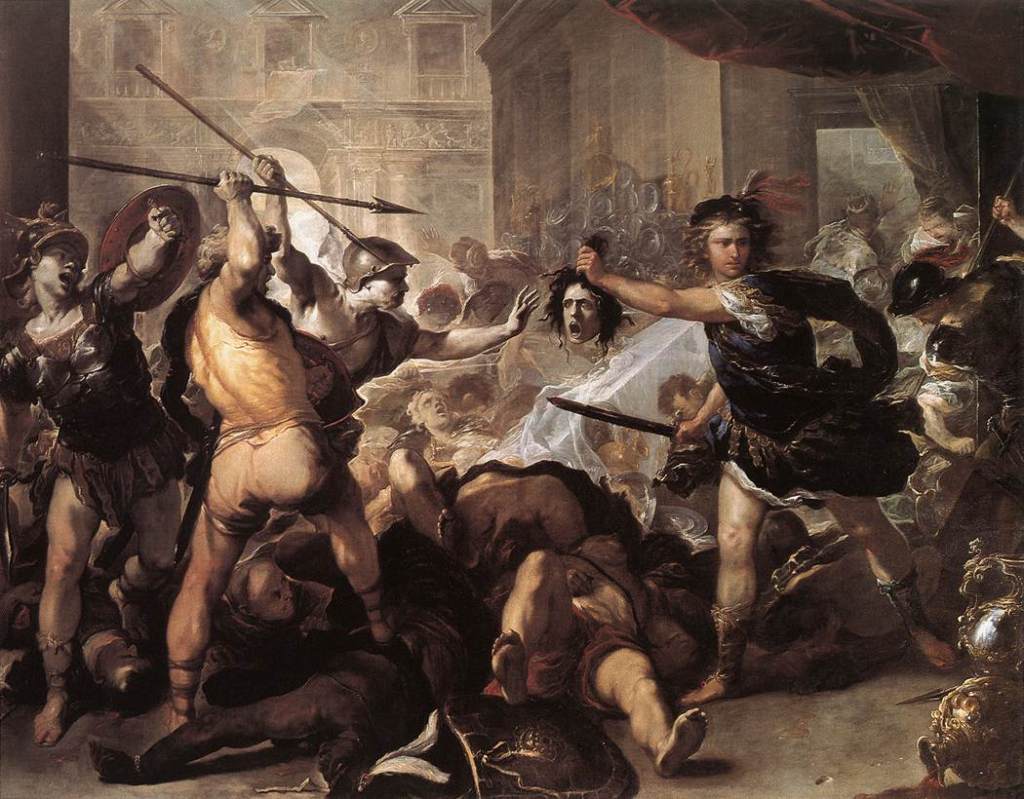
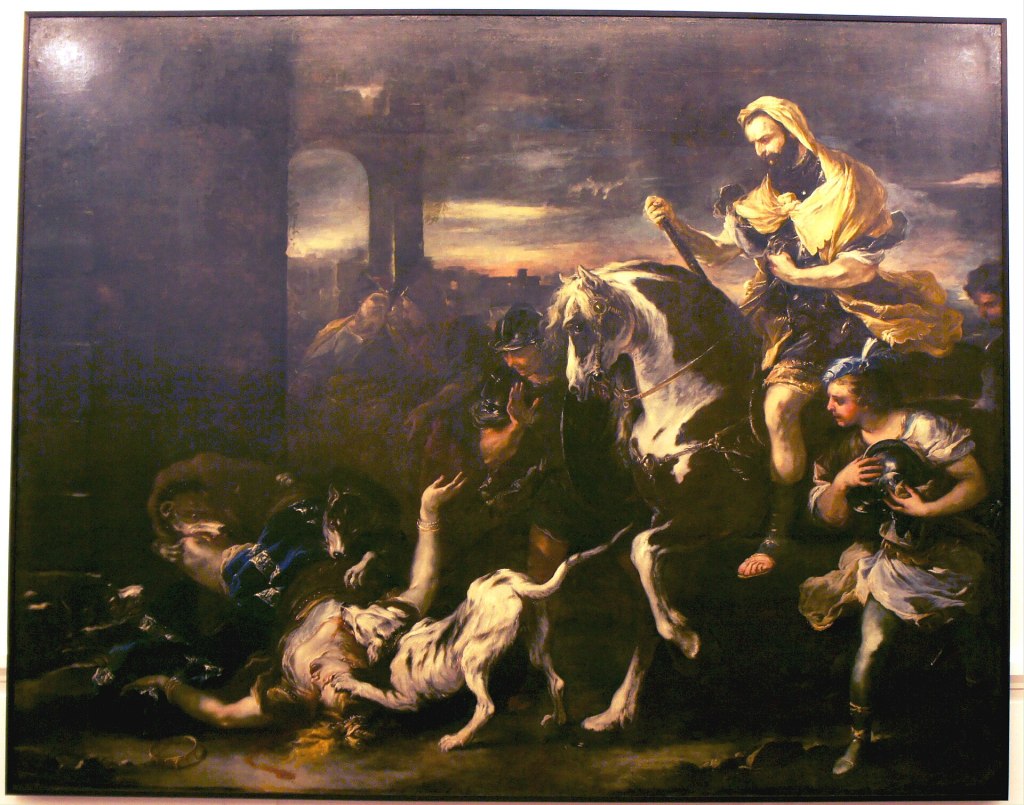
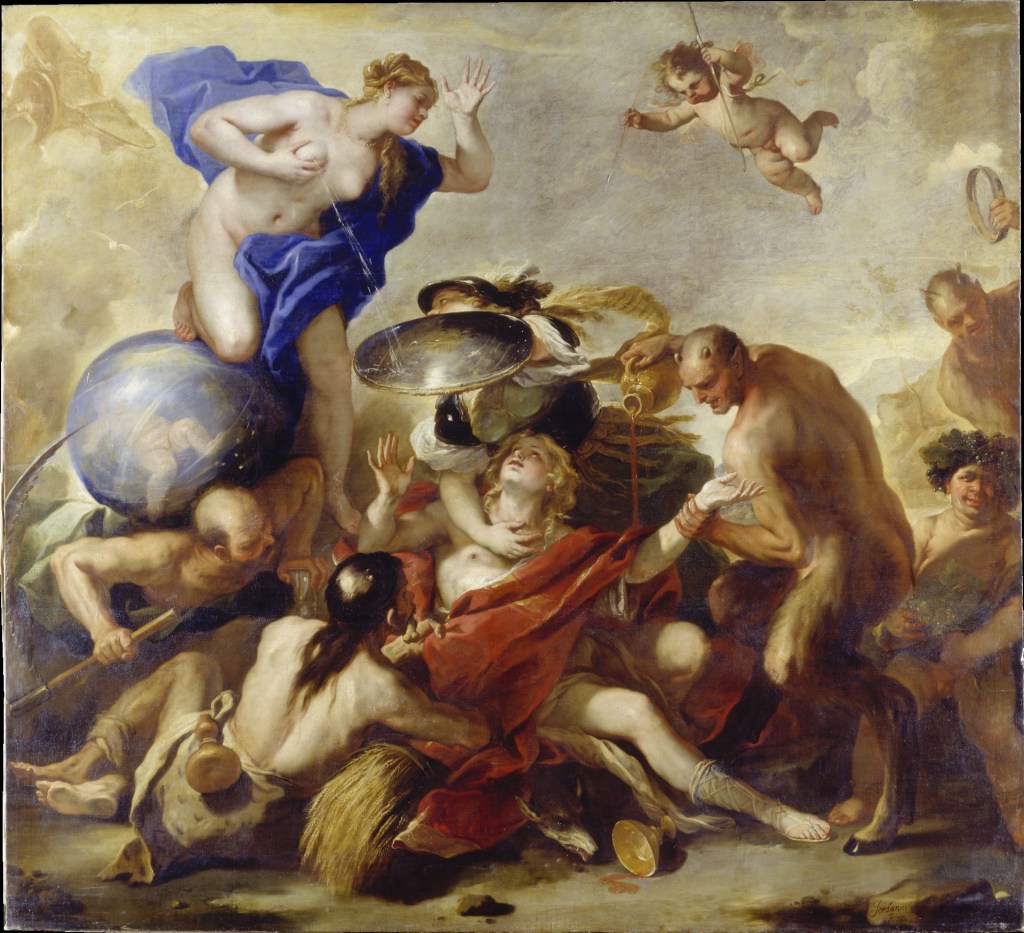
This helps explain why Causa’s phrase “from nature to painting” is not a retreat into artifice. Giordano does not abandon the visible world, but he changes the status of what he takes from it. Nature, bodies, gestures, prints, sculptures and earlier paintings all pass through the same pictorial intelligence. A Caravaggesque motif may lose its original gravity and become part of a broader Baroque motion. A Riberesque body may be lifted into warmer light. Venetian colour may become an instrument for freeing the surface. Rubensian action may be transformed into Neapolitan religious theatre or courtly allegory. Giordano’s art is not simply a sequence of influences. It is a process of conversion.
Drawing remains one of the instruments of that conversion, but Scavizzi’s account prevents us from thinking of Giordano’s preparation only in terms of drawings made before a painting. Giordano drew, copied and studied intensely; yet he also seems to have tested many ideas through painting itself. He worked rapidly, often alla prima, and when dissatisfied with a composition he could repeat it in another painting rather than resolve everything through preparatory study. His labour therefore did not always look like the slow correction of a single work. It could take the form of serial invention: returning to a subject, adjusting a grouping, altering a light, recomposing a borrowed model, and trying again. The apparent spontaneity of the surface should be seen against this larger practice of repetition and stored solutions.
This is why the legend of virtuosity remains both useful and dangerous. De Dominici’s stories of miraculous execution, manual tricks and paintings made almost without brushes belong to the mythology of Luca fa presto. But the better response is not to deny the bravura. It is to ask what the bravura serves. At his best, Giordano uses rapid handling to keep invention alive across large surfaces. Details that look loose or hurried at close range can gain their force within the larger ensemble. Causa is right to warn that Giordano suffers in reproduction: his great works depend on scale, colour, distance, architectural setting and the movement of the spectator. They were conceived not as isolated passages to be inspected in reproduction, but as works whose meaning emerges across the whole painted field.
The later stages of Giordano’s career confirm this mural intelligence. Florence allowed him to reactivate the lessons of Lanfranco and Cortona in a different artistic environment, especially in the Corsini cupola at Santa Maria del Carmine and the Medici Riccardi gallery. Cortona gave him a mobile, courtly and theatrical Baroque language capable of travelling beyond local schools; Bernini sharpened his sense of the relation between image, architecture and spectator; Venetian colour remained a means of lightening and expanding the surface. By the time Giordano worked for the Spanish monarchy, he was not simply exporting Neapolitan painting. He was operating in a European Baroque language formed through Naples, Rome, Venice, Florence, Rubens, Cortona, Lanfranco and the practical demands of large decorative settings.
The Casón del Buen Retiro gave these qualities one of their greatest Spanish opportunities. A ceiling such as the Alegoría del Toisón de Oro, or Allegory of the Golden Fleece, required far more than rapid execution. It needed a painter able to convert dynastic argument into visual theatre, and to prevent a dense allegorical structure from hardening into a diagram. Giordano was unusually equipped for that task. He had learned to move between traditions without becoming trapped by any one of them; to turn copying into emulation; to make colour, movement and scale carry narrative, allegory and political suggestion; and to organise a painted surface as a field of mobile attention. The Casón ceiling belongs to that long preparation. It is not merely a feat of speed, but a work in which speed, memory, allegory and decorative command become part of the visual language of monarchy.
The Casón and the Last Habsburg Court
The Casón del Buen Retiro belonged to the palace complex created under Philip IV on the eastern edge of Madrid. Built in 1637 as the palace ballroom, it later acquired a more formal ceremonial role under Charles II. Palomino described it as the most celebrated hall of the monarchy, used for royal functions, embassies and similar occasions. After the death of Charles II, the same room would be used for the reception of Philip V and for his installation as Grand Master of the Order of the Golden Fleece. The Casón was therefore not only a pleasure-palace room. It was a place where monarchy was staged through ceremony, diplomacy and dynastic display.
Giordano’s frescoes were probably made around 1697, at one of the most difficult moments in the history of the Spanish Habsburg court. Charles II had no direct heir, and the extinction of the dynasty was no longer a distant possibility. The succession was disputed by rival European interests and by factions within the court itself. At the same time, Spain had suffered military humiliation in Catalonia, including the fall of Barcelona in 1697. The monarchy still needed to present itself as continuous, sovereign and universal, but the immediate political situation made that claim increasingly hard to sustain through direct images of the king or of contemporary victory.
This helps explain the retrospective character of the Casón programme. The ceiling does not derive its authority from the achievements of Charles II himself. Instead, it returns to older and more durable foundations: Hercules, the Golden Fleece, Burgundian inheritance, Habsburg lineage, the defence of the faith, and the apotheosis of Spain as a world monarchy. Rosa López Torrijos reads the decoration as perfectly suited to the final phase of Charles II’s reign: an exuberant Baroque display that seeks to persuade the spectator of the magnificence of a lineage whose living representative and contemporary fortunes suggested weakness rather than strength.
The comparison with the Salón de Reinos sharpens the point. This earlier ceremonial hall, also part of the Buen Retiro palace complex, had been created under Philip IV in the 1630s as one of the great spaces of royal representation. Its decoration, organised under the Count-Duke of Olivares, combined dynastic portraits by Velázquez, battle paintings by several artists, royal arms and Zurbarán’s Labours of Hercules. It celebrated the monarchy through recent victories, dynastic presence and heroic ancestry. By the 1690s such a language could not simply be repeated. Recent war could not be turned easily into triumph, and any direct emphasis on Charles II himself, or on the unresolved question of succession, would only have exposed the fragility of the dynasty. The Casón therefore recovered some of the older signs of royal representation, but altered their tone. Hercules remained, the arms of the monarchy remained, and military power would reappear through Ferdinand the Catholic, but the central language became more allegorical, mythological and ceremonial.
Dawson Carr approaches the same problem through the ceiling’s dynastic retrospect. The decoration looks past the weakness of the living dynasty towards an image of monarchy grounded in origin, memory and institution. That does not make the Casón a simple lament for decline. It is an act of courtly assertion, made at a moment when assertion had become especially necessary. Giordano’s task was to give that assertion persuasive visual form: not as a heraldic lesson, but as a painted theatre in which myth, ceremony and monarchy could appear to belong to the same order.
The Surviving Ceiling
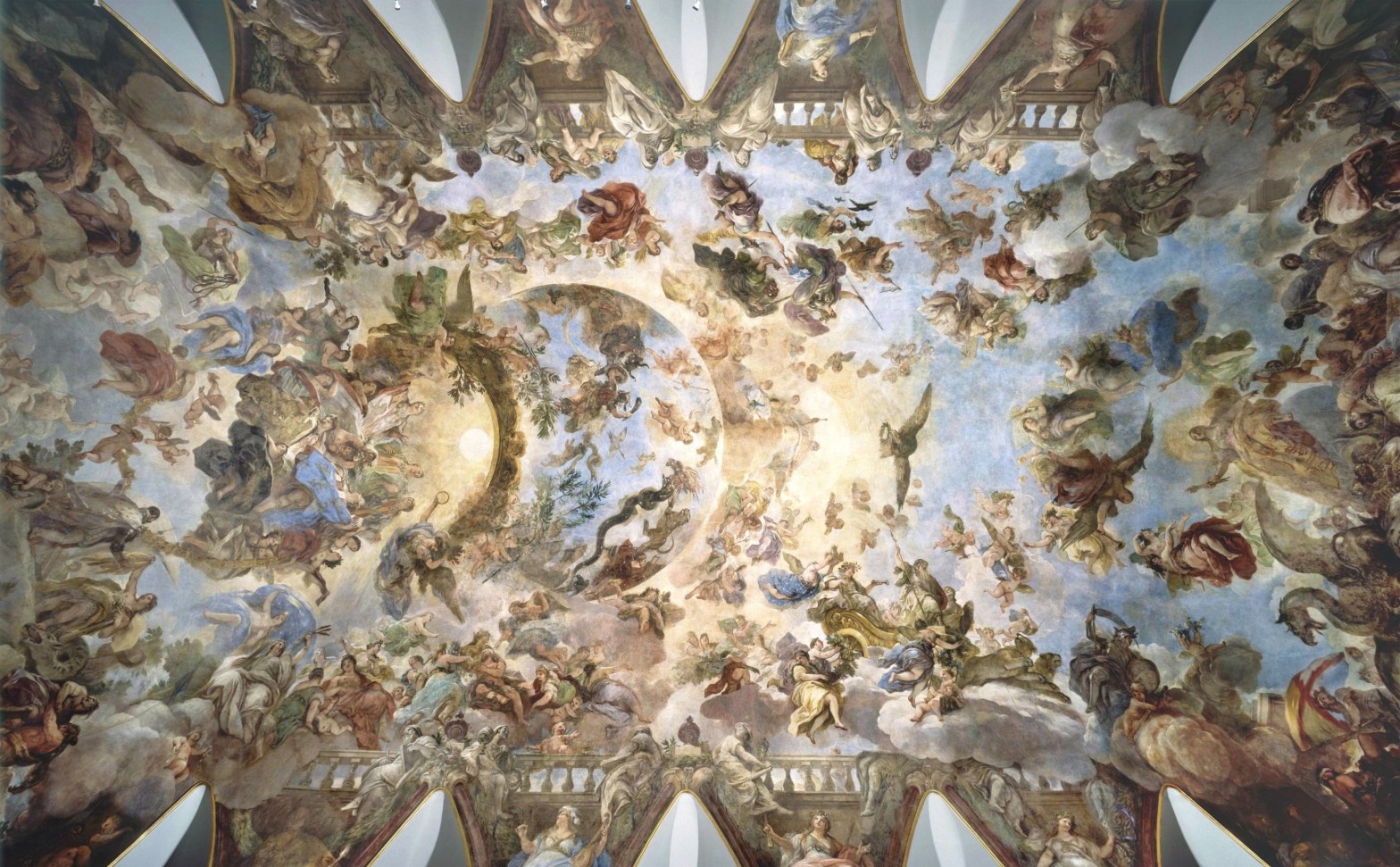
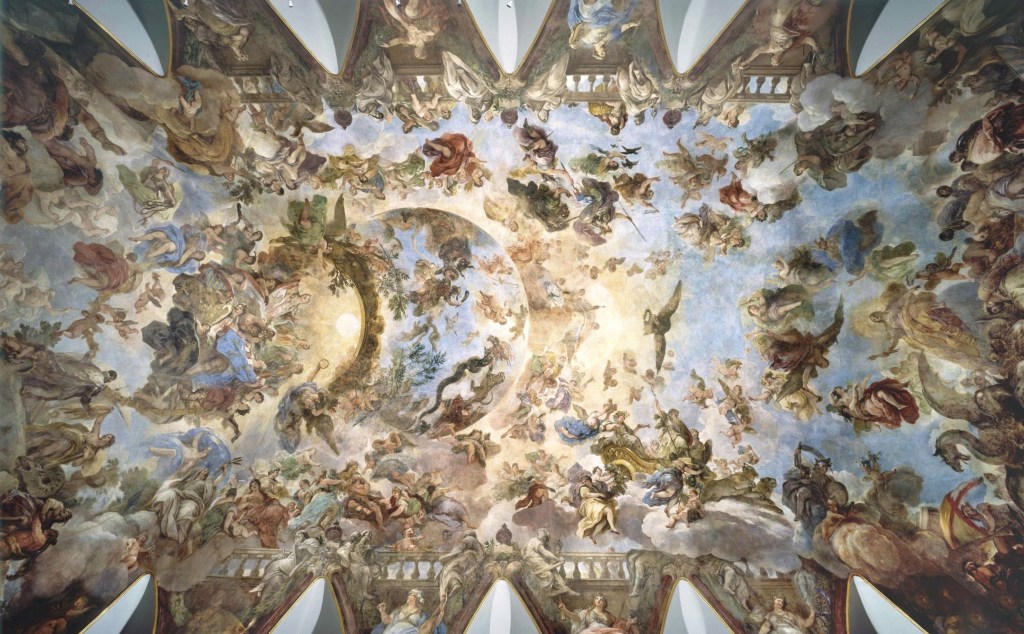
The fresco still visible in situ in the Casón is the ceiling of the central hall, the room also known as the Salón de Baile, or Ballroom, and later as the Salón de Embajadores, or Hall of Ambassadors. It was once part of a much larger decoration. Giordano also painted the spaces below the cornice and the adjoining rooms, but those parts have been lost or survive only through drawings, engravings, copies and written descriptions. What remains in place is the main ceiling of the central hall: the only substantial part of Giordano’s fresco decoration still visible in the building.
The ceiling has suffered damage, repainting and restoration, and it should not be imagined as an untouched seventeenth-century surface. Even so, its structure can still be read. The vault is long and rectangular, with five lunette windows on each of its long sides. At the level of these lunettes Giordano painted an illusionistic balustrade, marking the threshold between the lower zone of the ceiling and the mythological sky above.
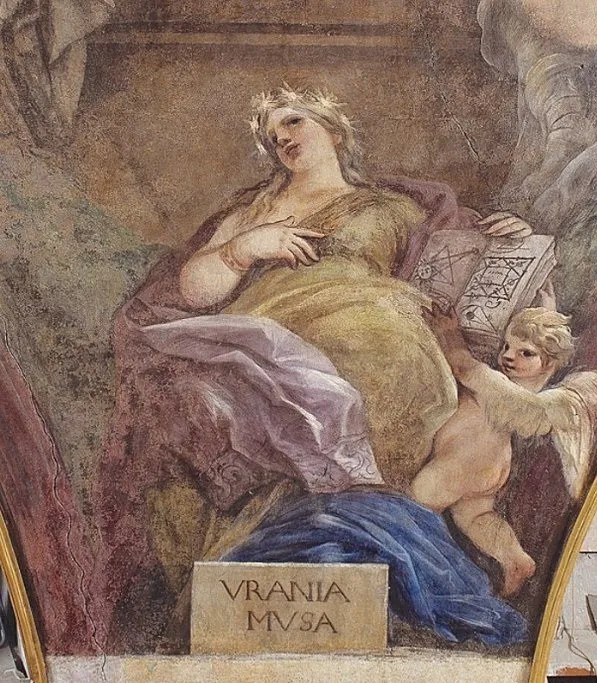
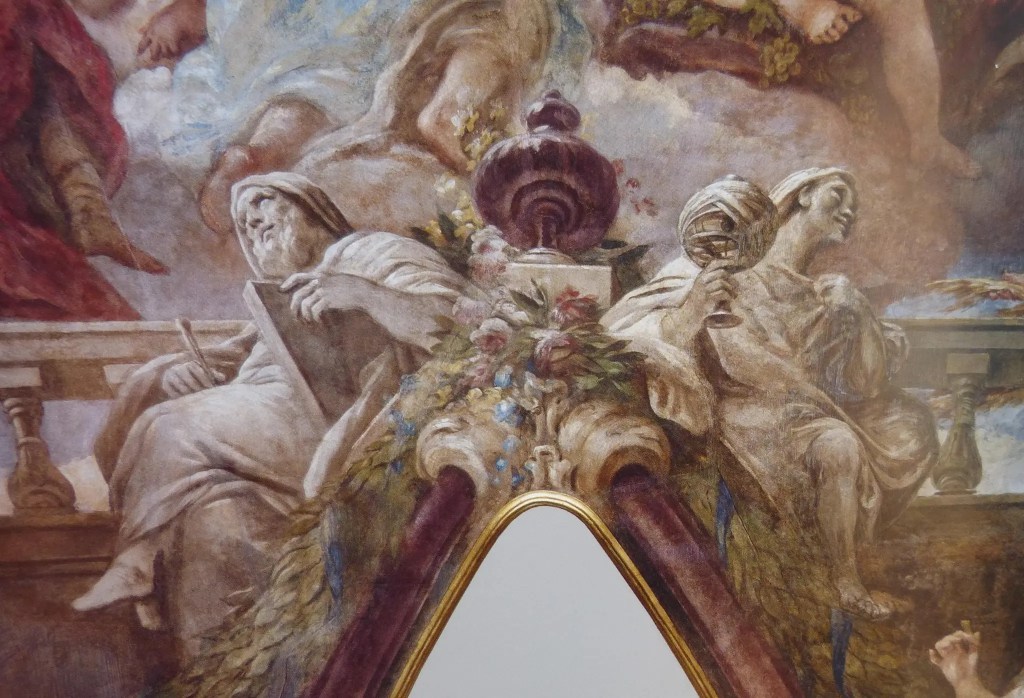
Below this painted balustrade, between and around the lunettes, Giordano placed the Muses and pairs of ancient philosophers or sages, some painted to imitate sculpture. These figures form a lower intellectual and poetic register. The Muses, daughters of Memory, introduce the ceiling as a work of commemoration: a painted song of origins, heroic deeds and dynastic glory.
Above this lower register, the ceiling opens out. Giordano does not organise the vault around a single central image. Instead, the two principal scenes are placed at the short ends of the rectangle. At the eastern end, Hercules presents the Golden Fleece to Philip the Good, Duke of Burgundy, the founder of the Order of the Golden Fleece. At the western end, Spain appears as an enthroned female personification of monarchy, seated above the globe and surrounded by signs of dominion, victory and submission.
The position of these scenes was not only compositional. Placed at the two short ends of the hall, they would have confronted those entering from either side, whether from the garden or from the palace. The arrangement also allowed the ceiling to work with ceremonial movement through the room, although the exact use of the hall in ambassadorial receptions is not securely documented.
Between the two ends, the vault is filled with gods, personifications, mythological combats, the Four Ages of Humanity, the celestial sphere and signs of cosmic order. The painted balustrade helps to hold this complexity together. It gives the viewer a stable architectural threshold, while the upper vault opens into sky, allegory and motion.
The ceiling therefore needs to be approached both as an argument and as a spatial experience. Its meanings depend on heraldry, myth and political allegory, but the long shape of the vault, the opposition between the two short ends, the rhythm of the lunettes, and the opening into painted sky all make the decoration something to be encountered across the room, not simply decoded from below.
The Programme of the Ceiling
The iconography of the Casón ceiling is elaborate, but its main structure is clear. Giordano turns the vault into a painted argument about memory, dynastic origin and Spanish monarchy. The title often attached to the fresco, Alegoría del Toisón de Oro, or Allegory of the Golden Fleece, identifies one of its central themes, but it narrows the programme too much. The Golden Fleece is the point of departure. The larger subject, as Úbeda de los Cobos argues, is better understood as the apotheosis of the Spanish monarchy.
The lower zone establishes the terms in which the ceiling is to be read. The Muses and ancient sages belong to the world of poetry, history, wisdom and memory. They prepare the spectator for a painted commemoration rather than a single narrative episode. The deeds represented above them are to be remembered, sung and interpreted. In this sense, the vault is not only an allegory of power. It is also a theatre of historical memory, in which myth, dynasty and ceremony are brought into the same space.
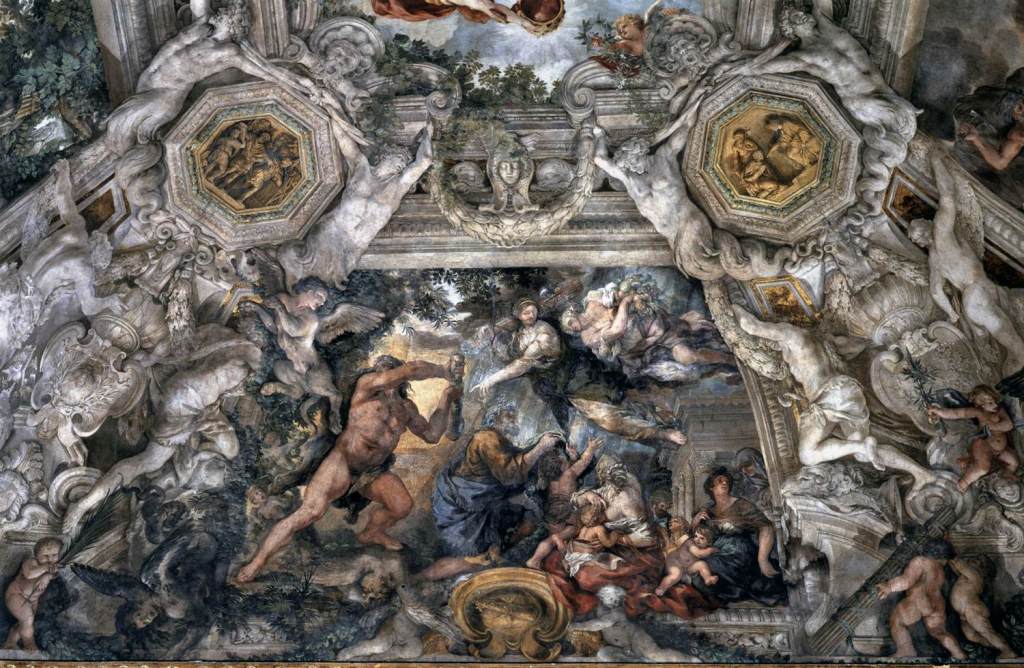
At the eastern end of the vault, Giordano places the foundation scene of the Order of the Golden Fleece. Philip the Good, Duke of Burgundy and founder of the Order, receives the fleece from Hercules. The choice is striking, because in the classical story the fleece belongs to Jason’s quest, not to Hercules. Jason, however, was a morally ambivalent figure and an awkward model for royal virtue. Hercules offered a more suitable alternative: a figure of heroic labour, princely virtue and Spanish dynastic ancestry.
The scene joins different kinds of time. Philip the Good belongs to Burgundian history; Hercules belongs to myth; the Golden Fleece belongs both to ancient legend and to chivalric institution. In Giordano’s fresco these layers are made to meet at the origin of Habsburg greatness. Burgundy gives the Order its historical foundation, Hercules gives it heroic ancestry, and the Spanish monarchy inherits both through the House of Austria. The Golden Fleece therefore carries a double identity: it is the legendary object won in antiquity and the Burgundian Order founded in the fifteenth century. Giordano uses that double meaning to bring myth, faith, lineage and monarchy into a single dynastic image.
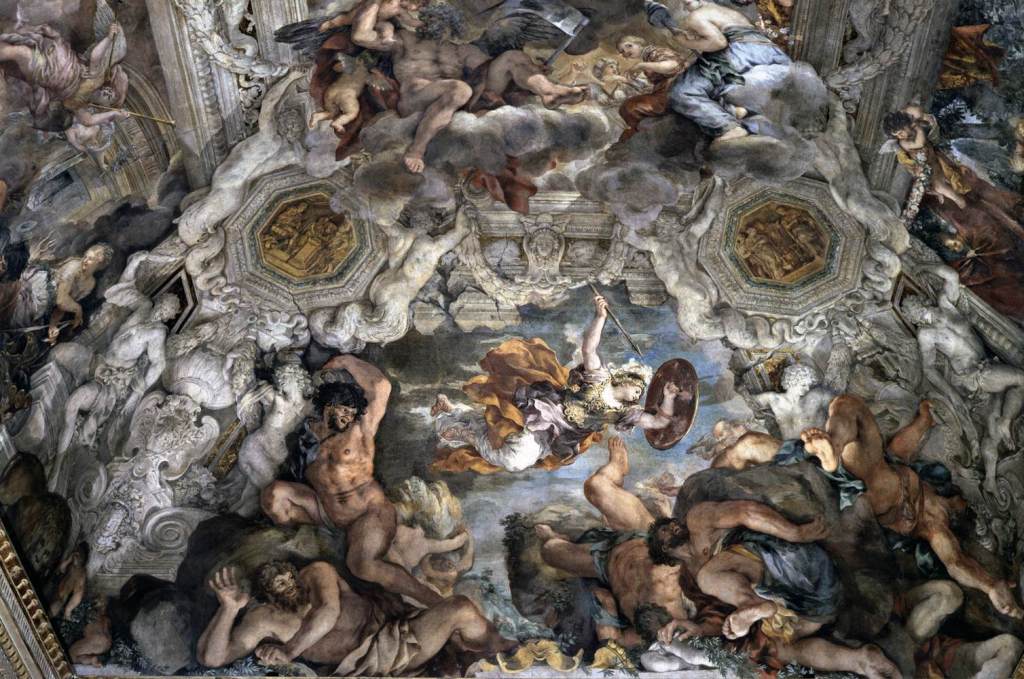
Around this foundation scene, Hercules appears again as a defender of cosmic and moral order. In the Gigantomachy he assists the gods against the Giants; in the combat with Antaeus he overcomes another figure of disorder. These episodes extend the meaning of the Golden Fleece scene. Hercules is not only associated with the origin of the Order. He is the heroic force through whom rebellion, violence and evil are subdued. The lost wall cycle of the Trabajos de Hércules, or Labours of Hercules, would once have strengthened this role, but the surviving vault already makes him central to the programme.
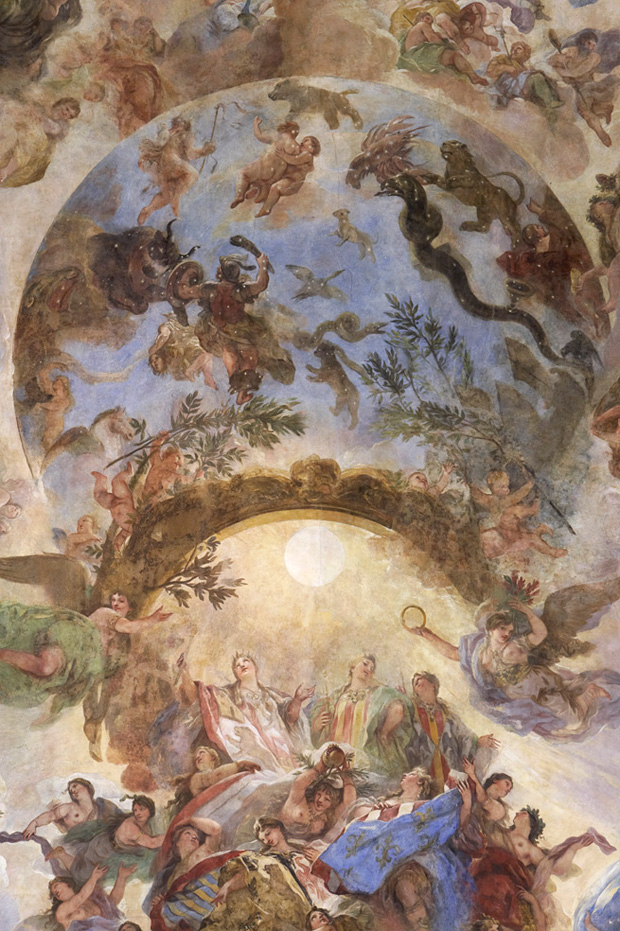
Above the foundation scene appears the dynastic ensemble of the House of Austria. The kingdoms and possessions associated with the Spanish Habsburg inheritance are gathered beneath the royal crown, while the collar of the Golden Fleece is offered to them. The political meaning is then carried upward into the sun, the celestial sphere, Parnassus and Olympus. The monarchy is not shown merely as a territorial power. It is placed within an imagined order of heaven, history, heroic descent and divine favour.
The celestial field should be handled with some restraint. Its presence gives the ceiling a cosmic dimension, but de los Cobos cautions against making every constellation serve the Golden Fleece directly. Earlier interpretations, following Palomino, assumed that Aries, the Ram, occupied the centre of the vault and so echoed the fleece itself. De los Cobos argues instead that Giordano followed astronomical prints by Jan Hevelius and Johannes van Keulen closely, both in the general disposition of the heavens and in the individual constellation figures. The central constellation is not Aries but Canis Minor. The evidence considered here does not explain whether Canis Minor had a symbolic function of its own. What it seems to show is that, in this part of the ceiling, Giordano’s appeal to recognised cosmographical sources was more important than rearranging the sky around a dynastic emblem. The heavens still enlarge the programme, but they do so as an image of cosmic order, not simply as an extension of the Golden Fleece.
At the western end, the programme reaches its answer: the personification of Spain. She appears as an enthroned female figure, seated above the globe and holding the sceptres of her realms. Around her are signs of dominion and victory: peoples subject to Spanish rule, defeated heresy, temporal power, riches, trophies and allegorical figures of peace and good government. The motto “OMNIBUS UNUS” sharpens the claim. The monarchy is presented as one power over many peoples and territories, a single centre holding together a vast composite world.
The two ends of the ceiling therefore speak to one another. At one end is origin: Hercules, Burgundy and the Golden Fleece. At the other is dominion: Spain enthroned over the globe. The movement from one to the other is the movement from foundation to fulfilment, from inherited myth and institution to the universal image of monarchy. This is why the fresco cannot be reduced to an allegory of the Order of the Golden Fleece. The Order begins the argument, but the final claim is made on behalf of Spain.
The programme also belongs to the wider literary and emblematic culture of allegory. Ovid’s account of the Four Ages in the Metamorphoses lies behind the movement from gold to iron, while Cesare Ripa’s Iconologia belongs to the repertory through which virtues, vices, powers, seasons and abstract qualities could be given visible form. In the Casón, however, such material is combined with dynastic history, court ceremony, printed sources and Giordano’s own pictorial memory.
The Four Ages of Humanity give the programme a further temporal structure. The Golden and Silver Ages belong to the more benign side of the ceiling, where peace, abundance, spring, agriculture and seasonal order surround the foundation of the Order. The Bronze and Iron Ages belong to the more troubled side, where war, terror, anger and violence gather near the enthroned figure of Spain. The passage through the Ages allows the vault to become a history of the world as well as a history of dynastic legitimacy. Human time moves from ideal beginning towards conflict and decline, but Spain is still presented as the ordering power within that fallen world.
The programme is therefore ambitious in scope, but its logic can be summarised simply. The Muses and sages establish memory and interpretation. Hercules supplies heroic ancestry and moral force. The Golden Fleece gives the monarchy a prestigious Burgundian and Habsburg institution. The crown, sun, celestial sphere and gods place that inheritance within a larger order of heaven and history. At the far end, Spain receives the whole structure as an image of universal monarchy. Giordano’s task was to make this dense argument visible across a ceiling: not as a flat political emblem, but as a moving Baroque fiction in which myth, history and monarchy appear to belong to the same order.
Space, Sources and Painterly Invention
The Casón ceiling belongs to the mature phase of Giordano’s Spanish work. By the time he painted it, probably around 1697, he had already completed the great fresco campaigns at the Escorial and the decoration of Charles II’s private office at Aranjuez. Úbeda de los Cobos sees this Spanish phase as marked by a lighter, more golden palette, looser handling, less sharply defined contours, and a deliberate crossing between the effects of oil painting and fresco. The Casón should be seen within that late manner. Its achievement lies not only in the complexity of the programme, but in the way Giordano makes that programme operate as painted space.
Carr gives the broader setting. Fresco had long been used by the Spanish Habsburgs, but in the mid-seventeenth century the dominant decorative language at Madrid was still largely that of quadratura: feigned architecture, perspectival extension and controlled illusion. Philip IV had wanted Pietro da Cortona for the Alcázar, but Cortona never came to Spain. Instead, the Bolognese painters Agostino Mitelli (1609–1660) and Angelo Michele Colonna (1604–1687) brought a different kind of illusionism to Madrid: Mitelli specialised in fictive architectural settings, while Colonna supplied much of the figural painting. Their work was influential, but it remained distinct from the more open Roman Baroque ceiling, in which architecture, cloud-borne figures, divine action and allegory could be drawn into a single expansive field. Giordano’s arrival changed that situation. He brought to the Spanish court a freer and more mobile kind of ceiling painting, in which dynastic signs, personifications, celestial figures and painted architecture could be made to serve one continuous visual theatre.
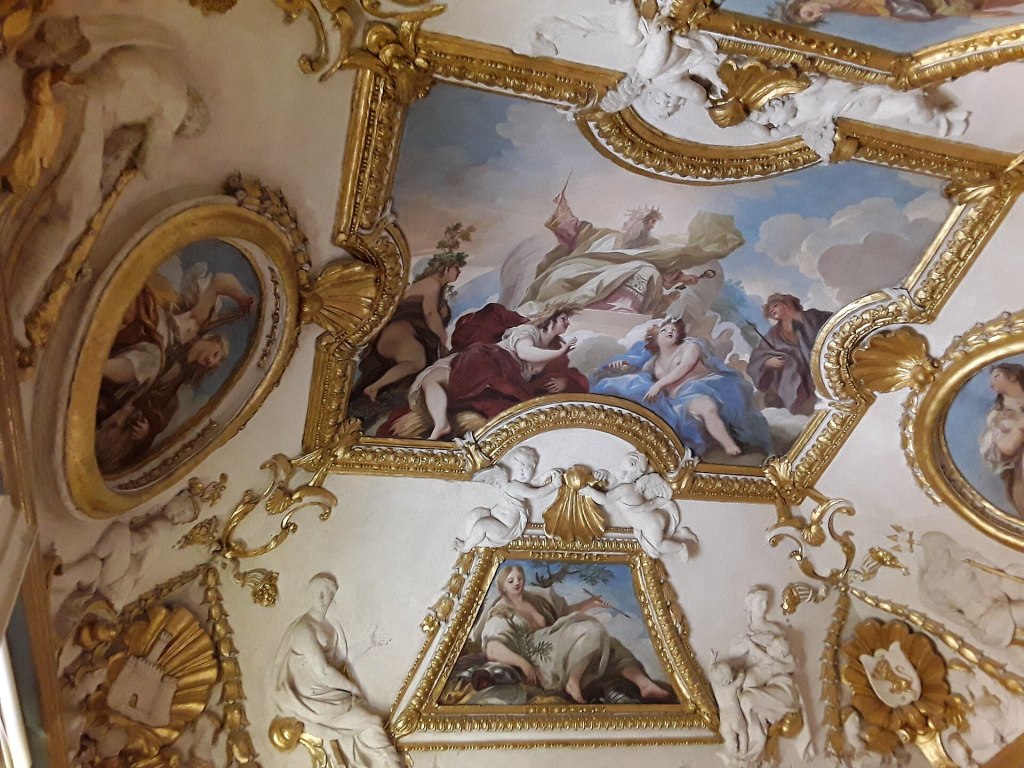
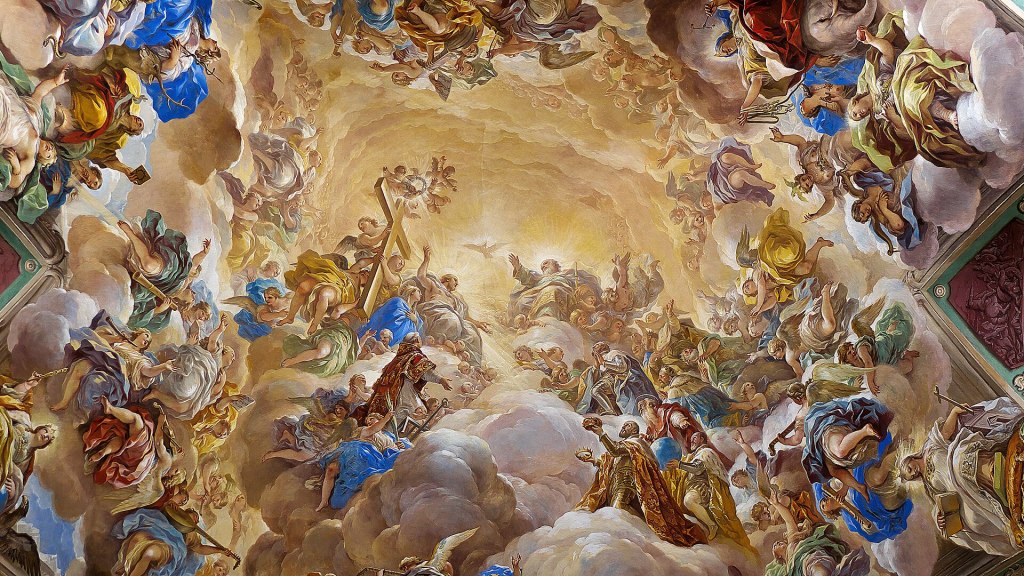
The comparison with the Escorial staircase is useful here. There, Carr describes Giordano as breaking open the vault into a heavenly vision. A feigned balustrade appears through the clouds, as if an upper walkway encircled the stairwell. The ceiling is not conceived as an image seen from one fixed point only; it responds to movement on the staircase. In the Casón, Giordano adapts a related device to a long ceremonial hall. The principal scenes are placed at the short ends, while the balustrade, lunettes and lower figures help mediate between the architecture of the room and the mythological and dynastic field above.
This spatial intelligence is discussed by de los Cobos. He suggests that the ceiling may have been designed to be read along an east-west route, connected with the ceremonial use of the hall. On this interpretation, ambassadors entering from the eastern side, towards the gardens, would first have encountered the foundation scene of the Golden Fleece, while the opposite side, linked to the palace, formed the royal pole of the room beneath the enthroned personification of Spain. The evidence does not allow the ceremonial choreography to be reconstructed with certainty, but the hypothesis helps explain the ceiling’s organisation. The long axis of the hall turns the programme into a movement from origin to fulfilment: from Hercules, Burgundy and the Golden Fleece towards the image of Spain enthroned above the globe.
The painted balustrade is crucial to that effect. De los Cobos calls it a skilful rhetorical device, and the phrase is justified. It marks a boundary between the hall and the visionary field above, but it also allows the two worlds to meet. At the height of the lunettes, pairs of philosophers appear in grisaille, closer to sculpture and architecture than to the coloured mythological figures above. At the base of the vault are the Muses: History, Tragedy, Rhetoric, Poetry, Astronomy, Comedy, Music, Dance and the now-lost Love. Apollo once accompanied them, although he was later replaced by the faun now visible. Small figures lean over the balustrade in astonishment at the spectacle above them. The lower register therefore does more than frame the ceiling. It stages the act of looking.
The eastern end is built in layers. At the base of the principal scene, Hercules delivers the Golden Fleece to Philip the Good. Behind them appears the prow of the Argo, recalling Jason and the Argonauts; beyond that is the sea, with Neptune, Amphitrite and nymphs. Above the central group comes the shield of territories subject to the House of Austria, sheltered by the royal crown, which contains the sun. The movement continues upwards into the celestial vault, the constellations, Parnassus and Olympus, with Jupiter and his eagle. Giordano’s solution is not to isolate these elements as a sequence of emblems. He builds an ascent from heroic action to dynastic heraldry and then to cosmic order.
At the opposite end, the figure of Spain is equally complex. She is not a static personification placed in isolation, but the centre of a dense arrangement of bodies, animals, trophies and attributes. She holds the four sceptres of her realms; around her appear subjected peoples, Heresy as a dragon, Temporal Power as a lion with a sceptre, conquered kingdoms, coins, jewels and objects of gold and silver. The motto “OMNIBUS UNUS” gives the group its verbal key. Yet the fresco is not merely an enlarged emblem. Draperies, diagonals, cloud forms and figures in attitudes of homage create movement around the enthroned figure without weakening her authority.
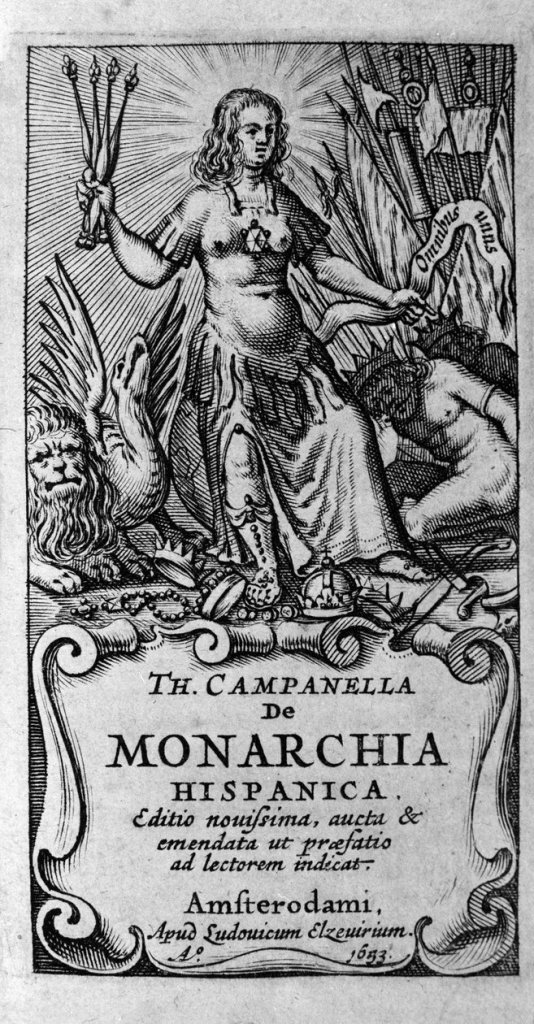
This movement beyond emblem can be seen most clearly in Giordano’s use of Tommaso Campanella’s De Monarchia Hispanica. De los Cobos shows that the title-page engraving of the Amsterdam edition of 1653 supplied the basic formula for the Majesty of Spain: the sceptres, the motto, the defeated peoples, trophies, lion, hydra, crowns and jewels. But the difference between engraving and fresco lies in the conception of space. Giordano takes a linear printed image and gives it physical scale, colour and aerial expansion. The figure of Spain herself also belongs to Giordano’s own earlier repertory of majestic female personifications. De los Cobos relates her to the figure of Divine Wisdom in the Biblioteca Riccardiana, in the Palazzo Medici Riccardi in Florence, and to Royal Majesty on the staircase of the Escorial. Campanella supplies the political image; Giordano supplies the painted apparition.
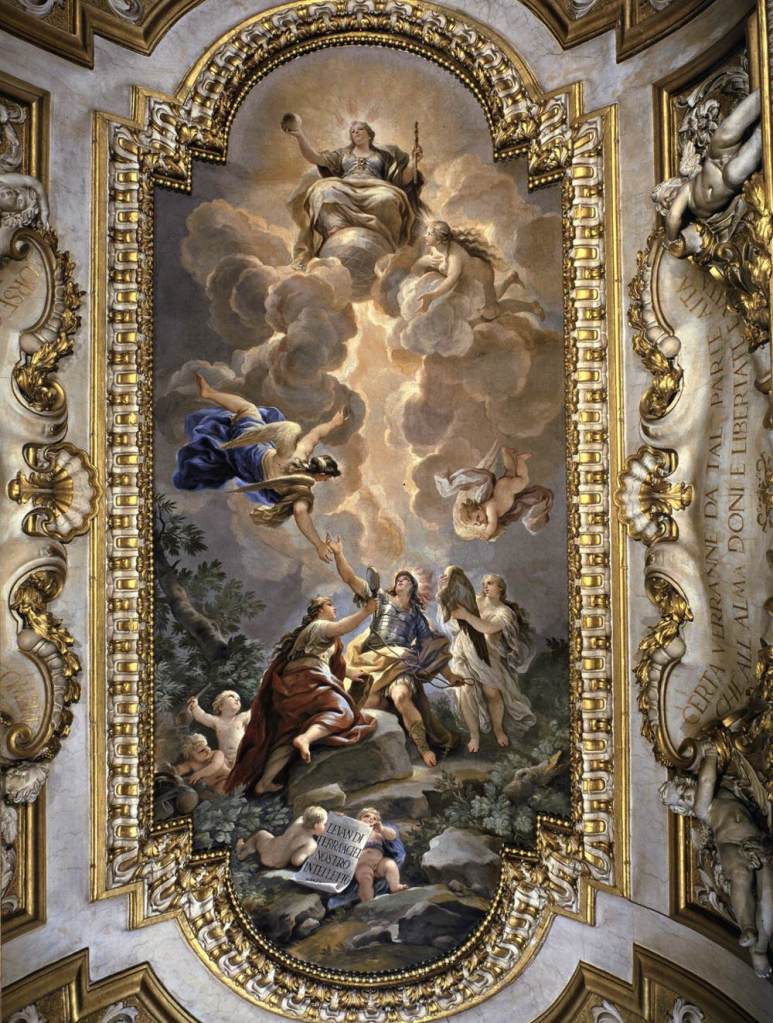
Related work: Luca Giordano’s modello for the Allegory of Divine Wisdom in the National Gallery, London.
https://www.nationalgallery.org.uk/paintings/luca-giordano-allegory-of-divine-wisdom
The celestial vault shows a different procedure. Whereas the personification of Spain is transformed from an emblematic print into a Baroque apparition, the constellations depend on their recognisability as a celestial map. De los Cobos’s identification of Hevelius and Van Keulen therefore points to another kind of source-use: in one area Giordano converts a printed political emblem; in another he incorporates learned cosmographical authority.
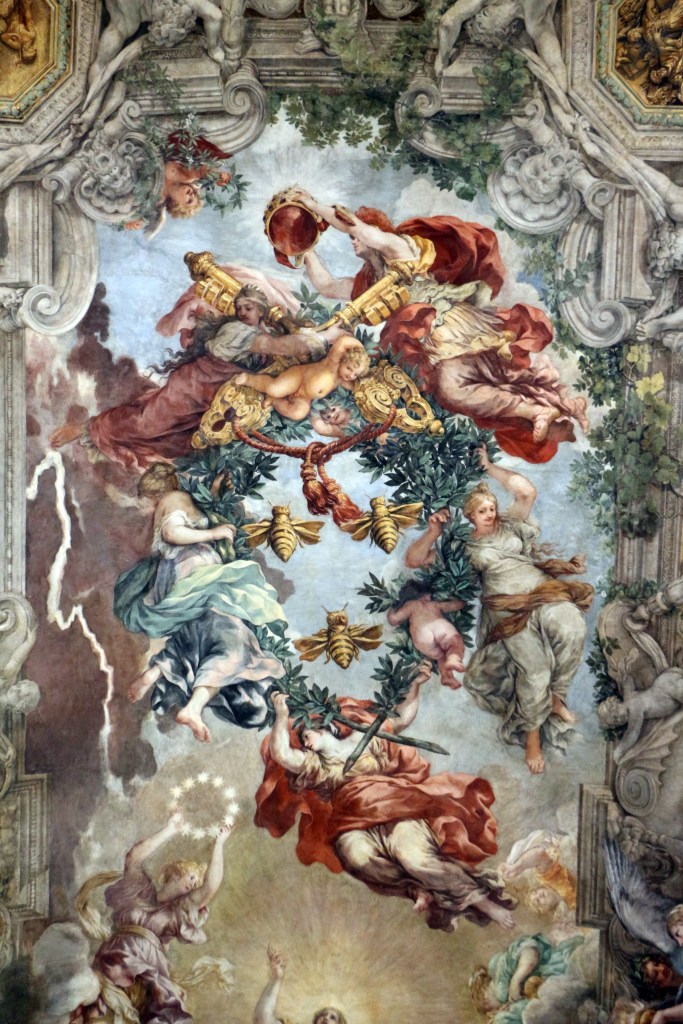
The Four Ages of Humanity give the ceiling another kind of movement. They are not just corner allegories, but changes in pictorial climate. The Golden Age is spring-like and abundant: a woman in a golden mantle is sheltered by an oak, while Zephyr, Flora, birds, winged children, fruit and corn create an atmosphere of softness and natural increase. The Silver Age introduces labour and measured time: the matron with ears of corn and a plough marks the end of spontaneous abundance, while the Four Seasons and Time govern the new cycle. The Bronze Age brings arms, but not yet complete depravity. Here Minerva appears as a figure of prudent war, accompanied by the crow and the owl, while Mars, Terror and Anger show war’s destructive aspect. The Iron Age is harsher: a rusty figure with wolf-headed helmet, scythe and shield carries the image of Fraud, a human form with a serpent’s tail.
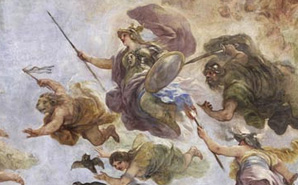
This sequence lets Giordano vary the visual temperature of the vault as the programme moves from origin towards the troubled present. The Golden Age is carried by wind, spring and abundance; the Silver Age by agriculture and time; the Bronze and Iron Ages by armour, flame, predation and deceit. The route from east to west is therefore also a passage through human history. It begins with mythic foundation and ends near the enthroned Spain of the Iron Age, where monarchy appears as the ordering power in a fallen world.
Giordano also brings his own earlier inventions into this structure. The clearest example is Céfiro, or Zephyr, a painting of 1687–89, formerly in the Santisteban collection and now in a private collection. De los Cobos identifies it as the source for the Zephyr group in the Golden Age: Zephyr himself, the feathered animals, the child receiving wings, and the child with the little windmill (illustrated in Andrés Úbeda de los Cobos, Luca Giordano y el Casón del Buen Retiro, pp. 122–23). In the earlier painting these elements form a self-contained mythological scene. In the Casón they are dispersed into the vault, lifted into cloud and made to serve the temporal poetry of the Golden Age.
The figure of Spring involves a related but separate process of adaptation. Placed opposite Zephyr in the ceiling, she is connected by de los Cobos with another Italian painting known at the Spanish court. That painting, now severely mutilated in the Palacio Real, Madrid, is identified through Pérez Sánchez’s catalogue entry in Luca Giordano y España. Giordano isolates Spring from the cycle of the seasons and gives her special prominence as the moment of renewal. Around her are figures marked with the zodiacal signs of the spring months. The passage extends the ceiling’s concern with time, fertility and dynastic continuity.
Pietro da Cortona enters the Casón in still another way. The relation is not merely a vague Cortonesque flavour. De los Cobos identifies specific borrowings from the Trionfo della Divina Provvidenza, or Triumph of Divine Providence, in the Palazzo Barberini: the Gigantomachy presided over by victorious Minerva, though reversed; the harpies taken from Cortona’s group of Hercules, Authority and Abundance; Furor, copied in reverse; the woman holding chains, repositioned as Meekness; Fame above the group; and Public Felicity paired with Abundance. Cortona’s Four Ages in the Sala della Stufa at the Palazzo Pitti also offered a precedent for giving the Ages of Man political significance. Giordano’s borrowing is direct, but not complacent. He uses Cortona as a repertory of figures, types and compositional devices, then redirects them towards the Spanish monarchy and the particular shape of the Casón.
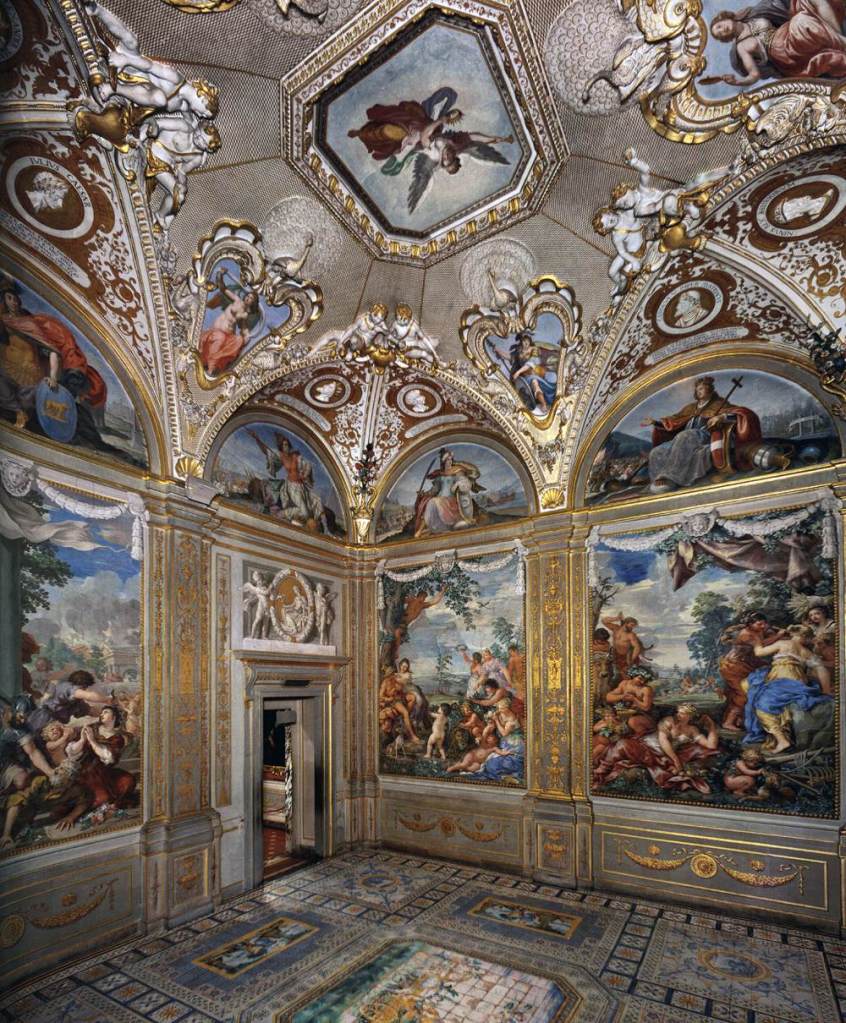
The preparatory material confirms that the ceiling was not the product of unmediated improvisation. De los Cobos notes that no contemporary document explains Giordano’s procedure, advisers or exact chronology, so the evidence has to be reconstructed from the works, from comparison with other mural cycles, and from drawings, bozzetti, prints and books. Ten surviving drawings are connected with the extant vault, including sheets for Bacchus among Nymphs, The Four Parts of the World with the Four Seasons and Time, Minerva with Mars, Terror and Anger, The Iron Age, Cybele, Polyhymnia, Thalia and three pairs of philosophers. Three further drawings belong to the destroyed western antechamber, bringing the known Casón drawings to thirteen.
These drawings reveal different levels of preparation. The Uffizi drawing for Minerva, Mars, Terror and Anger is rapid, crowded and labelled with the names of the figures. The inscriptions suggest that the sheets may have been used to inform or seek approval from the intellectual advisers responsible for the programme. The drawings of Polyhymnia and Thalia fix seated poses, attributes and draperies before the figures are translated into colour on the vault. The drawings for the pairs of philosophers show them already conceived as balancing seated groups, anchoring the balustrade like sculptural weights. The drawings are not decorative afterthoughts. They show Giordano planning how bodies would occupy curved, cloud-filled and architecturally edged space.
The oil sketches add another dimension. Twelve autograph bozzetti are known, most of them for the lost Trabajos de Hércules, or Labours of Hercules, in the central hall. Some show a distinctively Spanish type of preparation: a dark, almost black imprimatura laid over a reddish ground, with thick strokes marking light and volume with great economy. De los Cobos describes these as “manchas”, tonal notations able to anticipate the effect of the final painting with extraordinary speed. They help explain how fa presto could coexist with planning. Giordano’s rapidity did not replace preparation; it changed its form. At a certain stage, the painted sketch could do the work that a more finished drawing might once have done.
The lost Hercules cycle also reminds us that the surviving vault is only part of the original pictorial environment. Below the cornice of the Salón Central, Giordano painted sixteen scenes from the Trabajos de Hércules, placed between the windows and arranged like fictive tapestries. Although the frescoes themselves have disappeared, the surviving oil sketches suggest that this lower register may have had a darker and more concentrated character than the airy ceiling above. In subjects such as Hércules y el toro de Creta, Hércules alcanza al ciervo de los pies de bronce y astas de oro and Hércules arrastrando a los Cércopes, heroic action is compressed into powerful bodies, dense shadows and a more muscular handling of paint. This contrast gives the room its larger visual rhythm: above, Giordano opened the hall into a mythological and dynastic sky; below, the labours of Hercules gave that vision a darker ground of physical action.
What emerges from all this is not a simple opposition between learned programme and painterly execution. The Casón was almost certainly the result of collaboration. De los Cobos doubts that Giordano devised the whole programme unaided, and suggests that one or more advisers supplied its principal doctrinal lines. But the painting is not reducible to those instructions. Giordano had to negotiate between politically prescribed images, printed sources, astronomical maps, mythographical repertories, his own earlier inventions, Cortona’s fresco language and the physical demands of the hall itself.
That is the real measure of his handling. He makes the ceiling work as a ceremonial route, a dynastic fiction, a history of humanity, a transformation of sources and a prepared act of painterly speed. The programme remains dense, but it does not remain inert. It moves from wall to vault, from balustrade to sky, from print to body, from drawing to colour, from mythic origin to the image of Spain enthroned over the globe. Giordano’s achievement is to hold those transitions in one painted system, so that the Casón becomes not only an allegory to be interpreted, but a room in which monarchy is made visible as movement, memory and spectacle.
The Surviving Battle Canvases
The Casón decoration was not confined to the ceiling. The surviving fresco belonged to a larger ensemble, much of which has disappeared. One important fragment of that wider programme is a group of oil canvases connected with Ferdinand the Catholic and the War of Granada. These were painted for the western vestibule or antechamber, the side of the Casón that communicated with the palace. Four such canvases originally formed part of the decoration. Three survive: two paintings now at the Palacio Real de Aranjuez, both known as Batalla de Fernando el Católico, or Battle of Ferdinand the Catholic, and the Prado’s Toma de una plaza fuerte, or Capture of a Stronghold. A fourth canvas is lost.
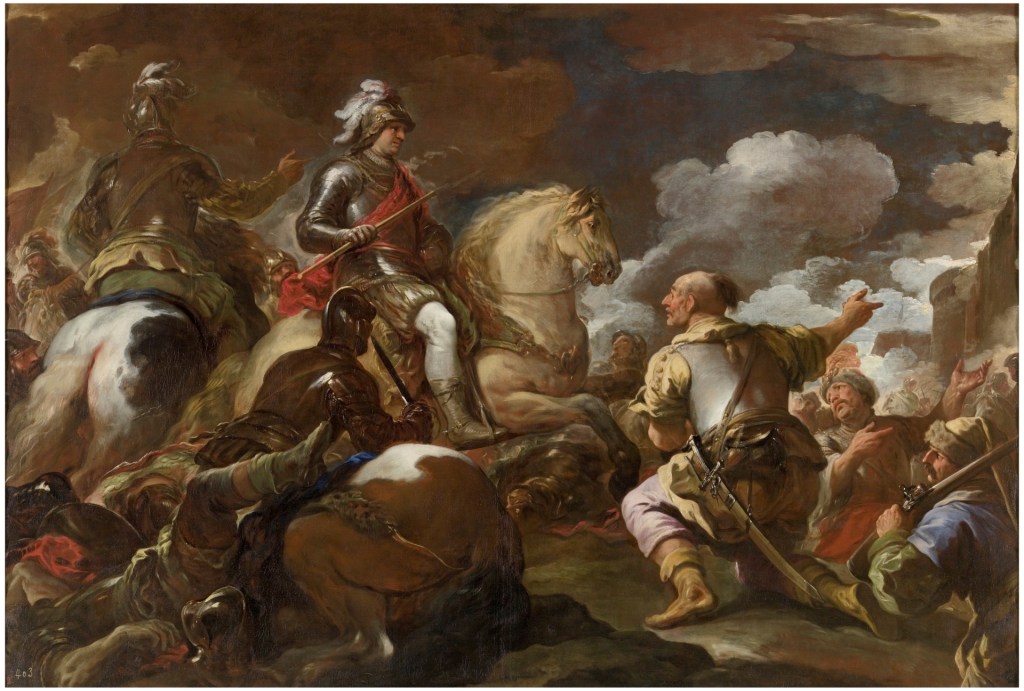
These works should not be treated as a separate appendix to the ceiling, as if they had only a loose connection with the programme above. They extend the Casón’s argument into Spanish history. The vault moves through Hercules, the Golden Fleece, Burgundian inheritance and the apotheosis of the Spanish monarchy. The western antechamber turns to Ferdinand the Catholic and the conquest of Granada. The effect is to join mythic and dynastic origin to a historical model of Spanish military triumph.
That choice was not neutral. De los Cobos argues that the Casón had to recover some of the functions once served by the Salón de Reinos, but in a changed political world. The older hall had celebrated recent victories under Philip IV through a series of battle paintings. By the 1690s, such a procedure was no longer available in the same way. Charles II’s reign had no comparable victories to display, and the disasters in Catalonia made contemporary battle imagery politically dangerous. A direct celebration of recent war could have recalled failure rather than power, and might also have been read through the factional struggles of the court.
Ferdinand the Catholic offered a solution. He could stand as an exemplary ruler rather than as a controversial contemporary reference. The Granada campaign allowed Spanish military power to be shown through conquest, Christian kingship and the memory of a more secure monarchy. More broadly, Ferdinand’s image also carried the victories and political authority of an earlier age. Against the centrifugal pressures of Catalonia, he recalled the union of Castile and Aragon; against defeat by France, he recalled earlier triumphs over French monarchs; against the weakness of Charles II, he offered the image of a prudent and victorious predecessor.
The paintings themselves support this exemplary function. The Prado’s Toma de una plaza fuerte is not presented as a precise reconstruction of a single historical event. Its inventories associated it generally with the “enterprises” of Ferdinand the Catholic, and the Prado notes that the three surviving canvases share a similar structure: a principal mounted figure is set apart from the surrounding turmoil. In the Prado painting, the clearest narrative cue is the kneeling defeated figure, who points towards the fortress in the distance as if acknowledging surrender. His appearance has been described as more Turkish or Ottoman than specifically Nasrid, which suggests some distance from a precise reconstruction of the conquest of Granada. The work turns conquest into a broad image of command, victory and submission.
The two Aranjuez paintings, both called Batalla de Fernando el Católico, appear to have functioned in the same way. Their titles do not securely identify individual episodes of the Granada campaign. They belong instead to a heroic military cycle. Giordano gives the viewer mounted leaders, rearing horses, fallen bodies and the confusion of battle. The subject is historical, but the treatment is not documentary. It is an image of royal military power displaced into the safer and more venerable past of Ferdinand.
The battle canvases belonged to the decoration of the Casón’s western antechamber, a space adjoining the main hall but distinct from the surviving ceiling. They formed part of a larger ensemble. Above them were further decorations, now lost: frescoed scenes and allegories connected with the same broad theme. The surviving evidence suggests two half-lunette battle scenes from the War of Granada and pendentive allegories, known partly through later prints and drawings. The antechamber therefore deepened the historical side of the Casón programme. The ceiling supplied the cosmic and dynastic fiction of monarchy; the antechamber supplied a Spanish historical exemplar.
The surviving canvases are consequently important even though they no longer occupy their original setting. They show how carefully the Casón avoided the immediate present while still asserting Spanish power. Giordano and the programme’s authors did not abandon military imagery; they moved it into exemplary history. Ferdinand’s victories could stand for conquest, unity and Christian kingship without forcing the decoration to confront the humiliations and uncertainties of Charles II’s own reign.
Conclusion: Giordano in Spain
The Casón del Buen Retiro shows Giordano at a late but still intensely inventive point in his career. He arrived in Spain not simply as the painter of Luca fa presto, but as an artist whose speed depended on an extraordinary store of remembered forms: Neapolitan naturalism, Roman and Emilian ceiling painting, Rubensian allegory, Venetian colour, and a lifelong practice of copying and transformation. In Madrid, that pictorial memory was placed at the service of a monarchy whose need for images had become urgent. Charles II’s court could not easily celebrate the present, yet it still needed to affirm continuity, legitimacy and command.
The Casón answered that difficulty by shifting attention away from Charles II himself and towards a larger fiction of monarchy. The Golden Fleece provided one of the programme’s central threads, but the ceiling’s claim is broader. Myth, genealogy, celestial order and Spanish historical memory are drawn together to present monarchy as something older, more durable and more coherent than the political circumstances of the 1690s could easily sustain.
Giordano’s achievement was to make this dense official language behave as painting. He did not merely transfer an iconographical programme onto a vault; he turned inherited material into colour, movement, spatial theatre and ceremonial display. The surviving battle canvases remind us that the ceiling once belonged to a wider decoration, linking dynastic myth with Spanish conquest. But the force of the Casón lies above all in the ceiling itself: a work in which late Baroque painting gathers the fragments of power into a persuasive image of order, even as the monarchy beneath it was approaching its end.
[Producing these essays requires care, time, research, and resources. Contributions to help sustain this exploration would be greatly appreciated.]
Donate to Inner Surfaces here.
Bibliography
I have consulted the following sources. Any errors are mine alone.
Aguilar, Juan, Bárbara Hasbach and Santiago Ferrete. ‘La técnica pictórica de Luca Giordano en la bóveda del Casón del Buen Retiro.’ In Luca Giordano. Técnica. Pintura mural. Actas del Congreso internacional, Madrid, Museo Nacional del Prado, 2008, 85–92. Madrid: Museo Nacional del Prado, 2010.
Alcolea Blanch, Santiago. ‘Ocho bocetos de Luca Giordano para frescos perdidos del Casón del Buen Retiro de Madrid.’ Napoli Nobilissima 21 (1982): 101–110.
Carr, Dawson W. ‘The Fresco Decorations of Luca Giordano in Spain.’ Record of the Art Museum, Princeton University 41, no. 2 (1982): 42–55.
Causa, Stefano. ‘Dalla natura alla pittura. Una lettura di Luca Giordano (1634–1705).’ In Luca Giordano. Dalla natura alla pittura, edited by Stefano Causa and Patrizia Piscitello, 15–138. Milan: Electa, 2020.
De Dominici, Bernardo. Vite de’ pittori, scultori ed architetti napoletani. Naples, 1742–43. Modern edition: Naples: Paparo, 2008.
Ferrari, Oreste, and Giuseppe Scavizzi. Luca Giordano. L’opera completa. 2 vols. Naples: Electa Napoli, 1992.
Ferrari, Oreste, and Giuseppe Scavizzi. Luca Giordano. Nuove ricerche e inediti. Naples: Electa Napoli, 2003.
González Mozo, Ana. ‘Luca Giordano: los segundos planos.’ In Luca Giordano. Técnica. Pintura mural. Actas del Congreso internacional, Madrid, Museo Nacional del Prado, 2008, 115–118. Madrid: Museo Nacional del Prado, 2010.
López Torrijos, Rosa. Lucas Jordán en el Casón del Buen Retiro: La alegoría del Toisón de Oro. Madrid: Ministerio de Cultura, 1985.
Marandel, J. Patrice. ‘Introduction.’ In Luca Giordano, 1634–1705, edited by Nicola Spinosa. Exhibition catalogue, Naples, Vienna and Los Angeles, 2001–02. Naples: Electa Napoli, 2001.
Museo Nacional del Prado. ‘Bóveda con la Apoteosis de la Monarquía Española.’ Collection entry, Museo Nacional del Prado. Accessed 8 July 2026.
Ovid. Metamorphoses. Translated by A. D. Melville, with an introduction and notes by E. J. Kenney. Oxford: Oxford University Press, 1986.
Palomino de Castro y Velasco, Antonio. El Museo pictórico y escala óptica. Vol. III, El Parnaso español pintoresco laureado. Madrid: Aguilar, 1988.
Pérez Sánchez, Alfonso E. “La huella de Luca Giordano en la pintura española.” In Luca Giordano y España, exhibition catalogue, Madrid, Palacio Real, 7 March–2 June 2002, 56–71. Madrid: Patrimonio Nacional, 2002.
Ripa, Cesare. Iconologia. Rome: Lepido Facii, 1603.
Sarti, Maria Giovanna. ‘Giordano, Luca.’ Dizionario Biografico degli Italiani, vol. 55. Rome: Istituto della Enciclopedia Italiana, 2001.
Scavizzi, Giuseppe. ‘Giordano’s Preparatory Drawings for Frescoes.’ In Luca Giordano. Técnica. Pintura mural. Actas del Congreso internacional, Madrid, Museo Nacional del Prado, 2008, 41–52. Madrid: Museo Nacional del Prado, 2010.
Scavizzi, Giuseppe. Luca Giordano. La vita e le opere. Naples: Arte’m, 2017.
Spinosa, Nicola. Pittura del Seicento a Napoli. II: Da Mattia Preti a Luca Giordano. Naples: Arte’m, 2010.
Spinosa, Nicola, ed. Luca Giordano, 1634–1705. Exhibition catalogue, Naples, Vienna and Los Angeles, 2001–02. Naples: Electa Napoli, 2001.
Úbeda de los Cobos, Andrés. Luca Giordano y el Casón del Buen Retiro. Madrid: Museo Nacional del Prado, 2008.
Úbeda de los Cobos, Andrés. ‘Los frescos de Giordano en España.’ In Luca Giordano. Técnica. Pintura mural. Actas del Congreso internacional, Madrid, Museo Nacional del Prado, 2008, 11–20. Madrid: Museo Nacional del Prado, 2010.
Úbeda de los Cobos, Andrés. Luca Giordano en el Museo Nacional del Prado: catálogo razonado. Madrid: Museo Nacional del Prado, 2017.
Video: Andrés Úbeda de los Cobos on the 2008 Prado exhibition Luca Giordano en el Casón del Buen Retiro:

