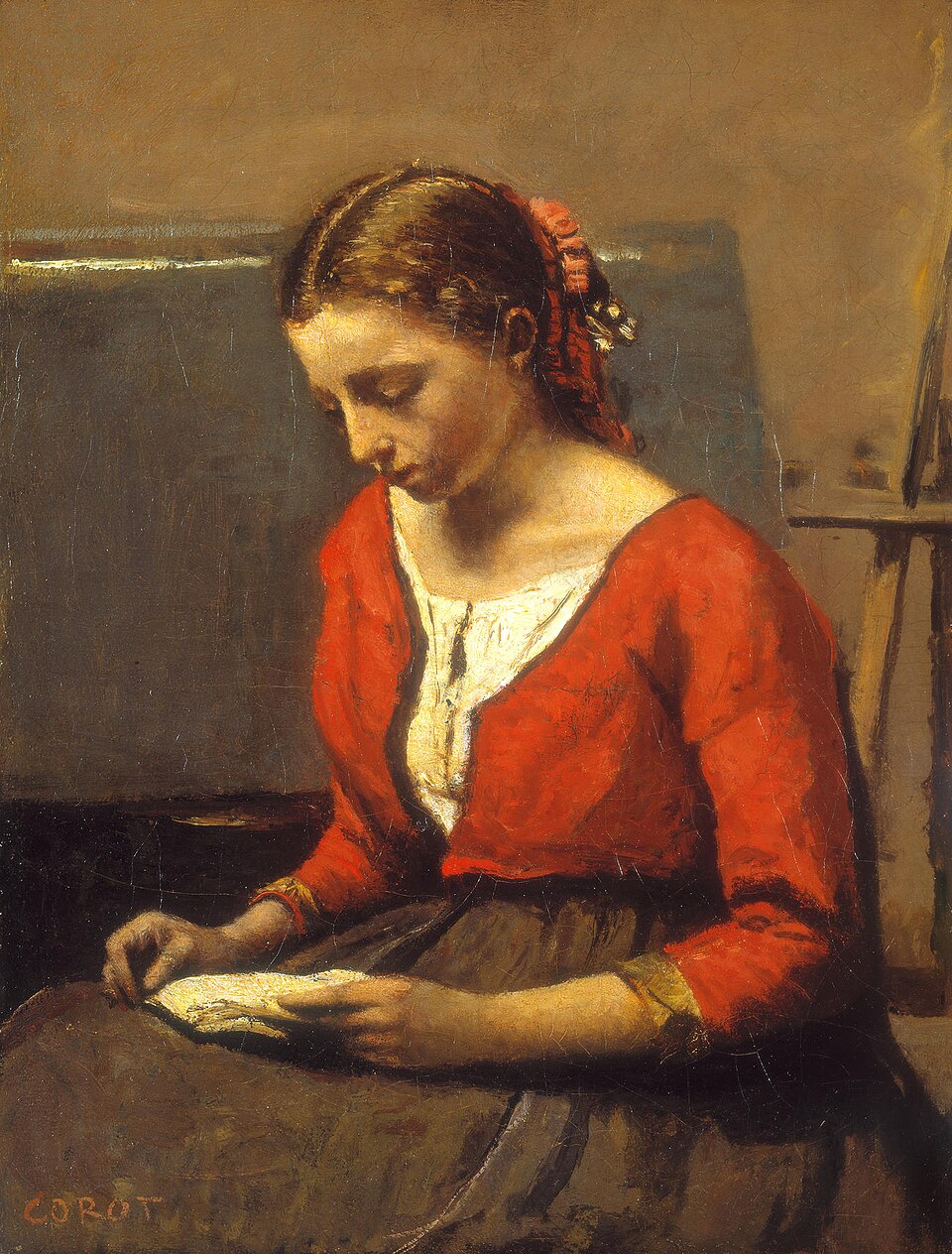
A young woman sits absorbed in a small book, her head inclined towards its pages in quiet concentration. Corot has reduced the setting to little more than a subdued arrangement of warm browns and ochres, relieved by the white of her blouse and the open pages before her, while the deep red of her jacket and the ribbon in her hair provide the composition’s most vivid accents. Behind her, the surroundings remain only loosely defined, with hints of the studio rather than a fully described interior. The resulting stillness seems to place her at a slight remove from both the painter and the viewer.
Painted around 1845–50, A Girl Reading belongs to the period following Corot’s third journey to Italy and is among the earliest examples of a subject to which he would return throughout his career. As Margaret Denton Smith observes, the red jacket, edged with gold at the cuffs, and the ribbon in the sitter’s hair form part of an Italianate costume that reappears in several of his later figure paintings. Yet the work resists any straightforward reading as either a portrait or a picturesque costume study. The sitter possesses a tangible individual presence, while Corot also holds her at a distance, supplying none of the details that would define her identity and allowing costume and inward absorption to transform her into a more elusive poetic figure.
Working from the model was not merely an adjunct to Corot’s better-known landscape practice, but one of his particular pleasures. His biographer Étienne Moreau-Nélaton described the weeks devoted to it as the artist’s “favourite form of relaxation”, suggesting a freedom quite different from the demands of the Salon or the expectations of patrons. Corot also brought to these paintings the tonal harmony he had developed in his landscapes, allowing the figure and her surroundings to be held together less by narrative than by carefully balanced colour. He generally kept these works to himself, and many became publicly known only after his death. Within the privacy of the studio, the model offered him a space in which observation, memory and pictorial invention could meet without resolving themselves into a finished narrative or an easily defined genre.
The models belonged to the fluid professional world of artistic Paris. Moreau-Nélaton recalled Corot alternating “Italian women from the rue Mouffetard” with working girls from Montmartre, while Delacroix recorded addresses supplied by Corot, whose knowledge of models was evidently valued by other painters. Emma Dobigny, who later sat for him, also posed for Degas and Puvis de Chavannes. Corot nevertheless resisted over-directing the women who worked for him, even defending the restlessness of one sitter with the remark that he needed “a model who moves”. The encounter remained open and immediate, even as the woman before him was transformed in Corot’s imagination.
Allard places these works at an unusual meeting point between inherited artistic tradition and modern painting. Corot repeatedly drew upon familiar types: women reading, drawing water or playing musical instruments, motifs established by painters such as Poussin, Vermeer, Valentin de Boulogne and Fragonard. Italian costume and recollections of his journeys introduced a further distance from the immediate studio encounter. Yet these references do not produce conventional history paintings or clearly defined narratives. The book, costume and pose remain elements within a pictorial vocabulary whose precise meanings are left uncertain.
The girl reading is neither simply the living model who sat before Corot nor an ideal type. She remains suspended between presence and distance.
[Producing these essays requires care, time, research, and resources. Contributions to help sustain this exploration would be greatly appreciated.]
Donate to Inner Surfaces here.
Bibliography
Allard, Sébastien. “Corot: From Model to Figure.” In Corot: Women, by Mary Morton, David Ogawa, Sébastien Allard and Heather McPherson, 39–53. Exhibition catalogue, National Gallery of Art, Washington. New Haven and London, 2018.
Denton Smith, Margaret. “A Girl Reading, c. 1845–1850,” cat. 13. In The Passionate Eye: Impressionist and Other Master Paintings from the E. G. Bührle Collection. Zurich and Munich, 1990.

