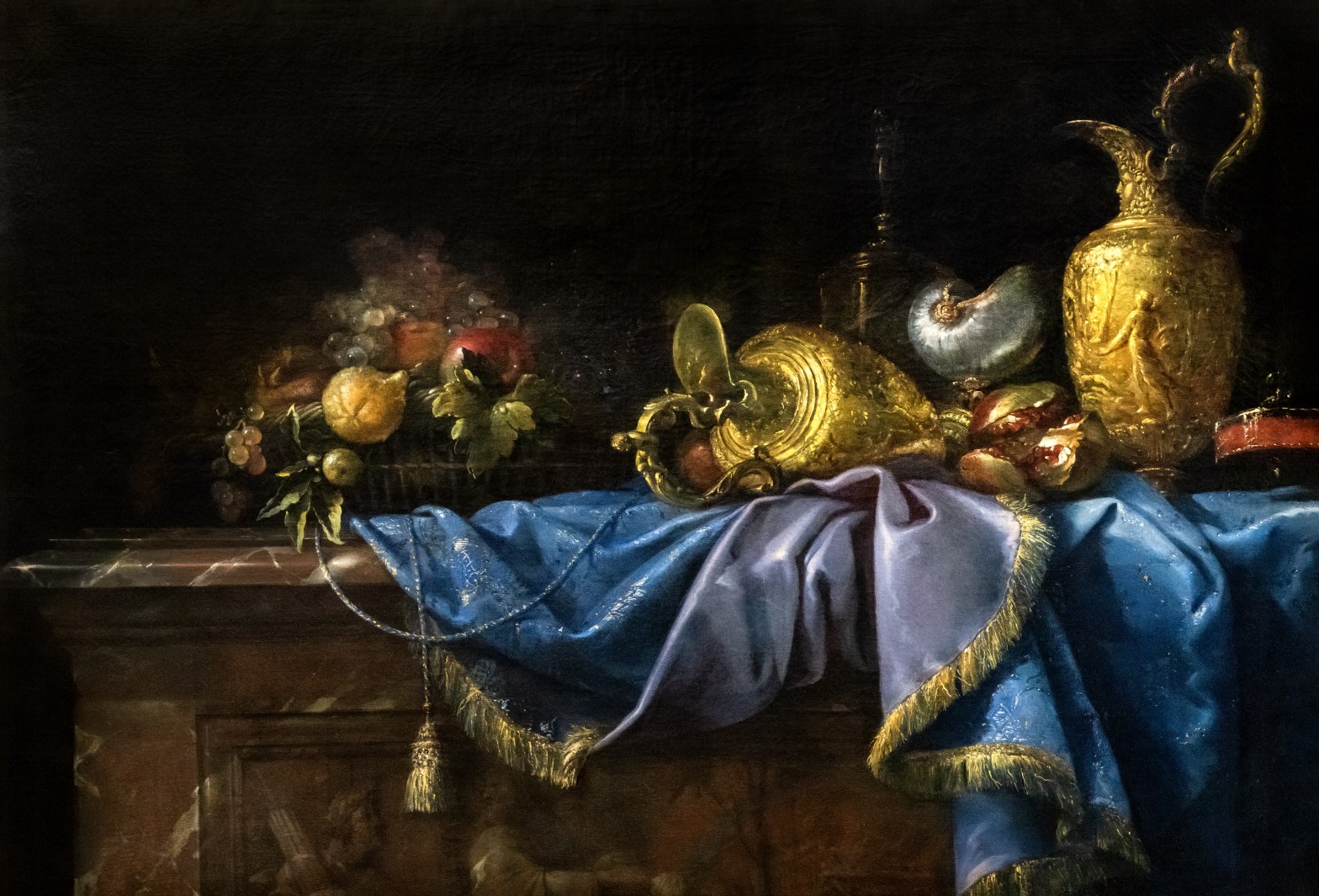
Meiffren Conte and the splendour of still life
Meiffren Conte, also found as Comte, Le Conte or Lecointe, was born in Marseille around 1630 and died there in 1705. He belongs to a later seventeenth-century world in which still life was no longer confined to modest arrangements of fruit, flowers or household objects. In his hands, the genre became more sumptuous: silver vessels, gold cups, rich draperies, carpets, fruit, shells and precious objects are brought together as signs of abundance, refinement and aristocratic taste.
Conte had spent time in Rome by the early 1650s and was probably formed in the circle of Francesco Noletti, called il Maltese (c. 1611–1654) and long known as Francesco Fieravino, a specialist in elaborate still lifes with carpets, armour and precious metalwork. This background helps explain the character of Conte’s own paintings. They are not merely displays of possessions, but exercises in surfaces: the sheen of metal, the softness of fabric, the bloom of fruit, the depth of mother-of-pearl and the way light moves across objects of very different textures.
A related still life in the Musée Granet, Aix-en-Provence, shows the kind of repertoire for which Conte became known. The painting brings together pieces of goldsmiths’ work, drapery, flowers, shells, a citron and a parrot on a stone ledge. The museum’s description rightly stresses the central importance of the silver vessels, which became something like the painter’s signature. These silver forms evoke princely tableware and the ornamental engravings of Jean Le Pautre (1618–1682), a Parisian designer and printmaker whose plates circulated models for Baroque decoration. The central ewer, with its elaborate relief ornament, points more specifically to Genoese silverwork and to older Mannerist forms. The painting belongs, too, to a culture of collecting, in which shells, exotic birds, flowers and precious vessels were objects of curiosity as much as of luxury.
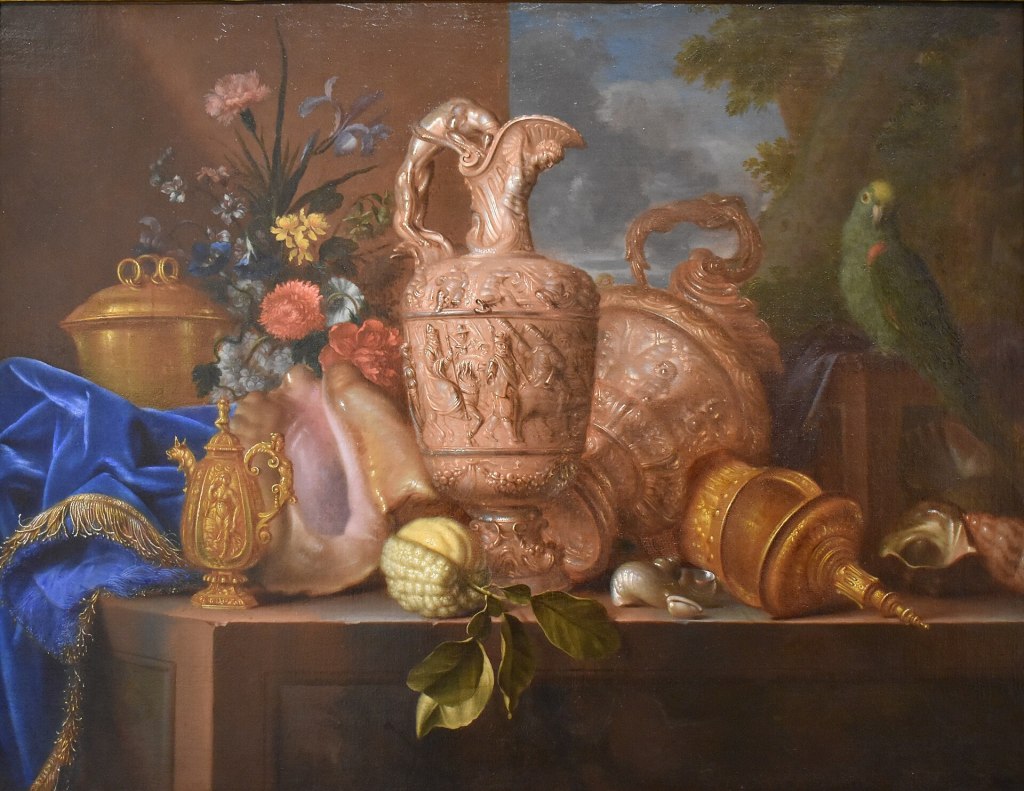
The Musée Granet entry makes another useful point: these are not primarily moral or allegorical still lifes. Their appeal lies instead in baroque accumulation, decorative splendour and painterly handling. Conte’s surfaces are broad, rich and sensuous, with creamy and rosy impasto used to suggest the brilliance of silver and the depth of nacre. It was this kind of sumptuous composition that appealed to his prosperous clientele, especially among the parliamentary circles of Aix, who could surround themselves with painted images of luxury even when the objects themselves were beyond reach.
His success was considerable. Conte worked for collectors in Marseille, Aix-en-Provence and Paris, and in the 1670s was employed by Louis XIV to paint the silver and gold treasures of the royal collection. That royal connection gives a useful frame for works such as this still life in Narbonne. Even when the arrangement is relatively compact, the mood is one of controlled magnificence. The fruit anchors the painting in the traditional language of still life, but the precious vessels and dark drapery move it towards a more courtly and theatrical register.
What is attractive in Conte is the balance between richness and restraint. The objects are splendid, but the painting avoids mere ostentation. Much of its pleasure lies in the variety of textures and surfaces, from polished metal and folded cloth to ripened fruit, each given its own weight and presence.
[Producing these essays requires care, time, research, and resources. Contributions to help sustain this exploration would be greatly appreciated.]
Donate to Inner Surfaces here.
Bibliography
Keith Sciberras, “Three Paintings by Francesco Noletti at the Bilbao Fine Arts Museum”, available online via Academia.edu. Accessed 8 July 2026.
Spike, John T. The Sense of Pleasure: A Collection of Still-life Paintings. With an essay by Maurizio Fagiolo dell’Arco. Milan: Skira, 2002.
Ministère de la Culture, POP / Joconde. “Aiguières, fleurs, coquillages et perroquet sur un fond de paysage (titre factice),” Meiffren Comte, Musée Granet, Aix-en-Provence, inv. 2014.3.1, notice 08940012299. Accessed 7 July 2026.

