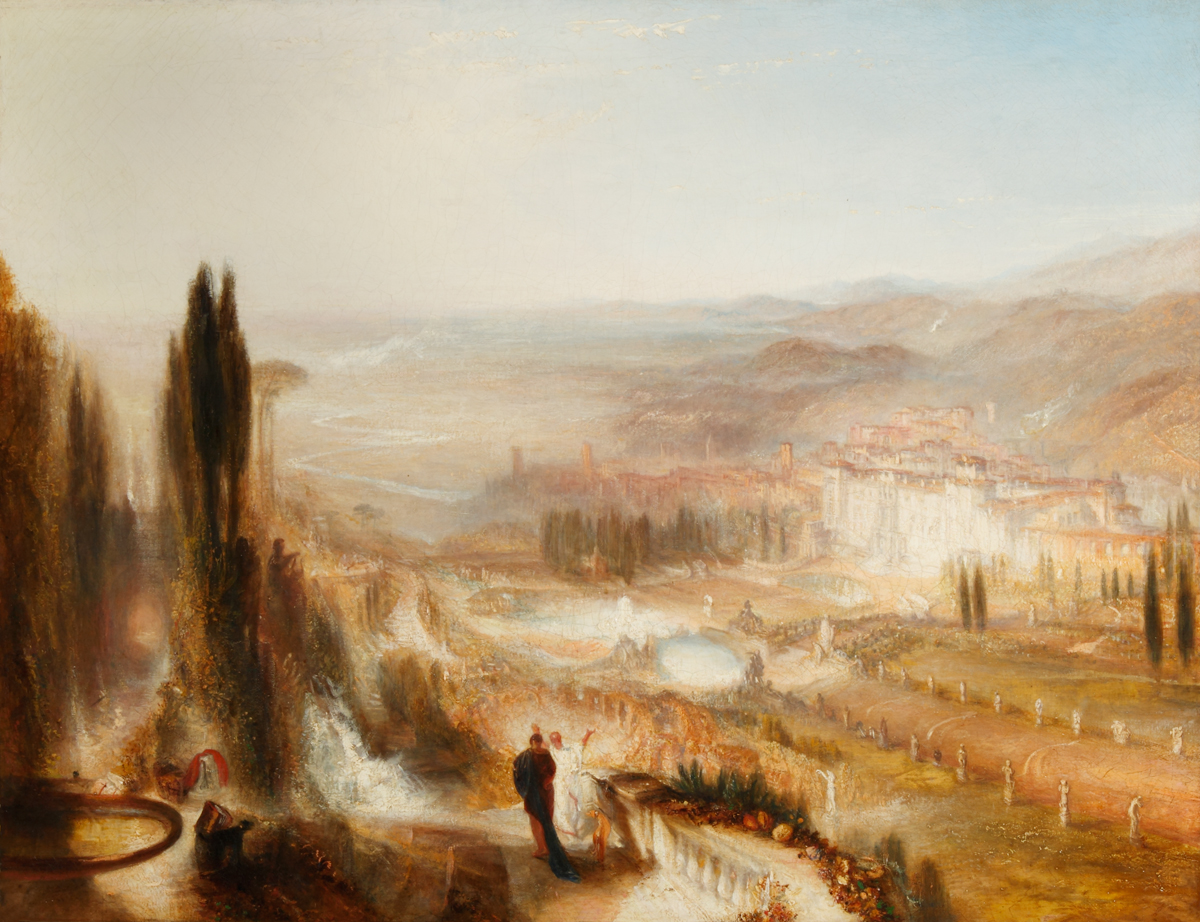
Richard Wilson (1713/14–1782) and J. M. W. Turner (1775–1851) belong to successive generations of British landscape painting. Wilson helped establish landscape as a vehicle for classical and historical subjects, earning the admiration of later painters, including Turner and Constable. Turner, whose early work owed much to Wilson and Claude Lorrain, transformed the possibilities of landscape painting through his increasingly adventurous treatment of light, colour and atmosphere.
Marcus Tullius Cicero (106–43 BC), the Roman statesman, orator and philosopher, offered later artists a figure in whom political achievement and intellectual cultivation were closely united. In De Legibus (On the Laws), he describes a visit with his brother Quintus and his friend Atticus to the family’s ancestral estate at Arpinum, where he had been born. Their conversation celebrates the beauty of the countryside, but also explores the deeper attachments arising from family history, memory and a sense of belonging. Cicero’s affection for the estate extends beyond its physical attractions to the associations it holds with his ancestors and his own childhood. The passage also evokes the Roman ideal of otium, leisure devoted to contemplation, reading and philosophical discussion, distinct from the demands of public affairs.
Such associations between classical learning, cultivated retirement and the natural world held considerable appeal in eighteenth-century Britain, especially among the aristocracy and landed gentry. During his years in Italy, Wilson developed an approach to landscape painting that combined close observation of nature with the classical traditions of Claude Lorrain and Gaspard Dughet. His landscapes belonged to the Grand Style, in which the natural world was given an idealised form and associated with the intellectual and cultural values of antiquity. For patrons whose education, travels and country estates encouraged identification with the classical world, Wilson’s paintings offered a familiar cultural ideal.
Wilson’s treatment of Cicero’s retreat at Arpinum was well suited to these interests. In De Legibus, the island formed by the River Fibrenus provides a secluded setting for philosophical discussion, where the beauty of nature encourages reflection on justice and law. Cicero’s ancestral estate thus emerges as a locus of intellectual contemplation, personal memory and attachment to place. For Wilson’s patrons, the image of cultivated men engaged in contemplation within a private rural estate offered an ideal with which they could readily identify.
Wilson exhibited Cicero and His Two Friends, Atticus and Quintus, at His Villa at Arpinum at the Royal Academy in 1770, correctly identifying the setting described in De Legibus. Yet by 1790 the same composition was also known as Cicero and His Friends at His Tusculum Villa, referring to another of Cicero’s estates, near Frascati. This confusion of locations is significant for understanding Turner’s subsequent engagement with Wilson’s painting.
David Blayney Brown associates Turner’s interest in Wilson’s painting with his attempts to locate sites connected with Cicero during his Italian journey of 1819. William Chubb offers a more specific interpretation of this interest. Turner may have encountered a version of Wilson’s composition under the title Cicero at Tusculum in 1799, and in his Albano, Nemi, Rome sketchbook he wrote, “If Tusculum Where is Wilson’s Picture taken from”. Chubb suggests that Turner was attempting to identify the viewpoint associated with Wilson’s painting, apparently searching near Tusculum for the setting of a composition originally conceived as Arpinum.
Whether Turner was already considering his own painting of Cicero in 1819, twenty years before exhibiting Cicero at His Villa, remains uncertain. In reality, Wilson’s landscape was largely imaginary, and scholars have suggested that it may have incorporated features of the Welsh countryside.
Wilson painted more than one version of the composition. The earlier painting, dated c. 1769–70 and now in the Ashmolean Museum, Oxford, measures 91.5 × 129.7 cm. A larger version, dated c. 1771–75 and measuring 121.8 × 174.5 cm, belongs to the Art Gallery of South Australia, Adelaide. The Adelaide painting retains essentially the same composition and is believed to have been commissioned by the Welsh landowner Sir Watkin Williams-Wynn, probably after he saw the earlier painting at the Royal Academy exhibition of 1770. This work remained in his family’s possession until the twentieth century.
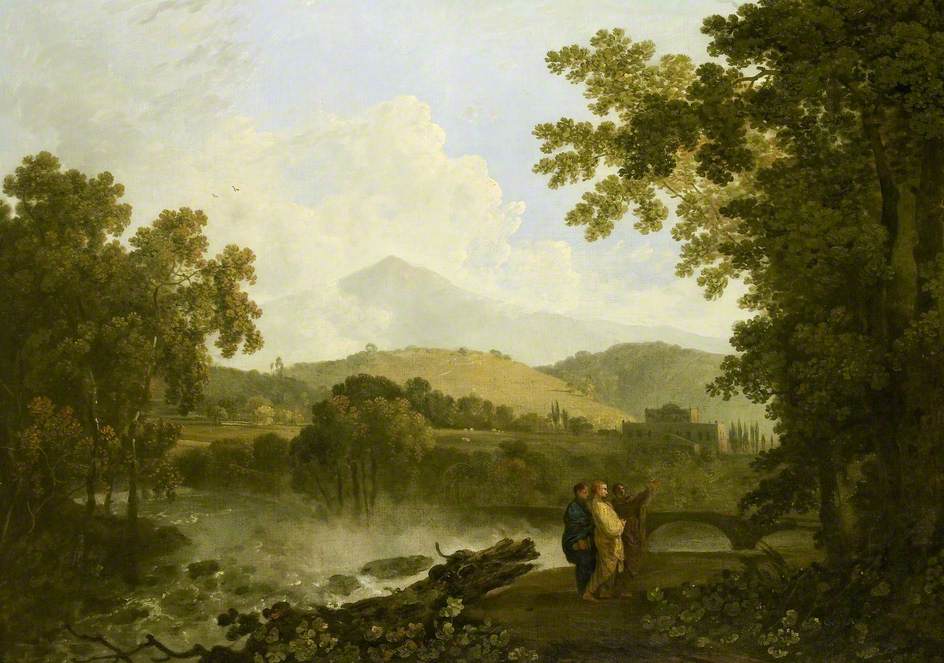
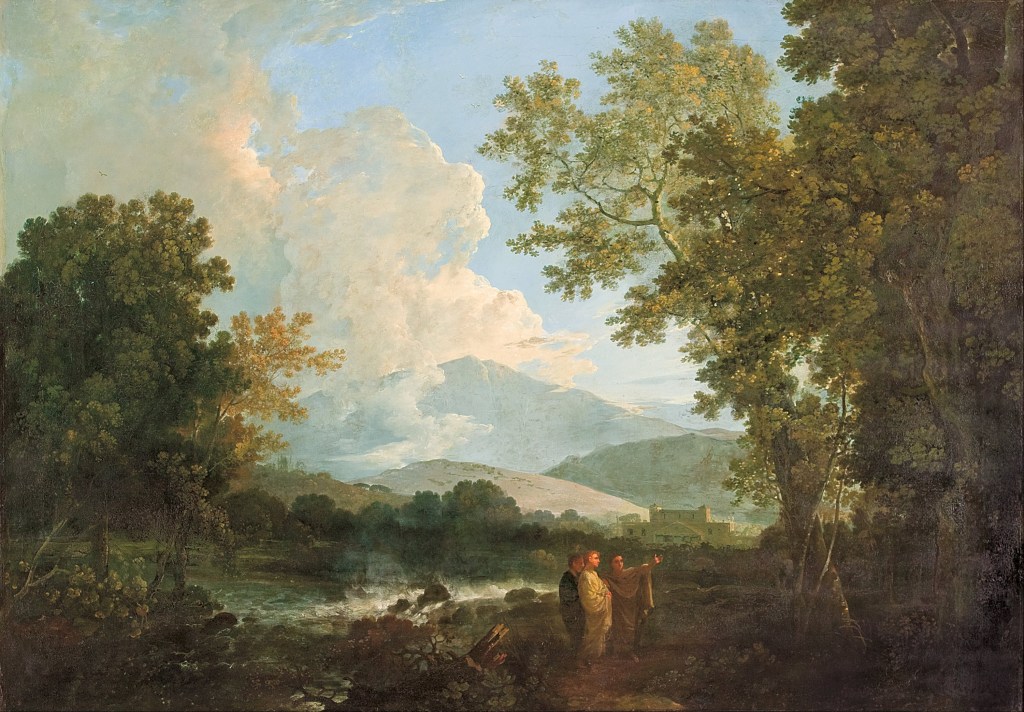
The Adelaide painting reveals considerable variation in Wilson’s handling of paint. The Richard Wilson Online Catalogue Raisonné, published by the Paul Mellon Centre, draws attention to the finely painted urns on the distant villa’s balustrade, the touches of pink on a broken foreground tree, the raised hand of one of the figures, and the varied impasto used to illuminate the clouds. In addition, the details of the middle-distance hills are less finely rendered, with vigorous horizontal brushstrokes. The catalogue also notes that the composition resembles Wilson’s View near Wynnstay in its arrangement of light and shade and its treatment of trees and distance.
The decades separating Wilson’s career from Turner’s also witnessed significant changes in the British art market. Wilson’s classical landscapes found an appreciative audience among the aristocracy and landed gentry, although the emergence of public exhibitions, notably those organised by the Society of Artists from 1760 and the Royal Academy from 1769, was already broadening the opportunities available to painters. By Turner’s maturity, exhibition culture had become well established, while commercial galleries, dealers and reproductive prints contributed to a more extensive market. Alongside aristocratic and landed patrons, wealthy merchants and industrialists became increasingly important collectors of contemporary British art. Turner benefited from this diversification, numbering among his patrons the London merchant Elhanan Bicknell and the Birmingham steel-pen manufacturer Joseph Gillott, who owned Cicero at His Villa by 1845.
The stylistic differences between Wilson’s painting and Turner’s interpretation of the subject are self-evident. Of particular interest, however, is Turner’s representation of Cicero, who stands in the foreground in a white magistrate’s toga, his arms raised in an emphatic gesture. As David Blayney Brown observes, he may be protesting some point of law or drawing attention to the beauties of his estate. Brown also raises the possibility that the scene represents the moment of Cicero’s arrest. Whatever its precise significance, the gesture gives Cicero a more animated and dramatic presence than the figures engaged in philosophical discussion in Wilson’s painting.
As Sam Smiles argues in ‘Turner In and Out of Time’, the increasing freedom of Turner’s later painting should not be understood as an anticipation of twentieth-century Modernism. Rather than abandoning representation, Turner was extending the expressive possibilities of painting. His exploration of light and atmosphere addressed the limitations of human perception, whether obscured by darkness or overwhelmed by radiance. He understood the visible world as dynamic and constantly changing, and employed heightened, sometimes non-naturalistic colour to establish the emotional character of a scene. His handling of paint became increasingly free, with relatively sparse descriptive detail, while the distinction between the spontaneity of his sketches and the finish of his exhibited paintings grew less pronounced. These developments were not a rejection of subject matter, but a means of communicating experiences and meanings that conventional representation could not adequately express.
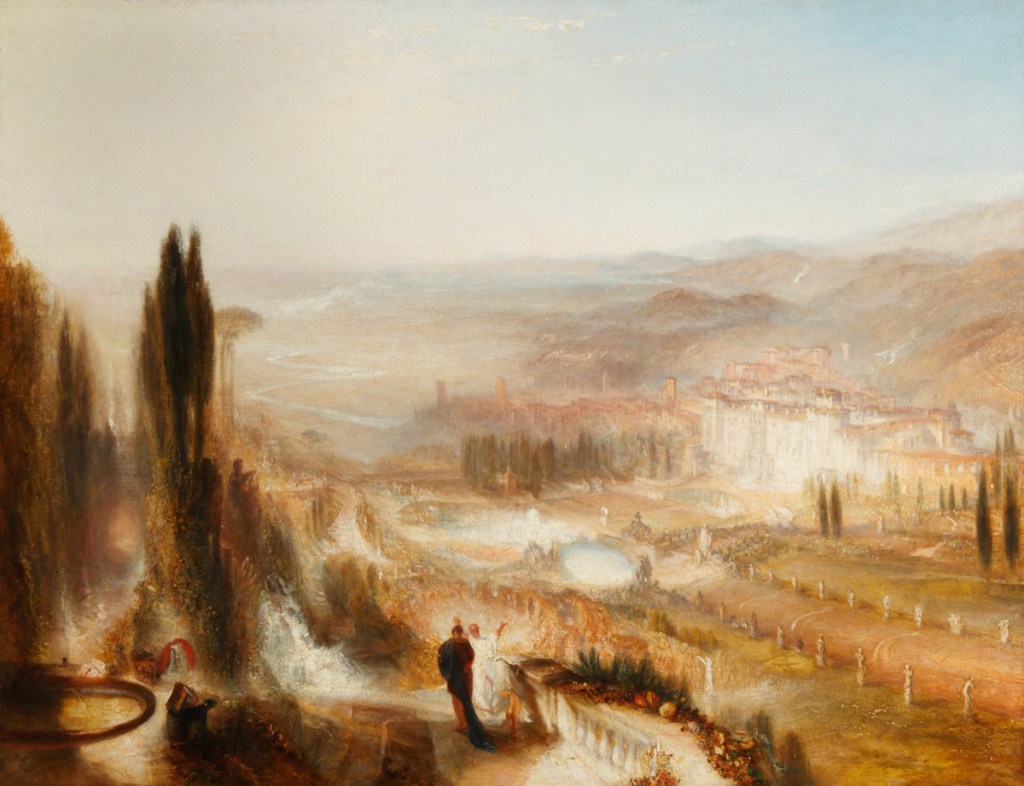
Turner himself had drawn a parallel between Cicero and Wilson in a lecture delivered at the Royal Academy in 1811. Reflecting on Wilson’s disappointed later career, he observed that ‘in acute anguish he retired, and as he lived he died neglected’. Turner was himself encountering increasingly hostile criticism, and Cicero at His Villa attracted its share. Reviewing the painting in 1839, Blackwood’s Magazine described it as ‘scratched in with old broken combs’. Against this background, David Blayney Brown suggests that Turner may have recognised something of his own vulnerability in Cicero, whose defence of the Roman Republic had ultimately led to his execution. The painting might therefore be understood, at least in part, as a veiled self-portrait.
Donate to Inner Surfaces here.
Bibliography
These are the sources. Any errors are mine.
Art Gallery of South Australia, Collection Online, ‘Cicero with His Friend Atticus and Brother Quintus at His Villa at Arpinum’, Richard Wilson, accession no. 0.1371.
Brown, David Blayney, ‘Cicero at His Villa’, catalogue entry no. 85, in Late Turner: Painting Set Free, exhibition catalogue, Tate Britain (London: Tate Publishing, 2014), p. 142.
Brown, David Blayney, Amy Concannon and Sam Smiles (eds), Late Turner: Painting Set Free, exhibition catalogue, Tate Britain (London: Tate Publishing, 2014).
Butlin, Martin, and Evelyn Joll, The Paintings of J. M. W. Turner, revised edition, 2 vols (New Haven and London: Yale University Press, 1984).
Chubb, William, ‘Turner’s “Cicero at His Villa”’, The Burlington Magazine, vol. 123, no. 940 (July 1981), pp. 417–21.
Layfield, Laura, Richard Wilson: Landscape Painting for a New Exhibition Culture, MA by Research dissertation, University of York, 2010.
Smiles, Sam, ‘Turner In and Out of Time’, in David Blayney Brown, Amy Concannon and Sam Smiles (eds), Late Turner: Painting Set Free (London: Tate Publishing, 2014), pp. 13–24.
Solkin, David H., Richard Wilson: The Landscape of Reaction, exhibition catalogue, Tate Gallery (London: Tate Gallery Publications, 1982).
Solkin, David H., Painting for Money: The Visual Arts and the Public Sphere in Eighteenth-Century England (New Haven and London: Yale University Press, 1993).
Spencer-Longhurst, Paul, with Kate Lowry and David Solkin, Richard Wilson Online: A Digital Catalogue Raisonné (London: Paul Mellon Centre for Studies in British Art, 2014), especially entries P162 (Ashmolean Museum) and P162A (Art Gallery of South Australia). Online resource: richardwilsononline.ac.uk.

