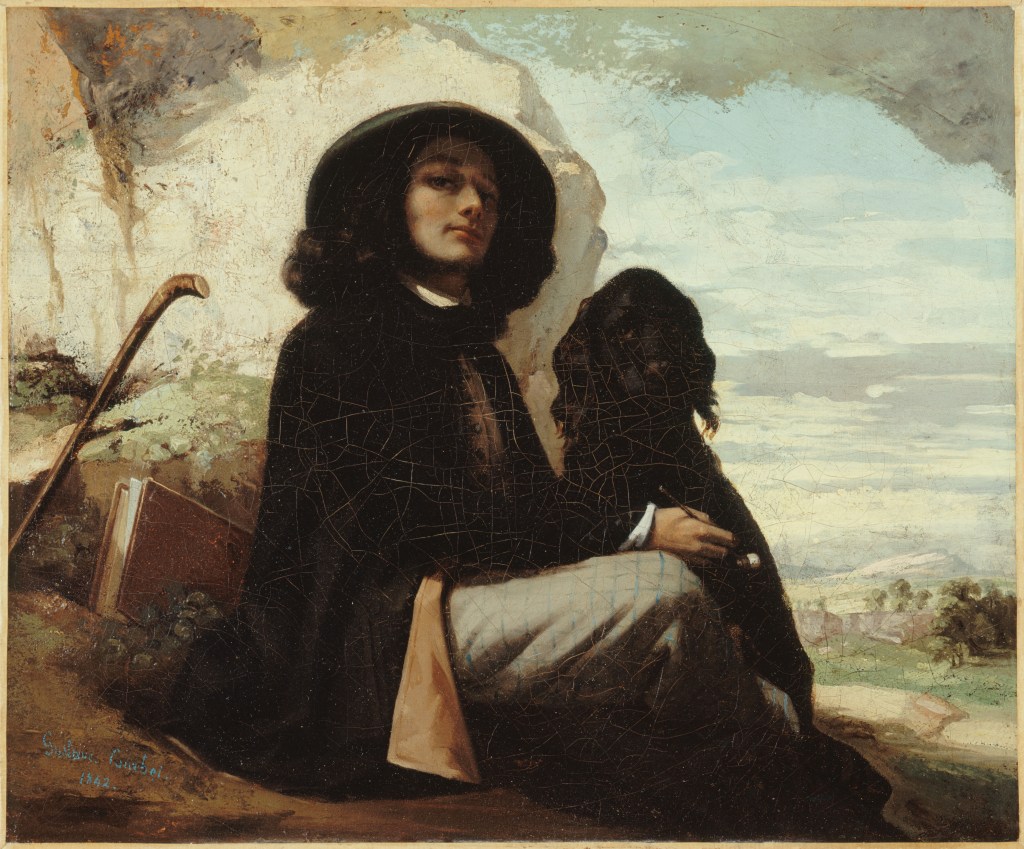
Self-Portrait with Black Dog (c. 1842–44)
Courbet’s Self-Portrait with Black Dog, accepted at the Salon of 1844, marked his first significant public success. The painting presents the young artist seated in a landscape near Ornans, accompanied by his black spaniel. He wears a broad-brimmed hat and dark clothing, with a pipe in his hand, while a walking stick and a book or sketchbook rest against the rocks beside him. His appearance combines something of the fashionable Parisian artist with the independence of a young man at ease in his native countryside.
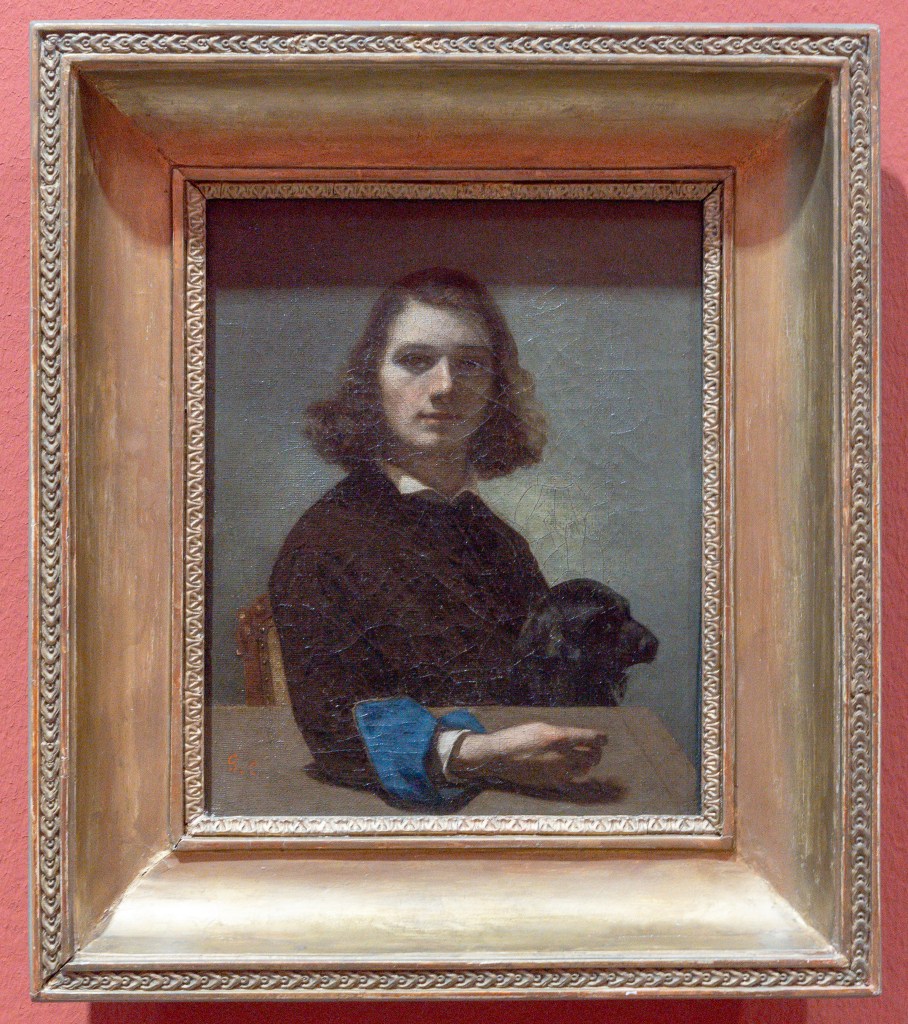
An earlier Self-Portrait or Man with a Dog (1842), now in the Musée de Pontarlier, provides a useful comparison. Courbet’s carefully arranged pose, with one hand brought prominently into the foreground, suggests his study of Old Master portraiture. Sylvain Amic notes a possible resemblance to Parmigianino’s Self-Portrait in a Convex Mirror, in which the artist’s hand is similarly prominent. Anthea Callen has suggested that the picture may have provided a starting point for the more ambitious composition in the Petit Palais. Both paintings represent Courbet accompanied by his dog. In the larger work, however, the relatively confined setting gives way to an expansive landscape, making the artist’s relationship with his native countryside central to the composition.
Callen relates the landscape setting of Self-Portrait with Black Dog to eighteenth-century English portraiture, in which the presentation of a sitter within the countryside could communicate social identity and personal interests. Courbet adapts this tradition to the Romantic image of the independent artist. Sylvain Amic has also considered the significance of the dog, a familiar attribute of aristocratic portraiture, where it could signify fidelity or social standing. In May 1842, Courbet wrote enthusiastically to his parents about the black spaniel he had received from a friend, joking that the animal attracted more attention than he did himself. The dog subsequently became a familiar companion in his presentation of himself.
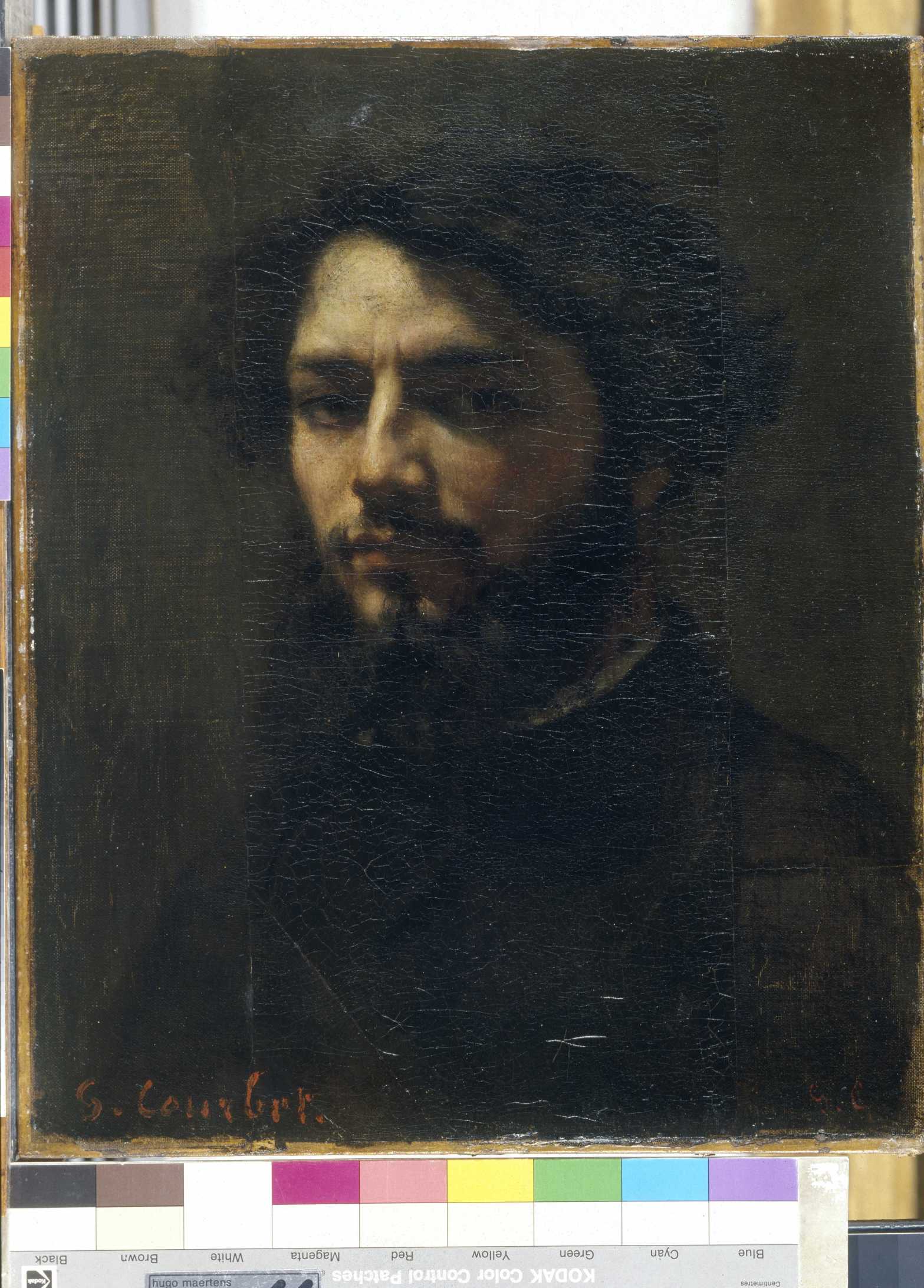
The history of the Petit Palais canvas raises questions regarding its origins. Although the painting bears the date 1842, this may have been added retrospectively, and its execution is generally placed between 1842 and 1844. Technical examination has also revealed that Courbet worked on a reused canvas and made substantial revisions to the composition. Its upper edge appears originally to have been curved, before the painting acquired its present rectangular format. Marie-Thérèse de Forges suggested that the work might initially have been conceived for an architectural setting, perhaps as an overdoor. Its low viewpoint lends some support to this possibility. More recently, Stéphanie Cantarutti has returned to the hypothesis of an original decorative purpose.
If the painting was initially intended for a private interior, Courbet may not originally have envisaged it as a Salon submission. Its eventual exhibition in 1844 would therefore represent a change in purpose as well as an important moment in his early career.
The Desperate Man (c. 1844–45)
Among Courbet’s youthful self-portraits, The Desperate Man (Le Désespéré) is one of the most arresting and difficult to interpret. The artist confronts the spectator with wide-open eyes, his hands gripping his hair and his mouth slightly parted. The closely framed composition, with its strong contrasts of light and shadow, concentrates attention upon the face and the dramatic gesture. Yet the emotion represented is not readily defined. Although the painting is generally known as The Desperate Man, its expression might equally suggest fear, astonishment or terror. Nothing in the picture identifies the event or circumstance that has provoked such an extreme reaction.
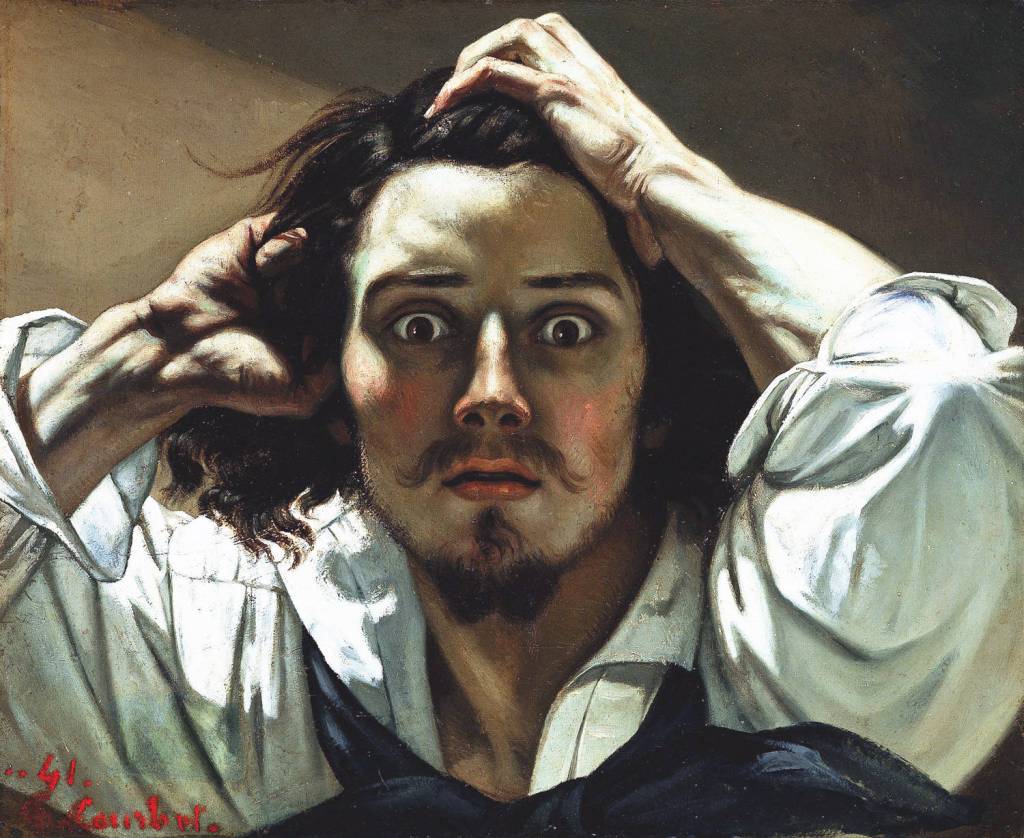
Its possible pictorial sources offer one approach to understanding this ambiguity. Hélène Toussaint suggested that the painting might be related to the academic tradition of têtes d’expression, studies of heads representing different emotional states. Such exercises, widely circulated through engravings, belonged to an established system of artistic training. The exhibition catalogue Gustave Courbet 1819–1877, published for the Grand Palais retrospective in Paris (1977–78), developed the comparison with Charles Le Brun’s studies of the passions, specifically his representation of fright. The exaggerated eyes and facial expression suggest that Courbet may have drawn upon this tradition, although the forceful gesture of his raised arms gives the composition a different character. René Huyghe had also proposed a comparison with Rembrandt’s etched Self-Portrait with Haggard Eyes.
The painting’s apparent psychological intensity has encouraged autobiographical interpretations. Laurence des Cars, in the 2008 Metropolitan Museum exhibition catalogue, considers the possibility that Courbet was deliberately representing an extreme emotional state rather than recording an actual experience of despair. His personal circumstances nevertheless provide a relevant context. During the mid-1840s he was struggling to establish himself in Paris, and his correspondence reveals both considerable ambition and repeated disappointment. He also moved within a literary and artistic milieu deeply influenced by Romanticism, whose representations of youthful suffering, frustrated love and misunderstood genius offered familiar models of behaviour.
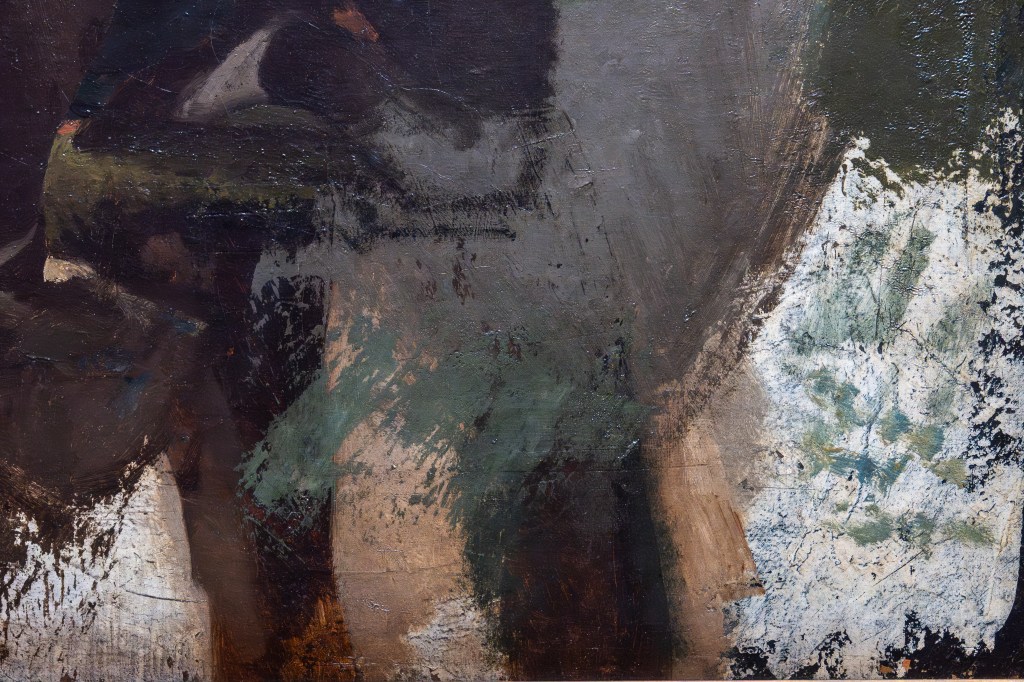
A comparison with The Man Mad with Fear (Le Fou de peur), another self-portrait from the mid-1840s, is revealing. Courbet represents himself in a precarious position, one hand raised to his head and the other reaching forward, as though he were about to fall. The rocky ground gives way to an unfinished foreground, suggesting the edge of a precipice without clearly defining it. In the pale area at the lower right, a faint impression of a hand with outspread fingers can be discerned. The Fondation Beyeler’s 2014 exhibition guide suggests that this handprint appears almost to answer the gesture of Courbet’s outstretched hand, as though another hand were reaching towards him from the undefined space below. The figure’s apparent fall might therefore suggest a leap into the unknown, with the unfinished foreground representing the unfamiliar artistic territory into which the young painter was venturing. Courbet exhibited the work in 1855 without describing it as a sketch, raising the possibility that he accepted its conspicuously unfinished appearance.
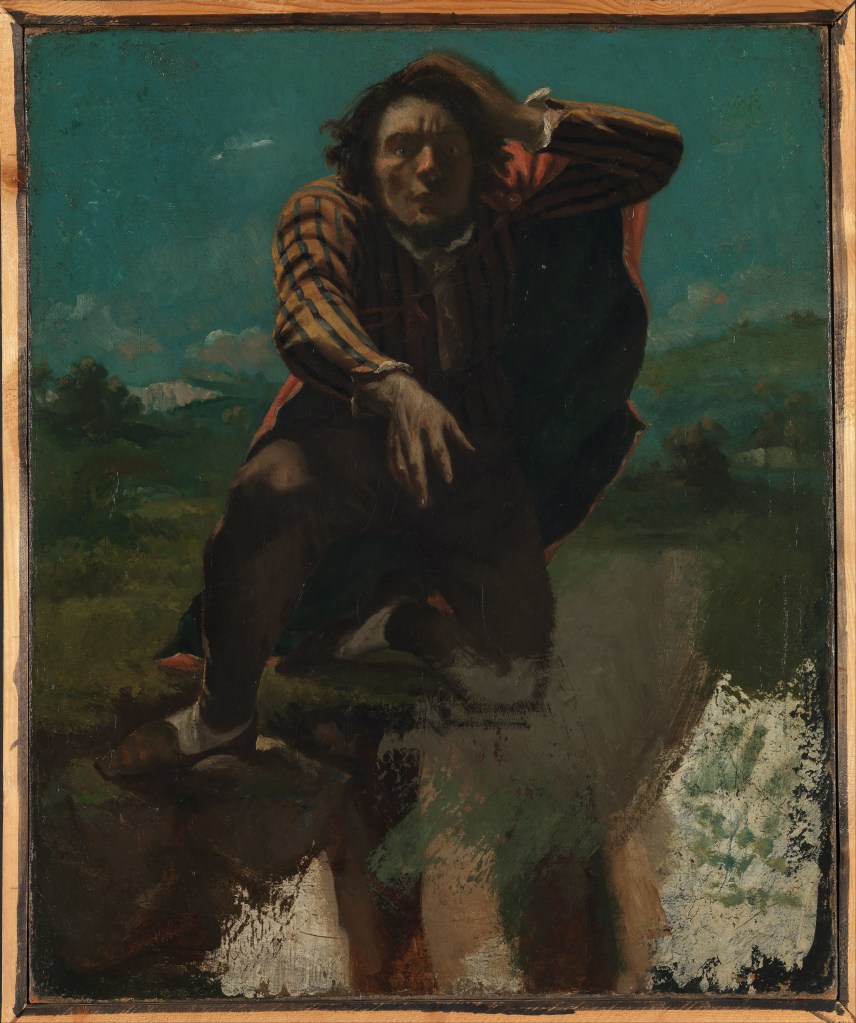
The dating and later history of The Desperate Man introduce further uncertainties. Although Courbet signed and dated the painting 1841 in red at the lower left, the inscription is thought to have been added retrospectively, and the work is generally dated to around 1844–45. Courbet retained it throughout his life, and it was not publicly exhibited until the 1870s. Its prolonged presence in his studio suggests that it continued to hold some significance for him, although the nature of that attachment remains uncertain.
The Man with the Leather Belt (c. 1845–46)
Courbet’s The Man with the Leather Belt (L’Homme à la ceinture de cuir) presents a different aspect of the artist’s youthful self-representation. Seated against a dark background, he rests one hand against his cheek, while the other grasps the leather belt across his waist. The elaborate pose, subdued colouring and carefully arranged contrasts of light and shadow recall the portraiture of earlier European masters. Unlike the emotional intensity of The Desperate Man, the effect is one of studied composure, although the prominent gestures and somewhat theatrical bearing suggest that Courbet remained concerned with the expressive possibilities of his own appearance.
Courbet’s study of Titian is documented by X-radiography. He painted The Man with the Leather Belt over a copy he had previously made of Titian’s The Man with a Glove in the Louvre, turning the canvas upside down so that the head of Titian’s sitter lay beneath his own elbow and forearm. As Anthea Callen has shown, Courbet incorporated elements of the earlier painting, including the white collar and shirt-front, into his new composition. The accumulated layers of paint also contributed to cracking in the surface. The discovery reveals something of Courbet’s working methods: rather than discard his copy, he reused both the canvas and parts of the painted image in constructing his self-portrait.
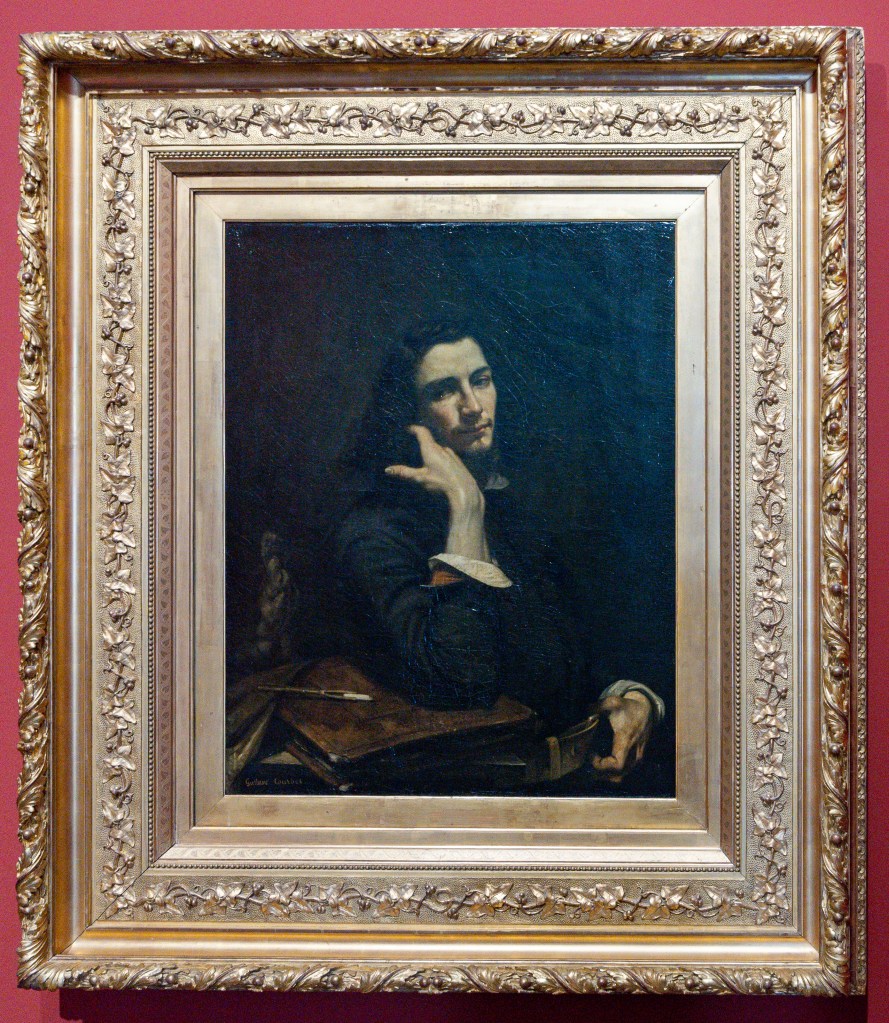
Among the objects in the shadowed background is a small plaster écorché, a model of a flayed human figure traditionally attributed to Michelangelo, although the attribution has been disputed. Its contorted, kneeling pose gave it an expressive character extending beyond its practical use in anatomical instruction. Mary Tompkins Lewis has explored the significance of this model in Courbet’s early paintings. In The Draughts Players (c. 1844–45), the figure occupies a more conspicuous position, its twisted musculature rendered with vigorous, heavily applied paint. In The Man with the Leather Belt, by contrast, it is seen from behind, placed beside a folio of drawings or prints and largely submerged in shadow. Lewis interprets this change as part of Courbet’s developing relationship with academic tradition. Lewis relates the formal tensions of the sculptural model to Courbet’s own pose, including the opposing gestures of his oversized hands and the slight twist of his body. She also regards the model’s relegation to the shadows as suggestive of the painter’s growing preoccupation with his own image.
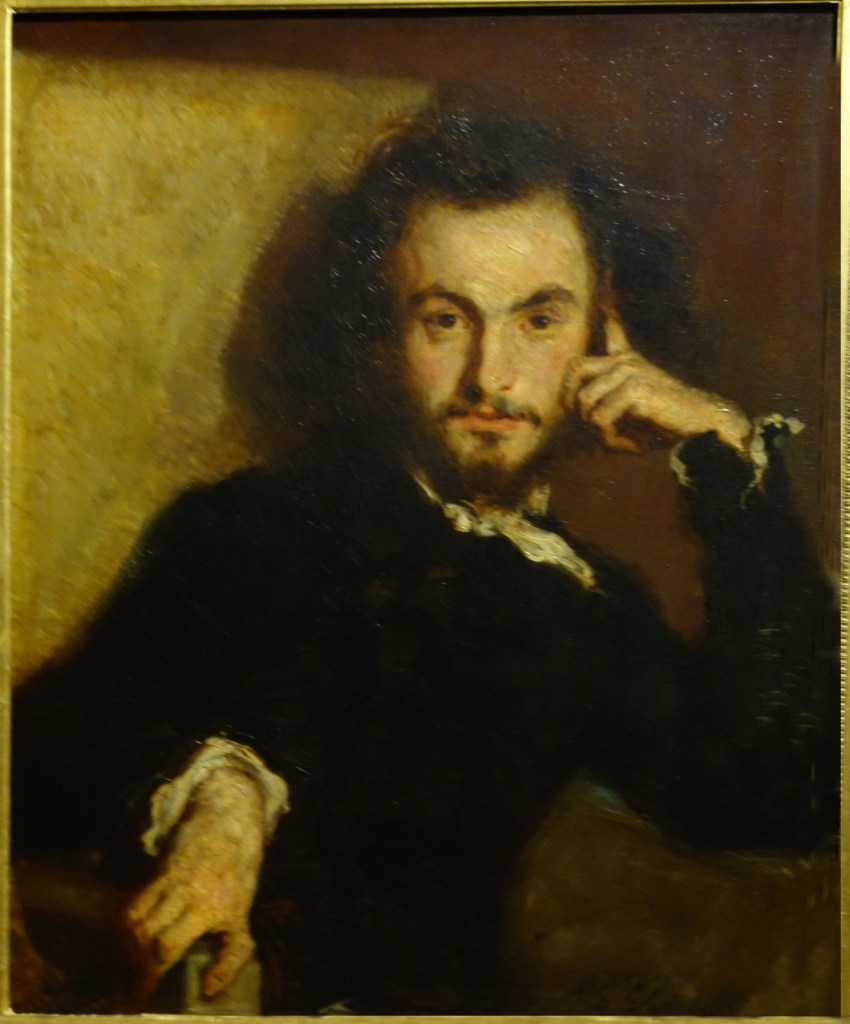
Laurence des Cars compares The Man with the Leather Belt with Émile Deroy’s Portrait of Baudelaire (1844), drawing attention to the arrangement of the hands in both paintings. Each figure grips an object with one hand, Courbet his leather belt and Baudelaire the arm of his chair, while the other hand is raised towards the face. The difference lies in the treatment of this second hand. Whereas Baudelaire’s gesture is characterised by what des Cars calls a ‘quizzical restraint’, Courbet’s hand is conspicuously large, powerful and strangely shaped, pressed against his cheek and hair. Des Cars sees in this emphatic presentation an image of Courbet as a melancholy creator.
The precise dating of The Man with the Leather Belt has been disputed, partly because Courbet attached inconsistent dates and descriptions to his early paintings in subsequent exhibitions. Marie-Thérèse de Forges proposed identifying it with a portrait accepted at the Salon of 1846, an identification supported by the dimensions recorded in the Salon registers and by contemporary correspondence. The Grand Palais catalogue favoured a date of around 1845–46, consistent with the artist’s appearance and the painting’s technical development.
The Cellist (1847)
In The Cellist (Le Violoncelliste), painted in 1847 and now in the Nationalmuseum, Stockholm, Courbet represents himself as a musician. Dressed in dark clothing, he sits with a cello between his knees, his head inclined and his face illuminated against a subdued background. The instrument occupies much of the foreground, while the artist’s hands are given considerable prominence.
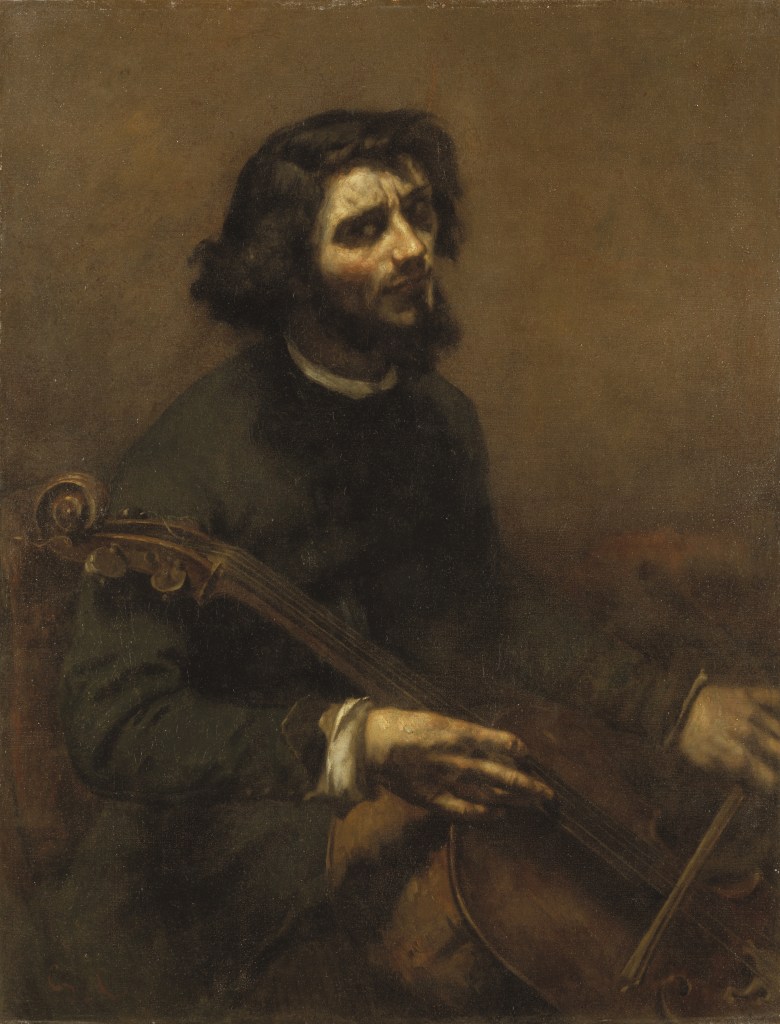
The painting has been associated with George Sand’s novel Consuelo (1842–43) and its continuation, La Comtesse de Rudolstadt (1843–44). Marie-Thérèse de Forges proposed that Courbet originally submitted the work to the Salon of 1847 under the title Souvenir de Consuelo, before its rejection and subsequent exhibition as The Cellist in 1848. Although the identification remains hypothetical, Sand’s novels, which follow the adventures of a gifted singer, offer a possible literary context for Courbet’s portrayal of himself as a musician. His adoption of this role may also suggest a parallel between musical performance and painting, allowing him to explore his identity as an artist through another form of creative expression.
The literary interpretations should nevertheless be considered alongside Courbet’s personal involvement with music. Amic draws attention to correspondence and contemporary recollections demonstrating that this interest extended throughout his life. Courbet had played the violin to some extent, but singing was his principal enthusiasm. His repertoire included popular songs, compositions associated with Pierre Dupont and Romantic ballads of his own. Music was also part of the social environment in which he grew up. Several of his friends in Ornans, including Ernest Cuenot and Charles Promayet, were musicians, and performances formed part of the gatherings attended by the young painter. The importance of this activity becomes apparent in the circumstances surrounding his return to Ornans after his success at the Salon of 1849, when he was welcomed by a municipal band conducted by Promayet, who had arranged compositions in his honour.
Music continued to occupy a place in Courbet’s Parisian friendships. Champfleury, whose literary activities brought him into close contact with the painter, was himself an enthusiastic amateur musician. Sylvain Amic suggests that he may have supplied the cello used in Courbet’s painting, although no direct evidence establishes the loan. The identification of the instrument has sometimes been confused by Champfleury’s reference to the painting as L’Homme à la basse, a title that might suggest a double bass, although Courbet clearly depicts a cello. Their association extended beyond music: Champfleury became one of the earliest critics to recognise Courbet’s abilities and helped introduce his work to a wider audience. The musical disguise adopted in The Cellist thus had a substantial basis in Courbet’s own experience, and need not be understood solely as an identification with an imagined Romantic character.
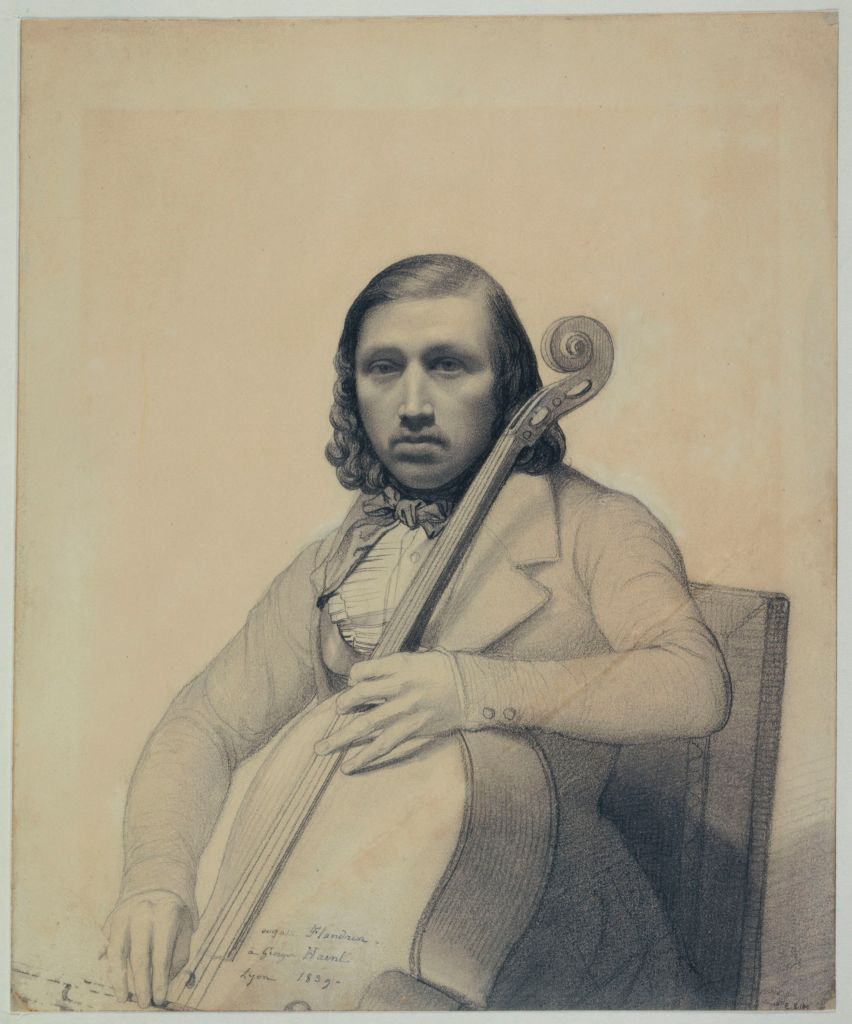
The expressive qualities of the instrument itself introduce another dimension. René Huyghe observed that the cello, whose sonority was often compared with that of the human voice, was especially suited to a conception of music as the expression of inward feeling. Unlike a portrait that simply establishes the identity of a professional musician, Courbet’s painting appears to invest the act of performance with a personal significance. The distinction becomes clearer in Amic’s comparison with Auguste-René Flandrin’s portrait of the celebrated cellist Georges Hainl. Flandrin presents his sitter with a comparatively restrained expression, concentrating upon the dignity and professional identity of the musician. Courbet, by contrast, employs dramatic lighting and a more expressive pose, directing attention towards the emotional character of the figure. The comparison suggests that the choice of subject provided him with a means of exploring aspects of his own personality through a familiar artistic convention.
The painting’s relationship with seventeenth-century art is equally important, although the execution reveals some of the difficulties Courbet encountered in adapting earlier models. Callen draws attention to the cramped pictorial space and the reliance upon strong contrasts of light and shadow to establish the figure’s presence. The illumination of the face is effective, but the hands and arms are less convincingly resolved. The modelling of the right hand is awkward, while the left arm and shoulder lack the solidity achieved elsewhere in the painting. Amic also notes the unusual position of the bow, which Courbet appears to hold in his left hand rather than his right, possibly because he was working from a mirror. Such difficulties suggest that Courbet’s ambition to construct an imposing image sometimes exceeded his command of the technical problems involved.
Despite these weaknesses, the painting attracted favourable attention when it appeared at the Salon of 1848. Prosper Haussard, writing in Le National on 15 June, praised Courbet’s handling and chiaroscuro, finding in The Cellist a reminiscence of Caravaggio and Rembrandt. Champfleury, meanwhile, compared Courbet’s qualities with those of Rembrandt and Ribera, suggesting that The Cellist would not look out of place in a Spanish museum alongside paintings by Velázquez and Murillo. These responses are significant not only as evidence of Courbet’s growing reputation but also because they show how his contemporaries understood the force of his paintings through the example of established masters. The critics recognised qualities that distinguished his work from that of other young French painters, even while associating those qualities with the achievements of the past.
The Man with a Pipe (c. 1848–49)
In The Man with a Pipe (L’Homme à la pipe), now in the Musée Fabre, Montpellier, Courbet abandons the elaborate gestures and accessories of some of his earlier self-portraits in favour of a closely framed image of his head and shoulders. His abundant dark hair surrounds his face, while a small pipe projects from the corner of his mouth. The eyes are half-closed beneath heavy lids, and the expression suggests detachment, self-possession and a certain melancholy. The composition has an apparent informality, but Courbet’s presentation of himself is no less deliberate than in the more theatrical images of his youth. The face fills much of the small canvas, confronting the spectator with a physical immediacy that contrasts with the elaborate poses and narrative suggestions of the preceding paintings.
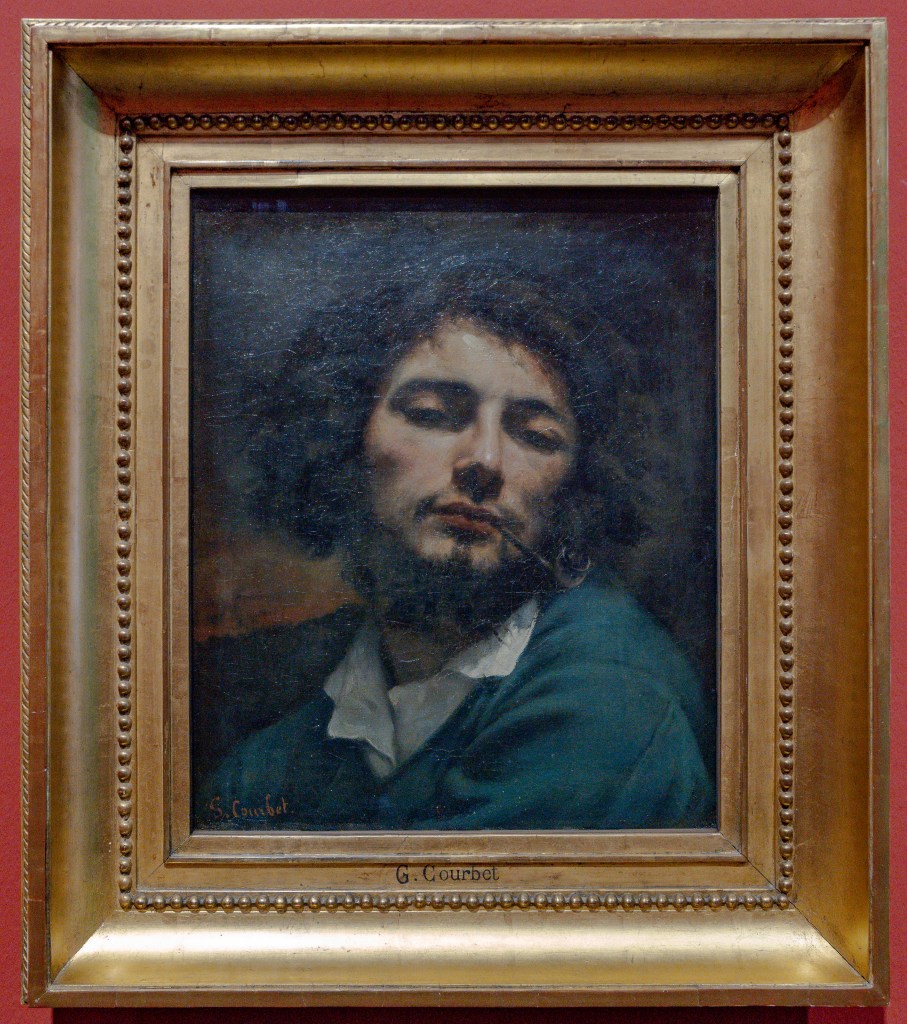
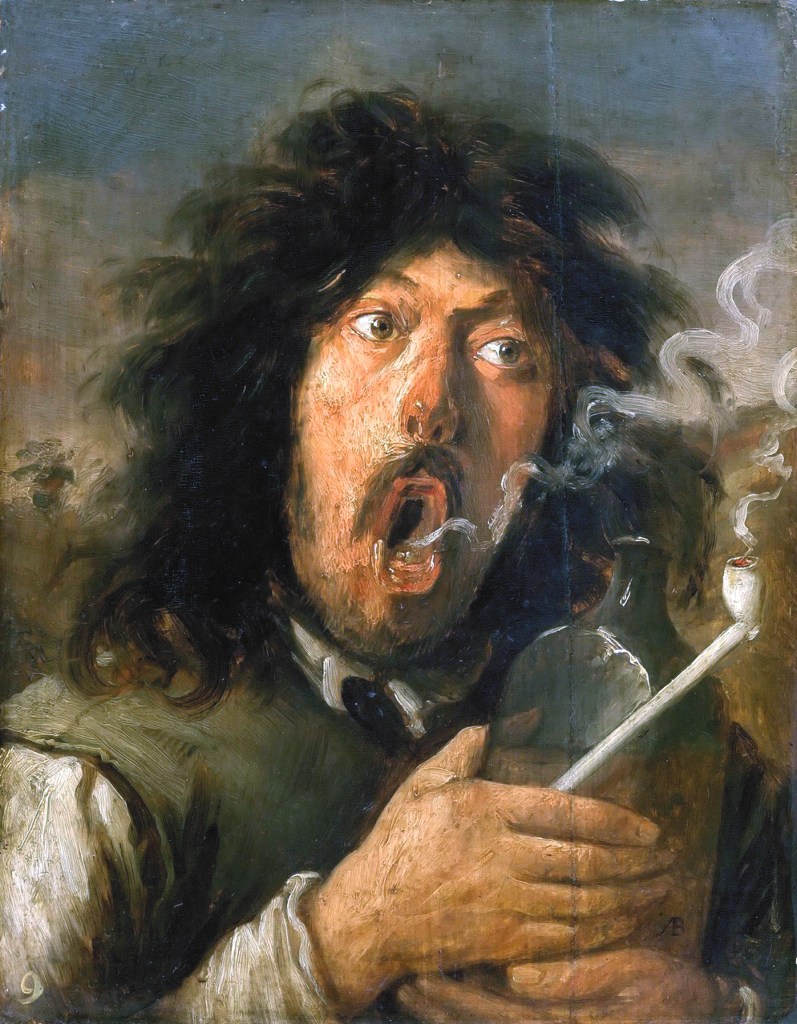
The portrait reflects Courbet’s growing engagement with seventeenth-century Dutch and Flemish painting. Hélène Toussaint proposed a comparison with The Smoker, a painting formerly attributed to Adriaen Brouwer and now assigned to Joos van Craesbeeck, which entered the Louvre through the La Caze bequest in 1869. In both works, the smoker’s face emerges from surrounding darkness, while the pipe contributes to an image of informal, almost provocative self-presentation. Such paintings belonged to a tradition in which ordinary subjects, including smokers and drinkers, offered opportunities for the observation of character and the display of painterly skill. Courbet had visited Amsterdam and The Hague in 1846, studying the paintings available in their collections, and his acquaintance with northern art was consequently founded upon direct experience as well as works he could examine in Paris. The resemblance to Craesbeeck’s painting is compelling, although there is no evidence that Courbet consciously adopted this particular composition.
The handling of The Man with a Pipe contributes considerably to its character. Deep shadows obscure the eyes and establish the broad structure of the face, while warmer passages of flesh colour define the cheeks, lips and nose. Callen draws attention to the restricted palette, in which the blue-green of Courbet’s jacket forms a subdued contrast with the more luminous flesh tones and the red of his lips. The surface conveys a sense of physical presence without the pronounced gestures and sharply differentiated areas of illumination found in some of his earlier self-portraits.
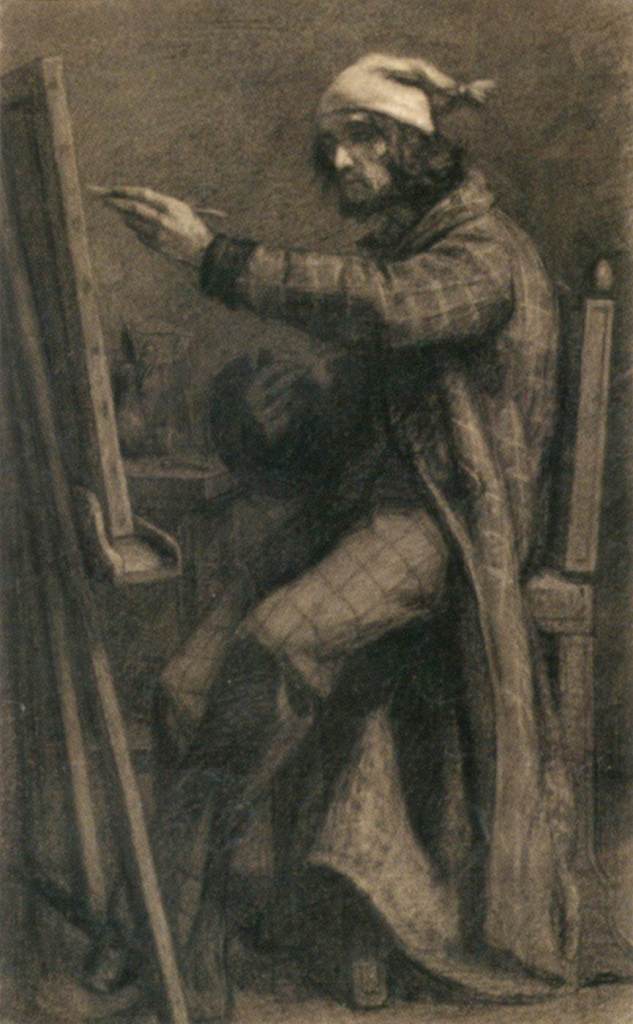
Yet the apparent spontaneity of the portrait conceals a process of revision. X-radiographic examination revealed that Courbet originally represented himself wearing a cap that restrained his abundant hair. In the finished painting, the cap has disappeared and the hair spreads around his face, becoming one of its most conspicuous features. The alteration changes the character of the image, directing attention away from a recognisable item of clothing and towards the painter’s physical appearance. A related drawing, The Artist Seated at His Easel, now in the collection of the Harvard Art Museums, shows Courbet wearing a cap and provides an instructive comparison. Although the technical examination establishes that the painted composition was altered, it does not determine whether the changes were made during a single period of work or after a longer interval.
Théophile Silvestre described Courbet as a dreamer seemingly absorbed in the smoke rising from his pipe. The painter’s heavy eyelids, relaxed mouth and slightly inclined head lend the portrait a contemplative, almost languid character, although the strongly modelled face and its proximity to the viewer give the figure considerable presence. As discussed in Part One, Courbet offered a rather different interpretation in a letter to Alfred Bruyas in May 1854, describing himself as a fanatic and an ascetic, disillusioned with his education and determined to discover principles of his own. The discrepancy between this forceful declaration and the apparent detachment of the painted figure is revealing, although the letter was written several years after the portrait’s execution, when Courbet’s artistic convictions and public reputation had developed considerably.
The precise date of The Man with a Pipe remains uncertain. Although Courbet later assigned it to 1846 and claimed that it had been rejected at the Salons of 1846 and 1847, the surviving exhibition records establish its appearance at the Salon of 1850–51. Most scholars favour a date around 1848–49, partly on stylistic grounds and because of the more mature appearance of the artist. The earlier composition revealed by X-radiography leaves open the possibility that Courbet returned to an existing portrait, although there is no firm evidence for a prolonged interval between its successive states.
Its appearance at the Salon of 1850–51 provoked an interesting response from Théophile Gautier. Courbet had attracted attention for paintings that challenged conventional expectations of beauty and artistic finish, yet Gautier observed that the painter had treated his own appearance with a degree of idealisation absent from some of his other subjects. He admired the execution but remarked upon the discrepancy between Courbet’s treatment of himself and the more uncompromising representations of ordinary people for which he was becoming known. The criticism was pointed, since it questioned whether the artist applied his principles with equal rigour to every subject. Yet it also draws attention to an important feature of the painting. The abundant hair, carefully modelled lips and dreamy expression contribute to an image whose apparent informality is accompanied by an evident concern for the sitter’s attractiveness. Courbet’s cultivated independence did not exclude an interest in presenting himself favourably.
The painting acquired a further significance through its association with Alfred Bruyas, who purchased it in 1854. Courbet welcomed the acquisition, writing to the collector with evident satisfaction that the portrait had found a sympathetic owner. He also claimed to have refused an offer from Louis-Napoléon Bonaparte, who had supposedly wished to acquire the painting. The claim also suggests how much importance Courbet attached to the circumstances of its ownership. Bruyas’s support was founded upon a shared interest in artistic independence, and the purchase represented both an expression of personal confidence and a practical commitment to the painter’s career. Courbet regarded the portrait as having a significance that extended beyond the likeness of its subject, and he was evidently pleased that Bruyas recognised something of his own convictions in the image.
The portrait’s subsequent popularity was considerable. Courbet received requests for replicas and copies, although he expressed impatience with the idea of exploiting the demand simply for commercial reward. In correspondence with Jules Laurens, he suggested that he could have become wealthy by producing the portraits of himself with a pipe for which collectors were willing to pay substantial sums, but that doing so would have compromised his artistic ambitions. His later letters also demonstrate a continuing attachment to the image. In 1873 he referred to a copy of The Man with a Pipe that remained in his possession, considering it more accomplished than the original. These remarks reveal a painter who recognised the commercial appeal of his likeness while remaining determined to control the circumstances of its reproduction. They also demonstrate the importance that this apparently informal self-portrait retained for him long after its original execution.
The Wounded Man (1844–54)
In The Wounded Man (L’Homme blessé), now in the Musée d’Orsay, Paris, Courbet represents himself lying beneath a tree, his eyes closed and his body apparently overcome by a serious injury. A dark stain of blood marks his white shirt, while a sword lies beside him. His posture suggests sleep as much as death, an ambiguity that contributes to the painting’s emotional character. The figure is presented in the aftermath of violence, his body seemingly abandoned to the stillness of the surrounding landscape. Courbet has transformed his own likeness into that of a wounded Romantic hero, concentrating attention upon the vulnerability and physical beauty of the reclining figure.
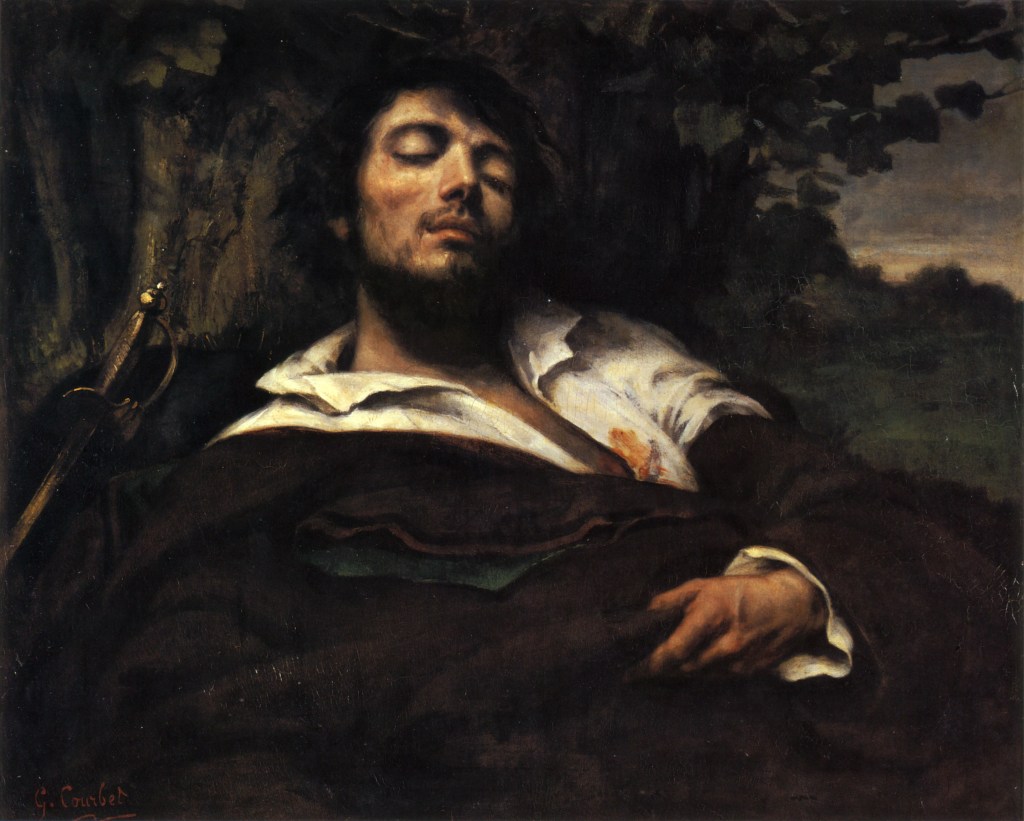
As discussed in Part One, X-radiographic examination revealed two earlier compositions beneath the surviving painting. The first contained the profile of a woman whose identity remains uncertain. In the second, Courbet represented himself embracing a young woman, her face resting against his shoulder. This composition bears a close resemblance to the charcoal drawing Country Siesta, now in the Musée des Beaux-Arts, Besançon. In both, the reclining artist is accompanied by a woman whose closeness transforms the scene into an image of intimacy and repose. In the final revision, Courbet removed the female companion, retained much of the reclining figure’s position and introduced the wound and sword. The transformation is remarkable. A composition originally conceived around the physical closeness of two lovers became an image of solitude and suffering, with the position of the artist’s body providing a visible connection between the successive subjects.
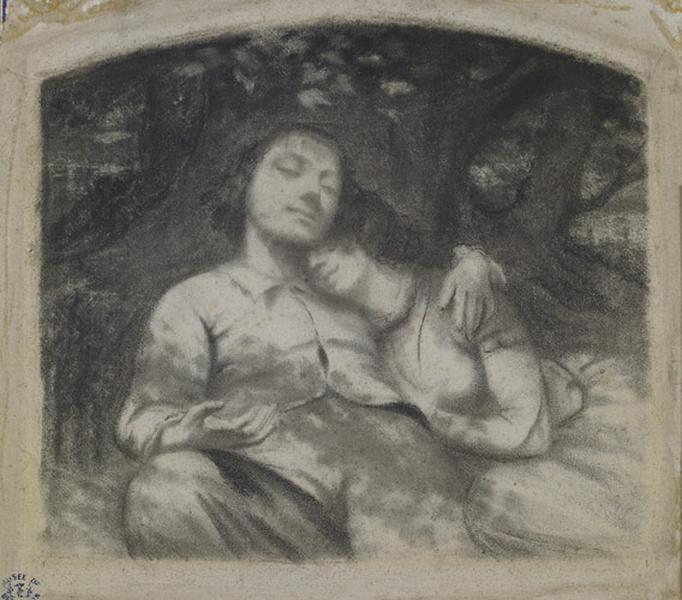
The relationship between Country Siesta and the concealed painting has prompted differing interpretations. Marie-Thérèse de Forges favoured an early date for the drawing, around 1840–44, while Hélène Toussaint suggested that it might have been made considerably later, perhaps when Courbet was preparing to alter the painted composition around 1854. On this reading, the drawing could have served as a record of the earlier image before it disappeared beneath the final version. Callen questioned the later dating, finding the drawing less accomplished than Courbet’s work of the early 1850s and placing it before 1849. It might therefore have been an independent exploration of the subject or a study for the composition subsequently painted over.
The transformation of The Wounded Man has often been connected with Courbet’s relationship with Virginie Binet, who bore him a son in 1847. Their separation, probably in 1852, was followed by Binet’s marriage to another man, and Courbet’s correspondence reveals the distress he experienced. In a letter to Champfleury in 1854, he described himself as deeply saddened and embittered, referring to the loss of the woman with whom he had shared many years and to their child. Toussaint interpreted the alteration of the painting in this context, suggesting that Courbet replaced the representation of a happy relationship with an image expressing the emotional consequences of its collapse. The Grand Palais catalogue similarly proposed a date around 1854 for the final transformation. The correspondence offers a persuasive biographical context for the change, especially given the remarkable contrast between the embracing couple and the solitary wounded figure.
The painting’s emotional character also belongs to a wider Romantic tradition in which disappointed love and the suffering of the individual were expressed through images of injury, exile and death. The Metropolitan Museum catalogue draws attention to literary treatments of duelling and unhappy love, including works by Émile de Girardin and Alfred de Musset. The sword beside Courbet’s body introduces the possibility of a duel, a familiar episode in Romantic literature in which questions of honour, jealousy and passionate attachment could culminate in violence. Yet the painting shows neither an adversary nor the conflict itself. Courbet presents a solitary figure whose injury suggests a story without revealing its circumstances. The drama resides in the wounded body, its abandonment and the contrast between the implied violence and the tranquillity of the setting.
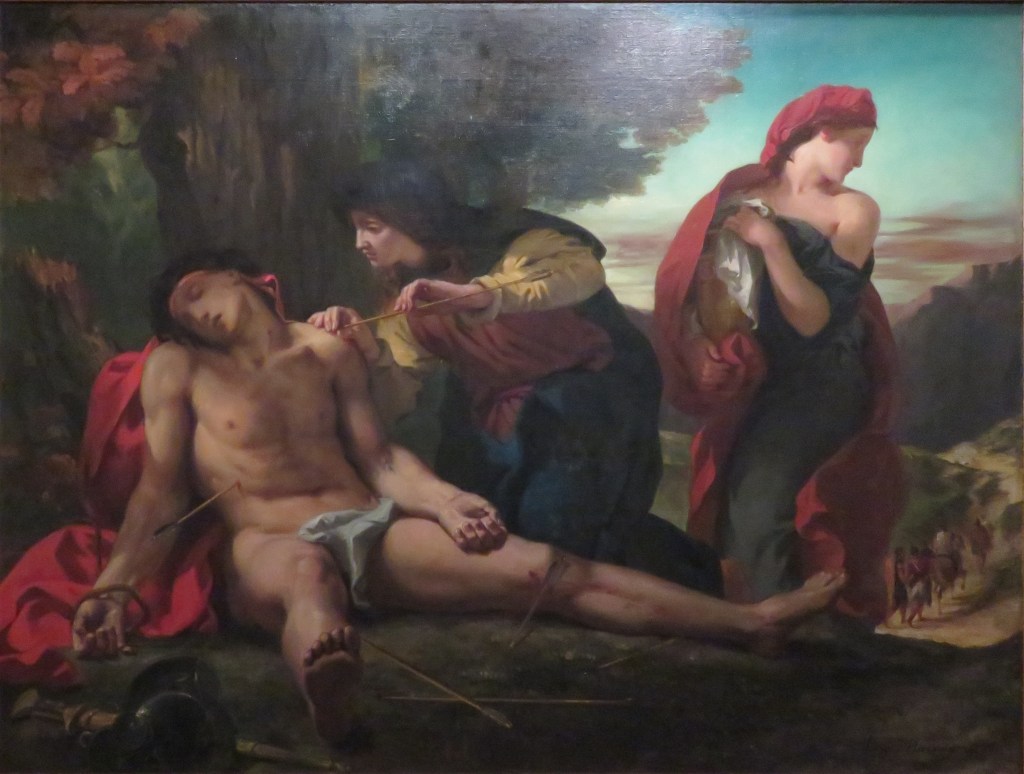
The imagery of suffering also recalls religious painting, especially representations of Saint Sebastian. Des Cars draws attention to the expressive position of the hands and the apparent abandonment of Courbet’s body, comparing the painting with Eugène Delacroix’s Saint Sebastian Tended by the Holy Women (1836). In Delacroix’s composition, the wounded martyr’s physical vulnerability is invested with tenderness and emotional dignity. Courbet draws upon this pictorial tradition to give the private drama of the wounded lover something of the pathos associated with religious martyrdom. The transformation of the earlier composition is significant here: gestures and bodily attitudes originally belonging to a scene of intimacy acquire a different emotional resonance when the female companion disappears and the reclining figure becomes a victim of violence.
Des Cars also considers the relationship between suffering and beauty, drawing upon Courbet’s correspondence with Pierre-Joseph Proudhon. Although the wound and sword suggest a violent encounter, the reclining figure retains an almost sensual tranquillity. The contrast recalls the Romantic fascination with the beauty of the suffering or dying hero.
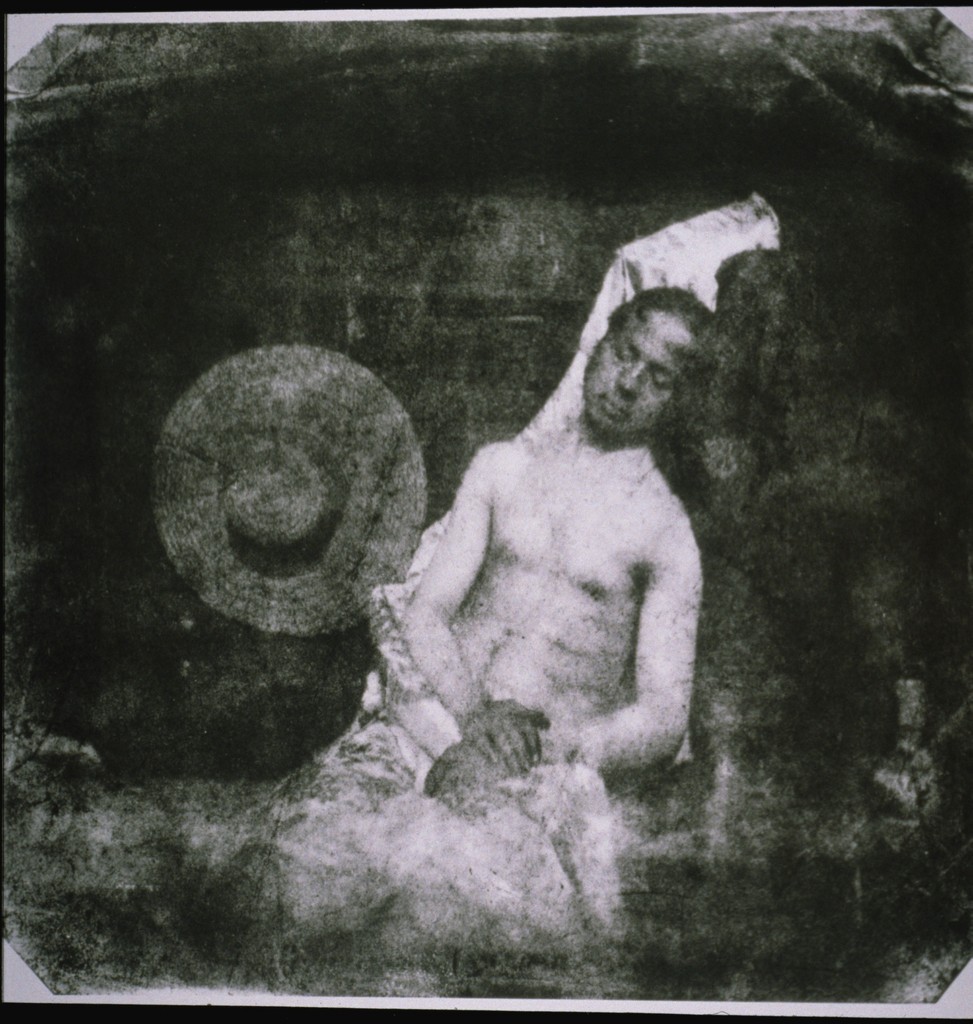
Des Cars introduces an illuminating comparison with Hippolyte Bayard’s Self-Portrait as a Drowned Man (1840), a staged photograph in which the inventor represented himself as a corpse following his failure to receive official recognition for his photographic process. Bayard accompanied the image with a sardonic account of his supposed death, transforming professional disappointment into an imaginary narrative of personal tragedy. The comparison places Courbet’s painting within a broader culture of artistic self-representation, in which the image of the suffering or apparently dead artist could convey experiences of frustration, rejection or loss. Bayard’s photograph employs an unmistakably satirical device, whereas Courbet gives his wounded figure a more lyrical and emotionally charged character.
Courbet retained The Wounded Man throughout his life and took it with him into exile in Switzerland. The final composition had been established by 1855, when the painting appeared at his independent exhibition in Paris. It was subsequently known by other titles, including The Duel and The Duellist, which emphasised the implied circumstances of the injury. The Grand Palais catalogue also records references to later repetitions of the composition, including one reportedly commissioned in 1865 and another associated with the period around 1870. Courbet’s decision to retain the original suggests that it held a special value for him, even as his circumstances and artistic interests changed over the following decades.
Self-Portrait (c. 1850)
Courbet’s Self-Portrait of around 1850, now in the Musée des Beaux-Arts et d’Archéologie, Besançon, differs markedly from the more theatrical images of his youth. He presents himself almost frontally, his face emerging from a dark background with little indication of the surrounding space. His expression is solemn, and the directness of his gaze gives the small painting considerable intensity. The dark clothing and subdued colouring contribute to an impression of austerity, while the sharply differentiated areas of light and shadow establish the structure of his features. Courbet has dispensed with the expressive gestures, elaborate costumes and narrative associations of his earlier self-portraits, concentrating almost entirely upon the appearance of his face.
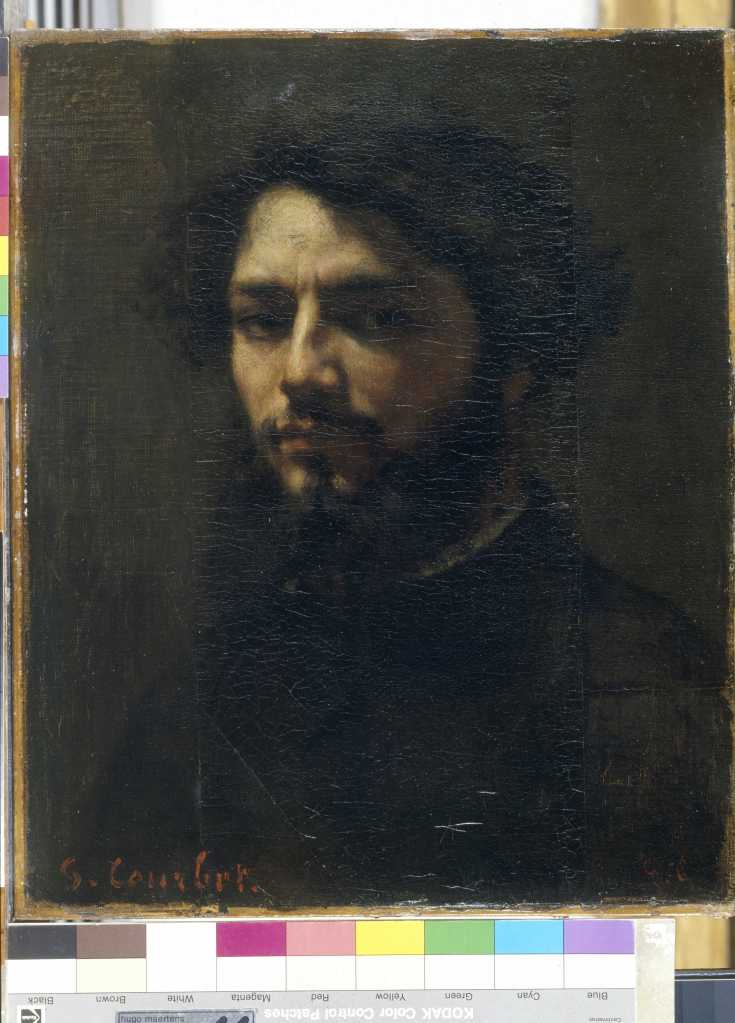
The painting nevertheless remains closely connected with his study of earlier European portraiture. Callen identifies the influence of Spanish painting, especially works Courbet could have encountered in Louis-Philippe’s Galerie Espagnole, displayed at the Louvre between 1838 and 1848. Its collection included paintings by Goya and Zurbarán, among many others. The dramatic contrasts of light and shadow, the grave expression and the uncompromising presentation of the sitter recall the austerity of Spanish portraiture. Des Cars also draws attention to affinities with Caravaggio. Yet the sombre expression retains something of the Byronic intensity familiar from Courbet’s earlier Romantic experiments. Callen finds a greater emotional restraint in the overall conception, despite the continuing drama of the lighting and the directness of the gaze.
The apparent simplicity of the portrait conceals an exceptionally complicated physical construction. Rather than painting on a single, continuous piece of canvas, Courbet worked with a support assembled from several sections joined together. The central strip contains the face, while additions on either side extend the composition to its present dimensions. The joins can still be detected, especially in the upper part of the painting, where the hair and background are less successfully integrated. Earlier technical accounts identified five sections, although Callen interprets the X-radiographic evidence as indicating four. There has also been disagreement about the presence of paper in the support. De Forges associated a central section with paper mounted on canvas, while des Cars distinguishes the assembled canvas from the paper used in relining the painting.
The construction raises the possibility that Courbet incorporated material from an earlier work. De Forges suggested that the central portion might have belonged to a larger composition, subsequently cut down and extended with additional pieces of canvas. Des Cars likewise considers the possibility that the face came from an earlier painting, now unidentified. X-radiography has also revealed a fragment of an unfinished copy after Jean-Auguste-Dominique Ingres’s Roger Delivering Angelica (1819), now in the Louvre, beneath the self-portrait. The underlying image belongs to Courbet’s study of earlier painting and may date from his first years in Paris, when he regularly copied works in the Louvre. The Besançon portrait thus provides another example of his reuse of painted material, although its assembled support makes the process more complicated than that encountered in The Man with the Leather Belt. The irregular construction is largely subordinated to the finished image, whose concentrated effect depends upon the force of Courbet’s expression.
The portrait was included in Courbet’s independent exhibition at the Pavillon du Réalisme in 1855, where its frontal presentation attracted the attention of the caricaturist Quillenbois. In a caricature published in L’Illustration, Quillenbois reduced Courbet’s likeness to a stark, isolated head emerging from a dark rectangular field. The caricature exploited the severity and directness of the original, qualities that made the painting readily recognisable even when its features were exaggerated or simplified. Courbet’s concentration upon his own face had produced an image capable of being transformed into a public caricature, an indication of how closely his appearance had become associated with his increasingly prominent artistic personality.
The painting remained in Courbet’s possession, and his correspondence suggests that he continued to value it. In 1865 he offered the portrait to the dealer Jules Luquet for 1,000 francs, describing it as a dark head on a canvas that had been divided and subsequently repaired. In the same correspondence, he suggested that the painting might be presented to the Uffizi in Florence for inclusion in its celebrated collection of artists’ self-portraits. The proposal was not realised, but it is revealing that Courbet considered this comparatively austere image an appropriate representation of himself within such a distinguished collection. By then he had produced many more ambitious paintings and had become one of the most controversial artists in France, yet he returned to a portrait made during his formative years. The painting eventually passed to his sister Juliette Courbet, who presented it to the museum in Besançon in 1883.
Self-Portrait at Sainte-Pélagie (c. 1872–74)
Courbet’s Self-Portrait at Sainte-Pélagie, now in the Musée Gustave Courbet, Ornans, belongs to a period when his political activities had brought about a profound change in his circumstances. Following the suppression of the Paris Commune in 1871, Courbet was imprisoned, partly as a consequence of his disputed responsibility for the destruction of the Vendôme Column. On 2 September he was sentenced to six months’ imprisonment and a fine of 500 francs. After detention in several establishments, he was transferred to Sainte-Pélagie in Paris on 22 September. The portrait recalls this experience, presenting the artist seated beside a barred window, dressed in dark civilian clothes with a red scarf around his neck. A pipe rests against his lips. The composition is quiet and restrained, its atmosphere far removed from the dramatic emotional displays of his youthful self-portraits.
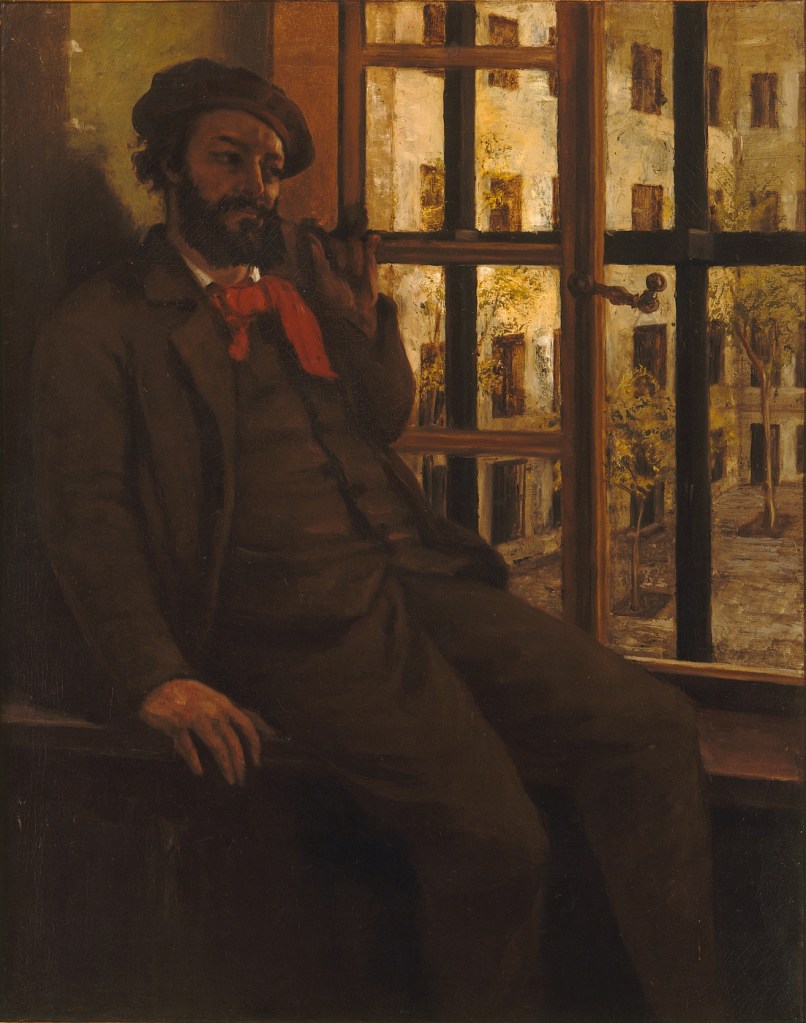
The conditions of Courbet’s imprisonment provide an important context for the painting. The Grand Palais catalogue records that he occupied cell number four at Sainte-Pélagie, overlooking the Cour de la Dette. Its obstructed window left the room poorly illuminated, and Courbet complained about the absence of sunlight. Although he received certain privileges, including a private cell, opportunities for exercise and food brought from outside, he resented being treated as an ordinary criminal rather than a political prisoner. In a letter to the critic Jules-Antoine Castagnary, he protested that the Communards were being held among common-law offenders, an arrangement he regarded as a deliberate humiliation.
The date of the painting remains uncertain. Its subject has encouraged an association with Courbet’s imprisonment in 1871, but Des Cars argues that it was probably executed after his release, perhaps in 1872 or 1873. Courbet had been permitted to resume painting towards the end of his sentence, when he was staying at a clinic in Neuilly, and another possibility is that he completed the picture after returning to Franche-Comté. Marie-Thérèse de Forges proposed a still later date, during his exile at La Tour-de-Peilz in Switzerland. The Grand Palais catalogue likewise favoured a date in 1873–74. The portrait may therefore represent Courbet looking back upon his confinement from circumstances already altered by the consequences of his conviction.
The contrast between the artist’s actual appearance and his painted likeness is striking. Contemporary descriptions of Courbet at his trial emphasised the physical deterioration brought about by his arrest and imprisonment. Witnesses remarked upon his weight loss, his grey hair and beard, and the exhaustion evident in his face. Photographs taken during his subsequent exile show a markedly aged figure. Yet in the self-portrait Courbet appears considerably younger, his dark hair and beard recalling the familiar features of his earlier paintings. As Hélène Toussaint observed, the weight he had lost contributed to this youthful impression, but the absence of grey hair represents a further alteration. Courbet seems to have returned to an established conception of his appearance, presenting himself with a composure and physical vitality at odds with contemporary accounts of his condition.
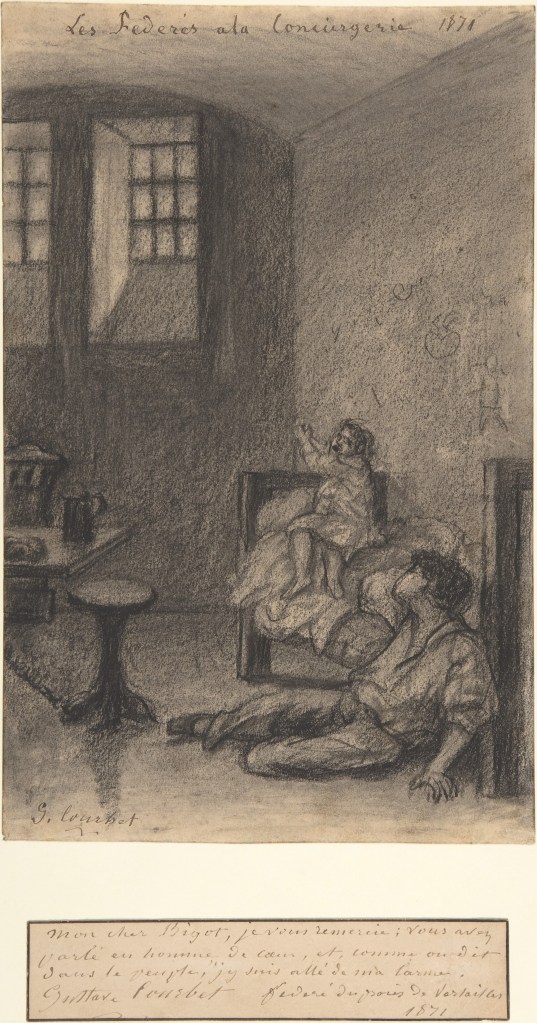
The contrast becomes more revealing when the painting is considered alongside the drawings Courbet made during his detention at the Conciergerie in Paris and the Orangerie at Versailles. These record the experience of imprisonment with a directness and distress largely absent from the later self-portrait. The Grand Palais catalogue draws attention to the difference between the drawings’ troubled atmosphere and the comparatively tranquil character of the painting. The latter retains the recognisable setting of confinement while modifying its emotional expression. The seated figure is reflective rather than visibly distressed, and the composition offers a degree of order and repose. Linda Nochlin has described its almost idyllic quality, an observation that gains force from the harsher images Courbet produced closer to the events themselves.
Several elements connect the portrait with Courbet’s earlier representations of himself. The pipe had long been associated with his bohemian identity and his cultivated independence, appearing prominently in The Man with a Pipe of around 1848–49. Here, however, the familiar accessory contributes to a different impression. The artist is neither confronting the spectator nor displaying the self-assurance of the earlier portrait. His gaze turns towards the window, directing attention beyond the confined space in which he sits. The familiar gesture of smoking is retained, but the figure’s subdued attitude gives it a more reflective and melancholy character.
The red scarf introduces a further association. Des Cars regards it as the painting’s clearest political statement, its colour recalling Courbet’s republican commitments and his involvement with the Commune. Against the dark clothing and restrained colouring of the room, the scarf is a conspicuous detail. Its presence also complicates the apparent tranquillity of the portrait. Courbet’s political convictions remained inseparable from the events that had brought him to Sainte-Pélagie, even as the painting presents those events through a quiet and reflective image. The contrast between the muted setting and the small assertion of colour allows political identity to remain present without dominating the composition.
Des Cars introduces an illuminating historical comparison with Jacques-Louis David’s Self-Portrait of 1794, painted during his imprisonment following the fall of Robespierre. Like Courbet, David had been imprisoned for his involvement in revolutionary politics. Both painters presented themselves with a composure that contrasts with the circumstances of their imprisonment, while their portraits also give them a more youthful appearance. David’s example offers a historical parallel for Courbet’s decision to represent imprisonment without allowing its physical hardships to determine the character of his likeness.
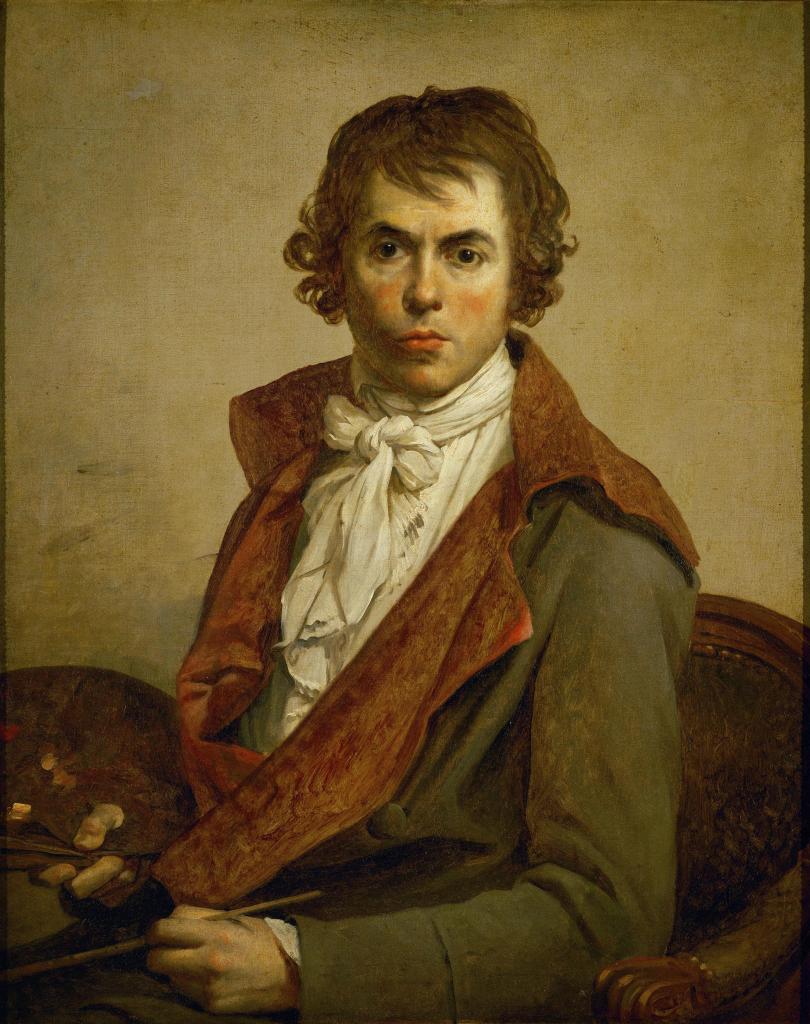
The painting remained in the possession of Courbet’s sister Juliette, who presented it to the town of Ornans in 1882, together with his Château de Chillon. In a letter accompanying the donation, she stated that both works had been made by her brother for her. The prison self-portrait was therefore intended, at least in its completed form, for someone within Courbet’s family rather than for immediate public exhibition. This private destination offers a possible context for the painting’s restrained presentation, but tells us little about Courbet’s reasons for depicting his imprisonment in such tranquil terms.
Donate to Inner Surfaces here.
Bibliography
Callen, Anthea, Courbet (London: Jupiter Books, 1980).
Cernuschi, Claude, ‘The Self-Portraits of Gustave Courbet’, in Jeffery Howe (ed.), Courbet: Mapping Realism (Chestnut Hill, MA: McMullen Museum of Art, Boston College, 2013), pp. 31–58.
Chu, Petra ten-Doesschate, The Most Arrogant Man in France: Gustave Courbet and the Nineteenth-Century Media Culture (Princeton: Princeton University Press, 2007).
Courbet Reconsidered, exhibition catalogue, Brooklyn Museum (New Haven and London: Yale University Press, 1988).
Des Cars, Laurence, ‘Inventing Courbet: The Early Self-Portraits’, in Gustave Courbet, exhibition catalogue, Metropolitan Museum of Art (Ostfildern: Hatje Cantz, 2008).
Gustave Courbet 1819–1877, exhibition catalogue, Galeries nationales du Grand Palais, Paris (Paris: Éditions des Musées Nationaux, 1977).
Gustave Courbet, exhibition catalogue, Metropolitan Museum of Art, New York (Ostfildern: Hatje Cantz, 2008).
Güdel, Niklaus Manuel, and Hans-Peter Wipplinger (eds), Gustave Courbet, exhibition catalogue, Leopold Museum, Vienna, and Museum Folkwang, Essen (Cologne: Walther König, 2026).
Lewis, Mary Tompkins, ‘Courbet, Cézanne and the Studio as Stage’, Société Paul Cézanne, 30 October 2013.
Marchal, Stephanie, ‘From Bildungsroman to Mask: Gustave Courbet’s Self-Portraits’, in Niklaus Manuel Güdel and Hans-Peter Wipplinger (eds), Gustave Courbet (Cologne: Walther König, 2026), pp. 98–100.
Nochlin, Linda, ‘Gustave Courbet’s Meeting: A Portrait of the Artist as a Wandering Jew’, The Art Bulletin, 49, no. 3 (September 1967), pp. 209–222.
Nochlin, Linda, Courbet (London: Thames & Hudson, 2007).
O’Regan, Eve-Anne, Art, Advertising and Modernism: The Transfiguration of the Artist in the Age of Capitalism, PhD thesis, University of Western Australia, 2012.
Riat, Georges, Gustave Courbet, peintre (Paris: H. Floury, 1906).

