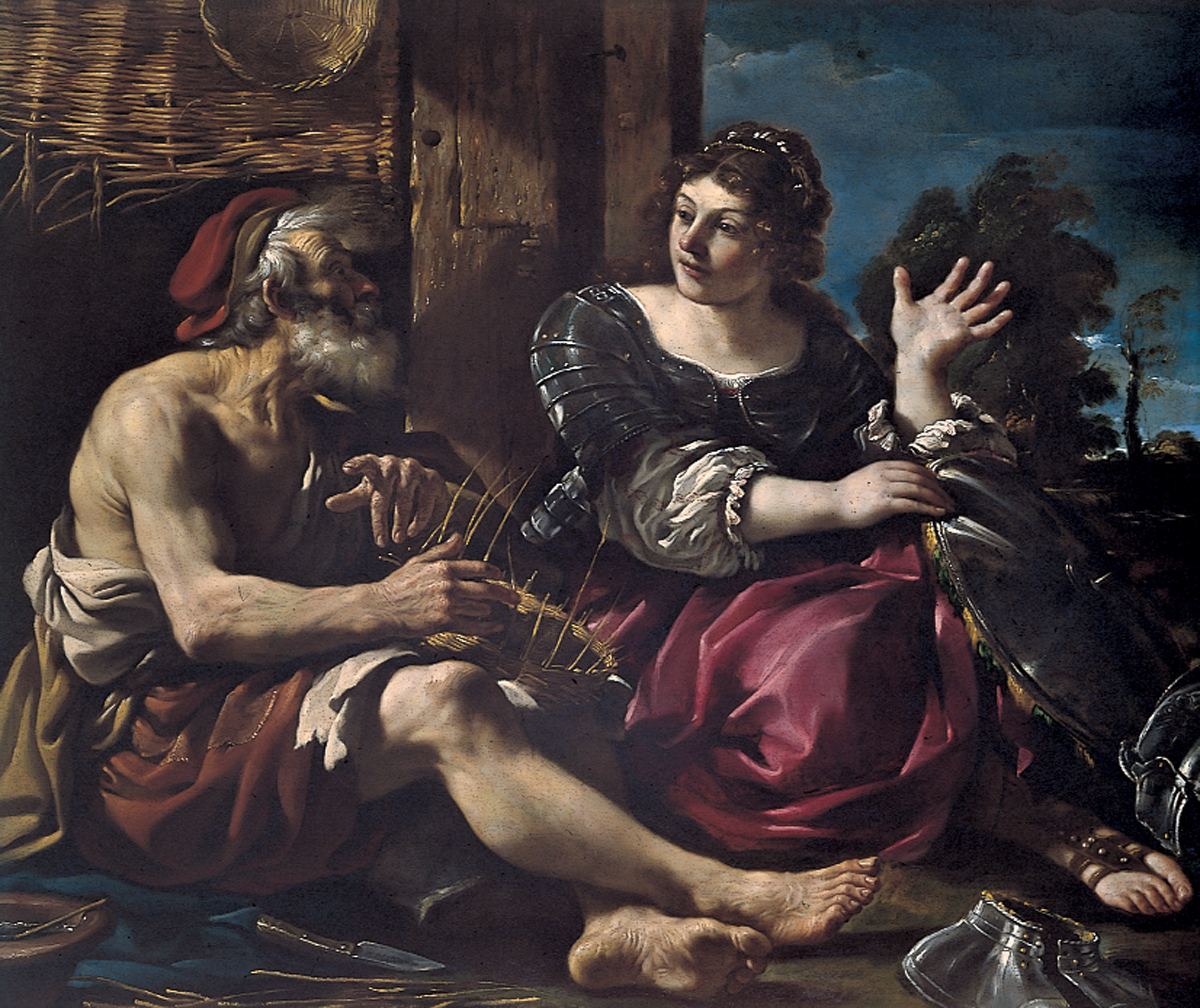
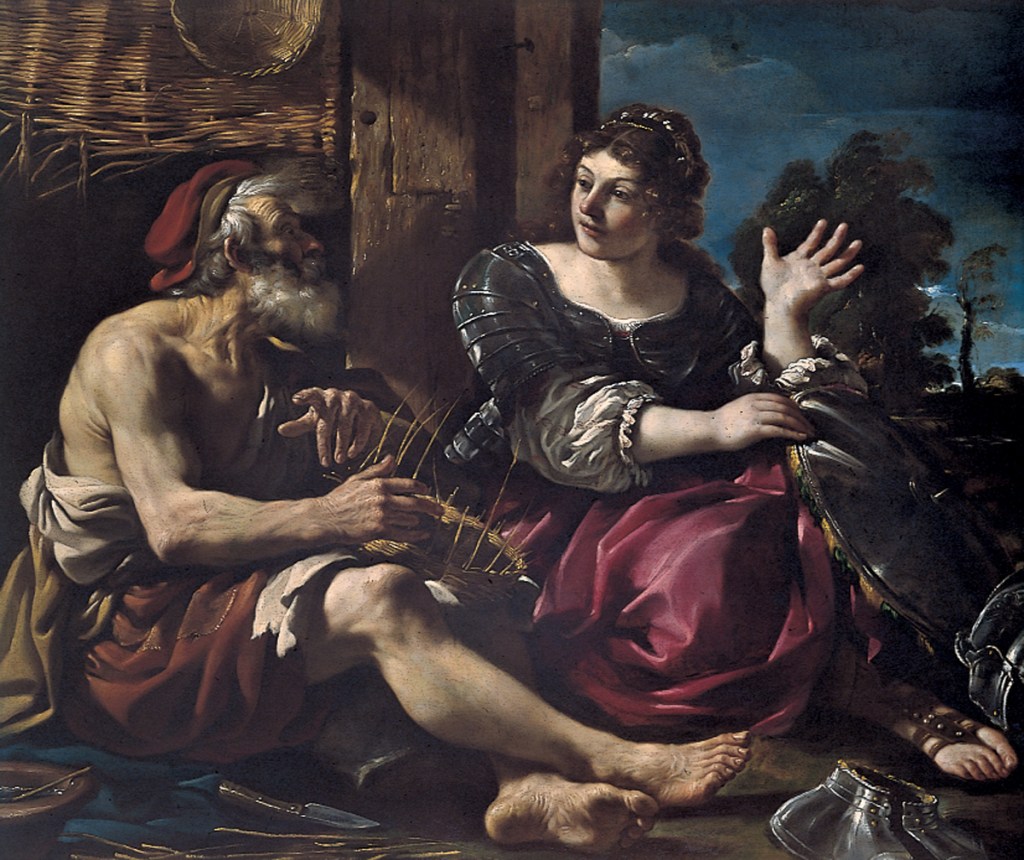
Painted around 1619–20, Guercino’s Erminia and the Shepherd, now in Birmingham Museum and Art Gallery, belongs to the years in which the young artist was establishing a reputation beyond his native Cento. Its subject comes from Torquato Tasso’s Gerusalemme liberata, but Guercino’s treatment is far from a straightforward illustration of the poem. The close grouping of the figures, their expressive gestures and the concentration of the action within a restricted space give the painting an immediacy that distinguishes much of his early work. Nearly thirty years later, he returned to the same episode in a composition that reveals how much his approach to narrative painting had changed.
In the seventh canto of Tasso’s epic, Erminia, a Saracen princess in love with the Christian knight Tancred, has ventured beyond the walls of Jerusalem disguised in armour. Pursued by soldiers, she escapes into the countryside, where she meets an elderly shepherd engaged in weaving baskets. He lives peacefully with his family, removed from the ambitions and violence that govern the wider world. Their meeting introduces a pastoral interlude into the poem, contrasting the disturbances of war and courtly life with the simplicity of rural existence.
The painting was commissioned by Ferdinando Gonzaga, Duke of Mantua, following an episode that gives some indication of Guercino’s growing reputation. In 1619 Lorenzo Gennari presented the Duke with a booklet of engravings by Oliviero Gatti after Guercino’s anatomical drawings. The publication, intended to assist students in the art of drawing, carried a dedication to Gonzaga. Gennari returned with a request for a painting a suo capriccio — of the artist’s own choosing. Guercino selected the meeting between Erminia and the shepherd.
The circumstances of the commission were reconstructed by Denis Mahon, who corrected a misleading implication in Carlo Cesare Malvasia’s Felsina pittrice (1678) that the painting had been delivered in 1618. Correspondence establishes that its subject and dimensions were still undecided in September 1619, and Mahon concluded that it was probably completed in 1620. According to Malvasia, Guercino personally delivered the work to Mantua, where he spent fifteen days and received 200 scudi. The Duke was sufficiently pleased to confer a knighthood upon him. David M. Stone adds that during his visit Guercino admired paintings by Caravaggio, Domenico Fetti and Rubens in the Gonzaga collection. Although this occurred after the completion of Erminia and the Shepherd, it gave him an opportunity to study the work of three important contemporaries.
Guercino presents the meeting as an intimate exchange between two figures who occupy almost the entire foreground. The elderly shepherd, seated with his basket-making materials, gestures as he speaks, while Erminia turns towards him attentively. Her elaborate costume and discarded armour establish her identity and social standing, in contrast to the shepherd’s bare limbs and simple clothing. The figures are closely brought together, with little intervening space, and the surrounding setting remains subordinate to their interaction. Strong contrasts of light and shadow give their forms a substantial physical presence.
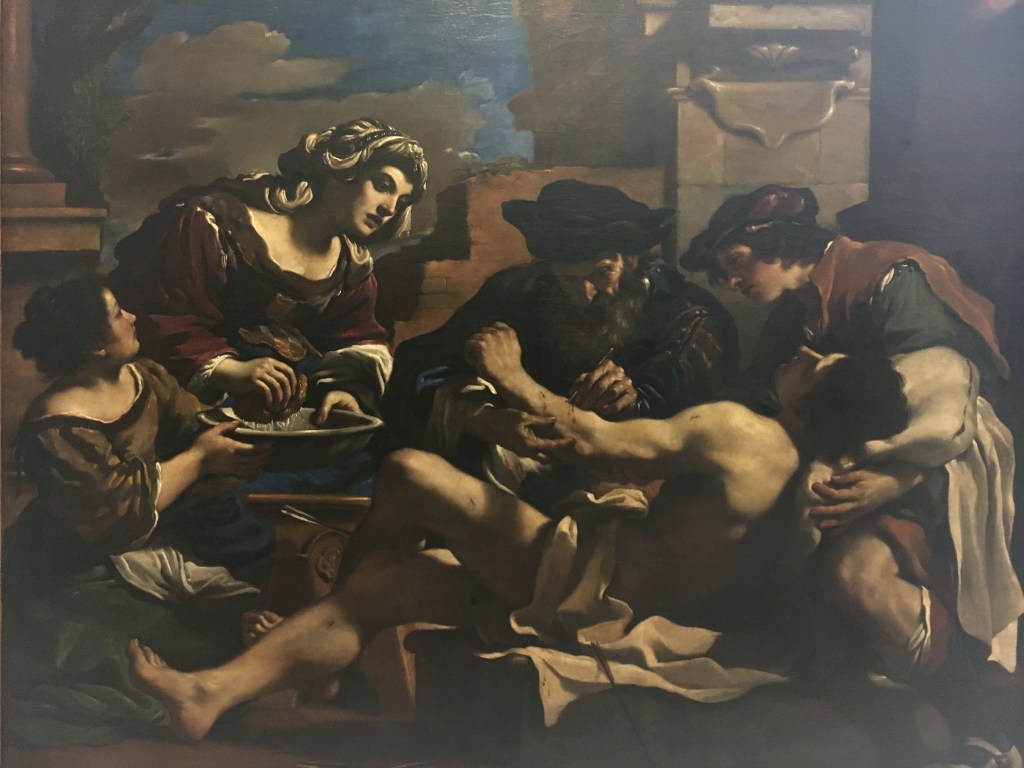
Mahon admired the directness of this presentation, regarding its natural observation and intimate rustic character as fundamental to Guercino’s artistic sensibility rather than simply an inheritance from Caravaggio. An instructive comparison can be made with the approximately contemporary Saint Sebastian Tended by Saint Irene (1619), in the Pinacoteca Nazionale di Bologna. There, too, Guercino concentrates the figures within a shallow foreground space, organising them through overlapping forms, bodily movement and expressive gestures. The close framing brings the action towards the picture plane, giving it a forceful immediacy for the spectator. Although the emotional circumstances are very different, both paintings demonstrate how Guercino could use a restricted pictorial space to intensify the relationships between his figures.
The treatment of Tasso’s episode raises a further question about the relationship between literary narrative and pictorial invention. Sybille Ebert-Schifferer has observed how Guercino skilfully combines elements from different stages of the poem. The shepherd’s gesture towards his sons, who remain outside the composition, recalls his description of their peaceful existence, while Erminia’s attentive response evokes a subsequent moment in their conversation. By bringing these elements together, Guercino captures the spirit of two passages in a single, convincing scene. The shepherd’s outward gesture also suggests a world extending beyond the tightly framed composition.
A preparatory drawing for Erminia, now in the Royal Collection at Windsor Castle, offers a further insight into Guercino’s construction of the picture. Executed in red chalk, with some stumping, it is an elaborate study of the whole figure, with differences from the finished painting. Nicholas Turner and Carol Plazzotta, in Drawings by Guercino from British Collections (1991), draw attention to the modelling of the figure, particularly the richly textured shadow behind her right shoulder and the suggestion of light falling across her skirts. They note that such carefully finished studies of entire figures are relatively rare in Guercino’s surviving drawings.
The drawing has an additional interest because Guercino subsequently returned to the figure’s pose in studies associated with two Roman commissions: Aurora, painted on the ceiling of the Casino Ludovisi in 1621, and Saint Chrysogonus, executed for San Crisogono in 1622. The Windsor sheet thus provides evidence not only of the preparation of the Birmingham painting but also of the artist’s continuing engagement with a figure invention that he could adapt to different subjects.
In 1648 Guercino returned to Erminia’s meeting with the shepherd in a much larger composition, now in the Minneapolis Institute of Art. The painting emerged from a complicated commission involving the Sicilian collector Don Antonio Ruffo and Cardinal Fabrizio Savelli, who saw the unfinished work in Guercino’s studio and insisted upon acquiring it. Guercino was consequently obliged to produce a second version for Ruffo, with payments for both paintings recorded in January 1649. Mahon considered the Minneapolis picture more likely to be the version supplied to Ruffo, partly on grounds of provenance. An eighteenth-century engraving by Guglielmo Morghen associates the composition with a Neapolitan collector, and paintings from Ruffo’s collection are known to have passed to Naples. Although this evidence does not establish an uninterrupted history of ownership, it lends support to Mahon’s identification. The version acquired by Savelli has not been securely traced.
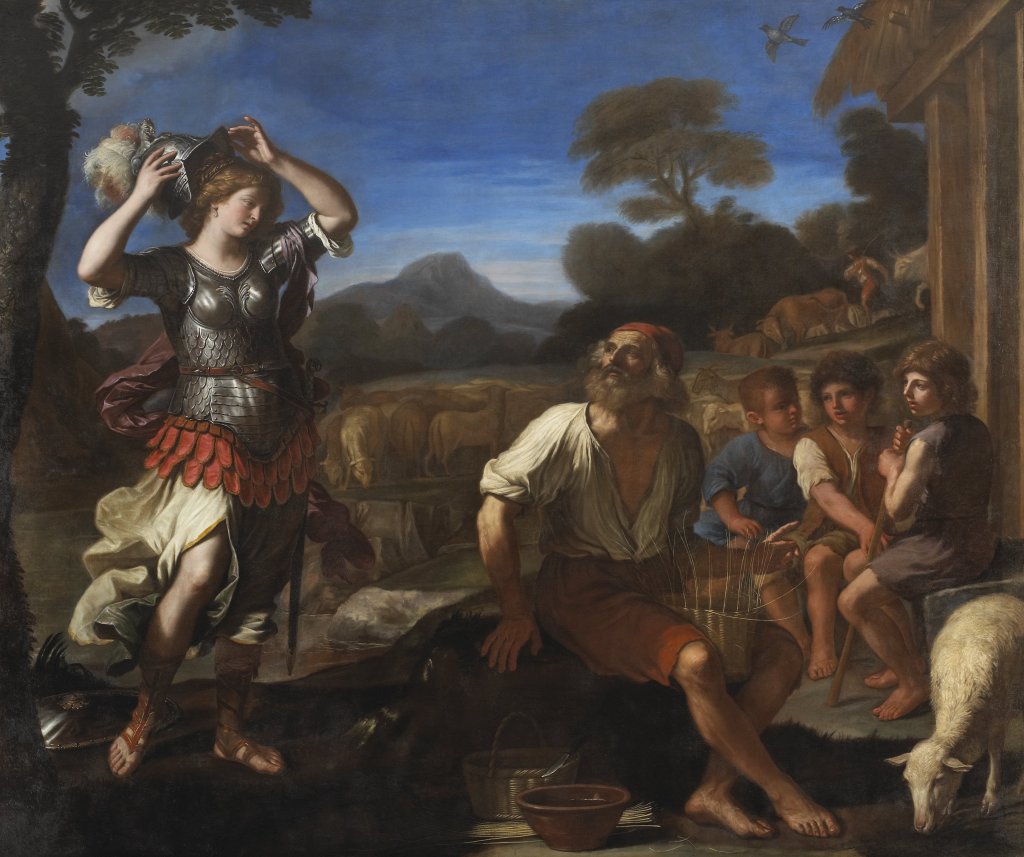
The difference between the early and late treatments is considerable. The Minneapolis composition unfolds across a broad landscape, with the shepherd’s children included in the scene and Erminia shown in a more explicitly narrative arrangement. The figures are more idealised, their relationships carefully balanced and the incident presented at a more measured pace. Rensselaer W. Lee, in his essay ‘Erminia in Minneapolis’ (1967), regarded the Birmingham picture as the more direct and convincing interpretation of Tasso, while acknowledging the greater fidelity of the later painting to the literary episode. Mahon broadly accepted this distinction, although he suggested that the later work’s more formal presentation owed something to the conventions of theatrical narrative, particularly dramma per musica.
Ebert-Schifferer approached the comparison through a wider consideration of Guercino’s narrative structure. In her interpretation, the change involved not simply a movement from naturalism towards idealisation, but a different conception of how painted figures communicate a story. As we noted earlier, the Birmingham painting brings together successive elements of Tasso’s narrative in a scene whose meaning is conveyed through gesture and response, inviting the spectator to complete the action imaginatively. The later version presents the narrative in a more complete and carefully ordered setting, requiring less imaginative participation from the viewer. The two paintings consequently offer more than a contrast between Guercino’s youthful and mature styles. They reveal different ways of translating a literary subject into pictorial form.
Donate to Inner Surfaces here.
Bibliography
Ebert-Schifferer, Sybille, ‘Reflections on Guercino’s Narrative Structure’, in Guercino: Master Painter of the Baroque, 1991.
Lee, Rensselaer W., ‘Erminia in Minneapolis’, in Studies in Criticism and Aesthetics: Essays in Honor of Samuel Holt Monk, Minneapolis, 1967, pp. 36–57.
Mahon, Denis, with contributions by Andrea Emiliani, Diane De Grazia and Sybille Ebert-Schifferer, Guercino: Master Painter of the Baroque, 1991, catalogue nos. 20 and 45.
Stone, David M., Guercino: Catalogo completo dei dipinti, catalogue nos. 51, 59 and 239.
Turner, Nicholas, and Carol Plazzotta, Drawings by Guercino from British Collections, London, 1991, catalogue no. 22.
Guercino in Britain, London, National Gallery, 1991, catalogue no. 6.

