Introduction
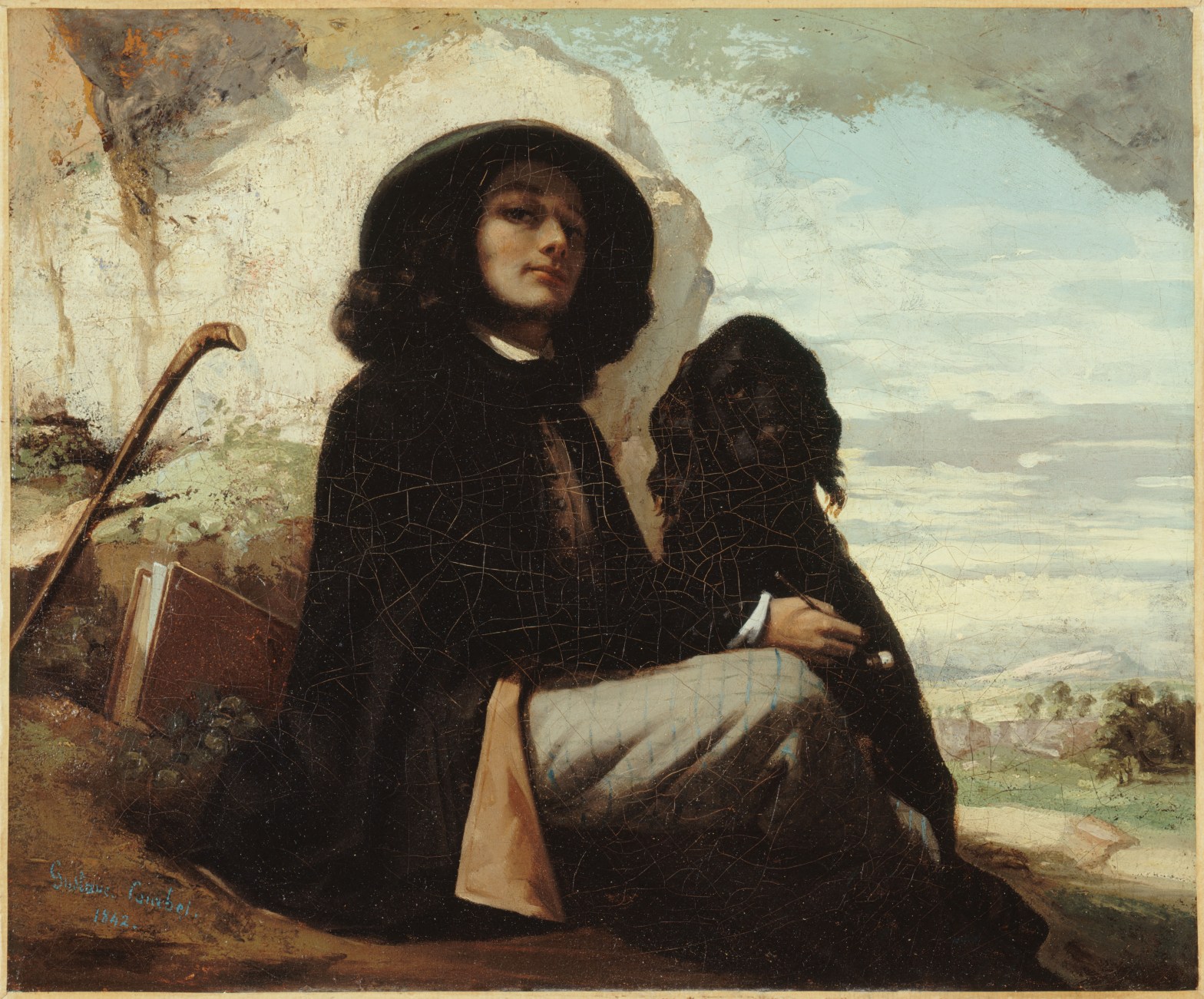
During the 1840s, Gustave Courbet produced a remarkable series of self-portraits in which he assumed a succession of different identities. He represented himself as a young man of fashionable appearance, a romantic lover, a sculptor, a musician and a figure overcome by fear or despair. These paintings differ considerably in their handling, composition and expressive character. Some recall the portraiture of earlier European masters, while others draw upon the theatrical and literary conventions of Romanticism. Taken together, they reveal a young painter experimenting not only with the possibilities of his art but also with the ways in which he might present himself to the world.
Courbet’s interest in his own image extended beyond these early paintings. As his reputation developed, his likeness became an increasingly familiar presence in exhibitions, photography and the illustrated press. He was an artist acutely conscious of his appearance and of the impression he made upon others, but the image he cultivated was not always the image that his contemporaries accepted. His assertive personality, unconventional behaviour and increasingly public declarations about art made him a conspicuous figure, admired by some and ridiculed by others. To consider Courbet’s image, therefore, is to examine both the representations he fashioned for himself and the wider public identity that developed around them.
Artistic Formation and Experiment
Courbet’s early self-portraits belong to a period in which he was developing his abilities without pursuing a conventional academic course of training. Having moved from Ornans to Paris in 1839, he studied paintings in the Louvre and became familiar with a wide range of European traditions. Titian, Rembrandt, Frans Hals and the Spanish masters were among the artists whose work attracted his attention. Their influence can be traced in his treatment of the figure, his use of light and shadow, and his experiments with different forms of portraiture. The extent of this engagement is confirmed by technical investigations revealing that Courbet sometimes painted his self-portraits over earlier copies of Old Master works.
These exercises took place within a culture still strongly influenced by Romanticism. The young Courbet encountered its conventions through painting, literature and the bohemian circles of Paris, where artistic ambition was often expressed through extravagant behaviour and cultivated appearances. His self-portraits reflect this environment, sometimes adopting historical costumes or dramatic gestures associated with literary and theatrical characters. Yet their variety also suggests a willingness to test competing approaches to painting. The artist who would later challenge established conventions of subject matter and artistic authority began by examining the expressive resources of traditions already available to him.
The changing identities assumed in these paintings gave Courbet considerable freedom to experiment with expression and composition. In The Sculptor (1845), he appears in historical costume, holding the tools of his imagined profession. The Cellist (1847) presents another imagined role, with possible associations to George Sand’s novel Consuelo. Elsewhere, Courbet explored more extreme emotional states. In The Desperate Man, he confronts the viewer with an expression of alarm, his hands raised to his hair, while The Man Mad with Fear places a distressed figure at the edge of a precipice. Such works drew upon established conventions of expressive imagery, but Courbet adapted them to the representation of his own features.
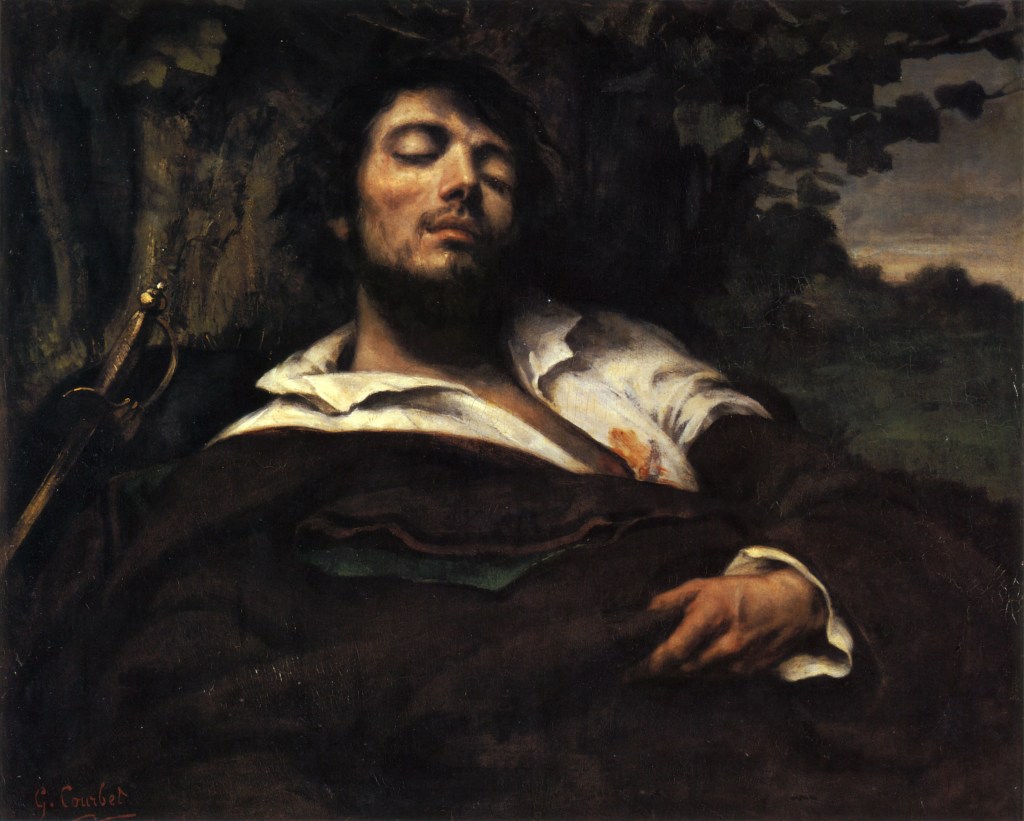
The Wounded Man offers a more intriguing example of Courbet’s self-representation. The painting underwent several transformations, as X-radiographic examination has revealed. An earlier composition included a woman embracing the artist, while the finished painting presents him alone, apparently wounded and suffering. The changes have been associated with the breakdown of his relationship with Virginie Binet, although the precise chronology remains uncertain. The technical evidence establishes the successive alterations to the painting; their autobiographical significance is a matter of interpretation.
Autobiography and Self-Presentation
In May 1854, Courbet wrote to his patron Alfred Bruyas about the self-portraits he had produced during the preceding decade. As his attitudes had changed, so too had his representations of himself; taken together, he suggested, they amounted to an autobiography. His description of The Man with a Pipe, which Bruyas acquired that year, is revealing. Courbet presented the figure as a man who had become disillusioned with his education and was seeking principles of his own. The painting, completed several years earlier, now served to explain the independence of thought and artistic conviction that Courbet wished to establish as the basis of his career. His account was therefore retrospective: he was giving the self-portraits a place within the story of his artistic development, rather than necessarily describing the intentions with which each had originally been painted.
The variety of these self-portraits also makes it difficult to regard them simply as records of successive states of mind. Laurence des Cars has drawn attention to the influence of contemporary literature, whose familiar characters and situations offered Courbet a repertoire of identities. Claude Cernuschi takes this argument further, questioning whether the apparent emotional intensity of the paintings provides reliable access to the artist’s private experience. Courbet’s circumstances undoubtedly informed some of his representations, but their meaning also depended upon the conventions he employed and the audience he hoped to reach. In adopting the roles of the suffering lover, the misunderstood genius or the independent bohemian, he could draw upon recognisable ideas about the artist while developing his own conception of artistic identity.
Ambition and Public Recognition
Courbet’s concern with his image developed alongside an intense ambition for professional recognition. In 1845, he declared his intention to establish a reputation in Paris within five years, insisting that he wanted everything or nothing. His determination was accompanied by a difficult relationship with the Salon, whose approval remained essential to an artist seeking a public career. The acceptance of Self-Portrait with Black Dog in 1844 marked his first success there, but subsequent rejections reinforced his hostility towards an institution upon which he nevertheless depended. His position improved considerably in 1849, when After Dinner at Ornans received a medal and was purchased by the French state. Recognition had begun to arrive, although Courbet’s increasingly ambitious paintings would continue to provoke controversy.
As Stephanie Marchal has observed, Courbet’s repeated use of his own likeness also had a practical significance within the competitive exhibition culture of nineteenth-century Paris. Between 1843 and 1851, his Salon submissions regularly included representations of himself, helping to establish an identity that audiences and critics could recognise. His growing reputation depended not only upon the paintings themselves but also upon the attention they attracted. Courbet’s resistance to conventional artistic authority reinforced his reputation for independence, even as his paintings attracted controversy. Claude Cernuschi has drawn attention to the tension within this position: the artist who cultivated an image of defiance was also acutely conscious of the recognition he sought from the public and the artistic establishment. Opposition and success were not entirely separate elements of Courbet’s career; both contributed to the identity he was establishing.
The Artist and His Public Image
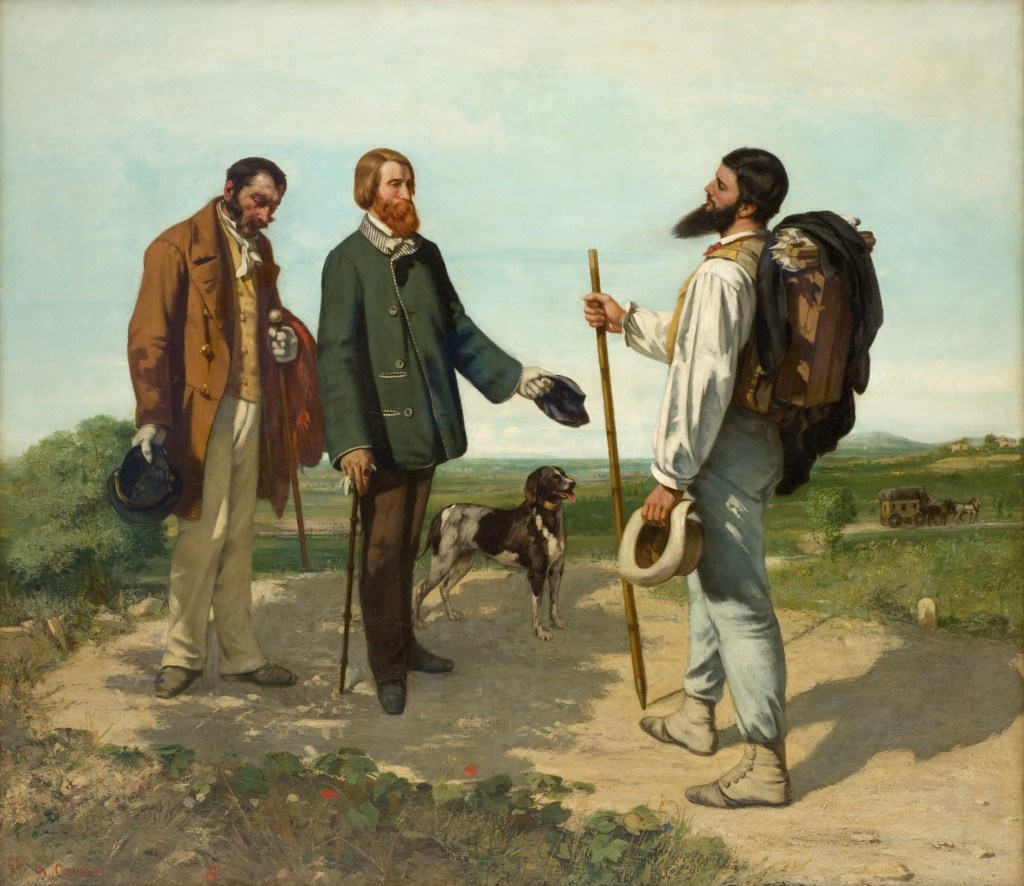
In The Meeting (1854), Courbet presented his encounter with Alfred Bruyas near Montpellier as a declaration of artistic independence. The painter, travelling on foot with his equipment, stands before his wealthy patron and the latter’s servant, whose respectful gestures seem to acknowledge his authority. The scene has the appearance of an informal meeting on a country road, but its composition was carefully devised. Linda Nochlin identified a popular print depicting the Wandering Jew as an important source, suggesting that Courbet had adapted an image associated with independence, movement and the transmission of ideas. Her interpretation places the painting within a wider nineteenth-century culture in which the travelling figure could embody a challenge to established social conventions. The relationship between Courbet and Bruyas was, however, more complex than a confrontation between an independent artist and a deferential patron. Bruyas provided substantial practical and financial support, and their correspondence reveals a friendship grounded in shared artistic convictions.
Courbet extended his representation of the artist’s place in society in The Painter’s Studio (1855), subtitled A Real Allegory Summing Up a Seven-Year Phase of My Artistic Life. At the centre of the immense composition he depicts himself painting a landscape, surrounded by figures drawn from different aspects of his experience. Friends and supporters occupy one side of the studio, while the other contains figures associated with contemporary society and its difficulties. The painting brings together the artist’s personal history, his social relationships and his conception of Realism within an arrangement that is openly symbolic. Its appearance at Courbet’s independent exhibition of 1855, organised after the rejection of several of his works from the Exposition Universelle, also made the circumstances of its display part of his assertion of artistic independence.
Photography, Publicity and Caricature
By the later 1850s, Courbet’s appearance had become familiar beyond the circle of those who encountered his paintings. Photography offered new opportunities to circulate his likeness, and he collaborated with photographers in producing portraits that continued the self-presentation of his earlier work. His distinctive beard, abundant hair and habitual pipe made him readily recognisable, while the illustrated press transformed these features into the attributes of a public personality. As Laurence des Cars has observed, Courbet became one of the most caricatured artists of his generation. His own efforts to establish a memorable identity had helped supply the material through which others could celebrate or ridicule him.
The distinction between Courbet’s intentions and his public reception became increasingly important. Critics and caricaturists could reduce his artistic principles to personal eccentricities, just as Courbet could use controversy to reinforce his reputation for independence. His refusal of the Légion d’honneur in 1870 illustrates the interaction between conviction and publicity. Opposed to accepting an honour from the Second Empire, he made his refusal public through the newspapers, ensuring that his decision became widely known. The publicity surrounding such actions reinforced his reputation as an uncompromising artist, but it would be reductive to regard his political and artistic convictions merely as devices for attracting attention.
The Later Image
Courbet’s involvement in the Paris Commune of 1871 brought consequences that profoundly altered his circumstances. Following its suppression, he was arrested and imprisoned, spending several months at Sainte-Pélagie. His later Self-Portrait at Sainte-Pélagie, generally dated to the early 1870s, presents a striking contrast between the artist’s confinement and the composure of his appearance. Seated beside a barred window, wearing civilian clothes and a red cravat, Courbet appears younger than contemporary evidence suggests he actually looked. The familiar pipe remains, recalling the assured bohemian of his earlier self-portraits. Yet the prison drawings made during his confinement convey a much harsher experience than the comparatively tranquil painted image.
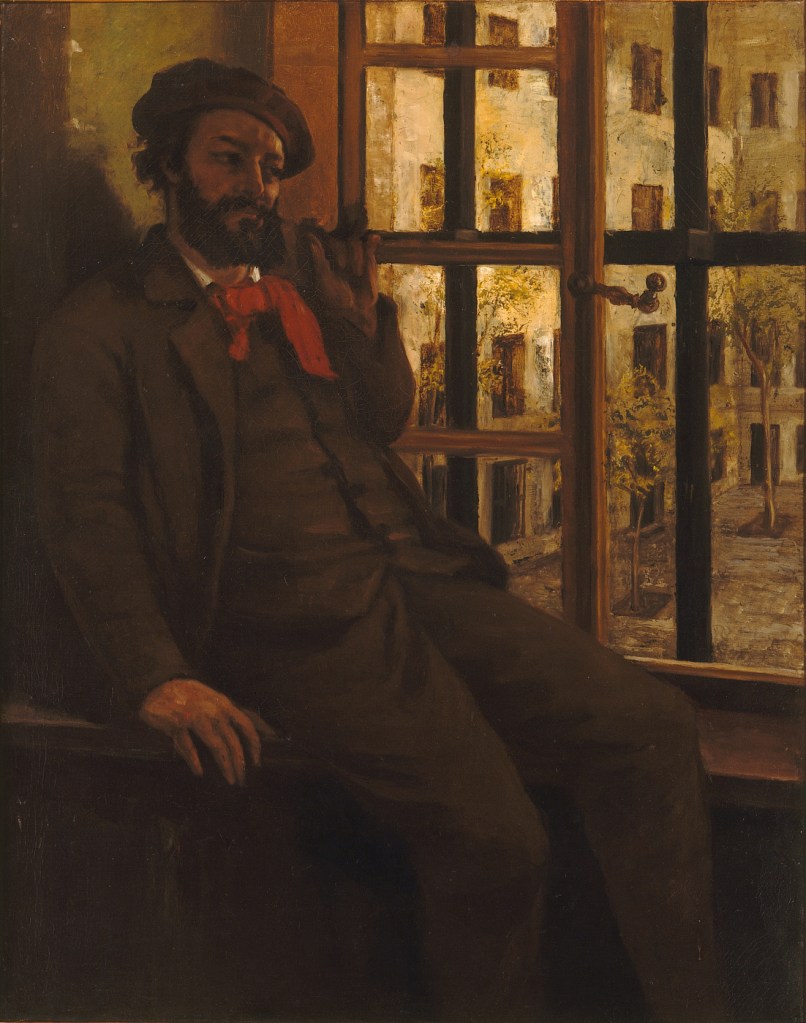
Linda Nochlin has drawn attention to the almost idyllic character of the prison portrait, interpreting its subdued atmosphere in relation to Courbet’s changed circumstances. The painting does not attempt to document the physical and emotional hardships of imprisonment, although these are evident in his correspondence. Nor does it present the defiant theatricality of his youthful self-representations. Courbet instead depicts himself as a dignified, reflective figure, retaining familiar attributes of his identity despite the restrictions imposed upon him. The circumstances in which the portrait was painted remain uncertain, but its distance from the immediate experience of imprisonment is significant. Even at this difficult stage of his career, Courbet continued to determine how he would appear in his own paintings, while events beyond the studio had dramatically altered the public meaning of his image.
Donate to Inner Surfaces here.
Bibliography
The following bibliography covers the present essay and the related studies of Courbet’s self-portraits.
Callen, Anthea, Courbet (London: Jupiter Books, 1980).
Cernuschi, Claude, ‘The Self-Portraits of Gustave Courbet’, in Jeffery Howe (ed.), Courbet: Mapping Realism (Chestnut Hill, MA: McMullen Museum of Art, Boston College, 2013), pp. 31–58.
Chu, Petra ten-Doesschate, The Most Arrogant Man in France: Gustave Courbet and the Nineteenth-Century Media Culture (Princeton: Princeton University Press, 2007).
Courbet Reconsidered, exhibition catalogue, Brooklyn Museum (New Haven and London: Yale University Press, 1988).
Des Cars, Laurence, ‘Inventing Courbet: The Early Self-Portraits’, in Gustave Courbet, exhibition catalogue, Metropolitan Museum of Art (Ostfildern: Hatje Cantz, 2008).
Gustave Courbet 1819–1877, exhibition catalogue, Galeries nationales du Grand Palais, Paris (Paris: Éditions des Musées Nationaux, 1977).
Gustave Courbet, exhibition catalogue, Metropolitan Museum of Art, New York (Ostfildern: Hatje Cantz, 2008).
Güdel, Niklaus Manuel, and Hans-Peter Wipplinger (eds), Gustave Courbet, exhibition catalogue, Leopold Museum, Vienna, and Museum Folkwang, Essen (Cologne: Walther König, 2026).
Marchal, Stephanie, ‘From Bildungsroman to Mask: Gustave Courbet’s Self-Portraits’, in Niklaus Manuel Güdel and Hans-Peter Wipplinger (eds), Gustave Courbet (Cologne: Walther König, 2026), pp. 98–100.
Nochlin, Linda, ‘Gustave Courbet’s Meeting: A Portrait of the Artist as a Wandering Jew’, The Art Bulletin, 49, no. 3 (September 1967), pp. 209–222.
Nochlin, Linda, Courbet (London: Thames & Hudson, 2007).
O’Regan, Eve-Anne, Art, Advertising and Modernism: The Transfiguration of the Artist in the Age of Capitalism, PhD thesis, University of Western Australia, 2012.

